It’s possible that I shall make an ass of myself. But in that case one can always get out of it with a little dialectic. I have, of course, so worded my proposition as to be right either way (K.Marx, Letter to F.Engels on the Indian Mutiny)
Tuesday, January 11, 2022
Climate disasters killed 688 people and cost the US more than $145 billion last year
asheffey@businessinsider.com (Ayelet Sheffey)
A bent stop sign in a storm damaged neighborhood after Hurricane Ida on September 4, 2021 in Grand Isle, Louisiana.
Sean Rayford/Getty Images
Climate disasters last year killed 688 people and cost the US more than $145 billion, a new government report found.
2021 was also the fourth-warmest year on record in the US, with December 2020 having been the warmest of all time.
The costs of the climate crisis bring urgency for Biden to mitigate the financial and physical risks.
The climate crisis ravaged the country last year, and it cost the US money and lives.
The National Oceanic and Atmospheric Administration released an overview of its annual report on Monday, and it found that fire, floods, hurricanes and other natural disasters cost the US $145 billion in losses while resulting in 688 deaths. According to the overview, there were 20 natural-disaster events with losses exceeding $1 billion each in 2021, with severe storm events having the most significant impact.
"Disaster costs over the last five years exceeded a record $742 billion, reflecting the increased exposure and vulnerability of the U.S. to extreme weather and climate events," the report said.
The report also found 2021 was the fourth-warmest year on record in the US, with December 2021 being the warmest December ever recorded. Overall, it marked the third-costliest year on record for climate disasters.
This is just the latest bit of bad climate news. Data continues to show the climate crisis is worsening. A Washington Post analysis last week found 40% of Americans were hit by climate disasters last year, with more than 80% of them experiencing heat waves, reflecting the warming climate. Even if the country acts on the crisis, the United Nations said in August some of global warming's effects would be "irreversible for centuries to millennia."
Amid these worsening conditions, President Joe Biden has taken steps to combat the warming climate. In October, he unveiled a report that focused on mitigating the risks the climate crisis has on Americans' savings and retirement funds, given the transition to clean energy could cause physical assets to lose their value.
He also proposed a $555 billion investment for the climate in his Build Back Better agenda. And although Senate Democrats tabled the agenda to focus on voting rights legislation, Sen. Joe Manchin — the centrist Democrat responsible for the delay — recently said climate "is one that we probably can come to an agreement much easier than anything else."
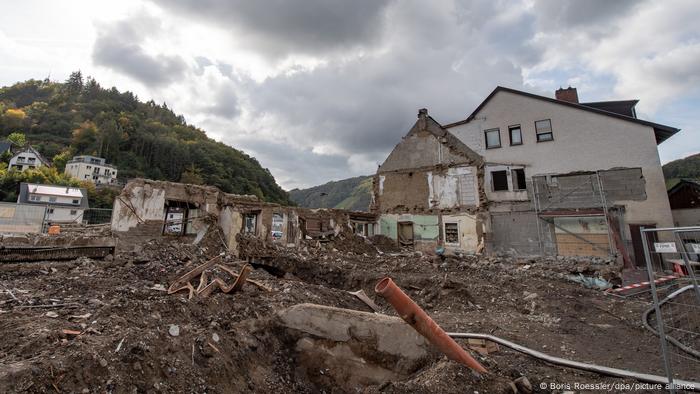
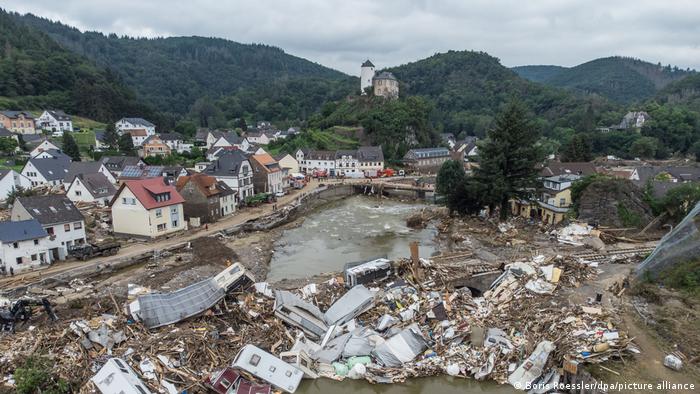
Natural disasters cost $280 billion in 2021: German insurance firm German reinsurance giant Munich Re has said that the climate crisis is behind the bulk of the costs. July's floods in western Europe were the second-costliest disaster of the year globally. Flooding in Germany's Ahr valley destroyed homes and businesses and killed some 200 people
German reinsurance giant Munich Re published a report on Monday indicating that the results of natural disasters cost $280 billion (€247 billion) globally in 2021, highlighting a trend expected to continue upward as climate changes takes it toll.
"Some of the extreme weather events are of the kind that are likely to become more frequent or more severe as a result of climate change," said scientific advisors for the company. "Among these are severe storms in the [United States], including in the winter half-year, or heavy rain followed by floods in Europe."
Where were the costliest natural disasters?
The report noted a high proportion of those costs incurred in the United States, which was battered by hurricanes, floods, and tornadoes in 2021.
Hurricane Ida was the costliest disaster around the world, incurring losses of $65 billion.
It estimated that some $145 billion in damages was incurred across the country, adding that "both overall and insured losses were significantly higher than in the two previous years." In 2019, the total was $52 billion overall.
IN PICTURES: DEADLY EXTREME WEATHER SHOCKS THE WORLD
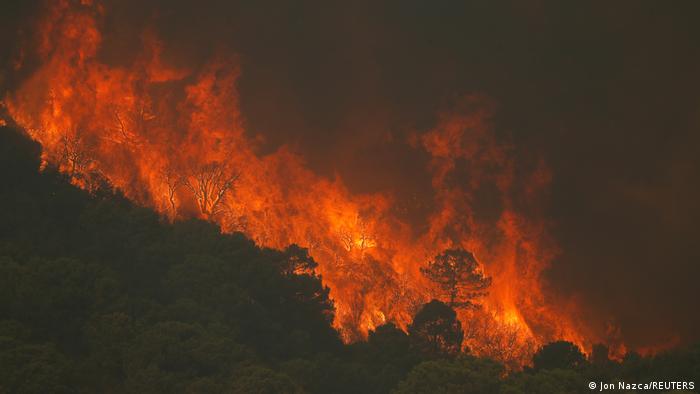
Rainfall best ally for Spanish firefighters
A wildfire that burned through at least 7,780 hectares (30 square miles) in about a week and devastated forests in southern Spain was brought under control thanks to steady rains. The downpour helped the firefighters, who were backed by some 50 aircrafts. The blaze was one of the most difficult to combat in recent times in Spain. Some 2,600 people were forced to flee their homes.
In Germany, the cost of devastating floods in July 2021 was estimated to be $40 billion, making it the most expensive natural disaster in Germany to date. Rainfall reached a level not seen in the country in a century.
"The deluge triggered flash floods that swept away countless buildings. There was also severe damage to infrastructure, such as railway lines, roads and bridges. More than 220 people were killed," the firm noted.
RETURNING HOME AFTER GERMANY'S DEADLY FLOODS
The devastation left by flooding
The water is slowly receding, but the disaster is far from over. In devastated riverside towns in Germany, people are only slowly working their way through dealing with what the flood has left behind: bulks of mud and piles of rubbish.
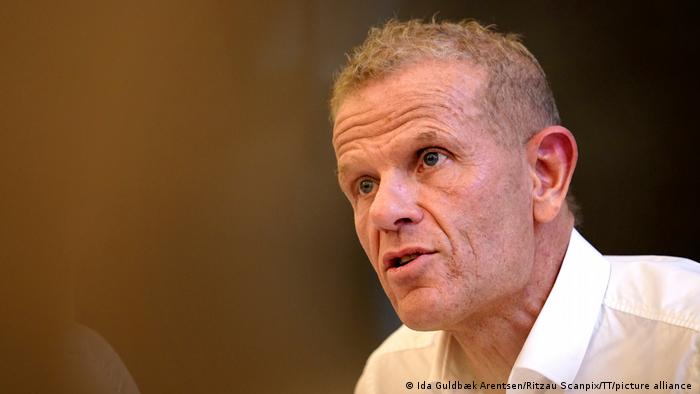
Danish spy chief detained over 'highly sensitive' leak
The head of Denmark’s defense intelligence service, Lars Findsen, has been placed in custody over the leak of highly classified information.
Findsen was suspended in 2020 in a possible case of illegal spying on Danish citizens, but was cleared
The chief of Denmark's Defense Intelligence Service (FE), Lars Findsen, has been held in custody for more than a month over an apparent leak, it was revealed on Monday.
Local media said the leak involved "highly sensitive" information. It follows allegations last year that Danish intelligence colluded with the US National Security Agency (NSA) to spy on European leaders and private Danish citizens. What do we know so far?
The news only emerged at a hearing behind closed doors at Copenhagen Magistrate's Court, when a publication ban was lifted. Findsen's name was revealed at his own request.
It emerged that four current and former employees of the two Danish intelligence services — foreign and domestic — had been detained for leaking highly sensitive information.
Findsen was the only one of them to remain in custody as the investigation proceeds.
"I want the charges brought forward and I plead not guilty. This is completely insane," Findsen told reporters at the hearing.
Public broadcaster DR cited unnamed sources as saying the case related to the leaking of classified information to Danish media outlets.
In 2020, DR reported that the FE had shared raw information cable data with the NSA. As a result, it said, the NSA may have had access to Danish citizens' personal data and private communications.
Authorities have published very little information on the investigation, which is being conducted behind closed doors. The exact charges and the content of the leaked information has not been made public.
It was unclear how long Findsen will be kept in custody, although he was said to have been already detained for more than a month. The Danish public prosecutor's office has declined to comment on the case.
Denmark has two intelligence agencies, the Police Intelligence Service (PET) and the FE, focusing respectively on domestic and foreign intelligence.
Findsen, 52, headed PET from 2002 to 2007 and the FE from 2015 to 2020, when he was suspended over an internal report. The document criticized a possible case of illegal spying on Danish citizens, although Findsen was recently cleared by a commission.
rc/rt (Reuters, dpa, EFE)
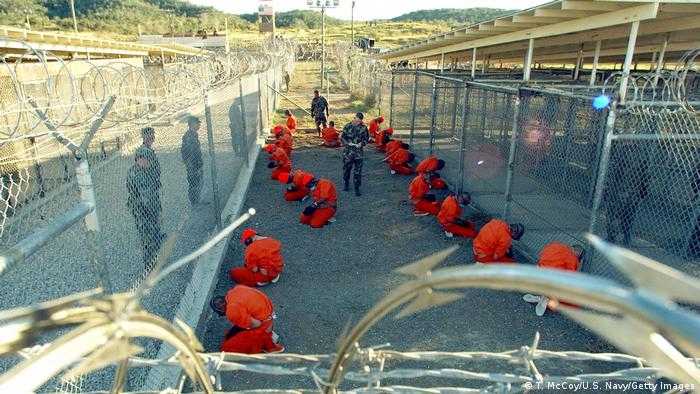
The 'forever prisoners' of Guantanamo
The notorious prison camp in Cuba is 20 years old. Over the years, several plans to close it have been rejected. For the detainees, little has changed in the last two decades. Oliver Sallet reports from Guantanamo Bay.
The Guantanamo detention camp opened in January 2002 and has been accused
of many human rights violations since (FILE)
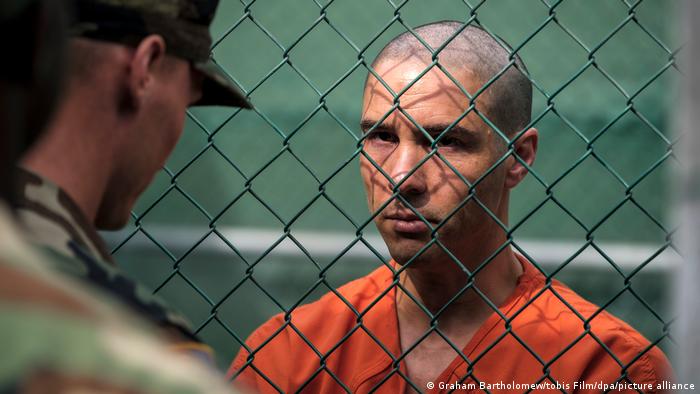
Mohamedou Ould Slahi spent 14 years behind bars. He was tortured for 70 days and interrogated for 18 hours a day for three years. He lived in Germany prior to his arrest and was suspected of being a high-ranking al-Qaeda operative involved in the September 11 attacks, although this was never proven.
He was never charged or convicted during his 14 years in Guantanamo. The Mauritanian, who is now 50, was eventually released — but was never compensated for his stolen life.
Defense attorney Nancy Hollander's most high-profile case continues to haunt her to this day. Slahi's story recently made it to the big screen as a motion picture. His crime was taking part in a terrorist training camp in Afghanistan and answering a phone call on Osama bin Laden's satellite phone. This of course does not cast him in the best light, his lawyer recalls, but it also was not enough to indict him.
His is a typical story in Guantanamo.
In the movie 'The Mauritanian', Mahamedou Ould Slahi is played by actor Tahar Rahim
Hollander says that Guantanamo illustrates that the US is a country that is "not one that respects the rule of law," labeling it a "disastrous situation."
This applies not only to the 13 detainees who are being held without charges and have been awaiting their release for years but also to alleged perpetrators of the September 11 attacks, the so-called "forever prisoners," who are also still awaiting trial 20 years after the attacks.
Legal system systematically suspended
This lack of rule of law was no accident but rather a goal of the US administration under President George W. Bush at the time, according to Amnesty International's Guantanamo expert Daphne Eviatar.
"The Bush administration set up an offshore prison specifically to get around the rules of the United States legal system," says Eviatar.
She denounced extensive human rights abuses at Guantanamo in an Amnesty report that documents the indefinite detention of detainees without charge, as well as the torturing of inmates. While there is no publically available proof to back this up, Eviatar did say that various investigations, including one by the US Senate Intelligence Committee, have already documented the brutal torture of dozens of men at Guantanamo.
Abd al-Rahim al-Nashiri, the suspected mastermind behind the bombing of the USS Cole in October 2000
The US Navy base at Guantanamo Bay, Cuba, has been in existence for more than 100 years. It was not until January 2002, a few months after the Sept. 11 attacks, that it was expanded into a detention center that has become notorious.
Anthony Natale, who is defending accused al-Qaeda operative Abd al-Rahim al-Nashiri in court, speaks candidly about his disappointment with Guantanamo: "We're ashamed that everything that made this country one that we could say was a free country, that had equal justice for all, has abandoned all of that."
Press censorship and strict secrecy
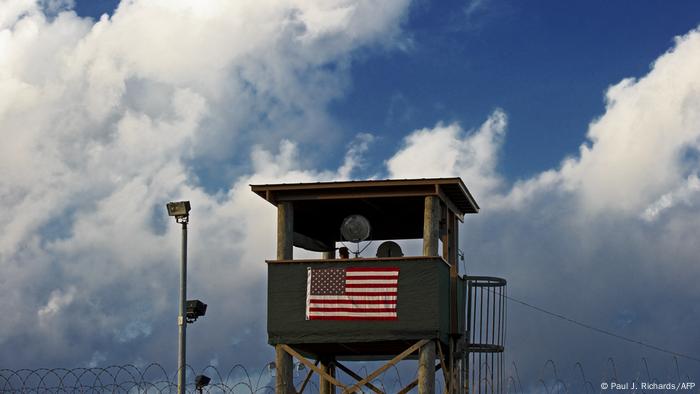
Anyone who wants to see Guantanamo firsthand has several obstacles to overcome. For a start, the weekly charter planes from Washington are not allowed to fly through Cuban airspace. Planes must first fly around Cuba to the east and are not allowed to set course for the military base until they are on final approach.
DW only received permission to visit on very short notice after weeks of security checks. Prior to departure, the "ground rules" had to be signed. These stipulate what journalists can expect in Guantanamo: no freedom of movement and, above all, no freedom of the press.
We were not even allowed to see the prison from the outside, and all information from inside is subject to the strictest secrecy, which is inevitably deeply frustrating for the lawyers of the detainees.
Plans, plans, plans
January 11 marks a grim anniversary for the Guantanamo detention center. It raises the question as to why the camp is still allowed to exist today despite the obvious violations of human rights and the rule of law that occur here — and above all, given that the US war on terror in Afghanistan is over and its troops have withdrawn. This was the justification for the detention center's existence in the first place.
The first plans to close down Guantanamo came at the end of George W. Bush's administration. Barack Obama promised to close it several times, but soon lost his majority in Congress to the Republicans, who in turn introduced a law that said "no one who has ever been in Guantanamo can come to the US for any purpose, trial, medical et cetera," explains Nancy Hollander. This, she says, makes it legally impossible to move inmates to the US.
Will the US leave Guantanamo?
Calls to back up words with actions
President Donald Trump subsequently changed course and announced that Guantanamo would remain open. According to Republicans, Guantanamo continues to protect against terrorist attacks and that transferring inmates to the US would be too dangerous. Guantanamo opponents however argue that the very existence of the camp radicalizes young Muslims.
The next reversal on Guantanamo policy came under President Joe Biden, who announced through his spokeswoman after taking office that he planned to close the camp during his term in office. But when the US Senate Intelligence Committee met recently to address the issue, not a single member of the Biden administration was on hand. This shows, above all, where the priorities of the government are, which so far is not following its words with action, says Nancy Hollander.
US defense lawyer Nancy Hollander
Imprisoned despite a lack of evidence
With its failed infrastructure program and the approaching midterm elections amid low polling numbers, the Biden administration arguably has bigger problems to deal with than Guantanamo. What the future holds for "Gitmo" is completely open. Some of the prisoners could be released as planned. Others could be returned to their countries of origin.
Daphne Eviatar of Amnesty International says she is optimistic about the future. "But as that number gets smaller and smaller it will become more and more clear and how irrational it is, how absurd it is," she adds.
What is also clear is that apart from the well-known moral reasons, one prisoner at Guantanamo costs US taxpayers $13 million a year.
It would be cheaper to have them imprisoned in the US, but that, again, aside from the legal hurdles, is not the answer either, says Nancy Hollander, who calls for the immediate release of all Guantanamo detainees.
"We can't hold people for 20 years without any charge because, according to the US, there is not enough evidence to charge them but we somehow know they're dangerous."
The question of Guantanamo's future can no longer be answered with rational arguments. Like so much in the US, it has become a political pawn in whose shadow the "forever prisoners"have been awaiting trial for 20 years.
Guantanamo, 20 years on: Former detainee Mohamedou Ould Salahi on FRANCE 24
It has been 20 years since the first detainees arrived at the Guantanamo US military prison in Cuba on January 11, 2002. At its peak, in 2003, the detention center held nearly 680 prisoners. Mohamedou Ould Salahi was one of them. He explains to FRANCE 24 how in 2001, he was taken from his home in Mauritania and eventually held at Guantánamo Bay for 14 years without charge.
Unstable Kazakhstan a big risk for energy markets
The central Asian country is the world's biggest uranium exporter and is among the top oil and coal producers. The resource-rich state has seen some of the biggest public protests in years, unnerving energy markets.
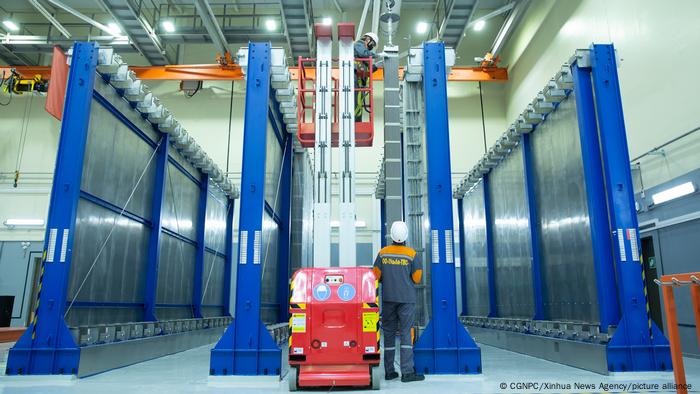
Kazakhstan is the top exporter of uranium, which is the most widely used nuclear fuel
Kazakhstan has been an anomaly in an otherwise volatile Central Asia. Years of stability in the country have pushed the resource-rich state's economy to grow manifold over the past two decades, propped up by billions in investments from global firms such as Chevron and France's TotalEnergies.
The demonstrations and the subsequent crackdown in the world's top uranium exporter and a major oil and gas producer have left investors anxious amid concerns that the social and political unrest could undermine Kazakhstan's reputation as a reliable investment destination.
"Generally, whichever administration emerges from the unrest, they will be mindful that FDI [foreign direct investment] is the golden goose and will not want to stop it laying eggs," economist Timothy Ash, an expert on the region, told DW. "There is confidence the natural resource sector will remain relatively well insulated, and it is encouraging that there have not been major disruptions to energy and raw material production."
"An interesting question to ask is if the government efforts to quell the protests are very violent, will Western governments be pushed to roll out sanctions as in Belarus. How will this impact investments in Kazakhstan," Ash asked. "I guess the West may well adopt a more pragmatic approach to ESG [Environmental, Social, and Governance] issues, given Kazakhstan's importance for global supply chains."
Kazakhstan produces over 40% of the world's uranium, the main fuel for nuclear reactors, making it a key player in the global transition away from fossil fuels. Many governments, including in the European Union, are doubling down on nuclear energy as part of their plans to decarbonize their economies.
State-controlled Kazatomprom, the world's biggest uranium producer, has said the turmoil has had no impact on production or exports so far. However, uranium spot prices rose sharply last week amid worries that the unrest could lead to a major disruption in production.
"Any curtailment of supply from Kazakhstan will clearly be felt across the globe," said Jonathan Hinze, president of nuclear fuel market consultancy UxC. "However, the nuclear fuel market is characterized by very long lead times, so nuclear utilities and upstream processors in the nuclear fuel cycle all hold significant pipeline as well as strategic inventories, which helps insulate them against any near-term supply disruptions."
Cameco, a major Canadian uranium producer and Kazatomprom's joint-venture partner, warned that any disruption in Kazakhstan could be a "significant catalyst in the uranium market."
"If nothing else, it's a reminder for utilities that an overreliance on any one source of supply is risky," a Cameco spokesperson said in a statement.
Kazakhstan, which supplies 20% of Europe's annual uranium needs, has emerged as an outsized player in the uranium market thanks to low costs of production in the country, a key factor for uranium producers in a post-Fukushima world where demand and prices for the nuclear fuel sank.
However, uranium prices have made a comeback in the past few years as countries bet on nuclear power to tackle climate change.
"The recent issues in Kazakhstan could certainly give a big boost to producers outside of Kazakhstan as utilities look to diversify away from overreliance on Kazakh uranium," Hinze told DW.
Rich fossil fuel resources
Kazakhstan, a member of the OPEC+, is the biggest oil producer in Central Asia, extracting about 1.6 million barrels of oil per day. Most of the fossil fuel it produces is shipped abroad, including to the European Union and China. The country has the 12-highest proven oil reserves in the world with 30 billion barrels of crude oil reserves.
The country is also among the top coal suppliers, producing 108 million tons in 2018.
The hydrocarbons sector has attracted about 60% of foreign direct investment (FDI) in Kazakhstan since 1991 and accounts for more than half of the country's exports revenue. Global oil majors such as ExxonMobil, Chevron, Italy's Eni and France's TotalEnergies have invested billions of dollars in the country over the years, helping foster its oil and gas growth.
In 2018, the country was the world's ninth-largest exporter of coal and crude oil and 12th of natural gas, according to the International Energy Agency. About 80% of Kazakhstan's annual oil exports are shipped to the European Union.
The current protests have yet to impact production at Kazakhstan's largest three oil fields — Tengiz operated by a Chevron-led consortium, plus Shell-owned Kashagan and Karachaganak.
"[The unrest] is coming at a time when OPEC+ is struggling to hit its quotas which is keeping upward pressure on oil prices. Should we see further outages, prices could climb above their October peak and, depending on the level of disruption, triple-digit prices may not be far away," Craig Erlam, senior market analyst at OANDA, told DW.
DW RECOMMENDS Kazakhstan: What's behind the unrest? Kazakhstan is experiencing the heaviest unrest in its history. For a long time, Russia's second most important ally in the post-Soviet realm was known as stable — so what happened? DW has the background.
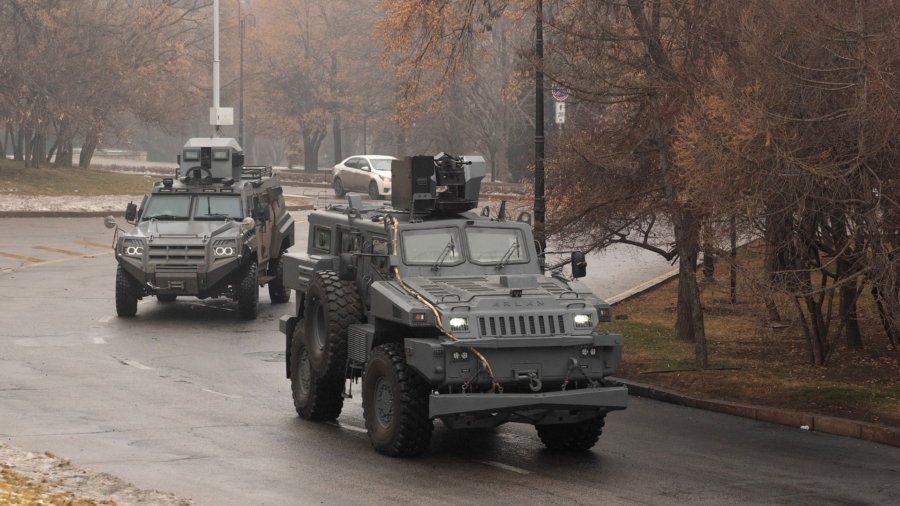
Military vehicles patrol streets in central Almaty, Kazakhstan on Jan. 7, 2022.
(Alexandr Bogdanov/AFP via Getty Images)
Security forces in Kazakhstan have detained 9,900 people regarding last week’s unrest, the interior ministry of the central Asian nation said on Tuesday.
President Kassym-Jomart Tokayev, who called the violence a coup attempt, nominated Alikhan Smailov for prime minister on Tuesday, and the lower house of parliament swiftly voted him in during a session broadcast live on state television.
Smailov, 49, served as first deputy prime minister in the previous cabinet which Tokayev dismissed last week amid violent unrest.
The oil-rich former Soviet republic says government buildings were attacked in several major cities after initially peaceful protests against hikes in the price of car fuel turned violent.
Tokayev has said Islamist militants from regional nations and Afghanistan, as well as the Middle East, were among the attackers.
He dismissed his cabinet amid the unrest, along with a number of security officials and detained on suspicion of treason the most senior among them, Karim Masimov, a former head of the national security committee.
Protesters attend a rally triggered by energy price hikes in Almaty,
Kazakhstan, on Jan. 4, 2022. (Abduaziz Madyarov/AFP via Getty Images)
The demonstrations began on Jan. 2 over a near-doubling of prices for vehicle fuel and quickly spread across the country, with political slogans reflecting wider discontent with Kazakhstan’s authoritarian government.
In a concession, the government announced a 180-day price cap on vehicle fuel and a moratorium on utility rate increases. As the unrest mounted, the ministerial cabinet resigned and the president replaced Nursultan Nazarbayev, former longtime leader of Kazakhstan, as head of the National Security Council.
One of the main slogans of the past week’s protests, “Old man out,” was a reference to Nazarbayev, who served as president from Kazakhstan’s independence until he resigned in 2019 and anointed Tokayev as his successor. Nazarbayev had retained substantial power at the helm of the National Security Council.
Despite the concessions, the protests turned extremely violent for several days. In Almaty, Kazakhstan’s largest city, the protesters set the city hall on fire and stormed and briefly seized the airport. For several days, sporadic gunfire was reported in the city streets.
A burned-out administrative building is seen behind a fence in central Almaty, Kazakhstan on Jan. 6, 2022.
(Alexandr Bogdanov/AFP via Getty Images)
The authorities declared a state of emergency over the unrest, and Tokayev requested help from the Collective Security Treaty Organization, a Russia-led military alliance of six former Soviet states. The group has authorized sending about 2,500 mostly Russian troops to Kazakhstan as peacekeepers.
Tokayev has said the demonstrations were instigated by “terrorists” with foreign backing, although the protests have shown no obvious leaders or organization. On Friday, he said he ordered police and the military to shoot to kill “terrorists” involved in the violence.
The Associated Press contributed to this report
Kazakhstan unrest: Thousands detained, gov't reforms regarded as 'relatively cosmetic'
Issued on: 11/01/2022
President Kassym-Jomart Tokayev on Monday described the unrest that followed initially peaceful protests against rising energy prices as a “terrorist aggression" and dismissed reports that authorities targeted peaceful demonstrators as “disinformation.” Dr. Assel Tutumlu, Assistant Professor at Near East University, says that the president refuses to cede any ground and continues to rule with an iron fist. So-called government reforms still do "not allow the grassroots movement to communicate with the regime," explains Dr. Assel Tutumlu. Until there's authentic reform of Kazakhstan's political and socioeconomic system, she doesn't think "we are going to see the termination of protests."
Back to school: Omicron already keeping Edmonton teachers and staff at home Kellen Taniguchi
Alberta Teachers’ Association president Jason Schilling. As students across Alberta returned to the classroom on Monday, Edmonton’s school divisions reported hundreds of absent staff members.
As of Monday morning, Edmonton Public Schools had 454 teacher absences, with 22 of those absences going unfilled, said Megan Normandeau, communications consultant for the division. She added 124 educational assistant absences were unfilled.
However, no classes, grades or schools have been moved online, said Normandeau.
Christine Meadows, communications and engagement services manager for Edmonton Catholic Schools, said 420 staff members were absent on Monday, including 217 teachers.
The president of the Alberta Teachers’ Association (ATA) said the staffing shortages will continue to be a concern.
“We know operationally this is going to be extremely difficult because what happens now is we have a short supply of substitute teachers who also have a lot of concerns about working during a pandemic as well,” said ATA president Jason Schilling.
“We’ve been encouraging government and school boards to put substitute teachers on contract so that they have benefits and income security in case they themselves become sick. So, some of them are hesitant about entering classrooms without that type of security.”
Leading up to the return of in-person learning, Schilling said teachers were nervous with the high number of COVID-19 cases and the Omicron variant spreading across the province. However, he said teachers also want to be in the classroom for face-to-face learning because it’s the ideal situation.
The provincial government promised 8.6 million rapid tests and 16.5 million medical-grade masks for students and teachers returning to school on Monday, however, the supply has not been completely delivered. Education Minister Adriana LaGrange said during a media availability last Wednesday all schools should have their first shipment by the end of this week.
“You listen to the government say that, ‘We’re doing everything possible to keep schools safe and we’re going to provide these two tools for teachers and students to use when they return on Jan. 10, but they won’t be there,’ is a really bad message to send to teachers, students and their families,” said Schilling, who added people are expecting these tools to be stocked to help them through the pandemic and keep schools open.
Schilling said the masks provided by the government also might not be high-quality enough, with experts suggesting KN95 or N95 masks are more effective.
Contact tracing is one measure not being done at schools this year. Schilling said it is important to keep track of cases through contact tracing.
“That information is really important for schools and school boards to know within their communities so they can better address COVID within their areas, ” he said.
“And the fact that the government has decided they’re not going to do that, and not include those who are working in schools in the high-risk category for PCR testing, I think is a mistake.”
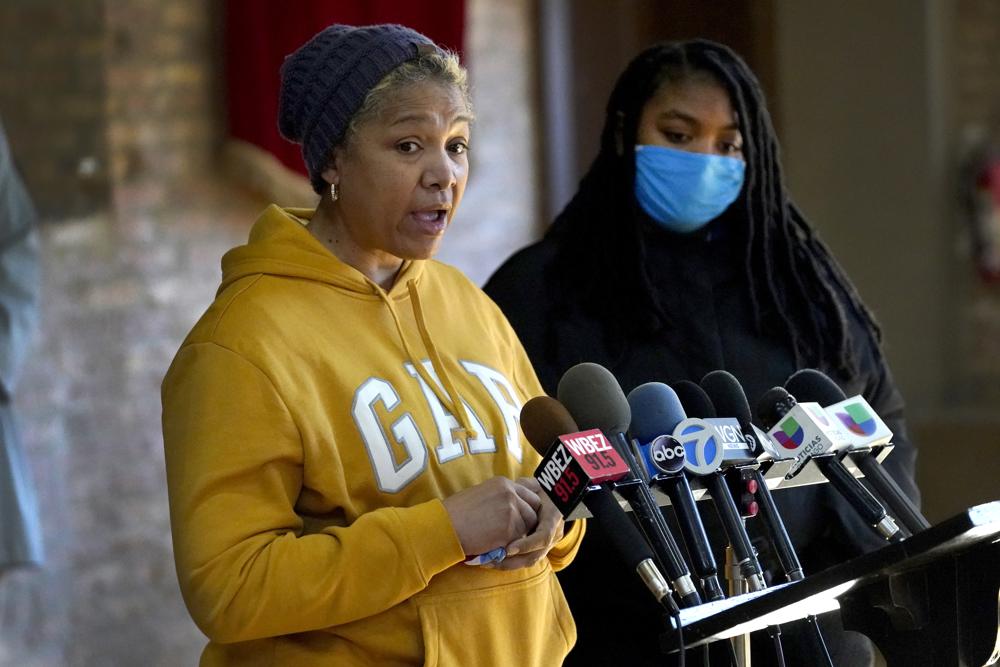
Cheri Warner, left, stands with her daughter, Brea, and speaks calling for the Chicago school district and teacher's union to focus on getting students back in the classroom Monday, Jan. 10, 2022, in Chicago. Hundreds of thousands of Chicago students remained out of school for a fourth day Monday, after leaders of the nation's third-largest school district failed to resolve a deepening clash with the influential teachers union over COVID-19 safety protocols. (AP Photo/Charles Rex Arbogast)
CHICAGO (AP) — Students are poised to return to Chicago Public Schools after leaders of the teachers union approved a plan with the nation’s third-largest district over COVID-19 safety protocols, ending a bitter standoff that canceled classes for five days.
While school districts nationwide have faced similar concerns amid skyrocketing COVID-19 cases, the labor fight in union-friendly Chicago amplified concerns over remote learning and other pandemic issues.
The deal approved late Monday would have students in class Wednesday and teachers back a day earlier. It still requires approval with a vote of the union’s roughly 25,000 members. Issues on the table have been metrics to close schools amid outbreaks and expanded COVID-19 testing
Neither side immediately disclosed full details of the proposal Monday evening, but leaders generally said the agreement included metrics to close individual schools and plans to boost district COVID-19 testing. The district notified parents in the largely low-income Black and Latino school district of about 350,000 students that classes would resume Wednesday.
“We know this has been very difficult for students and families,” Mayor Lori Lightfoot said at an evening news conference. “Some will ask who won and who lost. No one wins when our students are out of the place where they can learn the best and where they’re safest.”
In a dueling news conference, union leaders acknowledged it wasn’t a “home run” but teachers wanted to be back in class with students.
“It was not an agreement that had everything, it’s not a perfect agreement, but it’s certainly something we can hold our heads up about, partly because it was so difficult to get,” Union President Jesse Sharkey said.
The Chicago Teachers Union’s house of delegates voted Monday evening to suspend their work action from last week calling for districtwide online learning until a safety plan had been negotiated or the latest COVID-19 surge subsided. The district, which has rejected districtwide remote instruction, responded by locking teachers out of remote teaching systems two days after students returned from winter break.
While there has was some progress on smaller issues like masks, negotiations over the weekend on a safety plan failed to produce a deal and rhetoric about negotiations became increasingly sharp. Some principals canceled class Tuesday preemptively and warned of further closures throughout the week.
Earlier Monday, Union President Jesse Sharkey said the union and district remained “apart on a number of key features, accusing Lightfoot of refusing to compromise on teachers’ main priorities.
“The mayor is being relentless, but she’s being relentlessly stupid, she’s being relentlessly stubborn,” Sharkey said, playing on a reference the former prosecutor mayor made about refusing to “relent” in negotiations. “She’s relentlessly refusing to seek accommodation and we’re trying to find a way to get people back in school.”
Coronavirus pandemic in Africa: Two years after first deaths due to virus
Issued on: 11/01/2022
Africa has registered a total of more than 10 million coronavirus cases since the beginning of the pandemic, according to figures from the African Union's health watchdog. Vaccine uptake in Africa, home to nearly 1.2 billion people, has been low, due to poor access to jabs and some vaccine hesitancy. FRANCE 24's Nadine Theron reports from Cape Town, South Africa.
U.S. sets new COVID hospitalization record, signaling Omicron surge could be less mild than experts hoped
The U.S. set a new COVID-19 hospitalization record Monday, exceeding 140,000 patients for the first time since the start of the pandemic — a warning sign, experts say, that the nation’s Omicron surge is already more severe than in other countries and will only get worse as it spreads from highly vaccinated cities to less protected parts of the U.S.
America’s previous.hospitalization peak came on Jan. 6, 2021, when 139,781 COVID patients were hospitalized nationwide, according to New York Times data. But that was several months before a mass vaccination effort kicked in and shielded recipients from the vast majority of severe disease.
On Monday, the number of Americans hospitalized with COVID-19 hit 142,388.
Word of a new U.S. hospitalization record may surprise Americans who have repeatedly heard that the hypermutated Omicron variant — which has triggered an unprecedented wave of breakthrough cases in vaccinated and previously infected individuals — is ultimately milder because it’s less likely to seriously sicken those who catch it.
“I think people have fixated on this idea that it’s mild,” New York University epidemiologist Céline Gounder recently told New York magazine. “Mild means mild — relatively mild — for the individual who’s infected. But it does not necessarily mean mild at a population level.”
The new U.S. hospitalization numbers — including rising ICU admissions in the cities Omicron has struck first — suggest just that: If even a milder variant infects enough people, the resulting surge can be anything but “mild.”
The problem, as Gounder and others have pointed out, is twofold.
First, there is a ton of virus circulating right now, with an average number of new daily cases (the current 7-day average stands at 677,243) that’s nearly three times higher than ever before. Virologist Trevor Bedford of the Fred Hutchinson institute in Seattle has calculated that tests are now catching just one in four or five U.S. infections — which means that Omicron is actually infecting more than 3 million Americans each day.
Medical staff treat a COVID patient at Western Reserve Hospital in Cuyahoga Falls, Ohio. (Shannon Stapleton/Reuters)
Second, this once unthinkable level of spread guarantees that Omicron is finding as many people at increased risk of hospitalization as possible: the entirely unvaccinated (83 million Americans); the vaccinated but unboosted (132 million Americans); and especially seniors who are not boosted (26 million) or even fully vaccinated (7 million) and who remain most susceptible to severe disease.
“If a lot of people get infected, even if it’s a relatively benign virus, enough of those people will still [get] hospitalized and die that this is really going to be very overwhelming for the health care system,” Grounder explained.
Not all of the news about U.S. hospitalizations is grim. Doctors are reporting fewer patients on ventilators and shorter hospital stays in comparison to past waves, data that is consistent with higher population immunity and a variant that doesn’t latch onto lung cells as well as its predecessors. And data from various states show a significant fraction of COVID-19 patients tested positive “incidentally” upon admission for some other ailment, meaning that Omicron isn’t the thing that’s making them sick enough to seek care.
Unfortunately, as New York City emergency room doctor Craig Spencer explained Monday on Twitter, “entering the hospital WITH Covid versus FOR Covid isn’t a relevant distinction if the hospital doesn’t have the beds or providers needed to care for its patients. And the distinction isn’t always clear even to providers. Nor does it matter practically.”
“Every Covid + patient requires the same isolation to protect other patients from getting infected,” Spencer continued. “They require the same use of PPE. And they all represent another infection risk to providers. Most importantly they all require the same space in a bed. And that’s in short supply.”
In a New York Times op-ed published Monday titled, “As an E.R. Doctor, I Fear Health Care Collapse More Than Omicron,” Spencer elaborated on why U.S. hospitals trying to treat more than 140,000 COVID-19 patients at once represents an “unfolding tragedy.”
Among the reasons he mentioned: “‘classic’ COVID-19 patients, short of breath and needing oxygen,” all of whom are unvaccinated; “elderly patients for whom Covid rendered them too weak to get out of bed”; “people with diabetes in whom the virus caused serious and potentially fatal complications”; and on top of that “many hospitals [now] seeing their highest levels of employee infections of the pandemic,” with some having “lost 15 percent of their workforce or more.”
Medical workers confer in the ICU ward at UMass Memorial Medical Center in Worcester, Mass.(Joseph Prezioso/AFP via Getty Images)
“The Omicron surge is real — and even if Omicron is ‘milder,’ it's not mild,” Spencer concluded on Twitter. “It causes severe disease half as often as Delta, but infects 2-4x as many people, potentially washing out any potential 'benefit.’”
The data from early U.S. Omicron hot spots is starting to bear this out. In Chicago, hospitalizations have surpassed 150 percent of last winter’s peak; today, there are already more Chicagoans in the ICU or on ventilators than there were one year ago.
The hope was that the pattern would repeat itself in the U.S. because of Omicron’s relative mildness. But it hasn’t. Before Omicron arrived, the number of U.S. COVID patients in the ICU (per capita) was about twice as high as the number of U.K. COVID patients in the ICU. Today, two months later, that disparity is more than five times as high. While the U.K.’s ICU curve has remained flat, the U.S. curve has gone up about 100 percent — to the point where it’s just 21 percent lower than last winter’s pre-vaccination peak.
Why? Former Food and Drug Administration Commissioner Scott Gottlieb has theorized that “lower U.S. vax/booster rates” may be to blame.
“U.S. decoupling between cases, hospitalizations, deaths, while measurable vs prior waves, isn't as strong as UK; perhaps due to lower U.S. vax/booster rates (50% eligible adults boosted),” Gottlieb tweeted Sunday. “Our protracted wrangling over boosters may have sowed confusion, sapping consumer interest.”
Indeed, while America’s two-dose vaccination rate (62 percent of the total population) is somewhat lower than the U.K.’s (69 percent), its boosted rate is less than half as high: 23 percent here vs. 52 percent there. U.K. data shows that three vaccine doses prevent 88 percent of Omicron hospitalizations while two vaccine doses prevent just 52 percent.
At the ICU ward at UMass medical center. (Joseph Prezioso/AFP via Getty Images)
What this means for U.S. Omicron deaths remains to be seen. A New York Times analysis published Monday shows the trajectory of COVID deaths rising steeply in New York City, Boston and Washington, D.C. — and tracking closely with the trajectory of cases from three weeks earlier. (It typically takes a terminal COVID patient about that long to succumb to the disease.)
And while those cities have been suffering fewer deaths per case so far this winter than last, they’re also reporting far more cases now than there were then — more than six times as many per day in New York City, for instance. Once the worst of those cases work their way through the overloaded hospital system, the absolute number of deaths may also wind up being higher this winter.
On the other hand, the deadlier Delta variant was already spurring its own wave in the Northeast when Omicron took hold. So, lingering Delta cases may be making Omicron look worse than it is.
Either way, the next few weeks will see Omicron spreading from cities like New York, where 74 percent of the population is fully vaccinated, to places like Mississippi, where just 49 percent of the population is fully vaccinated — and where COVID cases have increased by 702 percent over the last two weeks, more than any other state.
In fact, every state where Omicron is now spreading the fastest is a low-vax state like Mississippi: Texas (+678 percent), South Carolina (+652 percent), Kentucky (+578 percent), Louisiana (+546 percent), Arkansas (+526 percent) and Alabama (+522 percent).
“As Omicron advances into less vaccinated rural regions with more limited health systems capacity, it will overwhelm already strained hospitals, exacerbate sharp rural disparities in COVID deaths, and further constrain access to non-COVID care,” Anne Sosin, a public health researcher at Dartmouth College, predicted Monday.
Meanwhile, 20 percent of hospitals in a state like Maryland are reporting staff shortages — and the COVID-19 Hospital Capacity Circuit Breaker dashboard shows that every single county there appears to have reached or exceeded its hospital capacity.
“I can attest the situation in Maryland is [expletive] horrendous,” one physician wrote to the dashboard’s creator. “The state has been maxed out for about 2 weeks. Multiple hospitals are operating under crisis standard of care. EMS [i.e. ambulances] is now so taxed that Baltimore County started transporting people in fire trucks last week. This is absolutely unheard of and absurd. Reports of people waiting over 1-2 hours on scene with fire fighters before an EMS unit gets there. Then when they get to the hospital they wait literally hours for a bed. Transfer centers now just laugh when you call, the system is so backlogged. It’s mind-boggling to me how none of this has been national news.”