It’s possible that I shall make an ass of myself. But in that case one can always get out of it with a little dialectic. I have, of course, so worded my proposition as to be right either way (K.Marx, Letter to F.Engels on the Indian Mutiny)
Wednesday, July 13, 2022
U$ Inflation surges 9.1% in June, most since November 1981
U.S. consumer prices in June accelerated at the fastest annual pace since November 1981.
The Bureau of Labor Statistics' Consumer Price Index (CPI) reflected a year-over-year increase of 9.1% last month, up from the prior 40-year high of 8.6% in May. Economists were expecting June's reading to show an 8.8% increase, according to estimates compiled by Bloomberg.
On a monthly basis, the broadest measure of inflation rose at a pace of 1.3%, inching up from 1% in May and climbing at a faster tempo than the 1.1% climb economists had projected. This marked the largest monthly increase since 2005.
U.S. stocks were slammed early Wednesday following the hotter-than-expected print. The S&P 500 dropped 1.3% at the open, while the Nasdaq shed 1.7%, and the Dow fell 1.1%.
The continued surge in inflation across the U.S. economy was elevated by broad-based increases, including high food costs and record gasoline prices, which topped more than $5 per gallon at the pump last month.
“Core” CPI, which excludes the more volatile food and energy components, rose 5.9% in June, compared to 6.0% in May. Economists expected a 5.7% increase in this measure.
The report's energy index soared 7.5% in June and 41.6% over the last year, marking the largest 12-month increase since the period ending April 1980. Meanwhile, the component of the report tracking food prices increased 1% over the month and 10.4% annually, the biggest 12-month increase since the period ending February 1981. Gasoline prices are displayed at an Exxon gas station behind American flag in Edgewater, New Jersey, U.S., June 14, 2022. REUTERS/Mike Segar
Commodity prices have been under pressure in recent weeks, however, with crude oil falling more than 8% on Tuesday.
"Overall, this report confirms that the Fed will need to hike by 75bp again at the end-July meeting," Capital Economics Senior U.S. Economist Michael Pearce said. "While some will draw parallels with the shockingly bad May CPI report, the backdrop is markedly different — commodity prices have fallen sharply and we’ve seen clearer signs of an economic slowdown, both of which will contribute to weaker price pressures ahead."
In Washington, the White House on Tuesday warned in a call with reporters that June’s inflation numbers were likely to be “highly elevated” but downplayed the weight of last month’s figure, pointing to gas prices that have since retreated from their highs.
Brian Deese, director of the National Economic Council, echoed that defense of June's CPI reading in an interview with Yahoo Finance Live on Wednesday. Deese underscored the downward trend in gasoline prices, but did not offer specific details when asked how volatility in energy markets may show up in future readings if prices swing back up.
"The Administration tried to get out in front of the bad economic news, and tell us the inflation report was going to be ugly this month, but it was even worse than markets imagined in their wildest dreams," FWDBONDS Chief Economist Christopher Rupkey said in emailed commentary.
Bank of Canada announces key interest rate hike of one full percentage point
FULL PRESS CONFERENCE
The Bank of Canada announced Wednesday that it will increase its benchmark interest rate by a full percentage point, taking a larger than expected hike to tame decades-high levels of inflation.
Bank of Canada Governor Tiff Macklem addressed the decision during a press conference Wednesday morning.
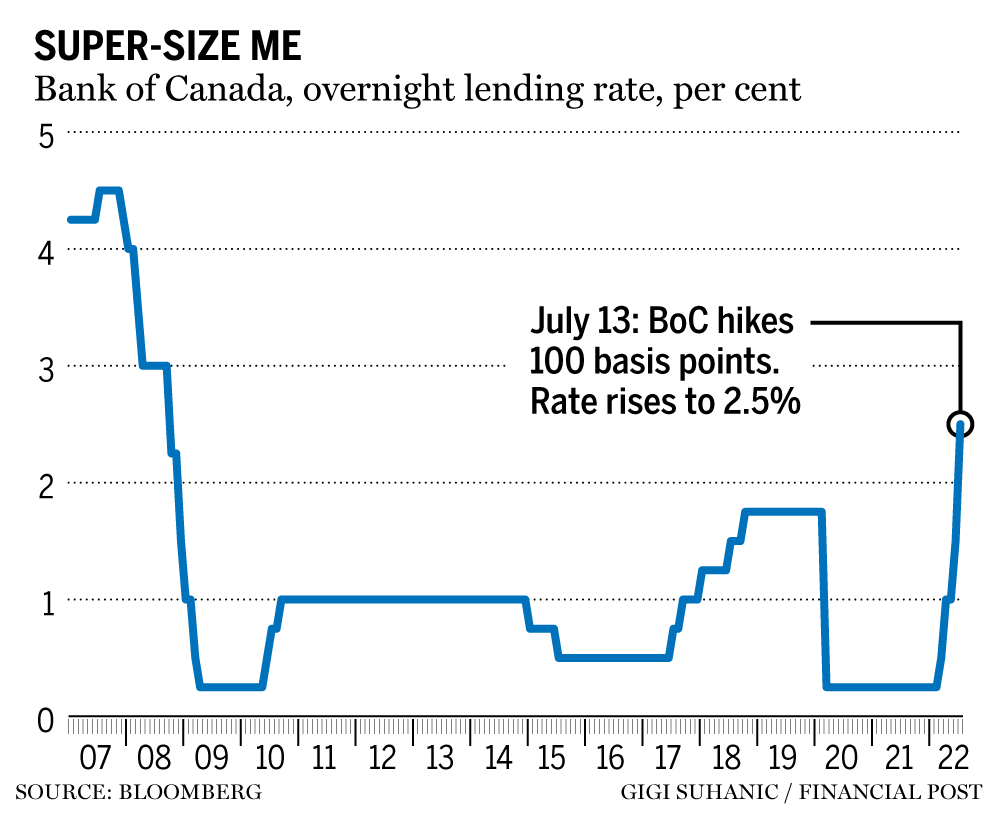
The central bank’s key interest rate now sits at 2.5 per cent, a drastic shift from the 0.25 per cent rate seen at the start of the year.
The Bank of Canada also signalled that interest rates would need to keep rising before the end of the current cycle.
Most economists had expected a 75 basis point increase, following the steps fo the U.S. Federal Reserve last month. Markets had also priced in that hike.
For more info, please go to https://globalnews.ca/news/8986132/ba...
Bank of Canada Governor Tiff Macklem takes part in a news conference in Ottawa, Ontario, Canada April 13, 2022. REUTERS/Blair Gable
The Bank of Canada raised its benchmark rate by 100 basis points on Wednesday, a surprise move that exceeded economist expectations, as the central bank attempts to set a firehose against scorching inflation.
The unexpected and supersized increase comes after two consecutive 50 basis point hikes, bringing the policy interest rate to 2.5 per cent, the highest level since 2008. It marks thefirst time the central bank has hiked its benchmark rate by a full percentage point since 1998, and was more aggressive than the 75 basis point increase most economists had widely predicted.
"With the economy clearly in excess demand, inflation high and broadening, and more businesses and consumers expecting high inflation to persist for longer, the Governing Council decided to front-load the path to higher interest rates by raising the policy rate by 100 basis points today," the Bank of Canada said in a statement.
The central bank also continued to warn on Wednesday of more hikes to come, saying that "interest rates will need to rise further, and the pace of increases will be guided by the Bank’s ongoing assessment of the economy and inflation."
But Bank of Canada Governor Tiff Macklem said at a press conference Wednesday that the surprise move – an increase he called "very unusual" – was necessary to combat inflation, which has reached levels not seen in nearly 40 years. Inflation hit 7.7 per cent in May, marking the biggest year-over-year increase since January 1983. Macklem says the bank expects the Consumer Price Index (CPI) to remain at around 8 per cent for "a few months."
"Inflation is too high, and more people are getting more worried that high inflation is here to stay. We cannot let that happen. Restoring price stability—low, stable and predictable inflation—is paramount," Macklem said.
"Our goal is to get inflation back to its two per cent target with a soft landing for the economy. To accomplish that, we are increasing our policy interest rate quickly to prevent high inflation from becoming entrenched. If it does, it will be more painful for the economy—and for Canadians—to get inflation back down."
The Bank of Canada is one of many central banks around the world on an aggressive path to tighten monetary policy in the wake of skyrocketing inflation. Wednesday's decision makes the Canadian central bank's policy rate the highest among G7 countries.
The central bank has estimated that the neutral range, where the interest rate is no longer stimulative, is within two and three per cent. Macklem says the bank is front-loading interest rate increases now to avoid higher rates down the road, which will bring the policy rate "quickly to the top end or slightly above the neutral range."
"The Bank seems determined to get to the finish line as quickly as possible," CIBC Capital Markets economist Karyne Charbonneau wrote in a research note.
"They are likely considering a move of 75 basis points in September, and it will take some downside data surprises to hold them to 50."
Alicja Siekierska is a senior reporter at Yahoo Finance Canada. Follow her on Twitter @alicjawithaj.
What economists are saying about Bank of Canada's steep rate increase
Governor Tiff Macklem and his deputies raised the policy rate by a full percentage point, bringing the interest rate up from 1.5 per cent to 2.5 per cent. It’s an aggressive move by the central bank, and the largest since 1998, but the governing council likely felt assured in their decision after the United States Federal Reserve Bank made a similarly vigorous hike of 75 basis points last month.
Inflation has hit records not seen in four decades, climbing to 7.7 per cent in May, thanks to higher prices in almost every category Statistics Canada tracks. Many economists predicted price pressures could be peaking, however the central bank’s rate increase landed just after the U.S. released inflation data for June, showing its consumer price index surged 9.1 per cent over the year.
Prices in Canada tend to follow what happens south of the border, and with inflation showing few signs of cooling, more hikes are likely to come.
Read on for expert reaction to what this outsized increase means.
Derek Holt, head of capital markets economics at Bank of Nova Scotia
“What I’d emphasize in this regard is that I just can’t accept their depiction of today’s move as being about how ‘the Governing Council decided to front-load the path to higher interest rates by raising the policy rate by 100 basis points today.’ That implies they think they are getting ahead of inflation risk when in reality they are far behind in the fight against inflation. All they have done today is to tiptoe into the neutral policy setting when what Canada needs to counter inflation is something more deeply into restrictive territory. Front-loading would have been like the (Reserve Bank of New Zealand) and (Bank of Korea) did when they began hiking last summer.
“We’re so past any relevant point at which today’s actions can be described as front-loading the response, when a more accurate depiction portrays the BoC in perpetual catch-up mode to inflationary pressures. As a consequence to having misread inflationary impulses last year, Canadians now face heightened economic anxiety because rates are going up by leaps and bounds when earlier and more gradual rate hikes could have nipped some of the inflation risk in the bud and avoided today’s big changes.”
Royce Mendes, managing director and head of macro strategy at Desjardins
“The Bank of Canada is committing to further rate hikes. Despite the fact that there are some signs that the economy is slowing and certain components of inflation are cooling, central bankers are again tying their hands with forward guidance. There’s not a lot of data between now and the September meeting. So expect further policy tightening is on a pre-set course.”
Stephen Brown, senior economist at Capital Economics
“The statement noted that the decision to hike the policy rate by 100 bp 2.5 per cent — the first 100 bp move since August 1998 — was intended to ‘front-load the path to higher interest rates,’ rather than to reach a higher final destination. While the Bank said that it ‘continues to judge that interest rates will need to rise further,’ it provided no update on where it expects the policy rate to end up, having hinted last month that it intends to raise it to either the top end of its neutral rate estimate — of between two per cent and three per cent — or a bit further.”
Simon Harvey, head of analysis at Monex Canada
“With the Fed expected to conduct two further 75 bp hikes at their next two meetings, it is likely the BoC will follow up today’s decision with a 75 bp hike in September. From thereon in, with rates considered to be above neutral, adjustments are likely to take a more fine-tuning approach.”
James Orlando, senior economist at TD
“This big step up in rates is uncommon, so too is the economic backdrop. With the unemployment rate at 4.9 per cent, wages running at 5.2 per cent, and inflation at 7.7 per cent, the pressure on the BoC has not let up. …The hit to consumers from high inflation and rising rates will weigh on growth over the remainder of this year and into 2023. Though this raises the risk that the economy tips into recession…. the Bank has to accept this risk (and possible outcomes) in order to prevent high inflation expectations from becoming even more entrenched.”
Karl Schamotta, chief market strategist at Cambridge Mercantile Corp
“Fear of an unmooring in inflation expectations was evident throughout the release, with officials noting ‘surveys indicate more consumers and businesses are expecting inflation to be higher for longer, raising the risk that elevated inflation becomes entrenched in price- and wage-setting,’ implying that ‘the economic cost of restoring price stability will be higher.'”
Tu Nguyen, economist at RSM Canada
“As unsettling as this news is for consumers and businesses alike, an economy-wide recession is still unlikely in 2022. Certain industries, such as the housing market which has already slowed, will likely go into decline, but overall, the economic indicators of the job market, businesses, and consumers point to a still rather healthy economy. However, a slowdown is certain and a necessary tradeoff to restore price stability.”
Josh Nye, senior economist at Royal Bank of Canada
“The BoC revised its GDP growth forecasts significantly lower, trimming 0.75 percentage ppts from its 2022 projection and 1.5 ppts from 2023. It attributed the downward revisions to higher inflation, tighter financial conditions, ongoing supply chain disruptions and weaker foreign demand (global GDP growth seen slowing to 2 per cent next year with the U.S. at 1.1 per cent). …
“The BoC thinks the easing of temporary supply disruptions (assumed to be worth 2.5 per cent of GDP currently) will support growth over the next two years, allowing for decent GDP gains while still absorbing excess demand (currently thought to be around one per cent of GDP). That allows inflation to ease from eight per cent in the near-term to three per cent by the end of next year and two per cent in 2024. But the BoC admitted the path to such a soft landing has narrowed. Indeed, we think the BoC’s forecasts are optimistic, with growth likely needing to slow more materially next year if domestic inflationary pressure is to be brought under control in any reasonable timeframe.
“In our view, a soft landing will be difficult to achieve and our forecast now assumes a mild recession next year.”
Charles St-Arnaud, chief economist at Alberta Central
“The key message in today’s decision is that the central bank is fully committed to controlling inflation. The decision to front-load the increase in policy rate is an effort to nip in the bud any upside pressure on inflation expectations and prevent the high inflation rate from becoming entrenched. It also suggests that when deciding between bringing down inflation or avoiding a recession, the BoC will prioritize inflation. This means that the BoC will likely remain unfazed by the current pullback in the housing market unless it threatens financial stability.”
“It is important to stress that the BoC has little control over global inflationary pressures coming from higher commodity prices or global supply chain disruptions. As such, increasing interest rates will not lower food or gasoline prices or make the computer chip shortage disappear. The only way for the BoC to lower inflation is by slowing the domestic economy, creating excess capacity and reducing domestic inflationary pressures. This is a balancing act that will lead to a period of economic underperformance, notably in the labour market and consumer spending. Whether it will be a soft-landing or a recession remains to be determined.”
Omar Allam, managing director of global trade and investment at Deloitte
“For small- and medium-sized Canadian exporters, this translates into more purchasing power, but it can also hurt accounts receivables. As the Canadian dollar appreciates, it makes Canadian goods and services more expensive in comparison to global competitors who are being more strategic in terms of market diversification. It also has the effect of reducing the value of Canadian-owned corporate profits from global operations. This makes for a more challenging environment for Canadian companies and may ultimately end up negatively affecting their profit margins.”
How the Bank of Canada's rate hike will impact mortgages, loans and spending
Wed, July 13, 2022
TORONTO — The Bank of Canada increased its key interest rate by one percentage point Wednesday in the largest hike the country has seen in 24 years.
The move indicates the central bank will take a more aggressive approach to tackling inflation, which sits at a 39-year high of 7.7 per cent and has made groceries, vacations and other purchases more pricey.
The hike to 2.5 per cent will also impact mortgages, loans and spending habits.
Mortgages
Commercial banks and other financial institutions usually raise or lower their mortgage rates in tandem with the Bank of Canada's interest rate hikes.
The rate hike means consumers should expect most variable rates to hit a range between 3.35 and four per cent, said mortgage agent Sung Lee, in a Ratesdotca release.
Leah Zlatkin, a licensed mortgage broker with Lowestrates.ca, said in a release that every $100,000 someone holds in a variable rate mortgage will result in about $55 more in costs per month.
Based on the Canadian Real Estate Association's average home price of $711,000 in May, a variable rate of 2.7 per cent will result in monthly mortgage payments of roughly $2,845. At 3.7 per cent, which she considers the best mortgage rate, those payments will total $3,168, an increase of $323 per month.
While people with variable mortgages will be affected, anyone whose mortgage rate is up for renewal will likely have "sticker shock" too, said Laurie Campbell, director of client financial wellness at advisement firm Bromwich + Smith.
"It's going to be a situation where a lot of people are going to be rethinking whether they can continue to afford that home," she said.
"We've seen 10 years leading up to this of continued housing increases and the housing market going astronomically insane. Now, it will level off no doubt with these interest increases."
During the COVID-19 pandemic, Campbell saw people tap into their home equity, so some have a traditional mortgage and second mortgage on their property. If there is a correction in the housing market, she fears they could end up owing more on their homes than the property is even worth.
Loans
People with variable rate lines of credit, personal loans or car loans are all impacted by interest rate hikes.
"A lot more of their money is going to be going to interest and they probably want to up their payment, if they can, to cover that and make sure they get out of that debt quickly," Campbell said.
That won't be an easy feat for some Canadians. Campbell said she has seen studies saying Canadians have more debt than ever before and for every dollar someone in the country makes they owe an average $1.86.
"Individuals are really going to have to buckle down and figure out how to manage all of this debt," Campbell said.
If you can't pay off your debt and your financial situation isn't set to improve, she recommends seeking help from a licensed insolvency trustee. Spending
Between inflation, supply chain snags, shortages and rising rates, most goods and services are becoming more expensive.
However, as pandemic-related restrictions ease, people are eager to venture out of their homes, gather and partake in favourite past times again.
"My guess is in the short term people will continue to spend because it is summer, people love to be outside and enjoy this time of year," Campbell said.
"However, I say that with caution. I think we're going to see increased debt levels and there will be a reckoning where people have to curb their spending because inflation is really killing us and really making it hard for us to make ends meet."
This report by The Canadian Press was first published July 13, 2022.
Tara Deschamps, The Canadian Press
Bank of Canada's jumbo rate hike set to slow lenders' earnings growth Housing construction in Ontario
Wed, July 13, 2022 By Saeed Azhar and Sinéad Carew
NEW YORK (Reuters) -Bank of Canada's surprise full percentage point interest rate hike on Wednesday could put the brakes on the country's once-frothy housing market and weigh on banks' profits after strong mortgage growth emerged as the main growth engine during the pandemic.
The Canadian housing market was on fire earlier this year, fueled by ultra-low borrowing costs and pandemic-related demand shifts, with prices surging more than 50% over two years.
But sales have dropped dramatically in recent months and May's average selling price was down 12.9% from February's peak.
"Higher mortgage rates are definitely going to be headwinds for real estate and for the banks," said Paul Gardner, portfolio manager and partner at Avenue Investment Management.
Mortgages accounted for about 50% of Canadian banks' loans book, analysts estimate.
But Gardner said unemployment is low in Canada, which means people can still pay their mortgages even though there's going to be less discretionary spending for them.
"You're most vulnerable when unemployment goes through 10% and we're facing the other side, so it's kind of things that there are extreme events that are neutralizing each other," Gardner said.
He said bond markets are already pricing in a recession with an inverted yield curve, which is generally not great for the banks.
The Canadian central bank raised its policy rate to 2.5% from 1.5%, its biggest rate increase in 24 years, and said more hikes would be needed. Economists and money markets had been expecting a 75-basis point increase.
The gap between the 2- and 10-year Canadian bond yields widened by 11 basis points to about 15 basis points in favor of the shorter-dated bond.
Shares of the Royal Bank of Canada fell as much as 2.3% to a session low of C$124.71 ($96.29) on the Toronto Stock Exchange after the rate decision. Toronto-Dominion Bank shares dropped as much as 2.8% to C$78.55 but were last trading down 1.7% at C$79.50, while Bank of Nova Scotia shares dropped as much as 2.1% to C$73.40, but last traded down 1.2%.
The benchmark Canadian stock index fell to its lowest since March 2021 after the rate decision, but recovered to trade flat by late afternoon.
Sohrab Movahedi, banking analyst at BMO Capital markets, said the housing market has held up and part of this is how the product works: banks pre-approve or provide a commitment to consumers on housing loans.
They have an assumption of what would translate into real loans and banks hedge themselves, he said.
"In all likelihood with the rates moving higher, the proportion of those commitments that ends up in a loan will be lower than usual. More people will choose to either buy smaller houses or defer the purchase," Movahedi said.
"If the economy is going to slow down from here, then earnings growth prospects for the banks will also slow."
(Reporting by Saeed Azhar and Sinead Carew; additional reporting by Julie Gordon and Fergal Smith in Ottawa; editing by Jonathan Oatis)
U$A
LIVE: House Oversight Committee holds Hearing on Abortion Rights
Streamed live 7 hours ago
House Oversight Committee hearing on 'The Impact of the Supreme Court's Dobbs Decision on Abortion Rights and Access Across the United States', with testimony from Michigan State Sen. Mallory McMorrow, Georgia State Rep. Renitta Shannon, National Women's Law Center President and CEO Fatima Goss Graves, University of California, Irvine Chancellor's Professor of Law Michele Bratcher Goodwin, others. Don't Miss: Valley of Hype: The Culture That Built Elizabeth Holmes WATCH HERE: https://youtu.be/Sb179GLPNYE
Gender pay gap narrowing in Canada’s health sector. Will COVID reverse that progress?
Canada’s premiers request additional health care funding as hospitals buckle under pressure
Gender pay gaps in the Canadian health sector are narrowing, but employment loss during the COVID-19 pandemic affected women more than men, according to a new report.
A global analysis by the World Health Organization (WHO) and International Labour Organization (ILO) released on Wednesday shows that in Canada, the wage divide between men and women working in the health and care sector almost halved over the last decade to 4.7 per cent in 2019 from 8.5 per cent in 2000.
This means, on average, earnings for female workers were 4.7 per cent lower than their male counterparts.
In contrast, the pay gap in the United States remained almost the same and increased in several European countries, such as Czechia, Estonia and Hungary, over the last decade.
“It's disappointing that we aren't at pay equity yet, especially as a country that does have pay equity legislation,” said Morgan Hoffarth, past president of the Registered Nurses Association of Ontario.
The COVID-19 pandemic, that has pushed many health-care workers to the brink, saw average hourly wages growing faster for Canadian women in the health and care field. This narrowed the gender gap in monthly earnings to 14 per cent in December 2020 from 19 per cent in January 2019.
However, these were only marginal improvements, the WHO and ILO said, given the crucial role front-line workers have played to fight COVID-19.
And health-care workers, who are predominantly women, say they are not adequately being compensated for their work.
"People who work in health care are not adequately compensated for the work that they do at work and the work that they continue to do outside of work and outside of their paid time as well," said Hoffarth, who is a registered nurse in Ontario.
How high the gender wage gap is in Canada
In Canada, the federal government passed the Pay Equity Act in December 2018, which requires federally regulated employers to establish and periodically update a pay equity plan. Meanwhile, in Ontario, the controversial Bill 124 that was passed in 2019 and limits wage increases to a maximum of one per cent total compensation per year for public employees, has been opposed by health-care workers.
“When we look at the actual policies that affect women's pay and women's livelihoods and women's safety in health care, I don't really see the policies that are supporting health-care workers and particularly women through the pandemic,” said Michelle Cohen, a family doctor in Brighton, Ont., and an expert on equity in health care.
Globally, women health-care workers face a larger pay gap compared to other economic sectors, earning an average of 24 per cent less than their male colleagues do, the report found.
“Historically, earnings in highly feminized sectors such as health and care have been lower because these are sectors that were considered to have a low value added attached to them,” Michelle McIsaac, a WHO economist and co-author of the report, told Global News.
Cohen said there needs to be a better valuation of care work and work that gets dumped into the “women's work category.”
Despite some progress in Canada, the latest WHO/ILO report paints a grim picture for women in the health-care sector, according to its findings, as women continue to face gender-based inequalities.
An analysis published in the Canadian Medical Association Journal in August 2020 suggested that female doctors are underrepresented in top-earning medical specialties and paid less for equivalent work because of structural inequities that follow them throughout their career.
Canada’s premiers meet with healthcare top of agenda
Using publicly available data, Canadian researchers found that women account for less than 35 per cent of doctors in the 10 specialties with the highest incomes, including radiology, ophthalmology and cardiology.
While past economic crises may have served to reduce gender inequalities in the labour market, the current pandemic, in the long run, could reverse any progress made towards achieving gender equality, the study authors warned.
This is because while employment in the health and care sector had recovered by December 2020, the recovery was greater for men than for women, the report said.
Since women have a greater representation at the low end of the pay scale, the loss of employment at the low end during the periods with the strictest public health measures may have impacted them more than men who are less represented at the low end of the pay scale in the health and care sector, she added.
There are also concerns about the long-term impact this will have with the health-care profession becoming less and less attractive.
“We're seeing health-care workers burn out and leave the field ... and … that's going to be primarily women,” said Cohen.
As the pandemic continues with parts of the country now in a seventh COVID-19 wave, Cohen said there needs to be better job security, adequate PPE and paid sick leave to better support health-care workers in the country.
In Canada, health-care is 75 per cent funded by the province and 25 per cent by the federal government.
“I think we really need to look at the funding model and make sure that we are regularly reviewing the salary and the wages of individuals working in health care and making sure that they are matching with the cost of inflation,” said Hoffarth.
McIsaac also said more needs to be done to reduce pay gaps in Canada and around the world, by providing help to young mothers, or women in reproductive years, to balance work with family; and by promoting laws that equalize women and men in the labour market, such as parental leave for women and men.
There also needs to be political commitment, she said, to make sure that the gender pay gap in the health and care sector is addressed through increasing investment and improving the working conditions of all workers in the industry, including pay scales that show the value the sector brings to society.
Dems stress national security as computer chips bill stalls
WASHINGTON (AP) — The Biden administration and congressional Democrats are warning of dire ramifications for the economy and for national security if Congress fails to pass a bill by the end of July that is designed to boost semiconductor manufacturing in the United States.
Their appeals have grown increasingly urgent as Senate Republicans led by Mitch McConnell threaten to block the computer chips legislation, creating a standoff that threatens to derail one of the biggest bipartisan initiatives in Congress. Republicans have tied their cooperation to Democrats not moving forward with a separate package of energy and economic initiatives that GOP lawmakers warn would increase taxes on small businesses and hurt the economy. It's a demand that Democrats dismiss out of hand.
Commerce Secretary Gina Raimondo said computer chipmakers are being offered lucrative incentives from other countries such as South Korea, Japan, France, Germany and Singapore to locate plants there. She cited Monday's announcement by STMicroelectronics and GlobalFoundries to build a semiconductor factory in France as an example of other countries moving faster than the U.S. on the issue.
“Bottom line is there are very real, very devastating consequences if Congress doesn't do its job in the month of July," Raimondo told The Associated Press.
Those consequences mean not only lost job opportunities for the U.S., but an overdependency on other nations for semiconductors that could become a critical vulnerability because they are so important for products ranging from cars and cellphones to modern weapons systems.
Raimondo was to be part of a closed-door briefing with senators Wednesday to discuss the national security implications of the semiconductor legislation. Set to join her were Deputy Defense Secretary Kathleen Hicks and Director of National Intelligence Avril Haines.
McConnell did not respond to questions from reporters after attending the briefing. Sen. Ron Wyden, D-Ore., said it underscored that Congress needs to act soon.
“The legislation we're trying to pass is a major national security issue. It is a major economic issue, and it is one where you cannot afford to delay," Wyden said.
Raimondo and Secretary of Defense Lloyd Austin, in a letter to congressional leaders, said semiconductor companies need to get “concrete in the ground” by this fall to meet increased demand. The Cabinet members said it was their assessment that further delays in passing the legislation will “result in a deficit of semiconductor investment from which we may not be able to recover.”
Both chambers of Congress have passed bills that include about $52 billion in financial support for the U.S. semiconductor industry, but they are struggling to merge the legislation into a final compromise that could gain 60 votes in the Senate, the number needed to overcome procedural hurdles.
McConnell, R-Ky., on Tuesday suggested the House could work from the Senate-passed version, which would allow it to move to President Joe Biden's desk to be signed into law. Or the two chambers could just take up a much narrower bill focused on semiconductor incentives, leaving out provisions on trade and new research priorities.
Both options face major hurdles. Maryland Rep. Steny Hoyer, the House majority leader, said McConnell's call for the House to go with the Senate bill was “an arrogant, unreasonable demand." Meanwhile, senators from both parties are wary of settling for the $52 billion in financial incentives after working for years on other priorities in the bill.
“It's just that there's too many other things that we worked so hard on. Why would we cut that down?" said Sen. Tim Kaine, D-Va. “If it's about being truly competitive, why would we say we just want to be a little competitive."
Sen. Charles Grassley, R-Iowa, said he could support legislation just focused on the financial incentives, “but it's got problems with other members of the conference" who are insisting on additional provisions.
Democrats have blown past their goal of reaching agreement on principles of the final bill by the end of June so that staff could prepare text and the two chambers could vote in July. Raimondo said she had been speaking with several Republicans on narrowing differences between the House and Senate before McConnell tweeted about the bill, known by the acronym USICA, for United States Innovation and Competition Act: “Let me be perfectly clear: there will be no bipartisan USICA as long as Democrats are pursuing a partisan reconciliation bill."
“Obviously, Senator McConnell's tweet a couple of Friday's ago has slowed down work," Raimondo said.
Still, she said she considers the bill at the “5-yard line" and that negotiators could finish within a week to 10 days if both parties cooperated. She said if lawmakers cannot get the bill completed, “it's not Republicans who win. China wins if this doesn't get passed."
Raimondo is trying to appeal to lawmakers' concerns about how the U.S. depends upon foreign countries, namely Taiwan, for the production of advanced computer chips.
“Look, I mean, I know a lot of these Republicans. They're patriots. They want to do the right thing for America. They're scared that we're so dependent on Taiwan for exactly the kind of chips our military depends on," Raimondo said.
Sen. Thom Tillis, R-N.C., was one of the Republicans who voted for the Senate's version of the semiconductor legislation. Before he makes a decision on a final compromise bill, he wants to see the price tag of the separate energy and economic package that Democrats are pursuing through a process called reconciliation, which would allow them to pass a bill without any Republican support.
Tillis also isn't buying the warning that lawmakers need to pass a semiconductor bill this month or it may not happen at all.
“This isn't the only vehicle that chips could ride on before the end of the year," Tillis said.
President Joe Biden’s top economic aides have been stressing for months that passing legislation to provide $52 billion to the semiconductor industry is crucial to America’s economic future.
But this week, as the bill has continued to languish and with Senate Minority Leader Mitch McConnell recently suggesting he'll stand in the way of its passage, Biden’s aides have upped the rhetorical stakes.
They are now more directly arguing that semiconductors are not just an economic issue — but a national security one, as well.
In a new letter Wednesday, Commerce Secretary Gina Raimondo teamed up with Defense Secretary Lloyd Austin to argue that alleviating the semiconductor shortage is “imperative for our national security.”
During a Cabinet meeting at the White House in 2021, Secretary of Defense Lloyd Austin and Secretary of Commerce Gina Raimondo sat next to President Biden as he delivered remarks. (Demetrius Freeman/The Washington Post via Getty Images)
Futurum Research Principal Analyst Daniel Newman also noted during an appearance on Yahoo Finance that nearly 100% of leading semiconductors are made overseas.
“That's an issue for national security; that's an issue for global technology leadership,” he said.
Biden officials say that semiconductors play a key role in weapons systems, and if the Department of Defense can keep critical efforts closer to home, that will speed up the deployment of future capabilities.
Domestic chip manufacturing will “enable game-changing capabilities our war-fighters need,” Lloyd and Raimondo wrote.
Defense contractors like Lockheed Martin (LMT) have also raised concerns about the semiconductor shortage, noting that many of their weapons — including the Javelin missile currently being produced for Ukraine — are semiconductor dependent.
During a Yahoo Finance appearance in May, Raimondo warned that Intel and other companies could flee within months if the logjam continues. This week’s letter now predicts permanent damage could come within weeks.
Brian Deese, the director of Biden’s National Economic Council, added during a Yahoo Finance live appearance Wednesday that, as part of the response to inflation, the White House is “so focused on trying to urge Congress to act...on things like semiconductors that go into almost every durable, good produced here in the country.”
The Commerce Secretary put an even finer point on it earlier this week during a television interview, saying that “it isn’t right to play politics with national security — that’s what I think is happening.”
‘We're in a conundrum here’
The fate of the years-long semiconductor effort on Capitol Hill is expected to be decided in the coming weeks as Congress rushes to pass a range of bills before the August recess, with the midterms elections looming soon afterwards.
Leader McConnell’s stance — that a bipartisan bill is not happening if Democrats continue to move forward on their unrelated reconciliation effort — has left negotiators only a few options.
One would be for the House of Representative to simply pass the version of the bill that the Senate approved in June 2021. A second would be to pass a stripped-down version of the legislation that only includes the funding for semiconductor makers and not other broader provisions around trade and competition with China.
A third option, which is what Biden officials and many Democrats are still discussing publicly, is to finish negotiations on the bill and then push it forward and see if McConnell's blockade holds.
Senate Minority Leader Sen. Mitch McConnell (R-KY) speak after a Senate Republican policy luncheon at the U.S. Capitol on July 12. (Alex Wong/Getty Images)
McConnell didn't retreat during remarks to reporters on Tuesday.
“There are members I have who are not overly fond of [the overall bill] but who think there's a national security aspect to the chips deficit,” the Republican Senate leader said. “We're in a conundrum here at the moment.”
Ben Werschkul is a writer and producer for Yahoo Finance in Washington, DC.
Ex-CIA engineer convicted in massive theft of secret info
NEW YORK (AP) — A former CIA software engineer was convicted on Wednesday federal charges accusing him of causing the biggest theft of classified information in CIA history.
Joshua Schulte, who chose to defend himself at a New York City retrial, had told jurors in closing arguments that the CIA and FBI made him a scapegoat for an embarrassing public release of a trove of CIA secrets by WikiLeaks in 2017.
The jury began its deliberations Friday.
The so-called Vault 7 leak revealed how the CIA hacked Apple and Android smartphones in overseas spying operations and efforts to turn internet-connected televisions into listening devices. Prior to his arrest, Schulte had helped create the hacking tools as a coder at the agency’s headquarters in Langley, Virginia.
Prosecutors alleged the 33-year-old Schulte was motivated to orchestrate the leak because he believed the CIA had disrespected him by ignoring his complaints about the work environment. So he tried “to burn to the ground” the very work he had helped the agency to create, they said
While behind bars awaiting trial, he continued his crimes by trying to leak additional classified materials from prison as he carried on an “information war” against the government, prosecutors said.
In his closing, Schulte claimed he was singled out even though “hundreds of people had access to (the information). … Hundreds of people could have stolen it.”
“The government’s case is riddled with reasonable doubt,” he added. "There’s simply no motive here.”
U.S. Attorney David Denton countered that there was plenty of proof that Schulte pilfered a sensitive backup computer file.
“He’s the one who broke into that system,” Denton said. “He’s the one who took that backup, the backup he sent to WikiLeaks.”
The prosecutor also encouraged jurors to consider evidence of an attempted coverup, including a list of chores Schulte drew that had an entry reading, “Delete suspicious emails.”
“This is someone who’s hiding the things that he’s done wrong,” Denton said.
Once the jury got the case, U.S. District Judge Jesse Furman complimented Schulte on his closing argument.
“Mr. Schulte, that was impressively done,” the judge said with jurors out of the courtroom. “Depending on what happens here, you may have a future as a defense lawyer.”
A mistrial was declared at Schulte’s original 2020 trial after jurors deadlocked on the most serious counts, including illegal gathering and transmission of national defense information. Schulte told the judge last year that he wanted serve as his own attorney for the retrial.
Schulte has been held behind bars without bail since 2018. Last year, he complained in court papers that he was a victim of cruel and unusual punishment, awaiting the two trials in solitary confinement inside a vermin-infested cell of a jail unit where inmates are treated like “caged animals.”
Larry Neumeister, The Associated Press
Justice Dept. taps reforming outsider to run federal prisons
Tue, July 12, 2022
WASHINGTON (AP) — The Justice Department on Tuesday named Colette Peters, the director of Oregon’s prison system, to run the federal Bureau of Prisons, turning to a reform-minded outsider as it seeks to rebuild the beleaguered agency.
Peters, who championed steeply reducing the state’s inmate population in the last decade, will inherit a federal agency plagued by myriad scandals. Her hiring comes about seven months after Bureau of Prisons Director Michael Carvajal submitted his resignation amid mounting pressure from Congress after investigations by The Associated Press exposed widespread corruption and misconduct in the agency.
In an interview with the AP, Peters stressed the importance of working to “create an environment where people can feel comfortable coming forward and talking about misconduct.”
When she officially begins her role on Aug. 2, Peters will become only the second director in the agency’s history with no prior experience in the federal prisons system. Deputy Attorney General Lisa Monaco, who led the search for the new director, had been looking for someone who was focused on reforming an agency that has had cultural issues for decades.
Monaco, in a recent interview with the AP, said she sought “somebody who’s got executive experience managing a corrections operation, but someone who’s got real experience and credibility, quite frankly, as a reformer.”
“And I think we have achieved that,” Monaco said. “I know we’ve achieved that with Colette Peters.”
Peters was selected from about 60 candidates, and Monaco had been directly involved in the hiring process, personally interviewing some of the prospects. The Justice Department had also reached out to a variety of organizations before posting the job, asking advocates and others what they wanted to see in a new director in an effort to solicit feedback in the application process.
Peters praised the values and mission of the Bureau of Prisons, pointing to the need for correctional systems to prioritize “the principles of normalcy and humanity” and vowed to put the wellness of officers at the forefront of her priority list.
Peters, though, didn’t directly address whether she has a plan to fix the slew of problems at the Bureau of Prisons — an agency that employs more than 30,000 people and has an annual budget of about $8 billion — including sexual abuse by correctional officers, rampant criminal conduct by staff, dozens of escapes, deaths and critically low staffing levels that have hampered responses to emergencies. Peters said she would be remiss if she addressed the allegations before she was in place and fully briefed on the agency’s operations.
“What I can tell you is that corrections is a complex environment,” she said. “It is an environment filled with humans. We have humans overseeing humans. And with that comes opportunity for error. And that comes with opportunity for accountability.”
At the Justice Department, Monaco has been focused on reforming the Bureau of Prisons and addressing allegations of serious staff misconduct. She has assigned senior officials to work on Bureau of Prisons issues full time and has pushed to prioritize the agency’s mission.
“It’s got a dual mission, and it’s equal parts, fully equal parts: safe, secure, humane detention and a focus on and responsibility to prepare people to reenter,” Monaco said.
She has focused on ensuring prosecutors and investigators examine staff members accused of misconduct or criminal activity to ensure accountability and has met with the Justice Department’s inspector general and FBI Director Christopher Wray to ensure the cases are being appropriately investigated. And the Justice Department has also been incorporating the need for accountability at the Bureau of Prisons in training materials for new U.S. attorneys, encouraging them to be sure their offices are taking the cases when they are presented by investigators.
Monaco said she sees leadership as a main crux of reforming the Bureau of Prisons as the agency moves forward.
“I think it’s leadership, seeing that leadership isn’t one person but it’s a management team,” she said. “It’s a culture that says we need more centralized oversight and accountability and policy management.”
In addressing the need for accountability, Peters also pointed to her work in trying to create a culture that encourages reporting of misconduct and abuse. The Bureau of Prisons has increased scrutiny in the last few months over allegations of retaliation against staff members and inmates who have reported corruption, abuse and criminal conduct.
Peters said throughout her career she has taken “very seriously the safety and security of our institutions, obviously for the adults in custody but also for those corrections professionals who come to work every day doing the right thing.”
“They want the individual standing next to them to be making good choices as well,” Peters said of correctional officers. “And so, I’ve always wanted to create an environment where people can feel comfortable coming forward and talking about misconduct, talking about safety and security concerns, and then doing everything we can to address those sooner rather than later.”
Peters said she realized there were “pros and cons” to an outsider taking over as Bureau of Prisons director. But she said it is “a great honor and a great opportunity” to run one of the largest correction systems in the country and declared, “Corrections is in my DNA.”
“I think that it’s always great to have a set of eyes come from the outside and take a look in,” she said. “But that will also come with concerns for the employees at the Bureau of Prisons, wondering how I’m going to get to know the agency and get to know their operations, and so I think it’s pros and cons.”
Peters had faced some scrutiny in Oregon and was accused in a lawsuit of placing underqualified friends in high-ranking positions within the state’s Department of Corrections and creating openings for them by firing other employees or creating a hostile environment causing other employees to quit.
Peters said it was important to build a leadership team “that supports your values and the mission and vision of the agency.” She said the allegations in the lawsuit were without merit and “not founded.”
“That is not how I operate,” she said. “I believe very strongly in recruitment processes and really finding the right person for the right job.”