‘Trying to save our fish’: B.C. First Nations appeal a court ruling in an attempt to restore the Nechako River
Seventy years ago, B.C. approved a hydroelectric project that would irreversibly alter an entire watershed and forever change the lives of First Nations living along the Nechako River.
The Kenney dam was built in the early 1950s to provide power to an aluminum smelter on the coast, owned by the Aluminum Company of Canada, now Rio Tinto Alcan. The provincial government at the time openly and actively courted the development through an aptly named piece of legislation called, An Act to Promote the Industrial Development of the Province.
Permits were issued, First Nations communities removed, construction completed and 890 square kilometres flooded to create the reservoir, reducing the natural flow of the Nechako River by 60 to 70 per cent.
Decades later, the Saik’uz and Stellat’en First Nations took Rio Tinto Alcan and the province to court. They wanted to force the company to restore some of the river’s flow and salvage what little remains of vital habitat for endangered white sturgeon and struggling salmon populations
After three years of hearings, their case was dismissed by the B.C. Supreme Court in January — but it paved the way for an appeal process. The judge affirmed the two nations inhabited the land prior to colonization and therefore Saik’uz and Stellat’en members have a fundamental “right to fish the Nechako watershed for food, social and ceremonial purposes.” The court also confirmed the dam and ongoing provincial regulation of water levels continues to have a direct and negative impact on fish populations. Their appeal was filed in late July.
“We’re not going to quit,” former Saik’uz elected chief and current councillor Jackie Thomas told The Narwhal in an interview. She explained how the fish provide both food security and spiritual and cultural connections. “We’ve taken a spiritual blow for 100 years here in B.C. … I will use every means necessary for my community to get what we need.”
Thomas, now a grandmother, is one of the named plaintiffs on the case which first went to trial in 2019.
“Truthfully, I think I’m the third generation on this file,” she said. “Before me, there was my uncle and before him, that was my grandma.”
It’s clear the government has a legal obligation to protect First Nations’ right to fish, Darwin Hanna, founding partner at Callison and Hanna law firm and member of the Nlaka’pamux Nation, told The Narwhal. The challenge, he said, is not so much agreeing the dam has an ongoing impact, it’s getting the government to do something about it.
“How do you provide for restitution and reconciliation for the interference with the fishery, the waterways and interference of Rights and Title?” Hanna said in an interview. “I think it’s going to require some real political shifting of how they approach these cases because really it’s a history of denial, denial, denial.”
While B.C. Supreme Court Justice Nigel P. Kent rejected the nations’ case, he acknowledged the “bleak and intractable” legacy of colonization, which includes B.C.’s approval of the project. The appeal centres on how the court ruling leaves Saik’uz and Stellat’en with no recourse, despite Kent agreeing with the nations on all the facts at hand.
“After 189 days of trial … the [nations] proved that the diversion of waters from the Nechako by Alcan is causing serious decline of the fisheries their Indigenous communities have relied on since time immemorial — to the near extirpation of sturgeon, and, with salmon now a ‘mere shadow of its former abundance’,” the opening statement of the appeal notes. “The identity, culture and way of life of the appellants — the very core of what … the Constitution promises to protect — are bound up and lost in the decline of the fisheries.”
According to the nations’ legal counsel, Justice Kent made a legal error by not requiring the province to order Rio Tinto to put more water back into the river, despite B.C.’s constitutional obligation to protect the nations’ rights. Kent said that if anyone is liable, it’s the Crown, but noted that Rio Tinto is operating under provincial permits so the court couldn’t hold the company responsible for the damage. In the same breath, he said that because the court couldn’t tell the company what to do, it was unable to make a “declaration” ordering the province to amend the permits.
“This reasoning is internally contradictory,” the appeal notes, pointing to the landmark 2021 Blueberry River First Nation decision on Treaty Rights which included a “declaration that the province may not continue to authorize activities that unjustifiably infringe the treaty right or breach the Crown’s duties.”
That kind of declaration, the appeal argues, can also be made for Sai’kuz and Stellat’en.
Hanna said this case could chart a path forward for “all First Nations” that have been similarly impacted by past development, noting the underlying question is how to “decolonize these industrial complexes.”
“This case is precedent setting, and so there’s a lot riding on it,” he said.
Notably, the two neighbouring nations are not asking the courts to destroy the dam or restore the river to its original state. Instead, they hope to come to an arrangement in which Rio Tinto would work with the province to establish a flow regime that helps restore natural ecological functions.
To this end, Saik’uz and Stellat’en asked the courts for an injunction against Rio Tinto to ensure the company regulates the flow of water in a way that does not continue to impact downstream fisheries.
The hydroelectric facility reverses the natural direction of the water, sending it west via a 16 kilometre tunnel through the Coast Mountains to Kemano, where it plunges over a 790 metre precipice to waiting turbines. The Kemano power station produces more electricity than Rio Tinto needs to operate its smelter and the company sells its surplus to BC Hydro.
“Why can’t they just put that difference back down this side of the mountain?” Thomas asked.
Rio Tinto told The Narwhal the Kemano power station has a capacity of 896 megawatts, around 80 per cent of which is used to power the smelter. BC Hydro data on its agreements with independent power producers notes Kemano produces a total of 3,307 gigawatt hours annually, which means it sells around 660,000 megawatt hours to the public utility — roughly the annual amount of energy consumed by around 60,000 households.
Neither BC Hydro nor Rio Tinto would disclose the dollar value of this surplus energy, which the public utility buys through an electricity purchase agreement, established in 2007 and locked in until 2034. According to provincial documents accessed through open information policy, BC Hydro pays the company between $64 and $88 per megawatt hour. A conservative calculation puts the revenue Rio Tinto earns from selling the electricity at upwards of $45 million per year.
For Thomas, it’s not about the money, it’s about the fish.
“Our ecosystem has value, our people have value. It’s not always about dollars and cents,” she said. “We’re not wealthy, we’re not well-off people. And we still depend on this hunting and fishing and gathering — that’s what supplements us financially.”
Saik’uz average income is less than half the provincial average, according to 2016 census data. Thomas said the community had to fundraise through the likes of bottle drives and bake sales to cover travel expenses for members who wanted to attend the court hearings.
There is an urgent need to “start doing some remediation work now, before we actually extirpate the last three of the six fish stocks that we have left,” she explained.
“Basically, that’s what it is: trying to save our fish.”
In a statement provided to The Narwhal, Rio Tinto noted it contributed $13 million to white sturgeon conservation, through a recovery initiative bringing together federal and provincial biologists, First Nations, industry experts, local and municipal governments and more. The company also said it committed $50 million to a fund set up in the late 1990s as part of an agreement between Rio Tinto and the province.
“Improving the health of the Nechako River is a goal we all share and we are actively engaged with First Nations communities on this priority,” a Rio Tinto spokesperson wrote in an emailed statement. “We will continue to collaborate with First Nations, governments and other stakeholders to review all aspects of the Nechako Reservoir management process.”
But Thomas said support from the company has never come easy.
“They have not willingly done the right thing — they’ve always had to be forced,” she said. “This company’s really good at dividing and conquering. That’s why we can’t get this water over the line, getting more water for our river and our sturgeon, our salmon. Those are the two main ones right now but the whole ecosystem is needing rehabilitation.”
“We understand it’s not going to be the same river because it’s been through 70 years of friggin’ change,” she added.
None
Matt Simmons, Local Journalism Initiative Reporter, The Narwhal
Tuesday, August 30, 2022

Fossil fuels causing cost-of-living crisis: climate expert
AFP -
The cost-of-living crisis pushing millions of people towards poverty in Europe is driven by fossil fuels, according to a leading Earth systems scientist, who has warned that global heating risks causing runaway climate change.

Rockstrom says spiralling inflation is a result of government failures to decarbonise their economies
AFP -
The cost-of-living crisis pushing millions of people towards poverty in Europe is driven by fossil fuels, according to a leading Earth systems scientist, who has warned that global heating risks causing runaway climate change.
Rockstrom says spiralling inflation is a result of government failures to decarbonise their economies
© AXEL SCHMIDT
Johan Rockstrom, director of the Potsdam Institute for Climate Impact Research and co-author of the new book Earth For All, said that spiralling inflation was in large measure a result of decades of government failures to decarbonise their economies.
"I find it very disturbing that our political leaders in Europe are unable to communicate that high living costs right now are caused by higher prices on fossil fuels," he told AFP at the book's launch on Tuesday.
"So this is fossil fuel-driven, supply-driven inflation. If 20 years ago you invested in solar (panels) or had a share in a wind farm, you're not affected today.
"The only reason why we have this crisis now is that we've had 30 years of underinvestment in preparing towards this turbulent phase which we knew would be coming," said Rockstrom.
"We've been saying since 1990 that we need to phase out the fossil fuel-driven economy towards a renewable-driven economy. And now here we are -- we're now hitting the wall."
European energy prices soared to new records last week ahead of what many analysts expect to be a challenging winter as Russia's invasion of Ukraine continues to disrupt oil and gas supplies.
The year-ahead contract for German electricity reached 995 euros ($995) per megawatt hour, while the French equivalent surged past 1,100 euros -- a more than tenfold increase in both countries from last year.
In Britain, energy regulator Ofgem said it would increase the electricity and gas price cap almost twofold from October 1 to an average £3,549 ($4,197) per year.
Rockstrom, who helped pioneer the concept of planetary boundaries -- thresholds of pollution or warming within which humanity can thrive -- said he hoped the current energy price crisis would be "communicated as another nail in the coffin" for oil, gas and coal.
"This should accelerate our transition towards renewable energy systems," he said.
- 'Giant changes required' -
Rockstrom has spent two years working on Earth For All -- a guide to help humans survive climate change -- with several of the authors of The Limits to Growth.
Written 50 years ago, that groundbreaking work warned that the development of civilisation could not go on indefinitely with no limit to resource consumption.
The new book outlines two growth trajectories this century.
The first -- "Too Little, Too Late" -- sees the economic orthodoxy of the last 40 years endure, leading to ever starker inequality as the Earth's average temperature rises by 2.5 degrees Celsius (36.5 degrees Farenheit) by 2100.
The second -- the "Great Leap" scenario -- sees unprecedented mobilisation of resources to produce five changes: eradicate poverty and inequality, empower women, transform the global food system towards more plant-based diets, and rapidly decarbonise energy.
In particular, the book says the International Monetary Fund must provide $1.0 trillion annually to poorer nations to create green jobs, and rich governments to cancel debt to low-income creditors while giving their own citizens a "universal basic dividend" to help share corporate windfalls.
Rockstrom said the tools are already available to make the Great Leap possible.
"(It) is to do with the current knowledge on all the current existing technologies and practices and policies. If we could put in place all the five turnarounds and scale them up very fast, that's the best outcome we can have."
- 'Urgency point' -
The project comes after another record-breaking summer that has seen unprecedented heatwaves and drought in Europe and China and devastating floods in Pakistan.
Rockstrom said the world had reached an "urgency point" as climate-linked disasters occur more frequently than predicted in climate models.
"Here we are -- at 1.1C (of warming now), the things that we thought would happen perhaps at 2C are happening much earlier and are hitting harder," he said.
Rockstrom was recently involved in a paper studying the "climate endgame" -- scenarios such as the complete melting of the Greenland ice sheet or heating "feedback loops", which are deemed by scientists to be extremely unlikely and, he believes, therefore understudied.
He explained the possibility of "self-amplified warming", which is when the Earth itself is triggered into producing emissions from carbon stored in forests and methane in permafrost.
"There is a risk of rolling towards a worst-case scenario, not because we are ploughing in more carbon dioxide and greenhouse gasses from (manmade) sourcing but that the Earth system itself starts emitting these greenhouse gasses."
Rockstrom said scientists needed to "open up a much broader palette of scenarios" in climate models that could incorporate the kind of low-probability, high-impact events that could lead to runaway warming.
As to whether governments were finally ready to take the kind of system-changing action needed to avoid climate meltdown, Rockstrom said that he was "actually quite pessimistic".
"If you asked me three years ago, I would have said I was optimistic -- we saw a post-Paris momentum and more policies coming into play and businesses stepping on board," he said.
"Now with the post-Covid meltdown in public trust and the rise of populism ... I cannot see that we are really ready to implement all these giant leaps.
"That's why timing is really important. We need to bring back the debate and we have to have a conversation about the urgency of action. But is it a challenge? Definitely."
pg/mh/gil
Johan Rockstrom, director of the Potsdam Institute for Climate Impact Research and co-author of the new book Earth For All, said that spiralling inflation was in large measure a result of decades of government failures to decarbonise their economies.
"I find it very disturbing that our political leaders in Europe are unable to communicate that high living costs right now are caused by higher prices on fossil fuels," he told AFP at the book's launch on Tuesday.
"So this is fossil fuel-driven, supply-driven inflation. If 20 years ago you invested in solar (panels) or had a share in a wind farm, you're not affected today.
"The only reason why we have this crisis now is that we've had 30 years of underinvestment in preparing towards this turbulent phase which we knew would be coming," said Rockstrom.
"We've been saying since 1990 that we need to phase out the fossil fuel-driven economy towards a renewable-driven economy. And now here we are -- we're now hitting the wall."
European energy prices soared to new records last week ahead of what many analysts expect to be a challenging winter as Russia's invasion of Ukraine continues to disrupt oil and gas supplies.
The year-ahead contract for German electricity reached 995 euros ($995) per megawatt hour, while the French equivalent surged past 1,100 euros -- a more than tenfold increase in both countries from last year.
In Britain, energy regulator Ofgem said it would increase the electricity and gas price cap almost twofold from October 1 to an average £3,549 ($4,197) per year.
Rockstrom, who helped pioneer the concept of planetary boundaries -- thresholds of pollution or warming within which humanity can thrive -- said he hoped the current energy price crisis would be "communicated as another nail in the coffin" for oil, gas and coal.
"This should accelerate our transition towards renewable energy systems," he said.
- 'Giant changes required' -
Rockstrom has spent two years working on Earth For All -- a guide to help humans survive climate change -- with several of the authors of The Limits to Growth.
Written 50 years ago, that groundbreaking work warned that the development of civilisation could not go on indefinitely with no limit to resource consumption.
The new book outlines two growth trajectories this century.
The first -- "Too Little, Too Late" -- sees the economic orthodoxy of the last 40 years endure, leading to ever starker inequality as the Earth's average temperature rises by 2.5 degrees Celsius (36.5 degrees Farenheit) by 2100.
The second -- the "Great Leap" scenario -- sees unprecedented mobilisation of resources to produce five changes: eradicate poverty and inequality, empower women, transform the global food system towards more plant-based diets, and rapidly decarbonise energy.
In particular, the book says the International Monetary Fund must provide $1.0 trillion annually to poorer nations to create green jobs, and rich governments to cancel debt to low-income creditors while giving their own citizens a "universal basic dividend" to help share corporate windfalls.
Rockstrom said the tools are already available to make the Great Leap possible.
"(It) is to do with the current knowledge on all the current existing technologies and practices and policies. If we could put in place all the five turnarounds and scale them up very fast, that's the best outcome we can have."
- 'Urgency point' -
The project comes after another record-breaking summer that has seen unprecedented heatwaves and drought in Europe and China and devastating floods in Pakistan.
Rockstrom said the world had reached an "urgency point" as climate-linked disasters occur more frequently than predicted in climate models.
"Here we are -- at 1.1C (of warming now), the things that we thought would happen perhaps at 2C are happening much earlier and are hitting harder," he said.
Rockstrom was recently involved in a paper studying the "climate endgame" -- scenarios such as the complete melting of the Greenland ice sheet or heating "feedback loops", which are deemed by scientists to be extremely unlikely and, he believes, therefore understudied.
He explained the possibility of "self-amplified warming", which is when the Earth itself is triggered into producing emissions from carbon stored in forests and methane in permafrost.
"There is a risk of rolling towards a worst-case scenario, not because we are ploughing in more carbon dioxide and greenhouse gasses from (manmade) sourcing but that the Earth system itself starts emitting these greenhouse gasses."
Rockstrom said scientists needed to "open up a much broader palette of scenarios" in climate models that could incorporate the kind of low-probability, high-impact events that could lead to runaway warming.
As to whether governments were finally ready to take the kind of system-changing action needed to avoid climate meltdown, Rockstrom said that he was "actually quite pessimistic".
"If you asked me three years ago, I would have said I was optimistic -- we saw a post-Paris momentum and more policies coming into play and businesses stepping on board," he said.
"Now with the post-Covid meltdown in public trust and the rise of populism ... I cannot see that we are really ready to implement all these giant leaps.
"That's why timing is really important. We need to bring back the debate and we have to have a conversation about the urgency of action. But is it a challenge? Definitely."
pg/mh/gil
CHARLEBOIS: Canadian brewers having a hard time staying afloat
Dr. Sylvain Charlebois - Yesterday

Total beer sales have actually dropped 7.3% compared to last year, according to a report obtained by Beer Canada.© Provided by Toronto Sun
When listening to reports about people going out and enjoying the weather, one can only assume that everything is back to normal. Not quite, especially for the beer industry in Canada. In fact, total beer sales have actually dropped 7.3% compared to last year, according to a report obtained by Beer Canada.
Total beer sales are up in Newfoundland and Labrador by a whopping 20.1%. But in other provinces, beer sales for both retail and service have dropped significantly. The largest drop so far this year has been in the province of Quebec. Beer sales have dropped 13.3% compared to last year. In Saskatchewan, sales have dropped by 12.6% and in Alberta, by 10.7%. All areas are in the red, except for the Territories. In the beer business, a simple -1% is massive, so the -3.3% in Ontario is considered a disaster. These drops are in addition to a disastrous 2021 when lockdowns were the norm to combat COVID. When things started to open earlier this year, this is not the scenario the beer industry was expecting — far from it.
In volume, beer sales are 8.3% below pre-pandemic levels. Beer sales have dropped for a variety of reasons. Firstly, our labour shortage is clearly a contributing factor. Restaurants are either closing earlier, or not opening some days during the week. Many locations are now opening only five days versus seven days as before. Many locations will close at 10 p.m. versus 12 a.m. or 2 a.m. Again, many operators cannot get the staff.
Public events are back, but we have had fewer of them across the country. And attendance in many cases have dropped significantly from pre-COVID standards. It will take a while before people get comfortable with our new post-COVID reality. We’re not sure what is in store for us this fall, pandemic-wise, but we are expecting people to behave with extreme caution, as they should.
As for consumers, they appear to be in a different place now. Home consumption beer sales this year so far have returned to pre-pandemic levels. But sales for beer consumed at restaurants and events remain 35% to 40% below pre-pandemic levels. Over the last three years or so, many of us were drawn instead to wine, spirits, and other products. Seltzer and ready-to-drink alternatives are also becoming more popular. In a nutshell, Canada went from being an on-premises beer drinking country to a more at-home wine and spirits drinking market. Many of us have tried new products and have experimented with new tastes and brands. These experiences have drawn many away from beer. Canadians are still drinking beer, but the numbers are telling us the percentage of beer drinkers has dropped significantly.
The other factor of course is inflation. Alcohol is obviously discretionary for consumers, and many are cutting back expenses these days to cope with skyrocketing food prices. Beer prices have also risen by 10% to 15% in the last 12 months, and will likely rise even more next year. In 2017, Ottawa introduced an indexation formula to raise taxes on beer, based on our consumer price index (CPI). With this year’s CPI, the deferral portion of taxes on beer could rise by up to 7% in April 2023, which is a record. Some provinces have expressed some sympathy by not raising their own tax portion on alcohol products, but not Ottawa. At least, not yet.
In essence, working from home changes our behaviours and food choices. The beer situation is one good example of how the food industry is being affected by a more home-based food market. People will drink beer at home, but going to events, and seeing friends at different locations will get people to consume more, but differently. Continuing labour issues and market changes will entice the food industry to adjust and seek new opportunities, for better or worse.
In the meantime, the year 2022 was to be a comeback year for the beer industry. Looks like it may need to wait a little longer for that to happen.
— Sylvain Charlebois is senior director of the Agri-Food Analytics Lab at Dalhousie University and a former member of the University of Regina faculty.
Dr. Sylvain Charlebois - Yesterday
Total beer sales have actually dropped 7.3% compared to last year, according to a report obtained by Beer Canada.© Provided by Toronto Sun
When listening to reports about people going out and enjoying the weather, one can only assume that everything is back to normal. Not quite, especially for the beer industry in Canada. In fact, total beer sales have actually dropped 7.3% compared to last year, according to a report obtained by Beer Canada.
Total beer sales are up in Newfoundland and Labrador by a whopping 20.1%. But in other provinces, beer sales for both retail and service have dropped significantly. The largest drop so far this year has been in the province of Quebec. Beer sales have dropped 13.3% compared to last year. In Saskatchewan, sales have dropped by 12.6% and in Alberta, by 10.7%. All areas are in the red, except for the Territories. In the beer business, a simple -1% is massive, so the -3.3% in Ontario is considered a disaster. These drops are in addition to a disastrous 2021 when lockdowns were the norm to combat COVID. When things started to open earlier this year, this is not the scenario the beer industry was expecting — far from it.
In volume, beer sales are 8.3% below pre-pandemic levels. Beer sales have dropped for a variety of reasons. Firstly, our labour shortage is clearly a contributing factor. Restaurants are either closing earlier, or not opening some days during the week. Many locations are now opening only five days versus seven days as before. Many locations will close at 10 p.m. versus 12 a.m. or 2 a.m. Again, many operators cannot get the staff.
Public events are back, but we have had fewer of them across the country. And attendance in many cases have dropped significantly from pre-COVID standards. It will take a while before people get comfortable with our new post-COVID reality. We’re not sure what is in store for us this fall, pandemic-wise, but we are expecting people to behave with extreme caution, as they should.
As for consumers, they appear to be in a different place now. Home consumption beer sales this year so far have returned to pre-pandemic levels. But sales for beer consumed at restaurants and events remain 35% to 40% below pre-pandemic levels. Over the last three years or so, many of us were drawn instead to wine, spirits, and other products. Seltzer and ready-to-drink alternatives are also becoming more popular. In a nutshell, Canada went from being an on-premises beer drinking country to a more at-home wine and spirits drinking market. Many of us have tried new products and have experimented with new tastes and brands. These experiences have drawn many away from beer. Canadians are still drinking beer, but the numbers are telling us the percentage of beer drinkers has dropped significantly.
The other factor of course is inflation. Alcohol is obviously discretionary for consumers, and many are cutting back expenses these days to cope with skyrocketing food prices. Beer prices have also risen by 10% to 15% in the last 12 months, and will likely rise even more next year. In 2017, Ottawa introduced an indexation formula to raise taxes on beer, based on our consumer price index (CPI). With this year’s CPI, the deferral portion of taxes on beer could rise by up to 7% in April 2023, which is a record. Some provinces have expressed some sympathy by not raising their own tax portion on alcohol products, but not Ottawa. At least, not yet.
In essence, working from home changes our behaviours and food choices. The beer situation is one good example of how the food industry is being affected by a more home-based food market. People will drink beer at home, but going to events, and seeing friends at different locations will get people to consume more, but differently. Continuing labour issues and market changes will entice the food industry to adjust and seek new opportunities, for better or worse.
In the meantime, the year 2022 was to be a comeback year for the beer industry. Looks like it may need to wait a little longer for that to happen.
— Sylvain Charlebois is senior director of the Agri-Food Analytics Lab at Dalhousie University and a former member of the University of Regina faculty.
New study offers sobering info on alcohol and health risks
The boundaries of safe drinking have been redrawn.
Liz Braun - TORONTO SUN - TODAY

New study offers sobering info on alcohol and health risks© Provided by Toronto Sun
When it comes to drinking alcohol, is would seem less is better.
A report from the Canadian Centre on Substance Use and Addiction (CCSA) reveals that health risks skyrocket if you consume six or more alcoholic drinks a week — and those risks include seven types of cancer as well as heart disease and cirrhosis.
Two drinks a week (or fewer) is a low-risk undertaking.
Between three and six carries moderate risk; risk level is high, “for those who consume above six standard drinks per week, with increasingly higher levels of risk with every additional drink,” according to the report.
The risks of health harms for women increase more steeply than for men once you go above low levels (two drinks a week) of consumption.
The report states that women experience more risk of damage or disease, “such as liver disease, at lower levels of alcohol consumption than do males.
“In general, males are more likely to develop alcohol use disorders, but females are more likely to develop organ and other bodily damage from drinking alcohol,” the report says.
The new guidelines, based on global research, are aimed at heightened awareness.
Many people are apparently unaware of just how dangerous alcohol is to health.
The fact that alcohol is a known carcinogen and causes breast, colon, mouth, rectum and a few other hideous cancers is apparently not a well-known fact in Canada.
Drinking contributes to heart disease and stroke. Past reports that it might protect against heart disease no longer stand up — drinking more than a little is a risk factor for heart attack, stroke, high blood pressure and coronary artery disease.
And alcohol is implicated in dementia, sexually transmitted diseases and a whole host of other negative outcomes.
The study reports, “Disproportionately more injuries, violence and deaths result from men’s drinking,” which opens a whole subset of other health problems such as drunk driving, intimate partner violence, sexual violence and all manner of alcohol-fuelled aggressive behaviour.
The last time alcohol guidelines were laid out was 2011 and newer research made it clear it was time to issue those guidelines again.
Researchers say alcohol should carry the same information and health warnings that food labels provide.
“A direct consequence of the current project is a recommendation for Health Canada to require, through regulation, the mandatory labelling of all alcoholic beverages to list the number of standard drinks in a container, the Guidance on Alcohol and Health, health warnings and nutrition information,” the report says.
Researchers state that a cultural shift around drinking is required: “it is necessary to promote the message that it is okay not to drink alcohol.”
So, perhaps no more buck-a-beer type slogans, folks.
On the upside, any reduction in drinking alcohol is beneficial. Cutting back can start to reverse the damage from alcohol-related chronic disease.
The boundaries of safe drinking have been redrawn.
Liz Braun - TORONTO SUN - TODAY
New study offers sobering info on alcohol and health risks© Provided by Toronto Sun
When it comes to drinking alcohol, is would seem less is better.
A report from the Canadian Centre on Substance Use and Addiction (CCSA) reveals that health risks skyrocket if you consume six or more alcoholic drinks a week — and those risks include seven types of cancer as well as heart disease and cirrhosis.
Two drinks a week (or fewer) is a low-risk undertaking.
Between three and six carries moderate risk; risk level is high, “for those who consume above six standard drinks per week, with increasingly higher levels of risk with every additional drink,” according to the report.
The risks of health harms for women increase more steeply than for men once you go above low levels (two drinks a week) of consumption.
The report states that women experience more risk of damage or disease, “such as liver disease, at lower levels of alcohol consumption than do males.
“In general, males are more likely to develop alcohol use disorders, but females are more likely to develop organ and other bodily damage from drinking alcohol,” the report says.
The new guidelines, based on global research, are aimed at heightened awareness.
Many people are apparently unaware of just how dangerous alcohol is to health.
The fact that alcohol is a known carcinogen and causes breast, colon, mouth, rectum and a few other hideous cancers is apparently not a well-known fact in Canada.
Drinking contributes to heart disease and stroke. Past reports that it might protect against heart disease no longer stand up — drinking more than a little is a risk factor for heart attack, stroke, high blood pressure and coronary artery disease.
And alcohol is implicated in dementia, sexually transmitted diseases and a whole host of other negative outcomes.
The study reports, “Disproportionately more injuries, violence and deaths result from men’s drinking,” which opens a whole subset of other health problems such as drunk driving, intimate partner violence, sexual violence and all manner of alcohol-fuelled aggressive behaviour.
The last time alcohol guidelines were laid out was 2011 and newer research made it clear it was time to issue those guidelines again.
Researchers say alcohol should carry the same information and health warnings that food labels provide.
“A direct consequence of the current project is a recommendation for Health Canada to require, through regulation, the mandatory labelling of all alcoholic beverages to list the number of standard drinks in a container, the Guidance on Alcohol and Health, health warnings and nutrition information,” the report says.
Researchers state that a cultural shift around drinking is required: “it is necessary to promote the message that it is okay not to drink alcohol.”
So, perhaps no more buck-a-beer type slogans, folks.
On the upside, any reduction in drinking alcohol is beneficial. Cutting back can start to reverse the damage from alcohol-related chronic disease.
CANADA
Child-benefits Spending Reduces for Lower-income Families: studyThe federal government has shifted the share of overall spending on child benefits away from lower-income families to middle and upper-income families to an even greater degree than previously thought, finds a new study published today by the Fraser Institute.
The Fraser Institute is an RIGHT WING
“While the federal government often claims that child benefits go to Canadian families who need the money the most, the shift in overall spending tells a different story,” said Jason Clemens, executive vice-president of the Fraser Institute and co-author of Adjusting for the Canada Child Benefit’s Tax-Free Status.
In 2016, the federal government replaced two child-benefit programs with the Canada Child Benefit (CCB), which provides tax-free benefits to eligible families with children under the age of 18.
The study, based on data from Statistics Canada, measures the shifts in the share of child-benefit spending due to this change — although unlike previous analyses, this study accounts for the tax-free status of CCB payments (most other government income transfers are taxable).
Specifically, the elimination of the previous two programs and their replacement with the CCB — coupled with a recognition of the CCB’s tax-free status — results in the share of total child-benefit spending on families with incomes less than $60,000 declining from 42.9 percent under the previous two programs to 29.7 per cent.
Related video: Study: It now costs Americans about $310,000 to raise a child
Duration 0:34
View on Watch
At the same time, the share of total child-benefit spending on families with incomes between $60,000 and $180,000 increased from 49.2 percent to 66.8 percent.
While the share of total child-benefit spending on families with incomes above $180,000 declined from 7.9 percent to 3.5 percent.
“At a time when Ottawa is running deficits with no end in sight, the CCB is yet another poorly targeted federal program,” Clemens said.
Jenna, a single mother, resident of Milton said that she was dependent on government support to take care of her child, but said that over time the amount received for child-benefits seems to have reduced.
“Especially for single mothers like me, the child-benefits should only be increasing rather than decreasing in real terms”, she said.
Shazia Nazir, Local Journalism Initiative Reporter, The Milton Reporter, Milton Reporter
Harper Government Agreed In 2015 To “Forever Discharge” Catholic Church From Residential School Compensation.png)
(ANNews) – In 2015, the Canadian government led by former prime minister Stephen Harper agreed to “forever discharge” the Catholic Church from its obligations under a $25-million settlement agreement for residential school survivors and agreed to pay the Church’s legal bills, according to documents obtained by The Canadian Press.
Through an access to information request, CP obtained a signed copy of the agreement, marking the first time it’s been publicized.
“That’s a very, very important set of records,” Ry Moran, an associate librarian at the University of Victoria and founding director of the National Centre for Truth and Reconciliation, told CP.
“Like all questions around accountability, the question is who made the decision? How was that decision made? Who ultimately signed off on this?”
Indigenous leaders and legal experts have previously questioned why the Canadian government gave up on an appeal of a 2015 Saskatchewan court decision that the Church would no longer have to pay its remaining obligations under the 2006 Indian Residential Schools Settlement Agreement.
Since the uncovering of thousands of suspected unmarked graves began in the summer of 2021, the Church and federal government have received renewed scrutiny.
The residential schools settlement obligated 48 Catholic entities in Canada to pay $79 million to survivors, which was divided into three parts, including a requirement that they make “best efforts” to raise $25 million for survivors.
The question was whether lawyers for the feds and Church had struck a deal freeing the Church from all its financial obligations in exchange for a $1.2-million payment, or whether that had applied only to a specific part of the settlement agreement.
Saskatchewan Justice Neil Gabrielson ruled that agreement covered all of the Church’s obligations, which allowed it to abandon its fundraising for survivors after raising just $4 million.
The documents obtained by CP show that a month after the July 2015 ruling, the feds had filed a “protective notice of appeal” while negotiating a final release agreement with the Catholic entities.
By October 2015, that final agreement had been signed by the deputy minister of the day for what was then known as the Department of Aboriginal and Northern Affairs.
“Canada does hereby remise, release and forever discharge the Catholic entities, its directors, officers, shareholders, agents, lawyers, and employees, of and from all manners of actions, causes of action, suits, debts, dues, accounts, bonds whatsoever against the releasees,” the document says.
“Canada further covenants and agrees not directly or indirectly to join, assist, aid, or act in concert in any manner whatsoever with any person or entity in making any financial claim or demand whatsoever against the releasees.”
The documents in question were released as part of more than 200 pages of briefing documents and court records prepared for Indigenous Relations Minister Marc Miller, who has committed to getting to the bottom of why the Church was released from its obligations.
Miller has floated the idea of reviewing his predecessor’s decision.
But the wording of “forever discharges [emphasis added]” would make it difficult for the government to follow through.
The obtained documents suggest the decision on whether to appeal depended on whether the Catholic entities would also use it as a pretext to relieve itself of the agreement’s non-financial obligations.
“Should discussions around the order result in a release that is limited to three financial obligations, Canada will not pursue the appeal,” reads a document dated September 2015 — a month prior to the election that brought Prime Minister Justin Trudeau to power.
The document also noted that releasing the Catholic entities from their non-financial commitments “could pose significant risk for Canada.”
While acknowledging the agreement would free the Church from its $21.5-million fundraising “shortfall” for survivors, “the likelihood of compelling the Catholic entities to meet their remaining fundraising obligations is very low.”
Ken Young, a former regional chief at the Assembly of First Nations and a residential school survivor, told CP he thinks it’s unlikely Canada would have succeeded in an appeal.
“Canada could have litigated until the cows came home,” he said. “I think we’re in a new phase.”
He said the problem was the settlement agreement relied on the Church’s “best efforts” to fundraise, rather than the fundraising’s outcome.
Young said it appears Church leaders have since learned their lesson, pointing to a promise the Canadian Conference of Catholic Bishops made in September 2021 to raise $30 million over five years for survivors. So far, just $4 million of those have been raised.
While Young said he believes the Church will match its fundraising goal, he questions why institutions as wealthy as the Vatican and Catholic Church need to fundraise.
“Write a cheque today, never mind bothering your parishioners to raise it,” he advised.
Jeremy Appel, Local Journalism Initiative Reporter, Alberta Native News
.png)
(ANNews) – In 2015, the Canadian government led by former prime minister Stephen Harper agreed to “forever discharge” the Catholic Church from its obligations under a $25-million settlement agreement for residential school survivors and agreed to pay the Church’s legal bills, according to documents obtained by The Canadian Press.
Through an access to information request, CP obtained a signed copy of the agreement, marking the first time it’s been publicized.
“That’s a very, very important set of records,” Ry Moran, an associate librarian at the University of Victoria and founding director of the National Centre for Truth and Reconciliation, told CP.
“Like all questions around accountability, the question is who made the decision? How was that decision made? Who ultimately signed off on this?”
Indigenous leaders and legal experts have previously questioned why the Canadian government gave up on an appeal of a 2015 Saskatchewan court decision that the Church would no longer have to pay its remaining obligations under the 2006 Indian Residential Schools Settlement Agreement.
Since the uncovering of thousands of suspected unmarked graves began in the summer of 2021, the Church and federal government have received renewed scrutiny.
The residential schools settlement obligated 48 Catholic entities in Canada to pay $79 million to survivors, which was divided into three parts, including a requirement that they make “best efforts” to raise $25 million for survivors.
The question was whether lawyers for the feds and Church had struck a deal freeing the Church from all its financial obligations in exchange for a $1.2-million payment, or whether that had applied only to a specific part of the settlement agreement.
Saskatchewan Justice Neil Gabrielson ruled that agreement covered all of the Church’s obligations, which allowed it to abandon its fundraising for survivors after raising just $4 million.
The documents obtained by CP show that a month after the July 2015 ruling, the feds had filed a “protective notice of appeal” while negotiating a final release agreement with the Catholic entities.
By October 2015, that final agreement had been signed by the deputy minister of the day for what was then known as the Department of Aboriginal and Northern Affairs.
“Canada does hereby remise, release and forever discharge the Catholic entities, its directors, officers, shareholders, agents, lawyers, and employees, of and from all manners of actions, causes of action, suits, debts, dues, accounts, bonds whatsoever against the releasees,” the document says.
“Canada further covenants and agrees not directly or indirectly to join, assist, aid, or act in concert in any manner whatsoever with any person or entity in making any financial claim or demand whatsoever against the releasees.”
The documents in question were released as part of more than 200 pages of briefing documents and court records prepared for Indigenous Relations Minister Marc Miller, who has committed to getting to the bottom of why the Church was released from its obligations.
Miller has floated the idea of reviewing his predecessor’s decision.
But the wording of “forever discharges [emphasis added]” would make it difficult for the government to follow through.
The obtained documents suggest the decision on whether to appeal depended on whether the Catholic entities would also use it as a pretext to relieve itself of the agreement’s non-financial obligations.
“Should discussions around the order result in a release that is limited to three financial obligations, Canada will not pursue the appeal,” reads a document dated September 2015 — a month prior to the election that brought Prime Minister Justin Trudeau to power.
The document also noted that releasing the Catholic entities from their non-financial commitments “could pose significant risk for Canada.”
While acknowledging the agreement would free the Church from its $21.5-million fundraising “shortfall” for survivors, “the likelihood of compelling the Catholic entities to meet their remaining fundraising obligations is very low.”
Ken Young, a former regional chief at the Assembly of First Nations and a residential school survivor, told CP he thinks it’s unlikely Canada would have succeeded in an appeal.
“Canada could have litigated until the cows came home,” he said. “I think we’re in a new phase.”
He said the problem was the settlement agreement relied on the Church’s “best efforts” to fundraise, rather than the fundraising’s outcome.
Young said it appears Church leaders have since learned their lesson, pointing to a promise the Canadian Conference of Catholic Bishops made in September 2021 to raise $30 million over five years for survivors. So far, just $4 million of those have been raised.
While Young said he believes the Church will match its fundraising goal, he questions why institutions as wealthy as the Vatican and Catholic Church need to fundraise.
“Write a cheque today, never mind bothering your parishioners to raise it,” he advised.
Jeremy Appel, Local Journalism Initiative Reporter, Alberta Native News
Canada to fund rent-to-own projects under C$2 billion housing plan
OTTAWA (Reuters) - Canada plans to fund new 5-year rent-to-own housing projects as part of an over C$2 billion ($1.53 billion) investment aimed at creating nearly 17,000 homes across the country, Prime Minister Justin Trudeau said on Tuesday.
The money, earmarked in previous budgets, would go toward creating 4,500 new affordable housing units through a rapid housing plan and at least 10,800 houses through the government's Affordable Housing Innovation Fund, Trudeau said.
Funding would also be aimed at helping housing providers develop and test rent-to-own models and projects that would help Canadians transition from renting to buying their first home.
"Tackling housing affordability is a complex problem and there is no one silver bullet, but announcements like today's give more people a place to call home, and a real and fair chance at success," Trudeau said.
Boosting housing affordability was a key part of the Liberal government's April budget, which promised fresh funding and a ban on foreign investors from buying Canadian homes for two years, among other measures.
OTTAWA (Reuters) - Canada plans to fund new 5-year rent-to-own housing projects as part of an over C$2 billion ($1.53 billion) investment aimed at creating nearly 17,000 homes across the country, Prime Minister Justin Trudeau said on Tuesday.
The money, earmarked in previous budgets, would go toward creating 4,500 new affordable housing units through a rapid housing plan and at least 10,800 houses through the government's Affordable Housing Innovation Fund, Trudeau said.
Funding would also be aimed at helping housing providers develop and test rent-to-own models and projects that would help Canadians transition from renting to buying their first home.
"Tackling housing affordability is a complex problem and there is no one silver bullet, but announcements like today's give more people a place to call home, and a real and fair chance at success," Trudeau said.
Boosting housing affordability was a key part of the Liberal government's April budget, which promised fresh funding and a ban on foreign investors from buying Canadian homes for two years, among other measures.
Trudeau targets $2B in spending to fix Canada’s housing supply, affordability issues

Construction crews work on a house in Kingston, Ontario on Monday June 13, 2022
Prime Minister Justin Trudeau detailed plans Tuesday to spend $2 billion to create more affordable housing across Canada.
That spending includes commitments made in the last two federal budgets.
Trudeau said part of that $2 billion would go towards the creation of 17,000 new homes in Canada, the majority of which would be affordable housing units.
He also announced a new five-year rent-to-own stream under the Affordable Housing Innovation Fund, applications for which are open to developers looking to use the model starting Tuesday. The 2022 federal budget allocated $200 million towards a rent-to-own plan.
While the Canadian housing market has shown signs of cooling since the Bank of Canada began raising interest rates earlier this year, Trudeau acknowledged that soaring rents have been a barrier for aspiring homeowners.
“For a lot of renters, saving to buy a home is increasingly difficult," he said from Kitchener, Ont.
Canada’s housing market is cooling as rates rise. But rents have never been hotter
New spending via the housing innovation fund will also go towards building 10,800 housing units to help address Canada’s supply gap, which economists have regularly identified as a barrier to affordability and home ownership in the country. Some 6,000 of those units would be affordable units, the government said.
No timeline was given on when those units would be completed.
Trudeau also announced Tuesday as part of the $2 billion a two-year expansion to the federal government’s Rapid Housing Initiative (RHI), which is not yet open for applications.
Read more:
Canada needs ‘all hands on deck’ to fill housing supply gap: CMHC
The third round of RHI was tapped for $1.5 billion in spending in the 2022 federal budget. In April, the feds said that money would support the construction of 6,000 affordable units, though Trudeau’s announcement Tuesday estimated 4,500 new builds.
The RHI launched in 2020 and has so far supported the construction of more than 10,000 units, according to the federal government's statistics, across two rounds of funding worth $2.5 billion.
The Liberals’ federal budget set aside $10.1 billion in spending over five years aimed at housing.
Deputy Prime Minister Chrystia Freeland said earlier this month that Ottawa will take "additional action if necessary" to improve housing affordability in Canada.
Construction crews work on a house in Kingston, Ontario on Monday June 13, 2022
Prime Minister Justin Trudeau detailed plans Tuesday to spend $2 billion to create more affordable housing across Canada.
That spending includes commitments made in the last two federal budgets.
Trudeau said part of that $2 billion would go towards the creation of 17,000 new homes in Canada, the majority of which would be affordable housing units.
He also announced a new five-year rent-to-own stream under the Affordable Housing Innovation Fund, applications for which are open to developers looking to use the model starting Tuesday. The 2022 federal budget allocated $200 million towards a rent-to-own plan.
While the Canadian housing market has shown signs of cooling since the Bank of Canada began raising interest rates earlier this year, Trudeau acknowledged that soaring rents have been a barrier for aspiring homeowners.
“For a lot of renters, saving to buy a home is increasingly difficult," he said from Kitchener, Ont.
Canada’s housing market is cooling as rates rise. But rents have never been hotter
New spending via the housing innovation fund will also go towards building 10,800 housing units to help address Canada’s supply gap, which economists have regularly identified as a barrier to affordability and home ownership in the country. Some 6,000 of those units would be affordable units, the government said.
No timeline was given on when those units would be completed.
Trudeau also announced Tuesday as part of the $2 billion a two-year expansion to the federal government’s Rapid Housing Initiative (RHI), which is not yet open for applications.
Read more:
Canada needs ‘all hands on deck’ to fill housing supply gap: CMHC
The third round of RHI was tapped for $1.5 billion in spending in the 2022 federal budget. In April, the feds said that money would support the construction of 6,000 affordable units, though Trudeau’s announcement Tuesday estimated 4,500 new builds.
The RHI launched in 2020 and has so far supported the construction of more than 10,000 units, according to the federal government's statistics, across two rounds of funding worth $2.5 billion.
The Liberals’ federal budget set aside $10.1 billion in spending over five years aimed at housing.
Deputy Prime Minister Chrystia Freeland said earlier this month that Ottawa will take "additional action if necessary" to improve housing affordability in Canada.
First ever Quebec housing summit searches for solutions to housing crisis
View on Watch
Tesla's policy requiring workers wear plain black t-shirts, or those with Tesla logos, at work is 'unlawful,' National Labor Relations Board rules
bnguyen@insider.com (Britney Nguyen) - Yesterday
\
The National Labor Relations Board ruled Tesla can't restrict workers from wearing union insignia.
Wearing union insignia is a "critical form of protected communication," an NLRB chairman said.
The NLRB previously ruled that Tesla violated labor laws repeatedly by preventing workers from organizing.
Tesla can't restrict its workers from displaying union insignia, like wearing union t-shirts and buttons, at work, the National Labor Relations Board ruled on Monday.
The majority of the board said it's "unlawful for Tesla to maintain a policy requiring employees to wear a plain black t-shirt or one imprinted with the employer's logo, thus prohibiting employees from substituting a shirt bearing union insignia."
Tesla, the board said, would have to find "special circumstances" to make its employee apparel rules necessary "to maintain production or discipline." The board majority found that Tesla did not have any special circumstances for the rule.
"Wearing union insignia, whether a button or a t-shirt, is a critical form of protected communication," NLRB chairman Lauren McFerran said. "For many decades, employees have used insignia to advocate for their workplace interests – from supporting organizing campaigns, to protesting unfair conditions in the workplace – and the law has always protected them."
Tesla and its CEO, Elon Musk, do not have a reputation of being pro-union.
The NLRB previously ruled against Tesla in 2021 for violating labor laws by not allowing its workers to organize and talk about working conditions. Tesla was also ordered by the NLRB to rehire a union activist worker it fired in 2017.
The 2021 NLRB decision also ruled that Musk "unlawfully threatened" Tesla workers in a tweet from 2o18, and ordered him to remove the tweet.
In September 2021, Musk criticized a bill from Democratic House lawmakers that would benefit electric-vehicle makers that had unions. He blamed the bill on "Ford/UAW lobbyists," and tweeted that it was "not obvious how this serves American taxpayers."
But in 2022, Musk tweeted an invite to the United Auto Workers Union to come to a Tesla factory and hold a union vote. In a Twitter reply to an article about the invitation, Musk shared a YouTube video saying it "helps explain why former UAW members who work at Tesla are not huge fans of UAW."
After Musk sent a companywide email to Tesla executives in June 2022 saying they had to work in the office at minimum 40 hours a week or resign, he received pushback from Germany's largest trade union, IG Metall. Tesla's factory workers were already being required to work in person through the pandemic.
The union told Reuters that it would support German workers who did not want to return to the office.
bnguyen@insider.com (Britney Nguyen) - Yesterday
\
The National Labor Relations Board ruled Tesla can't restrict workers from wearing union insignia.
Wearing union insignia is a "critical form of protected communication," an NLRB chairman said.
The NLRB previously ruled that Tesla violated labor laws repeatedly by preventing workers from organizing.
Tesla can't restrict its workers from displaying union insignia, like wearing union t-shirts and buttons, at work, the National Labor Relations Board ruled on Monday.
The majority of the board said it's "unlawful for Tesla to maintain a policy requiring employees to wear a plain black t-shirt or one imprinted with the employer's logo, thus prohibiting employees from substituting a shirt bearing union insignia."
Tesla, the board said, would have to find "special circumstances" to make its employee apparel rules necessary "to maintain production or discipline." The board majority found that Tesla did not have any special circumstances for the rule.
"Wearing union insignia, whether a button or a t-shirt, is a critical form of protected communication," NLRB chairman Lauren McFerran said. "For many decades, employees have used insignia to advocate for their workplace interests – from supporting organizing campaigns, to protesting unfair conditions in the workplace – and the law has always protected them."
Tesla and its CEO, Elon Musk, do not have a reputation of being pro-union.
The NLRB previously ruled against Tesla in 2021 for violating labor laws by not allowing its workers to organize and talk about working conditions. Tesla was also ordered by the NLRB to rehire a union activist worker it fired in 2017.
The 2021 NLRB decision also ruled that Musk "unlawfully threatened" Tesla workers in a tweet from 2o18, and ordered him to remove the tweet.
In September 2021, Musk criticized a bill from Democratic House lawmakers that would benefit electric-vehicle makers that had unions. He blamed the bill on "Ford/UAW lobbyists," and tweeted that it was "not obvious how this serves American taxpayers."
But in 2022, Musk tweeted an invite to the United Auto Workers Union to come to a Tesla factory and hold a union vote. In a Twitter reply to an article about the invitation, Musk shared a YouTube video saying it "helps explain why former UAW members who work at Tesla are not huge fans of UAW."
After Musk sent a companywide email to Tesla executives in June 2022 saying they had to work in the office at minimum 40 hours a week or resign, he received pushback from Germany's largest trade union, IG Metall. Tesla's factory workers were already being required to work in person through the pandemic.
The union told Reuters that it would support German workers who did not want to return to the office.
Germany debates raising retirement age to 70
An aging population, a dramatic labor shortage and a pension pot shortfall are an explosive mix for German economy and society. Would raising the age of retirement to 70 kill all those birds with one stone?
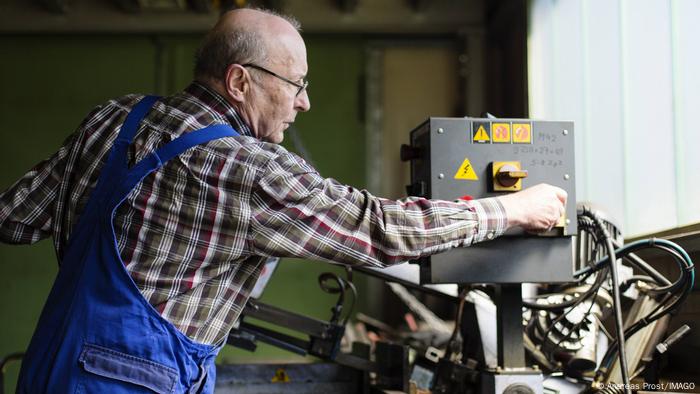
Germany is debating whether an ageing population can be expected to work longer
Germany is reporting a record number of job vacancies in the first quarter of this year the number jumped to an unprecedented 1.74 million open positions. That number was the highest since reunification 30 years ago.
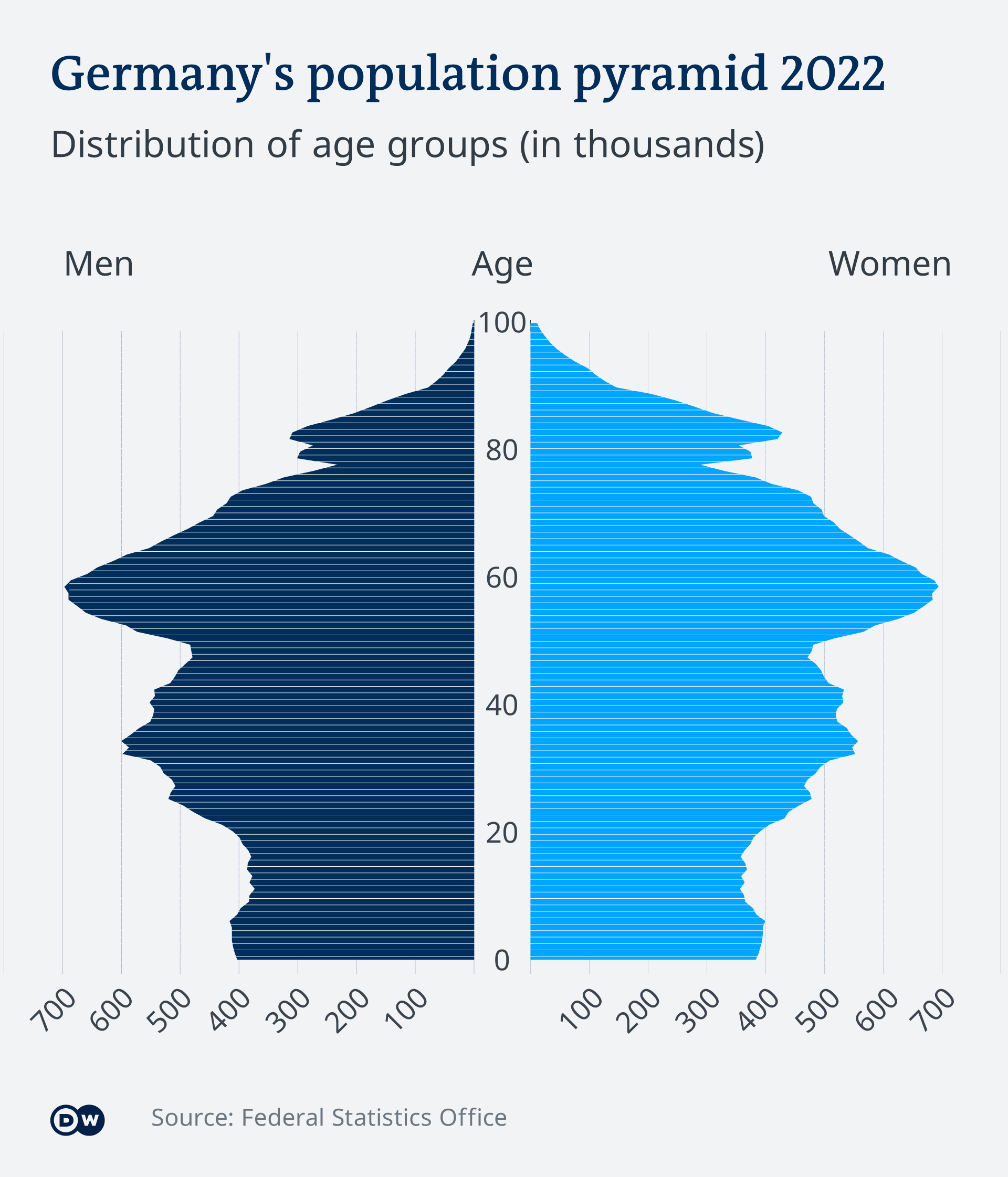
At the same time, Germany also has a record shortage of young people. According to the Federal Statistics Office in July, only 10% of the population is aged between 15 and 24, compared to 20% over the age of 65.
The country's birth rate is too low to compensate for the age shift. This also means that the state pension pot is under severe pressure.
One proposed solution is to raise the retirement age to 70. The president of the Federation of German Employers' Associations in the Metal and Electrical Engineering Industries Stefan Wolf called for this move at the beginning of August. And at summer vacation time the proposal quickly got picked up by national media.
Trade unions, social groups, and left-wingers reacted with fury, with the socialist Left Party's Dietmar Bartsch, calling the proposal "anti-social bullshit".
Currently, Germany is in the process of gradually raising its retirement age from the previous 65 to 67 for those born after 1967.
Pension system collapse predicted
Economists have been warning since as far back as the 1980s that Germany's pension system is facing imminent collapse.
In response, then Labor Minister Norbert Blüm from the center-right Christian Democratic Union (CDU) famously vowed "The pensions are safe" back in 1986. But is the same true today?
In Germany, pensions are predominantly financed through a so-called "pay-as-you-go" system where the majority of Germans — excluding civil servants and the self-employed — pay into the state retirement fund that is used to finance pensions for those who are already retired.
Employees currently contribute just over 9% of their monthly income to the fund. This figure is matched by their employer.
But this type of system only works on the assumption that there are enough working people paying into the state retirement fund to be able to cover current pension payments.
This is where an aging population becomes a problem.
The current Labor Minister Hubertus Heil from the center-left Social Democrats (SPD) has already rejected the idea of raising the retirement age and dismissed the current discussions as a "phantom debate."
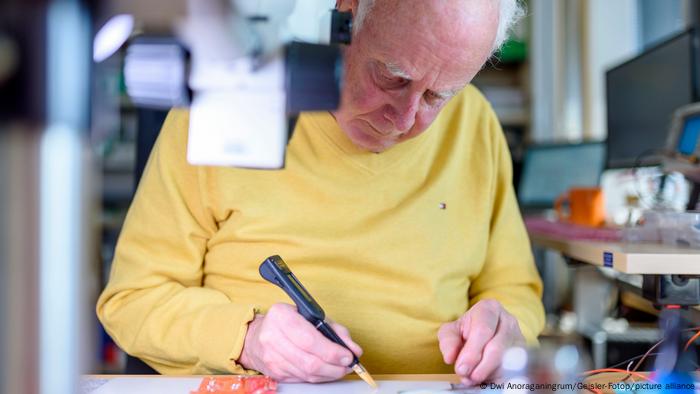
Many senior citizens have such low pensions, they already continue to work beyond retirement age
Mixed bag of proposals
"Raising the retirement age is always a very unpopular measure. That's why it is postponed as much as possible by politicians. But I could imagine that in the mid-2030s when we are stuck in the midst of demographic change, something will happen," says Johannes Rausch of the Munich Center for the Economics of Aging.
Rausch predicts that sooner or later — most likely later — the age of retirement will rise to reflect increasing life expectancy. This way, there would still be enough contributors to finance the system for pensioners, meaning that the contribution rate would have to be raised less and higher pensions could be paid out.
Germany would not be alone in introducing such a measure. The OECD predicts that the average age of retirement for an average person in continual employment will rise to 66.1 years for men and 65.5 years for women.
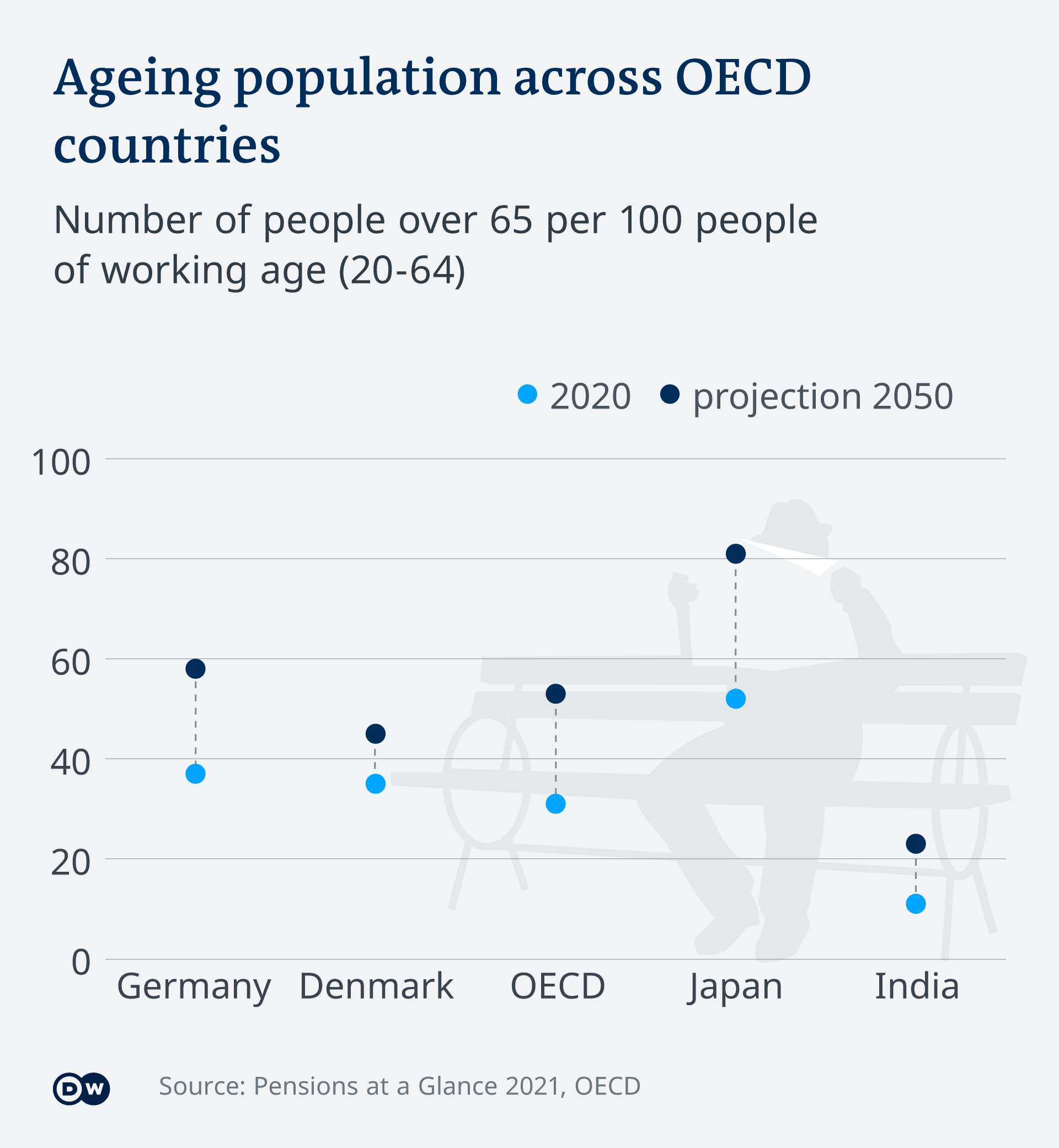
In countries where the retirement age is already linked to life expectancy, including Denmark, Italy, and Estonia, it is already becoming apparent the age of retirement will rise significantly.
Johannes Geyer, deputy head of Public Economics at the German Institute for Economic Research (Deutsches Institut für Wirtschaftsforschung), believes that the quantitative effect of raising the retirement age will be nominal.
"It is a distributional question; who bears the cost of demographic change? Raising the retirement age puts a lot of pressure on the working population," Geyer says. "People with low life expectancy, and those with health problems, will suffer more; a relevant part of the population dies before reaching retirement age."
He sees better potential solutions elsewhere.
"We need migration. It's essential that we have enough people coming from abroad to work in Germany," Geyer says.
"The government is trying to make it easier for migrants' qualifications from abroad to be recognized in Germany. We're also seeing some improvements in the regulations for asylum seekers and those on 'tolerated status' to help legalize their status and recognize vocational degrees and qualifications obtained outside of Germany. This is still a problem."

Many labor market researchers say increased immigration is the only way forward
Targeting part-timers and the long-term unemployed
There are also domestic potentials Geyer points to: "We have a large sector of people working in so-called mini-jobs, so marginal employment, which is poorly paid but not subject to tax or social security contributions. If we could move these people into regular jobs, then this would also help the system."
Geyer also sees the potential to get more unemployed people into work, as well as help to rehabilitate those who have been forced to retire on disability pensions due to illness. This applies to millions of individuals but many of them are unable to work full-time for a variety of reasons — ranging from health issues to caregiving commitments for family members.
Geyer suggests that civil servants and the self-employed, who currently pay into separate pension pots, could also be brought into the general state retirement system.
And finally, he points to another much-touted solution: to extend the working week to 42 hours.
But here, Geyer is skeptical. "I think in many sectors 40 hours is kind of the maximum you can expect people to work," he says. "If you increase working hours you have to take into account that people are already exhausted and those additional hours will add to this exhaustion and could have a negative impact on health."
Geyer believes people in work can expect to see a rise in contribution rates to the pension pot. He predicts a rise from the current 18.6% to well above 20% by 2025.
"Currently we have rather low [pension] contribution rates. Ten years ago nobody would have expected them to still be below 19%," Geyer says.
"Before the war [in Ukraine] and the increase in inflation I would have said we can afford to increase contribution rates, but given the high inflation, that will trigger a rather heated debate."
For now, Germany may still be taking its time to find a solution. But the likelihood is that demographic change will eventually force the country to act.
SEE LA REVUE GAUCHE - Left Comment: Search results for Pension system collapse
 |
| 1932 |
MEANS TESTING U$A
The rich are using long-term care funds meant for the poor
Set reasonable but increasingly ambitious goals for states — based on the best practices and experiences of successful states — for estate recovery efforts. If not met, these goals should be enforced by a penalty that reduces matching federal funds for Medicaid.
Require California to meet all current federal law requirements in this area, again enforced by a federal funding penalty.
Outlaw asset transfer techniques used by the wealthy.
These reforms would make Medicaid fairer, more sustainable and more consistent with the value of self-reliance — not government dependence by the well-to-do. It would also encourage the use of private insurance and increase asset accumulation. This is particularly important now, with an aging population, large and prospectively growing federal budget deficits and the impending exhaustion of funds for Social Security and Medicare in the next few years.
Mark Warshawsky is the Searle Fellow at the American Enterprise Institute and the vice chair of the 2013 Federal Commission on Long-term Care. This op-ed is based on his article “Steps to Make Long-Term Care Financing Fairer and More Sustainable” which appeared in the August 8, 2022 volume of Tax Notes Federal.
The rich are using long-term care funds meant for the poor
Mark Warshawsky, opinion contributor - Yesterday
Medicaid is a major payer for long-term care (extended-stay nursing home and home care for the disabled) in the United States. This health care program, intended for the poor and funded by federal and state governments, covers almost half of all long-term care spending, now nearly $500 billion a year.

The rich are using long-term care funds meant for the poor© Provided by The Hill
With the aging of the population and the declining birth rate, government spending on long-term care is expected to increase rapidly as people become disabled and family members providing free home care become rarer. These trends will cause Medicaid-provided long-term care to take up more and more of the government’s budget and national income. It is therefore important that Medicaid long-term care benefits be targeted to those who do not have the resources to pay for care, and not to those who have significant assets or the ability to purchase private insurance.
Unfortunately, several studies show that many older people with significant real estate and financial asset holdings get long-term care from Medicaid for free or at subsidized rates. These findings should not be surprising because, in many states, the rules and administration of the program are loose and porous, and little effort is made to recover assets from the estates of deceased Medicaid users, despite this being required by federal law. By my estimate every year almost $6 billion of Medicaid funds are inappropriately used for the long-term care of individuals with significant asset holdings. Breaking this amount down, almost $3 billion could be recuperated from enhanced estate recoveries and more than $3 billion from retirement assets.
Why is that? Because many states do not count retirement assets in assessing whether the individual is impoverished and eligible for Medicaid. By my estimate, this exemption alone amounts to a more than $3 billion loss to the government annually. Besides representing considerable resources for Medicaid, it is unfair because retirement assets, which have extensive tax advantages, are intended for spending on health and long-term care during old age, not for bequests. Also, despite federal law requirements, most states make little or no effort to recover assets from the estates of deceased Medicaid beneficiaries, whether real and financial.
Legislation introduced earlier this year by Rep. Jan Schakowsky (D-Ill.,) if passed, would worsen the problem by repealing the federal requirement that state Medicaid programs go after families and estates for repayment of long-term care services. In 2020, less than $700 million was recovered, which I estimate represents less than 3 percent of the $48 billion in total estates of deceased Medicaid beneficiaries in aggregate every year.
Of course, there are many (legally consistent) legitimate reasons which explain why some assets are not recoverable, but the superior results of states like Iowa and Idaho, which have 10 percent recovery rates by my estimate, show that much more can be done. California, which represents more than one-seventh of total U.S. economic activity, has yet to adopt the requirements of the 2005 federal law that tightened eligibility for Medicaid long-term care benefits. In fact, by removing all asset eligibility tests, California is seeking to move in the opposite direction. And despite several improvements to the 2005 law, there are still many techniques employed by lawyers of well-to-do families in all states which enable the transfer of assets to qualify their elderly disabled relatives for Medicaid.
I, therefore, recommend that Congress amend the law with the following rule changes:Count retirement assets in eligibility tests for Medicaid, as most states do, but some large states do not.
Medicaid is a major payer for long-term care (extended-stay nursing home and home care for the disabled) in the United States. This health care program, intended for the poor and funded by federal and state governments, covers almost half of all long-term care spending, now nearly $500 billion a year.
The rich are using long-term care funds meant for the poor© Provided by The Hill
With the aging of the population and the declining birth rate, government spending on long-term care is expected to increase rapidly as people become disabled and family members providing free home care become rarer. These trends will cause Medicaid-provided long-term care to take up more and more of the government’s budget and national income. It is therefore important that Medicaid long-term care benefits be targeted to those who do not have the resources to pay for care, and not to those who have significant assets or the ability to purchase private insurance.
Unfortunately, several studies show that many older people with significant real estate and financial asset holdings get long-term care from Medicaid for free or at subsidized rates. These findings should not be surprising because, in many states, the rules and administration of the program are loose and porous, and little effort is made to recover assets from the estates of deceased Medicaid users, despite this being required by federal law. By my estimate every year almost $6 billion of Medicaid funds are inappropriately used for the long-term care of individuals with significant asset holdings. Breaking this amount down, almost $3 billion could be recuperated from enhanced estate recoveries and more than $3 billion from retirement assets.
Why is that? Because many states do not count retirement assets in assessing whether the individual is impoverished and eligible for Medicaid. By my estimate, this exemption alone amounts to a more than $3 billion loss to the government annually. Besides representing considerable resources for Medicaid, it is unfair because retirement assets, which have extensive tax advantages, are intended for spending on health and long-term care during old age, not for bequests. Also, despite federal law requirements, most states make little or no effort to recover assets from the estates of deceased Medicaid beneficiaries, whether real and financial.
Legislation introduced earlier this year by Rep. Jan Schakowsky (D-Ill.,) if passed, would worsen the problem by repealing the federal requirement that state Medicaid programs go after families and estates for repayment of long-term care services. In 2020, less than $700 million was recovered, which I estimate represents less than 3 percent of the $48 billion in total estates of deceased Medicaid beneficiaries in aggregate every year.
Of course, there are many (legally consistent) legitimate reasons which explain why some assets are not recoverable, but the superior results of states like Iowa and Idaho, which have 10 percent recovery rates by my estimate, show that much more can be done. California, which represents more than one-seventh of total U.S. economic activity, has yet to adopt the requirements of the 2005 federal law that tightened eligibility for Medicaid long-term care benefits. In fact, by removing all asset eligibility tests, California is seeking to move in the opposite direction. And despite several improvements to the 2005 law, there are still many techniques employed by lawyers of well-to-do families in all states which enable the transfer of assets to qualify their elderly disabled relatives for Medicaid.
I, therefore, recommend that Congress amend the law with the following rule changes:Count retirement assets in eligibility tests for Medicaid, as most states do, but some large states do not.
Set reasonable but increasingly ambitious goals for states — based on the best practices and experiences of successful states — for estate recovery efforts. If not met, these goals should be enforced by a penalty that reduces matching federal funds for Medicaid.
Require California to meet all current federal law requirements in this area, again enforced by a federal funding penalty.
Outlaw asset transfer techniques used by the wealthy.
These reforms would make Medicaid fairer, more sustainable and more consistent with the value of self-reliance — not government dependence by the well-to-do. It would also encourage the use of private insurance and increase asset accumulation. This is particularly important now, with an aging population, large and prospectively growing federal budget deficits and the impending exhaustion of funds for Social Security and Medicare in the next few years.
Mark Warshawsky is the Searle Fellow at the American Enterprise Institute and the vice chair of the 2013 Federal Commission on Long-term Care. This op-ed is based on his article “Steps to Make Long-Term Care Financing Fairer and More Sustainable” which appeared in the August 8, 2022 volume of Tax Notes Federal.
SEE
Scientists have mapped the genetic code of the immortal jellyfish that can age in reverse after reaching adulthood
mloh@businessinsider.com (Matthew Loh) -

The T. dohrnii can reverse its aging process even after maturing to adulthood, returning to a polyp on the seafloor. Ian Gavan/Getty Images© Ian Gavan/Getty Images
Scientists have mapped the genome of T. dohrnii, a species of jellyfish that can reverse its aging.
They hope their findings will lead to a better understanding of how aging works.
After reaching adulthood, the jellyfish can then revert to its juvenile state.
Scientists in Spain have successfully mapped the genome of a species of jellyfish that can escape age-related death by returning to a juvenile state after reaching adulthood.
In their study published Monday in the peer-reviewed Proceedings of the National Academy of Sciences, the team writes that they hope their findings can provide clues toward understanding more about human aging and the health conditions we face as we age.
T. dohrnii, dubbed the immortal jellyfish, goes through a life cycle just like other species of jellyfish. In one of these stages, the jellyfish attach to the seafloor as a polyp — basically a stalk of tissue — and attempt to stay alive.
When conditions are right, they can reproduce asexually by cloning themselves and eventually turn into the jelly-like "medusa" shape that jellyfish are better known for.
Once most jellyfish reach this adult "medusa" stage, they can also start reproducing sexually by releasing sperm and eggs into the water. After this stage, the typical jellyfish would eventually die.
However, the T. dohrnii can reverse its aging process even after maturing to adulthood, returning to a polyp on the seafloor, the researchers said.
In a bid to discover how the T. dohrnii's immortality works, the researchers compared its genome to that of its cousin Turritopsis rubra, which doesn't have the same anti-aging ability. They said the T. dohrnii's genome had twice as many copies of genes associated with protecting and repairing DNA.
The team also discovered that the jellyfish had a unique mutation that allows it to prevent telomeres — the protective caps on the ends of chromosomes — from deteriorating. In humans, our telomeres tend to get shorter as we age.
Marine biologist Maria Pascual Torner, a lead author of the study, told The Wall Street Journal it's unlikely that humans one day can possess the same anti-aging ability as the T. dohrnii.
"It's a mistake to think we will have immortality like this jellyfish, because we are not jellyfish," said the postdoctoral researcher at the University of Oviedo, per the Journal.
Still, the results of the study could help us understand the mechanisms of aging in general, she told the outlet.
Monty Graham, a jellyfish expert and director of the Florida Institute of Oceanography, told Reuters that Torner's research has no immediate commercial value.
"We can't look at it as, hey, we are going to harvest these jellyfish and turn it into a skin cream," said Graham, who was not involved in the study, per Reuters.
mloh@businessinsider.com (Matthew Loh) -
The T. dohrnii can reverse its aging process even after maturing to adulthood, returning to a polyp on the seafloor. Ian Gavan/Getty Images© Ian Gavan/Getty Images
Scientists have mapped the genome of T. dohrnii, a species of jellyfish that can reverse its aging.
They hope their findings will lead to a better understanding of how aging works.
After reaching adulthood, the jellyfish can then revert to its juvenile state.
Scientists in Spain have successfully mapped the genome of a species of jellyfish that can escape age-related death by returning to a juvenile state after reaching adulthood.
In their study published Monday in the peer-reviewed Proceedings of the National Academy of Sciences, the team writes that they hope their findings can provide clues toward understanding more about human aging and the health conditions we face as we age.
T. dohrnii, dubbed the immortal jellyfish, goes through a life cycle just like other species of jellyfish. In one of these stages, the jellyfish attach to the seafloor as a polyp — basically a stalk of tissue — and attempt to stay alive.
When conditions are right, they can reproduce asexually by cloning themselves and eventually turn into the jelly-like "medusa" shape that jellyfish are better known for.
Related video: Jellyfish may be turned into crisps!Duration 1:07
Once most jellyfish reach this adult "medusa" stage, they can also start reproducing sexually by releasing sperm and eggs into the water. After this stage, the typical jellyfish would eventually die.
However, the T. dohrnii can reverse its aging process even after maturing to adulthood, returning to a polyp on the seafloor, the researchers said.
In a bid to discover how the T. dohrnii's immortality works, the researchers compared its genome to that of its cousin Turritopsis rubra, which doesn't have the same anti-aging ability. They said the T. dohrnii's genome had twice as many copies of genes associated with protecting and repairing DNA.
The team also discovered that the jellyfish had a unique mutation that allows it to prevent telomeres — the protective caps on the ends of chromosomes — from deteriorating. In humans, our telomeres tend to get shorter as we age.
Marine biologist Maria Pascual Torner, a lead author of the study, told The Wall Street Journal it's unlikely that humans one day can possess the same anti-aging ability as the T. dohrnii.
"It's a mistake to think we will have immortality like this jellyfish, because we are not jellyfish," said the postdoctoral researcher at the University of Oviedo, per the Journal.
Still, the results of the study could help us understand the mechanisms of aging in general, she told the outlet.
Monty Graham, a jellyfish expert and director of the Florida Institute of Oceanography, told Reuters that Torner's research has no immediate commercial value.
"We can't look at it as, hey, we are going to harvest these jellyfish and turn it into a skin cream," said Graham, who was not involved in the study, per Reuters.
Subscribe to:
Posts (Atom)