Tuesday, December 31, 2024


Maritime Trade Leads Revival of Ukraine's Export Economy
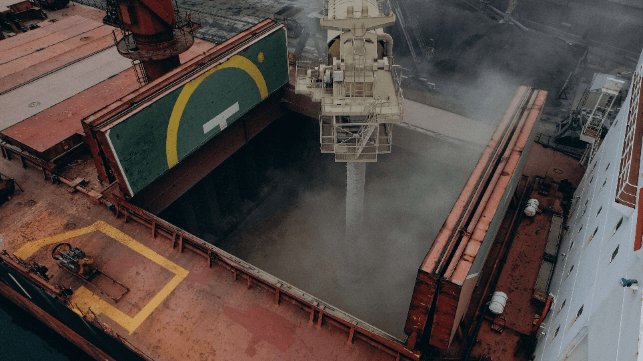
Odesa
Courtesy USAID / WFP

Published Dec 30, 2024 10:14 PM by The Maritime Executive


Ukraine's export economy posted a 13% increase in value and a 29% rise in tonnage, according to year-end data released by Ukraine's economy ministry. The war-torn nation exported 129 million tons of goods valued at $41 billion, outpacing 2023's figures of 100 million tons worth $36.1 billion - and the revival of Ukraine's maritime trade was the primary driver.

"The normalization of our seaport operations was key," said Yulia Svyrydenko, First Deputy Prime Minister and Minister of Economy. Maritime exports jumped from 55 million tons in 2023 to 87 million tons in 2024, despite repeated Russian attacks on maritime commerce in the Black Sea. 

Ukraine is heavily reliant on shipping to export its abundant agricultural production. Sunflower oil was the most valuable commodity this year, with exports worth over $5 billion, followed closely by corn ($4.9 billion). 

The European Union remained Ukraine's dominant trading partner and accounted for about 60 percent of the country's exports, worth $24.5 billion. Beyond Europe, Ukraine ships large quantities of grain and other products to China ($2.3 billion), Turkey ($2.1 billion), and Egypt ($1.6 billion). 

Ukraine's industrial sector has been badly battered by the Russian invasion, but its commercial export activity is showing signs of recovery. This year, semi-finished iron products brought in $927 million, while hot-rolled products generated $802 million in revenue. The manufacturing sector also made notable contributions, with cable producers exporting $1.26 billion worth of goods.

With renewed access to seaborne trade for bulk goods, Ukraine has improved the utilization of its landside links to the EU. Despite reduced road transport volume, the value of goods moved by truck increased to $14.5 billion this year, thanks to a shift toward higher-value exports.  


Ukraine Renews Drone Attacks on Sevastopol
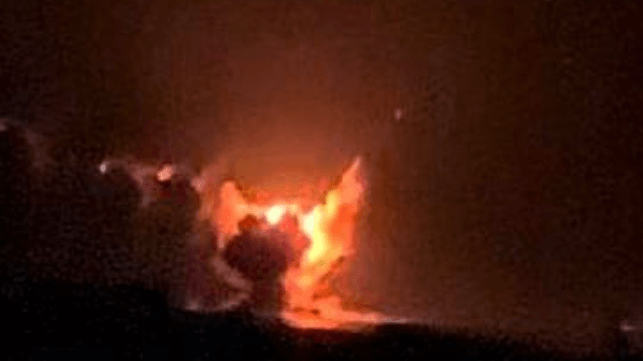
Blast
Image via Russian social media

Published Dec 30, 2024 8:56 PM by The Maritime Executive


The Russian-occupied port of Sevastopol, Crimea has come under renewed attack by Ukraine's drone forces after a monthslong lull. 

Three loud and heavy explosions were reported in Kozacha Bay late Monday night, and citizen journalists said that a large fire was burning in the area. Both aerial and maritime drone attacks were reported. 

Sevastopol's Russian-backed governor, Mikhail Razvozhaev, told state media that two Ukrainian aerial drones had been shot down over the Black Sea. He did not confirm local reports of large blasts. 

Kozacha Bay is located five miles southwest of the main harbor, which is more heavily protected by barriers and shore defenses. The bay is home to a large fuel depot, which Ukrainian forces targeted in April 2023. That attack was successful, resulting in a "level 4" fire and a major regional response. Three months later, Ukrainian forces hit and detonated a large munitions depot in the same area.  

Ukraine's suicide drone boats and guided missile strikes have been successful enough to drive most of the Black Sea Fleet out of Sevastopol. After losing corvettes, amphibs, missile boats, an attack sub and even a cruiser, the Russian Navy has largely withdrawn from the western half of the Black Sea and has concentrated its remaining forces in the relative safety of Novorossiysk, a port on the sea's northeastern corner.

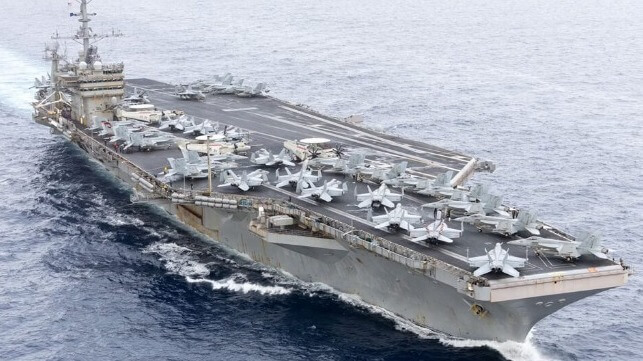
 

Houthis Claim Retaliatory Attack on Carrier Harry S. Truman in the Red Sea

Harry S. Truman aircraft carrier
Houthis claim to have attacked the U.S. carrier in the Red Sea (USN)

Published Dec 31, 2024 12:17 PM by The Maritime Executive


U.S. forces launched a series of new attacks on Houthi facilities in Yemen with the militants claiming to have stopped the attacks by targeting the carrier Harry S. Truman. U.S. CENTCOM appeared to confirm the attack mentioning in its report that seven cruise missiles and one-way attack UAVs were destroyed over the Red Sea.

On December 30 and 31, CENTCOM reports U.S. Navy ships and aircraft targeted a Houthi command and control facility as well as sites for the production and storage of advanced conventional weapons. The U.S. reported it had targeted both a location in the city of Sanaa and coastal locations. They also said a coastal radar site was destroyed.

CENTCOM cited the attacks on U.S. Navy warships and merchant vessels by the Houthi in the Red Sea and Gulf of Aden. The strikes yesterday and today followed similar strikes by the U.S. forces on December 21 when F/A-18s were launched against Houthi command and control targets along with operations by the U.S. Navy. During those strikes, CENTCOM also confirmed shooting down multiple Houthi one-way attack uncrewed aerial vehicles and an anti-ship cruise missile over the Red Sea. 

The Houthis’ spokesperson Yahya Saree released a statement today reporting their forces, “targeted the American carrier Harry S Truman with a large number of drones and cruise missiles while the American forces were preparing to launch a major air attack against our country.” He went on to assert, “the American air attack that was being prepared on our country was thwarted.”

The Houthis also alleged that they had targeted Israel’s Ben Gurion Airport and a power station south of Jerusalem with missiles. They claimed to have hit the power station with two rockets.

Israeli media did report that air raid sirens had been sounded in Central Israel last night, but the Israel Defense Forces reported that a missile had been shot down before it reached Israeli territory. After the repeated missile attacks, Israel has launched retaliatory strikes on Houthi positions while on Monday, its ambassador to the UN wanted that the country’s patience was running out. While calling for an international solution to the Houthis, Ambassador Danny Danon threatened the group with a "miserable fate" if the attacks continued. He compared the Houthis prospects to those of Hamas, Hezbollah, and Syria's Bashar al-Assad.


Video: Peru and Ecuador Pounded by High Waves Killing Two and Closing Ports

waves in Peru
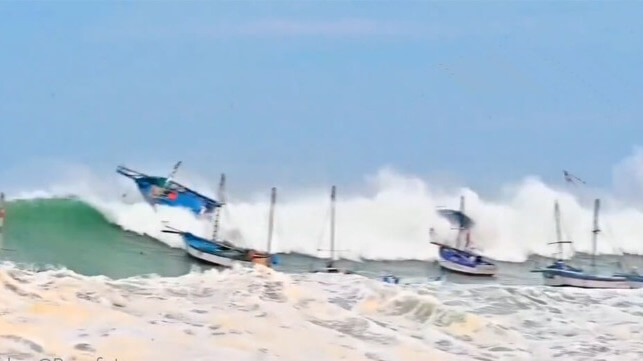
Massive waves three times normal crashing ashore in Peru (YouTube)

Published Dec 30, 2024 4:47 PM by The Maritime Executive


Officials in Peru and Ecuador are continuing to warn the public to stay away from the coast as massive waves several times the normal height are devastating the shoreline and washing inland. The phenomenon began on Christmas day and peaked on Friday and Saturday, December 27 – 28, but could continue until at least January 4. 

According to the reports coming from Peru, the massive waves have reached as high as 13 feet (4 meters) crashing into small fishing communities, popular tourist areas, and even flooding parts of Callao. In response, the government closed as many as 100 of the country’s 121 seaports. The worst of the impact is being felt in the northern reaches of the country.

Images from the peak of the waves show fishing boats being tossed around like toy boats. The Navy reported on Saturday, December 28, that it rescued as many as 30 fishermen trapped offshore while reports indicate at least 100, or possibly as many as 180 more remain stranded at sea. One fishing community in Peru is reporting that at least 100 boats were lost.


The waves were coming in at least three times the height usually seen along the coast and Navy Captain Enrique Varea warned on Sunday the waves might continue to intensify. Forecasters are saying they expected the waves would begin to modern by December 31 or January 1 but were likely to continue to impact the coastlines until at least January 4.

Asked to explain the phenomenon, Civil Defense officials pointed to climate change. A spokesperson told Agence France-Presse (AFP) it was being caused by a combination of strong winds blowing toward the coast from as far away as the United States. They said tides were also abnormally high. They dismissed reports of a freak wave, a tsunami, saying instead this was a persistent weather pattern. Furthermore, they predicted Peru would continue to experience more of this weather as global temperatures continue to rise.


Peru declared an environmental emergency last week after an oil shipment leaked into the ocean. Reuters reported that approximately 10,000 square meters of surface water had been impacted by the oil spill while the country’s environment ministry said it had affected at least seven beaches, as well as local wildlife. 

The holidays and the approaching New Year are normally a popular time for the coastal resorts. Report however said multiple destinations have been inundated by the waves destroying businesses. Ecuador reported that two people had been killed while Chile also said a body had been found on the beach. Peru, so far, has not confirmed any deaths associated with the waves.


Video: U.S. Coast Guard Rescue Swimmer Saves Two Fishermen

Desecheo Island rescue swimmer
Courtesy USCG

Published Dec 30, 2024 4:16 PM by The Maritime Executive


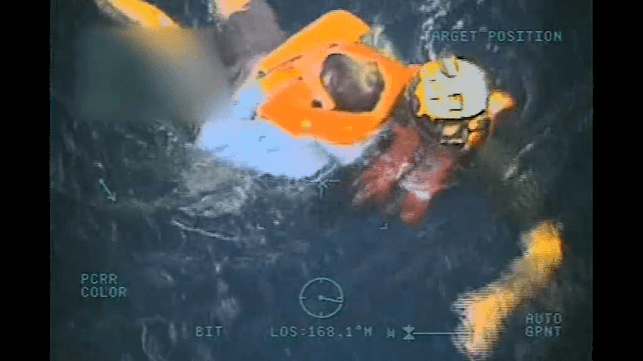
Over the weekend, a U.S. Coast Guard aircrew rescued two fishermen whose vessel capsized in rough weather off Desecheo Island, Puerto Rico. 

At about 1300 hours on Saturday, Sector San Juan received a DSC alert from an unregistered VHF radio. Shortly after, a good Samaritan called in a report of a disabled vessel off the coast of Desecheo Island. Three hours later, the sector's watchstanders received more specific information in the form of a Channel 16 distress call. The crew of a small fishing boat reported that their vessel was disabled off Desecheo Island, and that they had previously sent the DSC alert. 

A Coast Guard Auxiliary airplane crew out of Air Station Borinquen located the two men and their disabled vessel. Sector San Juan dispatched a Jayhawk helicopter air crew to the scene, and the rescuers arrived at about 1700. They were just in time: the boat was taking on water in 6-8 foot seas and winds of up to 30 knots, and it capsized five minutes after the helicopter arrived. 

The aircrew put their rescue swimmer in the water, and he safely transferred both survivors to a litter for hoisting, one after another. Both were delivered - uninjured but wet - to Air Station Borinquen. 

"Emergencies at sea can happen at any given moment. We recommend all mariners wear their life jackets and carry a marine grade radio as these men did, in case they encounter an unexpected situation at sea," said Lt. David Tirado Tolosa, Coast Guard Air Station Borinquen MH-60 aircraft commander. 


Video: Suez Canal Expands Two-Way Traffic as Part of Modernization Effort

Suez Canal
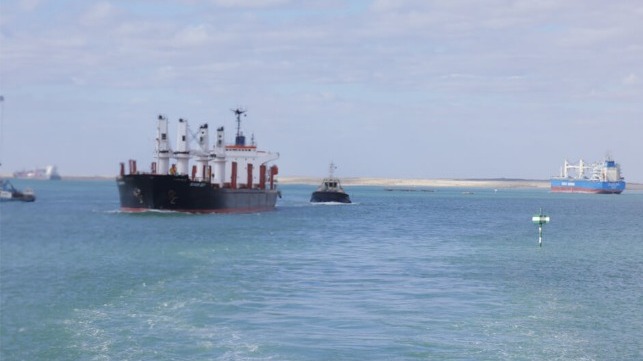
Vessels tested the new two-way navigation channels in Little Bitter Lake (Suez Canal Authority)

Published Dec 30, 2024 3:04 PM by The Maritime Executive


The Suez Canal Authority released images of a successful two-way traffic test in the southern part of the seaway. The Canal Authority is continuing to push forward with its efforts to improve navigation in the canal and capacity despite the year-long disruptions due to the Houthi attacks on shipping south of the Canal.

The latest effort will add just over six miles (10 km) of two-way traffic in the southern part of the canal in an area called Little Bitter Lake. It is south of Great Bitter Lake which has traditionally been used as a waypoint on the transit as the north and southbound convoys alternate in the narrower sections of the Suez.

The authority began to accelerate its efforts to modernize the canal after the 2021 incident with the Ever Given which blocked transit for a week and raised widespread fears for global shipping. The effort includes dredging and the creation of additional channel sections. According to the Chairman and Managing Director of the Authority, Admiral Ossama Rabiee the project is adding capacity and safety to the operation. He said it would help to reduce the impact of wind and currents, which was cited as one of the contributing factors to Even Given’s grounding and blocking of the canal.


Before conducting the test in the canal, they reported new navigation buoys had been established. They previously conducted trial maneuvers and simulations in the canal’s training facility. The bulk carriers Fu Xing Hai (38,800 dwt registered in Hong Kong) and Suvari Bey (23,900 dwt registered in St Vincent and Grenadines) transited through the new lane in Little Bitter Lake on Saturday, December 28. In the eastbound channel heading north, four vessels including the containership Mathilde Schulte (30,300 dwt registered in Singapore), the cargo ships COSCO Shipping Teng Da (61,600 dwt registered in China), and bulk carriers Yangtze Alpha (56,700 dwt registered in the Marshall Islands) and the Rui Fu Cheng (55,600 registered in Liberia) made the transit at the same time.


To ensure safety during the trial the Suez Canal Authority assigned two escort tugs to the area. They also used their most capable pilots to guide the vessels. The authority declared the test a success. The channel will be added to the route as soon as new navigation charts can be issued.

It is the latest step to prepare for the expansion of the canal with the SCA reporting this stretch provides the capacity for six to eight more vessels were day. At its peak the Suez Canal in 2023 set a new record handling nearly 60 vessels each in the north and southbound convoys in a day. When the expansion is completed, they will have added more than 18 miles (30 km) for additional lanes in the southern section of the canal.

Industry trade group BIMCO however in its year-end forecast for containership predicted that the disruptions and rerouting of ships away from the Suez Canal was likely to continue through most of 2025. They believe it will be 2026 before Egypt sees a full return of ships to the canal. Egypt’s President Abdel Fattah El-Sisi last Thursday, December 26, confirmed that the year-long attacks by the Houthi have cost Egypt around $7 billion in lost revenue from the Suez Canal. That is approximately 60 percent of the canal’s annual revenues but he said the modernization and expansion would continue.

The Suez Canal Authority also highlights that the program also prepares the canal to accommodate larger vessels. In addition, it provides greater flexibility and the capabilities to better respond to future emergencies in the canal.

Guyana Won’t Ask Exxon to Renegotiate Contract, President Says


(Bloomberg) -- Guyana’s President Irfaan Ali on Tuesday firmly ruled out formally asking Exxon Mobil Corp. to renegotiate its production contract, resisting calls from his political opposition and activists in the country. 

“We don’t need any official response,” he said in a news conference, referring to whether the country would seek consent from the oil major to renegotiate the terms, as outlined in the 2016 Production Sharing Agreement.

“We respect the sanctity of contracts,” Ali said, adding that his government was keen on ensuring investors not to pull out from investments in the nation. 

ExxonMobil Guyana President Alistair Routledge had already publicly stated that there would be no renegotiation. His comments were in response to plans by the opposition to do so if it wins the 2025 general elections.

©2024 Bloomberg L.P.


Tankers Sanctioned by U.S. are Part of a False Flag Operation Says Guyana

tanker at sea
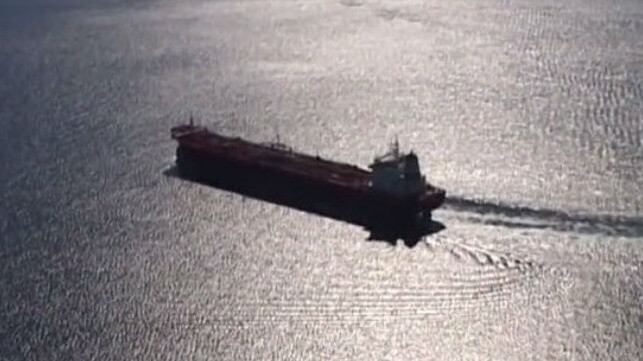
Guyana links five tankers to false flag operation (file photo)

Published Dec 30, 2024 1:54 PM by The Maritime Executive


The Maritime Administration Department of the South American country of Guyana declared that five tankers recently sanctioned by the United States are “false and fraudulent registrations.” The government reports it is aware of the operation saying the perpetrators are targeting several countries and that it has alerted maritime authorities.

The U.S. Department of the Treasury’s Office of Foreign Assets Control sanctioned on November 14, 26 companies, individuals, and vessels that it said were associated with a Syrian company responsible for generating hundreds of millions of dollars for Iran through the sale of oil to Syria and China. Among the 13 tankers listed were five that were identified as registered in Guyana.

“These ships are not registered in Guyana,” the Maritime Administration Department declared in a statement dated December 26. “They are false and fraudulent registrations,” they reported.

The authorities in Guyana highlighted that the country operates a closed registry. They state that the registry is limited to ships owned by Guyanese nationals, residents, citizens of the Caribbean Community states, and corporations established under the laws of Guyana. They reported none of the five tankers that claimed to be under the flag of Guyana falls into any of those categories. 

The U.S. stated that the vessels were controlled by the Syria-based Al-Qatirji Company, which was arranging for the export of millions of barrels of Iranian oil. They said the oil was traced to Syria and East Asia, including China, and the proceeds were being used to finance Iran and the Houthis. The U.S. called the company one of the main financial channels for Iran’s Islamic Revolutionary Guard Corps-Qods Force. They said the company was also involved in money laundering through major cities such as Istanbul and Beirut.

Four aging crude oil tankers were listed as under the flag of Guyana as well as a product tanker. One crude oil tanker, Ramona I (164,445 dwt) built in 2002, was reported to be owned by a company registered in Panama. Another of the tankers, Mia (149,686 dwt) built in 1993, was listed as owned and operated by a company based in the Seychelles. The third crude oil tanker Lia (146,273 dwt) built in 1996 was traced to a company in the Marshall Islands. The ownership of the last crude oil tanker, Chloe (159,539 dwt) built in 1999 was not identified.

The product tanker was the most mysterious of the group with the U.S. identifying it as Baron (46,166 dwt) built in 1995 and managed by a company in Lebanon. Databases such as Equasis list the vessel as Daran and report it is registered in Iran. Equasis flags the four crude oil tankers as all displaying a false flag.

The officials in Guyana reported that they have been aware of incidents of false registrations since 2021. It is not the first time they have warned of fraudulent registrations. In May 2024, the authorities blamed an unauthorized group for placing ships in the registry without proper authorization.

“The perpetrators of this fraud have targeted several countries including Guyana, Panama, and regional states,” the Maritime Administration Department reports. They said they are sharing details about these false registrations with relevant regional and international maritime associations.

The government of Guyana asserts that there is no effort to operate or have a separate ship registry. They asserted the country does not offer a flag of convenience and that it continues to take steps to protect the sovereignty and integrity of Guyana.


Migrant Boat's Crew Accused of Killing Four Passengers

Salvamento Maritimo
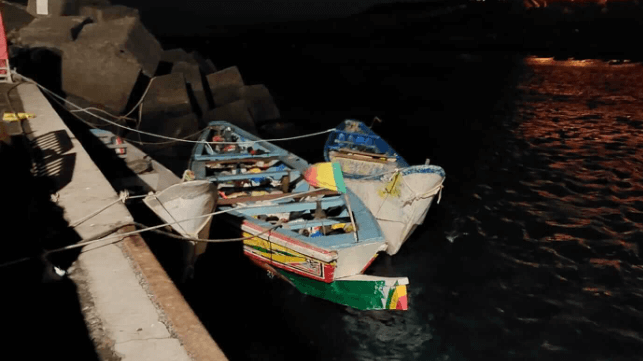
Migrant boats at Tenerife (File image courtesy Salvamento Maritimo)

Published Dec 29, 2024 11:08 PM by The Maritime Executive


Seven individuals stand accused of operating a migrant vessel and murdering four of its passengers on a voyage to the Canary Islands, authorities on Tenerife announced Sunday. 

On November 3, an African migrant vessel arrived on the island of El Hierro carrying 207 foreign asylum-seekers. The passengers told local officials that the boat had originated in the Gambia, but most of the passengers boarded at Bassoul, Senegal before making the 800 nautical mile voyage north to the Canary Islands. 

In the middle of the voyage, the crew of the migrant vessel decided that one passenger had become a problem. "The reason was that one of the occupants, possibly affected by the harshness of the journey, suffered an episode of disorientation, causing the three captains to blame him for the misfortune of the journey," Spain's Guardia Civil said in a statement.

The crew beat the man, according to witnesses, along with other passengers who stepped in to defend him. The police allege that the crew murdered four of the passengers "to frighten the migrants on the boat." One more passenger was hospitalized with a deep chest wound, possibly caused by a stabbing attack. 

Three of the victims have been identified, and their families have been notified. The fourth victim's identity is still under investigation. 

Long-distance maritime migration from Africa to the Canary Islands is on the rise this year. As of late December, more than 45,000 foreign nationals have arrived in the Spanish archipelago since the start of the year, including more than 600 people on Dec. 28 alone. 

NGO Caminando Fronteras estimates that nearly 10,000 asylum seekers have died at sea while attempting to reach the Canary Islands this year, suggesting a tragically high fatality rate - far higher than that on the Central Mediterranean route to Italy. 


Cost Remained Offshore Wind's Key Challenge in 2024

iStock wind farm
iStock

Published Dec 29, 2024 11:22 PM by The Maritime Executive


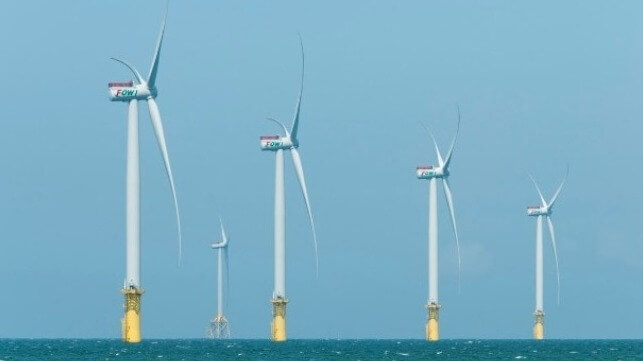
2024 could be characterized as another year of recovery for the offshore wind sector, which is still working through inflationary pressures from the Covid pandemic period. Amidst headwinds in the U.S. and EU, the Asia-Pacific (APAC) region is now the world’s largest wind market, with more than 51 percent of global total wind power installations by the end of 2023. The region is expected to make up 61 percent of the new installations worldwide from 2024-2030.

Despite encouraging news in the sector this year, major challenges are still slowing the deployment rate. To hit industry targets of about 500 GW by 2030, cost reduction in the offshore wind sector must be the top agenda.

“It is my 22nd year in the industry and I have never been so concerned about our future. Offshore wind costs are stuck in their post-Covid highs, roughly 30 percent up from pre-pandemic levels, a case in point being Hornsea contracts for difference (CfD) prices. The cost of our only long-term competition, solar PV and battery energy storage system (BESS), have more than halved in this period,” commented Chris Lloyd, a UK-based offshore wind expert.

Fortunately, some of the factors driving up the cost for offshore wind development could be easily resolved, especially by streamlining policy, experts say. Take the case of seabed access, which remains prohibitive for many developers. Numerous reports have indicated that the costs embedded in seabed lease agreements have been trending upward in the past decade - and could be reduced.

Chris Lloyd also argues that governments should stop asking the offshore wind sector to take steps that others do not. For example, the cost associated with some risk mitigation measures such as offshore bird boxes appear as a constraint to some developers. Lloyd argues that these offshore wind regulations appear to force the sector to solve wider environmental, economic and social issues, which is not the case with other technologies.


China Delivers Advanced Capability Offshore Wind Installation Vessel

China wind turbine installation vessel
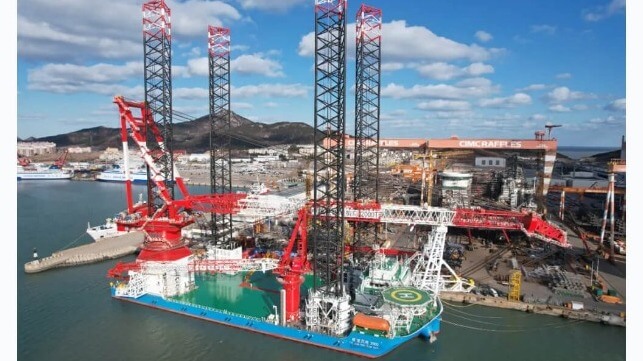
Wind turbine instalaltion vessel designed to handle 20 MW and larger turbines (CIMC Raffles)

Published Dec 30, 2024 5:53 PM by The Maritime Executive


Chinese officials hailed the newly built Tiejian Wind Power 2000 as the “most advanced fourth-generation self-elevating” wind power installation vessel in China. Delivered on December 28, the vessel is designed to place the largest wind turbines including ones with a capacity of over 20 MW.

The vessel was built by CIMC Raffles and will operate from Tiejian in northern China. It was built to support the offshore wind installation efforts with the reports calling it the largest single equipment investment and construction project in the history of the industry. 

The vessel is 445 feet (136 meters) in length with a beam of 174 feet (53 meters) which will give it over 5,000 square feet of deck space for the assembly and installation of the massive wind turbines. One of the critical elements is a 2,000-ton pile-circling full-slewing crane placed at the stern of the vessel. It has a reach of over 540 feet in height.

The capabilities mean the vessel will be able to handle with ease the new 20 MW turbines that China is pushing forward in developing. Prototype testing is already underway on the newest large-capacity wind turbines. 

Because they anticipate these new turbines will be placed further out to sea in more challenging locations, the new vessel can operate at ocean depths of over 260 feet (80 meters). The vessel is powered with three fully rotating stern thrusters as well as three side thrusters. It is fully self-propelled with speeds up to 8 knots. It also features the latest dynamic positioning technology.

With the combination of lifting capacity, lifting height, and operating water depth, Chinese officials highlight the vessel adds a new capability in the industry. They are calling the vessel a heavyweight in offshore wind farm development.

ECOCIDE

Shell's Singapore Refinery Suffers Second Leak in Three Months

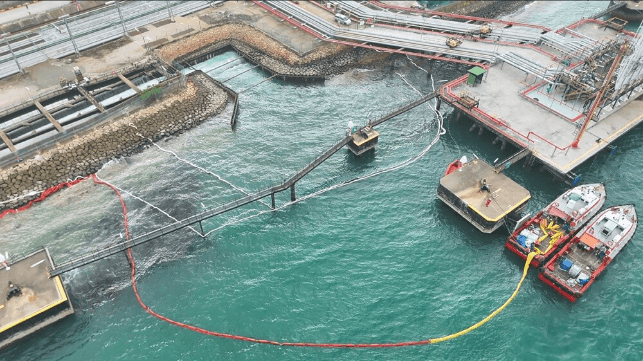
Spill at Shell refinery
Courtesy MPA Singapore

Published Dec 30, 2024 3:11 PM by The Maritime Executive


For the second time since October, the Shell refinery at Pulau Bukom, Singapore has sprung a leak. This time, a processing unit released oil products into the marine environment via its cooling water system. 

On December 27, Shell told the Maritime and Port Authority of Singapore (MPA) and National Environment Agency (NEA) that it had shut down one of its oil processing units at the Shell Energy and Chemicals Park at Pulau Bukom because of a suspected leak. The unit in question produces diesel and other refined products, and it uses cooling water from the sea. Shell estimated that several tonnes of refined products reached the water via a cooling water discharge outlet in a confined channel. 

To address the spill, the refinery deployed containment booms and sorbent booms, along with dispersant spray. It also turned on a built-in skimmer system that is permanently installed in the channel, and boomed off the channel inlet to prevent the spread of the spill to the open sea. 

The MPA and Shell also dispatched response boats to clean up light sheening off Pulau Bukom using dispersants and absorbent booms. For now, the agency continues to monitor the area via drone surveillance and satellite imagery. As an extra precaution, absorbant booms were deployed on the popular beaches of Sentosa and at nearby Sisters' Islands Marine Park; however, no slicks have reached these areas so far, and there has been no interruption in public access.  

On December 28, Shell confirmed that the leak was contained and that there was no more petroleum going into the cooling water discharge. The exact source of the leak is still under investigation. 
 
Singapore's NEA is investigating the release, and it said in a statement that it will take regulatory action if it discovers any noncompliance. 
 
This leak was the second at the massive refinery complex in three months. A land-based slop pipeline between Bukom Island and Bukom Kecil sprung a leak on 20 October 2024. The effluent overtopped a holding area and about 30 tonnes of oil-water mixture entered the sea between the two islands; the spill was contained and was quickly cleaned up. 

Shell Energy and Chemicals Park Singapore is the British company's largest wholly-owned refining complex. It has been in operation since 1961; Shell sold it to Glencore and Chandra Asri Capital earlier this year, but the transaction has not yet been finalized. 


North Atlantic Right Whales Die Decades Earlier Than Antarctic Cousins

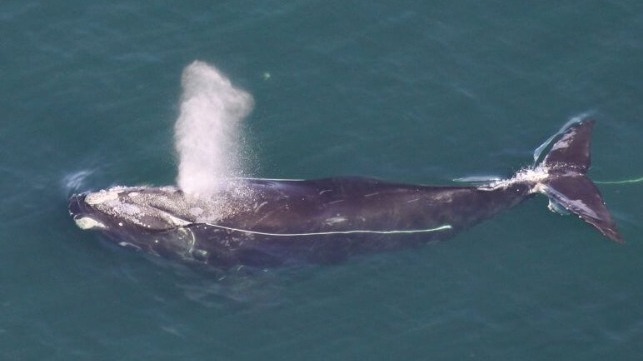
A North Atlantic right whale trails a length of line from fishing gear (NOAA file image)

Published Dec 29, 2024 6:24 PM by The Conversation


[By Greg Breed and Peter Corkerton]

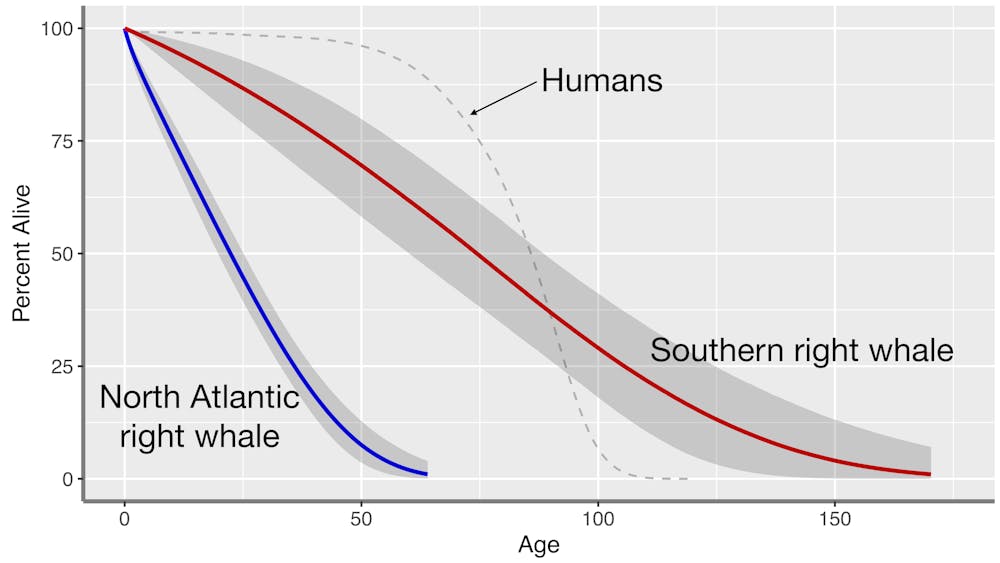
Southern right whales have lifespans that reach well past 100 years, and 10% may live past 130 years, according to our new research published in the journal Science Advances. Some of these whales may live to 150. This lifespan is almost double the 70-80 years they are conventionally believed to live.

North Atlantic right whales were also thought to have a maximum lifespan of about 70 years. We found, however, that this critically endangered species’ current average lifespan is only 22 years, and they rarely live past 50.

These two species are very closely related – only 25 years ago they were considered to be one species – so we’d expect them to have similarly long lifespans. We attribute the stark difference in longevity in North Atlantic right whales to human-caused mortality, mostly from entanglements in fishing gear and ship strikes.

Survivorship curves show female right whales can live to very old ages, but humans are causing North Atlantic right whales to die well short of their potential. Plotted for comparison is the U.S. survivorship curve for women as estimated by the Social Security Adminstration. Greg Breed

We made these new age estimates using photo identification of individual female whales over several decades. Individual whales can be recognized year after year from photographs. When they die, they stop being photographically “resighted” and disappear. Using these photos, we developed what scientists call “survivorship curves” by estimating the probability whales would disappear from the photographic record as they aged. From these survivorship curves, we could estimate maximum potential lifespans.

Twenty-five years ago, scientists working with Indigenous whale hunters in the Arctic showed that bowhead whales could live up to and even over 200 years. Their evidence included finding stone harpoon points that hadn’t been used since the mid-1800s embedded in the blubber of whales recently killed by traditional whalers. Analysis of proteins from the eyes of hunted whales provided further evidence of their long lifespan. Like right whales, before that analysis, researchers thought bowhead whales lived to about 80 years, and that humans were the mammals that lived the longest.

In the years following that report, scientists tried to figure out what was unique about bowhead whales that allowed them to live so long. But our new analysis of the longevity of two close relatives of bowheads shows that other whale species also have potentially extremely long lives.

Why it matters

Understanding how long wild animals live has major implications for how to best protect them. Animals that have very long lifespans usually reproduce extremely slowly and can go many years between births. Baleen whales’ life history – particularly the age when females start breeding and the interval between calves – is strongly influenced by their potential lifespan. Conservation and management strategies that do not plan accordingly will have a higher chance of failure. This is especially important given the expected impacts of climate disruption.

What still isn’t known

There are many other large whales, including blue, fin, sei, humpback, gray and sperm whales. Like bowhead and right whales, these were also almost wiped out by whaling. Scientists currently assume they live about 80 or 90 years, but that’s what we believed about bowhead and right whales until data proved they can live much longer.

How long can these other whale species live? Industrial whaling, which ended only in the 1960s, removed old whales from the world’s whale populations. Though many whale populations are recovering in number, there hasn’t been enough time for whales born after the end of industrial whaling to become old.

It’s possible, even likely, that many other whale species will also prove to have long lifespans.

What other research is being done

Other research finds the loss of older individuals from populations is a phenomenon occurring across most large animal species. It diminishes the reproductive potential of many species. Researchers also argue this represents a real loss of culture and wisdom in animals that degrades their potential for survival in the face of changing conditions.

What’s next

We want to better understand how whaling affected the number of old individuals in current whale populations and predict when the number of old individuals will recover to prewhaling levels. Preliminary results suggest it may be another 100 years before whale populations truly recover, even for species whose populations now number as many as there were before whaling.

For North Atlantic right whales, our research shows that even when the population was increasing, the management actions taken were insufficient to prevent these whales from dying far too young.

Greg Breed Associate Professor of Quantitative Ecology at University of Alaska Fairbanks.

Peter Corkeron is an Adjunct Senior Research Fellow, Centre for Planetary Health and Food Security, Griffith University.

This article appears courtesy of The Conversation and may be found in its original form here

The Conversation

The opinions expressed herein are the author's and not necessarily those of The Maritime Executive.