Tuesday, June 17, 2025

ARACHNOLOGY

Tarantulas bend rules to keep running after losing two legs


Despite losing two limbs, tarantulas run as fast as they did before by bending the rules and alternating between running like an ant and limping


The Company of Biologists


It might be hard to imagine, but dropping a limb or two is routine for spiders. If moulting goes wrong or a leg gets stuck, the pragmatic arachnids simply detach the limb just beyond the body joint. Then it regrows within a month when they are young. But how do impaired spiders cope when suddenly relieved of a couple of limbs? Capturing dinner and evading predators could become an issue. However, going down from eight to six legs might not be a problem if spiders are adaptable. Maybe they relearn how to manoeuvre on just six legs and get better at recovering after losing limbs multiple times; some insects are even capable of trotting on fewer limbs immediately after the loss. Curious to find out, Tonia Hsieh, Brooke Quinn and Sarah Xi (Temple University, USA) investigated how well Guatemalan tiger rump tarantula (Davus pentaloris) spiderlings recover their mobility when relieved of two limbs. Publishing their research in Journal of Experimental Biology, Hsieh and colleagues reveal that tarantulas do not relearn how to run after losing limbs. Instead they mix up a combination of different walking styles to compensate and run as fast as they did before losing their limbs.

Quinn and Xi gently adhered the front right and rear left legs to a piece of card, waited for the young tarantulas to detach their limbs and then filmed the animals immediately from above, capturing every detail of the arachnids’ footwork as they scampered away. Then they allowed the animals to regrow their limbs, filming them running with eight intact limbs, before encouraging the tarantulas to shed their limbs once more and filming their manoeuvres again. But with over 43,000 movie frames and more than 800 strides to analyse, Hsieh needed help to get to the bottom of what the tarantulas were up to, so she teamed up with physicists Suzanne Amador Kane and Kris Wu from Haverford College, USA, and mathematician Michael Ochs from The College of New Jersey. ‘Suzanne is an incredible out-of-the-box thinker’, says Hsieh, adding, ‘I don’t know of anyone else who could have come up with the novel approach for this analysis and then written up code to execute it’.

Immediately after losing their limbs the tarantulas seemed to pick up running as fast as they had before, which was impressive. In addition, they recovered the ability just as quickly after the second amputation, so they weren’t learning how to run on just six legs better after the second loss. Apart from splaying their legs wider, twisting their bodies a little more to one side and weaving increasingly, they were still as mobile. However, when Amador Kane, Wu and Ochs took a close look at the spiders’ footwork, it was evident that the arachnids are remarkably adaptable.

Hsieh explains that spiders with a full set of legs should alternate between having four feet (the first and third on one side, the second and fourth on the other) in contact with the ground at any one time. And six-legged tarantulas should, in theory, have two options: alternating between having four and two legs in contact with the ground – as if limping when on two alone – or alternating between using three legs touching the floor at a time, like an ant. In practice, the spiders rarely followed these rules. Tarantulas with all eight legs sometimes left a leg lingering on the ground as the next four descended, or raised the fourth limb early, leaving just three in contact. The spiders that were down two legs alternated randomly between limping forward on two and running like an ant on sets of three legs to keep moving fast. And the tarantulas seemed to favour their hind legs, which are mainly used for propulsion, keeping them grounded for longer when down to six limbs.

So, tarantulas don’t relearn how to run after losing limbs, and they bend the rules – alternating between limping and running like ants – to continue scampering without missing a beat.

***********************

IF REPORTING THIS STORY, PLEASE MENTION JOURNAL OF EXPERIMENTAL BIOLOGY AS THE SOURCE AND, IF REPORTING ONLINE, PLEASE CARRY A LINK TO: https://journals.biologists.com/jeb/article-lookup/doi/10.1242/jeb.250243

The research article is freely available at https://journals.biologists.com/jeb/article-lookup/doi/10.1242/jeb.250243

REFERENCE: Kane, S. A., Quinn, B. L., Wu, X. K., Xi, S. Y., Ochs, M. F. and Hsieh, S. T. (2025). Unsupervised learning reveals rapid gait adaptation after leg loss and regrowth in spiders. J. Exp. Biol. 228, jeb250243. doi:10.1242/jeb.250243

DOI: 10.1242/jeb.250243

This article is posted on this site to give access to other authorised media who may wish to report on this story. Full attribution is required and if reporting online a link to https://journals.biologists.com/jeb is also required. The story posted here is COPYRIGHTED. Advance permission is required before any and every reproduction of each article in full from permissions@biologists.com.

System adapted: Researchers now able to precisely analyze bonobo facial expressions


Universität Leipzig


Researchers have successfully adapted an existing coding system for human facial expressions to systematically analyse the facial expressions of bonobos. Their findings, recently published in PeerJ, confirm that bonobos possess a repertoire of 28 distinct facial movements, of which 22 are triggered by specific muscle actions. This development opens up new opportunities for understanding how these endangered great apes communicate with one another – and how their expressions differ from those of humans.

The study was conducted by an international team of scientists from institutions in Germany, Switzerland, France, the United States, and the United Kingdom, led by Dr Catia Correia-Caeiro from Leipzig University’s Institute of Biology and researchers from the Max Planck Institute for Evolutionary Anthropology.

One of their findings is that although bonobos display fewer facial movements than humans, they share a similar repertoire with another closely related species – chimpanzees. According to the researchers, this similarity points to the importance of facial communication in the social interactions of both species. To enable this comparison, the team extended the existing Chimpanzee Facial Action Coding System (ChimpFACS) to include bonobos. “This adaptation of ChimpFACS for bonobos fills an important gap in our ability to study facial expressions across different primate species,” says Correia-Caeiro. “We can now systematically compare facial movements in humans, chimpanzees and bonobos – providing new insights into the evolution of facial communication.”

The new coding system, which was originally developed for humans and previously adapted for nine other animal species, is not limited to academic research, according to Correia-Caeiro. “This tool will be especially valuable for assessing the welfare of bonobos in human care. By better understanding their facial expressions, we can more accurately evaluate their emotional states and overall well-being,” says the biologist. Facial Action Coding Systems (FACS) are tools used to measure animal facial behaviour in a detailed and objective way by coding independent muscle movements known as action units (AUs). The use of FACS has already led to several new findings in the field of animal communication – for example, that orangutans and gibbons use their faces flexibly and intentionally during play with others in order to influence the course of the interaction.
Bonobos and chimpanzees have similar facial muscles but differ in their facial morphology – for example, in species-specific features such as lip and eyelid colouring or the size of the brow ridge. These differences can affect how individual muscle movements are identified and measured. “They must be taken into account when studying facial expressions in both species – something that is possible with FACS,” explains Correia-Caeiro.

The human FACS has been used for over 40 years in research and in the creation of realistic facial expressions for animated films, as well as in clinical settings to help diagnose psychiatric and psychological conditions.

The researchers also recorded short video clips of individual muscle movements in bonobos to document the morphological differences in facial expressions between the two species. Future users of the tool can now be trained to recognise these muscle movements in bonobos and study their facial behaviour. “This tool will be available online and free of charge to anyone interested in learning more about bonobo facial expressions – even those with no prior experience with the species or the tool,” says Dr Correia-Caeiro. She adds that it can be used not only by researchers to explore empirical questions about the evolution of human communication and emotions, but also by veterinarians and animal care staff to help assess animal welfare.

Journal

Method of Research

Subject of Research

Article Title

Article Publication Date

 SPACE/COSMOS

Distant super-massive black hole shows high velocity sign of over-eating


University of Leicester scientists describe how the capture of new matter formed a ring around the black hole, before being partly swallowed by the hole, with excess matter ejected as a high velocity wind


University of Leicester


A new University of Leicester study shows how the uncontrolled growth of a distant Supermassive Black Hole (SMBH) is revealed by the ejection of excess matter as a high velocity wind.

Published in Monthly Notices of the Royal Astronomical Society (MNRAS), it describes for the first time how the black hole’s ‘over-eating’ of new matter led to the excess being ejected at nearly a third of the speed of light.

Powerful outflows of ionized gas have been a major interest of ESA’s XMM-Newton X-ray Observatory since first detected by Leicester X-ray astronomers in 2001, and subsequently recognized as a characteristic feature of luminous AGN.

A black hole is formed when a quantity of matter is confined in a sufficiently small region that its gravitational pull is so strong that nothing - not even light – can escape. The size of a black hole scales with its mass, being 3km in radius for a solar mass hole.

Real – astrophysical - black holes of stellar mass are common throughout the Galaxy, often resulting from the violent collapse of a massive star, while a supermassive black holes (SMBH) may lurk in the nucleus of all but the smallest external galaxies.

University of Leicester scientists conducted a 5-week study of an SMBH in the distant Seyfert galaxy PG1211+143 in 2014, about 1.2 billion light years away, using the ESA’s XMM-Newton Observatory, finding a counter-intuitive inflow that added at least 10 Earth masses to the black hole’s vicinity (MN 2018), with a ring of matter accumulating around the black hole being subsequently identified by its gravitational redshift (MN 2024).

The final part of this story now reports a powerful new outflow at 0.27 times the speed of light, launched a few days later, as gravitational energy released as the ring is drawn towards the hole heats the matter to several million degrees, with radiation pressure driving off any excess.

Professor Ken Pounds from the University of Leicester School of Physics and Astronomy, lead author of the three papers, commented: “Establishing the direct causal link between massive, transient inflow and the resulting outflow offers the fascinating prospect of watching a SMBH grow by regular monitoring of the hot, relativistic winds associated with the accretion of new matter.”

PG1211+143 was a target of University of Leicester X-ray astronomers, using the ESA’s XMM-Newton Observatory, from its launch in December 1999. An early surprise was detecting a fast-moving, counter-intuitive outflow, with a velocity 15% of light (0.15c), and the power to disrupt star formation (and hence growth) in the host galaxy. Later observations found such winds to be a common property of luminous AGN.

The availability of simultaneous ultra-violet fluxes from the Neil Gehrels Swift Observatory, a NASA mission which Leicester hosts the UK Swift Science Data Centre for, was – and will remain - critical in understanding the accretion process in SMBH.

Two European satellites mimic total solar eclipse as scientists aim to study corona

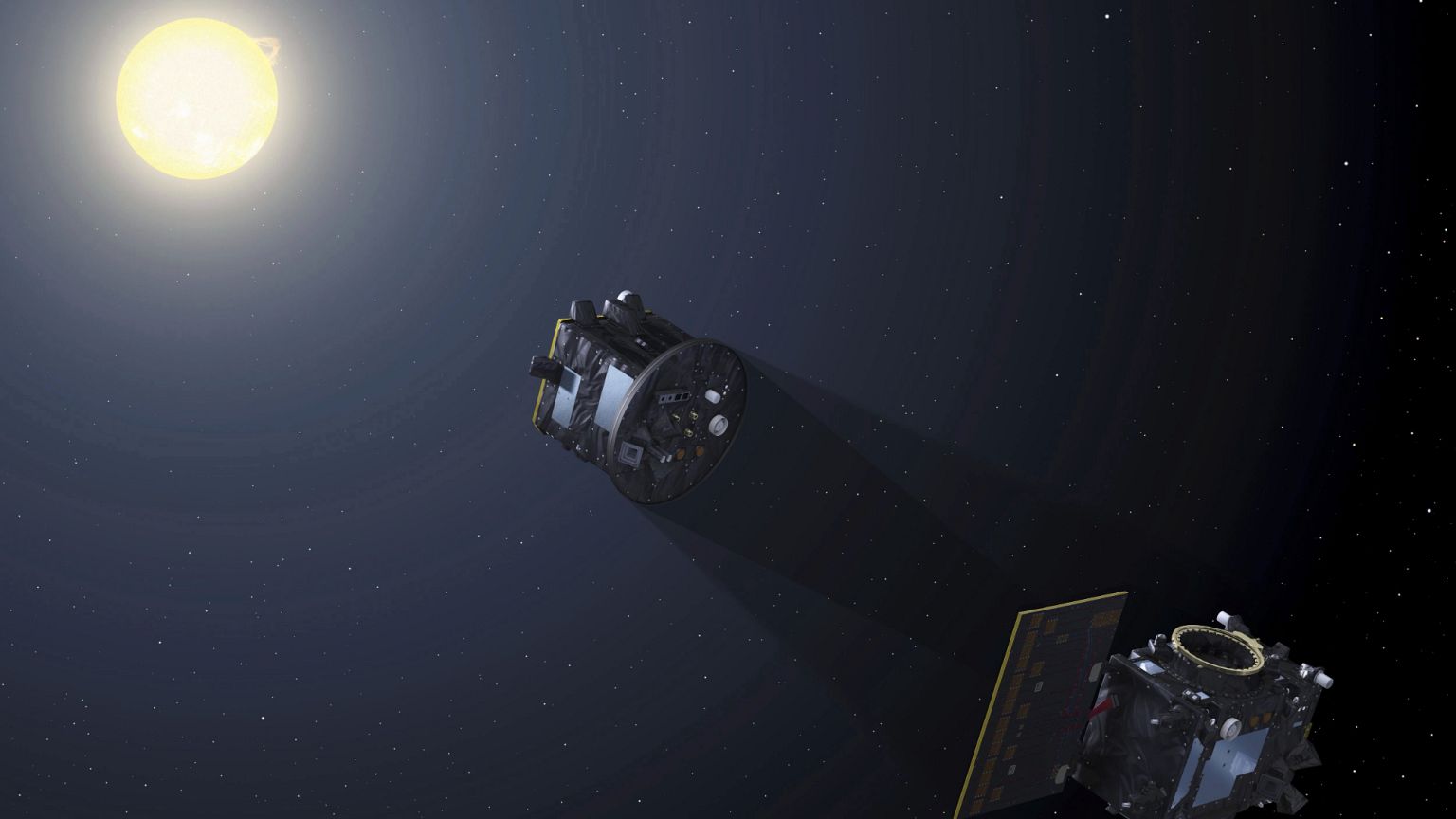
This image provided by the European Space Agency depicts the two spacecraft of the Proba-3 mission aligning to create an eclipse to capture a coronagraph in space
Copyright AP Photo


By Gavin Blackburn with AP
Published on 

Dubbed Proba-3, the $210 million (€181 million) mission has generated 10 successful solar eclipses so far during the ongoing checkout phase.

A pair of European satellites have created the first artificial solar eclipse by flying in precise formation, providing hours of on-demand totality for scientists.

The European Space Agency released the eclipse pictures at the Paris Air Show on Monday.

Launched late last year, the orbiting duo have churned out simulated solar eclipses since March while zooming tens of thousands of kilometres above Earth.

Flying 150 metres apart, one satellite blocks the sun like the moon does during a natural total solar eclipse as the other aims its telescope at the corona, the sun's outer atmosphere that forms a crown or halo of light.

It's an intricate, prolonged dance requiring extreme precision by the cube-shaped spacecraft, less than 1.5 metres in size.

Their flying accuracy needs to be within a mere millimetre, the thickness of a fingernail. This meticulous positioning is achieved autonomously through GPS navigation, star trackers, lasers and radio links.

Dubbed Proba-3, the $210 million (€181 million) mission has generated 10 successful solar eclipses so far during the ongoing checkout phase.

This image provided by the European Space Agency shows the Sun's corona captured by the Proba-3 pair of spacecraft, 23 May, 2025
This image provided by the European Space Agency shows the Sun's corona captured by the Proba-3 pair of spacecraft, 23 May, 2025 AP Photo

The longest eclipse lasted five hours, said the Royal Observatory of Belgium's Andrei Zhukov, the lead scientist for the orbiting corona-observing telescope. He and his team are aiming for a six-hour totality per eclipse once scientific observations begin in July.

Scientists are already thrilled by the preliminary results that show the corona without the need for any special image processing, said Zhukov.

"We almost couldn’t believe our eyes," Zhukov said in an email. "This was the first try, and it worked. It was so incredible."

Zhukov anticipates an average of two solar eclipses per week being produced for a total of nearly 200 during the two-year mission, yielding more than 1,000 hours of totality.

That will be a scientific bonanza since full solar eclipses produce just a few minutes of totality when the moon lines up perfectly between Earth and the sun, on average just once every 18 months.

The sun continues to mystify scientists, especially its corona, which is hotter than the solar surface.

Coronal mass ejections result in billions of tons of plasma and magnetic fields being hurled out into space. Geomagnetic storms can result, disrupting power and communication while lighting up the night sky with auroras in unexpected locales.

While previous satellites have generated imitation solar eclipses, including the European Space Agency and NASA's Solar Orbiter and Soho observatory, the sun-blocking disk was always on the same spacecraft as the corona-observing telescope.

What makes this mission unique, Zhukov said, is that the sun-shrouding disk and telescope are on two different satellites and therefore far apart.

The distance between these two satellites will give scientists a better look at the part of the corona closest to the limb of the sun.

"We are extremely satisfied by the quality of these images, and again this is really thanks to formation flying" with unprecedented accuracy, ESA's mission manager Damien Galano said from the Paris Air Show.


​​​​​​​Scientists’ new blueprint integrates rewilding and agriculture to tackle biodiversity crisis


Proposed approach would combine setting aside fields for nature with wildlife friendly practices on remaining farmland


UK Centre for Ecology & Hydrology

Rewilding actions in Spain 

image: 

A farmland landscape in central Spain where different actions to rewild it have taken place in the last four years.
 

view more 

Credit: Jose Maria Rey Benayas.


Setting aside at least 20% of agricultural landscapes for rewilding and adopting wildlife friendly practices on remaining farmland could reverse biodiversity declines while maintaining food production. That is according to scientists who have put forward a blueprint for integrating nature recovery and farming.

Intensification of farming since the 1940s has been critical for increasing crop yields and livestock production but has significantly contributed to declines in biodiversity which in turn threatens long-term farm productivity through loss of pollination and soil, natural pest control, as well as water and nutrient retention.

Professor James Bullock, an ecologist at the UK Centre for Ecology & Hydrology (UKCEH), one of the authors of the study, said: “Reversing biodiversity loss and degradation of ecosystems is essential both for nature as well as long-term global food security. But there is no single silver bullet for nature recovery and so far it has been unclear how to integrate rewilding into agricultural landscapes.

“Our proposed approach moves beyond land sparing versus land sharing. We believe rewilding can be interwoven into agricultural landscapes and could be key to maintaining food production in a way that is sustainable in the long term for people and the planet.”

Allocating land for nature

The authors of the study, published in Frontiers in Ecology and the Environment, propose:

  • Setting aside a total of at least 20% agricultural land for rewilding – ‘core conservation areas’ – including habitat creation, tree planting and introduction of key animal and plant species. These nature areas adjacent to remaining farmland would ideally be made up of large plots of land, with the aim of increasing resilience, biodiversity and ecosystem services.
  • Connecting these rewilded areas with ‘green corridors’ made up of small forest islands, tracts of scrubland and grassland, as well as hedgerows and ponds within the remaining agricultural land.
  • Wildlife-friendly measures on many small areas of the remaining agricultural land, including the green corridors, refuges and nesting sites for many animals, and perches for birds. These small areas combined would make up a total of at least 10% of the area of agricultural fields. Added to the set-aside land, this would achieve the goal of restoration of 30% of degraded land agreed by countries under the Kunming-Montreal Global Biodiversity Framework.
  • Combining rewilding measures with less damaging farming techniques on the remaining agricultural land, including reduced fertiliser and pesticide use, as well as sowing flower strips for pollinators and invertebrates that provide natural pest control.

More extensive – wilder – livestock systems would allow free-range grazing which can enhance dispersal of seeds and beneficial disturbance of vegetation and soil.

While many habitats in Europe may be unsuitable for large top predators such as bear and large herbivores such as bison, they may benefit from the introduction of smaller species like the lynx, wildcat and European hare which would enhance biodiversity and help create complex, resilient ecosystems.

Multiple benefits

The researchers point out that rewilding can increase crop yields on surrounding agricultural land through greater soil protection, natural pest control and pollination. This would partially compensate for the loss of overall production due to setting aside some agricultural land for rewilding .

Farmers may compensate for the potential loss of production locally by:

  • Increasing the quality and resilience of crop yield to earn more income.
  • Cutting on-farm costs by lowering the intensity of farming activities, including reducing inputs such as fertilisers, pesticides and soil amendments.
  • Taking advantage of any government payments and tax breaks for supporting biodiversity and ecosystem services are available (this varies across countries).

Professor José María Rey Benayas of the University of Alcalá, near Madrid, lead author of the study, said: “Integrating rewilding approaches with farming could create agroecological landscapes that are biodiverse, resilient and functionally connected.

“While setting aside land for nature recovery could potentially be made a legal requirement for farmers and landowners, there is more likely to be acceptance and success of rewilding if there are incentives in the form of payments for ecosystem services and tax deductions.”

Collective action

The authors acknowledge that it is likely that rewilding will not bring the same benefits for all farm systems, so say it would be necessary for smaller farms to act collectively in order to achieve significant action at large scales.

The main agricultural landscapes that could benefit largely from rewilding are the most intensive and degraded areas where little biodiversity remains and are likely at most risk of ecological collapse, which are mainly in developed countries.

There would be comparatively fewer benefits in landscapes where a substantial number of natural ecosystems remain and/or there are less intensive agricultural systems, which are common in some developing countries including those areas managed by Indigenous people.

  • Ends -

Media enquiries

For interviews and further information, please contact Simon Williams, Media Relations Officer at UKCEH, via simwil@ceh.ac.uk or +44 (0)7920 295384.  

Paper information

José M Rey Benayas, James M Bullock and Henrique M Pereira. 2025. A multi-scale approach to integrating rewilding into agricultural landscapes. Frontiers in Ecology and the Environment. DOI: 10.1002/fee.2860. Open access.

The study was supported by wildE a Horizon Europe project, and the AgZero+ programme funded by the Natural Environment Research Council and Biotechnology and Biological Sciences Research Council.


University of Seville study solves 120-year-old problem and corrects one of Einstein's ideas


The paper argues that the third principle of thermodynamics would be a consequence of the second principle and not an independent idea


News Release 

University of Seville


The University of Seville professor José María Martín-Olalla has published an article in which he solves a problem that arose 120 years ago in the field of thermodynamics. In doing so, he has corrected an idea put forward more than a century ago by Albert Einstein. 

Nernst's theorem - a general experimental observation presented in 1905 that entropy exchanges tend to zero when the temperature tends to zero - has been directly linked to the second principle of thermodynamics in a paper published in The European Physical Journal Plus, whose sole author is Professor Martín-Olalla. In addition to solving a problem posed 120 years ago, the demonstration is an extension of the consequences linked to the second principle of thermodynamics (the principle that establishes the increasing entropy of the universe).

The problem of the Nernst theorem arose at the beginning of the 20th century when the general properties of matter at temperatures close to absolute zero (minus 273 degrees Celsius) were being studied. Walther Nernst was awarded the Nobel Prize in Chemistry in 1920 for these studies. 

As an explanation of his results, Nernst argued that absolute zero had to be inaccessible, because otherwise it would be possible to build an engine that, using absolute zero as a coolant, would convert all heat into work, going against the principle of entropy increase. Thus, he proved his theorem in 1912.

Immediately afterwards, Einstein refuted this demonstration by pointing out that such a hypothetical engine could not be built in practice and, therefore, could not question the validity of the principle of entropy increase. Thus, Einstein detached the theorem from the second principle of thermodynamics and associated it to a third principle, independent of the second. This idea is now refuted.

In the demonstration presented, Professor Martín-Olalla introduces two nuances that were omitted by Nernst and Einstein: the formalism of the second principle of thermodynamics, on the one hand, requires the existence of the engine imagined by Nernst, and, on the other hand, that this machine be virtual; the engine does not consume any heat, does not produce any work, and does not question the second principle. The concatenation of both ideas allows us to conclude that entropy exchanges tend to zero when the temperature tends to zero (which is Nernst's theorem) and that absolute zero is inaccessible. 

Martin-Olalla points out "a fundamental problem in thermodynamics is to distinguish the sensation of temperature, the sensations of hot and cold, from the abstract concept of temperature as a physical quantity. In the discussion between Nernst and Einstein, temperature was merely an empirical parameter: the absolute zero condition was represented by the condition that the pressure or volume of a gas became close to zero. Formally, the second principle of thermodynamics provides a more concrete idea of the natural zero of temperature. The idea is not related to any sensation, but to that engine imagined by Nernst but which has to be virtual. This radically changes the approach to the proof of the theorem".

The study points out that the only general property of matter near absolute zero that cannot be related to the second principle of thermodynamics is the cancellation of heat capacities, also compiled by Nernst in 1912. However, Martin-Olalla proposes a different formalisation: "the second principle contains the idea that entropy is unique at absolute zero. The cancellation of specific heats only adds that this unique value is zero. It seems more like an important appendix than a new principle".

The professor at the University of Seville points out that the publication of this article is a first step towards the acceptance of this novel point of view: "the students on the thermodynamics course I teach were the first to learn about this demonstration. I hope that with this publication the demonstration will become better known, but I know that the academic world has a great deal of inertia".