Tuesday, June 17, 2025


Tanker Risk Response to Iran-Israel Is The Real Oil Chokepoint

  • Tanker operators avoid Gulf routes, driving freight rates up over 20% due to heightened Iran-Israel tensions.

  • Market stability remains fragile, as tanker companies' route shifts, insurance hikes, and operational caution signal ongoing volatility despite the absence of direct attacks.

  • A surge in premiums or new route warnings signal that tanker risk is structural, and this could create a situation of ongoing volatility even if tanker attacks remain unrealized.

Global tanker operators and shipping authorities have taken decisive action, even without an official closure of the Strait of Hormuz, amid escalating tension between Israel and Iran. Their public statements, route shifts, and risk assessments are reshaping freight scheduling, insurance premiums, and–most significantly–energy market sentiment in real time.

Oil shippers may have walked back some of their panic expressed during the weekend, which led oil to jump 7%, but this isn’t over, and the volatility will be high.  

Reuters reported on Monday that VLCC bookings for Middle East-to-Asia routes plunged this past Friday, with freight rates surging more than 20% to around Worldscale 55 by Monday—signal enough for tanker owners to adopt a “wait and see” posture. Analysts at LSEG noted that while ships remain available in the Gulf for outbound charters, new contracts are drying up, underscoring a sudden market-wide caution.

Reuters also reports that smaller shipowners are similarly holding back vessel offers, with export charters now largely priced out of the Gulf unless risk terms are adjusted. Clean-product tanker rates are showing signs of pressure too: once $3.3–3.5 million per voyage, brokers now expect quotes near $4.5 million.

Related: OPEC Oil Output Increase Falls Short of Target

At the center of this shift is Frontline, the world’s largest oil tanker company. Its CEO Lars Barstad confirmed to the Financial Times that the firm has suspended new bookings for Gulf voyages altogether. “We’re not contracting to go into the Gulf,” he said. Barstad explained that vessels already in the region would leave under naval convoy, adding poignantly: “Trade is going to become more inefficient and, of course, security has a price.”

Bloomberg corroborates that other major tanker firms have also rooted out Gulf contracts, citing growing alarm over potential retaliatory moves by Iran after recent Israeli strikes against its energy sites. Clients and charterers now face shrinking capacity—a trend that may ripple into regional and global fuel price pressures.

The tightening of tanker willingness flows directly into insurance markets. Brokers calculate that tankers traversing Gulf waters now require an additional $3–$8 per barrel in war-risk insurance, significantly inflating transport costs. That added cost alters the economics of crude trades, nudging pricing models upwards.

Ports and maritime agencies are publicizing precautionary measures. The Greek shipping ministry has instructed Greek-flagged vessels to report travel through high-risk zones like the Gulf of Aden or Hormuz, mandating detailed voyage logs. Similarly, the UK Maritime Trade Operations advises minimal crew deployment on deck and strict reporting protocols. Each advisory signals that national flags are treating the waters as low-grade conflict zones.

Maritime-security experts point to non-traditional threats as well. 

A recent CIMSEC analysis, cited by Capt. Harifidy A. Alex Ralaiarivony of Mauritius’s RMIFC, highlights that the Western Indian Ocean now faces a “diversifying threats” portfolio—from naval shadowing and electronic jamming to state-linked disruptive tactics. He emphasizes that escalating threats demand broader resilient responses, recognizing shipping firms as first responders in a complex threat environment.

Recent GPS spoofing and navigational interference events flagged by LSEG analysts also point to more danger beyond missiles. These “electronic ambushes” are also alarming insurers and shippers.

Now, as of June 16 at 10:40am ET, Brent is down over 4%, reflecting a partial unwinding of that initial fear trade as no tankers have yet been directly targeted and core shipping lanes remain technically open. In effect, the market initially reacted to perceived shipping risk, but as the weekend passed without a direct incident, some of that risk premium has been pulled back, even though the underlying vulnerabilities remain. This is not over for the tanker sector. 

Refined-product tankers have also felt the squeeze. According to Reuters, freight brokers report that clean-product tanker voyages from the Gulf to Asia, which previously cost around $3.3 to $3.5 million per voyage, are now being quoted as high as $4.5 million. The sharp rise reflects mounting war-risk premiums and growing owner reluctance to take on Middle Eastern routes as tensions escalate. These higher freight costs directly impact product supply chains, narrowing refinery margins and putting additional upward pressure on consumer fuel prices.

Even the IMO has echoed red-light conditions. It flagged an uptick in diverted routes, with vessels avoiding the Red Sea and Suez Canal and instead skirting the African southern coast, more willing to risk shipments to piracy.

The situation presses home the evolving logic of tanker risk. You don’t need bullets or missiles; uncertainty is enough. Shortened tanker routes, higher war-risk premiums, and stricter fill levels can render oversupply fragile. As one market observer noted, higher oil prices in such contexts reflect the narrowing of physical glut, not just headline supply figures.

For both governments and carriers, the key indicators now are freight rates, insurance clauses, and official advisories. A surge in premiums or new route warnings signal that tanker risk is structural, and this could create a situation of ongoing volatility even if tanker attacks remain unrealized.

If Iran or its proxies begin targeting tankers, the industry may retreat. For example, MSC rerouted container vessels away from drone threats in the Indian Ocean days ago, a move costing 10–14 days in transit delays. BIMCO’s Jakob Larsen predicted for Reuters that Western-linked ships may avoid entire zones, prompting capacity crunches.

National navies may respond, but shipping firms act first. That cascade—operators opting out, insurers hiking rates, HPC freight indices jumping—understands strategic shock as much as a direct hit. It makes tanker pullback today more consequential than headline diplomacy.

India, China, and other major refining nations are closely watching. Even minor signs of maritime unrest can trigger bunker price swings, eroding purchasing power and supply predictability measured in the millions of barrels per day.

While the G7 and U.S. may work behind the scenes, markets now pivot on what tanker companies do, not necessarily what policymakers promise. As markets track de-escalation or naval deployments, tanker behavior is what will really predict a supply shock. 

By Charles Kennedy for Oilprice.com


How Will the Israel-Iran Conflict Affect the Tanker Market?
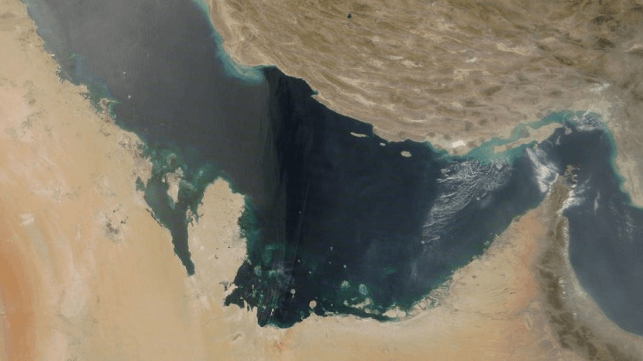
Strait of Hormuz (right) and the Persian Gulf from space (NASA)

Published Jun 15, 2025 8:18 PM by Erik Broekhuizen / Poten & Partners


In the early hours of Friday, June 13, Israel launched several waves of airstrikes on Iran, targeting command-and-control centers, ballistic-missile bases and air-defense batteries as well as nuclear installations. The attacks also killed several Iranian military commanders and nuclear scientists. Israel indicated that this is only the beginning of a campaign that can last for days or even weeks. The question is, what will happen next? How will Iran respond? Will the United States get involved? What will be the impact on the oil and tanker markets? We don’t have any answers, but we can discuss a few scenarios and look back at what happened during previous conflicts in the region.

In an immediate response, Iran launched a drone attack on Israel, but that was largely ineffective. Most of them were shot down and no significant damage was reported. Since then, Iran has started firing ballistic missiles towards Israel. Analysts do expect a forceful response from Tehran, not least because the regime has to save face with their domestic population. However, their options are limited. The Israeli attacks have reduced Iran’s ability to reach Israel and inflict significant damage. The capabilities of Iran’s proxies in the region, Hamas, Hezbollah, the militias in Iraq and the Houthi’s have been diminished and the Assad regime in Syria has been toppled.

Iran does have options to retaliate. They could try to close the Strait of Hormuz or disrupt shipping at this chokepoint through which more than 20% of global oil supplies are shipped. They could attack oil installations in neighboring countries or target U.S. military bases in the region.

However, all of these potential actions carry significant risks. Closing the Strait of Hormuz or attacking energy infrastructure in the region will spike energy prices, turn all their neighbors into adversaries and more likely than not draw the U.S. military, which has a large presence in the region, into the conflict. Closing the Straits of Hormuz may also hamper Iran’s own export capabilities and give the Israelis and/or Americans an incentive to attack their energy infrastructure (refineries, pipelines, export terminals, etc.). Losing the income from energy exports would quickly exhaust Iran’s resources and ability to fight back.  

In the immediate aftermath of the Israeli attacks, both oil prices and tanker rates moved up. This was to be expected and is a normal reaction to a spike in geopolitical tensions and an increased risk of significant disruptions to global energy supplies. Where oil prices will go over the next few days and weeks, will depend on whether there will be actual disruptions to oil supply. Overall, the global oil markets are well supplied, and inventories are at healthy levels worldwide.

Iranian supplies are increasingly at risk, however. Even before Israel’s attack, most oil market forecasts already assumed a decline in Iranian production over the coming months, leading to a decrease in Iranian exports of around 400-500 kb/d. This figure will likely increase if the conflict escalates. Chinese independent refiners, which buy almost all Iran’s oil, will need to look for alternative sources of crude, and they could try to buy more discounted crude from Russia or look for alternative barrels in the Middle East.

Tanker rates also rose after the attacks, in particular for VLCCs, the main vessel class for Arabian Gulf exports. Similar to the reaction of oil prices, this is a normal development under the circumstances. Rates for the benchmark Arabian Gulf (AG)-East VLCC route increased from WS43 to W55. However, while the increase is significant in percentage terms, the tanker market remains in the summer doldrums. Further rate increases are possible over the next few days, depending on how the conflict evolves, but it is also possible that the market weakens again after the weekend. In previous conflicts, charterers sometimes panicked and, in an attempt to access additional cargoes, fixing activity would rise dramatically. At the same time, shipowners would become increasingly reluctant to enter high risk areas such as the Arabian Gulf. This combination of factors would push tanker rates much higher very quickly. We are not in this scenario at the moment. According to our tanker brokers, fixing activity has not surged so far and most owners are still willing to bring their tankers into the AG. However, this can change quickly. Stay tuned.

Erik Broekhuizen is the manager of marine research and consulting at Poten & Partners. 

This update appears courtesy of Poten & Partners, and it may be found in its original form here.


The opinions expressed herein are the author's and not necessarily those of The Maritime Executive.


  

Iran Threatens To Leave Nuclear Treaty and Close Strait of Hormuz

  • Iran is considering withdrawing from the Nuclear Non-Proliferation Treaty due to escalating attacks from Israel.

  • Threats to close the Strait of Hormuz have emerged, potentially impacting a significant portion of the world's oil supply.

  • Experts suggest that while Iran's rhetoric is strong, actual changes in nuclear policy or closing the strait are unlikely in the immediate future.

Amid an escalating Israeli air campaign against Iran, calls are mounting in Tehran to withdraw from the Treaty on the Non-Proliferation of Nuclear Weapons (NPT) and close the Strait of Hormuz, one of the world’s most critical oil routes.

The archenemies have been trading fire since June 13 after Israel launched an unprecedented attack on Iran’s nuclear sites, military bases, and residential areas in a bid to hinder Tehran’s program and eliminate top military leadership.

Several high-profile Islamic Revolutionary Guards Corps (IRGC) commanders and nuclear scientists have been killed in the attacks. Iran’s Health Ministry said on June 15 that 224 people, including children, had been killed.

At least 24 people, including civilians, have been killed in Iranian counterstrikes, according to Israeli authorities.

Israel said it launched its attack because it had concluded that Iran was weeks, if not days, away from enriching uranium and acquiring a nuclear weapon. Iran rejects the claim, insisting that its nuclear program is peaceful.

Iran’s parliament is moving forward with a bill to withdraw from the NPT, Foreign Ministry spokesman Esmail Baqaei announced on June 16. Iranian officials are also threatening to close the Strait of Hormuz if the attacks continue.

But experts warn Tehran’s threats may be more about political theater than imminent change.

NPT Withdrawal: More Bark Than Bite?

Hard-line Iranian lawmaker Hamid Rasaee over the weekend charged that there was no point in remaining in the NPT since it had failed to protect Iran’s nuclear sites from attacks.

Fellow hard-line legislator Mohammad Mannan weighed in, announcing that a high-priority bill would be submitted to the parliament to push ahead with the withdrawal.

Despite the heated rhetoric in Tehran, experts say Iran is unlikely to actually leave the treaty anytime soon.

“For now, Iran appears unlikely to withdraw from the NPT, despite growing pressure from hard-liners,” Hamidreza Azizi, a fellow at the German Institute for International and Security Affairs, told RFE/RL.

Even if the parliament passes the bill, it needs to be approved by the Guardians Council, Iran’s constitutional watchdog whose members are -- directly and indirectly -- appointed by Supreme Leader Ayatollah Ali Khamenei, the country’s commander in chief who has the final say on all state matters.

Azizi argued that withdrawing from the NPT would effectively gut Iran’s legal defense.

“Tehran has so far based its defense at the international level on the assertion that Israel’s actions are unlawful, citing the absence of an imminent threat. Exiting the NPT would undermine this line entirely.”

In 2010, Khamenei issued a fatwa -- a religious ruling -- declaring the use of nuclear weapons as "haram," or forbidden under Islamic law, and stating that Iran would not pursue them

Iranian officials have frequently pointed to this decree as proof that the Islamic republic has no intention of developing nuclear weapons.

However, analysts argue that the fatwa does not present a serious obstacle to Iran acquiring a bomb. They note that Iran could carry out much of the necessary work while the fatwa remains in place, and Khamenei could simply revoke it at a later stage if a decision were made to move forward.

Baqaei said on June 16 that, despite legislative efforts to initiate Iran's withdrawal from the NPT, Tehran is not looking to acquire nuclear weapons.

Strait Of Hormuz: High Stakes, Low Odds

Hard-line media and several officials have again raised the possibility of closing the Strait of Hormuz -- a move that would threaten nearly a fifth of the world’s oil supply. But Gregory Brew, a senior Iran and oil analyst at the New York-based Eurasia Group, says it’s a threat Tehran is unlikely to carry out.

“Closing the strait is Iran's last big card to play,” Brew told RFE/RL. “It has the means of essentially blockading the waterway…by deploying short-range ballistic missiles, naval vessels, and mines.”

But attempting to blockade the strategic strait would have major ramifications, such as “immediately” triggering a response from the United States and the Gulf Cooperation Council (GCC).

“If war with Israel is proving very damaging, war with the US (and the GCC) would be much worse,” Brew said.

Economically, closing the Strait of Hormuz would also hurt Iran itself because it is using the waterway to export oil, mostly to China.

“So long as that continues, I don't think it will act on its threats,” Brew added.

By RFE/RL 


Iranian Navy Leaves Bandar Abbas in a Hurry

Imagery from June 14 showing IRINS Tonb (L513) and Lavan (L514) at anchor and IRINS Makran out of port (Sentinel-2/CJRC)
Imagery from June 14 showing IRINS Tonb (L513) and Lavan (L514) at anchor and IRINS Makran out of port (Sentinel-2/CJRC)  

Published Jun 16, 2025 1:02 PM by The Maritime Executive


A number of the resident naval ships which steadfastly remained in harbor over the first two days of the conflict between Israel and Iran have been seen maneuvering and taking up positions in the Bandar Abbas roads.

A satellite pass over the Bandar Abbas Naval Harbor early on June 14 appears to have captured a picture of regular Iranian Navy (Nedaja) vessels from the Southern Fleet - which are home-based there - leaving in what appears to be confusion. A large number of vessels are leaving port simultaneously, and it appears from the wake of ships underway as if there was some competition to get to the harbor entrance first. 

With the imagery resolution available publicly on June 14, it is possible to identify some vessels in the anchorage. Two Hengam-Class landing ships can be seen already at anchor (image at top), presumably the two vessels which are currently operational, namely IRINS Tonb (L513) and Lavan (L514). Both a Moudge-Class and an Alvand-Class frigate are close by, neither yet anchored, as is the intelligence collection frigate IRINS Zagros (H313). The forward base ship IRINS Makran (K441) has left the outer harbor and its home pier, to which it appeared to have been welded for months.

In imagery from early on June 16, ships previously seen maneuvering two days before seem now settled at anchor in the Bandar Abbas roads. The drone carrier Shahid Bagheri (C110-4) from the IRGC Navy (Nedsa) can be seen at 27.06029546N 56.12818203E. Its sister ship Shahid Madhavi (C110-3) appears to be close by, also probably the Nedaja’s IRINS Makran now at 27.088804 56.302067. The only Nedaja vessels which can be seen still at the dockside in the Naval Harbor are those which have previously been identified as being under repair or maintenance, along with some fast attack craft.

As a dispersal strategy to protect against attack, moving ships out of home base ports to the immediately adjacent anchorage does not make much tactical sense. Some ships still linger, but it can be expected that most ships spotted early on the morning of June 14 will by now be on the move to new locations.

The opinions expressed herein are the author's and not necessarily those of The Maritime Executive.
 

Pentagon Sends Another Carrier to Mideast as Iran Conflict Heats Up

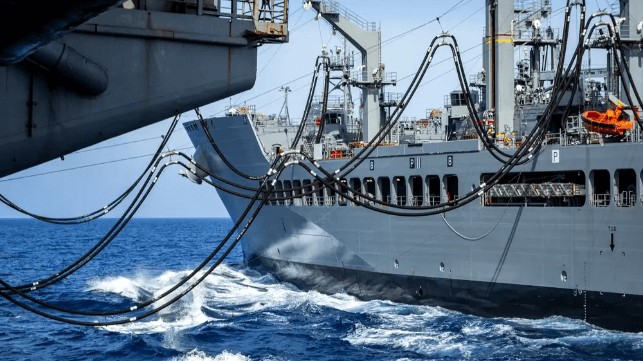
USS Nimitz
USS Nimitz takes on jet fuel from a fleet oiler in the South China Sea, June 14 (USN)

Published Jun 16, 2025 10:57 PM by The Maritime Executive


As Israel and Iran trade blows, the carrier USS Nimitz has departed the South China Sea and is westbound for the Mideast, according to USNI. USS Carl Vinson and her escorts are already in the Arabian Sea, positioned for possible contingencies.

Nimitz appears to have canceled a planned port call in Vietnam in order to depart swiftly for the Arabian Sea, according to an announcement shared by the U.S. embassy in Hanoi. USS George Washington remains in port in Japan as the sole U.S. Navy carrier in the Western Pacific. The Royal Navy's HMS Prince of Wales has recently departed the Mideast, headed eastbound as part of a scheduled long-distance deployment. 

The air campaign over Iran is prompting a minor split in the Trump administration's defense establishment between those who want to help Israel's campaign and those who want to minimize the odds of another long war in the Mideast, according to intelligence-community outlet Semafor. China hawk Eldridge Colby - undersecretary of defense - is believed to favor keeping U.S. military assets in Asia, where they can be used to deter PRC aggression against Taiwan. Gen. Michael Kurilla, head of Central Command, is said to favor relocating more equipment to the Mideast where it can be used to defend or support Israel. (The Pentagon told Semafor that there is no internal split.)

"Right now, we've got assets in the region and we're going to defend them," U.S. Defense Secretary Pete Hegseth told Fox News on Monday. "We're strong, we're prepared, we're defensive . . . President Trump hopes there can be peace."

Among the assets in the region is the naval base at Diego Garcia, where the U.S. Air Force stations strategic bombers for campaigns in the Central Command area of operations. This small outpost in the Indian Ocean provided the launch pad for strikes in Afghanistan during the War on Terror, and it was recently used for bombing runs over Yemen during the campaign against Houthi militants earlier this year. In May, satellite imaging identified six B-2 stealth bombers and four B-52 strategic bombers on the tarmac at Diego Garcia - all capable of delivering the Massive Ordnance Penetrator, the most powerful known conventional bunker-busting bomb. This 30,000-pound bomb would have a far greater chance of reaching Iran's deeply-buried nuclear facilities than anything in the Israeli arsenal.

Open-source flight tracking analysts have noted a surge of nearly three dozen U.S. aerial tankers headed east, most landing in Europe - a critical enabler for a large-scale U.S. "air bridge," if desired. Publicly, President Donald Trump has called for Iran to return to the negotiating table "before it is too late," and he warned Sunday that it was possible that U.S. forces would join the Israeli campaign. On Monday, he called for Iranian citizens to "immediately evacuate Tehran."


As Conflict Heats Up in Iran, Royal Navy Carrier Continues Eastward

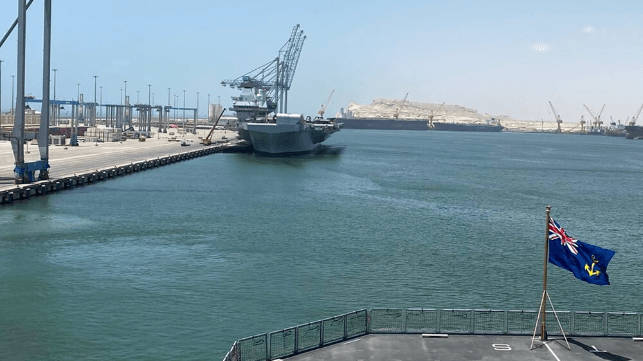
HMS Prince of Wales alongside in Duqm (@RFATidespring)
HMS Prince of Wales alongside in Duqm, seen from RFA Tidespring (@RFATidespring / Royal Navy)

Published Jun 16, 2025 6:13 PM by The Maritime Executive


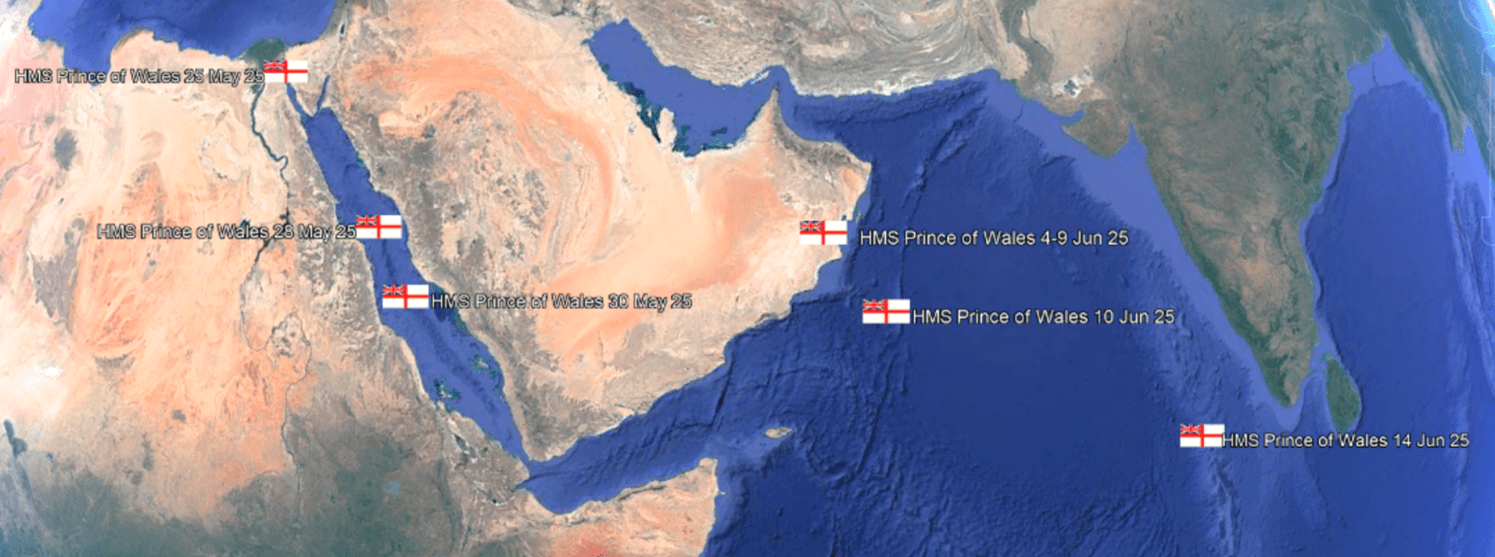
Having made its way south through the Suez Canal on May 25, ships of the Royal Navy-led Prince of Wales carrier strike group (CSG) appear to be maintaining their original deployment program, and have not diverted from plan to linger in the Arabian Sea area adjacent to the Iranian conflict zone.

Last spotted in the Red Sea on May 30 off Jeddah before a transit through the Bab el Mandeb, HMS Prince of Wales (R09), logistics ship RFA Tidespring (A136), Type 45 destroyer HMS Dauntless (D33) and Type 23 frigate HMS Richmond (F239) made a port call in Duqm June 7-9. British Forces enjoy logistic and maintenance facilities in the Omani port, and while the crews of the ships would not have enjoyed the weather, they will have had a chance to take a first run ashore since leaving Portsmouth.

RFA Tidespring (A136) has now replaced HNoMS Maud (A530) as the logistic vessel supporting the CSG, and on June 12 was seen resupplying Canadian Halifax Class frigate HMCS Ville de Quebec (F332) and Spanish Álvaro de Bazán Class frigate ESPS Mendez Nunez (F104). Norwegian Nansen Class frigate HNoMS Roald Amundsen (F311) remains with the CSG, which has now been joined by New Zealand ANZAC Class frigate HMNZS Te Kaha. 

Progress of HMS Prince of Wales (R09) across the Indian Ocean (CJRC)
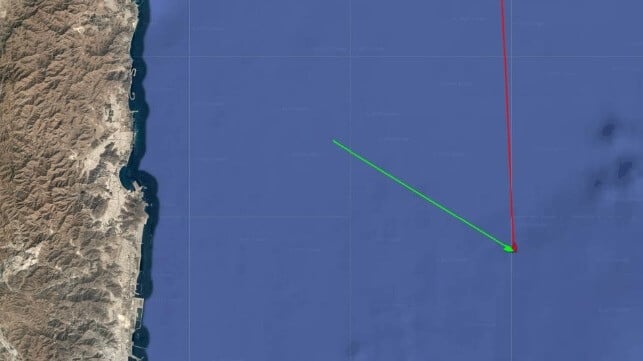
On leaving Duqm, the CSG was spotted in imagery en route to conduct anti-submarine warfare training in the Western Arabian Sea with a submarine and Talwar Class frigate INS Tabar (F44) from the Indian Navy. An F-35B from the RAF’s 617 Squadron on board HMS Prince of Wales made an emergency landing on June 14 at Thiruvananthapuram, possibly caught by unexpected early monsoon weather in the exercise area. During the transit, the CSG exercised with a Royal Australian Air Force P-8A maritime surveillance aircraft operating out of Cocos Island. The CSG is now making for Australia for further exercise activity.

Tankers Reportedly Ablaze Near Strait of Hormuz

  • Three tankers are reportedly on fire in the Gulf of Oman, with conflicting reports about the cause including a possible collision.

  • The incident occurs amid heightened tensions in the region, particularly between Israel and Iran, which has threatened to close the Strait of Hormuz.

  • The Strait of Hormuz is a critical chokepoint for global oil trade, handling over 20 million barrels daily, making the incident a significant concern for international markets.

Three tankers are reportedly on fire in the Gulf of Oman, according to social media posts, as cited by the Hindustan Times.

Kpler energy analyst Amena Bakr said on X that a British maritime security provider had reported it was aware of an unspecified incident in the area.

An outlet for shipping news published a YouTube video saying two tankers had collided in the Gulf of Oman.

An X account named OSINTDefender reported that “It appears that the fires seen off the coast of Iran in the Gulf of Oman may have been caused by the collision of two oil tankers, the Antigua Barbuda-flagged ADALYNN and the Liberian-flagged FRONT EAGLE. Though ship tracking suggests this likely happened over three hours ago, which does not explain why there had been no reports until the picture showing the fires and the statement by Ambrey [the British maritime security firm].”

The Strait of Hormuz is currently attracting a lot of attention amid the war between Israel and Iran, and the fact Iran has threatened in the past to close the chokepoint in case of hostilities against it.

The chokepoint handles more than 20 million barrels daily in oil trade, with the bulk of Middle Eastern oil—and Qatari LNG—passing through it en route to international markets.

Israel and Iran continued firing missiles at each other for the fifth day in a row with both sides apparently unwilling to end the hostilities. European foreign ministers earlier this week urged the Iranian foreign minister to restart nuclear negotiations with the U.S. and de-escalate, to which Abbas Araqchi responded that Tehran’s priority right now was retaliating against Israel, which attacked Iran on Friday.

President Trump also called on the Iranians to cease hostilities, saying on his social network Truth Social that Tehran should evacuate.

By Irina Slav for Oilprice.com


24 Crewmembers Rescued After Tanker Collision in Gulf of Oman

Front
Two tankers appear to have been in collision off Khor Fakkan (Pole Star)

Published Jun 16, 2025 9:51 PM by The Maritime Executive

 
Breaking] Early reports indicate that two tankers have collided off the coast of Khor Fakkan, UAE, possibly resulting in a fire.

AIS data provided by Pole Star confirms that the tankers Front Eagle and Adalynn appear to have had a collision at 2120 hours GMT on Monday. NASA FIRMS satellite infrared sensor observations confirm a heat source (potential fire) in the same location at 2140 GMT. Photos of a large fire purportedly off Khor Fakkan have been circulating on social media. 

The UAE's coast guard confirmed that a collision occurred, and reported that all 24 crewmembers were safely rescued from Adalynn on Tuesday morning (local time). 

Global risk intelligence agency Ambrey says that it is aware of an unspecified incident at a position about 22 nm off Khor Fakkan, the same area identified by AIS tracking.

An early analysis by maritime expert Prof. Sal Mercogliano suggests that as the two vessels neared each other in a crossing situation, one of them made a late turn to starboard instead of maintaining course and speed. He noted that the tanker had been subject to conspicuous AIS spoofing earlier in its voyage. 


Led by China's Growth, Offshore Wind Capacity Will Hit 100 GW by 2026

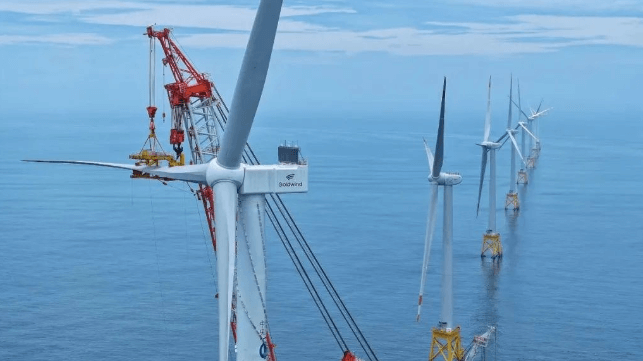
Goldwind turbine installation
File image courtesy Goldwind

Published Jun 17, 2025 3:51 PM by The Maritime Executive


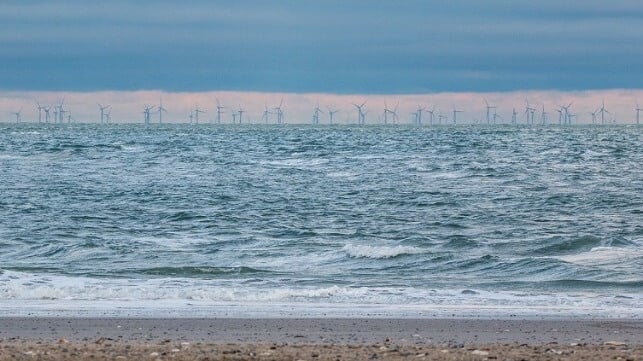
Despite uncertainties in the North American market, the global commissioned capacity of offshore wind is on course to surpass the 100 GW mark by mid-2026 as countries in Europe and Asia ramp up projects.  

UK’s trade group RenewableUK is highlighting that with 27.3 GW of offshore wind capacity currently under construction, the world should expect to cross the 100 GW mark by the middle of next year, an indication of an industry witnessing “significant increase” despite the storm clouds of higher capex and changing trade policies. Going by the current growth rate, operational capacity could increase nearly threefold to 244 GW worldwide by the end of 2030.

The positive future growth projections follow a healthy increase in installed capacity over the past 12 months. According to RenewableUK’s latest EnergyPulse Insights Offshore Wind report, operational capacity increased by 14 percent over the period to reach 85.2 GW, up from 74.7 GW. While pacesetters like China and UK aggressively sustain investments, emerging markets like Indonesia, Chile, Guernsey, Bermuda, and Malta have contributed to an installed capacity increase over the last twelve months.

China's ring-fenced domestic market continues to dominate offshore wind with over half of all existing commissioned capacity at 42.9 GW. The UK comes second with 15.6 GW, followed by Germany with 9 GW and the Netherlands with 5.4 GW. Taiwan is now fifth with 3 GW, and Denmark is in sixth place with 2.7 GW.

While the UK has put offshore wind at the heart of its energy transition goals, the country is facing a confidence crisis with developers starting to develop cold feet on projects. Last month, Danish renewable energy giant Ørsted said it will discontinue the UK’s Hornsea 4 project citing increased costs and risks. Hornsea 4 was the company’s fourth gigawatt-scale project in the Hornsea zone with a capacity to generate 2.4 GW.

Going by Ørsted’s decision, RenewableUK is raising concerns that upcoming auctions could fail to attract interest from developers. Nearly 8.5 GW of UK offshore wind capacity, across 13 projects, is technically eligible for bidding in the next auction, Allocation Round 7, which opens this year. There are indications that developers might choose to stay away. A further 7.8 GW could become eligible if five other projects receive consent from the government before the auction, bringing the potential total to 16.3 GW.

To attract bidding, the UK government is considering relaxing the eligibility rules to allow fixed-bottom projects still in the planning system to participate in forthcoming allocation round, which if implemented could see total eligible capacity reach 25.6 GW.

For the UK, the continued rollout of offshore wind remains critical, considering the number of people working in the industry has risen from just over 32,000 two years ago to nearly 40,000 today, a 24 percent increase.

The EnergyPulse report shows that the total global portfolio of active offshore wind farms worldwide at any stage of development, from early planning to fully operational, now stands at 1,219 GW across 1,555 projects in 46 countries. China maintains leadership with 261 GW under development followed by the UK with 94.4 GW and the U.S with 77.8 GW.

“It’s great to see this significant increase in operational offshore wind capacity worldwide, as well as the healthy pipeline of future projects with new countries entering the market every year,” said Jane Cooper, RenewableUK’s Deputy Chief Executive.

In the case of the UK, and considering the upcoming auction round, Cooper is urging the government to put the right framework in place to maximize interest by ruling out zonal pricing, something that has the potential to deter investors and jeopardize the country’s targets of reaching 45 GW to 50 GW of offshore wind by 2030.


Safety Risks on the Rise as Global Offshore Wind Industry Grows

Offshore wind
Pixabay / public domain

Published Jun 16, 2025 5:11 PM by The Maritime Executive


As the offshore wind sector across the world witnesses growth, there is a rise in safety concerns for personnel and vessels involved. Last week, the G+ Offshore Wind Health and Safety Organization released its 2024 incident report, revealing rising safety risks in the offshore wind industry.

The data contained in the report is compiled from G+ member companies, comprising lead operators and owners of offshore wind farms and original equipment manufacturers serving the sector. The reporting covered Asia, Europe, Australia and the U.S. A major highlight of the report, which is in its twelfth year, is the unprecedented growth for the industry in 2024, with 79 million work hours reported, representing a 27 percent increase from 2023.

However, this growth has also seen a rise in both the Total Recordable Injury Rate (TRIR), up 7 percent, and the Lost Time Injury Frequency (LTIF), which went up by 19 percent. Unfortunately, the industry recorded one fatality last year. The incident involved a worker fatally injured during the disassembly work on a monopile upending tool. The second worker was left hospitalized.

Notably, development sites saw the highest number of reported injuries, with a 75 percent increase year-on-year. The injury breakdown for the period include 99 lost work day injuries, 57 restricted work day injuries and 74 medical treatment injuries. Incidents tagged as high potential - having the greatest likelihood of causing serious harm regardless of actual consequence - were 245, representing 12 percent of all incidents.

Jack-up vessels/barges constituted a risky area for the industry, accounting for 14% of all injuries, with 92 incidents in 2024, up 42% from 2023. Other platforms that recorded significant increases in the number of injuries include the survey vessels, with 30 incidents from 12 in 2023, a rise of 150 percent. Cable installation vessels saw a 108 percent rise to 25 incidents, from 12 the previous year.

“The continued growth of the offshore wind sector is a testament to our industry’s commitment to the energy transition, but it also brings new and evolving risks. The increase in high potential incidents and the tragic fatality this year remind us that we must never be complacent,” said G+ Chair and Senior Vice President at Ørsted, Lisbeth Frømling.


Video: Brand New STS Crane Tips Over at Port of Tuas

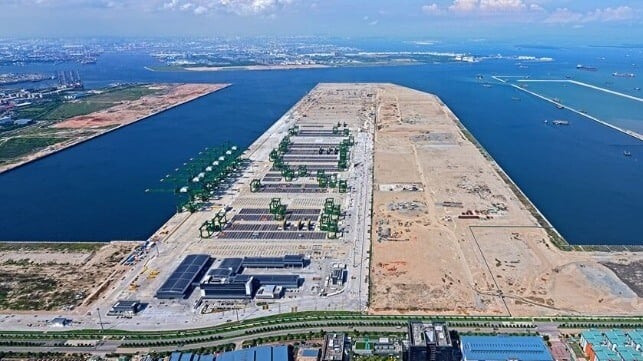
Tuas Port is brand new, and is taking regular deliveries of new STS cranes as buildout continues (MPA Singapore file image)ntinues (

Published Jun 15, 2025 4:20 PM by The Maritime Executive


STS crane collapses are a rare occurrence at global ports, and are almost exclusively caused when a crane gets struck by a merchant ship. But the port of Tuas, Singapore experienced an unwelcome and far less common casualty: a collapse during delivery. 

On Sunday afternoon at at about 1320 hours, a brand new quay crane tipped over while it was being delivered to a berth at Tuas. The quayside was not operational, and there were no injuries or fatalities.

According to Singapore's Maritime and Ports Authority (MPA), none of the nearby port facilities or equipment were damaged. All of PSA Singapore's current operational berths remain accessible, and all other port operations and development work were wholly unaffected. 

Unverified casualty video

The incident is under investigation, and PSA and the Maritime and the MPA are working with other agencies to respond to the casualty. 

Tuas is a brand new greenfield port complex, and it is on track to become the largest of its kind in the world (at full buildout). Singapore plans to gradually shift all of its container terminal operations to Tuas over the span of two decades, freeing up waterfront for other development in the city center. 


Second Response Tug Takes Over Tow of Burned-Out Car Carrier in N. Pacific

Morning Midas
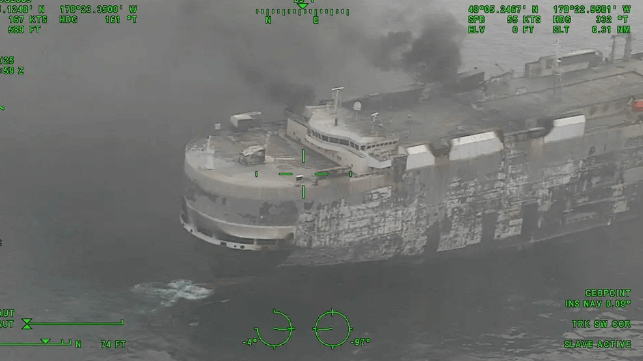
Morning Midas' fire-damaged bow, June 8 (USCG)

Published Jun 16, 2025 2:38 PM by The Maritime Executive


On Sunday, the second of three oceangoing tugs dispatched by salvage company Resolve Marine has arrived on scene to assist the burned-out car carrier Morning Midas, which is adrift in the Pacific south of Adak. 

The Morning Midas was abandoned on June 3 after an uncontrollable fire broke out on board. In comparatively calm conditions for the North Pacific, the crew abandoned ship and were safely rescued by a passing merchant ship.

The vessel, which is managed by London-based Zodiac Maritime, is reported to be carrying a total of 3,048 vehicles, including 70 fully electric vehicles and 681 gas-electric hybrids. It was heading from China to Lázaro Cárdenas under charter to China’s SAIC Anji Logistics.

The first responders arrived on scene aboard tug Gretchen Dunlap on June 9. Gretchen Dunlap managed to establish a towline to Morning Midas on the 11th, and the tug has been holding the stricken vessel in position ever since. Garth Foss has now arrived and taken over the tow. 

The third and final tug scheduled to assist - the first one powerful enough to tow Morning Midas away - is still one week out, a reminder of the sheer remoteness of the Aleutian Islands. With this vessel's current estimated ETA, it is on track to arrive roughly three weeks after the fire began. 

Luckily, salvors aboard Garth Foss report that thermal scans show no remaining signs of active fire onboard the car carrier. There are no signs of pollution in the water, and the vessel’s watertight integrity remains intact. Pollution control plans have been prepared as a precautionary measure. 

"Zodiac Maritime and Resolve Marine continue to be grateful for the ongoing close cooperation and support from the United States Coast Guard," operator Zodiac said in a statement. 


Grounded Laker Transits to Shipyard for Repairs

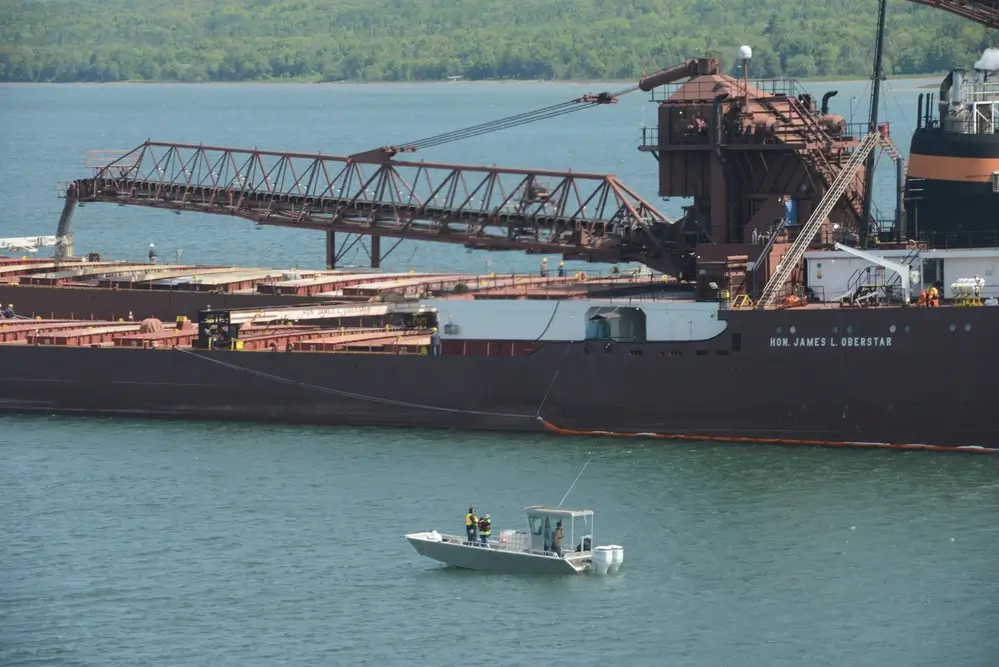
Hon. James L. Oberstar
Hon. James L. Oberstar offloads cargo onto another laker, June 12 (USCG)

Published Jun 15, 2025 7:53 PM by The Maritime Executive


After defueling, lightering off cargo and undergoing a thorough inspection, the laker Hon. James L. Oberstar has gotten under way for a drydock facility to conduct repairs from a grounding. 

At about 1550 hours on June 8, the laker Hon. James L. Oberstar experienced unusual vibration after making the turn at Johnson's Point on the St. Mary's River. The crew notified the Coast Guard and went to anchor on nearby Hay Lake to conduct a damage assessment. Photos from the scene appear to show that she had taken on a slight starboard list.

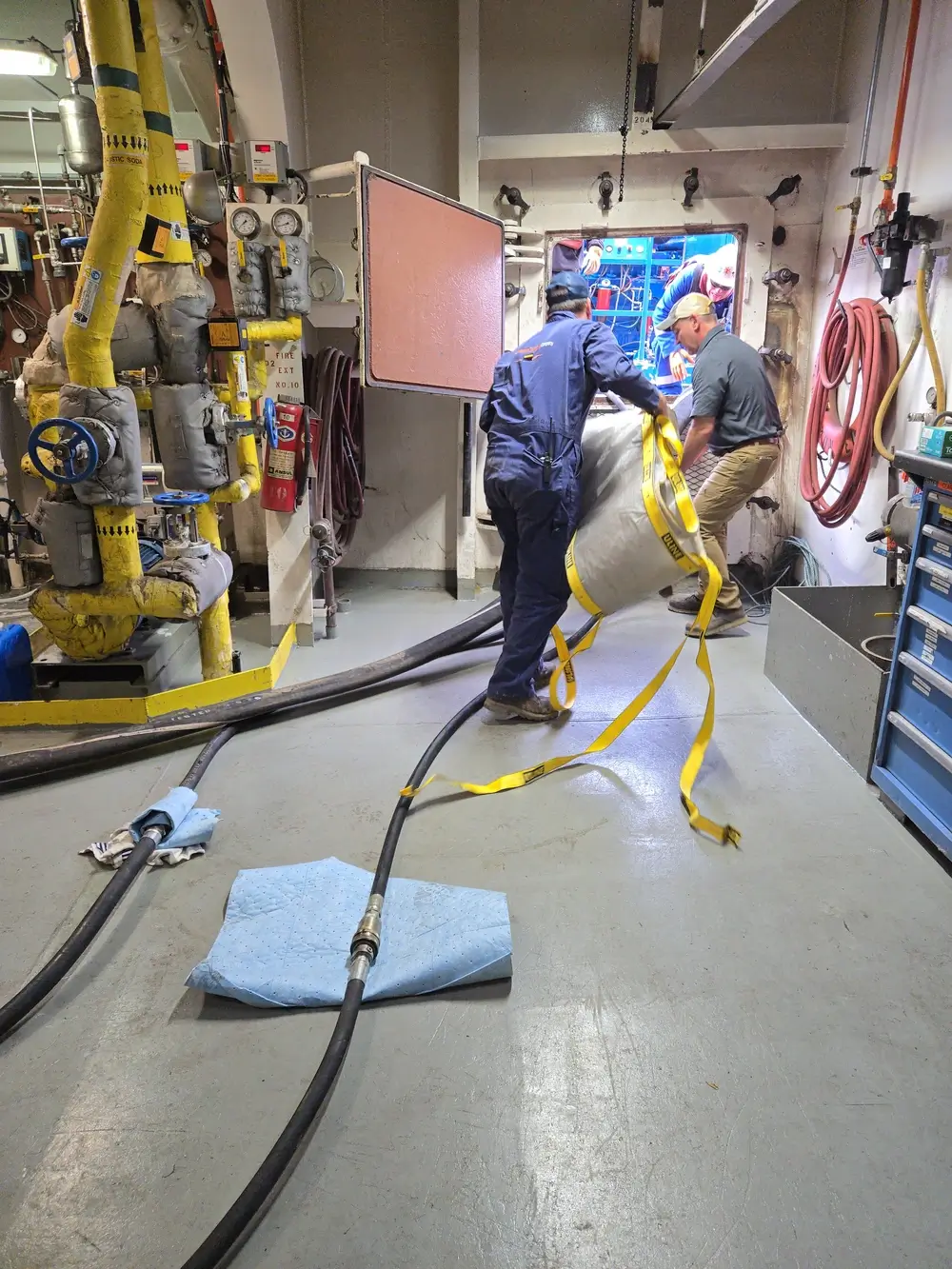
No injuries or pollution were reported, but responders deployed a containment boom around the vessel as a precautionary measure. Under the control of a unified command, the operator and commercial salvors began to take measures to reduce the risk of pollution and to maximize the vessel's stability. The laker Kaye E. Barker anchored alongside the Oberstar on Thursday morning, and the crew of the Oberstar used their self-unloading boom to transfer their cargo - 29,000 tonnes of limestone - over to the Barker. Responders also ran hoses to a damaged bunker tank and pumped off thousands of gallons of oily-water mixture. 

Oberstar's crew transfer limestone cargo over to another laker, June 12 (USCG)

Salvors work to transfer oil-water mixture out of a damaged bunker tank aboard Oberstar (USCG)

After these steps were completed, and a thorough engineering assessment of the ship was finished, the unified command authorized the Oberstar to make a transit to Fraser Shipyards in Superior, Wisconsin. The trip will take about 28 hours to complete. 

“This incident is not complete until the vessel is safe and secure at Fraser Shipyard,” says U.S. Coast Guard Captain James Bendle, Federal On-Scene Coordinator for the Hay Lake Marine Casualty Unified Command, “Everyone supporting this response is highly focused on ensuring that personnel aboard and escorting the vessel are safe, that our waterways and wildlife are protected, and that any impacts to economic activity are mitigated.”