Tokugawa Amerika
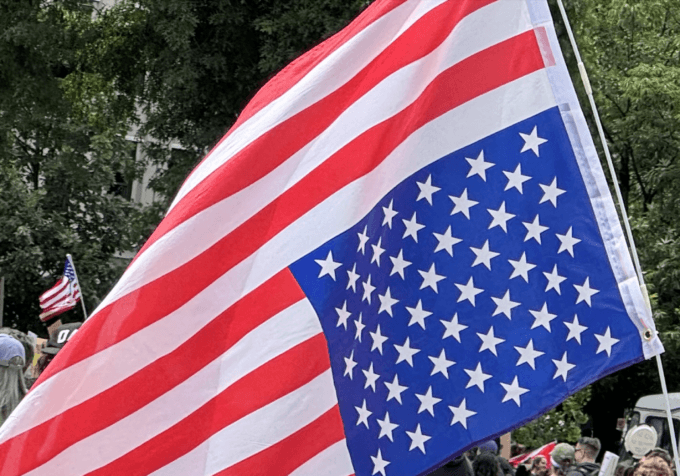
Photograph by Nathaniel St. Clair
War movies are not a favored genre in the United States these days. But there are exceptions that make it big in the box office. One is Blackhawk Down, directed by Scott Ridley, which depicted the big, botched raid to capture General Aidid in 1992 that ended with the bodies of U.S. Rangers being dragged through the streets of Mogadishu. The other is more recent, Alex Garland and Ray Mendoza’s Warfare. These two popular films have one thing in common: they depict hubris and arrogance that end in chaotic defeat.
The popularity of these two films that are almost masochistic in their celebration of defeat is indicative of a larger social fact in the United States today—that there is no popular base for war, whether on the left, the center, the right, or the far right. The only ones rooting for military intervention and confrontation are the liberal internationalists, like Joe Biden and Barack Obama, and the neoconseratives, like Dick Cheney, who came together in the disastrous campaign to elect Kamala Harris president, and they are in total disarray. It was not only Biden’s horrible debate performance that sealed his and Harris’s fate. It was partly their unrelenting support for Israel’s war in Gaza.
Equally important were their open-ended commitment to NATO’s war in Ukraine and their beating the drums of war in the Pacific. When Biden had all the other NATO heads of state join him onstage to pledge themselves to fight to the last Ukrainian during that fateful press conference last July, my reaction was that he was not only mentally dysfunctional, as revealed by his calling Zelensky Putin, but totally out of synch with the electorate when it came to foreign policy.
The End of Class Collaboration
One of the key reasons for the lack of a base for imperial war is something that Utsa and Prabhat Patnaik, authors of Capital and Imperialism, enlighten us on in their dissection of the relationships that made the British Empire function for an extended period:
The functioning of the price system, in short, was such that a rise in workers’ share in the gross value of output could be accommodated without a decline in capitalists’ share through a squeeze on the share of the primary commodity producers. It is not some category of ‘super-profits’ but the very modus operandi of the system that accommodates workers at the expense of primary commodity producers, and imperialism is the entire arrangement that makes this possible.
The Patnaiks stress that this accommodation of the metropolitan working class must be seen not just in distributive terms, but also in terms of other mechanisms, such as state-led demand management that can function as a substitute external to the system for squeezing the colonies once they have ceased to exist.
In the post-colonial arrangement that prevailed after the Second World War, Keynesian state-led demand management became the substitute for pacifying the working class in the metropolis, with continual real rises in working class income coupled with parallel rises in the the rate of profit that were kept in balance partly by the high marginal tax rates imposed on the rich. It was in this context, the so-called Golden Age of Capitalism, that President John F Kennedy could make that classic statement of imperial cross-class consensus in his inaugural address in January 1961, “Let every nation know, whether it wishes us well or ill, that we shall pay any price, bear any burden, meet any hardship, support any friend, oppose any foe to assure the survival and the success of liberty.”
The material and social conditions that allowed Kennedy to assume he had ordinary Americans behind him in his crusade in Vietnam and efforts to overthrow Fidel Castro no longer exist because, by gutting the state of its demand-management functions, the capitalist class imposed neoliberalism on the American masses as surely as the IMF and the World Bank imposed structural adjustment on the Global South. For the last four decades, income stagnation, greater income inequality, greater indebtedness, and the housing crisis so evident in San Francisco and so many other American cities have been the lot of ordinary Americans, a great number of whom are a central part of the MAGA (Make America Great Again) base. In short, the universal imposition of structural adjustment from the 1980s on deprived capital of that relatively privileged metropolitan white working class base necessary to support the imposition of imperial order both internationally and domestically.
Imperial Defeats
The absence of state-led demand management as an external prop is not, however, the only reason for the inability of the the capitalist class to provide both the energy and legitimacy to engage in imperial adventures. The fact is that, over the last four decades, the empire was dealt defeat in three critical fronts. In analyzing these struggles, two things must be emphasized: the agency of the Global South in accounting for these defeats and the way these struggles shaped the current politics of the U.S. working class.
One front was the relationship between U.S. capital and the Chinese Communist Party. To cut a long story short, China got the better of the United States in the devil’s deal it cut with U.S. capital, which was to acquire foreign capital, markets, and advanced technology necesssary for a forced march industrialization in exchange for offering labor that was 2-5 percent of the price of U.S. labor. For millions of American workers, this contract between the transnational corporations and the Chinese Communist Party blessed by Washington translated into massive deindustrialization and the loss of millions of relatively high paying manufacturing jobs. Although China might have been portrayed as the distant beneficiary of this wrenching process, U.S. transnationals were actually experienced by workers as the real villains.
The second front was the successful resistance of the developing country governments and global civil society to the effort of the United States and the European Union to institutionalize the radical pro-corporate global trading system via the World Trade Organization, a project that included the WTO’s becoming the agent of the Global North’s monopoly of advanced technologies, the arbiter of investment, competition policy, and state investment and procurement policies. Hundreds of thousands American workers, notably those in unions, gained a sense of agency through their participation in the successful effort to derail not just the WTO but also the Free Trade of the Americas and the Transpacific Partnership (TPP), and they would not forget that one of Trump’s first acts in office on January 21, 2017, was, owing to their resistance, to take the United States out of the TPP negotiations.
The third front was the spectacular defeat of the 20-year-long U.S. drive to reshape global politics via military means through its invasion of Afghanistan and Iraq. For most Americans, this experience was akin to Moses and the Israelites wandering for 40 years in the Sinai without ending up in the Promised Land of a supremacist America. In this regard, though I certainly was repelled ethically by his methods, we must nevertheless give the devil his due, as they say, and credit Osama bin Laden for his central role in baiting the Bush Jr administration into its unwinnable wars in the Middle East, for being the figure who translated into reality Che Guevara’s vision of creating a hundred Vietnams to disperse and debilitate imperial power. Individuals cannot simply be regarded as personifications of objective social forces—a perspective shared by most orthodox social scientists. Individuals do count and some, in fact, have an outsized imprint on history, their actions serving as the trigger that moves it from one track to another. Bin Laden is one of those figures who deserve the description “Napoleonic.” As Nelly Lahoud, the U.S. intelligence analyst who came out with the most detailed study of the inner workings of al-Qaeda under bin Laden’s direction, conceded, “Though the 9/11 attacks turned out to be a Pyrrhic victory for al-Qaeda, Osama still changed the world and continued to influence global politics for nearly a decade after.”
If the United States is the confused and groping global power with a sick economy that it is today—one that has been, moreover, reduced to a dog being wagged by the Zionist tail, a relationship illustrated by Netanyahu’s push in recent days to get a reluctant Trump to bomb Iran—it is, not to an insignificant degree, due to bin Laden.
The MAGA movement is a product of the four decades-long crisis of capitalism and imperialism. From a progressive standpoint, it has a number of contradictory features. It is, to use Althusser’s term, an “overdetermined contradiction” that combines the worst racist, ethnocentric, and anti-intellectual impulses with deep disdain for the neoliberal, pro-globalization initiatives and interventionist, warmongering policies of the liberal and neoconservative internationalists that have controlled policymaking over the last 80 years. Trump plays mainly to this base, and he knows that any hint of going to war or engaging in direct intervention would mean the unravelling of his presidency, as it was of Biden’s reign and Kamala Harris’s campaign. Trump has realized far more astutely than the neoliberals and neocons that the empire is vastly overextended and there is no mass constituency for imperialism.
Global competition for markets, land, and resources is a structural feature of capitalism, but there are countervailing pressures to capitalism and imperialism’s thrust towards war, and one of these forces is the absence of social base willing to go to war for capital.
David Hutt, a keen observer of Trump’s foreign policy has described him as a “pathological pacifist,” that is, “for Trump, all wars are scams. They are started by politicians for personal vanity and financial gain, and are fought by ‘suckers tricked into caring about things like patriotism and freedom.”
Imperial Retrenchment
I would not go as far as characterizing Trump as a pathological pacifist, but, as I told a conference of American Southeast Asia experts nostalgic for the good old days of interventionist liberal internationalism at a conference at Columbia University last March, Trump is moving from an open-ended commitment to confronting threats to capital everywhere to selective engagement or a spheres-of-influence strategy, something I have also called “defensive imperialism.” Latin America is seen as part of the Western Hemisphere’s core of the empire, and this is definitely bad for us in the Global South. Eastern Europe is seen as Russia’s sphere of influence, Western Europe is left on its own, Washington continues its retreat from Middle East, the one constant being its support for Israel, Africa becomes even more marginal to U.S. interests, and South Asia is most likely seen as being in China’s sphere of influence, despite Trump’s ideological affinity with India’s Modi.
The Asia Pacific is likely seen as China’s sphere of influence, so the South Korean, Japanese, and Philippine governments are right to worry that Trump may be entertaining some grand deal with China and North Korea that could lead to a significant reduction of the U.S. military and political presence in the area. Trump, it must be remembered, upended all expectations and shook the liberal internationalists and neoconservatives to the core when he crossed the thirty-eighth parallel to pat Kim Jong Un on the back in 2019.
Maintaining a global military presence is something that is very costly. The United States has 750 military bases all over the world, and it costs at least $67 billion a year to keep them functioning. Key figures on the far right, such as Steve Bannon and Vice President J.D. Vance, want to radically reduce this military profile, and they are extremely influential with the MAGA base, which is isolationist and no longer wants to be dragged into new foreign adventures in support of U.S. allies that this people feel have had a free ride at the expense of ordinary Americans.
Inevitable Pullback
To focus on the Asia Pacific, the United States will increasingly be transactional in its dealings with Japan, South Korea, the Philippines, and Taiwan, and U.S. forces in these areas will be increasingly seen less as protectors of ideological allies than as pure mercenaries with little common interest with the locals, making them more and more an intolerable burden, as in Okinawa. The process may, like the Roman withdrawal from Britain in the Fifth century CE, take decades, but the thrust is unmistakeable: the eventual pullback of the legions east of the international date line, much like the British pullback from East of Suez in the years following the Suez fiasco in 1956.
The Korean and Japanese elites realize this and are not fooled into thinking Trump’s approach is simply transactional; they know his ultimate game is strategic withdrawal. They and other global actors know that this political-military thrust goes hand and glove with Trump’s economic strategy, which is to disengage globally while creating a techno-economic Fortress America aimed at keeping foreign goods out, bringing back and padlocking U.S. capital, hoarding knowledge by keeping foreign students out, and preventing the entry of migrants from what he calls “shithole countries,” meaning us. It’s not quite Tokugawa Japan or the Hermit Kingdom of the Jeoson Dynasty in Korea, but it’s close.
Of course, Trump could be derailed, as he was after his first term. But the disengagement train is likely to get back on track since his base as well as most of those outside his base share his assessment that the empire is vastly overextended.
Long Overdue
The pullback of the empire to its North American core is largely a positive development from the perspective of the Asia Pacific, since we Asians will have to begin to work out our relations with one another instead of having Washington be the central actor determining our relations with our neighbors. I speak in particular of the U.S. protectorates of Japan, South Korea, and the Philippines in their relations with China, Southeast Asia, and South Asia.
The unfolding of this natural outcome of our evolution as societies that was derailed by 400 years of European colonial intrusion, followed by 175 years of American imperial disruption, is long overdue.