Putin warns of force if Ukraine rejects peace talks ahead of Trump-Zelenskyy meet
Putin said Russia would use force if Ukraine rejects peace talks after heavy attacks on Kyiv, while Zelenskyy said the strikes showed Moscow's desire to continue the war.
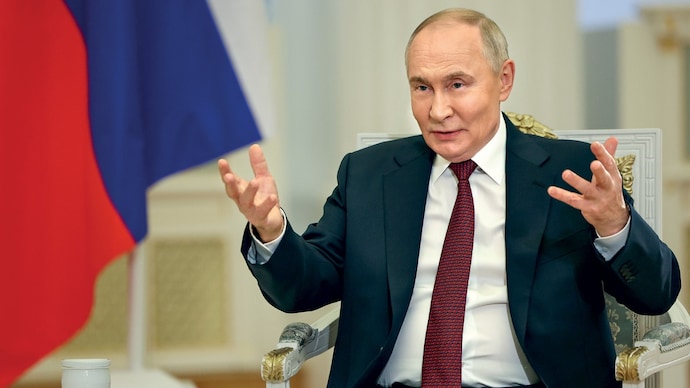
Russian President Vladimir Putin.
India Today World Desk
New Delhi,
Putin said Russia would use force if Ukraine rejects peace talks after heavy attacks on Kyiv, while Zelenskyy said the strikes showed Moscow's desire to continue the war.
Russian President Vladimir Putin.
India Today World Desk
New Delhi,
Dec 28, 2025
Russian President Vladimir Putin on Saturday said Moscow believed Kyiv was in no rush to end the conflict through peaceful means, warning that Russia would achieve all objectives of its so-called “special military operation” by force if diplomacy failed.
Putin’s remarks were reported by Russian state news agency TASS and came amid intensified Russian military action against Ukraine. The statement followed a massive overnight barrage in which Russia launched around 500 drones and 40 missiles at Kyiv and surrounding regions, killing at least one person and injuring about 27 others.
advertisement
Ukraine’s President Volodymyr Zelenskyy said the prolonged, 10-hour bombardment was clear evidence that Moscow had no intention of ending the war it launched in February 2022, a conflict that has since claimed tens of thousands of lives.
The Kremlin earlier said Putin had visited a Russian military command post, where he received briefings from Chief of the General Staff Valery Gerasimov and commanders overseeing the “Centre” and “East” groupings of Russian forces. Russian officials later claimed fresh territorial gains, saying their troops had captured towns in Ukraine’s Donetsk and Zaporizhzhia regions.
Zelenskyy is set to meet US President Donald Trump in Florida on Sunday, as discussions continue on possible pathways to end the nearly four-year-long war. Talks are expected to include security guarantees and territorial disputes, particularly in Donetsk and Zaporizhzhia.
WHAT ZELENSKYY SAID
Zelenskyy arrived in Canada on Saturday for talks, en route to his meeting with Trump, just hours after Russia pummelled Kyiv with drones and missiles in its latest attack on the capital.
Later the same day, Russia claimed further advances along different sections of the frontline. Zelenskyy said the renewed assault underscored Russia’s unwillingness to pursue peace, calling the attacks “Russia’s answer to our peace efforts.”
He reiterated that Ukraine remains committed to a diplomatic resolution, but said Moscow’s actions showed it was determined to prolong the war.
Russian President Vladimir Putin on Saturday said Moscow believed Kyiv was in no rush to end the conflict through peaceful means, warning that Russia would achieve all objectives of its so-called “special military operation” by force if diplomacy failed.
Putin’s remarks were reported by Russian state news agency TASS and came amid intensified Russian military action against Ukraine. The statement followed a massive overnight barrage in which Russia launched around 500 drones and 40 missiles at Kyiv and surrounding regions, killing at least one person and injuring about 27 others.
advertisement
Ukraine’s President Volodymyr Zelenskyy said the prolonged, 10-hour bombardment was clear evidence that Moscow had no intention of ending the war it launched in February 2022, a conflict that has since claimed tens of thousands of lives.
The Kremlin earlier said Putin had visited a Russian military command post, where he received briefings from Chief of the General Staff Valery Gerasimov and commanders overseeing the “Centre” and “East” groupings of Russian forces. Russian officials later claimed fresh territorial gains, saying their troops had captured towns in Ukraine’s Donetsk and Zaporizhzhia regions.
Zelenskyy is set to meet US President Donald Trump in Florida on Sunday, as discussions continue on possible pathways to end the nearly four-year-long war. Talks are expected to include security guarantees and territorial disputes, particularly in Donetsk and Zaporizhzhia.
WHAT ZELENSKYY SAID
Zelenskyy arrived in Canada on Saturday for talks, en route to his meeting with Trump, just hours after Russia pummelled Kyiv with drones and missiles in its latest attack on the capital.
Later the same day, Russia claimed further advances along different sections of the frontline. Zelenskyy said the renewed assault underscored Russia’s unwillingness to pursue peace, calling the attacks “Russia’s answer to our peace efforts.”
He reiterated that Ukraine remains committed to a diplomatic resolution, but said Moscow’s actions showed it was determined to prolong the war.
WHAT CANADA PM SAID
Canadian Prime Minister Mark Carney on Saturday said achieving lasting peace in Ukraine would require cooperation from Russia, strongly condemning the latest Russian strikes on Kyiv as “barbaric.”
“We have the conditions for a just and lasting peace, but that requires a willing Russia,” Carney said, according to AFP, while speaking during a stop in Halifax, Nova Scotia, on his way to meet Trump in Florida.
Carney also announced CAN$2.5 billion (US$1.82 billion) in new economic assistance for Ukraine, saying the funds would help unlock international financing needed to begin rebuilding the country even as the war continues.
- Ends

Arms Control Putin-Style Goes Nowhere – Analysis
December 28, 2025
The Jamestown Foundation
By Dr. Pavel K. Baev
Russian President Vladimir Putin’s offer on September 22 to extend the limitations on the strategic nuclear forces set by the Measures for the Further Reduction and Limitation of Strategic Offensive Arms (New START) between the United States and Russian Federation appeared reasonable and meaningful (U.S. State Department, April 8, 2010; President of Russia, April 8, 2010, September 22).
New START is due to expire on February 5, 2026, and even experts in Moscow who are loath to join the ranks of “patriotic” drum-beaters found Putin’s proposition timely and useful (Kommersant, October 7). The Kremlin, however, did not pursue follow-up actions. Deputy Russian Foreign Minister Sergei Ryabkov sourly confirmed the failure of opening a dialogue on that traditional high-priority track, despite Russian media celebrating Putin’s offer and U.S. President Donald Trump saying that extending NEW START sounded like a good idea (TASS, October 5; Mezhdunarodnaya Zhizn, December 8).
Putin’s offer has now all but disappeared. The only trace of it is in the leaked memo, known as the “28-point plan,” which was published in all Russian mainstream media (Kommersant, November 21). Russian experts pointed out a mistake in point 17, which confused New START with START I, stating, “The United States and Russia will agree to extend the validity of treaties on the non-proliferation and control of nuclear weapons, including the START I Treaty.” Russian media concluded that the document was an “odd hybrid” of various drafts prepared by incompetent mediators (Rossiiskaya gazeta, November 21). It is unclear whether this point—or the reference to the long-expired treaty—will survive the presumed reduction of the peace plan to 20 points or its division into four separate packages (RBC, December 8). The absence of any mention of strategic arms control in the new U.S. National Security Strategy is clear. Russian commentators appeared to find this omission flabbergasting (Vedomosti, December 5; Kommersant, December 7). Following the document’s publication, the Russian Foreign Ministry expressed disappointment at the lack of a U.S. vision for maintaining the balance of strategic forces (Russian Ministry of Foreign Affairs, December 8).
Nuclear deterrence has traditionally been central to Russian security thinking. The Russian National Security Strategy approved by Putin in July 2021 places great emphasis on maintaining strategic stability. It prescribes maintaining nuclear capabilities at a level sufficient for neutralizing growing threats, which it claims are caused by the U.S. dismantlement of the system of arms control (Russian Security Council, July 2, 2021). The new Russian Nuclear Doctrine, approved in November 2024, elaborates on this priority and defines conditions for a decision on the first use of nuclear weapons (President of Russia, November 19, 2024). The Kremlin’s preoccupation with nuclear matters came into focus when the Russian Security Council convened an emergency meeting on November 5 to deliberate an appropriate response to Trump’s presumed order to resume nuclear testing (see EDM, November 3; President of Russia, November 5). Russian Defense Minister Andrei Belousov omitted Russian violations of various agreements when he claimed that the United States would breach the Comprehensive Nuclear Test Ban Treaty (1996) (Kommersant, November 5)
That misunderstanding about nuclear testing has been mostly cleared up. The problem of Russia seeking status as an equal nuclear power to the United States, however, remains. The Kremlin’s desire for a leading role on the world stage is underpinned by sustained efforts at modernizing its nuclear arsenal (Rossiiskaya gazeta, December 8). Much of the new U.S. National Security Strategy denies Russia the status of a major global power in the emerging multipolar world, not least due to its full-scale invasion of Ukraine (Nezavisimaya gazeta, December 7). From this perspective, Russia’s role is reduced, and it is uncertain where a possible end to the hostilities will leave Russia (Vzglyad, December 9).
Putin has sought to counter this challenge by simultaneously narrowing and widening the agenda of the ongoing peace talks (see Jamestown, November 26). The former is achieved by focusing peace negotiations on the demand to award Russia the unconquered part of Ukraine’s Donetsk oblast (Republic.ru, December 3). The latter is attempted by impressing upon Washington, D.C., the importance of discussions on strategic stability, primarily by announcing tests of new weapon systems, such as the Burevestnik cruise missile and the Poseidon unmanned underwater vehicle, both nuclear-powered and capable of carrying nuclear warheads (Profile, November 11). The Kremlin has proposed a range of presumably lucrative joint projects, including constructing a tunnel connecting Alaska and Chukotka, to persuade the United States to look beyond what the Kremlin perceives as pesky details of territorial exchanges (Izvestiya, October 20).
Putin’s offer to stick to the limits set by New START was not as far-fetched as the Bering Sea tunnel, and it probably had a hidden agenda. Putin did not suggest an exchange of data or a resumption of verification procedures, which were affected by his February 2023 decree suspending Russia’s participation in New START (President of Russia, February 21, 2023; Forbes.ru, September 25). Moscow has no reason to suspect that U.S. nuclear arms will exceed the agreed-upon ceilings, but it probably seeks to hide the shrinking of its arsenal to well below the limits. The only part of the hugely expensive modernization program that is on track, with only slight delays, is the construction of Borei-class submarines. Putin inaugurated the eighth one (Knyaz’ Pozharsky, Князь Пожарский) in July, which joined the Northern Fleet without performing the mandatory launch of the Bulava missile (see EDM, May 30; President of Russia, July 24; Korabel.ru, August 3). Russia’s Strategic Rocket Forces need to retire all of the old heavy intercontinental missiles (SS-18 and SS-19) and the lighter Topol (SS-25) as well, but the new Sarmat (SS-X-29) missile, which Putin announced as ready for deployment in March 2018, failed one test in September 2024 and exploded early in another one on November 28 (Meduza, September 25, 2024; Verstka.media, November 28). Russia’s Long-Range Aviation, which has performed hard combat missions since the start of Russia’s full-scale invasion of Ukraine, is currently in an even worse state. Poor maintenance has caused many incidents—including the crash of a Tu-22M3 bomber in the Irkutsk oblast last April—while a dozen planes were destroyed and many more seriously damaged in Ukraine’s Operation Spiderweb on June 1 (Meduza, April 2; The Moscow Times, June 6). Current production levels of the Tu-160 bombers at the Kazan plant reach only a couple of planes a year, while the PAK-DA project for the stealth bomber has been postponed indefinitely (Radio Svoboda, June 28; 1.ru, September 20).
The scarcity of data due to wartime Russian censorship obscures the true scale of these setbacks. Putin is keen to deny the degradation of Russia’s strategic arsenal by both engaging in nuclear posturing and demonstrating readiness to discuss issues pertaining to strategic stability. This performance is aimed not only at the United States and Europe, but also at the People’s Republic of China (PRC). The PRC is building up its deterrence capabilities and presented many new weapon systems during its Victory Day parade on September 3, marking the end of World War II, which Putin attended (see China Brief, October 1; Top War, November 10). The PRC has so far refused to engage in any talks on limiting its nuclear arsenal. Moscow cannot embrace the PRC as a party to a treaty prohibiting the first use of nuclear weapons, but instead hopes that Beijing would approve its intention to preserve the framework of New START (RIAC, July 14).
Putin’s offer to extend New START reflects a deeper struggle to achieve recognition for Russia’s status as a global power and a peer competitor to the United States. The Kremlin cannot, nevertheless, develop any innovative framework to address the rapid progress in aeronautics, space, and information/artificial intelligence technologies, which are increasingly foreign to its defense-industrial base. These constraints make performative gestures an important tool for projecting strength and relevance as “European allies enjoy a significant hard power advantage over Russia by almost every measure, save nuclear weapons” (The White House, December 4). This reality may compel Putin to resort to nuclear brinksmanship even more often.
Source: This article was published by The Jamestown Foundation
The Jamestown Foundation
The Jamestown Foundation’s mission is to inform and educate policy makers and the broader community about events and trends in those societies which are strategically or tactically important to the United States and which frequently restrict access to such information. Utilizing indigenous and primary sources, Jamestown’s material is delivered without political bias, filter or agenda. It is often the only source of information which should be, but is not always, available through official or intelligence channels, especially in regard to Eurasia and terrorism.
December 28, 2025
The Jamestown Foundation
By Dr. Pavel K. Baev
Russian President Vladimir Putin’s offer on September 22 to extend the limitations on the strategic nuclear forces set by the Measures for the Further Reduction and Limitation of Strategic Offensive Arms (New START) between the United States and Russian Federation appeared reasonable and meaningful (U.S. State Department, April 8, 2010; President of Russia, April 8, 2010, September 22).
New START is due to expire on February 5, 2026, and even experts in Moscow who are loath to join the ranks of “patriotic” drum-beaters found Putin’s proposition timely and useful (Kommersant, October 7). The Kremlin, however, did not pursue follow-up actions. Deputy Russian Foreign Minister Sergei Ryabkov sourly confirmed the failure of opening a dialogue on that traditional high-priority track, despite Russian media celebrating Putin’s offer and U.S. President Donald Trump saying that extending NEW START sounded like a good idea (TASS, October 5; Mezhdunarodnaya Zhizn, December 8).
Putin’s offer has now all but disappeared. The only trace of it is in the leaked memo, known as the “28-point plan,” which was published in all Russian mainstream media (Kommersant, November 21). Russian experts pointed out a mistake in point 17, which confused New START with START I, stating, “The United States and Russia will agree to extend the validity of treaties on the non-proliferation and control of nuclear weapons, including the START I Treaty.” Russian media concluded that the document was an “odd hybrid” of various drafts prepared by incompetent mediators (Rossiiskaya gazeta, November 21). It is unclear whether this point—or the reference to the long-expired treaty—will survive the presumed reduction of the peace plan to 20 points or its division into four separate packages (RBC, December 8). The absence of any mention of strategic arms control in the new U.S. National Security Strategy is clear. Russian commentators appeared to find this omission flabbergasting (Vedomosti, December 5; Kommersant, December 7). Following the document’s publication, the Russian Foreign Ministry expressed disappointment at the lack of a U.S. vision for maintaining the balance of strategic forces (Russian Ministry of Foreign Affairs, December 8).
Nuclear deterrence has traditionally been central to Russian security thinking. The Russian National Security Strategy approved by Putin in July 2021 places great emphasis on maintaining strategic stability. It prescribes maintaining nuclear capabilities at a level sufficient for neutralizing growing threats, which it claims are caused by the U.S. dismantlement of the system of arms control (Russian Security Council, July 2, 2021). The new Russian Nuclear Doctrine, approved in November 2024, elaborates on this priority and defines conditions for a decision on the first use of nuclear weapons (President of Russia, November 19, 2024). The Kremlin’s preoccupation with nuclear matters came into focus when the Russian Security Council convened an emergency meeting on November 5 to deliberate an appropriate response to Trump’s presumed order to resume nuclear testing (see EDM, November 3; President of Russia, November 5). Russian Defense Minister Andrei Belousov omitted Russian violations of various agreements when he claimed that the United States would breach the Comprehensive Nuclear Test Ban Treaty (1996) (Kommersant, November 5)
That misunderstanding about nuclear testing has been mostly cleared up. The problem of Russia seeking status as an equal nuclear power to the United States, however, remains. The Kremlin’s desire for a leading role on the world stage is underpinned by sustained efforts at modernizing its nuclear arsenal (Rossiiskaya gazeta, December 8). Much of the new U.S. National Security Strategy denies Russia the status of a major global power in the emerging multipolar world, not least due to its full-scale invasion of Ukraine (Nezavisimaya gazeta, December 7). From this perspective, Russia’s role is reduced, and it is uncertain where a possible end to the hostilities will leave Russia (Vzglyad, December 9).
Putin has sought to counter this challenge by simultaneously narrowing and widening the agenda of the ongoing peace talks (see Jamestown, November 26). The former is achieved by focusing peace negotiations on the demand to award Russia the unconquered part of Ukraine’s Donetsk oblast (Republic.ru, December 3). The latter is attempted by impressing upon Washington, D.C., the importance of discussions on strategic stability, primarily by announcing tests of new weapon systems, such as the Burevestnik cruise missile and the Poseidon unmanned underwater vehicle, both nuclear-powered and capable of carrying nuclear warheads (Profile, November 11). The Kremlin has proposed a range of presumably lucrative joint projects, including constructing a tunnel connecting Alaska and Chukotka, to persuade the United States to look beyond what the Kremlin perceives as pesky details of territorial exchanges (Izvestiya, October 20).
Putin’s offer to stick to the limits set by New START was not as far-fetched as the Bering Sea tunnel, and it probably had a hidden agenda. Putin did not suggest an exchange of data or a resumption of verification procedures, which were affected by his February 2023 decree suspending Russia’s participation in New START (President of Russia, February 21, 2023; Forbes.ru, September 25). Moscow has no reason to suspect that U.S. nuclear arms will exceed the agreed-upon ceilings, but it probably seeks to hide the shrinking of its arsenal to well below the limits. The only part of the hugely expensive modernization program that is on track, with only slight delays, is the construction of Borei-class submarines. Putin inaugurated the eighth one (Knyaz’ Pozharsky, Князь Пожарский) in July, which joined the Northern Fleet without performing the mandatory launch of the Bulava missile (see EDM, May 30; President of Russia, July 24; Korabel.ru, August 3). Russia’s Strategic Rocket Forces need to retire all of the old heavy intercontinental missiles (SS-18 and SS-19) and the lighter Topol (SS-25) as well, but the new Sarmat (SS-X-29) missile, which Putin announced as ready for deployment in March 2018, failed one test in September 2024 and exploded early in another one on November 28 (Meduza, September 25, 2024; Verstka.media, November 28). Russia’s Long-Range Aviation, which has performed hard combat missions since the start of Russia’s full-scale invasion of Ukraine, is currently in an even worse state. Poor maintenance has caused many incidents—including the crash of a Tu-22M3 bomber in the Irkutsk oblast last April—while a dozen planes were destroyed and many more seriously damaged in Ukraine’s Operation Spiderweb on June 1 (Meduza, April 2; The Moscow Times, June 6). Current production levels of the Tu-160 bombers at the Kazan plant reach only a couple of planes a year, while the PAK-DA project for the stealth bomber has been postponed indefinitely (Radio Svoboda, June 28; 1.ru, September 20).
The scarcity of data due to wartime Russian censorship obscures the true scale of these setbacks. Putin is keen to deny the degradation of Russia’s strategic arsenal by both engaging in nuclear posturing and demonstrating readiness to discuss issues pertaining to strategic stability. This performance is aimed not only at the United States and Europe, but also at the People’s Republic of China (PRC). The PRC is building up its deterrence capabilities and presented many new weapon systems during its Victory Day parade on September 3, marking the end of World War II, which Putin attended (see China Brief, October 1; Top War, November 10). The PRC has so far refused to engage in any talks on limiting its nuclear arsenal. Moscow cannot embrace the PRC as a party to a treaty prohibiting the first use of nuclear weapons, but instead hopes that Beijing would approve its intention to preserve the framework of New START (RIAC, July 14).
Putin’s offer to extend New START reflects a deeper struggle to achieve recognition for Russia’s status as a global power and a peer competitor to the United States. The Kremlin cannot, nevertheless, develop any innovative framework to address the rapid progress in aeronautics, space, and information/artificial intelligence technologies, which are increasingly foreign to its defense-industrial base. These constraints make performative gestures an important tool for projecting strength and relevance as “European allies enjoy a significant hard power advantage over Russia by almost every measure, save nuclear weapons” (The White House, December 4). This reality may compel Putin to resort to nuclear brinksmanship even more often.
About the author: Dr. Pavel K. Baev is a senior researcher at the International Peace Research Institute, Oslo (PRIO).
Source: This article was published by The Jamestown Foundation
The Jamestown Foundation
The Jamestown Foundation’s mission is to inform and educate policy makers and the broader community about events and trends in those societies which are strategically or tactically important to the United States and which frequently restrict access to such information. Utilizing indigenous and primary sources, Jamestown’s material is delivered without political bias, filter or agenda. It is often the only source of information which should be, but is not always, available through official or intelligence channels, especially in regard to Eurasia and terrorism.

No comments:
Post a Comment