DOSSIER
.jpg)
Global Outrage Grows Over Israel's 'Preventable' US-Backed Genocidal Famine in Gaza
"This is not an unavoidable famine, this is a campaign of mass extermination," said Jewish Voice for Peace.
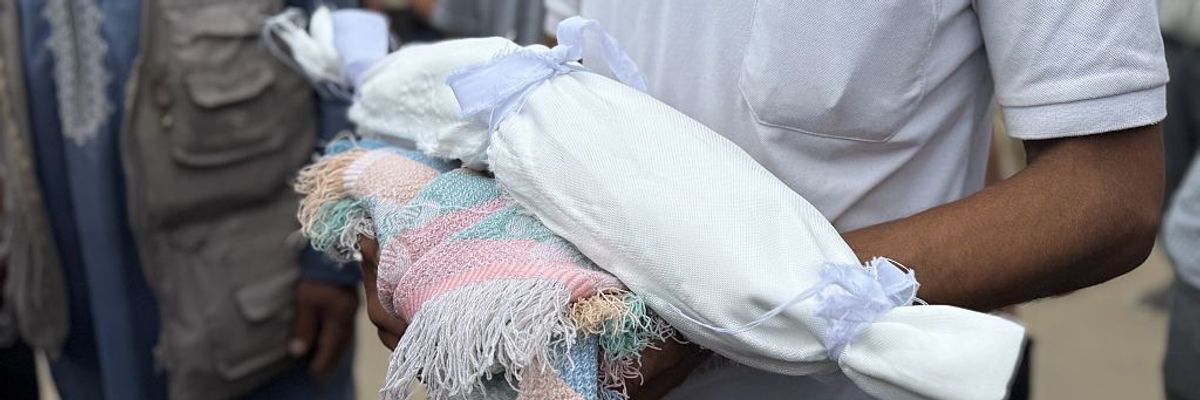
Ghadir Breika, a 5-month-old Palestinian infant who starved to death, is seen wrapped in a burial shroud while held by a relative outside Nasser Hospital in Khan Yunis, Gaza, Palestine on August 22, 2025.
(Photo by Abdallah Alattar/Anadolu via Getty Images)
Brett Wilkins
Aug 22, 2025
COMMON DREAMS
International outrage mounted Friday following the official declaration of full-blown famine in Gaza, with human rights defenders underscoring the preventable nature of a crisis caused by Israel's 22-month US-backed obliteration and siege of the Palestinian territory.
As Common Dreams reported, the Integrated Food Security Phase Classification (IPC)—the world's leading authority on hunger crises—issued a "special snapshot" on the situation in Gaza confirming the embattled Palestinian enclave has entered Phase 5, or catastrophic famine, characterized by "starvation, death, destitution, and extremely critical acute malnutrition levels."
According to the IPC, more than 500,000 Gazans are suffering Phase 5 conditions, more than 1 million Palestinians are currently in Phase 4 ("emergency"), and nearly 400,000 others are in Phase 3 ("crisis").
Hundreds of Palestinians have starved to death in Gaza, including at least 112 children, according to local health officials. Thousands more Palestinians have been killed or wounded while seeking food aid, including more than 850 people slain at or near distribution points run by the Gaza Humanitarian Foundation—described as "death traps"—where Israeli soldiers said they were ordered to fire live bullets and artillery shells into crowds of civilians.
"It is a famine on all of our watch. Everyone owns this."
The starvation crisis is so severe that even Israeli media and US President Donald Trump and senior members of his administration have addressed it, with Vice President JD Vance recently acknowledging that "you've got little kids who are clearly starving to death."
Critics—some of whom noted warnings of imminent starvation in Gaza dating back to late 2023—stressed that the Gaza famine is entirely the result of Israeli policies and practices.
"It is a famine that we could have prevented, if we had been allowed. Yet food stacks up at borders because of systematic obstruction by Israel," United Nations Undersecretary-General for Humanitarian Affairs and Emergency Relief Coordinator Tom Fletcher said during a Friday press briefing.
"It is a famine within a few hundred meters of food, in a fertile land," he continued. "It is a famine that we repeatedly warned of, but that the international media has not been allowed in to cover. To bear witness. It is a famine openly promoted by some Israeli leaders as a weapon of war."
"It is a famine on all of our watch. Everyone owns this," Fletcher contended. "The Gaza famine is the world's famine. It is a famine that asks, 'But what did you do?' A famine that will and must haunt us all. It is a predictable and a preventable famine. It is a famine that must spur the world to more urgent action."
"My ask, my plea, my demand to [Israeli Prime Minister Benjamin] Netanyahu and anyone who can reach him: Enough," he added. "Ceasefire. Open the crossings, north and south, all of them. Let us get food and other supplies in, unimpeded and at the massive scale required. End the retribution. It is too late for far too many. But not for everyone in Gaza. Enough. For humanity's sake, let us in."
Irish Foreign Minister Simon Harris—who is also defense minister and the equivalent of deputy prime minister—called the situation in Gaza "heartbreaking and devastating."
"It is sickening and despicable," Harris continued. "In [Ireland], we have called it out for what it is—a genocide."
Erika Guevara Rosas, the senior director for research, advocacy, policy, and campaigns at Amnesty International—one of many international human rights groups accusing Israel of genocide—said Friday that "this famine is the direct consequence of Israel's deliberate campaign of starvation in Gaza."
"It is all the more harrowing that this famine is an entirely man-made, deliberately orchestrated, and preventable catastrophe," she continued. "The deliberate obstruction of humanitarian aid, the destruction of life-sustaining infrastructure, and the direct killings of civilians are a clear manifestation of how Israel is inflicting conditions of life calculated to bring about the physical destruction of Palestinians in Gaza as part of its ongoing genocide."
"With every hour that passes without decisive international action, more Palestinian lives are lost, and Gaza City edges closer to complete annihilation," Guevara Rosas added, referring to Israel's launch of Operation Gideon's Chariots 2, a campaign to conquer, occupy, and ethnically cleanse 1 million Palestinians, possibly into a concentration camp proposed for construction over the ruins of Rafah.
"History will never forgive us for standing by as emaciated children die, while food remains just miles away, yet blocked by Israel," Guevara Rosas asserted. "To even begin reversing the devastating consequences of Israel's inhumane policies and actions, the world must take action now."
The US group Jewish Voice for Peace (JVP), which has led many protests against the Gaza genocide, said on the social media site Bluesky, "This is not an unavoidable famine, this is a campaign of mass extermination."
"The legacy of this genocide will last beyond any of our lifetimes," JVP added. "We've arrived at this point after decades of the US doing everything in its power to defend and fund the Israeli government's policies of ethnic cleansing, land theft, and now starvation and genocide. This depravity must end."
These statements follow similar condemnations earlier Friday by UN Secretary-General António Guterres, UN human right chief Volker Türk, and many others around the world on the 686th day of Israel's assault and siege, which have left more than 228,000 Palestinians dead, maimed, or missing, according to the Gaza Health Ministry.
Coinciding with the IPC designation, a report published Friday by Forensic Architecture and the World Peace Foundation detailed how Israel has dismantled the time-tested civilian aid distribution model and replaced it with a military-based system in which many Palestinians are not only dying from starvation but are also being killed while trying to obtain food.
The Israeli human rights group B'Tselem—which, along with Physicians for Human Rights-Israel recently became the first two groups in Israel to acknowledge the Gaza genocide—also published a report Friday on Israel's weaponized starvation of the strip.
Meanwhile, Israeli government officials responded to the IPC announcement in the same manner in which they've dismissed accusations of genocide for the past 22 months.
Netanyahu—who is a fugitive from the International Criminal Court wanted for alleged crimes against humanity and war crimes including murder and forced starvation—called the IPC report "an outright lie."
"Israel does not have a policy of starvation," the prime minister incredulously claimed. "Israel has a policy of preventing starvation."
According to the Gaza Health Ministry, two more Palestinians starved to death in Gaza within the past 24 hours, including a 5-month-old infant.
'Phase 5 (Catastrophe)': Global Food Authority Declares Famine in Gaza
"This engineered famine is the ultimate and inevitable result of the Government of Israel's use of starvation as a weapon of war," said the head of Save the Children International in response to the IPC assessment.
"This engineered famine is the ultimate and inevitable result of the Government of Israel's use of starvation as a weapon of war," said the head of Save the Children International in response to the IPC assessment.

Severely malnourished children receive medical treatment at the Al-Aqsa Martyrs Hospital in Deir al-Balah, Gaza Strip, on August 20, 2025. Due to Israel's ongoing blockade and restriction on food and medicine, children suffering from hunger are treated under extremely limited conditions.
(Photo by Hassan Jedi/Anadolu via Getty Images)
Jon Queally
Aug 22, 2025
COMMON DREAMS
The world's top authority on hunger crises officially declared Friday that a famine of the most severe kind is the reality in Gaza—a humanitarian disaster engineered by Israel's relentless blockade of food aid and other life-saving supplies amid a military campaign that makes little to no distinction between civilians and possible Palestinian fighters living in the occupied enclave.
The Integrated Food Security Phase Classification (IPC)—the multi-stakeholder global initiative which integrates international, regional, and national governments and agencies to monitor and respond to food-related emergencies—issued a "special snapshot" on the situation in Gaza and determined that "Famine (IPC Phase 5)—with reasonable evidence—is confirmed in Gaza Governorate."
Phase 5 is the highest level of its famine emergency categories, which, according to the IPC, which means the situation is beyond Category 4 ("Emergency") and now represents a "Catastrophe."
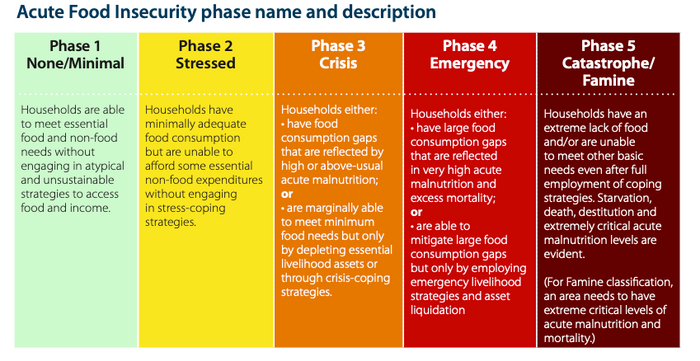
(Image: The Integrated Food Security Phase Classification)
According to the IPC's snapshot assessment:
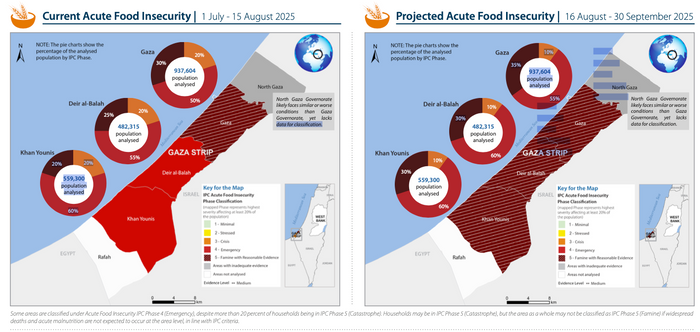
After 22 months of relentless conflict, over half a million people in the Gaza Strip are facing catastrophic conditions characterised by starvation, destitution and death. Another 1.07 million people (54 percent) are in Emergency (IPC Phase 4), and 396,000 people (20 percent) are in Crisis (IPC Phase 3).
Between mid-August and the end of September 2025, conditions are expected to further worsen with Famine projected to expand to Deir al-Balah and Khan Younis. Nearly a third of the population (641,000 people) are expected to face catastrophic conditions (IPC Phase 5), while those in Emergency (IPC Phase 4) will likely rise to 1.14 million (58 percent). Acute malnutrition is projected to continue worsening rapidly.
Through June 2026, at least 132,000 children under five are expected to suffer from acute malnutrition—double the IPC estimates from May 2025. This includes over 41,000 severe cases of children at heightened risk of death. Nearly 55,500 malnourished pregnant and breastfeeding women will also require urgent nutrition response.
Despite limited data, conditions in North Gaza Governorate are estimated to be as severe—or worse—than in Gaza Governorate.
Download the complete four-page assessment released Friday. The agency said a more complete assessment of its findings will be put out in the coming weeks.
Humanitarians, human rights groups, and relief organizations, which for months have desperately warned world leaders that starvation and malnutrition were rapidly spreading, reacted to the IPC designation—given the global community's failure to force Israel into compliance with international law—with a mix of fury and frustration.
"Despite warnings in July that famine was imminent, Israel has continued to deprive Palestinians of food, denying almost every request from long-established humanitarian agencies, preventing them from delivering vital food and aid that could have stemmed hunger, malnutrition, and disease," said Helen Stawski, the policy lead for Oxfam International.
According to the IPC's snapshot assessment:
After 22 months of relentless conflict, over half a million people in the Gaza Strip are facing catastrophic conditions characterised by starvation, destitution and death. Another 1.07 million people (54 percent) are in Emergency (IPC Phase 4), and 396,000 people (20 percent) are in Crisis (IPC Phase 3).
Between mid-August and the end of September 2025, conditions are expected to further worsen with Famine projected to expand to Deir al-Balah and Khan Younis. Nearly a third of the population (641,000 people) are expected to face catastrophic conditions (IPC Phase 5), while those in Emergency (IPC Phase 4) will likely rise to 1.14 million (58 percent). Acute malnutrition is projected to continue worsening rapidly.
Through June 2026, at least 132,000 children under five are expected to suffer from acute malnutrition—double the IPC estimates from May 2025. This includes over 41,000 severe cases of children at heightened risk of death. Nearly 55,500 malnourished pregnant and breastfeeding women will also require urgent nutrition response.
Despite limited data, conditions in North Gaza Governorate are estimated to be as severe—or worse—than in Gaza Governorate.
Download the complete four-page assessment released Friday. The agency said a more complete assessment of its findings will be put out in the coming weeks.
Humanitarians, human rights groups, and relief organizations, which for months have desperately warned world leaders that starvation and malnutrition were rapidly spreading, reacted to the IPC designation—given the global community's failure to force Israel into compliance with international law—with a mix of fury and frustration.
"Despite warnings in July that famine was imminent, Israel has continued to deprive Palestinians of food, denying almost every request from long-established humanitarian agencies, preventing them from delivering vital food and aid that could have stemmed hunger, malnutrition, and disease," said Helen Stawski, the policy lead for Oxfam International.
(Image: IPC assessment)
Stawski placed the blame squarely on Israel's government for blocking food and other supplies that could otherwise be saving lives.
"Oxfam alone has more than $2.5 million worth of life-saving aid, including high-calorie food packages—now sitting in warehouses outside Gaza," she said. "Israeli authorities have rejected it all, at a time when it is needed more than ever."
Inger Ashing, CEO of Save the Children International, rebuked the inaction of global actors who stood by while Israel and its allies allowed to the famine to take hold.
"The world has been watching as children have suffered the unthinkable for nearly two years in Gaza, and now, we have confirmation that hundreds of thousands are being slowly starved to death. None of us should accept this," said Ashing.
"All of Gaza is being systematically starved by design, and children are paying the highest price. The world has failed to act as their tiny, emaciated bodies have been overcome by hunger and disease and shut down," she added. "This engineered famine is the ultimate and inevitable result of the Government of Israel's use of starvation as a weapon of war. The sustained siege on food, medicine, and fuel was bound to lead to this preventable catastrophe. There is no world leader who did not know this was coming, who hasn't been warned again and again."
What's urgently needed now, say experts, is an immediate ceasefire and a return to the UN-backed humanitarian aid distribution system that was sidelined by the Israeli and US governments that put the ill-conceived and euphemistically named Gaza Humanitarian Foundation, stocked with private contractors and protected by IDF forces and mercenaries, in charge of food operations that have led to chaos and hundreds of killings around its distribution sites.
The IPC assessment called for the following actions in order to end the famine:
Stawski placed the blame squarely on Israel's government for blocking food and other supplies that could otherwise be saving lives.
"Oxfam alone has more than $2.5 million worth of life-saving aid, including high-calorie food packages—now sitting in warehouses outside Gaza," she said. "Israeli authorities have rejected it all, at a time when it is needed more than ever."
Inger Ashing, CEO of Save the Children International, rebuked the inaction of global actors who stood by while Israel and its allies allowed to the famine to take hold.
"The world has been watching as children have suffered the unthinkable for nearly two years in Gaza, and now, we have confirmation that hundreds of thousands are being slowly starved to death. None of us should accept this," said Ashing.
"All of Gaza is being systematically starved by design, and children are paying the highest price. The world has failed to act as their tiny, emaciated bodies have been overcome by hunger and disease and shut down," she added. "This engineered famine is the ultimate and inevitable result of the Government of Israel's use of starvation as a weapon of war. The sustained siege on food, medicine, and fuel was bound to lead to this preventable catastrophe. There is no world leader who did not know this was coming, who hasn't been warned again and again."
What's urgently needed now, say experts, is an immediate ceasefire and a return to the UN-backed humanitarian aid distribution system that was sidelined by the Israeli and US governments that put the ill-conceived and euphemistically named Gaza Humanitarian Foundation, stocked with private contractors and protected by IDF forces and mercenaries, in charge of food operations that have led to chaos and hundreds of killings around its distribution sites.
The IPC assessment called for the following actions in order to end the famine:
Immediate and sustained cessation of hostilities
To prevent further loss of life and famine from spreading further, an immediate ceasefire and putting an end to the conflict is critical.
Guarantee unconditional and safe humanitarian access
Safe, stable, and unhindered access must be guaranteed through all entry points, in full respect of international humanitarian law, allowing for lifesaving assistance and essential services to reach all people in need across the Gaza Strip. Access must also be granted urgently to allow for a comprehensive humanitarian assessment, in particular in North Gaza Governorate.
Immediate, large-scale, unobstructed multi-sector humanitarian assistance is needed to avert further destitution, starvation and death. This includes the provision of food, nutrition, health, WASH, shelter, fuel, cooking gas and food production inputs, while safeguarding humanitarian principles. This is also the only way to stop the interception of aid trucks by desperate populations.
Protect civilians and critical infrastructure
Ensure the safety of civilians and humanitarian personnel across the Gaza Strip. Protect and restore critical infrastructure essential for survival and for the functioning of food, health and WASH systems.
Restore commercial flows at scale, market systems, essential services, and local food production.
"Famine means there are no more breaking points and no more alarm bells," said Ashing. "The Government of Israel must immediately end the use of starvation as a weapon of war and lift the siege of the Gaza Strip, allowing aid, including food and nutrition supplies, into Gaza at the scale required, and restore electricity, fuel, and water."
The international community, she concluded, "must finally take every possible step to stop the Government of Israel from intentionally starving children and families in Gaza."
Report Details Israel's 'Architecture of Genocidal Starvation' in Gaza
The new report comes as the world's top authority on hunger crises officially declared a full-blown famine in the Palestinian territory.

Yezen Abu Ful—a 2-year-old who lives with his family in the Al-Shati refugee camp—is seen suffering from severe malnutrition caused by Israel's blockade of Gaza in this July 13, 2025 photo.
(Photo: Ahmed Jihad Ibrahim Al-arini/Anadolu via Getty Images)
Brett Wilkins
Aug 22, 2025
COMMON DREAMS
As the world's leading authority on hunger crises officially declared a catastrophic famine in Gaza, a report published Friday details how Israel has dismantled the time-tested civilian aid distribution model and replaced it with a military-based system in which many Palestinians are not only dying from starvation but are also being killed while trying to obtain food.
Forensic Architecture (FA)—a multidisciplinary research group based at Goldsmiths, University of London—and World Peace Foundation (WPF), a philanthropic organization affiliated with the Fletcher School of Law and Diplomacy at Tufts University in Massachusetts—published The Architecture of Genocidal Starvation in Gaza, March-August 2025, "revealing how... Israel has dismantled the proven and internationally-backed 'civilian model' of aid distribution, replacing it with a 'military model' which furthers Israel's military and political objectives in Gaza while starving the region'ss civilian population."
"Aid can be lethal when used in a manipulative way," an introduction to the report states. "We have unpacked the architecture of starvation imposed by Israel in Gaza. It is composed of acts of construction and destruction: the destruction of Palestinian agriculture and food sovereignty, the destruction of Palestinian civil society, and the construction of death traps."
The report opens by noting a March 2024 provisional order by the International Court of Justice in The Hague—a product of the tribunal's ongoing genocide case against Israel filed by South Africa—directing the Israeli government to allow desperately needed humanitarian aid into Gaza. Israel ignored the order and ramped up its forced starvation of Gaza.
"In Gaza, under the Israeli system of aid distribution, intentional mass starvation is happening on two levels, the biological starvation of individuals through the provision of starvation rations, or no rations at all," the report's authors wrote, as well as "the destruction of the group as a whole, through collective dehumanization, separating the population from its land, and the disintegration of a functioning Palestinian society in Gaza."
According to the report, Israel has dismantled the "civilian model" of aid distribution by:Attacking essential aid infrastructure like warehouses, distribution points, kitchens, and bakeries;
Restricting the supply of aid into Gaza by international humanitarian organizations; and
Creating the conditions for aid diversion, including attacking groups tasked with securing aid routes, and failing to intervene in the diversion of aid in areas controlled by the Israeli military.
The report says Israel has implemented a "dangerous and deadly" system in which there are only four ration stations run by the US-based Gaza Humanitarian Foundation (GHF), "all located in military zones."
Described by many as "death traps," GHF's aid points have been the sites of regular Israeli massacres of desperate Palestinian aid-seekers. Thousands of Palestinians have been killed or wounded while trying to obtain aid in Gaza, including more than 850 people slain at or near GHF centers. Israel Defense Forces (IDF) whistleblowers have said they were ordered to fire live bullets and artillery shells into crowds of desperate aid-seekers, even when they posed no security threat—accounts corroborated by a former US special forces colonel who resigned from GHF.
The new report found at least 64 incidents of Palestinian civilians "being attacked by the Israeli military while seeking aid, including 25 incidents at and around GHF ration stations," as well as dozens of attacks on aid infrastructure, humanitarian workers, and police.
Gaza's Government Media Office said earlier this year that more than 1,500 humanitarian workers were killed in Gaza since October 2023, including medical and civil defense personnel. The United Nations humanitarian affairs office said this week that 181 aid workers were killed while working in Gaza last year—accounting for nearly half of all such fatalities worldwide. Israel has baselessly accused many of these slain aid workers—especially employees of the United Nations Relief and Works Agency for Palestine Refugees in the Near East (UNRWA)—of being members of Hamas or other militant groups.
The new report also notes that "airdropped aid landed in active combat zones, or in densely populated areas, where airdrops have killed people, and destroyed shelters." Palestinians have also drowned while trying to reach aid airdropped into the Mediterranean Sea, which the IDF has prohibited Gazans from entering under penalty of death.
Furthermore, the report's authors found that Palestinians must walk an average of more than three-and-a-half miles to the nearest GHF aid point, with such centers being open for an average of just 10 minutes at a time between June 19 and July 4.
The publication also highlights the 58 evacuation orders to which Gazans have been subjected. Critics have called "evacuation" a euphemism for ethnic cleansing. Israeli operations, including Gideon's Chariots and the newly launched Gideon's Chariots 2, are aimed at conquering Gaza and ethnically cleansing its residents to locations including a proposed concentration camp that would be built over the ruins of the southern city of Rafah.
The report concludes that Israel is "instrumentalizing aid" in order to:Enforce displacement and reconcentration;
Make reaching aid deadly and dangerous;
Undermine civil order, dismantle the social fabric of Palestinian society, and dehumanize Palestinians; and
Permit and enable the diversion of aid.
"The dehumanization of Palestinians, the stripping of basic dignity, and the tearing apart of the fabric of the community are not accidental byproducts of the mass starvation inflicted on the people of Gaza," the report's authors assert. "There is every reason to believe that these are what Israel intends through its militarized ration system."
The report's publication adds to the body of research on Israel's weaponized starvation—one of the alleged crimes against humanity and war crimes for which Israeli Prime Minister Benjamin Netanyahu and former Defense Minister Yoav Gallant are wanted by the International Criminal Court in The Hague.
Earlier this week, Amnesty International—one of a growing number of human rights defenders around the world accusing Israel of genocide in Gaza—said the country's government is "carrying out a deliberate campaign of starvation in the occupied Gaza Strip, systematically destroying the health, well-being, and social fabric of Palestinian life."
Last month, WPF executive director Alex de Waal, a leading global authority on famine, asserted that "there is no case since World War II of starvation that is being so minutely designed and controlled" as Israel is doing in Gaza.
"This is preventable starvation. It is entirely man-made," de Waal added. "And every stage of this has been predicted, and at every stage action could have been taken—by Israel, by the international authorities, [the] international community, those who back Israel—to prevent what is happening now... Those steps have simply not been taken."
The new report comes as the world's top authority on hunger crises officially declared a full-blown famine in the Palestinian territory.
Yezen Abu Ful—a 2-year-old who lives with his family in the Al-Shati refugee camp—is seen suffering from severe malnutrition caused by Israel's blockade of Gaza in this July 13, 2025 photo.
(Photo: Ahmed Jihad Ibrahim Al-arini/Anadolu via Getty Images)
Brett Wilkins
Aug 22, 2025
COMMON DREAMS
As the world's leading authority on hunger crises officially declared a catastrophic famine in Gaza, a report published Friday details how Israel has dismantled the time-tested civilian aid distribution model and replaced it with a military-based system in which many Palestinians are not only dying from starvation but are also being killed while trying to obtain food.
Forensic Architecture (FA)—a multidisciplinary research group based at Goldsmiths, University of London—and World Peace Foundation (WPF), a philanthropic organization affiliated with the Fletcher School of Law and Diplomacy at Tufts University in Massachusetts—published The Architecture of Genocidal Starvation in Gaza, March-August 2025, "revealing how... Israel has dismantled the proven and internationally-backed 'civilian model' of aid distribution, replacing it with a 'military model' which furthers Israel's military and political objectives in Gaza while starving the region'ss civilian population."
"Aid can be lethal when used in a manipulative way," an introduction to the report states. "We have unpacked the architecture of starvation imposed by Israel in Gaza. It is composed of acts of construction and destruction: the destruction of Palestinian agriculture and food sovereignty, the destruction of Palestinian civil society, and the construction of death traps."
The report opens by noting a March 2024 provisional order by the International Court of Justice in The Hague—a product of the tribunal's ongoing genocide case against Israel filed by South Africa—directing the Israeli government to allow desperately needed humanitarian aid into Gaza. Israel ignored the order and ramped up its forced starvation of Gaza.
"In Gaza, under the Israeli system of aid distribution, intentional mass starvation is happening on two levels, the biological starvation of individuals through the provision of starvation rations, or no rations at all," the report's authors wrote, as well as "the destruction of the group as a whole, through collective dehumanization, separating the population from its land, and the disintegration of a functioning Palestinian society in Gaza."
According to the report, Israel has dismantled the "civilian model" of aid distribution by:Attacking essential aid infrastructure like warehouses, distribution points, kitchens, and bakeries;
Restricting the supply of aid into Gaza by international humanitarian organizations; and
Creating the conditions for aid diversion, including attacking groups tasked with securing aid routes, and failing to intervene in the diversion of aid in areas controlled by the Israeli military.
The report says Israel has implemented a "dangerous and deadly" system in which there are only four ration stations run by the US-based Gaza Humanitarian Foundation (GHF), "all located in military zones."
Described by many as "death traps," GHF's aid points have been the sites of regular Israeli massacres of desperate Palestinian aid-seekers. Thousands of Palestinians have been killed or wounded while trying to obtain aid in Gaza, including more than 850 people slain at or near GHF centers. Israel Defense Forces (IDF) whistleblowers have said they were ordered to fire live bullets and artillery shells into crowds of desperate aid-seekers, even when they posed no security threat—accounts corroborated by a former US special forces colonel who resigned from GHF.
The new report found at least 64 incidents of Palestinian civilians "being attacked by the Israeli military while seeking aid, including 25 incidents at and around GHF ration stations," as well as dozens of attacks on aid infrastructure, humanitarian workers, and police.
Gaza's Government Media Office said earlier this year that more than 1,500 humanitarian workers were killed in Gaza since October 2023, including medical and civil defense personnel. The United Nations humanitarian affairs office said this week that 181 aid workers were killed while working in Gaza last year—accounting for nearly half of all such fatalities worldwide. Israel has baselessly accused many of these slain aid workers—especially employees of the United Nations Relief and Works Agency for Palestine Refugees in the Near East (UNRWA)—of being members of Hamas or other militant groups.
The new report also notes that "airdropped aid landed in active combat zones, or in densely populated areas, where airdrops have killed people, and destroyed shelters." Palestinians have also drowned while trying to reach aid airdropped into the Mediterranean Sea, which the IDF has prohibited Gazans from entering under penalty of death.
Furthermore, the report's authors found that Palestinians must walk an average of more than three-and-a-half miles to the nearest GHF aid point, with such centers being open for an average of just 10 minutes at a time between June 19 and July 4.
The publication also highlights the 58 evacuation orders to which Gazans have been subjected. Critics have called "evacuation" a euphemism for ethnic cleansing. Israeli operations, including Gideon's Chariots and the newly launched Gideon's Chariots 2, are aimed at conquering Gaza and ethnically cleansing its residents to locations including a proposed concentration camp that would be built over the ruins of the southern city of Rafah.
The report concludes that Israel is "instrumentalizing aid" in order to:Enforce displacement and reconcentration;
Make reaching aid deadly and dangerous;
Undermine civil order, dismantle the social fabric of Palestinian society, and dehumanize Palestinians; and
Permit and enable the diversion of aid.
"The dehumanization of Palestinians, the stripping of basic dignity, and the tearing apart of the fabric of the community are not accidental byproducts of the mass starvation inflicted on the people of Gaza," the report's authors assert. "There is every reason to believe that these are what Israel intends through its militarized ration system."
The report's publication adds to the body of research on Israel's weaponized starvation—one of the alleged crimes against humanity and war crimes for which Israeli Prime Minister Benjamin Netanyahu and former Defense Minister Yoav Gallant are wanted by the International Criminal Court in The Hague.
Earlier this week, Amnesty International—one of a growing number of human rights defenders around the world accusing Israel of genocide in Gaza—said the country's government is "carrying out a deliberate campaign of starvation in the occupied Gaza Strip, systematically destroying the health, well-being, and social fabric of Palestinian life."
Last month, WPF executive director Alex de Waal, a leading global authority on famine, asserted that "there is no case since World War II of starvation that is being so minutely designed and controlled" as Israel is doing in Gaza.
"This is preventable starvation. It is entirely man-made," de Waal added. "And every stage of this has been predicted, and at every stage action could have been taken—by Israel, by the international authorities, [the] international community, those who back Israel—to prevent what is happening now... Those steps have simply not been taken."
Famine Officially Declared in Gaza After 2 Years of Near-Total Israeli Blockade
Since its establishment in 2004, the UN-backed IPC has only officially declared five famines.
By Sharon Zhang ,

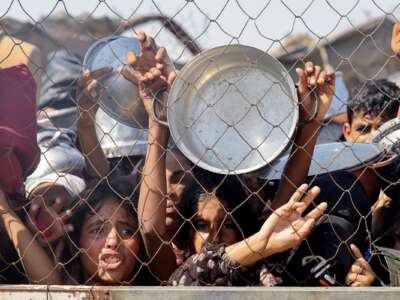
Israel Abducted Child Near Gaza Aid Site and Tortured Him for Nearly a Month
A recent report reveals Israel is also abducting Palestinians near aid sites, on top of near-daily massacres. By Sharon Zhang , Truthout August 15, 2025
Experts have long pointed out that conditions must be extremely dire for the IPC to classify a famine, as the group can only do so in response to escalated mortality and starvation rates. For months, Palestinians have pleaded for the entry of food, and humanitarian groups have warned of famine. But instead of allowing more aid, Israel and the U.S. came up with the Gaza Humanitarian Foundation (GHF) scheme that made getting food a death trap.
An official famine declaration is distinct from a Phase 5 classification. In order for the IPC to declare a famine, three criteria must be met. A fifth of the households in the area must be facing an “extreme lack of food”; 30 percent of children must be suffering from acute malnutrition; and the mortality rate for non-trauma deaths must be two adults per 10,000, or four children per 10,000 daily. The child malnutrition condition may also be met when 15 percent of children suffer from acute malnutrition as measured by the circumference of their arms.
The IPC has only declared a famine five times since it was established in 2004; once in Somalia, twice in South Sudan, and once in Sudan last year. The declaration in Gaza marks the first time it has ever been declared outside of the continent of Africa.
IPC noted that many of the elements of the famine in Gaza are unprecedented.
“Never before has the [Famine Review Committee] had to return so many times to the same crisis; a stark reflection of how suffering has not only persisted but intensified and spread until famine has begun to emerge,” the group wrote in its report.
“As this Famine is entirely man-made, it can be halted and reversed. The time for debate and hesitation has passed, starvation is present and is rapidly spreading. There should be no doubt in anyone’s mind that an immediate, at-scale response is needed,” it went on.
Israel has escalated its starvation campaign in recent months, implementing a total aid blockade for nearly three months starting in March, then pivoting to the GHF scheme where Israel rounds up Palestinians into distribution sites just to massacre them on a near-daily basis.
Gaza health officials have recorded nearly 300 deaths, including over 100 children, to starvation amid the genocide, most of them in recent weeks; the health ministry reported that two people had died in the past 24 hours in Gaza on Friday. IPC’s report notes that these deaths are likely underreported due to Israel’s destruction of monitoring and health systems.
Israeli officials and their propaganda network have denied that there is starvation in Gaza at all. These claims have been thoroughly debunked not just by humanitarian experts, but also, perhaps more importantly, by Palestinians in Gaza who say that famine and starvation is all around them, stalking everyone, adult or child.
Starvation is a critical part of Israel’s goal of inflicting conditions designed to bring about Palestinians’ physical destruction, as Amnesty International wrote earlier this month — and a key element of Israel’s genocide.
“In Gaza, survival has been redefined. It is no longer just about fleeing bombs — it is about keeping ourselves from dying of hunger. The echoing question — ‘Where do we go?’ — has now been compounded by another, more desperate one: ‘What can we eat so we don’t collapse?’” wrote Palestinian Hend Salama Abo Helow this month.
As the occupying power exercising total control of everything that enters and exits Gaza, Israel has long deprived Palestinians of food and other basic needs in the Strip. For decades, humanitarian groups have warned of widespread food insecurity in Gaza, as well as shortages of water and other human needs as a result of Israel’s blockades.
Since its establishment in 2004, the UN-backed IPC has only officially declared five famines.
By Sharon Zhang ,
August 22, 2025
Palestinians gather to receive cooked meals from a food distribution center in Gaza City, Palestine, on August 15, 2025. New Israeli legislation regulating foreign aid groups increasingly denies their requests to bring supplies into Gaza, a joint letter signed by more than 100 groups says.Majdi Fathi / NurPhoto via Getty Images
The world’s leading food insecurity authority has officially declared famine in Gaza, after officials finally determined that Israel’s almost two year long, near-total blockade on the 2 million Palestinians in the Strip has created conditions so horrific they surpass those needed for a famine declaration.
The UN-backed Integrated Food Security Phase Classification (IPC) confirmed that famine is occurring in Gaza in a report on Friday.
“As of 15 August 2025, Famine (IPC Phase 5) — with reasonable evidence – is confirmed in Gaza Governorate,” the group said, referring to the region of Gaza encompassing Gaza City and surrounding areas. The experts said famine conditions are expected to spread to the areas of Deir al-Balah and Khan Younis by the end of September, barring a complete cessation of Israel and the U.S.’s starvation campaign.
The group said that over half a million Palestinians are facing Phase 5 food insecurity, which is the group’s most dire classification, of “catastrophe” or “famine.” About 1.1 million Palestinians, roughly half the population, are experiencing Phase 4 “emergency” levels of hunger, while the remaining population of roughly 200,000 are experiencing a food “crisis,” of Phase 3.
Israel’s famine “is a man-made disaster, a moral indictment — and a failure of humanity itself,” said UN Secretary-General António Guterres. “Famine is not about food; it is the deliberate collapse of the systems needed for human survival.”
Related Story
The world’s leading food insecurity authority has officially declared famine in Gaza, after officials finally determined that Israel’s almost two year long, near-total blockade on the 2 million Palestinians in the Strip has created conditions so horrific they surpass those needed for a famine declaration.
The UN-backed Integrated Food Security Phase Classification (IPC) confirmed that famine is occurring in Gaza in a report on Friday.
“As of 15 August 2025, Famine (IPC Phase 5) — with reasonable evidence – is confirmed in Gaza Governorate,” the group said, referring to the region of Gaza encompassing Gaza City and surrounding areas. The experts said famine conditions are expected to spread to the areas of Deir al-Balah and Khan Younis by the end of September, barring a complete cessation of Israel and the U.S.’s starvation campaign.
The group said that over half a million Palestinians are facing Phase 5 food insecurity, which is the group’s most dire classification, of “catastrophe” or “famine.” About 1.1 million Palestinians, roughly half the population, are experiencing Phase 4 “emergency” levels of hunger, while the remaining population of roughly 200,000 are experiencing a food “crisis,” of Phase 3.
Israel’s famine “is a man-made disaster, a moral indictment — and a failure of humanity itself,” said UN Secretary-General António Guterres. “Famine is not about food; it is the deliberate collapse of the systems needed for human survival.”
Related Story
Israel Abducted Child Near Gaza Aid Site and Tortured Him for Nearly a Month
A recent report reveals Israel is also abducting Palestinians near aid sites, on top of near-daily massacres. By Sharon Zhang , Truthout August 15, 2025
Experts have long pointed out that conditions must be extremely dire for the IPC to classify a famine, as the group can only do so in response to escalated mortality and starvation rates. For months, Palestinians have pleaded for the entry of food, and humanitarian groups have warned of famine. But instead of allowing more aid, Israel and the U.S. came up with the Gaza Humanitarian Foundation (GHF) scheme that made getting food a death trap.
An official famine declaration is distinct from a Phase 5 classification. In order for the IPC to declare a famine, three criteria must be met. A fifth of the households in the area must be facing an “extreme lack of food”; 30 percent of children must be suffering from acute malnutrition; and the mortality rate for non-trauma deaths must be two adults per 10,000, or four children per 10,000 daily. The child malnutrition condition may also be met when 15 percent of children suffer from acute malnutrition as measured by the circumference of their arms.
The IPC has only declared a famine five times since it was established in 2004; once in Somalia, twice in South Sudan, and once in Sudan last year. The declaration in Gaza marks the first time it has ever been declared outside of the continent of Africa.
IPC noted that many of the elements of the famine in Gaza are unprecedented.
“Never before has the [Famine Review Committee] had to return so many times to the same crisis; a stark reflection of how suffering has not only persisted but intensified and spread until famine has begun to emerge,” the group wrote in its report.
“As this Famine is entirely man-made, it can be halted and reversed. The time for debate and hesitation has passed, starvation is present and is rapidly spreading. There should be no doubt in anyone’s mind that an immediate, at-scale response is needed,” it went on.
Israel has escalated its starvation campaign in recent months, implementing a total aid blockade for nearly three months starting in March, then pivoting to the GHF scheme where Israel rounds up Palestinians into distribution sites just to massacre them on a near-daily basis.
Gaza health officials have recorded nearly 300 deaths, including over 100 children, to starvation amid the genocide, most of them in recent weeks; the health ministry reported that two people had died in the past 24 hours in Gaza on Friday. IPC’s report notes that these deaths are likely underreported due to Israel’s destruction of monitoring and health systems.
Israeli officials and their propaganda network have denied that there is starvation in Gaza at all. These claims have been thoroughly debunked not just by humanitarian experts, but also, perhaps more importantly, by Palestinians in Gaza who say that famine and starvation is all around them, stalking everyone, adult or child.
Starvation is a critical part of Israel’s goal of inflicting conditions designed to bring about Palestinians’ physical destruction, as Amnesty International wrote earlier this month — and a key element of Israel’s genocide.
“In Gaza, survival has been redefined. It is no longer just about fleeing bombs — it is about keeping ourselves from dying of hunger. The echoing question — ‘Where do we go?’ — has now been compounded by another, more desperate one: ‘What can we eat so we don’t collapse?’” wrote Palestinian Hend Salama Abo Helow this month.
As the occupying power exercising total control of everything that enters and exits Gaza, Israel has long deprived Palestinians of food and other basic needs in the Strip. For decades, humanitarian groups have warned of widespread food insecurity in Gaza, as well as shortages of water and other human needs as a result of Israel’s blockades.
It Cannot Be Denied: Israel Is Starving Children to Death on Purpose
Starvation of civilians is not an accident of war, it is a deliberate policy.
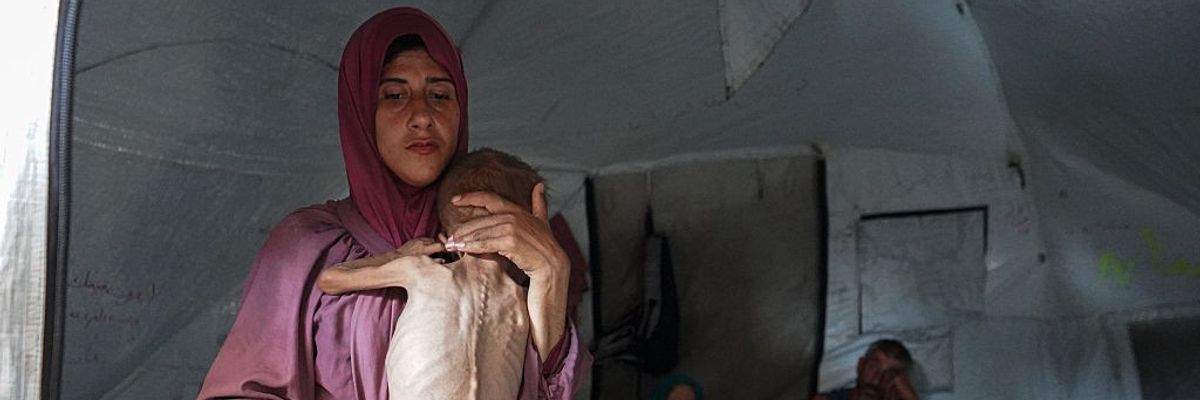
A Palestinian woman holds her severely malnourished 1.5-year-old son, Muhammad Zakariya Ayyoub al-Matouq, inside a tent shelter in Deirl Al-Balah, Gaza on July 29, 2025.
(Photo by Anas Zeyad Fteha/Anadolu via Getty Images)
Emina Ćerimović
Aug 22, 2025
Starvation of civilians is not an accident of war, it is a deliberate policy.
A Palestinian woman holds her severely malnourished 1.5-year-old son, Muhammad Zakariya Ayyoub al-Matouq, inside a tent shelter in Deirl Al-Balah, Gaza on July 29, 2025.
(Photo by Anas Zeyad Fteha/Anadolu via Getty Images)
Emina Ćerimović
Aug 22, 2025
Human Rights Watch
In July, major news organizations published the image of 18-month-old Muhammad Zakariya Ayyoub al-Matouq, a Palestinian child so emaciated that his bones protruded through his back, while his mom cradled him in her arms. Instead of a diaper, he wore a black plastic bag.
Some online commentators have sought to downplay the image’s power by pointing to a preexisting medical condition. But Muhammad is starving as the result of Israel’s use of starvation of civilians as a weapon of war. This is a war crime that is affecting the entire population and, based on my research, is inflicting particularly profound suffering on children with disabilities like Muhammad.
Humanitarian workers told me that restrictions on aid prevent them from bringing in special food that some children with disabilities or medical conditions need, while medical workers warned that children with disabilities are less likely to get care due to the Israeli government’s systematic assault on Gaza’s healthcare infrastructure.
In mid-August, in Geneva, I joined the United Nations Committee on the Rights of Persons with Disabilities for its session focused on the Occupied Palestinian Territory. Under the Convention on the Rights of Persons with Disabilities, governments are required to protect people with disabilities in situations of risks, including armed conflicts. The message from disability groups was clear: Governments need to press Israeli authorities to allow unimpeded, disability-inclusive humanitarian access and not leave children like Muhammad to suffer the consequences of intentional starvation.
Muhammad’s image should move world leaders to use all their leverage with Israel, including an arms embargo and targeted sanctions, to stop Israeli authorities’ mass starvation policy.
There are countless examples of Palestinian children with disabilities thriving with adequate nutrition and healthcare. In just one example, 6-year-old Fadi al-Zant, who has cystic fibrosis and was severely malnourished, was evacuated to the United States from Gaza last year and survived. Osman Shahin, a 16-year-old boy with cerebral palsy who had lost 7 kilograms, regained weight after his family left Gaza for Bosnia.
But Muhammed and other children in Gaza do not have that chance. Between April and mid-July alone, more than 20,000 children in Gaza were hospitalized for acute malnourishment, 3,000 of them severely. Starvation of civilians is not an accident of war, it is a deliberate policy.
Muhammad’s image should move world leaders to use all their leverage with Israel, including an arms embargo and targeted sanctions, to stop Israeli authorities’ mass starvation policy. Muhammad’s disability does not make his starvation less cruel or unlawful; it makes it all the more urgent for countries to act now.
Emina Ćerimović is the associate director of the Disability Rights Division at Human Rights Watch.
In July, major news organizations published the image of 18-month-old Muhammad Zakariya Ayyoub al-Matouq, a Palestinian child so emaciated that his bones protruded through his back, while his mom cradled him in her arms. Instead of a diaper, he wore a black plastic bag.
Some online commentators have sought to downplay the image’s power by pointing to a preexisting medical condition. But Muhammad is starving as the result of Israel’s use of starvation of civilians as a weapon of war. This is a war crime that is affecting the entire population and, based on my research, is inflicting particularly profound suffering on children with disabilities like Muhammad.
Humanitarian workers told me that restrictions on aid prevent them from bringing in special food that some children with disabilities or medical conditions need, while medical workers warned that children with disabilities are less likely to get care due to the Israeli government’s systematic assault on Gaza’s healthcare infrastructure.
In mid-August, in Geneva, I joined the United Nations Committee on the Rights of Persons with Disabilities for its session focused on the Occupied Palestinian Territory. Under the Convention on the Rights of Persons with Disabilities, governments are required to protect people with disabilities in situations of risks, including armed conflicts. The message from disability groups was clear: Governments need to press Israeli authorities to allow unimpeded, disability-inclusive humanitarian access and not leave children like Muhammad to suffer the consequences of intentional starvation.
Muhammad’s image should move world leaders to use all their leverage with Israel, including an arms embargo and targeted sanctions, to stop Israeli authorities’ mass starvation policy.
There are countless examples of Palestinian children with disabilities thriving with adequate nutrition and healthcare. In just one example, 6-year-old Fadi al-Zant, who has cystic fibrosis and was severely malnourished, was evacuated to the United States from Gaza last year and survived. Osman Shahin, a 16-year-old boy with cerebral palsy who had lost 7 kilograms, regained weight after his family left Gaza for Bosnia.
But Muhammed and other children in Gaza do not have that chance. Between April and mid-July alone, more than 20,000 children in Gaza were hospitalized for acute malnourishment, 3,000 of them severely. Starvation of civilians is not an accident of war, it is a deliberate policy.
Muhammad’s image should move world leaders to use all their leverage with Israel, including an arms embargo and targeted sanctions, to stop Israeli authorities’ mass starvation policy. Muhammad’s disability does not make his starvation less cruel or unlawful; it makes it all the more urgent for countries to act now.
Emina Ćerimović is the associate director of the Disability Rights Division at Human Rights Watch.
UN Human Rights Chief Says 'Famine' in Gaza May Constitute 'War Crime' by Israel
"The famine declared today in Gaza," said Volker Türk, "is the direct result of actions taken by the Israeli government."
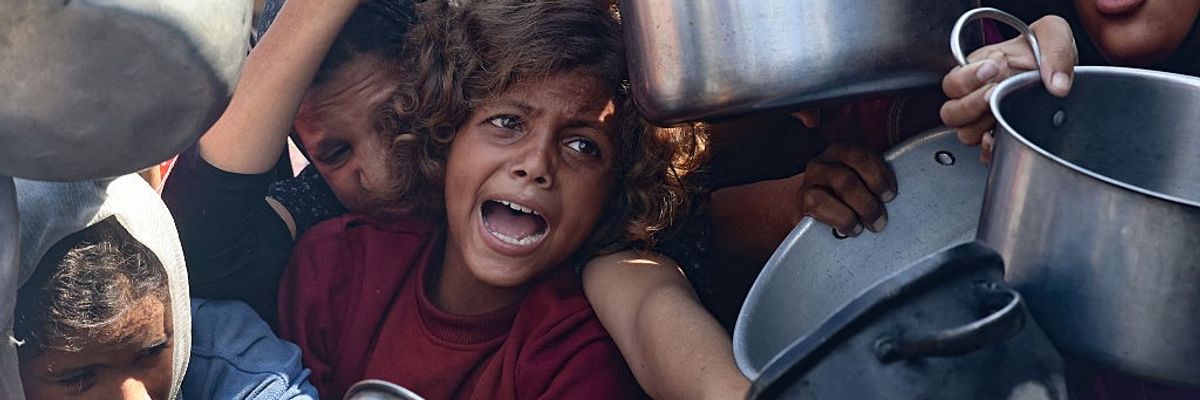
Palestinian women and children hold out their empty pots in front of a charity kitchen in Khan Younis in southern Gaza on August 21, 2025.
(Photo by AFP via Getty Images)
Brad Reed
Aug 22, 2025
COMMON DREAMS
United Nations human rights Chief Volker Türk on Friday accused the Israeli government of causing widespread starvation in Gaza that he said may constitute a war crime.
Shortly after the Integrated Food Security Phase Classification (IPC) officially declared that conditions in Gaza constituted a famine, Türk laid the blame for the humanitarian disaster directly at the feet of Israel.
"The famine declared today in Gaza... is the direct result of actions taken by the Israeli Government," he said. "It has unlawfully restricted the entry and distribution of humanitarian assistance and other goods necessary for the survival of the civilian population in the Gaza strip."
Türk noted that the Israeli military had "destroyed critical civilian infrastructure and almost all agricultural land, banned fishing, and forcibly displaced the population," all of which resulted in the starvation crisis in Gaza.
"It is a war crime to use starvation as a method of warfare, and the resulting deaths may also amount to the war crime of willful killing," Türk continued. "Israeli authorities must take immediate steps to end the famine in the Gaza Governorate and prevent further loss of life across the Gaza strip. They must ensure immediate entry of humanitarian assistance in sufficient amounts, and full access to UN and other humanitarian organizations."
UN Secretary-General António Guterres said that the IPC report confirmed that the starvation in Gaza is a "man-made disaster, a moral indictment—and a failure of humanity itself."
"Famine is not about food; it is the deliberate collapse of the systems needed for human survival," Guterres emphasized. "As the occupying power, Israel has unequivocal obligations under international law—including the duty of ensuring food and medical supplies of the population... No more excuses. The time for action is not tomorrow—it is now."
The IPC report emphasized that, as bad as the situation in Gaza currently is, it is projected to get even worse in the coming weeks.
"Between mid-August and the end of September 2025, conditions are expected to further worsen with famine projected to expand to Deir al-Balah and Khan Younis," the IPC stated. "Nearly a third of the population (641,000 people) are expected to face catastrophic conditions (IPC Phase 5), while those in emergency (IPC Phase 4) will likely rise to 1.14 million (58%). Acute malnutrition is projected to continue worsening rapidly."
The Gaza Health Ministry has estimated that 272 people in Gaza, including 112 children, have so far died from severe hunger as a result of the Israeli blockade. Additionally, international charity Save the Children earlier this month said that 43% of pregnant and breastfeeding women who showed up to its clinics in Gaza last month were malnourished, which represented a threefold increase since March, when the Israeli military imposed a total siege on the enclave.
"The famine declared today in Gaza," said Volker Türk, "is the direct result of actions taken by the Israeli government."
Palestinian women and children hold out their empty pots in front of a charity kitchen in Khan Younis in southern Gaza on August 21, 2025.
(Photo by AFP via Getty Images)
Brad Reed
Aug 22, 2025
COMMON DREAMS
United Nations human rights Chief Volker Türk on Friday accused the Israeli government of causing widespread starvation in Gaza that he said may constitute a war crime.
Shortly after the Integrated Food Security Phase Classification (IPC) officially declared that conditions in Gaza constituted a famine, Türk laid the blame for the humanitarian disaster directly at the feet of Israel.
"The famine declared today in Gaza... is the direct result of actions taken by the Israeli Government," he said. "It has unlawfully restricted the entry and distribution of humanitarian assistance and other goods necessary for the survival of the civilian population in the Gaza strip."
Türk noted that the Israeli military had "destroyed critical civilian infrastructure and almost all agricultural land, banned fishing, and forcibly displaced the population," all of which resulted in the starvation crisis in Gaza.
"It is a war crime to use starvation as a method of warfare, and the resulting deaths may also amount to the war crime of willful killing," Türk continued. "Israeli authorities must take immediate steps to end the famine in the Gaza Governorate and prevent further loss of life across the Gaza strip. They must ensure immediate entry of humanitarian assistance in sufficient amounts, and full access to UN and other humanitarian organizations."
UN Secretary-General António Guterres said that the IPC report confirmed that the starvation in Gaza is a "man-made disaster, a moral indictment—and a failure of humanity itself."
"Famine is not about food; it is the deliberate collapse of the systems needed for human survival," Guterres emphasized. "As the occupying power, Israel has unequivocal obligations under international law—including the duty of ensuring food and medical supplies of the population... No more excuses. The time for action is not tomorrow—it is now."
The IPC report emphasized that, as bad as the situation in Gaza currently is, it is projected to get even worse in the coming weeks.
"Between mid-August and the end of September 2025, conditions are expected to further worsen with famine projected to expand to Deir al-Balah and Khan Younis," the IPC stated. "Nearly a third of the population (641,000 people) are expected to face catastrophic conditions (IPC Phase 5), while those in emergency (IPC Phase 4) will likely rise to 1.14 million (58%). Acute malnutrition is projected to continue worsening rapidly."
The Gaza Health Ministry has estimated that 272 people in Gaza, including 112 children, have so far died from severe hunger as a result of the Israeli blockade. Additionally, international charity Save the Children earlier this month said that 43% of pregnant and breastfeeding women who showed up to its clinics in Gaza last month were malnourished, which represented a threefold increase since March, when the Israeli military imposed a total siege on the enclave.
Israel’s Full Takeover Plan of Gaza Proves This War Was Never About Hostages
I call on President Trump and every member of Congress: Oppose Israel’s escalation. Stop funding genocide. Demand an immediate ceasefire.
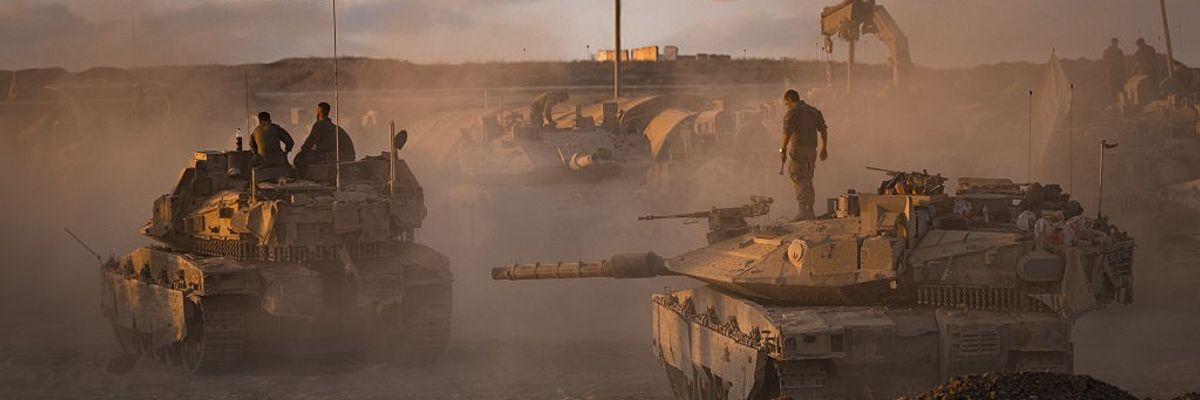
Israel Defense Forces soldiers prepare tanks on August 18, 2025 near the Gaza Strip's northern borders, Israel.
(Photo by Elke Scholiers/Getty Images)
Basim Elkarra
I call on President Trump and every member of Congress: Oppose Israel’s escalation. Stop funding genocide. Demand an immediate ceasefire.
Israel Defense Forces soldiers prepare tanks on August 18, 2025 near the Gaza Strip's northern borders, Israel.
(Photo by Elke Scholiers/Getty Images)
Basim Elkarra
Executive director of CAIR Action, a Muslim American 501(c)4
Aug 22, 2025
On Wednesday, Israel announced the call-up of 60,000 reservists to escalate its ongoing siege on Gaza. Nearly two years into this brutal campaign, the world is witnessing an endless cycle of destruction that has claimed tens of thousands of innocent lives, displaced millions, and left Gaza on the brink of complete devastation.
The Israeli government claims this war is about hostages. But the facts paint a different picture. Another ceasefire proposal is on the table, yet Israel refuses to budge. The refusal to engage in meaningful diplomacy, despite mounting international pressure, exposes a deeper agenda: a total takeover of Gaza under the guise of “security.”
Even within Israel, people are recognizing this. Tens of thousands of Israelis have taken to the streets in nationwide protests, demanding an end to the war. Families of captives have joined demonstrators, declaring that the government is using their loved ones as political pawns while prioritizing endless war over human life. When Israelis themselves are protesting in unprecedented numbers, Americans should be asking: Why are we still financing this catastrophe?
According to the Israeli military, an estimated 23,380 American citizens currently serve in its ranks. That means US citizens are directly participating in this war—sometimes even fighting against the policies and values their own government is supposed to uphold. At the same time, billions of our taxpayer dollars continue to flow to the Israeli military, subsidizing weapons that flatten schools, hospitals, and refugee camps. Our government cannot pretend it is neutral when our money and even our citizens are actively supporting this carnage.
No more blank checks. No more bombs dropped on refugee camps. No more excuses for a war that has long abandoned its stated objectives.
For me, this war is personal. Over the past 22 months, more than 180 members of my extended family have been killed in Gaza. Entire generations of cousins, uncles, aunts, nieces, nephews—wiped out. Their names will never appear in congressional speeches or cable news debates, but they were real people. They were teachers, children, engineers, shopkeepers, grandparents. Their lives mattered. And like thousands of other Palestinian families, mine has been shattered by US-funded bombs.
Every day this war continues, America’s moral standing erodes further. We cannot claim to champion human rights abroad while bankrolling war crimes in Gaza. We cannot claim to stand for democracy while ignoring the voices of Americans who are demanding an end to their tax dollars being used to carry out genocide.
US Congress and President Donald Trump have a choice to make. They can continue down the path of complicity, sending weapons and money to fuel escalation, or they can finally put their foot down and say: no more. No more blank checks. No more bombs dropped on refugee camps. No more excuses for a war that has long abandoned its stated objectives.
Our leverage is undeniable. The United States is Israel’s largest military backer, and without US funding, this war could not continue at its current pace. That means we have not only the power but also the responsibility to stop this genocide. History will not judge kindly those who stayed silent or those who offered political cover for atrocity.
The choice before us is stark but simple. We can continue to fund devastation, or we can insist on peace. We can allow ourselves to be complicit, or we can stand on the side of justice and humanity. For the sake of the families torn apart, for the sake of our values as a nation, and for the sake of our shared future, we must choose the latter.
I call on President Trump and every member of Congress: Oppose Israel’s escalation. Stop funding genocide. Demand an immediate ceasefire. America’s hands are not tied—we are the ones holding the purse strings. The question is whether we will finally use our influence to end suffering, or continue enabling it.
The time to act is now.
Our work is licensed under Creative Commons (CC BY-NC-ND 3.0). Feel free to republish and share widely.
Basim Elkarra
Basim Elkarra serves as executive director of CAIR Action, a Muslim American 501(c)4 political organization that aims to engage, educate, and mobilize Muslim voters. He has lost over a hundred family members in Gaza and recently sued President Biden for his role in the war on Gaza.
Full Bio >
Aug 22, 2025
On Wednesday, Israel announced the call-up of 60,000 reservists to escalate its ongoing siege on Gaza. Nearly two years into this brutal campaign, the world is witnessing an endless cycle of destruction that has claimed tens of thousands of innocent lives, displaced millions, and left Gaza on the brink of complete devastation.
The Israeli government claims this war is about hostages. But the facts paint a different picture. Another ceasefire proposal is on the table, yet Israel refuses to budge. The refusal to engage in meaningful diplomacy, despite mounting international pressure, exposes a deeper agenda: a total takeover of Gaza under the guise of “security.”
Even within Israel, people are recognizing this. Tens of thousands of Israelis have taken to the streets in nationwide protests, demanding an end to the war. Families of captives have joined demonstrators, declaring that the government is using their loved ones as political pawns while prioritizing endless war over human life. When Israelis themselves are protesting in unprecedented numbers, Americans should be asking: Why are we still financing this catastrophe?
According to the Israeli military, an estimated 23,380 American citizens currently serve in its ranks. That means US citizens are directly participating in this war—sometimes even fighting against the policies and values their own government is supposed to uphold. At the same time, billions of our taxpayer dollars continue to flow to the Israeli military, subsidizing weapons that flatten schools, hospitals, and refugee camps. Our government cannot pretend it is neutral when our money and even our citizens are actively supporting this carnage.
No more blank checks. No more bombs dropped on refugee camps. No more excuses for a war that has long abandoned its stated objectives.
For me, this war is personal. Over the past 22 months, more than 180 members of my extended family have been killed in Gaza. Entire generations of cousins, uncles, aunts, nieces, nephews—wiped out. Their names will never appear in congressional speeches or cable news debates, but they were real people. They were teachers, children, engineers, shopkeepers, grandparents. Their lives mattered. And like thousands of other Palestinian families, mine has been shattered by US-funded bombs.
Every day this war continues, America’s moral standing erodes further. We cannot claim to champion human rights abroad while bankrolling war crimes in Gaza. We cannot claim to stand for democracy while ignoring the voices of Americans who are demanding an end to their tax dollars being used to carry out genocide.
US Congress and President Donald Trump have a choice to make. They can continue down the path of complicity, sending weapons and money to fuel escalation, or they can finally put their foot down and say: no more. No more blank checks. No more bombs dropped on refugee camps. No more excuses for a war that has long abandoned its stated objectives.
Our leverage is undeniable. The United States is Israel’s largest military backer, and without US funding, this war could not continue at its current pace. That means we have not only the power but also the responsibility to stop this genocide. History will not judge kindly those who stayed silent or those who offered political cover for atrocity.
The choice before us is stark but simple. We can continue to fund devastation, or we can insist on peace. We can allow ourselves to be complicit, or we can stand on the side of justice and humanity. For the sake of the families torn apart, for the sake of our values as a nation, and for the sake of our shared future, we must choose the latter.
I call on President Trump and every member of Congress: Oppose Israel’s escalation. Stop funding genocide. Demand an immediate ceasefire. America’s hands are not tied—we are the ones holding the purse strings. The question is whether we will finally use our influence to end suffering, or continue enabling it.
The time to act is now.
Our work is licensed under Creative Commons (CC BY-NC-ND 3.0). Feel free to republish and share widely.
Basim Elkarra
Basim Elkarra serves as executive director of CAIR Action, a Muslim American 501(c)4 political organization that aims to engage, educate, and mobilize Muslim voters. He has lost over a hundred family members in Gaza and recently sued President Biden for his role in the war on Gaza.
Full Bio >
Israel vows to destroy Gaza City if Hamas doesn’t disarm, free hostages
By AFP
August 22, 2025

Israel says it is pushing for a ceasefire deal while at the same time launching a military operation to conquer Gaza City - Copyright AFP Eyad BABA
Israeli Defence Minister Israel Katz vowed Friday to destroy Gaza City if Hamas did not agree to disarm, release all remaining hostages in the territory and end the war on Israel’s terms.
“Soon, the gates of hell will open upon the heads of Hamas’s murderers and rapists in Gaza – until they agree to Israel’s conditions for ending the war, primarily the release of all hostages and their disarmament,” the minister posted on social media.
“If they do not agree, Gaza, the capital of Hamas, will become Rafah and Beit Hanoun,” he added, referring to two cities in Gaza largely razed during previous Israeli operations.
The statement came after Israeli Prime Minister Benjamin Netanyahu said late Thursday that he had ordered immediate negotiations aimed at freeing all the remaining hostages in Gaza.
Netanyahu added that the push to release the hostages would accompany the operation to take control of Gaza City and destroy the Hamas stronghold.
Later Friday, the Rome-based Integrated Food Security Phase Classification Initiative was set to release its latest figures regarding hunger in Gaza.
Ahead of the report’s release, US ambassador to Israel Mike Huckabee preemptively attacked its findings.
“You know who IS starving? The hostages kidnapped and tortured by uncivilised Hamas savages,” he wrote on X.
“Maybe the over fed terrorists could share some of their warehouse full they stole with hungry people especially the hostages”.
– ‘Hand in hand’ –
Earlier this week, the Israeli defence ministry authorised the call-up of roughly 60,000 reservists to help seize Gaza City.
“These two matters — defeating Hamas and releasing all our hostages — go hand in hand,” Netanyahu said in a video statement on Thursday, without providing details about what the next stage of talks would entail.
The UN humanitarian agency has warned that the Israeli plan to expand military operations in Gaza City would have “a horrific humanitarian impact” on an already exhausted population.
Mediators have been waiting for days for an official Israeli response to their latest ceasefire proposal, which Hamas accepted earlier this week.
Palestinian sources have said the new deal involves staggered hostage releases, while Israel has insisted that any deal must include the freeing of all the captives at once.
Israel’s plans to expand the fighting and seize Gaza City have sparked an international outcry as well as domestic opposition.
Hamas’s October 2023 attack on Israel that sparked the war resulted in the deaths of 1,219 people, mostly civilians, according to an AFP tally based on official figures.
Of the 251 hostages seized during the attack, 49 are still in Gaza, including 27 the Israeli military says are dead.
Israel’s offensive has killed at least 62,192 Palestinians, most of them civilians, according to figures from the health ministry in Hamas-run Gaza that the United Nations considers reliable.
'All Eyes On Gaza City' as Israel Ramps Up Campaign of Conquest and Ethnic Cleansing
"The explicit goal of turning Palestine's largest city into a wasteland has nothing to do with hostages or Hamas and everything to do with genocide," said one critic.
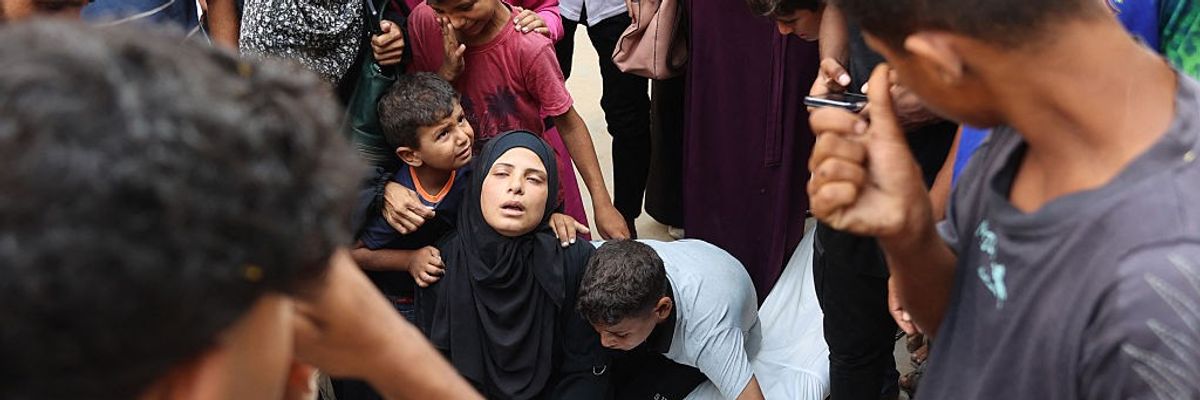
Palestinians mourn relatives killed in an Israeli airstrike on Gaza City, Palestine on August 21, 2025.
(Photo by Omar al-Qataa/AFP via Getty Images)
Brett Wilkins
Aug 21, 2025
COMMON DREAMS
Operation Gideon's Chariots 2—Israel's plan to conquer, occupy, and ethnically cleanse Gaza—intensified Thursday, with fugitive Prime Minister Benjamin Netanyahu saying Israeli forces will take over all of the embattled strip even if Hamas agrees to a ceasefire and one of his far-right ministers vowing to continue the genocidal war even "at the expense of the hostages' lives."
"We have begun the preliminary actions and the initial stages of the offensive on Gaza City, and already now [Israeli] forces are holding positions on the outskirts of Gaza City," Israel Defense Forces (IDF) spokesman Effie Defrin told reporters. "We will intensify the strikes on Hamas in Gaza City, the political and military stronghold of the terror organization."
Defrin added that the IDF is warning residents to evacuate in a bid to "minimize harm to civilians." However, critics say "evacuate" is a euphemism for ethnic cleansing, the stated goal of Israeli officials including Finance Minister Bezalel Smotrich, who said earlier this month: "We conquer, cleanse, and stay until Hamas is destroyed. On the way, we annihilate everything that still remains."
Arutz Sheva reported that Operation Gideon's Chariots 2—which ultimately aims to force much of Gaza's population into a concentration camp in order to make way for possible Jewish recolonization of the strip—will involve five IDF divisions, two of them reserves. The news site said that the IDF will issue new emergency draft orders to 60,000 reservists, who will augment the 70,000 who are already activated.
IDF Col. (Res.) Marco Moreno said Thursday that the only way to achieve security is via the "voluntary migration" of everyone in Gaza—another euphemism for ethnic cleansing, given Palestinians' unwillingness to voluntarily abandon their homeland.
"Even if Hamas disarms, raises a white flag, and disappears, it won't be long before a new organization rises in Gaza with the same agenda to destroy the state of Israel," Moreno said during a TV interview. "The only way to ensure true security is through the voluntary migration of all Gaza residents."
Israeli Settlement Minister Orit Strook, a member of the far-right Religious Zionism Party, told the radio station Kol BaRama Wednesday that she favors continuing the war "even if it is clear that Hamas will execute the hostages," 20 of whom remain imprisoned since the October 7, 2023 attack.
"Of course, it is not only me who will vote to continue the war at the expense of the hostages' lives," added Strook, who is known for her extreme support for illegal Israeli settler colonization of Palestine and for allegedly filming her and her husband's sexual abuse of their daughter for pornographic videos.
Hamas condemned the Israeli operation in a statement accusing the Netanyahu government of "continuing its brutal war against innocent civilians, escalating its criminal operations in Gaza City with the aim of destroying it, and displacing its residents in a full-fledged war crime."
The United Nations human rights office said Wednesday that "Israel's reported decision to take full control of Gaza City and to forcibly displace its population will lead to mass killings of civilians and destruction of infrastructure vital to the survival of the population."
Meanwhile, US Ambassador to Israel Mike Huckabee said President Donald Trump—who has said he wants to empty Gaza of Palestinians and transform the strip into the "Riviera of the Middle East"—is "fully supportive" of Israel's campaign.
Israel is facing an ongoing genocide case at the International Court of Justice, while Netanyahu and former Israeli Defense Minister Yoav Gallant are wanted by the International Criminal Court for alleged war crimes and crimes against humanity in Gaza, including murder and forced starvation.
The Gaza Health Ministry said that at least 50 Palestinians were killed by Israeli forces Thursday, including nine aid-seekers and five family members massacred in a drone strike in Khan Younis. Two massacres in Gaza City's Sabra neighborhood killed four and eight people respectively, while four people were killed in a separate strike on a family home in the al-Shanti area.
Two more Palestinians also reportedly starved to death in Gaza, where at least 271 people including 112 children have died from malnutrition driven by Israel's "complete siege."
Since October 2023, Israeli forces have killed at least 62,122 Palestinians—most of them women and children—and wounded more than 156,700 others, with thousands more missing and presumed dead and buried beneath rubble. Expert analyses including multiple peer-reviewed studies have concluded the official Gaza Health Ministry death toll is likely a vast undercount.
As Common Dreams reported Thursday, a joint investigation by Israeli journalist and filmmaker Yuval Abraham of +972 Magazine and Local Call and Guardian senior international affairs correspondent Emma Graham-Harrison revealed that, contrary to Israeli claims of a historically low civilian-to-combatant kill ratio in Gaza, a staggering 5 out of 6 Palestinians killed in the strip between October 2023 and May were noncombatants.
Classified IDF Intel Reveals 83% of Palestinians Killed in Gaza Are Civilians
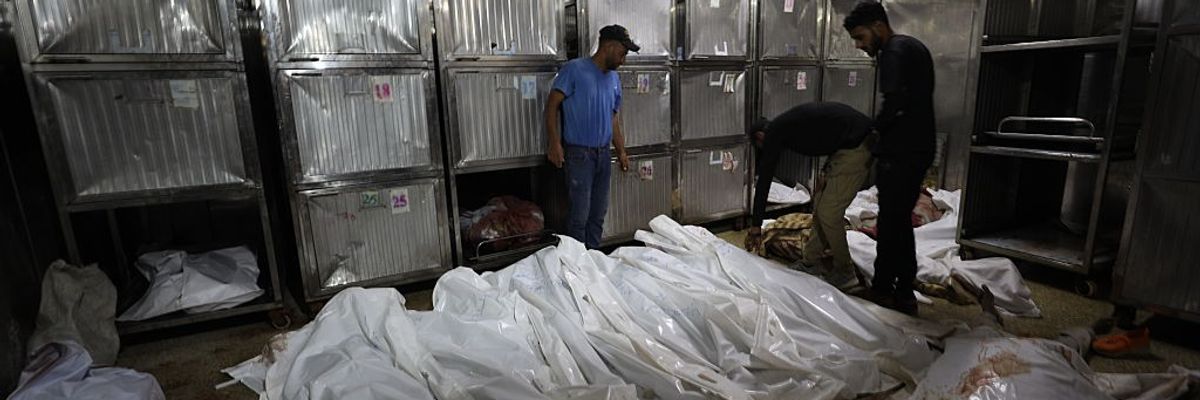
Bodies of Palestinians, including children, killed in Israeli airstrikes targeting residential neighborhoods are brought to al-Shifa Hospital in Gaza City, Palestine for identification and funeral preparations on August 21, 2025.
(Photo by Khames Alrefi/Anadolu via Getty Images)
Brett Wilkins
Aug 21, 2025
COMMON DREAMS
An investigation published Thursday belied Israeli government claims of a historically low civilian-to-combatant kill ratio in Gaza, as classified Israel Defense Forces intelligence data revealed that 5 in 6 Palestinians killed by the IDF through the first 19 months of the US-backed war were, in fact, civilians.
A joint investigation by Israeli journalist and filmmaker Yuval Abraham of +972 Magazine and Local Call and Guardian senior international affairs correspondent Emma Graham-Harrison revealed that, as of May, the Military Intelligence Directorate identified by name 8,900 fighters from Hamas—which led the October 7, 2023 attack—and Palestinian Islamic Jihad as "dead" or "probably dead."
At that time, the official Palestinian death toll in Gaza stood at 52,928, with the Gaza Health Ministry not differentiating between civilians and militants. Israeli officials and independent peer-reviewed studies have either concurred with the ministry's figures or called them an undercount.
The classified IDF data obtained by Abraham and Graham-Harrison show that at least 83% of Palestinians killed by Israeli forces through May were civilians, what Graham-Harrison called "an extreme rate of slaughter rarely matched in recent decades of warfare... even compared with conflicts notorious for indiscriminate killing, including the Syrian and Sudanese civil wars."
According to the Uppsala Conflict Data Program at Uppsala University in Sweden, the 83% civilian kill rate in Gaza is far higher than in Bosnia in 1992-95 (57%), the Syrian civil war of 2012-24 (29-34%), the ongoing Russian invasion of Ukraine (10-22%), or the US-led war in Afghanistan of 2001-21 (8-12%).
One unnamed intelligence source who was in Gaza told Abraham and Graham-Harrison: "People are promoted to the rank of terrorist after their death. If I had listened to the brigade, I would have come to the conclusion that we had killed 200% of Hamas operatives in the area."
In one case, +972 Magazine and Local Call revealed how one IDF battalion stationed in Rafah killed around 100 Palestinians and labeled them all as "terrorists." However, an officer from the unit later testified that all but two of the victims were unarmed.
The new investigation adds to the body of research showing that Israel's assault and siege on Gaza—which is the subject of an ongoing International Court of Justice (ICJ) genocide case filed by South Africa—has, as Abraham put it, "killed civilians at a rate with few parallels in modern warfare."
These studies destroy claims by Israeli Prime Minister Benjamin Netanyahu—who is wanted by the International Criminal Court for alleged crimes against humanity and war crimes including murder and forced starvation—and members of his government of historically low civilian death rates in Gaza.
"Israel is setting the new gold standard for urban warfare with what appears to be the lowest civilian-to-combatant casualty ratio in history," Israeli government spokesperson Avi Hyman claimed in May 2024.
Israel's supporters around the world have parroted this false claim. John Spencer, chair of urban warfare studies at the US Military Academy at West Point, said in January that "Israel's civilian-to-combatant ratio is still historically low," and that "Israel has done more and implemented more measures to prevent civilian harm than any military in the history of urban warfare."
However, the facts show a very different reality. Retired IDF Gen. Itzhak Brik told Abraham and Graham-Harrison that "there is absolutely no connection between the numbers that are announced and what is actually happening. It is just one big bluff."
"They lie non-stop—both the military echelon and the political echelon," Brik said. "In every raid, the IDF spokesperson's announcements said: 'Hundreds of terrorists were killed.' It's true that hundreds were killed, but they weren't terrorists."
Following the October 7 attack, the IDF dramatically loosened its rules of engagement, effectively allowing an unlimited number of civilians to be killed when targeting a single Hamas member, no matter how low-ranking. Numerous massacres ensued, including the October 31, 2023 killing of more than 120 civilians in a single IDF bombing targeting one Hamas member in the Jabalia refugee camp.
The IDF's use of massive ordnance, including US-supplied 1,000- and 2,000-pound "bunker buster" bombs capable of leveling entire city blocks,w and utilization of artificial intelligence to select targets has resulted in staggering numbers of civilian deaths. United Nations human rights officials have said that Israel's use of 2,000-pound bombs likely violates international law by deliberately targeting civilians in disproportionate attacks.
The indiscriminate slaughter is also taking place on the ground, where volunteer American surgeons have described treating—or sending to morgues—young children who appeared to be deliberately shot in the chest and head by IDF snipers. More recently, IDF whistleblowers said they were ordered to shoot or launch artillery shells into crowds of starving Palestinian civilians at aid distribution points run by the US-based Gaza Humanitarian Foundation.
Responding to the new investigation, the IDF confirmed the existence of the Military Intelligence Directorate database, but claimed that "figures presented in the article are incorrect," without further explanation.
However, in a recording published last week, Aharon Haliva—a former IDF general who was in charge of intelligence operations on and after the October 7 attack—is heard approvingly accepting the official Gaza Health Ministry death toll at the time.
"The fact that there are already 50,000 dead in Gaza is necessary and required for future generations," Haliva said. "It doesn't matter now if they are children."
Similar statements by Israeli officials are a key component of South Africa's ICJ case, where applicants must prove intent to commit genocide under Article II of the Genocide Convention.
The most recent Gaza Health Ministry figures show that Israel's 685-day assault and siege on Gaza have left at least 62,122 Palestinians dead—most of them women and children—and more than 156,700 others wounded, with thousands more missing and presumed dead and buried beneath rubble. At least 271 Palestinians, including 112 children, have starved to death.
The dire situation for civilians in Gaza could be about to deteriorate even further as Israel intensifies Operation Gideon's Chariots II, which aims to conquer, occupy, and ethnically cleanse Palestinians in numbers exceeding even the Nakba, or "catastrophe," during which more than 750,000 Arabs were forcibly expelled, sometimes via massacre and death march, during the establishment of Israel in 1948.
Israeli officials have repeatedly indicated that they would approve of such an annihilation, with Haliva asserted that Palestinians "need a Nakba every now and then to feel the price" of resisting more than a century of dispossession and displacement.
The data show "a proportion of civilian slaughter with few parallels in modern warfare."
Bodies of Palestinians, including children, killed in Israeli airstrikes targeting residential neighborhoods are brought to al-Shifa Hospital in Gaza City, Palestine for identification and funeral preparations on August 21, 2025.
(Photo by Khames Alrefi/Anadolu via Getty Images)
Brett Wilkins
Aug 21, 2025
COMMON DREAMS
An investigation published Thursday belied Israeli government claims of a historically low civilian-to-combatant kill ratio in Gaza, as classified Israel Defense Forces intelligence data revealed that 5 in 6 Palestinians killed by the IDF through the first 19 months of the US-backed war were, in fact, civilians.
A joint investigation by Israeli journalist and filmmaker Yuval Abraham of +972 Magazine and Local Call and Guardian senior international affairs correspondent Emma Graham-Harrison revealed that, as of May, the Military Intelligence Directorate identified by name 8,900 fighters from Hamas—which led the October 7, 2023 attack—and Palestinian Islamic Jihad as "dead" or "probably dead."
At that time, the official Palestinian death toll in Gaza stood at 52,928, with the Gaza Health Ministry not differentiating between civilians and militants. Israeli officials and independent peer-reviewed studies have either concurred with the ministry's figures or called them an undercount.
The classified IDF data obtained by Abraham and Graham-Harrison show that at least 83% of Palestinians killed by Israeli forces through May were civilians, what Graham-Harrison called "an extreme rate of slaughter rarely matched in recent decades of warfare... even compared with conflicts notorious for indiscriminate killing, including the Syrian and Sudanese civil wars."
According to the Uppsala Conflict Data Program at Uppsala University in Sweden, the 83% civilian kill rate in Gaza is far higher than in Bosnia in 1992-95 (57%), the Syrian civil war of 2012-24 (29-34%), the ongoing Russian invasion of Ukraine (10-22%), or the US-led war in Afghanistan of 2001-21 (8-12%).
One unnamed intelligence source who was in Gaza told Abraham and Graham-Harrison: "People are promoted to the rank of terrorist after their death. If I had listened to the brigade, I would have come to the conclusion that we had killed 200% of Hamas operatives in the area."
In one case, +972 Magazine and Local Call revealed how one IDF battalion stationed in Rafah killed around 100 Palestinians and labeled them all as "terrorists." However, an officer from the unit later testified that all but two of the victims were unarmed.
The new investigation adds to the body of research showing that Israel's assault and siege on Gaza—which is the subject of an ongoing International Court of Justice (ICJ) genocide case filed by South Africa—has, as Abraham put it, "killed civilians at a rate with few parallels in modern warfare."
These studies destroy claims by Israeli Prime Minister Benjamin Netanyahu—who is wanted by the International Criminal Court for alleged crimes against humanity and war crimes including murder and forced starvation—and members of his government of historically low civilian death rates in Gaza.
"Israel is setting the new gold standard for urban warfare with what appears to be the lowest civilian-to-combatant casualty ratio in history," Israeli government spokesperson Avi Hyman claimed in May 2024.
Israel's supporters around the world have parroted this false claim. John Spencer, chair of urban warfare studies at the US Military Academy at West Point, said in January that "Israel's civilian-to-combatant ratio is still historically low," and that "Israel has done more and implemented more measures to prevent civilian harm than any military in the history of urban warfare."
However, the facts show a very different reality. Retired IDF Gen. Itzhak Brik told Abraham and Graham-Harrison that "there is absolutely no connection between the numbers that are announced and what is actually happening. It is just one big bluff."
"They lie non-stop—both the military echelon and the political echelon," Brik said. "In every raid, the IDF spokesperson's announcements said: 'Hundreds of terrorists were killed.' It's true that hundreds were killed, but they weren't terrorists."
Following the October 7 attack, the IDF dramatically loosened its rules of engagement, effectively allowing an unlimited number of civilians to be killed when targeting a single Hamas member, no matter how low-ranking. Numerous massacres ensued, including the October 31, 2023 killing of more than 120 civilians in a single IDF bombing targeting one Hamas member in the Jabalia refugee camp.
The IDF's use of massive ordnance, including US-supplied 1,000- and 2,000-pound "bunker buster" bombs capable of leveling entire city blocks,w and utilization of artificial intelligence to select targets has resulted in staggering numbers of civilian deaths. United Nations human rights officials have said that Israel's use of 2,000-pound bombs likely violates international law by deliberately targeting civilians in disproportionate attacks.
The indiscriminate slaughter is also taking place on the ground, where volunteer American surgeons have described treating—or sending to morgues—young children who appeared to be deliberately shot in the chest and head by IDF snipers. More recently, IDF whistleblowers said they were ordered to shoot or launch artillery shells into crowds of starving Palestinian civilians at aid distribution points run by the US-based Gaza Humanitarian Foundation.
Responding to the new investigation, the IDF confirmed the existence of the Military Intelligence Directorate database, but claimed that "figures presented in the article are incorrect," without further explanation.
However, in a recording published last week, Aharon Haliva—a former IDF general who was in charge of intelligence operations on and after the October 7 attack—is heard approvingly accepting the official Gaza Health Ministry death toll at the time.
"The fact that there are already 50,000 dead in Gaza is necessary and required for future generations," Haliva said. "It doesn't matter now if they are children."
Similar statements by Israeli officials are a key component of South Africa's ICJ case, where applicants must prove intent to commit genocide under Article II of the Genocide Convention.
The most recent Gaza Health Ministry figures show that Israel's 685-day assault and siege on Gaza have left at least 62,122 Palestinians dead—most of them women and children—and more than 156,700 others wounded, with thousands more missing and presumed dead and buried beneath rubble. At least 271 Palestinians, including 112 children, have starved to death.
The dire situation for civilians in Gaza could be about to deteriorate even further as Israel intensifies Operation Gideon's Chariots II, which aims to conquer, occupy, and ethnically cleanse Palestinians in numbers exceeding even the Nakba, or "catastrophe," during which more than 750,000 Arabs were forcibly expelled, sometimes via massacre and death march, during the establishment of Israel in 1948.
Israeli officials have repeatedly indicated that they would approve of such an annihilation, with Haliva asserted that Palestinians "need a Nakba every now and then to feel the price" of resisting more than a century of dispossession and displacement.
We Have No Shelter and No Escape as Israel Prepares to Invade Gaza City
We have no real options: stay in the north and suffer, or flee south and suffer all the same.
By Dalia Abu Ramadan ,

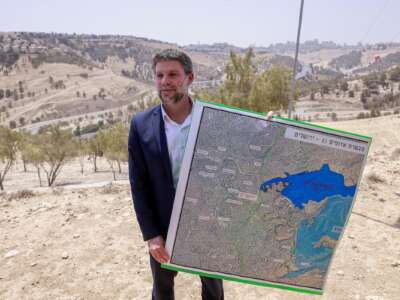
Israel’s Smotrich Approves Plan to Split West Bank, “Bury” Palestinian Statehood
The most merciless of these attacks came in March 2024, during the sacred month of Ramadan. Al-Rimal was placed under a suffocating siege for nearly 20 days. During that period, we could not even drink safe water. We could not contemplate moving or even looking out from our windows. My family and I endured a real famine, facing death by starvation during those 20 grueling days. Al-Shifa Hospital was completely destroyed, leaving behind total ruin, while surrounding neighborhoods were shattered, and residents trapped under relentless bombardment from tanks and airstrikes. Everything that moved in the streets — whether human or animal — was targeted.
I lived through those cursed days. I witnessed the full reality of an Israeli ground invasion: tanks patrolling day and night without pause, their engines roaring like beasts, the streets trembling under their weight. Yet the cruelty did not end with their withdrawal from any area. Once Israeli forces moved a safe distance away from a neighborhood, they obliterated it entirely from the air, erasing every home, every life — which is what happened to Palestine Square in Al-Rimal. Nothing was left behind.
This month — on August 10, 2025 — the occupation began demanding that the residents of Gaza City Governorate prepare for displacement — including from Al-Rimal neighborhood, where I reside. This governorate is one of the largest in Gaza, home to more than 1 million people. Is the plan, after seizing this vast governorate, to take control of the south, gather all of us in Rafah, and forcibly displace us from Gaza entirely?
Days after the occupation’s announcement, my father began reaching out to people in the south, searching desperately for any place where we could seek refuge. The southern Gaza Strip holds nearly a million people, yet everyone told us there is no place capable of sheltering us. Many southern areas are already in ruins, like Khan Younis, the largest governorate in the south. There was nowhere for us to go.
But even if we could leave, I could never forget what we endured at the start of the war. In the first week, the occupation ordered us to move south, claiming it was safe. Our actual displacement occurred on October 13, 2023. Just three hours after arriving in Khan Younis, in the south of the Gaza Strip — an area the where the occupation ordered us to go, claiming it was safe — a neighboring house was targeted in an airstrike, severely injuring my brother Mohammed in the head. By God’s grace, he survived, but the experience traumatized my family.
Ten days later, on October 23, 2023, we returned to northern Gaza, where the nightmare intensified. There was no place for safety or rest. The destruction was immense, the bombing relentless, and famine had already begun to take hold with a brutal grip.
Now, as the occupation presses us once again to flee south, we face a terrifying dilemma: How can we trust that the south is safe, after nearly losing my brother Mohammed there? We know that any misstep could revive the same nightmare, and that our lives, and the lives of our loved ones, could hang by a thread.
How could my family, which endured more than a year and a half of unimaginable suffering in northern Gaza, surviving the deadliest horrors — ground invasions, manufactured famine, relentless airstrikes, all from Israel — ever leave our city now? Starvation began ravaging northern Gaza in the third month of the war, yet no one knew the extent of our suffering because communications and the internet were cut off, leaving us invisible for three long months.
Now I can understand the pain of the people of northern Gaza who returned home during the 60-day truce. For them, going back north was like a dream realized after unbearable hardship. How could they even consider leaving it all again for the south?
“What do you think about going south? Everyone is advising us to,” my father asked his colleague, Abu Moayad Al-Ramlawi. Just days earlier, the Al-Tuffah neighborhood had received a warning to flee — and then was completely wiped out. My brother-in-law’s wife lost her brothers simply because they refused to flee.
Abu Moayad replied, “All I have is a tent. Nothing else. I will carry this tent anywhere in the south. Death will find me there too, but I’d rather die among people than alone here.”
My father then asked my uncle about leaving. He replied firmly: “I will stay in my home. If death wants me, it will find me — north or south.”
Desperate, my father reached out to his cousin’s daughter in the south, seeking a place to stay. She apologized: “There is nothing here but a tent, if you want it.”
And so, my family is torn, trapped in uncertainty. The coming winter looms — should we shiver in a tent, exposed to bitter cold? This war drags on endlessly, and no one else besides Palestinians seems to care how long it will last. Stay in the north and suffer, or flee south and suffer all the same. Either way, north or south, our torment is inevitable.
Tensions have escalated sharply over the past few days. The occupation has begun besieging the residents of Sabra, located near the borders of Gaza City Governorate. Anxiety and fear hang heavy over the population. On August 16, tanks drew dangerously close to the Al-Rimal neighborhood, signaling an imminent threat.
Two days later, the situation appeared to shift slightly. Reports indicate that Israel and Hamas have resumed negotiations. Analysts warn that a full occupation of Gaza City Governorate, due to its vast size, could take the entirety of 2026 to complete.
We fear that these negotiations may prove futile, leaving us displaced and forced out of Gaza — reliving the tragedy Palestinians endured during the Nakba of 1948. Many never returned to their homes, even to this day.
And yet, we ask ourselves: if we die while staying in these homes, who then will be left behind?
This article is licensed under Creative Commons (CC BY-NC-ND 4.0), and you are free to share and republish under the terms of the license.

Dalia Abu Ramadan is a Palestinian storyteller and aspiring graduate of the Islamic University of Gaza, sharing powerful narratives that reflect the strength, resilience, and challenges of life in Gaza.
We have no real options: stay in the north and suffer, or flee south and suffer all the same.
By Dalia Abu Ramadan ,
August 20, 2025
Displaced Palestinians check the damage following an Israeli strike that hit a school-turned shelter in the Al-Rimal neighborhood of Gaza City on July 25, 2025.OMAR AL-QATTAA/AFP via Getty Images
Where can we escape, when every corner is pervaded by death?
My family and I look into each other’s eyes. We don’t say a word, but our anguished faces are all asking the same question: Do we flee to the south, where bombardment and killing never cease — where death only comes slower? Or do we remain in Gaza City Governorate, just before the Netzarim checkpoint, which has also become home to everyone from Gaza’s north — more than 1 million people — only to be erased quickly, because the occupation has already decided to wipe it out completely?
The choice seems to be between how quickly we may die.
Uncompromised, uncompromising news
The occupation has devastated Gaza’s northern area — Jabalia, Beit Hanoun, and Beit Lahia — and its eastern frontiers in Zeitoun and Shuja’iyya, by land and air, leaving behind a trail of blood, destruction, and unimaginable suffering. Today, these areas lie 90 percent destroyed, flattened to the ground, utterly uninhabitable — no buildings standing, no shelter, no life. Entire neighborhoods were erased as if they had never existed. This total destruction is precisely what Israel today threatens in Gaza City Governorate— to turn it into a mirror image of the north and east, despite the destruction already present, leaving it as lifeless as those areas have become.
Between 2023 and 2024, Israel launched three brutal ground invasions into Gaza City Governorate, with tanks rolling through the streets, crushing everything in their path. Tel al-Hawa, Al-Rimal, and Al-Sabra bore the heaviest blows, with nearly 70 percent of homes destroyed and countless lives torn apart. Entire streets were reduced to rubble, and the air was thick with smoke, dust, and the stench of death.
Related Story
Where can we escape, when every corner is pervaded by death?
My family and I look into each other’s eyes. We don’t say a word, but our anguished faces are all asking the same question: Do we flee to the south, where bombardment and killing never cease — where death only comes slower? Or do we remain in Gaza City Governorate, just before the Netzarim checkpoint, which has also become home to everyone from Gaza’s north — more than 1 million people — only to be erased quickly, because the occupation has already decided to wipe it out completely?
The choice seems to be between how quickly we may die.
Uncompromised, uncompromising news
The occupation has devastated Gaza’s northern area — Jabalia, Beit Hanoun, and Beit Lahia — and its eastern frontiers in Zeitoun and Shuja’iyya, by land and air, leaving behind a trail of blood, destruction, and unimaginable suffering. Today, these areas lie 90 percent destroyed, flattened to the ground, utterly uninhabitable — no buildings standing, no shelter, no life. Entire neighborhoods were erased as if they had never existed. This total destruction is precisely what Israel today threatens in Gaza City Governorate— to turn it into a mirror image of the north and east, despite the destruction already present, leaving it as lifeless as those areas have become.
Between 2023 and 2024, Israel launched three brutal ground invasions into Gaza City Governorate, with tanks rolling through the streets, crushing everything in their path. Tel al-Hawa, Al-Rimal, and Al-Sabra bore the heaviest blows, with nearly 70 percent of homes destroyed and countless lives torn apart. Entire streets were reduced to rubble, and the air was thick with smoke, dust, and the stench of death.
Related Story
Israel’s Smotrich Approves Plan to Split West Bank, “Bury” Palestinian Statehood
The most merciless of these attacks came in March 2024, during the sacred month of Ramadan. Al-Rimal was placed under a suffocating siege for nearly 20 days. During that period, we could not even drink safe water. We could not contemplate moving or even looking out from our windows. My family and I endured a real famine, facing death by starvation during those 20 grueling days. Al-Shifa Hospital was completely destroyed, leaving behind total ruin, while surrounding neighborhoods were shattered, and residents trapped under relentless bombardment from tanks and airstrikes. Everything that moved in the streets — whether human or animal — was targeted.
I lived through those cursed days. I witnessed the full reality of an Israeli ground invasion: tanks patrolling day and night without pause, their engines roaring like beasts, the streets trembling under their weight. Yet the cruelty did not end with their withdrawal from any area. Once Israeli forces moved a safe distance away from a neighborhood, they obliterated it entirely from the air, erasing every home, every life — which is what happened to Palestine Square in Al-Rimal. Nothing was left behind.
This month — on August 10, 2025 — the occupation began demanding that the residents of Gaza City Governorate prepare for displacement — including from Al-Rimal neighborhood, where I reside. This governorate is one of the largest in Gaza, home to more than 1 million people. Is the plan, after seizing this vast governorate, to take control of the south, gather all of us in Rafah, and forcibly displace us from Gaza entirely?
Days after the occupation’s announcement, my father began reaching out to people in the south, searching desperately for any place where we could seek refuge. The southern Gaza Strip holds nearly a million people, yet everyone told us there is no place capable of sheltering us. Many southern areas are already in ruins, like Khan Younis, the largest governorate in the south. There was nowhere for us to go.
But even if we could leave, I could never forget what we endured at the start of the war. In the first week, the occupation ordered us to move south, claiming it was safe. Our actual displacement occurred on October 13, 2023. Just three hours after arriving in Khan Younis, in the south of the Gaza Strip — an area the where the occupation ordered us to go, claiming it was safe — a neighboring house was targeted in an airstrike, severely injuring my brother Mohammed in the head. By God’s grace, he survived, but the experience traumatized my family.
Ten days later, on October 23, 2023, we returned to northern Gaza, where the nightmare intensified. There was no place for safety or rest. The destruction was immense, the bombing relentless, and famine had already begun to take hold with a brutal grip.
Now, as the occupation presses us once again to flee south, we face a terrifying dilemma: How can we trust that the south is safe, after nearly losing my brother Mohammed there? We know that any misstep could revive the same nightmare, and that our lives, and the lives of our loved ones, could hang by a thread.
How could my family, which endured more than a year and a half of unimaginable suffering in northern Gaza, surviving the deadliest horrors — ground invasions, manufactured famine, relentless airstrikes, all from Israel — ever leave our city now? Starvation began ravaging northern Gaza in the third month of the war, yet no one knew the extent of our suffering because communications and the internet were cut off, leaving us invisible for three long months.
Now I can understand the pain of the people of northern Gaza who returned home during the 60-day truce. For them, going back north was like a dream realized after unbearable hardship. How could they even consider leaving it all again for the south?
“What do you think about going south? Everyone is advising us to,” my father asked his colleague, Abu Moayad Al-Ramlawi. Just days earlier, the Al-Tuffah neighborhood had received a warning to flee — and then was completely wiped out. My brother-in-law’s wife lost her brothers simply because they refused to flee.
Abu Moayad replied, “All I have is a tent. Nothing else. I will carry this tent anywhere in the south. Death will find me there too, but I’d rather die among people than alone here.”
My father then asked my uncle about leaving. He replied firmly: “I will stay in my home. If death wants me, it will find me — north or south.”
Desperate, my father reached out to his cousin’s daughter in the south, seeking a place to stay. She apologized: “There is nothing here but a tent, if you want it.”
And so, my family is torn, trapped in uncertainty. The coming winter looms — should we shiver in a tent, exposed to bitter cold? This war drags on endlessly, and no one else besides Palestinians seems to care how long it will last. Stay in the north and suffer, or flee south and suffer all the same. Either way, north or south, our torment is inevitable.
Tensions have escalated sharply over the past few days. The occupation has begun besieging the residents of Sabra, located near the borders of Gaza City Governorate. Anxiety and fear hang heavy over the population. On August 16, tanks drew dangerously close to the Al-Rimal neighborhood, signaling an imminent threat.
Two days later, the situation appeared to shift slightly. Reports indicate that Israel and Hamas have resumed negotiations. Analysts warn that a full occupation of Gaza City Governorate, due to its vast size, could take the entirety of 2026 to complete.
We fear that these negotiations may prove futile, leaving us displaced and forced out of Gaza — reliving the tragedy Palestinians endured during the Nakba of 1948. Many never returned to their homes, even to this day.
And yet, we ask ourselves: if we die while staying in these homes, who then will be left behind?
This article is licensed under Creative Commons (CC BY-NC-ND 4.0), and you are free to share and republish under the terms of the license.
Dalia Abu Ramadan is a Palestinian storyteller and aspiring graduate of the Islamic University of Gaza, sharing powerful narratives that reflect the strength, resilience, and challenges of life in Gaza.


