Saturday, August 23, 2025

German firm gives ‘second life’ to used EV batteries


By AFP
August 21, 2025


'We want to ensure European sovereignty in energy supply,' says Voltfang chief David Oudsandji - Copyright AFP Ina FASSBENDER


Léa PERNELLE

A German company is putting used electric vehicle batteries to new use by stacking them into fridge-size units that homes and businesses can use to store their excess solar and wind energy.

This week, the company Voltfang — which means “catching volts” — opened its first industrial site in Aachen, near the Belgian and Dutch borders.

With around 100 staff, Voltfang says it is the biggest facility of its kind in Europe in the budding sector of refurbishing lithium-ion batteries.

Its CEO David Oudsandji hopes it will help Europe’s biggest economy ween itself off fossil fuels and increasingly rely on climate-friendly renewables.

While wind turbines now dot Germany’s countryside and photovoltaic panels are found on many rooftops, he says the country still needs to build up battery storage capacity.

“We want to ensure European sovereignty in energy supply by enabling renewable energy production through storage,” Oudsandji, 29, told AFP.

“We can generate enormous amounts of electricity from solar and wind energy, then store it in a decentralised way all across Germany and distribute it,” he said.

“This means that the more renewable energy we use, the more storage capacity we deploy, the less we need fossil gas or oil.”

Inside the site, technicians receive used EV batteries and test them to determine their remaining lifespans.

Those still found to be in good condition are reconditioned for their “second life” and fitted inside cabinets the size of large refrigerators — effectively huge power banks for excess electricity.

Among the first customers is the discount supermarket chain Aldi Nord, which wants to store power from its rooftop solar panels for later use.


– Clean energy push –


Voltfang, founded in 2020 by three university engineering students, aims to produce enough systems by 2030 to store a capacity of one gigawatt-hour (GWh) of electricity per year, enough for 300 homes.

It is one of many small steps meant to help Germany’s decades-old “Energiewende”, or energy transition.

Last year, renewables covered nearly 60 percent of electricity produced in Germany, and the target is 80 percent by 2030.

One problem for solar and wind is what to do on days when the sun doesn’t shine and the wind doesn’t blow.

Such “dark lulls”, most common in winter, have at times forced Germany to temporarily import power produced by French nuclear reactors or Polish coal plants.

To guarantee a secure supply, conservative Chancellor Friedrich Merz’s government plans to build around 20 new gas-fired power plants by 2030.

The Greens and environmental groups have denounced this as a step backwards in German climate policy and fear the country will not meets its goal of carbon neutrality by 2045.


– Circular economy –


Europe’s battery sector is still nascent but expected to grow fast.

“In our opinion, small-scale distributed energy assets such as battery storage will play a major role to create efficient energy systems,” said Marc Sauthoff of the business consultancy Roland Berger.

The stationary storage market is growing exponentially in Germany: about six GWh of capacity were installed at end-2024, up from 2.5 GWh in 2022, he said.

Voltfang hopes to be profitable by next year, Oudsandji said, though he conceded there are hurdles.

For one thing, the supply of used EV batteries is still small, given that most vehicles have been on the road for only a few years.

Also, new batteries, produced mainly in China, are becoming more efficient and less expensive, making it harder to compete against them with refurbished models.

Oudsandji acknowledged that testing and refurbishing old batteries “is more complex” than simply buying new ones.

“But the big advantage is that it is more sustainable,” he said. “It is cheaper and allows us to create a circular economy, thus ensuring Europe’s independence in resource supply.”
Documents show New Zealand unease over Chinese warships in South Pacific


By AFP
August 21, 2025


Members of the Australian navy watch the Chinese naval task group operating near Australia and New Zealand earlier this year - Copyright AUSTRALIAN DEFENCE FORCE/AFP/File Handout


Steven TRASK

China set off alarm bells in New Zealand when it dispatched powerful warships on unprecedented missions in the South Pacific without explanation, according to military documents obtained by AFP.

Beijing has spent years expanding its reach in the southern Pacific Ocean, courting island nations with new hospitals, freshly paved roads and generous offers of climate aid.

But these diplomatic efforts have increasingly been accompanied by more overt displays of military power.

Three Chinese warships sailed the Tasman Sea between Australia and New Zealand in February this year, the first time such a task group had been sighted in those waters.

“We have never seen vessels with this capability so close to our shores — ships equipped for air, land and sea warfare,” New Zealand Defence Force officials wrote in briefings released under freedom of information laws.

The flotilla included a Renhai-class destroyer, one of the most advanced warships in the world and China’s “most capable surface combatant”, according to the documents.

It was only the second time a Renhai-class destroyer — first commissioned in 2020 — had been seen in the South Pacific, New Zealand defence officials noted.

The first foray came just months earlier, in October 2024, when a Renhai-class ship docked in Pacific island nation Vanuatu.

“We have not been informed by the Chinese government why this task group has been deployed into our region,” read a New Zealand Defence Force briefing from February.

“And we have not been informed what its future plans are.”


– ‘Didn’t come to see penguins’ –


Escorted by a supply tanker and a smaller naval frigate, the Renhai-class destroyer Zunyi was spotted off the eastern coast of Australia in mid-February.

“We have, in an unprecedented way, put in place assets to shadow the task group so that we know exactly what’s happening,” Australian Defence Minister Richard Marles said at the time.

Australia and New Zealand were caught off guard when the Zunyi started live-fire drills underneath a busy flight path in the Tasman Sea, forcing dozens of commercial planes to change course.

While both Canberra and Wellington stressed the task group was within the bounds of international law, they were unhappy about its conduct.

“We have concerns about the manner in which the task group notified its intention to conduct live fire exercises, which we do not consider meets best practice,” New Zealand officials wrote.

At several points during its voyage, the Chinese task group entered Australia’s exclusive economic zone, according to a separate batch of documents released by Canberra.

Australia’s Office of National Intelligence said this year it was the “furthest south a People’s Liberation Army-Navy task group has operated”.

Foreign policy expert David Capie said the presence of the Chinese naval task group was “unprecedented” — and clearly designed to send a message.

“The idea they could hold a military exercise, even a fairly routine one, was startling to a lot of New Zealanders,” said Capie, the director of the Centre for Strategic Studies at Wellington’s Victoria University.

“They didn’t come this far south to see the penguins.”


– China not sorry –


Capie said it also served as a pointed rebuke to Australia and New Zealand, which regularly join patrols in contested parts of the South China Sea that Beijing has tried to claim.

“This is a reminder that two can play at that game.”

China sent shivers through the South Pacific in September 2024, when it test-fired a nuclear-capable missile into the high seas near French Polynesia.

It was China’s first long-range missile launch over international waters in more than 40 years.

Beijing has shrugged off both the naval exercises and the missile test as nothing more than routine military manoeuvres.

“I don’t see there’s any reason why the Chinese side should feel sorry about that, or even to think about apologising for that,” China’s ambassador to Australia said in February, speaking about the ships.

“As a major power in this region… it is normal for China to send vessels to different parts of the region to conduct various types of activities,” ambassador Xiao Qian told national broadcaster ABC.

China’s New Zealand embassy did not reply to a request for comment.
Rice prices up 91 pct year-on-year in Japan

By AFP
August 21, 2025


Bags of rice are seen at the entrance of a shop in Tokyo. Rice prices soared 90.7 percent in July year-on-year, but the rate of increase slowed from previous months - Copyright GETTY IMAGES NORTH AMERICA/AFP/File CHIP SOMODEVILLA
Natsuko FUKUE

Rice prices in Japan soared 90.7 percent in July year-on-year, official data showed Friday, but the rate of increase slowed from previous months offering some relief for Prime Minister Shigeru Ishiba.

Ishiba’s future is uncertain after his coalition lost its majority in both chambers in elections this year, as voters angry about rising prices deserted his long-dominant Liberal Democratic Party.

Rice prices have skyrocketed in recent months because of supply problems linked to a very hot summer in 2023 and panic-buying after a “megaquake” warning last year, amongst other factors.

Overall, Japan’s core inflation eased to 3.1 percent from 3.3 percent in June.

But it remains above the Bank of Japan’s two-percent target, cementing expectations that it will hike interest rates this year.

The reading, which excludes fresh food prices, was slightly above market expectations of 3.0 percent.

Stripping out energy too, consumer prices rose 3.4 percent — the same as in June.

The BoJ last hiked interest rates in January but has been reluctant to tighten monetary policy further.

It sees above-target inflation as caused by temporary factors — including the price of rice.

This month US Treasury Secretary Scott Bessent added to pressure on the BoJ to hike, saying the central bank was “behind the curve” on inflation.

“Although inflation is likely to cool a bit further in the months ahead, it shouldn’t prevent the Bank of Japan from resuming its tightening cycle in October,” Abhijit Surya at Capital Economics said Friday.


– Rice reserves –


In June the price of rice was 100.2 percent higher than a year earlier. In May the rate was 101.7 percent.

Ishiba has appointed a new farm minister and his government has released emergency stocks in an effort to bring prices down.

Earlier this month it announced a change in its decades-old policy of encouraging farmers to grow crops other than rice.

US President Donald Trump also wants Japan to import more American rice.

Last week, data showed that Japan’s economy grew at an annualised pace of 1.0 percent in the second quarter.

The reading suggested the economy was suffering less than feared from US tariffs.

But other data released Wednesday showed exports to the United States plunging 10.1 percent in July, with cars down 28.4 percent.

Trump initially imposed across-the-board tariffs of 10 percent on Japan, as well as levies of 27.5 percent on cars.

Japan’s automobile industry, which includes giants such as Toyota and Honda, accounts for around eight percent of the country’s jobs.

Japan last month secured a trade deal that cut threatened 25 percent “reciprocal” tariffs to 15 percent.

The rate on Japanese cars was also cut to 15 percent, although this has yet to take effect.
Bumpy skies: How climate change increases air turbulence


By AFP
August 22, 2025


Seatbelts on: Climate change is making turbulence more common during flights, research shows - Copyright AFP/File PAUL J. RICHARDS
Issam AHMED

The seatbelt sign pings on, trays rattle, drinks slosh in their glasses.

For many flyers, air turbulence can be an unnerving experience — and in a world warming under the effects of climate change, it is only set to worsen, according to a growing body of scientific evidence.

Here are the key things to know during another searing summer in 2025.


– Why turbulence matters –


Beyond making people uneasy, turbulence is also the leading cause of in-flight weather accidents, according to official data.

The numbers remain relatively small: there were 207 reported injuries on US commercial flights between 2009 and 2024. But high-profile incidents have thrust the issue into the spotlight.

These include an Air Europa flight last year, in which 40 passengers were hurt, and a Singapore Airlines flight where one elderly passenger died and dozens were injured.

“Typically injuries (are) to unbelted passengers or cabin crew rather than structural damage,” John Abraham, a mechanical engineering professor at the University of St. Thomas told AFP.

“Modern aircraft withstand turbulence, so the main risk is occupant injury, not loss of the plane.”

Still, planes must be inspected after “severe” encounters with turbulence — about 1.5 times the normal force of Earth’s gravity — which occur some 5,000 times a year over the US, said Robert Sharman, a senior scientist emeritus at the National Center for Atmospheric Research.

Turbulence also increases fuel consumption when pilots must leave optimal altitudes, alter routes or change speeds, Abraham added.

– How climate change is making it worse –

Mohamed Foudad, an atmospheric scientist at the University of Reading in the UK, explained there are three main types of turbulence: convective, mountain wave and clear-air turbulence (CAT).

Convective turbulence is linked to rising or sinking air currents from clouds or thunderstorms that can be detected visually or by onboard radar, while mountain wave turbulence occurs over mountain ranges.

CAT, by contrast, is invisible — and therefore the most dangerous.

It generally arises from jet streams: fast-moving westerly winds in the upper atmosphere at the same altitude as commercial jets, about 10–12 kilometers up.

With climate change, the tropics are warming faster at cruising altitude than higher latitudes.

That increases the temperature difference between the higher- and lower-latitudes, driving up jet stream velocity and wind shear — volatile shifts in vertical air currents that trigger CAT.

Foudad and colleagues published a paper last year in the Journal of Geophysical Research: Atmospheres analyzing data from 1980 to 2021.

“We find a clear, positive trend — an increase in turbulence frequency over many regions, including the North Atlantic, North America, East Asia, the Middle East and North Africa,” he told AFP, with increases ranging from 60 to 155 percent.

Further analysis attributed the rising turbulence in certain regions to increased greenhouse gas emissions.

– What happens next? –

A 2023 paper led by Isabel Smith at the University of Reading found that for every degree Celsius of near-surface warming, winters would see an increase of about nine percent in moderate CAT in the North Atlantic, and summers a rise of 14 percent.

Winter has historically been the roughest season for turbulence, but warming is now amplifying CAT in summer and autumn, closing the gap.

Jet stream disruption is not the only concern: climate change is also fueling stronger storms.

“Climate change may also increase the frequency and severity of thunderstorms under future scenarios, and turbulence encounters near thunderstorms are a major component of turbulence accidents,” Sharman told AFP.

In terms of mitigation strategies, Foudad is working on two studies: optimizing flight routes to avoid turbulence hotspots and improving forecasting accuracy.

Some airlines are moving towards strategies involving passengers wearing seatbelts more often, such as ending cabin service earlier.

Promising technologies are also being tested, says Sharman, including onboard LIDAR, which beams lasers into the atmosphere to detect subtle shifts in air density and wind speed.

Ultimately, cutting greenhouse gas emissions will be essential, Foudad added.

Aviation is responsible for about 3.5 percent of human-caused warming. Airlines are exploring cleaner fuels to help reduce the industry’s footprint, though progress has been “disappointingly slow,” according to the International Air Transport Association.
Inflation bites: Impact on the UK economy revealed


ByDr. Tim Sandle
EDITOR AT LARGE
DIGITAL JOURNAL
August 22, 2025


Overview of the City of London. — Image by © Tim Sandle

As economic uncertainty continues to ripple across the UK, new data paints a sobering picture of how inflation, stagnant wages, and global instability are eroding financial well-being and career optimism among UK workers.

According to LiveCareerUK’s survey of over 1,000 UK employees, only 12% say their income has kept up with inflation. The findings reveal a nation bracing for tougher times, with rising anxiety around layoffs, recession, and technological disruption. Despite the stress, workers are eager for solutions, with 68% now supporting Universal Basic Income as a potential safeguard.

Key findings:89% are worried trade conflicts will further drive up prices.
75% cite inflation and cost of living as their top financial concerns in 2025.
65% are disillusioned with the idea that hard work leads to financial security.
58% expect more layoffs this year, while 89% fear a recession in the UK.

The May 2025 survey of over 1,000 UK workers reveals the profound impact of inflation on financial well-being and confidence in the labour market—and suggests a nation bracing for uncertainty ahead. Nearly half of respondents (47%) said they have had to cut back significantly to manage rising costs, while 11% are struggling to afford basic essentials like food, housing, or bills. Only 5% say they are better off financially than a year ago.

The survey collected responses from 1,004 UK workers and explored their views on inflation, recession concerns, job security, financial wellbeing, and broader economic and workforce issues. A variety of question formats were used, including yes/no questions, scale-based prompts to gauge levels of agreement or concern, and multiple-selection questions allowing respondents to choose from a list of applicable answers.

“The UK workforce is sending a clear signal—they’re under pressure, and their financial confidence is faltering,” Jasmine Escalera, career expert at LiveCareer tells Digital Journal.

“With 40% reporting regular financial anxiety and over half fearing layoffs, there’s a need for real solutions to support income growth, affordability, and upskilling in an evolving job market.”

Wages flatline

A substantial income gap is emerging as inflation continues to rise, according to the report. This is demonstrated in 39% of respondents saying their income has not kept up with inflation at all.

As a result, workers are making difficult financial choices, with 64% stating they have reduced discretionary spending (on things like travel and dining).

Trade tensions

Global instability is weighing heavily on household budgets. Here, 89% of workers are concerned that trade tensions or tariffs will increase the cost of living

Job security


The majority of UK workers feel unprepared for job loss. This is borne out by 54% indicating they could not go more than three months without income
TikTok’s UK content moderation jobs at risk in AI shift


By AFP
August 22, 2025


There is a global trend of social media companies reducing their use of human fact-checkers and turning to AI instead.
 - Copyright GETTY IMAGES NORTH AMERICA/AFP/File  JUSTIN SULLIVAN

Social media platform TikTok announced on Friday it will restructure its UK trust and safety operations, putting several hundred jobs at risk as it shifts to AI-assisted content moderation.

The move is part of global restructuring plans by TikTok, owned by China-based ByteDance, which also affects moderator jobs in South and Southeast Asia, notably in Malaysia.

“We are continuing a reorganisation that we started last year… concentrating our operations in fewer locations globally,” a TikTok spokesperson told AFP.

TikTok added that it plans to reshape content moderation “with the benefit of technological advancements.”

Content moderators are tasked with keeping content such as hate speech, misinformation and pornography off the platform, which has more than 1.5 billion users worldwide.

But, globally, there is a trend of social media companies reducing their use of human fact-checkers and turning to AI instead.

Moderation technologies, including AI, take down over 85 percent of content removed for violating TikTok’s guidelines, according to the company.

It also said it uses AI to help reduce the amount of distressing content moderators are exposed to.

Under the proposed plans, the work of employees affected by layoffs will be relocated to other European offices and some third-party providers.

“TikTok workers have long been sounding the alarm over the real-world costs of cutting human moderation teams in favour of hastily developed, immature AI alternatives,” said Communication Workers Union national officer John Chadfield.

He added that the layoffs “put TikTok’s millions of British users at risk.”

TikTok in June announced plans to increase investment in the UK, its biggest community in Europe, with the creation of 500 more jobs.

Around half the UK population, more than 30 million people, use TikTok each month.

The video-sharing platform has been in the crosshairs of Western governments for years over fears personal data could be used by China for espionage or propaganda purposes.

AFP, among more than a dozen other fact-checking organisations, is paid by TikTok in several countries to verify videos that potentially contain false information.

AI helps UK woman rediscover lost voice after 25 years


By AFP
August 22, 2025


Sarah Ezekiel's son Eric grew up never knowing how his mother had once spoken - Copyright AFP Genya SAVILOV
Helen ROWE

A British woman suffering from motor neurone disease who lost her ability to speak is once again talking in her own voice thanks to artificial intelligence and a barely audible eight-second clip from an old home video.

Sarah Ezekiel, an artist, was left without the use of her voice after she was diagnosed at the age of 34 with MND while pregnant with her second child 25 years ago.

The condition, which progressively damages parts of the nervous system, can cause weakness of the tongue, mouth and throat muscles, leading some sufferers to lose their speech completely.

In the years after her diagnosis Ezekiel, from north London, was able to use a computer and voice generating technology to help her communicate, albeit in a voice that sounded nothing like her own.

She was also able to continue her career as an artist using a computer cursor to create her images.

But her two children, Aviva and Eric, grew up never knowing how their mother had once spoken.

In recent years, experts have increasingly been able to use technology to create computerised versions of a person’s original voice.

But the technique has generally required long and good quality recordings, and even then tended to produce voices that while sounding something like the sufferer were “very flat and monotone”, said Simon Poole of the UK medical communication company Smartbox.

Poole told AFP the firm had originally asked Ezekiel for an hour’s worth of audio.

People who are expected to lose their ability to speak due to conditions like MND are currently encouraged to record their voice as soon as possible as a way of preserving their “identity” alongside their ability to communicate.

But in the pre-smartphone era, having suitable recordings to draw upon was far less common.

When Ezekiel could locate only one very short and poor quality clip, Poole said his “heart sank”.

– ‘Nearly cried’ –

The clip from a 1990s home video was just eight seconds long, muffled and with background noise from a television.

Poole turned to technology developed by New York-based AI voice experts ElevenLabs that can produce not only a voice based on very little but can also make it sound more like a real human being.

He used one AI tool to isolate a voice sample from the clip and a second tool — trained on real voices to fill the gaps — to produce the final sound.

The result, to Ezekiel’s delight, was very close to her original, complete with her London accent and the slight lisp that she had once hated.

“I sent samples to her and she wrote an email back to me saying she nearly cried when she heard it,” Poole said.

“She said she played it to a friend who knew her from before she lost her voice and it was like having her own voice back,” he added.

According to the UK’s Motor Neurone Disease Association, eight in 10 sufferers endure voice difficulties after diagnosis.

But the timing, pitch and tone of current computer generated voices “may be quite robotic”.

“The real advance with this new AI technology is the voices are really human and expressive, and they just really bring that humanity back into the voice that previously sounded a bit computerised,” Poole said.

Personalising a voice was a way of preserving someone’s “identity”,” he added.

“Particularly if you acquire a condition later in life, and you lost your voice, being able to speak using your original voice is really quite important, rather than using some off the shelf voice,” he said.

Pressure on Merz as Trump tariffs hit German economy

By AFP
August 22, 2025


Fixing the eurozone's traditional export powerhouse has been a priority for Chancellor Friedrich Merz - Copyright AFP Genya SAVILOV
Louis VAN BOXEL-WOOLF

Germany’s economy shrank more than expected in the second quarter as US tariffs battered exports, official data showed Friday, ramping up pressure on Chancellor Friedrich Merz to turn Europe’s top economy around.

Gross domestic product (GDP) fell 0.3 percent from the previous quarter, federal statistics agency Destatis said, a downward revision of its July estimate of a 0.1 percent decline.

Goods exports fell 0.6 percent and spending on machinery and equipment dropped 1.9 percent, highlighting the difficulties faced by the country’s manufacturers in the first full quarter after increased US tariffs took effect.

The United States is a Germany’s largest trade partner, taking about 10 percent of its exports, and a key destination for products from cars to chemicals.

Household consumption in Germany also came out lower than initial data had suggested, and the manufacturing and construction sectors also performed worse than expected.

Data released earlier in August showed that German industrial production plunged in June to its lowest level since the Covid pandemic in 2020.


– Trade tensions –


Fixing the eurozone’s traditional export powerhouse has been a priority for Merz, with the economy battered in recent years by high energy costs and fierce Chinese competition.

In July, Destatis said German GDP fell 0.9 percent in 2023 and 0.5 percent last year, a contraction even worse than previously reported.

Plans to spend hundreds of billions of euros on infrastructure upgrades and rearmament — combined with a series of brighter data releases since the start of the year — had raised hopes that the worst might be over.

German business morale rose to its highest level in July after seven straight increases, while think tanks including the respected DIW institute have revised growth forecasts up for this year and 2026.

But ING bank analyst Carsten Brzeski said Friday’s data suggested the increased optimism was a result not of a sustained upswing but rather temporary front-loading as US customers rushed to get orders in before new tariffs took effect.

“Optimism alone doesn’t bring back growth,” Brzeski said. “A full reversal of previous US front-loading effects has pushed the German economy back into recessionary territory.”

Though the United States and European Union clinched a deal at the end of July to avert a full-blown trade war, uncertainty around its implementation is hitting German exporters.

The two sides released details of the deal on Thursday, with most EU goods facing a 15-percent tariff.

Cars, however, are still subject to a 27.5 percent rate, with the tariff dropping to 15 percent only once the EU introduces legislation to eliminate its own levies on US industrial products.

“It is hard to see how the export-dependent German economy will be able to get out of seemingly never-ending stagnation,” Brzeski said.


– Budget troubles –


Finance Minister Lars Klingbeil, of the Social Democrats, has meanwhile floated the possibility of tax increases to plug a 30 billion euro ($34.8 billion) hole in 2027 spending plans, sparking swift rebukes from his conservative coalition partners.

“The tax burden for companies in Germany is already high,” said Economy Minister Katherina Reiche, from Merz’s centre-right Christian Democrats (CDU) party. “We need to talk about reducing the tax burden, not increasing it.”

The row threatened to act as an extra brake on growth, Brzeski said, blunting the impact of the bumper infrastructure- and defence-spending plans.

“The longer a debate on potential austerity measures lasts, the higher the risk that households and companies will hold back spending and investment decisions,” he said.

“The German economy has made itself too comfortable in stagnation, and it could take until next year before a more substantial recovery starts to unfold.”

German, French post offices restrict packages to US over tariffs


By AFP
August 22, 2025


DHL, which owns the Deutsche Post service, said it would suspend its standard category of US package delivery - Copyright AFP Ina FASSBENDER

The postal services of Germany and France on Friday announced a raft of restrictions on package deliveries to the United States due to tariffs imposed by President Donald Trump.

DHL, which owns the Deutsche Post service, said that from Saturday it would “temporarily suspend” its standard category of US package delivery, the preferred option for many small businesses.

“The reason for the restrictions, which we expect to be temporary, are new processes for postal delivery which have been put in place by the US authorities,” DHL said in a statement.

“Important questions have not yet been answered, including who will have to pay the tariffs and how,” it added.

France’s La Poste told AFP it would suspend from Monday package deliveries to the United States, except for gifts sent by individuals with a value of less than 100 euros ($116).

It said the new rules had been issued only on August 15, “leaving European postal services with an extremely limited timeframe to get prepared.

“Moreover, their related documentation still requires further clarification,” La Poste added in a statement.

Each year the French service sends 1.6 million packages on average to the United States, 80 percent from businesses and 20 percent from individuals.


– Extra checks –


Other European postal services, including in Belgium, Austria and Denmark, have already taken similar measures.

DHL said a more expensive “express” service for packages weighing up to 70 kilograms (154 pounds) would still be available.

Individual customers will also still be able to send items as presents with a maximum value of $100 (86 euros) but DHL warned that these would be subject to extra checks to prevent the service being used for commercial goods.

In late July the Trump administration said that as of August 29 it would abolish a tax exemption on small packages entering the US.

Such packages with a value of less than $800 will now be taxed at 15 percent, the same rate as other imports from the European Union.

That general tariff rate was agreed under a deal struck between Brussels and Washington late last month.

In April, DHL said it was suspending delivery of packages to the United States with a value in excess of $800.

It cited changes to US Customs rules as part of Trump’s trade war, which lowered the threshold at which parcels to individuals require formal entry processing by US Customs to $800 from $2,500 — leading to significant delays.
CRIMINAL CRYPTO CAPITALI$M
Australia orders audit of crypto trading giant Binance


By AFP
August 22, 2025


Image: — © GETTY IMAGES NORTH AMERICA/AFP/File JUSTIN SULLIVAN

Australia has ordered the local arm of the world’s largest cryptocurrency exchange, Binance, to appoint an external auditor after identifying “serious concerns” with its money laundering and terrorism financing controls.

The Australian Transaction Reports and Analysis Centre (AUSTRAC), the country’s financial intelligence agency, said Friday its concerns followed Binance Australia’s latest independent review which was “limited in scope relative to its size, business offerings and risks”.

AUSTRAC also flagged the company’s high staff turnover, lack of local resourcing and senior management oversight, the agency said in a statement.

“AUSTRAC has directed Binance Australia to appoint an external auditor after identifying serious concerns with the crypto exchange’s anti-money laundering and counter terrorism financing controls,” it said.

AUSTRAC’s chief executive Brendan Thomas added that while businesses could have safeguards that apply to multiple jurisdictions, their systems needed to reflect local regulatory requirements.

“This is a global company operating across borders in a high-risk environment. We expect robust customer identification, due diligence and effective transaction monitoring,” he said in the statement.

Binance has 28 days to nominate external auditors.

General manager of Binance Australia and New Zealand Matt Poblocki said in a statement that the company had “engaged openly and transparently with AUSTRAC over the past several months”.

“We remain committed to maintaining best-in-class compliance standards and will continuously enhance our capabilities,” Poblocki added.

Binance, the world’s largest cryptocurrency exchange by volume, was created in 2017.

It has cornered much of the crypto-trading market, turning its co-founder and former CEO Changpeng Zhao into a billionaire.

While Binance was founded in China, Zhao moved its operations to other locations internationally after a crackdown on the crypto sector by Beijing.

Binance runs crypto exchanges and provides other services around the world, but it took a severe hit when crypto markets collapsed and regulators began probing the legality of its business.

The firm has been accused in several countries of allowing criminal organisations to launder funds through its platform.

Zhao pleaded guilty to violating US anti-money-laundering laws in late 2023, and served a four-month prison sentence for it in 2024.
Op-Ed: Trump administration, Intel, and Big Tech — OCD, or ongoing ‘nepotech’?


By Paul Wallis
EDITOR AT LARGE
DIGITAL JOURNAL
August 23, 2025


Silicon Valley chip maker Intel says it cut about 15 percent of its 'core workforce' in the recently ended quarter - Copyright GETTY IMAGES NORTH AMERICA/AFP JUSTIN SULLIVAN

For those fortunate souls who don’t understand the basics of modern markets and politics, this is an object lesson. Intel has “agreed to” the US government taking a 10% stake in the company.

This rather bland bit of almost-information contains a lot to extremely warily unpack. As a writer who is extremely tired of hardly literate “TLDR” overviews, I’ll try to be tactful. I just won’t try very hard. This situation is extremely tricky.

Let’s start with the Intel side:

Intel has been staggering along with its CPU chips, not doing much at all with producing AI chips, the supposed ultra-focus of the Trump administration. Surprisingly, the new Intel chip is getting some market traction with good reviews, but it’s still plodding along.

The intel stock price has also been bumping along downward from $64 in 2022 to $27 this week. The market hasn’t been particularly friendly. The news about US government interest in Intel caused a relative spike in the stock price in mid-August. Forbes seems to think the Intel stock could go back up to $60.

The real question is how much of an asset Intel can be to the US government in the superheated AI environment. Superficially, not very. Intel isn’t much of a player in AI. It doesn’t even have a nominal market position.

Some say it’s “crony capitalism”, which it could well be. If you include the typical upvaluing of companies by association with people and publicity, it does look like it. Nvidia has been accused of that, too, although Nvidia has had trouble staying out of the limelight, unlike Intel.

This is also known as “state capitalism”, in which nations take roles in direct capital investment and ownership. This was far more common in the mid-20th century, particularly in the English-speaking countries like Canada, Australia, and the UK.

However- state capitalism is also the direct antithesis of modern conservative doctrine which openly demands maniacal levels of privatization and deregulation.

It depends how naïve you are in terms of this particular move.

For instance; if you assume that state capitalism isn’t just another name for privatization. It could well be. What value does a 10% stake in Intel deliver to the US? IP values? A market platform for pet programs? Somewhere to put new patents?

How about nepotech, the extension of the administration’s torrid love affair with big rich tech companies? Now do you see why this is as much a market move as any sort of policy?

Or, perhaps, a place to put direct market values on specific assets? if this sounds like guesswork, it has to be guesswork. There are no clear parameters for what 10% of Intel may mean in dollar values. Nor can those values be fixed for any length of time. The market can raise and lower values on specific assets, especially tech assets, very easily.

Watch how this works, because a lot of money is likely to flow through this sudden interest in Intel.

______________________________________________________

Disclaimer
The opinions expressed in this Op-Ed are those of the author. They do not purport to reflect the opinions or views of the Digital Journal or its members.


Trump called out after big Intel move: 'Literally communism'

NO IT'S NOT!  IT'S STATE CAPITALI$M


Sarah K. Burris
August 22, 2025
RAW STORY


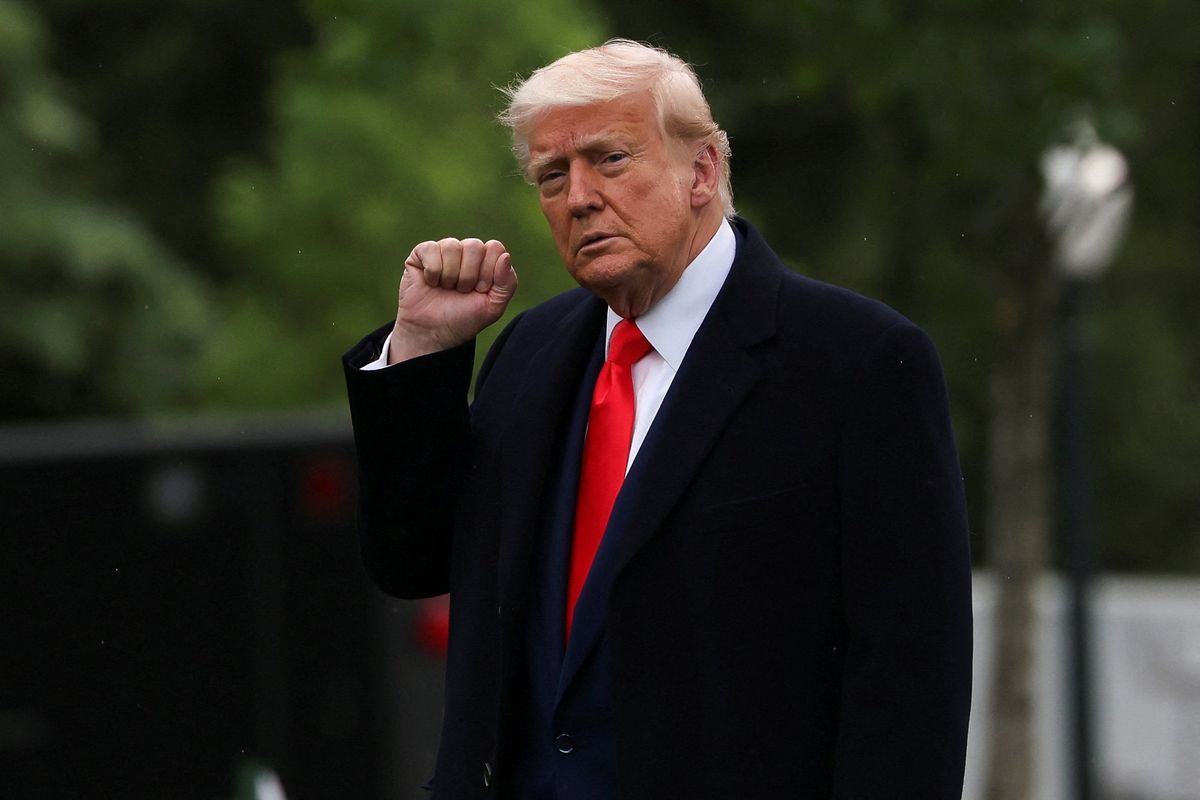
Donald Trump raises a fist to the cameras. REUTERS/Evelyn Hockstein


President Donald Trump has wielded his insult machine at Democrats he claims are "socialists" and "communists," but the state purchase of Intel has many, including conservatives, questioning whether he's the real "big government" guy.

On Friday, computer chip manufacturer Intel agreed to allow the government to purchase 10% of its company, making the U.S. government the largest shareholder in the company, NPR reported.

Libertarian Cato Institute vice president Scott Lincicome took to X to list off some of the worst possible outcomes of such a purchase, namely that it is "bad for Intel's long-term viability, as politics, not commercial considerations, increasingly drive its decisions." He added that it's also bad for Intel competitors, because the U.S. is being seen as picking winners and losers. It can also be problematic because Intel doesn't just manufacture computer chips, it has its claws in a number of other businesses.

"Washington will be Intel's single largest shareholder, and have a massive political/financial interest in the company's operations here and abroad. If you think this share will remain passive, I've got an unfinished chip factory in Ohio to sell you," he later added.

"Trump says Intel CEO agreed to give U.S. government $10 billion. Trump implies it’s an equity stake. The irony of his criticism of Democratic-Socialists as communists when, if this is true, its actual government takeover of private industry," said former Watergate prosecutor Jill Wine-Banks, a co-host of the "Sisters in Law" podcast.

Conservative former George W. Bush speechwriter David Frum pointed out, "On the same day, Trump is promoting government ownership of Intel and military patrols of Chicago, New York City, following upon existing military control of Los Angeles and District of Columbia. But apparently only RINOs still care about free enterprise and civilian rule. The conservatives these days get much more excited about the marketing decisions of roadside restaurant chains."

"Trump wants the U.S. government to take a 10% stake in Intel. Make no mistake: Trump’s "state capitalism" has nothing to do with public ownership, socialism, helping the working class, or improving national security. It’s another personal power grab," said former Labor Secretary Robert Reich.

Dan Shafer, political editor of Civic Media commented, "It's so funny to me that there are all these 'free market' think tanks in Wisconsin and none of them have said a single godd--n thing about tariffs, or the federal government buying a stake in Intel, or any of the very much not free market things happening in the Trump admin."

After Trump teased the idea on Wednesday, Sen. Rand Paul (R-KY) lamented, "If socialism is government owning the means of production, wouldn’t the government owning part of Intel be a step toward socialism? Terrible idea."

"Small government conservative," wrote Spencer Hakimian, the founder of Tolou Capital Management, his written voice dripping with sarcasm. He later agreed that Trump was a "socialist."

"Trump just announced that the CEO of Intel has agreed to give the US government a 10% stake in the company. That is literally communism!!!!!!!!!" Bernard Taylor, a local firefighter and paramedic running for Congress in Florida, exclaimed.

Trump turns US$11.1B in U.S. government funds into a 10% stake in downtrodden Intel


By The Associated Press
August 22, 2025

An Intel sign is shown at the chipmaker's global headquarters in Santa Clara, Calif. on Friday, Aug. 8, 2025. (AP Photo/Terry Chea

WASHINGTON – U.S. President Donald Trump on Friday announced the U.S. government has secured a 10 per cent stake in struggling Silicon Valley pioneer Intel in a deal that was completed just a couple weeks after he was depicting the company’s CEO as a conflicted leader unfit for the job.

“The United States of America now fully owns and controls 10 per cent of INTEL, a Great American Company that has an even more incredible future,” Trump wrote in a post.

The U.S. government is getting the stake through the conversion of US$11.1 billion in previously issued funds and pledges. All told, the government is getting 433.3 million shares of non-voting stock priced at $20.47 apiece -- a discount from Friday’s closing price at $24.80. That spread means the U.S. government already has a gain of $1.9 billion, on paper.

The remarkable turn of events makes the U.S. government one of Intel’s largest shareholders at a time that the Santa Clara, California, company is i n the process of jettisoning more than 20,000 workers as part of its latest attempt to bounce back from years of missteps taken under a variety of CEOs.Trade War coverage on BNNBloomberg.ca

Intel’s current CEO, Lip-Bu Tan, has only been on the job for slightly more than five months, an d earlier this month, it looked like he might be on shaky ground already after some lawmakers raised national security concerns about his past investments in Chinese companies while he was a venture capitalist. Trump latched on to those concerns in an August 7 post demanding that Tan resign.


But Trump backed off after the Malaysian-born Tan professed his allegiance to the U.S. in a public letter to Intel employees and went to the White House to meet with the president, leading to a deal that now has the U.S. government betting that the company is on the comeback trail after losing more than $22 billion since the end of 2023. Trump hailed Tan as “highly respected” CEO in his Friday post.

In a statement, Tan applauded Trump for “driving historic investments in a vital industry” and resolved to reward his faith in Intel. “We are grateful for the confidence the President and the Administration have placed in Intel, and we look forward to working to advance U.S. technology and manufacturing leadership,” Tan said.

Intel’s current stock price is just slightly above where it was when Tan was hired in March and more than 60 per cent below its peak of about $75 reached 25 years ago when its chips were still dominating the personal computer boom before being undercut by a shift to smartphones a few years later. The company’s market value currently stands at about $108 billion - a fraction of the current chip kingpin, Nvidia, which is valued at $4.3 trillion.

The stake is coming primarily through U.S. government grants to Intel through the CHIPS and Science Act that was started under President Joe Biden’s administration as a way to foster more domestic manufacturing of computer chips to lessen the dependence on overseas factories.

But the Trump administration, which has regularly pilloried the policies of the Biden administration, saw the CHIPs act as a needless giveaway and is now hoping to make a profit off the funding that had been pledged to Intel.

“We think America should get the benefit of the bargain,” U.S. Commerce Secretary Howard Lutnick said earlier this week. “It’s obvious that it’s the right move to make.”

About $7.8 billion had been been pledged to Intel under the incentives program, but only $2.2 billion had been funded so far. Another $3.2 billion of the government investment is coming through the funds from another program called “Secure Enclave.”

Although U.S. government can’t vote with its shares and won’t have a seat on Intel’s board of directors, critics of the deal view it as a troubling cross-pollination between the public and private sectors that could hurt the tech industry in a variety of ways.

For instance, more tech companies may feel pressured to buy potentially inferior chips from Intel to curry favor with Trump at a time that he is already waging a trade war that threatens to affect their products in a potential scenario cited by Scott Lincicome, vice president of general economics for the Cato Institute.

“Overall, it’s a horrendous move that will have real harms for U.S. companies, U.S. tech leadership, and the U.S. economy overall,” Lincicome posted Friday.


The 10 per cent stake could also intensify the pressure already facing Tan, especially if Trump starts fixating on Intel’s stock price while resorting to his penchant for celebrating his past successes in business.

Nancy Tengler, CEO of money manager Laffer Tengler Investments, is among the investors who abandoned Intel years ago because of all the challenges facing Intel.

“I don’t see the benefit to the American taxpayer, nor do I see the benefit, necessarily to the chip industry,” Tengler said while also raising worries about Trump meddling in Intel’s business.

“I don’t care how good of businessman you are, give it to the private sector and let people like me be the critic and let the government get to the business of government.,” Tengler said.

Although rare, it’s not unprecedented for the U.S. government to become a significant shareholder in a prominent company. One of the most notable instances occurred during the Great Recession in 2008 when the government injected nearly $50 billion into General Motors in return for a roughly 60 per cent stake in the automaker at a time it was on the verge of bankruptcy. The government ended up with a roughly $10 billion loss after it sold its stock in GM.Latest updates on company news here

The U.S. government’s stake in Intel coincides with Trump’s push to bring production to the U.S., which has been a focal point of the trade war that he has been waging throughout the world. By lessening the country’s dependence on chips manufactured overseas, the president believes the U.S. will be better positioned to maintain its technological lead on China in the race to create artificial intelligence.

Even before gaining the 10 per cent stake in Intel, Trump had been leveraging his power to reprogram the operations of major computer chip companies. The administration is requiring Nvidia and Advanced Micro Devices, two companies whose chips are powering the AI craze, to pay a 15 per cent commission on their sales of chips in China in exchange for export licenses.

By Michelle L. Price And Michael Liedtke, The Associated Press

Liedtke reported from San Ramon, California.

Organizers Are Demanding Palantir Drop Contracts With ICE and Israeli Military


Tech workers are also increasingly determined to hold their workplaces accountable for enabling the genocide in Gaza.

By Jesse Roth , 
August 21, 2025

Marching outside 9200 Sunset protestors carry portraits and signs demanding the abolition of ICE and Palantir on June 13, 2025, in Los Angeles, California.MADISON SWART / Hans Lucas / AFP via Getty Images

An organizer, wearing a keffiyeh and a shirt reading “Divest from Genocide,” stood on a table: “We’re all standing here today to hold companies like Palantir and Microsoft accountable for their role powering the world’s first AI-assisted genocide.”

Behind them, nearly 100 activists from Jewish Voice for Peace filled the lobby of Palantir’s Seattle offices on July 14, 2025. Activists carried banners featuring giant eyes with yellow irises: “First Palantir Surveils, then IDF Kills.” “First Palantir Tracks, then ICE attacks.” Arm in arm, they blocked the elevators to the building, preventing employees from accessing their offices.

On the same day, hundreds of activists protested at Palantir’s other U.S. Offices in New York, Washington D.C., Palo Alto, and Denver.

Palantir, one of the planet’s most advanced data mining companies, advertises that their mission is “to ensure America’s future” “on the factory floor, in the operating room, across the battlefield—we build to dominate.”

Hossam Nasr, an organizer with No Azure for Apartheid (and a participant in the Seattle protest), said, “Palantir is the [company] that’s most brazenly and explicitly leading this charge of tech companies becoming arms of the state…Their CEO brags about how their technology kills people.”

Related Story

Stephen Miller Owns Up to $250,000 in Palantir Stock, Report Finds
Palantir is reportedly building a mega-database of Americans’ personal information for the Trump administration. By Sharon Zhang , Truthout June 24, 2025


In 2022, the Department of Homeland Security signed a $96 million contract with the company, and under the second Trump administration, Palantir added a $30 million contract with ICE. Under these contracts, they’re creating an “ImmigrationOS” that would allow detailed, real-time tracking, and targeting of immigrants.” At the beginning of Trump’s second term, Palantir also struck a deal with Elon Musk’s Department of Government Efficiency to create a “Mega API,” which would allow DOGE to consolidate IRS records with other government data (such as health, education, and “criminal justice” records) and interpret it using AI — a major hit to the public’s privacy rights.

Palantir is profiting royally off these contracts. Since Trump’s term began, the company’s stock price is up by over 80% — in CEO Alex Karp’s words, “surging and ferocious growth.” Notably, Department of Homeland Security Advisor Stephen Miller has over $100,000 invested in the company.

Palantir’s technology is also powering Israel’s genocide in Gaza. In January of 2024, Palantir agreed to a “strategic partnership” with the Israeli Defense Ministry, selling them an advanced AI platform. A report from UN Special Rapporteur Francesca Albanese says there are “reasonable grounds” to believe that Palantir supplied predictive policing technology, “core defence infrastructure,” and the AI platform that powers “Lavender,” “Gospel,” and “Where’s Daddy” — AI platforms that make life-and-death surveillance and military decisions. Palantir’s software mines data from intelligence records. The AI System “Lavender” and “Gospel” then spit out lists of tens of thousands of targets. “Where’s Daddy” alerts the Israeli Occupation Forces (IOF) when a target enters their family home. The IOF then bombs them, their families, and often everyone else in the building. Humans serve only as a “rubber stamp” on the AI’s life-or-death decisions.

In response to Palantir’s growing power and violence, activists are increasingly targeting the company. Planet Over Profit, a climate justice organization, started targeting Palantir in mid-June by occupying the lobby of Thiel Capital, disrupting a recruiting event in San Francisco, and blocking the entrances to the company’s New York offices. These actions came to a head on July 14, when organizers across the country staged a #purgepalantir day of action.

In Washington D.C., an autonomous Palestinian and woman-led group staged a die-in outside of the Palantir Offices. The group (who have been leading demonstrations across D.C. almost every day since October 7, 2023) has protested Palantir several times before — at their offices and at several tech conferences. On July 14th, in the lobby activists chanted and unfurled banners; outside Palantir’s building, activists lay on the pavement, their faces and bodies marked with fake blood. “Palantir security guards got extremely violent,” said organizer Hazami Barmada. The guards attacked seven protestors, aggressively throwing a 67-year-old Palestinian woman against concrete.

In New York, a coalition including Planet over Profit, The New York Alliance Against Racist and Political Repression, and No Tech for Apartheid staged a protest featuring more than 60 people. Protestors blockaded the doors to Palantir’s offices, holding a banner reading “Purge Palantir. Stop the Kill Chain.” The NYPD arrested four people.

In Palo Alto, 200 attendees blocked traffic outside the Palantir office and set up a picket. Activists plastered the building with posters styled like “missing persons” posters featuring pictures and stories of people recently abducted by ICE. “ICE Runs on Palantir; Palantir Powers ICE,” they read.

Activists with JVP-Seattle protest at the Palantir Offices in Seattle, Washington, on July 14, 2025.Alex Garland

Denver’s protest featured a march from the Colorado State Capitol to the company’s headquarters. Eight protestors blockaded the entrances to the company.

Why, after nearly two years of genocide, after years of escalating surveillance, are people protesting Palantir now? For these organizers, Palantir is a common enemy, bringing together issues like police abolition, imperialism, immigrant rights, privacy, climate justice, and wealth inequality.

“Our consciousnesses are not single-issue,” said Seattle organizer Michael Grant. “Targets like Palantir connect movement struggles across issues in a way that is going to be increasingly important under authoritarianism.” He also pointed out that AI “is being trained at all times across geographies and peoples”: What AI “learns” from dropping bombs on Palestinians will be used to more viciously target immigrants in the U.S., and vice versa.

For these activists, this wave of protests is only the beginning. Organizers at Planet over Profit are inspired by the #TeslaTakedown movement and its work to tank Tesla’s stock price. “When you have really coordinated, disruptive mass resistance,” says Katie Na, “it is actually possible to hurt these companies that see themselves as being untouchable.”

For the organizers at JVP-Seattle (in coalition with the Palestinian-led lobby Washington for Peace and Justice), this action kicks off a campaign pressuring the Washington State Investment Board (WSIB) to divest from weapons manufacturers and other companies complicit in Israel’s apartheid and genocide. The WSIB manages investments for Washingtonians including pensions for over 600,000 public employees, publicly supported college savings funds, workers comp and long-term care funds, and trusts for schools across the state. The WSIB has $73.4 million invested in Palantir and millions more in other weapons manufacturers and genocide profiteers including Lockheed Martin, Raytheon, and Caterpillar.

Activists with JVP-Seattle hold a banner that reads “Washington State Out of Genocidal Tech” outside the Palantir Offices in Seattle, Washington, on July 14, 2025.Alex Garland

Michael Grant, a public school teacher, says he’s “only recently connected the dots” between Palantir and retirement funds by doing the research involved in building this campaign. Grant, who says 90 percent of his students are immigrants, called it is “cruel” that his pension is invested in “a company that’s also enabling and accelerating the Trump deportation agenda.”

Other organizers are encouraging tech workers to hold their workplaces accountable. “People inside these institutions are getting the courage to speak up and understanding that they play a role in exposing it from the inside,” says Washington D.C. organizer Hazami Barmada.

Hossam Nasr is an example of this: Microsoft fired him in the fall of 2024 for organizing a vigil for Gaza. He now organizes with No Azure for Apartheid. Azure is Microsoft’s cloud computing and AI system, which provides (according to Albanese) “virtually government-wide” digital infrastructure for Israel and its military — in particular supporting surveillance. Recent reporting from +972 Magazine revealed that Microsoft created a custom storage system on Azure to host 11,500 terabytes of Israeli military data. This data includes as much as 200 million hours of audio of surveilled Palestinian phone calls. Israeli military officials have described cloud services as a “weapon”. Palantir and Microsoft’s technologies work together to power the IOF. To fight back, Nasr says, tech workers can “use [their] privilege of being a worker to fight against these companies from the inside…At No Azure for Apartheid, we are more effective and successful because we have both external and internal pressure.”

No Azure for Apartheid has done just that. On August 19th and 20th, organizers — including current and former employees — created an encampment at Microsoft’s Redmond, Washington headquarters. They renamed Microsoft’s main plaza the “Martyred Palestinian Children’s Plaza.” Declaring the protest a “worker intifada”, they called on their fellow employees to join them in demanding that Microsoft cut ties with Israel. Police broke up the protest both days, attacking and arresting 18 on the second day.

Across the nation, these organizers plan to collectively escalate their actions and grow momentum, making it toxic for Palantir and other tech companies to continue facilitating state violence. Nasr says, “I hope that these actions continue to confront and to escalate against these executives and these companies until…these relationships with the genocidal apartheid state of Israel, with ICE, and with fascist states across the world become so untenable it’s actually not profitable anymore. That’s actually the only way to get these companies to bend. That’s what I hope to see.”


This article is licensed under Creative Commons (CC BY-NC-ND 4.0), and you are free to share and republish under the terms of the license.


Jesse Roth (she/her) is a writer, theatre artist, and organizer located on Coast Salish and Duwamish lands. Her writing has been published in The Stranger and An Apple a Day. She organizes with JVP-Seattle and writes the newsletter Art Gardening.