Saturday, August 23, 2025

Trump official reminds the world that the US now has a 'national position' on a single word

August 05, 2025

It was meant to be a routine discussion on pollution. One by one, delegates at the United Nations expressed support for a new panel of scientists who would advise countries on how to address chemicals and toxic waste.
.
But the U.S. delegate took the meeting in a new direction. She spent her allotted three minutes reminding the world that the United States now had a “national position” on a single word in the documents establishing the panel: gender.

“Use of the term ‘gender’ replaces the biological category of sex with an ever-shifting concept of self-assessed gender identity and is demeaning and unfair, especially to women and girls,” the delegate told the U.N. in June.

The Trump administration is pushing its anti-trans agenda on a global stage, repeatedly objecting to the word “gender” in international resolutions and documents. During at least six speeches before the U.N., U.S. delegates have denounced so-called “gender ideology” or reinforced the administration’s support for language that “recognizes women are biologically female and men are biologically male.”


The delegates included federal civil service employees and the associate director of Project 2025, the conservative blueprint for Trump’s policies, who now works for the State Department. They delivered these statements during U.N. forums on topics as varied as women’s rights, science and technology, global health, toxic pollution and chemical waste. Even a resolution meant to reaffirm cooperation between the U.N. and the Association of Southeast Asian Nations became an opportunity to bring up the issue.

Insisting that everyone’s gender is determined biologically at birth leaves no room for the existence of transgender, nonbinary and intersex people, who face discrimination and violence around the world. Intersex people have variations in chromosomes, hormone levels or anatomy that differ from what’s considered typical for male and female bodies. A federal report published in January just before President Donald Trump took office, estimated there are more than 5 million intersex Americans.

On at least two occasions, U.S. delegates urged the U.N. to adopt its language on men and women, though it’s unclear if the U.S.’ position has led to any policy changes at the U.N. But the effects of the country’s objections are more than symbolic, said Kristopher Velasco, a sociology professor at Princeton University who studies how international institutions and nongovernmental organizations have worked to expand or curtail LGBTQ+ rights.

U.N. documents can influence countries’ policies over time and set an international standard for human rights, which advocates can cite as they campaign for less discriminatory policies, Velasco said. The phrase “gender ideology” has emerged as a “catchall term” for far-right anxieties about declining fertility rates and a decrease in “traditional” heterosexual families, he said.

At the U.N., the administration has promoted other aspects of its domestic agenda. For example, U.S. delegates have demanded the removal of references to tackling climate change and voted against an International Day of Hope because the text contained references to diversity, equity and inclusion. (The two-page document encouraged a “more inclusive, equitable and balanced approach to economic growth” and welcomed “respect for diversity.”)

But the reflexive resistance to the word “gender” is particularly noteworthy.


Advocates for LGBTQ+ rights said the U.S.’ repeated condemnation of “gender ideology” signals support for more repressive regimes.


The U.S. is sending the world “a clear message: that the identities and rights of trans, nonbinary, and intersex people are negotiable,” Ash Lazarus Orr, press relations manager at the nonprofit Advocates for Trans Equality, said in a statement.


Laurel Sprague, research director at the Williams Institute, a policy center focused on sexual orientations and gender identities at the University of California, Los Angeles, said she’s concerned that other countries will take similar positions on transgender rights to gain favor with the U.S. Last month Mike Waltz, Trump’s nominee for ambassador to the U.N., told a Senate committee that he wants to use a country’s record of voting with or against the U.S. at the U.N. as a metric for deciding foreign aid.

In response to detailed questions from ProPublica, White House Deputy Press Secretary Anna Kelly said in a statement: “President Trump was overwhelmingly elected to restore common sense to government, which means focusing foreign policy on securing peace deals and putting America First — not enforcing woke gender ideology.”


A clash between Trump’s administration and certain U.N. institutions over transgender rights was almost inevitable.

Trump’s hostility to transgender rights was a key part of his election campaign. On his first day in office, he issued an executive order called “Defending women from gender ideology extremism and restoring biological truth to the federal government.” The order claimed there were only two “immutable” sexes. Eight days later, Trump signed an executive order restricting gender-affirming surgery for anyone under 19. Federal agencies have since forced trans service members out of the military and sued California for its refusal to ban trans athletes from girls’ sports teams.

In June, the U.N. High Commissioner for Human Rights criticized American government officials for their statements “vilifying transgender and non-binary people.” The human rights office urges U.N. member states to provide gender-affirming care and says the organization has “affirmed the right of trans persons to legal recognition of their gender identity and a change of gender in official documents, including birth certificates.” The office also supports the rights of intersex people.

“Intersex people in the U.S. are extremely worried” that they will become bigger targets, said Sylvan Fraser Anthony, legal and policy director at the intersex advocacy group InterACT.

“In all regions of the world, we are witnessing a pushback against women’s human rights and gender equality,” Laura Gelbert Godinho Delgado, a spokesperson for the U.N.’s human rights office, said in an email. “This has fueled misogyny, anti-LGBTI rhetoric, and hate speech.”

The Trump administration’s insistence on litigating “gender” complicates the already ponderous procedures of the U.N. Many decisions are made by consensus, which could require representatives from more than 100 countries to agree on every word. Phrases and single words still under debate are marked with brackets. Some draft documents end up with hundreds of brackets, awaiting resolution at a subsequent date.

At the June meeting on chemical pollution, delegates decided to form a scientific panel but couldn’t agree on crucial details about whether the panel’s purpose included “the protection of human health and the environment.” A description of the panel included brackets on whether it would work in a way that integrates “gender equality and equity” or “equality between men and women.”

The U.S. delegate, Liz Nichols, reminded the U.N. at one point that it “is the policy of the United States to use clear and accurate language that recognizes women are biologically female and men are biologically male. It is important to acknowledge the biological reality of sex to support the needs and perspectives of women and girls.”

Career staffers like Nichols are hired for subject-matter expertise and work to execute the agenda of whichever administration is in charge, regardless of personal beliefs. Nichols has a doctorate in ecology from Columbia University and has worked for the State Department since 2018. When asked for comment, she referred ProPublica to the State Department.

A State Department spokesperson said in a statement, “As President Trump’s Executive Orders and our public remarks have repeatedly stated, this administration will continue to defend women’s rights and protect freedom of conscience by using clear and accurate language and policies that recognize women are biologically female, and men are biologically male.”

Gender is a crucial factor in chemical safety, said Rachel Radvany, environmental health campaigner at the Center for International Environmental Law who attended the meeting. Pregnant people are uniquely vulnerable to chemical exposure and women are disproportionately exposed to toxic compounds, including through beauty and menstrual products.

Radvany said the statement read by Nichols contributed to the uncertainty on how the panel would consider gender in its work. The brackets around gender-related issues and other topics remained in the draft decision and will have to be resolved at a future gathering that may not happen until next summer.


The U.S. has also staked out similar positions at U.N. meetings focused on gender. At a session of the Commission on the Status of Women in March, Jonathan Shrier, a longtime State Department employee who now works for the U.S. Mission to the United Nations, said the U.S. disapproved of a declaration supporting “the empowerment of all women and girls” that mentioned the word “gender.” The phrase “all women and girls” in U.N. documents has been used as a way to be inclusive of trans women and girls.

Shrier read a statement saying that several factors in the text made it impossible for the U.S. to back the resolution, which the commission had recently adopted. That included “lapses in using clear and accurate language that recognizes women are biologically female and men are biologically male.”

During the summit, Shrier repeated those talking points at an event co-sponsored by the U.S. government and the Center for Family and Human Rights, or C-Fam. The group’s mission statement says its goal is the “preservation of international law by discrediting socially radical policies at the United Nations and other international institutions.”

Shrier directed questions to the U.S. Mission to the United Nations, which did not respond. Responding to questions from ProPublica, C-Fam’s president, Austin Ruse, said in a statement that the U.S. position on gender is in line with the definitions found in an important U.N. document on the empowerment of women from 1995.

Some countries have pushed back against the U.S.’ stance, often in ways that appear subtle to the casual observer. The U.N. social and environmental forums where these speeches have been delivered tend to operate with a culture of civility and little direct confrontation, said Alessandra Nilo, external relations director for the Americas and the Caribbean at the International Planned Parenthood Federation. Nilo has participated in U.N. forums on HIV/AIDS and women’s health since 2000.

When other delegates speak out in support of diversity and women’s rights, it’s a sign of their disapproval and a way to isolate the U.S., Nilo said. During the women’s rights summit, the delegate from Brazil celebrated “the expansion of gender and diversity language” in the declaration.

Nilo said many countries are scared to speak out for fear of losing trade deals or potential foreign aid from the U.S.

Advocating an “America First” platform, Trump has upended U.S. commitments to multinational organizations and alliances. He signed orders withdrawing the U.S. from the World Health Organization and various U.N. bodies, such as the Human Rights Council and the cultural group UNESCO.

It’s rare for the U.N. to directly affect legislation in the U.S. But the Trump administration repeatedly cites concerns that U.N. documents could supersede American policy.

In April, the U.S. criticized a draft resolution on global health debated at a meeting of the U.N. Commission on Population and Development. Spencer Chretien, the U.S. delegate, opposed references to the U.N.’s Sustainable Development Goals, which provide a blueprint for how countries can prosper economically while improving gender equality and protecting the environment. Chretien called the program a form of “soft global governance” that conflicts with national sovereignty. Chretien also touted the administration’s “unequivocal rejection of gender ideology extremism” and renewed membership in the Geneva Consensus Declaration, an antiabortion document signed by more than 30 countries, including Russia, Hungary, Saudi Arabia and South Sudan. The first Trump administration co-sponsored the initiative in 2020 before the Biden administration withdrew from it.

Chretien helped write Project 2025 when he worked at The Heritage Foundation. He is now a senior bureau official in the State Department’s Bureau of Population, Refugees and Migration. Chretien couldn’t be reached for comment.

The U.N. proposal on global health faced additional opposition from Burundi, Djibouti and Nigeria, where abortion is generally illegal. Delegates from those countries were upset about references to “sexual and reproductive health services,” which could include abortion access. The commission chair withdrew the resolution, seeing no way to reach consensus.

During a July forum about a document on sustainable development, the U.S. delegate, Shrier, asked for a vote on several paragraphs about gender, climate change and various forms of discrimination. In his objections, he cited two paragraphs that he argued advanced “this radical abortion agenda through the terms ‘sexual and reproductive health’ and ‘reproductive rights.’”

The final vote on whether to retain those paragraphs was 141 to 2, with only the U.S. and Ethiopia voting no. (Several countries abstained.)

When the results lit up the screen, the chamber broke into thunderous applause.


Trump's new Ministry of Truth is straight out of George Orwell

August 21, 2025 

When people use the term “Orwellian,” it’s not a good sign.

It usually characterizes an action, an individual or a society that is suppressing freedom, particularly the freedom of expression. It can also describe something perverted by tyrannical power.

It’s a term used primarily to describe the present, but whose implications inevitably connect to both the future and the past.

In his second term, President Donald Trump has revealed his ambitions to rewrite America’s official history to, in the words of the Organization of American Historians, “reflect a glorified narrative … while suppressing the voices of historically excluded groups.”

This ambition was manifested in efforts by the Department of Education to eradicate a “DEI agenda” from school curricula. It also included a high-profile assault on what detractors saw as “woke” universities, which culminated in Columbia University’s agreement to submit to a review of the faculty and curriculum of its Middle Eastern Studies department, with the aim of eradicating alleged pro-Palestinian bias.

Now, the administration has shifted its sights from formal educational institutions to one of the key sites of public history-making: the Smithsonian, a collection of 21 museums, the National Zoo and associated research centers, principally centered on the National Mall in Washington, D.C.

On Aug. 12, 2025, the Smithsonian’s director, Lonnie Bunch III, received a letter from the White House announcing its intent to carry out a systematic review of the institution’s holdings and exhibitions in the advance of the nation’s 250th anniversary in 2026.

The review’s stated aim is to ensure that museum content adequately reflects “Americanism” through a commitment to “celebrate American exceptionalism, [and] remove divisive or partisan narratives.”

On Aug. 19, 2025, Trump escalated his attack on the Smithsonian. “The Smithsonian is OUT OF CONTROL, where everything discussed is how horrible our Country is, how bad Slavery was…” he wrote in a Truth Social post. “Nothing about Success, nothing about Brightness, nothing about the Future. We are not going to allow this to happen.”

Such ambitions may sound benign, but they are deeply Orwellian. Here’s how.

Winners write the history

Author George Orwell believed in objective, historical truth. Writing in 1946, he attributed his youthful desire to become an author in part to a “historical impulse,” or “the desire to see things as they are, to find out true facts and store them up for the use of posterity.”

But while Orwell believed in the existence of an objective truth about history, he did not necessarily believe that truth would prevail.

Truth, Orwell recognized, was best served by free speech and dialogue. Yet absolute power, Orwell appreciated, allowed those who possessed it to silence or censor opposing narratives, quashing the possibility of productive dialogue about history that could ultimately allow truth to come out.

As Orwell wrote in “1984,” his final, dystopian novel, “Who controls the past controls the future. Who controls the present controls the past.”

Historian Malgorzata Rymsza-Pawlowska has written about America’s bicentennial celebrations that took place in 1976. Then, she says, “Americans across the nation helped contribute to a pluralistic and inclusive commemoration … using it as a moment to question who had been left out of the legacies of the American Revolution, to tell more inclusive stories about the history of the United States.”

This was an example of the kind of productive dialogue encouraged in a free society. “By contrast,” writes Rymsza-Pawlowska, “the 250th is shaping up to be a top-down affair that advances a relatively narrow and celebratory idea of Americanism.” The newly announced Smithsonian review aims to purge counternarratives that challenge that celebratory idea.

The Ministry of Truth


The desire to eradicate counternarratives drives Winston Smith’s job at the ironically named Ministry of Truth in “1984.”

The novel is set in Oceania, a geographical entity covering North America and the British Isles and which governs much of the Global South.

Oceania is an absolute tyranny governed by Big Brother, the leader of a political party whose only goal is the perpetuation of its own power. In this society, truth is what Big Brother and the party say it is.

The regime imposes near total censorship so that not only dissident speech but subversive private reflection, or “thought crime,” is viciously prosecuted. In this way, it controls the present.

But it also controls the past. As the party’s protean policy evolves, Smith and his colleagues are tasked with systematically destroying any historical records that conflict with the current version of history. Smith literally disposes of artifacts of inexpedient history by throwing them down “memory holes,” where they are “wiped … out of existence and out of memory.”

At a key point in the novel, Smith recalls briefly holding on to a newspaper clipping that proved that an enemy of the regime had not actually committed the crime he had been accused of. Smith recognizes the power over the regime that this clipping gives him, but he simultaneously fears that power will make him a target. In the end, fear of retaliation leads him to drop the slip of newsprint down a memory hole.

The contemporary U.S. is a far cry from Orwell’s Oceania. Yet the Trump administration is doing its best to exert control over the present and the past.

Down the memory hole

Even before the Trump administration announced its review of the Smithsonian, officials in departments across government had taken unprecedented steps to rewrite the nation’s official history, attempting to purge parts of the historical narrative down Orwellian memory holes.

Comically, those efforts included the temporary removal from government websites of information about the Enola Gay, the plane that dropped the atomic bomb over Hiroshima. The plane was unwittingly caught up in a mass purge of references to “gay” and LGBTQ+ content on government websites.

Other erasures have included the deletion of content on government sites related to the life ofHarriet Tubman, the Maryland woman who escaped slavery and then played a pioneering role as a conductor of the Underground Railroad, helping enslaved people escape to freedom.

Public outcry led to the restoration of most of the deleted content.

Over at the Smithsonian, which earlier in the year had been criticized by Trump for its “divisive, race-centered ideology,” staff removed a temporary placard with references to President Trump’s two impeachment trials from a display case on impeachment that formed part of the National Museum of American History exhibition on the American presidency. The references to Trump’s two impeachments were modified, with some details removed, in a newly installed placard in the updated display.

Responding to questions, the Smithsonian stated that the placard’s removal was not in response to political pressure: “The placard, which was meant to be a temporary addition to a 25-year-old exhibition, did not meet the museum’s standards in appearance, location, timeline, and overall presentation.”

Repressing thought


Orwell’s “1984” ends with an appendix on the history of “Newspeak,” Oceania’s official language, which, while it had not yet superseded “Oldspeak” or standard English, was rapidly gaining ground as both a written and spoken dialect.

According to the appendix, “The purpose of Newspeak was not only to provide a medium of expression for the worldview and mental habits proper to the devotees of [the Party], but to make all other modes of thought impossible.”

Orwell, as so often in his writing, makes the abstract theory concrete: “The word free still existed in Newspeak, but it could only be used in such statements as ‘This dog is free from lice’ or ‘This field is free from weeds.’ … political and intellectual freedom no longer existed even as concepts.”

The goal of this language streamlining was total control over past, present and future.

If it is illegal to even speak of systemic racism, for example, let alone discuss its causes and possible remedies, it constrains the potential for, even prohibits, social change.

It has become a cliché that those who do not understand history are bound to repeat it.

As George Orwell appreciated, the correlate is that social and historical progress require an awareness of, and receptivity to, both historical fact and competing historical narratives.

This story is an updated version of an article originally published on June 9, 2025.

The Smithsonian is a member of The Conversation U.S.

Laura Beers, Professor of History, American University

This article is republished from The Conversation under a Creative Commons license. Read the original article.
ICYMI
Trucking industry in shambles as Trump crackdown threatens supply chains


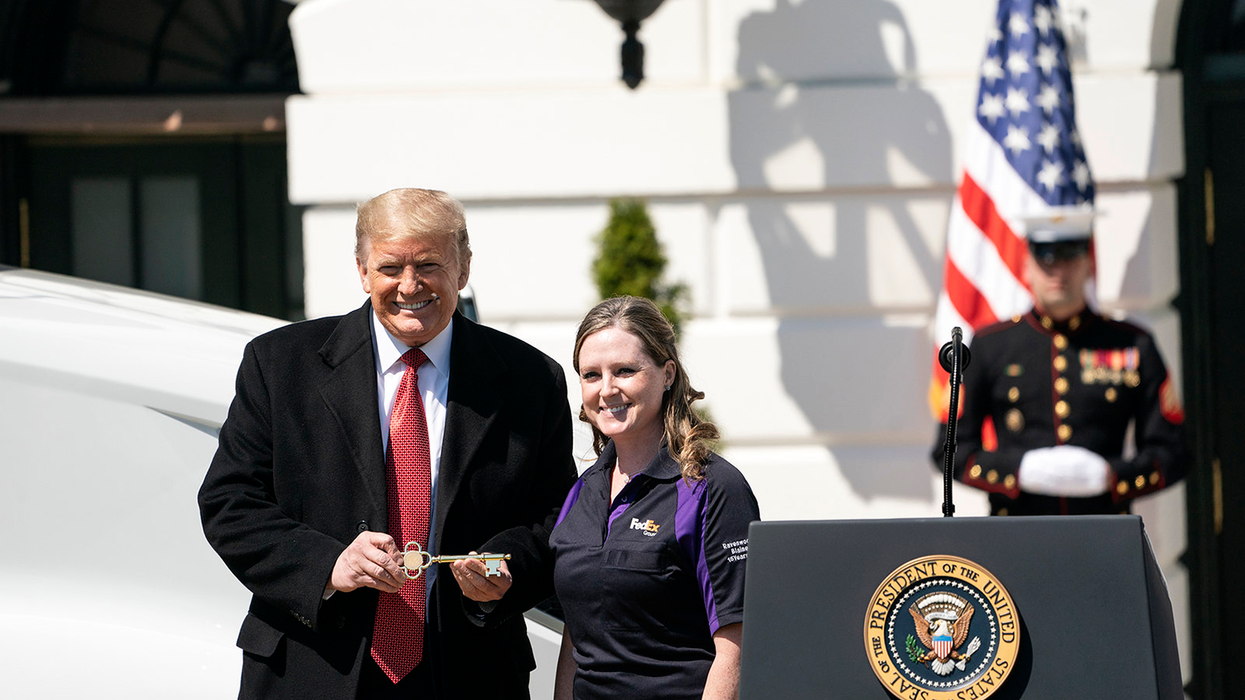
President Donald J. Trump presents FedEx truck driver Tina Peterson with a commemorative key on the South Lawn of the White House Thursday, April 16, 2020, during an event recognizing the front line efforts of truck drivers during the COVID-19 crisis. (Official White House Photo by Joyce N. Boghosian)

August 22, 2025 
ALTERNET

Newsweek reports a trade group representing the trucking industry is supporting Secretary of State Marco Rubio's pause of work visas for immigrant truckers, despite the halt potentially aggravating work shortages in the U.S. trucking industry.

Rubio’s announcement followed a fatal crash on a Florida highway earlier this month involving a trucker from India who officials confirmed was in the country illegally. Newsweek reports preliminary findings by the Department of Transportation (DOT) revealed the driver failed assessments on his English language proficiency and his understanding of U.S. highway traffic rules.

Rubio did not reference the fatal accident at the time of his announcement, reports Newsweek, but did claim in a post on X that the increasing number of foreign truckers was "endangering American lives and undercutting the livelihoods of American truckers."

In a statement released Thursday, Chris Spear, president and CEO of the American Trucking Associations (ATA), said his group supported the move, and that the issuance of non-domiciled commercial driver's licenses (CDLs) "needs serious scrutiny, including the enforcement of entry-level driver training standards."

“At a minimum, we need better accounting of how many non-domiciled CDLs are being issued, which is why we applaud Transportation Secretary Duffy for launching a nationwide audit in June upon our request,” Spear told Newsweek. “… We also believe a surge in enforcement of key regulations — including motor carrier compliance — is necessary to prevent bad actors from operating on our nation's highways, and we'll continue to partner with federal and state authorities to identify where those gaps in enforcement exist."

Industry reporters claims many employed in the trucking industry supported Trump for president.

As part of his crackdown on immigration, President Donald Trump signed an executive order directing Duffy to tighten regulations on English proficiency for commercial drivers in April, despite English language requirements already being included in federal regulations.

In February, trucking industry newsletter Matrack reported The U.S. trucking industry faces a severe driver shortage, “with a projected shortfall of 160,000 by 2030, disrupting supply chains and increasing costs.” It added that the aging workforce and CDL licensing challenges, combined with low pay, health concerns and high turnover, plague the industry.

“Long-haul trucking has a turnover rate of over 90 percent in large companies, reported Matrack. “This means that almost every driver in the industry will leave their job within a year. Long hours, stressful working conditions, and time away from home make the job unattractive.”

Labor Department data said that the number of foreign-born truckers in the U.S. comprise around 18 percent of the total workforce, said Newsweek.

Read the Newsweek report at this link.


Trump's DC Occupation Costs 4 Times More Than It Would Take to House City's Entire Homeless Population


"This militarized spending comes at the expense of federal programs—like public housing—that actually do prevent crime and improve health and education outcomes," said researcher Hanna Homestead.


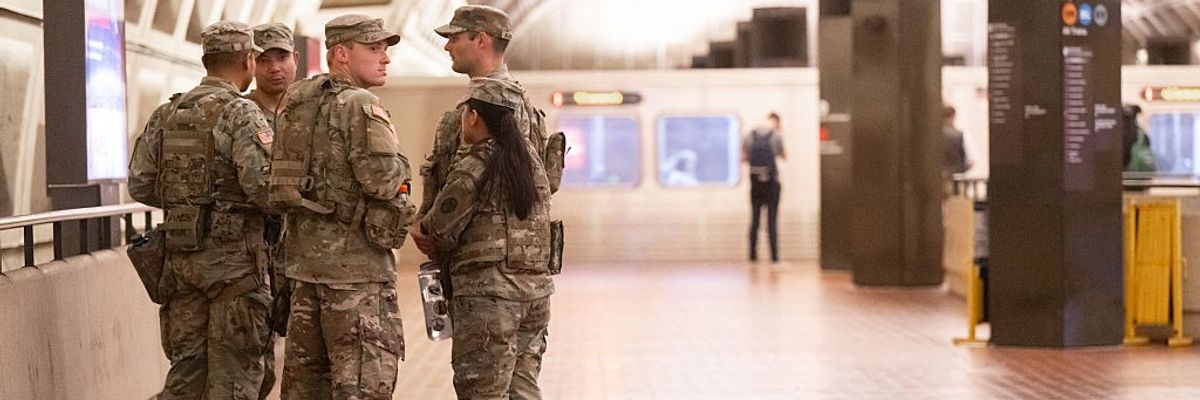
Members of the National Guard patrol inside the Metro Center Metrorail Station in Washington, DC, on August 21, 2025.
(Photo by Saul Loeb/AFP)


Stephen Prager
Aug 22, 2025
COMMON DREAMS


Last week, when Trump federalized Washington, DC's police force and deployed the National Guard to occupy its streets, one of his main orders was to "end vagrancy" by destroying homeless encampments and arresting and forcibly relocating the people taking shelter there.

But according to an investigation published on Wednesday by Hanna Homestead of the National Priorities Project, in collaboration with The Intercept, deploying the National Guard and "getting rid of the slums" is costing far more than it would cost to simply provide housing to every homeless person in the city.

Governors from six US states have sent troops to Washington to help Trump's effort, swelling the ranks to nearly 2,100 who will soon be on patrol.

According to previous reporting, National Guard deployments cost the US government $530 per guard member each day. Using that figure, Homestead estimated that it would cost just over $1.1 million.

She added that "the number of troops will likely continue to grow. And with no deadline for the DC deployment, those costs could add up for months or even years."

According to the most recent data from the Department of Housing and Urban Development (HUD), there are about 5,600 people experiencing either sheltered and unsheltered homelessness in DC on a given night. Operating an affordable housing unit for each one of them, the data shows, costs about $45.44 per person, per day, on average in DC.

Providing affordable housing to every homeless person in DC would cost an estimated $255,166, which is 4.3 times less than the cost of Trump's military deployment.

"Taxpayers like you and me bear the cost of this cruel power grab," Homestead said. "This militarized spending comes at the expense of federal programs—like public housing—that actually do prevent crime and improve health and education outcomes."

Last week, White House Press Secretary Karoline Leavitt told reporters that over 70 encampments had been cleared since Trump's order to federalize the police. She also said that over 600 people had been arrested, though it was not specified how many of them were homeless.

Trump has sought to conflate homelessness with criminality, suggesting that the nation's capital had been "overtaken by violent gangs and bloodthirsty criminals, roving mobs of wild youth, drugged-out maniacs, and homeless people."

While his solution has been a show of military force against people with nowhere to go, a large body of research suggests that the approach of providing "Housing First"—meaning a stable place to stay with no preconditions for sobriety or treatment—reduces crime.

A 2021 study from UCLA found that providing homeless people with targeted housing assistance reduced the probability of committing a crime by 80%.

"Arresting or ticketing people for sleeping outside makes homelessness worse, wastes taxpayer money, and simply does not work," said Jesse Rabinowitz of the National Homelessness Law Center. "The solution to homelessness is housing and supports, not handcuffs and jails."

But in addition to a crackdown on the homeless, the Trump administration is also pushing to eliminate funds for public housing. The White House's proposed budget for fiscal year 2026 slashes funding for HUD's Continuum of Care program, which provided cities with funding for initiatives to house the homeless.

According to the National Alliance to End Homelessness, the proposal would effectively end funding of permanent supportive housing for 170,000 residents and potentially increase the number of homeless people in the US by 36%.

"Arresting people for no reason other than the fact that they have no home is inhumane and unjust," said Amber W. Harding, executive director of the Washington Legal Clinic for the Homeless. "It is particularly cruel to do so knowing that federal and local housing programs have been slashed and that DC does not have enough shelter beds."

"Fines, arrests, and encampment evictions make homelessness worse, further traumatize our homeless neighbors while disconnecting them from community and support," said Dana White, Director of Advocacy at Miriam's Kitchen, a DC-based homeless services organization. "If policing resolved homelessness, we wouldn't have homelessness here in DC or anywhere else in this country."


Trump’s Test Case: Deploying the Military to Washington, DC


Saturday 23 August 2025, by Malik Miah


IN A LONG rant of over 70 minutes at an August 10 news conference, Trump claimed that the nation’s capital, Washington, D.C., “has been overtaken by violent gangs and bloodthirsty criminals, roving mobs of wild youth, drugged-out maniacs, and homeless people. And we are not going to take it anymore.”

Everyone knows that when he singles out “wild youth” he means Black youth. By “high crimes areas” he means the Black community.

Trump then ordered an extraordinary exertion of federal power over an American city with the deportment of National Guard troops to the capital. He put the city police under federal control, and deployed 500 federal law enforcement officials, including 120 FBI agents, 50 deputy U.S. marshals, as well as agents from the Drug Enforcement Agency and the Bureau of Alcohol, Tobacco, Firearms and Explosives.

Some will be on patrol duty and others will be visible in “high crime” or high traffic areas. The first night they picked up 23 residents, on that Saturday night they arrested 68.

Since under federal law, this action can only last 30 days without Congress’s approval, Trump boasted that if Congress doesn’t extend it, he will declare a national emergency.

Trump described the deployment as part of a broader effort to “liberate” the city and make it “great again.” In fact, he claims he will remake the city “beautiful” again.

Unsurprisingly, he promised to send troops to other cities, specifically mentioning Chicago, New York, Baltimore and Oakland, California. All of these cities have elected Black mayors and large African American communities.

Washington, DC, once known as “Chocolate City,” has been run by Black politicians for decades. With a population of 290,772, African Americans are the largest racial group, standing at 43%, about four percent more that the city’s white population. (Another 15% are people of color from a variety of ethnicities.)

The DC Mayor, Muriel Bowser, and other local officials hadn’t been told about the takeover; they heard and watched it announced on television.

Speaking during a live town hall on social media, Mayor Bowser urged community members to “protect our city, to protect our autonomy, to protect our home rule and get to the other side of this guy and make sure we elect a Democratic House so that we have a backstop to this authoritarian push.”

“We are not 700,000 scumbags and punks,” she added. “We don’t have neighborhoods that should be bulldozed. We must be clear about our story, who we are and what we want for our city.”

U.S. Attorney General Pam Bondi plowed ahead and installed Drug Enforcement Administrator Terry Cole the “emergency police commissioner.” The city sued. District Court Judge Ana Reyes ordered the parties — which included Trump, Bondi and the Department of Justice — to work out a plan with DC officials. Subsequently the Trump administration rescinded Bondi’s directive.
Need for Self-Rule

This is the first time a president has ever used Section 740 of the Home Rule Act — DC is not a state — to federalize the metro police,” said Dr. Heidi Bonner, chair of the Department of Criminal Justice and Criminology at East Carolina University.

Although DC residents elect their own politicians and raise their own money, Congress still has power over the city’s policies, which it frequently uses. (The people of DC have a nonvoting representative in the House and no voice in the Senate.)

The D.C. situation is unique because the city — lacking statehood – is uniquely vulnerable to federal intervention. But it provides Trump with a test case on the road toward authoritarianism. And Democratic mayors across the country have warned Trump against expanding his law-and-order power grab.

Brandon Johnson, Chicago’s mayor said in a statement, “Sending in the national guard would only serve to destabilize our city and undermine our public safety efforts.”

Brandon Scott, the mayor of Baltimore, shot back, “When it comes to public safety in Baltimore, he should turn off the rightwing propaganda and look at the facts. Baltimore is the safest it’s been in over 50 years.”

Barbara Lee, the former longtime African American Congresswoman and newly elected mayor of Oakland, wrote on X: “President Trump’s characterization of Oakland is wrong and based in fear mongering in an attempt to score cheap political points.”

Stephen Miller, an influential White House deputy chief of staff, a well-known white supremacist, stepped up the rhetoric on April 11, tweeting without evidence: “Crime stats in big blue cities are fake. The real rates of crime, chaos & dysfunction are higher orders of magnitude. Everyone who lives in these areas knows this. They program their entire lives around it. Democrats are trying to unravel civilization. President Trump will save it.”
What Next

Critics call Trump’s move a “brazen power grab,” especially since there is no emergency. In fact, D.C. crime is declining.

Trump maintains the executive branch has the right to do as the president pleases because of national security concerns and attacks judges who rule against him.

Previously Trump deployed the California National Guard in Los Angeles over the objection of the governor. Governor Newsom has challenged the order, arguing it violated both the Tenth Amendment and federal law. The Posse Comitatus Act, adopted in 1878, restricts military involvement in civilian law enforcement. A San Francisco Federal court is now hearing the case.

This growing pattern of federal override could permanently reshape the balance of powers between the executive, legislative and judicial branches. It also sets a dangerous precedent for federal control of local law enforcement.

The reality is that Trump is a white supremacist racist and nationalist. He seeks a return to a White Republic where Blacks and other oppressed national minorities and women are subordinate. That’s his meaning of Make America Great Again.

The DC takeover, like Trump’s attack on gerrymandering and diversity, equity and inclusion (DEI) is aimed at wiping out the representation of Blacks and other racial minorities as citizens and residents of the country. When he says the country must go back to 1776, when Indians were slaughtered and Blacks were slaves, he means there should be no positive mention of them in schools, universities, or museums.
Grassroot Organizing

In Los Angeles after Trump sent in the National Guard, community groups led by immigrant rights activists, started to organize a fightback and continue to do so.

They are using varied tactics including confronting masked ICE immigration cops and their buddies, videoing them and having lawyers help immigrants who are disappeared. They are not relying on the Democratic Party establishment or elected officials.

African Americans understand how to do this better than any other segment of the population. It took a mass civil rights movement years of protests to win the right to vote.
The Los Angeles model shows us the way. Organized nonviolent mass protest, including use of civil disobedience, must be planned.

19 August 2025

Source Solidarity.


Attached documentstrump-s-test-case-deploying-the-military-to-washington-dc_a9140.pdf (PDF - 911.4 KiB)
Extraction PDF [->article9140]

Malik Miah is a retired aviation mechanic, union and antiracist activist. He is an advisory editor of Against the Current.


International Viewpoint is published under the responsibility of the Bureau of the Fourth International. Signed articles do not necessarily reflect editorial policy. Articles can be reprinted with acknowledgement, and a live link if possible.


'Spin': Red state cities exposed for sending troops to DC while having higher crime rates


Matthew Chapman
August 22, 2025
RAW STORY


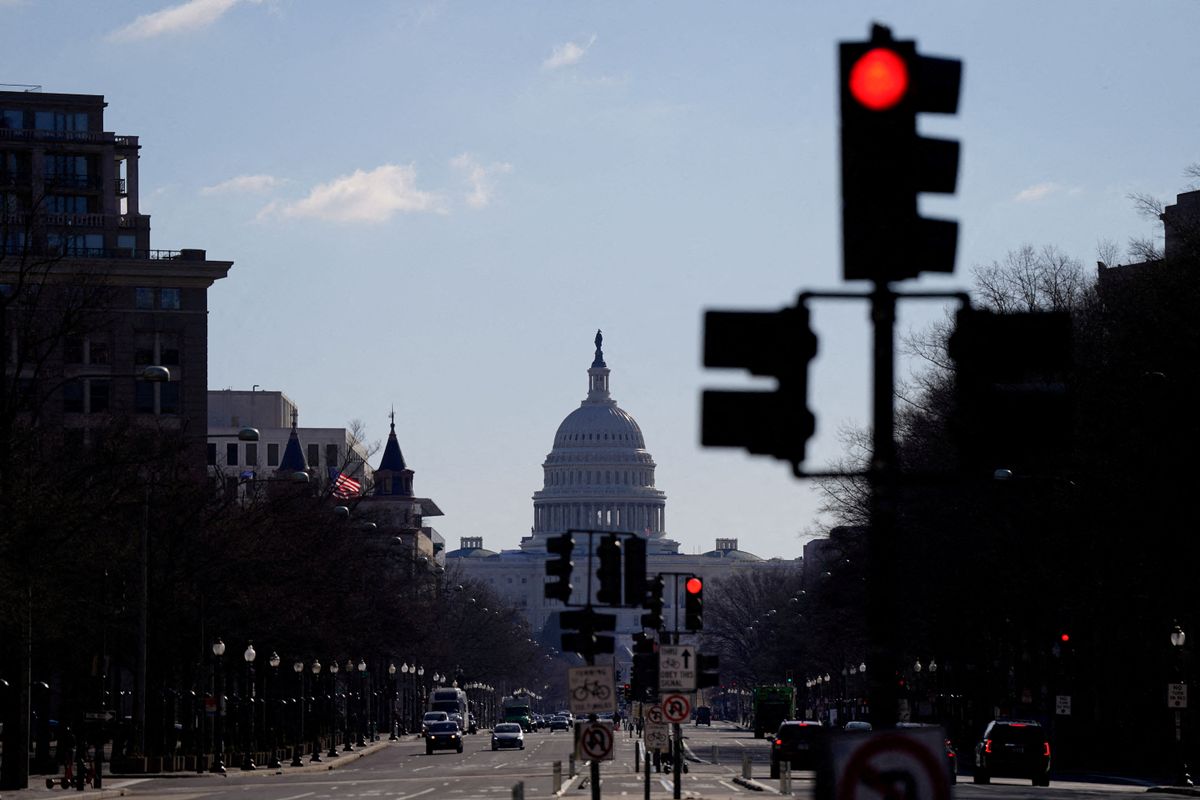
The U.S. Capitol is seen along Pennsylvania Avenue in Washington. REUTERS/Kent Nishimura

President Donald Trump has received support in his effort to take military control of law enforcement in Washington, D.C., with Republican governors sending hundreds of their own troops to patrol the streets of the nation's capital, all in the name of addressing crime. However, the actual number of arrests related to this initiative remains questionable.

A bigger issue, CNN analyst Marshall Cohen told anchor Boris Sanchez, is that most of the governors who are sending in troops have higher crime rates in their own cities.

"Marshall, take us through the data," said Sanchez.

"Yeah, Boris, there's a lot of talk, there's a lot of spin, but the numbers don't lie," said Cohen. "So we pulled the latest FBI violent crime statistics to find out what's going on."

"You just mentioned the National Guard troops," he continued. "There are 2,000 of them here in our nation's capital, half of them from the D.C. National Guard. Half of them come from these six states. Republican governors in these states sent troops here to join the D.C. guard: Ohio, West Virginia, South Carolina, Tennessee, Mississippi, and Louisiana. And we looked at the data, and there's actually 10 cities in those states that have a higher violent crime rate than D.C."

He pointed to Cleveland and Toledo in Ohio, as well as Memphis, Tennessee.

"They were number one last year in the nation for violent crime. Nashville. Charleston, West Virginia, the capital city there. And then two down in Louisiana, Shreveport and Lafayette. They all had a higher violent crime rate last year," he said.

"But if that's not bad enough for us, look at this," Cohen added. "The homicide rate. The murder rate last year in D.C. — it was 27 per 100,000. Not saying that's good. That's not good. It's too high. But look at this. Seventy-seven last year in Jackson, the capital city in Mississippi. And that's why the critics of this are saying it's not really about public safety. Because if that was the case, you'd be looking at some of these other states. It's more to put on a show for Donald Trump."

Watch the video below or at the link here.


Trump Says Chicago 'Probably Next' for National Guard Invasion


"If Trump wants to take his ego trip on tour, he picked the wrong city," said one senior Illinois official. "Chicago doesn't bow down to kings or roll out the red carpet for dictators."


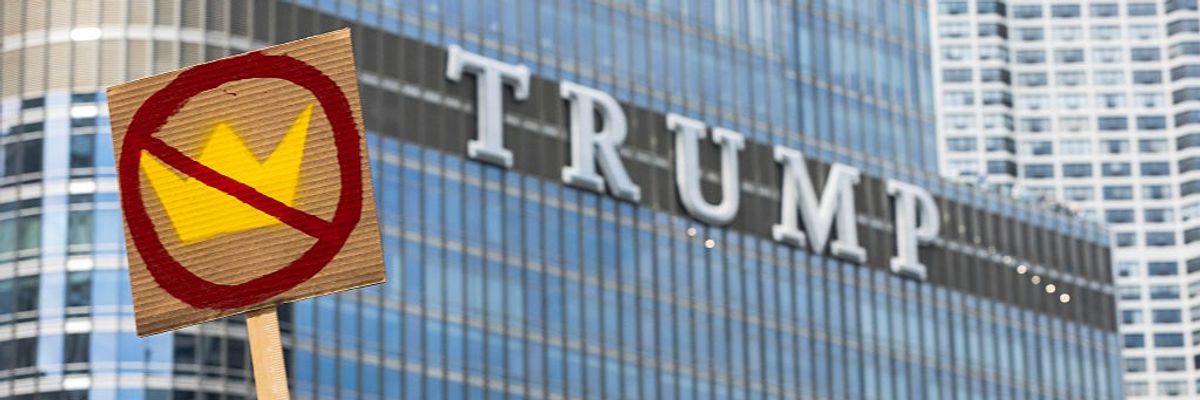
A protester holds a sign during a "No Kings" protest against President Donald Trump outside Trump International Hotel and Tower in Chicago on June 14, 2025.
(Photo by Jim Vondruska/Getty Images)


Brett Wilkins
Aug 23, 2025
COMMON DREAMS

US President Donald Trump said Friday that Chicago is the next city in his crosshairs for the kind of federal invasion and occupation currently underway in Washington, DC—a threat that sparked defiant pushback from officials in the Windy City and beyond.

"After we do this, we'll go to another location, and we'll make it safe also," Trump told reporters in the Oval Office, referring to his federalization of Washington's Metropolitan Police Department and deployment of National Guard troops from the district and five Republican-controlled states.

"We're going to make our cities very, very safe. Chicago's a mess. You have an incompetent mayor. Grossly incompetent and we'll straighten that one out probably next," the president said, referring to progressive Brandon Johnson. "That will be our next one after this. And it won't even be tough."


On August 11, Trump dubiously declared a public safety emergency in Washington, DC, despite violent crime being down 26% from a year ago, when it was at its second-lowest level since 1966, according to official statistics. Critics have noted that Trump's crackdown isn't just targeting criminals, but also unhoused and mentally ill people, who have had their homes destroyed and property taken.

On Friday, Trump threatened to completely take over Washington and oust Mayor Muriel Bowser if she does not stop pointing out that crime has decreased in the city, which the president called a "crime-infested rat hole."

In addition to Chicago, Trump has threatened to send federal forces into cities including Baltimore, Los Angeles, New York, Oakland, and San Francisco. Violent crime is trending downward in all of those cities—with some registering historically low levels.

Unlike in Washington, DC, where home rule laws allow the federal government to take control of local police, Trump would face greater obstacles to intervention in other cities.

"President Trump can't seize control of the Chicago police or any other local department outside of DC," Congressman Raja Krishnamoorth (D-Ill.) noted on social media Friday. "The military cannot and will not patrol the streets of Chicago, and I will work with state and local officials to ensure that doesn't happen."

Mayor Johnson said in a statement that "the problem with the president's approach is that it is uncoordinated, uncalled for, and unsound."

"If the Trump administration is serious about driving down violence in Chicago, or anywhere else in America, then he should not have taken over $800 million away from violence prevention," he added.

Other elected officials in Illinois also expressed anger and alarm at the prospect of a Trump intervention in Chicago.


"After using Los Angeles and Washington, DC as his testing ground for authoritarian overreach, Trump is now openly flirting with the idea of taking over other states and cities," Democratic Illinois Gov. JB Pritzker said on X.


"Trump’s goal is to incite fear in our communities and destabilize existing public safety efforts—all to create a justification to further abuse his power," the governor continued. "He's playing a game and creating a spectacle for the press to play along with."


"We don't play those games," Pritzker added. "Our commitment to law and order is delivering results. Crime rates are improving. Homicides are down by more than 30% in Chicago in the last year alone. Our progress in lowering crime has been made possible with [community violence intervention] programs that they’re defunding."

Lt. Gov. Juliana Stratton, a Democrat running for US Senate, said that "if Trump wants to take his ego trip on tour, he picked the wrong city."


"Chicago doesn't bow down to kings or roll out the red carpet for dictators," she added. "As a Black woman from the South Side, I can assure you... your political circus isn't welcome here."


Congresswoman Robin Kelly (D-Ill.) wrote on social media, "President Trump: You are not welcome in Chicago."


"Sending the National Guard endangers Black communities already overpoliced and under-invested in," she added. "If you cared about saving lives, you'd pass gun safety laws and fund community violence intervention."

'Declaring a war on America': Trump blasted for saying he may send military to more cities


U.S. President Donald Trump speaks on the day he is expected to sign a sweeping spending and tax legislation, known as the "One Big Beautiful Bill Act," during a picnic with military families to mark Independence Day, at the White House in Washington, D.C., U.S., July 4, 2025. REUTERS/Ken Cedeno

August 22, 2025  
ALTERNET

In what would be an unprecedented act and an escalation of his current occupation of Washington, D.C., President Donald Trump announced that he is willing to deploy U.S. Armed Forces to cities including Chicago and New York, after sending thousands of National Guard troops and FBI, DEA, DHS, ATF, and ICE agents to patrol the streets of the nation’s capital.

The President’s remarks came shortly after the Pentagon announced it will arm the 2,000 National Guard troops currently in Washington, D.C.


Deploying the U.S. Military to a major American city in peacetime—without a national emergency, without invoking the Insurrection Act, and without a governor’s request—would risk violating the Posse Comitatus Act.

“We haven’t had to bring in the regular military, which we’re willing to do, if we have to,” Trump told reporters in the Oval Office on Friday, speaking about his occupation of Washington, D.C. “And after we do this, we’ll go to another location, and we’ll make it safe also. We’re going to make our country very safe, we’re going to make our cities very, very safe.”

“Chicago’s a mess,” Trump charged. “You have an incompetent mayor. Grossly incompetent, and we’ll straighten one out probably next. That’ll be our next one after this. And it won’t even be tough.”

“And the people in Chicago,” Trump claimed without offering evidence, “are screaming for us to come. They’re wearing red hats, just like this one. But they’re wearing red hats.”

“African American ladies, beautiful ladies, are saying, ‘Please, please, President Trump, come to Chicago. Please.'”

“I did great with the Black vote, as you know, and they want something to happen.”

Trump won just 15% of Black voters in 2024. 83% voted for Vice President Kamala Harris.

“So I think Chicago will be our next, and then we’ll help with New York.”

Critics blasted the President’s remarks.

Illinois Governor JB Pritzker wrote: “Things People are Begging for: 1. Cheaper groceries 2. No Medicaid and SNAP cuts 3. Release of the Epstein Files.”

“Things People are NOT begging for: 1. An authoritarian power grab of major cities.”

Illinois Lt. Governor Juliana Stratton added: “If Trump wants to take his ego trip on tour, he picked the wrong city. Chicago doesn’t bow down to kings or roll out the red carpet for dictators. As a Black woman from the South Side, I can assure you @realdonaldtrump, your political circus isn’t welcome here.”

“Chicago isn’t going to sit down for this s—,” commented attorney Seth Abramson. “It’s illegal, it’s un-American, and it comes very close to declaring a war on America.”

“He said it. Chicago is next,” wrote former journalist Kat Abughazaleh. “This is an authoritarian order being pushed by a racist wannabe-dictator to terrorize one of America’s bluest and most diverse cities.”

Watch the video below or at this link.


Trump to deploy National Guard across 19 states 'in the coming weeks': report


Members of the U.S. National Guard stand together, after U.S. President Donald Trump deployed National Guard and ordered an increase presence of federal law enforcement to assist in crime prevention, in Washington, D.C., U.S., August 16, 2025. REUTERS/Nathan Howard

August 22, 2025
ALTERNET

Roughly 1,700 National Guard troops will soon be on the streets in nearly two dozen states by the end of the summer, according to a new report.

In a Friday article, Fox News reported that President Donald Trump will soon be using his official powers to deploy the National Guard in 19 states "in the coming weeks." Trump will be deploying guardsmen under his presidential Title 32 authority, meaning that despite Trump initiating the deployment, guardsmen will still be reporting to state governors and their respective National Guard adjutant generals.

A Department of Defense official told Fox News that the guardsmen are meant to serve as a "visible deterrent" while assisting U.S. Immigration and Customs Enforcement (ICE). Troops will be mainly handling administrative duties like "case management, transportation, logistical support and clerical functions associated with the processing of illegal migrants at the facilities," according to the report. This could include "data collection, fingerprinting, DNA swapping and photographing of personnel in ICE custody."

The network further reported that planning documents show the National Guard will be deploying in Alabama, Arkansas, Florida, Georgia, Idaho, Indiana, Iowa, Louisiana, Nebraska, Nevada, New Mexico, Ohio, South Carolina, South Dakota, Tennessee, Texas, Utah, Virginia and Wyoming. All of those states save for New Mexico have Republican governors. Their window of deployment will reportedly last between August and mid-November.

A spokesperson for the Virginia National Guard (VNG) told Fox that training for their deployment — scheduled for early September — will begin next week. The VNG spokesperson added that there are so far approximately 60 soldiers and airmen who will be deployed in the Old Dominion State.

"VNG personnel will not conduct law enforcement functions, and VNG support will not include making arrests," the spokesperson said. "VNG Soldiers and Airmen will report directly to ICE leadership at their assigned duty locations but remain under the control and direction of the Virginia Governor and Adjutant General of Virginia."

The Posse Comitatus Act of 1878 prohibits the U.S. military from conducting law enforcement operations on American soil. However, the Act doesn't apply to the president's Title 32 to call up the National Guard. The reported deployment comes on the heels of Trump telling reporters in an Oval Office press gaggle that he was contemplating sending the military to Chicago and New York City, following his imposition of federal control over Washington D.C.'s law enforcement operations.

Click here to read Fox's full report.


'Bad things': Trump now threatening 'complete and total' occupation of DC


Members of the Police patrol at The Wharf after U.S. President Donald Trump's announcement of the federal take over of the Metropolitan Police Department under the Home Rule Act and the deployment of the National Guard to assist in crime prevention in the nation's capital, in Washington, D.C., U.S., August 13, 2025. REUTERS/Evelyn Hockstein
ALTERNET
August 22, 2025 

Despite polls showing his takeover of the D.C. Metropolitan Police and deployment of federal forces are deeply unpopular, President Donald Trump is now threatening to escalate, vowing a “complete and total” occupation of the District of Columbia.

In addition to taking over the Metropolitan Police, Trump has deployed thousands of National Guard troops, ICE, DEA, FBI, and DHS agents to patrol the city’s streets, often in areas with little to no crime.

Restaurant bookings dropped by double digits, and experts warn the current takeover is already hurting local businesses, CNN reported.

“Despite Trump’s claim earlier this week that DC restaurants have been ‘busier than they’ve been in a long time,’ reservations tracked by OpenTable have been down recently. On August 11, when Trump announced the takeover, seated diners dropped 16% compared to a year ago. Two days later, when troops mobilized around the city, seated diners fell 31% compared to a year ago.”

“If there’s a perception that DC is turning into a police state, then there’s going to be some hesitancy to go out and explore the city,” Adam Kamins, director of regional economics at Moody’s, told CNN. “That would be true of visitors from overseas but also of local residents who just want to steer clear of all of this.”

As Restaurant Week kicked off this week, restaurant visits were down 22 percent.

While restaurants are a good barometer, the downturn is more widespread.

“In the week starting August 11, foot traffic was down about 81% of retail-store categories in Washington compared to data from a year ago, according to pass_by, with car dealerships, department stores, convenience stores and beauty-supply shops seeing some of the steepest drops.”

President Donald Trump promoted a very different perception in the early hours of Friday morning.

“Washington, D.C. is SAFE AGAIN!” Trump wrote on his Truth Social website. “The crowds are coming back, the spirit is high, and our D.C. National Guard and Police are doing a fantastic job. They are out in force, and are NOT PLAYING GAMES!!!”

Washington Post poll released Wednesday found nearly eight out of ten (79%) D.C. residents oppose Trump’s takeover of the Metropolitan Police Department, and the presence of the National Guard and federal agents patrolling their city’s streets. About the same number, 78%, said they felt very safe in their neighborhoods.

The President made other demonstrably false claims as well: “As bad as it sounds to say, there were no murders this week for the first time in memory.”

According to Fox News, the last time there were no murders in D.C. was in March.

Trump then made his threat: “Mayor Muriel Bowser must immediately stop giving false and highly inaccurate crime figures, or bad things will happen, including a complete and total Federal takeover of the City! Washington D.C. will soon be great again!!!”

The President isn’t the only Trump focused on the takeover.

Donald Trump Jr. on Friday morning told Newsmax, “Maybe we should roll out the tour to Portland, Seattle, you know, the other what we call, you know, c— hole cities of the country.”

He also claimed that Democratic residents of D.C. are very happy about the Trump takeover, a claim not supported by polling.

Watch the video below or at this link.


Kilmar Abrego Garcia 

'Grateful': Wrongly deported migrant freed as lawyers blast 'vindictive attack'

Stephen Prager,
 Common Dreams
August 22, 2025 


Kilmar Abrego Garcia walks, after he has been released from the Putnam County Jail in Cookville, Tennessee, U.S., August 22, 2025. REUTERS/Seth Herald

Kilmar Abrego Garcia, the Salvadoran man whom the Trump administration wrongfully deported in violation of a judge's order earlier this year, was released from custody in Tennessee on Friday.

"Today, Kilmar Abrego Garcia is free," his attorney, Sean Hecker, said. "He is presently en route to his family in Maryland, after being unlawfully arrested and deported, and then imprisoned, all because of the government's vindictive attack on a man who had the courage to fight back against the administration's continuing assault on the rule of law. He is grateful that his access to American courts has provided meaningful due process."

The Trump administration acknowledged that its deportation of Garcia to languish in a prison camp in El Salvador in March was the result of an "administrative error." But it fought to keep him there based on unsubstantiated charges that he was a member of the Salvadoran gang MS-13, even after the Supreme Court ruled 9-0 that the administration must facilitate his return.

Abrego Garcia was one of more than 200 people deported to the CECOT prison without trial—the vast majority of whom were found to have never been convicted of or even charged with a crime. While there, he says he endured beatings and psychological torture before being brought back to the United States in June.

The Justice Department hit him with charges for human smuggling, which his lawyer Simon Sandoval-Moshenberg has described as "preposterous" and a way for the Trump administration to save face after an egregious miscarriage of justice. Nearly a month after a judge ordered his release from custody, Abrego Garcia is now heading back to Maryland, where he will await trial.


His lawyers argue that the DOJ "has engaged in a vindictive prosecution, seeking to penalize Abrego Garcia for asserting his rights, rather than accepting an unjust outcome."

In a motion to dismiss the case filed this week, the attorneys argued that "such tactics are inconsistent with principles of fairness and justice, and that the prosecution should be dismissed."

As evidence of this, his lawyers have cited a claim from a former Justice Department lawyer who says he was fired after refusing to file a misleading brief claiming Abrego Garcia was a member of MS-13.

The Trump administration, which has argued that Abrego Garcia is not entitled to due process because of his immigration status, has threatened to immediately return him to Immigration and Customs and Enforcement (ICE) detention and deport him to a third country. However, last month, US District Judge Paula Xinis, who is overseeing his case, barred ICE from immediately rearresting him.

If he is taken into custody, US Magistrate Judge Barbara D. Holmes has ordered that he be given access to his attorneys.

Rep. Pramila Jayapal (D-Wash.) has said Abrego Garcia's release was "fantastic news!"

"I am thrilled for Kilmar Abrego Garcia!" she wrote on X. "The Trump administration must stop their unfounded investigations and let his family remain together."

Trump's DHS reveals shocking new deportation plan for Kilmar Abrego Garcia

Matthew Chapman
August 22, 2025 
RAW STORY


Kilmar Abrego Garcia, a Salvadoran migrant who lived in the U.S. legally with a work permit and was erroneously deported to El Salvador, is seen wearing a Chicago Bulls hat, in this handout image obtained by Reuters on April 9, 2025. Abrego Garcia Family/Handout via REUTERS

The Trump administration is planning once again to deport Salvadoran immigrant Kilmar Abrego Garcia — this time, to Africa.

According to a new memo submitted by the Justice Department to Abrego Garcia's counsel, "Pursuant to the court order issued in the District Court of Maryland on July 23, 2025, Civil Action No. 8:25-cv-00951-PX, please let this email serve as notice that DHS may remove your client, Kilmar Armando Abrego Garcia, to Uganda no earlier than 72 hours from now (absent weekends)."

This comes just hours after Abrego Garcia was released from custody in Tennessee.

It's the latest in a series of efforts the Trump administration has made to carry out mass deportations to foreign countries the detainees have no relation to. Controversy erupted earlier this year when U.S. Immigration and Customs Enforcement officials reportedly threw Asian immigrants in solitary confinement unless they agreed to be deported to Libya, a country facing ongoing instability.

Abrego Garcia, who has a family in Maryland, became a huge rallying cry for critics of the Trump administration's deportation policies after he was deported, with next to no due process, to the infamous CECOT megaprison in El Salvador, despite a standing order from a federal judge barring him from being deported to that country.

Over months of legal wrangling, the Trump administration claimed, even while acknowledging the removal was an "administrative error," they could not compel Salvadoran President Nayib Bukele to return a prisoner under his jurisdiction. The administration also repeatedly claimed he was a member of the transnational criminal gang MS-13, which Abrego Garcia denies.

He was finally returned to the United States earlier in the summer, but was immediately hit with federal charges alleging he engaged in a human smuggling scheme. Attorneys representing him say the charges are "baseless" and an attempt by the administration to save face.

Kilmar Abrego Garcia is 'Free' From Custody, En Route to Family in Maryland

He now awaits trial in what his lawyers argue is a "vindictive prosecution" by the Justice Department.


Supporting signs are displayed outside the US District Court for Maryland during a hearing on Kilmar Abrego Garcia's case on July 10, 2025, in Greenbelt, Maryland.
(Photo by Alex Wong/Getty Images)

Stephen Prager
Aug 22, 2025
COMMON DREAMS


Kilmar Abrego Garcia, the Salvadoran man whom the Trump administration wrongfully deported in violation of a judge's order earlier this year, was released from custody in Tennessee on Friday.

"Today, Kilmar Abrego Garcia is free," his attorney, Sean Hecker, said. "He is presently en route to his family in Maryland, after being unlawfully arrested and deported, and then imprisoned, all because of the government's vindictive attack on a man who had the courage to fight back against the administration's continuing assault on the rule of law. He is grateful that his access to American courts has provided meaningful due process."

The Trump administration acknowledged that its deportation of Garcia to languish in a prison camp in El Salvador in March was the result of an "administrative error." But it fought to keep him there based on unsubstantiated charges that he was a member of the Salvadoran gang MS-13, even after the Supreme Court ruled 9-0 that the administration must facilitate his return.

Abrego Garcia was one of more than 200 people deported to the CECOT prison without trial—the vast majority of whom were found to have never been convicted of or even charged with a crime. While there, he says he endured beatings and psychological torture before being brought back to the United States in June.

The Justice Department hit him with charges for human smuggling, which his lawyer Simon Sandoval-Moshenberg has described as "preposterous" and a way for the Trump administration to save face after an egregious miscarriage of justice. Nearly a month after a judge ordered his release from custody, Abrego Garcia is now heading back to Maryland, where he will await trial.

His lawyers argue that the DOJ "has engaged in a vindictive prosecution, seeking to penalize Abrego Garcia for asserting his rights, rather than accepting an unjust outcome."

In a motion to dismiss the case filed this week, the attorneys argued that "such tactics are inconsistent with principles of fairness and justice, and that the prosecution should be dismissed."

As evidence of this, his lawyers have cited a claim from a former Justice Department lawyer who says he was fired after refusing to file a misleading brief claiming Abrego Garcia was a member of MS-13.

The Trump administration, which has argued that Abrego Garcia is not entitled to due process because of his immigration status, has threatened to immediately return him to Immigration and Customs and Enforcement (ICE) detention and deport him to a third country. However, last month, US District Judge Paula Xinis, who is overseeing his case, barred ICE from immediately rearresting him.

If he is taken into custody, US Magistrate Judge Barbara D. Holmes has ordered that he be given access to his attorneys.


Rep. Pramila Jayapal (D-Wash.) has said Abrego Garcia's release was "fantastic news!"

"I am thrilled for Kilmar Abrego Garcia!" she wrote on X. "The Trump administration must stop their unfounded investigations and let his family remain together."