Saturday, August 23, 2025

Rising concerns over U.S. move to broaden products subject to metal tariffs

By The Canadian Press
 August 21, 2025 

A worker welds at a steel manufacturing facility, in Hamilton, Ont., Wednesday, July 16, 2025. THE CANADIAN PRESS/Chris Young

TORONTO — There’s growing concern about a move by the United States to make hundreds more product categories subject to the country’s 50 per cent tariffs on steel and aluminum content.

The addition of 407 categories, ranging from bulldozers to furniture, came into effect earlier this week to add pressure and costs to those hoping to sell into the U.S. market.

Catherine Cobden, head of the Canadian Steel Producers Association says the move is another blow to the integrated Canada-U.S. economy and will impact the manufacturing of steel-containing products in Canada destined for the United States.

She says products like cutlery, propane tanks, air conditioners, agricultural equipment like tractors and many more now face the additional tariffs on their metal content.

Cobden says in the statement issued Thursday that Canada should retaliate with a 50 per cent tariff on all U.S. steel entering Canada, including ending an “ill-advised” April reprieve on U.S. steel used in manufacturing and processing.


On Wednesday, Hamilton, Ont., mayor Andrea Horwath said Trump’s latest “underhanded move to quietly expand U.S. tariffs” is devastating for the city, adding she’s reached out to both the provincial and federal governments to push them to act.

This report by The Canadian Press was first published Aug. 21, 2025.

Ian Bickis, The Canadian Press


Added tariffs have piled on to an already ‘crushing situation’: Canadian steel producers

Journalist, BNNBloomberg.ca
Published: August 22, 2025 

The head of the Canadian Steel Producers Association is expressing concerns after the United States expanded its list of steel and aluminum products subjected to tariffs, and is calling on the federal government to intervene and protect the domestic steel industry.

Catherine Cobden, president and CEO of the Canadian Steel Producers Association, said she is dismayed the United States added 407 products to the list of goods subject to 50 per cent tariffs for their steel and aluminum content, according to a news release.

“We knew that there was an inclusion process to expand the list of derivatives for steel containing goods that they tariff,” Cobden told BNN Bloomberg in an interview Thursday. “But the magnitude, the scope of this is far greater than we expected.”

The national advocacy group represents steel producers and consumers in the country in the automotive, energy, construction, and transportation industries.Latest updates on investing here

The U.S. Commerce Department on Tuesday said it would expand its steel and aluminum tariffs to include additional products to a list of derivatives. Products include wind turbines, mobile cranes, bulldozers and other heavy equipment.


“What this has done is taken a crushing situation and piled on, if you will,” said Cobden.

She said the industry has, for decades, integrated both economies, but it is now unravelling. The U.S. is adding components of products imported into the country, including automotive exhaust systems and electrical steel needed for electric vehicles, to the list of products subjected to tariffs, as well as components for buses, air conditioners and appliances, as well as refrigerators, freezers and dryers.

“If you are shipping a tractor into the United States, the portion of that tractor that is steel will get applied to 50 per cent tariff on the value of that steel,” said Cobden. “If it has aluminum as well, that will be an additional tariff that you’ll pay on the aluminum content.”

The new tariffs take effect immediately and cover compressors, pumps and the metal in imported cosmetics and other personal care packaging like aerosol cans and lipstick.

Cobden said motorcycle parts for companies such as Harley Davidson will be subject to the additional tariffs.

“Things are getting very, very complicated for exporters into the United States and importers into the United States, said Cobden.
Canadian manufactures feeling frustrated

Cobden said a lot of manufacturers are feeling a sense of frustration with additional tariffs being implemented on uncertain economic times disrupting supply chains on both sides of the American and Canadian border. She said companies have faced significant layoffs


Algoma Steel Group Inc., which had 2,800 employees at the end of 2024, applied for a $500 million loan program from the federal government to diversify domestic investment. The company reported a net loss of $24.4 million last quarter compared with a $2.8 million profit a year earlier. Cobden said she wants the federal government to strengthen and protect the Canadian market.

“We’ve had a drop in production and things of that nature,” said Cobden. “We really appreciate the programs that are in place, but what we really want to do is pivot to our domestic market so that we can be more resilient and not have to rely on programs in these tough times. We want to sell more to the Canadian market.”

SOCIAL DEMOCRACY

Quebec will donate rather than destroy expiring U.S. alcohol


By The Canadian Press
Updated: August 22, 2025 


Quebec plans to give away $300,000 worth of American alcohol to charities.

Quebec’s finance minister says $300,000 of expiring American alcohol that is banned from the province’s shelves will be donated rather than destroyed.

Eric Girard’s comments come after the liquor board earlier this week said it might have to destroy some products that are set to expire.

Girard says on social media he asked the board to offer the products to foundations, charity events, and to hospitality training schools.

The provincial government on March 4 ordered the state-owned corporation to empty shelves of U.S. alcohol in response to tariffs imposed by President Donald Trump.

Girard says the government was prepared to lose money with its boycott, on storage costs and as products expire.


But he says the ban has boosted the sale of Quebec products by between 30 to 60 per cent, depending on the type of alcohol.

---

This report by The Canadian Press was first published Aug. 22, 2025.
Exclusive-Air Canada labor deal faces fierce opposition over wages, vote could fail

Story by Reuters
AUGUST 22, 2025


Passengers walk in front of demonstrators holding placards as Air Canada flight attendants said they will remain on strike and challenge a return-to-work order they called unconstitutional, defying a government decision to force them back to their duties, at Vancouver International Airport in Richmond, British Columbia, Canada, August 17, 2025. REUTERS/Chris Helgren TPX IMAGES OF THE DAY© Thomson Reuters

(Reuters) -Many Air Canada flight attendants are dissatisfied with wage increases in a tentative agreement that ended a crippling strike earlier this week and the deal may not win approval from union members, cabin crew and a source familiar with the matter told Reuters.


Passengers walk past demonstrators holding placards as Air Canada flight attendants said they will remain on strike and challenge a return-to-work order they called unconstitutional, defying a government decision to force them back to their duties, at Vancouver International Airport in Richmond, British Columbia, Canada, August 17, 2025. REUTERS/Chris Helgren© Thomson Reuters

Five flight attendants interviewed by Reuters said they plan to vote against the agreement for failing to provide a living wage to entry-level workers and not fully addressing concerns about lack of payment for hours spent waiting for a flight. The leader of the union acknowledged many members were frustrated with the deal.


A passenger walks as striking Air Canada flight attendants hold placards as they defy a back to work order at Vancouver International Airport in Richmond, British Columbia, Canada August 18, 2025. REUTERS/Chris Helgren© Thomson Reuters

That sentiment was echoed on social media posts by people who say they are flight attendants, although Reuters could not confirm their identity.

(Reporting by Kyaw Soe Oo, Allison Lampert and Rajesh Kumar Singh; Editing by Caroline Stauffer and Peter Henderson)


A woman sits with her luggage, as Air Canada flight attendants said they will remain on strike and challenge a return-to-work order they called unconstitutional, defying a government decision to force them back to their duties, at Toronto Pearson International Airport in Mississauga, Ontario, Canada August 17, 2025. REUTERS/Kyaw Soe Oo© Thomson Reuters


Related video: Former KLM flight attendant 'appalled' that Air Canada colleagues don't get ground pay (CBC)

U.S. flight attendants are fed up like their Air Canada peers. Here’s why they aren’t likely to strike

By The Associated Press
 August 21, 2025 

PSA Airlines flight attendants hold placards during a demonstration at Ronald Reagan Washington National Airport, Monday, August 18, 2025, in Washington.
 (AP Photo/Rahmat Gul)

At the end of work trips, Nathan Miller goes home to a makeshift bedroom in his parents’ house in Virginia. The 29-year-old flight attendant is part of a PSA Airlines crew based in Philadelphia, but Miller says he can’t afford to live there.

He makes about US$24,000 a year working full-time for the American Airlines subsidiary. Despite often staffing multiple flights a day, Miller commutes by plane between Virginia Beach and Philadelphia International Airport, a distance of about 215 miles.

“I’ve considered finding a whole new job. It’s not something that I want to do,” Miller, who joined PSA two years ago, said. ”But it’s not sustainable.”

His situation isn’t unique. Frustrations among flight attendants at both regional and legacy airlines have been building for years over paychecks that many of them say don’t match the weight of what their jobs demand. Compounding the discontent over hourly wages is a long-standing airline practice of not paying attendants for the work they perform on the ground, like getting passengers on and off planes.

Air Canada’s flight attendants put a public spotlight on these simmering issues when about 10,000 of them walked off the job last weekend, forcing the airline to cancel more than 3,000 flights. The strike ended Tuesday with a tentative deal that includes wage increases and, for the first time, pay for boarding passengers.


In the United States, however, the nearly century-old Railway Labor Act makes it far more difficult for union flight attendants like Miller, a member of the Association of Flight Attendants, to strike than most other American workers. Unlike the Boeing factory workers and Hollywood writers and actors who collectively stopped work in recent years, U.S. airline workers can only strike if federal mediators declare an impasse — and even then, the president or Congress can intervene.

For that reason, airline strikes are exceedingly rare. The last major one in the U.S. was over a decade ago by Spirit Airlines pilots, and most attempts since then have failed. American Airlines flight attendants tried in 2023 but were blocked by mediators.

Without the ultimate bargaining chip, airline labor unions have seen their power eroded in contract talks that now stretch far beyond historical norms, according to Sara Nelson, the international president of the AFA. Negotiations that once took between a year and 18 months now drag on for three years, sometimes more.

“The right to strike is fundamental to collective bargaining, but it has been chipped away,” Nelson said. Her union represents 50,000 attendants, including the ones at United Airlines, Alaska Airlines and PSA Airlines.

On Monday, she joined PSA flight attendants in protest outside Ronald Reagan Washington National Airport, near where an airliner operated by PSA crashed into the Potomac River in January after colliding with an Army helicopter. All 67 people on the two aircraft were killed, including the plane’s pilot, co-pilot and two flight attendants.

The airline’s flight attendants also demonstrated outside three other U.S. airports. In a statement, PSA called the demonstrations “one of the important ways flight attendants express their desire to get a deal done — and we share the same goal.”

Flight attendants say their jobs have become more demanding in recent years. Planes are fuller, and faster turnaround times between flights are expected. Customers may see them mostly as uniforms that serve food and beverages, but the many hats attendants juggle include handling in-flight emergencies, deescalating conflicts and managing unruly passengers.

“We have to know how to put out a lithium battery fire while at 30,000 feet, or perform CPR on a passenger who’s had a heart attack. We’re trained to evacuate a plane in 90 seconds, and we’re always the last ones off,” said Becky Black, a PSA flight attendant in Dayton, Ohio, who is part of the union’s negotiating team.

And yet, Black says, their pay hasn’t kept pace.

PSA flight attendants have been bargaining for over two years for better wages and boarding pay. Alaska flight attendants spent just as long in talks before reaching a deal in February. At American, flight attendants began negotiations on a new contract in 2020 but didn’t get one until 2024.

Southwest Airlines attendants pushed even longer — over five years — before winning a new deal last year that delivered an immediate 22 per cent wage hike and annual 3 per cent increases through 2027.

“It was a great relief,” Alison Head, a longtime Southwest flight attendant based in Atlanta, said. “Coming out of COVID, where you saw prices were high and individuals struggling, it really meant something.”

The contract didn’t include boarding pay but secured the industry’s first paid maternity and parental leave, a historic win for the largely female workforce. A mother of two, Head said she returned to work “fairly quickly” after having her first child because she couldn’t afford to stay home.

“Now, new parents don’t have to make that same hard decision,” she said.

Many of her peers at other airlines are still waiting for their new contracts.

At United, attendants rejected a tentative agreement last month, with 71 per cent voting no. The union is now surveying its members to understand why and plans to return to the bargaining table in December.

One major sticking point: boarding pay. While Delta became the first U.S. airline to offer it in 2022 — followed by American and Alaska — many flight attendants still aren’t compensated during what they call the busiest part of their shift.

Back in Virginia Beach, Miller is still trying to make it work. On family vacations during his childhood, Miller said he was fascinated by flight attendants and their ability to make people feel comfortable and safe.

Now he’s got his dream job, but he isn’t sure he can afford to keep doing it.

---

Rio Yamat, The Associated Press

 Philippines: Support striking workers at Kawasaki Motors

For more than three months, workers at Kawasaki Motors Philippines have been on strike.  

The employer refuses to engage in good faith negotiations and its response to the union's concessions has been to lower its wage and benefits offers.  

In an attempt to bust the union, the company has filed legal cases against union leaders.  

The union is calling for international solidarity, asking all of us to send off messages of protest and solidarity -- please click here

If you have an account on WhatsApp please note that you can now share LabourStart campaigns to your contacts -- see the link on the right side of the campaign page.

Thank you for your support!

Eric Lee

LabourStart


'Fundamental weakness': Why evangelical Trump supporters claim 'empathy is a sin'


Allie Beth Stuckey at the 2025 Young Women's Leadership Summit in Grapevine, Texas on June 14, 2025 (Gage Skidmore/Flickr)


August 21, 2025 |
ALTERNET

The word "empathy" usually has a positive connotation. But during an interview with vodcast host Joe Rogan in February, Tesla/SpaceX/X.com head Elon Musk railed against "suicidal empathy" and declared, "The fundamental weakness of western civilization is empathy, the empathy exploit."

Musk's critics were quick to pounce, arguing that his disdain for "empathy" underscores the lack of compassion that plagues the far right and President Donald Trump's MAGA movement.

Musk, however, isn't the only one who claims that "empathy" is a bad thing.

In an article published on August 21, Associated Press (AP) reporter Tiffany Stanley takes a look at far-right white evangelical Christian fundamentalists who "are preaching that" empathy "has become a vice."

Allie Beth Stuckey, author of the 2024 book "Toxic Empathy: How Progressives Exploit Christian Compassion" and host of the podcast "Relatable," told AP, "Empathy becomes toxic when it encourages you to affirm sin, validate lies or support destructive policies."

Another anti-empathy book is evangelical pastor Joe Rigney's "The Sin of Empathy: Compassion and its Counterfeits."

According to Stanley, the "anti-empathy arguments" coming from Stuckey, Rigney and others "gained traction in the early months of President Donald Trump’s second term."

But not all Christians are buying into the anti-empathy arguments coming from white evangelicals and MAGA Republicans.

Historian Susan Lanzoni, a graduate of Harvard Divinity School in Cambridge, Massachusetts, told AP that empathy is "the whole message of Jesus."

The Rev. Canon Dana Colley Corsello of the Washington National Cathedral takes issue with the evangelical anti-empathy trend as well.

Corsello told AP, "Empathy is at the heart of Jesus’ life and ministry…. It’s so troubling that this is even up for debate."

Read Tiffany Stanley's full Associated Press article at this link.
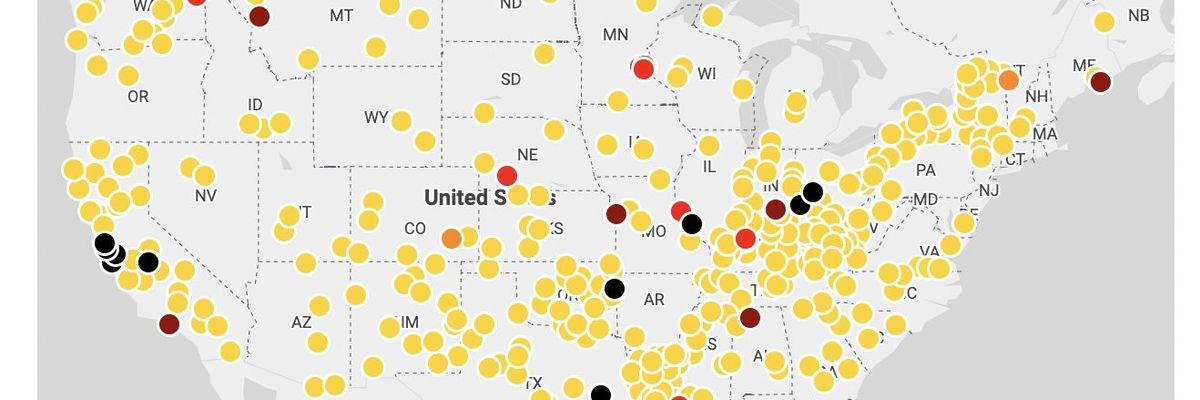
Here's a Map of What Trump-GOP Destruction of US Hospitals Looks Like


"Hospitals count on Medicaid to keep their doors open," said healthcare advocacy group Protect Our Care. "Medicaid accounts for one fifth of spending on hospitals, one fifth of hospital discharges, and at least one in five inpatient days in nearly every state."


An interactive map showing hospitals at risk due to Republican cuts to Medicaid
(Source: Protect Our Care)

Brad Reed
Aug 21, 2025
COMMON DREAMS

The healthcare advocacy organization Protect Our Care has been tracking financially troubled hospitals across the country that are projected to take a big hit thanks to the Medicaid cuts in the massive Republican budget package—and the group has produced a new tool to let people see the damage being done in real time.

The organization on Wednesday launched a new project called "Hospital Crisis Watch" that identifies and provides updates on healthcare facilities around the country at risk of closure thanks to the Medicaid cuts, and produced an interactive map showing exactly which hospitals and medical centers are in danger.


Protect Our Care found that the most vulnerable facilities tend to be in rural areas, identifying 338 endangered rural hospitals throughout the US. The state of Kentucky has the largest concentration of vulnerable hospitals with 35, followed by Louisiana at 33, and California at 28.

In a report about the threats these hospitals face, Protect Our Care explained why Medicaid funding, which the GOP budget package slashed by $1 trillion over the next decade, is vitally important to these institutions' financial well being.

"Hospitals count on Medicaid to keep their doors open," the report said. "Medicaid accounts for one fifth of spending on hospitals, one fifth of hospital discharges, and at least one in five inpatient days in nearly every state."

The report also pointed to an analysis from Commonwealth Fund estimating that more than 475,000 healthcare workers would lose their jobs as a result of the cuts. This would have serious economic ramifications for rural areas given that "hospitals employ 10% of all employees in rural counties that report having any hospital employment," explained Protect Our Care.

Even if these hospitals don't shut down, Protect Our Care warned that they are likely to slash services and increase wait times in emergency rooms.

The potential closure of hospitals isn't the only crisis facing American healthcare. A separate report from Protect Our Care earlier this week documented how health insurance premiums are expected to skyrocket in the coming year unless the Republican-led Congress passes an extension to enhanced subsidies for people who buy their insurance through the exchanges created by the 2010 Affordable Care Act.


"Because of these GOP policies, insurance companies have already indicated they plan to raise premiums for 24 million Americans by an average of 15%," the group noted. "At the same time, Republicans are ripping away tax credits from 20 million, forcing them to pay an average of 75% more for their coverage. These price hikes will cause countless hard-working families to lose life-saving coverage while millions more will suffer under the already-rising cost of living."


Meet 100 CEOs Getting Filthy Rich at Their Workers’ Expense

CEOs of the 100 S&P 500 firms with the lowest median wages, a group we’ve dubbed the “Low-Wage 100,” have enjoyed skyrocketing pay over the past six years.


Brian Niccol, then-chief executive officer of Chipotle Mexican Group and now CEO of Starbucks, waits to putt on the eighth hole green during the second round of the AT&T Pebble Beach Pro-Am at Monterey Peninsula Country Club on February 3, 2023 in Pebble Beach, California.
(Photo by Keyur Khamar/PGA TOUR via Getty Images)

Sarah Anderson
Aug 22, 2025
Inequality.org

The gap between CEO compensation and median worker pay at Starbucks hit 6,666 to 1 last year. In other words, to make as much money as their CEO made last year, typical baristas would’ve had to start brewing macchiatos around the time humans first invented the wheel.

Starbucks takes the prize for the most obscene corporate pay disparities of 2024. But jaw-dropping gaps are the norm among America’s leading low-wage corporations.

This year’s edition of the annual Institute for Policy Studies Executive Excess report finds that CEOs of the 100 S&P 500 firms with the lowest median wages, a group we’ve dubbed the “Low-Wage 100,” have enjoyed skyrocketing pay over the past six years.

The Low-Wage 100


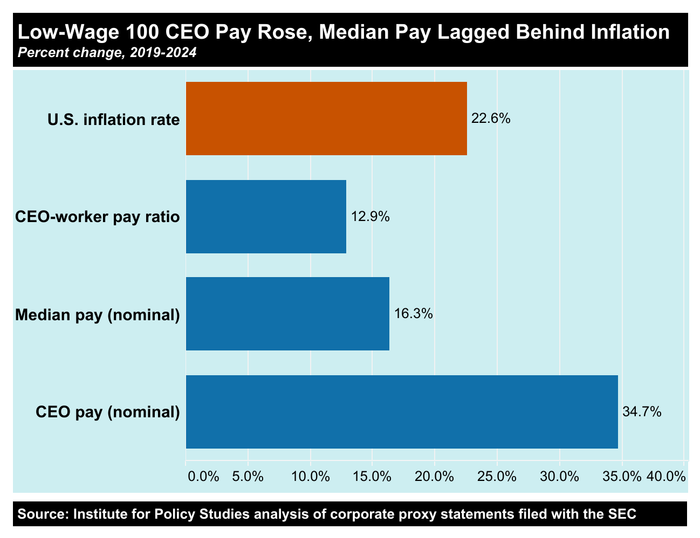
In 2024, average compensation for Low-Wage 100 top executives rose to $17.2 million, up 34.7% since 2019 (not adjusted for inflation). Global median worker pay at these firms stood at just $35,570, after increasing at a nominal rate of only 16.3% since 2019—significantly below the 22.6% US inflation rate. The Low-Wage 100 pay ratio increased 12.9% to 632 to 1 over the past half decade.

Buybacks Bonanza

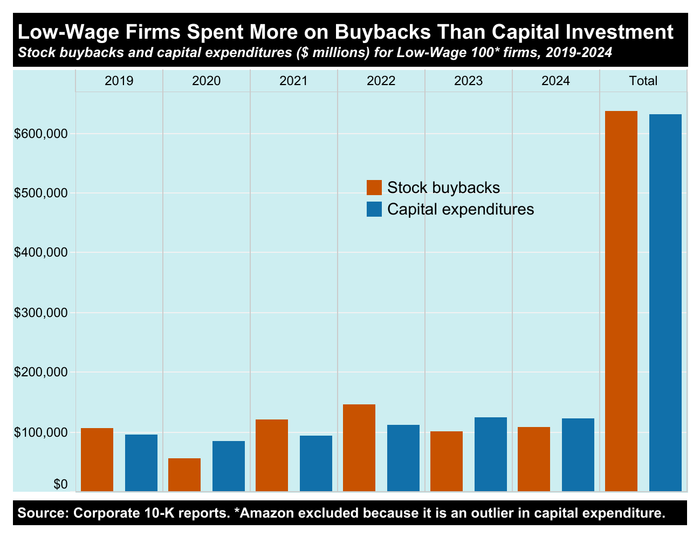
Here’s yet another sign of the Low-Wage 100’s skewed priorities: Between 2019 and 2024 these firms spent a combined $644 billion on stock buybacks. This once-illegal financial maneuver artificially inflates the value of a company’s shares and, in the process, pumps up the value of CEOs’ stock-based compensation. Even the most inept executives can rake in vast fortunes through this scam.

Every dollar spent on buybacks represents a dollar not spent on workers. The tradeoffs can be downright staggering. At Lowe’s, for instance, every one of their 273,000 employees could’ve gotten an annual $28,456 bonus over the past six years with the money the retailer blew on stock buybacks. Lowe’s median worker pay in 2024: $30,606.

80% of workers said they view corporate CEOs as overpaid, and nearly 70% said they do not believe their own company’s CEO could do the job they do for even one week.

If McDonald’s had spent their buyback outlays on worker bonuses during this period, they could’ve given all their employees an extra $18,338 per year—more than that company’s median wage.

Siphoning resources from workers to make CEOs even richer is especially outrageous at a time when so many Americans are struggling with high costs for groceries, housing, and other essentials.


Stock buybacks also divert resources from capital investments vital to long-term growth, such as employee training or upgrading technology, equipment, and properties.

At 56 Low-Wage 100 companies, outlays for stock buybacks actually exceeded capital expenditures between 2019 and 2024. If we exclude Amazon, a CapEx outlier, the Low-Wage 100 as a whole spent considerably more on buybacks than on capital expenditures over this six-year period.

Extensive research has also shown that excessive CEO compensation is bad for business because extreme internal pay disparities undermine employee morale and boost turnover rates.

Solutions to Executive Excess


As poll after poll after poll has shown, Americans across the political spectrum are fed up with overpaid CEOs and want government action. In one rather amusing recent survey, 80% of workers said they view corporate CEOs as overpaid, and nearly 70% said they do not believe their own company’s CEO could do the job they do for even one week.

How could policymakers incentivize more equitable pay practices? Several bills in the US Congress and state legislatures would increase taxes on corporations with huge CEO-worker pay gaps. Polls suggest this would be enormously popular. In one survey of likely voters, 89% of Democrats, 77% of Independents, and 71% of Republicans said they’d like to see tax hikes on companies that pay their CEOs more than 50 times what they pay their median employees.

Congress could also increase the 1% excise tax on stock buybacks that went into effect in 2023. If that tax had been set at 4%, the Low-Wage 100 would have owed approximately $6.3 billion in additional federal taxes on their share repurchases during the past two years. That revenue would’ve been enough to cover the cost of 327,218 public housing units for two years.

Policymakers have ample tools for tackling the problem of runaway CEO pay. Now they just need to listen to their constituents and get the job done.

This work is licensed under a Creative Commons Attribution-Share Alike 3.0 License.

Sarah Anderson directs the Global Economy Project of the Institute for Policy Studies, and is a co-editor of Inequality.org.
Full Bio >


'What Oligarchy Looks Like!' Sanders Blasts Anti-Worker SpaceX Ruling

Sanders charged that the ruling gave "Elon Musk... and other union busters the absolute power to exploit workers and violate labor law with impunity."


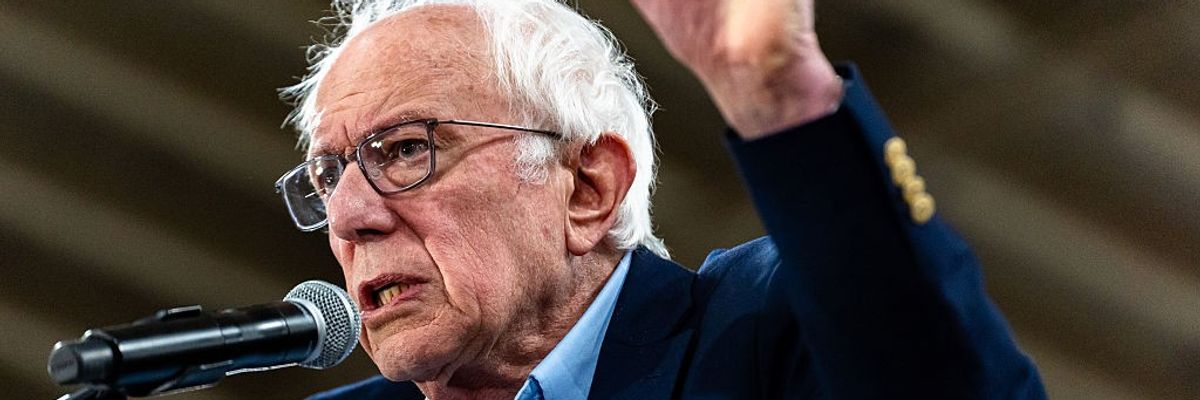
Senator Bernie Sanders (I-Vt.) speaks at the Fighting Oligarchy rally in Harrisburg, Pennsylvania on May 2, 2025.
(Photo by Nathan Morris/NurPhoto via Getty Images)


Brad Reed
Aug 21, 2025
COMMON DREAMS

US Sen. Bernie Sanders on Wednesday evening warned that a ruling by the 5th Circuit Court of Appeals, which struck down a law that shielded National Labor Relations Board judges from being fired at will by the White House, would give union-busting employers yet another advantage in a legal system that is already stacked in their favor.

As Reuters reported, the appeals court ruled that protections for administrative judges at the board were unconstitutional impediments to the president's ability to run the executive branch as he sees fit

"This is what oligarchy looks like," Sanders wrote in a post on X. "Today, two Trump judges ruled that the NLRB's structure is unconstitutional giving [SpaceX CEO] Elon Musk, worth $410 billion, and other union busters the absolute power to exploit workers and violate labor law with impunity. This disastrous decision cannot stand."


Circuit Judge Don Willett, a Trump appointee, wrote that "because the executive power remains solely vested in the president, those who exercise it on his behalf must remain subject to his oversight," meaning that the president should have more power to dismiss judges.

As a result of the ruling, National Labor Relations Board (NLRB) cases against SpaceX, pipeline operator Energy Transfer, and social services search engine Aunt Bertha have for now been put on hold, although NLRB is expected to appeal the ruling.

California-based law firm CDF Labor Law explained that, under the 1935 National Labor Relations Act, the president could only fire NLRB board members for "neglect of duty or malfeasance in office," and could only remove NLRB administrative judges for "good cause" after undergoing a hearing conducted by a separate agency.

New York-based labor attorney Benjamin Dictor warned that this ruling could ultimately leave the US labor movement with little recourse when employers violate workers' rights.

"Right now, the NLRB is the only federal body that investigates unfair labor practices, certifies unions, and compels bargaining. If it's defunct, there is no backup system," wrote Dictor. "That means workers fired for union activity? No remedy. Employers refusing to bargain? No consequences. Organizing elections? Suspended indefinitely."

If federal courts eventually rule that the NLRB is unconstitutional, he added, "it won't just be a US labor crisis. It could put the US out of compliance with its obligations under international law."

He then explained that the US has obligations as a member of the International Labor Organization (ILO) and that gutting NLRB would throw international labor standards into chaos.

"In ILO terms, that's the US failing to ensure even basic compliance with freedom of association and collective bargaining standards," he said. "It's not just a domestic constitutional question. It's the US signaling to the world that workers' rights are optional—and that's exactly what the ILO was created to prevent... The stakes are global."


'Make Billionaires Pay': Coalition Opposed to Destructive Oligarchy Forges Mass Mobilization


"As the US braces for more extreme heat, wildfires, and hurricanes, the Trump administration has been systematically defunding our communities to give handouts to billionaires," said one organizer.


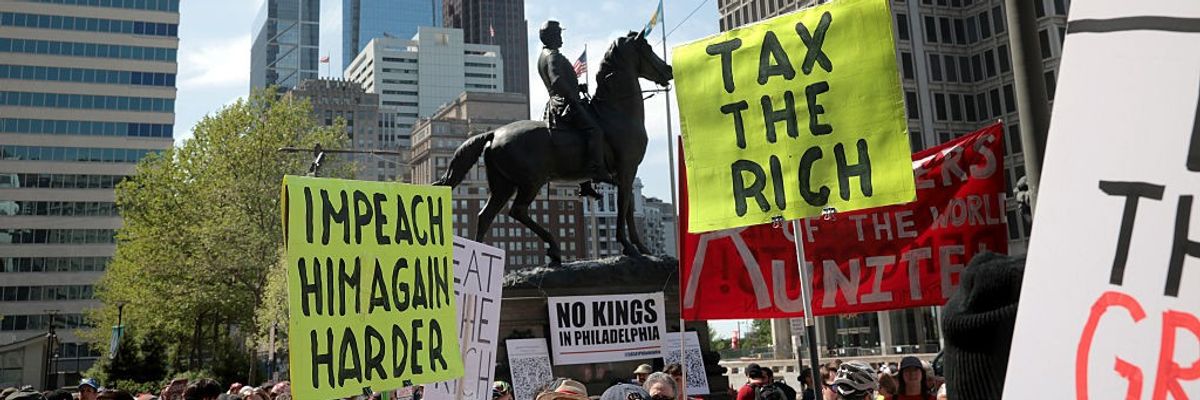
Supporters rally ahead of a Sen. Bernie Sanders (I-Vt.) May Day rally at City Hall on May 1, 2025 in Philadelphia, Pennsylvania.
(Photo by Kayla Bartkowski/Getty Images)


Brad Reed
Aug 21, 2025
COMMON DREAMS

A broad coalition of progressive organizations on Thursday announced that they are uniting for a mass mobilization event aimed at taking on the billionaire class.

The upcoming Make Billionaires Pay marches, scheduled to occur nationwide on September 20, link together multiple crises—ranging from authoritarianism to the climate emergency to US President Donald Trump's mass deportations—by pointing the finger at the ultra-wealthy oligarchs who have been supporting them all.

Candice Fortin, US campaign manager for climate action organization 350.org, said that billionaires are the connective tissue that links together the major problems currently facing the United States and the world.

"This isn't a new story—billionaires have always prioritized profit over people," Fortin said. "This is a system working exactly as it was designed, but now without even the pretense of justice. As the US braces for more extreme heat, wildfires, and hurricanes, the Trump administration has been systematically defunding our communities to give handouts to billionaires. They're dismantling our democracy, attacking immigrants, and feeding the war profiteers."

Tamika Middleton, managing director for Women's March, also emphasized that today's crises are closely linked together.

"Women, migrants, queer and trans people, and communities of color have long been at the center of overlapping crises, from climate disaster to economic injustice to gender-based violence and forced displacement," she said. "These are not separate struggles; they stem from a global system designed by billionaires who exploit our struggles to maintain power."

Organizers said that these planned actions will focus on advocating for taxing extreme wealth, ending Trump's mass deportation program, and transitioning from fossil fuels to renewable energy.

The marches are being convened by Desis Rising Up and Moving (DRUM), Women's March, Climate Defenders, and 350.org, and more than 100 other organizations have endorsed them so far.

The flagship march is set to take place in New York City at the same time the 2025 United Nations General Assembly will be taking place. Other marches are set to occur simultaneously across the country.


'Shameful': Trump State Dept. Official Fired After Efforts to Denounce Ethnic Cleansing, Killing of Journalists

"There really are no words left for the debasement of US policy in supporting, arming, enabling, and justifying Israel's genocide and ethnic cleansing."


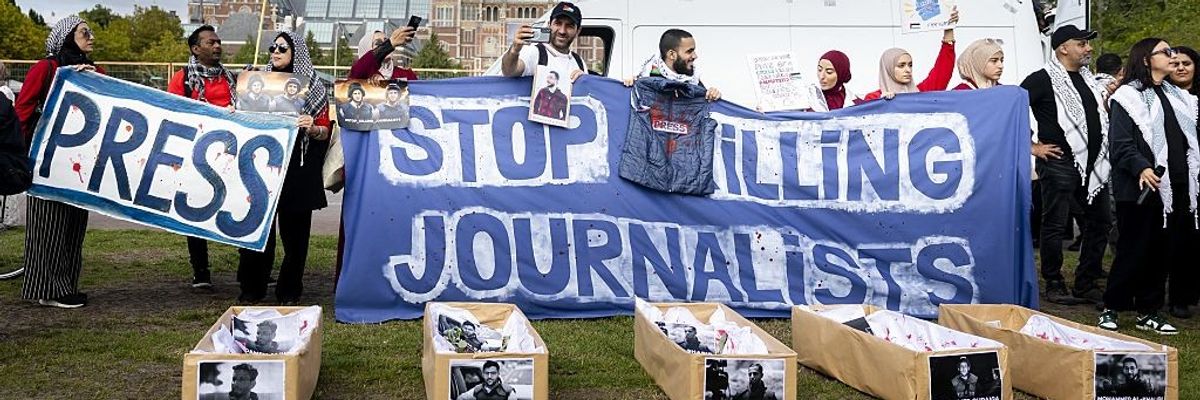
Protestors hold a slogan reading "Stop killing journalists" as they stand in front of mock coffins with portraits of killed Palestinian journalists in the war between Israel and Hamas in Gaza, during a pro-Palestinian demonstration at Museumplein in Amsterdam on August 16, 2025.
(Photo by Remko de Waal / ANP / AFP)


Jon Queally
Aug 21, 2025
COMMON DREAMS

Human rights advocates and critics of the Trump administration are denouncing the US State Department's firing of a top media relations official who reportedly recommended "expressing condolences" for journalists killed by Israeli forces in Gaza and drafted a statement articulating US government opposition to what amounts to ethnic cleansing in the besieged enclave.

According to the Washington Post, Shahed Ghoreishi, the department's lead press officer on Israeli-Palestinian affairs, was fired Monday after a series of internal debates over how to characterize aspects of White House policy regarding Gaza, including over the release of a statement which simply said: "We do not support forced displacement of Palestinians in Gaza."

The Post's reporting, based on unnamed officials familiar with the situation as well as documents the newspaper reviewed, also included comments from Ghoreishi:
Ghoreishi told The Post he was not given an explanation for his firing, which the State Department was not required to provide due to his status as a contractor. He said the incident raised troubling questions about the department's position on the potential expulsion of Palestinians from Gaza.

"Despite a strong reputation and close working relationship with many of my colleagues, I was unable to survive these disputes," he said, noting the language he recommended for the media statement had been previously cleared by the State Department since Trump took office on Jan. 20.

A separate recent dispute was over the targeted assassination by Israel of Al-Jazeera journalist Anas al-Sharif earlier this month, killed by a missile strike alongside four other journalists: correspondent Mohammed Qreiqeh; photojournalists Ibrahim Al Thaher and Moamen Aliwa; and Mohammed Noufal, an Al-Jazeera staff member.

The Israeli military has claimed, without providing evidence, that al-Sharif was a Hamas soldier, but Al-Jazeera and others who know his work have repeatedly denounced that assertion as a baseless lie intended only to discredit the award-winning journalist who reported relentlessly from the frontlines of the horrors taking place in Gaza, including broadcasting reports of starving children to the world over recent months. Notably, the other journalists killed in the attack were not accused of being Hamas members.

When Ghoreishi drafted a statement that included the phrase, "We mourn the loss of journalists and express condolences to their families," higher-ups in the department told him that no such comment was needed.

"If you needed more evidence [President Donald] Trump has totally contracted out US policy in the Middle East to Netanyahu, look no further," said Sen. Chris Van Holen (D-Md.). "It's now apparently a fireable offense to say America opposes forced displacement of Palestinian civilians and regrets the killings of journalists. Shameful."

Progressive critics, like veteran labor organizer Chuck Idelson, said the firing speaks volumes about the administration overall under President Donald Trump and the US State Department under Secretary of State Marco Rubio.

"There really are no words left for the debasement of US policy in supporting, arming, enabling and justifying Israel’s genocide and ethnic cleansing," said Idelson in a social media post responding to the reporting. "It rivals every past horror in US policy, no wonder Trump wants to whitewash our nation’s history as he recreates every crime."

Arif Rafiq, an editor and frequent writer on foreign affairs, wrote: "There's never been so extensive a purge of Americans from public life for criticizing a foreign government."

Named as a key figure in the disputes that led to Ghoreishi's firing was David Milstein, a senior adviser to Mike Huckabee, the US ambassador to Israel.

The Post reports, citing unnammed officials they spoke with on the matter, that Milstein is viewed as someone "overly eager to please Israeli officials and frequently involves himself in matters that are beyond the scope of his responsibilities."

As one official put it: "Milstein is an adviser to an ambassador. That's it, yet he has his hands in everything."

Assault With A Deli Weapon


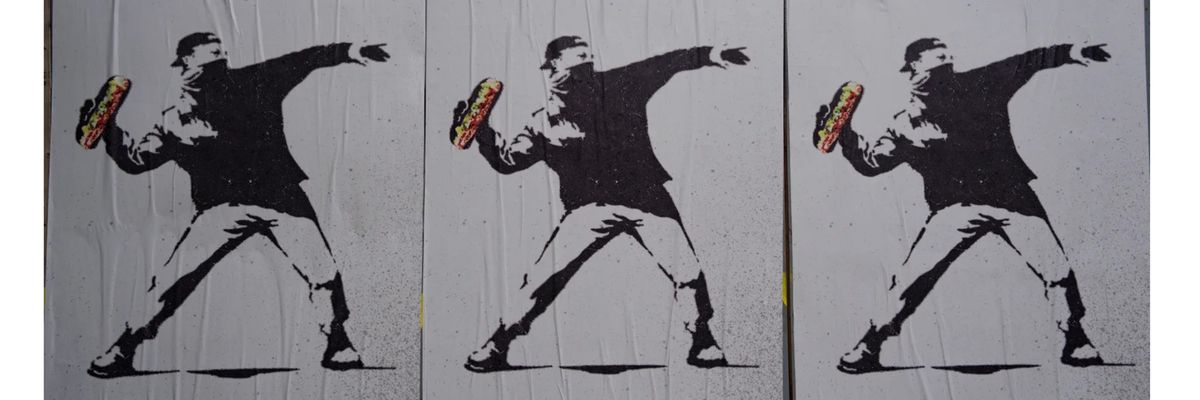
Images of acclaimed Sandwich Guy, with hat tip to Banksy, near Dupont Circle
Photo by Kayla Bartkowski via Getty Images

Abby Zimet
Aug 21, 2025
COMMON DREAMS

As armed, burly goons roam D.C.'s streets, besieged residents say "it's the little things" that give them solace, which is why they've embraced as their new folk hero "The Sandwich Guy," the pissed-off, pink-shirted, possibly drunk veteran and DOJ attorney who one recent night lost it, got in a goon's face, yelled "Fuck you! You Fucking Fascists!" and heaved his sub at him. He was arrested and fired, but a grateful city has joined in his valiant subrising, joyfully proclaiming, per Bowie, "We can be gyros just for one day."

These totalitarian days, the nation's capitol is thronged with "an alphabet soup" of so many alleged law-enforcers - National Guard, Customs and Border, DHS, DEA, Capitol Police, US Marshals - many people feel "they walking the streets like there's a war going on." With ongoing risks to D.C.'s precarious local autonomy - a bogus DOJ probe into "fake" crime data, a GOP push to end home rule, their purported leader's threat to take over and "run it really, really properly" (God knows what that means) - the tensions were evident Wednesday with a massive show of force outside Union Station, where regime hacks Hegseth, Vance and Miller came to survey their armed carnage, swagger about and hand burgers to a pointlessly deployed National Guard. Predictably - polls show over 80% of residents oppose the seizure - they were met by boos, jeers, "Free D.C!" and, for Vance, "Go fuck a couch, J.D."

It got worse when they opened their fetid mouths. Vance smirked it's good they were there in one of D.C's most crime- free spots because there are so many (gasp) "vagrants." Repulsive, sing-songy white supremacist Stephen Goebbels Miller "erupted in a manic fascist rant," babbling the thugs will now let black people feel safe even though he doesn't know any, and besides, "We are not going to let these crazy communists destroy a great American city." "All these demonstrators, they're just elderly white hippies, they're not part of the city and never have been," he snarled brown-shirt style as the multi-hued-and-aged crowd booed. (Hegseth sneered.) "We're gonna ignore these stupid white hippies that all need to go home and take a nap because they're 90 years old." Vile, hateful, clueless, entitled, agitprop assholes 'R us. From we the people: Better a stupid white hippie than a Nazi loser any day.

Amidst so much rancor, hubris, racism and mindless flexing of military force, residents say, "People do want to fight back - just resisting and not being beat down by all the crap that’s going on." Which is how "a sandwich became a symbol of resistance in a surreal time," the people's way to combat an autocrat's illegal seizure of their city and a primal, if petty, "collective scream for everyone who loves D.C., "One Small Sub for Man…One Giant Gesture for Democracy.” Enter, possibly having imbibed a bit, Sean Charles Dunn, a 37-year-old veteran and trial attorney who on the night of Aug. 10 famously brought a sandwich to a gun fight when he confronted a pack of masked-and-kitted-up cops and border patrol guys "performing official duties" - aka standing aimlessly on 14th Street NW glowering at innocent passersby in a performative show of firepower for their mob boss leader.

A brief video of the encounter has gone viral. A fuller version shows Dunn first across the street, holding a wrapped hoagie, yelling to a guy filming, "See these fascists right here in our city?" Then he turns toward them, yelling, "Shame, shame, shame." The guy laughs: "That's the truth, you ain't talking shit." Later, Dunn strides purposefully toward the swarm of uniforms, stops in front of one, points in his face and yells, "Fuck you! You fucking fascists! Why are you here? I don't want you in my city!" Police say he "continued his conduct for several minutes" before crossing the street, coming back, "winding his arm back and forcefully throwing a sub-style sandwich" at the agent, "striking him in the chest." All hell breaks loose. Up to 20 goons, with nothing else to do, give chase, handcuff and arrest him. He's later released, then re-arrested in a hyped-up DOJ video, "Operation Make D.C. Safe Again."

Dunn was charged with one felony count of "assaulting, resisting, or impeding certain officers (of) the United States," a federal charge that carries up to ten years in prison. The dangerous perp, it turns out, is an attorney who worked as an international affairs specialist in the Justice Department's criminal division. He's also an Air Force veteran who served in Afghanistan from 2006 to 2011, with a stint in Kandahar. He earned over a dozen awards during his service, including the Global War on Terrorism Service Medal, Air Force Good Conduct Medal, Afghanistan Campaign Medal, National Defense Service Medal, Air Force Legacy Service Award and National Atlantic Treaty Organization Medal. After news of the foot-long fray, the Air Force Times couldn't believe "this nonsense" (over) assault with a deli weapon," noting Dunn's lawyer "questioned whether this deli-quence meets the standard for a felony charge."


D.C residents were also up in arms and subs, gleefully insisting - hat tip to Gil Scott-Heron - "The Revolution Will Be Satirized." New protest signs sprang up: "Don’t Fuck With DC Unless You Want This Foot-Long," "Sandwiches Against Fascism: These Condiments Don't Run," "Totalitarian Italian," "Don't Bread On Me," "Officer-Involved Hoagieing," "Hero With A Hero." They demanded the Smithsonian display the sub as "a national treasure" (until purged); urged Subway to redeem itself for a pedophile scandal with a 2-for-1 deal, “One to Eat and One to Throw"; suggested new "throwables - Choose Your Weapon" - like Operation Breadstick Thunder and BLT-47-Assault Sub. They had questions: "Was it a Club Sandwich?" "Assault with a deli weapon is a felony now?", "Isn't this baloney?" They had praise: "Now this is how you use your White Privilege for good." And if called to serve on Dunn's jury, "I will vote 'Not Guilty.'"

There are sub-themed t-shirts: "Battle For D.C." Also sub-themed D.C. flags that fortuitously replace the two former red horizontal bars, based on George Washington's coat of arms, with, yes, subs. Lorraine Hu initially posted one on Reddit for "a moment of levity," and was flooded with thousands of likes and requests. "I realize sub-sandwich art is a very specific cultural moment," she laughs, but she is still frantically filling Etsy orders on flags, pins, tote-bags and a $20 "Tasty Symbol of the Resistance" t-shirt. Most noticeably, one as-yet-unnamed patriot, or more likely several, took to festooning much of D.C. with posters memorializing the subrising by riffing off a popular Banksy piece Flower Thrower that pictures a protester hurling, instead of a Molotov, a bouquet. For D.C., of course, the bouquet has been delectably replaced by - hold the mustard, bring on the fury - a sub.

Shockingly, regime officials are unamused by a newly rowdy populace rising to proclaim, as the late, great David Bowie exhorted, "We can be heroes (or gyros)/Just for one day." One grim White House spokesperson decried posters "glorifying" violence against the blue, declaiming of Dunn, "This man assaulted a law enforcement officer" - widely deemed "a bit rich" coming from a White House that pardoned over 600 hooligans who viciously assaulted hundreds of cops in a Jan. 6 riot. FBI hack head Kash Patel bloviated like it was Bin Laden the FBI had "arrested this individual and he has been charged with a felony assault." Fox loudmouth and new U.S. Attorney Jeanine Pirro (really) said of the perp who "forcefully threw a sub-style sandwich", "If you lay a hand on a law enforcement officer (not, actually), we will come after you with the full weight of the law...This alleged assault is no joke."

The worst of the worst, Pam Bondi, was the worst. Likewise stern, she decreed, "If you touch any law enforcement officer" - again, actually not; the sub did - "we will come after you." Evidently unaware setting such a ludicrously low bar for assault could encourage protesters with nothing to lose to be more violent, she stonily announced Dunn had been "FIRED" from the righteous work of the DOJ and charged with one felony count for assault, with a court hearing in September. Okay: due process and all. Then she got as ridiculous and grandiose as her ridiculous, grandiose boss. Of the military-serving, DOJ-lawyering, and yes sandwich-hurling Dunn, she said, "This is an example of the Deep State we have been up against for seven months." Sigh. Every petty, brutish, lawless, witless day, these cartoon villain prove, says one online sage, "We are not a serious country."


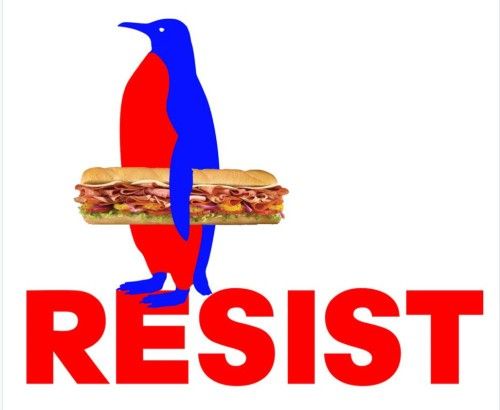
Penguins join the Subrising  Meme on BlueSky

Trump: the Personification of the End of History?

Donald Trump is sending the US down the tubes in double time, and, in the process, potentially taking much of the rest of the world with him.


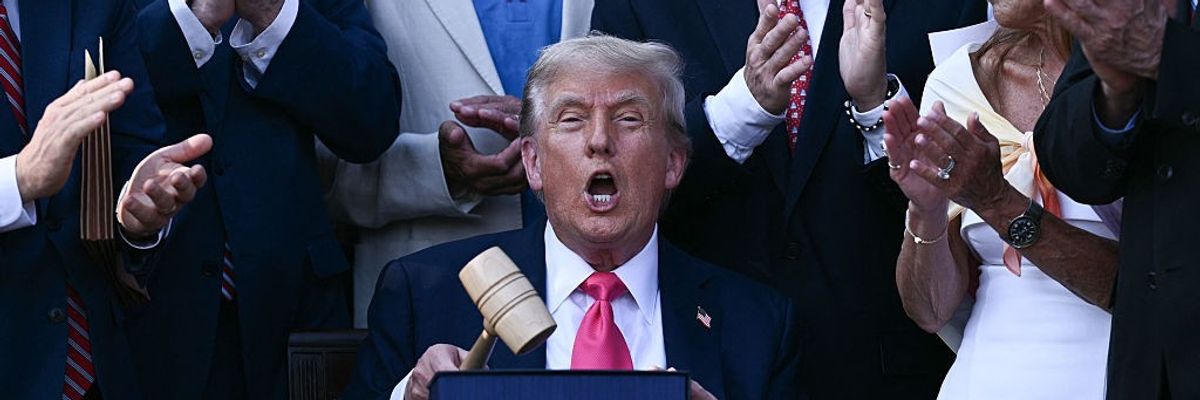
US President Donald Trump (C) holds a gavel after signing the "Big Beautiful Bill Act" at the White House in Washington, DC, on July 4, 2025.
(Photo by Brendan Smialowski/Pool/AFP via Getty Images)

Tom Engelhardt
Aug 22, 2025
TomDispatch

Sometimes I dream—in the sense of a nightmare—about bringing my parents back to this all too strange world of ours to tell them about… yes, of course, Donald J. Trump. They died long before The Apprentice even made it onto TV early in this century, so—best guess—though they also lived in New York, they undoubtedly had never heard of him.

My mother died in 1977 when Donald Trump was 31 and Jimmy Carter was president; my father in 1983 when Trump was 37 and Ronald Reagan was president. But nothing, not even Richard Nixon, could have prepared them for a Trump presidency, not once but (yes!) twice.

Mind you, my father was a salesman and, in that sense, he might have understood something about Trump, including his ability to sell himself to all too many of the rest of us so damn successfully, again not once but twice—and if he has anything to do with it, maybe (but “probably” not) a third time, too. My parents could never have imagined, however, that the country which, at my mom’s birth, had Theodore Roosevelt as president and, in the years to come, Franklin D. Roosevelt and John F. Kennedy, among others, would have elected a madly self-referential ex-salesman with six bankrupt businesses in his past to the White House not once, but—yes, again!—twice.

I think my mother, a professional political and theatrical caricaturist, might have grimly laughed and then gone to her easel to turn him into her caricature of the ages. She would undoubtedly have caught his strange essence, as she did that nightmarish Trumpian figure of her moment (though he never had the same power to devastate our world), Sen. Joe McCarthy.

Under the circumstances, here’s my new phrase for this global moment of ours: We—and I mean all of us on Earth—are in Trumple deep.

And believe it or not, there is indeed some appropriate history here. Great powers—and after the Soviet Union collapsed and the Cold War ended in 1991, this country seemed to be a great power like no other, possibly ever—do come and go. Indeed, the going can be bizarre and disorienting. But when they come, it often seems as if they might be here forever and a day. And of course, in that now distant moment when the Soviet Union suddenly unraveled and China had not yet risen, the US did appear to be The Great Power (and capitals and italics are indeed appropriate), the only one left on Planet Earth.

At the time, in fact, it felt as if this country might actually prove to be the Ultimate Great Power, the Greatest of All. Who then could have imagined that, not quite a quarter of a century later, the US would, in its own fashion, have gone to the dogs, that it would be ever more—and yes, we do need some new words to describe this increasingly stranger, more disturbing world of ours—tariffyingly alone on an increasingly resentful and hostile planet? And mind you, I’m not just thinking about countries like Brazil, India, and Switzerland that are deeply ticked off by Donald Trump’s soaring tariffs and so much else. Who then could have imagined that we were already heading for the historical edge of what may prove to be the ultimate cliff of history? Who, then, could have imagined that Donald J. Trump—that living, breathing symbol of ultimate decline—would indeed become this country’s president, not once but—yes, again (and again)!—twice?

Honestly, in those nearly 25 years, how did the seemingly greatest power in history become something like an all-too-grim planetary laughing-stock—or do I mean totally frightening-stock?

Of course, in a fashion my parents couldn’t have imagined once upon a time, Donald Trump may be the ultimate… Wait, what word or words am I searching for here? I wonder if it or they even exist. He’s almost too strange for the ordinary language we’re used to, while—though who yet knows?—it’s at least possible to imagine that he might prove to be the personification of the end of history. The last president, so to speak.

After all, though in my parents’ time humanity already had the ability to do this planet in, thanks to the atomic weapons that ended my father’s war, who would have imagined then that we humans had already come up with a second, slow-motion way to do the same thing—I’m thinking, of course, about climate change—while essentially not noticing for decades. Nor could they have imagined that, once the long-term destructiveness of global warming became more apparent, the American people would elect a president dedicated to the very substances, fossil fuels, that are slowly transforming this planet into a giant fire hazard, heat condominium, and flooding nightmare first class.


The Final Act?

I mean, imagine this: even if the atomic weaponry that has spread to nine countries is never used again—and don’t count on that when the Russians and the Americans have only recently implicitly or explicitly threatened to employ just such weaponry, while the last nuclear treaty between those two countries is scheduled to run out in February 2026 (oh, and my country is also planning to invest another $1.7 trillion in “modernizing” its nuclear arsenal in the decades to come)—the burning of fossil fuels, a slow-motion version of atomic warfare, has now become the heart and soul(lessness) of the potential devastation of planet Earth. After all, last November, Americans reelected a man who, in a fashion that could hardly have been blunter, ran his third campaign for president as a “drill, baby, drill” candidate. It was, in fact, his main election slogan. And since retaking the White House, he has indeed backed to the hilt the idea of increasing this country’s production of coal, oil, and natural gas. In fact, he only recently reached a tariff deal with the European Union in which he forced the EU to agree to purchase $250 billion worth of American natural gas and oil annually in the years to come. Who cares that US energy exports to all buyers globally in 2024 added up to (and what a word to use in this context!) only $318 billion?

As John Feffer recently put it all too accurately, “Trump uses tariffs like a bad cook uses salt. It covers up his lack of preparation, the poor quality of his ingredients, the blandness of his imagination. It’s the only spice in his spice rack.” Indeed, that couldn’t be more on target, unless, of course, you start to think of climate destruction as a kind of spice, too.

Worse yet, he has proven all too grimly a man of his word. Under him, for instance, the Environmental Protection Agency (EPA) is being turned into an outfit that will essentially protect nothing whatsoever. As David Gelles and Maxine Joselow of the New York Times reported recently: “Lee Zeldin, the administrator of the Environmental Protection Agency, this week proposed to repeal the landmark scientific finding that enables the federal government to regulate the greenhouse gases that are warming the planet. In effect, the EPA will eliminate its own authority to combat climate change.”

He has, in short, brought us to what might be considered the ultimate cliff of history and is, in essence, putting a potentially devastating tariff on Planet Earth.

The only thing that the Trump administration now has to do is change that outfit’s name to the Environmental Destruction Agency, or EDA, since it’s already doing everything it can to halt wind and solar power projects of any sort in this country. And as Gelles and Joselow also report, it has recently “dismissed hundreds of scientists and experts who had been compiling the federal government’s flagship analysis of how climate change is affecting the country. In May, Mr. Trump proposed to stop collecting key measurements of greenhouse gases in the atmosphere as part of his 2026 budget plan.”

In short, right now the very idea of a “great” power seems to be heading for the dustbin of history, and that Cold-War-ending moment in 1991 appears ever more like a fantasyland of the first order. Yes, much that’s all too familiar is still ongoing on this planet of ours, including endless wars. But what a time to have made Donald J. Trump president of the United States again. Under the circumstances, here’s my new phrase for this global moment of ours: We—and I mean all of us on Earth—are in Trumple deep.

In truth, the very phrase “great power” might as well now be “grape power.” And mind you, given the strange ingenuity of humanity, don’t for a second assume that there isn’t a third way of doing us all in as well, even if we don’t yet know what it is.

Worse yet, don’t for a second imagine that President Trump is alone on planet Earth. Just consider Vladimir Putin, the Russian ruler who decided that the best way to go in 2022 was to invade a neighboring country and simply never stop fighting there. (Yes, I know, I know… NATO did seem to be creeping up on Russia in those years, but still…) And what about Israeli Prime Minister Benjamin Netanyahu, who simply can’t stop slaughtering Gazans and utterly devastating that microscopic 25-mile strip of land—with American weaponry no less—while potentially starving thousands (tens of thousands? hundreds of thousands?) of Gazans to death? (And while you’re at it, don’t forget that war itself is one of humanity’s most effective ways of putting yet more greenhouse gases into the atmosphere and heating this planet further!)

Putting a Tariff on Planet Earth?

It’s not exactly a pretty picture, is it? And mind you, I haven’t even mentioned the ongoing disasters in Sudan or Somalia, or so much else on this unsettled and unsettling planet of ours. Nor have I mentioned the one major country that seems to fit none of the above categories, being neither at war, nor in decline, nor headed by some distinctly strange and unnerving version of humanity, and that, of course, is China. There can be no question that it is indeed a significant power and, once upon a time, would undoubtedly have been considered the next great power to loom over Planet Earth.

And give the Chinese some credit. While not acting globally in the usual fully imperial fashion, they have been moving to create ever more green energy—in fact, installing more wind and solar power than the rest of the world combined. And yet, that country is also a carbon disaster, using more coal than almost all the other countries on this planet put together and still planning to install startling numbers of new coal power plants. So, a “great” power? Not exactly, not on this ever-less-than-great planet of ours.

Meanwhile, Donald Trump is sending the US down the tubes in double time (and, in the process, potentially taking much of the rest of the world with him). He has, in short, brought us to what might be considered the ultimate cliff of history and is, in essence, putting a potentially devastating tariff on Planet Earth.

We face what could—not even a quarter century after the United States appeared to stand alone and all-powerful on this planet of ours—be something like the last act in the drama (the tragedy?) of human history.

Under the circumstances, the question, of course, is: Why can’t we humans seem to learn what truly matters on this increasingly endangered planet of ours?

I sometimes feel like a bewildered child when I think about what we’re now doing to our world—a child with no parents around to explain what’s happening. And 79-year-old Donald Trump catches that mood of mine exactly as, having just turned 81, I watch him visibly begin to move into an altered state of personal decline, while ensuring by his acts (and those of his minders) that this planet continues to head for hell in a handbasket.

In the past I’ve suggested that his middle initial J should be changed to a D for decline. But now that seems almost too mild to me as we face what could—not even a quarter century after the United States appeared to stand alone and all-powerful on this planet of ours—be something like the last act in the drama (the tragedy?) of human history.

And yes, I still do have the urge to call my parents back from the dead, hoping they might be able to explain us humans and our ever-stranger ways to their son. I suspect that, on returning to this eerie world of ours so many decades later, my mother might find it to be the ultimate caricature.

© 2023 TomDispatch.com


Tom Engelhardt
Tom Engelhardt, co-founder of the American Empire Project, runs the Type Media Center's TomDispatch.com. His books include: "A Nation Unmade by War" (2018, Dispatch Books), "Shadow Government: Surveillance, Secret Wars, and a Global Security State in a Single-Superpower World" (2014, with an introduction by Glenn Greenwald), "Terminator Planet: The First History of Drone Warfare, 2001-2050"(co-authored with Nick Turse), "The United States of Fear" (2011), "The American Way of War: How Bush's Wars Became Obama's" (2010), and "The End of Victory Culture: a History of the Cold War and Beyond" (2007).
Full Bio >