Thursday, July 08, 2021

USING JEWS AS A TROPE
We want to avoid NI jewish exodus says Boris Johnson in attack on EU over protocol implementation

The PM said the Jewish community is considering leaving amid concerns about access to kosher foo
ds.

A loyalist protest against the Northern Ireland protocol (Brian Lawless/PA)

By Gavin Cordon, PA Whitehall Editor

July 07 2021 05:39 PM

Boris Johnson has again accused the EU of implementing the provisions on Northern Ireland in the Brexit divorce settlement in a “grossly disproportionate and unnecessary” fashion.

Giving evidence to the Commons Liaison Committee, the Prime Minister insisted the NI Protocol did not pose any threat to Northern Ireland’s status within the United Kingdom.

Read More
Northern Ireland Protocol puts Belfast’s Jewish community under threat

But he said recent problems over to movement of chilled meats from the rest of the UK were still “far from fixed” following an agreement to delay the implementation of border checks.

There is absolutely no threat to Northern Ireland's place within the United KingdomBoris Johnson

He said there were now concerns among Northern Ireland’s Jewish community that they would be unable to access kosher foods unless it was resolved.

“They are talking now about an exodus from Northern Ireland. We want to do everything that we can to avoid that,” he said.

“I think what we all need to do is work rapidly on some solutions, fix this thing fast.

“I think it will take some effort but we really can’t exclude any actions that the UK government my need to take to protect what it says in the Protocol.”

Boris Johnson said he wanted to avoid an exodus of Northern Ireland’s Jewish community (House of Commons/PA)

At the same time, the Prime Minister sought to allay concerns among some unionist communities that Northern Ireland’s place in the UK had been weakened as a result of the Protocol.

“There is absolutely no threat to Northern Ireland’s place within the United Kingdom and there should not be from the Protocol,” he said.

“It is clear that Northern Ireland is part of the sovereign territory of the United Kingdom. That is all clear from the Protocol.”

Mr Johnson however indicated that he regretted some parts of the agreement which he had signed to get the UK out of the EU.

He said he had agreed to checks on goods moving from Great Britain out of “neighbourliness” as part of the arrangements to ensure there was no return of a hard border with the Republic.

“We also agreed, unfortunately, that the EU could have a say in how this was done,” he said.
Collapsed Florida tower could have been repaired faster under repealed law, experts say

If a 2008 Florida law that required condos to plan for repairs had still been in place, "this never would have happened," said the legislator who sponsored the law.


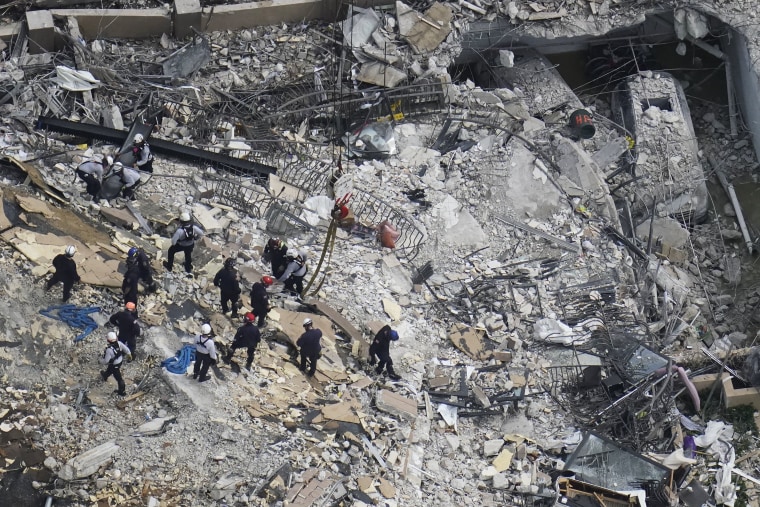
Rescue workers search in the rubble at the Champlain Towers South condominium in Surfside, Fla., on June 26. Gerald Herbert / AP

July 8, 2021, 2:31 AM MDT
By Jon Schuppe and Phil Prazan, NBC Miami


SURFSIDE, Fla. — Late last year, after years of delays and disputes, the Champlain Towers South Condominium Association began a desperate search for $16.2 million to fix major structural damage that was slowly threatening the Surfside high-rise — and that may have contributed to the building's partial collapse June 24.

The obvious place to look was the building's reserve fund — extra money socked away to cover the cost of future repairs. But the account held just $777,000, according to condo board documents — nowhere near enough to soften the blow.

The collapse, which killed at least 54 people and left 86 others missing, occurred before the condo board could collect the needed money from residents and begin repairs. The cause of the collapse is unknown, and investigators, experts and advocates are trying to determine whether the uncompleted repairs played a role, whether the board could have seen the problem coming earlier — and whether a Florida law regulating condo repairs that was repealed a decade ago could have made a difference.

One way to keep track of needed repairs is a "reserve study," in which condo boards bring in experts like engineers or certified specialists every few years to inspect buildings and estimate how much the boards should collect from residents to prepare for future fixes. The building's financial documents, obtained by NBC News and NBC Miami, show that Champlain Towers South had not done a professional reserve study since at least 2016. That decision was legal, but it meant that planning was left to the board, a shifting group of volunteers with little training in building maintenance.


"If the owners would have had a reserve study, if the board was proactive and had funded its reserves, this never would have happened," said Julio Robaina, a former Republican state legislator.


Robaina sponsored a 2008 law requiring condo associations to hire engineers or architects to submit reports every five years about how much it would cost to keep up with repairs.

The law lasted just two years before it was repealed in 2010, after Robaina left office. Robaina blamed pushback from real estate lawyers and property managers, who he said claimed that the law was too burdensome for condo owners. The legislator who sponsored the repeal, former state Rep. Gary Aubuchon, a Republican real estate broker and homebuilder, did not reply to messages seeking comment.

The repeal left Florida's condo residents less protected than those in nine states that legally require reserve studies, according to the Community Associations Institute, a nonprofit organization that advocates for condo associations. Thirty-one other states, including Florida, regulate reserves in some way — although Florida is one of three states with loopholes that enable owners to opt out of requirements, the nonprofit said. Ten states have no regulations about reserves at all.


"One of the steps that should be taken by a building, especially an aging building, is having adequate funds available so that when you have to face significant cost challenges there's an appropriate amount of money available," said Gary Mars, a South Florida lawyer who represents condo associations.

A survey last year by the Community Associations Institute found that most homeowners associations are hesitant to increase residents' fees, anticipating opposition, and therefore fail to plan for long-term infrastructure fixes.

"In postponing inspections, reserve studies, and — ultimately — complete repairs or renovations, boards often end up facing an exponentially more comprehensive and expensive project in the long run," the report said.

Maxwell Marcucci, a spokesman for the Champlain Towers South Condominium Association, declined to comment on reserve studies. In a previous statement to NBC News, he said the condo board was doing its best to ensure the building was safe. “They are not engineers and not building safety experts,” Marcucci said. “They hired experts, trusted experts, and at no point did the experts indicate that there was a threat of imminent collapse.”

The lack of a professional reserve study is a departure from what many experts say is best practice for condominiums, particularly older ones on the coast — like Champlain Towers South, built in 1981 — that have been exposed for decades to corrosive salt and water.

Robaina, who co-owns a property management company, said maintaining healthy reserves "is the single most important action that a condominium board needs to take."

Florida law requires condo boards to maintain reserves for repairs over $10,000, but it does not say exactly how much to set aside. That means condo boards have some flexibility in avoiding saving for repairs that do not need to be made right away.

In addition, the law allows condo buildings to waive the reserve requirement altogether. Once it has passed its annual budget, a condo board can give residents the opportunity to opt out of collecting reserves by a vote of a majority of unit owners. The votes are common in Florida condo buildings, condo lawyers say.

That is what it appears Champlain Towers South did, lawyers and reserve experts said.

The experts pointed to the board's reliance on special assessments — additional fees on top of residents' normal monthly payments — to fund needed repairs. The board imposed a $1 million special assessment in 2016 for hallway renovations and a $350,000 special assessment in 2019 for work on a generator, a fuel pump and a fuel tank. Such lump-sum levies are indicative of a building whose owners have decided not to set aside enough reserves through regular monthly fees, choosing instead to wait until a big-ticket repair is needed to ask residents to pay for it, experts said. Many associations make that choice by repeatedly voting to waive or reduce the funding of their reserves.

"I can't help but think that the building did that for years and years, which is why there was not enough funds available," said Matthew Kuisle, Southeast regional director for Reserve Advisors, which prepares reserve studies. "Why would they do that? So they have lower fees. But in the long run, the fees are a small price to pay."


The shortcomings of that approach started to become clear in 2018, when the board began inspecting the building before a checkup mandated by Miami-Dade County for buildings that reach 40 years old. In an October 2018 report, engineer Frank Morabito alerted the board to "major structural damage" to concrete slabs underneath the building's pool deck and its entrance drive. He blamed a "major error" in the building's construction and years of corrosion. He estimated the cost of repairs at $9 million.

Reeling from sticker shock, the board invited a Surfside building official to its November 2018 meeting. The official told the board that the building was "in very good shape," according to minutes of the meeting. Some residents have said that led them to believe the situation was not dire.

Even so, the board began trying to find a way to repair the damage — and to pay for it.

Disagreements over the costs frustrated board members. Five members quit over two weeks in fall 2019. The condo association has had four presidents since 2018.

Damage to Miami building was known — but key oversight process was broken, experts say


By late last year, the board had accepted that there was no safe way forward without doing the massive reconstruction Morabito recommended, along with repairs to a deteriorating roof. Morabito began preliminary work and found that the damage discovered in 2018 had gotten worse. The bill rose to more than $16 million.

The board scrambled for money. It found $707,000 left over from the previous special assessments and $777,000 more in reserves. But a quarter of the reserves were designated for insurance deductibles, leaving $556,000. The board chose not to tap the reserves just in case there was another emergency. That meant the building was short by $15.5 million, which the board voted in April to raise through a special assessment. The cost to residents would be $80,000 to $360,000 per unit.

"A lot of this work could have been done or planned for in years gone by. But this is where we are now," board President Jean Wodnicki wrote to residents before the vote.

By last month, the board had started work on the roof, and it put other repairs out for bid. Responses were due July 7. Two weeks before the deadline, the building partly collapsed.
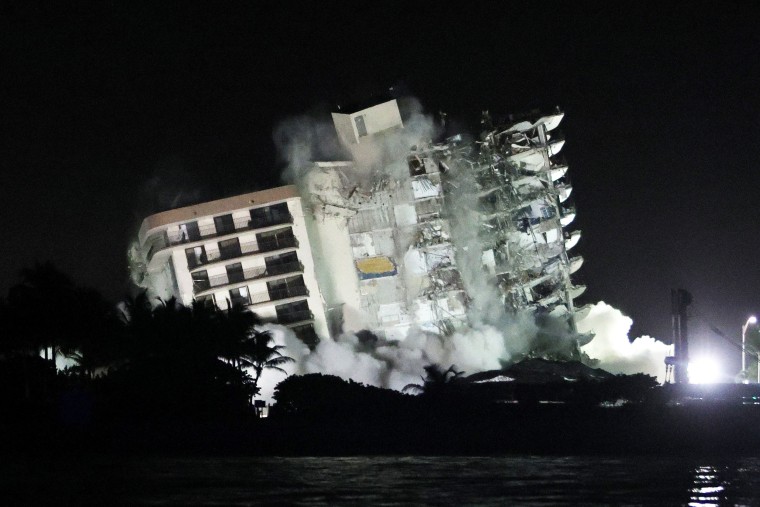
The remaining part of the partly collapsed 12-story Champlain Towers South condominium building falls in a controlled demolition Sunday.Joe Raedle / Getty Images

The board's nearly three-year struggle to start work on the concrete replacement project has loomed over the catastrophe's aftermath. Investigators have not determined what caused the failure; the deteriorating supports are among the possibilities.

Experts say the extent of disrepair documented in the 2018 report raises questions about how the damage went unnoticed previously.

"I read the report, and I wondered how long the building looked that way," said Robert Nordlund, founder and CEO of Association Reserves, a reserve study firm based in California. "Did it look that way in 1998? 2008? Because clearly there was some significant deterioration in that 2018 report."

Documents reviewed by NBC News and NBC Miami, including audits, budgets, financial statements and board meeting minutes, do not indicate when the structural issues noted by Morabito started, though the board did pay to replace leaking pipes in the building’s parking garage in 2016. But the documents do show that the board did not perform professional reserve studies and instead relied on board members to determine how much to set aside for repairs. In 2016, an accountant performing a year-end audit noted that "an independent study has not been conducted to determine the adequacy of the current funding" and that "the estimates for future replacement costs are based upon estimates provided by the budget committee."

Audits conducted by the same accountant in 2017, 2018 and 2019 included the same language. Last year, a different accountant provided a similar disclaimer.

Mars, the lawyer who represents condo associations, said he believes that the note was "the CPA saying, 'We don't have any official documentation to rely on.'"

The accountants who conducted the audits did not respond to messages seeking comment.

Jeffrey Rembaum, another lawyer for condo associations, pointed to figures in the audits that showed that from 2016 to 2020, the board did not update the amount of money needed to replace balconies and concrete. Each year, the board estimated needing $320,000 for the work, even after Morabito's report found that much more extensive and costly repairs were needed.

"We know the building had millions in concrete repairs on the horizon," Rembaum said. "So how did it come up with $320,000 for their current needs? If they'd had a reserve study and an engineer looked at what they had, they would have come up with a higher number. That suggests the board wasn't regularly updating it."

He added: "This is the effect of the Florida Legislature not requiring a reserve study by qualified people."

More than a decade since his short-lived law on reserve studies was repealed, Robaina said he hopes lawmakers will change course and reimpose the mandate.

"This is a window of opportunity," he said, "and unfortunately it took a tragedy that could have been prevented."

Jon Schuppe reported from New York; Phil Prazan reported from Surfside, Florida

A White Teen Was Killed by Cops. Working Class Lives Need to Matter, Too | Opinion
JOURNALIST WRITING ABOUT THE INTERSECTION OF IDENTITY, POLITICS, AND PUBLIC POLICY.

Hunter Brittain should have been celebrating this Fourth of July weekend. A seventeen-year-old white boy from McRae, Arkansas, Hunter was a rising senior at Beebe High School. Like so many country boys, Hunter enjoyed the little things in life: fishing, riding dirt bikes, 4-wheelers. He dreamed of becoming a NASCAR driver.

But instead of spending the holiday weekend fishing, wheeling and dreaming, Hunter spent it being laid to rest by his family. He was the latest victim of police brutality in the United States.

Last week, after being stopped by a police officer, Hunter's truck wouldn't shift into park, so he got out of the car to get a blue oil jug to put behind a tire; he wanted to make sure it wouldn't roll back and hit the police cruiser. According to a witness, without warning, the officer who had pulled him over shot and killed Hunter.

Like George Floyd before him and Eric Garner before him and Michael Brown before him, Hunter Brittain was killed in cold blood by the police who ostensibly were there to protect him. Like Floyd and Garner and Brown, he was unarmed. Unlike Floyd, Garner, and Brown though, you probably haven't heard Hunter Brittain's name. That's because Hunter Brittain was white.

Some on the right like The Federalist's Eddie Scarry have latched onto Hunter's death and the fact that poor and working-class white people suffer from brutality as a means of discrediting the Black Lives Matter movement. "Hunter Brittain's life mattered just as much as Andrew Brown's," he writes, referencing the killing of yet another Black man by police earlier this year. "Say his name, even though he's white."

We should say Hunter Brittain's name, but not for the reasons Scarry and his ilk would have. Yes, Hunter represents an often-overlooked reality: White working-class and poor Americans are also disproportionately victims of police brutality. But rather than using identity politics to stoke racial divisions, Hunter Brittain's death should serve as a call-to-action for everyone interested in justice to join a diverse coalition committed to ending police violence against unarmed Americans.

Over the past several years, we have begun a reckoning in this country about violence committed by agents of the state against Black and brown citizens. It is as right and just as it is long overdue. Studies show that Black people are more than three times as likely to be killed by police as white people.

But lost in this discourse is an important fact, one tragically represented by the killing of Hunter Brittain: Working class and poor white people are also disproportionately victims of police brutality. A 2020 study by the People's Policy Project found that "whites in the poorest areas have a police killing rate of 7.9 per million, compared to 2 per million for whites in the least-poor areas." This experience is mirrored in attitudes towards the police, with a 2016 CATO Institute study finding that white folks making more than $60,000 a year had a much more favorable view of police than those making less than $30,000 a year.


Over the years, cases of unarmed white boys being killed by the police have occasionally made the headlines. In 2014, 18-year-old Keith Vidal was killed by a cop in North Carolina after suffering a schizophrenic episode. The officer reportedly said, "I don't have time for this shit," shortly before killing Vidal in his home, while his parents watched helplessly. In 2015, 19-year-old Zachary Hammond was shot and killed by an officer when the passenger in his car attempted to buy marijuana from an undercover cop. He was unarmed. And last year, a Salt Lake City, Utah officer shot and killed 13-year-old Linden Cameron after his mother called for a crisis intervention team while the autistic teen has a "mental breakdown."

And yet, none of these cases ever solicited outrage from the #AllLivesMatter brigade. No one on the right organized marches or protests for these boys. No one said their names, except preceded by "what about" whenever police brutality against Black Americans was brought up. Instead, they use these deaths to stoke racial division and keep white working-class Americans from joining in arms with our Black brothers and sisters to demand justice for our slain children.

Meanwhile, Black civil rights leaders are left to speak for white victims of police brutality—as they have done for Hunter Brittain, standing alongside his family and friends in their own community. Crowds gathered last week outside the Lonoke County Sherriff's Office chanting "No justice, no peace" just as they do when unarmed Black people are killed.

The local NAACP chapter pledged to support the family as they seek justice for Hunter. Benjamin Crump and Devon M. Davis, the attorneys who represented the families of Trayvon Martin, Ahmaud Arbery, and George Floyd, are representing the Brittain family. The Reverend Al Sharpton will speak at his funeral today.

"At his funeral today." Those words fill me with an incandescent rage and inconsolable sadness. I think of my own teenage brother, two years older than Hunter and, like him, a racing fan who just graduated from the NASCAR Technical Institute. I think of all the crazy ass redneck boys I grew up with in the mountains of Eastern Kentucky who drove too fast, smarted off too much, even the ones who bullied me, who were just kids themselves.

I think of Hunter. He was 17. A child. Just trying to fix his truck.

Maybe you disagree with certain tactics or tenants of the Black Lives Matter movement. That's fine. One needn't want to defund the police to recognize that something's rotten when a good ol' boy can't even fix his truck without the law shooting him like roadkill. If, like me, you are white and working class or poor, I want you to consider the injustice and inhumanity of this. I want you to consider Hunter.

Saying Black Lives Matter doesn't mean Hunter's didn't. Recognizing the material reality of racism in policing does not diminish Hunter Brittain's life, nor the pointless and evil taking of it. But failing to demand justice for Hunter and all victims of police brutality insults the memory of that precious boy whose family will lay him to rest today. It is downright sinful.

The time has come for the white working class join hands with our Black brothers and sisters and say, quite simply, enough is enough. We will not sit here while our children, our neighbors, our friends and family are gunned down like dogs on the side of the road. Enough is enough is enough. It is time for the white working class to join the movement for Black lives—and for all lives cruelly and needlessly taken by this barbarous and inhuman system we dare call policing.


NEWSWEEK ON 7/6/21 


Skylar Baker-Jordan writes about the intersection of identity, politics, and public policy based. He lives in Tennessee.


OPIUM IS THEIR MAJOR EXPORT
Laila Haidari, the mother to Kabul's drug addicts


Issued on: 08/07/2021 -
The founder of a rehabilitation centre for drug addicts, Haidari says many of her social activist friends have already quit the country ADEK BERRY AFP


Kabul (AFP)

Her friends and family tell her to pack up and flee Afghanistan without waiting for the possible return of the Taliban, but sitting on a terrace, smoking a cigarette, Laila Haidari is determined to stay.

The founder of a rehabilitation centre for drug addicts, she says many of her social activist friends have already quit the country.

"How can I easily leave all this behind? 'Laila Haidari, the mother of the addicts' -- this is my identity," she told AFP.

The US has pulled out more than 90 percent of its troops from the country, at a time when peace talks between the Taliban and the Afghan government have stalled and the insurgents are waging a blistering offensive.

There are growing fears that Afghan security forces will be unable to hold back the militants without the help of international troops.

"For the Taliban, drug addicts are criminals who are tried and sent to prison, they do not see them as sick," she said.

Poppy cultivation was banned under Taliban rule, but since being kicked out of power by a US-led invasion in 2001, the export of heroin has provided militants with billions of dollars, fuelling their insurgency.

With poppies cheap and easy to grow, Afghanistan now provides 90 percent of the world's production of heroin.

Crystal methamphetamine production has also surged, created from the ephedra plant which grows wild in the country.

According to anti-narcotics experts, 11 percent of Afghanistan's 34 million population are drug users, with four to six percent addicted to hard stimulants.

- 'The Mother Centre' -


Raised in Iran where her family had taken refuge, Haidari was married at 12 to a mullah, who as a man had instant custody rights over their three children when she divorced him a decade later.

On her return to Afghanistan, she discovered her brother, Hakim, had become addicted to heroin and was living with other homeless users under a squalid Kabul bridge, next to a filthy stream.#photo1

Like "something out of a Hollywood movie", she began rescuing the "living dead" and attempting to wean them off drugs using the Narcotics Anonymous programme, at a live-in centre that she launched.

"When I started, it was estimated that there were around 5,000 (addicts) in the country. The youngest were 15 to 18 years old," she said.

"Today the number is only increasing. And above all, 10 to 12 year-old children are falling victim," she said.

Affectionately named "the Mother Centre" by her first guests, she has helped hundreds kick their habits and connected them with support groups for ongoing help.

Sayed Hossein was one of those pulled from under the bridge and given a fresh start by Haidari.

"I started using drugs when I was in Iran, I arrived here at 20 without a family," said Hossein, who called Haidari "my mother".

The 33-year-old now works at a restaurant -- temporarily shut because of the pandemic -- Haidari established to offer employment to recovered addicts.

- 'Can the Taliban accept me?'


In a yellow dress and with turquoise painted nails, Haidari watches over the Taj Begum restaurant -- increasingly popular with young Hazaras, a minority persecuted under the Taliban and now facing a fresh wave of violence in Kabul.

As a woman who enjoys speeding through the city's streets in her car, singing along to the radio with her friends, she knows there is much that puts her at risk.#photo2

A string of high profile women, including activists, judges and journalists have been assassinated in recent months -- attacks the US and Afghan government have blamed on the Taliban.

"Can the Taliban accept me, with an uncovered head, smoking and chatting with a man?"

"I received a lot of threats in the past... now the only threat is the Taliban," she said.

As violence surges across the country, Haidari -- who has already overcome so many challenges in her lifetime -- is doubtful peace will ever return to her country.

"The Taliban killed people 20 years ago. Today they are attacking the districts. When they get here, we will have to fight," she said.

© 2021 AFP
Mary Akrami, fighting to keep Afghan women's shelters open

Issued on: 08/07/2021 
As the Taliban seizes large swathes of the country, Mary Akrami fears for the safety of the women at her shelters for survivors of domestic violence
 ADEK BERRY AFP

Kabul (AFP)

Gathered around a tandoori oven in the kitchen of a small Kabul restaurant, a group of Afghan women prepare naan for their lunchtime customers.

They are all survivors of domestic violence, and many will never be able to return to their families.

Mary Akrami, the founder of the shelter where they sleep and the restaurant where they work, fears these lifelines will be lost with the departure of foreign forces, who had pledged to restore women’s rights in war-weary Afghanistan.

"The international community encouraged us, supported us, funded us... now they ignore us," said the 45-year-old, who is also director of the Afghan Women's Network, an alliance of NGOs.

US and international troops have all but gone from Afghanistan, as the Taliban seizes control of large swathes of the country, leaving Afghan forces in crisis.

Akrami fears for her safety and that of the women at her shelters. One site has already closed because of clashes in the provinces.

"A woman who is running away from home has no place to go," she said, adding that many girls and women end up on the streets.
.
"We received cases of women tortured, sexually abused, physically abused," she added.


Having spent the Taliban's 1996-2001 rule in Pakistan, Akrami returned after the Islamist group was toppled by the US-led invasion.

With the help of some European NGOs in 2002, she opened Afghanistan's first shelter for women fleeing family violence.


More than 20,000 women have passed through Akrami's network of more than two dozen shelters since then.

In Afghanistan, a country of 35 million, the vast majority of women are estimated by the United Nations to have experienced physical, sexual or psychological violence, and the culture remains unforgiving to those who part with their husbands.

In some parts of the country, women are still given as brides to settle debts or feuds, and subjected to so-called "honour killings".

- 'I can be independent' -


Since the ousting of the Taliban, which denied girls and women education and employment, there have been some hard-won gains -- women are now judges, police officials and legislators, and schools have reopened.

The government passed a law on the Elimination of Violence Against Women, although the provisions are unreliably enforced.

At the shelter in Kabul, some women study for exams or go to work, returning at night to sleep.

Others raise their children within its walls.#photo2

For those who have no opportunity to leave, Akrami has opened the restaurant.

Hassanat, who was married off as a peace offering, fled her husband when he strangled her, leaving her permanently hoarse.

The 26-year-old found her way to the capital’s shelter and has since mastered cooking.

"I learned to read and I can make kebabs for 100 people. I can be independent," said Hassanat, who used a pseudonym to protect her identity.

At the restaurant, male customers are only welcome if escorted by women, flipping the conservative tradition where women have to be chaperoned to leave the house.

- 'Betrayed' -


After pouring her life into the shelters, Akrami said she felt "betrayed" to discover Washington had failed to make any demands over women’s rights in the landmark withdrawal deal with the Taliban last year.

At peace talks between the warring Afghan government and Taliban, the militants have made only vague commitments to protecting women's rights in line with Islamic values.

Meanwhile, high-profile women including media workers, judges and activists are among more than 180 people who have been assassinated since September -- killings the US and Afghan government blame on the militants.

While some activists have been able to flee the country, most ordinary women face no option but to watch the chaos unfold.#photo3

"Being a woman in Afghanistan is not easy," Akrami said.

"I'm tired of fighting continuously and I'm on the verge of losing everything," she said.
Norway's Telenor quits Myanmar over military coup

Issued on: 08/07/2021 -
Telenor has had a commercial presence in Myanmar since 2014 and employs a workforce of around 750 in the country Ye Aung Thu AFP/File

Oslo (AFP)
Norwegian telecoms group Telenor said Thursday it is selling its subsidiary in Myanmar, where it is one of the major operators, as a result of the military coup there.

The agreement to sell Telenor Myanmar to M1 Group for $105 million will ensure continued operations of its fixed and wireless networks, it said.

"The situation in Myanmar has over the past months become increasingly challenging for Telenor for people security, regulatory and compliance reasons," Telenor chief executive Sigve Brekke was quoted as saying in a statement.

"We have evaluated all options and believe a sale of the company is the best possible solution in this situation," he said.

Telenor was pushed deep into the red in the first quarter after it was forced to write down all of its assets in Myanmar, taking their value from 6.5 billion kroner ($769 million) to zero.

Telenor has had a commercial presence in Myanmar since 2014 and employs a workforce of around 750 in the country.

Myanmar has been rocked by massive protests and a brutal military response since the February coup that ousted civilian leader Aung San Suu Kyi and her government.

More than 880 civilians have been killed in a crackdown by the State Administration Council -- as the junta calls itself -- and almost 6,500 arrested, according to a local monitoring group.

The sale is subject to regulator approval by the authorities in Myanmar.

The junta has vested interests in swathes of the country's economy, from mining to banking, oil and tourism.

NGOs have urged foreign companies to review their presence in Myanmar.

M1 Group is a holding company founded by former Lebanese prime minister Najib Azmi Mikati and his brother.

It holds a major stake in the MTN mobile operator that is a leader in Africa but which is also active in Asia.

M1 is also on the blacklist established by Burma Campaign UK, which monitors the business ties of international firms with the Myanmar military.

According to a 2019 report conducted by an international independent fact-finding mission presented the UN Human Rights Council on the economic interests of Myanmar's military, the M1 Group has a stake in a company that rents mobile phone towers to the MEC, an army-owned firm that owns the Mytel mobile network.

© 2021 AFP
Chinese rogue elephant herd's breakaway male sent home

Issued on: 08/07/2021 - 
A herd of elephants has wandered 500 kilometres north from their natural habitat in southern China, captivating social media Handout Yunnan Provincial Command of the Safety Precautions of the Migrating Asian Elephants/AFP/File

Beijing (AFP)

A lone elephant who broke away from a herd marching through southern China has been captured and returned to a nature reserve, officials said, in the latest twist for a journey that has caused chaos but captivated Chinese social media.

He was part of a herd of Asian elephants that has spent months rambling across the province, travelling over 500 kilometres (310 miles) from the nature reserve in one of the longest ever animal migrations of its kind in China.

Since setting off in spring last year they have pilfered shops and trampled crops worth over $1 million, and thousands of residents have been evacuated from their path.

The solo 10-year old strayed from the group a month ago.

On Wednesday the animal, weighing over 1.8 tonnes, was tranquilized and taken to the Xishuangbanna National Nature Reserve, the wildlife department in Yunnan province said.

It did not specify how he was transported some 530 kilometres back to the reserve.

After being released in the reserve, state broadcaster CCTV showed him foraging for food among lush green foliage before taking a dip in a river.

Male elephants usually leave their mother's herd to live alone or in small groups with other males as they reach sexual maturity.

Scientists are still baffled by what prompted the elephants to leave their home at the Xishuangbanna National Nature Reserve, on the border with Laos.

But their mammoth trek has helped highlight habitat loss and conservation challenges in one of the few places in the world where wild elephant numbers are on the rise.

China's wild elephant numbers have doubled to over 300 in the past three decades -- but their habitats have shrunk by nearly two-thirds over the same period.

© 2021 AFP
Hungary's LGBTQ community braces for 'propaganda' bill


Issued on: 08/07/2021 - 
The law, which comes into force on Thursday, has been met with a chorus of criticism ATTILA KISBENEDEK AFP/File

Budapest (AFP)

For Dorottya Redai, a Hungarian LGBTQ activist who visits schools to help combat homophobia, Hungary's new law that bans "promoting" homosexuality to minors came as no surprise.

The law, which comes into force on Thursday, has been met with a chorus of criticism, with European Commission chief Ursula von der Leyen labelling it a "disgrace" and warning of consequences if it is not rectified.

"For years the ruling party Fidesz has been eliminating references to sexual minorities or gender equality or gender in the school curriculum," Redai, 48, said in Budapest.

PUBLICITÉ


"It's as if gay people don't exist, but they do," she said, pointing to training booklets for teachers and LGBTQ-themed books published by her Labrisz Lesbian Association.

In recent years, politicians from Fidesz, headed by Prime Minister Viktor Orban, have been "equating homosexuality with paedophilia," she added.

The ban on the "display or promotion" of homosexuality or gender reassignment to under-18s is part of a broader "Anti-Paedophilia Act" which was originally limited to tougher action against child sexual abuse.

But late changes to the bill, approved by the Fidesz-dominated parliament last month, included the ban and restrictions on sex education as well as media content.

- 'Self-censorship' -

While the measures have been compared to Russia's 2013 bill that bans "gay propaganda" for minors, lawyers have said that it is not clear yet what sanctions will be meted out for breaking the law.

"It's vague," said Redai, who has helped take one of Labrisz's programmes called "Getting To Know LGBT People" to around 40 to 50 schools a year since 2004.

"For us, the real impact will be self-censorship, teachers won't invite us anymore to their schools for fear of getting into trouble with parents or the central school management bureau," she said.

"But school-kids will keep talking a lot about being gay, even though it's still a taboo for most teachers, they are not trained to talk about such social issues," Redai continued.

"We talk to them about homophobic or transphobic discrimination or bullying at school, it matters where young people learn about LGBTQ issues -- the internet is not always the best source," she said.

- 'Propaganda' -

The latest legislation is seen by its supporters as part of Orban's project since he took power in 2010 to reshape Hungary into a so-called "illiberal" socially conservative bastion.

In 2019, a Coca-Cola advertising campaign featuring smiling gay couples prompted some prominent members of Fidesz to call for a boycott of the company's products.

In December, parliament approved an effective ban on adoption by gay couples, while a year ago, a ban on legally changing one's gender came into force.

"Leave our children alone!" Orban said last year in sympathy with a far-right politician who publicly shredded a fairytale book published by Labrisz that included some homosexual characters.

Orban insists that the new law is about "child protection" and brushed off outrage from Brussels.

"No-one besides parents should have a say in the sex education of children... the law bans sexual -– homosexual and heterosexual -- propaganda targeted at children," the government's press office told AFP Tuesday.

"Sexual education must only be carried out by professionals, upon the authorisation of parents who have been made aware of the curriculum beforehand," it said.

- Finding 'enemies' -

Some analysts say Orban's move is aimed at shoring up his voter base ahead of an election next year that is expected to be a tight race, and meeting calls from far-right party Our Homeland for an anti-LGBTQ crackdown.

"As this law is unlikely to be actually applied legally, it is more like trolling or theatre to provoke conflict and polarise society," Bulcsu Hunyadi, an analyst with the Political Capital think tank, told AFP.

Over his decade in power Orban has "sought enemies to present to his voters, from the EU and civil society organisations, to migrants, asylum-seekers, and George Soros," said Hunyadi.#photo1

"And now that the coronavirus pandemic might be subsiding and the elections are near, the anti-gender narrative is intensifying, but that plays with the lives of citizens for short-term political gain," he said.

Since the law was passed several homophobic attacks have been reported in local media, and Redai worries about "people being encouraged by this law to vent their aggression on other people".

"In a political climate where we are made into an enemy, LGBTQ people, especially those living in the countryside who haven't come out yet, must be terrified," she said.

© 2021 AFP
POSTMODERN FUEDALISM
Rajapaksa family tightens grip on crisis-hit Sri Lanka


Issued on: 08/07/2021
Basil Rajapaksa, 70, has taken over the finance portfolio ISHARA S. KODIKARA AFP


Colombo (AFP)

A brother of Sri Lanka's President Gotabaya Rajapaksa on Thursday became finance minister, tightening the family's grip on power in the South Asian nation as it confronts growing economic troubles.

Basil Rajapaksa, 70, took over the finance portfolio from another brother, Prime Minister Mahinda Rajapaksa.

The 72-year-old president has put Mahinda in charge of a newly created but lower level economic policies and planning ministry.

Mahinda Rajapaksa, 75, was the country's president for a decade up to 2015, and Basil, who is known as the family's political strategist, managed the economy then.

Basil takes charge now after the economy recorded a coronavirus-inflicted 3.6 percent contraction for 2020, the worst since independence from Britain in 1948.

With his entry, the cabinet headed by Gotabaya now has five members of the Rajapaksa family.

Eldest brother Chamal, 78, is minister of irrigation while the prime minister's eldest son Namal, 35, is the youth and sports minister.

Several Rajapaksa family members hold junior minister positions and other key positions in the administration.

Basil Rajapaksa was described as "Mr Ten Percent" in a 2007 US embassy cable published by the WikiLeaks organisation because of commissions he allegedly took from government contracts.

He has denied any wrongdoing and inquiries failed to find any evidence to back charges he syphoned off millions of dollars from state coffers.

As a dual US-Sri Lankan citizen, Basil was prohibited from standing in the 2020 election, but Gotabaya removed constitutional provisions which prevented his entry to the legislature.
French spy agency DGSI emerges from shadows with first website


Issued on: 08/07/2021 -
The DGSI website aims to demystify the agency's activities to millions of French people. AP - Stephane de Sakutin

France's intelligence agency, the DGSI, has launched its first website – giving ordinary folk a peek at its top secret missions fending off terrorism, cyberattacks, foreign spies and more.

A year in the making, the website is a PR tool of sorts. It aims to demystify the agency's activities to millions of French people who are either unsure what it does, or who believe it was created to monitor the population.

Described as “a tool for contact and exchange", the new online address also gives individuals another avenue for reporting a person suspected of having been radicalised.

“All of the world’s major intelligence services have dedicated website," DGSI director general Nicolas Lerner told a press conference Tuesday at the agency’s headquarters in the Paris suburb of Levallois-Perret.

“We have an obligation to publicise what we do."

Advice, info, quizzes

As well as offering practical advice on how to protect oneself from cyberattacks, the DGIS website warns citizens of the unscrupulous methods used by foreign spy agencies to recruit sources and collect sensitive information.


"A professional manipulator, a spy will first show sympathy and interest in the private life and activities of the person they are targeting," it cautions.

"They are an enlightened strategist who will do everything in their power to trap their target in an insidious spiral from which that person will not be able to extricate themselves without outside help."

The website also offers a virtual museum packed with unusual objects related to the world of espionage – think James Bond-style gadgets – as well as quizzes for young people who might one day want to become secret agents.


Then there's info on how the service has been set up, the legal framework under which it operates and a list of the modern defence challenges it faces.

Active recruitment

Created in 2014, the DGSI is the resulting merger of two police services – the General Intelligence and the Directorate of Territorial Surveillance. It actively recruits hundreds of agents every year, boasting a team of almost 5,000 men and women.

The testimonies of some of those agents can be found on the website, where would-be agents can also lodge their job applications.

“Talking about the secret activities of an intelligence service is complicated," Lerner said.

“But it is precisely because we are a service whose activity is classified that we have a strong obligation to talk, to explain and to make known who we are.”

 Magnificent building from Second

Temple-period revealed


Recently-developed visitors’ route reveals one of the most

magnificent public buildings discovered from 

Second Temple-period Jerusalem.

Arutz Sheva Staff , 

The Western Wall Heritage Foundation and the Israel Antiquities Authority are enabling the public to view impressive new sections of one of one of the most magnificent public buildings uncovered from the Second Temple period. The discovery – the fruit of archaeological excavations recently conducted in the Western Wall Tunnels – will be part of the new route opened to visitors ahead of Rosh Chodesh Elul and Selichot (penitential prayers).

Part of the structure, to the west of Wilson’s Arch and the Temple Mount, was discovered and documented by Charles Warren in the nineteenth century, followed by various archaeologists in the twentieth century. Now that its excavation is complete, we know that it contained two identical magnificent chambers with an elaborate fountain between them. The walls of the halls and the fountain were decorated with a sculpted cornice bearing pilasters (flat supporting pillars) topped with Corinthian capitals. The decorative style of the building is typical of opulent Second Temple-period architecture.

Mordechai Soli Eliav, Chairman of the Western Wall Heritage Foundation said, “It is exciting to reveal such a magnificent structure from the Second Temple period while we mourn the destruction of Jerusalem and pray for its restoration. These chambers are part of a new walk through the Western Wall Tunnels, where visitors will view fascinating finds and walk for the first time along the entire route among Second Temple-period remains that illustrate the complexity of Jewish life in Jerusalem between the Hasmonean and the Roman periods.”

According to Dr. Shlomit Weksler-Bdolach, excavation director on behalf of the Israel Antiquities Authority, “This is without doubt one of the most magnificent public building from the Second Temple period that has ever been uncovered outside the Temple Mount walls in Jerusalem. It was built in around 20–30 CE. The building, which apparently stood along a street leading up to the Temple Mount, was used for public functions – it may even have been the city council building where important dignitaries were received before entering the Temple compound and the Temple Mount.”

“Visitors to the site can now envisage the opulence of the place: the two side chambers served as ornate reception rooms and between them was a magnificent fountain with water gushing out from lead pipes incorporated in the midst of the Corinthian capitals protruding from the wall. The excavation also uncovered the original massive stone slabs with which the ancient building was paved. The archaeologists believe that the guest rooms, which were also used for dining, contained wooden reclining sofas that have not been preserved.

“Reclining dining rooms were common in the Greek, Hellenistic, and Roman worlds from the fifth century BCE to the third–fourth centuries CE. They are known in the archaeological record from private homes, palaces, temples, synagogue complexes and civilian compounds. Dining or feasting while reclining is mentioned as early as the Book of Amos – in the first half of the eighth century BCE – when the prophet rebukes the people of the Kingdoms of Judah and Israel.

“In the late Second Temple period, before the Temple’s destruction, extensive changes made throughout the area included alterations to the building, which was divided into three separate chambers. In one of the chambers, a stepped pool was installed that was used as a ritual bath.”

Shachar Puni, architect for the Israel Antiquities Authority’s Conservation Department explained, “The new route provides a better understanding of the complex and important site known as the Western Wall Tunnels, while emphasizing the extent of this magnificent building. It creates a new visitors’ route that passes through the building and leads to the spacious compound at the foot of Wilson’s Arch (one of the bridges leading to the Temple Mount), which was also excavated by the Western Wall Heritage Foundation and the Israel Antiquities Authority. By making the route accessible and opening it to the public, visitors are introduced to one of the most fascinating and impressive sites in the Old City of Jerusalem.”

Remains of the magnificent 2000-year-old building recently excavated and due to be opened to the public. Yaniv Berman, Israel Antiquities Authority

Remains of the magnificent 2000-year-old building recently excavated and due to be opened to the public. Yaniv Berman, Israel Antiquities Authority
Stepped pool installed in one of the chambers in the late Second Temple period that served as a ritual bath. Yaniv Berman, Israel Antiquities Authority
Remains of the magnificent building in the Western Wall Tunnels Yaniv Berman, Israel Antiquities Authority
BLUE HYDROGEN IS MADE FROM NAT GAS 
Rebound in global gas demand threatens international climate targets: Energy agency
Gas demand in 2021 is expected to rise by 3.6 per cent as global economies recover following a record fall in 2020.
PHOTO: AFP

PUBLISHED JUL 5, 2021, 


LONDON (REUTERS) - A rebound in global gas demand to 2024 following a record fall last year is poised to knock the world off track for a climate goal of achieving net zero emissions by 2050, the International Energy Agency (IEA) said on Monday (July 5).

More than 190 countries have signed the Paris agreement designed to limit global warming to 1.5 deg C, which will require a huge reduction in the use of fossil fuels such as coal and gas.

"Natural gas demand is set to rebound strongly in 2021 and will keep rising further if governments do not implement strong policies to move the world onto a path towards net-zero emissions by mid-century," the IEA said in its latest gas outlook.


Gas demand in 2021 is expected to rise by 3.6 per cent as global economies recover following a record fall in 2020 due to restrictions to limit the spread of the novel coronavirus.

From 2022 to 2024, demand growth is expected to average 1.7 per cent per year, meaning gas demand would be too high to keep to the IEA's road map towards meeting global net zero emissions by 2050.

The IEA in May published a pathway for the energy sector to meet the net zero emissions target and said investors should not fund new oil, gas and coal supply projects.

But new demand could be met by projects already approved or under development before the pandemic, the latest report said.

Global gas prices have soared to multi-year highs over the past month, with high temperatures driving demand for power generation in the northern hemisphere for air conditioning and as some regions such as Asia seek to boost stocks before winter.

The report said Europe's benchmark Dutch gas prices are expected to average US$9.5 per million British Thermal Units (MBtu) in 2021, their highest since 2013, while Asian spot LNG prices are expected to average US$11/MBtu, the highest since 2014.

In Monday's report, the IEA said the gas industry should ramp up efforts to reduce emissions such as addressing methane leaks.

MORE ON THIS TOPIC

Global fossil fuel use similar to decade ago in energy mix, report says

Unrelenting coal demand in Asia poses challenge to climate goals
Climate change linked to 5 million deaths a year, new study shows
Extreme weather accounted for 9.4 per cent of all deaths globally between 2000 and 2019.
PHOTO: REUTERS

SYDNEY (BLOOMBERG) - The extraordinarily hot and cold temperatures that are becoming more common as climate change accelerates are responsible for five million deaths globally every year.

Extreme weather accounted for 9.4 per cent of all deaths globally between 2000 and 2019, according to researchers who on Wednesday (July 7) published the first study linking changes in temperatures to annual increases in mortality.

While most deaths have been caused by exposure to the cold, the trend is likely to reverse as the planet warms, they said.

"In the long term, climate change is expected to increase the mortality burden" as heat-related deaths rise, said Dr Yuming Guo, one of the report's authors and a professor at Monash University.

Hundreds of people have already died from heatwaves sweeping across the Northern Hemisphere this summer. The last two decades were the hottest since the pre-industrial era, with the 10 warmest years on record occurring during the period.

Global warming continues to accelerate, with the planet on track to warming around 3 deg C above the pre-industrial average, according to estimates by nonprofit Climate Action Tracker.

Scientists forecast that a warming of more than 2 deg C would be catastrophic for life on earth.

Researchers at Monash in Australia and China's Shandong University estimated that there were 74 excess deaths from abnormally cold or hot temperatures for every 100,000 people.

The paper, published in The Lancet Planetary Health, analysed mortality in 43 countries across all continents.

It also concluded that cold-related deaths fell 0.5 per cent from 2000 to 2019, while heat-related deaths rose 0.2 per cent.

Europe had the highest excess death rates per 100,000 people due to heat exposure, the research found. Sub-Saharan Africa registered the highest death rates per 100,000 people due to exposure to cold. The largest decline of net mortality happened in South-east Asia.

Australian govt must consider climate risks to kids in decision on coal mine expansion, court rules
The Australian federal court ruling could set a precedent for all fossil fuel projects.

PHOTO: REUTERS


SYDNEY (BLOOMBERG) - Australia's federal court has ruled that the government must consider risks posed to young people from climate change in a looming decision on a coal mine expansion - a ruling that could set a precedent for all fossil fuel projects.

Environment Minister Sussan Ley must assess the consequences of additional greenhouse gas emissions from raw materials produced if Whitehaven Coal is permitted to extend an operation in New South Wales, Judge Mordy Bromberg said in a Thursday (July 8) ruling at the Federal Court of Australia.

"The risk of harm that the minister must take reasonable care to avoid is personal injury or death to the children arising from the emission of carbon dioxide from the burning of coal extracted from the extension project," he said in the judgment.

Eight schoolchildren and an octogenarian nun brought the case to court.

Whitehaven declined to comment on the judgment. The producer's shares were 2.7 per cent lower in afternoon trade in Sydney.

This is the latest legal challenge to the fossil fuel industry as climate campaigners seek to use courts to press companies to accelerate efforts to address global warming.

A May ruling in The Hague ordered Royal Dutch Shell to cut emissions faster than planned, and there are about 1,800 climate litigations pending around the world, according to Columbia Law School's Sabin Centre for Climate Change Law.

Judge Bromberg earlier dismissed an injunction aimed at halting the mine expansion sought by campaigners in Australia. The latest decision that the government must weigh climate risks will likely complicate the task of considering Whitehaven's proposal.

The judgment could pose challenges to any applications for the approval of new fossil fuels projects in Australia, a key global producer of coal and liquefied natural gas. Earnings from energy and mining exports are forecast to rise to A$334 billion (S$337.5 billion) in the current fiscal year.

"The reasons underpinning the duty set a precedent for the minister to take reasonable care over the risks any fossil fuel project before the minister poses to children," Mr David Barnden, lawyer for the Australian campaigners, said by phone.

Whitehaven's planned Vickery mine expansion involves a "tiny but measurable" impact on climate change, and would produce about an additional 100 million tonnes of carbon dioxide emissions over the life of the operation, Judge Bromberg said in May.

Australia's emissions last year were 499 million tonnes, according to government data.

Australia's government "will review the judgment closely and assess all available options", Mrs Ley's office said in an e-mail statement.

MORE ON THIS TOPIC

Australian regulators step up climate disclosure oversight

Coal will stay important part of economy: Australia PM

THEY LEFT THE LENS CAP ON HUBBLE ORIGINALY 
Space eye: Hubble trouble continues as Webb telescope moves ahead

Scientists at NASA are working to fix the ageing Hubble Space Telescope as a new window to the cosmos, the James Webb Telescope, passes a key test and prepares to launch in November.

The James Webb Space Telescope, slated to launch in November, is expected to expand on the Hubble Space Telescope's 31-year legacy by peering even further into the universe than Hubble ever could [File: Desiree Stover/NASA via AP]


By Amy Thompson
7 Jul 2021

NASA’s next great eye in the sky, the golden-mirrored James Webb Space Telescope, passed a key review this week, bringing it one step closer to launching in November and observing new parts of the cosmos for scientists here on Earth.

That’s good news for the United States’ space agency, which has spent the last several weeks trying to troubleshoot issues with its current window on the universe, the Hubble Space Telescope.

The storied telescope that has revolutionised our understanding of the cosmos for more than three decades is experiencing a technical glitch. According to NASA, the Hubble Space Telescope’s payload computer, which operates the spacecraft’s scientific instruments, went down suddenly on June 13.

During its more than 30 years in the sky, the Hubble Space Telescope has captured stunning images like this one of the Messier 106 galaxy [File: STScI/AURA, R Gendler via AP]

As a result, the instruments on board meant to snap pictures and collect data are not currently functioning. The agency’s best and brightest have been working diligently to get the ageing telescope back online and have run a barrage of tests but still can’t seem to figure out what went wrong.

“It’s just the difficulty of trying to fix something orbiting 400 miles [653 kilometres] over your head instead of in your laboratory,” Paul Hertz, the director of astrophysics for NASA, told Al Jazeera.

“If this computer were in the lab, it would be really quick to diagnose it,” he explained. “All we can do is send a command, see what data comes out of the computer, and then send that data down and try to analyse it.”
Hubble’s legacy

When Hubble launched on April 24, 1990, scientists were excited to peer into the vast expanse of space with a new set of “eyes”, but they had no idea how much one telescope would change our understanding of the universe.

The telescope has looked into the far reaches of space, spying the most distant galaxy ever observed — one that formed just 400 million years after the big bang.

This image taken with the Hubble Space Telescope shows a hot, star-popping galaxy that is farther than any previously detected, from a time when the universe was a mere 400 million years old [File: Space Telescope Science Institute via AP]Hubble has also produced stunning galactic snapshots like the Hubble Ultra Deep Field.

Captured in one single photograph are hundreds of thousands of ancient galaxies that formed long before the Earth even existed — each galaxy a vast and thriving stellar hub, where hundreds of billions of stars were born, lived their lives, and died.

The light from these galaxies has taken billions of years to reach Hubble’s sensors, making it a time machine of sorts – one that takes us on a journey through time to see them as they were billions of years ago.

Hubble has also spied on our cosmic neighbours, discovering some of the moons around Pluto.

Its observations showed us that almost every galaxy has a supermassive back hole at its centre, and Hubble has also helped scientists create a vast three-dimensional map of an elusive, invisible form of matter that accounts for most of the matter in the universe.

Called dark matter, the enigmatic substance can’t be seen. Scientists only know it exists by measuring its effects on ordinary matter. Thanks to Hubble’s suite of scientific instruments, scientists were able to create a 3D map of dark matter.
What went wrong

Scientists have been planning for Hubble’s inevitable demise for quite some time. Over the past 31 years, the telescope has seen its fair share of turmoil.

Shortly after it launched, NASA discovered that something wasn’t quite right: Hubble’s primary mirror was flawed. Fortunately, the problem could be fixed, as the telescope is the only one in NASA’s history that was designed to be serviced by astronauts.


Astronauts Steven L Smith and John M Grunsfeld serviced the Hubble Space Telescope during a December 1999 mission [File: NASA/JSC via AP]Over its lifetime (and the course of the agency’s shuttle programme), groups of NASA astronauts have repaired and upgraded Hubble and its instruments five different times.

When the space shuttle retired in 2011, it meant that Hubble would be on its own. If the telescope were in trouble, ground controllers would need to troubleshoot remotely.

So far that has proven to be effective. That is, until June 13.

Just after 4pm EDT (20:00 GMT), an issue with the observatory’s payload computer popped up, putting the telescope and its scientific instruments into safe mode.

Hubble has two payload computers on board — the main computer and a backup for redundancy. These computers, called a NASA Standard Spacecraft Computer-1 (or NSSC-1), were installed during one of the telescope’s servicing missions in 2009; however, they were built in the 1980s.

They’re part of the Science Instrument Command and Data Handling (SI C&DH) unit, a module on the Hubble Space Telescope that communicates with the telescope’s science instruments and formats data for transmission to the ground. It also contains four memory modules (one primary and three backups).

The current unit is a replacement that was installed by astronauts on shuttle mission STS-125 in May 2009 after the original unit failed in 2008.

When the main computer went down in June, NASA tried to activate its backup, but both computers are experiencing the same glitch, which suggests the real issue is in another part of the telescope.

Currently, the team is looking at the various components of the SI C&DH, including the power regulator and the data formatting unit. If one of those pieces is the problem, then engineers may have to perform a more complicated series of commands to switch to backups of those parts.

This image made by the NASA/ESA Hubble Space Telescope shows M66, the largest of the Leo Triplet galaxies [File: NASA, ESA/Hubble Collaboration via AP]NASA says it’s going to take some time to sort out the issue and switch over to the backup systems if necessary. That’s because turning on those backups is a riskier manoeuvre than anything the team has tried so far.

The operations team will need several days to see how the backup computer performs before it can resume normal operations. The backup hasn’t been used since its installation in 2009, but according to NASA, it was “thoroughly tested on the ground prior to installation on the spacecraft”.

Part of the trouble with Hubble is that the observatory was designed to be serviced directly. Without a space shuttle, there’s just no way to do so.

“The biggest difference between past issues and this one is there’s no way to replace parts now,” John Grunsfeld, a former NASA astronaut, told Al Jazeera.

But, he added, “The team working on Hubble are masters of engineering. I”m confident they will succeed.”
Looking to the future

The James Webb Space Telescope, scheduled to launch in November, is expected to expand upon Hubble’s legacy. The massive telescope, essentially a giant piece of space origami, will unfold its shiny golden mirrors and peer even further into the universe than Hubble ever could. Its infrared sensors will let scientists study stellar nurseries, the heart of galaxies and much more.

Hubble has shown us that nearly all galaxies have supermassive black holes at their centres, the brightest of which we call quasars. These incredibly bright objects can tell us a lot about galaxy evolution, as the jets and wind produced by a quasar help to shape its host galaxy.

Previous observations have shown that there is a correlation between the masses of supermassive black holes and the masses of their galaxies, meaning that quasars could help regulate star formation in their host galaxy.

In August 2020, the Hubble Space Telescope captured this image of the planet Jupiter and one of its moons, Europa, at left, when the planet was 653 million kilometres (406 million miles) from Earth [File: NASA/ESA via AP]


“We see black holes at a time when the universe was only 800 million years old that are almost as massive as the biggest we see today, so they evolved extremely early,” Chris Willott of the Canadian Space Agency told Al Jazeera.

“By studying their galaxies, we can see what the impact of such extreme black holes is on the early formation of stars in these galaxies.”

Through Hubble’s eyes, scientists cannot detect individual stars in the galaxies with these ultra-bright quasars, but with Webb, scientists hope they will be able to see not only individual stars, but also the gas from which these stars form.

That means the Webb telescope has the potential to truly revolutionise our understanding of galaxy formation and evolution, the same way that Hubble did for our knowledge of the universe over the past three decades.

SOURCE: AL JAZEERA

#CANCELTOKYOOLYMPICS
Japan to impose COVID emergency in Tokyo, mulls fan-free Olympics

As Japanese capital battles a new wave of cases, pressure grows on Olympic organisers about spectators.

Japan is expected to impose a state of emergency in Tokyo that will last throughout the Olympic Games [Kim Kyung-Hoon/Reuters]
8 Jul 2021

Japan is set to declare a state of emergency for Tokyo to contain the city’s latest wave of coronavirus, which will continue even as it hosts the Olympics, a key minister said on Thursday, as organisers consider banning all spectators from the event.

Medical advisers experts have said for weeks that having no spectators at the Games would be the least risky option amid widespread public concern that the influx of thousands of athletes and officials will fuel a fresh wave of infections.
KEEP READINGSuga’s LDP falls short of majority in Tokyo city election‘This is hell’: 1,500 rescuers search mud for Japan missingTokyo goes to the polls as COVID-shadowed Olympics loomTokyo 2020 organisers warn of no-fan Olympics as COVID cases rise

Organisers have already banned overseas spectators and have set a cap on domestic fans at 50 percent of capacity, to a maximum of 10,000 people. Talks to finalise the restrictions on the spectators are expected either on Thursday or on Friday.

International Olympic Committee (IOC) President Thomas Bach, who arrives in Tokyo on Thursday to oversee the last leg of the preparations, will preside over the talks.

Japan’s economy minister Yasutoshi Nishimura, who heads the government’s coronavirus response, said a state of emergency in Tokyo is set to begin on July 12 and remain in force until Aug 22.

The Olympic Games are scheduled to begin on July 23 and run for two weeks. They will be followed by the Paralympic Games.

The decision to impose a state of emergency follows a rise in Tokyo cases to their highest since mid-May. The Japanese capital is currently under slightly less strict “quasi emergency” measures.

The move is expected to be made official later on Thursday and followed by a news conference by Prime Minister Yoshihide Suga.

Areas neighbouring Tokyo where some Olympic events are also slated to take place, such as Chiba and Kanagawa, are set to remain under “quasi emergency” through August 22.

Underscoring the last-minute nature of the preparations, organisers told Olympic sponsors on Wednesday they are anticipating two scenarios when Tokyo goes under the state of emergency: having no spectators or setting a 5,000-person limit on spectators, a source familiar with the matter told the Reuters news agency.

In the no-spectator scenario, the opening and closing ceremonies, as well as all sports events, will probably be carried out without fans, including tickets allocated to the sponsors, the organisers told companies in online meetings.

If the number of spectators is capped at 5,000 per venue, tickets allocated to Olympic sponsors would be halved, and organisers also expect any session after 9pm (12:00 GMT) would be staged without spectators, the source said.

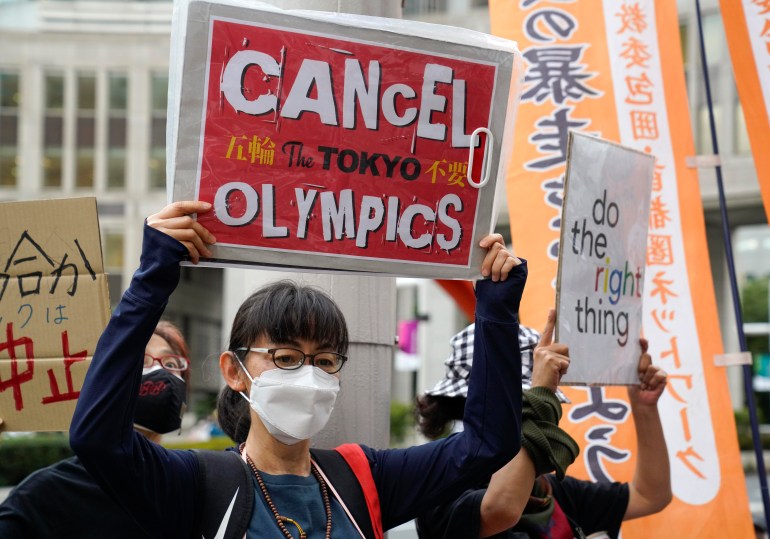
There have been persistent protests against holding the Games with the issue blamed for a relatively poor performance by the ruling party in recent city elections [Kimimasa Mayama/EPA]The organising committee did not immediately respond to an email seeking comment.

Until this week, officials have insisted they could organise the Games safely with some spectators, but a governing party setback in a Tokyo assembly election on Sunday, which some of Suga’s allies attributed to public anger about the Olympics, had forced the change of tack, sources said.

Japan will hold a parliamentary election later this year and the government’s insistence that the Games – already postponed by a year because of the pandemic – should go ahead could cost it support at the ballot box, they said.

SOURCE: REUTERS


Tokyo to be put under state of emergency for duration of 2020 Olympic Games

Measure increases the likelihood that the Games in Japan will be held without a single spectator


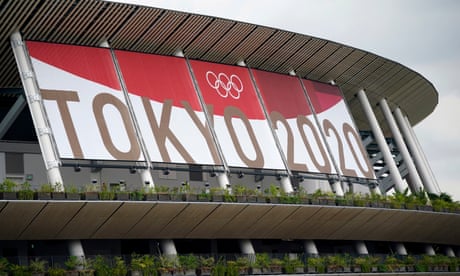
Japan is set to place Tokyo under a state of emergency starting next week and lasting through the Olympic Games. Photograph: Shinji Kita/A

Justin McCurry in Tokyo
THE GUARDIAN
Thu 8 Jul 2021 

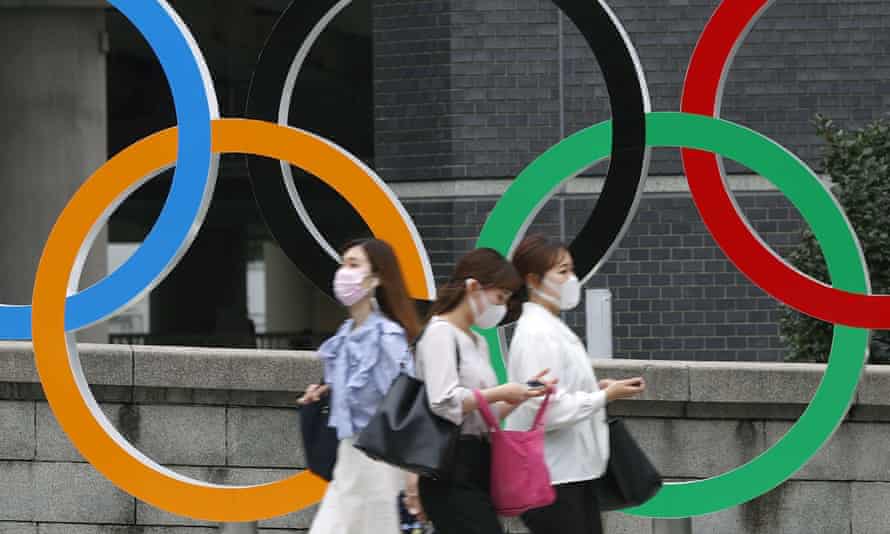
Japan’s government is to declare a state of emergency in Tokyo that will be in force during the Olympics, as the capital battles a sharp rise in coronavirus infections.

The measure, expected to be made official by the prime minister, Yoshihide Suga, later on Thursday, increases the likelihood that the Games will be held without a single spectator.

The latest blow to Japan’s troubled Olympic preparations comes after Tokyo reported 920 new infections on Wednesday. That compares with 714 last Wednesday and is the highest total since 1,010 were reported on 13 May.

The economy minister, Yasutoshi Nishimura, who heads the government’s coronavirus response, said Tokyo’s fourth state of emergency would begin on 12 July – 11 days before the Games open – and end on 22 August, two days before the start of the Paralympics.


Tokyo Olympics: attendance to be slashed at opening ceremony

Weeks of quasi-emergency measures targeting Tokyo’s night-time economy have failed to prevent the latest wave of cases. The government is expected to reimpose an unpopular ban on serving alcohol at bars and restaurants, Japanese media reported.

The emergency declaration in Tokyo – the centre of Japan’s outbreak for much of the pandemic – is an embarrassment for Suga, whose handling of the crisis saw his party perform badly in Tokyo metropolitan assembly elections last weekend.

“Politically speaking, having no spectators is now unavoidable,” a ruling party source told Reuters.

Suga’s insistence that organisers and the International Olympic Committee (IOC) will be able to stage a “safe and secure” Olympics even as cases rise in the host city could further anger voters just a few months out from a general election.

The IOC and the Tokyo 2020 organising committee said last month that attendances would be capped at 50% of a venue’s capacity, or a maximum of 10,000 people.

But Suga and the organising committee’s president, Seiko Hashimoto, said a ban on fans was also an option, depending on the number of virus cases in the host city.

Medical advisers have said for weeks that having no spectators at the Games would be the least risky option, amid public concern that the arrival of tens of thousands of athletes, officials, sponsors reports and support staff could trigger a new wave of infections.


Surge in Covid-19 cases in Tokyo, less than a month out from Olympics

Having banned overseas sports fans, the Olympic movement was pinning its hopes on a limited number Japanese spectators creating a semblance of atmosphere.

But with the opening ceremony just two weeks away, it is looking more likely that competitions will take place in empty venues, including the opening ceremony at the new $1.4bn national stadium. IOC officials, however, could attend in their role as “organisers”, media reports have said.

The IOC, organisers and Japanese government officials were due to meet by the end of the week to discuss spectator numbers. The talks will include the IOC’s president, Thomas Bach, who arrives in Tokyo on Thursday to oversee the last phase of preparations.

Bach, who will self-isolate at his hotel for three days, and other senior IOC officials have drawn criticism for insisting the Games will go ahead regardless of case numbers and pressure on medical services in Tokyo.

Earlier this year, John Coates, an IOC vice-president who is overseeing preparations, said the Games could “absolutely” be held even if Tokyo were under a state of emergency.

Suga has backed the IOC’s push to stage the Games, despite widespread opposition among the Japanese public and warnings from his own chief medical adviser, Shigeru Omi, that the Olympics – combined with the summer holidays and the spread of the more transmissible Delta variant – could spark a surge in infections.

“Infections are in their expansion phase and everyone in this country must firmly understand how serious that is,” Omi told reporters on Wednesday. “The period from July to September is the most critical time for Japan’s Covid-19 measures.”

Japan has reported about 810,000 cases and nearly 14,900 deaths. Only 15% of the population is fully vaccinated, compared with 47.4% in the US and almost 50% in Britain.

Agencies contributed to this report