Sunday, July 11, 2021

Schumer wants NRA investigated for bankruptcy fraud

By MICHAEL BALSAMO and MICHAEL R. SISAK
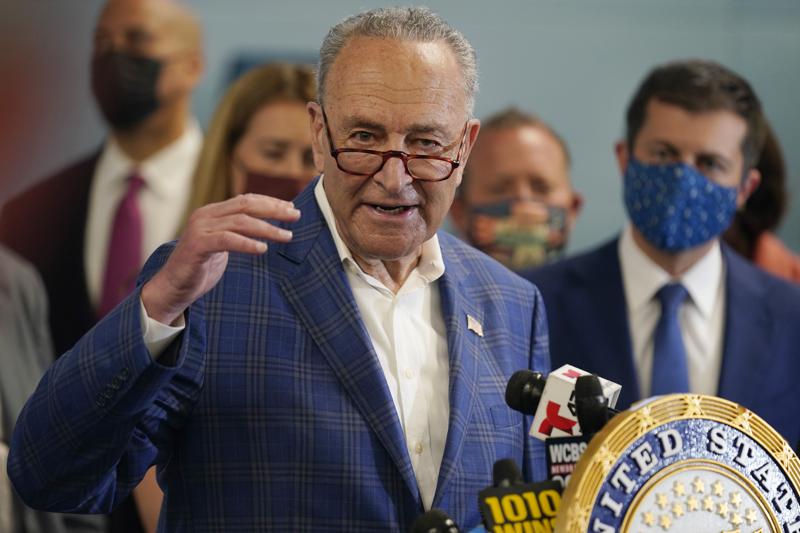
New York Sen. Chuck Schumer speaks during a news conference in New York, Monday, June 28, 2021. Schumer on Sunday, July 11, 2021 called on the Justice Department to investigate the National Rifle Association for bankruptcy fraud, saying the financially stable gun-rights group abused the system when it sought bankruptcy protection in the wake of a New York lawsuit seeking to put it out of business. (AP Photo/Seth Wenig, file)


NEW YORK (AP) — U.S. Senate Majority Leader Chuck Schumer on Sunday called on the Justice Department to investigate the National Rifle Association for bankruptcy fraud, saying the financially stable gun-rights group abused the system when it sought bankruptcy protection in the wake of a New York lawsuit seeking to put it out of business.

A judge rejected the NRA’s bankruptcy case in May, ruling the nonprofit organization had not acted in good faith. NRA leaders made clear that the organization was “in its strongest financial condition in years” and was seeking bankruptcy protection so it could changes its state of incorporation from New York to gun-friendly Texas.

Schumer, a New York Democrat, said the NRA’s continued heavy spending on advertising criticizing proposed gun control measures and the nomination of gun control lobbyist David Chipman to run the Bureau of Alcohol, Tobacco Firearms and Explosives are further evidence that its bankruptcy filing was inspired by legal, not financial, concerns.

“They recently told the judicial branch of government that they are bankrupt after the lawsuit by Tish James, and at the same time they’re saying they’re bankrupt, they’re spending millions of dollars on ads to stop universal background checks,” Schumer said, referencing New York Attorney General Letitia James. “That demands an investigation by the Justice Department.”

The NRA said it was working on a statement. The Justice Department declined comment.

The organization filed for bankruptcy protection in January, months after James sued the NRA, seeking its dissolution over claims that top executives illegally diverted tens of millions of dollars for lavish personal trips, no-show contracts for associates and other questionable expenditures. That lawsuit is ongoing.

In dismissing the NRA’s bankruptcy case, Judge Harlin Hale wrote that it appeared “less like a traditional bankruptcy case in which a debtor is faced with financial difficulties or a judgment that it cannot satisfy and more like cases in which courts have found bankruptcy was filed to gain an unfair advantage in litigation or to avoid a regulatory scheme.”

Schumer, speaking to reporters Sunday, highlighted a $2 million advertising blitz the NRA announced in April, aimed at fighting gun control proposals, while the bankruptcy case was still pending. The organization said it was placing ads on TV and digital platforms, sending out mailers and holding town hall meetings in at least 12 states.

In West Virginia, Schumer said, the organization spent $250,000 on TV ads encouraging people to call U.S. Sen. Joe Manchin, a Democrat, and tell him to reject Chipman’s confirmation. Chipman, a former ATF agent, has worked as a policy adviser at an organization that supports gun control.

“How can you say you’re bankrupt at the same time you have millions of dollars to spend on ads throughout the country trying to prevent universal background checks fundraising and other things that will stop the killings on the streets?” Schumer said.

“The bottom line is the NRA shot itself in the foot when they declared bankruptcy and still have millions of dollars,” he said.
QAnon has receded from social media -- but it’s just hiding

By BARBARA ORTUTAY
July 9, 2021

The Facebook app is shown on a smart phone, Friday, April 23, 2021, in Surfside, Fla. Since the start of the year, Twitter and Facebook have removed tens of thousands of accounts, groups and pages dedicated to the QAnon conspiracy theory. But QAnon is far from winding down. Federal intelligence officials recently warned that its adherents could commit more violence, like the deadly Capitol insurrection on Jan. 6. (AP Photo/Wilfredo Lee)


On the face of it, you might think that the QAnon conspiracy has largely disappeared from big social media sites. But that’s not quite the case.

True, you’re much less likely to find popular QAnon catchphrases like “great awakening,” “the storm” or “trust the plan” on Facebook these days. Facebook and Twitter have removed tens of thousands of accounts dedicated to the baseless conspiracy theory, which depicts former President Donald Trump as a hero fighting a secret battle against a sect of devil-worshipping pedophiles who dominate Hollywood, big business, the media and government.

Gone are the huge “Stop the Steal” groups that spread falsehoods about the 2020 U.S. presidential elections. Trump is gone as well, banned from Twitter permanently and suspended from posting on Facebook until 2023.

But QAnon is far from winding down. Federal intelligence officials recently warned that its adherents could commit more violence, like the deadly Capitol insurrection on Jan. 6. At least one open supporter of QAnon has been elected to Congress. In the four years since someone calling themselves “Q” started posting enigmatic messages on fringe internet discussions boards, QAnon has grown up.

That’s partly because QAnon now encompasses a variety of conspiracy theories, from evangelical or religious angles to alleged pedophilia in Hollywood and the Jeffrey Epstein scandal, said Jared Holt, a resident fellow at the Atlantic Council’s DFRLab who focuses on domestic extremism. “Q-specific stuff is sort of dwindling,” he said. But the worldviews and conspiracy theories that QAnon absorbed are still with us.

Loosely tying these movements together is a general distrust of a powerful, often leftist elite. Among them are purveyors of anti-vaccine falsehoods, adherents of Trump’s “Big Lie” that the 2020 presidential election was stolen and believers in just about any other worldview convinced that a shadowy cabal secretly controls things.

For social platforms, dealing with this faceless, shifting and increasingly popular mindset is a far more complicated challenge than they’ve dealt with in the past.

These ideologies “have cemented their place and now are a part of American folklore,” said Max Rizzuto, another researcher at DFRLab. “I don’t think we’ll ever see it disappear.”

Online, such groups now blend into the background. Where Facebook groups once openly referenced QAnon, you’ll now see others like “Since you missed this in the so called MSM,” a page referencing “mainstream media” that boasts more than 4,000 followers. It features links to clips of Fox News’ Tucker Carlson and to articles from right-wing publications such as Newsmax and the Daily Wire.

Subjects range from allegedly rampant crime to unfounded claims of widespread election fraud and an “outright war on conservatives.” Such groups aim to draw followers in deeper by directing them to further information on less-regulated sites such as Gab or Parler.

When DFRLab analyzed more than 40 million appearances of QAnon catchphrases and related terms on social media this spring, it found that their presence on mainstream platforms had declined significantly in recent months. After peaks in the late summer of 2020 and briefly on Jan. 6, QAnon catchphrases have largely evaporated from mainstream sites, DFRLab found.

So while your friends and relatives might not be posting wild conspiracies about Hillary Clinton drinking children’s blood, they might instead be repeating debunked claims such as that vaccines can alter your DNA.

There are several reasons for dwindling Q talk — Trump losing the presidential election, for instance, and the lack of new messages from “Q.” But the single biggest factor appears to have been the QAnon crackdown on Facebook and Twitter. Despite well-documented mistakes that revealed spotty enforcement, the banishment largely appears to have worked. It is more difficult to come across blatant QAnon accounts on mainstream social media sites these days, at least from the publicly available data that does not include, for instance, hidden Facebook groups and private messages.

While QAnon groups, pages and core accounts may be gone, many of their supporters remain on the big platforms — only now they’re camouflaging their language and watering down the most extreme tenets of QAnon to make them more palatable.

“There was a very, very explicit effort within the QAnon community to to camouflage their language,” said Angelo Carusone, the president and CEO of Media Matters, a liberal research group that has followed QAnon’s rise. “So they stopped using a lot of the codes, the triggers, the keywords that were eliciting the kinds of enforcement actions against them.”

Other dodges may have also helped. Rather than parroting Q slogans, for instance, for a while earlier this year supporters would type three asterisks next to their name to signal adherence to the conspiracy theory. (That’s a nod to former Trump national security adviser Michael Flynn, a three-star general).

Facebook says it has removed about 3,300 pages, 10,500 groups, 510 events, 18,300 Facebook profiles and 27,300 Instagram accounts for violating its policy against QAnon. “We continue to consult with experts and improve our enforcement in response to how harm evolves, including by recidivist groups,” the company said in a statement.

But the social giant will still cut individuals posting about QAnon slack, citing experts who warn that banning individual Q adherents “may lead to further social isolation and danger,” the company said. Facebook’s policies and response to QAnon continue to evolve. Since last August, the company says it has added dozens of new terms as the movement and its language has evolved.

Twitter, meanwhile, says it has consistently taken action against activity that could lead to offline harm. After the Jan. 6 insurrection, the company began permanently suspending thousands of accounts that it said were “primarily dedicated” to sharing dangerous QAnon material. Twitter said it has suspended 150,000 such accounts to date. Like Facebook, the company says its response is also evolving.

But the crackdown may have come too late. Carusone, for instance, noted that Facebook banned QAnon groups tied to violence six weeks before it banned QAnon more broadly. That effectively gave followers notice to regroup, camouflage and move to different platforms.

“If there were ever a time for a social media company to take a stand on QAnon content, it would have been like months ago, years ago,” DFRLabs’ Rizzuto said.
JORDAN IS ALSO PALESTINE
In Jordan sedition trial, U.S. defendant alleges torture

By KARIN LAUB and OMAR AKOUR
yesterday

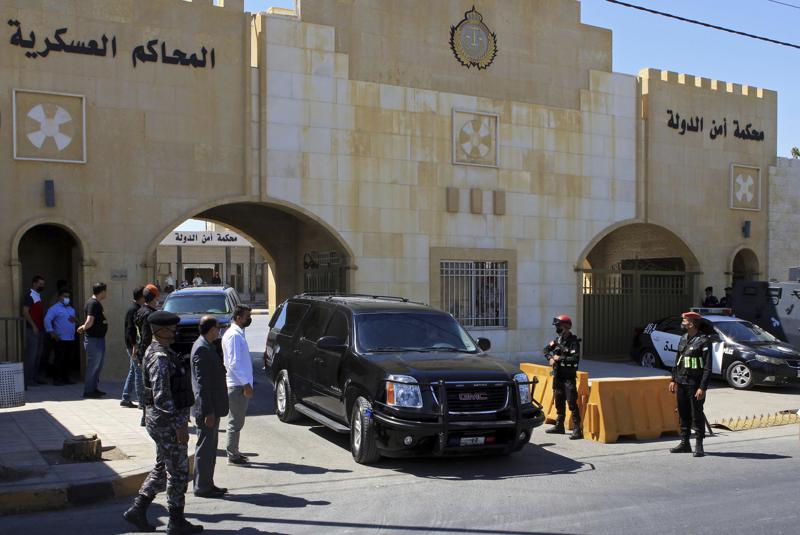
FILE - In this June 21, 2021 file photo, Bassem Awadallah, a former royal adviser, leaves a state security court in a vehicle after the first session of his closed-door trial, in Amman, Jordan. Awadallah, a Jordanian American, alleges he was tortured and fears for his life in Jordanian detention, Michael Sullivan, a U.S. lawyer said Sunday, July 11, 2021, on the eve of a verdict in the high-profile sedition trial linked to a rare public rift in the kingdom's ruling family. (AP Photo/Raad Adayleh, File)

AMMAN, Jordan (AP) — A U.S. citizen and former top aide to Jordan’s King Abdullah II alleged he was tortured in Jordanian detention and fears for his life, his U.S.-based lawyer said Sunday, on the eve of a verdict in the high-profile sedition trial linked to a rare public rift in the kingdom’s ruling family.

Along with the mistreatment allegations, the closed-door trial before Jordan’s state security court “has been completely unfair,” Michael Sullivan, a former federal prosecutor hired by defendant Bassem Awadallah’s U.S.-based family, told The Associated Press.

The allegations of mistreatment, denied by Jordanian officials Sunday, were raised just days before Jordan’s king is to become the first Arab leader to meet with President Joe Biden at the White House on July 19. Jordan is a key Western ally in an unstable Middle East.

Awadallah and co-defendant Sharif Hassan bin Zaid, a distant cousin of the king, have pleaded not guilty to sedition and incitement charges, which carry lengthy prison terms.

The defendants were accused of conspiring with a senior royal — Prince Hamzah, a half-brother of the king — to foment unrest against the monarch while soliciting foreign help. The indictment portrayed Hamzah as a disgruntled royal who never forgave Abdullah for taking away his title of crown prince in 2004. Hamzah, who was placed under house arrest in April and has been seen in public just once since then, denied he incited against the king, saying he was being punished for calling out high-level corruption.

Despite the serious nature of the charges against Awadallah and bin Zaid, the trial ended after just six sessions. The court denied requests by Jordanian defense lawyers to call witnesses and prosecutors only shared purported transcripts, but not audio, from surveillance of the alleged plotters.

The prosecutor’s office at the state security court denied the trial was unfair. Awadallah was “guaranteed due process” in line with Jordanian law, the prosecutor said in a statement to the AP. “He has not been mistreated in any way, and his allegations of torture of any kind are false.”

The U.S. State Department said that U.S. consular officials visited Awadallah five times and that “we also take seriously any allegations of abuse and lack of minimum fair trial guarantees.”

Sullivan, a former U.S. attorney for Massachusetts and former acting director of the federal Bureau of Alcohol, Tobacco, Firearms and Explosives, said that based on the way the trial was conducted, a guilty verdict appeared to be a foregone conclusion. He said any conviction would be appealed.

The U.S. legal team, which has remained in the background until now, will play a more open role in the appeals stage, said Sullivan. He said the aim is to raise awareness about Awadallah’s case in the United States and internationally. This includes “the serious concerns about his safety and security in the short term and the complete unfairness in terms of the process, as well as obviously the torture and violation of a number of international conventions, treaties and laws,” Sullivan said.

The prosecutor’s office said Awadallah didn’t raise torture allegations during the court hearings, his 17 meetings with his Jordanian lawyer or the first four meetings with U.S. consular officials in Jordan. “He only made these claims at his most recent meeting with the consul, as the ruling’s pronouncement (verdict) neared,” the statement said.

Sullivan said Awadallah told his visitor that he had been been beaten, subjected to electrical shock and was threatened with future mistreatment “if he didn’t confess.”

The prosecutor’s office said Awadallah gave a voluntary statement about the case, denying it had been extracted by force.

Awadallah’s family said late last week that he fears for his life. “Bassem is justifiably fearful of being killed in prison after the sentencing, especially because he held several high ranking and sensitive positions in the Jordanian government,” the family said.

Awadallah, who also holds Jordanian and Saudi citizenship, served as head of the royal court and government minister in Jordan. He has extensive business interests in the Gulf and has advised Saudi Arabia’s powerful crown prince, Mohammed bin Salman, on attracting foreign investment.

The Awadallah family urged the Biden administration to call for Awadallah’s release.

Laub reported from Berlin, Germany.
Gangs complicate Haiti effort to recover from assassination
By DÁNICA COTO and EVENS SANON
yesterday

1 of 7
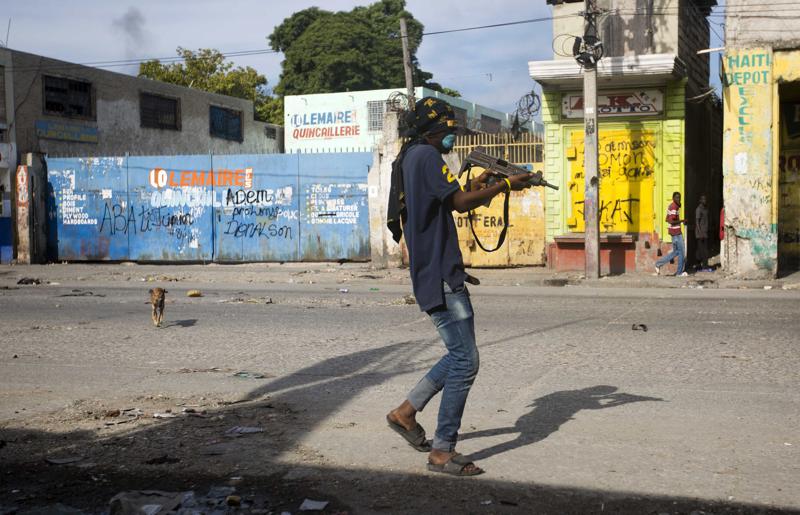
FILE - In this Nov. 21, 2018 file photo, an armed civilian carries a weapon on during a shootout between rival gangs to take control of the Croix-des-Bossales market, on Boulevard Jean-Jacques Dessalines, a main commercial artery, in Port-au-Prince, Haiti, Wednesday, Nov. 21, 2018. The fight for control of the market, where vendors pay the controlling gang regular payments, erupted amid days of protests and a strike against alleged government corruption. (AP Photo/Dieu Nalio Chery, File)

PORT-AU-PRINCE, Haiti (AP) — Gangs in Haiti have long been financed by powerful politicians and their allies — and many Haitians fear those backers may be losing control of the increasingly powerful armed groups who have driven thousands of people from their homes as they battle over territory, kill civilians and raid warehouses of food.

The escalation in gang violence threatens to complicate — and be aggravated by — political efforts to recover from last week’s brazen slaying of President Jovenel Moïse. Haiti’s government is in disarray; no parliament, no president, a dispute over who is prime minister, a weak police force. But the gangs seem more organized and powerful than ever.

While the violence has been centered in the capital of Port-au-Prince, it has affected life across Haiti, paralyzing the fragile economy, shuttering schools, overwhelming police and disrupting efforts to fight the COVID-19 pandemic.

“The country is transformed into a vast desert where wild animals engulf us,” said the Haitian Conference of the Religious in a recent statement decrying the spike in violent crime. “We are refugees and exiles in our own country.”

Gangs recently have stolen tens of thousands of bags of sugar, rice and flour as well as ransacking and burning homes in the capital. That has driven thousands of people to seek shelter at churches, outdoor fields and a large gymnasium, where the government and international donors struggle to feed them and find long-term housing.

Those included dozens of disabled people who were forced to flee last month when gangs set fire to the encampment where they settled after being injured in the catastrophic 2010 earthquake.

“I was running for my life in the camp on these crutches,” said 44-year-old Obas Woylky, who lost a leg in the quake. “Bullets were flying from different directions. ... All I was able to see was fire in the homes.”

He was among more than 350 people crammed into a school converted into a makeshift shelter where hardly anyone wore face masks against disease.

A cigarette dangled from the mouth of an older woman who washed clothes in a large bowl while a group of children took turns flicking a single blue marble. Nearby, a teenage girl crouched next to an elderly blind man sitting on the concrete floor and lifted a small bag of water to his mouth.

Experts say the violence is the worst they’ve seen since in roughly two decades — since before the creation of a second U.N. peacekeeping mission in 2004.

Programs aimed at reducing gang activity and an influx of aid following the earthquake helped quell some of the problem, but once that money dried up and aid programs shut down, gangs turned to kidnappings and extortion from businesses and neighborhoods they control.

Gangs are in part funded by powerful politicians, a practice recently denounced even by one of its reputed beneficiaries — Jimmy Cherizier, a former police officer who heads a gang coalition known as G9 Family and Allies.

He complained that the country is being held “hostage” by people he did not identify: “They reign supreme everywhere, distribute weapons to the populous quarters, playing the division card to establish their domination.”

Cherizier, known as “Barbecue,” has been linked to several massacres and his coalition is believed to be allied with Moïse’s right-wing party. He criticized those he called “bourgeois” and “exploiters,” adding: “We will use our weapons against them in favor of the Haitian people. ... We’re ready for war!”

Cherizier held a news conference on Saturday and called Moïse’s killing “cowardly and villainous,” saying that while many disagreed with him, “no one wanted this tragic outcome that will worsen the crisis and amplify political instability.”

He also issued a veiled warning: “We invite all those who are trying to take advantage of this coup to think carefully, to consider whether they have in their hands the appropriate solution to the country’s problems.”

Cherizier added that he and others will demand justice for Moïse: “We are just now warming up.”

G9 is one of at least 30 gangs that authorities believe control nearly half of Port-au-Prince. Their names range from “5 Seconds” — for how long it allegedly takes them to commit a crime — to “400 Mawozo” — which roughly translated means 400 lame men.

The epicenter of the recent gang violence is Martissant, a community in southern Port-au-Prince whose main road connects the capital to southern Haiti. Drivers’ fear of caught in a crossfire or worse has almost paralyzed commercial connections between the two regions, driving up prices, delaying the transportation of food and fuel and forcing international organizations to cancel programs including the distribution of cash to more than 30,000 people, according to a July 1 report by the U.N.’s Office for the Coordination of Humanitarian Affairs.

The agency said more than 1 million people need immediate humanitarian assistance and protection.

“Newly displaced people seek refuge in shelters every day,” it said, adding that hygiene there was “appalling.” Authorities worry about a spike in COVID-19 cases in a country that has yet to give a single vaccine.

“Escalating violence on an almost daily basis is expected to last for some time,” the agency said in a report.

The overall economy doesn’t help. The U.N. said the cost of a basic food basket rose by 13% in May compared with February, and that foreign direct investment fell by more than 70% from 2018 to 2020, dropping from $105 million to $30 million. That translates into fewer jobs and increased poverty in a country where 60% of the population makes less than $2 a day and 25% less than $1 a day.

Many also worry that the gangs could derail elections scheduled for September and November — a contest crucial to restoring functional legislative and executive branches now largely moribund in the wake of Moïse’s slaying.

But Haiti’s elections minister, Mathias Pierre, said Saturday that those backing the gangs may want to disrupt the elections. Such periods commonly see an upsurge in violence as groups try to use fear to nullify rivals’ advantages.

He said that wouldn’t work this time, noting that countries have held elections even during wars. “We need to organize elections. ...They need to back off.”

Haiti’s Office of the Protection of Citizens, a sort of ombudsman agency, has urged the international community to help Haiti’s National Police, which it said was “unable to respond effectively to the gangsterization of the country.”

Pierre said that lack of resources and weakness of Haiti’s police led the government to ask the United States and United Nations to send troops to help maintain order following Moïse’s killing: “We have a responsibility to avoid chaos.”

Officials say they have been trying to boost the budget and manpower of a police force that now has about 9,000 operational officers for a country of more than 11 million people. Experts say it needs at least 30,000 officers to maintain control.

The government also is trying to figure out where to put people who have fled their homes due to violence, such as 43-year-old Marjorie Benoit, her husband and their three children.

Benoit, who lost an arm in the earthquake, said they fled as gunfire crackled around their neighborhood. She now also has lost her home and all their belongings.

“We have been uprooted,” she said, “and we don’t know where to start.”
VDH: Data shows that vaccinated people rarely die from COVID

RICHMOND, Va. (AP) — The Virginia Department of Health says that only 17 people who were fully vaccinated against the coronavirus have died of the disease in the state since January.

The Virginian-Pilot reported Sunday that the new data indicates that unvaccinated Virginians make up more than 99% of COVID-related illnesses and fatalities this year.

It’s a fact that public health officials hope will persuade people who are unvaccinated to get their shots.

State Health Commissioner Norman Oliver urged more Virginians to get vaccinated in a statement on Friday.

“I applaud those who have chosen to protect themselves and the community by getting vaccinated,” he said, “and we appreciate the work of all who are helping to vaccinate Virginians.”

Public health officials say vaccines will be the most effective tool at ending the pandemic. It has killed more than 11,400 Virginians and infected at least half a million.

Cases have started ticking up again in several health districts. And public health officials say the delta variant is gaining ground in Virginia, leaving undervaccinated pockets of the state vulnerable.
Bath Iron Works seeks assurances of more Naval destroyer orders


Deputy Defense Secretary Kathleen Hicks, C, visited Bath Iron Works Bath, Maine, this week, at a time the company fears a reduction in orders for Navy destroyers will lead to layoffs. Photo courtesy of Department of Defense


July 9 (UPI) -- Shipyards could suffer if the U.S. Navy does not order additional Arleigh Burke-class destroyers, Deputy Defense Secretary Kathleen Hicks was told this week.

Hicks visited Bath Iron Works in Maine, a General Dynamics subsidiary founded in 1884 whose primary customer is the U.S. Navy, and the Naval Sea Systems Command's Portsmouth, N.H., Naval Shipyard, to discuss a decrease in orders for Navy destroyers, the Pentagon said on Friday.

The trips were part of an assessment Hicks conducted this week of modernization and innovation efforts at several Pentagon installations.

In its 2022 budget, the Navy asked Congress to fund construction of only one destroyer, down from two requested in 2021, although last week the House Appropriations Committee returned the second ship to the military budget.

RELATEDKeel laid for USS Harvey Barnum destroyer at Bath Iron Works

Bath Iron Works executives are concerned that the low order will cause layoffs among experienced workers capable of building the Navy's newest destroyer, the DDG(X) class.

The new destroyers are designed to succeed the Arleigh Burke-class destoryers.

"There's no overlap between the current projected end of the [Arleigh Burke] program and the start of DDG(X)," Jon Mason, Bath Iron Works' vice president for human resources at the shipyard, told Defense One.

RELATEDNavy defends call for 1 destroyer in 2022 budget, tells Congress new contract coming

"And the challenges that that will create from an industrial base standpoint is what we really wanted to convey in these discussions here today," Mason said.

The Navy's long-term goals include a reduction in the older destroyers to about 65, down from the 90 currently at sea -- some of which are ready for decommissioning and retirement.

Bath Iron Works has requested orders for construction of at least 15 destroyers, beginning in 2023.

RELATEDFuture USS Inouye completes builder's trials after 4 days at sea

It currently has six Arleigh Burke-class ships under construction, and one Zumwalt-class ship.

Thirty-two Zumwalt-class ships were originally planned by the Navy, a number later reduced to seven and then to three.

Without new orders, the company has projected layoffs of 2,500 workers, of a workforce of about 7,000 people.

Maine's congressional delegation has advocated restoration of funding for new ships.

In June, Bath Iron Works was visited by Rep. Joe Courtney, D-Conn., chairman of the House Armed Services Subcommittee on Seapower and Projection Forces, who is in favor of restoring construction of the previously-eliminated Arleigh Burke destroyer.

Ethiopia’s Abiy Ahmed gets his Pyrrhic victory

Ethiopian PM has prevailed in his first electoral contest, but there is little to celebrate given the country’s dire state, analysts say.

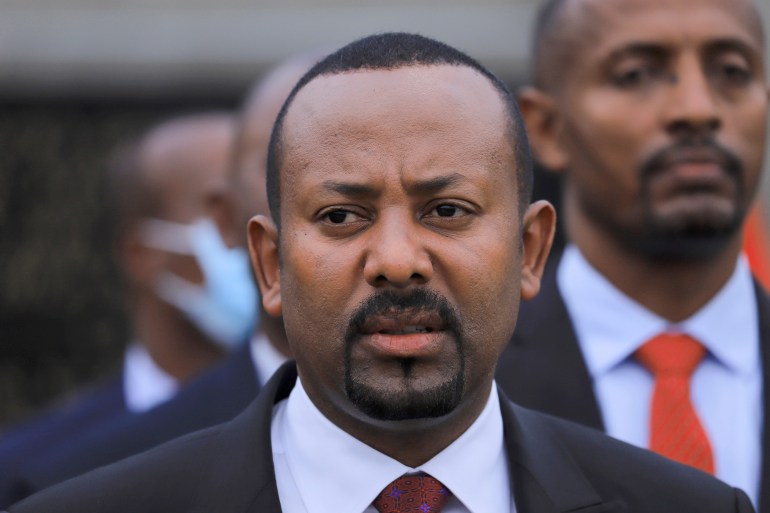
On Saturday, the election board announced a landslide victory of Prime Minister Abiy Ahmed's party in his first electoral contest on June 21 [File: Tiksa Negeri/Reuters]

By James Jeffrey
11 Jul 2021

After months of setbacks – including being twice delayed – Ethiopia has had its election.

Originally scheduled for August 2020, it was postponed until June 5 due to the coronavirus pandemic. It was delayed again to enable more time to tackle voter registration problems and other electoral challenges across African’s second-most populous country, eventually taking place on June 21.

On Saturday, the National Electoral Board of Ethiopia (NEBE) announced that the party of Prime Minister Abiy Ahmed had won a landslide victory in his first electoral contest.

Hailing what he described as an “historic” election, Abiy said his Prosperity Party (PP) was “happy that it has been chosen by the will of the people to administer the country”.

The election’s belated completion is undoubtedly a significant moment, even as the polls were overshadowed by an opposition boycott, the conflict in the northern Tigray region and instability elsewhere. The NEBE channelled a lot of money and effort to overcome myriad obstacles and hold an election during a pandemic.

“I think that NEBE has done a reasonable job in difficult circumstances and may have created the kind of institution and precedents that Ethiopia needs,” said Terrence Lyons at George Mason University’s Jimmy and Rosalynn Carter School for Peace and Conflict Resolution.

But, at the same time, observers say, there is no escaping how numerous restrictions that characterised the election, and that were unrelated to COVID-19, speak to far larger fault lines running throughout Ethiopia. It means Abiy, who swept to power in 2018 on the back of years of anti-government protests, has little reason to savour the victory.

At stake, some say, remains not only Ethiopia’s democratic revival and break from its authoritarian past, but potentially the country’s survival as a nation state.

“Far from supplying legitimacy to the government and stability to the country, the election — boycotted by opposition parties and undertaken amid a war — is likely to pull Ethiopia further apart, to calamitous effect,” Tsedale Lemma, the founder of Addis Standard, an independent monthly magazine in Ethiopia, wrote in an op-ed in The New York Times on the election day.
‘Reshaping Ethiopia’

One of the most glaring problems with the election was it did not include Tigray, which represents 38 seats in the national parliament of 547 constituencies. Home to six million people, the region has been mired in eight months of catastrophic conflict pitting the federal government and its Eritrean allies against the Tigray People’s Liberation Front (TPLF), Tigray’s former governing party which also used to dominate national politics until Abiy took office.

Many other Ethiopians also did not participate in the election due to worsening security in the Oromia, Benishangul-Gumuz and Amhara regions, from which 64 constituencies have to wait until the second round of voting due on September 6, while there has been no date set for polls in Tigray, whose capital, Mekelle, was recently recaptured by forces loyal to TPLF. Ethiopia’s long-term ally, the United States, which has already spoken out over Tigray, has warned the exclusion of so many voters risks undermining confidence in the process

In addition to what some of Abiy’s critics say is yet another failure to deliver free and fair elections that fundamentally undermines the government’s legitimacy, the biggest issue at the heart of Ethiopia’s ongoing ructions remains the dispute over the nature of the Ethiopian state, which is metastasising in the form of the Tigray conflict that remains Abiy’s most immediate and greatest challenge, even as his government announced a unilateral ceasefire until September.

It all hinges on the balance of power between the federal centre and the regions, and the role of ethnolinguistic identity groups in the federal system.

“The big unknown going forward is whether Abiy’s victory encourages him to consolidate power and deploy the kinds of authoritarian means he has been using — arresting opposition, human rights violations, refusing negotiations with those he perceives to be his enemies — or will it allow him to relax, recognise that his mandate is now secure, and to take the opportunity to reach out and begin a process that is more inclusive and recognises that there are constituencies that have real grievances and oppose him,” says Lyons, noting that many believe Abiy would lean towards the first option.

Among the proponents of this more pessimistic view are Matt Bryden, director of Sahan, a research think-tank focused on the Horn of Africa. He says the most likely scenario is Abiy “will claim that the election was Ethiopia’s best and that he now has an even stronger mandate to pursue his agenda”, including the war in Tigray, and “reshaping Ethiopia as a more centralised autocracy”.

Salvaging Ethiopia’s democratic transition hinges on Abiy instigating a national dialogue to reform the current federal system that is no longer fit for purpose, argues Tewodrose Tirfe, chair of the Amhara Association of America, a US-based advocacy group for the Amhara, Ethiopia’s second-largest ethnic group.

Reforms needed

“The ethnic federalism system is hardly a nation-building project and has evidently become a system that is encouraging separatism,” Tewodrose says.

“If Ethiopia does not reform the ethnic apartheid system that leaves millions of Ethiopians stateless if they live outside of their ‘ethnic homeland’, Ethiopia will not be able to realise true democracy and take advantage of its enormous natural potential and population size.”

But others, such as Crisis Group’s Ethiopia specialist William Davison, argue that while the federal design contains defects, it is important to remember the federal system was created in 1994 in response to sustained armed resistance from various liberation fronts to homogenising tendencies — of the sort that Abiy is once again displaying.

At the end of 2019, Abiy dissolved the Ethiopian People’s Revolutionary Democratic Front (EPRDF) ruling alliance that had dominated Ethiopia politics since 1991, merging the ethnically based regional parties — apart from the TPLF that refused to join—into a single, national entity: the PP.

Since then, critics say Abiy and his new party appear just as disinclined as the EPRDF towards ruling in a genuinely democratic manner. Davison notes that some among the Oromo — Ethiopia’s biggest ethnic group — are increasingly incensed by Abiy’s governance. The two main Oromo opposition parties boycotted the election amid increasing unrest in Oromia.

“The current violent blowback indicates that Abiy and his allies cannot achieve peace and prosperity for all Ethiopians by imposing their vision and party on Ethiopia using the coercive power of the state,” says Davison, noting Ethiopia’s internal strife leaves the country weaker and more fragile than it has been for decades.

This is not lost on the likes of Sudan and Egypt that have long-running disagreements with Ethiopia over the Grand Ethiopian Renaissance Dam (GERD) project as well as, in Sudan’s case, a territorial border dispute.

It is also not lost on Eritrea and its longtime ruler Isaias Afwerki to Tigray’s north. All the while, on the international stage Ethiopia is likely to find itself increasingly isolated and at odds with its supporters, says Bryden.

The precarious situation for Ethiopia and the wider region is made all the worse, Davison says, by the “extreme toxicity” between the main political actors involved, polarised perspectives and “unwillingness to compromise”.

The election does nothing to change these dynamics. To avoid a continuation along the current violent trajectory requires, Davison says, Abiy should accept the dire need to bring everyone around the table — an option that so far he has shown no sign of being willing to consider — to hash out a compromise. It would be a difficult discussion, Davison says, but the alternative for Ethiopia is “far, far worse”, with others like Bryden agreeing there is a real risk of Ethiopia fragmenting further and even sliding towards state failure.

“I am always reluctant to predict the end of Ethiopia, since it looked pretty bad in early 2018 as well, and the state often manages to muddle through crisis after crisis,” Lyons says. “But it does not look good.”

SOURCE: AL JAZEERA


U.S. Navy controls inventions that claim to change "fabric of reality"

Inventions with revolutionary potential made by a mysterious aerospace engineer for the U.S. Navy come to light.

U.S. Navy ships

Credit: Getty Images
  • U.S. Navy holds patents for enigmatic inventions by aerospace engineer Dr. Salvatore Pais.
  • Pais came up with technology that can "engineer" reality, devising an ultrafast craft, a fusion reactor, and more.
  • While mostly theoretical at this point, the inventions could transform energy, space, and military sectors.

The U.S. Navy controls patents for some futuristic and outlandish technologies, some of which, dubbed "the UFO patents," came to light recently. Of particular note are inventions by the somewhat mysterious Dr. Salvatore Cezar Pais, whose tech claims to be able to "engineer reality." His slate of highly-ambitious, borderline sci-fi designs meant for use by the U.S. government range from gravitational wave generators and compact fusion reactors to next-gen hybrid aerospace-underwater crafts with revolutionary propulsion systems, and beyond.

Of course, the existence of patents does not mean these technologies have actually been created, but there is evidence that some demonstrations of operability have been successfully carried out. As investigated and reported by The War Zone, a possible reason why some of the patents may have been taken on by the Navy is that the Chinese military may also be developing similar advanced gadgets.

Among Dr. Pais's patents are designs, approved in 2018, for an aerospace-underwater craft of incredible speed and maneuverability. This cone-shaped vehicle can potentially fly just as well anywhere it may be, whether air, water or space, without leaving any heat signatures. It can achieve this by creating a quantum vacuum around itself with a very dense polarized energy field. This vacuum would allow it to repel any molecule the craft comes in contact with, no matter the medium. Manipulating "quantum field fluctuations in the local vacuum energy state," would help reduce the craft's inertia. The polarized vacuum would dramatically decrease any elemental resistance and lead to "extreme speeds," claims the paper.

Not only that, if the vacuum-creating technology can be engineered, we'd also be able to "engineer the fabric of our reality at the most fundamental level," states the patent. This would lead to major advancements in aerospace propulsion and generating power. Not to mention other reality-changing outcomes that come to mind.

Among Pais's other patents are inventions that stem from similar thinking, outlining pieces of technology necessary to make his creations come to fruition. His paper presented in 2019, titled "Room Temperature Superconducting System for Use on a Hybrid Aerospace Undersea Craft," proposes a system that can achieve superconductivity at room temperatures. This would become "a highly disruptive technology, capable of a total paradigm change in Science and Technology," conveys Pais

High frequency gravitational wave generator.

Credit: Dr. Salvatore Pais

Another invention devised by Pais is an electromagnetic field generator that could generate "an impenetrable defensive shield to sea and land as well as space-based military and civilian assets." This shield could protect from threats like anti-ship ballistic missiles, cruise missiles that evade radar, coronal mass ejections, military satellites, and even asteroids.

Dr. Pais's ideas center around the phenomenon he dubbed "The Pais Effect". He referred to it in his writings as the "controlled motion of electrically charged matter (from solid to plasma) via accelerated spin and/or accelerated vibration under rapid (yet smooth) acceleration-deceleration-acceleration transients." In less jargon-heavy terms, Pais claims to have figured out how to spin electromagnetic fields in order to contain a fusion reaction – an accomplishment that would lead to a tremendous change in power consumption and an abundance of energy

According to his bio in a recently published paper on a new Plasma Compression Fusion Device, which could transform energy production, Dr. Pais is a mechanical and aerospace engineer working at the Naval Air Warfare Center Aircraft Division (NAWCAD), which is headquartered in Patuxent River, Maryland. Holding a Ph.D. from Case Western Reserve University in Cleveland, Ohio, Pais was a NASA Research Fellow and worked with Northrop Grumman Aerospace Systems. His current Department of Defense work involves his "advanced knowledge of theory, analysis, and modern experimental and computational methods in aerodynamics, along with an understanding of air-vehicle and missile design, especially in the domain of hypersonic power plant and vehicle design." He also has expert knowledge of electrooptics, emerging quantum technologies (laser power generation in particular), high-energy electromagnetic field generation, and the "breakthrough field of room temperature superconductivity, as related to advanced field propulsion."

Suffice it to say, with such a list of research credentials that would make Nikola Tesla proud, Dr. Pais seems well-positioned to carry out groundbreaking work.

A craft using an inertial mass reduction device.

Credit: Salvatore Pai

The patents won't necessarily lead to these technologies ever seeing the light of day. The research has its share of detractors and nonbelievers among other scientists, who think the amount of energy required for the fields described by Pais and his ideas on electromagnetic propulsions are well beyond the scope of current tech and are nearly impossible. Yet investigators at The War Zone found comments from Navy officials that indicate the inventions are being looked at seriously enough, and some tests are taking place.

If you'd like to read through Pais's patents yourself, check them out here.

Laser Augmented Turbojet Propulsion System

Credit: Dr. Salvatore Pais


Edward O. Wilson: Science, Not Philosophy, Will Explain the Meaning of Existence

Biologist Edward O. Wilson tackles the meaning of life and existence. He argues that explaining why we're here, what we are, and where we're going is a task best suited to science, not philosophy. He identifies five major scientific branches that are currently making the most progress.


Biologist Edward O. Wilson, a two-time Pulitzer Prize recipient and the author of the new book The Meaning of Human Existenceknew that it was vital that he define "meaning" early on in his book, lest he be attacked by a hornet's nest of philosophers. Thus, he identifies the meaning of meaning as:

What are we and why?

Where do we come from?

Where are we most likely to be headed?

Wilson believes those questions cannot be explained with religion for two reasons. First, because every religious faith has a different creation story that, almost categorically, is in competition with every other creation story. Second, because every religious faith is a product of human culture. To assume that human culture can explain meaning is to put a whole lot of trust in introspection, yet Wilson says we can't discover meaning just by thinking about it. The facts lie elsewhere.

This is also why Wilson believes philosophy is ill-equipped to tackle the meaning of existence. In fact, the storied biologist has few kind words for the field as a whole:

"I like to say that most of philosophy, which is a declining and highly endangered academic species, incidentally, consists of failed models of how the brain works. So students going into philosophy have to learn what Descartes thought and then after a long while why that's wrong and what Schopenhauer might have thought and what Kant might of thought or did think. But they cannot go on from that position and historical examination of the nature of humanity to what it really is and how we might define it."

Wilson concludes then that, by default, the task of explaining meaning necessarily falls to science. There are five disciplines in particular which he identifies as the leaders in determining meaning:

1. Evolutionary biology: "That is, biology seen in a historical context going all the way back millions of years to the origin of the human species."

2. Paleontology: "Which segues as we come closer to modern humanity and the invention of agriculture and the birth of the Neolithic period turns into archaeology. So archaeology and paleontology, which are on a different time scale, is the other discipline, a second discipline."

3. Neuroscience: "It's progressing so rapidly in so many ways."

4. Artificial Intelligence: "Coming out of brain science or running parallel to it and trading with it and depending upon it and driving from it."

5. Robotics: "The notion of studying the mind in perfecting artificial intelligence, and more than that; creating what the artificial intelligence and robotics people call whole brain emulation. That is using robots as avatars and creating robots that are by design an imitation of what we know about the brain more and more like humans."

The five disciplines above serve as bridges "to tell us what the meaning of humanity is." Wilson calls it the product of a grand epic, the full story of humanity. Together, they will explain what we are, where we came from, and where we're going.

Pancakes and protests: Politicians met with conflict at several Calgary Stampede breakfasts


Mark VillaniCTV News Calgary Video Journalist
Published Saturday, July 10, 2021


CALGARY -- Politicians were flipping flapjacks with pride and promising better days ahead as the Calgary Stampede marks Canada’s first major event to fully open up with nearly zero restrictions.

A series of pancake breakfasts on Saturday morning saw thousands gather for the traditional celebration in what Premier Jason Kenney hopes to be a symbol of Alberta’s path to fully reopening.

“I'm glad people are embracing Alberta being open for summer and I believe with the vaccines we're open for good,” Kenney said.

“It's just a great feeling to get back in touch with friends, family and community.”

Although, not everyone is embracing a sense of togetherness.

Several protesters taunted Kenney and Health Minister Tyler Shandro outside of a breakfast at Calgary’s Trico Centre.

Many of them held up signs in frustration of COVID-19 restrictions that halted surgeries during the COVID-19 pandemic, while others said their rights were taken away during Alberta’s lockdown.

As the pair flipped pancakes, members from the protest group taunted them and shouted protests.

Politicians like Shandro say those comments have been all too familiar over the course of the last couple of years, but he hopes tensions will calm as Alberta continues to reopen.

“I think COVID has, on both sides of the political spectrum, made a lot of folks anxious and I think we're going to see as we continue to go throughout the reopening of the province, going into recovery moving from pandemic that anxiety will calm down,” Shandro said.

When Kenney was asked about his response to the protesters he said, “they should switch to decaf.”

“It's a democracy, people are free to share their views but these are the same people that attacked Minister Shandro's young children last week.”

'RAGING GRANNIES' FIGHT FOR NURSES AND END TO COAL MINING


While thousands of people enjoyed the taste of buttermilk pancakes and sausages, several protesters gathered outside of a pancake breakfast at Marlborough Mall Saturday morning for a peaceful demonstration.

A non-partisan group called the ‘Calgary Raging Grannies’ sang songs and held signs in protest of pay cuts to Alberta health-care workers.


“It’s despicable,” said group organizer, Rebecca Brown.


“They were heroes a little while ago and suddenly it’s a three per cent payback and a five per cent cut to their benefits and retroactive so they want us to pay it back too?”

Brown adds that several doctors, nurses, and frontline health-care workers have had cancelled vacations, been exposed to outbreaks and lost sick pay.

“A lot of nurses work part-time so the politicians go off with saying they’re earning all this money, but a lot of them are not so a cut in their pay could mean a serious deficit,” she said.

Meanwhile, other protesters fought against coal mining and for the protection of the eastern slopes of the Rocky Mountains.

Benita Estes drove in from High River, Alta. Saturday morning for the protest to send a message to federal and provincial politicians attending the breakfast.

“We still have a huge fight on our hands,” Estes said.

“For the people that live in southern Alberta, they’re going to ruin our water and this is our agricultural lands, something that we rely on for irrigation. People come from all around the world to see these mountains, they're not going to want to see a bunch of coal dusted lands.”

O'TOOLE: 'I WILL HAVE THEIR BACK'

Federal Opposition Leader, Erin O’Toole arrived in Calgary to attend the Stampede Breakfast at Marlborough Mall Saturday morning where he was greeted by several people wishing to take photos with him and share their thoughts on Conservative policies.

O’Toole spoke briefly to the crowd and, upon leaving the event, shared a brief comment with CTV News as a potential federal election looms for Canadians this fall.

“This is the greatest outdoor show on Earth and it's so good to see this province and the country reopening,” O’Toole said.

“I'm really proud of what Albertans have done for this country over the last generation, and will have their back, so it's great to be here.”


Erin O'Toole was met with admirers looking for a photo with the Conservative leader at a northeast Calgary Stampede breakfast.


Protesters heckled Premier Jason Kenney and Health Minister Tyler Shandro at one Stampede breakfast Saturday, calling them out over Alberta's COVID-19 restrictions.
Autonomous drones learn to find 'hidden' meteorite impact sites


Jon Fingas
·Associate Editor
Sat., July 10, 2021


It's easy to find large meteorites (or their craters) once they've reached Earth, but the smaller ones often go neglected — scientists recover fewer than 2 percent of them. Soon, however, it might just be a question of sending a robot to do the job. Universe Today reports that researchers have developed a system that has autonomous drones use machine learning to find the smaller meteorites in impact sites that are either 'hidden' (even if observers traced the fall) or simply inaccessible.

The technology uses a mix of convolutional neural networks to recognize meteorites based on training images, both from online images as well as staged shots from the team's collection. This helps the AI distinguish between space rocks and ordinary stones, even with a variety of shapes and terrain conditions.

The results aren't flawless. While a test drone did correctly spot planted meteorites, there were also some false positives. It could be a while before robotic aircraft are trustworthy enough to provide accurate results all on their own.

The implications for space science are significant if the technology proves accurate, though. It would help scientists spot and potentially recover meteorites that are either too small to find or too remote. That, in turn, could help pinpoint meteorite sources and identify the rocks' compositions. Simply put, drones could fill gaps in humanity's understanding of the cosmic debris that lands at our doorstep.
Massive solar storm heading towards Earth at 1.6 million kmph may impact cell phone, GPS signals

A hole has opened up in the Sun's atmosphere and is spewing a stream of solar wind in Earth's direction.


WRITTEN BY
DNA Web Team
EDITED BY
Karishma Jain
DNA webdesk Updated: Jul 11, 2021, 08:27 PM IST

A fierce solar storm is moving towards the Earth at a speed of 1.6 million kilometers per hour. It is feared that this storm may hit the Earth either on Sunday or Monday, due to which there may be a power failure around the world.

According to the website SpaceWeather.com, the storm has originated from the Sun's atmosphere. A hole has opened up in the Sun's atmosphere and is spewing a stream of solar wind in Earth's direction.

Direct effect on radio signals

ALSO READ
Sun blasts biggest solar flare since 2017, causes shortwave radio blackout

According to the website, satellite signals can also be interrupted due to this collision. It can also have a direct effect on radio signals, communication and weather. Not only this, the storm can have a significant impact on a region of space dominated by Earth's magnetic field.

As per the US space agency, NASA, the speed of the solar storm could increase from 1.6 million kilometres per hour.

ALSO READ
Shocking! Solar flares may shut down radio signals and cause navigation blackouts, experts warn

Can cause interference in mobile phone signals

This can heat the Earth's outer atmosphere, which will have a direct effect on satellites. It can cause interference in GPS navigation, mobile phone signals and satellite TV, current in power lines can be increased. However, this is rarely the case because the Earth's magnetic field acts as a protective shield.

X1.5-class flare


According to the Space Weather Prediction Centre of the United States, the impact of the solar flare will be centered on sub-solar point on the sunlit side of Earth. NASA has classified this flare as an X1.5-class flare.

X-class denotes the most intense flares, while the number provides more information about its strength. An X2 is twice as intense as an X1, an X3 is three times as intense, etc.

Due to the solar storm, people living at the North or South Pole will be able to see a view of beautiful celestial lighting (auroras) at night.

Historically, solar storms have been known to plunge parts of the world into chaos. A solar storm in March 1989 caused a nine-hour blackout Hydro-Québec's electricity transmission system in Canada.


Sculpted by Starlight: An Unusual Meteorite Witness to the Solar System’s Birth

Carina Nebula Acfer 094

The Carina Nebula, where newborn stars are irradiated by intense ultraviolet light from nearby massive stars – possibly similar to the environment which birthed our solar system – is pictured over a fragment of Acfer 094. (Carina nebula image: NASA; ESA; N. Smith, University of California, Berkeley; and The Hubble Heritage Team (STScI/AURA). Acfer 094 image: Ryan Ogliore. Credit: Ryan Ogliore, Washington University in St. Louis

Researchers use unusual meteorite to gain insight into our solar system’s past, present.

In 2011, scientists confirmed a suspicion: There was a split in the local cosmos. Samples of the solar wind brought back to Earth by the Genesis mission definitively determined oxygen isotopes in the sun differ from those found on Earth, the moon and the other planets and satellites in the solar system.

Early in the solar system’s history, material that would later coalesce into planets had been hit with a hefty dose of ultraviolet light, which can explain this difference. Where did it come from? Two theories emerged: Either the ultraviolet light came from our then-young sun, or it came from a large nearby star in the sun’s stellar nursery.

Now, researchers from the lab of Ryan Ogliore, assistant professor of physics in Arts & Sciences at Washington University in St. Louis, have determined which was responsible for the split. It was most likely light from a long-dead massive star that left this impression on the rocky bodies of the solar system. The study was led by Lionel Vacher, a postdoctoral research associate in the physics department’s Laboratory for Space Sciences.

Their results are published in the journal Geochimica et Cosmochimica Acta.

“We knew that we were born of stardust: that is, dust created by other stars in our galactic neighborhood were part of the building blocks of the solar system,” Ogliore said.

“But this study showed that starlight had a profound effect on our origins as well.”

Tiny time capsule

All of that profundity was packed into a mere 85 grams of rock, a piece of an asteroid found as a meteorite in Algeria in 1990, named Acfer 094. Asteroids and planets formed from the same presolar material, but they’ve been influenced by different natural processes. The rocky building blocks that coalesced to form asteroids and planets were broken up and battered; vaporized and recombined; and compressed and heated. But the asteroid that Acfer 094 came from managed to survive for 4.6 billion years mostly unscathed.

“This is one of the most primitive meteorites in our collection,” Vacher said. “It was not heated significantly. It contains porous regions and tiny grains that formed around other stars. It is a reliable witness to the solar system’s formation.”

Acfer 094 is also the only meteorite that contains cosmic symplectite, an intergrowth of iron-oxide and iron-sulfide with extremely heavy oxygen isotopes — a significant finding.

The sun contains about 6% more of the lightest oxygen isotope compared with the rest of the solar system. That can be explained by ultraviolet light shining on the solar system’s building blocks, selectively breaking apart carbon monoxide gas into its constituent atoms. That process also creates a reservoir of much heavier oxygen isotopes. Until cosmic symplectite, however, no one had found this heavy isotope signature in samples of solar system materials.

With only three isotopes, however, simply finding the heavy oxygen isotopes wasn’t enough to answer the question of the origin of the light. Different ultraviolet spectra could have created the same result.

“That’s when Ryan came up with the idea of sulfur isotopes,” Vacher said.

Sulfur’s four isotopes would leave their marks in different ratios depending on the spectrum of ultraviolet light that irradiated hydrogen sulfide gas in the proto-solar system. A massive star and a young sun-like star have different ultraviolet spectra.

Cosmic symplectite formed when ices on the asteroid melted and reacted with small pieces of iron-nickel metal. In addition to oxygen, cosmic symplectite contains sulfur in iron sulfide. If its oxygen witnessed this ancient astrophysical process — which led to the heavy oxygen isotopes — perhaps its sulfur did, too.

“We developed a model,” Ogliore said. “If I had a massive star, what isotope anomalies would be created? What about for a young, sun-like star? The precision of the model depends on the experimental data. Fortunately, other scientists have done great experiments on what happens to isotope ratios when hydrogen sulfide is irradiated by ultraviolet light.”

Sulfur and oxygen isotope measurements of cosmic symplectite in Acfer 094 proved another challenge. The grains, tens of micrometers in size and a mixture of minerals, required new techniques on two different in-situ secondary-ion mass spectrometers: the NanoSIMS in the physics department (with assistance from Nan Liu, research assistant professor in physics) and the 7f-GEO in the Department of Earth and Planetary Sciences, also in Arts & Sciences.

Putting the puzzle together

It helped to have friends in earth and planetary sciences, particularly David Fike, professor of earth and planetary sciences and director of Environmental Studies in Arts & Sciences as well as director of the International Center for Energy, Environment and Sustainability, and Clive Jones, research scientist in earth and planetary sciences.

“They are experts in high-precision in-situ sulfur isotope measurements for biogeochemistry,” Ogliore said. “Without this collaboration, we would not have achieved the precision we needed to differentiate between the young sun and massive star scenarios.”

The sulfur isotope measurements of cosmic symplectite were consistent with ultraviolet irradiation from a massive star, but did not fit the UV spectrum from the young sun. The results give a unique perspective on the astrophysical environment of the sun’s birth 4.6 billion years ago. Neighboring massive stars were likely close enough that their light affected the solar system’s formation. Such a nearby massive star in the night sky would appear brighter than the full moon.

Today, we can look to the skies and see a similar origin story play out elsewhere in the galaxy.

“We see nascent planetary systems, called proplyds, in the Orion nebula that are being photoevaporated by ultraviolet light from nearby massive O and B stars,” Vacher said.

“If the proplyds are too close to these stars, they can be torn apart, and planets never form. We now know our own solar system at its birth was close enough to be affected by the light of these stars,” he said. “But thankfully, not too close.”

Reference: “Cosmic symplectite recorded irradiation by nearby massive stars in the solar system’s parent molecular cloud” by Lionel G. Vacher, Ryan C. Ogliore, Clive Jones, Nan Liu and David A. Fike, 25 June 2021, Geochimica et Cosmochimica Acta.
DOI: 10.1016/j.gca.2021.06.026

This work was supported by the McDonnell Center for Space Sciences at Washington University in St. Louis and NASA grant NNX14AF22G.


17 million gallons of sewage spill into ocean, close miles of LA beaches


Dockweiler State Beach, pictured here in March 2020, was closed for swimming Monday after 17 million gallons of sewage spilled into the ocean. File Photo by Jim Ruymen/UPI | License Photo

July 13 (UPI) -- Miles of beaches along the Southern California coast in the Los Angeles area remained closed on Tuesday after 17 million gallons of sewage leaked into the Pacific Ocean.

Officials said the sewage came from the Hyperion treatment plant and spilled into Santa Monica Bay on Sunday.

As a result, about 4 miles of beaches were closed Monday to swimmers and surfers.

"Water samples are being tested and I'm getting more information about the scope of the problem," Los Angeles County Supervisor Janice Hahn tweeted. "Beaches from El Segundo to the Dockweiler RV Park are closed for swimming."

The Los Angeles County Department of Public Health closed off the affected areas and said the beaches will stay closed until test results are "confirmed negative for elevated bacteria."

"Public Health officials are advising residents to avoid contact with ocean water in the affected areas," the department said in a statement. "Beach users are advised to stay out of the water until the advisory is removed."

The Hyperion Water Reclamation Plant is Los Angeles' largest and oldest sewage treatment facility and can handle about 450 million gallons of water each day.

"The plant's relief system was triggered and sewage flows were controlled through use of the plant's one-mile outfall and discharge of untreated sewage into Santa Monica Bay," Executive Plant Manager Timeyin Dafeta said, according to USA Today.