It’s possible that I shall make an ass of myself. But in that case one can always get out of it with a little dialectic. I have, of course, so worded my proposition as to be right either way (K.Marx, Letter to F.Engels on the Indian Mutiny)
Tuesday, December 30, 2025
Platinum price set for biggest monthly gain in 39 years on EU auto policy boost
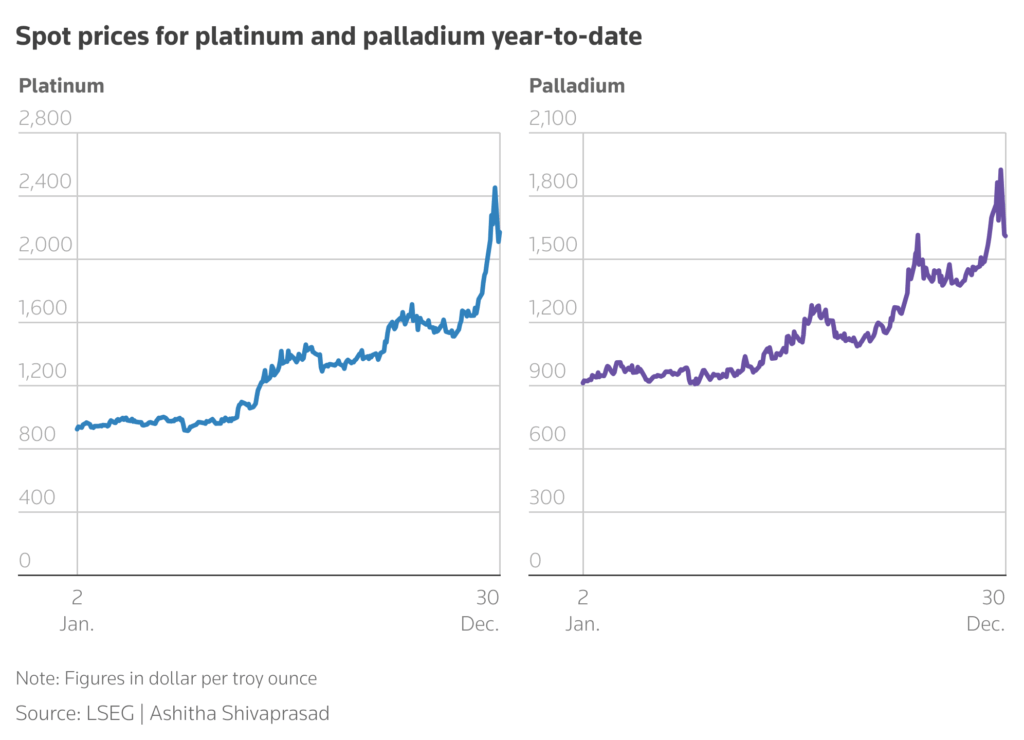
Platinum prices are on track for their strongest monthly rally in nearly four decades in December, fuelled by the EU’s U-turn on its 2035 combustion-engine ban, a tight supply backdrop and rising investment demand for precious metals.
Platinum and palladium, both used in autocatalysts that reduce car exhaust emissions, have surged this year as US tariff uncertainty and a rally in gold and silver helped offset long-term headwinds from the rise of electric vehicles.
The EU’s plan unveiled in December is “a steroid jab for PGMs, prolonging their use in catalytic converters”, analysts at Mitsubishi said.
“Not only is the extension indefinite, but the EU will require ongoing tighter emission levels, which by extension will require higher PGM loadings.”
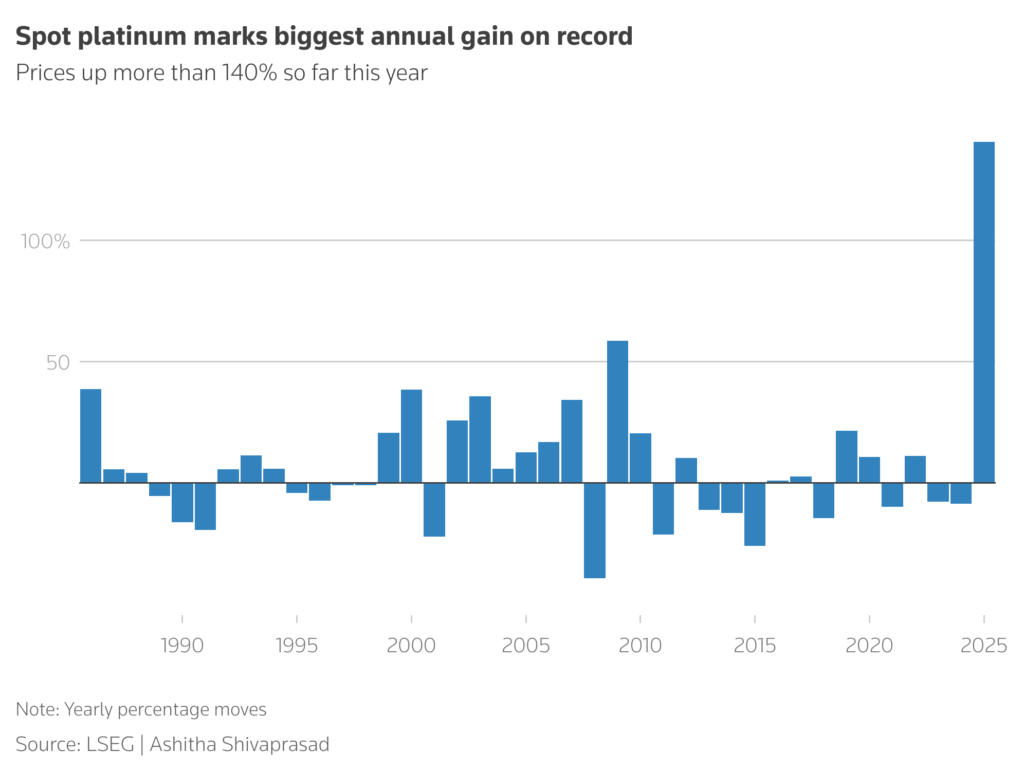
Platinum, also used in other industries such as jewellery, is up 33% so far in December, its biggest jump since 1986, according to LSEG data.
After hitting a record high of $2,478.50 per ounce on Monday, the metal is heading for its biggest yearly growth on record of 146%. Its sister metals, palladium and rhodium, are up 80% and 95% respectively so far in 2025.
Both platinum and palladium also benefited from defensive stock-building and tighter supply in the regional physical markets due to outflows to the US as Washington included the metals on the US critical minerals list.
The market expects more clarity on US tariffs in January.
The start of PGMs futures trading in China a month ago gave another boost, attracting heavy speculative flows and prompting the Guangzhou Futures Exchange to adjust price limits.
These contracts are the first domestic price-hedging mechanism for the PGMs in the world’s second-largest economy, which is also the top PGMs consumer, relying heavily on imports.
“If Chinese spot import buying remains elevated, the major test for platinum group metals will likely come after there is clarity on US tariffs,” Macquarie analysts said.
(By Ashitha Shivaprasad, Pablo Sinha, Sherin Elizabeth Varghese and Polina Devitt; Editing by Jan Harvey)
Nickel price hits nine-month high as Indonesia plans to cut output
Nickel smelter in Sorowako, Indonesia. (Image by Marcelo Coelho, courtesy of Vale).
Nickel hit the highest since March after top producer Indonesia flagged plans to cut supply in order to boost prices.
Output will be reduced in 2026 to better match demand with supply, said Energy and Mineral Resources Minister Bahlil Lahadalia, according to CNBC Indonesia. The Southeast Asian country’s production of the metal, which is used in both stainless steel and electric vehicle batteries, has surged this decade to almost 70% of the world’s total.
Nickel is still among this year’s weaker performers on the London Metal Exchange as demand from the battery sector continues to disappoint due to the rise of alternative chemistries. Supply from Indonesia has continued to rise even as prices dragged for much of the year, causing stockpiles in warehouses tracked by the LME to rise rapidly.
Indonesian production is now central to the outlook for nickel prices next year. The government is able to control supply by tightening the issuance of mining quotas, known locally as RKABs.
Nickel rose as much as 4.7% to $16,560 a ton on the LME, extending a rally that tracked other metals from mid-December.
Copper price racks up longest rally since 2017 with bulls at the helm
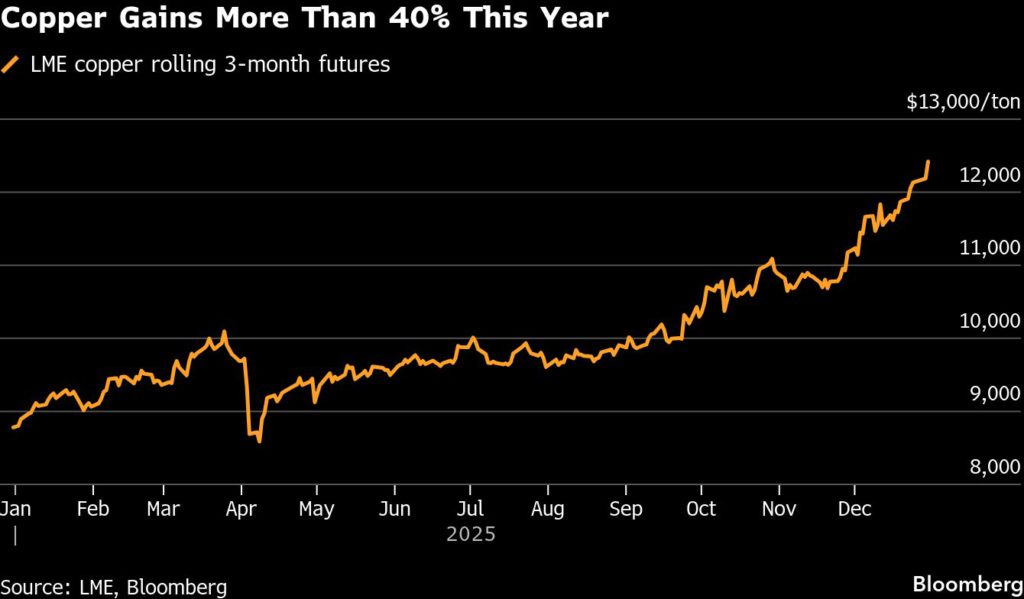
Copper recorded the longest winning run since 2017 in a December rally powered by the prospect of more stress in the supply chain.
The metal rose 2.7% to settle at $12,558.50 a ton, the eighth day of gains, with positive sentiment showing resilience. Traders have been rushing metal to the US in anticipation of potential tariffs, tightening the market in the rest of the world.
Copper hit a record just below $13,000 a ton Monday in an end-of-year surge, before paring gains. Futures have rallied by more than 40% this year, setting up the biggest annual advance since 2009. A weaker US dollar — which makes metals less costly for buyers in other currencies — also has helped to bolster the gains, with a gauge of the greenback losing about 8% in 2025.
Supply issues have dominated metals this year, with copper mines from Indonesia and Chile to the Democratic Republic of the Congo suffering accidents. Aluminum production, meanwhile, is under threat from higher energy costs and supply limits in China, while zinc mines have also been disrupted.
For copper, it’s the threat of US import tariffs that remain the major driver. Mercuria Energy Group Ltd. warned in November there would be an extreme shortage of the metal in the rest of the world in 2026.
In the coming months, copper is likely “to be led by sentiment from investors over US copper specific tariffs, with focus on regional levels of global stocks and material entering the US, rather than underlying global fundamentals,” according to Natalie Scott-Gray, senior metals analyst at StoneX Financial Ltd.
The premium for March copper futures on Comex over comparable contracts on the London Metal Exchange has come down in recent days, but inventories in the US exchange are still rising, she said. Along with a “warming” macroeconomic outlook and supply risks, “the narrative hasn’t changed for copper with this perfect storm situation” seen throughout the fourth quarter, Scott-Gray said.
All other metals on the exchange rose, led by nickel, after top producer Indonesia flagged plans to cut supply in order to boost prices
Silver price: Here’s what to watch for after wild ride past $80
Silver’s exceptional volatility in recent days has captured the zeitgeist — with even the likes of Elon Musk drawing attention to the metal’s ferocious rally to all-time highs.
The metal rose to a record above $84 an ounce early Monday, before promptly crashing close to $70 in thin, post-holiday trading. It was one of silver’s largest price reversals ever.
Prices remain up more than 150% this year. Now the big question is: where does silver go from here?
Here are key charts to watch in the silver market to evaluate what happens next.
Chinese buying
Surging investor interest in China has been a key driver of silver prices in recent days. Speculators piled into the precious metal, mirroring a similar dynamic playing out in platinum. Elevated buying in the Shanghai Gold Exchange’s silver contract in December has pushed premiums to a record high, dragging other international benchmarks along.
The blistering rally provoked the country’s only pure-play silver fund to turn away new customers last week, after repeated risk warnings went unheeded. The fund’s manager announced the unusual step Friday after multiple actions — from tighter trading rules to cautionary advice about “unsustainable” gains — failed to quell an eruption of interest fueled by social media.
ETF inflows
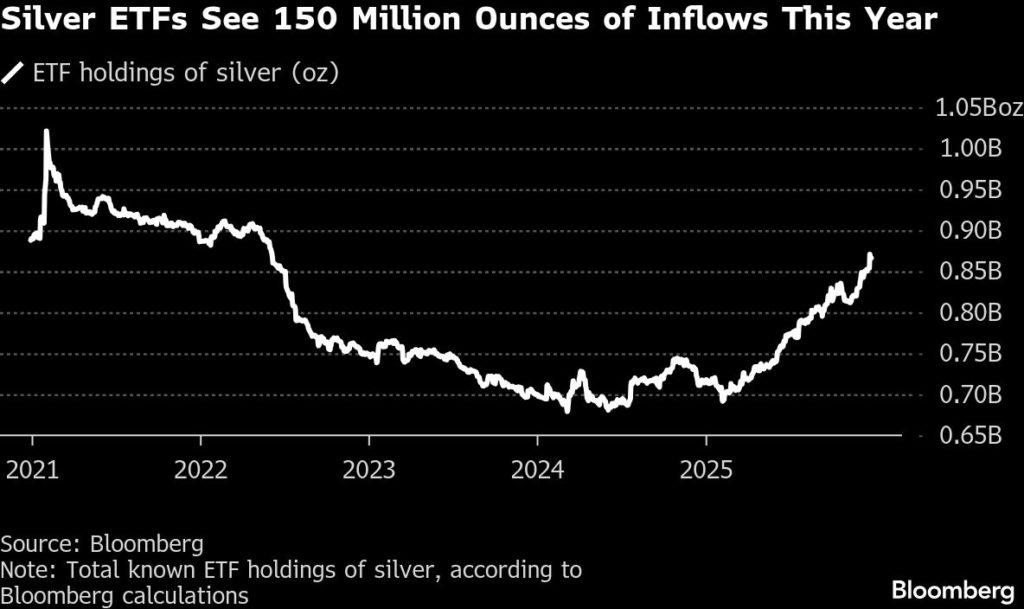
Holdings in physical-backed silver exchange-traded funds have surged this year, rising by more than 150 million ounces. The total amount of metal held by the funds is still below a peak set during a Reddit-driven retail investment surge in 2021, but the inflows have been instrumental in eroding available supplies in an already tight market. Holdings in the funds have risen every month but one this year, according to Bloomberg calculations.
Technical indicators, margins
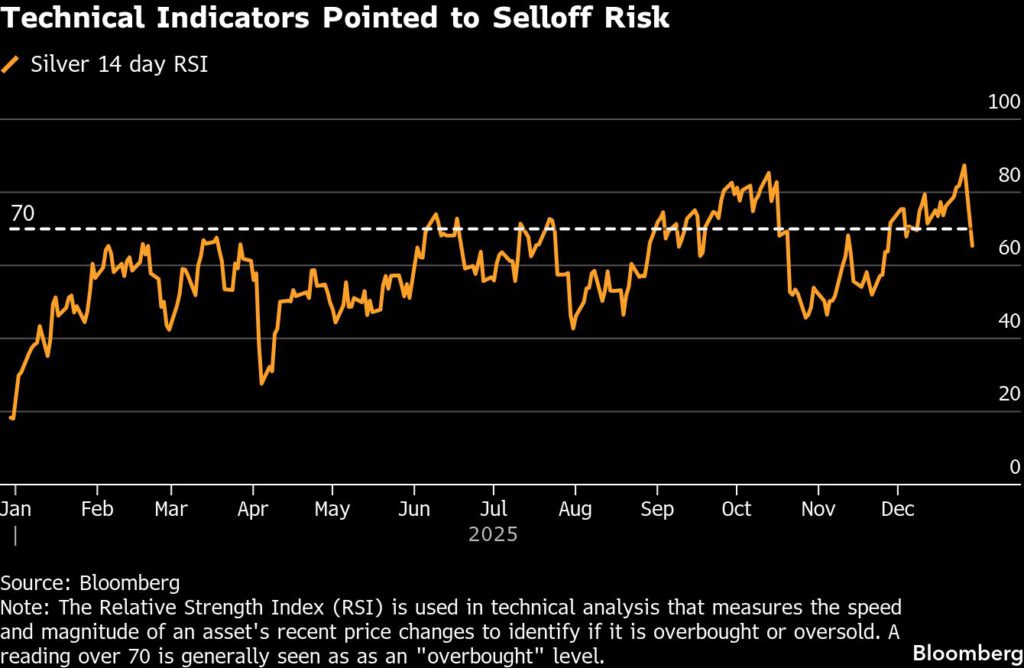
Silver prices jumped more than 25% in December alone, on track for the biggest monthly increase since 2020. The speed of the gains meant some technical indicators were signaling that prices had run too far, too quickly. The metal’s relative strength index — a gauge of buying and selling momentum — has stayed above 70 for most of the past few weeks. A reading higher than 70 usually indicates that too many investors bought silver in a short period.
Some exchanges are moving to rein in risk amid heightened volatility. The margins for some Comex silver futures contracts will be raised from Monday, according to a statement from CME Group Inc. That’s adding to headwinds since traders will need to put up more cash to keep their positions open. Some speculators won’t want to do that and will be forced to shrink or close their trades instead.
Options frenzy
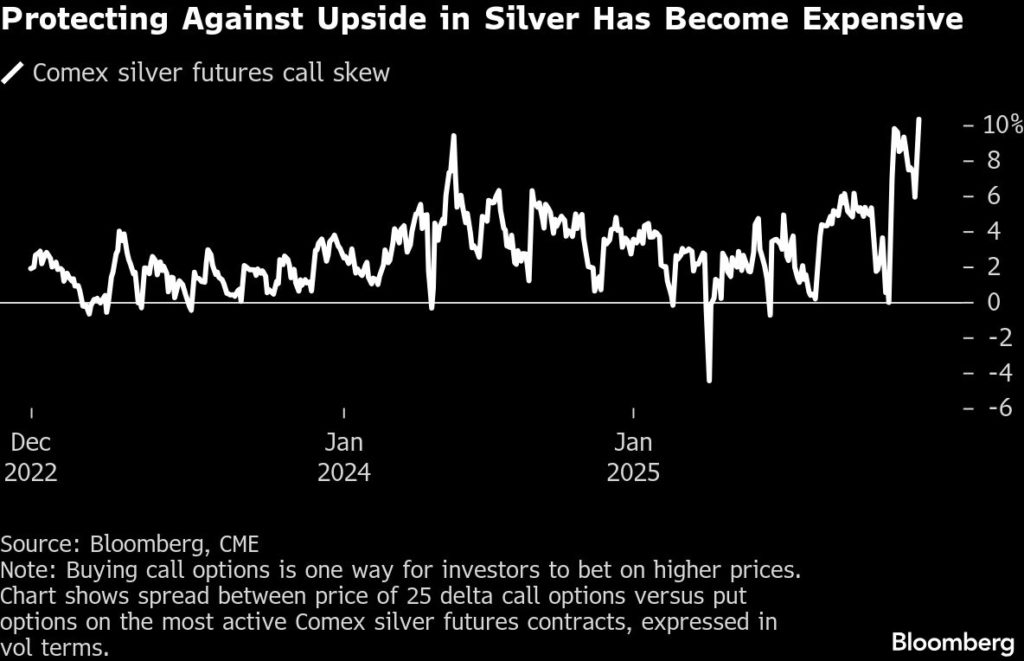
One indication of speculative fervor has been the level of buying for call options, both on silver futures and related ETFs. Call options, which give the buyer the ability to buy a security at a pre-determined price level, are typically seen as a cheap way to bet on market upside.
For iShares Silver Trust (SLV), the largest silver ETF, total call volume hit the highest since 2021 last week. The cost of buying calls on silver futures relative to the cost of buying equivalent puts, which protect against price declines, also jumped to historical highs in December.
Borrowing costs
Thanks to a tariff-related trade, much of the world’s available silver still remains in New York warehouses. Meanwhile, the market is awaiting the outcome of a US Section 232 probe into critical minerals, which could lead to levies or other trade restrictions on the metal.
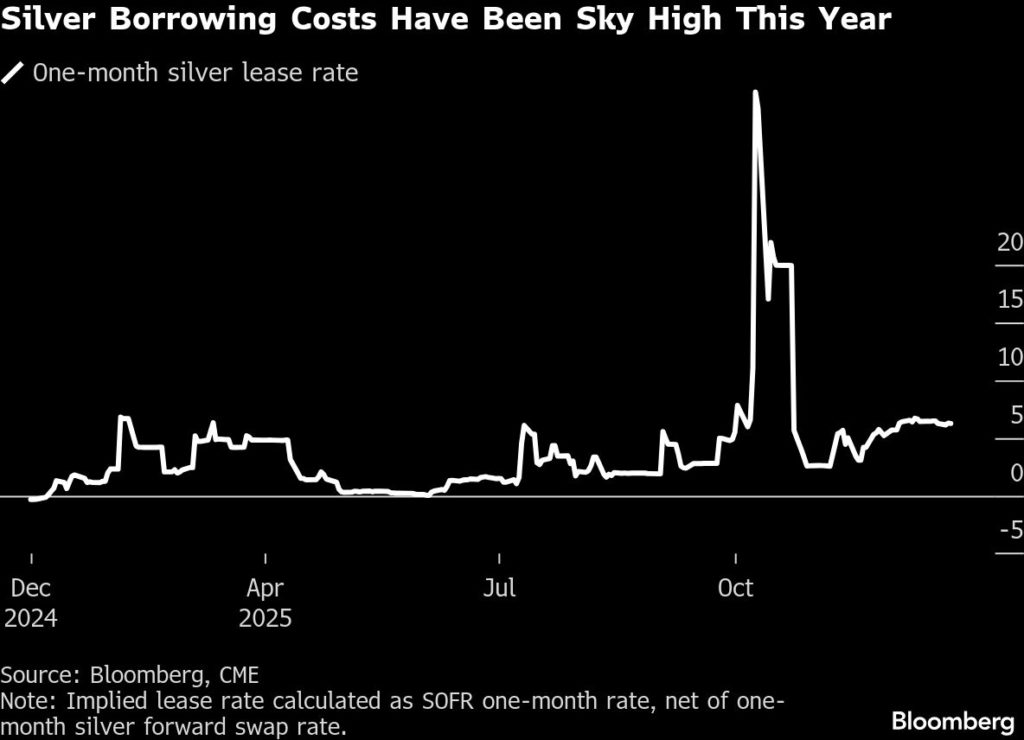
The surge of metal into the US pushed the London market into a full blown squeeze in October, and borrowing costs there still remain well above their normal levels of close to zero. That helped set the stage for increased volatility and frequent price spikes.
Catching up with gold
Precious metals generally have seen a surge in investment demand this year, supported by a sagging US dollar, President Donald Trump’s aggressive moves to remake global trade and threats to the Federal Reserve’s independence.
Gold was the first to rally, benefiting additionally from strong buying by global central banks. Some market watchers hold as a rule of thumb that when gold makes a decisive move, silver will eventually move twice as far in the same direction — this year, of course, they would have been right.
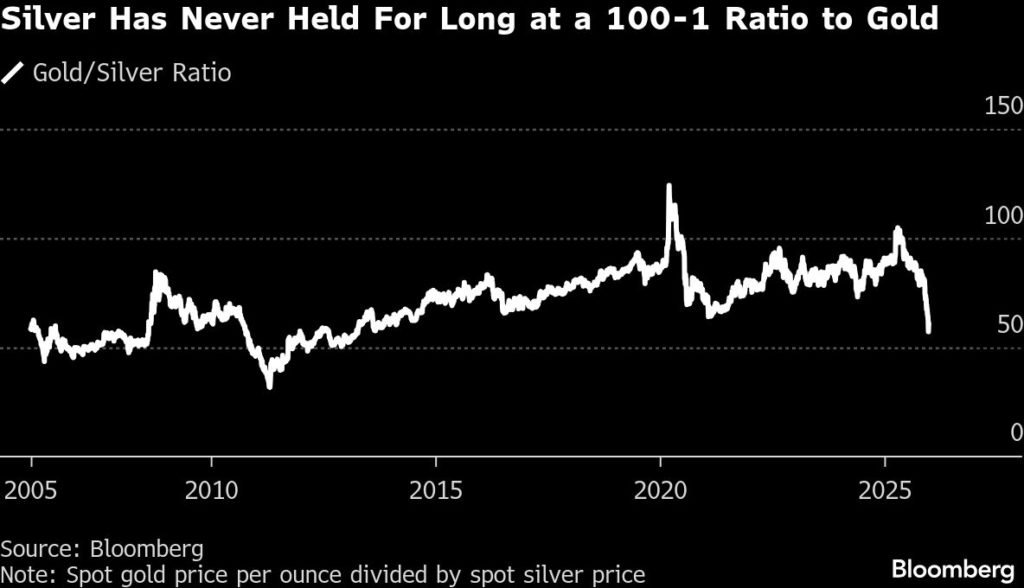
Many investors also track the ratio between the two commodities. After gold’s initial surge in the early months of this year, that ratio stretched above 100 to 1, signaling to some that it was time to buy the white metal. But in recent weeks, the ratio has rapidly shifted lower.
(By Jack Ryan)
BAN DEEP SEA MINING
ISA rules leave seabed mining stuck without benefit sharing
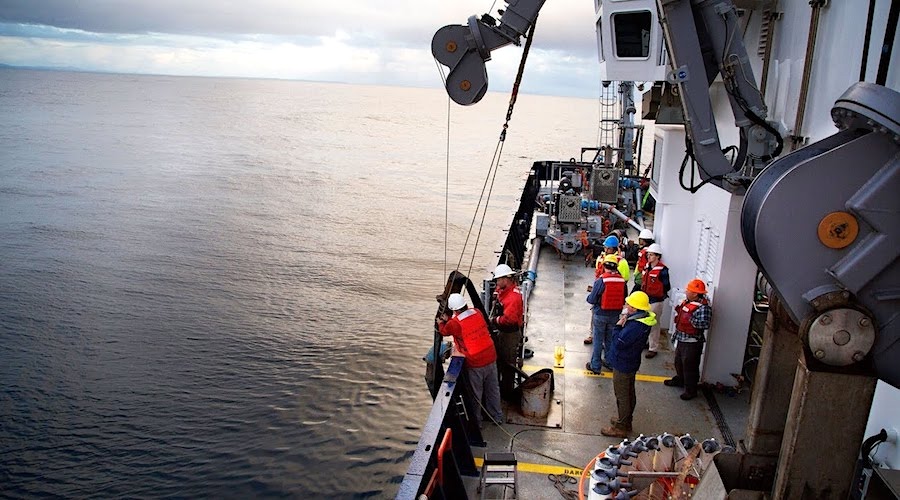
Research team studying the environmental impacts of deep-sea mining. (Image courtesy of Global Sea Mineral Resources.)
The International Seabed Authority (ISA), a UN body that manages mineral-related activities in the deep sea, cannot lawfully approve deep seabed mining without first adopting benefit-sharing rules, a core treaty obligation that remains unresolved despite mounting pressure to launch commercial extraction, legal experts say.
Debate over deep seabed mining has largely focused on when the ISA, a UN-established body overseeing mineral activities beyond national jurisdiction, will finalize long-negotiated exploitation regulations, particularly since Nauru triggered the so-called two-year rule in 2021 to accelerate the process.
Mining companies and some states argue that adopting those rules would clear the way for commercial activity. but legal scholars Aline Jaeckel and Erik van Doorn say the UN Convention on the Law of the Sea (UNCLOS) makes clear that exploitation rules alone are insufficient.
UNCLOS designates the seabed beyond national jurisdiction as the common heritage of humankind and requires the ISA to ensure that financial and economic benefits from mining are shared equitably. That obligation must be met through a distinct set of benefit-sharing regulations, which remain at an early stage of development.
Support for restraint has grown. As of December 2025, about 40 countries back a moratorium on deep seabed mining, citing environmental uncertainty and governance gaps. Scientific studies have added weight to those concerns, including trials showing steep declines in seabed animal abundance and diversity following disturbance. Several governments have slowed or halted plans, with Norway pausing its deep-sea mining ambitions amid domestic and international opposition.
Legal hurdle
Under UNCLOS, authority over benefit sharing rests with the ISA Assembly, not the Council. The Assembly must approve the regulations and decide how benefits are distributed, a process separate from and slower than adoption of exploitation rules. Unlike other regulations, benefit-sharing provisions cannot be applied provisionally.
Without clear rules on who benefits and how, states cannot judge whether seabed mining meets the treaty requirement of serving humankind as a whole. African nations have repeatedly warned that mining should proceed only if it demonstrably delivers shared benefits, arguing that past extractive models funnelled wealth to industrialized states while leaving others behind.
The issue has taken on new urgency as geopolitical interest in seabed minerals intensifies. The US, which is not a party to UNCLOS, has pushed to access critical minerals from the ocean floor, raising alarms among treaty members.
Companies are also repositioning. US defence giant Lockheed Martin (NYSE: LMT) has revived Pacific seabed mining plans through its UK subsidiary, even as regulatory uncertainty persists.
California-based Impossible Metals has applied for exploration rights both under US law and through the ISA, targeting the Clarion-Clipperton Zone (CCZ) in the Pacific, which holds nodules rich in copper, nickel, manganese and other metals vital for electric vehicles.
Progress on benefit sharing has been slow. The ISA’s Finance Committee released its first draft framework only in 2024, decades after the concept emerged in negotiations during the early 1970s. Officials also acknowledge that early mining would generate limited revenue, as income would first cover the ISA’s operating costs and compensation for developing countries affected by seabed mineral production.
Current discussions centre on creating a Common Heritage Fund rather than direct payments to states. Supporters say such a fund could finance research and capacity building, while critics argue it shifts the original aim away from reducing global inequality and towards enabling mining. African states have also opposed using shared funds for environmental remediation, insisting that responsibility lies with contractors, not humankind at large.
In July 2025, the ISA Council asked its Secretariat to further develop the Common Heritage Fund concept, while several countries urged that all benefit-sharing options remain on the table. Jaeckel and van Doorn warn that approving mining before these questions are settled would breach UNCLOS and undermine future negotiations, including talks on benefit sharing for marine genetic resources under the new BBNJ (Biodiversity Beyond National Jurisdiction) Agreement, a landmark UN treaty adopted in 2023.
For now, they say, international law leaves little room for manoeuvre: without agreed benefit-sharing rules, the ISA has no mandate to greenlight deep seabed mining, regardless of how advanced exploitation regulations become.
ABS Approval for SHI Floating Nuclear Power Plant Design
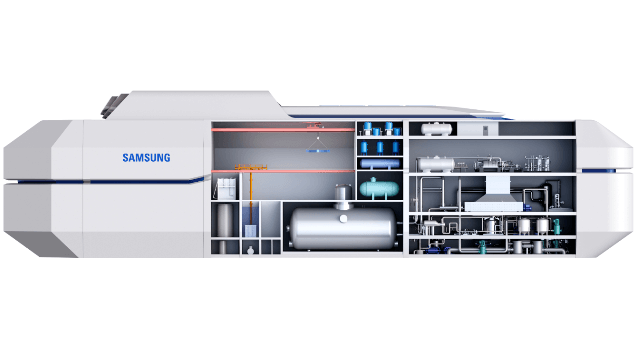
A Floating Nuclear Power Plant (FNPP) designed by Samsung Heavy Industries (SHI), known as the FSMR, featuring two small modular reactors (SMRs) developed by the Korea Atomic Energy Research Institute (KAERI) has received ABS Approval in Principle.
The design, which initially features two SMART100 SMRs, introduces a compartment approach separating the reactor and power generation functions, ultimately allowing the use of a variety of different SMR types. The design also features a modular reactor and safety system within a single containment vessel to enhance safety, simplify testing and shorten construction times.
ABS also conducted an extensive HAZID workshop, not including the reactors, to check for potential hazards in the design.
Patrick Ryan, ABS Senior Vice President and Chief Technology Officer, said: “We see significant potential for floating nuclear power and the technology is developing rapidly, as this innovative design highlights. Our focus is the safe adoption of nuclear at sea and we are proud to use our industry leading insight to support these important steps towards that goal.”
Youngkyu Ahn, Executive Vice President and Chief Technology Officer at Samsung Heavy Industries said: “This AIP is an important milestone for pioneering the offshore nuclear power generation market. Going forward, Samsung Heavy Industries will continue to develop safe and economical offshore nuclear power plants based on its offshore plant technology.”
Jinyoung Cho, Senior Vice President and Head of KAERI’s Advanced Nuclear Reactor Laboratory, said: “This award of an AIP using SMART100 proves the innovativeness of our nuclear power technology. We will accelerate technology development so that our country can establish itself as a leading country in the marine nuclear power industry.”
SMART100's development prioritized safety improvements, including the integration of a passive safety system capable of maintaining reactor cooling without the need for external power to ensure the safe shutdown and cooling of the reactor during emergencies.
The products and services herein described in this press release are not endorsed by The Maritime Executive.
Video: Indonesian Authorities Battle Stubborn Engine Room Fire
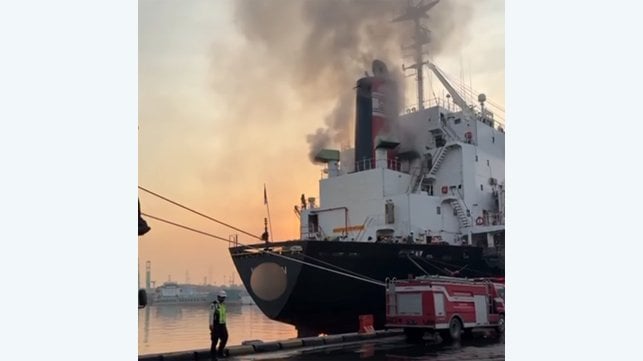
Indonesian firefights battled a challenging engine room fire on an interisland contaienrship (call112surabaya)
Fire authorities at the Tanjung Perak port on Surabaya in Indonesia reported they were able to bring a challenging engine room fire under control after about four hours on Monday morning, December 29. No one was injured, but the fire caused panic in the busy seaport after people began seeing heavy smoke coming from the interisland containership.
The vessel named Verizon (15,400 dwt) had arrived in the port on Sunday. Around 0500 local time on Monday, observers saw large plumes of smoke emerging from the vessel. At its peak, the fire department said 16 units were deployed to fight the difficult fire. It was challenging because it was deep within the hull having started in the engine room in the area of the generator.
Crews evacuated without incident all 22 crewmembers from the ship. They said the first efforts to access the fire were unsuccessful. They required heavy breathing apparatus to get into the lower levels of the ship.
The fire spread from the engine room to involve the paint room, a storage room, and the CO2 tank room according to the fire chief. He said it consumed 20 square meters of the interior, but they were able to prevent it from spreading to other areas of the vessel.
One concern was the fuel onboard. They said the ship had nine tons of fuel and two tons of black fuel in reserve. The fire consumed as much as 60 percent of the fuel they are reporting.
After about four hours they said the fire was under control but exterior cooling operations continued.
Built in 1995, the vessel was acquired in 2015 for interisland operations in Indonesia, including a feeder service for international container operations. It is 145 meters (475 feet) in length and operated by Salem Pacific Indonesia Lines.
Port officials said that they had been able to maintain most operations during the firefight. Operations at the Berlian Container Terminal resumed full operations at 0920, after the vessel was declared safe.
Fire teams are surveying the vessel and seeking to confirm the source of the fire. Local media is reporting the operator said it was likely an electrical short circuit in the engine room.
CRIMINAL CAPITALI$M
Japan Suspends Kawasaki Heavy Industries for Submarine Engine Data Fraud
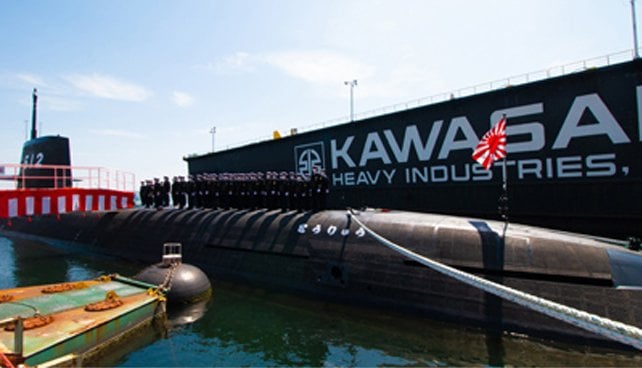
Japan's MOD suspended KHI due to a long-running practice of falsifying engine test data (KHI)
The Japanese Ministry of Defense announced a series of steps it is taking after investigations confirmed that Kawasaki Heavy Industries had supplied fraudulent test data on its engines and provided inappropriate gifts to a number of naval personnel over the past 40 years. Kawasaki Heavy Industries had first announced in 2024 that it was investigating after information surfaced showing a long-term pattern of falsifying test data to ensure engines were delivered on time under their contracts.
Kawasaki Heavy Industries is the long-term supplier of engines for Japan’s submarines and works with Mitsubishi Heavy Industries in the construction of the submarine force. The company had issued announcements in July and August 2024 about the discovery of misconduct in its submarine repairs business and in the testing of marine engines.
The Ministry of Defense reports that it confirmed data for the engines of 23 of its submarines has been found to have been falsified. Kawasaki reports that target data for emission and fuel efficiency performance was used in the trials reports instead of the actual results. The MOD reports that Japan’s 24 current submarines all use KHI engines and that only one vessel, delivered after 2024, has accurate testing data.
Defense officials emphasized that the data did not impact the safety or operation of the engines, but meant that the vessels did not meet the contractual required fuel consumption levels. As a result, the Ministry of Defense decided to suspend Kawasaki Heavy Industries from bidding on MOD projects. The initial suspension was set at 5 months but was cut in half in recognition of the company’s having notified the MOD of the fraud, admitting to the misinformation, and its cooperation.
The manipulated testing data was part of a much wider fraud that began emerging when a whistleblower in February 2024 revealed that IHI Power Systems had been altering fuel consumption data for decades. In July 2024, Hitachi Zosen also issued a report confirming that it had also discovered altered data from its tests, and KHI confirmed its role a month later.
Kawasaki Heavy Industries said its internal investigations showed the practice dated back at least to 1988 and continued until at least 2021, all done to ensure the timely delivery of the engines. On December 26, the company issued a detailed notice after receiving its final reports and called the misconduct “very serious.” It details steps being taken to enhance the compliance and governance system and to restore trust. Among the steps are ongoing efforts to automate inspection processes.
The company also received an internal report about work hour misallocations at the Kobe Shipyard and misconduct within the procurement processes. In August 2025, it was revealed that KHI and other major shipbuilders had billed for fraudulent transactions and overbilled the MOD, and in part, the funds were placed into a fund used to buy gifts for naval personnel.
The gifts included game consoles, golf bags, and matches. While the scheme had gone on for more than 40 years, the reports were able to place a value of $7,400 on the gifts over the past six years. The MOD initially said 13 individuals had been identified as receiving the gifts, but it was lowered to 11 as two people only received official items associated with their work.
The Ministry announced last week that three sailors who supervised ship repairs and the supply depots and were responsible for overseeing contracts with shipbuilders, were suspended. A chief petty officer received a 15-day suspension, while another chief petty officer and a petty officer were each given 5-day suspensions. Eight current or former submariners received pay cuts.
Kawasaki Heavy Industries apologized for the conduct and said it has developed three core compliance pillars to prevent future recurrences. It said its system would prevent misconduct, strengthen detection capabilities, and reform the organizational culture.
Iranian Navy Sketches Out Shipbuilding Plans
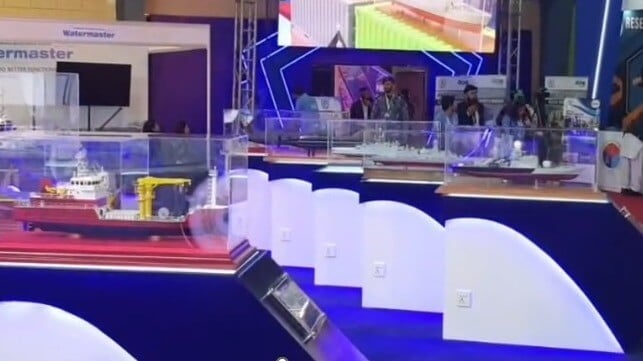
The Iranian stand at the Karachi PIMEC exhibition, with Iranian naval vessel designs on display (Mehr News)
Iranian naval enthusiasts have sketched out an overview of the regular Iranian Navy (Nedaja)’s future ship-building program. Details and drawings of four new classes of ship under design appear to have been taken from the Iranian exhibition stand at the Pakistan International Maritime Expo & Conference (PIMEC), which was held in Karachi November 3-6, but also draw on remarks made by the Nedaja commander Rear Admiral Shahram Irani at Iran’s annual Naval Day celebrations held at the Naval Academy at Nowshahr on the Caspian Sea on November 30.
When interpreting Iranian commentary on their own military, there is often a high degree of hubris and hyperbole in descriptions of future equipment plans and equipment capabilities. Sometimes there is deliberate deception. Shipbuilding in Iran is even more painfully slow in many respects than in some advanced Western countries, albeit Iranian shipbuilders must be given credit for innovative equipment developed to compensate for the effects of international sanctions. A naval architect would have a better perspective, but all the designs make attempts to incorporate stealth features. Nonetheless, the plans outlined recently give an idea of the direction in which Iranian naval thinking is heading.
In terms of immediate deliveries, the last frigate of the Moudge Class, IRINS Toufan (F79?) is still not yet near operational, despite having been laid down in 2014. The Moudge Class was based on the Alvand frigates, which were built for Imperial Iran in the United Kingdom in the 1960s, and of which three vessels are still serving (occasionally), namely IRINS Alvand (F71), Al Borz (F72) and Sabalan (F73).
The Moudge Class has not been without its problems, with the Nedaja having overloaded the vessels with new weapons systems, making them top-heavy and prone to capsize. IRINS Talaiyeh fell over in dry dock while under construction – but was resurrected as the intelligence collection frigate IRINS Zagros (H313). IRINS Sahand (F74) capsized and later sank in Bandar Abbas Naval Harbor on July 9, 2024, but was resurfaced and brought back into service last month, the Nejada claims.
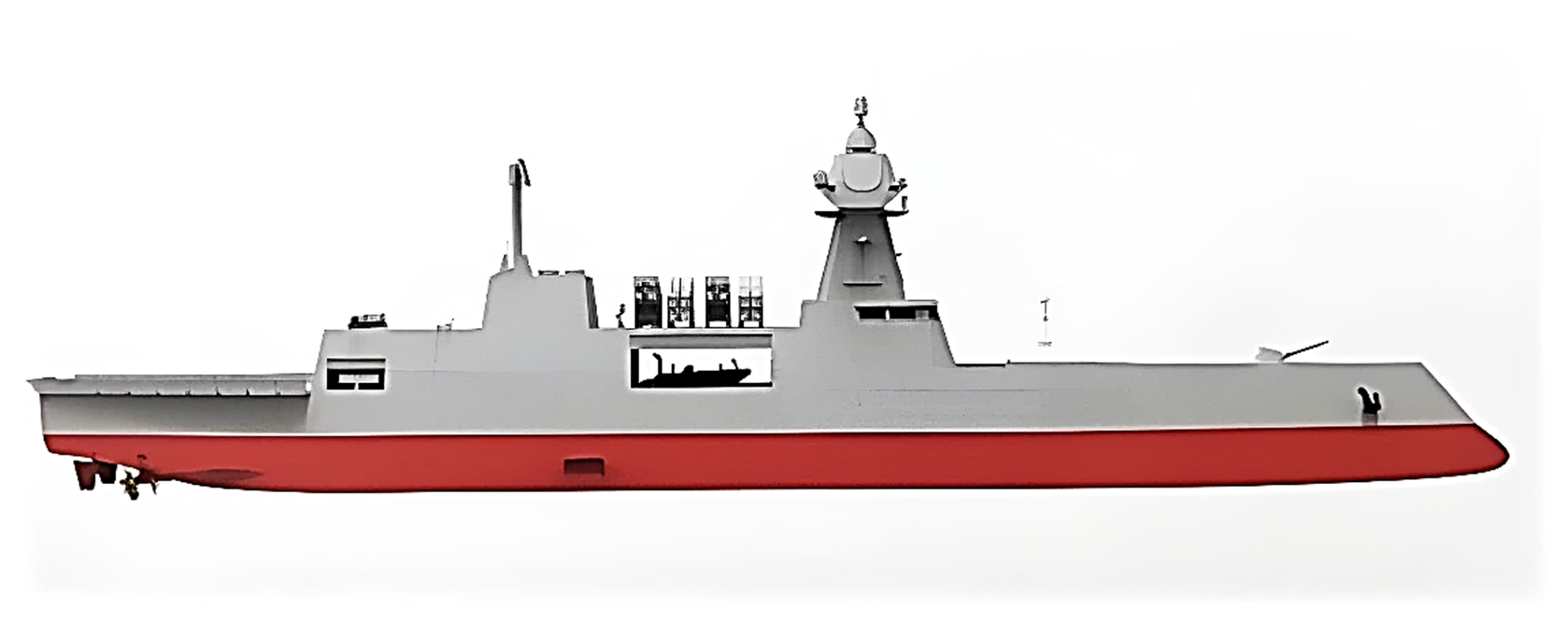
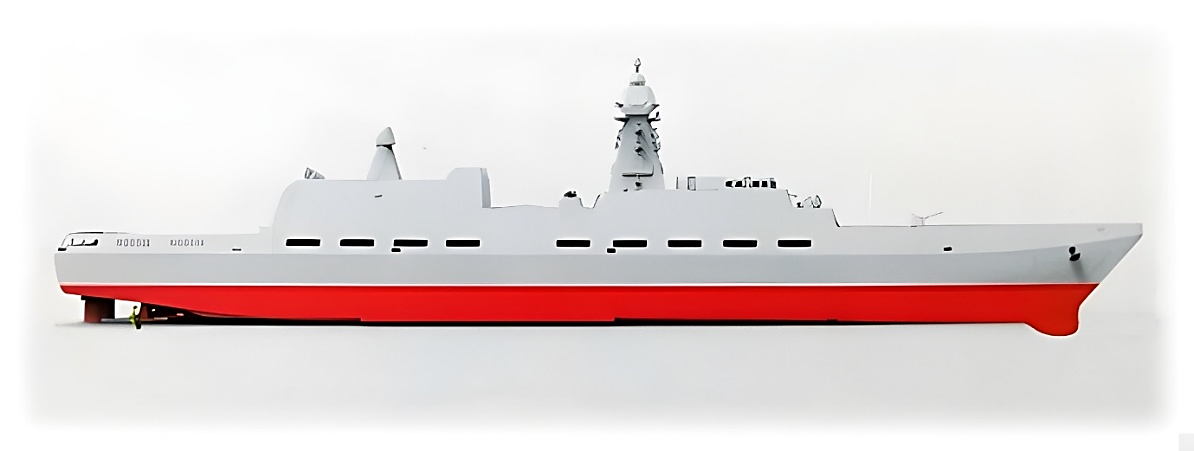
The Moudge vessels, and presumably the two older Bayandor Class frigates, are apparently to be superseded by the Binder Class. At 105m it is longer by 10 meters and at 1700 tons heavier by 200 tons than the Moudge Class. Binder Class ships will still have a 76mm gun and a helicopter hangar. It appears as if they will have 26 Vertical Launch System (VLS) tubes, plus 16 cruise missile tubes for the short to long range Noor/Qader/Ghadir anti-ship cruise missile series derived from the Chinese C-802. Aside from the emphasis on missiles, the new design has a customary-elsewhere integral capability to launch small fast attack craft.
The proposed Binder-class (CJRC)
The Nedaja currently has a substantial fleet of aging fast attack patrol craft. The 15 Sina and Kaman Class boats based on the French La Combattante II Class, almost all of which are between 50 to 20 years old, are equipped with missiles and 76mm guns, albeit Sina Class boats are still being built and the design still looks useful. The six smaller US-built and gun-equipped Kaivan and Parvin Class patrol boats are even older.
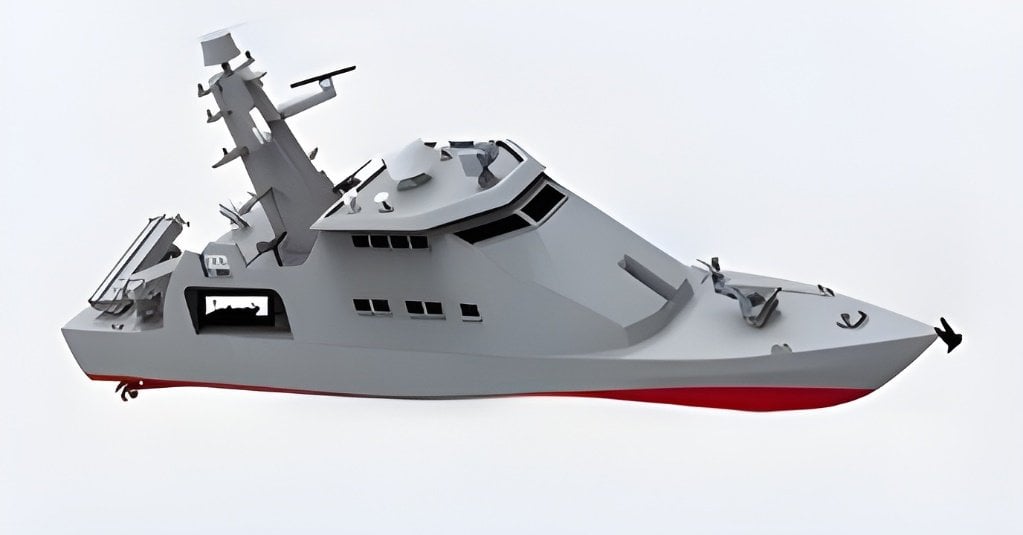
New 33-meter missile patrol boat design (CJRC)
The smaller boats look as if they could be the first to be replaced by a new 33-meter missile patrol boat, class name as yet unknown, designed primarily for coastal patrol. This boat is supposed to be capable of 25 knots, and has a 20mm Oerlikon cannon and tube-launched Noor/Qader/Ghadir anti-ship cruise missiles. The design is said to be capable of adaptation to host a helicopter, but from the images of the design, this might be difficult to achieve.
On 2 June 2, 2021, the Nedaja’s flagship IRINS Kharg (K431) sank off Jask in the Gulf of Oman after a suspicious fire on board. The loss of this ship was keenly felt, because in addition to its important long-distance replenishment role, it also served as the major training vessel on which naval cadets gained sea experience. Substitute training cruise ships were the aging Hengam Class landing ships IRINS Tunb (L513) and IRINS Lavan (L514), both 50 years old and in poor shape. To fulfil the long-vacant training role will be the 145m IRINS Luqman, armed with a 76mm gun, 24 VLS canisters and an onboard helicopter. The design is apparently intended to provide a lead-in and a test-bed for a new Negin Class of destroyers.
Design of the proposed training ship IRINS Luqman (CJRC)
As any good commander would, Rear Admiral Shahram Irani has recently made much of the ambitions and capabilities of his force, which following the 12-Day War must have taken a dent to its morale. An outline of the Nedaja’s future ship-building program may well form part of his campaign to establish a more optimistic mood. But if these projected missile-heavy newbuilds are to be combat effective, the ultimate test will be whether they will be able to detect targets, and then engage them effectively, at ranges greater than their adversaries.
ClassNK Grants AiP for Designs of Cable Jointing & Cable Burial Vessels
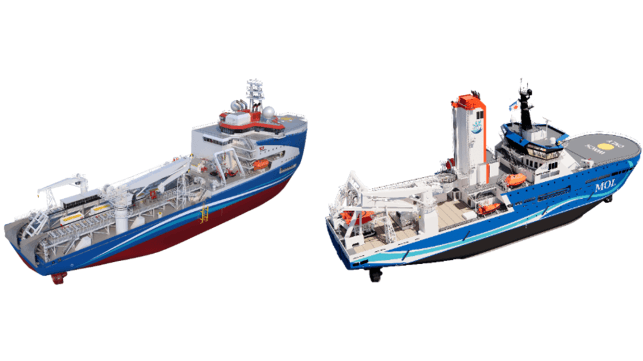
Image of a cable jointing vessel & cable burial vessel (Courtesy of Mitsui O.S.K. Lines)
ClassNK has issued an Approval in Principle (AiP) for the designs of a cable jointing vessel and a cable burial vessel developed by Mitsui O.S.K. Lines, Ltd. The certification demonstrates its feasibility from regulatory and safety perspectives.
In Japan, the expansion of wind power generation utilizing offshore areas and surrounding islands with favorable wind conditions and relatively limited site constraints is expected as part of efforts to increase the share of renewable energy. However, regions suitable for wind power generation are often located far from major electricity demand centers, making the development and reinforcement of power transmission infrastructure a key challenge in delivering generated electricity to demand areas.
In response to this challenge, long-distance subsea DC transmission using cable jointing and burial vessels is regarded as an effective solution for achieving efficient power transmission.
ClassNK carried out a design review of the ship based on part O of its "Rules and Guidance for the Survey and Construction of Steel Ships", as well as other relevant rules. ClassNK issued AiP after it was confirmed that the prescribed requirements were met.
ClassNK will continue to contribute to the widespread adoption of offshore wind power generation by supporting new technology development and social implementation, including through safety assessments.
The products and services herein described in this press release are not endorsed by The Maritime Executive.

 Copper bull statue in Shanghai. Stock image.