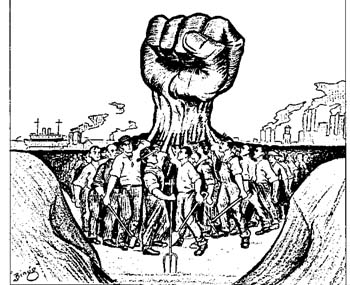
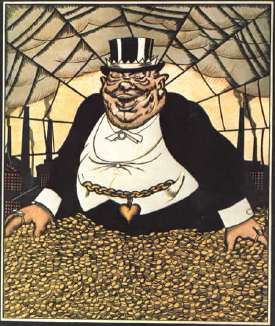
To sum up: the development of the productive forces of world capitalism has made gigantic strides in the last decades. The upper hand in the competitive struggle has everywhere been gained by large-scale production; it has consolidated the "magnates of capital" into an ironclad organisation, which has taken possession of the entire economic life. State power has become the domain of a financial oligarchy; the latter manages production which is tied up by the banks into one knot. This process of the organisation of production has proceeded from below; it has fortified itself within the framework of modern states, which have become an exact expression of the interests of finance capital. Every one of the capitalistically advanced "national economies" has turned into some kind of a "national" trust.N.I. Bukharin: Imperialism and World Economy Chapter VIII
State Capitalism in the thirties took on various forms, including Fascism, which itself is a form of nationalized corpratist state. Which once again right wing American politicos deliberatly confuse with Socialism. Whether it was FDR, or the populist movements of Prairie Socialism or Social Credit, state capitalism originated as a form of Distributionism, and is not socialism.At best it is about 'sharing the wealth', but not changing the fundametal nature of capitalism.
With the end of WWII the modern form of State Capitalism was born. It was internationalist and imperialist, reliant upon the Cold War to continue the prosperity of War Production. Both East and West were mutating into new forms of State Monopoly Capitalism; Stalinism in the East and the Military Industrial Complex in the West.
Contrary to pundits on the right, it is the historic mission of the capitalist state to save capitalism from itself, from its excesses. A lesson learned in the thirties. Socialism is not merely the state nationalizing or owning private assets, it is workers owning the means of production, not as taxpayers or consumers, but as producers. Anything less is merely another face of capitalism.
And capitalism is not a 'free' market, but the historic movement towards global expansion and the increasing development of large monopolies, whether they are private corportations or state controled ones. Thus China's development as evolving from State Capitalism into a form of Monopoly Capitalism can be explained in light of both Schumpter and Hilferding .
Lenin and Bukharin influenced by Hilferding saw Capitalism of their day evolving as a new form of Imperialism, which today we call Globalization. They also saw the beginings of a new form of Capitalism; Fordist rproduction financed by Banks which we call Monopoly Capitalism. However their view that socialism was public ownership of Monopoly Capitialism was coloured by their view of the State.
As Social Democrats they viewed control of the State as the essence of Socialism. When in reality, as the Russian Revolution, and later Revolutionary periods of workers uprisings; Spaing 1936-39, post WWII revolts in Poland/East Germany and Hungary, France in 1968 and Italy in 1973 would show, workers recolution was about direct workers control of production, workers self management, not state ownership or state management.
Which is why stripped of the rhetoric, the so called Socialism of China is simply another face of Monopoly capitalism. And the current financial crisis is a crisis of competing capitals, which may result in rebalancing the Imperialist powers globally. America is in debt to the Asian Tigers and the current economic crisis harkens us back to the crisis and reshaping of the world after 1914.
And like that period the elephant in the room is actually not the fiscal crisis at all but the solution to this crisis which is either Inter-Imperialist War or workers revolution. Already the sabre rattling and small wars and war like crisises are part of the background noise we read and hear everyday, despite the rollercoaster that is Wall Street.
Around the world food production is down, costs are up and last year there were thirty major revolts world wide around food. In China and around the developing capitalist economies the proletariat are revolting, each new product failure, collapsing mine, or major capitalist disaster is met with increasing distrust of the 'system', the 'estalishment'. The falling rate of profit that so called Marxist myth, has once again reared its ugly head.
And if the pending crash and recession are serious and deep enough even American Idol besotted American Consumers may suddenly realize they are actually proletarians, facing the imminant collapse of not only their Empire, but of their very livlihoods, and revolution will be on the agenda once again.
It was exactly this threat of world revolution that spurned FDR and the American capitalist establisment to try and stablize capitalism last time around. And for sixty years it succeeded, until the predictable happened again; capitalism melted down.
--------------------The Origins of State Capitalism-------------------------
"H.G. Wells was one of the few socialists who claimed to see big business, and multinational corporations, in particular, as the forerunners of a World Socialist State"
John Maynard Keynes wanted a global system of fair trade and fair development free of debt bondage and unemployment. His greatest ideas came up against a USA determined to rule the world, to hold off trade competitors at any cost, and to wring from the Third and Fourth worlds every ounce of wealth it could squeeze at whatever cost in human suffering.
Keynes was an enlightened capitalist. His life’s work is adequate proof of that. He was also an anti-Communist, quite openly. Nonetheless, his total defeat on international trade and monetary policy by the US demonstrates the fate of the enlightened, even of enlightened capitalists – even ones of outstanding genius up against corporate capitalist imperialism.
He was a member of the justly famous Bloomsbury group: Virginia and Leonard Woolf, Lytton Strachey, Clive and Vanessa Bell, Duncan Grant, and a host of other luminous, talented, gifted people. Keynes connected as well with W.H. Auden, Rupert Brooke, Serge Diagilev, Nijinsky, Ottoline Morrell, G.B. Shaw, Ludwig Wittgenstein, Sidney and Beatrice Webb, as well as every major economist and many of the most powerful politicians of his time.
Franklin Roosevelt Studied in Post-Soviet Russia
Primakov, now functioning as a senior figure in Russian policy circles, and an informal advisor to Putin, made a high-profile television appearance on an NTV Sunday evening program, Jan. 28. He said that Russia is being criticized today more sharply than at any time since the end of the Cold War, because of "subjective factors on the other side": expectations that Russia would be a towel boy for Western institutions, beginning in the early 1990s.
Primakov recalled how, when he was Prime Minister, "a representative of the International Monetary Fund came over and tried to impose certain models of development on us. They were trying to impose on us a system whereby the state was not to be involved in anything, everything was to be left at the mercy of the market, and the market was supposed to take care of everything."
As against the fallacies of the IMF, Primakov cited Franklin Roosevelt, saying: "No country has ever managed to extricate itself from an economic crisis situation without decisive interference of the state. This is what Roosevelt said, and this is what [Ludwig] Erhard in West Germany after the Second World War said, and he acted accordingly.... We have seen a turning point; at long last we have rejected the views of the people I would describe as dogmatic liberals who thought that the market would provide all the answers.... At present the state is increasingly involved in the economy. It does not mean that the state will revert to [the Soviet central planning agency] Gosplan, to issuing directives. But indicative planning and even industrial policy as such were also denied. Now, thank God, we have abandoned this, and this is not liked."
The current Russian deliberations about Roosevelt go far beyond any opportunistic considerations that might be involved, having to do with Putin's team seeking a third term for him. They bring to the front of the agenda, where they should be, three things.
First, a reminder of what a difference for the world, the quality of leadership in the United States of America makes.
Second, an understanding of how the collaboration of the United States and Russia, as two of the world's great nations, has shifted the course of history for the better, in the past, and could do so again. MGIMO, the venue for the Feb. 8 "New Deal" conference, recently issued an in-depth study of what a multipolar world could look like, and it by no means excluded the U.S.A. (See "Moscow Discussion: Can U.S.-Russian Relations Improve?" in EIR, Dec. 8, 2006.) And when his NTV interviewer asked if Russia should form a bloc with countries that have been ostracized, e.g., for seeking nuclear weapons, Yevgeni Primakov strongly condemned any notion of turning anti-American: "To form a bloc against America? I am against it.... There should be no anti-Americanism in our policy. We should look for ways to uphold our national interests without confrontation. This is Putin's course and I support him on that to the hilt."
Lastly, the American System economics of the Roosevelt period in the U.S.A., with all it implies for basing relations among nations on their mutual interest in the improvement of life for their populations, is exactly what needs to be brought into action in Russia, in the United States itself, and throughout the world.
'A new deal'
In his Presidential acceptance speech in 1932, Roosevelt promised "a new deal for the American people." The term was taken from a 1932 book by the same name, "A New Deal," written by Stuart Chase. That book rapidly disappeared from the shelves after Roosevelt's election. Its contents were the currency of White House economic policy discussion by Tugwell and other central planners around the new President.
Chase, along with Tugwell and Robert Williams Dunn, had jointly written a report, "Soviet Russia in the Second Decade," following their 1927 travel to Stalin's Russia.
In his 1932 book, "A New Deal," Chase argued that the earlier transition out of feudalism into what he called laissez-faire capitalism, was essentially over. The era of Trusts, monopolies, capital concentration by large banks, must now give way to central or collective planning. Chase wrote, "modern industrialism, because of its delicate specialization and interdependence, increasingly demands the collectivism of social control to keep its several parts from jamming. We find a government meeting that demand by continually widening the collective sector through direct ownership, operation and regulation of economic functions." He adds, "Competition is perhaps a good thing—in its proper place. Where is its proper place? Collectivism is beyond peradventure on the march."
Much of Chase's book was filled with fulsome praise for Stalin’s Russian model of central planning and its achievements, reflecting the fascination of numerous younger American intellectuals in the early 1930's.
In his "A New Deal," intended as a kind of blueprint for the Roosevelt campaign, Chase advocated what he called, "The Third Road, a road which runs neither to red dictatorship nor to black (business)." Chase proclaimed that under the Third Road, "private profit will not furnish the happy hunting ground it used to. State trusts, investment control, the curbing of speculation, will choke the muzzle of the more devastating forms." He also proposed drastic economic controls, an eerie harbinger of what would come to pass under the Federal Reserve of Alan Greenspan: "The Federal Reserve will take over the control of currency, the stock exchanges, banks and domestic investment... A new Foreign Trade Corporation will supervise exports, imports and foreign loans. Public works will undoubtedly be centralized in one department..."
Leaving no doubt that his sentiments were not market-oriented in any way, Chase concluded his tract by stating, "We can go on, however...without violent revolution...if we are willing to halt expansion, and organize industry on the basis of using to the full the equipment we now possess. This is the program of the third road. It is not an attempt to bolster up capitalism, it is frankly aimed at the destruction of capitalism, specifically in its most evil sense of ruthless expansion. The redistribution of national income, the sequestration of excess profits, and the control of new investment are all designed to that end." Little wonder that Chase was given a very discreet background policy role in FDR's inner circle. This was explosive stuff for the American public, even in an economic depression.
After leaving Harvard in 1910, Chase had joined the Boston Fabian Club and went to Chicago to work in Jane Addams' Hull House. As a young bureaucrat with the Federal Trade Commission in 1917, Chase investigated charges against Armour & Co. meatpackers. This all shaped his social outlook, and the Soviet model gave it justification in terms of national planning. Chase first met Roosevelt in 1932, but his role was more as a writer than as a policy administrator in the New Deal. He held several official consulting posts in the New Deal, but was mainly influential through his good friend, Rexford Tugwell, and through his writings.
Rexford Guy Tugwell, the Columbia University economics professor who traveled with Chase in 1927 to the Soviet Union, was the central person of this collectivist group around FDR. Indeed, when it emerged that Tugwell was one of the inner circle of the new President, business leaders and newspapers began to research Tugwell's economic writings, and came away shocked, leading some to nickname him, "Rexford the Red."
As newspaper journalists began digging into Tugwell's published writings for clues as to what policies the new President Roosevelt was being given by his top advisers, they became alarmed.
In a paper in the American Economic Review March 1932, Tugwell wrote, that the quest for profit no longer motivated business, but that instead it produced "insecurity" because profits were, "used for creating over-capacity in every profitable line; they are injected into money market operations in such ways as to contribute to inflation; they are used, most absurdly of all, as investments in the securities of other industries." Tugwell proceeded further in his frontal assault on the core of the market private enterprise system which had created such extraordinary wealth and improvement of general living standards over the previous decade: "Industry is thought of as rather a field for adventure...The truth is profits persuade us to speculate." When such comments were widely reported in the Nation's media, they did little to bolster businessmen's confidence in the new Administration.
In discussing a proposal to introduce national economic planning, Tugwell wrote in 1932, "it seems altogether likely that we shall set up, and soon, such a consultative body...The day on which it comes into existence will be a dangerous one for business...There may be a long and lingering death (of the private profit enterprise—w.e.), but it must be regarded as inevitable." Private business, Tugwell added, "would logically be required to disappear. This is not an overstatement for the sake of emphasis; it is literally meant."
In October 1932, that is, one month before FDR's election, Rexford Guy Tugwell went on to formulate a six-point program for dealing with the depression crisis. Tugwell opposed wage cuts, then a common method of corporate cost cutting. He insisted, however, on reducing retail prices, and called for "drastic income and inheritance taxes," as well as "avoidance of budgetary deficits and monetary inflation." Obviously businesses could not possibly simultaneously maintain wage levels, reduce prices, and pay increased taxes, without risking bankruptcy in such crisis times. To this, Tugwell advocated, "the taking over by the government of any necessary enterprises which refuse to function when their profits are absorbed by taxation."
In brief, Tugwell's program, and this was planed, would first make it impossible for business to function, then bring those failed businesses under nationalization or state ownership. Tugwell concluded his 1932 program, "So long as prices, profits and individual production programs are at the disposal of independent business executives, our system will continue to show much the same faults as it displays at present." Tugwell endorsed Norman Thomas' League for Industrial Democracy program which called for a, "new social order based on production for use, not for profit."
Tugwell was strategically placed in 1933 as Deputy Secretary of Agriculture, just under his recommended choice of Secretary of Agriculture, Iowa farm editor, Henry A. Wallace. Tugwell continued in the early months to have regular access to his old friend, FDR as well.
Rudolf Hilferding and the total state.
Before World War I, Hilferding followed the traditional Marxist view that identified the executive branch of the modern state as a "committee for managing the common affairs of the whole bourgeoisie." He regarded the state as the "conscious organ of [a] commodity producing society" which reached the height of its power in the era of finance capital. For Hilferding the most important features of "modern capitalism" were "those processes of concentration which, on the one hand eliminate free competition' through the formation of cartels and trust, and on the other bring bank and industrial capital into an ever more intimate relationship." Through this relationship, he argued, capital assumed the form of finance capital which, "in its maturity, is the highest stage of concentration of economic and political power in the hands of the capitalist oligarchy."(3) Hilferding also thought that the development of finance capital created the economic preconditions for socialism, which could be achieved only through the seizure of political power. Workers, organized in trade unions and in the SPD, could use the state to wrest large-scale industry from the control of finance capital and transform it into public property. He thought that it was possible for the working class to win state power through electoral means, but that capitalist suppression of workers' rights or a major war between rival capitalist powers could lead to violent revolution. Nevertheless, he did not argue that the SPD itself should "make" the workers' revolution.(4) World War I and its aftermath forced Hilferding to revise his views on the relationship between Social Democracy and the state. In 1918 he joined the anti-war Independent Social Democratic Party (USPD), in which he supported the socialization of key industrial sectors, the dismantling of the army and bureaucracy, and the democratization of German politics. By 1921, however, he was convinced that the socialist revolution had failed. The splintering of the workers' parties, the SPDs counterrevolutionary actions, and the political "immaturity" of the working class combined to halt Germany's social and economic tranformation. For Hilferding defending whatever democratic gains the revolution had made against the growing strength of Germany's reactionary right wing became the socialist movement's main task and he strongly supported the USPD's reunification with the SPD in 1922.(5) Hilferding steadfastly advocated the parliamentary road to socialism after 1922, and he justified this strategy with an analysis of contemporary changes in the economic and political situation both at home and abroad. He asserted that the war had accelerated the economic processes he had identified prior to 1914. The expansion and further concentration of capital, the formation of cartels and trusts, the increasing influence of finance capital, and the state's intervention in the economy were bringing the era of capital competition to a close. A new system, characterized by economic regulation and planned production, was developing. If left undisturbed, this process would result in a hierarchical social order in which the economy was organized, but the ownership of the means of production remained in private hands. Hilferding called this system "organized capitalism." He saw in its stability and its enhanced use of planning the potential for a socialist planned economy.(6) Social Democracy's task, Hilferding believed, was to educate workers and to fight for the democratization of production. In his view, the republic gave the working class real access to political power because its institutions were subject to the will of the voters.
Permanent Revolution 08 Revolutionary theory and imperialism
In his 1910 book, Finance Capital,4 Hilferding examined the latest developments in the capitalist mode of production. He explained how the process of concentration and centralisation of capital, which Marx outlined, had grown apace in the last quarter of the nineteenth century. This had given rise to the domination of the economy by huge cartels or trusts rather than small scale enterprises so typical of the era of “free competition capitalism”. This he called monopoly capitalism, a new stage in the development of capitalism.The reason that the banks had come to dominate in this way was due in the first instance to changes within capitalist production itself. The rise in the organic composition of capital had lengthened turnover time (i.e. the length of time it takes for machinery and plant to wear out and transfer its value completely through several cycles of production) and so reduced the adaptability of firms to short-run cyclical ups and downs. To get over the effects of short term fluctuations in demand the firms turned more and more to the banks and the provision of credit; they also needed credit to finance the ever larger sums necessary for new investment in machinery. As a result of this development the banks themselves began to commit huge sums to industry for ever longer periods of time. As a consequence they could not move capital about freely to take advantage of every short term fluctuation in the rate of profit between sectors. This meant, in turn, that the banks had an interest in the formation of cartels and trusts so as to prevent as far as possible fluctuations in output and demand putting their huge credits at risk. Hilferding summarised the process thus:“The most characteristic features of ‘modern’ capitalism are those processes of concentration which, on the one hand, ‘eliminate free competition’ through the formation of cartels and trusts, and on the other, bring bank and industrial capital into an ever more intimate relationship. Through this relationship . . . capital assumes the form of finance capital, its supreme and most abstract expression.” 5Thus a central feature of this new stage was the growth of banking monopolies which in the course of their development had come to dominate, and even fuse with, the key sectors of industrial capitalism to form “finance capitalism”.A natural consequence of the concentration of capital in this way was that huge amounts of machinery and plant (constant capital) more and more outweighed the growth of variable capital (i.e. the amount advanced to buy wages). This growth in the “organic composition of capital” led inexorably to the tendency of the rate of profit to fall (TRPF), as Marx had explained in Capital.On the basis of this law he explained how finance capital uses its power to offset this law. The huge monopolies can cut output within certain limits in order to maintain prices and profits; they can influence the national governments to erect tariffs preventing foreign monopoly capital entering their markets to compete with and undercut them; they can even keep prices in the internal market high and practise “dumping” at lower prices in colonial or semi-colonial markets.But for Hilferding the key factor which explained the relatively crisis-free expansion of monopoly capital which marked the last years of the nineteenth century and the early years of the twentieth was the export of capital to foreign countries. This, for Hilferding, was the root of the explanation of the long boom of 1895-1913. Following Marx in Capital he illustrated the way in which the export of capital to countries with a lower organic composition of capital and higher rate of profit overcomes the effect of crises due to the operation of the law of the TRPF:“The precondition for the export of capital is the variation in the rate of profit, and the export of capital is the means of equalising regional rates of profit. The level of profit depends upon the organic composition of capital, that is to say upon the degree of capitalist development.” 6Hilferding explained that the policy of finance capital which it pursues to secure external markets for sales, capital investment, access to raw materials and so on is the policy of imperialism. Moreover, on the basis of the recent developments in the growth of monopoly capital and faced with the internal contradictions of this growth, “capital can pursue no other policy than that of imperialism”
.7Rudolf Hilferding and 'the stability of capitalism' --
The real danger comes from WITHIN scientific socialism--Rudolf Hilferding the orthodox [Marxist], not Eduard Bernstein(4), the revisionist. Hilferding sees the new stage of capitalism in its financial razzle-dazzle appearance and becomes enamored of its capacity to “unify” commercial, industrial, and financial interests [instead of being] concretely aware of the greater contradictions and antagonisms of the new monopoly stage of capitalism.
I wish to stress the seeming orthodoxy of Hilferding. No one, absolutely no one--not the firebrand Rosa Luxemburg, nor the strict realist V.I. Lenin, and I dare say not Hilferding himself--knew that what he was doing with his theory of finance capitalism was bringing in the first theory of retrogressionism [into Marxism]....Even with over four decades of hindsight, and much, hard thinking on the subject, I have first now realized that what Hilferding was SEEING and analyzing (and it took Nikolai Bukharin’s theory of the transition period to bring it home to me)(5) was the STABILITY OF CAPITALISM.
Watch the orthodoxy though: Hilferding is proposing no revisionism. The automatic fall of capitalism is still expected and the inevitability of socialism in a mechanistic sort of way is also held to tightly. BUT rather than seeing monopoly as a transition into opposite of a previous stage, monopoly is treated more like simple large-scale production. THAT IS THE KEY. For if it is not a transition into opposite of a fundamental attribute of capitalism, then CAPITALISM’S ORGANIZATION and centralization, monopolization’s appearance as the “emergence of SOCIAL control”...is in fact superseded socialism. Or more precisely, [Hilferding] retrogresses back to home base: the equilibrium of capitalist production.
By viewing the whole development of trusts and cartels not from within the factory, but from “society,” that is, the market, Marx’s general law of capitalist accumulation--the DEGRADATION of the proletariat along with capitalist accumulation--has no meaning for Hilferding. Neither does Marx’s postulate “private production without the control of private property” make any imprint on Hilferding.(6) And of course labor remains a unity; there is not any inkling of an aristocracy of labor arising out of the monopolization and degradation and imperialism.
You must remember that even with the outbreak of World War I, but before Lenin did his own analysis [of imperialism in 1915], he introduced Bukharin’s WORLD ECONOMY AND IMPERIALISM which said pretty much the same thing as Hilferding. All this I want to repeat again and again in order to emphasize the orthodoxy, in order to show that [even when] all the formulae are adhered to the loss of revolutionary perspective not yet in a positive way but in the negative of awe before the EXISTENT, continued capitalism can be very, very deceiving. If it was [deceiving] to Lenin we better watch it all the time.
What in truth emerges from a close study of Hilferding...is that the new generation of Marxists following Engels’ death [in 1895], placed within growing, centralized production, SAW MONOPOLY NOT AS A FETER BUT RATHER AS AN ORGANIZING FORCE OF PRODUCTION. So that the Second International, which had openly rejected Bernsteinism and gradualness, accepted Hilferdingism. That meant tacit acceptance of the capacity of capital to gain a certain “stability,” to modify its anarchism as a “constant” feature. They saw in [this] new stage not a TRANSITION to a higher form, but something in itself already higher, although “bad.”
Now the person who made this all clear to me was Bukharin, that logical extension of Hilferding, blown into the THEORY of counter-revolution right within the first workers’ state. It is to him that we must turn. Here too for our generation it is correct to view him with hindsight, precisely because his is “only” theory that will become full-blown actual counter-revolution with Stalin supplying it an objective base.
Keep in mind therefore the three actual stages of capitalist production for the three decades since the publication of Bukharin’s ECONOMICS OF THE TRANSITIONAL PERIOD:
l) 1920-30: Taylorism plus Fordism, that is, the discovery of the [assembly] belt line and with it the necessity for a fascistic order in the factory. It may be “vulgar” to call gangsters part of the intelligentsia, but that is the genuine face of “social control” when the masses themselves do not control [production]. Marx’s view of the planned despotism plus the industrial ARMY of managers, foreman, etc. has moved from theory to such EVERYDAY practice that every worker knows it in his bones; he needs no ghost come from the grave to tell him THAT....
2) 1930-40: General crisis; New Dealism where “everybody” allegedly administers, and fascism where openly only the elite do, both in mortal combat with the CIO and the general sit-down strikes (which made a true joke of private property) for “social control.” Plan, plan, plans: National Five-Year Plans in Russia, Germany, Japan; John Maynard Keynes, the New Deal, technocracy, the Tennessee Valley Authority, public works.
3) 1940-50: Monopolization has been transformed into its opposite, statification. (What greater scope for a modern Moliere, to take those weighty volumes of the Temporary National Economic Committee (TNEC)(7) proving monopolization and how strangling it is, and then on the eve of World War II they are finally published in full, prefaced by a call for full mobilization which shows that monopolization plus Hitlerism is child’s play as compared to American statification.)
End of World War II, “end” of fascism and state-private-monopoly rule. Complete state-capitalism reaching its tentacles from Russia into Eastern Europe, engulfing Britain, seeping into Western Europe and peering out of the U.S. TOTAL, GLOBAL PLANS: Marshall, Molotov, Monnet, Schumann, Truman’s Point 4.(8) Keynes is dead; long live the state plan. The intelligentsia in Russia, the Social Democratic labor bureaucracy elsewhere, all in mortal combat with the Resistance, with the Warsaw [uprising](9), with general strikes and colonial revolutions. One strangles the revolution “for” the masses’ own good, and the other for “democracy’s” shadow.
Did Hilferding Influence Schumpeter?
The thesis regarding the limited ability of free competition to promote
technological progress is supposed, for both theoreticians, to be a conclusion drawn
from past historical experience. More precisely, Schumpeter argued that the
capitalist era could be divided into two distinct periods (Screpanti and Zamagni
1993, pp. 243ff.): (a) The era of ‘competitive capitalism’ when small enterprises
dominated, an era which declines in the 1880s and (b), the era of monopolistic or
‘big-business capitalism’, during which large enterprises, trusts and cartels
dominated, starting roughly from the 1880s and having consolidated its fully
fledged form by the time Schumpeter’s book was written.
For Hilferding, too, the elimination of free competition and monopolies
came, historically, in a similar way: ‘Finance capital signifies the unification of
capital. The previously separate spheres of industrial, commercial and bank capital
are brought under the common direction of high finance, in which the masters of
industry and of the banks are united in a close personal association’, and
consequently: ‘The basis of this association is the elimination of free competition
among individual capitalists by the large monopolistic combines’ (Hilferding 1910,
p. 301, emphasis added). Thus, ‘it is also clear that monopolistic combines will
control the market’ (ibid., p. 193).
We have seen, so far, that for both theoreticians the real incentive for
innovation was the ability of monopolistic formations – deriving from their noncompetitive
nature – to create extra profits. Also, the elimination of free
competition was regarded, by both economists, as the main characteristic of an era
during which large enterprises, trusts and cartels dominated, and which attained its
typical characteristics around 1900.
As far as the other aspect of the Schumpeterian hypothesis is concerned,
namely that perfect competition is an unstable market structure where only large
enterprises can push technological progress forward, the views of both theoreticians
are strikingly similar. For Schumpeter, once big corporations are formed, the
imperfectly competitive market structure becomes stable, as large firms become
increasingly conducive to technological progress and change:9 ‘There are superior
methods available to the monopolist which either are not available at all to a crowd
of competitors or are not available to them so readily’ (Schumpeter 1942, p. 101).
‘The perfectly bureaucratized giant industrial unit .… ousts the small or mediumsized
firm’ (ibid., p. 134). On the same line of argument, the large firm is
considered to possess the ability to attract superior ‘brains’, to secure a high
financial standing (ibid., p. 110), and to deploy an array of practices to protect its
risk-bearing investments.
In his Finance Capital, Hilferding had developed a similar approach:
The expansion of the capitalist enterprise which has been converted into
a corporation .… can now conform simply with the demands of
technology. The introduction of new machinery, the assimilation of
related branches of production, the exploitation of patents, now takes
place …. from the standpoint of their technical and economic suitability
.… Business opportunities can be exploited more effectively, more
thoroughly, and more quickly .… A corporation .… is able, therefore,
to organize its plant according to purely technical considerations,
whereas the individual entrepreneur is always restricted .… The
corporation can thus be equipped in a technically superior fashion, and
what is just as important, can maintain this technical superiority. This
also means that the corporation can install new technology and labour
saving processes before they come into general use, and hence produce
on a large scale, and with improved, modern techniques, thus gaining
an extra profit, as compared with the individually owned enterprise.
(ibid., pp.123-4)
Consequently, ‘The introduction of improved techniques .… [benefits] the
tightly organized cartels and trusts. [T]he largest concerns introduce the
improvements and expand their production’ (ibid., p. 233).
Hilferding repeatedly affirmed the position that the big corporation is able
to create the conditions which may assure its market supremacy as well as its extra
profits for a long period: ‘An industrial enterprise which enjoys technical and
economic superiority can count upon dominating the market after a successful
competitive struggle, can increase its sales, and after eliminating its competitors,
rake in extra profits over a long period’ (ibid., p. 191).
Thus Hilferding expressed what we could codify as ‘Hilferding’s
hypothesis’, namely the thesis that ‘the size and technical equipment of the
monopolistic combination ensure its superiority’ (ibid., p. 201), which is, in general
terms, very similar to ‘Schumpeter’s hypothesis’, written thirty-two years after
Hilferding: ‘large firms with considerable market power, rather than perfectly
competitive firms were the “most powerful engine of technological progress”’
(Schumpeter 1942, p. 106). The obvious similarity of ideas of both theoreticians on
this specific issue needs no further comment.
Further to the above, Hilferding introduced, in his Finance Capital, the
notion of a ‘latest phase’ of capitalism, which is characterised by the following
main features: the formation of monopolistic enterprises, which put aside capitalist
competition; the fusion of bank and industrial capital, leading to the formation of
finance capital, which is considered to be the ultimate form of capital; the
subordination of the state to monopolies and to finance capital; and, finally, the
formation of an expansionist policy of colonial annexations and war.10
Hilferding regarded capital exports as an inherent characteristic of
capitalism in its ‘latest’, monopolistic, stage, rooted in the ‘cartelisation and
trustification’ of the economy and the need ‘to annex neutral foreign markets ....
above all overseas colonial territories’ (Hilferding 1910, pp. 326, 328).
Finance capital, as Hilferding defined it, is advanced to industrial
capitalists who use it. This ‘new’ concept is also seen as the linking between
capitalism’s ‘latest’ stage and imperialism (Winslow 1931, p. 727). The colonies
were regarded as the outlets for the export of finance capital. In this sense, finance
capital was considered to be helpless without political and military support: ‘capital
export works for an imperialistic policy’ (Hilferding 1910, p. 406) since it ‘does not
want freedom, but domination’ (ibid., p. 426). Imperialism is, thus, a tendency to
expansion of a developed capitalist power, a tendency created, in the last instance,
by economic processes, but also supported by political processes. It is argued,
therefore, that imperialism, which is capitalist rivalry at its highest level, leads to
war and mutual destruction of the capitalist powers.
SEE:
No Austrians In Foxholes
State Capitalism in the USSR
China: The Truimph of State Capitalism
Find blog posts, photos, events and more off-site about:
Smoot-Hawley, protectionism, tariffs, Herbert Hoover, U.S., U.S. economy, Great Depression, market crash, free trade, Republicans, recession,