Showing posts sorted by relevance for query PELE VOLCANO. Sort by date Show all posts

Friday, October 01, 2021

VULCANOLOGY
Lava eruption at Kilauea spews 'Pele's hair' volcanic glass into Hawaii's skies

Pilots flying by the volcano reported seeing "Pele's hair."

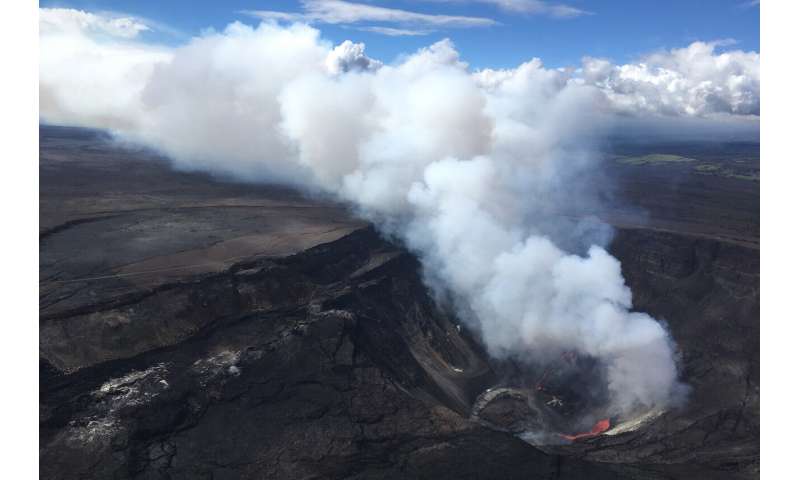
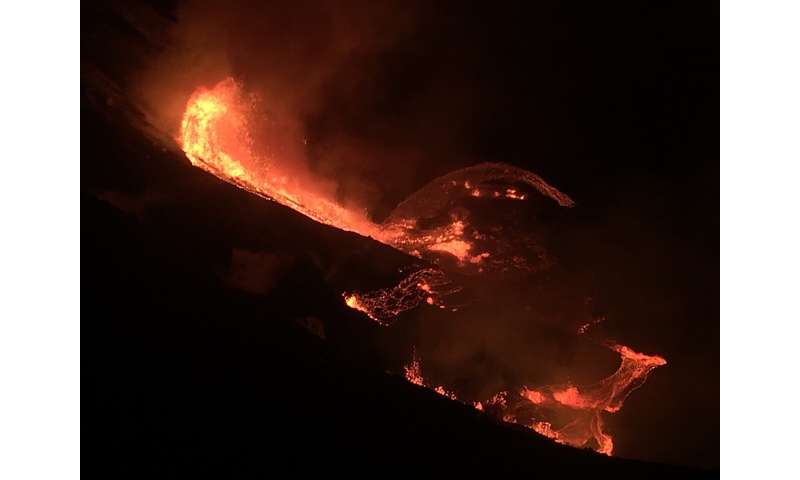
The Kilauea eruption, as seen at dawn local time on Sept. 30. Lava fountains are spurting out at multiple fissure locations at the base and west wall of the crater, and a lava lake is growing within Halema'uma'u. (Image credit: B. Carr/USGS)

Kilauea volcano is erupting, sending lava and thread-like pieces of volcanic glass, known as Pele's hair, into Hawaii's skies, according to the U.S. Geological Survey (USGS) and the National Weather Service.

The eruption began at about 3:20 p.m. local Hawaii time Wednesday (Sept. 29), when the USGS Hawaiian Volcano Observatory detected a glow from its webcam at Kilauea summit. That glow indicated a lava eruption happening at Halema'uma'u crater — a pit crater nestled in the much larger Kilauea caldera, or crater.

The webcam footage also revealed fissures at the base of Halema'uma'u crater that were releasing lava flows onto the surface of the lava lake that had been active until May 2021, the USGS said in a statement. However, the eruption at Kilauea — located within Hawaii Volcanoes National Park, on Hawaii's Big Island — is confined to Halema'uma'u crater, meaning it's not currently a threat to the public.

Related: Photos: Fiery lava from Kilauea volcano erupts on Hawaii's Big Island

"At this time, we don't believe anybody or any residents are in danger, but we do want to remind folks the park remains open," Cyrus Johnasen, a Hawaii County spokesperson, told Hawaii news station KHON2 on Sept. 29. "It will remain open until the evening. Please proceed with caution," especially for those with respiratory conditions, he added.

However, the part of the park where the eruption is happening is currently closed to the public, according to the USGS.

Due to the eruption, the Hawaiian Volcano Observatory has elevated Kilauea's volcano alert level from "watch" to "warning" and its aviation color code from orange to red, which warns pilots about possible ash emissions. Those are the highest warning levels, meaning a "major volcanic eruption is imminent, underway or suspected, with hazardous activity both on the ground and in the air," according to the USGS.


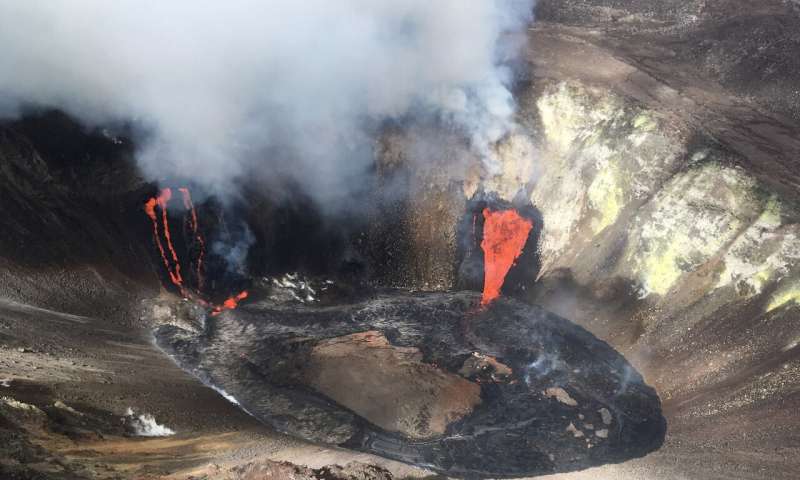
The eruption within Halema'uma'u crater is spewing low lava fountains in the center of the lava lake (pictured) and along the western wall of Halema'uma'u. (Image credit: M. Patrick/USGS


Telephoto image of fissures that opened at Halema'uma'u crater during the ongoing eruption that began Septe. 29 at Kilauea. (Image credit: M. Patrick/USGS)

Meanwhile, several pilots flying aircraft near Kilauea Wednesday evening reported seeing volcanic glass known as Pele's hair, according to the National Weather Service. The golden, sharp strands of glass — named for Pele, the Hawaiian goddess of fire and volcanoes — form when gas bubbles within lava burst at the surface.

"The skin of the bursting bubbles flies out, and some of the skin becomes stretched into these very long threads, sometime[s] as long as a couple of feet [more than half a meter] or so," Don Swanson, a research geologist at the Hawaiian Volcano Observatory, previously told Live Science.

Pele's hair can be beautiful, but it poses a danger if it's ingested through drinking water, Swanson cautioned.

The current eruption is the latest of a long string of volcanic activity at Kilauea. At an elevation of 4,009 feet (1,222 m) aboveground, the shield-shaped volcano has a magma-pumping system that extends more than 37 miles (60 kilometers) below Earth, according to the USGS. Kilauea has erupted 34 times since 1952, and it erupted almost continuously from 1983 to 2018 along its East Rift Zone. A vent at Halema'uma'u crater was home to an active lava pond and a vigorous gas plume from 2008 to 2018.

Kilauea's volcanic activity also made headlines in May 2018, when the lava lake at the summit caldera drained just as the Eastern Rift Zone revved to life with lava fountains and new fissures, whose lava created a red-hot river that destroyed hundreds of houses before draining into the ocean.

From December 2020 to May 2021, a summit eruption made a lava lake within Halema'uma'u crater, and in August 2021, a series of small earthquakes rattled the summit.

El Salvador President: Volcano-Powered Bitcoin Mining Has Begun

President Nayib Bukele has tweeted that El Salvador has begun mining Bitcoin using geothermal power from volcanoes.


By Scott Chipolina
Oct 1, 2021 


EL SALVADOR PLANS TO USE GEOTHERMAL ENERGY FROM VOLCANOES TO MINE BITCOIN. IMAGE: SHUTTERSTOCK

The President of El Salvador, Nayib Bukele, took to Twitter early this morning to provide an update on the country’s recently launched Bitcoin mining industry.

According to Bukele's tweet, El Salvador has mined almost $500 worth of Bitcoin, a number that the government surely intends to increase over time.


In a follow-up tweet, Bukele clarified that “this is officially the first #Bitcoin mining from the #volcanode,” the country’s volcano-powered Bitcoin mine. Earlier this week, he shared a video on Twitter that appeared to show the country taking its first steps to mining Bitcoin using geothermal energy from volcanoes.

The video—which shows a data center in a forest before zooming in on a worker wiring up a Bitcoin mining machine—has been viewed over 2 million times already. In today’s tweet, Bukele noted that the project is “still testing and installing.”

Bitcoin mining is controversial given its energy-consumption demands and resulting carbon footprint. Due to increased scrutiny over the cryptocurrency’s impact on the environment, some miners have turned to cleaner, renewable power sources, such as geothermal energy.

In June, President Bukele said that El Salvador’s state-owned electricity company LaGeo would use “very cheap, 100% clean, 100% renewable, 0 emissions energy from our volcanoes,” to mine Bitcoin.

While the decision may have spared President Bukele criticism from environmentalists, his own population remains divided over the country’s embrace of Bitcoin as legal tender.
Bukele's Bitcoin ambitions

President Bukele first announced his plans to accept Bitcoin as legal tender in El Salvador during this year’s Bitcoin Conference in Miami.

Ever since, his decision has been mired in controversy, with some Salvadorans claiming that the Bitcoin Law has exposed President Bukele’s already well-documented authoritarian streak.

Despite President Bukele’s suggestions to the contrary, Article 7 of the Bitcoin Law compels businesses to accept Bitcoin as a payment, even if they don’t want to. And the government has doubled down on this stance ever since.

“The government has harassed big business and small business alike. They’ve sent government agents to inspect businesses to ensure they are following labor regulations just because C-level executives have said negative things about the Bitcoin Law,” one local businessperson told Decrypt on condition of anonymity.

Critics who've spoken out against the government’s policy have also been targeted. “The police doesn’t have to take anyone to court. They just scare one of the vocal dissidents with kidnapping him a couple of hours or a couple of days,” another local businessperson told Decrypt, referring to the illegal arrest of Bitcoin critic Mario Gomez earlier this month.

This summer also saw multiple surveys and protest after protest after protest—all evidencing the fact that many Salvadorans do not wish to accept Bitcoin as legal tender.

Yet, President Bukele’s embrace of Bitcoin has continued—with crucial details of the project yet to be revealed.

“There are so many things that are not being disclosed. For example, who’s holding the private keys to these Bitcoin?" Nolvia Serrano, head of operations at crypto wallet provider BlockBank, asked on the Decrypt Daily podcast earlier this week. "Also, what’s the criteria for saying, 'Oh, today, we’re going to buy more Bitcoin, or we’re going to wait until next month.' We don’t know that."

“There’s no space to make wrong calls on this, and we need to be transparent because the cryptocurrency community cares about these principles,” she added.

However, many of the world’s loudest Bitcoin advocates, including Jack MallersMichael Saylor and Peter McCormack—have rushed to heap praise on the crypto ambitions of the self-professed “coolest dictator in the world.”

Tuesday, September 28, 2021

UPDATED
Lava spewing again from Canary Islands volcano, airport remains closed

GAIA LIVES PELE VOCIFERATES

Issued on: 28/09/2021 - 
Text by: NEWS WIRES|
Video by: Fraser JACKSON

A volcano began spewing out ash again Monday after a brief lull in the Canary Islands, where coastal residents are confined to their homes over fears of toxic gases when the lava hits the sea.

La Cumbre Vieja, which straddles a southern ridge in La Palma in the Atlantic archipelago, erupted on September 19, spewing out rivers of lava that have slowly crept towards the sea.

But on Monday morning, the lava and ash flow had stopped, and the week-long rumble of the eruption faded to silence, before resuming its activity several hours later, an AFP correspondent at the scene said.

Smoke had continued to emerge from the top during the lull.

"In the last hours, the volcanic tremor has almost disappeared, as well as the explosive strombolian activity," tweeted Involcan volcanology institute, using the scientific term for a mix of explosions and lava flow.

"Volcanic activity in La Palma has reduced significantly in the last few hours," Madrid's Institute of Geosciences tweeted.

"We must be very vigilant about how it evolves because the scenario can change quickly."

Several hours later, the volcano started pumping out ash again.

Fits and starts

Speaking to AFP after the resumption, Involcan spokesman David Calvo said it was "just ash, for the time being". La Cumbre Vieja had been switching between "explosive episodes and lulls for quite a while", he added.

Overnight, 300 residents living in coastal areas were ordered to stay at home to avoid harm from the release of toxic gases when the lava finally reaches the sea, the regional government said.

"The population must follow the instructions of the authorities and remain at home, with doors and windows closed," it said.

The lava, moving very slowly, is currently between 800 and 1,000 metres (around half a mile) away from the shore, it said. An evacuation order affecting four areas is in place around Tazacorte, where it is expected to enter the sea.

Officials have also set up an exclusion zone to head off curious onlookers.

Experts say the entry of lava into the seawater will send clouds of toxic gas into the air, causing explosions and a fragmentation of the molten rock like gunshots.

"Inhalation or contact with acid gases and liquids can irritate the skin, eyes and respiratory tract, and may cause breathing difficulties, especially in people with pre-existing respiratory diseases," Involcan warned.

Air traffic disrupted


The molten rock has so far scorched its way across more than 235 hectares of land, burning up many banana plantations, devoured 513 properties and destroyed nearly 20 kilometres of road, the European Union's Copernicus Earth Observation Programme said.

And eruption has so far force more than 6,000 people from their homes, although 160 were allowed to return home on Sunday.

The authorities also said clouds of ash from the volcano had started to affect areas on the eastern side of the island.

At La Palma's airport, where air traffic was halted on Saturday for 24 hours due to the ash, local airline Binter said it had been unable to resume flights.

"We have halted our La Palma operations again after trying to make a first flight today and finding conditions were not safe enough," tweeted the airline, which is based in the Canary Islands, saying it would try again on Tuesday.

(AFP)

Lava from Spanish island volcano rolls slowly toward the sea

by Daniel Roca and Barry Hatton

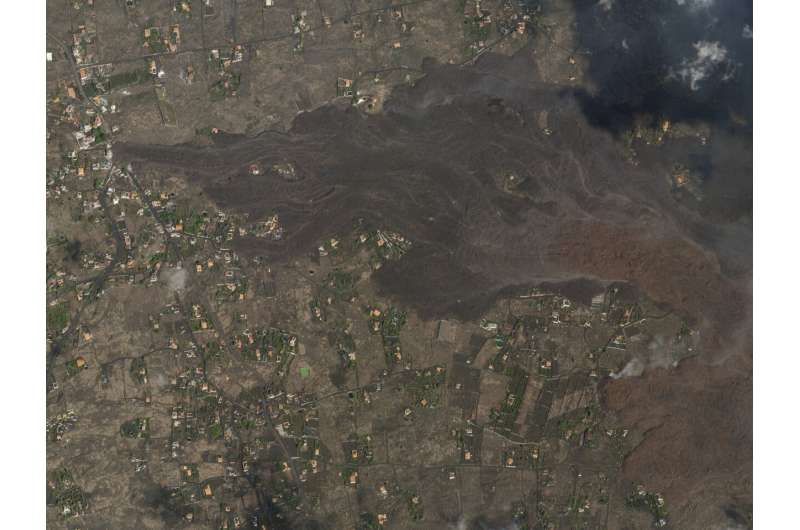
In this Saturday, Sept. 25, 2021 satellite photo from Planet Labs Inc. lava and ash from a volcano on the Canary island of La Palma, Spain can be seen. A Spanish island volcano that has buried more than 500 buildings and displaced over 6,000 people since last week lessened its activity on Monday, although scientists warned that it was too early to declare the eruption phase finished and authorities ordered residents to stay indoors to avoid the unhealthy fumes from lava meeting sea waters. Credit: Planet Labs Inc. via AP

Lava flowing from a volcano in Spain's Canary Islands picked up its pace on its way to the sea Tuesday, but scientists said it was impossible to estimate when the black-and-red stream of molten rock would reach the shore.


Authorities said the lava had moved on the island of La Palma to within 800 meters (875 yards) of the Atlantic Ocean as of Tuesday morning, nine days after the volcano's eruption. When it eventually meets sea water, the lava could trigger explosions and the release of toxic gas.

By the afternoon, officials said various factors dictated the unpredictable speed of the lava flow, including its departure from a path over an earlier flow that had hardened. The river of cooled lava had helped the moving flow slide along.

"The lava cools down as time passes and it meets uneven ground, which slows it down," said Miguel Ángel Morcuende, technical director of the Canary Islands emergency volcano response department. "And if it comes off the highway it was going along, that slows it even more because it spreads out wider."

A small hill and a built-up area also stood in the lava's way, and the shore area is flatter than the hills the lava has been flowing down.

For days, officials have nervously awaited the time when lava from the Sept. 19 eruption reaches the Atlantic, but the volcano has been erratic. After calming down on Monday, the volcano became more explosive again overnight.
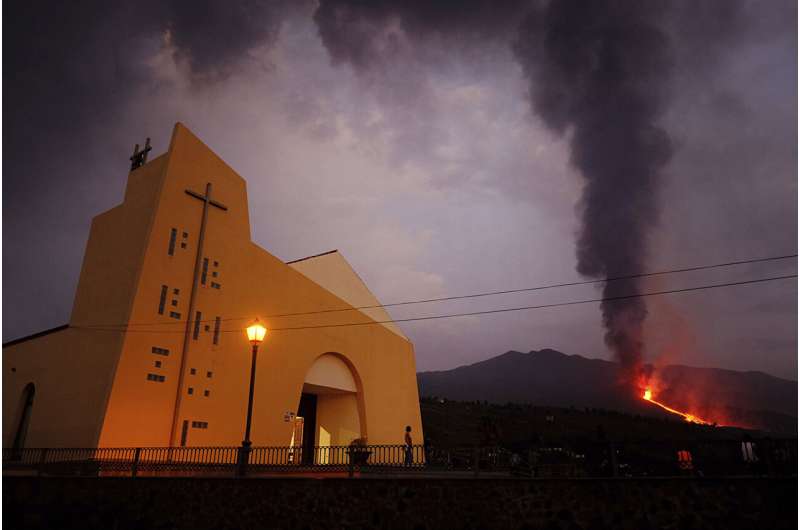
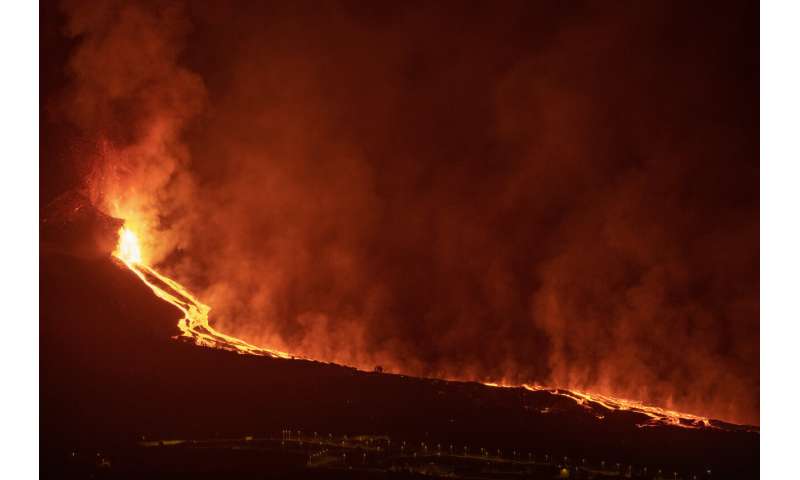
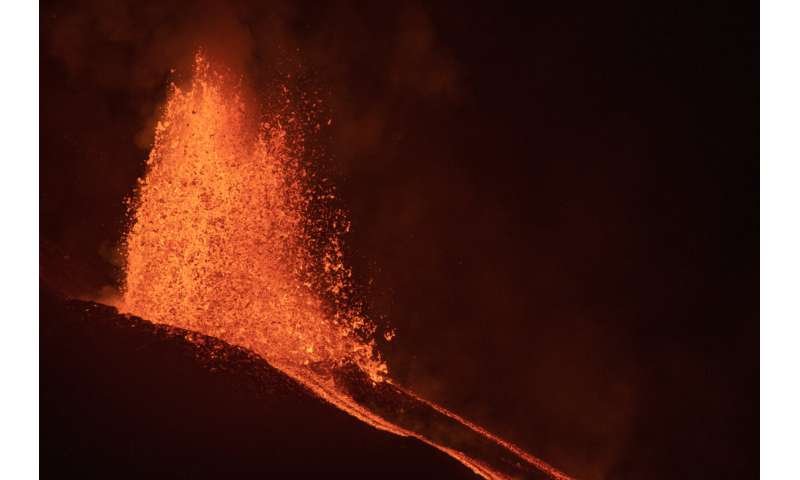
Lava flows from a volcano on the Canary island of La Palma, Spain on Monday Sept. 27, 2021. A Spanish island volcano that has buried more than 500 buildings and displaced over 6,000 people since last week lessened its activity on Monday, although scientists warned that it was too early to declare the eruption phase finished and authorities ordered residents to stay indoors to avoid the unhealthy fumes from lava meeting sea waters. Credit: AP Photo/Daniel Roca
Authorities said they don't expect the slow-moving lava to create a large disruption on the coast. But Eugenio Fraile, a researcher at the Spanish Oceanography Institute, told Cadena Ser radio that only scientists wearing protective gear will be inside a security perimeter when the flow hits the ocean.

The National Geographic Institute detected six earthquakes Tuesday in the area of the eruption, with the strongest measured at magnitude 3.3.

La Palma, home to about 85,000 people, is part of the volcanic Canary Islands, an archipelago off northwest Africa. The island is roughly 35 kilometers (22 miles) long and 20 kilometers (12 miles) wide at its broadest point.

Lava from the eruption has devoured everything in its path, destroying 589 buildings and 21 kilometers (13 miles) of roads on La Palma. The lava now covers 258 hectares (637 acres), mostly farmland, according to a European Union satellite monitoring agency.

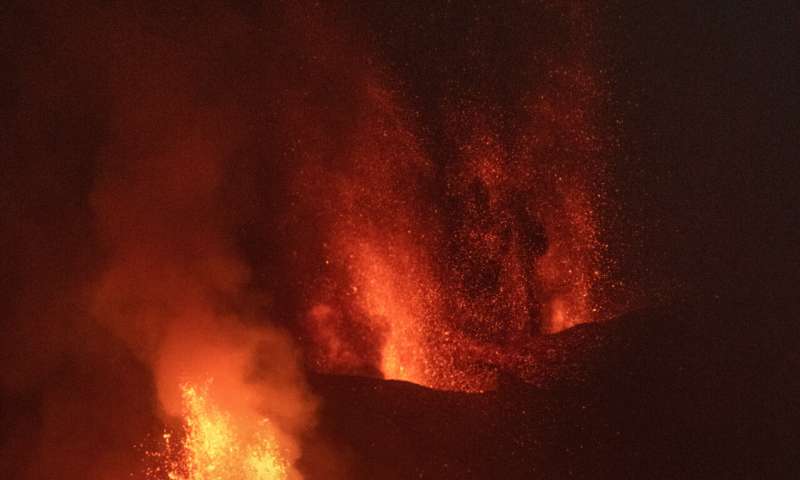
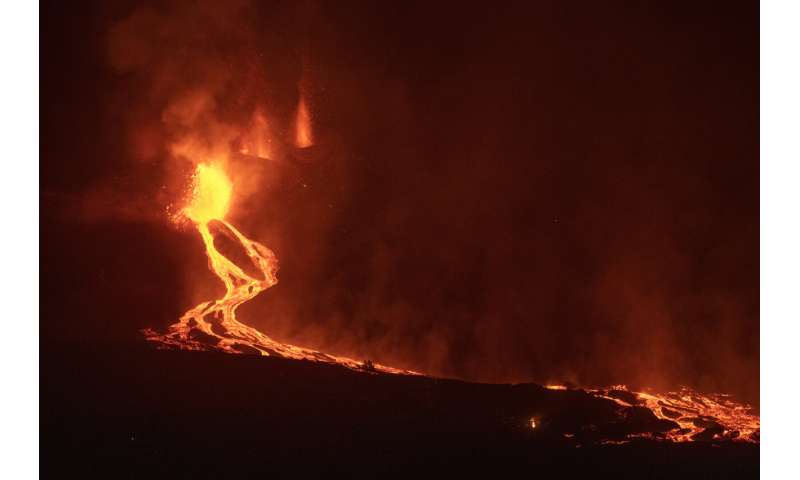
Lava flows from a volcano on the Canary island of La Palma, Spain in the early hours of Tuesday Sept. 28, 2021. A Spanish island volcano that has buried more than 500 buildings and displaced over 6,000 people since last week lessened its activity on Monday, although scientists warned that it was too early to declare the eruption phase finished and authorities ordered residents to stay indoors to avoid the unhealthy fumes from lava meeting sea waters. Credit: AP Photo/Saul Santos
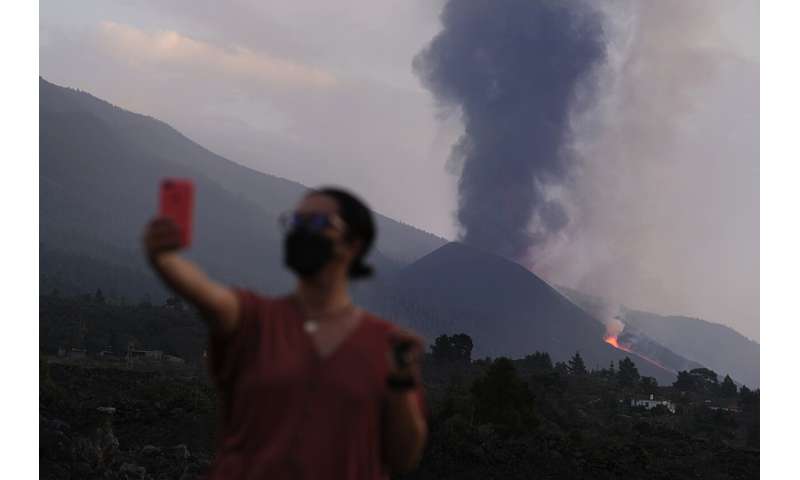
A woman takes a selfie as lava flows from a volcano on the Canary island of La Palma, Spain on Monday Sept. 27, 2021. A Spanish island volcano that has buried more than 500 buildings and displaced over 6,000 people since last week lessened its activity on Monday, although scientists warned that it was too early to declare the eruption phase finished and authorities ordered residents to stay indoors to avoid the unhealthy fumes from lava meeting sea waters. Credit: AP Photo/Daniel Roca
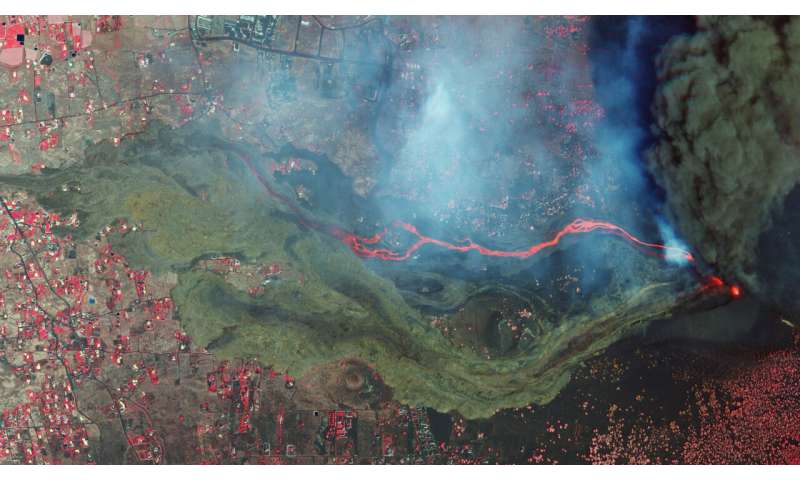
In this Sunday, Sept. 26, 2021 satellite photo from Planet Labs Inc. lava and ash from a volcano on the Canary island of La Palma, Spain can be seen. A Spanish island volcano that has buried more than 500 buildings and displaced over 6,000 people since last week lessened its activity on Monday, although scientists warned that it was too early to declare the eruption phase finished and authorities ordered residents to stay indoors to avoid the unhealthy fumes from lava meeting sea waters. Credit: Planet Labs Inc. via AP

Lava flows from a volcano on the Canary island of La Palma, Spain in the early hours of Tuesday Sept. 28, 2021. A Spanish island volcano that has buried more than 500 buildings and displaced over 6,000 people since last week lessened its activity on Monday, although scientists warned that it was too early to declare the eruption phase finished and authorities ordered residents to stay indoors to avoid the unhealthy fumes from lava meeting sea waters. Credit: AP Photo/Saul Santos

No deaths or serious injuries have been reported, thanks to the prompt evacuations of over 6,000 people.

But local people have lost their homes and their livelihoods at the same time. Farming is one of the island's economic mainstays, along with tourism, and the lava and ash has ruined crops and irrigation systems, endangered aviation and poses a significant health risk to those nearby.

No flights went in or out of La Palma's airport for a fourth straight day because of a huge ash cloud. Volcanic ash is hazardous for aircraft engines.

The Spanish government announced after its weekly Cabinet meeting Tuesday it's providing an immediate grant of 10.5 million euros ($12.3 million) to buy 107 properties to rehouse local people and also provide them with income aid.

More aid, including for the rebuilding of public infrastructure, will be sent once the current emergency is over, government spokeswoman Isabel Rodríguez said.

The volcano has so far spewed out more than 46 million cubic meters (1.6 billion cubic feet) of molten rock, according to the Canary Island Volcanology Institute.


Explore furtherSpanish volcano still packs a punch 5 days after eruption

© 2021 The Associated Press. All rights reserved. This material may not be published, broadcast, rewritten or redistributed without permission.

Friday, August 22, 2025

Underwater volcano off Oregon coast could erupt by the end of the year, researchers say, but nothing ‘looks imminent’

When it does erupt, it likely won’t pose a threat to human life.

Kate Murphy, Reporter
Thu, August 21, 2025 


Underwater volcano Axial Seamount. (National Science Foundation)

An underwater volcano off the coast of Oregon that was forecast to erupt sometime this year doesn’t look imminent, according to volcanologists who are closely monitoring it.

The Axial Seamount is located about 300 miles off the coast of Oregon in the Pacific Ocean, and it’s 4,900 feet below the surface of the sea along the Juan de Fuca Ridge. For comparison, its depth is about two-and-a-half times the height of One World Trade Center in New York City, which is 1,776 feet, according to the U.S. Geological Survey.

It’s the most active submarine volcano in the northeast Pacific. In the last 30 years that it’s been monitored, three eruptions have occurred: in 1998, 2011 and 2015, according to researchers Bill Chadwick at Oregon State University and Scott Nooner at the University of North Carolina at Wilmington.

“Our forecast of an eruption at Axial Seamount by the end of the year still stands, but I have to say nothing looks imminent,” Chadwick told KOIN on Wednesday. Yahoo contacted Chadwick for an updated confirmation of this assessment and is awaiting a response.

Here’s what else to know about the underwater volcano.
Does the underwater volcanic eruption pose a serious threat?

No. Due to the Axial Seamount’s great depth underwater, combined with its relatively gentle lava flow style, it doesn’t pose a threat to human life, ocean travel or property, the U.S. Geological Survey says.

“For the size of eruptions we’ve seen in the last 20 years … if you were on top of it on a boat, you would never know it,” Chadwick previously told local media.

However, the next eruption will help researchers better understand and forecast how volcanoes erupt on land.

Why is it forecast to erupt this year?


Inflation in an underwater volcano happens when magma accumulates below the sea floor and pushes the surface of the volcano upward, Chadwick explained at a 2024 seminar. One of the signs that an eruption of Axial Seamount might happen this year is that the volcano reached the same inflation levels from when it erupted in 2015, back in January.

But as of July, “the rate of inflation has been slowly decreasing all year,” Chadwick wrote in a blog on the OSU website that details the eruption forecast.

Researchers also monitor seismic activity near the volcano through instruments and cables that extend from the U.S. coast. In June, there were more than 2,000 earthquakes recorded near Axial Seamount in a single day, which is a sign that an eruption could be imminent.

A new benchmark deployed at the base of the western caldera wall of the Axial Seamount volcano. (NOAA)

Additionally, in July, the tsunami wave from the 8.8 magnitude earthquake near Russia’s Kamchatka Peninsula "triggered the automated alerts we have in place to notify us when an eruption might be starting,” even though it wasn’t actually an eruption, according to Chadwick’s blog post.

“We can only wait and see, but nothing seems imminent at the moment since the rate of unrest keeps wavering up and down, up and down,” Chadwick writes. “Of course, we don’t really know what it will take to trigger the next eruption and exactly when that will happen. But hopefully we’ll learn more about that triggering process by the monitoring we are doing now.”


Scientists play a waiting game with a giant volcano off the West Coast

N'dea Yancey-Bragg and Elizabeth Weise, 
USA TODAY
Wed, August 20, 2025


Scientists play a waiting game with a giant volcano off the West Coast

Hundreds of miles off the coast of Oregon, Deb Kelley watched a pod of dolphins swim past the research vessel Atlantis as the sun set on the Pacific Ocean.

But beneath the calm seas lurked a behemoth: Axial Seamount, a massive volcano 4,500 feet below the ocean’s surface. Kelley and her team are in the middle of a maintanence mission, working nearly 24 hours a day for weeks to recover and restore the instruments that keep tabs on the volcano, which scientists believe will erupt in 2025.

Kelley, director of the Regional Cabled Array, is not so sure.

USA TODAY reported on the volcano in May, and not much has changed since then, other than a slight decline in some of the prescursors to eruption. Researchers say they still don't know what it will take to trigger the next eruption or exactly when it will happen.

"We can only wait and see, but nothing seems imminent at the moment since the rate of unrest keeps wavering up and down, up and down," Bill Chadwick, a volcanologist with Oregon State University who’s part of a team that’s studying the volcano, wrote in a July 30 blog post.

What's happening with Axial Seamount? 'Not much'

A reservoir has been refilling with magma since its last eruption in 2015, gradually inflating and causing the volcano to rise. Eventually, the pressure will become so great that it will open up and lava will pour out.

Kelley said there have been some indications that an eruption is coming, like submarine hydrothermal vents beginning to boil. The hot water is attracting sea life that prefer warm, nutrient-rich waters.

But "not much" has been happening with the volcano lately, Chadwick wrote.

The rate of inflation has been slowly decreasing all year. There was a brief spike in seismic activity - including one day in June with over 2,000 earthquakes - but that has dwindled to an average of 100 per day.

"All those indications from previously was that it would erupt, but those have all slowed down now," Kelley said.

What happens when the volcano erupts?

When the volcano erupts, it will spew enormous amounts of lava into the ocean for days or even months.

Kelley said the lava flow could potentially cause tens of thousands of explosions and billions of microbes will stream out onto the sea floor like flakes from a snowblower.

But Axial Seamount is not a threat to humans. It won't trigger a tsunami or earthquakes on land, and even a person in a boat directly above it likely wouldn't notice, Chadwick previously said.

But it will provide researchers a virtually unprecedented opportunity to watch what happens when the lava flows.

"We're never there in the right place, in the right time to know that's happening," Kelley said. "So this is a phenomenal opportunity to gain a lot of insights about major processes operating on our planet."

Research facing Trump cuts

Axial is the world’s most extensively studied undersea volcano because more than 660 miles of undersea cables crisscross it, sending a steady stream of real-time data about the area to scientists. The Regional Cabled Array includes more than 140 instruments that are constantly monitoring it.

The work is part of a larger ocean monitoring effort by the Ocean Observatories Initiative, which maintains more than 900 ocean-based instruments to address critical questions about the world's oceans, funded by the National Science Foundation.

But that work may now be under threat. The National Science Foundation's budget for fiscal year 2026 proposed slashing the initiative's budget by 80% in its tenth year, the organization said in June.

Kelley said its not yet clear how the cuts will affect her projects, but she hopes to be back out on the waters above Axial next summer.

"We don't know how that what the cuts will be, what the budget will be, and how that funnels down to us yet," Kelley said. "So we have hope. I always have hope, it's just in my nature to do so."


One of the world's most active volcanoes in this US state is about to erupt again

JULIA JACOBO
Wed, August 20, 2025 

One of the most active volcanoes in the world is living up to its reputation as it gears up for another eruption.

An eruption at Hawaii's Kilauea volcano is imminent, based on current activity, according to the U.S. Geological Survey. Lava fountains -- jets of lava that are sprayed into the air during an eruption -- are expected to begin flowing between Wednesday and Saturday.

MORE: Eruption at Hawaii's Kilauea volcano sends lava shooting 1,000 feet in air


Kilauea began to show signs of eruption on Monday, when deflation was recorded on two tiltmeters, instruments used to measure the tilting or rotation of a structure or the ground surface, according to the USGS.

M. Patrick/USGS - PHOTO: On Aug. 18, 2025, two USGS scientists and two researchers from the University of Colorado hiked to an overview of the north vent in Halemaʻumaʻu crater at Kīlauea volcano to confirm if lava was moving up inside the vent.More

Continued tremors and what's known as "glow" at Kilauea indicate that magma remains relatively high in the north vent of the volcano, according to the USGS. In addition, "elevated degassing continues from the vent."

"The onset and persistence of glow suggest that magma is close to the surface," the USGS said in its latest update.

MORE: Kilauea, active Hawaiian volcano, could erupt like a 'stomp-rocket toy,' new study suggests

The current volcano alert level is at "Watch" or "Orange" level, indicating heightened or escalating unrest and an increased potential for eruption, according to the USGS.

Once the eruption begins, it will be the 31st time Kilauea has erupted since December. In some of the eruptions, lava was seen shooting up to 1,000 feet from the volcano's vent.

USGS - PHOTO: This close-up view of the Kīlauea summit eruption's north vent was captured during an uncrewed aircraft system (UAS) overflight conducted by Hawaiian Volcano Observatory scientists on Aug. 18, 2025.More

Magma has been using the same pathway to gather in a chamber under the Halemaumau Crater since Dec. 23, making the eruptions "intermittently active" within the crater, according to the USGS.

The last eruption ended on Aug. 6 after 12 hours of continuous fountaining, according to the USGS. Lava fountains reached up to 165 feet and covered 80% of the crater floor.

The eruption was characterized by episodic lava fountaining not seen since the 1980s, according to the USGS.

Kilauea has erupted dozens of times since 1952. Eruptive activity was nearly continuous along the volcano's East Rift Zone between 1983 and 2018.


H. Weiss-Racine/USGS - PHOTO: On August 18, the goal field observations confirmed that lava was moving up inside the vent. While perched lava was not observed, lava spatter was visible intermittently during gas pistoning events.More

High levels of volcanic gas -- including water vapor, carbon dioxide and sulfur dioxide -- is a major hazard of concern.

Strands of volcanic glass known as "Pele's hair", are present throughout the summit area of Hawaiʻi Volcanoes National Park and can spread by wind, even after fountaining has ended, according to the USGS.

Kilauea's caldera rim surrounding the Halemaʻumaʻu crater has been closed to the public since 2007 due to such hazards.

Friday, January 06, 2023

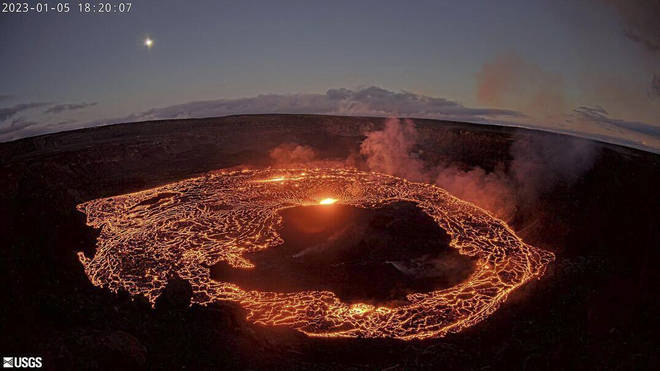
Hawaii’s Kilauea volcano erupts again, summit crater glows

Associated Press
January 6, 2023 
Kilauea volcano in Hawaii has erupted again for the second time in less than. a year.

Hawaii’s Kilauea began erupting inside its summit crater Thursday, the U.S. Geological Survey said, less than one month after the volcano and its larger neighbor Mauna Loa stopped releasing lava.

The Hawaiian Volcano Observatory detected a glow in webcam images indicating Kilauea had begun erupting inside Halemaumau crater at the volcano’s summit caldera, the agency said.

Kilauea’s summit is inside Hawaii Volcanoes National Park and away from residential communities.

Earlier Thursday, the U.S. Geological Survey raised the alert level for Kilauea due to signs that magma was moving below the summit surface, an indication that the volcano might erupt.

Kilauea is one of the world’s most active volcanoes. It last erupted for 16 months starting in September 2021. For about two weeks starting Nov. 27, Hawaii had two volcanoes spewing lava side by side when Mauna Loa erupted for the first time in 38 years. Both volcanoes stopped erupting at about the same time
.
Images of Kilauea volcano spewing lava on Jan. 5, 2023.AP

During the twin eruption, visitors to Hawaii Volcanoes National Park were able to see lava from both eruptions at the same time.

“It was a beautiful eruption, and lots of people got to see it, and it didn’t take out any major infrastructure and most importantly, it didn’t affect anybody’s life,” said Ken Hon, the Hawaiian Volcano Observatory’s scientist in charge.

Mauna Loa lava didn’t pose a threat to any communities, but got within 1.7 miles (2.7 kilometers) of a major highway connecting the east and west sides of the island. A 2018 Kilauea eruption destroyed more than 700 residences.

The observatory planned to continue monitoring the volcanoes for signs of renewed activity. Hon previously said there is generally a three-month “cooling off” period before scientists consider an eruption to be complete.

The alert level for the volcano was raised due to magma moving below the surface of the mountain’s summit.

It was unclear what connection there could be to the volcanoes stopping their eruptions around the same time. The volcanoes can be seen at the same time from multiple spots in Hawaii Volcanoes National Park near Kilauea’s caldera.

What do you think? Be the first to comment.

Scientists planned to look at data to study the relationship between the two volcanoes, Hon previously said.

For Native Hawaiians, volcanic eruptions have deep cultural and spiritual significance. During Mauna Loa’s eruption, many Hawaiians took part in cultural traditions, such as singing, chanting and dancing to honor Pele, the deity of volcanoes and fire, and leaving offerings known as “hookupu.”


Summit crater glows as Hawaii’s Kilauea volcano erupts again

6 January 2023, 07:54

Hawaii’s Kilauea volcano, from the west rim of the summit caldera, looking east
Hawaii-Volcano. Picture: PA

The Hawaiian Volcano Observatory detected a glow in webcam images.

Hawaii’s Kilauea has begun erupting inside its summit crater, the US Geological Survey said – less than one month after the volcano and its larger neighbour Mauna Loa stopped releasing lava.

The Hawaiian Volcano Observatory detected a glow in webcam images, indicating Kilauea had begun erupting inside Halemaumau crater at the volcano’s summit caldera, the agency said.

Kilauea’s summit is inside Hawaii Volcanoes National Park and away from residential communities.

Hawaii’s Kilauea began erupting inside its summit crater on Thursday, the US Geological Survey said
Hawaii’s Kilauea began erupting inside its summit crater on Thursday, the US Geological Survey said (US Geological Survey/AP)

Kilauea is one of the world’s most active volcanoes. It last erupted for 16 months starting in September 2021. For about two weeks starting on November 27, Hawaii had two volcanoes spewing lava side by side when Mauna Loa erupted for the first time in 38 years. Both volcanoes stopped erupting at about the same time.

Earlier on Thursday, the US Geological Survey raised the alert level for Kilauea due to signs magma was moving below the summit surface, an indication the volcano might erupt.

During the twin eruption, visitors to Hawaii Volcanoes National Park were able to see lava from both eruptions at the same time.

“It was a beautiful eruption and lots of people got to see it and it didn’t take out any major infrastructure and, most importantly, it didn’t affect anybody’s life,” said Ken Hon, the Hawaiian Volcano Observatory’s scientist in charge.

Mauna Loa lava did not pose a threat to any communities but got within 1.7 miles of a motorway connecting the east and west sides of the island. A 2018 Kilauea eruption destroyed more than 700 homes.

The observatory plans to continue monitoring the volcanoes for signs of renewed activity. 

Mr Hon previously said there is generally a three-month “cooling off” period before scientists consider an eruption to be complete.

It was unclear what connection there could be to the volcanoes stopping their eruptions at around the same time. The volcanoes can be seen at the same time from multiple spots in Hawaii Volcanoes National Park near Kilauea’s caldera.

Scientists planned to look at data to study the relationship between the two volcanoes, Mr Hon previously said.

For Native Hawaiians, volcanic eruptions have deep cultural and spiritual significance. During Mauna Loa’s eruption, many Hawaiians took part in cultural traditions, such as singing, chanting and dancing to honour Pele, the deity of volcanoes and fire, and leaving offerings known as “hookupu”.

By Press Association


Thursday, December 24, 2020

PELE CELEBRATES SOLSTICE
UPDATE
Lava lake forms as Hawaii volcano erupts after 
2-year break

by Audrey McAvoy
A plume rises near active fissures in the crater of Hawaii's Kilauea volcano on Monday, Dec. 21, 2020. People are lining up to try to get a look at the volcano on the Big Island, which erupted last night and spewed ash and steam into the atmosphere. A spokeswoman for Hawaii Volcanoes National Park says the volcanic activity is a risk to people in the park Monday and that caution is needed. (M. Patrick/U.S. Geological Survey via AP)

Lava was rising more than 3 feet (1 meter) per hour in the deep crater of a Hawaii volcano that began erupting over the weekend after a two-year break, scientists said Tuesday.

Kilauea volcano within Hawaii Volcanoes National Park on the Big Island was gushing molten rock from at least two vents inside its summit crater, the U.S. Geological Survey said. A lava lake has formed, rising about 440 feet (134 meters) from the bottom of the crater.

Since the eruption began Sunday night, Kilauea has spewed some 2 billion gallons of lava (10 million cubic meters), enough to cover 33 acres (13 hectares). The lava has been contained inside the deep crater.

It isn't threatening to get close to people or cover property, like when Kilauea erupted from vents in the middle of a residential neighborhood in 2018 and destroyed more than 700 homes.

Still, the Hawaiian Volcano Observatory has warned residents to beware of potentially high levels of volcanic gas, rockfalls and explosions.

When erupting, Kilauea tends to spew large volumes of sulfur dioxide, which forms volcanic smog, or vog, when it mixes with oxygen, sunlight and other gases in the air. The state Department of Health warned residents to reduce their outdoor activities if they encounter volcanic smog conditions.

Kilauea is one of the world's most active volcanoes, having erupted some 50 times in the last century. Between 1983 and 2018, it erupted almost continuously. It had a lava lake in its crater for the last decade of that eruption.


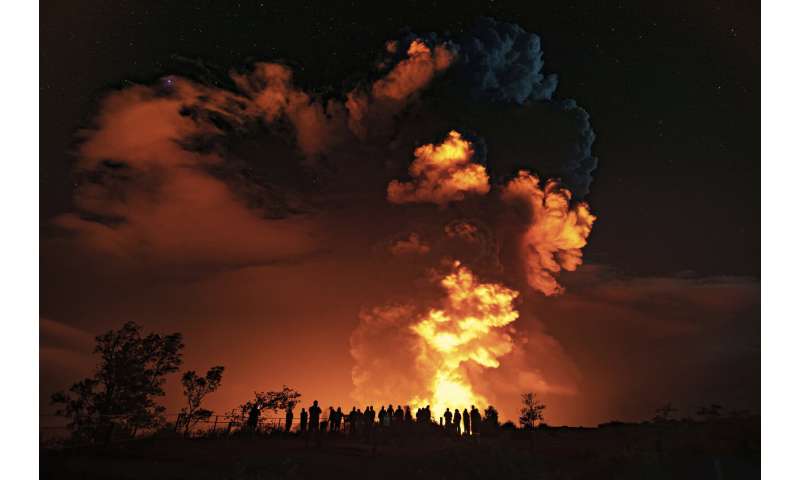
In this photo provided by the National Park Service, people watch an eruption from Hawaii's Kilauea volcano on the Big Island on Sunday, Dec. 20, 2020. The volcano shot steam and an ash cloud into the atmosphere which lasted about an hour, an official with the National Weather Service said early Monday, Dec. 21, 2020. (Janice Wei/National Park Service via AP)


A plume rises near active fissures in the crater of Hawaii's Kilauea volcano on Monday, Dec. 21, 2020. People are lining up to try to get a look at the volcano on the Big Island, which erupted last night and spewed ash and steam into the atmosphere. A spokeswoman for Hawaii Volcanoes National Park says the volcanic activity is a risk to people in the park Monday and that caution is needed. (M. Patrick/U.S. Geological Survey via AP)


In this photo provided by the U.S. Geological Survey, lava flows within the Halema'uma'u crater of the Kilauea volcano Sunday, Dec. 20, 2020. The Kilauea volcano on Hawaii's Big Island has erupted, the U.S. Geological Survey said. (U.S. Geological Survey via AP)


Explore further Volcano erupts on Hawaii's Big Island, draws crowds to park

© 2020 The Associated Press. 

Volcanic eruption boils off massive lake


For months, Hawaii's Kilauea volcano site had been home to a deadly water lake. The lake was over 130 feet deep with a volume equivalent to almost 200 Olympic swimming pools. It showed temperature reading as high as 185 degrees Fahrenheit. For reference, water 154 degrees Fahrenheit or higher can scald humans instantaneously. However, that lake's life came to an abrupt end as the volcano started erupting on December 20. Lava began flowing from three fissure vents inside the crater. The lava cascaded into the summit water lake and in no time, boiled off the water. The water lake is now gone and a new lake made up of lava sits at the base of the crater.


Video player from: Oath (Privacy Policy)


Tuesday, January 14, 2020

Here's Why George Patton Sent American Bombers To Attack A Hawaiian Volcano
Sebastien Roblin,
The National Interest•January 12, 2020

Key point:

Disaster seemed imminent: day by day, a glowing river of molten lava was creeping steadily towards Hilo, Hawaii. The town of 15,000 lay slightly over 30 miles northeast of Mauna Loa, known as the second-largest volcano on the planet.

The over 13,000-foot tall behemoth had erupted on Hawaii island on November 21. By December, Dr. Thomas Jaggar, a local volcanologist and founder of the Hawaii Volcano Observatory, estimated that one of the five streams of lava issuing from Mauna Loa was advancing at a mile per minute towards Hilo, threatening to first flood the Wailuku River feeding into it.

At first, Jaggar considered dispatching mule teams laden with explosive to Mauna Loa to collapse the lava tubes feeding the lava streams—but such a project seemed likely to take far too long to avert catastrophe.

Then his colleague Guido Giacometti proposed a faster solution: why not ask the Army Air Corps if it could blast the streams from the air with a little precision bombing?

On December 23, Jaggar contacted the G-2 intelligence staff officer of the Army Hawaiian Division, a young lieutenant colonel by the name of George S. Patton. He signed off on the idea and tapped the 23rd and 72nd Bomber Squadron for the job, both based at Luke Field on Ford/Oahu island.

At the time these units flew large, fabric-covered Keystone B-3A and LB-6 twin-engine biplane bombers. The obsolete aircraft had five-man crews armed with defensive machineguns, and Wright Cyclone engines nestled in the spars between their two sets of wings. Though highly similar, the older LB-6 was distinguished by its twin vertical tail fins compared to the single fin on the B-3A.

Jaggar briefed the pilots on the geological theory behind the raid, and on December 26 the Army Air Force bombers flew the 220-mile long journey from Luke Field in Pearl Harbor to a field in Hilo.

The following morning the aviators were visited by a native Hawaiian named Harry Keliihoomalu who warned them not to attack, lest they displease the Madam Pele, the Hawaiian goddess of volcanoes, and thus by implication the creator of the volcanic Hawaiian archipelago itself.

“Why don’t they leave Pele alone?” Keliihoomlu later told Hilo’s local newspaper. “They shouldn't interfere with the flow. If Pele decides to flow to Hilo, there's nothing that they can do to stop her.”

Pele, also known as She Who Devours the Earth, remains a popular local deity, and many Hawaiian natives believed it wrong to obstruct volcanos, seen as manifestations of her power.

Another citizen quoted in the paper said: “Pele should not be disturbed. This bombing is a folly. It will do more harm than good. If Pele makes up her mind to come to Hilo it is not for man to dissuade her by artificial methods. She cannot be stopped that way.”

Nonetheless, the Army pilots carried out their mission in two waves of five, the rickety open-cockpit aircraft approaching the volcano at an only 4,000 feet high due to their bombloads, and likely below their pokey maximum speed of 115 miles per hour. Jaggar observed the attack through his telescope from a perch neighboring on Mauna Kea, while a geologist named Harold Stearns accompanied the bomber crew for a first-hand view of the operation.

The first wave—two LB-6s and three B-3As—each carried two 300-pound practice bomb with black powder charges to test different approaches. In the following five-ship wave at noon, each aircraft carried two 600-pound Mark 1 bombs with fuses set to detonate a tenth of a second after impact.

You can see the eruption and the unusual bombing raid in archival footage here and here.

Most of the bombs exploded ineffectually to either side of the stream—but five landed on target, their explosions creating craters that rapidly flooded with molten rock and causing lava to fountain hundreds of feet into the air. According to one article, flying volcanic sediment even burned holes in one of the bomber’s fabric-covered wings.

Six days after the raid on December 2, the lava stream abruptly ceased its advance. Jaggar was not shy about according to his bombing scheme credit for this fortuitous outcome.

“The experiment could not have been more successful; the results were exactly as anticipated,” he told the New York Times. He expounded:

This channel was broken up by the bombing and fresh streams poured over the side of the heap…. I have no question that this robbing of the source tunnel slowed down the movement of the front…. The average actual motion of the extreme front … for the five days after the bombing was approximately 1000 feet per day. For the seven days preceding the bombing the rate was one mile per day. How long would the flow have lasted without bombing it?

But Stearns, who witnessed the bombing up close concluded the opposite:

“The tube walls look 25 to 50 feet high and deep in the flow so that I think there would be no chance of breaking the walls. The lava liquid is low. The damming possibility looks effective but the target is too small.” Regarding the flow’s halt on December 2, he later wrote: “I’m sure it’s a coincidence.”

Most geological analysis of the bombing shared Stearn’s conclusion that the bombs simply weren’t powerful to meaningfully affect the lava flow.

Nonetheless, seven years later on May 1 or 2, 1942, the wartime Army Air Force again dispatched bombers to strike an active Mauna Loa, this time targeting her vents. The aircraft (most likely B-18 Bolo light bombers) again missed with most of their bombs and left behind several duds. A later study again judged the raid had been ineffectual. But three days later vents collapsed, likely due to natural causes.

Then from 1975–1976, the Air Force engaged in multiple tests using far more powerful 2,000-pound bombs on volcanic rock, producing 100-foot diameter craters. A detailed 1980 study by J.P. Lockwood and F.A. Torgerson judged that the attacks in 1935 and 1942 were unlikely to have had any affect, but estimated that larger weapons employed with greater precision could be effective. The idea continues to be proposed from time to time as possible solution for dealing with modern eruptions.

However, the idea of using bombers or other technologies to divert lava flows in Hawaii remains objectionable to many Hawaiians, who believe that respecting Pele means accepting her unpredictable bouts of fiery destruction—or risk suffering worse consequences.

Indeed, some hold Pele responsible for a fatal crash at Luke Field two months after the 1935 bombing which killed six aircrew who had participated in the raid.

Despite having possibly incurred the wrath of a goddess, the 23rd Bomber Squadron continues to sport a unit patch depicting bombs falling upon a volcano. In 2015 on the eightieth anniversary of the raid, the squadron dispatched two B-52 for a flyby of Mauna Loa to commemorate their shared history in a unique confrontation between man and nature.

Sébastien Roblin holds a Master’s Degree in Conflict Resolution from Georgetown University and served as a university instructor for the Peace Corps in China. He has also worked in education, editing, and refugee resettlement in France and the United States. He currently writes on security and military history for War Is Boring. This appeared last year.

Image: Wikipedia.

Read the original article.

Monday, February 10, 2020

Does the eruption of the White Island volcano spell the end for ‘volcano tourism’?

Publishing Details
Travel Insurance
3 Feb 2020
Robin Gauldie
Featured in Issue 229 | February 2020
Overexposure to danger?

Could the eruption of the White Island volcano on 9 December last year spell the end for ‘volcano tourism’? In the aftermath of the tragedy, cruise lines and travel insurers may be considering their position on cover for such activities. Robin Gauldie asked industry experts for their take on the issue

The unforeseen eruption on a tiny, privately owned volcanic island just off the coast of New Zealand killed 17 people, including tour guides and cruise passengers. At the time of writing, 13 people were still in hospital with severe burns, and two remained missing.

Regular visits

Volcano tours are popular shore excursions for cruise passengers. Most of the 47 people on White Island at the time of the eruption were passengers from the Royal Caribbean vessel Ovation of the Seas, several of whom were among the fatalities. Soon after the incident, Royal Caribbean announced that it had suspended all tours of active volcanoes.

Small, slumbering volcanoes like White Island, as well as awesome giants from Hawaii to the Mediterranean, have become magnets for a wide range of visitors

Despite the highly publicised event, most ‘volcano tourism’ remains an acceptable risk, according to travel insurers. Deciding when visiting a volcano becomes a foreseeable hazard, though, is made trickier due to the lack of an internationally accepted system of eruption warnings. Nevertheless, small, slumbering volcanoes like White Island, as well as awesome giants from Hawaii to the Mediterranean, have become magnets for a wide range of visitors.

Package holidaymakers and cruise ship passengers swim happily in sea heated by undersea vents and wander among volcanic rocks at Nea Kameni, an islet off Santorini, one of Greece’s most popular holiday islands. Perhaps they’re unaware that Santorini’s spectacular, sea-filled caldera was created around 4,000 years ago by an apocalyptic event that destroyed Europe’s first civilisation, or that Nea Kameni last erupted as recently as 1950. Or perhaps that’s part of the thrill.

Also in Greece, day-trippers in search of an exotic setting for an Instagram selfie troop to tiny Nissiros, close to the popular resort island of Kos, to discover a dormant crater filled with bubbling, sulphurous mud pools. In Italy, Vesuvius and Stromboli – which has been in continuous eruption for almost 90 years – attract thousands of visitors.

Volcano Discovery, a specialist tour operator based in Germany, features ‘adventure guaranteed’ trips to volcano destinations such as Stromboli, Santorini, Krakatau in Indonesia and the remote Kurile Islands off Russia’s Pacific coast. Insurance provided by World Nomads is offered on the operator’s website.


Still insurable
Despite recent events, World Nomads spokesperson Phil Sylvester does not believe volcano tourism is likely to become an uninsurable hazard. “We discussed this in the immediate aftermath of the White Island tragedy,” he says. “We came to the conclusion that we have sufficient safeguards in place from a risk point of view, considering licensing of operators, warning and alert systems and, ultimately, the obligation on insureds to not take ‘unnecessary risk’.”

Sylvester draws comparisons with other activities that may appear hazardous, but are in reality low risk. “Consider bungee jumping, which was also popularised in New Zealand,” he says. “If you tied a bunch of elastic bands to your legs and jumped off the roof of your hotel, I can confidently predict no insurer would entertain a claim. But if an insured with appropriate cover turns up at a provider who has passed safety audits and consequently holds a license to operate, follows all their safety procedures, takes directions from their staff and doesn’t do anything stupid, it is highly unlikely that any harm will come to them, and if it does it would be ‘unforeseen’ and extraordinary.”

For those visitors to White Island, the criteria above seem to have been met. Sylvester said to ITIJ: “The operator was licensed, safety equipment was used, a trained guide accompanied all visitors [and] the eruption alert was below the level which would have precluded a visit.” He added: “Perhaps official inquiries will recommend that the criteria for future visits to volcanoes need to be tightened, which would seem prudent as any loss of life is truly terrible. If the threshold for volcano tours was lowered, our current test for extending cover would remain effective,” Sylvester confirmed.

The reputation of travel insurers could be damaged, he added, if the industry were to take a more draconian approach to such cover: “The public already eyes the product disclosure statement (PDS) and policy wording with suspicion. While adding clauses may help insurers manage risk, it is very likely to add to ambiguity and confusion for the end user. It is important for insurers to strike a balance between managing risk and providing a great customer experience.”

Kasara Barto, Public Relations Manager at US-based travel insurance comparison website Squaremouth, agreed that a measured approach is appropriate: “It would be unlikely that insurers would exclude coverage for dormant volcanoes outright,” she said. “However, once an event occurs, or becomes known or expected, providers will no longer offer coverage for that event on any policies purchased after that date. [So] while insurers probably won’t exclude dormant volcanoes specifically, they can stop providing coverage for losses related to a volcanic eruption once it becomes ‘foreseen’.”

The general exclusion in travel insurance policies around the world for foreseen events, noted Barto, can be applied to a volcanic eruption. “An example of this wording is: ‘any issue or event that was not anticipated or expected and occurs after the effective date of coverage’.”


Tourists killed and injured in New Zealand volcano eruption
A volcano eruption in New Zealand has killed at least five people, while 18 have been injured and several others are reported missing
9 Dec 2019
Lauren Haigh

Risk assessment

Managing and assessing risk is tricky when it comes to volcanoes, though. Predicting eruptions is not an exact science, even in comparison with monitoring events such as hurricanes, blizzards and avalanches.

Writing in online publication The Conversation in the aftermath of the White Island eruption, Shane Cronin, Professor of Earth Sciences at the University of Auckland, New Zealand, pointed out that such explosive hydrothermal (steam-driven) eruptions can happen without warning and are much harder to track using existing monitoring systems than a magma eruption, such as those seen in volcanoes such as Vesuvius, Stromboli or Hawaii’s Mt Pele (all of which are also popular volcano tourism destinations). Once a hydrothermal event is underway, those nearby have only minutes or even seconds to react, Professor Cronin stated.

Vulcanologists also point out that each volcano is unique, so monitoring all the world’s potential volcano tourism sites seems an impossible dream. Nor is there a standardised worldwide system of alert levels.

New Zealand’s GeoNet monitoring service operates a five-rung volcanic alert system system, from level zero – indicating no volcanic unrest – to level five, indicating a major eruption. GeoNet’s volcanic alert bulletin of 3 December (six days before the White Island eruption) placed White Island at level two: ‘moderate volcanic unrest’.

Should the industry create a risk assessment process down to specific volcanoes? No.

White Island is not the only volcanic incident to cause tourist deaths in recent years. In September 2014, 63 hikers were killed when Mount Ontake in Japan erupted.

Japan, a densely populated island nation with more than 100 active volcanoes, has the world’s most sophisticated – and plain-spoken – volcano monitoring system. On the Japan Meteorological Agency’s five-level scale, level one indicates potential for increased activity. At level two, a ‘near crater warning’ kicks in, instructing ‘do not approach the crater’. Presumably, therefore, insurers would regard any advisory above level one as indicating a ‘foreseen risk’.

The US Geological Survey’s (USGS) alert system, by contrast, is fuzzier. Level zero or ‘normal’ indicates a ‘non-eruptive state’; level two or ‘advisory’ indicates ‘elevated unrest’; level three or ‘watch’ indicates ‘increased potential of eruption’; and level four or ‘warning’ indicates ‘hazardous eruption imminent, under way or suspected’. Insurers erring on the side of caution might look at the USGS’s level two as uninsurable. Even those with a higher appetite for risk would probably balk at level three.

Disparate as they are, various national vulcanism monitoring and warning systems have one thing in common: their priority is preventing mass casualties by providing timely evacuation warnings to residents of cities in the shadow of active volcanoes, such as Popocatépetl, 40 miles from Mexico City, or Taal, a similar distance from Manila, capital of the Philippines. Both erupted powerfully in January 2020, with thousands of residents forced to flee.

But, compared with safeguarding the lives of tens of thousands of people living near major volcanoes, monitoring small and remote locations that are visited by comparatively tiny numbers of tourists is a relatively low priority for national warning systems.

“Volcanoes have always been dangerous and there are different levels of risk, but travel companies are exploring their destinations as the demand for new experiences grows,” says Greg Lawson, Head of Travel Insurance for UK-based Collinson Group. “Where demand grows, niche travel and insurance industries will adapt as they did for climbing Mt Everest, for example. Should the travel industry ensure it can deliver such activities safely and transparently? Yes, it should. Should the travel insurance industry keep an eye and review claims impacts? Yes. Should the industry create a risk assessment process down to specific volcanoes? No.”


Culture of recklessness?

Media coverage of the White Island eruption also homed in on New Zealand’s government-run accident compensation scheme, which pays for medical treatment for New Zealanders and visitors injured in accidents of any kind. The scheme effectively blocks the accident victim from launching a negligence suit against other parties, including tour operators. Some sources credit the scheme with fostering New Zealand’s transformation into a world leader in ‘adventure experience’ tourism – and arguably fostering a culture of recklessness among adventure tourists. Insurers rebut that claim, though.

Activities that verge on the reckless remain a niche pursuit, says Sylvester of World Nomads. “We continue to cover more than 130 adventure activities, but some of the most daring, like wing-suit flying, remain outside the ambit of our cover,” he told ITIJ. “There has been growth in ‘soft adventure’ activities. There has also been related growth in safety standards imposed on providers by legislation and self-regulation. The early days of cowboy operators with dubious safety standards are long gone.”

A case in point, Sylvester says, is Vang Vieng in Laos, which became notorious after a series of fatal accidents involving river tubing, rope swings and waterslides, before local authorities clamped down on ad-hoc operators.

Collinson Group’s Lawson concurs, but says not all destinations live up to the standards set by countries like New Zealand. “There are two key influences on people’s growing approach to adrenaline/adventure travel,” Lawson said. “The first is that travel companies are increasingly moving away from typical beach/winter/city holidays and their inventory now often reflects new and exciting opportunities – itself a challenge when marketing to generations that have increasing disposable income and ability to travel. They have a greater reach of destinations and a growing market wanting to stretch their ambitions.

“Certain countries have understandably capitalised on the tourist attractions that exist in their region and, not surprisingly, that creates demand, even when there is an element of greater risk. Whilst some countries can show that their provision for such attractions has been supportive, such as New Zealand, others have maybe not got the same infrastructure in place when things go wrong.

“The other key driver is that we are in a social media world where showing people what you are doing, and where you have been, is a major part of the holiday. This has clearly driven people to push the boundaries. As an industry, all we can do is continue to monitor cause of loss, adjust our rating where we have to pay claims, but also ensure that our longstanding clauses of needless exposure to risk are translated at the point of sale into simple language – if you think it’s dangerous, and you still do it, don’t be surprised if you get hurt and need help. If you haven’t thought about travel insurance, don’t be surprised if that help costs.” 


This article originally appeared in

Issue 229 | February 2020READ FULL ISSUE