Tuesday, March 17, 2020

One of Darwin's evolution theories finally proved by Cambridge researcher
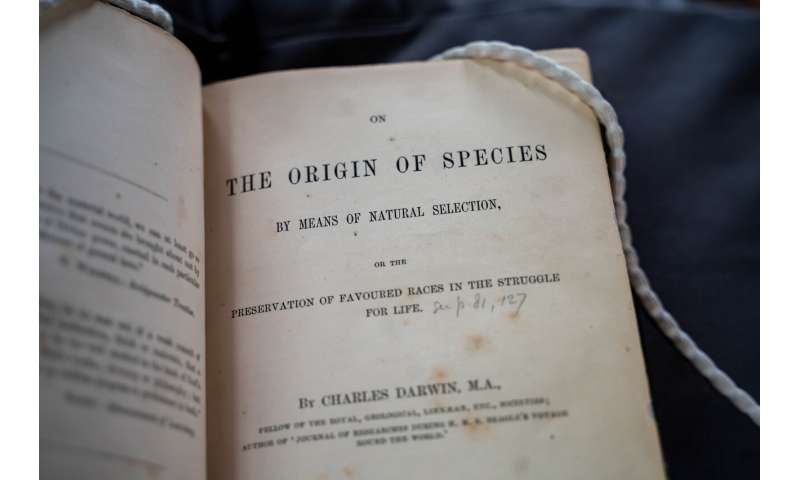
Charles Darwin's seminal book On The Origin of Species. Credit: Nordin Catic
Scientists have proved one of Charles Darwin's theories of evolution for the first time—nearly 140 years after his death.
Laura van Holstein, a Ph.D. student in Biological Anthropology at St John's College, University of Cambridge, and lead author of the research published today (March 18) in Proceedings of the Royal Society B, discovered mammal subspecies play a more important role in evolution than previously thought.
Her research could now be used to predict which species conservationists should focus on protecting to stop them becoming endangered or extinct.
A species is a group of animals that can interbreed freely amongst themselves. Some species contain subspecies—populations within a species that differ from each other by having different physical traits and their own breeding ranges. Northern giraffes have three subspecies that usually live in different locations to each other and red foxes have the most subspecies—45 known varieties—spread all over the world. Humans have no subspecies.
van Holstein said: "We are standing on the shoulders of giants. In Chapter 3 of On the Origin of Species Darwin said animal lineages with more species should also contain more 'varieties'. Subspecies is the modern definition. My research investigating the relationship between species and the variety of subspecies proves that  play a critical role in long-term evolutionary dynamics and in future evolution of species. And they always have, which is what Darwin suspected when he was defining what a species actually was."

One of Darwin's evolution theories finally proved by Cambridge researcher
Laura van Holstein in the Old Library at St John's College, Cambridge, with a first edition of Charles Darwin's seminal book On The Origins of Species. Credit: Nordin Catic
The anthropologist confirmed Darwin's hypothesis by looking at data gathered by naturalists over hundreds of years ¬- long before Darwin famously visited the Galapagos Islands on-board HMS Beagle. On the Origin of Species by Means of Natural Selection, was first published in 1859 after Darwin returned home from a five-year voyage of discovery. In the seminal book, Darwin argued that organisms gradually evolved through a process called 'natural selection' - often known as survival of the fittest. His pioneering work was considered highly controversial because it contradicted the Bible's account of creation.
van Holstein's research also proved that evolution happens differently in land mammals (terrestrial) and sea mammals and bats (non-terrestrial)¬ because of differences in their habitats and differences in their ability to roam freely.
van Holstein said: "We found the evolutionary relationship between mammalian species and subspecies differs depending on their habitat. Subspecies form, diversify and increase in number in a different way in non-terrestrial and terrestrial habitats, and this in turn affects how subspecies may eventually become species. For example, if a natural barrier like a mountain range gets in the way, it can separate animal groups and send them off on their own evolutionary journeys. Flying and marine mammals—such as bats and dolphins—have fewer physical barriers in their environment."
The research explored whether subspecies could be considered an early stage of speciation—the formation of a new species. van Holstein said: "The answer was yes. But evolution isn't determined by the same factors in all groups and for the first time we know why because we've looked at the strength of the relationship between  and subspecies richness."
The research acts as another scientific warning that the human impact on the habitat of animals will not only affect them now, but will affect their evolution in the future. This information could be used by conservationists to help them determine where to focus their efforts.

One of Darwin's evolution theories finally proved by Cambridge researcher
Darwin's hypothesis that was proved by a PhD student at St John's College, Cambridge. Credit: Nordin Catic
van Holstein explained: "Evolutionary models could now use these findings to anticipate how human activity like logging and deforestation will affect evolution in the future by disrupting the habitat of species. The impact on animals will vary depending on how their ability to roam, or range, is affected. Animal  tend to be ignored, but they play a pivotal role in longer term future evolution dynamics."
van Holstein is now going to look at how her findings can be used to predict the rate of speciation from  and non-endangered species.
Notes to editors: What Darwin said on page 55 in 'On the Origin of Species': "From looking at species as only strongly-marked and well-defined varieties, I was led to anticipate that the species of the larger genera in each country would oftener present varieties, than the species of the smaller genera; for wherever many closely related species (i.e species of the same genus) have been formed, many varieties or incipient  ought, as a general role, to be now forming. Where many large trees grow, we expect to find saplings."
Datasets: Most of the data is from Wilson and Reeder's Mammal Species Of The World, a global collated database of mammalian taxonomy. The database contains hundreds of years' worth of work by taxonomists from all over the world. The current way of "doing" taxonomy goes all the way back to botanist Carl Linnaeus (1735), so the accumulation of knowledge is the combined work of all taxonomists since then.Scientists to search for relatives of extinct Galapagos tortoises

More information: Terrestrial habitats decouple the relationship between species and subspecies diversification in mammals, Proceedings of the Royal Society Brspb.royalsocietypublishing.or … .1098/rspb.2019.2702

Emissions of several ozone-depleting chemicals are larger than expected

ozone
Credit: CC0 Public Domain
In 2016, scientists at MIT and elsewhere observed the first signs of healing in the Antarctic ozone layer. This environmental milestone was the result of decades of concerted effort by nearly every country in the world, which collectively signed on to the Montreal Protocol. These countries pledged to protect the ozone layer by phasing out production of ozone-depleting chlorofluorocarbons, which are also potent greenhouse gases.
While the  is on a recovery path, scientists have found unexpectedly high emissions of CFC-11 and CFC-12, raising the possibility of production of the banned chemicals that could be in violation of the landmark global treaty. Emissions of CFC-11 even showed an uptick around 2013, which has been traced mainly to a source in eastern China. New data suggest that China has now tamped down on illegal production of the chemical, but emissions of CFC-11 and 12 emission are still larger than expected.
Now MIT researchers have found that much of the current emission of these gases likely stems from large CFC "banks"—old equipment such as building insulation foam, refrigerators and cooling systems, and foam insulation, that was manufactured before the global phaseout of CFCs and is still leaking the gases into the atmosphere. Based on earlier analyses, scientists concluded that CFC banks would be too small to contribute very much to ozone depletion, and so policymakers allowed the banks to remain.
It turns out there are oversized banks of both CFC-11 and CFC-12. The banks slowly leak these chemicals at concentrations that, if left unchecked, would delay the recovery of the ozone hole by six years and add the equivalent of 9 billion metric tons of carbon dioxide to the atmosphere—an amount that is similar to the current European Union pledge under the UN Paris Agreement to reduce .
"Wherever these CFC banks reside, we should consider recovering and destroying them as responsibly as we can," says Susan Solomon, the Lee and Geraldine Martin Professor of Environmental Studies at MIT, who is a co-author of the study. "Some banks are easier to destroy than others. For instance, before you tear a building down, you can take careful measures to recover the insulation foam and bury it in a landfill, helping the ozone layer recover faster and perhaps taking off a chunk of global warming as a gift to the planet."
The team also identified an unexpected and sizable source of another ozone-depleting chemical, CFC-113. This chemical was traditionally used as a cleaning solvent, and its production was banned, except for in one particular use, as a feedstock for the manufacturing of other chemical substances. It was thought that chemical plants would use the CFC-113 without allowing much leakage, and so the chemical's use as a feedstock was allowed to continue.
However, the researchers found that CFC-113 is being emitted into the atmosphere, at a rate of 7 billion grams per year—nearly as large as the spike in CFC-11, which amounted to about 10 billion grams per year.
"A few years ago, the world got very upset over 10 gigagrams of CFC-11 that wasn't supposed to be there, and now we're seeing 7 gigagrams of CFC-113 that wasn't supposed to be there," says lead author of the study and MIT graduate student Megan Lickley. "The two gases are similar in terms of their ozone depletion and global warming potential. So this is a significant issue."
The study appears in Nature Communications. Co-authors with Lickley and Solomon are Sarah Fletcher, and Kane Stone of MIT, along with Guus Velders of Utrecht University, John Daniel and Stephen Montzka of the National Oceanic and Atmospheric Administration, Matthew Rigby of the University of Bristol, and Lambert Kuijpers of A/gent Ltd. Consultancy, in the Netherlands.
From top to bottom
The new results are based on an analysis the team developed that combines two common methods for estimating the size of CFC banks around the world.
The first method is a top-down approach, which looks at CFCs produced around the world, based on country-by-country reporting, and then compares these numbers to actual concentrations of the gasses and how long they persist in the atmosphere. After accounting for atmospheric destruction, the difference between a chemical's production and its atmospheric concentrations gives scientists an estimate of the size of CFC banks around the world.
Based on recent international assessments that use this top-down approach, there should be no CFC banks left in the world.
"But those values are subject to large uncertainties: Small differences in production values or lifetimes or concentrations can lead to large differences in the bank size," Lickley notes.
The second method is a bottom-up approach, which uses industry-reported values of CFC production and sales in a variety of applications such as refrigeration or foams, and estimates of how quickly each equipment type is depleting over time.
The team combined the best of both methods in a Bayesian probabilistic model—a hybrid approach that calculates the global size of CFC banks based on both atmospheric data, and country and industry-level reporting of CFC production and sales in various uses.
"We also allow there to be some uncertainties, because there could be reporting errors from different countries, which wouldn't be surprising at all," Solomon says. "So it's a much better quantification of the size of the bank."
Chasing a lost opportunity
The CFC banks, and the sheer quantity of old equipment storing these chemicals around the world, seem to be larger than any previous estimates. The team found the amount of CFC 11 and 12 stored up in banks is about 2.1 million metric tons—an amount that would delay ozone recovery by six years if released to the atmosphere. This CFC bank is also equivalent to about 9 billion metric tons of carbon dioxide in terms of its effect on climate change.
Interestingly, the amount of both CFC-11 and CFC-12 that is being emitted from these banks is enough to account for the recently observed emissions in both gases.
"It really looks like, other than the extra amount being produced in China that seems to have stopped now, the rest of what we're seeing is no mystery: It's just what's coming out of the banks. That's good news," Solomon says. "It means there doesn't seem to be any further cheating going on. If there is, it's very small. And we wanted to know, if you were to recover and destroy these building foams, and replace old cooling systems and such, in a more responsible way, what more could that do for climate change?"
To answer that, the team explored several theoretical policy scenarios and their potential effect on the emissions produced by CFC banks.
An "opportunity lost" scenario considers what would have happened if all banks were destroyed back in 2000—the year that many developed countries agreed to phase out CFC production. If this scenario had played out, the measure would have saved the equivalent of 25 billion metric tons of carbon dioxide between 2000 and 2020, and there would be no CFC emissions lingering now from these banks.
A second scenario predicts CFC emissions in the atmosphere if all banks are recovered and destroyed in 2020. This scenario would save the equivalent of 9 billion metric tons of carbon dioxide emitted to the atmosphere. If these banks were destroyed today, it would also help the ozone layer recover six years faster.
"We lost an opportunity in 2000, which is really sad," Solomon says. "So let's not miss it again."

Common anti-parasite treatments used on cattle have devastating impacts on wildlife

Common anti-parasite treatments used on cattle have devastating impacts on wildlife
Urgent need for alternatives to widely used treatments for cattle, after research reveals devastating impact of anti-parasitics on wildlife. Credit: © Fiona Mathews
Experts have stressed an urgent need to find alternatives to wormers and anti-ectoparasitic products used widely on cattle, following the findings of a study just published in Environmental Toxicology and Chemistry.
Researchers from the University of Sussex looked at a body of published evidence into the environmental impact of anthelmintics—products used as wormers and anti-parasitic agents and widely applied across the world. They found that, across all drug classes, the products were having a devastating impact on dung beetles—species that are vital prey items for a range of bat and .
The study conducted by Domhnall Finch and Professor Fiona Mathews also found that some of the products actively attracted adult dung beetles, before impairing the development of their larvae.
Fiona Mathews, Professor of Environmental Biology at the University of Sussex, said: "When compared with controls, we found that dung samples from cattle treated with these products had about a third fewer dung beetle larvae.
"What's particularly worrying is that the beetles actually seemed to be more attracted to treated dung but, because of the toxicity of the chemicals, their larvae have poor survival rates and face impaired development.
"Over time, this reduces the number of dung beetles which is troubling news for a range of bird and bat species—for which dung beetles are key prey items.
"Many of these species are already listed as vulnerable so any decline in prey availability is a serious concern."
Dung beetles are commonly preyed upon by the serotine bat, noted as Vulnerable to Extinction on the new British Red List; the greater horseshoe bat, protected under European Law because of its perilous conservation status right across Europe; and the Nightjar and the Chough, both of which are protected by the Wildlife and Countryside Act 1981. The Nightjar has been given an amber UK conservation status.
The study, published in the journal Environmental Toxicology and Chemistry, highlighted the particularly  on dung beetle larvae of pour-on treatments—the most common form of application. It also revealed that one of the most widely used products, the anti-parasitic agent Ivermectin, is extremely toxic. These treatments are available for purchase in most EU countries without the involvement of a veterinarian.
But the authors stress that more research is needed into the other treatment types and newer drugs in order to determine the exact effects of each.
The results are particularly timely as they come just a few months after the government announced that it would not be funding extensions to higher-tier organic stewardship agreements in England. This means that farms who currently avoid the use of insecticides will be faced with a difficult choice moving forward.
Prof. Mathews explained: "Many farmers are now facing a gap in their income as they have to make new applications. Sticking to an insecticide-free approach may not be economically attractive compared with switching to conventional systems where the routine use of anti-parasitic agents is normal. Once applied, the residues can remain in the soil—affecting a wide range of invertebrates—for months."
"Some of these farms are also critical for British wildlife, particularly rare bats, and the introduction of chemicals could really impact their numbers—as demonstrated in our study."
Dung beetles themselves provide important ecosystem services for farmers. By ensuring that dung is cleared from pasture quickly, they help to control pest flies and also allow for rapid grass regrowth through nutrient cycling, soil aeration and dung removal. The presence of  has also been shown to reduce the prevalence of cattle nematode infections by 55 to 89% (Fincher 1975) and pest flies by 58% (Benyon et al. 2015). In the UK alone, these services are estimated to exceed £350M per year.
Domhnall Finch, doctoral student at the University of Sussex, said: "Dung beetles are an overlooked but hugely important part of our landscape.
"Studies have proven that they can help to reduce the prevalence of worm infections in cattle, which is ironic when we consider that they're now under threat from chemical products which essentially do the same thing.
"While more research is needed to determine the effects of newer agents, our work has clearly shown that those chemicals which are present in pour-on treatments have a long-lasting negative impact.
"There is an urgent need to find alternatives."
Court approves PG&E's $23B bankruptcy financing package


Justice Montali conceded that the nuances of PG&E's financing package are “beyond my understanding" 

CALIFORNIA SHOULD NATIONALIZE PG&E

NOT TOO LATE
By MICHAEL LIEDTKE, AP Business Writer

BERKELEY, Calif. (AP) — Pacific Gas & Electric on Monday won court approval to raise $23 billion to help pay its bills over destructive California wildfires after Gov. Gavin Newsom dropped his opposition to a financing package designed to help the nation's largest utility get out of bankruptcy. 
© Provided by Associated Press FILE - In this Jan. 14, 2019, file photo, Pacific Gas & Electric vehicles are parked at the PG&E Oakland Service Center in Oakland, Calif. Pacific Gas & Electric on Monday, March 16, 2020, won court approval to raise $23 billion to help pay its bills over destructive California wildfires after Gov. Gavin Newsom dropped his opposition to a financing package designed to help the nation's largest utility get out of bankruptcy. (AP Photo/Ben Margot, File)

The milestone reached during an unusual court hearing held by phone moves PG&E closer to its goal of emerging from one of the most complex bankruptcy cases in U.S. history by June 30.

Newsom has said he fears P&E is taking on too much debt to be able to afford an estimated $40 billion in equipment upgrades needed to reduce the chances of its electricity grid igniting destructive wildfires in the future.


The utility's outdated system triggered a series of catastrophic wildfires in 2017 and 2018 that killed so many people and burned so many homes and businesses that the company had to file for bankruptcy early last year.

But the recent volatility in the financial markets caused by the coronavirus pandemic apparently softened Newsom's stance after PG&E lined up commitments from investors promising to buy up to $12 billion in company stock.Those guarantees are looming larger, given the turmoil that has caused the benchmark Standard & Poor's 500 index to plunge by roughly 25% during the past three weeks. Because of the company's already shaky condition, PG&E's stock has been hit even harder, with shares losing nearly half their value during the same stretch. The stock fell 12% Monday to close at $8.95, its lowest price since early December.

Given the potential for upheaval in the financial markets to persist, PG&E lawyer Paul Zumbro told U.S. Bankruptcy Judge Dennis Montali that the commitments are “critically important.” A representative for Newsom said the governor agreed.

“People often talk tough when there is a level playing field, but in circumstances, almost all people want to make deal," said Eric Snyder, a bankruptcy lawyer who has been following PG&E's case.

Newsom has unusual leverage over PG&E because the company also needs state approval of its bankruptcy plan to qualify for coverage from a wildfire insurance fund that California created last summer.

In a statement, PG&E said it's making “good progress" in discussions with Newsom. The governor's office didn't immediately respond to requests for comment about Newsom's change of heart on PG&E's financing package or other aspects of his talks with the company.

Among other demands that still haven't been addressed, Newsom wants PG&E to replace its entire 14-member of board of directors to help ensure the utility is better managed. The company so far has promised to reshuffle its board but has resisted sweeping out all the directors, including CEO Bill Johnson.

Newsom has intensified his focus on the coronavirus during the past two weeks as the disease's outbreak worsened in California, but that doesn't mean the Democratic governor isn't keeping a close watch on PG&E, said Jared Ellias, a UC Hastings College of the Law professor who has been tracking the case.

“The long-term health of PG&E has to remain a top priority because God forbid if this coronavirus remains a problem heading into wildfire season this summer,” Ellias said.

Besides issuing more stock to raise money, PG&E and its parent company will take on as much as $11 billion in additional debt while refinancing billions in existing loans.

PG&E primarily needs the cash to pay off $25.5 billion in claims as part of settlements reached with wildfire victims, insurers and government agencies. That's a fraction of the more than $50 billion in losses that wildfire victims and insurers had estimated PG&E owed them in the early stages of the bankruptcy case.

Reflecting the complexity of the situation, Montali conceded that the nuances of PG&E's financing package are “beyond my understanding" and put his faith in the parties who put it together that it's now the best option available.
The unusual admission came during an extraordinary hearing that had to be held by phone because Montali's courthouse was closed to try to help limit the spread of the coronavirus.
Russian court backs move to let Putin stay in power despite outcry from some

By Tom Balmforth and Gabrielle Tétrault-Farber

MOSCOW (Reuters) - Russia's Constitutional Court on Monday ruled it was legal to change the country's constitution in a way that could allow President Vladimir Putin to remain in power until 2036, less than a week after Putin publicly backed the idea.


The court ruling came hours after thousands of Russians signed a petition urging judges to protect them from what they said was an illegal coup that would allow Putin, who has dominated the Russian political landscape for the last two decades, to subvert the constitution. 

Putin, 67, unveiled an overhaul of the constitution in January which the Kremlin cast as a redistribution of power from the presidency to parliament.

He made a dramatic appearance in parliament on Tuesday to endorse a new amendment that would allow him to ignore a constitutional ban requiring him to stand down in 2024.


© Reuters/EVGENIA NOVOZHENINA 

Russia's President Putin attends a session of the lower house of parliament in Moscow

The move, which must still be put to a nationwide vote due next month, raises the prospect of Putin serving another two six-year terms after 2024, though the Kremlin points out that Putin has not yet said whether he will run again.

The Constitutional Court's blessing was delivered in a 52-page ruling posted on its website on Monday.

'ANTI-CONSTITUTIONAL COUP'

The Kremlin said in a statement on Saturday that Putin had signed off on the constitutional changes after both houses of parliament and regional parliaments backed them with lightning speed last week.

Earlier on Monday, more than 18,000 Russians signed a petition denouncing the reform as "politically and ethically unacceptable".

"We believe the threat of a deep constitutional crisis and an unlawful anti-constitutional coup ... is hanging over our country," the petition, signed by prominent scientists, journalists and writers said.

The petition does not have any legal force, but its blunt language shows how strongly some Russians oppose the idea of Putin having the option to run again in 2024.


Putin remains popular with other Russians however who see him as a welcome source of stability after what some recall as the anarchic 1990s following the fall of the Soviet Union.

The Kremlin told reporters it was aware of the petition, but that it had also received numerous messages of support for the change and that it was up to Russians at a nationwide vote to decide whether to back it or not.

(additional reporting by Alexander Marrow and Maria Kiselyova; Editing by Andrew Osborn)

Putin’s Aides Shocked by His Presidential Power Play


Evgenia Pismennaya, Henry Meyer and Ilya Arkhipov,
Bloomberg•March 17, 2020


(Bloomberg) -- Vladimir Putin’s surprise move to allow himself to remain as president until 2036 caught even many Kremlin insiders off guard, leaving some feeling deceived by his motivation for changing the constitution.

His sudden reversal -- approving a plan that he’d long publicly resisted -- was a blow to some senior officials’ hopes that he would find a more elegant way to retain influence once his current term ends in 2024. Some drew parallels to the clumsily announced move in 2011 that saw him retake the presidency from protege Dmitry Medvedev, who had fueled expectations of liberalization that were dashed with Putin’s return.

Putin had probably already formed his plan to stay on as president in January, when he unveiled the constitutional shake-up that seemed to respect term limits, four people familiar with the matter said. The amendments were a “grand deception,” said one person close to Putin, while another called them a “smokescreen” intended to allow him to ditch the term-limit restriction at the last moment to minimize potential opposition within the Kremlin elite.

Putin’s move to allow himself up to two more six-year terms tilts Russia onto a new trajectory of entrenched authoritarianism similar to China, where Xi Jinping has changed the constitution to prolong his presidency. It also puts to rest any questions of whether Putin would step down and allow Russia to evolve into a European-style democracy.


“This is a very different kind of Russian state, unashamedly authoritarian in design,” said Alexander Baunov, an analyst at the Carnegie Moscow Center. “It sets back any chances of normalizing ties with the West and will halt development at home, most likely intensifying stagnation.”

It also reveals difficulties Putin faced in maintaining a careful political balance as rival Kremlin factions began jostling for position ahead of a succession that was still four years away. The move was seen as a way to end growing uncertainty about the president’s ability to keep control and bring restless elites into line, two senior officials said.

“This was one of the most brilliant special operations of Putin’s rule,” said Tatiana Stanovaya, head of R. Politik, a political consultancy. If he had set out his plan in January, “it would have triggered massive protests and given time to derail the referendum,” she said.

Virus Impact

The national public vote that the president made a condition of the constitutional changes taking effect is scheduled so far for April 22. About the only thing Putin may not have planned for is the impact of the coronavirus outbreak on Russia that may force the Kremlin to delay the vote until June.

Kremlin spokesman Dmitry Peskov denied that Putin carried out the constitutional reforms with the intention of avoiding term limits and that Kremlin officials had been unaware of this, declining to comment further.

For most of his two decades in power, Putin, 67, was a stickler for the appearances of democratic procedure, if not the substance, taking pains to make Russia seem to be playing by something like western rules. While he could choose not to run again for president in 2024, few think he will pass up the opportunity.

The global chaos unleashed by the coronavirus and Putin’s own decision to tear up Russia’s oil-production agreement with OPEC, sending crude prices plunging to the lowest in a generation, offered a “perfect storm” to achieve his objective, said Olga Kryshtanovskaya, who studies the Russian elite at the State University of Management in Moscow.

Still, Putin faces risks with many in his own inner circle puzzled over why he chose to strike now. Public anger at his 2011 maneuver to reclaim the presidency helped spark the largest anti-Kremlin protests of Putin’s rule in 2011-2012.


A survey of 1,600 Russians published Jan. 30 by the independent Levada Center found that just 27% wanted Putin to stay on as president after 2024, while 25% preferred him to retire from public life.
The president’s approval rating with Russians has suffered after years of falling incomes and an unpopular 2018 pension-age reform. An extended period of low oil prices would deal a blow to Putin’s ambition of bolstering living standards during this term by ramping up spending. The central bank warned last year that Russia would slide into recession in 2020 under a “risk scenario” of $25 oil.


In the end, Putin seized his moment with breathtaking speed. He took less than two hours to endorse the surprise proposal by Valentina Tereshkova, a ruling-party lawmaker and the first woman in space, that the lower house of parliament should “set to zero” the term limit for him during final debates on the constitutional changes.

The Kremlin later insisted it had no advance knowledge of her statement and said Putin changed his view on term limits because of the growing turmoil in the world. No ruling-party lawmaker would have made such a proposal without being told to do so by the leadership, two officials said.

Parliament approved the amendments, including Tereshkova’s addition, the next day and Putin signed it at the weekend before asking for a review by the Constitutional Court. The court gave the plan its stamp of approval on Monday.

With Putin able to stay as president, “Western leaders are going to have to get used to the idea that Russia equals Putin and give up any illusions that he’ll be on his way out,” said Fyodor Lukyanov, head of the Council on Foreign and Defense Policy, which advises the Kremlin.

©2020 Bloomberg L.P.


Russia's Putin orders April vote on constitutional changes despite coronavirus

Russian President Vladimir Putin chairs a meeting with members of the government at the Kremlin in Moscow, Russia March 17, 2020. 
Sputnik/Mikhail Klimentyev/Kremlin via REUTERS

MOSCOW (Reuters) - Russian President Vladimir Putin has ordered a nationwide vote on constitutional amendments, which would allow him to run again for president, on April 22, the Kremlin said on Tuesday, despite the spread of the coronavirus.

The amendments, if passed, would allow Putin to run again despite the current constitutional ban. There had been speculation the vote would be postponed due to the coronavirus.

“And yet, bearing in mind the difficult epidemiological situation in the world... which is not as acute as in other countries, but nevertheless affects our country, we will hold this vote only if this situation allows such event to be carried out,” Putin told Ella Pamfilova, head of the Central Election Commission, at a meeting.

As of now, Putin is required by the constitution to step down in 2024 when his second sequential and fourth presidential term ends. The proposed constitutional changes would open the door for him to remain in power until 2036.

Russia has reported 114 cases of coronavirus, but no deaths, and has introduced a raft of economic and social measures to limit its spread.

“You and I see that in those countries where the situation is much more complicated than ours, nevertheless political events of this kind are not abandoned,” Putin told Pamfilova.

Russia will postpone the vote if the situation requires, he added.

Reporting by Polina Devitt and Anton Kolodyazhnyy; editing by Chris Reese and Nick Macfie


Boeing calls for $60 billion lifeline for US aerospace industry

AMERICA'S LEGACY INDUSTRY SAYS CNBC'S CRAMER
STATE CAPITALISM BY ANY OTHER NAME

By David Shepardson

Boeing on Tuesday called for a $60 billion lifeline for the struggling U.S. aerospace manufacturing industry, which faces huge losses from the coronavirus pandemic.

Reuters first reported that Boeing was seeking "tens of billions of dollars" in U.S. government loan guarantees and other assistance as faces it a looming liquidity crunch due to the coronavirus' impact on the aviation sector, two people briefed on the matter told Reuters.


Boeing spokesman Gordon Johndroe subsequently said the company "supports a minimum of $60 billion in access to public and private liquidity, including loan guarantees, for the aerospace manufacturing industry."


Boeing declined to say how much of that would be for the planemaker versus loan guarantees for its suppliers; it was also unclear if U.S. banks would loan any of the more than $60 billion without government backing.

The U.S. planemaker has told lawmakers it needs significant government support to meet liquidity needs and it cannot raise that in current market conditions, the people said.

Boeing confirmed Monday it was in talks with the administration about short-term support, while U.S. President Donald Trump said Tuesday the U.S. government would provide support. Boeing has noted that typically 70% of its revenue flows to its 17,000 suppliers and has told lawmakers that without significant assistance the entire U.S. aviation manufacturing sector could collapse.

"This will be one of the most important ways for airlines, airports, suppliers and manufacturers to bridge to recovery. Funds would support the health of the broader aviation industry, because much of any liquidity support to Boeing will be used for payments to suppliers to maintain the health of the supply chain," Johndroe said.

The amount of aid Boeing needs remains in flux based on market conditions and how long the crisis lasts. Congressional officials are reviewing Boeing's cash needs as Congress considers a stimulus and rescue package that could top $1 trillion.

"Boeing got hit hard in many different ways," Trump said at a press conference Tuesday. He said he would also help suppliers like engine maker General Electric Co. "We have to protect Boeing... We'll be helping Boeing."


© Reuters/Willy Kurniawan A cleaning worker sprays disinfectant inside the cabin of a Lion Air's Boeing 737-800 at Soekarno-Hatta International Airport 
HE IS NOT WEARING NITRILE PROTECTIVE GLOVES

Boeing's stock has been plummeting. After falling 24% on Monday, it fell another 4.4% Tuesday to close at $123.92. Boeing is down more than 60% over the last month as the coronavirus pandemic slashed travel demand worldwide. S&P Global downgraded Boeing's credit rating on Monday and lowered its free cash flow expectations for the company.


Boeing has been struggling to win approval from regulators for its 737 MAX to return to service after two fatal crashes in five months. The plane has been grounded since March 2019.

U.S. airlines and cargo carriers have said they are seeking at least $58 billion in loans and grants along with additional tax changes, while airports have sought $10 billion.

Boeing confirmed on Tuesday that it had completed the drawdown of the rest of a $13.8 billion line of credit it had secured last month.

Boeing’s total debt nearly doubled to $27.3 billion in 2019, as it compensated airlines and grappled with additional production costs for the 737 MAX even as the grounding prevented it from delivering the aircraft to buyers.


Reuters on Tuesday reported Airbus has about 16 billion euros ($17.60 billion) in cash and needs some 5.5 billion euros a month, a person familiar with Monday’s discussions said.

Industry sources said that even before the coronavirus crisis squeezed its finances, Boeing had been providing financial support to a number of suppliers to help them ride out the shutdown of 737 MAX production as well as paying airlines compensation for the delay in delivering MAX planes.

The focus on design problems as a key factor leading up to two fatal crashes that led to the grounding has left the planemaker exposed to potential shareholder lawsuits from partners and airlines at risk from the MAX shutdown.

(Reporting by David Shepardson in Washington; Additional reporting by Alexandra Alper in Washington and Tim Hepher in Paris; Editing by Lisa Shumaker and Cynthia Osterman)


To Track Coronavirus, Israel Moves to Tap Secret Trove of Cellphone Data

David M. Halbfinger, Isabel Kershner and Ronen Bergman


a group of people standing in front of a building: A market in Tel Aviv on Sunday. The Israeli government is escalating efforts to contain the spread of the new coronavirus. 4 SLIDES 

© Corinna Kern/Reuters

JERUSALEM — Prime Minister Benjamin Netanyahu of Israel has authorized the country’s internal security agency to tap into a vast and previously undisclosed trove of cellphone data to retrace the movements of people who have contracted the coronavirus and identify others who should be quarantined because their paths crossed.

The unprecedented move to use data secretly gathered to combat terrorism for public health efforts was debated for hours on Sunday by Mr. Netanyahu’s holdover cabinet.

It was supposed to be approved by Parliament’s Secret Services Subcommittee on Monday but the subcommittee ended its discussions after 4 p.m. — when a new Parliament was sworn in — without holding a vote.

Mr. Netanyahu then said the government would approve emergency regulations on Monday night that would allow for the use of the data for a limited period of 30 days, with the permission of the attorney general.

“Israel is a democracy,” Mr. Netanyahu said. “We have to maintain the balance between the rights of the individual and needs of general society, and we are doing that.”

The existence of the data trove and the legislative framework under which it is amassed and used have not previously been reported. The plan to apply it to fighting the virus, alluded to only vaguely by Mr. Netanyahu, has not yet been debated by lawmakers or revealed to the public.

The idea is to sift through geolocation data routinely collected from Israeli cellphone providers about millions of their customers in Israel and the West Bank, find people who came into close contact with known virus carriers, and send them text messages directing them to isolate themselves immediately.

Disclosure of the plan raised alarms among privacy advocates and among critics of Mr. Netanyahu, who is simultaneously battling to retain power after those seeking his ouster won a majority in elections March 2, and imposing increasingly authoritarian measures in response to the crisis. His justice minister on Sunday severely curtailed the courts, a move that was followed hours later by the postponement of Mr. Netanyahu’s criminal trial on bribery and corruption charges, which had been scheduled to begin on Tuesday.

In addition to the location-tracking effort, Mr. Netanyahu’s caretaker government on Sunday authorized prison sentences of up to six months for anyone breaching isolation orders; barring visitors, including lawyers, from prison and detention facilities and allowing the police to break up gatherings — as of now, more than 10 people — by means including “the use of reasonable force.”

It is the existence of the cellphone metadata trove and its use to track coronavirus patients and carriers that privacy advocates say poses the greatest test of Israeli democracy at an extraordinarily fragile moment.

Malkiel Blass, who was a deputy attorney general from 2004 to 2012, said that because of the dissolution of Parliament in December, Mr. Netanyahu’s cabinet had been operating without legislative oversight for too long.

“Even in crises of this nature, the core of civil rights in a democracy must be preserved,” Mr. Blass said in an interview. “I understand that infection and contagion and the spread of the virus must be prevented, but it is inconceivable that because of the panic, civil rights should be trampled without restraint, at levels that are totally disproportionate to the threat and the problem.”

Anticipating such criticism, officials insisted that the use of cellphone data by the Internal Security Agency — known by its Hebrew acronym, Shin Bet — would be scrupulously circumscribed.

“The use of advanced Shin Bet technologies is intended for one purpose only: saving lives,” said a senior security official, who insisted on anonymity to discuss such a sensitive matter. “In this way, the spread of the virus in Israel can be narrowed, quickly and efficiently. This is a focused, time-limited and limited activity that is monitored by the government, the attorney general and the Knesset’s regulatory mechanisms.”

If the virus is putting Israel’s democratic norms to the test, the lack of a broader immediate outcry suggested that people may be fairly tolerant.

“Like in every country, there are things that happen secretly, and that’s a good thing so long as there is oversight,” said Ran Sa’ar, chief executive of Maccabi Health Services, Israel’s second-largest health fund, with 2.4 million members.

Saying there could be many as-yet-unknown carriers of the virus in Israel, Mr. Sa’ar said the country could soon be overwhelmed if it did not identify them before their numbers grow to tens of thousands. “If we can locate them, it will help,” he said.

The Shin Bet has been quietly but routinely collecting cellphone metadata since at least 2002, officials confirmed. It has never disclosed details about what information it collects, how that data is safeguarded, whether or when any of it is destroyed or deleted, who has access to it and under what conditions, or how it is used.

Two laws and a number of secret regulations and administrative orders govern the data-collection effort and its use by the Shin Bet, officials said.

The Telecommunications Law, amended in 1995 with the advent of widespread cellular networks, gives the prime minister broad powers to order carriers to allow access to their facilities and databases “as necessary to perform the functions of the security forces or to exercise their powers.”


Article 11 of the Israeli Security Agency Law, enacted in 2002, lets the prime minister determine what sort of information about cellphone subscribers “is required by the service to fulfill its purpose,” and declares that the companies must “transfer information of these types” to the Shin Bet.


A former senior Shin Bet official who was involved in pushing for the 2002 legislation said that the agency had not pushed for Article 11 because officials believed lawmakers would “never allow such a draconian clause to pass.” But lawmakers “didn’t understand what it was about and nobody said anything,” added the former official, who insisted on anonymity to discuss sensitive intelligence issues.

The former official added that after Edward Snowden, a former National Security Agency employee, leaked details about the United States government’s bulk collection of data on American citizens, igniting a furor, “we all laughed, that what the American intelligence community was trying to hide, and what caused such an uproar among the American public, is so clearly written in Israeli law.”

Under that law, it is up to the head of the Shin Bet to determine how cellphone data is used. While the law authorizes its use for only six months, the Shin Bet director may reauthorize it. The director is required to report to the attorney general every three months and to the Knesset’s Secret Services Subcommittee yearly.

Since 2002, a former senior Justice Ministry official said, prime ministers have required cellphone companies to transfer to the agency a vast range of metadata about their subscribers. The official refused to say what categories of data were being provided or withheld, but metadata includes the identity of each subscriber, recipients or initiators of each call, payments made on the account, as well as geolocation information collected when phones communicate with cellular transmission towers.


Using cellphone data to combat the coronavirus requires government approval because the Security Agency Law limits the Shin Bet’s role to protecting Israel “against threats of terror, sabotage, subversion, espionage and exposure of state secrets.” It is permitted to act in other ways “vital to national security” but only with the approval of the cabinet and the Secret Services Subcommittee.


Ami Ayalon, Shin Bet’s chief from 1995 to 2000 and a former Labor party lawmaker, called the clause allowing the agency’s mission to be expanded “very problematic.”

“The question of whether it is justified is a dilemma that falls exactly in that crack between democracy and national security,” Mr. Ayalon said.

Still, he said, “Liberal democracy is violated by all sorts of battles.”

Contrary to some Israeli reports, there is no plan to hack into Israeli citizens’ cellphones. But experts said that was simply unnecessary because the government already receives, as a matter of course, enough data from cellphone carriers to monitor the whereabouts of nearly anyone.

Lior Akerman, a former Shin Bet officer, said the agency was well practiced in distinguishing between appropriate targets — those suspected of harming national security — and innocent civilians.

“In this case,” Mr. Akerman said, “it is not about tracking innocent people or invading their privacy, but using existing technologies to identify and locate sick people and carriers who could infect thousands.”

But Tehilla Shwartz Altshuler, a senior researcher at the Israel Democracy Institute, argued that deploying the Shin Bet, which already has the necessary data in hand, was “easy but dangerous.”

“The problem is it’s a very slippery slope,” she said, arguing that it would be safer to put the police in charge.

“I don’t want to sound like a dissident, but if your right to privacy is important for you, you ought to be worried,” Ms. Altshuler said, adding: “This is not war or an intifada. It’s a civilian event and should be treated like one.”
ACLU sues Homeland Security over airport facial recognition records

Christine Fisher

There's no question that AI surveillance is on the rise, but there are a lot of questions about just how extensively law enforcement agencies, like the Department of Homeland Security (DHS), are using it. In an attempt to increase transparency, the American Civil Liberties Union (ACLU) is suing DHS -- along with Customs and Border Protection (CBP), Immigration and Customs Enforcement (ICE) and the Transportation Security Administration (TSA). The ACLU is requesting records on the use of face surveillance at airports and borders, as well as the agencies' plans for future use.

On January 9th, the ACLU filed a Freedom of Information Act requesting info on the government's contracts with airlines, airports and other entities that use facial recognition at airports and borders. DHS, CBP, ICE and TSA did not respond, so now the ACLU is taking legal action.

"The little we do know about the government's plans for face surveillance at airports is deeply disturbing," the ACLU wrote in a blog post.

As the ACLU points out, if the use of facial recognition is normalized at the airport, the government could theoretically argue for its use elsewhere. Facial recognition still has a bias problem, and then there are concerns about data protections. With companies like Clearview AI, and now Banjo, free to operate on their own and no widespread facial recognition regulation, it's understandable that the ACLU is asking questions.
In Earth's early history, a day was 23.5 hours and a year lasted 372 days

By Ashley Strickland, CNN

When dinosaurs walked the Earth, days on our planet were a little bit shorter than the full 24 hours we know today. 
© Wilson44691/Wikipedia

Earth turned more quickly, meaning that a day lasted about 23.5 hours and a year equated to 372 days, according to a new study.

Researchers discovered this fact from a surprising resource: ancient shells, dated to the Late Cretaceous period 70 million years ago.

The fossilized mollusk shell belonged to a group called rudist clams, which grew quickly and recorded their lives in daily growth rings visible in the shells. These specific clams were known as Torreites sanchezi and rudist means that they have two shells, with a hinge connecting them.

Laser sampling produced slices of the shells, allowing the researchers to get an accurate count of the rings. That let them know how many days there were in a year, allowing for the breakdown of how long a day would be.

The study published this week in the journal Paleooceanography and Paleoclimatology, which is published by the America Geophysical Union.

"We have about four to five data points per day, and this is something that you almost never get in geological history. We can basically look at a day 70 million years ago. It's pretty amazing," said Niels de Winter, lead study author and analytical geochemist at Vrije Universiteit Brussel.

We've long known that an Earth day lasts 24 hours, and that remains constant because Earth's trip around the sun doesn't vary.

However, the number of days that make an Earth year have shifted and shortened because days have grown longer. That is thanks to the moon's gravity, which draws on ocean's tides and slows Earth's rate of rotation.

Meanwhile, as the moon tugs on Earth, our natural satellite distances itself about 1.5 inches per year from Earth.

The ancient shell also contained information about the environment the clams lived in. Shell data revealed that oceans during the Late Cretaceous 70 million years ago were much warmer than they are now, reaching 104 degrees Fahrenheit in the summer and above 86 degrees Fahrenheit in the winter.

The maximum temperature would have about reached the limit for mollusks like clams, the researchers said.

But these clams enjoyed temperatures that were warmer than today's oceans.

The particular clam they studied lived for more than nine years, situated in a shallow tropical seabed. Today, this is dry land in Oman. Rudist clams are unique looking, described in a release by AGU as resembling "tall pint glasses with lids shaped like bear claw pastries."

Like oysters, the clams thrived in reef environments. And in their day, they acted like coral, building and growing together.

"Rudists are quite special bivalves. There's nothing like it living today," de Winter said. "In the Late Cretaceous especially, worldwide most of the reef builders are these bivalves. So they really took on the ecosystem building role that the corals have nowadays."

And they loved sunlight.

Their shells grew faster during the day in response to sunlight. The researchers believe this means that like modern giant clams, which are covered in algae, these clams were similarly supporting a symbiotic species.

But the clams were wiped out 66 million years ago, just like the dinosaurs.

The data collected from the shell helped the researchers piece together parts of Earth's past, as well as the evolution of clams. In the future, the researchers hope to study older fossils and learn more about a day in the life of Earth's distant past.
This Remote, Pristine Underwater Forest in South America Hasn't Changed in Decades

David Nield

Scientists have returned to a group of underwater kelp forests off the tip of South America for the first time since 1973 – and they've found the ecosystem virtually unchanged despite the passage of nearly half a century.
© Enric Sala/National Geographic

These seaweed forests, close to Tierra del Fuego, are something of a marine marvel; experts say we can learn some important conservation lessons from them.

Kelp forests like these are under threat from climate change and human activity, but divers found that this particular stretch had the same numbers of kelp, sea urchins and sea stars as it did in the early 1970s.


a starfish on a table SLIDES © Provided by ScienceAlert
kelp f 3(Enric Sala/National Geographic)

What's more, the researchers didn't spot any signs of urchin barrens – this is a harmful type of unchecked sea urchin grazing that's been spotted in other kelp forests, and which can quickly reduce kelp levels.

"The kelp forests of the extreme tip of South America are some of the most pristine on Earth and have not changed substantially since the early 1970s, when they were first surveyed," says oceanographer Alan Friedlander, from the National Geographic Society.

"Re-examination of this remote region is incredibly valuable in this age of climate change, and gives us a better understanding of how these ecosystems function in the absence of direct human impacts."

The remote location, lack of human activity in the area, and rough surrounding seas are likely to be responsible for having kept these parts of the ocean locked in their own time capsule, according to the researchers.

Besides direct observations underwater, the scientists also looked at satellite imagery from the last 20 years, noting that kelp coverage seems to move in four-year cycles based on rainfall patterns.


a tree in a forest: kelp f 2
1/1 SLIDES © Provided by ScienceAlert
kelp f 2(Enric Sala/National Geographic)

In terms of fish populations, the team did find some variation: levels of different species, including pipefish, pink cusk-eel and rock cod, tended to depend on how well-sheltered the sample site was from ocean waves.


The work fills in some of the gaps in our knowledge when it comes to kelp forest protection. If scientists are going to understand how these submarine ecosystems are evolving and how they can be protected, they need to know about the ones that haven't changed as well as the ones that have.

Kelp forests are some of the most diverse and vibrant ecosystems on the planet, cropping up extensively along shallow, rocky coasts in cold water habitats, and this particular group plays a significant role in the entire South American ecosystem. The challenge now is to make sure it remains largely unspoilt for the next 50 years.

"This region is one of the last global refuges for kelp forest ecosystems and supports large populations of seabirds [and] marine mammals, and has high biodiversity value due to high endemism and unique community composition," conclude the researchers in their paper.

"There is therefore an urgent need to protect this region for its biodiversity values and the ecosystem services it provides."

The research has been published in PLOS One.