Wednesday, August 31, 2022

Dispute in B.C. reveals cracks in Canada's shipbreaking regulations

Yvette Brend -CBC - Yesterday 

When Mary Reynolds started flying her camera-equipped drone over a small stretch of Vancouver Island shoreline she landed in the middle of a fight between local activists and a company that dismantles old watercraft.

The 71-year-old's videos, posted on her blog, showed how Deep Water Recovery was taking apart old barges and other vessels at its site in Union Bay, B.C. — a violation, say activists, of regional and provincial zoning regulations, that endangers an environmentally sensitive area rich with oysters.

Locals are upset that Deep Water Recovery has continued operating, despite a cease-and-desist order from the province. Deep Water and some of its people were, in turn, upset by Reynolds's many flyovers.

One time, she alleges in a civil suit, a "volatile and out of control" man snatched her drone out of the air and a different man confronted her, yelling obscenities and calling her a troublemaker.

"I came back with a mouthful at him," Reynolds told CBC News with a laugh.

"It's just. It's bizarre. It's absolutely bizarre," she said of the June 11 incident.

Reynolds says her drone was returned to her porch three days later, damaged a memory card.

In a counterclaim, company director Mark Jurisich denies Reynolds's accusations, alleging she engaged in a "malicious campaign" of trespassing and harassment, trying to shut down his business.

Those are just a few of the accusations traded over the last few years between the company and local activists who don't want shipbreaking to continue in their backyard. It's an industry known globally as having the potential to pollute shorelines with harmful substances like asbestos and PCBs and for which, experts warn, Canada needs to establish clear laws.


Legal experts say the dispute has revealed gaps in Canadian law around shipbreaking, which can end up being handled by regional governments.
© Curt Petrovich/CBC

The Concerned Citizens of Baynes Sound (CCOBS) has been lobbying against Deep Water Recovery not long after they saw the first vessels being dismantled two years ago on the shores of nearby Baynes Sound, the channel that runs between Vancouver Island and Denman Island.

"It's an ecological area that needs protection," said Ray Rewcastle, CCOBS president.

"We pride ourselves on our shorelines, why would we even allow this to happen?"


Local activist Ray Rewcastle says the shoreline near Union Bay is an 'ecological area that needs protection.'
© Curt Petrovich/CBC

'Mish-mash' of jurisdictions

Environmental lawyer Carla Conkin says CCOBS is fighting a "sort of do it yourself" operation that's breaking down barges and other large vessels on the beach without a dry dock or other internationally accepted safety protocols for dismantling ships to prevent pollution or escaped toxins.

A B.C. ferry that was at the site was not recycled there, according to B.C. Ferries.

"We moored it there as we didn't have any space at our refit facility in Richmond during our refit season," said Deborah Marshall, executive director of public affairs for the ferry service.

"The ship is back at the refit facility now. We are looking at recycling options. No decision has been made as yet."

Marshall says no B.C. ferries have been recycled at this site.

Conkin says the site also disturbed a creek, and there were concerns about workers living on site in a trailer.

"These guys are flying by the seat of their pants on the beach, basically dismantling major sized vessels," she said.

"No one pays attention to what happens to ships when they die and have to be dealt with."

Deep Water Recovery denies the allegations.

Neither Jurisich nor his lawyer agreed to interview requests from CBC News.


Old ships anchored in Union Bay at the Deep Water Recovery site on May 10.
© Curt Petrovich/CBC

Jurisich recently told The Tyee he is filling a vital role in the marine recycling industry and that he has always followed the rules. He told the online magazine that Deep Water has has dismantled 13 or 14 vessels.

His lawyer, in that same article, vowed to "vigorously defend" the company.

Conkin says part of the problem in Union Bay is the complex "mish mash" of levels of government involved.

'Pretty slippery'

The site is overseen by the province, which handles the shoreline, while the regional district oversees the high part of the beach. The federal government, meanwhile, oversees vessels, transport and the environment.

Conkin says Comox Valley Regional District (CVRD) is "ill-equipped" to deal with shipbreaking issues and, after reviewing how the site's usage has changed, says she believes the province was manipulated.

"It's pretty slippery," she said.

Deep Water Recovery arrived when it took over a company called Union Bay Industries, and its 30-year log-salvaging licence.

But then the company shifted into ship dismantling, asking in 2019 for B.C.'s Ministry of Forests, Lands, Natural Resource Operations and Rural Development to allow the moving and storage of vessels for repair and recycling.

Instead provincial regulators worked with the company and wrote it a new licence allowing the movement of ships over the foreshore so they can be dismantled in the higher portion of the site — which falls under regional government jurisdiction. That company's lease over the land expires in 2038.


Workers carry a rope line to fasten a decommissioned ship at the Alang shipyard in the western Indian state of Gujarat, on March 27, 2015.
© Amit Dave/Reuters

Deep Water "stepped into the shoes of that log-sorting company and then slipped their way through to getting lease amendments to allow for shipbreaking," said Conkin.

"The company has been capitalizing on the different levels of government and how they're not co-ordinating with each other."

Canada has no federal shipbreaking rules. The industry here is small, but key in countries like Turkey, India, Pakistan and Bangladesh, which feed the recycled steel back into their economies.


A worker uses a cutting torch to dismantle the hull of a barge at the Galloo ship recycling plant in Ghent, Europe's largest ship recycling plant, in 2015.
© Francois Lenoir/Reuters

Canadian owners used to send their old vessels overseas, but towing has become expensive and environmental rules now limit some exports.

Transport Canada says countrywide regulations are under consideration. But in the meantime, it also lists a total of 47,321 Canadian-registered vessels, — including 3,054 large ships, over 100 gross tonnage — that at some point will all need to be scrapped.

A March 2021 report commissioned by Transport Canada says Canada is far short of the capacity needed to deal with vessels reaching end of life between 2021 and 2030.

The industry is high-risk and expensive — deconstruction of one passenger ferry can cost more than $2 million, says Wayne Elliott, founder of Marine Recycling Corp., Canada's largest shipbreaker.

His company operates a shipyard in Campbell River, B.C., and is setting up a new site in Port Mellon.

He says he considered setting up at the Union Bay site, but skipped it given the ecologically sensitive location and proximity to people's homes.


A barge crashed into Vancouver's seawall during November 2021 storm and ran aground on Sunset Beach where it still sits, a visible reminder of the need for more ship salvage and dismantling experts in Canada.© Ben Nelms/CBC

"That made us decide it wasn't worth going after," said Elliott.

One international advocacy group says Canada should halt all shipbreaking that does not involve a dry dock to contain contaminants.

Belgium-based NGO Shipbreaking Platform says Deep Water Recovery's plan to dismantle the NOAAS Miller Freeman — a former U.S. research vessel — poses hazards as the ship is rife with toxic paint and asbestos.

Nicola Mulinaris of NGO says what's happening in Union Bay is "really shocking" and a good case to strengthen industry standards in Canada.

The province issued a cease-and-desist order on Feb. 17, demanding Deep Water stop all shipbreaking activities. But that didn't happen.

Likewise, the CVRD on April 14 filed a notice of civil claim to halt the operation, alleging a zoning violation.

But the company continued to dismantle ships.

This process is still ongoing in court.

By Aug. 24 regional officials said they were seeking a permanent injunction to halt the operations.

In his response to the injunction, Jurisich alleges that the region knew of the company's intention to ship-break and only reversed approval in "bad faith" for political reasons.

The Comox Valley Regional District declined comment for this story. The K'ómoks First Nation, whose traditional territory Deep Water is operating on, also declined comment, but in an earlier statement said the site is "an environmental disaster waiting to happen."

The Environment Ministry said in a statement it is "continuing to investigate" concerns about pollution at Union Bay, but officials did not agree to be interviewed.


This Union Bay site on Vancouver Island's east side, north of Denman Island, was a log-sorting operation for 30 years.
© Curt Petrovich/CBC
Elizabeth May and running mate Jonathan Pedneault among six Green leadership hopefuls


OTTAWA — Elizabeth May is running on a joint ticket to reclaim the leadership of the Green Party, sources say.


Elizabeth May and running mate Jonathan Pedneault among six Green leadership hopefuls
© Provided by The Canadian Press

The former party leader is expected to launch a joint bid for the leadership Wednesday in Sidney, B.C., with her running mate, Jonathan Pedneault.

They are two of six candidates cleared by the party to run, according to two Green Party sources with direct knowledge of the situation who were granted anonymity because they were not authorized to speak publicly about it.

Sarah Gabrielle Baron, who ran as an Independent against former Conservative leader Erin O'Toole in Durham, Ont., in last year's election, and Simon Gnocchini-Messier, a federal public servant who ran for the Greens in Hull-Aylmer, Que., will also run.

Anna Keenan and Chad Walcott are also expected to join the race on another joint ticket.

The winner, to be announced in November, will take over from interim leader Amita Kuttner, who stepped in after the resignation of Annamie Paul last year.

This report by The Canadian Press was first published Aug. 30, 2022.


Fuel shortages, inclement weather disrupting Canadian North's High Arctic flights

WE NEED AIRSHIPS FOR THE NORTH

Yesterday 
.
OTTAWA — An airline that services Canada's North says an ongoing fuel shortage at some airports in the High Arctic and inclement weather are causing significant disruptions to its operations.


Fuel shortages, inclement weather disrupting Canadian North's High Arctic flights
© Provided by The Canadian Press

Canadian North first announced fuel shortages at airports in Pond Inlet, Arctic Bay, Resolute Bay and Grise Fiord in Nunavut two weeks ago.

As a result, the airline said there were fewer seats available on flights to those communities and some cargo shipments could be delayed as planes had to carry more fuel


Canadian North says weather disruptions are also affecting service in the High Arctic.

It says its customer contact centre has been experiencing a higher than average call volume because of the travel disruptions.

The airline says it is working with the fuel available to move as many passengers and as much freight as possible.

This report by The Canadian Press was first published Aug. 30, 2022.
Surprise! Protons Contain a Subatomic Particle That’s Heavier Than the Proton Itself

Robert Lea - Yesterday 
POP MECH


But when the charm quark is present, it still only accounts for around half of the proton’s mass. How can that be?

New research shows that protons contain intrinsic charm quarks.

This is despite the fact that subatomic charm quarks are about 1.5 times more massive than the proton, itself.

When charm quarks are present, they carry about half of the proton’s mass.


Protons are particles that exist in the nucleus of all atoms, with their number defining the elements themselves. Protons, however, are not fundamental particles. Rather, they are composite particles made up of smaller subatomic particles, namely two “up quarks” and one “down quark” bound together by force-carrying particles (bosons ) called “gluons.”

This structure isn’t certain, however, and quantum physics suggests that along with these three quarks, other particles should be “popping” into and out of existence at all times, affecting the mass of the proton. This includes other quarks and even quark-antiquark pairs.

Indeed, the deeper scientists have probed the structure of the proton with high-energy particle collisions, the more complicated the situation has become. As a result, for around four decades, physicists have speculated that protons may host a heavier form of quark than up and down quarks called “intrinsic charm quarks,” but confirmation of this has been elusive.

Now, by exploiting a high-precision determination of the quark-gluon content of the proton and by examining 35 years’ worth of data, particle physics data researchers have discovered evidence that the proton does contain intrinsic charm quarks.

What makes this result more extraordinary is that this flavor of quark is one-and-a-half times more massive than the proton itself. Yet when it is a component of the proton, the charm quark still only accounts for around half of the composite particle’s mass.
The Weirdness of Quantum Mechanics

This counter-intuitive setup is a consequence of the weirdness of quantum mechanics, the physics that governs the subatomic world. This requires thinking of the structure of a particle and what can be found within it as probabilistic in nature.

“There are six kinds of quarks in nature, three are lighter than the proton [up, down, and strange quarks] and three are heavier [charm, up, and down quarks],” Stefano Forte, NNPDF Collaboration team leader and professor of theoretical Physics at Milan University, tells the Nature Briefing podcast. “One would think that only the lighter quarks are inside the proton, but actually, the laws of quantum physics allow also for the heavier quarks to be inside the proton.”

Forte — the lead author of a paper published earlier this month in the journal Nature, describing the research—and his team set out to discover if the lightest of these heavier quarks, the charm quark, is present in the proton.

When the Large Hadron Collider (LHC) and other particle accelerators smash protons against each other (and other particles, like electrons) at high energies, what emerges is a shower of particles. This can be used to “reconstruct” the composition of the original particle and the particles that comprised it, collectively known as “partons.”

Each of these partons carries away a portion of the overall momentum of the system — the momentum distribution—with this share of momentum known as the momentum fraction.

Forte and colleagues fed 35 years of data from particle accelerators, including the world’s largest and most powerful machine of this kind, the LHC, to a computer algorithm that pieces proton structure back together by looking for a “best fit” for its structure at high-energies. From here, the team calculated the structure for the proton when it is at rest.

This resulted in the first evidence that protons do indeed sometimes have charm quarks. These are labeled “intrinsic” because they are part of the proton for a long time and are still present when the proton is at rest, meaning it doesn’t emerge from the high-energy interaction with another particle.

“You have a chance, which is small but not negligible, of finding a charm quark in the proton, and when you do find one, it so happens that that charm quark is typically carrying about half of the proton mass,” Forte says on the podcast. “This is quantum physics, so everything is probabilistic.”
The “Intrinsic” Charm Quark Scenario

Romona Vogt is a high-energy physicist at Lawrence Livermore National Laboratory (LLNL) in California, who wrote a “News and Views” piece for Nature to accompany the new research paper.

She explains to Popular Mechanics how charm quarks could be connected to proton structure and how the intrinsic charm quark scenario differs from the standard scenario that sees protons comprised of just two up and one down quarks joined by gluons.

“Charm quarks come in quark-antiquark pairs in both the standard scenario and the intrinsic charm one,” Vogt says. “In the standard scenario, a gluon radiates this pairing during a high-energy interaction. Because of the charm quark’s mass, it is too heavy to be part of the ‘sea’ of light up, down, and strange quarks.”

This means the charm quark doesn’t have a large role when physicists calculate the standard parton momentum distribution functions until momentum reaches a threshold above mass.

“That’s very different from the intrinsic charm scenario where the charm distribution carries a large fraction of the proton momentum,” Vogt adds. “Because in the intrinsic charm quark scenario, the quark-antiquark pair is attached to more than one of the up and down quarks in the proton they travel with. That’s why the charm quarks appear at large momentum fractions.

“The proton is more or less ‘empty’ in this scenario or has a small size configuration because the proton is just up, up, down quarks and charm quark pairs with no other quarks at low momentum fractions in the minimal model of intrinsic charm.”

Vogt suggests that the NNPDF Collaboration’s results could lead other researchers to ask if other quarks could play a role in the composition of protons.

“One question these findings might raise is whether or not there are other intrinsic quark scenarios, like intrinsic bottom and intrinsic strangeness,” she says.
Alberta to re-index income tax as surplus jumps to $13.2 billion: Kenney

Alberta Premier Jason Kenney says the province’s projected surplus this fiscal year has jumped to $13.2 billion and as a result the government will be re-indexing income tax starting this year.


Premier Jason Kenney at the McDougall Centre in Calgary on April 12, 2022
.© Provided by Edmonton Journal

Kenney made the announcement in a video posted on Twitter Tuesday, one day before the government is scheduled to release its first quarter fiscal update.

In the video Kenney credits the government with keeping its word to get Alberta’s books in order including reporting a surplus last year for the first time since 2014-15.

“Recognizing that our finances are back in order, we are now able to restore full indexation of Alberta’s provincial personal income tax system effective … (at the) beginning of this fiscal year,” he said.

“And that means when you file your taxes next spring, at the end of this fiscal year, you will see more money stays in your pocket as a result.”

When this year’s budget was first tabled in February, officials predicted a relatively small surplus of $511 million . Kenney said Tuesday that the jump is thanks to growth in commodity prices and royalty revenues.

The original budget was based on a projected average West Texas Intermediate (WTI) price per barrel of US$70. As of Tuesday afternoon, WTI prices sat at just over US$92 per barrel.

The Kenney government de-indexed income taxes — meaning tax levels were no longer tied to inflation — in 2019 and has faced heavy pressure to reverse the decision particularly as high inflation pushes up the cost of living.

Prior to Kenney’s announcement, the NDP held a news conference pushing for the government to use the expected extra surplus to institute a “fee holiday” and re-index income tax and various other supports like AISH to inflation.

Late Tuesday, Opposition finance critic Shannon Phillips issued a statement saying the 2019 decision to de-index income taxes has cost Albertans hundreds of millions in additional taxes during the worst affordability crisis in 40 years.

“Today’s announcement fails to give all of that money back to Albertans who need it to afford food, housing, utilities and car insurance. All of these costs have risen steeply thanks to the UCP,” she said.

“While it’s good to see the UCP finally reverse their terrible decision to increase income taxes on Albertans, it’s only one of several ways they have made life more expensive. They have also increased property taxes, school fees, tuition, interest on student debt, medical exams for seniors, camping and park fees, utilities, and auto insurance. At the same time the UCP has cut AISH, the Seniors Benefit, and the Child and Family Benefit.”

Kenney said going back to indexing personal income tax will benefit the average taxpayer by about $300 and cost the government about $300 million.

“We never wanted to de-index the system in the first place but we had to get the province’s finances in order and do so without cutting health care,” he said.

Kenney said the government would be making the single largest annual contribution ever to the Alberta Heritage Savings Trust — nearly $3 billion.

“We will make careful investments where there’s need, like continuing to increase health-care capacity and criminal justice to keep our streets safe. But fundamentally, funds will be going from the surplus to reduce our debt and put money into our savings account,” he said.


Nunavut ends state of emergency over water shortage in Iqaluit

IQALUIT, Nunavut — The Nunavut government says it has ended a state of emergency intended to address a water shortage in Iqaluit.

Nunavut ends state of emergency over water shortage in Iqaluit
© Provided by The Canadian Press

The territory declared the emergency earlier this month to ensure its capital could get necessary regulatory approvals to begin replenishing its reservoir.

The city declared its own state of emergency a week earlier due to a lack of precipitation and flows into the Apex River, Iqaluit's secondary water resupply source, being at a 40-year low.

As a result, Lake Geraldine, which serves as the reservoir for the city, would not be replenished before freeze-up.

Related video: Nunavut announces state of emergency over Iqaluit water shortage
Duration 0:45

Acting Minister of Community and Government Services Joanna Quassa says Iqaluit now has the necessary regulatory approval to begin pumping.

The city plans to pump additional water from the nearby Unnamed Lake into the Apex River then into Lake Geraldine.

The city says it will need to pump more than 500 million litres of water.

This report by The Canadian Press was first published August 30, 2022.

SEE  IQALUIT WATER SUPPLY TAINTED
Vanishing glaciers threaten Europe's water supply

Switzerland's glaciers have lost more than half their volume in less than a hundred years, and the long hot summer this year has accelerated the thaw, a new study shows.


A rise in global temperatures is causing glaciers in the Swiss Alps to shrink© BBC

The glaciers support ski resorts and attract climbers and hikers in summer, but are also essential to Europe's water supply. Now, communities across the Alps are worrying about their future.

In Switzerland, at 3,000m (9,800ft) above sea level, you expect to see ice. But above the village of Les Diablerets, where cable car company Glacier 3000 operates, there are now huge areas of bare rock.

Two glaciers, the Tsanfleuron and the Scex Rouge, have split apart, revealing ground not seen for thousands of years. "We're probably the first people walking here," says Bernhard Tschannen, who runs the company.

Mr Tschannen is watching one of Switzerland's top attractions disappear before his eyes.

Visiting tourists can see from the Eiger to the Matterhorn to Mont Blanc. They could also, until recently, walk across miles of pristine blue glacier.


Now the ice is broken up by rock, mud, and puddles. The change is dramatic.

"When we constructed this chairlift we had to dig seven metres into the ice. This was 23 years back," he explains. "Look,"' he points several metres further away, "where the glacier is now".

Scientists have been monitoring the shrinking of Alpine glaciers for years. A joint study by Zurich's Federal Institute of Technology and the Swiss Federal Office for Landscape compared topographic images of glaciers from the 1930s, to those from the last 10 years.

The findings are in line with long standing evidence that Europe's glaciers are shrinking, and that there is a direct link between the ice loss and global warming.

Ice caps are particularly sensitive to changes in temperature, so if the earth warms, glaciers are the first to notice, and respond, by melting.

Mauro Fischer, a glaciologist at the University of Bern, is responsible for monitoring the Tsanfleuron and Scex Rouge. Every year in spring he installs ice measuring rods, and checks them regularly over the summer and autumn.

When he went to check them in July, he got a shock.

Related video: Germany’s Glaciers Are Melting So Fast They Could Be Gone in Only 15 Years


The rods had melted completely out of the ice, and were lying on the ground. His ice measurements, he says, were "off the chart - far beyond what we've ever measured since the beginning of the glacier monitoring, maybe three times more mass loss over one year than the average over the last 10 years".


Vanishing glaciers threaten Europe's water supply© BBC

The thaw brings danger with it. In the famous resort of Zermatt, climbing trails up to the Matterhorn have had to close because, as the glaciers melt, the rock once held together by ice becomes unstable.

Richard Lehner, a Zermatt mountain guide like his father and grandfather before him, has spent less time climbing this summer, and more time repairing or rerouting risky paths. He remembers when he could walk right across the Gorner glacier. Not any more.

"The permafrost on the mountains is melting off. You have more crevasses on the glacier, because there is not enough snow from the winter, and it makes our job more challenging. You have to think more about risk management."

Melting glaciers also reveal long-held secrets. This summer, the wreckage of a plane that crashed in 1968 emerged from the Aletsch glacier. The bodies of climbers, missing for decades but perfectly preserved by the ice, have also been discovered.


The wreckage of a small aircraft has been uncovered due to the thawing of ice© BBC

But the consequences of the ice loss are far wider than the damage to local tourism, or finding lost climbers.

Glaciers are often referred to as the water towers of Europe. They store the winter snow, and release it gently over the summer, providing water for Europe's rivers and crops, and to cool its nuclear power stations.
Climate change: A really simple guide

Already this summer, freight along the Rhine in Germany has been interrupted because the water level is too low for heavily laden barges. In Switzerland, dying fish are being hastily rescued from rivers which are too shallow and too warm.

In France and Switzerland, nuclear power stations have had to reduce capacity because the water to cool them is limited.

Samuel Nussbaumer of the World Glacier Monitoring Service believes it is a sign of what is to come.

He says current projections suggest that by end of the century the only ice remaining will be high up in the mountains: "Above 3,500m there will still be some ice in 100 years. So, if this ice is gone, there won't be any water any more."

The extent of the loss this summer has focused minds. Glaciologist Mauro Fischer admits that even though he knew, because of his monitoring, what was happening, the outcome made him emotional. "It's as if the melting glaciers are crying. The high mountain environments tell us we really need to change. It makes me really sad."


At Glacier 3000, a popular tourist destination, blocks of ice have been wrapped in protective coverings© BBC

At Glacier 3000, Bernhard Tschannen has begun wrapping some of the remaining ice in protective coverings in a bid to slow down the thaw. Asked if he feels helpless, there is a long pause.

"We can contribute that it's perhaps a bit less fast, but I think we cannot stop it completely, at least not at this altitude for the glaciers."

In Zermatt, Richard Lehner's great-grandparents used to hope the glaciers would not extend too far into the valley and cover their pastures. In the 19th Century, there was so much ice that poor Swiss Alpine communities carved parts of it off and sold it to smart Paris hotels, to keep the champagne cold.

Those days are long gone, and no-one is especially nostalgic for them.

But to have no glaciers at all?

"We have a problem," says Richard. "All over Europe, it's not just up here in the mountains. These glaciers, this water, I don't know how we're going to live without the glaciers."
US Judge tosses suit that tried to deem books obscene for kids

NORFOLK, Va. (AP) — A judge in Virginia dismissed a lawsuit Tuesday that had sought to declare two books as obscene for children and to restrict their distribution to minors, including by booksellers and libraries.


Judge tosses suit that tried to deem books obscene for kids© Provided by The Canadian Press

The books in question were “Gender Queer: A Memoir” by Maia Kobabe and “A Court of Mist and Fury” by Sarah J. Maas.

Both books describe or illustrate sexual acts that prompted the lawsuit. In a petition to the court, Tommy Altman, a Virginia Beach tattoo shop owner and former Republican congressional candidate, said the depictions were inappropriate for children under Virginia's obscenity law. He asked the court to issue a restraining order against distributing, selling or loaning the books to minors.

The suit was filed in April and dismissed before it could proceed to trial.

Circuit Court Judge Pamela S. Baskervill struck down the suit on jurisdictional grounds, citing state law as well as principles under the U.S. Constitution.

Related video: Lawsuit on bookstores requiring parental consent to sell books with sexual content to minors proceeds in VB    Duration 2:49     View on Watch

For example, Baskervill wrote that Virginia law doesn't give her the specific authority to determine whether the books are obscene for minors.

The judge also wrote that restricting the books' distribution would authorize “prior restraint” of speech and violate the First Amendment. The judge also described concerns about prosecuting someone who didn't know they were selling or loaning books that were deemed to be obscene.

The judge's order comes at a time when book challenges and bans have surged across the U.S. to levels not seen in decades. And Virginia has been on the frontlines of such conflicts, with public school curricula and books serving as a major prong for Republican Glenn Youngkin’s successful run for governor last year.

Many of the books targeted in schools and libraries have focused on sexuality, gender identity or race. And Kobabe's “Gender Queer” has served as a particular flashpoint in the debate that continues to unfold across the nation. The Virginia Beach school board removed the book from school libraries earlier this year.

Tim Anderson, Altman's attorney, said the lawsuit in Virginia Beach was not focused on what the two books were about.

“This was never never about trying to ban gay literature or trans literature,” Anderson said. “This was simply just saying these have really sexual explicit content and it’s not appropriate for kids.”

Anderson said the suit's intent was on changing Virginia law, which Anderson said is "one size fits all" when defining what's obscene for both children and adults alike. Atlman wanted a “carve out" that determines what's obscene for juveniles specifically.

Ben Finley, The Associated Press
Equity is goal, not mandate, in California electric car rule


1 of 6
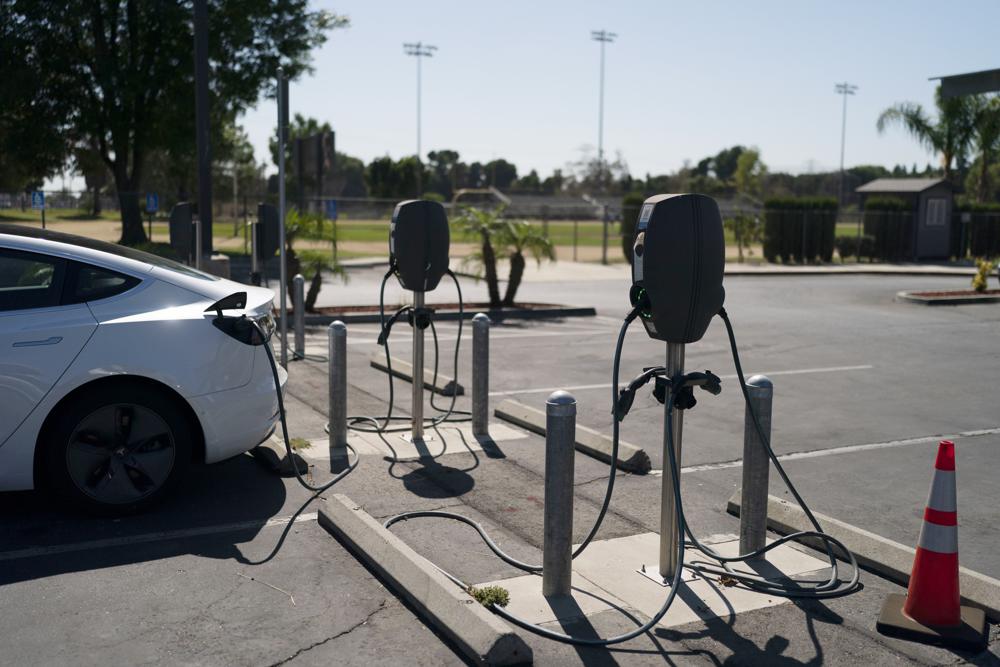
Electric vehicle chargers are seen in the parking lot of South El Monte High School in South El Monte, Calif., Friday, Aug. 26, 2022. Discounted prices, car-share programs, and a robust network of public charging stations are among the ways California will try to make electric vehicles affordable and convenient for people of all income levels as it phases out the sale of new gas cars by 2035. Advocates for the policy say the switch from gas- to battery-powered cars is a necessary step to reducing pollution in disadvantaged neighborhoods, but that the state make sure those residents can access the cars, too.(AP Photo/Jae C. Hong)

SACRAMENTO, Calif. (AP) — Discounted prices, car-share programs and at least one million more public charging stations are among the ways California will try to make electric cars easier to buy and drive as it phases out the sale of gas-powered cars.

But the state won’t force automakers to participate in any equity programs designed to ensure people of all income levels can buy electric cars.

“This rule had the opportunity to really set the path for lower income households to have increased access and affordability (for) electric vehicles, but it missed the mark,” said Roman Partida-Lopez, legal counsel for transportation equity with The Greenlining Institute.

Instead, car companies will get extra credit toward their sales quotas if they make cars available to car share or other programs aimed at disadvantaged Californians. Democratic Gov. Gavin Newsom has pledged $10 billion over six years for incentives to get electric vehicles into the hands of low-income residents, charging infrastructure, and other efforts to put cleaner cars and trucks on the road.

The Stockton Mobility Collective is one example. Designed to increase transportation options in disadvantaged parts of the city, the collective will set up five to seven neighborhood charging stations with 30 electric cars people can rent out on an hourly or daily basis. The first cars and charging stations launched last week in an apartment complex. The program got $7.4 million from the state.

Car ownership in South Stockton is low, so interest in the program is high, said Christine Corrales, senior regional planner for the program. But its just the first step in what must be a major effort to make electric vehicles a realistic option for lower-income Californians.

“If the infrastructure is not available locally, it may be challenging to encourage people to adopt and switch over,” she said. “That’s something that we’re trying to be proactive about.”

The regulations passed by the California Air Resources Board last week say that 2035 the state will require automakers to sell only cars that run on electricity or hydrogen, though some can be plug-in hybrids that use gas and batteries. People will still be able to buy used cars that run on gas, and car companies will still sell some plug-in hybrids. Beyond questions of affordability and access, the state will need to overcome skepticism of people who think electric cars simply aren’t for them.

“We’ve got to get past the elitism that’s involved with owning an electric car,” said Daniel Myatt, who brought an electric car in 2020 through the state’s Clean Cars 4 All program, which he qualified for when he was out of work due to an illness.

Since 2015, more than 13,000 electric cars have been purchased through the program. It offers people up to $9,500 for people to trade in their gas cars for electric or hybrid models.

About 38% of the money spent on a separate rebate program has gone toward low-income or disadvantaged communities, and the state has spent hundreds of millions of dollars building charging stations in those neighborhoods. Today, though, there are just 80,000 public charging stations around the state, far short of the 1.2 million the state estimates it needs by 2030.

Under the new regulations, car makers can get extra credit toward their sales quotas if they participate in several equity programs.

Those programs include: Selling cars at a discount to car-share or other community programs; making sure cars that come off lease go to California dealers that participate in trade-in programs; or selling cars at a discounted price. To meet the third option, cars would have to cost less than $20,275 and light-duty trucks less than $26,670 to qualify for the extra credit. It only applies to model years 2026 through 2028, and there’s no restriction on who those cars can be sold to.

Southern California EVen Access is using a $2.5 million state grant to install at least 120 chargers across a 12-county region, at apartment complexes and public places like library parking lots. Apartment complex owners can get $2,500 per charger installed on the property.

Overall, the state should do more public messaging about the programs that are available to buy electric vehicles so that all communities can enjoy the benefits of fewer cars that spew emissions and pollution, said Lujuana Medina, environmental initiatives manager for Los Angeles County. The state must also invest in a workforce that can support an electric transportation economy, she said.

“There will have to be some really progressive public purpose programs that help drive electric vehicle adoption and sales,” she said.

Alicia Young of Santa Clara, California, was unsure when she first heard about the state’s trade-in program. But she eventually pursued the deal, leaving behind her 2006 Nissan for a plug-in hybrid from Ford. It cost $9,000 after her trade-in value.

The car runs more smoothly and just as fast as any gas-powered car she’s ever owned. She mostly runs it on battery charges, though she still fills the gas tank about once a month. The apartment complex where she lives with her mother does not have a car charger, so she often relies on charging stations at the grocery store or other public places.

She’s shared information about the trade-in program with her colleagues at the senior retirement center where she works, but many of them seem mistrustful, she said. The state could speed adoption by having public messengers from a wide variety of backgrounds to help build trust in electric cars, she said.

“It’s a little bit different at first, but that’s normal with any new car,” she said.
Japan PM apologizes for party’s church (CULT)
links, will cut ties


1 of 4
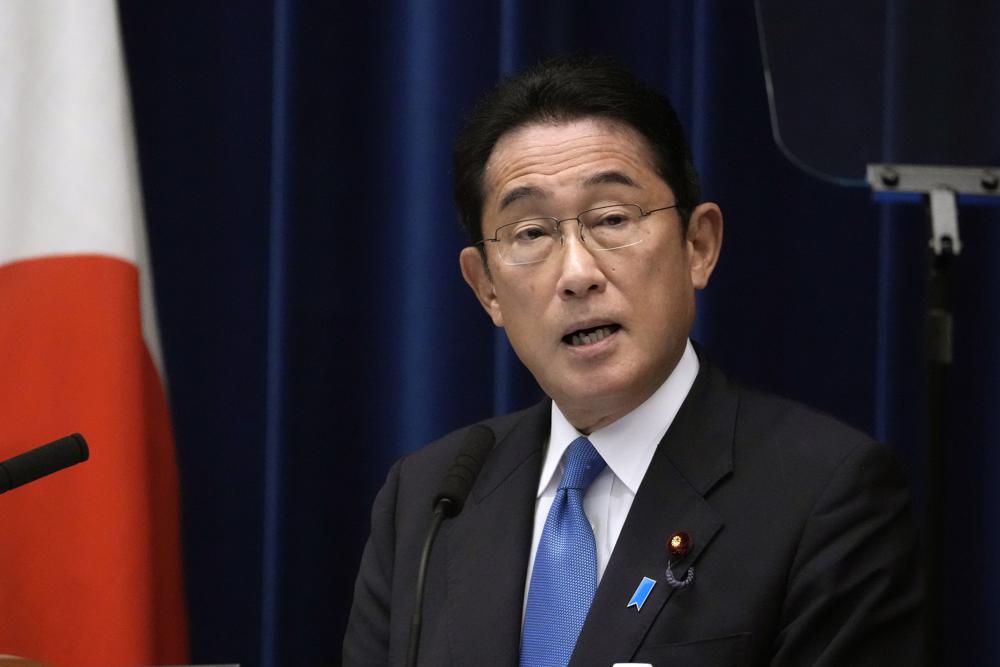
Japan's Prime Minister Fumio Kishida speaks during a news conference at the prime minister's official residence in Tokyo Wednesday, Aug. 31, 2022. (AP Photo/Shuji Kajiyama, Pool)


TOKYO (AP) — Japan’s Prime Minister Fumio Kishida said Wednesday his ruling party will cut ties with the Unification Church following a widening scandal triggered by former leader Shinzo Abe’s assassination last month, and apologized for causing the loss of public trust in politics.

Widespread cozy ties between members of Kishida’s governing Liberal Democratic Party, many of them belonging to Abe’s faction, and the South Korean-born church have surfaced since Abe was shot to death while giving a campaign speech in July.

The suspect, Tetsuya Yamagani, who was arrested at the scene, allegedly told police he killed Abe because of his apparent link to the church. In a letter seen by The Associated Press and social media posts believed to be his, Yamagani said he believed his mother’s large donations to the church had ruined his life.

Some Japanese have expressed understanding, even sympathy, as details of the man’s life emerged, creating deep implications for the political party that has governed Japan virtually uninterrupted since World War II.

While religious groups must abide by law, “politicians are strictly required to be careful about groups with social problems,” Kishida said. Members of his Cabinet and other key posts have agreed to review their past links and cut ties with the church.

“As president of the LDP, I honestly express my apology” for causing the public’s doubts and concerns over the continuing revelations in media reports about the party’s extensive ties to the church, Kishida said.

The Unification Church, which was founded in South Korea in 1954 and came to Japan a decade later, has built close ties with a host of conservative lawmakers over their shared interests of opposing communism. Abe’s grandfather and former Prime Minister Nobusuke Kishi was a key figure who helped the church’s political unit in Tokyo.

Since the 1980s, the church has faced accusations of problematic recruiting, sales of religious items and donations, which often lead to financial strains on the followers’ families and, according to experts, mental health of adherents’ children. The issues led to the government’s decision to cut ties with the church.

Abe sent a video message last year to the Universal Peace Federation, an international group affiliated with the church, which experts say may have motivated the suspect in Abe’s shooting. Abe had praised the federation’s co-founder Hak Ja Han Moon, who is also head of the church, for her effort in promoting traditional family values.

Experts and cult watchers also say that the church has promoted its key agendas such as the opposition to women’s advancement and same-sex marriage to influence policy.

Kishida shuffled his Cabinet earlier in August to purge seven ministers linked to the church. Among them was Abe’s younger brother Nobuo Kishi, who acknowledged that church followers volunteered in his election campaign. Dozens of LDP members have since come forward with their ties to the church and related organizations.

Kishida said at the news conference that he has instructed LDP Secretary General Toshimitsu Motegi to survey the party fully over any other members’ ties to the church. Kishida said he is rushing the effort but it may take time because the review will span decades.

Kishida apologized for the loss of public trust because of the scandal and his lack of explanation for organizing a state funeral for Abe, one of most divisive leaders in Japan’s postwar history.

The state funeral scheduled for Sept. 27 has split public opinion. The only other state funeral in postwar Japan was for former Prime Minister Shigeru Yoshida, who signed the San Francisco Treaty that restored ties with the Allies and ended the U.S. occupation of Japan.

Kishida’s Cabinet last week allocated at least a 250 million yen ($1.8 million) budget to invite about 6,000 guests for the funeral at the Budokan arena in Tokyo.

Kishida insisted that Abe deserved a state funeral because of his achievement in raising Japan’s global profile as its longest-serving postwar leader. He said Japan must respond with courtesy to “outpouring of condolences” from foreign leaders and legislations.