Thursday, April 24, 2025


Panama President rules out new mining contract law with First Quantum

Cobre Panama was the biggest foreign investment in the Central American nation, supporting over 40,000 jobs. (Image courtesy of Minera Panama.)

Panama will not offer a new mining contract law to Canada’s First Quantum Minerals (TSX: FM), President José Raúl Mulino said amid an ongoing dispute that has kept the company’s $10 billion Cobre Panamá copper mine shuttered since late 2023.

Speaking at an industry event in Panama City, Mulino said the path forward remained uncertain, but noted he was open to forming an association with First Quantum. 

“I cannot yet tell you what the path forward will be; the only path that will not exist is a contract law, and I announce that here: There will be no mining law contract, period,” Mulino said, according to local media.

He stressed that any new mining law tied to a contract, such as the 406 law deemed unconstitutional by the previous government, would require approval from the national assembly. He said the assembly was not willing to back such a deal. Instead, he proposed a “real partnership” — a structure that would make clear the mine belongs to Panama and its people.


Mulino noted that if the decision is made to close the mine permanently, the process could take up to 15 years due to its scale.

“Let’s be smart and get the most benefit as Panamanians from a mine we already have,” he said.

The president has not yet met with First Quantum’s executives, though the company dropped its arbitration case against Panama—one of Mulino’s conditions for resuming talks.

Cobre Panamá, Central America’s largest open-pit copper mine, produced over 330,000 tonnes of copper in 2023 before operations were halted

The mine was on track to become a 100-million-tonne-per-year operation by the end of 2024, which would have placed it among the world’s largest copper producers.

Cobre previously accounted for roughly 5% of Panama’s GDP.


NTSB: Not Following Maintenance Recommendations Led to Cruise Ship Fire

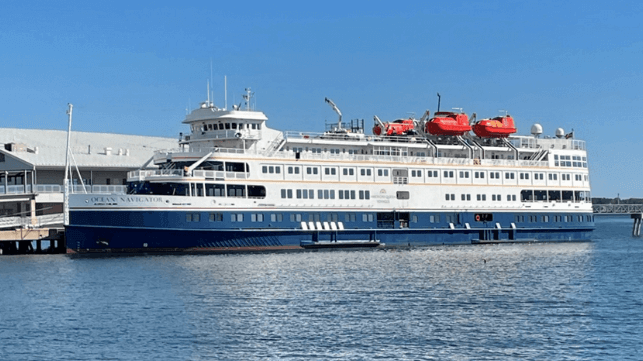
coastal cruise ship Ocean Navigator
Small cruise ship Ocean Navigator docked in Portland after the fire (NTSB)

Published Apr 22, 2025 6:12 PM by The Maritime Executive


An explosion and fire aboard the coastal cruise ship Ocean Navigator in October 2023 was likely caused by not following maintenance recommendations and infrequent changes of lube oil and oil filters concluded the National Transportation Safety Board. One crewmember was seriously injured in an explosion and fire in the engine room of the ship when one of its auxiliary engines failed and parts were ejected during an explosion followed by a fire.

The Ocean Navigator, which was built in 2001 as a modern version of an American coastal cruise ship, was operating at the time for Hornblower’s American Queen Voyages and had just docked in Portland, Maine on its next to last scheduled cruise when the explosion occurred. Earlier in the year, AQY announced it would be removing the ship and her sister ship from service at the conclusion of the Canadian cruise season.

Engineers reported that the machinery was working properly as they navigated into the port and docked around 0630. There was a total of 210 people aboard, 128 passengers and 82 crewmembers. After shutting down the propulsion system, the third engineer and a motorman were assigned to troubleshoot a high exhaust temperature issue in the no. 1 auxiliary engine while the vessel was using its no. 2 auxiliary engine to provide electric power for the ship.

The third engineer reported smelling oil and found a small lube oil leak from a crankcase cover door on the running no. 2 auxiliary engine. He went to tighten a bolt, but before he could there was an explosion and fire along with low lube oil pressure and oil filter plugged alarms. Both the engineer's and motorman’s overalls were on fire with the motorman more seriously injured.

NTSB commends the quick response of the crew in sealing the engine room by closing watertight doors, shutting off ventilation fans, closing dampers, and activating quick-closing fuel valves to effectively starve the fire of fuel and oxygen. They prevented the spread of the fire and the fire self self-extinguished. 

The captain saw thick smoke coming from the funnel and immediately returned to the bridge. The passengers were mustered and evacuated without injury. Local fire crews responded but found the situation controlled.
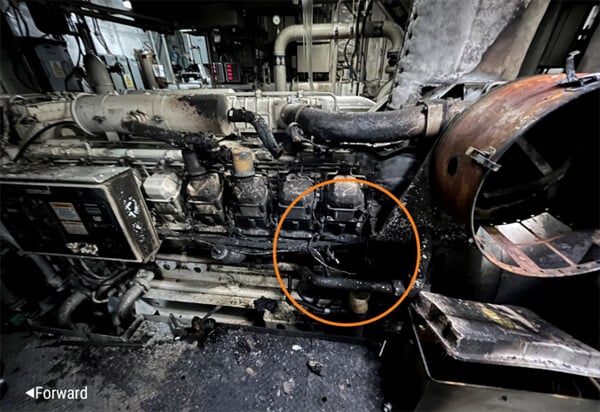
 

Fire damage to the no. 2 auxiliary (NTSB report)


The subsequent investigation found that the no. 2 engine was damaged beyond repair. The engine block had cracked, and investigators found a 10-inch high and 16-inch wide hole and reported one of the connecting rods had been ejected. There was damage to the no. 1 auxiliary engine from the fire as well as the turbocharger, piping, cables, and electrical wires and lighting in the engine room. The NTSB reports the cost of the casualty at $2.4 million.

The NTSB investigators concluded that the engine failure was caused by debris in the engine’s lube oil system—possibly due to the crew exceeding manufacturer-recommended intervals for changing the lube oil and oil filter elements—which caused catastrophic mechanical damage to the engine and subsequent fire from the ignition of atomize lube oil released through the engine’s ruptured crankcase.

The crew had last changed the entire quantity of lube oil for the no. 2 auxiliary engine in September 2022—about 13 months before the engine failure—but the engine had operated more than 5,000 hours with this lube oil in the engine, five times longer than the manufacturer’s recommendation. Additionally, since the last change of the lube oil filter elements in May 2023, the engine had run over 3,000 hours. The engine manufacturer’s recommendation is to replace filter elements at every oil change or after the filter elements had been used for 1,000 hours.

“Manufacturers provide maintenance recommendations and intervals (schedules) to ensure equipment operates safely, optimally, and reliably throughout its service life,” the NTSB writes in its report. “By regularly reviewing equipment manufacturer manuals and guidance, operators can ensure conformance with recommended maintenance plans and mitigate the risk of equipment malfunction or failure.”

The analysis of the lube oil in the no. 2 engine identified abnormally high levels of aluminum and iron. It had increased significantly since the last in-service sample was taken in September. There was also an increase in lead and tin. 

The vessel was sold during the bankruptcy of American Queen Voyages and Hornblower. The subsequent survey for the repairs showed that the engine block, crankshaft, several main bearings, connecting rod bearings, and the no. 14 fuel injector were all damaged during the explosion and fire with the plunger of the no. 14 fuel injector broken off, pistons and pins and other components from the nos. 13 and 14 cylinders “totally destroyed.” They also observed “heavy local wear” in main bearings and signs of cavitation that were not typical and also suggested oil quality or other lube oil issues.

NTSB concluded that debris in the system would have caused scratching or scoring of the inner layer of the bearings as the debris circulated. The wear would have permitted more lube oil to flow out the sides of the bearings, reducing pressure, and generating excessive heat. The lack of changing out the filter elements made the filter less effective or it could have clogged and a bypass value would have permitted more debris into the system.

These factors they believe contributed to the failures and catastrophic mechanical damage to the engine. The hot oil spewing out started the fire.

Repairs were made to the ship and it returned to service under its new owners in April 2025. The complete report is available online.

 

U.S. Navy Plans to Order U.S. Army Landing Ship for the Marine Corps

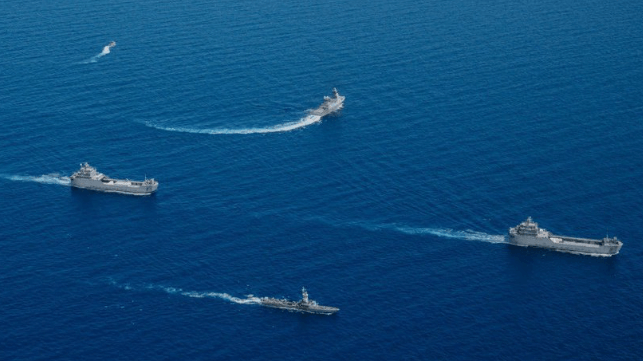
The Navy plans to order a landing ship of the same design as the Israeli Navy's INS Nahshon and INS Komemiyut (right and left center). The design is derived from the U.S. Army's Besson-class (IDF photo)

Published Apr 21, 2025 9:46 PM by The Maritime Executive


The U.S. Navy is preparing to resolve its long debate with the Marine Corps over the fate of the Landing Ship Medium (LSM), the amphibious force's small transport for inter-island warfare in the Pacific. On April 7, Naval Sea Systems Command quietly issued notice that it plans to award Bollinger a sole-source contract to build one lead-ship LSM based on the U.S. Army's Gen. Frank S. Besson-class

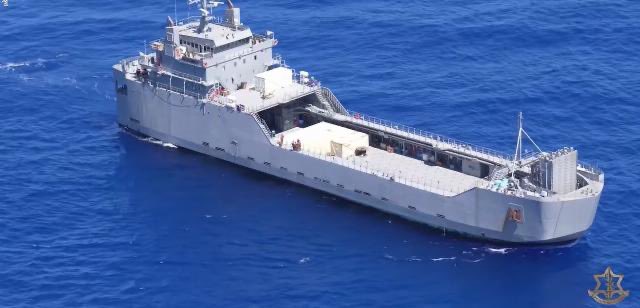
The ship that the U.S. Navy plans to buy is based on a revised version of the Army design that Bollinger-owned VT Halter built for the Israeli Navy. In Israeli service, this variant makes 14 knots with a cargo of up to 2,000 tonnes in deep-draft pier-to-pier mode, with a lesser payload for beaching operations. The design has a bow visor for better seakeeping in open water, rather than the original Besson-class' flat ramp.  

INS Nahshon (IDF image)

The class also has a stern ramp that can be used to load and offload while Med-moored at a pier. In U.S. Army service, the ramp facilitates drive-through ro/ro cargo transloading for the complex Joint Logistics Over The Shore (JLOTS) transfer system. 

Unless it is to be heavily modified, the IDF's Besson variant does not have a suite of high-end air defense or surface warfare weaponry. The long Navy-Marine Corps fight over the LSM's fate hinged on whether there would be a few highly survivable and very expensive hulls - the Navy's preference - or whether there would be a large number of less expensive ships built to a less stringent standard, as the Marine Corps demanded. The Besson-class appears to land further towards the Marine Corps' version: it is serviceable enough to be the primary landing and logistics ship for the U.S. Army, and for the Israeli Navy, but it is not an exquisite naval weapons platform (unless up-armed).

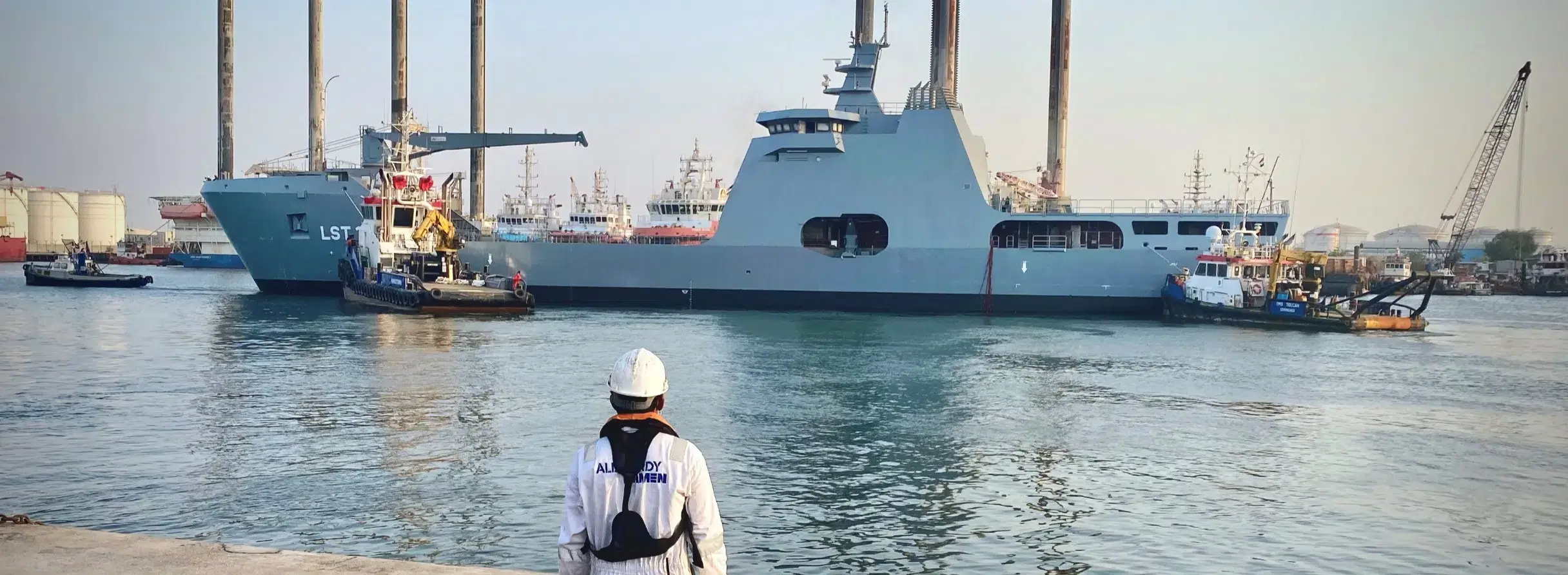
As first reported by USNI, NAVSEA is also buying the technical data package for the Damen LST 100, a popular landing ship design of comparable size and specifications - but equipped with an enclosed foredeck and an aft helideck. The LST 100 is in use by the Nigerian Navy and was recently ordered by the Australian Army.

A Nigerian Navy Damen LST 100 on delivery (Damen)
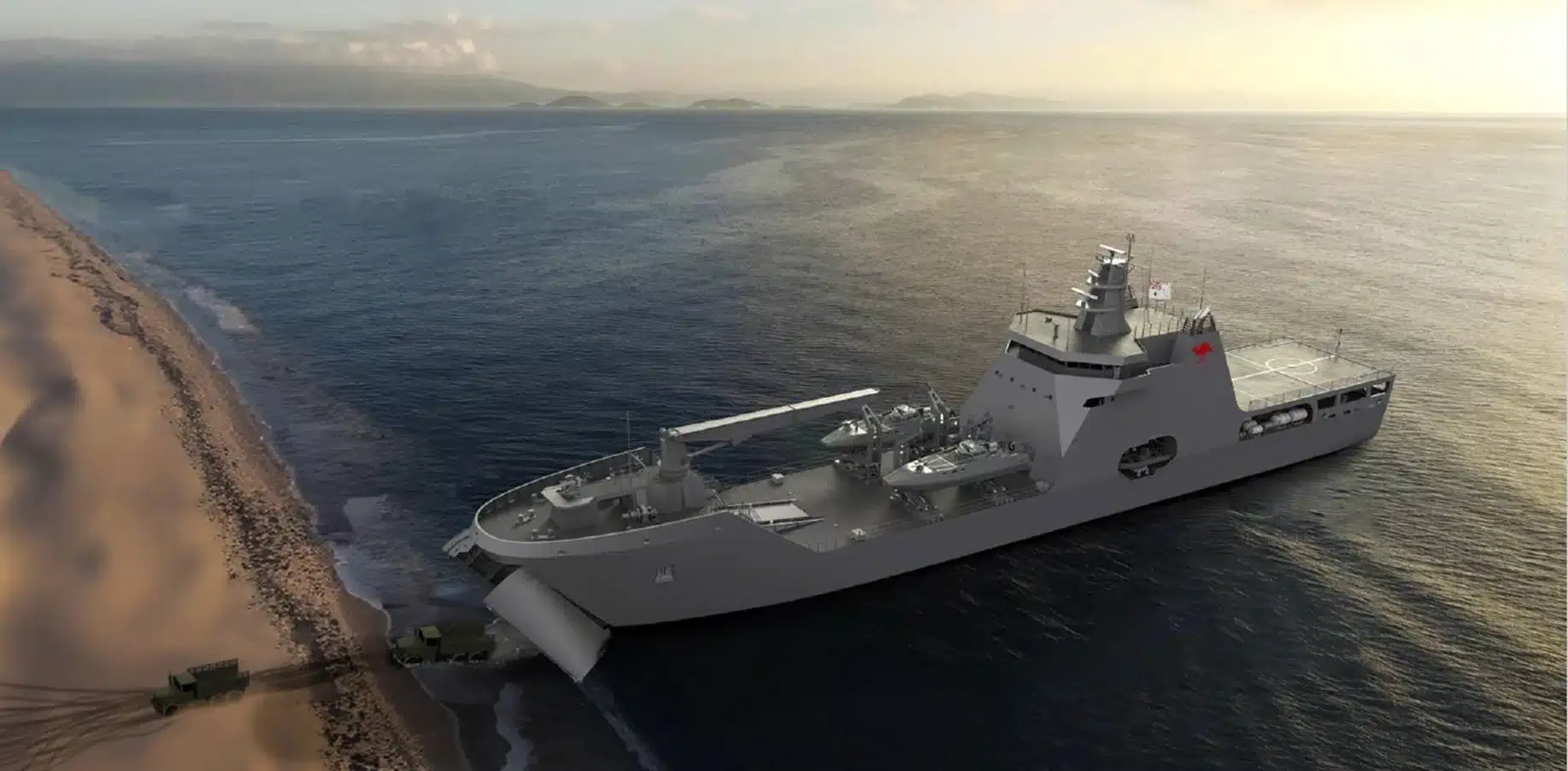
A rendering of the LST 100 design for Australia's armed forces (Damen)


U.S. Navy Plans to Order U.S. Army Landing Ship for the Marine Corps

The Navy plans to order a landing ship of the same design as the Israeli Navy's INS Nahshon and INS Komemiyut (right and left center). The design is derived from the U.S. Army's Besson-class (IDF photo)

Published Apr 21, 2025 9:46 PM by The Maritime Executive


The U.S. Navy is preparing to resolve its long debate with the Marine Corps over the fate of the Landing Ship Medium (LSM), the amphibious force's small transport for inter-island warfare in the Pacific. On April 7, Naval Sea Systems Command quietly issued notice that it plans to award Bollinger a sole-source contract to build one lead-ship LSM based on the U.S. Army's Gen. Frank S. Besson-class

The ship that the U.S. Navy plans to buy is based on a revised version of the Army design that Bollinger-owned VT Halter built for the Israeli Navy. In Israeli service, this variant makes 14 knots with a cargo of up to 2,000 tonnes in deep-draft pier-to-pier mode, with a lesser payload for beaching operations. The design has a bow visor for better seakeeping in open water, rather than the original Besson-class' flat ramp.  

INS Nahshon (IDF image)

The class also has a stern ramp that can be used to load and offload while Med-moored at a pier. In U.S. Army service, the ramp facilitates drive-through ro/ro cargo transloading for the complex Joint Logistics Over The Shore (JLOTS) transfer system. 

Unless it is to be heavily modified, the IDF's Besson variant does not have a suite of high-end air defense or surface warfare weaponry. The long Navy-Marine Corps fight over the LSM's fate hinged on whether there would be a few highly survivable and very expensive hulls - the Navy's preference - or whether there would be a large number of less expensive ships built to a less stringent standard, as the Marine Corps demanded. The Besson-class appears to land further towards the Marine Corps' version: it is serviceable enough to be the primary landing and logistics ship for the U.S. Army, and for the Israeli Navy, but it is not an exquisite naval weapons platform (unless up-armed).

As first reported by USNI, NAVSEA is also buying the technical data package for the Damen LST 100, a popular landing ship design of comparable size and specifications - but equipped with an enclosed foredeck and an aft helideck. The LST 100 is in use by the Nigerian Navy and was recently ordered by the Australian Army.

A Nigerian Navy Damen LST 100 on delivery (Damen)
A rendering of the LST 100 design for Australia's armed forces (Damen)


Iran Seizes Two Ships and Issues Jail Sentences in Fuel Smuggling Crackdown

Iranian patrol boat
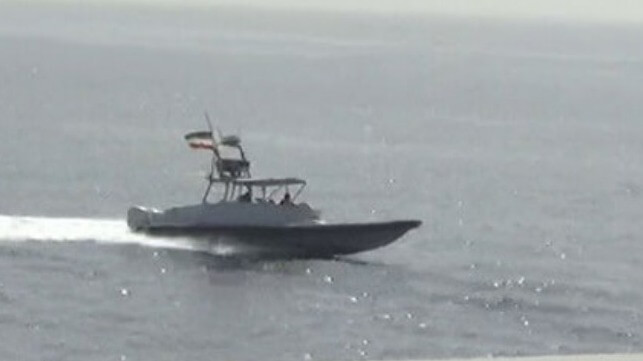
Iran says it is stepping up efforts to stop smugglers (file photo)

Published Apr 22, 2025 4:05 PM by The Maritime Executive


Iran’s efforts at stopping fuel smuggling are continuing with local media outlets citing additional cases of vessels being seized and crews prosecuted. An Iranian court is reported to have handed down stiff jail sentences in two cases today and hours later the semi-governmental news agency Fars reported two more vessels have been apprehended.

According to the media reports, Iran claims that it has seized 4.5 million liters of smuggled diesel fuel alone this year. The country’s low price of diesel and gasoline is reported to encourage smuggling in the Persian Gulf region. Iran offers lower prices for the fuels than its neighboring Arab states.

Fars reports two vessels registered in Tanzania, which it names as Sea Ranger and Salama, were stopped today, April 22. The vessels were reported to be near the central district port city of Bushehr on the Persian Gulf.  A total of 25 “foreign crew” were reportedly detained and 1.5 million liters of diesel fuel seized. Both vessels were being directed back to the Bushehr Port where the media said the vessels were being handed over by the Iran Navy for “legal proceedings.”

Separately, Iranian media reported a court in the southern Iranian province of Hormozgan issued judgment today, April 22, on two other foreign crews. It said one of the unnamed vessels was caught with 4.25 million liters of smuggled fuel and that the captain and two “deputies” were each sentenced to five years in jail. Collectively a fine of $5.37 million was also ordered.

The second captain and his two top “deputies” were also sentenced to five years in jail for smuggling 1.7 million liters of fuel. They were ordered to pay a total of $3 million in fines. In both cases, Iran said the vessels would be released once the fines were paid.

The reports also highlight that on March 31, Iran confiscated two vessels, Star 1 and Vintage. They were stopped in the Persian Gulf with a total of 3 million liters of diesel fuel.

Iranian forces have previously said they increased the monitoring of vessel activity. They have vowed to crack down on fuel smuggling.


A Chinese Jackup Rig off South Korea Raises Suspicions of Expansionism

Atlantic Amsterdam
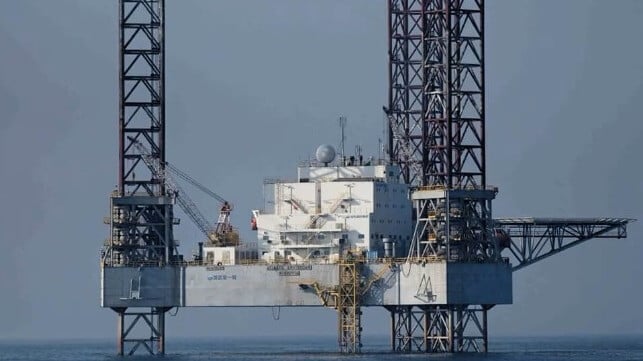
Atlantic Amsterdam in the Yellow Sea (Korea Institute of Ocean Science and Technology / Um Tae-young)

Published Apr 23, 2025 10:37 PM by The Maritime Executive


China's drills around Taiwan and its ambitions in the South China Sea get plenty of attention, but officials in South Korea warn that it is also encroaching on a contested space in the Yellow Sea - and may be attempting to move in with a durable presence. 

According to South Korean officials, Chinese interests have moved an older jackup platform into an area known as the Provisional Measures Zone, a region where the two nations' exclusive economic zone claims overlap. The former rig is in use for aquaculture, according to China, but South Korea's government believes that there is more to the story. Chinese authorities intervened to stop a Korean research vessel from investigating the rig in February, raising security concerns in Seoul. Korean diplomats plan to raise the issue with China at an upcoming maritime dialogue, officials said.   

"We are treating this issue with utmost seriousness from the standpoint of protecting our maritime territory," Korean minister of oceans and fisheries Kang Do-hyung told reporters on Monday. 

The jackup platform has been identified as the Atlantic Amsterdam. It began life in 1984 as a drill rig, but in 2013 it was refitted for use as a floatel. In service with Northern Offshore - a subsidiary of state-owned Shandong Shipping Corporation - it has capacity for up to 70 people, plus a helipad and vertical gangway for access. 

Atlantic Amsterdam was listed as available for commercial charter as recently as 2023, but according to Korean intelligence it has been emplaced in the Yellow Sea since early 2022.

Korean political commentators - particularly in the opposition People Power Party - have drawn comparisons between the rig and China's South China Sea bases. The vast land reclamation projects in the Spratly Islands and Paracels started under civilian descriptions, then evolved into strategic naval air stations within a few years' time. 

"China’s method of installing the structure [Atlantic Amsterdam] is similar to its tactic of creating artificial islands in the South China Sea," People Power Party floor leader Rep. Kweon Seong-dong told Korea Herald. 


Hanwha Markets Building LNG Carriers in Pennsylvania to Meet USTR Rules

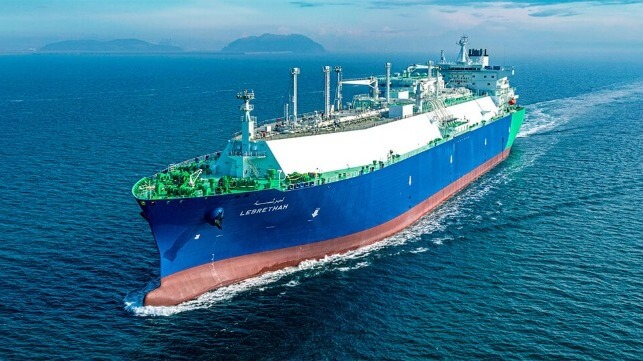
LNG carrier
Hanwha Ocean building on the DSME legacy delivered its 200th LNG carrier in 2025 (Hanwha Ocean)

Published Apr 22, 2025 2:05 PM by The Maritime Executive


South Korea’s Hanwha Ocean is reported to be looking to leverage its long expertise in LNG carriers and its unique position through the ownership of a shipyard in Pennsylvania in response to the new U.S. Trade Representative’s fees for Chinese-built ships. Bloomberg quotes an executive from Hanwha highlighting its unique capabilities and the pending need for the first modern U.S.-built LNG carriers.

While much of the attention on the USTR fee structure released last week has been on the aspects of Chinese-build ships, Chinese vessel operators, and the foreign companies operating Chinese-built ships, another key provision of the fee structure picks up an idea that had been circulating in Washington D.C. for years to require a portion of LNG exports to leave the U.S. on U.S.-built and operated vessels.

The U.S. emerged as the leading exporter of LNG in the past few years rivaling Qatar and Australia, in part driven by Europe’s need to replace Russian supplies of gas. The Trump administration has promised to accelerate the LNG market and already moved to license new projects and terminals.

“To incentivize U.S.-built liquified natural gas (LNG) vessels, limited restrictions on transporting LNG via foreign vessels,” proposed USTR outlining its fee structure. “These restrictions will increase incrementally over 22 years,” notes the announcement.

USTR calls for introducing a requirement starting April 2029 that one percent of U.S. LNG exports must travel on U.S.-flagged and U.S.-operated vessels. Starting in 2031, it would step up to two percent, reaching seven percent by the 2040s, and ultimately 15 percent in 2047. USTR says it may direct the suspension of LNG export licenses if the percentages are not met.

The requirement for U.S. vessels calls for vessels built in the U.S. where all the major components of the hull or superstructure are manufactured in the U.S. as well as key components in propulsion, cargo handling, and alike. Many in the industry have called the USTR requirement unrealistic noting the lack of commercial shipbuilding capacity in the U.S. and the lack of experience specifically with LNG carriers. 

Bloomberg is quoting Ryan Lynch, vice president of commercial shipping at Hanwha Shipping who says “as many as five to seven US-flagged, US-operated LNG carriers would be required before the end of the decade.”

South Korea’s Hanwha Group entered the shipbuilding sector in 2023 when it acquired control of Daewoo Shipbuilding & Marine Engineering (DSME) in an agreement with the South Korean government-controlled banks. Then in December 2024, it completed its $100 million acquisition of Philly Shipyard, highlighting its role in building commercial U.S. Jones Act ships as well as its work for MARAD. 

Earlier this year, building on DSME’s legacy, Hanwha Ocean highlighted it had become the first shipbuilder to deliver 200 LNG carriers. The vessel was the Lebrethah, built by the company for SK Shipping, and which will be deployed and operated in Qatar Energy’s North Field Expansion Project.

The company reports it made history in 1995 by successfully delivering its first LNG carrier and 21 years later, in 2016, delivered its 100th LNG carrier. Over the next nine years, it built another 100 LNG carriers claiming a 57 percent market share. It noted that between 2022 and 2024 it received orders for 31 ships for the second Qatar project.

Hanwha, according to Bloomberg, is now positioning itself to share the Korean expertise with its Philly Shipyard. As such, it could become the first to build a modern U.S. LNG carrier.
 

AWOL

Crewmember From Carrier USS Nimitz Goes Missing on Guam

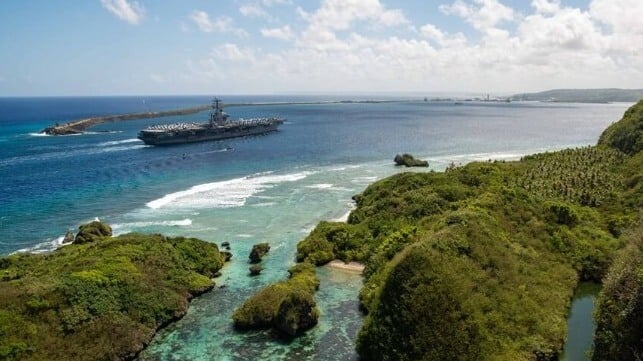
Nimitz
USS Nimitz arrives at Apra, Guam, April 18 (USN)

Published Apr 23, 2025 9:23 PM by The Maritime Executive


A sailor from the carrier USS Nimitz has gone missing in Guam, and his ship has sailed without him, according to the Navy. 

Sailor Gabriel D. Holt was off base when he was last seen late on April 18, the same day as Nimitz's arrival in Guam. At around midnight, he was spotted in the Tumon district, in between Hotel Nikko and Gun Beach - about 10 miles northeast of the base at Apra Harbor. He was reported missing on April 19. The search for Holt is still active, and the local police are looking for public tips.

"At this time, all available agencies are actively engaged in efforts to locate the missing sailor," Nimitz spokesman Lt. Cmdr. Tim Pietrack told Navy Times. "The search is ongoing, and we are committed to fully cooperating with local authorities while search and rescue efforts continue."

On April 21, USS Nimitz sailed from Guam to resume her deployment in the Western Pacific. She is accompanied by the destroyers USS Gridley and USS Lenah Sutcliffe Higbee; the Zumwalt-class destroyer USS Michael Monsoor also deployed as part of the carrier strike group, and called at Guam on April 17. 

USS Nimitz is 50 years old this year and is on her final deployment before decommissioning. She is expected to end her service in April 2026 and begin the long process of nuclear vessel deactivation.

Nimitz commissioned in 1975, and was the first of a successful class of supercarriers that have defined naval power projection ever since. Her itinerary on this voyage is not disclosed, but USNI reports that she could transit to the Mideast; sister ships USS Carl Vinson and USS Harry S. Truman are already in the region and involved in high-intensity operations against targets in Yemen, and Truman is due for relief.  


Jury Awards $2.8M to Crewmembers of Superyacht That Sank a Tanker

Tanker Tropic Breeze settles in the water after she was struck by Utopia IV (NTSB)

Published Apr 23, 2025 9:49 PM by The Maritime Executive


Three former crewmembers of a yacht that hit and sank a tanker in 2021 have won millions of dollars in damages in a suit against the yacht's owners. 

On the evening of December 23, 2021, the product tanker Tropic Breeze got under way from New Providence Island in the Bahamas with about 150,000 gallons of petroleum products aboard. The vessel's AIS transceiver was not working, according to the NTSB. 

At 2030 hours, the Italian-built superyacht Utopia IV departed New Providence Island with 12 crewmembers and seven passengers, making 20 knots. The yacht's bosun - who was on watch alone in the wheelhouse at the time of the collision - told the NTSB that the spray at the bow made it harder to see, and the S-band radar display was out. Only the X-band was available, and it was set to a range of three nautical miles. 

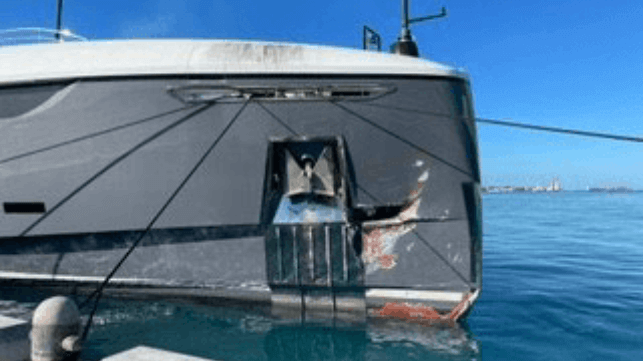
At about 2200 hours, Utopia IV hit Tropic Breeze's transom, penetrating the hull. The tanker's crew abandoned ship, and the stricken vessel sank in about 2,000 feet of water. The yacht suffered minor damage at the bow (below left) and stayed afloat. Three injuries were reported aboard Utopia IV, but no fatalities on either vessel. 

NTSB concluded that the casualty occurred because both vessels' crews failed to keep a proper lookout by all available means. "Although the Utopia IV bore responsibility as the overtaking vessel to manoeuvre away from the tank vessel, once the yacht’s intentions were unclear and a close-quarters situation had developed, the tank vessel should have taken action," NTSB found. 
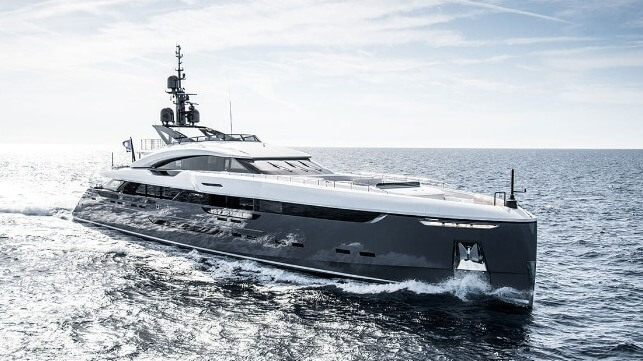
In late 2022, three former Utopia IV crewmembers - identified by yachting media as the vessel's deckhand, ETO and chief engineer - filed a negligence and unseaworthiness suit against the yacht's owners, seeking maintenance and cure plus damages. The ETO reported a fractured left ankle and PTSD; the chief engineer reported whiplash and PTSD, among other injuries; and the deckhand reported a fractured right foot and PTSD. A Florida jury awarded them a combined $2.8 million for medical bills and wages, plus punitive damages. 

Utopia IV was refitted after the casualty and is currently listed for sale with Fraser Yachts. The asking price is $44 million, all U.S. import duties paid. 

Utopia IV (file image courtesy Rossinavi)

Workers Injured by Fire Aboard Petrobras Platform Pending Sale to Perenco

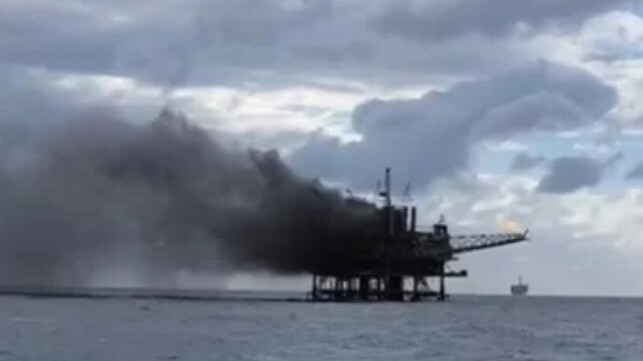
oil platform fire
The workers' union released a photo of the fire (Sindipetro-NF)

Published Apr 22, 2025 1:17 PM by The Maritime Executive


Multiple injuries are being reported as fire hit one of the offshore platforms owned by Brazil’s Petrobras which is part of a pending sale to Perenco. The workers’ union was first to report the fire which it says took four hours to control. The incident was later confirmed by Petrobras.

The fire started Monday morning, April 21, on the platform PCH-1 in the Cherne field in the Campos basin approximately 80 miles offshore. The union, Sindipetro-NF, is saying that it began around 0720. It reported there was likely an explosion on one of the production decks located below the housing (where the workers' cabins and food areas are located). Reports indicate heavy smoke and flames with the union saying it took till 1125 for the fire to be extinguished.

There were 176 workers aboard the platform when the fire broke out with tankers standing by for the loading of gas. Sindipetro-NF is saying that one worker was burnt and fell from the platform being rescued by the Locar XXII vessel, suffering from burns, but remained conscious. Petrobras confirmed the worker was treated on an offshore support vessel and later transferred to a hospital.

Petrobras listed 13 additional workers as having been injured. Sindipetro-NF however says as of Monday night, 32 oil workers had been identified as injured with 14 due to burns and the rest due to smoke inhalation. It is also saying that all non-essential personnel were evacuated from the platform on Monday afternoon.

It is one of Petrobras’ older platforms and oil and gas production was suspended in 2020 after it was identified among a series of mature and non-lucrative assets in Brazil. The platform has continued to operate in a relay capacity transferring gas from other assets in the basin to tankers.

Perenco announced in 2024 an agreement to acquire assets from Petrobras in the Cherne and Bagre fields including the deactivated platforms PCH-1 and PCH-2. The company said it would complete the deal in 2025 and then begin a redevelopment project to revitalize the assets, restart oil production, and unlock gas reserves.

Petrobras is promising to launch a commission to investigate the cause of the fire.