Thursday, April 24, 2025


Will Magnesium Disrupt the Electric Vehicle Industry?

  • Researchers are developing magnesium batteries to address the environmental and geopolitical issues associated with lithium-ion batteries, which currently dominate the electric vehicle market.

  • Magnesium offers advantages such as abundance, lower cost, and less complex supply chains compared to lithium.

  • Recent breakthroughs in magnesium battery technology, including advancements in electrolytes and anodes, show promise for a more sustainable and efficient energy storage solution.

On an international scale, researchers have been hard at work making magnesium batteries a feasible replacement for lithium-ion batteries and hydrogen fuel cells, in a development that could upend the electric vehicles industry on a worldwide scale. 

Currently, the global EV fleet runs on lithium-ion batteries, but these fundamental building blocks of the decarbonization movement carry some critical drawbacks. As it stands lithium production and refining for use in lithium-ion batteries and other applications is all but monopolized by China. China alone is responsible for more than more than 98% of the world’s lithium iron phosphate, and “the country dominates almost the entire value chain of lithium-ion batteries - from raw material extraction to battery production - and controls both national and international production capacities,” according to research from the Fraunhofer Research Institution for Battery Cell Production FFB. 

This supply chain concentration generates major risks for the global economy. China has already shown that it’s not afraid to cause global disruption of lithium supplies in response to the intensifying trade war and punitive tariffs being imposed by the Trump administration in the United States.

Moreover, the production of lithium – while broadly associated with clean energy – causes considerable environmental damage in the localities where it’s extracted. The process requires the use of chemicals and heavy metals that can leach into the soil and groundwater of surrounding communities, causing public health crises and threatening local wildlife. It’s also an incredibly thirsty business, requiring around 500,000 gallons of water per tonne of lithium extracted. 

“Like any mining process, it is invasive, it scars the landscape, it destroys the water table and it pollutes the earth and the local wells,” said Guillermo Gonzalez, a lithium battery expert from the University of Chile, in a 2009 interview. “This isn’t a green solution – it’s not a solution at all.”

To this end, researchers have been hard at work finding alternative solutions to lithium-ion batteries. Potential breakthroughs have ranged from hydrogen fuel cells to iron-air batteries to proton batteries. But new breakthroughs in the sector show that magnesium may hold the answer for a more sustainable EV battery. 

Historically, magnesium has not seemed to be a promising alternative as it’s an incredibly difficult material to work with. It’s highly reactive to oxygen, causing major challenges for its handling and regulating power surges within battery technologies. Plus, previous experiments have yielded far lower voltages than lithium. But researchers at the University of Waterloo may have cracked the code by designing an electrolyte that facilitates high efficiency within a magnesium anode.

“The electrolyte we developed allows us to deposit magnesium foils with extremely high efficiency and it is stable to a higher voltage than successfully tested before,” said  Chang Li, a postdoctoral fellow in the Nazar Group. “All we need now is the right cathode to bring it all together.”

Scientists at the Korea Institute of Science and Technology (KIST) have also made recent breakthroughs in magnesium-air battery technology for enhanced energy density, safety and efficiency, and longevity, according to reporting from EcoNews. 

Together, these advances could have major disruptive potential, as magnesium is extremely abundant in the Earth’s crust and much less costly than lithium. It also is much less geopolitically fraught, as value chains are not as well (and unevenly) established. EcoNews also reports that these breakthroughs could not only oust lithium-ion batteries, but the potential of hydrogen fuel cells as well. “Hydrogen fuel cells have been hailed as an attractive alternative to lithium-ion batteries but are plagued by infrastructure, storage, and cost problems, they report. “Magnesium batteries, however, offer a more realistic and efficient solution. [...] Magnesium batteries utilize more standard materials and don’t need specialized infrastructure, making them simpler and less costly to realize on a large scale.”

By Haley Zaremba for Oilprice.com

China Plastics Makers Risk Closures as Tariffs Hit Feedstock Imports

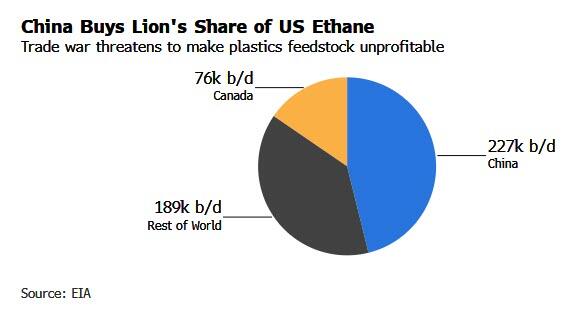
  • Data from the U.S. Energy Information Administration shows that China takes in about half of U.S. exports of ethane.

  • IndraStra: The United States has been virtually the only supplier of ethane to Chinese petrochemical makers since 2018.

  • With tariffs looming large over this trade, Chinese ethane consumers may have to close shop.

Plastics manufacturers in China are facing some tough times ahead due to their dependence on imports of U.S. feedstock. These imports are already running at record highs. This year, they were expected to surge by 20%, but then Trump started his tariff offensive. And there are no suppliers of this feedstock that compare in terms of production size with the United States.

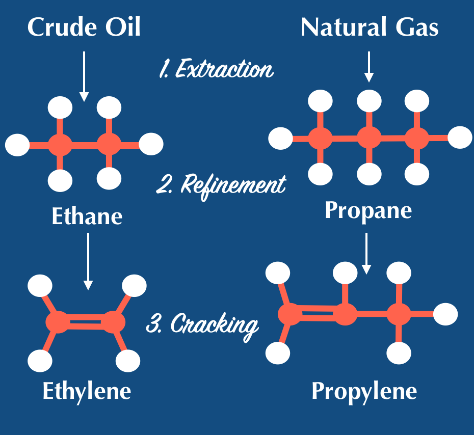
Ethane is a component of natural gas. Its production in the U.S. took off with the shale gas boom and is still booming thanks to the relentless growth in petrochemical demand on a global scale. This turned the U.S. into a major exporter to the biggest plastics maker in the world: China. Now, the flow of ethane to Chinese plastics manufacturers is set to shrink significantly as Washington and Beijing trade tariffs instead of commodities.

“The situation is dire for China’s ethane crackers as they have no alternative to US supply,” Manish Sejwal, Rystad Energy analyst, told Bloomberg this week. “Unless they are granted tariff exemptions, they may have to stop production or close shop.”

Data from the U.S. Energy Information Administration shows that China takes in about half of U.S. exports of ethane, or 248,000 barrels daily. The rest of the world, per that data, takes in 277,000 barrels daily. For U.S. gas producers, this is not a huge volume of exports—especially compared with the export of another natural gas constituent: propane. Those exports from the U.S. run at some 1.87 million barrels daily. And those ethane exports to China were set to soar.

Reuters reported back in February that Chinese plastics makers’ already substantial reliance on U.S. ethane supply, which is cheaper than alternatives thanks to the shale boom, was about to grow. The reason: slimming profits that those companies were looking to boost by cutting costs. Several Chinese petrochemical makers were investing in ethane cracker expansion, storage buildout, and the construction of ethane carriers for the increased import flows. Now, based on the latest reports, these plans are all in jeopardy, with all that investment risking ending up wasted.

Analysts forecast in February that China’s imports of ethane were set to rise by between 9% and as much as 34% this year, which would drive an overall increase in U.S. ethane exports, according to the EIA. The agency saw total U.S. ethane exports this year hitting 520,000 bpd, or 8% higher than the 2024 average daily, for a total annual 11.2 million tons. That 11.2 million tons of exports is no small potatoes for gas producers in the shale patch, especially with domestic gas prices where they are.

The United States has been virtually the only supplier of ethane to Chinese petrochemical makers since 2018, strategic analysis provider IndraStra noted in a recent report on the ethane and propane situation between the United States and China. The propane and ethane trade between the two is worth a not insignificant $18 billion annually. In fact, IndraStra says, the size of the U.S.-China liquid petroleum gas trade ranks second only to their agricultural trade.

So, with tariffs looming large over this trade, Chinese ethane consumers may have to close shop—but U.S. producers will be hit as well because there are precious few alternative destinations for this amount of gas. “The U.S. needs to be able to send its propane to China. For a large portion of it, the propane has nowhere else to go except China,” Kristen Holmqvist, analytics managing director at RBN Energy, said, as quoted by IndraStra. In other words, the situation with ethane is, while not equally bad, perhaps, certainly fraught with unpleasant potential developments for both buyers and sellers of the petrochemical feedstock if the tariffs remain in place.

By Irina Slav for Oilprice.com


Trade War Threatens to Shut Down Chinese Plastics Factories

By ZeroHedge - Apr 22, 2025

  • Chinese plastics factories heavily reliant on US ethane imports are at risk of widespread shutdowns due to tariffs implemented during the US-China trade war.

  • The lack of alternative ethane suppliers and existing long-term contracts make it difficult for Chinese factories to find alternative solutions, leading to financial losses.

  • Economic indicators suggest a potential slowdown in China's GDP growth, further exacerbating the challenges faced by the plastics industry and the overall economy.

Previously we explained that the US-China trade war has been unique in that the US was hit fast and hard, mostly through capital markets and financial linkages, which travel instantaneously with acute consequences (the recent dump of US treasuries by China and subsequent purchases of the yuan and perhaps gold took effect in milliseconds, and prompted a cottage industry of narratives how the US dollar is losing its reserve currency status). At the same time, the impact to the Chinese economy takes a while to propagate, as supply chains take weeks if not months to normalize to a new status quo; the period is even longer when the frontrunning of tariffs meant China would overproduce in the days leading up to the outbreak of the trade war, and keep economic output artificially inflated, as demonstrated by the paradoxically strong Q1 GDP numbers out of Beijing. Yet once the slowdown hits, as it inevitably will, the consequences for China - which unlike the US has no social safety net - will be far more dire. It also means that the trade war with China will apex only once Beijing suffers max pain, at which point Xi will be far more amenable to talks with Trump. The only question is when will said max pain moment hit.

We don't know yet, although we are keeping a close eye on alternative Chinese economic indicators (one can't trust official Chinese data in normal times, and one certainly can't trust any local "data" at a time when gepolitical leverage is measured in growth basis points, even if they are completely fabricated) for the tipping point. 

Until then, however, there are growing signs that the first wave of pain has already landed, and as Bloomberg reports, Chinese plastics factories that depend on a gas they mainly import from the US are contending with the prospect of widespread shutdowns as the world’s two largest economies bunker down for a prolonged trade war.

The world’s dominant plastics manufacturer gets almost all its ethane, a petrochemical feedstock that is also a component of natural gas, from the US. But eye-watering tariffs on American goods mean plants that cannot process substitute raw materials will bleed money; their only alternative is to mothball production for the near (or not so near) future.  

"The situation is dire for China’s ethane crackers as they have no alternative to US supply,” said Manish Sejwal, an analyst at Rystad Energy AS, using an industry term for such facilities. "Unless they are granted tariff exemptions, they may have to stop production or close shop."

Needless to say, that would be catastrophic for China's plastics industy.

Most so-called crackers in China use naphtha as a feedstock, with processors that solely use ethane as raw material for petrochemicals making up is less than 10% of the total at about 4 million tons, according to Rystad. China is by far the biggest buyer of American supply, according to the US Energy Department.

But with 125% tariffs in place, factories would have lost $184 for every ton of US ethane they processed in the week ending April 11, according to Rystad data. That compares with more than $100 they would have made in profits if there were no tariffs. 

According to Bloomberg, the extra costs are another blow for China’s plastics sector, which is already dealing with a glut as the growth in production capacity exceeds demand. The tussle is also threatening other feedstocks, including natural gas liquids and propane, and has led to sharp drops in US prices, hardly the inflationary shock so many have predicted.

Across China, domestic ethane production won’t be able to plug the gap, with the nation producing around 120,000 tons in 2024, according to industry consultancy JLC International.

Furthermore, the ethane market “is marked by long-term contracts, with little to no opportunity to resell cargoes on the spot market,” Rystad said April 10, making it tough for the Chinese to obtain alternative supplies from non-US sources.

While China has so far avoid widespread closures of production across sectors, it appears likely that the plastics industry in general, and the ethane and propane supply chains in particular, will be among those hit first and hardest. So for those seeking to time the moment of max pain, and greatest malleability of Beijing, keep an eye on Chinese plastic prices and/or labor strikes in the region.

The lower the former goes, the higher the latter will move, and the faster the trade war will come to an end. And come to an end it will, because as even Goldman forecast in its latest China forecast (available to pro subs here), the country's GDP is about to fall off a cliff: the bank now expects China's Q2 GDP growth to crater to just 0.8% QoQ from 4.9% in Q1. And that's just the start, if China is unable to unleash a stimulus similar in size to what it did during covid.

By Zerohedge.com 

Rare Earth Showdown Hits Tesla, Defense Firms Hardest


By Tsvetana Paraskova - Apr 22, 2025


Beijing has restricted exports of seven key rare earth elements critical to EVs, defense systems, and clean energy.

Automakers and defense firms face potential shortages as stockpiles of rare earth-dependent components rarely exceed three months.

With no domestic heavy rare earth separation capacity and a shuttered alternative facility in Vietnam, the U.S. is highly dependent on Chinese supply.


The global automotive industry could soon start reeling from one of China’s boldest moves in the trade war—restricting exports of several rare earth metals that are critical to the auto manufacturing, energy, and defense industries.

Earlier this month, China, which dominates the global rare earth and critical minerals supply chain, announced it would curb its exports of dysprosium, gadolinium, scandium, terbium, samarium, yttrium, and lutetium. These so-called “heavy” and “medium” rare earth elements are mostly used in automotive applications, including rotors and motors and transmission in electric vehicles and hybrids, as well as in the defense industry in parts of jets, missiles, and drones.

China Curbs Exports

Following Beijing’s move, Chinese exporters of these seven rare earth metals will need to apply for licenses to export, while re-export to the United States is banned. China placed 16 U.S. entities – mostly in the defense and aerospace sectors – on an export control list, limiting them from receiving dual-use goods.

This was not the first time Beijing has leveraged its dominance in rare earths in a trade war with its biggest rival. Back in December, China banned exports of antimony, gallium, and germanium to the U.S., minerals are used in specialty applications in chipmaking, defense and communications industries.


In 2023, China banned the export of technology to extract and separate rare earths in a bid to protect its rare earth industries.

China dominates rare earth minerals mining and processing and will still dominate globally at the end of this decade, although the share could be smaller as countries are exploring options to limit their reliance on Chinese materials.

Related: Hammerfest LNG Hits the Snooze Button Again—This Time on Purpose

China is expected to be the world’s top producer of rare earth elements in 2030, with a 54% share of the global market, followed by Australia at a distant second with 18%, estimates from the International Energy Agency (IEA) showed.

In refining rare earth elements, China is expected to have an even stronger grip on the global market, with a 77% share in 2030. The second-largest refiner at the end of the decade is set to be Malaysia, with a share of 12%, according to the IEA’s estimates.


Impact on Industries

While the Trump Administration has focused on slapping higher and higher tariffs on China, Beijing’s response has been more varied than the simple, endless tit-for-tat. China used its dominance in rare earth supply chains critical for the U.S. and Western defense, automotive, and energy industry.

Following the restriction of exports of the seven heavy and medium rare earth elements, shipments of these stopped as exporters scrambled to apply and waited on export licenses.

The exports were halted on April 4, sources told Reuters earlier this month.

“When asked by my clients when their cargoes will be able to leave China, we give them an estimated time of 60 days but it may actually take longer than that,” an anonymous China rare earth trader told Reuters.


The potential two-month-long wait for shipments to leave China with newly issued export licenses could be too long for many customers of these materials.

Most auto makers and their supply chain providers hold only two to three months’ supply of magnets, which are used in transmissions and rotors, metals traders told the Financial Times.

On a scale of 1 to 10, the Chinese export curbs are 7 or 8 in terms of severity and would be “consequential” for all automakers, including Tesla, Jan Giese, a metals trader at Tradium, a company based in Frankfurt, told FT.

If exporters wait for months to obtain their export licenses from China, there could be shortages at a global level, considering the fact that the stockpiles at the supply chain and automakers do not exceed three months.

“Heavy rare earth stockpile elements do not suffice to avoid potential turbulence of automotive supply chains,” a government official in Japan, a major automaker, told FT.

Analysts say that the U.S. is exposed to China’s rare earths export controls.

“The United States is particularly vulnerable for these supply chains,” analysts at the Critical Minerals Security program at the Center for Strategic and International Studies (CSIS), said last week, commenting on the Chinese export restrictions of the seven medium and heavy rare earths.

Until 2023, China accounted for 99% of global heavy rare earth elements (REEs) processing, with only minimal output from a refinery in Vietnam. However, that facility has been shut down for the past year due to a tax dispute, effectively giving China a monopoly over supply, CSIS’s Gracelin Baskaran and Meredith Schwartz wrote.

Apart from the global automotive industry, the Chinese export restrictions could affect U.S. defense technologies manufacturing as REEs are crucial for many of these, including F-35 fighter jets, Virginia- and Columbia-class submarines, Tomahawk missiles, radar systems, Predator unmanned aerial vehicles, and the Joint Direct Attack Munition series of smart bombs.

An F-35 fighter jet contains over 900 pounds of REEs, an Arleigh Burke-class DDG-51 destroyer needs about 5,200 pounds, while a Virginia-class submarine uses around 9,200 pounds of REEs, according to CSIS.


Domestic U.S. capabilities are not ready to fill the gap in case of a shortfall in REE supply, as there is no heavy rare earth separation happening in the United States at present, CSIS’s analyst said.

By Tsvetana Paraskova for Oilprice.com


Iran Claims Latest U.S. Sanctions Show ‘Lack of Goodwill’ in Nuclear Talks

The latest U.S. sanctions on Iran suggest a “lack of goodwill and seriousness” from the United States in the talks with Iran over its nuclear program, according to the spokesman of the Iranian foreign ministry.

After tightening the screws on Iran’s oil trade and oil flows, the Trump Administration is seeking negotiations with Iran over its nuclear program, determined to never allow Iran to obtain a nuclear weapon.

The U.S. and Iran started indirect talks via mediators last week, but it isn’t clear where the dialogue is going amid mixed messages. Talks are expected to resume at expert level on Saturday in Oman.

On Tuesday, the U.S. Department of the Treasury’s Office of Foreign Assets Control (OFAC) sanctioned Iranian national and liquefied petroleum gas (LPG) magnate Seyed Asadoollah Emamjomeh and his corporate network. The U.S. says the network is collectively responsible for shipping hundreds of millions of dollars’ worth of Iranian LPG and crude oil to foreign markets.

“The United States remains committed to holding accountable those who seek to provide the Iranian regime with the funding it needs to further its destabilizing activities in the region and around the world,” Secretary of the Treasury Scott Bessent said on Tuesday.

On Wednesday, Iran’s Foreign Ministry spokesperson Esmaeil Baghaei said in a statement on Telegram cited by Reuters, “The continued imposition of sanctions against various economic sectors of Iran is in clear contradiction with the U.S. claim for dialogue and negotiation and indicates the lack of goodwill and seriousness of the U.S. in this regard.”

Iran’s Foreign Minister Abbas Araghchi said this week he believes the talks were going in the right direction.

“We are cautiously optimistic and if the Americans continue to stay in a constructive way and avoid any unrealistic, undoable demands, I am confident we can conclude a good deal at the end,” Araghchi said.

By Charles Kennedy for Oilprice.com


RWE Expands Wind Portfolio in Germany

RWE is expanding its onshore wind presence in Mecklenburg-Western Pomerania with a new 22.8-megawatt wind farm near Papenhagen, set to be commissioned in mid-2026. The project includes four wind turbines and will provide clean electricity for approximately 20,000 households. Construction began after RWE secured the project through a competitive auction run by Germany's Federal Network Agency at the end of 2024.

As part of its commitment to local communities, RWE will voluntarily pay 0.2 cents per kilowatt-hour of electricity produced—an estimated €130,000 annually—for regional development. An additional wind turbine is being constructed nearby on behalf of a project partner.

Katja Wünschel, CEO of RWE Renewables Europe & Australia, emphasized the company’s commitment to accelerating wind energy deployment in Germany, highlighting the importance of local stakeholder benefits.

RWE’s continued expansion comes at a time of shifting dynamics in the renewable energy investment landscape. According to BloombergNEF, global acquisitions of clean power assets fell 26% in 2024 to 89.4 GW, due to a volatile M&A environment. However, strategic players such as RWE, Masdar, and TotalEnergies capitalized on the downturn by acquiring high-quality assets at lower valuations, strengthening their portfolios for long-term growth.

Despite broader market hesitancy, RWE’s steady investment signals confidence in wind energy’s role in Europe’s energy transition and in its ability to turn short-term market weakness into long-term opportunity.


Record Wind Energy Installations Not Enough to Meet Renewables Goals

The world installed a record-high wind power capacity last year, but this isn’t enough to meet the goal of tripling renewable energy capacity by the end of the decade, the Global Wind Energy Council (GWEC) said in a new report on Wednesday.

Globally, a total of 117 gigawatts (GW) of wind energy were installed in 2024—a record year for new capacity, the wind industry body said in its 2025 Global Wind Report.

New wind capacity boomed despite policy uncertainty and instability, GWEC said.

It also noted “Yet, this momentum is not enough. To deliver the full benefits of wind energy, and align with COP28's agreement to triple global renewable capacity by 2030, wind deployment must scale rapidly.”

Moreover, GWEC pointed out that although 2024 was another record year for wind installations, “the headline numbers mask big disparities in terms of the pace of deployment across global markets, with the lion’s share of installations taking place in a small number of key mature markets, including China and Europe.”

Looking forward, the industry body warns of increasing policy instability in some markets and points to the need to improve permitting, grid transmission, and auctioning mechanisms to keep pace with electrification, while fulfilling globally agreed ambitions to triple renewable energy capacity by 2030. 

The wind power industry now faces new headwinds, including macroeconomic pressures, fragmented trade, supply chain misalignment, and disinformation.

“While wind energy continues to drive investment and jobs, improve energy security and lower consumer costs, we are seeing a more volatile policy environment in some parts of the world, including ideologically driven attacks on wind and renewables and the halting of under construction projects, threatening investment certainty,” said Ben Backwell, CEO of GWEC.

Even with record-breaking wind and solar installations, the world is not on track to reach the goal of tripling renewables capacity by 2030, the International Energy Agency (IEA) said in October. This assessment of a shortfall in the needed capacity came before the latest headwinds for the sector emerged—unwelcome U.S. administration, tariff wars threatening cost inflation and supply-chain chaos, and a gloomier outlook of the global economy. 

By Charles Kennedy for Oilprice.com

Shale Slowdown? 

Halliburton Sounds the Alarm

  • Halliburton: U.S. customers are re-evaluating drilling activity plans for 2025.
  • Halliburton saw a drop in North American revenue for Q1 2025.

  • The macroeconomic uncertainty, the cost of equipment with the Trump Administration’s tariffs, and the oil prices barely at breakeven levels at some fields and wells have prompted analysts to lower their estimates of U.S. oil production growth.

The heightened oil market and macroeconomic uncertainties in recent weeks are baffling not only analysts. Halliburton, the oilfield services giant with the highest exposure to the U.S. fracking market, has just warned investors that its U.S. customers are re-evaluating drilling activity plans for 2025.

“Looking forward, many of our customers are in the midst of evaluating their activity scenarios and plans for 2025,” Halliburton’s chairman, president, and CEO, Jeff Miller, said on the first-quarter earnings call this week.

Halliburton reported Q1 revenues, beating analyst expectations. Earnings, excluding a pre-tax charge of $356 million, were in line with estimates.

However, North America revenue in the first quarter of 2025 fell by 12% from a year earlier to $2.2 billion. Halliburton said the decline was primarily driven by lower stimulation activity in U.S. onshore operations and decreased completion tool sales in the Gulf of Mexico.

International revenue also fell, but only slightly, by 2% versus the first quarter of 2024.

Analysts were closely watching Halliburton’s Q1 figures – which kicked off the earnings reporting season of the big oilfield services providers – for clues about where North America drilling is heading amid uncertainties about the economy and the willingness of oil producers to keep drilling activity levels as U.S. benchmark oil prices fell into the low $60s per barrel.

Related: Mexico’s New Refinery Ships First Cargo of Ultra-Low Sulfur Diesel

The macroeconomic uncertainty, the cost of equipment with the Trump Administration’s tariffs, and the oil prices barely at breakeven levels at some fields and wells have prompted analysts to lower their estimates of U.S. oil production growth this year and next.

“Activity reductions could mean higher than normal white space for committed fleets, and, in some cases, the retirement or export of fleets to international markets,” Halliburton’s Miller said on the earnings call.

“The last three weeks have been highly dynamic as the trade environment injected uncertainty into markets, raised broad economic concerns, and along with faster than expected return of OPEC production weighed on commodity prices,” the executive added.

Apart from heightened macro and oil price uncertainties, Halliburton flagged it would be hit by the U.S. tariff policies—in the region of $0.02 to $0.03 per share impact on the earnings per share for the second quarter of the year. 

“We are doing a lot of work on mitigating the impact of tariffs. We have a well diversified supply chain,” Eric Carre, Executive Vice President and Chief Financial Officer at Halliburton, said on the earnings call.

“We have a lot of levers we can pull. But really, to be more clear in terms of the overall impact, we need a bit more clarity and stability in the structure of tariffs, so that we can really understand what levers we can pull and then what the overall outcome is going to be,” the executive added. 

“So there’s just a lot of moving parts right now. And I think we’ll be able to give you more color in three months from now.”

Halliburton’s warnings about uncertain drilling plans by U.S. onshore producers, the impact of the tariffs, and concerns about the macro environment sent its shares plunging by 5.5% at close on Tuesday in New York.

While public statements from the U.S. oil lobby and oil producers welcome President Donald Trump’s rollback of regulations and eased permitting processes, executives are privately fuming about the administration’s perceived target to bring oil prices down to $50 a barrel.

U.S. Energy Secretary Chris Wright, the former boss at fracking firm Liberty Energy, remains bullish on U.S. oil production—and believes that the industry will not only survive but thrive even with oil at $60 or below.

Yet, the industry begs to differ—at least that’s what executives wrote anonymously in March in comments to the quarterly Dallas Fed Energy Survey for the first quarter.

“There cannot be "U.S. energy dominance" and $50 per barrel oil; those two statements are contradictory. At $50-per-barrel oil, we will see U.S. oil production start to decline immediately and likely significantly (1 million barrels per day plus within a couple quarters),” an executive at an exploration and production firm said.

Another executive put it even more bluntly, “The administration’s chaos is a disaster for the commodity markets. "Drill, baby, drill" is nothing short of a myth and populist rallying cry. Tariff policy is impossible for us to predict and doesn't have a clear goal. We want more stability.” 

Stability and clarity are what Halliburton’s executives say they need to assess how the oilfield services giant should approach the new market realities.  

By Tsvetana Paraskova for Oilprice.com


Tariff Concerns Weigh on Baker Hughes Outlook

Oilfield service major Baker Hughes is going to be cautious about its financial performance outlook this year, due to “broader macro and trade policy uncertainty,” most likely meaning tariffs, the company said in its first-quarter financial report.

Baker Hughes booked net profits of $509 million, which was down from $694 million for the last quarter of 2024 on a GAAP basis, which represented a 27% decline. Cash flow from operating activities was down by 40%, to $709 million from $1.189 billion three months earlier. Free cash flow stood at $454 million at the end of March 2025, down 49% from the $894 million booked for the final quarter of 2024.

The company also reported a decline in both its domestic and international operations during the first quarter. The North American decline stood at 5% and the international hit 11% during the period, after a year when international operations growth largely offset domestic declines for the oilfield service sector.

“Although our outlook is tempered by broader macro and trade policy uncertainty, we remain confident in our strategy and the resilience of our portfolio. We believe Baker Hughes is well positioned to navigate near-term challenges and deliver sustainable growth in shareholder value,” CEO Lorenzo Simonelli said.

Reuters cited the company as saying at the presentation of its first-quarter results it had estimated a potential minimum impact of the tariffs at between $100 million and $200 million for its business. That impact calculation was based on tariff application during the 90-day pause period that President Trump granted trade partners with the exception of China.

The effect of tariffs on Baker Hughes’ operations beyond that 90-day window have not been estimated. Still, analysts believe Baker Hughes is more immune to the adverse effects of tariffs than its peers thanks to its thriving Industrial and Energy Technology business division that focuses on LNG.

By Irina Slav for Oilprice.com


Trump Emergency Order Accelerates Oil and Gas Permitting

  • The Trump administration has reduced the approval time for new oil and gas projects to a maximum of 28 days using an emergency procedure.

  • The new procedures also cover other energy sources and critical minerals, with the stated goal of bolstering energy security and national competitiveness.

  • These actions have drawn criticism and are expected to face legal challenges regarding compliance with established regulatory processes.

The Trump administration has shortened the approval procedure for new oil and gas projects to just 28 days—at most—from several years under the national energy emergency that the White House declared earlier this year.

The new “emergency permitting procedures”, per the Department of the Interior, will cover not just oil and gas but uranium and critical minerals as well. The full list also includes coal, biofuels, geothermal energy, and kinetic hydropower.

“The United States cannot afford to wait,” Secretary of the Interior Doug Burgum said. “President Trump has made it clear that our energy security is national security, and these emergency procedures reflect our unwavering commitment to protecting both.”

“We are cutting through unnecessary delays to fast-track the development of American energy and critical minerals—resources that are essential to our economy, our military readiness, and our global competitiveness,” Burgum also said.

The Trump administration’s focus on developing all energy segments with the exception of wind has frustrated the transition advocacy and technology sector considerably, with Reuters reporting the climate NGO industry was already hiring lawyers to take the fight over hydrocarbons and climate regulations to court.

“They really are kicking it into high gear now,” Dan Goldbeck, director of regulatory policy at conservative think tank American Action Forum, told Reuters. “They are trying to push some of these legal doctrines a bit to see if they can implement a new policy framework.”

The publication noted that most of the Trump administration’s moves in the energy area test the limits of the Administrative Procedure Act from 1946, which stipulates that federal agencies must publish notices of regulatory proposals and final regulations, and include an option for public comments on these. This may well be the reason why President Trump is using the emergency option to pass relevant regulatory changes.

By Irina Slav for Oilprice.com