SPACE/COSMOS
Chinese astronauts set to blast off for space station
By AFP
April 23, 2025
Astronauts for China’s Shenzhou-20 space mission (L-R) Wang Jie, Chen Dong and Chen Zhongrui wave during a press conference a day before the launch of the mission - Copyright AFP Pedro Pardo
Matthew WALSH
China will send a new team of astronauts to its space station on Thursday, as the country marches towards its ambition of becoming a space power to rival the dominance of the United States.
Beijing has pumped billions of dollars into its space programme in recent years in an effort to achieve what President Xi Jinping describes as the Chinese people’s “space dream”.
The world’s second-largest economy has bold plans to send a crewed mission to the Moon by the end of the decade and eventually build a base on the lunar surface.
It will mark its latest milestone on Thursday, when the Shenzhou-20 mission will ferry a team of three astronauts to the country’s self-built Tiangong space station.
The all-male trio will blast off at 5:17 pm (0917 GMT) from the Jiuquan Satellite Launch Center in the country’s remote northwestern desert, according to the China Manned Space Agency (CMSA).
Leading the mission is Chen Dong, 46, a former fighter pilot and veteran space explorer who in 2022 became the first Chinese astronaut to clock up more than 200 cumulative days in orbit.
The other two crew members — 40-year-old former air force pilot Chen Zhongrui, and 35-year-old former space technology engineer Wang Jie — will be embarking on their first space flight.
“Today, I am on the point of realising my dream of flying in space,” Chen Zhongrui told a news conference on Wednesday arranged to introduce the astronauts to the public.
The crew will work on Tiangong for six months, carrying out experiments in physics and life sciences and installing protective equipment against space debris.
For the first time, they will also bring aboard planarians –- aquatic flatworms known for their regenerative abilities.
The team will also conduct spacewalks, replenish supplies and carry out general maintenance on the structure.
Three astronauts currently aboard Tiangong are scheduled to return to Earth on April 29 after completing handover procedures.
– Jewel in the crown –
During a government tour on Wednesday afternoon, AFP journalists saw the rocket ensconced in a sky-blue launch tower, surrounded by red flags as workers in blue jumpsuits made final checks before the launch.
China’s space programme is the third to put humans in orbit and has also landed robotic rovers on Mars and the Moon as it seeks parity with the world’s two most established celestial powers, the United States and Russia.
Crewed by rotating teams of three astronauts every six months, Tiangong — whose name means “celestial palace” in Chinese — is the jewel in its crown.
China has been excluded from the International Space Station since 2011, when the United States banned NASA from collaborating with Beijing.
It has since sought to bring other countries into its space programme, and in February signed a deal with longtime ally Pakistan to bring the first foreign astronaut aboard Tiangong.
As part of this process, “two Pakistani astronauts will be selected to come to China for training”, the CMSA confirmed on Wednesday.
Space Tourism: Balancing Innovation with Environmental Concerns
- The article presents a debate on whether space tourism is irresponsible, highlighting concerns about its high carbon emissions compared to other activities.
- Arguments in favor of space tourism suggest it can reduce costs for scientific missions and advance space technology, contributing to a stronger space economy.
- The verdict of the debate acknowledges the potential benefits of space tourism for innovation but questions if these outweigh the immediate environmental costs and whether resources could be better allocated elsewhere.

Blue Origin’s star-studded space flight caused more backlash than awe, but is all space tourism frivolous? Two writers hash it out in this week’s Debate
Yes: A single space flight emits more carbon than 1bn individual will in their lifetime
Tourism is not the harmless middle-class pastime we’ve all been brainwashed into believing, thanks to a never-ending diet of slick, over-produced adverts.
No. Tourism is an insidious scavenger. While you tramp through some chapel searching for enlightenment and culture, your sweat and breath are busy devouring the frescos. And it gets worse. Much worse.
If you’re on the so-called cutting edge of travel — a trailblazer searching for new frontiers — the first to boldly go to that unspoilt beach in wherever — guess what? There is a cost. After a few trips, too many tourists. So, time to trash the next unspoilt utopia on the list. Some Instagrammable Shangri-la on the verge of collapse. But who cares — so long as you’re keeping up with the Kardashians. Or Katy Perry. Space tourism is worse than all that combined.
The trouble is that we are not talking about some quaint Greek taverna bulldozed to make way for a megahotel. We are talking about space, Earth’s celestial crash helmet that sits over our heads and keeps us safe.
A 2022 World Inequality Report said that a single space flight of a few minutes emits more carbon emissions than 1bn individuals will emit in their lifetime. The study also noted that an 11-minute space trip emits no less than 75 tonnes of carbon per passenger “once indirect emissions are taken into account” and that the number is more likely to be in the 250–1,000 tonnes range.
We all know that pretty soon, space will be like that litter-strewn beach that no one visits. Yet, for those with their feet planted on the ground, no convenient new destination is waiting to be discovered. There is no planet B.
Andy Blackmore is picture editor at City AM and writes at Fishing in the Rivers of Life
No: Space tourism can reduce costs for scientific missions
While there are good arguments to be made on both sides, I believe space tourism is a net positive, and will contribute to a stronger space economy for many reasons.
Similarly to early aviation, space tourism contributes to advancements in propulsion systems, reusable launch vehicles and flight safety. By reducing costs for scientific missions with access to orbit, and generating more cash flow for exploration, space tourism also supports societal advances.
As part of commercial space, investment in tourism helps build infrastructure, and supports new industries from spaceports to vehicles to life support systems to training programs. This in return contributes to the growth of a global space economy, in orbit, cislunar space, on the moon and beyond.
Additionally, expanding access to space for leisure can demystify it. This further encourages public engagement in science and exploration. Experiencing the “Overview Effect” can inspire and educate more people to advocate for a deeper commitment to Earth’s protection and global cooperation.
Moreover, overlooking the environmental impact of other luxury industries (private jets, yachts, cruises) is downright hypocritical, since these are far more prevalent and offer no technological spin-offs. Singling out space tourism among other luxury travel activities is inconsistent and short-sighted.
This debate ultimately rests on values and vision: can bold investments in frontier technologies, including space tourism, play a role in long-term sustainability, innovation, societal potential and benefits for Earth? I believe they can and they will in the years to come.
Chris Bosquillon is a consultant at SAY Space
Evidence blasted into space: Mystery why some meteorites look less shocked solved
image:
In carbon-containing meteorites, impacts create extremely hot carbon monoxide and carbon dioxide gases (yellow). Kurosawa says: “We found that the momentum of the ensuing explosion is enough to eject the highly shocked rock material (red) into space. Such explosions occur on carbon-rich meteorites (left), but not on carbon-poor ones (right).” The team thus concluded that carbon-containing meteorites are no less shocked, but that, in fact, the evidence is simply removed.
view moreCredit: KUROSAWA Kosuke
Carbon-containing meteorites look like they had less severe impacts than those without carbon because the evidence was blasted into space by gases produced during the impact. The Kobe University discovery not only solves a 30-year-old mystery, but also provides guidelines for a future sampling mission to Ceres.
Knowing what happens when meteorites collide is important for understanding the evolution of the solar system because it provides a window into the solar system’s past. And so, planetary scientists as well as astrobiologists analyzing meteorite samples have been puzzled to find that meteorites containing carbon show much less evidence of high-speed impacts than those without. It is as if the ones containing carbon all somehow collided at lower speeds, although it is unclear why that should be. Kobe University astrophysicist KUROSAWA Kosuke says: “I specialize in impact physics and am interested in how the meteorite material changes in response to impacts, something called ‘shock metamorphism.’ And so I was very interested in this question.”
Kurosawa was inspired by a theory put forward 20 years ago by another Kobe University researcher that the impact produces degassed vapor from water-containing minerals in the meteorite which then ejects the evidence into space. “I thought the idea was brilliant, but it had problems. For one, they did not perform calculations whether this process would produce enough water vapor. Also, there are carbon-containing meteorites without such water-containing minerals that also seem to be less shocked,” explains the astrophysicist. Thinking that the carbon-containing materials themselves should behave differently when shocked, he decided to investigate this idea using a device he had developed: a two-stage light gas gun connected to a sample chamber. This setup allowed Kurosawa and his team to collect and analyze the gases produced by a pellet’s high-speed impact into a sample that mimicked meteorites both with and without carbon without the measurements being contaminated by the gases produced by the gun shot itself.
The Kobe University team now published their results in the journal Nature Communications. Their experiments revealed that impacts on carbon-containing meteorites cause chemical reactions that produce extremely hot carbon monoxide and carbon dioxide gases. Kurosawa says: “We found that the momentum of the ensuing explosion is enough to eject the surrounding highly-shocked rock material into space. Such explosions occur on carbon-rich meteorites, but not on carbon-poor ones.” The team thus concluded that carbon-containing meteorites are no less shocked, but that, in fact, the evidence is quite literally blown away.
All may not be lost, however. On larger space rocks such as the dwarf planet Ceres, the team calculated that gravity may be strong enough to pull the ejected material back to the body’s surface. “Our results predict that Ceres should have accumulated highly-shocked material produced by these impacts, and so we believe that this provides a guideline for planning the next generation of planetary exploration missions,” Kurosawa explains.
Kurosawa developed a two-stage light gas gun connected to a chamber that allows researchers to analyze the gases produced by the impact into a sample without being contaminated by the gases produced by the gun shot itself. He and his team used this device to measure what gases are produced by impacts on samples that mimicked meteorites with and without carbon.
Credit
Planetary Exploration Research Center, Chiba Institute of Technology
This research was funded by the Japan Society for the Promotion of Science (grant JP19H00726), the Hyogo Science and Technology Association (grant #6077), and the Science and Technology Facilities Council (grant ST/S000615/1). It was conducted in collaboration with researchers from the Chiba Institute of Technology and Imperial College London. This work was supported by ISAS/JAXA as a collaborative program with the Hypervelocity Impact Facility. Numerical computations and analyses were in part carried out on the general-purpose PC cluster and the analysis servers at Center for Computational Astrophysics, National Astronomical Observatory of Japan.
Kobe University is a national university with roots dating back to the Kobe Higher Commercial School founded in 1902. It is now one of Japan’s leading comprehensive research universities with nearly 16,000 students and nearly 1,700 faculty in 10 faculties and schools and 15 graduate schools. Combining the social and natural sciences to cultivate leaders with an interdisciplinary perspective, Kobe University creates knowledge and fosters innovation to address society’s challenges.
Journal
Nature Communications
Method of Research
Experimental study
Subject of Research
Not applicable
Article Title
Impact-driven oxidation of organics explains chondrite shock metamorphism dichotomy
Article Publication Date
24-Apr-2025
The heart of world’s largest solar telescope begins to beat
First Light! The spectro-polarimeter of the world's largest solar telescope in Hawaii looks at the Sun for the first time. The instrument was developed in Germany
Max Planck Institute for Solar System Research
image:
A narrow-band image of the Sun at a wavelength of λ=588.9nm, that of a well known solar sodium line also known as the “NaD line.” The image was acquired during recent first light efforts with the VTF at the Inouye, and shows how precisely the structures within a sunspot are resolved. Each pixel in the original version of the image corresponds to 10 km (or 6.2 miles) on the Sun.
view moreCredit: © VTF/KIS/NSF/NSO/AURA
With a primary mirror diameter of four meters, the Inouye Solar Telescope is the largest in the world. Thanks to the optimal observational conditions on the Hawaiian volcano Haleakala and the use of sophisticated methods of image stabilization and reconstruction, the Inouye Solar Telescope has been providing breathtakingly detailed views of our star since 2022: it can make smallest structures visible. To extract as much detailed information as possible about our star from sunlight, the Inouye Solar Telescope is gradually being equipped with additional scientific instruments. They process the incoming light, for example by examining individual wavelength ranges or polarization states of the light separately. Four of the five instruments are already in operation. The latest addition, the world's largest spectro-polarimeter VTF, is the most powerful of them. As part of the technical commissioning, the first images of the Sun have now been taken with VTF. Researchers refer to this milestone as a technical first light.
“The Inouye Solar Telescope was designed to study the underlying physics of the Sun as the driver of space weather. In pursuing this goal, the Inouye is an ideal platform for an unprecedented and pioneering instrument like the VTF”, said Christoph Keller, Director of the National Solar Observatory, which operates the Inouye Solar Telescope.
A look at the dynamic nature of the Sun
The goal of the VTF team is to better understand the dynamic nature of our star. Time and again, the Sun displays powerful eruptions that hurl particles and radiation into space. On Earth, this solar bombardment can trigger spectacular auroras, but can also disrupt technical infrastructure and satellites. With VTF, the Inouye Solar Telescope will peer more precisely than ever before into the region of the Sun where eruptions originate: the visible surface of the Sun, the photosphere, and the adjacent layer of the solar atmosphere, the chromosphere. The complex interaction of hot plasma flows and changing magnetic fields there holds the key to a better understanding of the processes that trigger eruptions. VFT can determine crucial properties such as plasma flow velocity, magnetic field strength, pressure, and temperature.
A colossus peering at the Sun
“The commissioning of VTF represents a significant technological advance for the Inouye Solar Telescope. The instrument is, so to speak, the heart of the solar telescope, which is now finally beating at its final destination,” says Matthias Schubert, VTF project scientist at KIS.
VTF is a true colossus. Weighing 5.6 tons and with a footprint roughly the size of a small garage, it occupies two floors. It was developed over the past years at the Institute for Solar Physics in Freiburg (Germany); installation on site at the Inouye Solar Telescope began at the beginning of last year. The total development time was about 15 years, almost as long as that of the solar telescope itself.
The task of VFT is to image the Sun at the highest possible spatial, temporal, and spectral resolution. To filter out individual, very narrow wavelength ranges from the incoming visible sunlight, the instrument uses two Fabry-Pérot interferometers that are unique in the world in terms of their size and precision. This makes it possible to spectrally scan the sunlight with an accuracy of a few picometers. In addition, VTF selects individual polarization states, i.e. the oscillation direction of the light. Two-dimensional images of the Sun are then created for each wavelength and polarization state, from which temperature, pressure, speed, and magnetic field strength at different altitudes of the Sun can be determined. The observational data achieves a spatial resolution of about 10 kilometers per pixel and a temporal resolution of hundreds of images per second.
“VTF enables images of unprecedented quality and thus heralds a new era in ground-based solar observation,” says Sami K. Solanki, director at the MPS.
A first glimpse
The newly published image utilizes sunlight with a wavelength of 588.9 nanometers. It shows a dark sunspot with its finely structured penumbra in a section of the solar surface measuring approximately 25,000 kilometers by 25,000 kilometers. Sunspots cover the surface of the Sun with varying frequency. They are associated with particularly strong magnetic fields that prevent hot plasma from rising from the interior of the Sun. The image achieves a spatial resolution of 10 kilometers per pixel.
About the telescope and instrument
The Daniel K. Inouye Solar Telescope is funded by the US National Science Foundation (NSF) and operated by the National Solar Observatory (NSO). The Visible Tunable Filtergraph (VTF) spectro-polarimeter was developed and built by the Institute for Solar Physics in Freiburg (Germany). Project partners are the Max Planck Institute for Solar System Research (MPS) in Göttingen (Germany) and the Istituto ricerche solari Aldo e Cele Daccò (IRSOL) in Switzerland.
More information: https://idw-online.de/en/news850970
Largest imaging spectro-polarimeter achieves first light at the NSF Daniel K. Inouye solar telescope
First solar image from the new Visible Tunable Filter marks its emergence as a centerpiece of Inouye's scientific instruments
Association of Universities for Research in Astronomy (AURA)
image:
A narrow-band image of the Sun at a wavelength of λ=588.9nm - that of a well known solar sodium line also known as the “NaD line.” The image was acquired during recent first light efforts with the VTF at the Inouye, and shows how precisely the structures within a sunspot are resolved - and imply how thoroughly they can be examined by combining all data (image, spectroscopy, and polarimetry) available from the VTF. Each pixel in the original version of the image corresponds to 10 km (or 6.2 miles) on the Sun.
view moreCredit: VTF/KIS/NSF/NSO/AURA
Maui, HI – The U.S. National Science Foundation Daniel K. Inouye Solar Telescope, the world’s most powerful solar telescope, operated by the NSF National Solar Observatory (NSO) near the summit of Maui’s Haleakalā, reached a major milestone: achieving first light with its most advanced instrument, the new Visible Tunable Filter (VTF). The solar image it produced shows early promise to the instrument’s scientific capabilities. Designed and built by the Institut für Sonnenphysik (KIS) in Freiburg, Germany, the VTF is the world’s largest imaging spectro-polarimeter, emerging as a centerpiece to the Inouye’s instrument suite.
First Light Achieved
After arriving last year, the KIS team, in collaboration with NSF NSO scientists and engineers, rebuilt and integrated the VTF into the Inouye’s Coudé Lab, marking the completion of the telescope’s originally designed suite of five first-generation instruments. Following extensive optic calibration and alignment, the team successfully carried out the instrument’s first on-Sun observations.
The newly released image reveals a cluster of sunspots on the Sun’s surface with a spatial sampling of 10 km (or 6.2 miles) per pixel. Sunspots, areas of intense magnetic activity, often lead to solar flares and coronal mass ejections. This image, taken during technical testing as part of first light, shows early promise for the VTF’s full capabilities. While it is not yet fully operational, science verification and commissioning are expected to begin in 2026.
The Inouye was built for instruments like the VTF - of such magnitude that it took over a decade to develop. These successful first light observations underscore the unique quality and functionality of the instrument, setting the stage for exciting findings in solar physics in the coming decades.
“After all these years of work, VTF is a great success for me,” said Dr. Thomas Kentischer, KIS Co-Principal Investigator and key architect behind the instrument’s optical design. “I hope this instrument will become a powerful tool for scientists to answer outstanding questions on solar physics.”
“The significance of the technological achievement is such that one could easily argue the VTF is the Inouye Solar Telescope’s heart, and it is finally beating at its forever place,” added Dr. Matthias Schubert, KIS VTF Project Scientist.
The Instrument
The VTF is an imaging spectro-polarimeter that captures two-dimensional snapshots of the Sun at specific wavelengths. Different wavelengths of light appear to our eyes as different colors - and light increases in wavelength as it moves from violet to red in the optical range of the electromagnetic spectrum. Unlike traditional spectrographs that spread light into a full spectrum like a rainbow, the VTF uses an etalon - a pair of precisely spaced glass plates separated by tens of microns - that allows it to tune through colors. By adjusting this spacing at the nanometer scale (i.e., as tiny as a billionth of a meter), the VTF sequentially scans different wavelengths, similar to taking a series of photographs using different color filters. It takes several hundred images in just a few seconds with three high-accuracy synchronized cameras, at different colors, and combines these images to build a three-dimensional view of solar structures and analyzes their plasma properties.
The VTF features the largest Fabry-Pérot etalons ever built for solar research, with a second etalon expected to arrive from KIS by year’s end.
“Seeing those first spectral scans was a surreal moment. This is something no other instrument in the telescope can achieve in the same way,” said Dr. Stacey Sueoka, Senior Optical Engineer at NSO. “It marked the culmination of months of optical alignment, testing, and cross-continental teamwork. Even with just one etalon in place, we’re already seeing the instrument’s potential. This is only the beginning, and I’m excited to see what’s possible as we complete the system, integrate the second etalon, and move toward science verification and commissioning.”
Additionally, light moves in waves that can oscillate in different directions. Polarimetry is the technique of measuring the direction in which these lightwaves oscillate. When you combine spectroscopy and polarimetry, you are not just looking at the colors of the light - you are also figuring out how lightwaves’ oscillations are oriented at each color. Certain features, like solar magnetic fields, are not obvious just by looking at the light’s colors; but if the light is polarized in a particular way, and we are able to measure it, that can reveal hidden details about the solar magnetic field, which is crucial for understanding solar flares, and space weather. The VTF, with its unparalleled combination of imaging, spectral, and polarimetric capabilities, allows us to get an unprecedented full picture from the light we receive from the Sun.
The central mission of the VTF is to spectroscopically isolate narrow-band images of the Sun at the highest possible spectral, spatial and temporal resolution provided by the Inouye - i.e., a spectral resolution able to resolve a range of wavelengths as small as 1/100,000th of the center wavelength; a spatial resolution that requires 10 km sampling to image the finest details on the sun accessible to the Inouye/VTF; and a temporal resolution of a few seconds within which the instrument acquires hundreds of images.
This means that it can take consecutive images of areas of the Sun by recording just a distinct small range of wavelengths tied to specific properties of solar phenomena. During one single observation, around 12 million spectra are recorded, which can then be used to determine the temperature, pressure, velocity, and magnetic field strength at different altitudes in the solar atmosphere. From this, high-precision velocity and magnetic field maps can be derived to track evolutionary changes of solar phenomena on spatial scales between 20-40,000 km (i.e., 12-25,000 miles).
Finally, it is VTF’s polarimetric capabilities that allow us to measure the polarization of the light coming from the imaged areas, and from it, infer its magnetic properties. By correlating all this information - i.e., spatial, temporal, spectral, and magnetic - we get an unprecedented understanding of the nature of our home star, and the mechanisms driving solar phenomena.
Why It Matters
“When powerful solar storms hit Earth, they impact critical infrastructure across the globe and in space. High-resolution observations of the sun are necessary to improve predictions of such damaging storms,” said Carrie Black, NSF program director for the NSF National Solar Observatory. “The NSF Inouye Solar Telescope puts the U.S. at the forefront of worldwide efforts to produce high-resolution solar observations and the Visible Tunable Filter will complete its initial arsenal of scientific instruments.”
The Sun is a plasma laboratory right on our doorstep. Everyone is familiar with aurorae, for instance, which show the influence of solar activity on Earth - a consequence of energy and small particles released by the Sun interacting with our planet’s magnetic field. Similar to weather forecasts on Earth, it should be possible to predict the geomagnetic disturbances caused by energy eruptions on the Sun responsible for these beautiful aurorae - which can also have other unwelcoming implications. Space weather refers to the changing conditions in space, driven by the Sun’s behavior, that affect Earth and space-based technologies. On our increasingly technological Earth, sudden solar storms can cause devastating damage to critical infrastructure, and disable large portions of the electrical power grid, communications networks, or space systems.
“The Inouye Solar Telescope was designed to study the underlying physics of the Sun as the driver of space weather. In pursuing this goal, the Inouye is an ideal platform for an unprecedented and pioneering instrument like the VTF,” said Christoph Keller, NSO Director.
In order to access the necessary measurements to make crucial predictions a reality, we need cutting-edge instruments manufactured with atomic precision. The pioneering image spectro-polarimeter VTF is an example of the necessary technological leaps needed to increase our ability to produce reliable space weather predictions.
More information can be found online at www.nso.edu.
###
About the U.S. NSF Daniel K. Inouye Solar Telescope
The U.S. National Science Foundation (NSF) Daniel K. Inouye Solar Telescope is operated by the NSF National Solar Observatory (NSO), a federally funded research and development center focused on solar research, under management by the Association of Universities for Research in Astronomy (AURA). The Inouye and NSO are funded by NSF through a cooperative agreement with AURA. The Inouye Solar Telescope is located on land of spiritual and cultural significance to Native Hawaiian people. The use of this important site to further scientific knowledge is done so with appreciation and respect. For more information, visit www.nso.edu.
The Inouye is the largest solar telescope in the world. With a focus on understanding the Sun’s explosive behavior, observations of magnetic fields are at the forefront of this innovative telescope. A combination of an off-axis design, to reduce scattered light, and cutting-edge polarimetery produces the first ongoing measurements of the magnetic fields in the Sun’s corona. The Inouye’s 4-meter mirror provides views of the solar atmosphere like we have never seen before. Focusing on small observing changes, the cutting-edge instrument suite gathers unprecedented images from the Sun’s surface to the lower solar atmosphere. The Inouye Solar Telescope reveals features three times smaller than anything we can see on the Sun today, and does so multiple times a second. Not only do the world-class instruments and optical assembly allow spectacular imagery, but also have incredible spectroscopic capabilities. Observing the specific fingerprints of hundreds of atoms and ions throughout the solar surface and atmosphere will help us explain the dynamic nature of the Sun’s behavior.
About the Institut für Sonnenphysik (Institute for Solar Physics)
The Institut für Sonnenphysik (KIS) is a state and federally funded research facility located in the city of Freiburg in the south of Germany. Its scientific focus is astronomy and astrophysics with a particular interest in solar physics. The main pillars are fundamental research, operations of the German solar telescope infrastructure on Tenerife (Spain), scientific instrument development, and science data infrastructure. Furthermore, the institute is strongly engaged in the education of students of all levels at Freiburg University.
The mission of the institute is to advance scientific knowledge of the Sun, stars, and their space environments by developing state-of-the-art theories and instrumentation for the largest ground-based solar telescopes at the frontier of what is scientifically and technically feasible, and by providing the global solar physics community with access to these developments. The latest achievement was the successful development of the VTF for the Inouye Solar Telescope.
To advance the understanding of the sun, a wealth of science-ready data will be generated and interpreted through observations performed on ground-based solar telescopes, their instruments and sophisticated data analysis methods and pipelines developed at KIS. The aim is to convey this field of research, which is important for the understanding of the effect of solar activity on space weather and thus on Earth, also to young researchers and to the general public. Along those lines, the institute also develops and provides access points to calibrated observational data for scientific research for free.
About the U.S. NSF National Solar Observatory
The mission of the U.S. National Science Foundation (NSF) National Solar Observatory (NSO) is to advance knowledge of the Sun, both as an astronomical object and as the dominant external influence on Earth, by providing forefront observational opportunities to the research community. The mission includes the operation of cutting edge facilities, the continued development of advanced instrumentation both in-house and through partnerships, conducting solar research, and educational and public outreach. NSO is managed by the Association of Universities for Research in Astronomy (AURA) under a cooperative agreement with NSF.
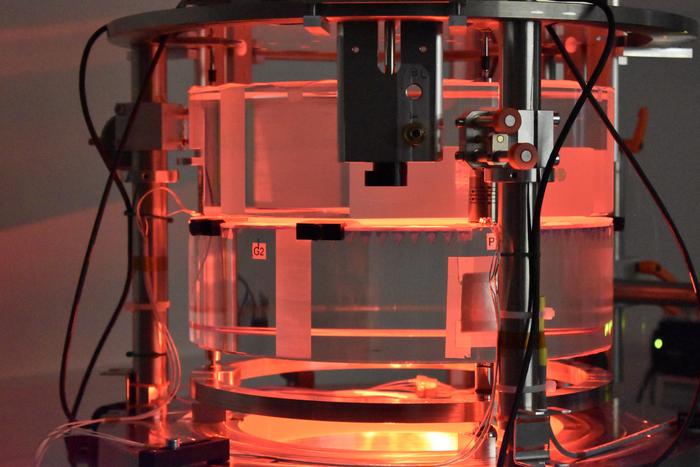
The Visible Tunable Filter’s (VTF) etalon, pictured here, consists of two reflecting plates, employed for measuring small differences in the flux of light for different wavelengths using the interference it produces. The size of the etalon, and its extreme high surface quality, are unique and unprecedented. The VTF was designed and built by the Institut für Sonnenphysik (KIS) in Freiburg, Germany, and has now been integrated into the Inouye Solar Telescope in Maui, HI - where it recently successfully saw first light.
Credit
KIS
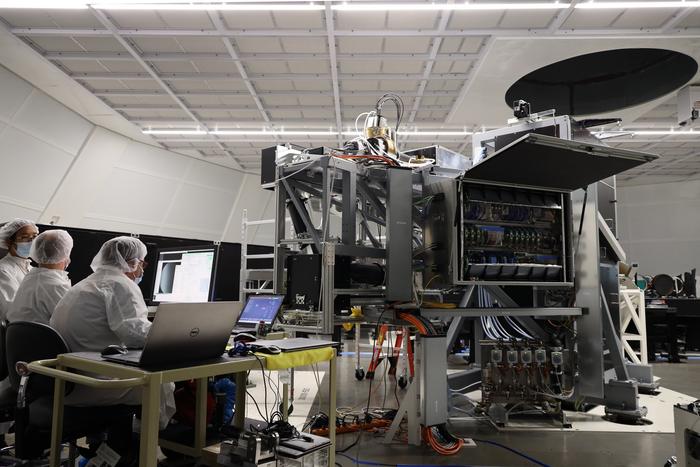
NSO and KIS engineers and scientists work on the Visible Tunable Filter (VTF) inside the Coudé Lab at the Inouye Solar Telescope, preparing the instrument for its first light. The VTF is early in its technical testing phase, and the early images it produced are impressive. The data is expected to improve with the arrival of the second etalon, after which the instrument will subsequently enter its commissioning phase. Eventually, during scientific operations, extensive data processing and resolution will realize its full potential.
Credit
NSF/NSO/AURA
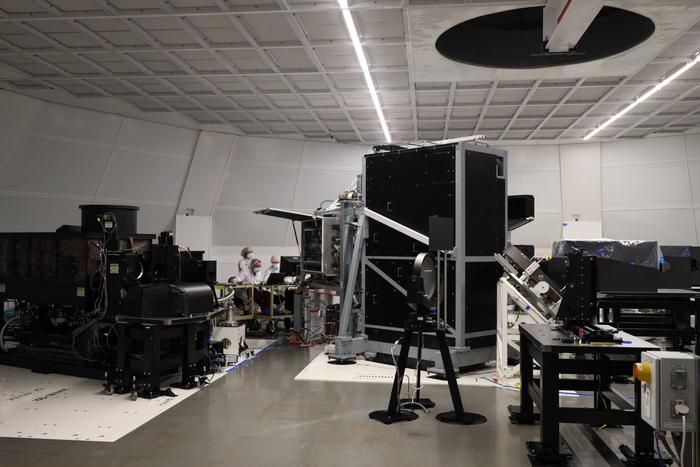
The Visible Tunable Filter (VTF), pictured center in the Inouye Solar Telescope’s instrument lab, is the new centerpiece of the telescope’s scientific instrument suite. The VTF has successfully connected to the Inouye’s light path, and following proper alignment and calibration, has achieved its first light observations.
Credit
NSF/NSO/AURA

Near the summit of Maui’s Haleakalā, the NSF Daniel K. Inouye Solar Telescope - and its set of cutting-edge solar instruments, such as the Visible Tunable Filter - is set to pave the way for a deeper understanding of our home star.
Credit
NSF/NSO/AURA
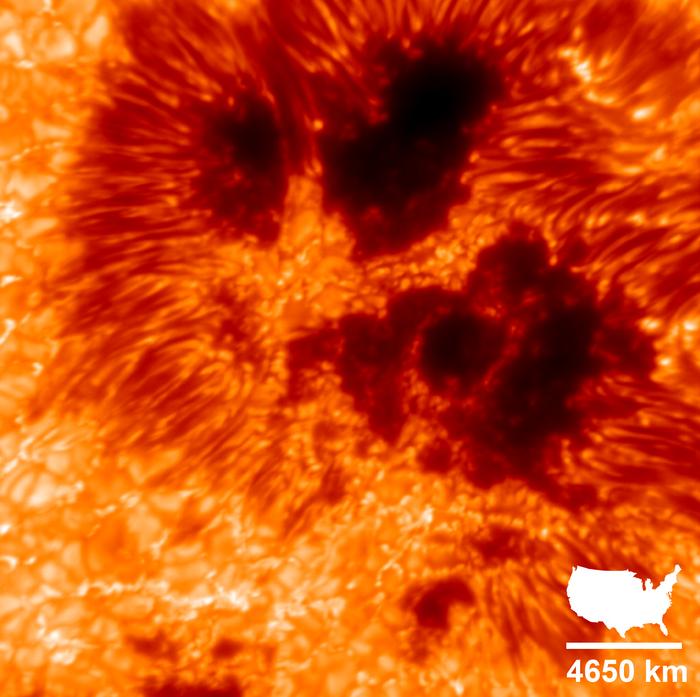
A narrow-band image of the Sun at a wavelength of λ=588.9nm - that of a well known solar sodium line also known as the “NaD line.” The image was acquired during recent first light efforts with the VTF at the Inouye, and shows how precisely the structures within a sunspot are resolved - and imply how thoroughly they can be examined by combining all data (image, spectroscopy, and polarimetry) available from the VTF. Each pixel in the original version of the image corresponds to 10 km (or 6.2 miles) on the Sun.
Credit
VTF/KIS/NSF/NSO/AURA
Credit
KIS
NSO and KIS engineers and scientists work on the Visible Tunable Filter (VTF) inside the Coudé Lab at the Inouye Solar Telescope, preparing the instrument for its first light. The VTF is early in its technical testing phase, and the early images it produced are impressive. The data is expected to improve with the arrival of the second etalon, after which the instrument will subsequently enter its commissioning phase. Eventually, during scientific operations, extensive data processing and resolution will realize its full potential.
Credit
NSF/NSO/AURA
The Visible Tunable Filter (VTF), pictured center in the Inouye Solar Telescope’s instrument lab, is the new centerpiece of the telescope’s scientific instrument suite. The VTF has successfully connected to the Inouye’s light path, and following proper alignment and calibration, has achieved its first light observations.
Credit
NSF/NSO/AURA
Near the summit of Maui’s Haleakalā, the NSF Daniel K. Inouye Solar Telescope - and its set of cutting-edge solar instruments, such as the Visible Tunable Filter - is set to pave the way for a deeper understanding of our home star.
Credit
NSF/NSO/AURA
A narrow-band image of the Sun at a wavelength of λ=588.9nm - that of a well known solar sodium line also known as the “NaD line.” The image was acquired during recent first light efforts with the VTF at the Inouye, and shows how precisely the structures within a sunspot are resolved - and imply how thoroughly they can be examined by combining all data (image, spectroscopy, and polarimetry) available from the VTF. Each pixel in the original version of the image corresponds to 10 km (or 6.2 miles) on the Sun.
Credit
VTF/KIS/NSF/NSO/AURA


