It’s possible that I shall make an ass of myself. But in that case one can always get out of it with a little dialectic. I have, of course, so worded my proposition as to be right either way (K.Marx, Letter to F.Engels on the Indian Mutiny)
Tuesday, April 29, 2025
Video: Severe Collision Sinks Bulker on Vietnam's Long Tau River
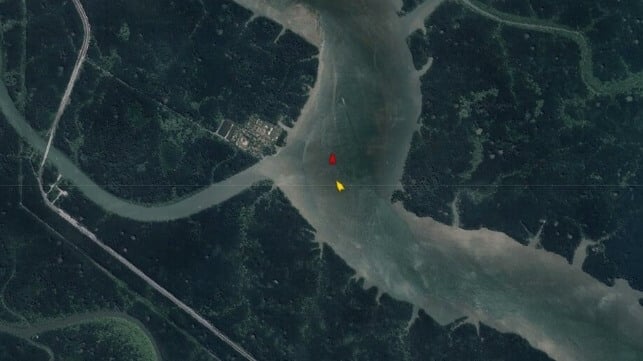
KMTC Surabaya (red) and Glengyle (yellow) were heading in opposite directions on the Long Xue River (Pole Star)
On Friday, a boxship and a bulker collided on Vietnam's Long Tau River, near Ho Chi Minh City, partially sinking the bulker.
At about 2240 hours Friday night, boxship KMTC Surabaya collided with the bulker Glengyle at milepost 15 on the Long Tau. Surabaya's near-verticalplumb bow made contact with Glengyle's port side at an oblique angle, just forward of the bulker's deckhouse. It hit with enough force to peel back Glengyle's hull plating and penetrate deep into the bulker's after hold.
The Surabaya's port bow came to rest against a cargo crane on Glengyle's centerline, just forward of the bridge deck. One of Glengyle's hatch covers was torn off its coaming by the force and appeared to be partially embedded in Surabaya's bow.
Flooding from extreme damage, Glengyle partially sank and appeared to settle onto the shallow bottom of the river, exposing the scrapes on Surabaya's hull where the ships made contact. Fuel oil could be seen spilling from the bulker's tanks. As of Saturday, the two ships remained interlocked, with tugs on scene and monitoring.
Luckily, no casualties have been reported, and KMTC Surabaya's cargo is intact.
It far from the first collision in which a vessel with a plumb bow penetrated and sank another ship. The most recent example may be the 2021 collision between the aluminum superyacht Utopia IV and the tanker Tropic Breeze in 2021: the yacht's axe-shaped, near-vertical plumb bow sank the steel-hulled tanker, but Utopia IV remained afloat and capable of navigation.
Shadow Fleet Tanker Departs Estonia After Achieving Technical Compliance
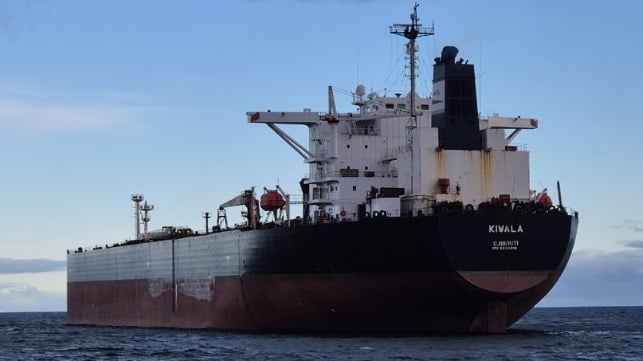
Shadow tanker was permitted to depart after it achieved technical compliance (Estonia's Transport Administration)
Estonian officials confirmed on Saturday, April 26, that the shadow fleet tanker they had been detaining for two weeks had been released reporting the vessel was now technically in compliance. The Kiwala (115,577 dwt) was stopped on April 10 while it was transiting the Baltic and a standard Port State inspection raised concern about the legitimacy of its flag and insurance as well as multiple deficiencies.
The Estonia Transport Administration last week reported it was still waiting for confirmation that 40 deficiencies had been corrected. Its inspectors identified 29 issues that were grounds for detention. This included 23 issues related to documentation, in addition to issues with safety management aboard the tanker, crew preparedness for various shipboard emergencies, and unspecified technical issues. The vessel is also operating under sanctions from the European Union, the United Kingdom, Canada, and Switzerland.
The key question related to the vessel’s flag state. Estonia reported that the ship said it was registered in Djibouti, but records showed that the flag had been withdrawn at the start of the year. Estonia’s foreign ministry however reports it received information from Djibouti that it would accept the vessel until May 7. A confirmation letter was submitted to the Estonian Transportation Administration for what was called a “transitional period” with the documentation valid for another week and a half.
The tanker was re-inspected and the results of an audit of the vessel’s class society were checked. Estonia reports the technical issues had been corrected and so the detention order was lifted. The authorities said the vessel’s Chinese captain and international crew had cooperated. The Director of the Transport Administration told ERR News, “Technically, the ship is in order and it may depart.”
AIS signals show the Kiwala got back underway over the weekend and is arriving tomorrow, April 29, at the Russian port of Ust-Luga. The ship was traveling from Sikka, India, where it departed on March 11. Equasis shows the vessel managed from China but lists the Djibouti flag as false.
The vessel has been flag hopping and listed multiple managers over the past three years. There was no word of what flag it would be moving to in May.
“The whole incident confirms once again that there are significant deficiencies in the registers of the so-called flags of convenience countries and the data is not reliable and communication with them is problematic,” said Estonia’s Foreign Minister Margus Tsahkna.
He declared that his country would continue to deter Russian shadow fleet vessels that are sailing under a flag of convenience. He said since June 2024 the country has stopped over 500 ships to request insurance documents while they are transiting the Baltic. He said they would continue to work with other Baltic countries to ensure the safety of shipping.
Two Caribbean Wrecks Identified as Danish Slave Ships
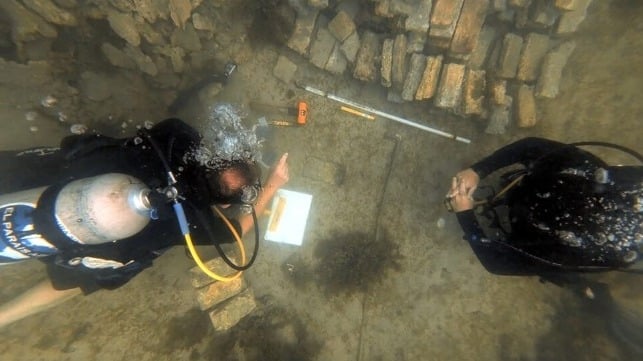
Archaeologists have confirmed the identity of two 18th-century shipwrecks in Costa Rica that for years were thought to be pirate ships. It has now been confirmed that the wrecks located in shallow waters off Cahuita National Park are those of Danish slave ships Fridericus Quartus and Christianus Quintus, which were shipwrecked off the coast of Central America in 1710.
The National Museum of Denmark is announcing that after analyzing samples taken from the shipwrecks, archaeologists have finally managed to resolve their mystery, bringing to an end years of speculation that they were pirate ships.
While the history of the two ships is well known and documented, their resting place had remained a mystery. Records show that in 1708, the two ships sailed from Copenhagen via West Africa towards Saint Thomas in the West Indies. Over several months of sailing along the coast of West Africa, the holds of the ships were filled with hundreds of slaves and made ready for the long voyage across the Atlantic.
In the spring of 1710, the two ships were in the Caribbean Sea. During the voyage across the Atlantic, however, they had gone off course, sailing nearly 2,000 kilometers further west than their intended destination, the Caribbean island colony of Saint Thomas in the Danish West Indies.
Sailing off course resulted in food and water rations running low, and a mutiny broke out among the crews of the two ships. The ensuing melee resulted in Fridericus Quartus being set on fire. Christianus Quintus had its anchor cable cut so the ship drifted towards the coast, where it was crushed in the waves in shallow water and also sank.
The two wrecks were first discovered in the 1970s, although it was not until 2015 when U.S archaeologists discovered yellow bricks in one of the wrecks, igniting renewed interest in the history of the ships. In 2023, archaeologists from the National Museum of Denmark and the Viking Ship Museum carried out a diving mission to the two ships' resting place and took samples of wood and bricks that were part of the cargo. Several clay pipes were also found.
Detailed analysis of the samples has returned results that are consistent with Danish medieval history and accounts of the two ships. Analysis of the wood showed the timbers originated in the western part of the Baltic Sea, with the tree having been cut down sometime during the years 1690-1695. The wood was charred and sooty, confirming historical accounts about one of the ships being set ablaze.
The bricks bore remarkable similarities to those manufactured in Flensburg for use in Denmark and the Danish colonies in the 18th and 19th century. Analyses of the clay showed it came from parts of Denmark that were home to a sizable brick-producing industry. The clay pipes were identified as ordinary, Dutch-produced pipes that were also used onboard Danish ships.
“The analyses are very convincing and we no longer have any doubts that these are the wrecks of the two Danish slave ships. The bricks are Danish and the same goes for the timbers, which are additionally charred and sooty from a fire. This fits perfectly with the historical accounts stating that one of the ships burnt,” said David Gregory, National Museum marine archaeologist.
The project that led to the identification of the two shipwrecks, which was made possible through collaboration among several organizations, is part of a new mission by the National Museum to excavate several Danish shipwrecks abroad. The two ships are a reminder of Denmark’s involvement in the transatlantic slave trade, which the government banned in 1792 (although slavery was not abolished until half a century later in 1847).
Trump Demands Free Transits for U.S. Ships on Suez Canal
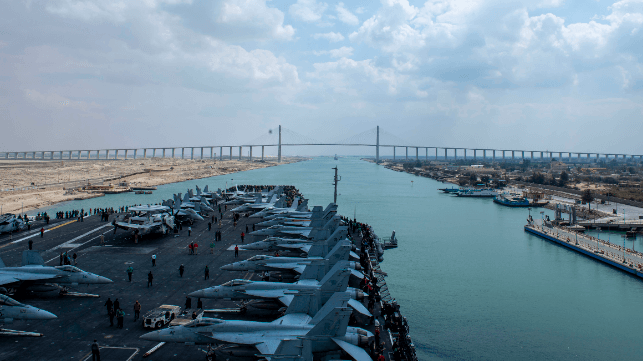
Supercarrier USS Dwight D. Eisenhower during a Suez Canal transit (USN file image)
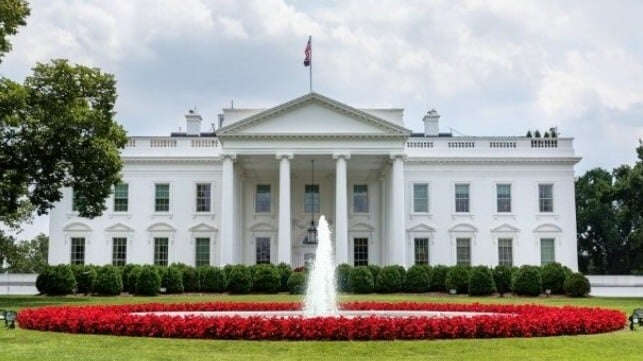
On Saturday, U.S. President Donald Trump called for the Suez Canal and the Panama Canal to provide no-cost transits for all U.S. naval and merchant vessels. The remarks on Panama reflect his previous statements, but this is the first time that Trump has made equivalent demands about access to the Suez Canal.
In a social media post, Trump claimed that the French- and Egyptian-built Suez Canal "would not exist without the United States of America," and said that he has instructed Secretary of State Marco Rubio to "immediately take care of, and memorialize, this situation." The remarks drew outrage from Egypt's political class - but not its rulers, who have remained quiet.
The Suez Canal was built by French diplomat Ferdinand de Lesseps' Compagnie Universelle du Canal Maritime de Suez during the period of the U.S. Civil War, supported by participation from international shareholders. The privately-funded work started in 1859, and it initially depended upon forced labor. Despite the warnings of naysayers, and a substantial number of casualties during construction, the canal opened in late 1869 and was an immediate commercial success. It passed into British hands in 1882, and British troops defended it from attack until Egypt nationalized it in 1956. Under the current Egyptian administration, it has been widened and expanded, with new parallel channels for two-way traffic.
According to Al Jazeera, U.S. traffic accounts for about 10-20 percent of the volume on the Suez Canal, and generates fees of $400-700,000 per vessel traffic for the Egyptian government's Suez Canal Authority. Waiving these fees would be a significant blow to the SCA's already-reduced finances.
Egyptian commentators have expressed surprise at Trump's demand, and have questioned whether the canal's existence depended on the U.S., given its French, British and Egyptian operating history.
"[Egypt] refused the presence of any military bases from the Americans and before them the Russians," said Egyptian member of parliament Mahmoud Badr in a social media statement. "The Suez Canal was built by Egyptians with their blood, nationalized by Egyptians, and is protected by the Egyptian army."
Egypt's Civil Democratic Movement, which includes several of the country's political opposition parties, accused Trump of "a lack of historical awareness and unacceptable arrogance."
"The Egyptian people consider the Suez Canal a red line and will never accept any infringement on Egypt's sovereignty and national security," the group said in a statement. "They will follow in the footsteps of their fathers and grandfathers in defending their nation's freedom and territorial integrity."
Red Sea security
Over the course of the past year, the Suez Canal's traffic levels have fallen drastically due to the Houthi threat in the Red Sea. The militant group carried out more than 100 attacks and caused two sinkings off Yemen in 2024; merchant shipping is now taking a cautious approach to the Suez route, and traffic on the canal has fallen by 60 percent since 2023.
The Houthis' stated objective - a Gaza ceasefire - briefly occurred with U.S. support in January; Israel ended that ceasefire in March, and the U.S. has turned to an intensive campaign of airstrikes to suppress the Houthis' capacity to interfere with shipping. If successful, this campaign would benefit Egypt and the Suez Canal.
While the Houthis' operational tempo has fallen, the group still has the ability to launch drones and missiles - for now, focused on U.S. Navy and Israeli targets. Merchant shipping traffic levels remain low in the Red Sea, and most top shipping companies have said that they would wait until long after hostilities have ended before bringing their ships back to the area.
Shipping Stocks Begin to Regain Losses After Hints of a Tariff Reprieve
Clear signals that the Trump administration wants to pare back its new tariffs have prompted a market recovery, and key stocks in cruise and commercial maritime have begun to regain the losses they suffered after the April 2 levy announcements - but the course ahead is still far from certain.
Trade with China has been hit hardest with a 145 percent blanket tariff rate. Container booking data for mid-May shows that shipments for inbound cargo from China to LA-Long Beach will be down by more than 40 percent, according to CNBC, an unprecedented and sudden drop.
On Tuesday, Trump told the press that he would not "play hardball" with China and would be "nice" in negotiations going forward. He added that the current rate would be coming down "substantially," though not all the way to zero.
On Wednesday, the Wall Street Journal reported that Trump's team is aiming at average tariffs of 50-65 percent on Chinese goods, possibly lower for noncritical items and higher for strategic industries. A final decision has not been made, the WSJ said.
Later in the day, Treasury Secretary Scott Bessent denied that the White House is considering cutting tariff rates on China without getting something in return. But he said that both sides are motivated to walk back from current levels. "Neither side believes that these are sustainable [tariff] levels," he said. "This is the equivalent of an embargo, and a break between the two countries in trade does not suit anyone's interests."
Stocks have rallied on the news of a likely tariff rollback, including some key shipping stocks. AP Moller-Maersk, the largest publicly-listed ocean carrier (and second-largest overall) saw its shares jump up eight percent in a day. It has now regained most of its losses since April 2, buoyed by expectations of lower trade barriers.
Jones Act carrier Matson, which operates an express service between China and the United States, has been hit hard by the tariff disruption: its stock has lost nearly a quarter of its value since April 2. It began to recover from those losses on Tuesday, reflecting rising expectations of an eventual return to higher booking levels on transpacific routes.
As a discretionary expense, cruising is sensitive to swings in economic outlook, and it has tracked the recovery of the rest of the market. Carnival rebounded 3.5 percent over the past five days, Royal Caribbean is up by 7.5 percent, and Norwegian Cruise Line is up by 5 percent. However, all of the big three cruise stocks - like the markets overall - are still well below where they were last month.
Oil Spill Response Under Way Near Pass a Loutre, Louisiana
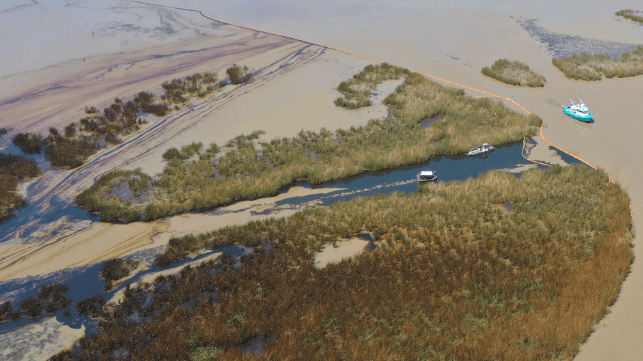
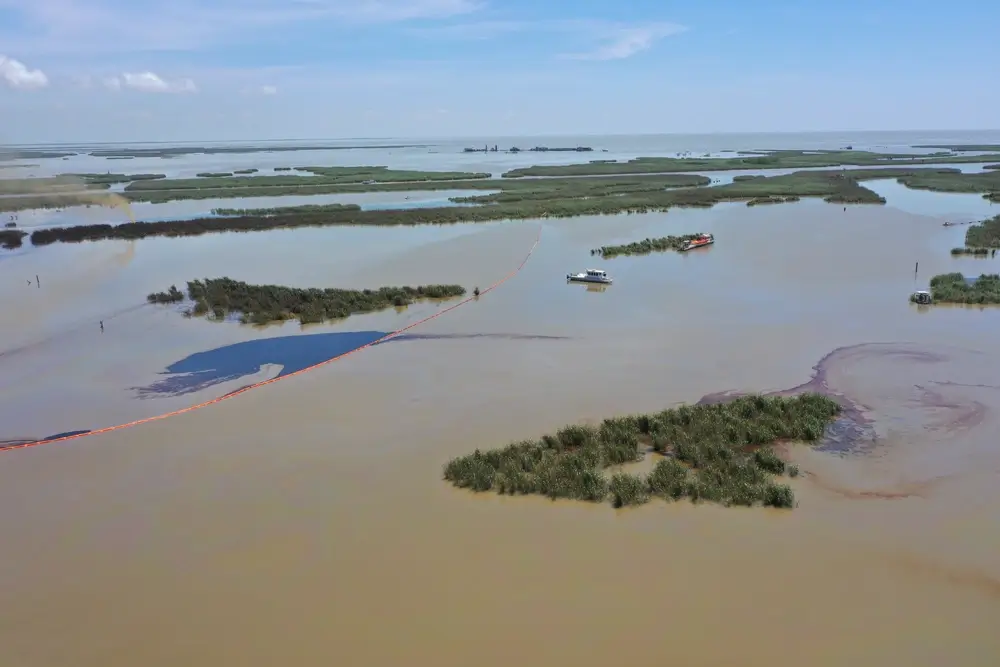
A containment boom (upper center) has been deployed to keep the spill from spreading (USCG)
On Sunday, the U.S. Coast Guard launched a response to a spill near an oil production site in the Bird's Foot of the Mississippi Delta.
The spill is located near the Garden Island Bay Production Facility, a marshland well collection point near Pass a Loutre. Operator Spectrum OpCo LLC, the Coast Guard and the Louisiana Oil Spill Coordinator's Office (LOSCO) have set up a unified command to address the mixed oil and gas release. A LOSCO overflight confirmed the spill, and first responders are on scene to help mitigate the damage. At least one containment boom has been deployed.
The operating company has hired in three firms - Forefront Emergency Management, Environmental Safety & Health Consulting Services, and Clean Gulf Associates - in order to address the spill.
Courtesy USCG
The volume of the spill has not been assessed yet, but overflight assessments are scheduled daily. There have been no reports of injuries or wildlife impacts, and the affected area is well outside of the Mississippi's main shipping channel.
The Pass a Loutre area is the end point of the Mississippi Flyway bird migration route, a key travel corridor for a large number of familiar American bird species. In an adjacent wildlife management area just to the south, the state and federal governments have spent millions of dollars on marshland and habitat restoration for the benefit of migratory birds.
RWE is Latest to Stop U.S. Offshore Wind Activities
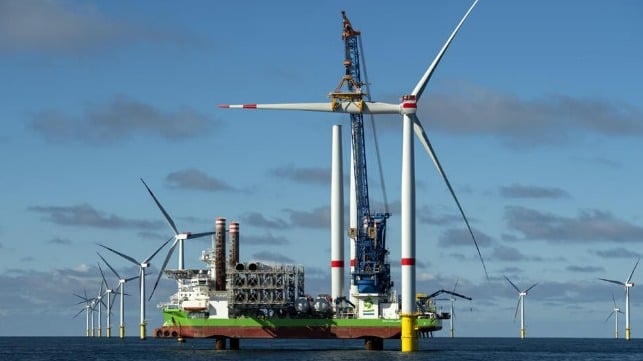
RWE is proceeding with offshore wind farms in Europe while it has stopped offshore activities in the U.S. (RWE file photo)
German renewable energy giant RWE is set to announce that it has stopped its offshore activities in the United States and setting higher requirements for future investments because of the “political developments.” The company follows TotalEnergies, Shell, and BP which previously announced they were backing away from projects in the U.S., and Equinor which last week said it is considering “legal remedies” after Trump’s Department of Energy suspending offshore work on a full-permitted wind farm off New York.
RWE released a manuscript of the speech Dr. Markus Krebber, CEO of RWE, will deliver next week, April 30, during the company’s annual meeting. In the speech, he will highlight the company’s many successes in 2024 and the progress being made on the Sofia wind farm for the UK and with the Danish wind farm Thor. He notes RWE has a combined offshore wind farm capacity currently of 3.3 GW and a further four projects with a capacity of 4.4 GW under construction.
Turning to the U.S. market environment, Krebber will tell shareholders, “We have stopped our offshore activities for the time being,” while the company has also introduced “higher requirements for future investments in the U.S.” He says despite the company’s success with onshore wind, solar energy, and battery storage, “Nevertheless, we remain cautious given the political developments.”
RWE became the largest leaseholder in the New York Bight with a potential 3-gigawatt area it won in the hotly contested 2022 offshore auction. At the end of the same year, RWE won a lease area to develop up to 1.6 GW off the coast of Northern California, which it projected would be one of the first commercial-scale floating wind farms in the country. It is also working with Greater New Orleans and GNOwind Alliance for regional opportunities. It launched site investigations off California in 2024 and proposed the Community Wind project with 1.3 GW of capacity to New York State.
The company in November 2024 warned it was delaying investments citing higher risks for offshore wind in the U.S. and a slower ramp-up of the European hydrogen economy. Krebber will tell shareholders next week the company has raised its threshold expectations for new investments. For future projects, he says they will increase the average return requirement from 8 percent to more than 8.5 percent.
For the U.S., he notes while the company surpassed 10 GW of generation capacity from renewable energy at the start of 2025, RWE will enforce higher requirements for future investments. This includes having all necessary federal permits in place, tax credits being safe harbored, and all relevant tariff risks mitigated. Only if these conditions are met for future investments, for the time being in onshore wind and solar, will it “be possible given the political environment.”
Developers of U.S. offshore wind projects remain concerned after the moves by the Trump administration including launching a review of the leasing process, pulling permits for projects in New York and New Jersey, and stopping funding on a research project in Maine. At the beginning of the month, four offshore projects were reported to be proposing to delay their state-level regulatory reviews. Shell reported in November 2024 that it would take a $1 billion charge as it moved away from U.S. offshore wind projects and Equinor said if a full-stop ensues for its Empire Wind project, it would have to repay $1.5 billion in financing and would be exposed to termination fees from its suppliers.
Trump Administration Suspends Funding for UMaine Floating Wind Research
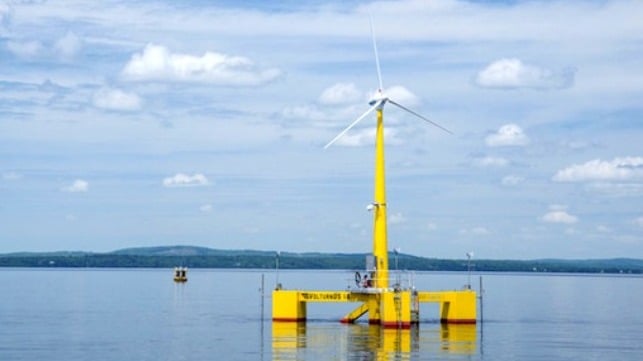
Maine previously demonstrated other prototypes for its offshore wind farms (New England Aqua Ventus)
In its latest move against the offshore wind energy sector, the Trump administration suspended funding for a research project developing prototypes for floating offshore wind turbines. The move came days after the research project being undertaken by the University of Maine launched the base for its test system which was due to begin operations this summer.
In a letter released online by Maine State Representative Reagan Paul, the U.S. Department of Energy’s Advanced Research Projects Agency (ARPA-E) accuses the university of “failure to comply with one or more of the National Policy Assurances” in its ongoing grants. It is informed that ARPA-E “is suspending all activity” effective this date (April 11) for a period of up to 90 days. The suspension could be canceled or extended by ARPA-E and the university has the right to object and provide information and documentation challenging this suspension.
A university spokesperson told the media in Maine they had not been aware of any issues or investigations. It is being pointed out that the letter does not make specific allegations of the nature of failures or violations of rules.
The state of Maine and the Trump administration have been feuding since February. State Governor Janet Mills openly rejected Trump policies including on transgender rights during a White House event. The governor cited state law to which Donald Trump said “You better comply,” and later “See you in court.” Maine Public Radio is saying that two other grants were also suspended and that the university has had several pools of federal aid suspended, cut, and reinstated since February.
The university’s Advanced Structures and Composites Center has been leading the research into floating offshore wind turbines for more than a decade and in 2024 won grants which are reportedly valued at $12.5 million. The project was to build and test a prototype in the Gulf of Maine.
The researchers successfully floated a 375-ton concrete base on March 30 as the first step in the prototype project. The base was towed to Searsport, Maine where it was docked. The work called for the installation of the tower, turbines, and blades in the coming week. The prototype is a 56-foot square base that stands 32 feet high. It is a quarter-size research prototype for the tests.
By the end of May, the prototype was to be towed into position in Penobscot Bay near Castine, Maine. It was scheduled to undergo 18 months of testing and data collection from more than 200 sensors.
Maine proposed a research site for floating offshore wind in 2021 and won approval from the Bureau of Offshore Energy Management (BOEM) in 2023. A research lease was awarded in August 2024 for a project that ultimately proposes to place up to 12 floating turbines that would have a capacity based on current designs for up to 144 MW of electricity.
Updated: At Least 1,200 Injured in Blast at Bandar Abbas, Iran
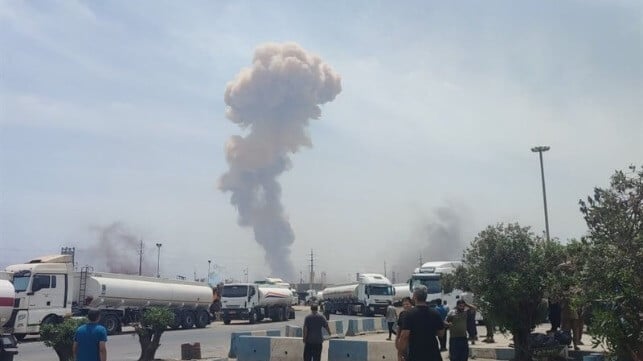
Blast rocked the port city of Bandar Abbas (Tasnim News Agency - CC BY 4.0)
[Updated] A huge explosion in the commercial port of Bandar Abbas in Iran at 12.00 on the morning of April 26 has injured at least 1,000, according to Iranian state media. First reports suggested that four people have been killed, a toll which had risen to 40 overnight. Office buildings in the port have been damaged and glass blown out of windows, although the immediate neighborhood is a commercial rather than a residential area. Explosions were still occurring in the area several hours after the initial explosion.
Footage shows the moment an explosion occurred in Shahid Rajaee Port, Bandar Abbas. pic.twitter.com/Sjl1X9LJqP
The explosion is believed to have started in a container stored in the hazardous and flammable section of the container park. An extensive container storage park lies immediately to the north of the port’s container loading quays.
New footage has been released, showing the moment that yesterday’s chemical fire started at the port of Bandar Abbas on the coast of the Persian Gulf, which resulted in a massive explosion causing severe damage to the port and the deaths of at least 28 workers in Southern Iran. pic.twitter.com/ym9MSTi5mV
Russia's emergency ministry said Sunday that it would be dispatching two aircraft to help Iranian officials address the fire, including a Beriev Be-200 amphibious firefighting plane and an Ilyushin Il-76 transport aircraft.
The Shahid Rajaei commercial port handles about 85% of Iran’s non-oil and gas exports and imports, and is connected to Iran’s transnational rail network. The Iranian authorities have for some years been planning an expansion of the port to increase throughput. The commercial port lies 10 miles to the west of the Bandar Abbas Naval Harbor, which is the homeport to most of Iran’s regular Navy.
In February and March, the Maritime Executive tracked the progress from China of two sanctioned ships owned by Islamic Republic of Iran Shipping Lines (IRISL), MV Golbon and MV Jairan, which then unloaded their cargoes of sodium perchlorate at Bandar Abbas. Sodium perchlorate is processed into ammonium perchlorate rocket fuel at the Iranian facilities at Parchin south of Tehran and Khojir. Ammonium perchlorate makes up 70% of the standard fuel load of most of Iran’s solid-fueled ballistic missiles, such as medium range Khybar-Shikan and Fattah missiles, and the shorter range Fateh-110 and Zolfaghar missiles. It is not known if containers unloaded from the two ships were, several weeks after unloading, still in the Sina container port at the time of the explosion, or whether the containers formed the seat of the explosion.
As would be expected, an Israeli spokesman denied any knowledge of the explosion, although the Times of Israel was the first media organization to point out a possible connection. Washington Institute missile expert Farzin Nadimi has said that he believes the yellow character of the explosive fireball is indicative of the presence of sodium. Within Iran, newspapers are split on the cause of the explosion, conservatives blaming safety failures and reformists blaming sabotage, implicity accepting the target was the sodium perchlorate.
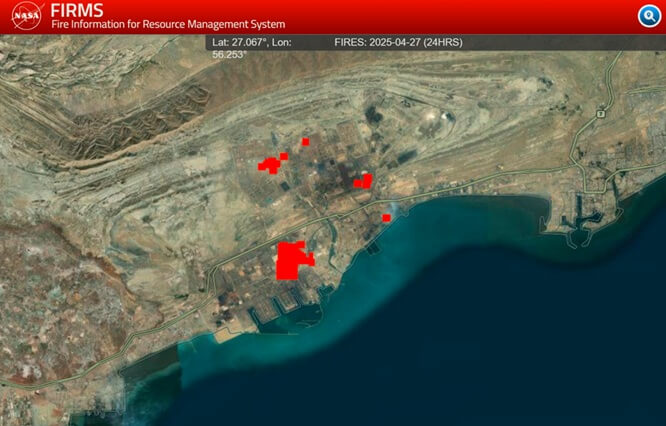
The fire/heat source detected by the NASA fire-detecting system FIRMS grew in size throughout April 26, inicating that the fire continued to burn into nightfall; other heat spots initially detected were from oil refineries and the Hormozgan steel works (FIRMS/CJRC).
The NASA FIRMS system which monitors fires and heat sources initially detected only a small fire, which grew as the day wore on. On the afternoon of April 27, the fire was still spreading. Other regular heat spots to the north of the fire, namely oil refineries and the Hormozgan steel works, have since yesterday gone cold, suggesting that these industrial facilities have been closed down, possibly because workers have been evacuated. At least 10,000 containers hve been destroyed, and there is likely to be long-term damage to the port, with operations likely to be disrupted for some time.
Unprecedented Bleaching Event Affects 84 Percent of World's Corals
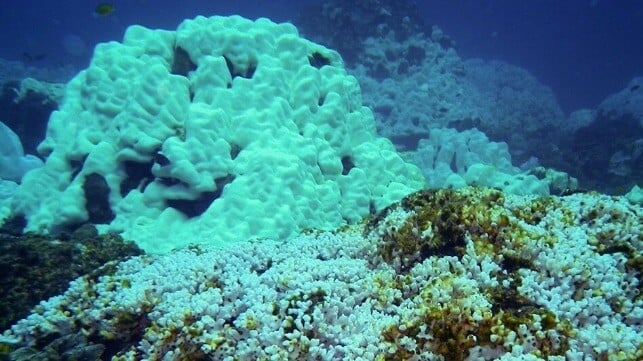
Coral bleaching off Thailand, 2010 (NOAA file image)
One year after the official declaration of the fourth global coral bleaching event, NOAA and the International Coral Reef Initiative (ICRI) have updated the initial impact of the catastrophe. From January 2023 to March 2025, the bleaching event has impacted 84 percent of the world’s reefs, with 82 countries and territories reporting damage.
As sea surface temperatures continue to rise, bleaching-level heat stress has been extensively reported across the Atlantic, Pacific and Indian Ocean basins. Bleaching occurs when corals lose their colorful photosynthetic algae (Zooxanthellae), revealing the white calcium carbonate skeleton. When this occurs, the corals are left without their primary energy source, which could lead to death unless temperatures drop. This time, though, scientists are concerned that bleaching will simply be a state of being going forward.
"We just may never see the heat stress that causes bleaching dropping below the threshold that triggers a global event. So this may be the last one," marine scientist and former NOAA Coral Reef Watch coordinator Dr. Mark Eakin told PBS.
The first global coral bleaching event was declared in 1998, with 21 percent of reefs experiencing bleaching-level heat stress. This rose to 37 percent in the second event in 2010 and 68 percent during the third event (2014-2017).
Scientists have called the fourth event unprecedented, starting with some bleaching episodes from May 2024. This has seen a widely-used bleaching prediction platform adding three new levels (Level 3-5) to its Bleaching Alert Scale, which indicates heightened risk of mass coral mortality. The previous highest level, Level 2, indicates risk of mortality to heat sensitive corals. The new level now, Level 5, indicates the risk of over 80 percent of all corals on a reef dying due to prolonged bleaching.
The fourth bleaching event is happening at a time that the global average temperature is rising. NASA confirmed 2024 as the warmest year on record. The average surface temperature in 2024 was 1.28 degrees Celsius above NASA’s 20th-century baseline (1951-1980), topping the record set in 2023. This contributed to record-breaking ocean temperatures, and triple the previous record number of marine heatwaves around the world.
“The fact this most recent, global-scale coral bleaching is ongoing, takes the world’s reefs into uncharted waters,” said Dr. Britta Schaffelke, Coordinator of the Global Coral Reef Monitoring Network (GCRMN). “In the past, many coral reefs around the world were able to recover from severe events like bleaching and storms. We need to continue to observe and measure if and how reefs will recover and change, to help inform the combination of conservation measures most suited for a particular reef.”
NTSB Cites Inexperienced Pilot Using Cell Phone in Ohio River Tow Incident
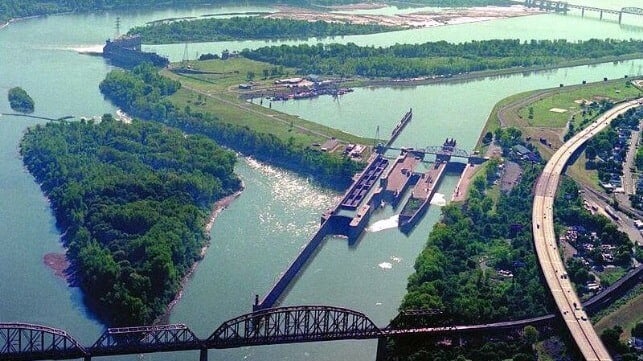
McAlpine Locks is a complicated area where the incident took place in 2024 (Army Corps file photo)
The NTSB released a report on a 2024 incident in which a towing vessel moving coal barges struck a vane dike on the Ohio River resulting in an estimated $1.3 million in damages to the barge, cargo, and dam rates. It found that the pilot did not effectively compensate for the outdraft current while navigating out of the locks near Louisville, Kentucky, but that a lack of communication, an inexperienced pilot, and the use of a personal cell phone contributed to the incident.
The report recognizes that the upstream section of the McAlpine Locks and Dam is uniquely difficult to navigate, even under ideal circumstances. It highlights that there have been nine reported incidents in the area involving tow vessels since January 2020, totaling over $2.7 million in property damage.
“Lock canal entrances near dams present unique hazards for vessels transiting inland rivers,” the report said. “Fast moving river water near low-flow canal waters can produce outdraft currents. Mariners should thoroughly assess the potential impact of outdraft currents when entering or exiting locking channels. Vessel horsepower and vessel handling should be carefully considered.”
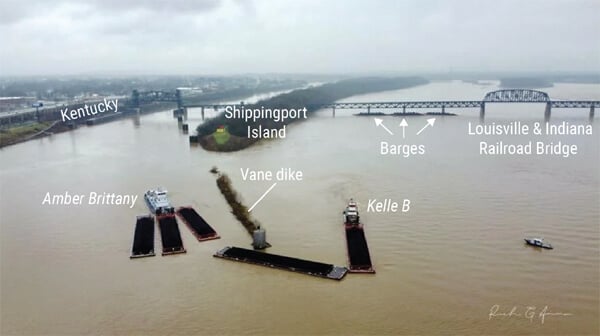
In this instance, the towing vessel Amber Brittany, built in 1982 and 138 feet in length, was pushing 15 loaded coal barges along the Ohio River. On March 8, 2024, the vessel was waiting its turn to enter the McAlpine Locks when the captain was relieved by the pilot. The captain and pilot discussed the upcoming locking procedure and transit strategy. The captain recommended favoring the left descending bank to avoid the effects of outdraft. He also warned of shoaling on the left descending bank.
During the investigation, it came out that the company personnel was under the impression that the pilot had previous experience operating tows on the Ohio River. However, the pilot told the Coast Guard and NTSB investigators that he had not previously operated on the Ohio River. This led the NTSB to the conclusion that the pilot’s inexperience in a challenging location contributed to the contact.
(Source NTSB)
An analysis of the AIS signal showed that as the tow vessel was exiting the lock area its course alerted appreciably to port. The pilot blamed an outdraft current saying he had attempted to counter it and then realizing the tow was going to contact the vane dike, attempted to land as softly as possible.
The second barge contacted the vane dike mooring cell and the tow broke apart. Ten of the 15 barges broke free and floated downstream. One of the barges ultimately sank. Another barge began taking on water and was pushed to the bank.
Further investigation however revealed that the pilot was also on his personal cell phone. Records indicated the pilot was using the phone just before the contact. The first in a series of outgoing and income text messages coincided with the Amber Brittany’s departure from the sailing line. In all, the NTSB reports that the pilot sent 16 messages starting before the contact and continuing afterward over a 20-minute period and made two outgoing calls after the contact happened. In the three minutes prior to the contact, the pilot sent three messages and received three incoming messages.
The NTSB warns that mariners should avoid using mobile devices, especially while maneuvering in unfamiliar areas of restricted navigation.
“Using cell phones and other wireless electronic devices has been demonstrated to be visually, manually, and cognitively distracting. Talking on cell phones can have serious consequences in safety-critical situations, and sending or reading text messages is potentially even more distracting than talking because texting requires visual attention to the display screen of the device,” the report highlights.
It is not the first time personal cell phone usage has been documented during incidents. The NTSB said the pilot on the containership Ever Forward was busy on his personal cell phone when the boxship grounded in the Chesapeake Bay. That same year a bulker and an OSV were in a collision 66 miles south of Port Fourchon, Louisiana. The master of the OSV later admitted to the NTSB that he had made a personal call using his cell phone, and was using dictation to send personal text messages. At the same time, the second officer on the bridge of the bulker was also distracted while he had begun printing updates for electronic navigation charts and digital publications.
NTSB in its role can only conclude the probable cause of the incidents. The U.S. Coast Guard and other local authorities are responsible for the regulations and disciplinary actions. The Coast Guard has also issued warnings against using personal devices which could cause distractions while navigating.