Wednesday, May 28, 2025

US- and Israel-Backed Gaza Aid Scheme Reportedly 'Being Used to Detain Civilians'

"Humanitarian assistance must not be politicized or militarized," said one humanitarian worker.



Displaced Palestinians receive food packages from a U.S.-backed foundation pledging to distribute humanitarian aid in western Rafah in the southern Gaza Strip on May 27, 2025.
(Photo: AFP via Getty Images)

Julia Conley
May 27, 2025
COMMON DREAMS

On the first day of operations for the U.S.- and Israel-backed foundation set up to provide aid to Palestinians in Gaza, reports Tuesday indicated that distribution sites descended into "chaos," with desperate people who have suffered increasingly from malnutrition in recent months "corralled" into metal enclosures for hours, U.S. and Israeli forces firing live ammunition, and at least one person reportedly being "kidnapped" by Israeli intelligence officers.

The Gaza Humanitarian Foundation (GHF), which is based in Geneva and staffed by private U.S. security contractors, said it had distributed 8,000 food boxes containing more than 460,000 meals on Tuesday, but some Palestinians said they were hesitant to approach the group's distribution points for fear of being targeted after going through the GHF's facial recognition technology screening process.

Israeli officials have said recipients of the aid will be screened so Hamas members don't obtain food packages, but Jeremy Scahill of Drop Site News said there was already a report Tuesday morning of a Palestinian man "being kidnapped when he went to get one of the small boxes of food" at the Muraj Crossing distribution point.


"To our shock, he called us under threat from Israeli intelligence officers, demanding information about one of our relatives with whom we've had no contact since the beginning of the war," said the man's family. "When we were unable to provide the information the army requested, communication was cut off, and we were later informed that he was transferred to a detention center. He is now considered missing."

A humanitarian coordinator in central Gaza toldDrop Site the distribution points are "being used to detain civilians."

The United Nations and aid groups that have long operated in Gaza have boycotted the GHF and warned against its plan to set up distribution points only in the southern part of the enclave, forcibly displacing Palestinians—90% of whom have already been forced from their homes since Israel began its bombardment of the enclave in retaliation for a Hamas-led attack in October 2023.

"Humanitarian assistance must not be politicized or militarized," Christian Cardon, chief spokesperson of the International Committee of the Red Cross, toldReuters.

Drop Site and Reuters reported that at a distribution point in Tel al-Sultan, west of Rafah, order quickly collapsed as Palestinians rushed toward the site to retrieve aid after "waiting for hours in the sun"—and following 86 days of Israel's total blockade on humanitarian aid, which has caused the risk of famine to rise across Gaza and has caused dozens of children to die of starvation, as Israel has also intensified its bombardment.

"This situation constitutes humiliation and degradation of the Palestinian citizen," said Eyad Amawi of the Gaza Relief Committees. "We are talking about tens of thousands across the Gaza Strip who will not be able to access these aid points. A single distribution location in Rafah, in the heart of the military incursion zone, poses significant danger and threat. It will not be effective unless aid distribution is returned to a system managed by U.N.-affiliated institutions—ensuring neutrality, fairness, and inclusivity in the process."

Images posted online showed Palestinians crowded into metal enclosures at the site.


The Israeli news outlet Ynet  published conflicting accounts, with an Israeli security source saying U.S. forces fired warning shots into the air after a "Gazan mob" entered a "sterile area." Another source said that American security forces "fled the scene" after Palestinians raced toward the distribution point. Channel 12 in Israel reported that an Israeli combat helicopter reportedly fired into the air to disperse the crowd—even though Israel has said its forces would not be involved in GHF's operations.

"No entity can manage the humanitarian scene in Gaza except for U.N. agencies, foremost among them the U.N. Relief and Works Agency for Palestine Refugees in the Near East," said Ramy Abdul, chairman of the Euro-Mediterranean Human Rights Monitor. "Any other parties are engaging in political blackmail and criminal acts, led by the U.S. and Israel."

Drop Site posted a video online showing a large crowd of Palestinian people rushing toward a distribution site without any humanitarian workers appearing to ensure order or provide aid.


"The Gaza Humanitarian Foundation has left Palestinians without food," said José Andrés, the chef who founded World Central Kitchen, which has provided aid in Gaza, even as Israel has killed some of its workers. "The people that created it are selfish. And now because people are really hungry [they] just stormed the distribution place damaging the fence. It seems a helicopter began shooting."

"The World Central Kitchen system of kitchens is the way," said Andrés. "Palestinians feeding Palestinians."

The GHF and Israel claimed without evidence that Hamas tried to block Palestinians from reaching the distribution centers.

Ismail Al-Thawabta, director of Gaza's Government Media Office, which is run by Hamas, told Reuters that "the real cause of the delay and collapse in the aid distribution process is the tragic chaos caused by the mismanagement of the same company operating under the Israeli occupation's administration in those buffer zones."

"This has led to thousands of starving people, under the pressure of siege and hunger, storming distribution centres and seizing food, during which Israeli forces opened fire," said Al-Thawabta.

The chaotic first day of operations for GHF came two days after its executive director, Jake Wood, resigned, saying the foundation's plan for aid distribution violated basic "humanitarian principles."

Jewish Voice for Peace (JVP) said that starving Palestinians were forced to walk an average of 9.3 miles to a distribution point near Al-Mawasi.

"This is the grim reality for Palestinians trapped under siege by the Israeli military: insufficient aid, poorly organized, delivered at gunpoint by military contractors in coordination with the Israeli military," said JVP. "Instead of GHF, established international organizations operating under the U.N. should be granted full, safe, and unlimited access to deliver aid effectively, impartially, and with dignity."

"There is no time to waste," said the group. "Stop funding the Israeli military. End the siege. Let in U.N.-coordinated aid. Demand an immediate cease-fire. End the occupation. Free Palestine."

Intensifying Israeli Onslaught Has Displaced 180,000 Palestinians in Just 10 Days

"They call places safe, then attack them," said one Palestinian aid worker. "I'd rather stay home with my family and face whatever comes, at least we all die together, rather than be separated."


A Palestinian boy is seen at the Fahmi Al-Jarjawi school after an Israeli airstrike in Gaza City on May 26, 2025.
(Photo: Rizek Abdeljawad/Xinhua via Getty Images)

Jake Johnson
May 27, 2025
COMMON DREAMS

A United Nations group said Tuesday that Israel's renewed ground offensive and continued airstrikes in the Gaza Strip displaced roughly 180,000 Palestinians in just 10 days this month, leaving desperate, starving families with nowhere to turn as Israeli forces target shelters and other civilian infrastructure.

The estimate from the International Organization for Migration's Global Camp Coordination and Camp Management (CCCM) Cluster came a day after the Israeli military bombed a school-turned-shelter in Gaza City, killing dozens.

CCCM said Tuesday that direct attacks on shelters for displaced people "have become common" in recent weeks as Israeli forces have moved ahead with Operation Gideon's Chariots, an expansion of Israel's devastating assault on the besieged Palestinian enclave. The official death toll from Israel's assault, which began in the wake of a Hamas-led attack in October 2023, surpassed 54,000 on Tuesday.

"Since the collapse of the cease-fire on 18 March, nearly 616,000 people have been displaced—multiple times, some as many as 10," said the U.N. group. "During the cease-fire, over half a million people went back to their homes, mostly in the north, to try to rebuild their lives. That fragile progress has now been reversed, as intensified military operations are once again displacing families away from the areas they had only recently returned to."

Citing humanitarian partners on the ground, CCCM noted that roughly 80% of the Gaza Strip is either under a displacement order or marked as a "no-go" zone, making most of the enclave's population vulnerable to Israel's ground and aerial onslaught.

"My sibling died in a 'safe' zone after they bombed it," one Palestinian aid worker told CCCM. "They call places safe, then attack them. I'd rather stay home with my family and face whatever comes, at least we all die together, rather than be separated."

CCCM also raised alarm over a newly launched aid scheme led by the Gaza Humanitarian Foundation (GHF), a private organization with ties to the U.S. and Israeli governments.

"These arrangements risk circumventing established humanitarian coordination mechanisms, undermining humanitarian principles, and putting civilians at further risk by promoting displacement without essential protection or adequate access to lifesaving services," the U.N. organization said.

The Euro-Mediterranean Human Rights Monitor echoed that warning, saying in a statement that "all available information about the new Israeli mechanism clearly indicates that it is designed as a tool of coercive control over the Gaza Strip's civilian population."

"It limits families to just one aid parcel per week under highly restrictive security conditions, thus violating the principles of non-discrimination, adequacy, and continuity in humanitarian aid," the group said. "Such limited distribution is not a genuine humanitarian response, but a deliberate policy aimed at barely managing hunger, rather than actually alleviating it."

Economic expert demolishes Trump's demand for companies to 'eat the tariffs'

Matthew Chapman
May 27, 2025 
RAW STORY


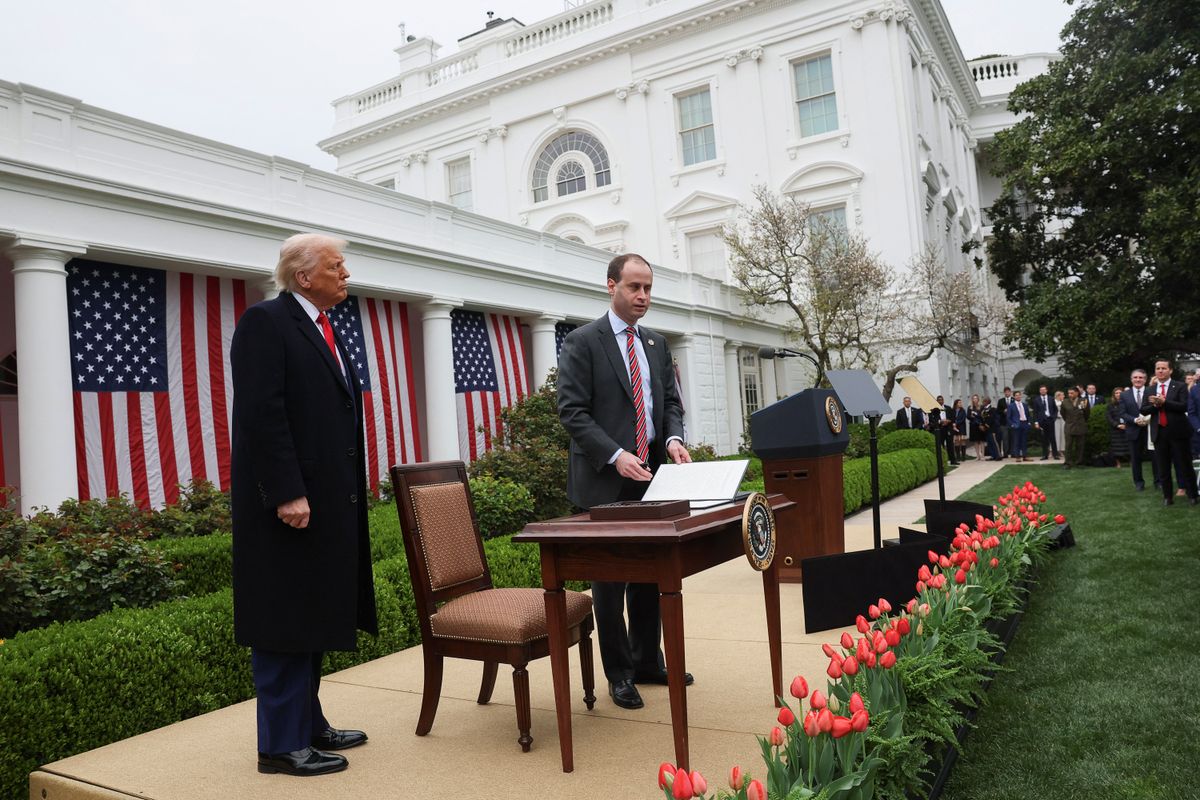
U.S. President Donald Trump stands, ahead of signing an executive order on tariffs, in the Rose Garden at the White House in Washington, D.C., U.S., April 2, 2025. REUTERS/Leah Millis

President Donald Trump is demanding that U.S. companies pay the entirety of his tariffs rather than raise prices and pass them to consumers — but even if they fully complied with Trump's orders, that doesn't actually make his tariffs any better of a situation for the economy, wrote a prominent tax policy expert on Tuesday.

As Republican lawmakers and entrepreneurs alike sound the alarm that the tariffs will stifle economic growth and supercharge inflation, Trump has picked fights with any company that suggests price hikes might be necessary, most notably demanding that Walmart "eat the tariffs" in response to reports they may raise prices on some items.

But in a series of posts on X this week, Erica D. York, vice president of tax policy for the conservative-leaning Tax Foundation, pointed out that forcing an American corporation to pay tariffs fundamentally comes to the same thing as forcing their customers to pay it.

"Here’s what 'eat the tariffs' looks like in the real world," wrote York, posting an excerpt from a story detailing a small business, Jeans Day Apparel, selling clothing in McCordsville, Indiana. This company faced a 3 percent increase in cost for supplies due to the tariffs, and they kept their prices the same — but that meant laying off the high schoolers they were paying part-time at $12-15 an hour to help them make their clothing.

When a commenter replied to her by saying, "You literally proved that overwhelming majority of the tariff was eaten and they didn’t pass anything to the consumer," York had a ready response on Tuesday.

"It's interesting that people seem to think 'eat the tariff' means it has no ill effect," she said, posting more supplemental material. "Eat the tariff means lower incomes. Pass the tariff means lower incomes. No matter which channel tariffs take, the result is a reduction in real, after-tax incomes."

Trump's 'scum' attack gave awful signal of what's coming

Thom Hartmann
May 27, 2025 
TRUTH OUT

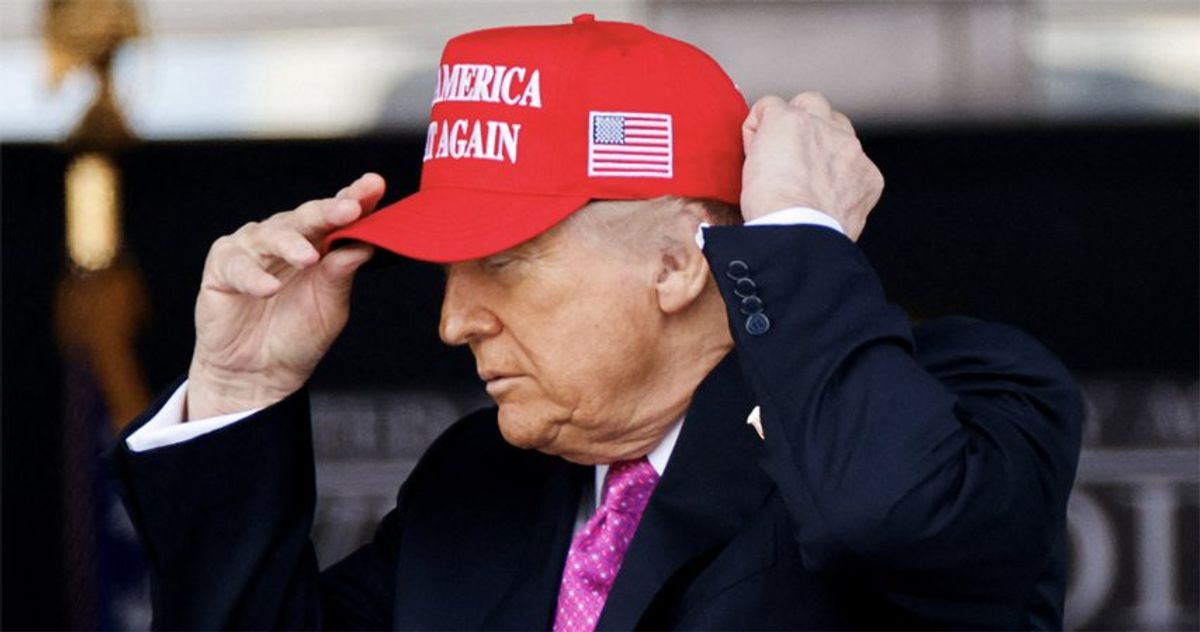
U.S. President Donald Trump wears a 'Make America Great Again' (MAGA) hat as he attends the commencement ceremony at West Point Military Academy in West Point, New York, U.S., May 24, 2025. REUTERS/Eduardo Munoz

Donald Trump opened Memorial Day in the most disgusting way possible, not by praising our fallen heroes but by attacking Democrats. He wrote on his Nazi-infested social media site on Monday morning:

“Happy Memorial Day to all, including the scum that spent the last four years trying to destroy our country through warped radical left minds…”

When the president of the United States calls members of the oldest political party in the world and a former president “scum,” it’s not just another ugly outburst that embarrasses America before the rest of the world: It’s a warning sign. A bright red flag.

It tells us that something far more sinister than partisan posturing is afoot. Something our media has already decided to overlook in their perpetual effort to normalize the abominable.

This kind of rhetoric isn’t new, and it’s not harmless. History has shown us — again and again — that when political leaders use dehumanizing language to vilify their opponents, they’re in actuality laying the groundwork for authoritarianism, repression, and violence.

In a healthy democracy, political disagreements are expected. Even fierce debates over policy and direction are part of the process. But a functioning democracy depends on a shared understanding that both sides, no matter how much they disagree, are legitimate participants in the system.

The moment that idea is tossed aside — when one side starts branding the other not as the loyal opposition but as enemies, traitors, or “scum” — democracy starts to fail.

When a president engages in this kind of language, he’s not just lashing out at critics. He’s explicitly trying to erase the legitimacy of any voice but his own.


This tactic is not original. It’s ripped from the playbooks of authoritarians throughout history.

— Hitler routinely referred to Jews, communists, and democratic socialists as “vermin” and “filth,” conditioning the German public to accept ever-increasing acts of brutality and repression.

— In Rwanda, Hutu leaders called Tutsis “cockroaches” on the radio for months before the genocide began.

— In Serbia, Slobodan Milošević labeled political opponents and ethnic minorities as “parasites” and “traitors” before launching ethnic cleansing campaigns.

Language like this isn’t about winning arguments. It’s about destroying opposition.

Trump has flirted with this disgusting sort of rhetoric for years, calling the press “the enemy of the people,” mocking disabled journalists, referring to immigrants as “animals,” and branding his political opponents as “radicals” or “traitors.”


But labeling Democrats — over 45 million American citizens — as “scum” is a different level of escalation. It’s not just name-calling. It’s a signal. A test balloon. A way of seeing how far he can go. And if there’s no consequence, he’ll go further.

What happens when a leader no longer sees himself as the president of all Americans, but only of those who worship him? What happens when one party becomes synonymous with the state, and all others are demonized?

You get systems like Vladimir Putin’s Russia, where opposition leaders are jailed, poisoned, or pushed out of windows. You get Viktor Orbán’s Hungary, where the ruling party rewrites the constitution to lock in power and crush dissent. You get a country where elections still happen, but they no longer mean anything.


Trump’s use of the word “scum” may seem like just another day in MAGA world, but it is, in fact, part of a much larger and more deliberate strategy. It’s designed to radicalize his base, to cast Democrats not as fellow Americans with different ideas but as dangerous enemies who must be defeated at all costs. It’s designed to terrify Trump’s opponents and paralyze the media.

When you convince people that the opposition is not just wrong but evil, the next logical step is to justify extraordinary actions to stop them, whether that’s purging them from government, throwing them in jail, or inciting paramilitary violence against them.

We’ve already seen where this leads.


January 6th, for example, wasn’t some spontaneous tantrum. It was the inevitable result of years of delegitimization and demonization of Democrats. The people who stormed the Capitol sincerely believed they were saving America from “scum” who had stolen the presidency. They were acting on the poisonous lie that only one side has the right to rule and that any electoral outcome that contradicts their will is illegitimate. A lie that came straight from Trump and his morbidly rich neofascist enablers.

This is how democracies die; not all at once, but in a slow, deliberate campaign of character assassination against political rivals, institutions, and the rule of law. It happens when a strongman convinces just enough people that he alone is the embodiment of the nation, and that anyone who opposes him is a threat to the country itself.

And once that belief takes root, atrocities become not just possible, but justified. And, in most cases, inevitable. We’re already seen this in the case of Kilmar Abrego Garcia and the Venezuelans who Trump deported to El Salvador and the Asians he deported to Africa, in both cases in defiance of court orders.


From Agustin Pinochet throwing small-d democrats he called “subversivos” and “terroristas” out of helicopters over the ocean, to Joseph Stalin using the phrase “enemy of the people” (враг народа) to describe democracy advocates, to Mao Tse Tung calling educated people monsters and demons” (牛鬼蛇神) as he killed an estimated 35 million of them, this is an old, old story.

It’s the same type of language that the Ku Klux Klan used for centuries here in America as they embarked on campaigns of terror and murder. And that the paramilitary groups that have largely replaced them in the 21st century continue to use.

It’s also important to note that when Trump calls people who didn’t vote for him “scum,” he’s not just talking about elected officials. He’s talking about more than half the country.

He’s talking about your neighbors, your coworkers, maybe your family members. He’s talking about teachers, nurses, scientists, union workers, veterans; millions of Americans who simply don’t buy into his brand of neofascist grievance politics. He’s trying to turn Americans against each other so he can seize even more power out of the chaos he creates.


This kind of dehumanization also serves a more practical political purpose: it undermines accountability. If Democrats are “scum,” then their investigations into Trump’s corruption are not legitimate. If the media is “fake news,” then any critical reporting is a hoax. If the courts rule against him, they’re “rigged.” It’s a classic authoritarian tactic: delegitimize all checks on your power and paint yourself as the sole source of truth.

In doing so, Trump is also poisoning the well for any future attempt at national unity or reconciliation.

Once you’ve labeled your opponents as subhuman, how do you work with them? How do you compromise to do what’s best for the country? You don’t.


And that’s exactly the point. He doesn’t want compromise. He wants domination. He wants a political system like in Russia or Hungary, where the only choice is himself.

We can’t afford to normalize this. We can’t laugh it off as Trump being Trump. We can’t wait and hope that someone, somewhere, will step in and draw a line. We have to be that line. We have to call this what it is: a deliberate, dangerous assault on the core of American democracy.

Words matter. In every fascist movement of the 20th century, it started with the words. Before the arrests, before the beatings, before the camps, there were the words. And in every case, those words went unchallenged until it was too late.

It’s not too late now. But we are closer than we’ve ever been. We must push back hard against this dehumanizing rhetoric, demand better from our leaders, and defend the democratic principle that every citizen, no matter their party, is entitled to dignity, voice, and full participation in the political process.

Because once a president gets away with calling fellow Americans “scum,” it’s only a matter of time before he treats them that way.
Trump accused of 'most blatant show of white supremacy in America in history'


Matt Laslo
Martin Pengelly
May 27, 2025 
RAW STORY


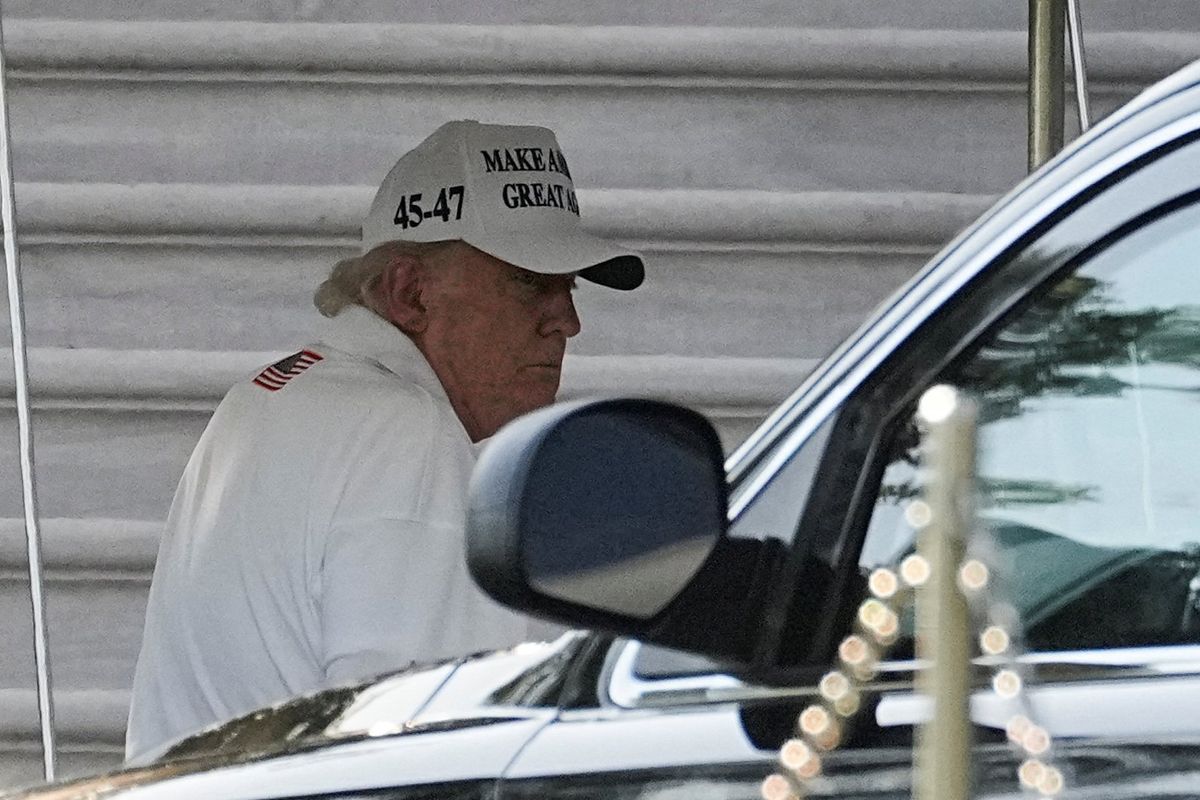
U.S. President Donald Trump arrives at the White House, following his attendance at ceremonies in commemoration of the Memorial Day holiday, in Washington, D.C. U.S., May 26, 2025. REUTERS/Ken Cedeno

WASHINGTON – Veteran members of the Congressional Black Caucus (CBC) say the Trump administration has moved from offensive to straight racist with its decision to welcome white South Africans as refugees.

Amid continuing controversy over President Donald Trump’s crackdown on immigration by people of color, one senior Black House Democrat lamented “the most blatant show of white supremacy in America in the history of the world.”

“It is a slap in the face to every African American and every person in this country who believes in the rule of law,” added Rep. Frederica Wilson (D-FL), ahead of Congress’ Memorial Day recess.

Afrikaners are the descendants of Dutch colonists who underpinned South Africa’s racist apartheid regime until 1994, when the African National Congress leader Nelson Mandela, who spent 27 years in prison, became his country’s first Black president.


Now, the Trump administration claims Afrikaner farmers are the victims of government-sponsored genocide — claims Trump spewed live on TV last week in a widely decried Oval Office meeting with South African President Cyril Ramaphosa.

Trump’s conspiratorial claims were rejected by Ramaphosa — and easily debunked.

A picture Trump claimed showed farmers being buried was from the Democratic Republic of Congo. An image Trump claimed showed “burial sites” of “over a thousand of white farmers” showed a memorial to one murdered couple.

One experienced observer, Dorothy Byrnes, a former head of news for the British TV network Channel 4, went viral when she told radio station LBC: “There is no genocide against Afrikaners, that was absolute drivel.”

Byrnes added: “Overwhelmingly, and this is covered, and I have covered it myself, the big problem of violence in South Africa inordinately affects Black people. South Africa has a terrible problem with violent crime, and the chief victims are Black people.”

Regardless, Trump plowed ahead.


“We're deporting thousands of people, and he's bringing in white Afrikaners who he says he's gonna uplift, get health insurance, get found jobs, resettle and housing,” Wilson said.

“I mean, what an insult, right? And also the foundation for his conspiracy theories, saying that there's this genocide happening, that is insane and none of it is true.

“I think that the way that he acted when the president of South Africa came, to try to embarrass … one of our African countries’ heads of state, was just an insult.”


Rep. Emmanuel Cleaver (D-MO), a minister and former CBC chair, called Trump’s meeting with Ramaphosa “embarrassing.”

“He was set up,” Cleaver said of Ramaphosa, who followed Ukrainian President Volodymyr Zelensky in enduring a White House harangue.

“You know, in some ways we should have known [Trump was] gonna do that when he met with African leaders,” Cleaver said.


“He's divisive in his spirit. And so I guess he can't help himself. I wonder who was orchestrating that stuff. Is it him, or is it Elon Musk?”

Musk, the Tesla and SpaceX mogul, is a Trump donor and adviser and attended the Ramaphosa meeting. A U.S. citizen, Musk was born in South Africa and has advanced claims of genocide against Afrikaners.

Rep. Alexandria Ocasio-Cortez (D-NY) had time for only a short word, as she rushed to a vote.


Trump’s Afrikaner policy was “Elon weirdo stuff,” the progressive phenom told Raw Story.
‘Stephen Miller probably came up with this’

On the other side of the Capitol, Sen. Peter Welch (D-VT) told Raw Story Trump’s policy was simply another instance of his “burning our alliances, eroding if not totally compromising trust.”

“As long as he's on top, he’s the bully,” Welch said.

The Afrikaner policy is an example of Trump “changing inherent policies to pick who's going to vote for him,” said Sen. Ben Ray Luján (D-NM.) “Rather than looking at policy, fixing the broken immigration policy and then let us all work towards finding these solutions and working together.”

Luján also said “the initial reaction and response that I've heard from constituents and from colleagues is a negative one. It just feels very overt. It's not a surprise coming from this administration but I would argue it's intentional. Stephen Miller probably came up with this.”


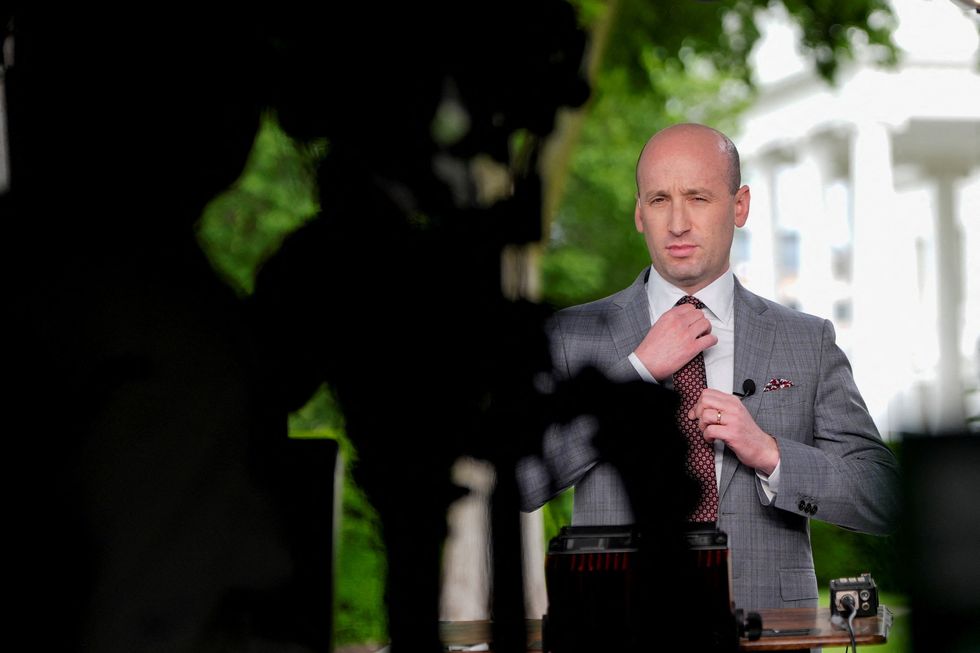
White House aide Stephen Miller. REUTERS/Kent Nishimura

Miller is an immigration ultra-hardliner and one of Trump’s closest advisers.

Earlier this month, Miller told reporters “what's happening in South Africa fits the textbook definition of why the refugee program was created. This is persecution based on a protected characteristic, in this case, race. This is race-based persecution.”

Miller claimed “a whole series of government policies specifically targets farmers and the white population in South Africa”, including “land expropriation.”


He added: “You even see government leaders chanting racial epithets and espousing racial violence.”

Miller said such policies and threats were “all very well documented.”

Experts disagree.

“The politicians quoted [as espousing racial violence] were not ANC politicians, one of them was a man who’d been specifically thrown out of the ANC and the other was an opponent of the ANC,” said Byrnes, the British expert.

The first 59 Afrikaner refugees arrived in the U.S. in mid-May. Before that, Miller predicted “a much larger-scale relocation effort, and so those numbers are going to increase.

“It takes a little while to set up a system and processes and procedures to begin a new refugee flow,” Miller said. “But we expect that the pace will increase.”
‘Against the ideals of our nation’

Sen. Cory Booker (D-NJ) has emerged as a leading Democratic voice against Trump, notably through a record-breaking Senate speech in April, when he spent 25 hours highlighting Trump’s threat to the Constitution.

Speaking to Raw Story, Booker said the Afrikaner refugee policy was a dereliction of moral duty.

“Why, at a time of ungodly ethnic cleansing, like in places like Darfur and Sudan, are we not allowing in people that are escaping legitimate threats?” Booker asked. “Why are we making it harder for them to get in?

“So this is, to me, unconscionable. It's against the larger ideals of our nation. It's morally unacceptable.”


Matt Laslo has covered Congress since 2006, bringing Raw Story readers the personalities behind the politics and policy straight from Capitol Hill. Based in Washington, D.C., Matt has been a long-time contributor to NPR, WIRED, VICE News, The Daily Beast, Rolling Stone, and Playboy. 


Trump's image of America is straight out of Shogun: columnist


Krystina Alarcon Carroll
May 27, 2025

An AI image of Donald Trump dressed as a Japanese Shogun. (MidJourney)

President Donald Trump's economic policies are turning the U.S. into 'a nation of serfs,' according to Slate senior writer Ben Mathis-Lilley.

“So far, the story of the Trump administration when it comes to the economy is a tale of two countries,” Mathis-Lilley wrote. He believes, “What country America is becoming at any given time depends on which member of the administration is speaking on television and/or what mood Trump is in.”

“The first country is a more dynamic version of the current one, in which the stock market keeps rising and America remains an international center of innovation and production,” Mathis-Lilley said.

However, the second version of the U.S. Mathis-Lilley called a “modern version of shogunate Japan,” which is a reference to the hereditary Military government that led Japan from 1192 through 1867.

In this second world Mathis-Lilley claimed, “Tariffs are enormous and permanent, foreign professionals are actively excluded from the country, science and medical research is nonexistent, children’s dolls are as precious as gold, and Americans are funneled into manual labor jobs like making screws for Apple.”

Mathis-Lilley called American citizens in this reality, “A nation of serfs—who are happy, despite being serfs in 2025, because the country has been returned to its prior state of cultural homogeneity (read: most of the population is white people) and spiritually rewarding manual labor.”

“Financial markets would very much like the first country, rather than North Korea with Energy Drinks,” the senior writer said. However, “The administration’s Isolated Peasantry Caucus has been racking up some wins.”

This includes the GOP-controlled House pressing “forward last week with a budget bill that would create $4 trillion in deficits (LOL!) in order to cut the heck out of tax rates for millionaires and billionaires.”

He also railed against “The administration told Harvard it has to expel all its international students.” Mathis-Lilley said the move “probably doesn’t make the world’s smartest and most innovation-generating biomedicine and computer science graduate students more likely to apply to U.S. schools."

Another issue Mathis-Lilley foresees is the “slowdown of vaccine approval under vaccine-truther Health and Human Services Secretary Robert F. Kennedy Jr.”

What he found most concerning is how the markets reacted to Trump’s “out of nowhere” social media post, claiming that Trump informed Apple CEO Tim Cook "that he intends to eventually put a 25 percent tariff on iPhones unless they’re entirely manufactured and assembled in the United States.

Mathis-Lilley noted "Apple stock, as they say, took a tumble.”
Mexicans face wall of impunity in search for justice

By AFP
May 27, 2025


"There is still no justice," says Estanislao Mendoza, whose son Miguel Angel has been missing for a decade - Copyright AFP Mandel NGAN


Arturo Ilizaliturri and Samir Tounsi

From parents whose children were murdered or are missing to a man imprisoned for two decades with no sentence — many Mexicans seeking justice feel they face a wall of corruption and impunity.

The government says the justice system is rotten and that elections beginning on Sunday allowing voters to choose all judges and magistrates will help to clean it up.

Critics say the world-first vote will only politicize the judiciary.

Here are four high-profile cases illustrating the flaws of a justice system in a country where criminal groups use threats, bribes and violence to wield influence.


– ‘Nothing has changed’ –

“It’s been 10 years and nothing has changed,” said Estanislao Mendoza, whose son Miguel Angel was one of 43 students from a teacher training college who disappeared in the southern state of Guerrero in 2014.

The case, one of the country’s worst human rights atrocities, has come to symbolize a missing persons crisis that has seen more than 120,000 people vanish.

Investigators believe the students were abducted by a criminal group with the help of corrupt police, possibly because a bus they commandeered to travel to a demonstration had drugs hidden inside.

This month, a former senior judge was arrested and accused of helping to conceal videos that allegedly showed the tragedy unfolding.

But despite dozens of arrests, there have been no convictions and the remains of only three victims have been identified.

“For us there is still no justice, because of the corruption of the judges,” Mendoza, a 65-year-old farmer, told AFP.

– Justice ‘not being served’ –

The disappearance of five young Mexicans in Lagos de Moreno in the western state of Jalisco in August 2023, allegedly at the hands of drug traffickers, also shook a country that has become inured to kidnapping and killing.

The case was particularly shocking because the criminals filmed the young men being tortured and forced to attack each other.

Five suspects are being prosecuted but relatives are still waiting for the young men — or their remains — to be found and identified.

Armando Olmeda, whose 22-year-old son Roberto Carlos is one of the victims, feels that justice “is not being served” for the people who need it.

“We have trusted the authorities,” but so far they have “not done their job properly,” the 55-year-old told AFP.

– ‘Worst enemy’ –

The judicial system seems designed “to protect everyone except the citizen thirsty for justice,” said Mario Escobar, whose 18-year-old daughter Debanhi disappeared in April 2022 in the northern state of Nuevo Leon.

Her body was found in a motel water tank, triggering a public outcry over the nation’s femicide crisis.

A photo taken on the night Debanhi disappeared, showing her standing in the dark by the roadside after an altercation with a taxi driver, made her a symbol for women’s rights in a country where about 10 women or girls are murdered every day.

Hypotheses suggested by investigators ranged from an accidental blow to the head to suffocation.

Time is the “worst enemy,” Escobar said.

“It passes very quickly without any justice for us.”

– ‘Justice was denied’ –

Israel Vallarta, accused of belonging to a kidnapping gang, has been in preventive detention awaiting trial since 2005 in a case that sparked a diplomatic rift between Mexico and France.

His ex-partner, Frenchwoman Florence Cassez, was freed in 2013 after the Supreme Court ruled that police violated her rights by staging her arrest on national television.

“In the case of my family, access to justice was denied,” said Vallarta’s sister Guadalupe.

Five of Vallarta’s relatives were also accused of belonging to the same gang.

“I spent six years and nine months in prison because of my last name,” said his nephew Alejandro Cortez Vallarta, who alleged authorities took him to a “torture chamber” to force a confession.

“There was a lot of corruption,” he said. “I experienced it firsthand.”
China not trying to ‘replace’ US in Colombia: ambassador


By AFP
May 27, 2025


China's ambassador to Colombia Zhu Jingyang says the Asian nation is not seeking to replace the US as Bogota's top trading partner - Copyright AFP

 Raul ARBOLEDA

China is not seeking to “replace” the United States as the top trading partner of Colombia, Beijing’s ambassador to Bogota, whose president has announced a pivot to China, told AFP on Tuesday.

Until recently Colombia was one of the United States’ closest trade and security partners in Latin America.

But the country’s first leftist president Gustavo Petro, who has crossed swords with his US counterpart Donald Trump, is trying to steer more trade towards China.

China’s ambassador to Bogota denied that Beijing was seeking to topple the United States from its pole position in Latin America.

“China is coming to offer our collaboration, not to replace anyone, nor seeking to take someone’s place,” Zhu Jingyang told AFP on the sidelines of a media briefing.

Earlier this month, Colombia formally joined China’s vast Belt and Road (BRI) infrastructure program.

Bogota’s accession boosted Beijing’s efforts to deepen ties with Latin America, a key battleground in its confrontation with the Trump administration.

It came in the wake of a showdown between Trump and Petro over deportation flights which ended in humiliation for Colombia.

After initially denying entry to US military planes carrying deported Colombians in January, Bogota sent its own planes to bring them home to avoid hefty US tariffs threatened by Trump.

The business community in Latin America’s fourth-biggest economy has expressed fears that Petro’s rapprochement with China could damage Colombia’s trade with the United States.

The State Department’s special envoy for Latin America, Mauricio Claver-Carone, warned recently that the United States might start buying flowers and coffee — two of Colombia’s top exports to the United States — from other Latin American countries instead.

Zhu accused the Trump administration of using “intimidation” and “blackmail” to try keep Colombia in its orbit.

Two-thirds of Latin American countries have already joined the Belt and Road Initiative.
SE Asia, Gulf and China three-way talks ‘response to call of times’


By AFP
May 27, 2025


Chinese Premier Li Qiang (L) attended the ASEAN gala dinner on Monday, alongside Malaysian Prime Minister Anwar Ibrahim and his wife Wan Azizah Wan Ismail - Copyright POOL/AFP FAZRY ISMAIL


Rebecca BAILEY and Isabelle LEONG

Chinese Premier Li Qiang said Tuesday that the first-ever summit between his country, Southeast Asian leaders and Gulf states was “a response to the call of the times” in a geopolitically uncertain world.

The trade-dependent economies are looking to insulate themselves after US President Donald Trump blew up global trade norms by announcing a slew of tariffs targeting countries around the world this year.

Though he subsequently instigated a 90-day pause for most, the experience has spurred the Association of Southeast Asian Nations (ASEAN) and others to accelerate efforts to diversify their trading networks.

On Tuesday the Malaysian capital hosted the inaugural summit between ASEAN, China and the Gulf Cooperation Council (GCC) — a regional bloc made up of Bahrain, Kuwait, Oman, Qatar, Saudi Arabia and the United Arab Emirates.

Li told the meeting that “against the backdrop of a volatile international situation”, the summit was “a pioneering work of regional economic cooperation”.

“This is not only a continuation of the course of history, but also a response to the call of the times,” he said.

ASEAN has traditionally served as “a middleman of sorts” between developed economies like the United States, and China, said Chong Ja Ian from the National University of Singapore (NUS).

With Washington looking unreliable these days, “ASEAN member states are looking to diversify”.

“Facilitating exchanges between the Gulf and People’s Republic of China is one aspect of this diversification,” he said.


– ‘Timely and calculated’ –


Beijing has suffered the brunt of Trump’s tariffs and is also looking to shore up other markets.

China and ASEAN are already each other’s largest trading partners, and Chinese exports to Thailand, Indonesia and Vietnam surged by double digits in April — attributed to a re-routing of US-bound goods.

Premier Li’s participation is “both timely and calculated”, Khoo Ying Hooi from the University of Malaya told AFP.

“China sees an opportunity here to reinforce its image as a reliable economic partner, especially in the face of Western decoupling efforts.”

At dinner on Tuesday, Li urged ASEAN and the GCC to “persist in opening up”.

Beijing and Washington engaged in an escalating flurry of tit-for-tat levies until a meeting in Switzerland saw an agreement to slash them for 90 days.

Chinese goods still face higher tariffs than most though.

According to a draft statement seen by AFP, ASEAN will express “deep concern… over the imposition of unilateral tariff measures”.

But the bloc earlier this year said it would not impose retaliatory duties.


– ‘Centrality’ –


ASEAN has historically avoided choosing a side between the United States and China.

China is only Southeast Asia’s fourth largest source of foreign direct investment, after the United States, Japan and the European Union, noted NUS’ Chong.

At a press conference at the tail-end of the talks, Malaysian Prime Minister Anwar Ibrahim vowed ASEAN would continue engaging both Washington and Beijing.

“The… ASEAN position is centrality,” Anwar said, adding “if it means working with the Chinese, yes we’ll do that.”

However, “it makes a lot of sense to continue to engage and have reasonably good relations” with the United States, he added.

Dialogue with Washington was particularly important as Malaysia has become a hub for semiconductors, he said.

State-of-the-art chips have become a focal point of Washington’s trade restrictions, as they try to prevent China from undermining US dominance in artificial intelligence.

Anwar said Monday he had written to request an ASEAN-US summit this year, with his foreign minister saying Washington had not yet responded.

Closer alignment with Beijing presents problems of its own.

On Monday, Philippines leader Ferdinand Marcos said there was an “urgent need” to adopt a legally binding code of conduct in the South China Sea.

Beijing has territorial disputes with five ASEAN member states in the area, with China and the Philippines having engaged in months of confrontations in the contested waters.

Anwar raised the South China Sea with Li and the Philippines, saying: “I’m not saying all issues can be resolved now but there was real positive engagement.”
Data breaches rise in UK across Q1 2025


By Dr. Tim Sandle
May 27, 2025
DIGITAL JOURNAL


New cybercrime crime gangs are looking to extort money from companies and individuals - Copyright AFP/File ATTA KENARE

A data breach happens when confidential and sensitive data gets exposed to unauthorized third parties. In 2025 so far, a total of 2.2 million accounts have been breached in the UK, the 6th-highest count in the world, the company Surfshark’s analysis shows.

The data was collected by from 29,000 publicly available databases and aggregated by email address. This data was then anonymized and then analysed statistically. Countries with a population of less than 1 million people were not included in the analysis.

The UK ranks 6th globally and ranks first within Northern Europe, although this is high the figure represents a 49 percent decrease in Q1 2025 over Q4 2024.

This includes big brands such as M&S, Co-op, and Harrods, firms that have been forced to halt online operations to deal with cybercrime.

Global patterns

In descending order, the ten most breached countries in Q1 2025 were the US (16.9M), Russia (4.4M), India (4.2M), Germany (3.9M), Spain (2.4M), the UK (2.2M), France (2.1M), Canada (0.89M), Argentina (0.79M), and South Sudan (0.73M).

The countries with the highest breach density in Q1 2025 (number of leaked accounts per 1,000 residents) were South Sudan (61), Spain (51), the US (49), Germany (46), Slovenia (45), Israel (37), the UK (32), France (32), Russia (30), and Norway (25).

UK’s run-rate

In terms of the rate of breaches for the UK, 17 accounts are being leaked in the UK every minute throughout 2025 so far and since 2004, the UK has had a total of 368 million user accounts exposed. 79 million of them have unique email addresses, which means an average user email was breached four times.

Breaking this down further, the level of breaches represents a total of 79.2 million unique emails were breached from UK. 238.4 million passwords were leaked together with British accounts, putting 65% of breached users in danger of account take over that might lead to identity theft, extortion or other cybercrimes. Statistically, an average British has been affected by data breaches around 5 times.

Furthermore, the UK has had a total of 1.2 billion personal records exposed since 2004. On average, each email is breached with 3.1 additional data points.

Future action

The future threat remains relatively high. Cyberthreats continue to evolve and attackers are constantly adapting their tactics. To protect personal and organizational data, it remains essential for users to follow strong security practices, regularly update passwords, enable two-factor authentication, and stay informed potential risks.
CRIMINAL CRYPTO CAPITALI$M

Second suspect in New York bitcoin kidnapping surrenders to police


By AFP
May 27, 2025


Kidnappings targetting crypto enterpreneurs have become
 increasingly frequent around the world
 - Copyright AFP

 Giuseppe CACACE

A second suspect in the alleged kidnapping and torture of an Italian bitcoin investor in New York surrendered on Tuesday, authorities said.

Police on Friday arrested John Woeltz, 37, of Kentucky, on suspicion of brazenly kidnapping and torturing an Italian cryptocurrency entrepreneur for weeks in a luxury Manhattan townhouse in order to extort his bitcoin password.

New York City Police Chief Jessica Tisch said on Fox 5 that the second suspect in the case, William Duplessie, was also taken into custody Tuesday morning.

“We do have someone that we were looking for, Mr Duplessie, in custody. As of this morning, 7:45, he turned himself in at our 13th precinct,” Tisch said.

“We know he is going to be charged with Mr Woeltz with kidnapping and false imprisonment of an associate in Soho,” said.

Duplessie, who according to US media is 33 and comes from Miami, Florida, surrendered to police clad in black pants and a white shirt, photos from the scene showed.

The name of the alleged victim has not been published, but US media reports identified him as Italian bitcoin entrepreneur Michael Valentino Teofrasto Carturan.

According to reports, Carturan arrived in New York from Italy on May 6 and went Woeltz’s home.

There, Woeltz, described by the New York Post as “Kentucky’s crypto boss,” and Duplessie confiscated the victim’s electronic devices and passport, and demanded access to his bitcoin accounts, according to police.

After the victim refused, the two men tortured him for two weeks, tying his wrists, hitting him with a rifle, pointing a gun at his face, threatening to throw him off the roof of the five-story building and promising to kill his family members, media reports said.

Several details of the story remain murky, including exactly why the victim had agreed to come to the townhouse in an upscale SoHo neighborhood, and whether he revealed anything of use to the kidnappers.

France foils new crypto kidnapping plot, arrests over 20: source


By AFP
May 27, 2025


French police foiled a new kidnapping plot Monday in the western city of Nantes - Copyright AFP 

Sébastien DUPUY

Sabine COLPART

France has foiled the latest in a spate of kidnapping plots targeting cryptocurrency entrepreneurs, and detained more than 20 people over that attempt and another against crypto boss Pierre Noizat’s family, a police source said Tuesday.

The new kidnapping attempt, near the western city of Nantes, was foiled on Monday before it was carried out, the police source said, without providing further details.

It came after a series of attempted abductions targeting cryptocurrency traders and their families, prompting one prominent crypto entrepreneur to call on authorities to “stop the Mexicanisation of France”.

Authorities on Monday and Tuesday arrested 24 people as part of a probe into the Nantes abduction attempt, as well as an investigation into the attempted kidnapping in mid-May of Noizat’s pregnant daughter and young grandson.

Noizat is the CEO and co-founder of Paymium, a French cryptocurrency exchange platform.

“The entire commando unit was arrested,” said the police source, referring to the attack on Noizat’s family.

The public prosecutor’s office said it would issue a statement at a later date, probably on Friday.

In an interview with BFM television, Noizat has praised his “heroic” son-in-law and a neighbour armed with a fire extinguisher, who thwarted the attempted kidnapping in broad daylight in the heart of Paris.

The kidnappings have raised concerns about the security of wealthy crypto tycoons, who have notched up immense fortunes from the booming business.


– ‘Rise in kidnappings’ –


French authorities have also been investigating the May 1 abduction of a crypto-millionaire’s father who was later rescued by police.

The victim, for whom a ransom of several million euros was demanded, was freed after being held for more than two days, in a raid on a house outside Paris.

Six people have been charged in connection with that kidnapping.

Five of them — aged 18 to 26 — were being prosecuted for organised extortion, kidnapping and false imprisonment involving torture or acts of barbarity by an organised gang, Paris prosecutor Laure Beccuau said in early May.

On January 21, kidnappers seized French crypto boss David Balland and his partner. Balland co-founded the crypto firm Ledger, valued at the time at more than $1 billion.

Balland’s finger was cut off by his kidnappers, who had demanded a hefty ransom. He was freed the next day, and his girlfriend was found tied up in the boot of a car outside Paris.

At least nine suspects have been charged in that case, including the alleged mastermind.

Ledger co-founder Eric Larcheveque, who received a ransom demand when Balland was kidnapped, urged authorities to “stop the Mexicanisation of France”.

Mexico has been plagued by drug-linked murders and disappearances for decades.

“For several months now, there has been a rise in sordid kidnappings and attempted kidnappings. In broad daylight. In the heart of Paris,” Larcheveque said on X.

“Today, to succeed in France, whether in crypto-assets or elsewhere, is to put a target on your back.”

In mid-May, Interior Minister Bruno Retailleau held an emergency meeting with crypto currency leaders, with the ministry announcing plans to bolster their security.

sc-mca-ekf-as/jhb