Wednesday, May 28, 2025

As Hurricane Season Looms, FEMA Is Being Torn to Shreds

Trump is underfunding FEMA, leaving states that rely on it dangerously unprepared for severe storms.
May 27, 2025

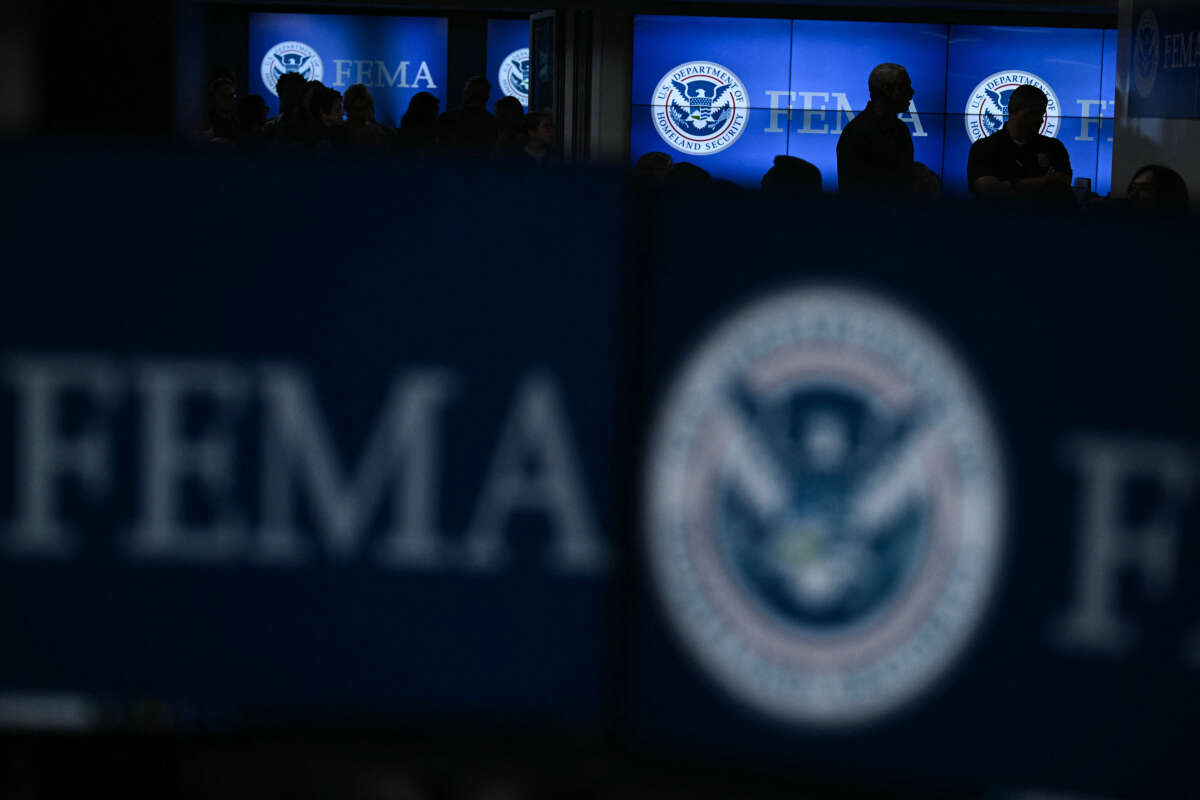
A view inside FEMA headquarters as then-Vice President Kamala Harris attends a briefing about the impacts of Hurricane Helene and updates on the federal response, at Federal Emergency Management Agency (FEMA) headquarters in Washington, D.C., on September 30, 2024.Brendan Smialowski / AFP via Getty Images

With the official start of hurricane season less than a week away, the Federal Emergency Management Agency (FEMA) is facing a storm of its own.

Donald Trump’s administration has begun gutting the agency, slashing budgets and cutting staff. The president has made clear from the start of his term that he wants to shift the financial burden for disaster relief from the federal government to states — the same vision outlined in the far right Project 2025 playbook — if not eliminate FEMA entirely, as Homeland Security Secretary Kristi Noem has pledged. While emergency management experts agree that states should play a role in funding their disaster relief efforts, recent government leaks have raised concerns that the Trump administration is leaving FEMA dangerously underfunded — and leaving the states that rely on it unprepared in the face of upcoming severe storms.

In a May budget draft, Trump proposed slashing FEMA grants by $646 million, even as the agency is projected to run out of disaster relief money by this summer for the third consecutive year. The administration also canceled a grant program called Building Resilient Infrastructure and Communities, which funds community-level emergency preparedness efforts. The popular program had enjoyed bipartisan support.

In internal meetings, newly appointed FEMA head David Richardson admitted himself that the agency isn’t ready for hurricane season. Like many of the efforts undertaken by the Trump administration this term, FEMA’s transition to a “smaller footprint” has been hasty and disorganized. An internal review found that understaffing and other issues had derailed FEMA’s usual processes for hurricane season preparedness. The agency is also scrambling as it adjusts to new leadership after the Trump administration fired acting FEMA head Cameron Hamilton earlier this month. The sudden firing was in response to Hamilton’s public testimony at a House Appropriations subcommittee hearing, during which he said he does not “believe it is in the best interests of the American people to eliminate the Federal Emergency Management Agency.” White House Press Secretary Karoline Leavitt later told reporters that Hamilton had been dismissed because he said “something that was contrary to what the president believes.”

Scientists say that warming ocean temperatures are causing more intense and destructive hurricanes. And many months later, states are still reeling from last year’s devastating season: In North Carolina, where Hurricane Helene killed at least 100 people last September and caused nearly $60 billion in damage, residents and town leaders are still waiting for disbursements of federal funds. Data released this month by North Carolina’s Office of State Budget Management found that $5.95 billion has been allocated by federal and state governments for Helene recovery — only about 10 percent of the total amount needed to rebuild homes and public infrastructure. But just because money has been earmarked doesn’t mean it’s been disbursed. “The money is there,” Zeb Smathers, the mayor of Canton, North Carolina, told The Charlotte Observer. “It’s the will to act. I’m very tired of excuses.”

Related Story

What Hurricane Helene Relief Taught Me About Preparing for Trump’s Second Term
We can mobilize mutual aid to feed and shelter people all the time, not just after major environmental disasters. By Schuyler Mitchell , Truthout  December 25, 2024


In April, FEMA denied North Carolina’s request for the federal government to continue matching 100 percent of the state’s spending on Helene debris removal for another six months. “The need in western North Carolina remains immense — people need debris removed, homes rebuilt, and roads restored,” North Carolina Gov. Josh Stein said in a statement. “I am extremely disappointed and urge the President to reconsider FEMA’s bad decision, even for 90 days. Six months later, the people of western North Carolina are working hard to get back on their feet; they need FEMA to help them get the job done.”

It’s clear that FEMA needs reforms. Bureaucratic red tape and procedural lags have left vulnerable people in limbo. Ironically, as the Trump administration has preached streamlining the agency, a memo obtained by southwest Virginia outlet Cardinal News outlined new, additional “manual review processes” implemented by FEMA that were slowing Helene recovery efforts in the region. John Scrivani, the acting state coordinator of the Virginia Department of Emergency Management (VDEM) wrote to local emergency managers on April 11, that FEMA had provided “revised guidance” on how documentation should be submitted for grant programs. After submitting the requested documentation, Scrivani wrote, VDEM still had not received feedback from FEMA, leaving the state agency without guidance as it awaited payment for a range of disaster reimbursements and emergency preparedness funds — seven months after the storm.

“Unfortunately, at this time, we do not have an update as to when and if these funds will be made available,” wrote Scrivani. “We are asking for your patience and understanding as we navigate this together.”

In a statement to Cardinal News, Sen. Tim Kaine (D-Virginia) voiced his opposition to the new procedures, noting that allocated federal funds had already undergone a thorough review process. “FEMA and DHS’s announcement to conduct additional reviews of grants, including for emergency management and disaster assistance, is ridiculous. These communities need funding as soon as possible, and the Trump Administration is unnecessarily making it harder for these communities to rebuild,” said Kaine.

Similarly, in North Carolina, state lawmakers are wrangling over what to do as they await clarity on federal relief funds. “The continual line from the Republicans in the North Carolina legislature is ‘Well, we got to wait and see what the feds are going to do,’” North Carolina Rep. Eric Ager told The Assembly. “We’ve been doing that for six months now, right? And it’s still not completely clear what the feds are gonna pay for and what they’re not.”
Billionaire investor warns Trump policies 'remarkably like' 1930s 'hard-right' leaders

May 27, 2025
ALTERNET

Ray Dalio, founder of hedge fund investment firm Bridgewater Associates, said President Donald Trump carries every characteristic of a 1930s-era Mussolini or German fascist leader, particularly regarding his methods for expanding presidential power.

“When I say that the policies President Trump is using to ‘make America great again’ are remarkably like the policies that those of the hard-right countries in the 1930s used, that should not be controversial,” writes Dalio, who predicted the 2008 financial crash and subsequent recession.

“It would be fair to argue that his attempts to maximize the power of the presidency by bypassing the other branches of government are analogous to the ways that Andrew Jackson (of the right) and Franklin D Roosevelt (of the left) did, though he is even more aggressive than they were.”

Dalio writes that in times of conflict, aggressive leaders like the ones who devastated the lives of millions in the last world war always begin by eliminating opposition in their own government. This usually involves changing their nation’s laws to assume special powers and seizing control of the media to produce pro-government propaganda. This could describe Trump signing more than 150 executive orders, concentrating federal power in the White House and virtually turning the Republican Congress into a mouthpiece.

“Are there effective regulators in place? If so, it is not clear to me who they are,” said Dalio.

Trump also defies court orders pertaining to habeas corpus and detains legal residents without due process, and he has personally sued CBS News while also siccing the formerly independent FCC upon the company, which completes the comparison.

Additionally, the businessman also condemns the Trump administration’s cost-cutting measures as likely to have negative consequences because “valuable support systems will be weakened or eliminated”.

Read the full Guardian report here.
Chemical Plants Near Black Neighborhoods Pollute While Hiring Few Black Workers

“People don’t have the jobs here, but people do have cancer,” one Louisiana-based organizer told Truthout.
May 27, 2025

A house sits along the long stretch of River Road by the Mississippi River and the many chemical plants in Baton Rouge, Louisiana, on October 12, 2013.Giles Clarke / Getty Images

Anew study confirms what locals and environmental activists across the Gulf South and beyond have said for years: Black, Brown and Indigenous workers do not benefit equitably from jobs offered by the petrochemical industry despite their communities often bearing the brunt of its pollution.

In Louisiana, for example, residents and activists say jobs promised to Black communities located near refineries and chemical plants often go to white workers who commute from their homes a safer distance away from the toxic smokestacks, chemical fires, explosions, leaky pipelines and sky-high cancer rates that make the region notorious.

Published in the Ecological Economics journal by a team of environmental experts last month, the study examines employment at chemical and petroleum manufacturers nationwide. The researchers also conducted a case study of Louisiana’s petrochemical corridors, where local and state politicians lure industrial developers with lucrative tax breaks in the name of creating jobs and revenue.

The study cites years of research showing that the pollution and climate risks associated with the fossil fuel and petrochemical industry disproportionately fall on Black, Brown, Indigenous and poor white communities. Most of the wealth extracted from and created in these communities does not stay there, one reason why academics and activists call them fossil fuel “sacrifice zones.”

Researchers say the latest findings “reveal systemic inequality” in the petrochemical workforce across the United States. At plants that manufacture chemicals or products made from petroleum and other fossil fuels, people of color were “consistently underrepresented among the highest-paying jobs and overrepresented among the lowest-paying jobs in both subsectors,” the authors wrote.

Related Story

Trump’s EPA Is Botching Removal of Toxic Waste From the Los Angeles Fires
The federal government is prioritizing speed over public health, refusing to test ash from LA for toxicity.  By Schuyler Mitchell , Truthout March 5, 2025


For decades, Black residents of the Gulf South fighting against the expansion of refineries and chemicals plants near their historic neighborhoods — or virtually right on top of them — have been met with promises of jobs and other economic benefits. And for decades, residents have told visitors to Louisiana’s “Cancer Alley” and other industrial corridors that the jobs and benefits touted by petrochemical companies and supporters of their expansion rarely materialize after those corporate polluters receive permission from the government to set up shop.

Instead, residents are left to wonder about the long-term health impacts of pollution when they get sick or are forced to evacuate their homes due to a release of toxic chemicals from the plant, refinery or storage tanks located on the other side of the fence, according to Roishetta Ozane, a Louisiana-based organizer and founder of the Vessel Project, a mutual aid and environmental justice group.

“We are screaming at the top of our lungs about all the promises the industry makes to our communities that they don’t keep, and about those burdens that come from industry,” Ozane told Truthout in an interview. “We are constantly carrying those burdens.”

Ozane lives in the small town of Sulphur outside of Lake Charles in southwest Louisiana, where she counts 14 petrochemical facilities within miles of her house. Her family’s home is walking distance from a chemical plant that caught fire and produced a massive plume of toxic gas after Hurricane Laura made landfall in 2020, Ozane said.

“When we go by these facilities, the license plates on these vehicles are from Alabama, Georgia, Florida — wherever but from Louisiana,” Ozane said. “People don’t have the jobs here, but people do have cancer, and children do have asthma.”

Ozane says her community is already overburdened with pollution, but the fossil fuel industry is aggressively pushing to build new infrastructure in the region, including massive terminals for liquifying cheap fracked gas and exporting it overseas. Despite becoming the world’s top fossil gas producer, the price U.S. households pay for natural gas skyrocketed by 52 percent between 2016 and 2023. In Louisiana, enough methane gas was flared and leaked from existing infrastructure in 2019 to cover energy bills for two-thirds of households in the state. Methane pollution is a major contributor to global warming, which intensifies hurricanes and flooding in the Gulf South.

“We get the jobs that are most dangerous — temporary work, construction — and then those jobs go away and we’re back to figure out how to survive and thrive in this community that is now more polluted to begin with,” Ozane said, adding that workers worry about exposing their children to chemical residues.

Ozane said her community remains impoverished despite the vast industrial development, with a large portion of the population depending on food assistance and other safety net programs. Lake Charles has a poverty rate of 23 percent, more than twice the national average. People struggle to pay bills while also contending with health threats from petrochemical pollution.

“It’s critical that policy makers speak with frontline folks to get our perspective,” Ozane said. “People of color were significantly underrepresented in jobs at these oil refineries and chemical plants in particular here in Louisiana, which is a very racist place for lack of a better term. There are still state laws based on the Jim Crow era, so it’s nothing new to us.”

American Fuel & Petrochemical Manufacturers, a national trade association for the industry examined in the study on racial disparities in hiring, did not respond to a request for comment.

David Cresson, president of the Louisiana Chemical Industry Alliance, said the study does not consider the role of the chemical industry in workforce development in the state, including by supporting STEM programs for elementary and high school students, and working with universities and trade schools to provide scholarships and career paths toward high-paying science and engineering jobs in chemical manufacturing.

“We are committed to closing the training gap in Louisiana by investing in early education, STEM training and technical scholarships to ensure that all members of our communities are represented among our industrial workforce,” Cresson said in a statement to Truthout.

However, potential opportunities for students in the future offer little condolence to the people already living in the shadow of industry. In Cancer Alley, the petrochemical corridor along the Mississippi River located between New Orleans and Baton Rouge, residents of the rural, majority-Black communities in St. James Parish are fighting a historic legal battle in federal court.

St. James and the surrounding area is packed with the fossil fuel and petrochemical facilities that give Cancer Alley its name. Residents of majority-Black neighborhoods face increased risks of cancer, respiratory ailments and newborn health harms. After a multiyear fight to prevent a Taiwanese company from building another massive plant on land where the community’s ancestors were enslaved, worked and eventually buried after death, St. James residents sued the parish government, arguing that a land use policy slating residential areas for industrial development is unconstitutional and discriminatory.

Activists fighting environmental racism in St. James originally filed the lawsuit in 2023, seeking a moratorium on construction of new sources of pollution in their community. On April 9, the Fifth Circuit Court of Appeals ruled that advocacy groups representing residents of St. James can proceed with the lawsuit, a major victory after a series of legal setbacks.

“The pendulum of Justice has swung in our favor,” said Gail LeBoeuf, a St. James resident and organizer with Inclusive Louisiana, in a statement last month, after the ruling. “We have been sounding the alarm for far too long that a moratorium is needed to halt the expansion of any more polluting industries in our neighborhoods, and too many lives have been lost to cancer.”
'It's happening to me again!' South African president mocks Trump to laughing audience


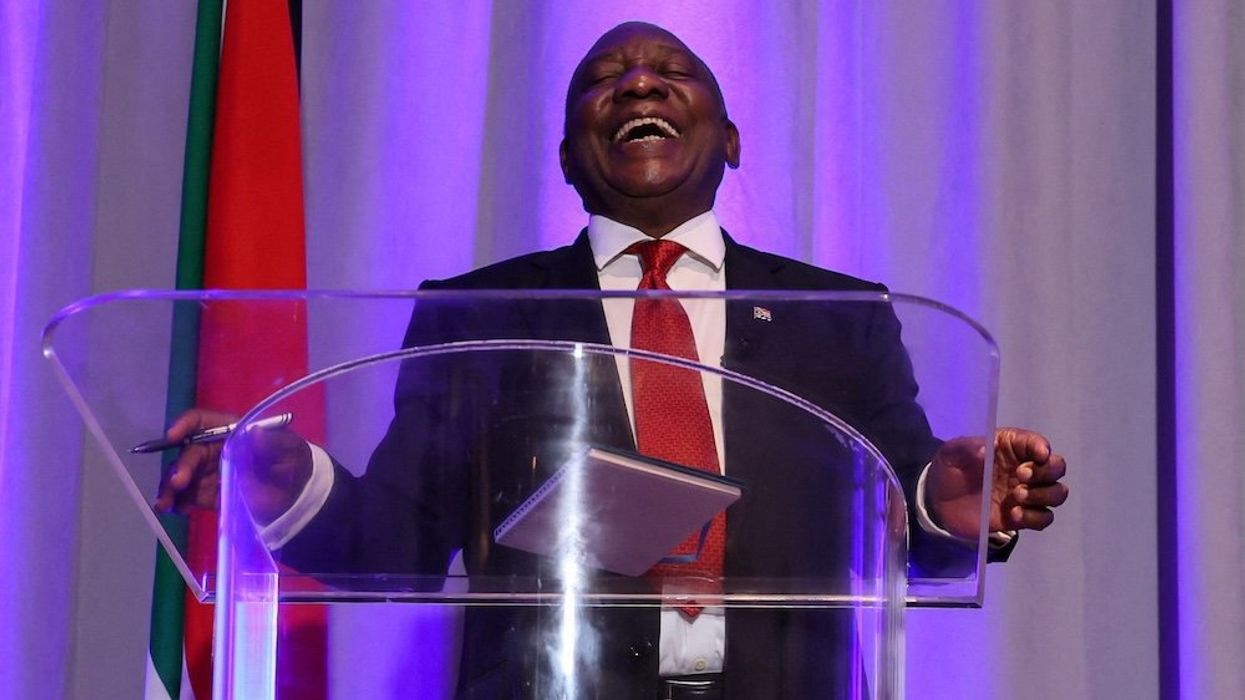
South African President Cyril Ramaphosa reacts as he attends a press conference, after his White House meeting with U.S. President Donald Trump, in Washington, D.C., U.S., May 21, 2025. REUTERS/Leah Millis

May 27, 2025
 ALTERNET

South African President Cyril Ramaphosa recently used a speech as an opportunity to make a dig at President Donald Trump, and got the audience to join in with him.

Politico reported Tuesday that during a speech to the 2025 Sustainable Infrastructure Development Symposium in Cape Town, South Africa, Ramaphosa recalled the viral moment from his Oval Office meeting with Trump earlier this month. During one moment at the event, the venue dimmed the house lights. This prompted Ramaphosa to openly wonder if he were about to watch a video purportedly showing crimes against South African farmers.

“When I came in, I saw the room going a bit dark,” Ramaphosa said as the crowd laughed. “They darkened the room. And for a moment I wondered, ‘what is this! It’s happening to me again!’”

The South African leader told the assembled audience that while he was under the impression that he and Trump were having a productive conversation, he was caught off-guard when Trump asked a staffer to turn off the Oval Office lights and play a video he had cued up. The footage — which CBS said was recorded in 2020 — showed rows of white crosses in a field that Trump asserted were meant to represent white Afrikaner farmers who had been killed, though CBS said that the crosses actually were part of a demonstration for farmers of all races.

"Each one of those white things you see is a cross. And there's approximately a thousand of them. They're all white farmers, the family of white farmers ...Those people are all killed," Trump told Ramaphosa as the video played.

Trump also showed news articles to Ramaphosa that he alleged were of reports on white South African farmers being murdered, though at least one of the article printouts he held up featured a screenshot of the Democratic Republic of Congo. Ramaphosa said he was "bemused" by the encounter.

“I was beginning to get into a groove of, you know, interacting with this man,” Ramaphosa said. “And I suddenly hear him say, no, ‘dim the lights.’ And I must say, a number of people have said, ‘this was an ambush, this was an ambush.’ And I was bemused, I was like, ‘what’s happening!’”

Click here to read Politico's report in full.
Maryland Lawmaker Denied Access to Abrego García During El Salvador Visit

The Supreme Court ordered the White House to facilitate Kilmar Abrego García's return to the United States more than a month ago.


Democratic Rep. Glenn Ivey of Maryland speaks during a press conference to share details of his trip to El Salvador on May 26, 2025.
(Photo: Marvin Recinos/AFP via Getty Images)

Julia Conley
May 27, 2025
COMMON DREAMS 


"If there is nothing to hide, cut the crap," said a Maryland congressman late Monday after being denied a visit with his constituent, Kilmar Abrego García, who is being held in a prison in El Salvador after being wrongly expelled by the Trump administration to the Central American country.

Rep. Glenn Ivey, a Democrat, said he had made contact with the Salvadoran ambassador before making the trip to El Salvador and had made a formal request to see Abrego García—more than a month after the U.S. Supreme Court ordered the Trump administration to "facilitate" the Maryland resident's return to the United States.

"We came here to visit him today, and now they're telling us we've got to go all the way back to San Salvador to get a permit," said Ivey. "That's ridiculous... They knew we were coming, they knew why we were coming, and they know we have the right to do this."


Abrego García, a Salvadoran national with no criminal record, entered the U.S. without authorization in 2011 and had been living with his wife and children and working as a sheet metal worker in Maryland.

He was one of more than 100 migrants who were swiftly expelled to El Salvador's Terrorism Confinement Center (CECOT) in March under a $6 million deal with Salvadoran President Nayib Bukele.

He was accused of being a member of the gang MS-13, which Abrego García's family has denied. The Trump administration based its actions on an accusation from an anonymous police informant who said in 2019 that Abrego García's Chicago Bulls cap was indicative of his gang membership after he was detained for loitering. That year, a judge ruled that Abrego García should not be deported to his home country because he had a credible fear of torture by a local gang.

The White House has spread misinformation about Abrego García, including an image that was edited to make it appear like his tattoos signified MS-13 membership.

Last Friday, U.S. District Judge Paula Xinis said her repeated efforts to get the Trump administration to disclose information about Abrego García's case has been "an exercise in utter frustration."

Department of Justice lawyers told the judge that details about the case are protected under "state secrets" privileges.

Xinis called on the government to provide legal reasoning for invoking those privileges and said she would issue an official order.

Administration officials have alternately claimed they have no way of returning him to the U.S. after he was deported due to an "administrative error," and Bukele has said the same. But Chief Judge James Boasberg of the U.S. District Court in Washington, D.C. questioned a Department of Justice lawyer earlier this month about President Donald Trump's claim that he could bring Abrego García back to the U.S. with a phone call.

Abrego García was initially sent to CECOT, which is notorious for its poor conditions and reports of torture and physical abuse, but just before U.S. Sen. Chris Van Hollen (D-Md.) visited him in April, he was moved to a lower-security prison.

Ivey said Monday that he had planned to assess the conditions of the facility during his visit, noting the Democrats in Congress have not received information about how U.S. taxpayer dollars are being spent to house Abrego García.

"We need to get that," Ivey said in a press briefing. "We've got the power in the purse. We've got a constitutional obligation to make sure that money is being used in the right way, but we can't figure that out if we don't even know how much is being spent."
Report: 
Commerce Sec. Lutnick’s Family Business Dumped At Least $300M More Into Largest Corporate Bitcoin Holder As Lutnick Helped Establish Trump’s Strategic Bitcoin Reserve


WASHINGTON - An Accountable.US review of Q1 2025 SEC filings posted this week for Cantor Fitzgerald – billionaire Trump Commerce Secretary Howard Lutnick’s family-run financial services firm – reveals that while Lutnick was playing a leading role in President Trump’s national Bitcoin reserve effort, Lutnick’s family business empire dramatically deepened its investment in Microstrategy (now called Strategy), the largest corporate holder of Bitcoin in the world. From Q4 2024 to Q1 2025, Lutnick’s family-run Cantor Fitzgerald increased its holding of regular Strategy stock by $304 million, to a total of $1.3 billion, even amid being publicly criticized for the egregious conflict of interest. Including puts and calls, Accountable.US found Cantor boosted its total investment by over $568 million to over $2.1 billion, representing 44.5% of the firm’s portfolio.

“President Trump’s billionaire Commerce Secretary has been playing the ultimate Washington insider game to pad his family’s riches,” said Accountable.US Executive Director. “From the White House, Howard Lutnick has played a leading role in orchestrating Trump’s Bitcoin reserve policy at the same time his family company was pumping hundreds of millions of dollars into the biggest corporate Bitcoin holder in the game – pushing up their stake by at least $300 million. While both the Lutnick and Trump families seem to be self enriching from positions of power with their massive crypto interests, their bumbling tariff policies and harsh budget plans stand to leave millions of working people with less health and financial security.”

WHAT YOU NEED TO KNOW:In early March 2025, President Trump held the first White House Crypto Summit, where industry leaders discussed “regulations, stablecoins, and Bitcoin’s potential role in the financial system.”
Ahead of the summit, Trump’s billionaire Commerce Secretary Howard Lutnick broke news by saying the summit would likely reveal a “unique status” for Bitcoin, the most popular cryptocurrency, in an unprecedented national crypto strategic reserve Trump announced days earlier. Then, the day before the summit, Trump signed an executive order establishing a “Strategic Bitcoin Reserve,” plus a separate “U.S. Digital Asset Stockpile” for other types of cryptocurrencies. Ahead of the policy announcement, critics called Trump’s crypto plans a “gift to the industry,” “open corruption,” and possibly a “blatant insider trading scam.”
Lutnick, who was CEO of “titan” financial firm Cantor Fitzgerald, helped lead Trump’s crypto reserve and sovereign wealth fund, which was expected to invest in crypto. After his confirmation, Lutnick gave control of the business to his two 20-something-year-old sons—though insiders said his “grip on his various businesses is bolted tight” ahead of his confirmation, and expressed skepticism about his ability to truly relinquish control.
In a new filing for Q1 2025, Cantor Fitzgerald revealed holding up to $2.1 billion in Microstrategy Inc. (now called Strategy), which has “the largest corporate Bitcoin holding in the world” and was seen as “‘a big beneficiary’” of Trump’s crypto reserve announcement, also made in Q1 2025. Ahead of Trump’s official announcement, Lutnick notably said the reserve would give Bitcoin a “unique status” over other cryptocurrencies.
From Q4 2024 to Q1 2025, Cantor Fitzgerald increased its total holding in Strategy by over 1.9 million shares valued at over $568 million, to a total of over 7.4 million shares valued at over $2.1 billion. Excluding puts and calls, Cantor still bought over 1 million more shares valued at $304 million in Q1 2025.
In Q1 2025, Strategy continued to be Cantor Fitzgerald’s largest holding, according to Fintel, with the company representing 44.5% of Cantor’s portfolio, including puts and calls.
CNN previously reported Accountable.US research revealing Cantor Fitzgerald’s total investment of $1.5 billion in Strategy in Q4 2024.
On March 7, 2025, the day after he established the Strategic Bitcoin Reserve, President Trump held a White House crypto summit—with Howard Lutnick and Strategy’s Executive Chairman Michael Saylor in attendance. Meanwhile, Cantor Fitzgerald’s holding in Strategy’s Class A shares soared by 20% from the day before Trump’s reserve announcement to the day Lutnick announced Bitcoin’s unique status in the fund.
In Q1 2025, Cantor Fitzgerald also reported nearly $88 million in other Bitcoin-related investments, including over $86 million in iShares Bitcoin Trust ETF.
In March 2025, after the Bitcoin strategic reserve announcement, Cantor Fitzgerald announced a new $2 billion Bitcoin financing partnership, with Cantor’s Head of Bitcoin Financing saying they “‘expect to substantially grow the operation over time.’” The move was seen as an expansion of Cantor’s bitcoin business “in the wake of Trump administration changes.”

Accountable.US has previously documented billions of dollars of interests Cantor Fitzgerald is involved in that could directly benefit from Lutnick’s role as Commerce Secretary – including urging a national television audience to “buy Tesla” stock in March while his family-run firm Cantor Fitzgerald reported holding nearly $840 million in Tesla Inc. in its most recent holdings report. Conveniently, Lutnick’s appeal to would-be average investors came on the same day Cantor Fitzgerald analysts upgraded Tesla to a “buy” rating.


Accountable.US is a nonpartisan watchdog that exposes corruption in public life and holds government officials and corporate special interests accountable by bringing their influence and misconduct to light. In doing so, we make way for policies that advance the interests of all Americans, not just the rich and powerful.


'Soft underbelly': Investigative reporterd detail 'biggest area of corruption for the Trump family'


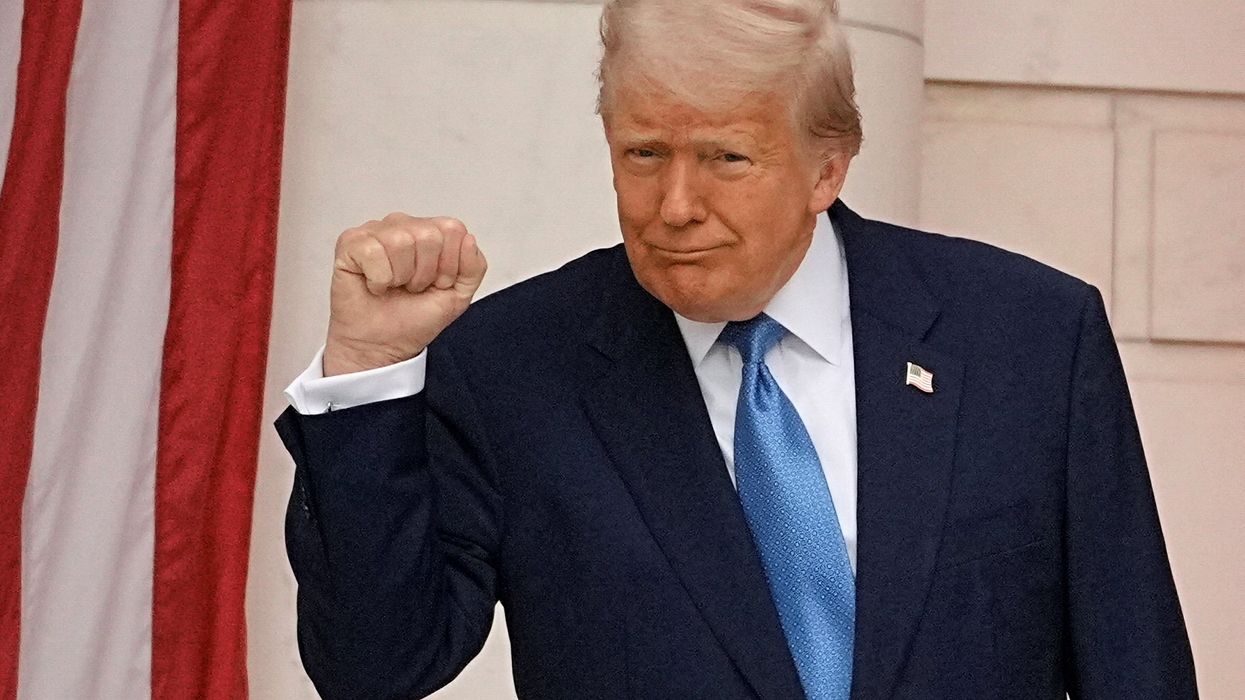
U.S. President Donald Trump gestures, as he attends the annual National Memorial Day Observance in the Memorial Amphitheater at Arlington National Cemetery in Arlington, Virginia, U.S., May 26, 2025. REUTERS/Ken Cedeno
May 28, 2025 
ALTERNET

New York Times reporter Ezra Klein spoke with Bloomberg reporter Zeke Faux about the “shocking” potential for corruption surrounding the Trump family’s involvement in the world of crypto.

“It’s like muzzle velocity for political corruption here,” said Klein. “There are so many stories that, on their own, seem like they should be era-defining political scandals. But the big picture— from Trump trading cards, where he looks like a firefighter or whatever, all the way to the Trump stablecoin, Trump media launching (exchange-traded funds) — is that the Trump family has been groping its way, evolving, learning how to open up a lot of avenues to let people invest in various crypto schemes of theirs.”

“They can’t deny that people are giving them money, but their claim is that they are still acting in what they believe to be the U.S.’s best interest. But the conflicts of interest are so obvious,” said Faux. “… And in fact, once Trump’s appointees took over at the S.E.C., they announced that memecoins were collectibles, like Beanie Babies, and that the rules did not apply.”

Faux estimates the Trump family has generated “at least $700 million” off crypto. It was not clear how much of this included purchases from foreign leaders and billionaires seeking favor.

World Liberty, for example, produces a coin that should not seem appealing to investors because Faux says they are “literally impossible to resell.” However, 75 percent of all the money World Liberty makes is paid to the Trump family as a fee, which provides a motivation all by itself. Chinese-born crypto billionaire Justin Sun, who is facing an S.E.C. investigation, bought $30 million of these “unresellable World Liberty tokens” right after the election, and then later bought another $45 million, “which meant that the Trumps were going to get something like $56 million in a payout based on just what he bought,” Faux said.

“A few weeks after Sun finished his $75 million purchase, his S.E.C. case was put on hold. No explanation was given,” Faux said

The controversy over people spending money at the Trump Hotel in D.C looks “quaint” by comparison, Faux added. “That was a couple hundred thousand dollars. Now people are sending millions to buy Trump’s coins.”

“Tens of millions,” said Klein. “The thing about the crypto play here is it’s so much more scalable. The number goes up."

"Yes. And they ended up selling out. They sold all the (World Liberty Financial) tokens that they had offered — a total of $550 million worth. So that meant $400 million to the Trumps, based on the terms of the offering as I read them,” said Faux.

A company called Freight Technologies also recently announced it was buying $20 million of Trump’s memecoin, phrasing it as “an effective way to advocate for fair, balanced and free trade between Mexico and the U.S.”

“So, what is a company like that doing, publicly announcing a multimillion-dollar investment in the Trump memecoin? What are they saying this memecoin investment is buying them?” asked Klein.

“It seems like those guys are talking about using it to buy access,” said Faux.

Klein said the U.S. system is still trying to find a way to deal with a figure so effortlessly corrupt, backed by a political party so willing to enable the corruption.

“This guy, with his bizarre genius for shamelessness, is just doing it all so unbelievably directly. The coin is called $TRUMP. He’s just promoting it himself. It’s all for him… He has control of the Republican Party, so they’re not going to do anything to him. And they control Congress,” said Klein. “He sort of overwhelms the system’s capacity to know what to do about him, because it never had any defense for something so over the line that the administration refuses to treat as a problem."

“The thing that is supposed to happen in government is somebody says: ‘Hey, you’re taking a bribe. You’re trying to make yourself rich off this,’" Klein added. "And he says: ‘Oh, of course I’m not. I would never do that. How dare you impugn my integrity. But Trump is instead like: ‘Yeah, I mean, wouldn’t you?’"

Read the full NY Times interview at this link. (subscription needed) 


'Rise' in white collar crimes: Expert warns of 'Golden Age of Scams' under Trump


REUTERS/Leah Millis

May 27, 2025
ALTERNET

Sharing a series of articles published in The Prospect Tuesday, journalist and author David Dayen noted that the Trump administration has effectively ended white-collar crime enforcement, warning that "ripoffs, deceptions, and cons will rise as a result to part the public from their money."

Titled "The Golden Age of Scams," one of the pieces in the series, written by Dayen, who serves as the publication's executive editor, highlighted how President Donald Trump’s second term "will unleash dishonesty and abuse across the economy."

"Investigations into any business executive with even a passing relationship to Trump have been scotched, with beneficiaries ranging from the richest man in the world to the husband of the education secretary," the article noted.

"Over 100 active enforcement actions have been either paused or dropped across the executive branch. In March, Trump donor Trevor Milton was pardoned after being sentenced for lying to investors; in April, Trump issued a corporate pardon to BitMEX, a crypto exchange that had pled guilty to failing to prevent money laundering," it adds.

Dayen, author of the book Chain of Title: How Three Ordinary Americans Uncovered Wall Street's Great Foreclosure Fraud, further wrote in the piece that sectors of legal oversight — ranging from restrictions on American firms bribing foreign officials, to efforts aimed at curbing corruption and workplace discrimination — have largely disappeared.

He added that a sweeping deregulation effort, overwhelmingly favorable to corporate interests, is on the horizon.

Roughly $50 million in contributions to Trump’s inauguration came from corporations facing ongoing federal probes or litigation, per the report. This raises serious doubts that these cases will proceed to trial or that the involved executives will face consequences.

Another article in the series written by journalist Jacob Silverman warned that the Trump administration "is removing every financial guardrail from crypto, in order to enrich the first family and its tech and finance allies while destabilizing the economy."

"Since Trump introduced his meme coin, many observers (including me) have warned that it is an unprecedented vehicle for personal enrichment and potentially for bribery," Silverman wrote.

Trump’s aggressive efforts to roll back regulations on the cryptocurrency market have sparked major controversy, particularly as he and his sons have rapidly grown their involvement in crypto enterprises.

Ethics advocates, Democratic lawmakers, and even some Republicans are sounding the alarm over potential conflicts of interest. Much of the outrage centers on Trump’s promotion of a self-branded meme coin called $Trump — a digital token with no real utility.

Critics were especially concerned after Trump hosted an exclusive dinner last week at his Virginia golf resort for the top 220 purchasers of the coin, along with a private event for the top 25 investors.

From USAID to US Harms

Donald Trump’s sharp cuts to this country’s humanitarian aid will ensure that its soft power crumbles, doing lasting damage to its international standing.


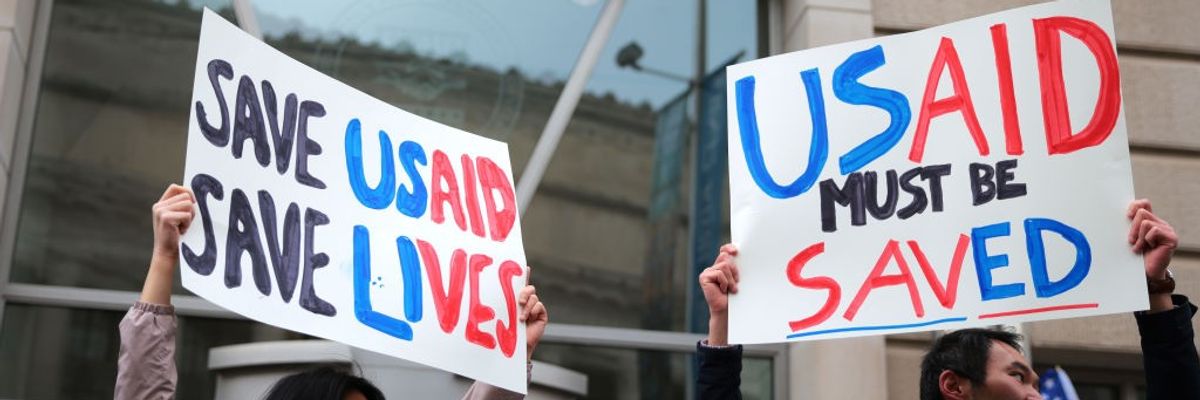
Protestors gather outside of USAID headquarters on February 3, 2025 in Washington, D.C.
(Photo: Kayla Bartkowski/Getty Images)


Alfred W. Mccoy
May 27, 2025
TomDispatch

With the Oval Office looking more like a middle school classroom every day, let’s recall the way, once upon a time, we responded to childhood taunts from a playground bully. You remember how it goes. Your nemesis says mockingly that you’re a this-or-that and you shout back: “Takes one to know one!” Indeed, it does. This month, Microsoft founder Bill Gates said of his fellow billionaire Elon Musk: “The world’s richest man has been involved in the deaths of the world’s poorest children.”

Elaborating, Gates explained that Musk, as head of his self-created Department of Government Efficiency (DOGE), had decided to put “USAID in the wood chipper” by cutting 80% of its global humanitarian programs and that, he pointed out, will mean “millions of additional deaths of kids.” To help undo the damage, Gates announced that he’ll be spending down his own $200 billion fortune over the next 20 years to promote public health in Asia and Africa so that “children [are] not being malnourished or women not bleeding to death or girls not getting HIV”

Amid the blizzard of executive orders and bizarre budgetary decisions pouring out of the Trump White House, Gates put his finger on the cuts that really matter, the ones that will do lasting damage—not just to their unfortunate victims but to America’s sense of global leadership as well.

In short, globally, the sharp cuts to USAID’s humanitarian programs represent a crippling blow to America’s soft power at a time when great-power competition with Beijing and Moscow has reemerged with stunning intensity.

In President Donald Trump’s transactional diplomacy, only the hard power of mineral deals, gifted airplanes, or military might matters. And yet, as we learned in the Cold War years, it’s much easier to exercise world leadership with willing followers won over by the form of diplomacy scholars have dubbed “soft power.” As the progenitor of the concept, Harvard Professor Joseph Nye, put it: “Seduction is always more effective than coercion. And many of our values, such as democracy, human rights, and individual opportunity, are deeply seductive.” He first coined the term in 1990, just as the Cold War was ending, writing that “when one country gets other countries to want what it wants,” that “might be called co-optive or soft power, in contrast with the hard or command power of ordering others to do what it wants.” In his influential 2004 book, Soft Power: The Means to Success in World Politics, Nye argued that, in our world, raw military power had been superseded by soft-power instruments like reliable information, skilled diplomacy, and economic aid.

Actually, soft power is seldom soft. Indeed, Spanish steel might have conquered the New World in the 16th century, but its long rule over that vast region was facilitated by the appeal of a shared Christian religion. When Britain’s global turn came in the 19th century, its naval dominion over the world’s oceans was softened by an enticing cultural ethos of commerce, language, literature, and even sports. And as the American century dawned after World War II, its daunting troika of nuclear-armed bombers, missiles, and submarines would be leavened by the soft-power appeal of its democratic values, its promise of scientific progress, and its humanitarian aid that started in Europe with the Marshall Plan in 1948.

Even in these uncertain times, one thing seems clear enough: Donald Trump’s sharp cuts to this country’s humanitarian aid will ensure that its soft power crumbles, doing lasting damage to its international standing.
The Logic of Foreign Aid

Foreign aid—giving away money to help other nations develop their economies—remains one of America’s greatest inventions. In the aftermath of World War II, Europe had been ravaged by six years of warfare, including the dropping of 2,453,000 tons of Allied bombs on its cities, after which the rubble was raked thanks to merciless ground combat that killed 40 million people and left millions more at the edge of starvation.

Speaking before a crowd of 15,000 packed into Harvard Yard for commencement in June 1947, less than two years after that war ended, Secretary of State George Marshall made an historic proposal that would win him the Nobel Peace Prize. “It is logical,” he said, “that the United States should do whatever it is able to do to assist in the return of normal economic health in the world, without which there can be no political stability and no assured peace.” Instead of the usual victor’s demand for reparations or revenge, the U.S. gave Europe, including its defeated Axis powers, $13 billion in foreign aid that would, within a decade, launch that ruined continent on a path toward unprecedented prosperity.

What came to be known as the Marshall Plan was such a brilliant success that Washington decided to apply the idea on a global scale. Over the next quarter century, as a third of humanity emerged from the immiseration of colonial rule in Africa and Asia, the U.S. launched aid programs designed to develop the fundamentals of nationhood denied to those countries during the imperial age. Under the leadership of President John F. Kennedy, who had campaigned on a promise to aid Africa’s recovery from colonial rule, disparate programs were consolidated into the U.S. Agency for International Development (USAID) in 1961.

At the outset, USAID’s work was complicated by Washington’s Cold War mission. It would sometimes even serve as a cover for CIA operations. Just a few years after the Cold War ended in 1991, however, USAID was separated from the State Department and its diplomatic aim of advancing U.S. interests.

Then refocused on its prime mission of global economic development, USAID would, in concert with the World Bank and other development agencies, become a pioneering partner in a multifaceted global effort to improve living conditions for the majority of humanity. Between 1950 and 2018, the portion of the world’s population living in “extreme poverty” (on $1.90 per day) dropped dramatically from 53% to just 9%. Simultaneously, USAID and similar agencies collaborated with the United Nation’s World Health Organization (WHO) to eradicate smallpox and radically reduce polio, ending pandemics that had been the scourge of humanity for centuries. Launched in 1988, the anti-polio campaign, the Centers for Disease Control and Prevention estimates, spared 20 million children worldwide from serious paralysis.

Behind such seemingly simple statistics, however, lay years of work by skilled USAID specialists in agriculture, nutrition, public health, sanitation, and governance who delivered a multifaceted array of programs with exceptional efficiency. Not only would their work improve or save millions of lives, but they would also be winning loyal allies for America at a time of rising global competition.
And Along Comes DOGE

Enter Elon Musk, chainsaw in hand. Following President Trump’s example of withdrawing from the World Health Organization on inauguration day, Musk started his demolition of the federal government by, as he put it, “feeding USAID into the wood chipper.” As his DOGE hirelings prowled the agency’s headquarters in the weeks after inauguration, Musk denounced that largely humanitarian organization as “evil” and a “viper’s nest of radical-left Marxists who hate America.” Without a scintilla of evidence, he added, “USAID is a criminal organization. Time for it to die.”

With head-spinning speed, his minions then stripped the USAID logo from its federal building, shut down its website, purged its 10,000 employees, and started slashing its $40 billion budget for delivering aid to more than 100 nations globally. The White House also quickly transferred what was left of that agency back to the State Department, where Secretary of State Marco Rubio spent six weeks slashing 83% of its global humanitarian programs, reducing 6,200 of them to about 1,000.

As USAID’s skilled specialists in famine prevention, public health, and governance stopped working, the pain was soon felt around the world, particularly among mothers and children. In Colombia, the agency had spent several billion dollars to settle a decades-long civil war that killed 450,000 people by mapping 3.2 million acres of uncharted lands so that the guerrillas could become farmers. That work, however, was suddenly halted dead in its tracks—project incomplete, money wasted, threat of civil conflict again rising. In Asia, the end of USAID support forced the World Food Program to cut by half the already stringent food rations being provided to the million Rohingya refugees confined in miserable, muddy camps in Bangladesh—forcing them to survive on just $6.00 a month per person.

Washington will soon be left with only the crudest kind of coercion as it tries to exercise world leadership.

In Africa, the aid cuts are likely to prove catastrophic. Departing USAID officials calculated that they would be likely to produce a 30% spike in tuberculosis, a deadly infectious disease that already kills 1.25 million people annually on this planet and that 200,000 more children would likely be paralyzed by polio within a decade. In the eastern Congo, where a civil war fueled by competition over that region’s rare-earth minerals has raged for nearly 30 years, the U.S. was the “ultra dominant” donor. With USAID now shut down, 7.8 million Congolese war refugees are likely to lose food aid and 2.3 million children will suffer from malnutrition. In war-torn Sudan, U.S. aid sustained more than 1,000 communal kitchens to feed refugees, all of which have now closed without any replacements.

With 25 million of the world’s 40 million HIV patients in Africa, cuts to USAID’s health programs there, which had reduced new infections by half since 2010, now threaten that progress. In South Africa, a half-million AIDS patients are projected to die, and in Congo, an estimated 15,000 people could die within the next month alone. Moreover, ending USAID’s Malaria Initiative, which has spent $9 billion since President George W. Bush launched it in 2005, essentially ensures that, within a year, there will be 18 million more malaria infections in West Africa and 166,000 more likely deaths.

On March 3, with such dismal statistics piling up, Elon Musk insisted that “no one has died as a result of a brief pause to do a sanity check on foreign aid funding. No one.”

Writing from Sudan just 12 days later, however, New York Times columnist Nicholas Kristof reported that Peter Donde, a 10-year-old child infected with AIDS at birth, had just died. A USAID program launched by President Bush called PEPFAR had long provided drugs that were estimated to have saved 26 million lives from AIDS (Peter’s among them) until Musk’s cuts closed the humanitarian agency. Kristof reported that the end of U.S. funding for AIDS treatment in Africa means “an estimated 1,650,000 people could die within a year without American foreign aid.” Why, he asked, should Americans spend even 0.24% of their Gross National Product on programs that keep poor children alive? Answering his own question, he wrote that the demolition of USAID “means that the United States loses soft power and China gains.”

Indeed, Dr. Diana Putman, USAID’s former assistant administrator for Africa, argues that the agency’s programs have been the chief currency for U.S. ambassadors in negotiations with developing nations. “Their leverage and ability to make a difference in terms of foreign policy,” she explained, “is backed up by the money that they bring, and in the Global South that money is primarily the money that USAID has.”
The Loss of Soft Power

In short, globally, the sharp cuts to USAID’s humanitarian programs represent a crippling blow to America’s soft power at a time when great-power competition with Beijing and Moscow has reemerged with stunning intensity.

In back-handed testimonials to USAID’s success, the world’s autocrats celebrated the agency’s demise, particularly the end of the $1.6 billion—about 4% of its annual budget—that it devoted to pro-democracy initiatives. “Smart move,” said former Russian Prime Minister Dmitri Medvedev. On X (formerly Twitter), Hungarian strongman Viktor Orbán announced that he “couldn’t be happier that @POTUS, @JDVance, @elonmusk are finally taking down this foreign interference machine.” Expressing his joy, Orbán offered a “Good riddance!” to USAID programs that helped “independent media thrive” and funneled funds to the “opposition campaign” in Hungary’s 2022 parliamentary elections. Similarly, El Salvador’s de facto dictator, Nayib Bukele, complained that USAID’s pro-democracy funds had been “funneled into opposition groups, NGOs with political agendas, and destabilizing movements.”

Offering even more eloquent testimony to USAID’s past efficacy, China has moved quickly to take over a number of the abolished agency’s humanitarian programs, particularly in Southeast Asia, where Beijing is locked in an intense strategic rivalry with Washington over the South China Sea. Writing in the journal Foreign Affairs, two public health specialists observed that “a U.S. retreat on global health, if sustained, will indeed open the door for China to exploit the abrupt, chaotic withdrawal of U.S. programs in… Southeast Asia, and it may do the same in Latin America.”

Last February, only a week after Washington cancelled $40 million that had funded USAID initiatives for child literacy and nutrition in Cambodia, Beijing offered support for strikingly similar programs, and its ambassador to Phnom Penh said, “Children are the future of the country and the nation.” Making China’s diplomatic gains obvious, he added: “We should care for the healthy growth of children together.” Asked about this apparent setback during congressional hearings, Trump’s interim USAID deputy administrator, Pete Marocco, evidently oblivious to the seriousness of U.S.-China competition in the South China Sea, simply dismissed its significance out of hand.

Although the dollar amount was relatively small, the symbolism of such aid programs for children gave China a sudden edge in a serious geopolitical rivalry. Just two months later, Cambodia’s prime minister opened new China-funded facilities at his country’s Ream Naval Base, giving Beijing’s warships preferential access to a strategic port adjacent to the South China Sea. Although the U.S. has spent a billion dollars courting Cambodia over the past quarter-century, China’s soft-power gains are now clearly having very real hard-power consequences.

In neighboring Vietnam, USAID has worked for several decades trying to heal the wounds of the Vietnam War, while courting Hanoi as a strategic partner on the shores of the South China Sea. In building a “comprehensive strategic partnership,” manifest in today’s close trade relations, USAID played a critical diplomatic role by investing in recovering unexploded American munitions left over from that war, cleaning up sites that had been polluted by the defoliant Agent Orange, and providing some aid to the thousands of Vietnamese who still suffer serious birth defects from such toxic chemicals. “It is through these efforts that two former enemies are now partners,” said former Sen. Patrick Leahy (D-V.T.). “People in the Trump administration who know nothing and care less about these programs are arbitrarily jeopardizing relations with a strategic partner in one of the most challenging regions of the world.”
A Global Turn Toward Hard Power

Although the demolition of USAID and sharp cuts to economic aid will have consequences for the world’s poor that can only be called tragic, it’s but one part of President Trump’s attack on the key components of America’s soft power—not only foreign aid, but also reliable information and skilled diplomacy. In March, the president signed an executive order shutting down the U.S. Agency for Global Media, including organizations like Voice of America and Radio Free Europe that had been broadcasting in 50 languages worldwide, reaching an estimated 360 million people in nations often without reliable news and information.

A month later, the White House Office of Management and Budget proposed a 50% cut to the State Department’s budget, closing diplomatic missions and completely eliminating funds for international organizations like NATO and the U.N. While the actual implementation of those cuts remains uncertain, the State Department is already dismissing 20% of its domestic workforce, or about 3,400 employees, including a significant number of Foreign Service officers, special envoys, and cyber-security specialists. Add it all up and, after just 100 days in office, President Trump is well on his way to demolishing the three critical elements for America’s pursuit of global soft power.

Already, the erosion of U.S. influence is manifest in recent criticism of this country, unprecedented in its bitterly acrid tone, even among longstanding allies. “Europe is at a critical turning point in its history. The American shield is slipping away,” warned veteran French legislator Claude Malhuret in a March 4 speech, from the floor of France’s Senate that soon won a remarkable 40 million views worldwide. “Washington has become Nero’s court, with an incendiary emperor, submissive courtiers, and a ketamine-fueled buffoon in charge of purging the civil service.”

With such cutting critiques circulating in the corridors of power from Paris to Tokyo, Washington will soon be left with only the crudest kind of coercion as it tries to exercise world leadership. And, as Professor Nye reminds us, leadership based solely on coercion is not really leadership at all.

Welcome to Planet Trump in the year 2025.


© 2023 TomDispatch.com


Alfred W. Mccoy is professor of history at the University of Wisconsin-Madison is the author of "In the Shadows of the American Century: The Rise and Decline of U.S. Global Power". Previous books include: "Torture and Impunity: The U.S. Doctrine of Coercive Interrogation" (University of Wisconsin, 2012), "A Question of Torture: CIA Interrogation, from the Cold War to the War on Terror (American Empire Project)", "Policing America's Empire: The United States, the Philippines, and the Rise of the Surveillance State", and "The Politics of Heroin: CIA Complicity in the Global Drug Trade".
Full Bio >
'Heartbreaking': 4-Year-Old Who Came to US Legally Could Die Within Days If Deported


"It's cruel and inexcusable," said Rep. Judy Chu.


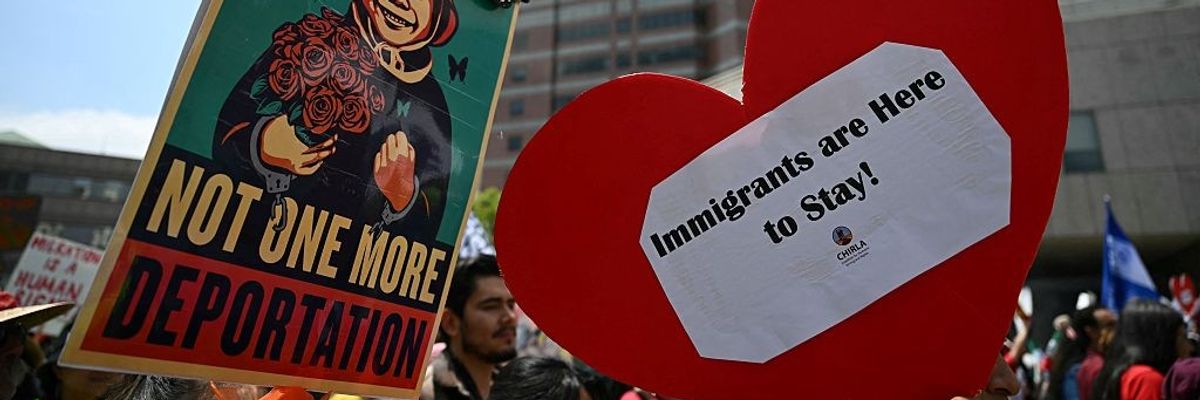
Protestors call for an end to deportations outside the Metropolitan Detention Center in Los Angeles, California, on May 1, 2025.
(Photo by Patrick T. Fallon/AFP via Getty Images)

Jessica Corbett
May 27, 2025
COMMON DREAMS


Yet another Trump administration deportation case is sparking outrage: This time, a 4-year-old Mexican girl and her parents face expulsion, despite the family coming to the United States legally and the child's risk of death if she loses the medical care she is receiving in California.

The Los Angeles Times on Tuesday shared the story of the family, which came to the United States on humanitarian grounds in 2023: the young girl, identified by her initials, S.G.V.; her mom, 28-year-old Deysi Vargas, who is also Mexican; and her 34-year-old dad, who is from Colombia.

They have been living in Bakersfield, and S.G.V. has been receiving care for her short bowel syndrome at the Children's Hospital Los Angeles (CHLA). However, the family received a letter last month stating that their legal status had been terminated and urging them to leave the United States of their own accord, to avoid deportation.

While spokespeople for U.S. Citizenship and Immigration Services as well as CHLA declined to comment, the Times reported on a letter written by Dr. John Arsenault at the family's request:
If there is an interruption in her daily nutrition system, called Total Parenteral Nutrition (TPN), the doctor wrote, "this could be fatal within a matter of days."

"As such, patients on home TPN are not allowed to leave the country because the infrastructure to provide TPN or provide immediate intervention if there is a problem with IV access depends on our program's utilization of U.S.-based healthcare resources and does not transfer across borders," Arsenault wrote.


"This is a textbook example of medical need," said the family's attorney, Rebecca Brown of the pro bono legal firm Public Counsel, who petitioned for continuation of their temporary humanitarian legal status. "This child will die and there's no sense for that to happen. It would just be a cruel sacrifice."

Readers of the reporting quickly called out U.S. President Donald Trump and other key officials in his administration, including Homeland Security Secretary Kristi Noem and Stephen Miller, the White House deputy chief of staff for policy, who was behind the family separation policy from Trump's first term.


"Heartbreaking: A 4-year-old came here legally with her family for lifesaving care. Yet Trump still seeks to deport her despite doctors warning she could die. It's cruel and inexcusable," said Congresswoman Judy Chu (D-Calif.), whose district is in Los Angeles County.

Adrian Carrasquillo, who writes the immigration-focused newsletter "Huddled Masses" at The Bulwark, an anti-Trump conservative outlet, stressed that "this is being done in our name."


The Trump administration has provoked legal battles and intense scrutiny for deporting various people in recent months, including multiple children who are U.S. citizens—among them, a 4-year-old cancer patient.
Why Does the US Press Ignore the Trauma Experienced by Palestinians in Gaza? 
Racism

Because we don’t see Palestinians as fully human, we fail to understand how destroying their lives, denying them a normal present and a hopeful future can result in deformities in their sense of self.


The victims of the Israeli attack are taken from the morgue of al-Nasser Hospital to be buried after the funeral procedures, on May 19, 2025 in Khan Younis, the southern Gaza Strip.
(Photo: Abed Rahim Khatib/Anadolu via Getty Images)

James Zogby
May 27, 2025
Common Dreams

One thing of which we can be certain is that there will be consequences to the genocide in Gaza.

It is difficult to wrap one’s arms around the excruciating pain being endured by Palestinians in Gaza. We only know the rough outline of the devastation. Tens of thousands have been murdered in aerial bombardments, over 100,000 have sustained serious injuries, the majority of homes have been demolished, and, as a result of Israel’s blockade, mass starvation is impacting more than one and one-half million people. In addition, hospitals and schools have been destroyed, and other essential services to provide support for births, illnesses, deaths and grieving, and treatment of the psychological wounds of war have been largely terminated.

We know that most of the dead and wounded are civilians, with the majority being women and children. We also know that upwards of 4,000 people have lost limbs. And many wounded children are the only survivors in their families, making them maimed orphans without a support network.

If we don’t demonstrate compassion and implement a comprehensive approach to rebuilding Gaza and restoring a sense of wholeness to its people, I fear what the future may have in store.

I’ve written before about the indecency of those “day after” discussions that focus exclusively on matters of governance or bricks-and-mortar while ignoring the human dimension and long-term consequences of this conflict. Of course, those governing and reconstruction issues are important, and it is gratifying that working papers are being developed to address them. But building housing and infrastructure and creating administrative structures should not be the sole considerations; attention must also be paid to addressing and healing the physical and psychological wounds of this war.

Consider the psychic wounds experienced by Gaza’s children. We know that significant losses produce trauma. Losing a parent, a sibling, or a friend, or even just moving to a new neighborhood can be unsettling and have an impact on behavior or mental stability. We also know that the degree of the shock can be mitigated by other factors. For example: the discomfort experienced by a child when their family moves to a new city and the child loses friends and a familiar environment can be somewhat offset by a supportive family.

But what if, as is the case in Gaza, your family has lost many loved ones (parents, children, and close extended family members), been forced to move multiple times, and is now living in a tent without food or water? And then imagine that during the last cease-fire, children, already traumatized by loss, joined the hundreds of thousands of Palestinians making the long trek northward to their old homes. What they find upon arrival is that not only their home but also their entire neighborhood is rubble and unrecognizable. And then they are forced to deal with hunger and the indignity of witnessing their parents begging for food.

We know that as we grow our brains organize our experiences so that they sense to us. We develop a mental map of our relationships and our place in the world in which we live. But what if, in the case of a 12-year-old returning to Gaza City, they find that there is no home, and the way to school, the neighborhood store, a friend’s home, or the mosque or school have all have been erased. The compounding of multiple losses and extreme dislocation can only be seen as profoundly traumatizing. Under these circumstances it is impossible to calculate the severity of the impact on this child’s well-being or future development. What will become of them, their older siblings, and their parents? How will their brains ingest and make sense of all of these losses?

Given the seriousness of this situation, it becomes imperative not only to end the conflict and make plans for reconstruction and governance, but also to create strategies to address psychic and developmental needs as well. The U.S. press focuses on the need to address the trauma of those young Israelis who’ve been held hostage in Gaza. This is obviously needed, but what is disturbing is the extent to which we’ve ignored the trauma experienced by Palestinians in Gaza. Why? In a word, racism.

Because we don’t see Palestinians as fully human, we fail to understand how destroying their lives, denying them a normal present and a hopeful future can result in deformities in their sense of self. If we don’t demonstrate compassion and implement a comprehensive approach to rebuilding Gaza and restoring a sense of wholeness to its people, I fear what the future may have in store.

Even now, neither Israel nor the U.S. have shown any interest in addressing the humanity of Palestinians and instead are advancing plans that see this much beleaguered people reduced to pawns to be moved about to help Israel achieve its goals.

The solution must come from a forceful and united stand taken by Arabs and key European states to sanction Israel for its crimes, force them to evacuate Gaza, and end their occupation of Palestinian lands. Then and only then, under an international mandate, can reconstruction begin that will rebuild Gaza and help to heal the wounds of the Palestinian victims of this war.

If we do not take this course, there will be hell to pay as the bitter seeds being planted today will be bearing fruit in future generations.


Our work is licensed under Creative Commons (CC BY-NC-ND 3.0). Feel free to republish and share widely.


James Zogby
Dr. James J. Zogby is the author of Arab Voices (2010) and the founder and president of the Arab American Institute (AAI), a Washington, D.C.-based organization which serves as the political and policy research arm of the Arab American community. Since 1985, Dr. Zogby and AAI have led Arab American efforts to secure political empowerment in the U.S. Through voter registration, education and mobilization, AAI has moved Arab Americans into the political mainstream. Dr. Zogby has also been personally active in U.S. politics for many years; in 1984 and 1988 he served as Deputy Campaign manager and Senior Advisor to the Jesse Jackson Presidential campaign. In 1988, he led the first ever debate on Palestinian statehood at that year's Democratic convention in Atlanta, GA. In 2000, 2008, and 2016 he served as an advisor to the Gore, Obama, and Sanders presidential campaigns.
Full Bio >