Wednesday, May 28, 2025


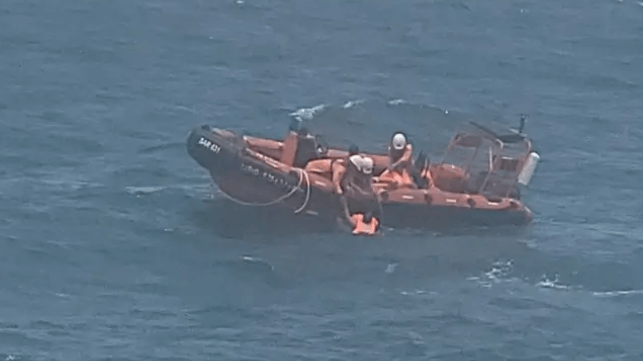
Vietnamese SAR Forces Rescue 10 Crewmembers After Bulker Sinks

Rescue
Courtesy Vietnam Maritime Search and Rescue Coordination Center

Published May 27, 2025 10:59 PM by The Maritime Executive


Last weekend, a coal carrier flooded and sank off the coast of Vietnam's Son Duong port, forcing the crew to abandon ship quickly. In a remarkable large-scale operation spanning more than 12 hours, first responders found and rescued all 10 crewmembers from the water.  

At about 2100 hours on Sunday night, the bulker Cong Thanh 07 was under way at a position about six nautical miles off Son Duong when it began taking on water in rough seas. The vessel sank in about 30 meters of water. The crew abandoned ship and began to drift with the current.

Seven vessels were mobilized to participate in the search, according to the Vietnam Maritime Administration. The first survivor was rescued by a fishing boat at a position 17 nautical miles southwest of the location of the sinking, six hours after the casualty. 

After this initial rescue, the national SAR coordination center updated the search area to a 30-nautical-mile strip extending southeast from the place where the first crewmember was found. At 1200 hours, the search vessel SAR 631 found and rescued six more individuals; good Samaritans found another three more, bringing the total to 10 survivors - the entire crew. 


USS Truman Carried Out Largest Carrier Airstrike in History

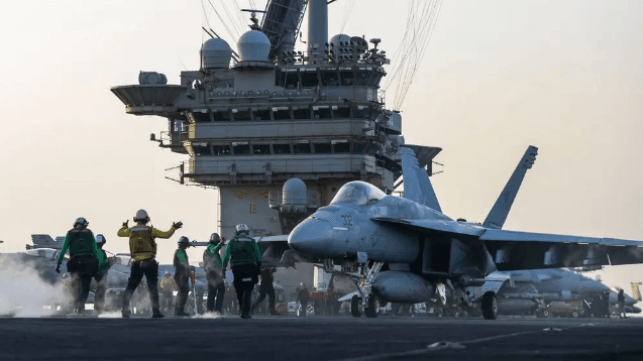
An F/A-18 Super Hornet prepares for takeoff aboard USS Harry S. Truman (USN)

Published May 28, 2025 8:38 PM by The Maritime Executive


During its recent deployment to the Mideast, the USS Harry S. Truman launched the largest airstrike ever conducted from an aircraft carrier - before Truman's monthlong bombing campaign over Yemen even began. 

According to acting chief of naval operations Adm. James Kilby, Truman's air wing dropped 125,000 pounds of ordnance over a target in Somalia - nearly enough to fill two B-52 strategic bombers. 

U.S. officials told Business Insider and Defense News that the attack happened on February 1, when 27 F/A-18 Super Hornets took off from Truman and headed for a target zone about 50 miles to the southeast of Bosaso. 16 of the aircraft made one bombing run on a cave complex used by the Somali branch of terrorist group ISIS. 

In a two-minute span, an estimated 14 militants were killed, roughly one individual for every four tonnes of ordnance deployed. According to U.S. Africa Command, the deceased included known ISIS leader Ahmed Maeleninine, who led efforts to infiltrate the group's terrorists into countries in the West. 

The airwing returned to Truman without casualties after the sortie, but was not always so lucky during the rest of the deployment. In early May, an F/A-18 fighter came in for a landing and touched down aboard Truman, but the arresting cable system failed to halt it and the aircraft went over the side. Two pilots ejected successfully, and they were rescued by one of the carrier's helicopters. 

In April, Truman was forced to turn hard to avoid an incoming Houthi munition, and an F/A-18 fighter rolled over the side from the hangar deck elevator, along with the tractor that was towing it. One crewmember sustained slight injuries, but none were killed or pulled over the side in the incident. 

In December, one of Truman's escorts - the cruiser USS Gettysburg - accidentally shot down one of the carrier's F/A-18 fighters with an anti-aircraft missile following an engagement with Houthi drones and missiles. Both pilots ejected successfully and were rescued. . 


Allianz: Geopolitical Tensions Risk Reversing Declines in Vessel Losses

tanker attacked
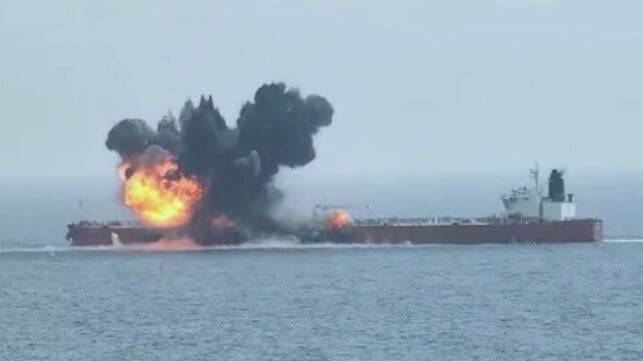
Houthi-released photo showing explosion damaging tanker in the Red Sea

Published May 28, 2025 4:10 PM by The Maritime Executive


The global merchant shipping industry is grappling with a fast-changing geopolitical landscape that is creating new risks and challenges, an emerging phenomenon that has the potential to reverse significant gains achieved over the past decade in terms of safety. Global insurer Allianz released its Safety and Shipping Review 2025 showing that although shipping losses have maintained a downward trend, the situation could change due to geopolitical headwinds.

The shipping industry continues to be the engine propelling the global economy, transporting 90 percent of international trade highlights the report. Despite its importance, Allianz says the industry is operating in an increasingly volatile and complex environment characterized by attacks, vessel detentions, and sanctions, as well as the fallout from incidents involving damage to critical sub-sea cables. In recent months, increasing protectionism and tariff wars have added another layer of risks.

Despite the ever-present dangers, the industry is performing relatively well in terms of safety improvements reports Allianz. In 2024, the industry recorded only 27 large ship losses, which is a record low considering 35 ships were lost the previous year. The 2024 figure represents a 20 percent annual decline and a 75 percent decline in total losses over the past decade (105 in 2015). When compared to the 1990s, the level of safety improvements is dramatic. Two decades ago, the industry was losing over 200 vessels annually but managed to halve it a decade ago. Since then, there has been an impressive trend of decline in losses.

Allianz is now warning that the gains could be eroded. The U.S.-China trade conflict, Russia’s growing shadow fleet, and emerging challenges brought about by decarbonization have the potential to offset the gains. The U.S. has come out aggressively with tariffs against China and also intends to impose port charges on Chinese vessels. The impact according to the report has the potential to create significant stress and disruption of supply chains, pressure on trade routes, and port congestion.

Russia’s shadow fleet is another major threat to maritime safety and the environment. The shadow fleet, composed of older, poorly maintained oil tankers, has expanded rapidly since the Ukraine invasion. Today, it is estimated that around 17 percent of the world tanker fleet belongs to the shadow fleet, which is close to 600 tankers trading Russian oil alone. These vessels have been involved in tens of incidents including fires, collisions, and oil spills.

“The relevance of political risk and conflict as a potential cause of maritime loss is increasing with heightened geopolitical tensions,” said Captain Rahul Khanna, Allianz Commercial Global Head of Marine Risk Consulting. “Total losses from traditional causes may have reduced over time, but we could be in a position where this positive trend is potentially offset by war and other political-related exposures. As an industry, we are in a better position with regard to traditional risks, but there is a renewed focus on geopolitical risks.”

Though the shipping industry is facing an uncertain immediate future, 2024 was another year characterized by significant improvements. South China, Indochina, Indonesia, and the Philippines however maintained a negative reputation as the hotspot of losses. Together with the British Isles and the East Mediterranean and Black Sea, the regions reported four losses each and 169 cumulatively over the past decade.

Fishing vessels have replaced cargo ships in terms of losses, accounting for 40 percent of the total losses. Foundering continued to be the main cause of losses accounting for close to 50 percent, with fire being another major cause. Extreme weather was reported as being a factor in at least seven losses during the year with the average age of a vessel involved in a total loss over the past 10 years being 29.

The review shows that the number of reported shipping casualties or incidents around the world increased by around 10 percent in 2024, rising to 3,310 compared to 2,963 in the previous year. The British Isles saw the highest number at 799, followed by the East Mediterranean and Black Sea at 694.

For the industry, cases of fires remain a major concern with seven losses reported in 2024, the same number as a year earlier. Notably, there were 250 reported fire incidents during the year, up by 20 percent year-on-year and the highest total for a decade. Nearly a third of the fire incidents occurred on either container, cargo, or RoRo vessels. Critically, more than 100 of the total losses were caused by fires over the past decade.

Allianz reports that while shipowners are trying to operate vessels safely within an ever-changing and dynamic regulatory framework, this is becoming increasingly difficult. It highlights that shipping choke points are increasingly coming under fire as geopolitical and regional tensions rise. The Suez Canal has for instance recorded a massive decline in transits due to Houthi attacks while the South China Sea, which carries one-third of global shipping, could see disruptions in the future. The same is transpiring in the Arctic waters, which have become focal points of international tension as countries seek control over emerging trade routes as the ice melts.
 

Russia Evacuates Stranded Tanker Crew from Yemen

damaged port in Yemen
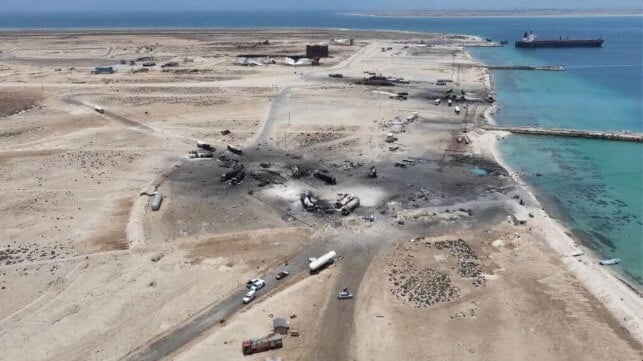
Image released by the Houthis showing damage after the U.S. air strike on Ras Isa ( Al-Masirah TV, Yemen)

Published May 27, 2025 1:41 PM by The Maritime Executive


A month after reporting that three crewmembers from the product tanker Seven Pears (53,700 dwt) had been injured during the strikes on Houthi positions in the port of Ras Isa in Yemen, Russian officials are reporting the remainder of the crew of the tanker has been evacuated. The ship was caught at anchor near the port when the U.S. started strikes on the port complex.

The Russian embassy in Yemen reported that the crewmembers of the tanker were injured, “most likely as a result of the American air strike on the infrastructure facilities.” At the time the embassy said that three crewmembers were in a hospital in Sanaa. It said that one was going to need complex eye surgery.

The Seven Pearls, registered in St. Kitts and Nevis but managed from Dubai in the UAE, was one of several vessels in the port. Reports after the U.S. air strikes said the Houthis had not permitted vessels to leave the port.

The Russian Charge d’Affaires in Yemen, Yevgeny Kudrov told TASS that the shipping company was making arrangements in the days after the air strikes to evacuate the three injured seafarers. At the time, the other 19 crewmembers were staying aboard the ship and reported they had sufficient supplies.

TASS now reports the remaining crew of the vessel flew on May 25 from Sanaa to Amman in Jordan and was returning to Russia. The product tanker however remains in Ras Isa. Records show that the tanker had regularly traded between the UAE, Djibouti, and Houthi areas of Yemen.

While the U.S. suspended its attacks on the ports and Houthi-controlled areas in Yemen, Israel on May 11 issued a warning telling civilians to evacuate the port areas of Ras Isa, Hodeidah, and Salif. Days later on May 16, Israel retaliated for the Houthi missile attacks by bombing the ports. Israeli officials after the strikes said they believed the ports had been disabled for months.


Mystery Surrounds Iranian Arms Ship Anchored off Libya

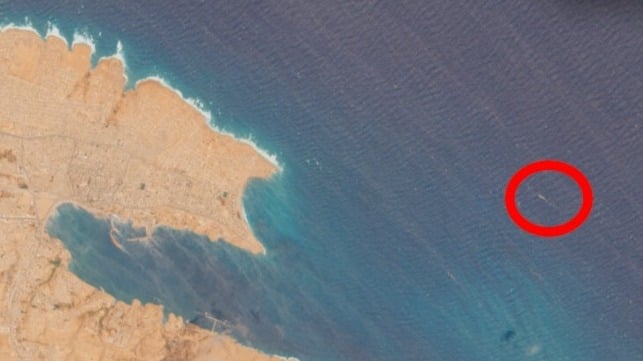
MV Elyana off Tobruk at 32.0791N 24.0617E on May 27 (Sentinel-2/CJRC)

Published May 27, 2025 11:29 PM by The Maritime Executive


Mystery surrounds a small Iranian cargo vessel that has been anchored off the Libyan port of Tobruk for the last three weeks.

The 23,000 dwt Elyana (IMO 9165827) is linked to the Islamic Republic of Iran Shipping Line (IRISL), which is subject to secondary sanctions imposed by the U.S. Treasury's Office of Foreign Assets Control (OFAC). Additionally, the MV Elyana has been specifically sanctioned by name.

The ship has an established history of shipping arms for Iran’s Islamic Revolutionary Guard Corps (IRGC). In June 2024, the Elyana unloaded an Iranian-origin cargo in Latakia, Syria. At the time, before the fall of then-President Bashar al-Assad, the IRGC used Latakia as a hub for their arms imports. IRGC cargos destined for Hezbollah and the Syrian regime were shipped into the port of Latakia, or flown in by Boeing 747 cargo aircraft flights using Latakia International Airport. 

On its latest journey, the Elyana set off from Bandar Abbas on April 18, making a port call in Jebel Ali - notwithstanding the ship’s sanctioned status - and resuming her voyage on April 21. It is not known what cargo, if any, the Elyana took on at Jebel Ali. But the ship then took a leisurely 13 days to reach the southern end of the Suez Canal without making any declared port call. A transit from Jebel Ali to the Suez Canal normally takes six days. As it is equipped with deck cranes, the Elyana would be capable of offloading cargo at unsophisticated ports en route, potentially being able to do so in Houthi-controlled areas of Yemen or in Sudan. 

After transiting the Suez Canal, the Elyana made for Tobruk, Libya, where she has been anchored for the last three weeks.

The port of Tobruk is managed by the forces of Field Marshal Khalifa Haftar, who controls Eastern Libya and the country's oilfields, whilst the UN-recognized and Islamist-inclined government controls Western Libya and the capital of Tripoli. 

Haftar is supported by the UAE, Egypt, Saudi Arabia and the rebel RSF faction in Sudan, not normally regarded as Iranian allies. But Haftar is also supported by Russia, which is a close Iranian ally. The main backers of the recognized government in Tripoli are Turkey and Qatar.  

The question of who is sponsoring the Elyana’s cargo, and who it is destined for, is thus a complete mystery. Likewise, who is turning a blind eye or conspiring to allow the delivery of the cargo is equally puzzling - which may be why the Elyana is marooned at anchor with its cargo still unladen. 

The only thing clear in the saga is that the consignor has been approved by or is sponsored by the IRGC. A degree of indecision on the part of the Tobruk port captain would therefore be understandable. In the past, cargos unloaded from suspicious IRGC-associated vessels, such as the IRISL ships Golbon and Jairan, have caught fire with dramatic results. 


Skipper Injured as Sailboat is Caught in Tanker’s Wake Entering Lock

sailboat accident
Sailboat accident injured the skipper as the mast hit the tanker (Yachtschule Eichler)

Published May 28, 2025 5:02 PM by The Maritime Executive


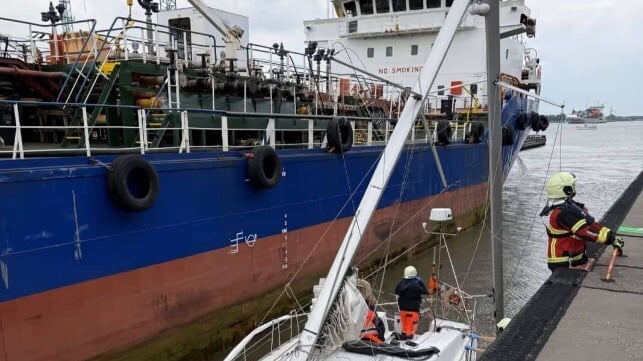
The skipper of a training sailboat operating in Germany was injured when the vessel was caught in the wake of a tanker as it was entering a lock on Saturday evening, May 24. The skipper was injured when the rigging collapsed as the vessels collided in the lock and the mast was damaged on the sailboat.

The 11.5-meter (38-foot) sailboat Elbe Express built in 2016 is employed for sailing instruction in Hamburg and the surrounding areas of Germany. School operator Yachtschule Eichler highlights that it is an agile vessel “ideal for sailing instruction because it conveys the physical feeling of sailing a large dinghy.” It is certified by the German Maritime Accident Insurance Association (Seeberufsgenossenschaft) and used for cruises on the Elbe River, North Sea, Atlantic, and Baltic Sea.

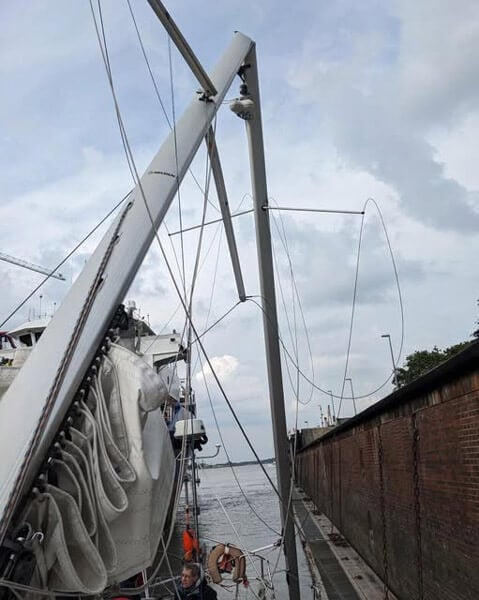
The vessel was directed into the lock at Brunsbüttel on Saturday evening but became caught in the wake of an unnamed tanker that had already entered the lock. The mast of the Elbe Express hit the deck of the tanker and broke. 


Mast of the sailboat broke and the rigging fell to the deck injuring the skipper (Yachtschule Eichler)


The collapsing pieces of the rigging trapped the skipper of the vessel against the rail of the boat and the Brunsbüttel fire brigade had to be brought in with equipment to free her. She was airlifted to a local hospital. The company reports the skipper is bruised and suffered a broken rib but avoided more serious injury and has been released from the hospital.

The operator reports that these types of incidents are unfortunately a relatively frequent occurrence. The tanker had fenders to prevent serious damage to the vessel but unfortunately, the incident still occurred. The company reports it is in a dialogue with the Federal WSV about how these types of incidents can be avoided in the future. It also warns boats not to enter the lock until the situation in the chamber is safe.

The authorities are not proceeding with a further investigation. After an initial review, the company reports, it was determined the skipper had acted correctly attempting to prevent the incident in the lock.

Trips with the Elbe Express were canceled while the company was waiting for a new rig from Denmark. They expect the vessel to be repaired and back in service next week.


Hellenic Coast Guard Crew Charged for Deaths of Dozens of Migrants

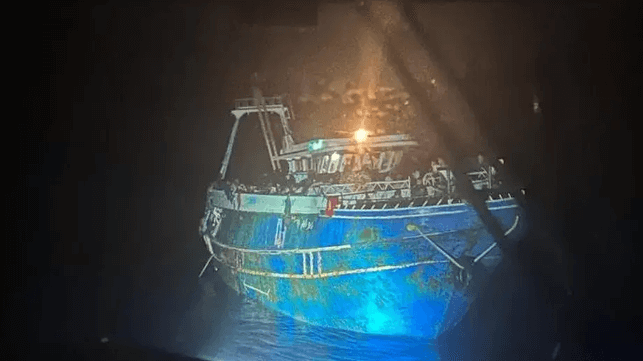
Adriana on the night of the sinking (Hellenic Coast Guard)

Published May 28, 2025 6:17 PM by The Maritime Executive


On Tuesday, prosecutors in Greece charged 17 crewmembers from a Hellenic Coast Guard cutter for allegedly causing the capsizing that killed dozens (if not hundreds) of migrants off Pylos in 2023. 

On June 10, 2023, the aging trawler Adriana got under way from Libya, bound for Italy with an estimated 400-750 irregular migrants on board. The overloaded fishing vessel entered the Greek search and rescue zone on June 13, and the Hellenic Coast Guard dispatched patrol vessel LS-920 to the scene. 

On June 14, the fishing vessel capsized and sank; 82 bodies were recovered, 104 survivors were saved, and up to 500 people were presumed dead. 

Survivors alleged that LS-920 attempted to tow the Adriana. During the third and final tow attempt, survivors told media, the Adriana capsized. The Hellenic Coast Guard strongly disputed these accounts and maintained that no towing attempts occurred. The agency refused to launch its own internal disciplinary investigation, even after the Greek government's ombudsman asserted that LS-920's crew may have violated the law. 

In May, nearly two years after the sinking, the deputy prosecutor of the Piraeus Naval Court concluded that there was enough evidence to charge the crew of response vessel LS-920. The commanding officer of the patrol vessel has been charged with "causing a shipwreck," resulting in the deaths of 82 people - the number of bodies recovered from the scene. The 16 members of the crew face charges of "simple complicity" for following the commanding officer's orders. Four officials, including the then-head of the Hellenic Coast Guard and the head of the National Search and Rescue Center, were charged with exposing others to danger for their role in the LS-920's operations. 

Under Greece's judicial system, the charges mean that the suspects will now be questioned by prosecutors at the Piraeus Naval Court. The prosecutor will then decide whether to bring the case to trial. 

In addition to the facts of the night of the sinking, the prosecutors will likely explore accounts of an alleged cover-up. 
Beginning immediately after the sinking, some survivors said that they were instructed by Hellenic Coast Guard officers not to talk about any alleged "towing attempt." The agency also told investigators that on-scene video and VHF recordings of the casualty - the only hard evidence of what happened that night - were missing. VHF recordings were later leaked to the press.

MULTIPOLAR WORLD

BERTRAND: China, leading Asian countries, set up rival to International Court of Justice

BERTRAND: China, leading Asian countries, set up rival to International Court of Justice
China and a group of about 20 other countries are setting up the International Organization for Mediation that will rival the Western dominated International Court of Justice as the last stop in international dispute resolution. / bne IntelliNews
By Arnaud Bertrand in Switzerland May 27, 2025

This could potentially be very consequential: China and a group of about 20 other countries (including Indonesia, Pakistan, Algeria and Serbia) are launching this week the "International Organisation for Mediation" (IOM), a treaty-based multilateral organisation that will be a platform for the peaceful settlement of international disputes.

It's basically a competitor to the International Court of Justice (ICJ) in The Hague with a few notable differences, besides the obvious fact it is started by the Global South and not the West.

The fundamental difference seems to be philosophical: where the ICJ determines legal rights and wrongs through binding verdicts, the IOM will seek mutually acceptable "win-win" solutions that allow all parties to save face and maintain cooperation. It's designed as an alternative that prioritises relationship preservation over legal victory.

This is basically what China achieved in its mediation role between Iran and Saudi Arabia. In that instance there was no point to determine a "loser" and a "winner": the objective was to resolve differences via mediation in order to restore the relationship, which is often the case in disputes between countries.

Obviously, this represents yet another significant step taken to de-monopolize the West's hold over the international order. With such an institution, developing nations will be able resolve their disputes without having to navigate institutions designed by (and often for) the West.

It's also in many ways an illustration of the dysfunction of the current world order: when existing structures fail to serve the majority of humanity, new ones naturally emerge to fill that void.

Which will likely be remembered as a critical strategic error by the West: by failing to reform existing institutions to serve the world as it is instead of the world they preferred, they sowed the seeds of their growing irrelevance.

Arnaud Bertrand is an entrepreneur and China analyst. Can be found on X @RnaudBertrand. Bertrand founded HouseTrip, a leading European vacation rental marketplace, He is also a graduate, honorary professor and founder & CEO of Me & Qi, one of the premier English-language platforms for traditional Chinese medicine. He is also a graduate and honorary professor of Ecole Hôtelière de Lausanne in Switzerland.


Central Asian states ready to meet rising global demand for critical minerals

Central Asian states ready to meet rising global demand for critical minerals
Kazakhstan and Uzbekistan are expanding mining and export of critical minerals. / gov.kz


Eurasianet May 28, 2025

The global appetite for critical minerals and rare earths is skyrocketing, according to a report issued by the International Energy Agency (IEA). China is the dominant player in terms of mining and refining, but Kazakhstan is the world’s leading producer of uranium, while Uzbekistan is expanding exports of uranium, copper and rare earths.

The IEA’s Global Critical Minerals Outlook 2025 notes that global demand for lithium increased by 30% in 2024 over the previous year’s total. Other minerals used in the production of electric vehicles (EVs), batteries and renewables, including cobalt, nickel and rare earths, also registered strong growth in demand.

The report indicated that the Russia-Ukraine war, namely the ongoing “geopolitical tension” clouding Russian trade, helped Kazakhstan boost uranium exports despite “operational hurdles.” Meanwhile, the IEA touted an Uzbek deal with the United States covering critical minerals, even though details of the arrangement have not been released.

Kazakhstan could significantly increase its earnings in coming years, if claims made by Astana in April about the discovery of major rare earths deposits prove accurate.   

Over the past two years, China has been “the single largest contributor to demand growth,” according to the IEA. At the same time, Beijing is the world’s foremost supplier of rare earths. The report states that China is the leading refiner for 19 out of 20 strategic minerals examined in the report.

China’s market dominance could have potentially troubling ramifications for the global economy as technologies evolve, the IEA report indicates.

“Emerging battery technologies are challenging the incumbent nickel-based lithium-ion batteries, and these are not immune to high supply concentration and volume risks,” the report cautions.

“The supply chains for these [emerging] technologies are significantly more concentrated than those for nickel-based batteries,” it adds. “China produces 75 percent of the world’s purified phosphoric acid, essential for lithium iron phosphate batteries, and 95 percent of high-purity manganese sulphate, a key input for manganese-rich and sodium-ion battery chemistries.” 


Bulgaria's EnduroSat raises €43mn to scale modular satellite production and expand global operations


Bulgaria's EnduroSat raises €43mn to scale modular satellite production and expand global operations

The Balkan-1 satellite was launched into space in January 2025. / EnduroSat
By bne IntelliNews May 27, 2025

Bulgarian aerospace company EnduroSat said on May 27 it has secured a €43mn investment round led by US-based Founders Fund, supporting it to scale up next-generation satellite production and expand its operations across Europe and the US.

The funding round included participation from regional investors CEECAT Capital, Morphosis Capital and existing backers, reflecting growing investor confidence in EnduroSat’s strategy to democratise access to space through modular, software-defined satellite platforms.

“This significant funding... highlights the strong confidence in EnduroSat’s vision and capabilities,” said founder and CEO Raycho Raychev in a press release.

The fresh capital will be used to accelerate production of EnduroSat’s new Endurance Gen3 ESPA-class satellites, which weigh between 200 and 500 kilograms and support advanced payloads such as hyperspectral imaging, synthetic aperture radar (SAR) and broadband communications.

The Gen3 class features modular avionics, peak power of up to 3.5 kW and data transfer rates of 2 Gbps. With an entirely cableless bus design, the satellites can be assembled and tested within hours, significantly shortening production cycles compared to traditional aerospace models, according to the company.

“Our mission is to make space universally accessible... by building and operating the space infrastructure our customers need,” Raychev said. “By increasing our production and introducing our new generation of satellites, we’ll unlock access to satellite constellations for even more customers – with reliability and price transparency.”

Delian Asparouhov, partner at Founders Fund and president of Varda Space Industries, said EnduroSat’s shift from traditional aerospace supply chains to those used in consumer electronics and automotive manufacturing has given it a competitive edge.

“Raycho and his team... have taken the massive leap to go from utilising traditional aerospace supply chains to consumer electronics and automotive,” Asparouhov said. “This makes EnduroSat’s cost efficiency and performance above all in the market.”

EnduroSat’s new Space Service offering aims to simplify the space mission lifecycle by providing end-to-end support from payload integration to operations, allowing clients to focus on core activities without being burdened by technical complexity.

The company plans to use part of the funding to construct a 17,500-square-metre research and production centre in Sofia, which it says will be one of the largest space R&D facilities in Europe. The new facility will house two satellite assembly lines, expanded clean rooms and space qualification equipment, with the capacity to produce up to 60 satellites per month by the end of 2025.

In the US, EnduroSat is expanding its footprint with a new dedicated cleanroom to support commercial and defence clients.