Wednesday, May 28, 2025


Geopolitics to shape mining’s future: TNMG president

Newfoundland is viewed as a key player in Canada’s critical minerals supply chain. Stock image.

At the CentralMinEX conference held last week in Newfoundland, The Northern Miner Group (TNMG) president Anthony Vaccaro delivered a compelling address on the critical importance of geopolitics in shaping the future of mining, investment, and mineral extraction.

His talk urged industry stakeholders to view resource development through a global lens, emphasizing that shifting geopolitical dynamics will be a defining force in how metals are taken from the ground over the coming decades.

“We need to look at our industry through the lens of what’s going on in the world through geopolitics,” Vaccaro told attendees. “Then we’re going to bring it down into Canada, then into Newfoundland and Labrador, because that will be the most defining factor in investing and how we extract metals for many decades.”

Spheres of influence

In his opening remarks, the TNMG president outlined a world increasingly fractured into what he called not just “spheres of influence,” but more accurately “spheres of control” dominated by the US, China and Russia. These blocs are competing to secure control over global trade and, critically, the production and processing of strategic minerals.

In this landscape, countries such as Canada, Australia, Japan, South Korea, and Western Europe are emerging as a “coalition of the willing” that aim to pursue resource autonomy rather than fall under the dominion of authoritarian-aligned spheres.

“Why would we go along with that? We have the populations and the economies where we don’t have to,” Vaccaro said, referencing the recent Canadian federal election as evidence of public alignment with this view.

China’s dominance

Using copper as a case study, he noted about 50% of the world’s copper extraction takes place in jurisdictions aligned with the US sphere, thanks largely to South American producers like Chile and Peru. China, having recognized its own resource deficiencies, aggressively pursued Belt and Road investments in Africa, enabling it to secure roughly 30% of copper extraction through ties with Congo and Zambia.

However, the advantage shifts in the downstream. China currently dominates copper refining, processing over 50% of the world’s supply. In contrast, the US and allied nations lag behind, with North America having only nine copper refineries compared to China’s 60-plus.

“We’ve been a bit sleepy on this,” Vaccaro noted. “There’s going to have to be a government piece in this to get the capital flowing.”

This theme recurred as Vaccaro turned to rare earths. While the West may hold some resources, China controls over 90% of global refining capacity. He emphasized that Canada must work with governments to attract investment and build strategic capacity: “We need to get our act together… to shape the world or at least have a voice in it.”

Canadian opportunities

According to the TNMG president, Canada’s own copper production is showing signs of decline, with its global share falling from nearly 3% to 2%, and reserves not keeping pace with extraction. Nevertheless, he highlighted opportunities in Newfoundland and Labrador, particularly in new projects emerging alongside legacy producers like Voisey’s Bay.

Vaccaro also celebrated local achievements such as the Long Harbour Hydromet facility, calling it “a shining beacon” and an example of how North America can process critical minerals in a cleaner, more environmentally responsible way than China.

Strategic investments

However, the tide may be turning, said Vaccaro, as evident in the recent international funding flows, including US Department of Defense support for Canadian critical mineral projects. “Money is already flowing into Canada. These are Canadian assets receiving American money,” he said.

Vaccaro concluded with a warning and a call to action centered on the Beaver Brook antimony mine, a strategic asset currently owned by a Chinese company and held in care and maintenance. Antimony is critical to military applications, and Vaccaro urged scrutiny over foreign ownership.

“It might be a case study going forward,” he warned, citing previous Canadian government interventions to force Chinese divestments.

“The theme is set: geopolitical spheres,” Vaccaro said. “How do we in North America, how does the coalition of the willing, stay strong? What are the next strategic steps to do it?”


 

BHP building AI hub in Singapore

Stock image.

BHP (ASX: BHP) announced Tuesday it will establish its first industry AI hub in Singapore to accelerate digital transformation and AI adoption in the mining and resources sector.

The hub, the world’s biggest miner said, will focus on solving enterprise-wide challenges using AI technologies to improve safety and lift productivity.

Once established this month, the hub of BHP AI specialists will look at further integration of data-driven decisions, intelligence and automation into the company’s core operations.

With the support of Enterprise Singapore, and in partnership with AI Singapore (AISG), BHP said it selected Singapore to further develop its AI capabilities for its innovation ecosystem, strong digital infrastructure and alignment with BHP’s ambitions to scale technologies that deliver operational value.

The hub will support the growth of BHP’s digital capabilities in Singapore and the region, with plans for a number of AI specialists to lead collaboration between BHP teams and local AI partners to solve business problems.

BHP noted it is using AI to make a real-world impact to its operational systems. Three 3 billion litres of water and 118 GWh of energy have been saved since FY22 through AI-powered plant control at its Escondida copper mine in Chile.

The hub is intended to create opportunities for collaboration and build capability as BHP works to unlock the potential of AI across its operations, it added.

“As BHP accelerates our digital transformation and grows our internal AI capabilities, we see tremendous opportunity to work with AI Singapore and other global leaders to help deliver solutions to complex, enterprise-wide challenges,” BHP chief technical officer Johan van Jaarsveld said in the statement.


California start-up launches next-generation magnesium production technology 

Magnesium metal made with Magrathea’s technology. Image from Magrathea.

Magrathea, a California-based start-up developing technology to produce carbon neutral light metal from seawater, has launched its next-generation magnesium chloride electrolyzer to split magnesium salts to make magnesium metal at its pilot facility in Oakland. 

The launch is a component of its plans to establish the first new commercial-scale magnesium electrolyzer in the United States in the past 50 years, the US Department of Defense-backed company said.  

Magnesium unlocks a wide range of applications, such as stiffening aluminum in alloys, steel making, nuclear inputs, automotive, aerospace, and next-generation defense applications.  

Russia and China currently control 90% of the global primary magnesium supply and there is no significant producer in any NATO country. 

The company said this milestone is a crucial step to advance the technical and data framework for a future scaled plant, adding that the project positions Magrathea’s technology to provide American companies with access to US-based critical mineral supply chains amid shifting trade policies and export controls. 

“Magnesium is one of the most important critical materials, but NATO countries face a dire shortage of non-China supply,” CEO Alex Grant said in a news release.  

“At our core, Magrathea’s innovative technology revitalizes a proven process with our own twist for considerable efficiency improvement and expense reduction,” Grant said. “We expect to reduce the technology’s operating expenses to make it cost-competitive with alternative production methods that exist today, including in China.”  

Magrathea is in conversations with several major defense, chemical and mining industrial players to form a strategic partnership to scale up it technology, it said.  

Over the coming months, Magrathea said it will use data gathered from the pilot-scale electrolyzer to create a scalable technical model aimed at achieving the highest efficiencies from both environmental and economic perspectives. 


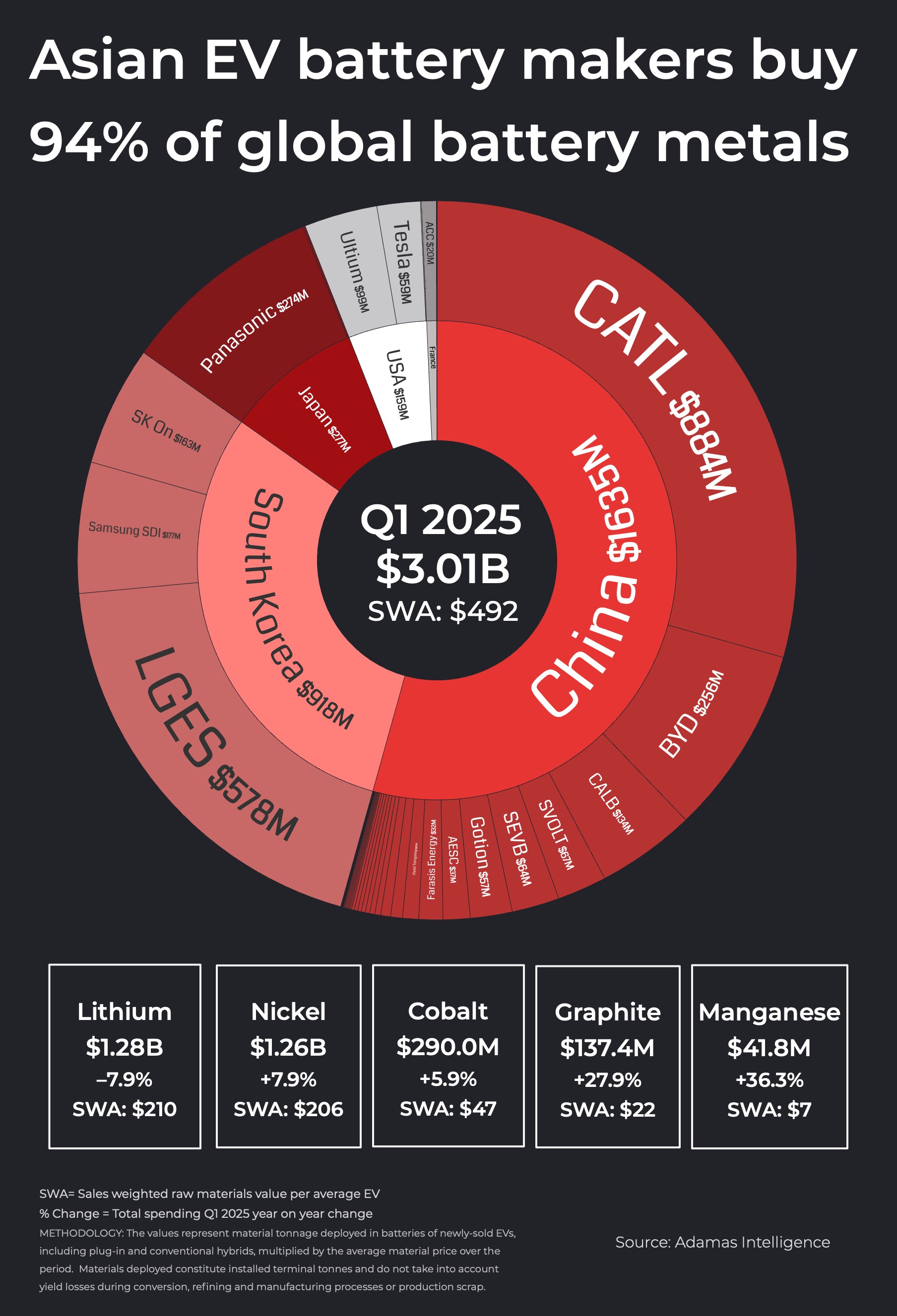
CHART: Asian EV battery makers buy 94% of global battery metals

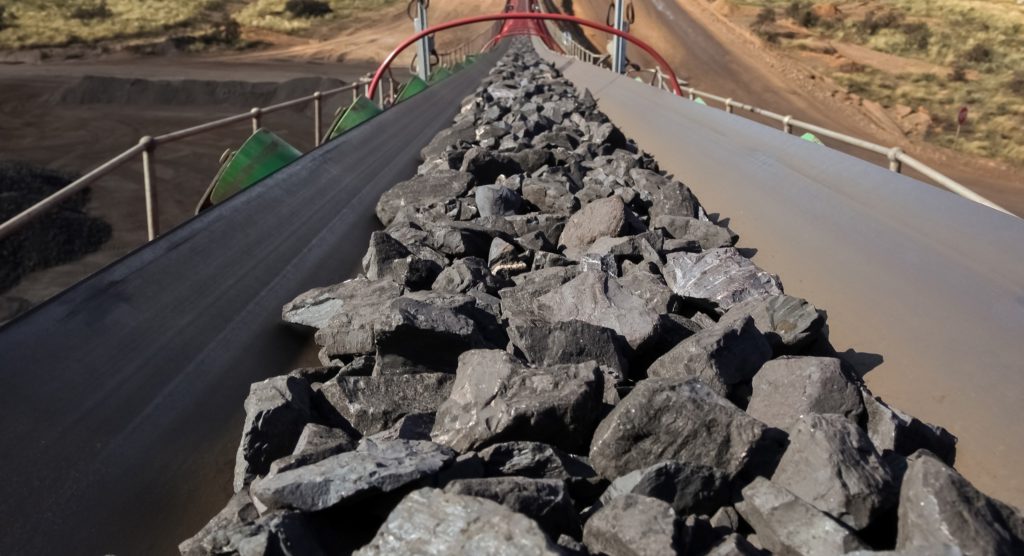
Manganese ore. Long way away from being roadworthy. Stock image.

EV battery manufacturers based in China, South Korea and Japan have almost complete control of the global market and it’s not changing any time soon. 

During the first quarter of 2025 a combined $3.01 billion worth of battery metals were contained in the packs of newly sold EVs worldwide, up a modest 1.3% year over year.

The stagnant costs of the EV metal basket is great news for cell suppliers and battery manufacturers as demand for raw material continues to boom. The tonnes of graphite, lithium, nickel, cobalt and manganese deployed during the first three months was up a robust 27% year on year to a combined 428.2 kilotonnes, according to data from EV supply chain research consultants Adamas Intelligence.

Keeping in mind that the installed tonnage does not take into account any losses during processing, chemical conversion or battery production scrap (often well into double digit percentages), so required tonnes and revenues are meaningfully higher at the mine mouth.

The accompanying graph shows the spending of the more than 60 global cell suppliers and battery manufacturers by country of ownership. It’s virtually an all-Asia affair with Chinese, South Korean and Japanese battery makers representing 94% of raw material spending.  EV batteries are a particularly top heavy industry with the big 4 – CATL, LGES, BYD and Panasonic – accounting for two out of every three dollars spent. 

Top spender in North America, Ultium Cells, is a fast-growing partnership between LG Energy Solution and General Motors, so technically a portion of the battery manufacturer’s spending could also be assigned to the East, making the dominance of Asian players even more prevalent. 

Moreover, since lithium iron phosphate or LFP’s market share in China has been above 50% for the better part of three years and top EV maker BYD has long since moved to an all LFP line up, battery suppliers there under spend their NCM-reliant competitors by reducing spend on pricier nickel and cobalt. That means on a combined battery capacity deployed basis their control of the market is even more substantial. 

Nevertheless, Chinese battery makers spend more than half the global total (Japan’s other EV battery champion, AESC, is majority owned by China’s Envision group).  Panasonic’s 9% market share in dollar terms is higher than for total battery capacity deployed (6% in Q1 on GWh terms, according to Adamas) due to the large proportion of its cells ending up in conventional hybrids where nickel metal hydride is the cell of choice and LFP has made no inroads.  

Despite its already towering presence in the market, CATL, fresh from a blockbuster share offering in Hong Kong, is aggressively pursuing growth.  The presence outside China of the Fujian-based company, which in its present form was only established in 2011, is set to rise rapidly – as is the adoption of LFP cathode chemistries.   

CATL already has a foothold on Western markets with its largest operating plant outside China located in Thuringia, Germany. A giant 100 GWh factory currently under construction in Debrecen, Hungary capable of equipping as many as 1.5 million EVs per year, is set to come on towards the end of the year, and plans for a 50 GWh facility in Zaragoza, Spain are far advanced. All three manufacture LFP cells.

Wrestling control from the incumbents has been slow. The world’s number two automaker, Volkswagen’s PowerCo, has yet to put into production any of its planned (and scaled back) battery plants, the largest of which is located in Ontario, Canada. Premier Ford’s BlueOval facility using CATL’s LFP technology is set to start production next year, but given the trade tensions between Washington and Beijing, the Chinese giant’s involvement may be reduced further.

Tesla’s ambitious plans to become a battery manufacturer in its own right also seem to have hit a wall, with its Austin, Texas factory representing only 15% of total raw material tonnes contained in Tesla models sold during the first three months of the year.  Worldwide, Tesla remains CATL’s number one customer.    

While France’s ACC, part owned by Stellantis and Mercedes-Benz deserves an honourable mention, the $8 billion failure of Europe’s great battery hope – Northvolt – shows the benefits of economies of scale and institutional knowledge in the still fast-growing EV industry.

On top of that, China’s grip on the mine to megawatt pipeline provides the underpinnings of its continued dominance.

For a fuller analysis of the battery metals market check out the latest issue of the Northern Miner print and digital editions.

*Frik Els is Editor at Large for MINING.COM and Head of Adamas Inside, providing news and analysis based on Adamas Intelligence data.


Diamond mining industry cracks under pressure

Natural diamond nestled in kimberlite. (Stock photo by Björn Wylezich.)

The global diamond industry is undergoing a rapid and unprecedented collapse, according to tech entrepreneur and academic Leanne Kemp, though some industry analysts argue that while the downturn is severe, it is not terminal.

Plunging revenues, halted operations and growing doubts about diamonds’ cultural and economic relevance are just some of the symptoms cited by Kemp, who insists the industry isn’t just slumping. She said it’s “disassembling”.

The past quarter has laid bare the severity of the crisis. Anglo American’s (LON: AAL) De Beers, the world’s largest diamond producer by value, saw a 44% revenue drop and is sitting on $2 billion worth of unsold stock. The company plans to cut over 1,000 jobs at its Debswana joint venture, according to the mine workers union, even though the operation is the backbone of Botswana’s economy.

Russia’s Alrosa, under heavy sanctions, reported a 77% plunge in profits and halted operations at key mining sites. Petra Diamonds (LON: PDL), battered by a 30% decline in sales, lost its CEO  and has now two people in that position while it sells off assets to stay afloat.

Lucapa (ASX:LOM) in Australia entered voluntary administration last week, while Sierra Leone’s Koidu Limited shuttered operations and laid off more than 1,000 employees after losing $16 million to labour strikes. Even Lucara (TSX: LUC), which operates in both Botswana and Canada, is now facing a “going concern” warning, despite continued investment in its Karowe mine and production records.

“These are not isolated events. They are symptoms of an industry whose cost structures, cultural relevance, and geopolitical foundations are no longer fit for the moment, Kemp writes.

The entrepreneur notes the diamond’s traditional narrative of permanence, romance and rarity no longer resonates in a world that demands ethical sourcing, sustainability, and transparency.

But not everyone sees an existential threat. Industry analyst Paul Zimnisky offers a more tempered view. “This has been a painful period, especially over the past three years,” he told MINING.COM. He attributes much of the downturn to a post-covid demand correction after record sales in 2021 and 2022, a luxury recession in China, and the disruptive rise of lab-grown diamonds.

Zimnisky argues the easing of these pressures could return the sector to growth. Still, he acknowledges that the industry’s fate hinges on its ability to rekindle desire for natural diamonds. “If the industry gets lethargic and loses its way on the marketing front, all bets are off,” he warned.

For ever?

The spotlight now falls on De Beers. Once synonymous with manufactured scarcity and aggressive branding, the company is up for sale. Anglo American has cut its valuation by $4.5 billion in just over a year, and no buyers have emerged.

Earlier this month, De Beers announced it would shut down its lab-grown diamond jewellery brand, Lightbox, signalling a return to its roots and a renewed focus on natural diamonds, which inspired the iconic “Diamonds are Forever” slogan. The move marks an effort to reposition the company amid growing pressure on the industry.

Kemp believes the future of diamonds lies in verifiable origin and ethical narratives, not in nostalgia. Zimnisky, while optimistic about De Beers’ future under new ownership, agrees that the cultural meaning of diamonds is shifting. “There are constantly changing cultural norms and behaviours,” he noted.

De Beers, Signet launch campaign to attract youth to mine diamonds
Fresh campaigns are targeting Zillennials, the microgeneration born between 1993 and 1998. (Image courtesy of De Beers.)

Some have proposed repositioning diamonds as stable, tradable assets. But Zimnisky is sceptical. “Diamonds are not fungible like gold,” he said. “There’s more friction in secondary trading. Still, the rarest and highest quality stones will continue to be seen as stores of value.”

For economies “sensitive” to changes in the diamond market, such as Botswana, Canada, Namibia, Angola and Russia, the stakes are high, says Zimnisky. He notes the lesson of recent years is clear: storytelling and marketing are now critical. “This is a luxury product — it needs to be merchandised as such. All stakeholders must contribute to shaping the message.”

The old era of diamonds, rooted in mystique and monopolies, is ending. What comes next must be leaner, more transparent, and grounded in today’s values. The glitter hasn’t gone, but it needs a new reason to shine.


Plastic Waste Drifts Ashore After MSC Boxship Sinks

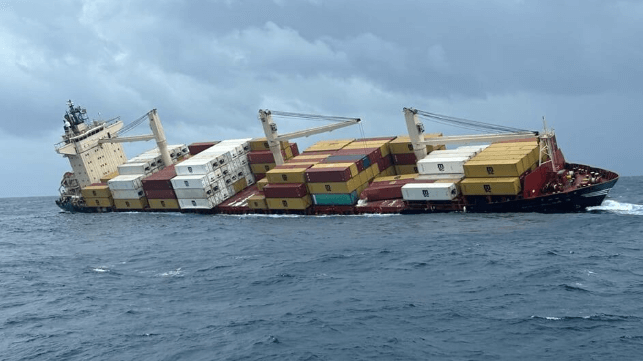
MSC Elsa 3, seen shortly before capsizing (Indian Coast Guard)

Published May 28, 2025 9:44 PM by The Maritime Executive


With monsoon season getting into full swing off India's southwest coast, salvors are gearing up to manage the risk of fuel and plastics pollution from the sunken boxship MSC Elsa 3, which went down off Kerala on May 25. So far, little if any of the boxship's bunker fuel has come ashore, but local sources report washed-up reefer containers and snowdrifts of white plastic pellets - the hallmark of a modern container ship casualty. 

On Saturday, the feeder MSC Elsa 3 was under way from Vizhinjam to Kochi with a cargo of 640 containers on board. It developed a severe list, and the crew abandoned ship in time to escape a capsizing. They were promptly rescued by the Indian Coast Guard and Indian Navy, and all survived.

MSC Elsa 3 went down with about 85 tonnes of diesel and 370 tonnes of fuel oil on board. The shipowner has hired T&T Salvage to mitigate the pollution risk and recover lost containers from the shoreline, and that effort is already under way, officials from the Mercantile Marine Department of Kochi (MMD) told media on Wednesday. 

According to the MMD, the vessel lost about 100 containers when it went down, and about 50 of them have washed up in and around the Kollam region. The ship is leaking a small quantity of fuel oil, and the Indian Coast Guard is applying dispersants to reduce the spread. 

The responders are planning to empty the fuel tanks of the wreck to reduce the risk of further pollution. The oil recovery operation is already under way, and the salvors hope to complete the work by July 3. Operations to clean up the wrecked containers on shore are also in progress and should be finished by the end of this week, the MMD said. 

The reports of raw plastic nurdles on the beach present a new hurdle. The tiny microscopic pellets are hard to clean up, and tend to intermingle with sand, sometimes reemerging months or years later. Birds and other wildlife often mistake the pellets for food and ingest them, along with any toxins that the pellets may have absorbed from the surrounding environment. The world's largest plastic spill, the release of 1,680 tonnes of nurdles off Sri Lanka in 2021, continues to pollute beaches and reefs near Colombo after years of cleanup. 


Dutch Safety Board Says Maritime Emergency Response Needs Overhaul

fire at sea
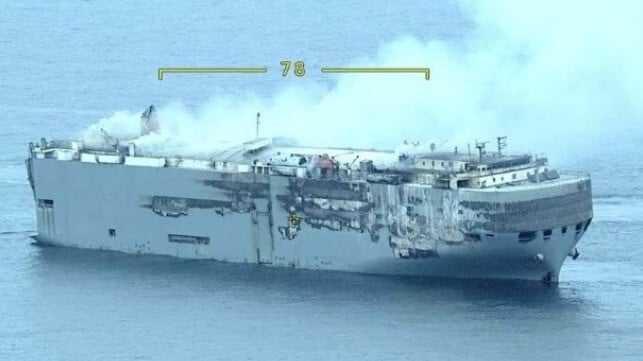
Dutch Safety Board cites the delayed and poorly organized response to the Fremantle Highway fire (Dutch Coastguard)

Published May 28, 2025 6:52 PM by The Maritime Executive


The Dutch Safety Board is calling for an overhaul of the systems used for responding to maritime emergencies. It completed a nearly two-year review of the response to the 2023 fire aboard the vehicle carrier Fremantle Highway pointing to a lack of training and coordination which contributed to a delayed response and the likely injury of several crewmembers aboard the vessel.

The report concludes that the emergency response system is not properly organized so calls are not properly prioritized and the different organizations are not working together in their response. They concluded that the vulnerabilities of the system only become apparent when there is a complex request for assistance that demands a coordinated response from multiple organizations.

The case of the Fremantle Highway was one of those complex requests. The failure of the system saw seven crewmembers feeling compelled to jump from the burning ship from heights of up to 30 meters (nearly 100 feet). The board concluded that the focus had remained for too long on firefighting rather than moving to search and rescue to evacuate the seafarers in a timely fashion. As a result, the crewmembers were trapped unable to reach safety and the lifeboats were rendered unusable. Six crewmembers jumped suffering injuries and a seventh also jumped despite a KNRM (Royal Netherlands Sea Rescue Institution) captain urging them not to jump due to the dangers. All the crewmembers were injured from jumping into the ocean and one later died of his injuries.

“The Dutch Safety Board has repeatedly pointed out in recent years that the Coastguard Center is insufficiently capable of assuming control when it needs to collaborate with other parties,” says Erica Bakkum, a member of the Dutch Safety Board. “It does not help that several ministries share administrative responsibility for the Coastguard. That setup makes it harder to take rapid action.”

The report of the fire aboard the Fremantle Highway was received just before midnight on July 25, 2023, but the board says “assistance was slow to materialize.” The priority was placed on firefighting without aerial support to determine the level of severity. It was not until 0200 that a Coastguard surveillance aircraft with thermal imaging reached the vessel and determined the full extent of the spread of the fire. The crew requested evacuation at 0230 but it took another 45 minutes for helicopters to reach the vessel.

The safety board in reviewing the timeline found that the helicopters assigned to pick up the specialized firefighting unit were left waiting in Rotterdam for over an hour and the team hesitated to board due to a lack of clarity on whether the fire could be safely engaged. The helicopters were sent to the vessel without the firefighting team.

A lack of communication and coordination also created onshore delays. Hospitals were not notified till shortly before the injured arrived. Ambulances had to wait outside the airport for 15 minutes because entry gates were locked. 

The board concludes that the lack of early aerial support directly contributed to the problems. It also says the decision-making process was bogged down by incomplete communications between the Coastguard and other agencies.

“The system for responding to incidents in the North Sea needs to be put in order as soon as possible,” the report concludes. The Safety Board is advocating for the appointment of a mandated director who can coordinate the necessary improvements in the response to emergencies. They are calling for the Ministries of Infrastructure and Water Management, Defense, and Justice and Security to work together to collectively put the emergency response system in order as quickly as possible.

Currently, the board says it is unclear which scenarios actually require the deployment of the maritime firefighting team. In the case of the Fremantle Highway, it concludes the situation involved an “undesirable degree of interference between the tasks of maritime firefighting and rescue.”

They are calling for establishing a digital exchange of information between the Coastguard Coordination Center and the others involved in the emergency response chain of command. The center’s assessment and decision-making processes, training, and exercises have to be linked and improved. They are also calling for clarifying which scenarios require firefighting versus rescue and applying an approach to address the potential for interference between the different teams’ deployment.