Tuesday, June 17, 2025

Gold mining companies in Ghana, Ivory Coast resist tax hikes
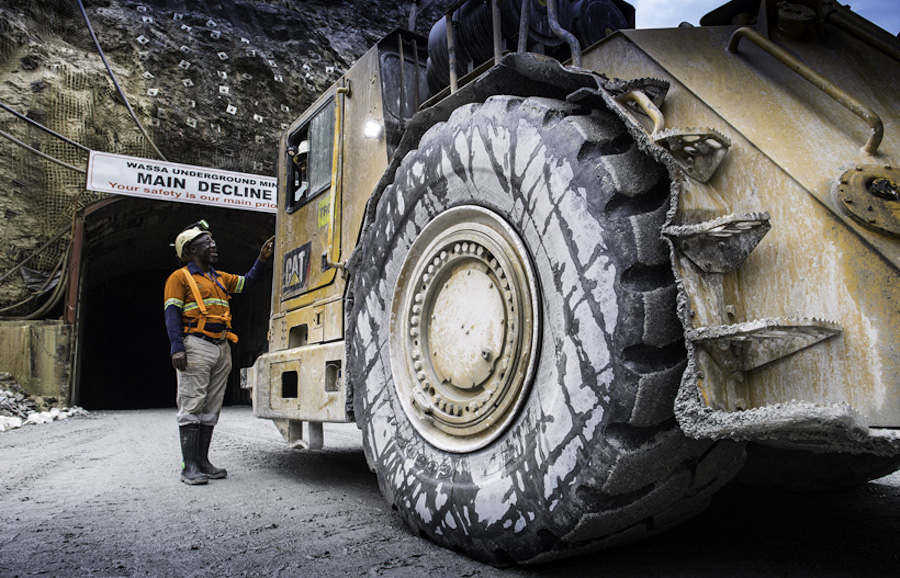

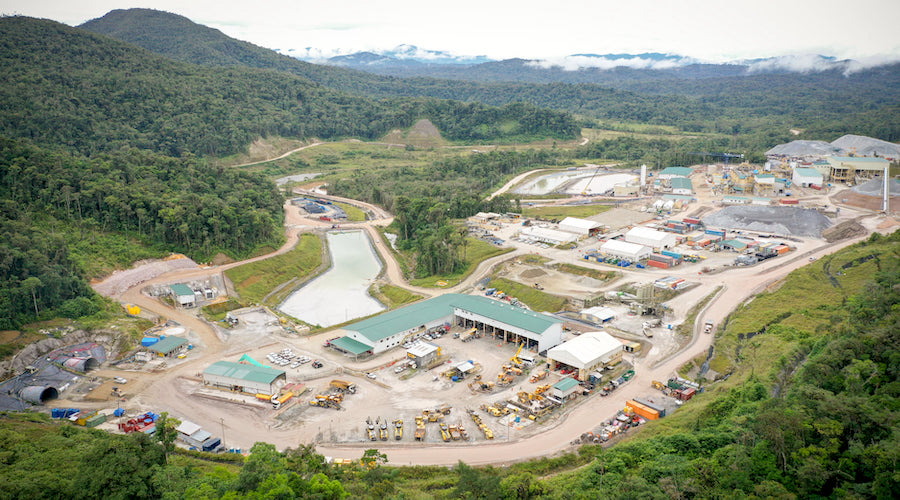
The Wassa mine. (Image courtesy of Golden Star Resources.)

Gold miners operating in Ghana and Ivory Coast are refusing to comply with tax increases imposed this year, saying the new regulations flout their existing licence agreements, industry sources told Reuters.

Countries across West Africa have been taking advantage of soaring gold prices to increase mining taxes and raise additional revenue to plug gaping budget deficits and ease high debt levels.

Mining companies in the region have mostly complied apart from in Ghana and Ivory Coast, Africa’s top and seventh biggest gold producers respectively, where companies say terms agreed when licenses were granted should be honoured by both parties to protect and spur investment, the six industry sources said.

Mining companies have agreed between themselves not to pay the extra taxes while they negotiate with the Ivory Coast and Ghana governments to repeal the hikes, according to the sources.

Producers in the two countries include Gold Fields, Newmont, AngloGold Ashanti, Barrick, Endeavour, Allied Gold and Perseus. They all declined to comment or did not respond to Reuters‘ requests for comment.

In January, Ivory Coast introduced a flat royalty tax of 8% of annual revenue, according to a document seen by Reuters, up from 3%-6% previously, depending on the miner’s contract.

Ghana, which has defaulted on its debt and is undergoing a debt restructuring, raised a tax on gold miners’ annual gross output to 3% in March, from 1%, after appealing to the companies to help it plug revenue gaps, said a source in the country’s finance ministry.

“If people have invested for the long term and you change the rules midway, it can affect the project. New rules can apply to new projects,” said an executive at a major international mining company operating in Ivory Coast, who asked not to be named.

The mines and finance ministries in Ghana and Ivory Coast did not respond to Reuters requests for comment.

Elsewhere in the region, military-ruled Burkina Faso introduced a sliding scale royalty regime in February, linking royalties to gold prices, which miners have largely complied with, two other sources familiar with the matter said.

Miners in Mali, Niger and Guinea have also been mostly complying with aggressive regulations introduced by new mining codes.

Ongoing negotiations

Gold prices have surged nearly 30% this year, driving up profits for gold miners in the first quarter, but sudden regulatory changes are a frequent obstacle to doing business in Africa.

Barrick has been in a two-year standoff with Mali’s military-ruled government over new mining legislation aimed at boosting state revenue, a dispute that has seen the Canadian miner’s Loulo-Gounkoto complex shut, executives detained and its share price plunge.

Barrick, which also has operations in Ivory Coast, did not respond to a Reuters request for comment.

Miners in Ivory Coast are currently holding talks with the mines and finance ministries to break the impasse over the new taxes, a mining executive said.

In Ghana, the companies under the Ghana Chamber of Mines have asked the government to reconsider its measures.

If talks fail, companies could face financial penalties for delayed tax payments if the governments insist on the tax increases. One mining company in Ghana, which did not want to be named, said the tax authority has the right to shut a company’s operations and impose penalties. The companies could also choose to sue if they can prove their contracts should be immune to tax hikes.

Denis Gyeyri, Africa senior program officer at the nonprofit Natural Resources Governance Institute, said governments are too quick to raise taxes when prices spike but don’t lower them when prices fall.

“Royalty rates should be progressive – compensating mines at low prices and maximizing government revenue at high prices,” Gyeyri said.

Countries should also keep their tax rates competitive, he said, pointing out that royalty rates for miners in Western Australia, for example, vary between 2.5% and 7.5% depending on the extent of processing.

(By Maxwell Akalaare Adombila, Loucoumane Coulibaly and Emmanuel Bruce; Editing by Veronica Brown and Susan Fenton)


 

Lithium startup eyes US battery plant to skirt Trump tariffs

Image from Pure Lithium.

US startup Pure Lithium Corp. is working on a testing facility to build a new type of lithium battery that’s completely manufactured domestically.

The company has developed a lithium metal battery that chief executive officer Emilie Bodoin says will displace lithium-ion batteries. Pure Lithium has spent the last four years doing research and development on the technology, which could be used in electric vehicles, utility-scale energy storage and other applications.

“We’re working as hard as we can to build a prototype pilot facility,” Bodoin said Tuesday in a Bloomberg Television interview. She added that the company is expanding its lithium production process and is integrating that into a manufacturing plant, “and as soon as we get it up and running we’re going to start getting these batteries out into the hands of US customers that need it.”

The Boston-based company’s move to build a pilot plant comes as President Donald Trump’s administration sets the stage for tariffs on imports of key battery components from China. Pure Lithium says it extracts lithium from brine to manufacture a battery free of graphite, nickel, cobalt and manganese, allowing it to be produced without any inputs from China.

The company received a letter of interest from the US Export-Import Bank in April for financing of as much as $300 million.

(By Elise Harris and Ed Ludlow)


Chevron joins oil majors in US lithium production push


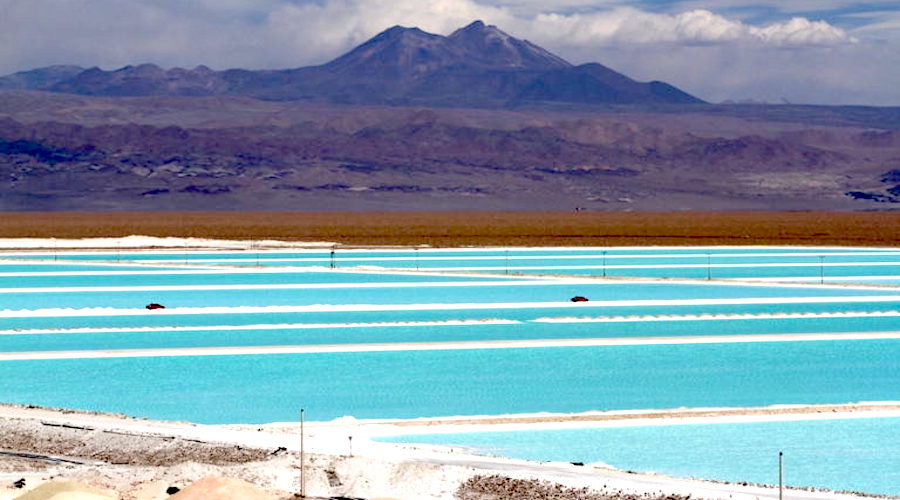
Lithium brines found in Chile’s Salar de Atacama contain the world’s highest known concentrations of lithium and potassium. (Image courtesy of SQM.)

Chevron USA, a subsidiary of Chevron Corporation (NYSE: CVX), became on Tuesday the latest oil major to enter the lithium market in the United States with the acquisition of lease rights to about 125,000 net acres in northeast Texas and southwest Arkansas.

The company secured the lithium-rich acreage from TerraVolta Resources and East Texas Natural Resources, but did not disclose financial details.

“This acquisition represents a strategic investment to support energy manufacturing and expand US-based critical mineral supplies,” Chevron New Energies president Jeff Gustavson said in a statement.

Chevron follows the lead of other major oil companies, such as ExxonMobil (NYSE: XOM), which entered the lithium space last year with a $100 million purchase of 485 square km of brine-rich acreage in the Smackover Formation from Galvanic Energy. ExxonMobil has since launched a pilot project and signed a preliminary agreement to supply lithium to SK On, a South Korean battery maker building plants in the US to serve Hyundai and Ford.

Occidental Petroleum is testing a joint venture with a Berkshire Hathaway (NYSE: BRK.B) unit to extract battery-grade lithium from geothermal brine at 10 power plants in California. Norway’s Equinor has partnered with Standard Lithium (TSX-V: SLI), which began operating a commercial-scale demonstration plant in Arkansas in December.

Brines preferred

These oil majors are leveraging their core expertise in subsurface exploration, drilling, and chemical processing to focus on direct lithium extraction (DLE) from brines, which shares operational similarities to conventional oil production.

DLE offers an alternative to traditional evaporation ponds, which remain the dominant technology in Chile, the world’s second-largest lithium producer.

Arcadium Lithium, acquired by Rio Tinto (ASX, LON: RIO) earlier this year, was the only company outside China with a commercial DLE operation, in Argentina’s Hombre Muerto region. Most brine operators, such as Albemarle (NYSE: ALB) and SQM (NYSE: SQM), still rely on evaporation methods.

One of the sites in Arkansas’ Columbia County where Exxon Mobil plans to extract lithium from brine reservoirs about 10,000 feet underground. (Image courtesy of Exxon Mobil.)

Oil fields repurposed for lithium extraction are a growing trend. In Alberta, Canada, E3 Lithium (TSX-V: ETL; US-OTC: EEMMF) is advancing its $2.5 billion Clearwater project, targeting depleted wells in the Leduc formation.

A recent prefeasibility study estimates production of 32,250 tonnes annually of lithium hydroxide monohydrate for 50 years. Imperial Oil (TSX: IMO), ExxonMobil’s Canadian arm, has invested C$6.4 million ($4.7M) in E3 for an equity stake of 4.3%

As energy giants pivot to green metals, their capital and expertise could fast-track the development of domestic lithium supply, offering a boost to a mining sector still reeling from investor pullback after recent price declines.


Ecuador reopens mining registry after seven-year freeze

Fruta del Norte became in 2020 Ecuador’s first large-scale modern gold mine. (Image courtesy of Lundin Gold | Facebook.)

Ecuador has reopened its mining concessions registry for the first time since January 2018, aiming to attract investment, streamline licensing, and crack down on illegal mining—a long-standing issue across the country.

The registry had been closed amid concerns about irregularities in the concession system. Since then, no new licences have been issued. Now, authorities including the ministries of environment, energy, and mines, have renewed power to identify illegal mining activities nationwide and can call in the police and armed forces when necessary.

Energy and Mines Minister Inés Manzano announced that new exploration applications and concessions will be accepted gradually. The process will begin in the third quarter of this year, starting with small-scale non-metallic mining, such as limestone and clay used in cement and ceramics. Small-scale metallic mining will follow in September. The registry will fully reopen to other types of mining at the start of 2026.

To secure a concession, applicants must show at least two years of mining experience, either nationally or internationally. The state-owned National Mining Company (Enami) will have first rights to apply.

In response to criticism from local groups, particularly the Confederation of Indigenous Nationalities of Ecuador (CONAIE), which represents around 10,000 communities, Manzano defended the policy. She said the government is focused on building a competitive and responsible mining sector that drives investment, improves local living conditions and ensures better use of natural resources.

“What we’re doing is the best thing for the country,” Manzano said. “It’s wealth that’s being illegally stolen.”

Lagging behind

Despite its mineral wealth – mainly copper, gold, and silver – Ecuador has fallen behind regional mining leaders like Chile and Peru. Development has been slowed by legal challenges and opposition from Indigenous groups. Last year, Ecuador’s mining exports exceeded $3 billion.

Illegal mining has spread across 19 of the country’s 24 provinces, with major hotspots in Esmeraldas, Imbabura and Azuay. Protected areas have also been impacted. International reports, including one from the US Department against Transnational Organized Crime (DTOC), have detailed corruption in the sector.

Investigative news outlet Mongabay found that 652 mining concessions were issued without proper procedures. It also reported a rise in unauthorized gold-processing plants and violence linked to criminal groups.

“Criminal organizations are reinvesting drug trafficking profits into this lucrative [illegal gold] trade, fuelling a violent struggle for territorial control,” Amazon Watch’s Sofía Jarrín said in a report on gold gangs published in September. 

President Daniel Noboa’s administration is considering new mining fees estimated to be able to generate $229 million a year, a move that has drawn criticism from the country’s mining chamber.

At least six large and medium-scale mining projects are set to begin operations over the next four years. These include CMOC Cangrejos gold projectSolGold’s (LON: SOLG) Cascabel copper-gold phase 1, and Solaris’ (TSX: SLS)(NYSE: SLSR) Warintza copper and molybdenum project. There is also SilverCorp (TSX: SVM) and Salazar’s (TSX-V: SRL) Curipamba-El Domo copper-gold venture and the expansion of The Mirador Norte copper mine, operated by Chinese-backed EcuaCorriente.

Ecuador expected to delay fee on mining, industry says

Construction of the Cascabel mine in Ecuador is seen starting in 2025. Credit: SolGold

Ecuador has indicated that it will consider delaying the implementation of a new mining fee estimated to generate $229 million annually, according to Rodrigo Darquea, vice president of the country’s mining chamber.

Darquea said he attended a meeting with Deputy Mining Minister Javier Subia on Thursday, in which officials asked the industry to request in writing that the charge be suspended while it’s discussed further. That decision still has to be formalized. The ministry didn’t respond to requests for comment.

“We expect a favorable reply to be able to talk with a suspended fee, which would reduce the stress and discomfort currently affecting investors, many of which have seen that they cannot continue in the country if it goes into effect,” Darquea said in a telephone interview.

Weekly talks between authorities, including the finance ministry, and industry representatives are expected to last a month. “We need legal security, we need clear rules,” Darquea said. “There is a lot of work to be done.”

The two sides need to “come up with something that makes sense,” Dan Vujcic, chief executive officer of Ecuador-focused Solgold Plc, said by telephone from Sydney. “Governments everywhere do things like this. The key thing is just education on how capital markets work.”

The fee was announced earlier this month as part of efforts to bolster oversight amid a surge in illegal mining and reduce deficits as President Daniel Noboa looks to comply with an International Monetary Fund agreement.

The measure — which would see mining regulator ARCOM’s budget this year jump 20-fold to $115 million — caught the industry off guard after the reelection of the market-friendly Noboa. In the meeting, company representatives argued that the fee would make Ecuador too expensive for exploration companies that lack cashflow.

Aurania Resources Ltd. estimates the fee would represent about 10 times the amount the Toronto-based company pays for its annual concession fees in Ecuador, according to a June 11 statement.

(By Stephan Kueffner)


Bolidt Selected as Cruise Refit Projects Surge

Bolidt
Bolidt renewed over 30 indoor and outdoor spaces on board Allure of the Seas

Published Jun 16, 2025 4:35 PM by The Maritime Executive


[By: Bolidt]

Bolidt, the resin-based decking and flooring specialist, has secured a record number of cruise refit projects in the past nine months as demand for its solutions ramps up ahead of a new cruise season.

Major operators including Carnival Cruise Line, Norwegian Cruise Line, and Royal Caribbean International have once again specified Bolidt’s industry-leading decking solutions and refit expertise as their vessels – some of the world’s largest – undergo preparations for the coming cruise season.

In one of the company’s most extensive-ever refit projects, Bolidt has renewed more than 30 indoor and outdoor spaces on board Royal Caribbean’s multi-award-winning Allure of the Seas. To prepare the 362-metre, 5,496-guest ship for its Mediterranean itineraries this year, a team of 150 Bolidt technicians carried out installations across decks 5 to 17, covering an area of around 18,000 m2.

On the 4,000-m2 pool deck, Bolidt installed its lightweight and hardwearing Bolideck® Future Teak, resurfacing existing installations, and fitting a new kids’ pool area with Bolideck® Select in various designs. It also repaired and re-sanded the 1,950-m2 jogging track, installing Bolideck® Future Teak and Select Soft on 115 balconies spanning 1,900 m2, and soundproofing a new 800-m2 extension to the solarium on Deck 15. In addition, ahead of installing Bolideck® Select across the 1,800-m2 sun deck, approx. 5mm of the existing surface was removed from the top layer using a diamond cutter to help with weight savings.

“While a typical refit takes two or three weeks to complete, this project was of such a scale that its duration amounted to 43 days in drydock, and a further 7 days at sea,” said Gerben Smit, Head of Operations, Global Maritime Division, Bolidt. “Yet thanks to close collaboration and a little over seven months of preparation, we brought the project to a successful conclusion.”

Allure of the Seas is one of nine Royal Caribbean ships Bolidt has refurbished since mid-2024 amid surging demand for the company’s solutions and refit expertise.

Meanwhile, the upgrade of 2975 m2 of decking on board Carnival Sunshine – one of five recent refit projects for Carnival – involved the challenge of removing all balcony teak to install an entirely new system, topped with Bolideck® Future Teak, from the steel up. The project commenced in voyage between Charleston and Marseille, and completed with full installation in drydock.

Bolidt recently completed refits aboard six Norwegian vessels – Bliss, Breakaway, Encore, Getaway, Star, and Sun – most notably renovating the Speedway go-kart tracks aboard Bliss and Encore with slip-resistant Boligrip® 1250, despite facing challenging weather conditions. For Marella Cruises’ Explorer and Discovery 2, the company refreshed a total of 6,500 m2 of decking, including the jogging track and sports court, with a combination of Bolideck® Future Teak, Select Hard, and Select Soft.

Bolidt has also refitted ships for AIDA Cruises, Celebrity Cruise Line, Holland America Line, MSC Cruises, and TUI Cruises in recent months.

“Bolidt solutions are now ubiquitous in the cruise industry, with Bolideck® Future Teak an especially popular choice thanks to its weight and durability,” commented Smit. “Operators also appreciate our capacity to manage entire projects as a one-stop shop offering production, logistics, and application services under one roof.”

The products and services herein described in this press release are not endorsed by The Maritime Executive.


Bolidt Acquires Boteka to Consolidate Leading Position in Cruise Industry

Bolidt
Pictured (l-r): Rientz-Willem Bol, CEO, Bolidt and Roberto Suarez, Boteka

Published Jun 15, 2025 8:15 PM by The Maritime Executive


[By: Bolidt]

Bolidt’s acquisition of prefabricated resin systems specialist Boteka signals continuing international growth as part of the ‘all-under-one-roof’ principle.

Bolidt has acquired a majority stake in Florida-based Boteka, in a move intended to consolidate Bolidt’s leading position in the global cruise industry.

As a specialist in prefabricated elements for cruise ships, Boteka has worked exclusively with Bolidt products during a 14-year relationship that has seen the two parties serve major operators including Norwegian Cruise Lines, Royal Caribbean Group, and Celebrity Cruises. The collaboration has covered both newbuild and retrofit projects.

In line with Bolidt’s ‘all-under-one-roof’ principle, the acquisition will allow the Dutch company to accelerate its development of custom-made solutions while enhancing its efficiency, planning, and flexibility in cruise ship projects. It also strengthens Bolidt’s presence in the United States and increases its manufacturing capacity with an additional production facility in Miami.

“We are delighted to welcome Boteka into the Bolidt Group as we move forward with our strategy for growth – expanding our portfolio to provide total solutions for our clients,” said Rientz-Willem Bol, CEO of Bolidt. “Boteka possesses considerable technical expertise and customer insight that can inspire our R&D efforts, further optimise internal processes, enhance employee learning, and provide added value for our global cruise clients.”

Under the terms of the expanded cooperation, Boteka will continue to develop prefabricated synthetic elements at the Miami production facility and oversee their installation, inspection, and measurement on board the vessel, while Bolidt remains exclusively responsible for sales activities.

The products and services herein described in this press release are not endorsed by The Maritime Executive.


Pacific Basin Enhances Operations and Crew Welfare with Inmarsat NexusWave

Inmarsat Maritime
Pacific Basin Shipping Limited to benefit from unparalleled speeds, unlimited data, and global coverage of NexusWave

Published Jun 16, 2025 4:40 PM by The Maritime Executive


[By: Inmarsat Maritime]

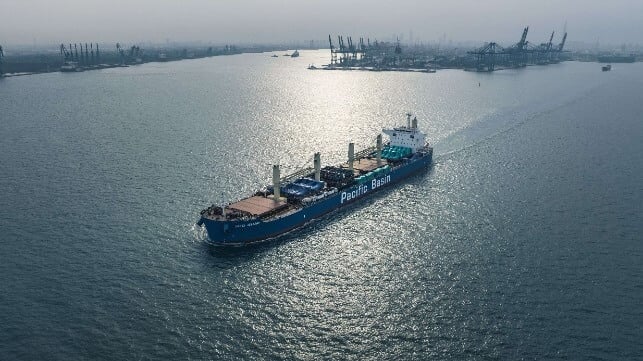
Inmarsat Maritime, a Viasat company, has signed an agreement with Pacific Basin Shipping Limited, one of the world’s leading dry bulk carrier owners, to install NexusWave fully managed bonded connectivity service on board an initial five ships.

Hong Kong-based Pacific Basin is prioritising enhancements to both crew and business communications aboard its growing fleet of geared Handysize and Supramax bulk carriers, as part of a connectivity and digitalisation strategy that also supports fuel efficiency and emissions reporting.

Through its unique network bonding technology, NexusWave ensures crew and business applications are always connected with the solution dynamically adjusting traffic routing to maintain a seamless experience. Pacific Basin will leverage the unparalleled speeds, unlimited data, and global coverage of NexusWave to enable uninterrupted ship–shore audio and video conferencing while providing seafarers with a consistent, home-like internet connection.

With unlimited data and the upcoming integration of the ViaSat-3 network, NexusWave provides confidence in enabling Pacific Basin's ambitious digitalisation strategy well into the future, supported by cost certainty. 

Samar Das, Head of Technical Procurement, Pacific Basin Shipping (HK) Ltd, commented: “We are excited to be among the first operators in dry bulk shipping to equip our ships with Inmarsat NexusWave. Our seafarers’ wellbeing is a top priority, and this service will optimise communications channels to secure the fastest available connection to their loved ones ashore. The capabilities of NexusWave also align closely with our expanding use of digital applications across our fleet for better decision-making and efficiencies.”

Recent real-world tests saw the fully managed service achieve download speeds of up to 330–340 megabits per second and upload speeds of up to 70–80 Mbps, while network availability on vessels exceeded 99.9%.

Justin Yi, Regional Director APAC Sales, Inmarsat Maritime, said: “Pacific Basin is a global force in dry bulk shipping and their commitment to NexusWave underscores their forward-thinking approach. By enhancing both crew and business communications, they are ultimately transforming their vessels into floating homes and offices. With NexusWave, operators like Pacific Basin can enjoy complete connected confidence, enabled by high speeds and availability, unlimited data, global coverage, and robust enterprise-grade security – all from a single, trusted maritime connectivity provider.”

The products and services herein described in this press release are not endorsed by The Maritime Executive.


Seamen’s Church Institute Celebrates at 2025 Silver Bell Awards Dinner

Seamen’s Church Institute
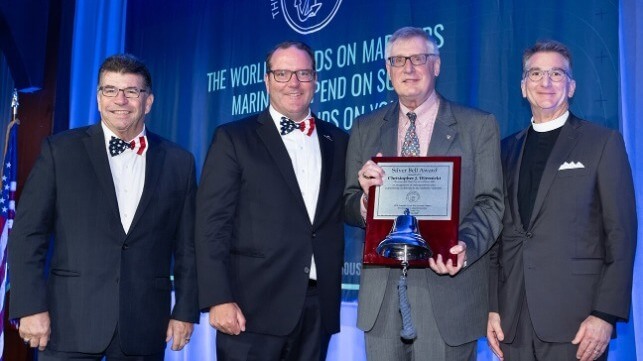
L to R: John D. (Jack) Noonan, B. Buckley McAllister, Esq., Christopher J. Wiernicki, Rev. Mark Nestlehutt

Published Jun 16, 2025 4:44 PM by The Maritime Executive


[By: Seamen’s Church Institute]

On Thursday, June 12, the Seamen’s Church Institute hosted the 47th Annual Silver Bell Awards Dinner at New York City’s Chelsea Piers. This year, the event honored Christopher J. Wiernicki, Chairman and Chief Executive Officer, American Bureau of Shipping, with the Silver Bell Award and Joseph E.M. Hughes, Chairman of Shipowners Claims Bureau, Inc.—Managers of the American P&I Club, with the Lifetime Achievement Award.

The Rev. Mark Nestlehutt, President and Executive Director of SCI remarked, “The Silver Bell is SCI’s opportunity to bring the maritime community together in celebration of our industry and in recognition of the vital contributions made by seafarers to global commerce. This year, we’re especially thrilled to honor two remarkable industry leaders, Chris and Joe, both long-time champions of SCI’s mission and tireless advocates for the seafarers we are privileged to serve.”

As is tradition for the Silver Bell event, the evening began with a parade of vessels on the Hudson River, blessed by the Rt. Rev. Matthew F. Heyd, Episcopal Bishop of New York, assisted by Suffragan Bishop Alan Shin. They were joined by the Rev. Kristin Kaulbach Miles from Trinity Church, NYC, and the Rev. James Kollin and the Rev. Dr. Bill Allport, SCI Chaplains. The Port Authority Police Department Pipes & Drums led the guests inside to dinner, where the United States Coast Guard Sector New York Color Guard opened the dinner by presenting the colors. The National Anthem was sung by the Quartet from the Choir of Trinity Church, NYC, who also closed the evening with the hymn Eternal Father, Strong to Save.

The 2025 Silver Bell Awards Dinner welcomed 600 guests and raised more than $770,000 to fund SCI’s efforts in supporting international seafarers and domestic mariners. The Rev. Nestlehutt expressed his gratitude, stating, “The Silver Bell is always a meaningful event for us, and we are thankful this evening for the guests, supporters, and sponsors who share our commitment, believe in our work, and gave generously to support our mission.” 

Since its founding in 1834, the Seamen’s Church Institute (SCI) has set the standard for mariner and seafarer support. SCI meets mariners wherever they are, standing shoulder-to-shoulder with the men and women of the maritime industry through their best days and their darkest hours. Although its roots are in the Episcopal Church, SCI welcomes all faiths and offers inclusive ministry and services. The organization fulfills its mission through four core focus areas: providing chaplaincy and crisis-support services to seafarers and mariners; offering cutting-edge simulator training and e-Learning for inland and Gulf Coast maritime professionals; conducting feasibility studies to improve vessel and operational safety; and delivering comprehensive advocacy—ranging from individual legal support to advising on national and international maritime policy. Grounded in the core values of compassion, dependability, and integrity, SCI remains firmly committed to supporting the people of maritime who sustain global commerce and industry.

The products and services herein described in this press release are not endorsed by The Maritime Executive.


Initiative Launched to Equip 10,000 Vessels for Weather Monitoring

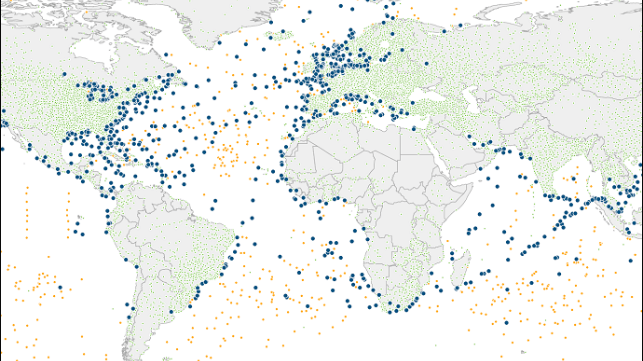
Weather data sources at sea: blue dots are reporting vessels, yellow dots are buoys (ECMWF)

Published Jun 16, 2025 12:46 PM by The Maritime Executive


A new initiative was launched last week, aimed at improving weather forecasting and ocean monitoring. The initiative - dubbed 10,000 Ships for the Ocean - aims to increase the number of vessels equipped for ocean and weather monitoring.

Although the ocean covers over 70% of the Earth, vast areas remain under-observed. Limited coverage means that there are critical knowledge gaps in some weather systems. The goal is to increase the current fleet of 2,000 ships to 10,000 commercial vessels providing real-time weather and surface ocean data. This will help to improve the accuracy of weather forecasts, early warning systems and climate monitoring.

The initiative is led by partners including the European Center for Medium-Range Weather Forecasts (ECMWF), UNESCO Intergovernmental Oceanographic Commission and the International Maritime Organization (IMO).

The Norwegian car carrier Höegh Autoliners is one of the shipping companies that have pledged support for the initiative. The company said that it would commit its fleet to the project as a contribution to expand ocean data, benefitting both society at large and maritime operations.

“This initiative will go some way to address the gap in weather measurements over the ocean. To give a context, we currently use 15 times less data from ships over the sea than from meteorological stations over land to predict weather worldwide. The more the data points we get, the more accurate our forecast will be,” said Florence Rabier, the Director General of ECMWF.

For centuries, ships at sea have been instrumental in monitoring the ocean and the atmosphere, contributing to science and marine safety. The initiative to scale ship-based observing infrastructure is part of a global reforms effort targeted at upgrading ocean monitoring.

The initiative complements an ongoing push to reform the Argo program, which is a critical pillar of the Global Ocean Observing System (GOOS) administered by the UN and the International Science Council (ISC). Launched in the early 2000s, the international Argo program provides real-time data on the temperature and salinity of the ocean up to 2,000 meters. This is made possible through a global network of 4,000 autonomous floats deployed across all oceans.

But as the ocean is undergoing changes, there is consensus in the scientific community for the Argo program to evolve. The goal is to expand the observational capabilities of the program by 2030, enabling comprehensive monitoring of the global ocean from the surface to the seabed. In addition, the program will broaden the range of physical and chemical parameters it monitors.

In the new phase of the Argo program, 1,200 new floats will be deployed to monitor the deep ocean down to 6,000 meters.