Tuesday, June 17, 2025

Banks Boost Fossil Fuel Financing for The First Time since 2021

The world’s biggest banks raised their combined financing for fossil fuels by more than one-fifth last year, bucking a falling trend since 2021 amid a backlash against net-zero policies, especially in the United States. 

The world’s top 65 banks increased fossil fuel funding to $869 billion in 2024, up by $162 billion from 2023, according to the 16th annual Banking on Climate Chaos (BOCC) report released by climate campaign organizations on Tuesday.  

Last year, loans were the top form of financing, rising to $467 billion from $422 billion in 2023. Bonds saw the largest increase to $401 billion, up from $284 billion, while acquisition financing also increased—to $82.9 billion from $63.7 billion.  
Since the Paris Agreement was signed a decade ago, banks have funded fossil fuels with $7.9 trillion, found the report co-published by Rainforest Action Network, BankTrack, the Center for Energy, Ecology, and Development, Indigenous Environmental Network, Oil Change International, Sierra Club, and Urgewald.

JP Morgan Chase remains the largest fossil fuel financier in the world for yet another year, committing $53.5 billion to fossil fuel companies in 2024. A total of four banks increased their fossil fuel financing by more than $10 billion. 

Moreover, the top 4 banks with the largest absolute increase are JP Morgan Chase, Citigroup, Bank of America, and Barclays.  

U.S. banks committed a total of $289 billion in fossil fuel financing in 2024, which represents one third of the global financing for the year. 

“Even in the face of worsening disasters and increasingly dire warnings of scientists and policy experts, banks actually increased their financing to fossil fuels between 2023 and 2024 and still poured billions into expanded fossil infrastructure,” said Allison Fajans-Turner, Policy Lead at Rainforest Action Network and co-author of the report. 

After years of scrutiny and blacklisting from Republican states in the U.S. and lawsuits from Republican attorney generals, North American banks and asset managers began quitting net-zero alliances en masse following President Donald Trump’s election victory. 

The top U.S. banks and four of Canada’s largest banks are no longer part of the Net-Zero Banking Alliance (NZBA), a group of leading global banks committed to aligning their lending, investment, and capital markets activities with net-zero greenhouse gas emissions by 2050.   

By Tsvetana Paraskova for Oilprice.com


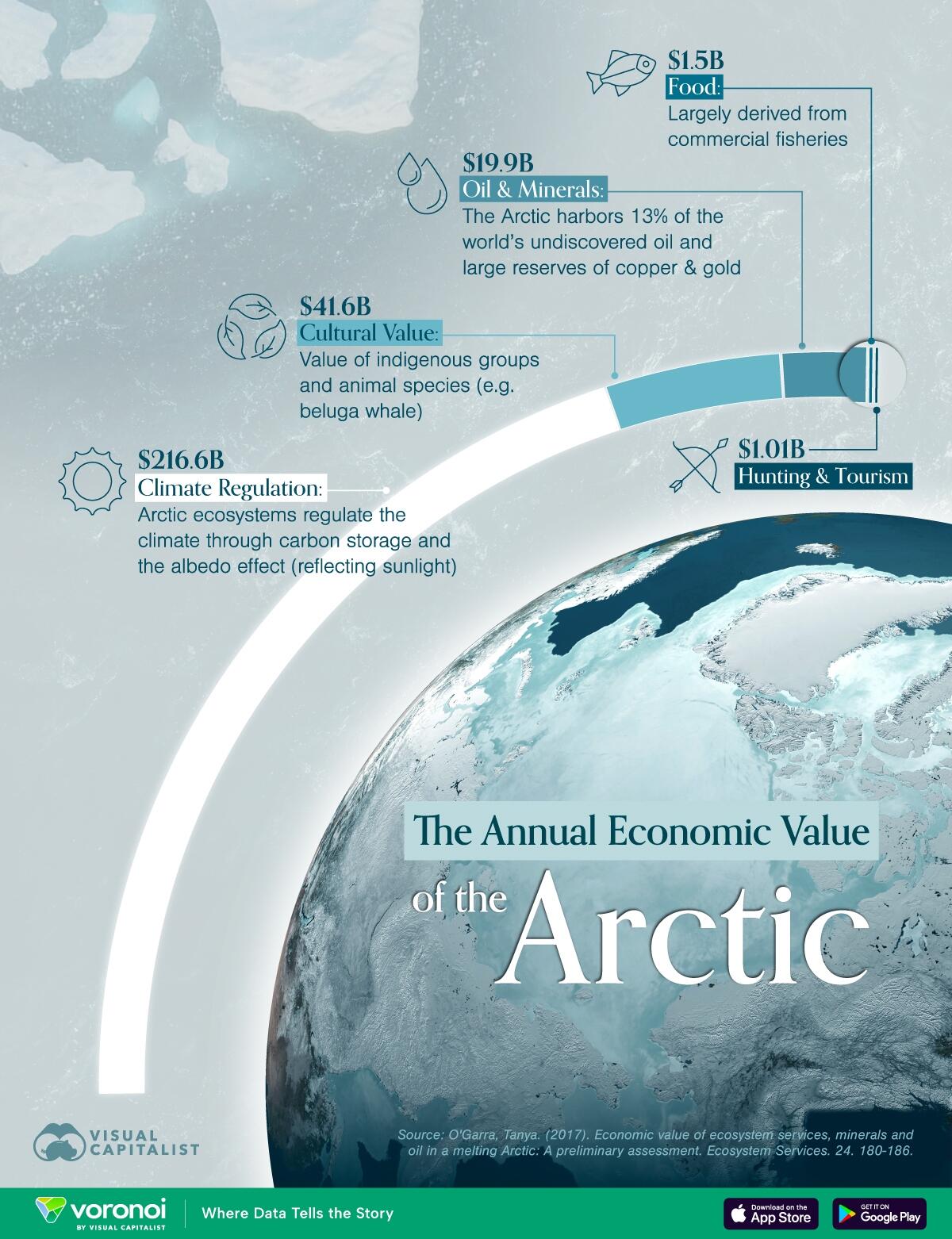
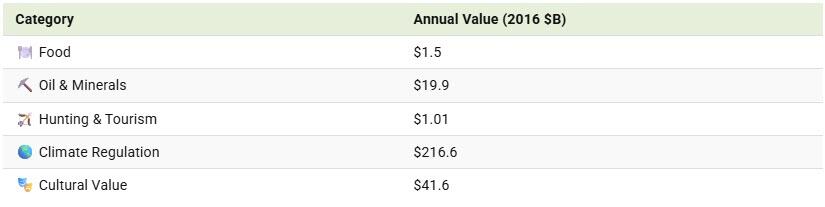
How Much Are the Arctic’s Oil and Mineral Resources Worth?

  • The Arctic holds significant economic value due to its natural resources and ecosystem services, which are becoming more accessible as ice melts.

  • Economic values of Arctic resources were estimated by analyzing biophysical data, market prices, and cultural significance.

  • Global warming is changing the Arctic's economic landscape, with both positive impacts like new shipping routes and negative impacts like increased pollution and geopolitical tension.

The Arctic is gaining global attention as melting ice unlocks access to vast natural resources. From “ecosystem services” like climate regulation to lucrative mineral and oil reserves, this chilly region’s economic value is surprisingly large.

In this graphic, Visual Capitalist's Marcus Lu breaks down the Arctic’s annual economic value based on the results of a 2017 study from Tanya O’Garra titled Economic Value of Ecosystem Services, Minerals, and Oil in a Melting Arctic.

Data and Methodology

The economic values of various Arctic resources were estimated using a combination of biophysical data and economic valuation techniques.

For climate regulation, the study assessed the Arctic’s role in carbon sequestration and its impact on global climate systems, assigning value based on the cost of carbon emissions and the benefits of climate stabilization.

Cultural values were evaluated through contingent valuation methods, which estimate individuals’ willingness to pay for the preservation of cultural and spiritual benefits associated with the Arctic environment.

The valuation of oil and minerals involved analyzing market prices, extraction costs, and the quantity of known reserves. Given the large variation in production costs for mining, it was assumed that 50% of mining revenue comprises costs.

Climate Change’s Impact on Economic Value

Global warming is expected to have varied effects on the Arctic’s economic value.

For example, retreating sea-ice could open up new shipping routes, fishing grounds, and areas for mineral exploration. On the flipside, increased resource extraction from the Arctic could also lead to more environmental disasters (e.g. pipeline leaks) and pollution.

Geopolitical competition is also ramping up in the region, as major economic powers like China, Russia, and the U.S. seek to secure shipping routes and resource access.

By Zerohedge.com


UK Aerospace Industry Avoids Tariffs in Trump-Starmer Trade Deal

  • A new trade deal between the UK and the US eliminates tariffs on the UK aerospace sector and provides relief for car manufacturers.

  • The agreement has been praised for protecting UK jobs, but concerns remain regarding steel tariffs, beef access, and potential tariffs on other goods.

  • Despite the deal, UK trade data shows a sharp drop in exports to the US, and economists warn of continued trade turmoil regardless of the agreement.

Prime Minister Keir Starmer and President Donald Trump met on the sidelines of the G7 summit to agree a trade deal that will remove tariffs on the UK aerospace sector and save carmakers from facing aggressive taxes on exports. 

The pair of world leaders heaped praise on one another while the UK government said the likes of Rolls Royce were set for a “huge win” while car manufacturers could “breathe a sigh of relief”. 

During the brief meeting in Western Canada, Trump claimed Starmer had “done what they haven’t been able to do” after years of post-Brexit negotiations

“The UK is very well protected. You know why? Because I like them – that’s their ultimate protection,” Trump told reporters. 

“The prime minister has done a great job. I want to just tell that to the people of the United Kingdom. He’s done a very, very good job.”

It was also revealed that the UK would continue to avoid 50 per cent tariffs on steel but a full tariff reduction has not yet been agreed as previously assured. 

In early May, the government declared:

“The UK steel industry – which was on the brink of collapse just weeks ago – will no longer face tariffs thanks to today’s deal. The Prime Minister negotiated the 25% tariff down to zero, meaning UK steelmakers can carry on exporting to the US.”

The UK will face a ten per cent tariff rate on a quota of car exports to the US, dodging a 27.5 per cent hit taken by other countries. 

The Office for National Statistics (ONS) last week said monthly trade data for UK exports to the US had seen the sharpest drop since records began as the UK’s total trade deficit with the world’s largest economy grew.

Trade deal hailed

Business and trade secretary Jonathan Reynolds hailed the deal as a lifeline for UK workers amid intensified global tensions. 

“We agreed this deal with the US to ensure jobs and livelihoods in some of our most vital sectors were protected, and since then we have been focused on delivering those benefits to businesses,” Reynolds said.  

“Bringing trade deals into force can take several months, yet we are delivering on the first set of agreements in a matter of weeks.”

The UK and US will also have reciprocal acciss to 13,000 metric tonnes of beef, an agreement that has received mixed reactions as the National Farmers Union suggests the inclusion of bioethanol in deals would put British farmers’ profit margins under risk. 

While the deal is seen as vital in removing tariffs by various business groups, exporters in the UK car industry and other sectors face higher tariffs than before Trump’s taxes on goods were first announced. 

A baseline ten per cent tariff on all other goods imported to the US could still come into effect in around a month. 

But Trump hinted at more trade deals being agreed, including with the European Union

Economists have suggested that the UK will stand to suffer from trade turmoil regardless of its latest trade deal, with all eyes on how Starmer’s European counterparts find an agreement with Trump. 

By City AM


U.S. Steel Tariffs Add Uncertainty to Global Economy

  • The European Union has expressed strong concern over the US decision to double tariffs on steel imports, warning of potential retaliatory measures.

  • The US has also threatened to impose tariffs on all imports from the EU, while considering exemptions for certain steel categories.

  • In addition to the steel tariffs, the EU has implemented tariffs on tinplate imports from China due to unfair trade practices and increased import volumes.

The European Commission (EC) has expressed concern about Donald Trump’s announcement of plans to double import tariffs on steel. The U.S. President proclaimed the new “Trump Tariffs” during a speech at US Steel’s Mon Valley-Irwin works in Pennsylvania on May 30.

“We strongly regret the announced increase of U.S. tariffs on steel imports from 25% to 50%,” the European Union’s executive body said in a May 31 statement. “This decision adds further uncertainty to the global economy and increases costs for consumers and businesses on both sides of the Atlantic.”

EC Says New Trump Tariffs Threaten Ongoing Negotiations

“We don’t want America’s future to be built with shoddy steel from Shanghai,” Trump said to steelworkers at the West Mifflin site, which sits just south of Pittsburgh. The President was in town to celebrate his approval of Japan’s Nippon Steel acquiring US Steel as a wholly owned subsidiary.

Meanwhile, news agencies report that the EC has threatened to accelerate retaliatory duties if the President goes through with the new Trump tariffs on aluminum and steel. EC Commissioner for Trade and Economic Security Maroš Šef?ovi? is also due to meet with U.S. Trade Representative Jamieson Greer in Paris on June 4.

“If no mutually acceptable solution is reached, both the existing and possible additional EU countermeasures will automatically take effect on July 14 or earlier, if circumstances require,” news agencies quoted EC spokesman Olof Gill as saying on June 2. He later added, “The commission has been clear at all times about its readiness to act in defense of EU interests, protecting our workers, consumers and industry.”

Exemptions May Be Necessary

Trump also threatened to impose an import tax of 50% on all imports from the EU from June 1, citing a lack of progress in talks with the 27-member bloc. After making the initial announcement on May 23, he later extended that to July 9.

While many market participants expressed concern over the tariffs, others have noted that steelmakers in the United States either do not produce finished products that match the quality of the material rolled in other countries, or do not produce certain types of steel products. Some sources note that this could potentially cause the U.S. to seek exemptions on entire categories of steel imports.

One analyst told MetalMiner that Chinese steelmakers have also invested at least $500 billion into modernization over the past 25 years, allowing them to produce higher-quality steels as well as downstream products.

EU Also Placing Tariffs on Chinese Tinplate Imports

Also last week, the EC implemented import tariffs of 13-63% on Chinese tinplate. “An anti-dumping investigation preceding the imposition of measures showed that imports of tinplate from China had been dumped on the EU market, which is worth €2.7 billion [$3.08 billion] annually, and were causing damage to EU tinplate producers,” the EC said in a May 28 announcement.

The EC initially announced an anti-dumping investigation on tinplate imports from China in May 2024, partly citing overcapacities.

“The influx of cheap tinplate imports from China has already had serious repercussions on EU tinplate producers. In particular, besides squeezing profit margins, it has resulted in reduced production volumes, capacity utilization, and market share, therefore causing severe injury to EU steelmakers,” the group stated.

According to the EC, “The EU industry lost a quarter of its sales volume from 2021 to 2023, whereas the market share of EU consumption taken by Chinese imports more than doubled in the same period.”

Tinplate Imports from China Recently Doubled

The International Tin Association also noted in January that tinplate imports from China rose 73% in 2023 and increased again in 2024, approximately doubling the proportion of tinplate imports from China. This fact, combined with the pressure from the Trump tariffs, signals that the EC still has a lot of work to do.

Besides its primary application as packaging for food and beverages, tinplate is also used in chemical and aerosol storage. Other applications for tinplate are in the electronics sector, such as shielding from electromagnetic interference or housing batteries to protect them from corrosion.

Tinplate has also found some use in the automotive sector for light structural parts that need corrosion resistance.

By Christopher Rivituso 


Blockades Loom Again as Libya Seeks Global Oil Investment

  • Libya aims to boost oil production to 2 million bpd by 2028, with new bidding rounds attracting major global energy firms.

  • Rising political instability, including the recent assassination of a militia leader, threatens new oil blockades and production disruption.

  • Eastern-backed forces may challenge Tripoli’s control over oil revenues, risking a repeat of costly shutdowns unless a revenue-sharing deal is reached.


Given that around 97% of its government revenues come from oil, it might seem obvious to all Libya’s principal factions that increasing production is a very good idea. There is plenty of scope to do so, as before the removal of long-time leader Muammar Gaddafi in 2011 it had easily been able to produce around 1.65 million bpd of predominantly high-quality light, sweet crude oil. Additionally positive back then was that production had been on a rising trend, up from about 1.4 million bpd in 2000. Further increases were on the horizon to push output close to the circa-3 million bpd achieved in the late 1960s, with the National Oil Corporation (NOC) planning to roll out enhanced oil recovery techniques at maturing oil fields to that effect. Up until very recently, new plans were progressing well from the ‘Strategic Programs Office’ (SPO) to boost oil production from the current 1.4 million bpd level up to 1.6 million bpd within a year or so and then to 2 million bpd by 2028/29. However, rising political unrest again threatens not only to derail this process but also to see the imposition of widespread blockades on Libya’s existing oil output as well.

At the beginning of this year, oil minister Khalifa Abdulsadek stated that the country still required US$3-4 billion to reach the 2026/27 1.6 million bpd production target. Towards this end, early March saw Libya announce plans to launch its first oil exploration bidding round in over 17 years, with 22 areas up for grabs across the country, which still has 48 billion barrels of proved crude oil reserves in place -- the largest in Africa. These include major sites in the Sirte, Murzuq, and Ghadamis basins as well as in the offshore Mediterranean region. According to an update from the Oil Ministry in the middle of last month, the bidding had already attracted more than 40 applicants, including some of the world’s biggest and most technologically advanced oil firms. U.S. supermajor ConocoPhillips is one firm that has voiced its interest in expanding its operations in Libya, in which it currently runs the Waha concession. Other interest is likely to come from major firms from Europe, for which Libya has become one country targeted to substitute for lost supplies from Russia due to sanctions resulting from its 2022 invasion of Ukraine, as analysed in full in my latest book on the new global oil market order. These may well include Italy’s Eni, Spain’s Repsol, Austria’s OMV, and the U.K.’s BP, OilPrice.com has been told by sources close to the bidding process. Each of these firms were quick to resume exploration activities in Libya following blockades last August that halted around 700,000 bpd of oil production, despite a 10-year hiatus in their activities beforehand.

That said, it may be that their patience will be tested again very soon as the possibility of new blockades rises sharply following the 12 May assassination of Abdul Ghani al-Kiklii – a militia leader and head of the Presidential Council-affiliated Stability Support Apparatus (SSA). According to a source who works closely with U.S. diplomatic initiatives in the country, spoken to by OilPrice.com last week, al-Kiklii was specifically targeted as retaliation for the shooting of Salaheddin Elnajih, chairman of the Libyan Post Telecommunications and Information Technology Company and an appointee of the Tripoli-based Government of National Unity (GNU) Prime Minister, Abdulhamid Dbeibah. The GNU is the successor to the previous Government of National Accord (GNA). More broadly, the killing has been seen by rival factions as part of ongoing manoeuvres by Dbeibah and his supporters to consolidate his power through the elimination of key rivals in his main opposition groups. Following all this, it remains to be seen precisely how these opposition groups will react, but it is unlikely to portend well for the GNU government’s plans to boost oil production.

One group in particular may believe that the timing is right to launch another major offensive, political, economic and/or military, against the GNU, and this is Libya’s alternative government – the Government of National Stability (GNS), based in the east – which in turn is backed by Khalifa Haftar, the leader of the Libyan National Army. Early signs of trouble ahead was a report on 28 May that the NOC’s headquarters in the GNU-controlled Tripoli had been stormed by gunmen, although the NOC later bizarrely said that this had only been “a limited personal dispute”. Nonetheless, shortly after the GNS’s Haftar threatened to declare blockades of key Libyan oil fields again due to such attacks on institutions such as the NOC and suggested that its headquarters be moved into the eastern area – controlled by the GNS and his army – which would be “safe”. He has made it clear since an agreement signed on 18 September 2020 that there can be no reconciliation in Libya between the opposing GNU and GNS governments so long as there is no sustainable equitable way for the country’s oil revenues to be distributed between the rival groups.

More specifically, at the time of signing the 2020 agreement that ended an economically devastating series of oil blockades across Libya, Haftar and his opposite number from the then-GNA at the signing, Ahmed Maiteeq, made an in-principle agreement to look into establishing a commission not only to determine how oil revenues across Libya are distributed but also to consider the implementation of several measures designed to stabilise the country’s perilous financial position. The blockade from 18 January to 18 September cost the country at least US$9.8 billion in lost hydrocarbons revenues. Key to this tentative agreement was the formation of a joint technical committee, which would – according to the official statement: “Oversee oil revenues and ensure the fair distribution of resources… and control the implementation of the terms of the agreement during the next three months, provided that its work is evaluated at the end of the 2020 and a plan is defined for the next year.” In order to address the fact that the then-GNA – and now GNU -- effectively held sway over the NOC and, by extension, the Central Bank of Libya (in which the revenues are physically held), the committee would also “prepare a unified budget that meets the needs of each party… and the reconciliation of any dispute over budget allocations… and will require the Central Bank [in Tripoli] to cover the monthly or quarterly payments approved in the budget without any delay, and as soon as the joint technical committee requests the transfer.”

Due to the influence of various domestic and international disruptive elements – notably Russia – since that idea was mooted it has never been properly implemented. However, there is still hope from several quarters – including the U.S. and U.N. – that such a deal could work well, and indeed that it might still be able to solve the ongoing impasse over the country’s oil and gas revenues. In the meantime and in the absence of such a deal, it looks highly likely that Libya will remain subject to further oil blockades and shutdowns as part of the ongoing struggle its warring factions for control over Libya’s oil resources.

By Simon Watkins for Oilprice.com


Somaliland’s Rising Strategic Role in U.S. Oil and Military Policy

  • Somaliland is gaining strategic importance in U.S. oil and military policy.

  • Somaliland offers a stable base near Red Sea chokepoints amid rising tensions with Iran and China’s influence in Djibouti.

  • Somaliland also holds major untapped oil potential, attracting international interest despite ongoing security concerns and political sensitivities.


Oil bulls have finally found some relief as crude prices rallied to multi-month highs, driven by escalating tensions between Israel and Iran, which continue to trade attacks in one of the region's most volatile periods in recent years. As of Tuesday morning, Brent crude for August delivery had surged $9 from a week earlier to reach $75 per barrel, with WTI following suit. 

Prices, which had remained under pressure much of the year due to concerns over oversupply and flagging demand, are now being buoyed by the specter of widening geopolitical instability, even in the absence of major supply disruptions.

Much of the market's anxiety centers on potential threats to the Strait of Hormuz and Red Sea shipping routes, both of which are critical chokepoints for global oil flows. Recent negotiations have aimed to reduce the risk of major disruptions, but traders remain on edge.

Amid these uncertainties, a lesser-known but strategically vital player has begun to attract growing attention: Somaliland.

In April, U.S. forces reportedly used Somaliland's coastline as a staging area for operations targeting Houthi positions in Yemen. Somaliland, a self-declared republic of around 5 million people in the Horn of Africa, has maintained relative stability for over three decades, complete with functioning institutions and regular democratic elections. However, it remains unrecognized internationally, as Washington has long adhered to a "one Somalia" policy. That stance may be shifting, with some policymakers in Washington reportedly contemplating a change.

One influential policy blueprint, Project 2025, advanced by the Trump administration, suggests that formal recognition of Somaliland could serve as a hedge against growing Chinese influence in neighboring Djibouti. Djibouti hosts the only permanent U.S. military base on the African continent but has also become a key node in China’s Belt and Road Initiative, hosting Beijing’s first overseas military base. Its location at the Bab-el-Mandeb Strait makes it a prized maritime asset.

"The U.S. and other international partners may soon have to rethink their stance on Somalia," Somaliland’s new president, Abdirahman Mohamed Abdullahi, recently told The Guardian. "We are a partner in security, in counter-terrorism, and in ensuring safe marine routes for global commerce," he added. There is also speculation that Somaliland's recognition may come before 2028 as the Trump administration recalibrates its Africa policy.

Recognition could have far-reaching implications beyond geopolitics. The United Arab Emirates, through DP World, has invested over $400 million to modernize Berbera Port, which includes constructing a highway connecting Somaliland to landlocked Ethiopia. Ethiopia, in turn, has signed a memorandum of understanding that some analysts believe signals its willingness to recognize Somaliland’s independence—a move that has triggered diplomatic tensions with Somalia and Egypt, who oppose Ethiopia’s Grand Ethiopian Renaissance Dam project.

Beyond its strategic location, Somaliland's untapped hydrocarbon potential has also caught the attention of international investors. Norwegian firm TGS previously estimated that the Somali basin—which encompasses parts of Somaliland’s onshore and offshore territories—could hold up to 30 billion barrels of oil. However, exploration efforts remain hampered by regional instability and security concerns. British-Turkish firm Genel Energy acquired exploration rights back in 2012 but has faced setbacks and been forced to suspend activities in certain areas due to emerging threats.

As global supply chains grow increasingly fragile, the international community may find itself compelled to reconsider Somaliland’s status—not merely as a diplomatic footnote, but as a critical node in securing oil flows and countering rising instability in some of the world’s most volatile regions.

By Alex Kimani for Oilprice.com


Can Canada Replace Russia as an Oil and Gas Superpower?

  • While Canada holds significant oil and natural gas reserves, it currently produces substantially less than Russia, making a full replacement challenging.

  • Canada's energy sector faces regulatory hurdles that hinder its ability to rapidly increase production and exports to meet global demand.

  • Despite having the resources, Canada's infrastructure and government policies need adjustments to compete with established energy exporting countries like Russia and the United States.

“G7 members must fully ban imports of Russian energy – oil, coal, natural gas, uranium. Canada, with the world’s fifth-largest oil reserves and as a top-three uranium producer, can help fill the gap.” The statement was made this week by the head of the G7 research group, a University of Toronto political science professor. 

But can Canada really replace Russia entirely on the global energy scene? That might be tough.

Both Russia and Canada are in the top five oil producers globally. Russia is third, and Canada is fourth, with the top two places occupied by, respectively, the United States and Saudi Arabia. Russia produces over 9 million barrels daily—and can produce more than 10 million bpd without major effort—and Canada produces around 5 million barrels daily.

That’s already reason enough to take John Kirton’s statement with some skepticism—it is physically impossible for a country that produces 5 million barrels daily to replace one that produces almost twice that amount. This is an interesting state of affairs because Canada certainly has the resources to do that: it ranks third in the world in terms of oil reserves, with 171 billion barrels, most of those in the oil sands. Russia, in comparison, has less than half that, at some 80 billion barrels. Yet there is also the matter of politics and prices—and whether Canada can ramp up production to match Russia’s, hypothetically. 

Canada is notorious for its red tape in the energy industry. Several consecutive liberal governments have done their best to stifle the industry with ever more environmental requirements that have added to producers’ costs and made it more difficult for them to do business overall. And yet Canada has been producing more, and not less oil, despite the tightening regulatory grip. So, there is plenty of demand out there—especially south of the border.

Canada exports most of its crude to neighbor U.S. There are sound reasons for that, and the biggest and simplest of them is geography. Moving oil from Canada to the United States is simple geographically and makes sense economically, so that’s where almost all of Canada’s oil has been going, until recently when authorities in Ottawa decided some diversification might be a good idea. The main diversification direction is Asia. Europe does not import crude from Canada—yet. Neither does Japan—but it can import Canadian LNG gladly.

So, replacing Russia as an oil supplier to the G7, although certainly possible in terms of reserves, would be challenging in terms of implementation because first, Canada would need to boost production rather sharply, and to do that, the government would have to give up its net-zero plans that envisage ever-tightening regulations for the energy industry.

In natural gas, the situation is similar, although this time, the reserve scales are tipped in Russia’s favor. The country has the largest reserves in the world, followed by Iran, Qatar, the United States, and Saudi Arabia. Canada is not in the top 10, but this is not the most important factor when it comes to exports. The most important factor is the presence of export infrastructure. Russia has half a dozen functioning—albeit sanctioned—LNG plants and is building more. Canada is yet to complete its first one. And it will need more to become an international gas player—where it would have to compete with the world’s top LNG exporter, neighbor U.S.

So, while Canada certainly has the natural resources to become a force to be reckoned with on the global stage, turning these resources into exports that could replace one of the established top players in that state would be tricky due to government policies. It will also take time. Ignoring this serves no one’s interest, especially not the interests of the G7.

By Irina Slav for Oilprice.com