It’s possible that I shall make an ass of myself. But in that case one can always get out of it with a little dialectic. I have, of course, so worded my proposition as to be right either way (K.Marx, Letter to F.Engels on the Indian Mutiny)
Tuesday, June 17, 2025
BBB
Trump tax bill would widen deficits by US$2.8 trillion after factoring in economic impacts, CBO says
WASHINGTON — U.S. President Donald Trump’s tax and budget bill would increase deficits by US$2.8 trillion over the next decade after including other economic effects, according to a more fulsome analysis of the measure released Tuesday by the Congressional Budget Office.
The report, produced by the nonpartisan CBO and the Joint Committee on Taxation, factors in expected debt service costs and finds that the bill would increase interest rates and boost interest payments on the baseline projection of federal debt by US$441 billion.
Tuesday’s report uses dynamic analysis by estimating the budgetary impact of the tax bill by considering how changes in the economy might affect revenues and spending. This is in contrast to static scoring, which presumes all other economic factors stay constant.
The CBO released its static scoring analysis earlier this month, estimating that Trump’s bill would unleash trillions in tax cuts and slash spending, but also increase deficits by US$2.4 trillion over the decade and leave some 10.9 million more people without health insurance.
Marc Goldwein, senior vice president and senior policy director for the Committee for a Responsible Federal Budget, said Tuesday on social media that considering the new dynamic analysis, “It’s not only not paying for all of itself, it’s not paying for any of itself.”
The analysis comes at a crucial moment as Trump is pushing Congress, where Republicans have majority control, to send the final product to his desk to become law by the Fourth of July. Treasury Secretary Scott Bessent and other Republicans have sought to discredit the CBO, saying the organization isn’t giving enough credit to the economic growth the bill will create.
Republicans on the Senate Finance Committee unveiled a proposal Monday for deeper Medicaid cuts, including new work requirements for parents of teens, as a way to offset the costs of making Trump’s tax breaks more permanent in draft legislation unveiled for his self-described big, beautiful bill.
The first House proposal on the new Medicaid work requirement exempted parents with dependents. But the Senate’s version broadened the requirement to include parents of children older than 14, as part of their effort to combat waste in the program and push personal responsibility.Latest news & updates on tariffs and the trade war here
The proposals from Republicans keep in place the current US$10,000 deduction of state and local taxes, called SALT, drawing quick blowback from GOP lawmakers from New York and other high-tax states, who fought for a US$40,000 cap in the House-passed bill. Senators insisted negotiations continue.
Bessent said Tuesday that the Senate Republican proposal for the tax cuts bill “will deliver the permanence and certainty both individual taxpayers and businesses alike are looking for, driving growth and unleashing the American economy.”
“We look forward to continuing to work with the Senate and the House to further refine this bill and get it to President Trump’s desk,” he said in a news release.
The CBO separately released another analysis on the tax bill last week, including a look at how the measure would affect households based on income distribution. It estimates the bill would cost the poorest Americans roughly US$1,600 a year while increasing the income of the wealthiest households by an average of US$12,000 annually.
---
Fatima Hussein And Lisa Mascaro, The Associated Press
Survey finds most Canadians don’t think they will ever be able to retire
A person walks up a set of stairs in this undated stock image. (Shutterstock)
As Canada’s population continues to age, an increasing number of Canadians are examining their finances and weighing retirement options, but a majority of those who have yet to retire don’t believe they will ever be able to, according to a new survey.
On Tuesday, the Healthcare of Ontario Pension Plan (HOOPP), in partnership with Abacus Data, released the findings of its seventh annual Canadian Retirement Survey, which was conducted in April.
The survey found that among unretired respondents, 59 per cent believe they will never be in a financial position to retire, while 66 per cent believe they’ll need to continue working even if they do retire to support themselves financially.
Many Canadians simply don’t have the means to save for retirement, the survey found. Sixty per cent of respondents reported having no disposable income, with all the money they earn going directly to necessities.
The survey also found that 49 per cent of respondents had not set aside any money for retirement in the past year, while 39 per cent reported having never saved for retirement.
Canadians’ inability to save for retirement is due to a variety of factors including day-to-day living costs, economic uncertainty, inflation, housing affordability and cuts to government healthcare services, according to the survey respondents.
Fifty-five per cent of Canadians described their financial situation as living paycheque to paycheque, up from 48 per cent in the same survey in 2023.
Homeownership
Amongst unretired people, the survey found that there was a stark difference when it came to saving for retirement between those that owned their home and those that didn’t.
It found that 71 per cent of homeowners had set aside money for retirement at some point, compared to only 36 per cent of non-homeowners, the majority of whom reported having never done so.
Sixty-two per cent of survey respondents said they viewed homeownership as a “key part” of their retirement strategy, and half of unretired homeowners plan to set themselves up for retirement by selling their property, according to the survey.
But for those who have yet to retire and currently have a mortgage, the survey found that 65 per cent of them are worried about their ability to pay it off so they can retire when they plan to. That’s up from 51 per cent in 2024 and 45 per cent in 2023.
The survey also found that 66 per cent of mortgage holders have either seen their mortgage payments rise in the last year or expect them to in the next 12 months.
The vast majority of non-homeowners – 84 per cent – worry about the rising cost of rent, and for 66 per cent of them, paying rent is their top financial priority. Geopolitics and Canada-U.S. relations
The survey found that Canadians are also concerned about the ongoing trade war with the U.S. and global geopolitical instability.
Sixty-seven per cent of respondents said they were “very concerned” with the state of U.S.-Canada relations. Concern over the impact of the trade war between the two countries is highest amongst seniors, but was also one of the top economic worries for Canadians aged 55 to 64.
The implications of U.S. tariffs and prolonged global conflicts have also changed how some Canadians are managing their finances. The survey found that 22 per cent of respondents were putting aside more savings as a result of geopolitical instability.
“When Canadians are feeling even more uncertain about the future as they are now, pensions can offer more certainty about the future,” said David Coletto.
“Policy makers and employers should be taking a closer look at this now, more than ever.”
Methodology
Findings are based on an online survey of 2,000 Canadians aged 18 and older from April 11 to 16, 2025. A random sample of panelists was invited to complete the survey from a set of partner panels based on the Lucid exchange platform.
These partners typically use double opt-in survey panels, blended to reduce potential skews in the data from a single source.
The margin of error for a comparable probability-based random sample of the same size is +/- 2.19%, 19 times out of 20. The margin of error will be larger for data that is based on sub-groups of the total sample.
“The ‘go it alone’ approach seems very implausible because the market didn’t like that approach before the offer,” Cole Smead, CEO and portfolio manager of Smead Capital Management, told BNN Bloomberg in a Tuesday interview.
“(Investors) were effectively trading MEG like they had something wrong… their capital allocation overall, we don’t disagree with, and we think the management did a really good job. The difference though is they don’t have an anchor shareholder, a large capital allocator like Adam Waterous.”
Waterous is managing partner and CEO of Waterous Energy Fund, which owns Calgary-based Strathcona, one of the fastest growing oil companies in North America that has pursued a number of mergers and acquisitions (M&A) in recent years.
“Ultimately, when I went through (MEG Energy’s) rejection proposal they provided yesterday to shareholders, going through that deck it just says one thing: ‘If you’d like to provide us a better offer, please come with it and we will discuss it,’” Smead said.
Strathcona’s unsolicited takeover offer valued MEG at nearly $6 billion, a number MEG said was inadequate. Despite rejecting the offer, MEG’s board announced it would be launching a strategic review to explore alternatives to its current business model.
“They’re up for sale, there’s no doubt about that, the question is at what price and who’s the buyer, and in our opinion, we just don’t see another buyer out there,” said Smead.
As Canadian energy suppliers face an unprecedented demand to power artificial intelligence (AI) and data centres, an expert says new technologies can reduce electrical waste.
“We waste as a country, 50 per cent of the energy we produce,” said Emily Heitman, president of Schneider Electric Canada, in an interview with BNN Bloomberg on Tuesday.
“With digital technology coming alongside electrical equipment in your home, building and factory and the onset of AI, we can now real time monitor and manage the electrical usage that’s being utilized throughout the entire system of that building.”
Schneider Electric Canada is a subsidiary of French power-equipment manufacturer, Schneider Electric SE. It helps customers, such as homeowners and building owners, manage and improve energy efficiency and resiliency.
“A good example would be an airport running the HVAC system at night when there is nobody in the section of the airport or a machine idling in a factory in the middle of the night when there’s no production going on,” said Heitman. “These are great examples of where energy is wasted every single day in practical applications.”
According to the International Energy Agency, data centres consumed an estimated 460 terawatt-hours (TWh) globally, or roughly 1.4 to 1.7 per cent of global electricity in 2022. That amount of energy is about 71 per cent of Canada’s electricity generation that same year and the agency projects global data centre energy consumption will double by the end of 2026.
“We like to say: ‘We don’t make energy, but we help our customers manage the energy that they’re utilizing,’” said Heitman.
Heitman acknowledged the conversation around energy use and production has ramped up in Canada in recent months considering the ever-changing geopolitical and trade environment.
After the U.S. placed blanket tariffs on Canadian imports earlier this year, Ontario Premier Doug Ford briefly introduced a 25 per cent levy on U.S.-bound electricity exports as an initial retaliatory measure. Ford suspended the levy after a meeting with U.S. Commerce Secretary Howard Lutnick in Washington.
“It is our plan to say: ‘Let’s produce as much as we can in Canada, strengthen the global supply chains we have and make sure we’re still serving our customers effectively no matter what is going on in the uncertainty of our geopolitical situation,’” Heitman said.Latest updates on investing here
The company is expanding its production capacity in Quebec by 30 per cent and adding 70 new employees to meet the rising demand for electricity, driven by AI and digital technology.
“We make switchboards, from panel boards to all types of electrical equipment for low voltage and medium voltage applications that are both produced in Quebec but also shipped across Canada for electrical distribution in this country,” said Heitman.
An airplane stands in the hangar during the official launching ceremony of the Airbus A330-200 cargo airplane by the European Air Transport Leipzig GmbH (EAT) at the European DHL Express air freight hub in Schkeuditz near Leipzig, Germany, Friday, Oct. 12, 2018. (AP Photo/Jens Meyer)
DHL Express Canada says it will shut down operations across the country amid a strike and lockout involving 2,100 truck drivers and other workers.
With the two sides at an impasse, the company says it will halt parcel deliveries starting June 20, the day federal legislation banning replacement workers takes full effect. Inbound packages to Canada will cease on Tuesday night.
On June 8, the German-owned carrier said it was rolling out a “contingency plan” that allowed it to keep serving its more than 50,000 customers, which range from retailer Lululemon to e-commerce giants Shein and Temu.
Spokeswoman Pamela Duque Rai had said in an email at the time that DHL did not expect “significant disruptions” to its service.
Unifor, which represents DHL truck drivers, couriers and warehouse and call centre employees, had warned against any steps to supplant unionized workers with temporary ones, with president Lana Payne saying the move would impose a chill on contract talks.
The upcoming shutdown adds to the labour turmoil in the parcel market, as Canada Post remains at loggerheads with 55,000 workers amid strained negotiations and an overtime ban imposed by the union last month.
This report by The Canadian Press was first published June 17, 2025
Christopher Reynolds, The Canadian Press
Carney Faces Crisis as Alberta Oil Anger Boils Over
Alberta separatist sentiment is rising, driven by dissatisfaction with federal policies, particularly regarding oil and gas regulations and export restrictions.
Premier Danielle Smith doesn't support separation, but will allow a referendum if citizen-led efforts meet signature thresholds, reflecting significant local frustration.
Prime Minister Carney faces a critical unity test, emphasizing infrastructure projects and pipelines to address Alberta’s grievances and prevent a potential secession crisis.
Canada’s new Prime Minister Mark Carney faces his first real challenge to Canadian unity amid a soured relationship with the long-time trade partner and ally, the United States.
A movement to secede from Canada is growing in the oil-rich province of Alberta, which contributes a large part to Canadian economy and budget and has the highest gross domestic product (GDP) per capita among Canadian provinces.
Alberta could hold a referendum to leave Canada next year if a citizen-led petition gathers the requisite number of signatures requesting such a question to be put to a referendum.
Danielle Smith, the Premier of the Alberta province, said last month “I do not support Alberta separating from Canada. I personally still have hope that there is a path forward for a strong and sovereign Alberta within a United Canada.”
“To be clear from the outset, our government will not be putting a vote on separation from Canada on the referendum ballot; however, if there is a successful citizen-led referendum petition that is able to gather the requisite number of signatures requesting such a question to be put to a referendum, our government will respect the democratic process and include that question on the 2026 provincial referendum ballot as well,” Smith said.
For years, Alberta has been opposing federal legislation regarding emissions and resource development. Alberta has been fighting the federal government on the plan to cap emissions from oil and gas production, which the province and the industry see essentially as a cap on output.
For years, Alberta has been trying to have more pipeline options to export its huge oil and gas resources, including to markets other than the United States.
With the U.S. under President Trump, Carney’s federal government has started to realize that diversification of oil exports – 90% of which go to the U.S. – could be a smart move.
During a meeting with oil and gas executives in Canada’s oil-producing province of Alberta, Carney pledged earlier this month that the federal government would work to fast-track major projects to make Canada an energy superpower.
Carney said he discussed with Smith “what matters most: building one united Canadian economy — including getting big things built and major infrastructure projects off the ground, in Alberta and across Canada.”
Smith, for her part, said that Alberta needs a guaranteed corridor and port access to tidewater off the Pacific, Arctic, and Atlantic coasts for the international export of Alberta resources. The oil-rich province also needs an approval of an oil pipeline to the B.C. Northwest coast, repealing the Tanker Ban to enable exports from the Port of Prince Rupert, and returning the regulation of industrial emissions to the provinces, among other things, Alberta’s premier added.
Alberta is working to engage private backers for a new pipeline to ship about 1 million barrels per day (bpd) of crude from Canada’s oil-producing province to British Columbia on the West Coast, Premier Smith said last week. The pipeline would run from the oil sands in Alberta to the Port of Prince Rupert on British Columbia’s northwest coast, and to international markets afterwards, according to the plans of the province.
“There has to be a real demonstration, and very soon, that some of the priorities of Alberta are going to be addressed,” Smith told The Wall Street Journal in an interview last week.
Albertans are dissatisfied with the way the province has been treated by the federal government for years and the sentiment to secede is not just a fringe movement.
“They are quite literally our friends and neighbours who have just had enough of having their livelihoods and prosperity attacked by a hostile federal government,” Premier Smith said last month.
In May, a poll by Ledger found that 47% of Albertans are in favor of the province becoming an independent country, while 48% are opposed.
Analysts say that the federal government addressing some or most of Alberta’s grievances, including increased access for oil and gas to international markets, could sway potential “leave” voters to want to remain part of a united Canada.
By Tsvetana Paraskova for Oilprice.com
CANADA
Feds say they will move open banking forward at ‘earliest opportunity’
A magnifying glass enlarges the holographic image of Parliament Hill's Peace Tower on a 20 dollar bill issued at the Bank of Canada Museum in Ottawa on Wednesday, Sept. 4, 2024. THE CANADIAN PRESS/Justin Tang
OTTAWA — The federal government says it will introduce legislation to implement open banking at its “earliest opportunity” as some advocates warn the project’s momentum may have stalled.
Open banking — or consumer-driven banking, as Ottawa calls it — is about allowing Canadians and businesses to securely share their financial data with third parties other than their banks.
Open banking could let Canadians with multiple accounts across different banks see their entire financial picture on one convenient dashboard. It also could help renters build their credit scores just by paying their rent on time every month.
Other nations have implemented open banking systems and the federal Liberals passed initial legislation last year to break ground on open banking in Canada.
But getting to that point — and keeping up the pressure to get the second half of that legislation tabled — has been “a slog,” said Fintechs Canada executive director Alex Vronces.
“I don’t think the government at first understood really what consumer-driven banking was,” he said.
After years of study, Ottawa got the ball rolling on open banking through the legislation to implement the 2024 federal budget roughly a year ago.
That bill gave the Financial Consumer Agency of Canada a mandate to head up the country’s open banking framework. Legislation is still required to implement a plan to accredit service providers and set the common rules that financial institutions will have to follow.
The Liberal government said in the 2024 fall economic statement that it’s looking at early 2026 for implementation of open banking.
But Canada has gone through a federal election since those plans were made — and while the Liberals were returned to power with another minority government, references to consumer-driven banking were absent from the party’s election platform.
And the government of Prime Minister Mark Carney did not table a spring budget, which it normally would use to outline its legislative priorities.
Natacha Boudrias, leader of the National Bank of Canada’s open banking strategy, said the industry lacks “clarity” on the future shape of consumer-driven banking. She said the spring election likely stalled movement on the file.
“We’re certainly hoping that the government is going to kick-start the effort sooner rather than later so that we don’t get stuck in a loop of consultation,” she said.
A Finance Canada official said in a media statement that the government is still committed to consumer-driven banking.
“The remaining elements of the consumer-driven banking framework will be introduced at the earliest opportunity, to ensure that Canadian consumers and business can securely benefit from tools that help them reduce costs and improve their financial outcomes,” the statement says.
Instead of waiting on Ottawa, the National Bank has moved forward on its own open-banking framework that lets fintechs — financial technology firms that develop apps for Canadians and businesses — essentially plug into their databases to share information securely when users give their permission.
The status quo for financial data sharing is “screen scraping,” a process that usually sees an individual share banking credentials with a third party to access the information an app needs to run.
But Boudrias said there’s no control over how much or how little data is shared through screen scraping — it’s all or nothing, making it a potential privacy nightmare.
Open banking ideally takes that firehose of data and narrows it, giving users control over the information a fintech sees and how long it can access it.
“It’s about putting the rails of trust in place,” Boudrias said.
Financial Consumer Agency of Canada commissioner Shereen Benzvy Miller addressed the risks of screen scraping in notes for her keynote address at the Open Banking Expo in Toronto on Tuesday.
Benzvy Miller said Canadians are already sharing data widely with fintechs but they may not know much about the privacy risks involved. She said part of the agency’s task will be to drive consumer awareness of open banking to build trust.
“We envision a future — not far off — where consumers can securely share their financial data with trusted providers at the tap of a button,” she said in a copy of the speech shared with The Canadian Press.
The Financial Consumer Agency of Canada will be in charge of building and vetting a public registry of fintechs that Canadians and financial service providers can trust to handle data securely. These fintechs will be granted a handy visual logo to mark their accreditation.
Benzvy Miller said the agency is also working with Finance Canada on setting out common rules for the system and the agency is looking forward to seeing legislative amendments from the finance minister.
But if that final legislation isn’t tabled soon, Vronces said, the agency will be stuck in “regulatory purgatory.”
“They’ll have a mandate but they won’t be able to do anything with it,” he said.
Getting to this point has been a long haul for Vronces, who has been lobbying on behalf of Canadian fintechs for roughly seven years.
He said he has reasons to believe Carney will be a champion of consumer-driven banking. Carney was governor of the Bank of England when the United Kingdom introduced such a system in 2017.
The opportunity to implement open banking comes as a pivotal time, Vronces said, as Carney looks to overhaul the Canadian economy and improve productivity in the face of global trade upheaval.
Open banking could light a fire under Canada’s financial sector, he said, because big banks would be forced to diversify their services and compete with the wider fintech industry.
Vronces said early conversations with the federal government give him hope that the second half of the legislation will be tabled soon, possibly alongside the federal budget in the fall.
He compared the open banking file to a magazine that’s already had the articles written and the layout set, with just a few finishing touches remaining.
“It’s really not a lot of work for the government to complete its promise,” he said. “It just needs to hit print.”
This report by The Canadian Press was first published June 17, 2025.
Nuclear at heart of Ontario's integrated energy strategy
Monday, 16 June 2025
The government's newly released energy roadmap brings together electricity, natural gas, hydrogen and other energy sources under a single coordinated strategy to ensure the province which already gets more than half of its electricity from nuclear plants has the affordable, secure, reliable and clean energy it needs.
Minister Lecce (front row, third from left) was joined by many generations at the launch of the new plan (Image: Stephen Lecce/X)
Energy for Generations, which was launched on 12 June by Minister of Energy and Mines Stephen Lecce, builds on a 2024 vision paper setting out a comprehensive assessment of the challenges facing the province's energy system, including the need to meet rapidly growing demand, electrify key sectors, and maintain reliability, all while keeping energy rates down. A public consultation on that paper, Ontario's Affordable Energy Future: The Pressing Case for More Power, attracted responses from Indigenous communities, municipalities, utilities, stakeholders and the public.
With the subtitle Ontario's Integrated Plan to Power the Strongest Economy in the G7, the government says this is Ontario's first integrated energy plan. It establishes a planning horizon to 2050. Four principles of affordability, security, reliability, and clean energy are embedded throughout the plan, which the government says "enables smarter decision-making, better system coordination, and more cost-effective investments that will benefit families, workers, and businesses across the province."
With nuclear currently responsible for 50% of Ontario's total generation and hydro contributing 24%, Ontario already has one of the cleanest grids in the world, the plan notes. Under Energy for Generations, "nuclear power will continue to serve as the backbone of the province's electricity system providing the 24/7 baseload power the province's economy requires" as demand continues to rise.
Ongoing refurbishments of Ontario's existing nuclear power plants "are anchoring a domestic nuclear supply chain that supports long-term energy security, economic resilience, and innovation," the plan notes, and the province is building on the experience from these major projects as it supports the development and deployment of small modular reactor (SMR) units at Darlington. The construction, operation and maintenance of the four units will add CAD38.5 billion (USD28.4 billion) to Canada's GDP over the next 65 years, with 80% of spending going to Ontario companies and with construction and operations sustaining an estimated 3,700 highly skilled, good-paying jobs for the next 65 years.
Bruce units 1 and 2 are not part of the current round of refurbishments: those two units were fully refurbished and returned to service more than a decade ago. But a second refurbishment of those units "remains an available option that can be explored under the existing contract between Bruce Power and the IESO", the plan said. The IESO is Ontario's Independent Electricity System Operator.
The province is also looking to new large-scale nuclear generation, which the plan notes will be needed in the long-term to meet future electricity demand. Pre-development work has already begun to site the first large-scale nuclear build in Ontario since 1993 at the existing Bruce nuclear site; Ontario Power Generation (OPG) is advancing early-stage planning for new large scale nuclear generation at Wesleyville, Port Hope.
"As Ontario plans for the next generation of nuclear energy, the government is ensuring OPG and Bruce Power take a deliberate, coordinated approach to evaluating future large-scale nuclear technologies at their sites. This approach recognises the long lead times, complexity, and lasting impacts of new nuclear projects and would draw on the expertise of the IESO to support informed, long-term decision-making on the role of nuclear energy in Ontario's future electricity system," the plan notes.
Lecce described the plan as Ontario's most ambitious energy plan in a generation. "At the turn of the century, our great grandparents had the vision to build Ontario's hydroelectric dams, later our grandparents started the build-out of Ontario's nuclear fleet, and today, that responsibility falls on us to build for the future," he said. "While every jurisdiction around us scrambles for affordable power, our government is thinking ahead, building for our children and grandchildren. Energy for Generation represents the ambition and long-term thinking necessary to deliver critical nation-building priorities that solidify Canada's self-reliance."
"With this blueprint, Ontario has the opportunity to lead the world in both small and large nuclear development," OPG President and CEO Nicolle Butcher said. "Coupled with our expanding hydroelectric portfolio and other low-carbon technologies, the growth of a reliable provincial grid will also boost economies and strengthen our energy security."
Bruce Power President and CEO Eric Chassard said the company was "proud" of its central role in building a "clean, reliable, and affordable energy future" for Ontario. "As a company that's Canadian at our core, we're committed to powering the growth of our economy and communities with made-in-Ontario nuclear innovation. Our investments in life-extension and pre-development work for Bruce C support the province's growing economy and population while ensuring we remain a global leader in emissions-free electricity.
India's Gorakhpur slated for 2031 operation
Tuesday, 17 June 2025
The first concrete for unit 1 at Nuclear Power Corporation of India's four-unit Gorakhpur Haryana Anu Vidyut Pariyojana plant is to be poured in October, Minister of Power Manohar Lal Khattar has said.
The minister reviewed progress at the Gorakhpur site (Image: Office of Manohar Lal/X)
Gorakhpur, in the Fatehabad district of Haryana, is earmarked for the construction of four Indian-designed 700 MWe pressurised heavy water reactors (PHWRs) to be built in two phases. India's Atomic Energy Regulatory Board (AERB) granted a siting licence in 2015, and approved the start of excavation work for the construction of the first two units as long ago as 2018 - several years after an official groundbreaking ceremony had been held.
At that time, first concrete had been expected to be poured for unit 1 in 2019, with construction expected to take five and a half years. Consent for the pouring of first concrete was given by the AERB in 2020.
According to the Press Trust of India, the minister visited the site on 14 July "to review the progress of the nuclear power project being implemented by the Nuclear Power Corporation of India Limited (NPCIL) under the Department of Atomic Energy" and confirmed that the first pour of concrete for unit 1 is targeted "by October 2025". First criticality is targeted by June 2030 and commercial operation by March 2031. Unit 2 is expected to follow "with a 6-month gap from Unit 1".
The Indian government already classes Gorakhpur 1 and 2 as "under construction", although the International Atomic Energy Agency's PRIS database does not consider a reactor to be under construction until the first major placing of concrete for the base mat of the reactor building is made.
The second phase at Gorakhpur - units 3 and 4 - are amongst ten units that the Indian government has sanctioned to be built under a "fleet" approach: the others are Mahi Banswara units 1-4 (in Rajasthan), Kaiga units 5 and 6 (in Karnataka), Gorakhpur units 3 and 4 (Haryana), and Chutka units 1 and 2 (Madhyar Pradesh).
India currently has 24 operable nuclear energy reactors with a total installed capacity of 8.88 GW, with six units - totalling 4,768 MWe - under construction. The country is targeting an aiming to increase its nuclear energy capacity to 100 GW by 2047.
First Westinghouse nuclear fuel delivered to Dukovany
Tuesday, 17 June 2025
The first Westinghouse nuclear fuel assemblies have arrived at the Dukovany Nuclear Power Plant, as the Czech Republic continues to diversify its supplies.
(Image: CEZ)
Daniel Beneš, Chairman and CEO of CEZ, said: "This is a step that significantly increases the energy security of the Czech Republic." He added that "in addition to diversifying nuclear fuel suppliers, we also hold strategic reserves in both of our nuclear power plants".
CEZ signed a contract in 2022 for the supply of fuel assemblies for the Temelín nuclear power plant with Westinghouse - which includes the Robust Westinghouse Fuel Assembly design - and with Framatome, and the following year signed a contract with Westinghouse for Dukovany and has now received its first VVER-440 fuel reload of its NOVA E-6 design.
Eighty of the newly delivered cartridges are currently being accepted - the fuel has to meet strict safety requirements and get approval from the national regulator before being loaded in the reactor. The new fuel will also meet the requirements for running longer fuel campaigns of 16 months at Dukovany and 18 months at Temelín.
Tarik Choho, President of Westinghouse's Nuclear Fuel Division, said: "Westinghouse supplied VVER-1000 fuel to both Temelín units from 2000 to 2010. As the largest supplier of VVER fuel in Europe, we have continued to invest in advanced fuel designs to support energy security in the region. These fuel deliveries are a testament to our shared commitment to safety, reliability, and supply diversification for VVER reactors. Both types of newly delivered VVER fuel, manufactured in Västerås, Sweden, are fully compatible with other manufacturers' assemblies and offer increased fuel efficiency and extended fuel cycles."
The Czech Republic currently gets about one-third of its electricity from two VVER-1000 units in operation at Temelín, which came into operation in 2000 and 2002, and four VVER-440 units at Dukovany, which began operating between 1985 and 1987.
The diversification of nuclear fuel suppliers - and increases in fuel reserves - is seen as increasing energy security among European Union countries previously using Russia's TVEL for fuel for their VVER reactors which were designed in the Soviet Union era.
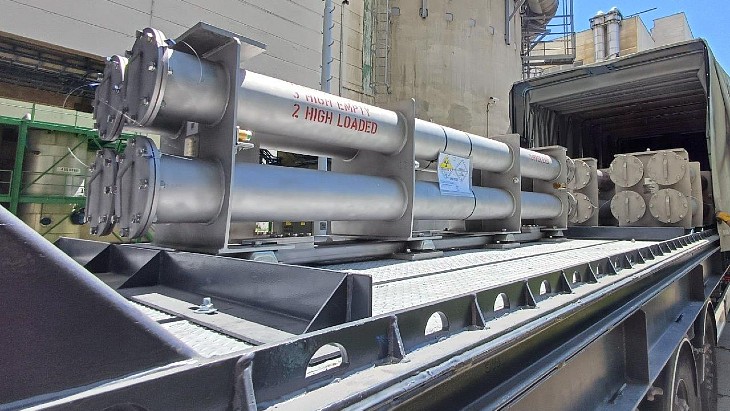
Steam generators removed from German plant
Tuesday, 17 June 2025
The removal of all four steam generators from the reactor building at Germany's shut down Unterweser nuclear power plant, which began in mid-May, has now been completed, PreussenElektra announced.
(Image: PreussenElektra)
In total, all four steam generators - each measuring 20 metres in height and weighing about 300 tonnes - have been removed within four weeks, completing the project on schedule.
The actual dismantling was preceded by nearly two years of planning, testing, and implementation of the necessary modifications and additions inside and outside the reactor building, as well as the individual dismantling steps of the large heat exchangers.
PreussenElektra said the work within the reactor building to remove the steam generators was particularly challenging, with each component needing to be rotated, tilted, and gradually lifted several times before being lowered into a storage area on the plant site. It said the removal of the first steam generator in mid-May took about 18 hours, but with the experience gained from each individual lift, this time was reduced to around 11 hours for the final steam generator.
"This was absolute precision work and a masterpiece of engineering," said Project Manager Attila Damon. "The intensive preparation paid off. Our experienced partners Framatome and Mammoet handled this task well."
In July, the steam generators will be shipped to Cyclife in Sweden, dismantled on-site, and then melted down in a smelter.
Unterweser - a pressurised water reactor with a gross installed capacity of 1410 MWe - operated between 1978 and 2011. It was one of seven nuclear power plants shut down in Germany in March 2011 when it lost its commercial operating licence under the 13th Amendment to the Atomic Energy Act.
PreussenElektra is also decommissioning the Brokdorf, Grafenrheinfeld, Grohnde, Isar 2 and Stade PWR nuclear power plants.
In 2021, PreussenElektra awarded the contract for the dismantling and disposal of a total of 16 steam generators from the Unterweser, Grafenrheinfeld, Grohnde, and Brokdorf plants to Cyclife, a subsidiary of EDF specialising in nuclear power plant decommissioning and waste management.
Preparations for the removal of the four steam generators at the next plant, Grafenrheinfeld, are already under way, PreussenElektra said.
Hot testing of first San'ao unit completed
Tuesday, 17 June 2025
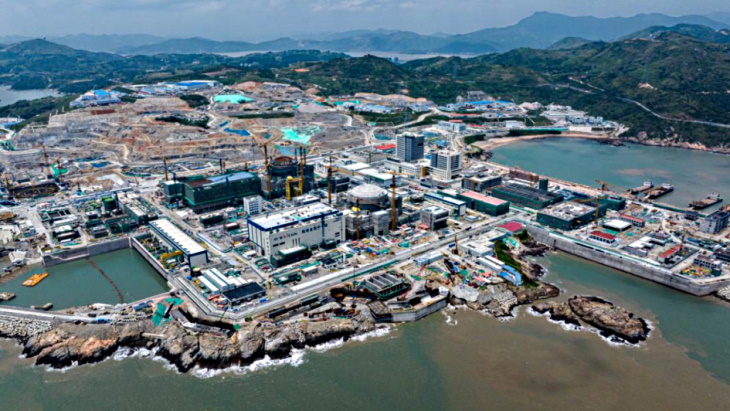
Tests that simulate the temperatures and pressures which the reactor systems will be subjected to during normal operation have been completed at unit 1 of the San'ao nuclear power plant in China's Zhejiang province. The unit is the first of six HPR1000s (Hualong Ones) planned at the site.
(Image: CGN)
Hot functional tests involve increasing the temperature of the reactor coolant system and carrying out comprehensive tests to ensure that coolant circuits and safety systems are operating as they should. Carried out before the loading of nuclear fuel, such testing simulates the thermal working conditions of the power plant and verifies that nuclear island and conventional equipment and systems meet design requirements.
China General Nuclear (CGN) said the completion of hot test at San'ao unit 1 on 10 June "lays the foundation for subsequent reactor loading, grid-connected power generation and commercial operation".
Cold functional tests - which are carried out to confirm whether components and systems important to safety are properly installed and ready to operate in a cold condition - were completed at San'ao 1 in November last year. The main purpose of those tests - which marked the first time the reactor systems were operated together with the auxiliary systems - was to verify the leak-tightness of the primary circuit.
The San'ao plant site (Image: CGN)
In May 2015, the National Energy Administration approved the project to carry out site protection and related demonstration work at San'ao. On 2 September 2020, the executive meeting of the State Council approved the construction of units 1 and 2 as the first phase of the plant. China's National Nuclear Safety Administration issued a construction permit for the two units on 30 December that year and first concrete for unit 1 was poured the following day. The first concrete for San'ao 2 was poured on 30 December 2021.
San'ao 1 and 2 are scheduled to begin supplying electricity in 2026 and 2027, respectively.
The San'ao plant is the first nuclear power project in China's Yangtze River Delta region to adopt the Hualong One reactor design. A total of six Hualong One units are planned for the San'ao site. In August 2024, the State Council approved the construction of San'ao Phase II (units 3 and 4).
The San'ao project marks the first Chinese nuclear power project involving private capital, with Geely Technology Group taking a 2% stake in the plant. CGN holds 46% of the shares of the project company Cangnan Nuclear Power, with other state-owned enterprises holding the remainder.
Belarus looking at potential radioactive waste disposal site locations
Tuesday, 17 June 2025
Belarus Energy Minister Denis Moroz has said the country is looking at potentially locating its planned radioactive waste disposal facility in the Grodno, Mogilev or Gomel areas.
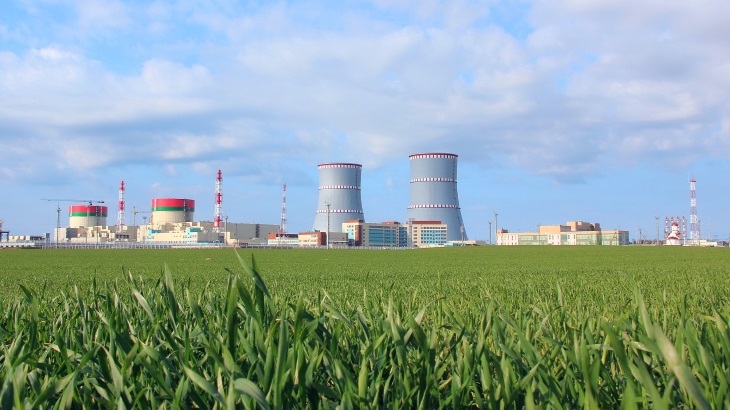
The Belarusian nuclear power plant, built at Ostrovets (Image: Rosatom)
According to the official Belta news agency Moroz told the Belarus 1 TV channel that there is a current storage facility at the site of the country's nuclear power plant, but a purpose-built site is required by 2030.
He said: "The construction of such a facility is a large-scale and complex task. It should be as transparent as possible to the world community and to the citizens of the Republic of Belarus."
He said that they were following the International Atomic Energy Agency's recommended process for site selection. He said that geological and environmental studies had been taking place and pre-project documentation was being prepared for potential sites before a full environmental impact assessment and public consultations.
According to Belta, during the interview he also discussed the on-going feasibility study into future expansion of nuclear energy capacity in Belarus. The study is due to be published this year and is considering whether to build a third unit at the existing Ostrovets plant, or to build a new plant.
He said the study was in its "final stages" and that both options had been found to be technically and economically feasible.
The Belarus nuclear power plant has two VVER-1200 reactors and is located in Ostrovets in the Grodno region. A general contract for the construction was signed in 2011, with first concrete on the first unit in November 2013. Construction of unit 2 began in May 2014. The first power unit was connected to the grid in November 2020, with the second unit put into commercial operation in November 2023. More than a quarter of Belarus's electricity is now generated by nuclear.
Kazakhstan selects Rosatom for first nuclear power plant
Monday, 16 June 2025
Russia's Rosatom has been selected as the leader of an international consortium to build Kazakhstan's first planned nuclear power plant - with China being lined up to build a second one.
(Image: Radoslaw Drozdzewski (Zwiadowca21), CC BY-SA 3.0)
The Atomic Energy Agency of Kazakhstan held negotiations with leading global manufacturers and had drawn up a shortlist of potential suppliers: Rosatom with its VVER-1200 reactors, China National Nuclear Corporation (CNNC) with its HPR-1000, France's EDF with its EPR1200 and Korea Hydro & Nuclear Power (KHNP) with its APR-1000/APR-1400.
In a statement announcing the result, the agency said: "The listed companies submitted a comprehensive package of materials consisting of technical and commercial proposals for the construction of a nuclear power plant in Kazakhstan. These materials included the following information: estimated construction cost; project implementation deadlines; financing models; methods of localisation of equipment and construction works; recommendations for the development of personnel training and scientific and educational potential; opportunities for integration in the nuclear fuel cycle; and issues of social obligations."
The assessment was carried out based on methodology developed by the Atomic Energy Agency, Kazakhstan Nuclear Power Plants LLP and French engineering company Assystem. It looked at the areas highlighted in the statement's list of materials submitted as well assessing nuclear power plant safety and international experience. The analysis was then submitted to the Interdepartmental Commission on the Development of the Atomic Industry.
"It was determined that the most optimal and effective proposals for the construction of a nuclear power plant in Kazakhstan came from the Russian company Rosatom," with second place taken by CNNC and third place by EDF and KHNP, the agency statement said. "Thus, Rosatom was identified as the leader of the international consortium for the project to build the first nuclear power plant in Kazakhstan."
Discussions are now taking place on state export funding from the Russian Federation based on the proposals submitted by Rosatom.
In a statement issued by Rosatom, its Director General Alexei Likhachev said: "We welcome Kazakhstan's decision to begin implementing the nuclear power plant construction project. VVER-1200 generation 3+ reactors combine time-tested engineering solutions with the latest active and passive protection systems developed in strict compliance with international safety standards. VVER-1200 reactors are already operating in Russia and abroad - four units in Russia and two units in Belarus and this technology has also been chosen by our partners in Hungary, Egypt, Turkey, Bangladesh and China. There is still a lot of work ahead, and we sincerely count on the help and support of the leadership of Russia and Kazakhstan."
China, and a second plant
In its statement the Atomic Energy Agency for Kazakhstan said it would "continue to work with foreign partners to form an effective international consortium to build the country's first nuclear power plant".
And in a separate statement it quoted agency chairman Almasadam Satkaliyev as saying "all prequalified participants included in the shortlist have their own unique technologies".
He added: "It is planned to sign a separate agreement with the People's Republic of China on cooperation in the nuclear sector. We want to use Chinese technologies to build another nuclear power plant in Kazakhstan ... in general, there are not many countries in the world that can implement a full nuclear cycle on their own. And China is a country that has such an opportunity, has all the necessary technologies and an industrial and production base. Therefore, our next main priority is cooperation with China."
"We have agreements at the highest level. We are interested in adopting Chinese experience, we understand well that they can carry out construction quickly and qualitatively. We have already started work in this direction."
Background
Kazakhstan is the world's leading producer of uranium. Although it does not currently use nuclear energy, it is not without nuclear experience: it has three operating research reactors, and a Russian-designed BN-350 sodium-cooled fast reactor operated near Aktau for 26 years, until 1999.
Kazakhstan has been preparing for a possible nuclear power programme to reduce its reliance on fossil fuels, diversify its energy mix and reduce CO2 emissions for some time. Kazakhstan Nuclear Power Plant (KNPP), a subsidiary of Kazakhstan's Samruk-Kazyna National Welfare Fund JSC, was set up in 2014. As well as being designated as the owner/operator of a future plant, KNPP has been tasked with pre-project work including a feasibility study to justify the need for nuclear power - carried out in 2018 - and locating a site.
In a referendum last year more than 70% of the 7.8 million people who voted answered 'yes' to the question: "Do you agree with the construction of a nuclear power plant in Kazakhstan?"
As well as the proposed first nuclear power plant - the Zhambyl district of Almaty region has been selected as the preferred location - there are also options for using small modular reactors to replace retiring coal plants in the years to come and the second large plant is being considered with the government's target being for nuclear to produce a 5% share of the national generation mix by 2035.
Kraft Heinz pulling certain artificial dyes from its U.S. products in 2027
Containers of Heinz ketchup on the shelf of a market. (Toby Talbot / AP Photo)
Kraft Heinz will be pulling artificial dyes from its U.S. products starting in 2027 and will no longer roll out new products with the dyes.
The move comes nearly two months after U.S. health officials said that they would urge foodmakers to phase out petroleum-based artificial colors in the nation’s food supply.
Kraft Heinz said Tuesday that almost 90% of its U.S. products already don’t contain food, drug & cosmetic colors, but that the products that do still use the dyes will have them removed by the end of 2027. FD&C colors are synthetic additives that are approved by the U.S. Food and Drug Administration for use in food, drugs and cosmetics.
Kraft Heinz said that many of its U.S. products that still use the FD&C colors are in its beverage and desserts categories, including certain products sold under brands including Crystal Light, Kool Aid, Jell-O and Jet Puffed.
The company said that it will instead use natural colors for the products.
“The vast majority of our products use natural or no colors, and we’ve been on a journey to reduce our use of FD&C colors across the remainder of our portfolio,” Pedro Navio, North America President at Kraft Heinz, said in a statement.
Kraft Heinz stripped artificial colors, flavors and preservatives from its macaroni and cheese in 2016 and said it has never used artificial dyes in its ketchup.
The company plans to work with licensees of its brands to encourage them to remove the dyes.
In April Food and Drug Administration Commissioner Marty Makary said at a news conference that the agency would take steps to eliminate the synthetic dyes by the end of 2026, largely by relying on voluntary efforts from the food industry.
Health advocates have long called for the removal of artificial dyes from foods, citing mixed studies indicating they can cause neurobehavioral problems, including hyperactivity and attention issues, in some children. The FDA has maintained that the approved dyes are safe and that “the totality of scientific evidence shows that most children have no adverse effects when consuming foods containing color additives.”
The FDA currently allows 36 food color additives, including eight synthetic dyes. In January, the agency announced that the dye known as Red 3 -- used in candies, cakes and some medications -- would be banned in food by 2027 because it caused cancer in laboratory rats.
Artificial dyes are used widely in U.S. foods. In Canada and in Europe -- where synthetic colors are required to carry warning labels -- manufacturers mostly use natural substitutes. Several states, including California and West Virginia, have passed laws restricting the use of artificial colors in foods.
Many U.S. food companies are already reformulating their foods, according to Sensient Colors, one of the world’s largest producers of food dyes and flavorings. In place of synthetic dyes, foodmakers can use natural hues made from beets, algae and crushed insects and pigments from purple sweet potatoes, radishes and red cabbage.


(1)_99382.jpg)
_20784.jpg)
_32578.jpg)
_75473.jpg)
_1_49124.jpg)
