It’s possible that I shall make an ass of myself. But in that case one can always get out of it with a little dialectic. I have, of course, so worded my proposition as to be right either way (K.Marx, Letter to F.Engels on the Indian Mutiny)
Friday, June 27, 2025
Fast fashion: From your wardrobe to Chile's Atacama desert
Every year, more than 60,000 tonnes of clothes are shipped to northern Chile from Europe, the US and Asia. Whether they're brand new, unsold or second hand, many of these items are abandoned or burned in Chile's Atacama desert – releasing toxic fumes, affecting people's health and scarring the landscape. A recycling plant is set to open soon, with more than 3,000 tonnes of clothes already waiting. The local community is calling for stricter global regulations, as residents suffer the consequences of the fast fashion industry. The Down to Earth team takes a closer look.
A new report about antiziganism in Germany has revealed alarming figures — and criticized the media for feeding cliches. But the community is also counting small successes.
Sinti and Roma, who still suffer widespread discrimination in Germany, marked Romaday with a parade in Berlin in April
Image: Thomas Bartilla/Geisler-Fotopress/picture alliance
Sinti and Roma are especially affected by prejudice, discrimination, racism, according to the Antiziganism Reporting and Information Center in Germany (MIA), which has documented the nature and scale of antiziganism in the country in its latest annual report.
The report recorded 1,678 antiziganism cases in 2024, ranging from verbal abuse to assaults — a significant increase on the 621 reported in its first edition, published for the year 2022.
"The incidents documented in this report clearly show that verbal stigmatization and antiziganism propaganda paves the way for discrimination and for physical attacks up to life-threatening violence," Mehmet Daimagüler, Germany's first federal commissioner against antiziganism, wrote in the foreword.
New federal antiziganism commissioner
A lawyer by profession, Daimagüler was appointed in 2022 but was replaced by the new German government in June with Michael Brand, a member of the Bundestag for the center-right Christian Democratic Union (CDU) and state secretary at the Family Ministry, which supported the MIA report.
Brand took over the office in difficult times. "It is absolutely clear, in light of the increase in extremism fanned from within and outside Germany, that we must now especially protect minorities such as the Sinti and Roma from the effects of extremism and discrimination," he said.
Increasingly hostile atmosphere 'poisoning the social climate'
The significantly higher number of antiziganist incidents can be attributed to the growing awareness of the MIA's work. But beyond the raw figures, the report shows that those affected are reporting a generally hostile atmosphere.
The almost 70-page report includes numerous concrete examples of degrading, sometimes violent discrimination. In one incident caught on camera, a Sinti boy who was bullied in school was held down by several boys after school one day, tied to a bench and beaten.
According to the report, the incident escalated further when the parents of the boy and two of their relatives confronted the parents of the perpetrators. Several people joined the row and attacked the Sinti family, one of whom suffered a broken foot. Another was threatened with a knife and injured.
A study has shown that such excesses are occurring repeatedly in German kindergartens and schools. The root of this development is what the report calls an increasingly hostile political debate: "The MIA observes that anti-Roma and Sinti statements, especially by right-wing parties, are poisoning the social climate."
Nazis committed genocide against Sinti, Roma
Romani Rose, who has headed the Central Council of German Sinti and Roma since 1982, draws a pessimistic conclusion in the MIA report.
"Unfortunately, we must acknowledge that despite our almost 50 years of political work in this country, a change in consciousness has only just begun," he said.
Rose also recalled the systematic extermination of his ethnic group by the National Socialists. By the end of World War II, more than half a million Sinti and Roma throughout Europe had been persecuted or murdered. Today, an estimated 80,000–140,000 live in Germany. Europe-wide, their population numbers between 10 and 12 million.
Media often spread cliches
The MIA also blamed the media for shaping the cliched image of Sinti and Roma. Distorted or false portrayals are found in commercial media outlets and public service broadcasters alike, the report found, and there have been more frequent complaints about stigmatizing or false depictions.
One documented case concerned the supposed large-scale misuse of public funds by Roma allegedly posing as Ukrainian refugees. "More than 5,000 cases of social fraud via fake Ukrainians," read a March 2024 article published by the Ippen media group, which appeared on numerous German news outlets.
The background to the text was stories circulating shortly after Russia's invasion of Ukraine about people said to have posed as refugees. According to the MIA report, this was a typical case of media failure, as the story was specifically directed against Roma, who were accused either of traveling to Germany with forged Ukrainian passports or concealing possible Ukrainian-Hungarian dual citizenship. In fact, Ukrainian Romani people have suffered discrimination in Germany. Successful complaint to German Press Council
The publishing of the report in the Hanauer Anzeiger newspaper was the trigger for a successful complaint to the German Press Council, the self-regulating body for Germany's print media and their online channels.
According to the council, the reports violated fundamental journalistic principles. Instead of scrutinizing the numbers, other media outlets were simply taken as a source. The council went on to condemn the story on three counts: Violating journalistic due diligence, the non-discrimination rule and disregarding the presumption of innocence.
Due to limited resources, the MIA is still unable to carry out its own systematic media monitoring. "Nevertheless, we closely follow the discourse and developments in media coverage," the organization's annual report said. Discrimination 'must be clearly and decisively confronted'
The MIA welcomed the fact that the post of an antiziganism federal commissioner had been retained after all — something that had been in doubt because there was no commitment to the post in the coalition agreement of Germany's new federal government. Now the MIA team can breathe a sigh of relief and appeal to policymakers to strengthen the office with the appropriate resources and personnel.
The initial statements by the new antiziganism commissioner are likely to raise hopes in the Sinti and Roma community.
"Where discrimination occurs, it must be clearly and decisively confronted — by the state and society alike," said Brand. "It is important to me to also highlight the many positive examples of cooperation between the majority society and minorities."
Marcel Fürstenau Berlin author and reporter on current politics and society.
'Slaughter masquerading as aid': MSF slams US-backed Gaza Humanitarian Foundation
Medical non-profit Doctors Without Borders (MSF) on Friday slammed a US- and Israeli-backed aid distribution scheme in the devastated Gaza Strip as "slaughter masquerading as humanitarian aid". More than 500 people have been killed since the group's operations began, health authorities say, with witnesses reporting Israeli troops shooting into gathered crowds nearly every day.
Medical charity Doctors Without Borders (MSF) called on Friday for a controversial Israel- and US-backed relief effort in Gaza to be halted, branding it "slaughter masquerading as humanitarian aid".
The Gaza Humanitarian Foundation, which began operating last month, "is degrading Palestinians by design, forcing them to choose between starvation or risking their lives for minimal supplies", MSF said in a statement.
UN Secretary-General Antonio Guterres said Friday that hungry people in Gaza seeking food must not face a "death sentence".
"People are being killed simply trying to feed themselves and their families. The search for food must never be a death sentence," Guterres told reporters, without explicitly naming the Gaza Humanitarian Foundation.
Starting in March, Israel blocked deliveries of food and other crucial supplies into Gaza for more than two months, leading to warnings of that the entire population of the occupied Palestinian territory is at risk of famine.
The United Nations says Israel's occupation of the West Bank and Gaza is illegal under international law.
The densely populated Gaza Strip has been largely flattened by Israeli bombing since the October 7, 2023, attack on Israel by Hamas.
Israel began allowing food supplies to trickle in at the end of May, using GHF – backed by armed US contractors, with Israeli troops on the perimeter – to run operations.
The latter have been marred by chaotic scenes and near-daily reports of Israeli forces shooting people desperate to get food.
An 'abomination' and a 'death trap': Papers denounce Israel's food aid system in Gaza
There are also concerns about the neutrality of GHF, officially a private group with opaque funding.
The UN and major aid groups have refused to work with it, citing concerns it serves Israeli military goals and that it violates basic humanitarian principles.
The Gaza health ministry says that since late May, nearly 550 people have been killed near aid centres while seeking scarce food supplies.
"With over 500 people killed and nearly 4,000 wounded while seeking food, this scheme is slaughter masquerading as humanitarian aid and must be immediately dismantled," MSF said. Surge in gunshot wounds
GHF has denied that fatal shootings have occurred in the immediate vicinity of its aid points.
On Tuesday, the United Nations condemned what it said was Israel's "weaponisation of food" in Gaza and called it a war crime.
MSF said the way GHF distributes food aid supplies "forces thousands of Palestinians, who have been starved by an over 100 day-long Israeli siege, to walk long distances to reach the four distribution sites and fight for scraps of food supplies".
"These sites hinder women, children, the elderly and people with disabilities from accessing aid, and people are killed and wounded in the chaotic process," it said.
Aitor Zabalgogeazkoa, MSF's emergency coordinator in Gaza, said the four sites were all under the full control of Israeli forces, surrounded by watch points and barbed wire.
"If people arrive early and approach the checkpoints, they get shot. If they arrive on time but there is an overflow and they jump over the mounds and the wires, they get shot," he said in the statement.
"If they arrive late, they shouldn't be there because it is an 'evacuated zone' – they get shot."
MSF said that its teams in Gaza were seeing patients every day who had been killed or wounded trying to get food at one of the sites.
It pointed to "a stark increase in the number of patients with gunshot wounds".
MSF urged "the Israeli authorities and their allies to lift the siege on food, fuel, medical and humanitarian supplies and to revert to the pre-existing principled humanitarian system coordinated by the UN".
(FRANCE 24 with AFP)
"It's possible' Putin will invade more than Ukraine, says Donald Trump Copyright Copyright 2025 The Associated Press. All rights reservedBy Shona MurrayPublished on 25/06/2025 -
The US president said at the NATO summit on Wednesday that negotiations over a ceasefire in Ukraine have proved trickier than people thought, and that Putin is "more difficult" than expected.
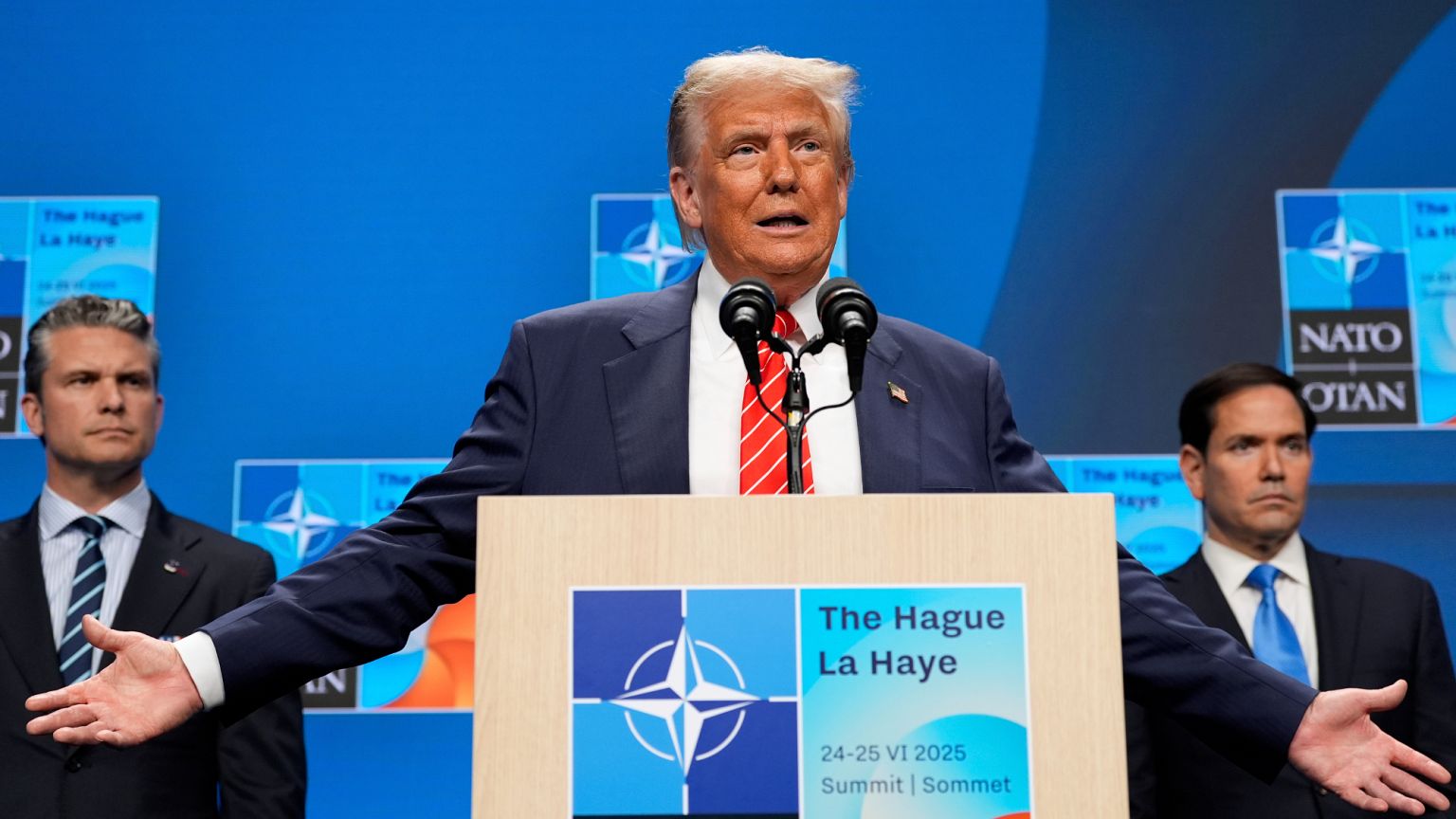
US President Donald Trump has touted the possibility that his Russian counterpart Vladimir Putin may invade other countries following the full-scale invasion of Ukraine during a press conference at the NATO summit in the Hague on Wednesday.
Trump was asked whether he considered Putin an enemy and if he believed the Russian leader had territorial ambitions beyond Ukraine. "It's possible", Trump replied.
"I consider him a person who I think is misguided," the US president said.
Trump also said Putin called him to offer help in settling the recent Middle East conflict and to act as an interlocutor between the US, Israel and Iran.
"He called the other day (and) said: 'Can I help you with Iran?' I said no, you can help me with Russia," said Trump.
The US president has previously indicated he's in regular contact with Putin especially over Ukraine.
"I know one thing. He would like to settle. He would like to get out of this. It's a mess for him. I said: 'You help me get a settlement with you,' and I think we're going to be doing that soon," Trump told reporters.
Ahead of his second term in the White House, Trump announced he would negotiate an end to the Russian invasion of Ukraine within 24 hours, but he told reporters at the NATO summit that he was being sarcastic.
He said the negotiations are "more difficult that anyone had thought", and that "Putin is more difficult".
Trump also said he had a "good" meeting with Ukrainian President Volodymyr Zelenskyy on the margins of the summit.
Trump said he would "see" if the US could supply Ukraine with Patriot air defence systems in future.
All 32 NATO allies agreed to increase spending on defence to 5% of GDP within 10 years at the two-day summit in the Hague.
Trump said this was a "big win" for the US and the West.
Greenland, breaking the silence: The scandal of Denmark's forced contraception campaign
In 1960s Greenland, thousands of young Inuit girls – some barely teenagers – were sent to hospital. Without giving an explanation or obtaining their consent, Danish doctors fitted them with IUDs, a painful procedure that left lifelong scars. In total, more than 4,500 Greenlandic women were victims of this mass forced contraception campaign orchestrated by the Danish authorities. FRANCE 24's Sarah Andersen met with victims now demanding justice.
In this investigative report, Franco-Danish journalist Sarah Andersen sheds light on a policy of forced birth control commissioned at the highest level of Denmark's government that has left deep trauma in Greenland.
From Greenland's capital Nuuk to the Danish capital Copenhagen, she brings us the moving stories of women who have long been silenced, and who are now demanding justice.
Teachers pay dispute shuts schools for months in Nigerian capital
Abuja (AFP) – A strike by elementary school teachers in Nigeria's capital is dragging into its fourth month, as workers demand to be paid the minimum wage enacted almost a year ago but yet to be implemented.
Affecting more than 400 schools in Abuja, the prolonged closure has left over 50,000 pupils without lessons, according to the teachers' union, in a country where more than 20 million children are already out of school.
The Nigeria Union of Teachers (NUT) in the capital says it will not call off its strike until the 70,000 naira ($45) national minimum wage is implemented and outstanding salaries and entitlements are settled.
President Bola Tinubu signed the new wage into law in July 2024, more than doubling the west African country's previous minimum wage of 30,000 naira.
The move was meant to soften the effects of rampant inflation that has followed the government's economic reforms over the past two years. Yet implementation has lagged nationwide as local governments have been left to institute the wage hikes.
"We went on two warning strikes and we are currently on the third," union leader Abdullahi Mohammed Shafas told AFP. "Despite arguments and promises, the government has not been able to fulfil any till now."
Critics have blamed Nyesom Wike, Minister of the Federal Capital Territory, which includes Abuja, for the impasse.
Wike says he has approved the new wages, accusing the local government councils of failing to pay. 'Sitting at home'
Elisha Goni, a teacher at a public elementary school in Abuja's Garki neighbourhood, said he hardly scrapes by on his 120,000 naira salary -- which would also be bumped up if the new minimum wage is applied.
"I can barely cater for myself, not to talk of my family, from the little I am earning," said Goni who lives 50 kilometres (30 miles) from his workplace to evade the expensive rent in the city centre. "Teachers cannot be lecturing on empty stomachs."
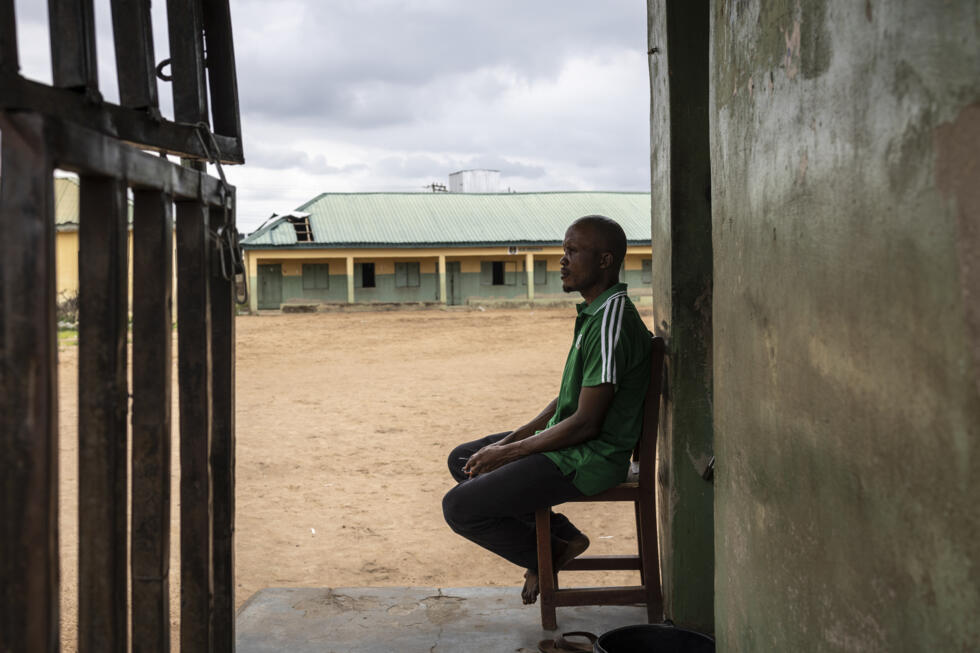
At a Local Education Authority (LEA) primary school, the gate creaks in the wind as an AFP reporter entered while a security guard dozed off in his wooden chair -- his new routine since the classrooms went quiet early this year.
"I used to be busy controlling students from roaming around the gate, helping teachers, watching the kids," the 54-year-old, who gave his name as Abdu, said.
"Now, I just sleep after breakfast till lunch. There is nothing else to do."
For many pupils, the disruption means more than boredom.
Blessing, 10, should have been preparing for her final exam to enter junior secondary school.
But instead she sat under the scorching sun, scooping ground chillies into small plastic bags at her mother's roadside milling shop.
Her mother Mary, who only gave her first name, said she was considering enrolling Blessing in a nearby private school, "even though it is poorly rated".
"At least she won't just be sitting at home," Mary muttered, her eyes fixed on the busy roadside.
Nigerian television footage has shown small protests by placard-waving pupils in uniform, chanting that they want to return to school.
One of the placards read: "You call us leaders of tomorrow while stopping our school for nine weeks."
The strike comes as a further blow to an already creaky education system that sees millions of children fail to attend regularly, while adults contend with Nigeria's worst cost-of-living crisis in a generation.
French state ordered to pay man over discriminatory police ID check The European Court of Human Rights (ECHR) has found France guilty of discrimination over a police identity check in 2011, ruling in favour of a French citizen of North African origin who was stopped three times in 10 days without clear justification.
Issued on: 26/06/2025 - RFI
Police identity checks in France under scrutiny after court ruling. AFP - ALAIN JOCARD
In its judgment published on Thursday, the court said there was a “presumption of discriminatory treatment” against Karim Touil and that “the government failed to rebut it”.
The judges said they were “well aware of the difficulties faced by police officers who must decide quickly and sometimes without clear internal guidelines whether there is a threat to public order or safety”.
But in Touil’s case, they concluded there was no “objective and reasonable justification” for the stops.
France was found to have violated Article 14 of the European Convention on Human Rights, which prohibits discrimination, taken together with Article 8, on the right to private and family life.
The state must now pay Touil 3,000 euros in moral damages.
The case dates back more than a decade and involved six French men of African or North African origin, who said they were victims of racial profiling during identity checks in 2011 and 2012.
The men – from cities including Marseille, Roubaix and Besançon – first brought their cases before French courts but lost. In 2017, they turned to the ECHR, which ensures respect for the European rights convention in 46 countries.
They argued the stops violated their rights to privacy and freedom of movement and called on the court to push France to introduce safeguards against discriminatory policing, such as written receipts for every identity check.
The six were part of a larger group of 13 men who launched legal action more than a decade ago, claiming they were unfairly targeted during police stops – sometimes accompanied by pat-downs, rude language or disrespectful behaviour.
Five of the six applicants lost their ECHR case. The court ruled that the police checks they experienced were not proven to be discriminatory and said it found no evidence of a broader structural failure.
French courts had partially agreed with the plaintiffs in earlier proceedings. In 2015, the Paris court of appeal found in favour of five men and ordered the state to pay them 1,500 euros each in compensation.
In 2016, France’s highest court, the Cour de cassation, upheld three of those rulings – marking the first time the state had been definitively condemned over identity checks of this nature.
Six of the men whose claims were not upheld decided to escalate the matter to the Strasbourg court.
Increase in identity checks
The decision comes days after new figures showed a sharp rise in identity checks in France over the past eight years.
A study by the French rights ombudsman, Claire Hédon, revealed that 26 percent of people surveyed in 2024 had been stopped at least once by police or gendarmes in the previous five years – up from 16 percent in 2016.
Young men perceived as Arab, black or North African were four times more likely than the rest of the population to be stopped and 12 times more likely to face a more intrusive check involving searches or orders to leave an area.
More than half of those stopped said they were not given a reason. Nearly one in five described inappropriate behaviour by officers, including being spoken to disrespectfully, insulted or physically mistreated.
In response, Hédon has recommended better traceability of police checks and the introduction of a system allowing people to challenge them more easily.
(with AFP)
Son of colonial fighter killed in Thiaroye massacre takes France to court The only known descendant of a Senegalese rifleman killed by French forces in the 1944 Thiaroye massacre has filed a legal complaint against the French state, accusing it of concealing mass graves and blocking justice.
Issued on: 26/06/2025 - RFI
For over 50 years, 86-year-old Senegalese Biram Senghor has been demanding an apology and compensation for the shooting of his father M'Bap Senghor during the 1944 Thiaroye massacre. AFP - SEYLLOU
Biram Senghor, 86, is the son of M’Bap Senghor, one of dozens of West African riflemen, known as tirailleurs senegalais, who were shot by French colonial forces in Thiaroye near Dakar after returning from World War II service in Europe.
The soldiers were demanding unpaid wages when the army opened fire on 1 December, 1944.
"My father fought for France. He returned to ask for what he was owed and was killed," Senghor told France's AFP news agency from his home in central Senegal. “I still don’t know where he’s buried.”
His lawyer, Mbaye Dieng, filed a legal complaint Tuesday in a Paris court. It targets both the French state and unidentified persons for "concealment of a corpse" – a crime under French law when linked to violence.
Dieng argues that France deliberately withheld the locations of mass graves and key historical records.
“For years the family was told M’Bap Senghor had deserted,” Dieng said. “Now they acknowledge he died at Thiaroye, but his burial site remains unknown.”
French authorities at the time admitted to at least 35 deaths, but historians estimate there could be more than 300. Despite decades of advocacy, the massacre’s full scale and burial details remain unknown.
In July 2024, six soldiers killed at Thiaroye – including M’Bap Senghor – were officially recognised as having “died for France”, a symbolic gesture that Senegalese advocates say falls short of justice.
In December of that year, President Emmanuel Macron officially recognised the killings as a massacre – calling it a tragedy that demands the uncovering of the full truth.
Recent archaeological digs launched by the Senegalese government have uncovered human remains with bullet wounds at Thiaroye cemetery. Officials say the findings underscore France’s failure to fully disclose the truth.
“The French government continues to stall,” said Senghor. “They want me to die so the matter can be buried with me.”
France maintains that relevant archives have been opened, citing a 2014 pledge by former president François Hollande. But critics say access remains complicated.
“After 80 years, we ask only for truth and dignity,” Dieng said. “And for France to pay what it owes.”
(with AFP)
France faces €5bn in fresh cuts as debt balloons to record high
France’s public debt rose again in early 2025, reaching just over €3.35 trillion at the end of the first quarter – 114 percent of GDP – official figures showed on Thursday. The government now says it needs to find another €5 billion in savings to rein in the ballooning deficit.
Issued on: 27/06/2025 -
Last year, France’s deficit was 5.8 percent of GDP – the worst in the eurozone.
AFP - LIONEL BONAVENTURE
The national statistics office INSEE said debt had gone up by €40.5 billion since the end of 2024. France now has the third highest debt in the EU after Greece and Italy.
The current debt level is double what it was in 1995, when it stood at 57.8 percent of GDP. The rise has been fuelled by financial shocks, the Covid-19 pandemic and the recent spike in inflation.
Last year, France’s deficit – the yearly shortfall in government revenues versus expenditures – was 5.8 percent of GDP, the worst in the eurozone.
Prime Minister François Bayrou has pledged to bring it down below the EU target of 3 percent by 2029. The government forecasts 5.4 percent in 2025 and 4.6 percent in 2026.
The plan is to keep spending in check without raising taxes. Officials say the cost will be shared between the state, the social security system and local governments.
France's Minister for Economy, Finances and Industrial and Digital sovereignty Eric Lombard. AFP - STEPHANE DE SAKUTIN
Bayrou’s government is under pressure from the left, which has filed a no-confidence motion over failed pension reform talks. He survived a similar vote in January.
He has promised to publish a financial “roadmap” by mid-July, before presenting the 2026 draft budget in September.
“Given the disastrous budgetary situation, the 2026 budget involves unpopular austerity measures, making its adoption as difficult, if not more so, than the 2025 budget,” Bruno Cavalier, chief economist at Oddo BHF, told French news agency AFP.
Government spokesperson Sophie Primas told Franceinfo on Wednesday that “all options are being explored, without taboos”.
One possibility, she said, is a “gap year” – a spending freeze that ignores inflation.
Lombard said more consultations with political and social groups would be held before 11 July.
The drive to cut spending comes as France faces slower growth and growing uncertainty in global markets.
The government still expects GDP to grow by 0.7 percent this year, but the Banque de France has cut its forecast to 0.6 percent – a sharp drop from 1.1 percent in 2024.
There are also external risks, including rising US tariffs and tensions in the Middle East.
Cavalier said many MPs are “preoccupied with satisfying their electorates”, with municipal elections coming up in 2026 and a presidential vote in 2027.
Marius Borg Høiby, son of Norway's crown princess, charged with rape and assault
The charges, based on messages, witness accounts and police searches, have drawn significant media attention in Norway, where the royal family is widely respected.
Oslo police have charged Marius Borg Høiby, the eldest son of Norway's crown princess Mette-Marit, with multiple offences including rape, sexual assault and bodily harm following an extended investigation involving a "double-digit" number of alleged victims.
Høiby, 28, who is the stepson of Crown Prince Haakon, was arrested several times in 2024 amid allegations of rape and preliminary charges of physical assault and criminal damage.
Speaking at a press conference on Friday, Oslo Police Attorney Andreas Kruszewski confirmed that the investigation has concluded, with charges now filed.
"I cannot go into further detail about the number of victims in the case beyond confirming that it is a double-digit number," he said.
Evidence was gathered from text messages, witness statements and police searches.
The charges include one count of rape involving intercourse, two counts of rape without intercourse, four counts of sexual assault and two of bodily harm.
Defence lawyer Petar Sekulic told the Associated Press that Høiby is "absolutely taking the accusations very seriously," but denies wrongdoing in most cases, particularly those concerning "sexual abuse and violence."
The high-profile case has dominated headlines in Norway, where the royal family remains widely admired.
Høiby, who once resided with the royal couple and their children, Princess Ingrid Alexandra and Prince Sverre Magnus, now lives independently nearby.
He remains at liberty ahead of a possible trial and is presumed innocent until proven guilty in court.
Crown Princess Mette-Marit attracted public attention in 2001 when she married Crown Prince Haakon, having previously been a single mother and partner to a man with a drug conviction.


 Copyright Copyright 2025 The Associated Press. All rights reserved