It’s possible that I shall make an ass of myself. But in that case one can always get out of it with a little dialectic. I have, of course, so worded my proposition as to be right either way (K.Marx, Letter to F.Engels on the Indian Mutiny)
Friday, June 27, 2025
Carnival Cruise Ship Changes Dry Dock During Refit Due to Strike
Carnival Liberty is changing shipyard in the middle of its current refit due to a strike in Spain (Barcos por Cádiz on X)
A strike by metalworkers in Spain caused Carnival Cruise Line to take the unusual step of switching dry docks in the middle of a refurbishment project as it sought to maintain the schedule for the overhaul. However, according to media reports, the unions scuttled the plan, and it took the intervention of the shipyard’s staff to free the cruise ship.
Pictures began appearing on the internet of the half-completed refit of the Carnival Liberty (110,400 GT) cruise ship preparing to make a hasty retreat from Cadiz, Spain. On the exterior, the hull appears to have been blasted and looks rust-colored instead of the pristine white with the red and blue livery of Carnival Cruise Line.
The cruise ship arrived in Spain for a general overhaul, the first it has undergone in nearly four years. The cruise line and its parent corporation have a long-term contract for overhauls at the Navantia Shipyard, which includes several very large projects since 2018.
According to the Spanish media, Carnival Cruise Line got wind of the planned strike by the subcontractors at the shipyard, which was ahead of a formal strike that was due to begin this week. La Voz De Cádiz and Dario de Cadiz report that the cruise line informed Navantia that it was canceling the refurbishment contract and the cruise ship was to be ready to leave the dry dock late last week. The surprise strike, however, prevented the ship from leaving the dock as planned.
Saturday morning, June 21, Carnival Liberty, without her new coat of paint, was pulled from the dry dock after 20 Navantia staff members and auxiliary personnel released the cruise ship. Pictures show her at an adjacent dock preparing to depart.
Navantia’s misfortune in Cadiz turned into an opportunity for the dry dock in Marseille, France, where Carnival Liberty arrived on June 24. The painting operation was due to get underway, as well as completing the major refurbishment work after a few days' delay.
Dario de Cadiz reports Carnival Cruise Line is “very annoyed” at how the situation has unfolded. It was compounded by the line having to cancel the first scheduled post-refit cruise with passengers for a departure from New Orleans scheduled for July 6, receiving an email over the weekend. Carnival said that due to a labor stoppage, the cruise ship is behind schedule, and they unfortunately had to cancel the cruise. The current plan calls for the ship to operate its July 13 cruise from New Orleans.
La Voz De Cádiz reports that Carnival is now demanding €4.5 million in damages from Navantia. Further, Carnival Corporation is reported to have plans for 11 or 12 more overhauls at the yard, which have now also been put in jeopardy. Navantia is working to rebuild the trust with its long-time client.
Cruise lines work on tight schedules for their revitalization projects. Days out of service are lost revenue, and it is compounded by the time spent crossing the Atlantic from their home ports in Florida and in this case, Louisiana. To compensate, Carnival has been operating Atlantic cruises to reposition some ships while others start and finish their work during the ocean crossing.
The metal workers’ strike moved into full force this week, impacting operations in Cadiz, including the three major shipyards in the area, as well as in Cartagena. Conflicting reports from day four of the strike said there could be an agreement, but over the weekend terms were reached only to have one of the unions back out of the talks.
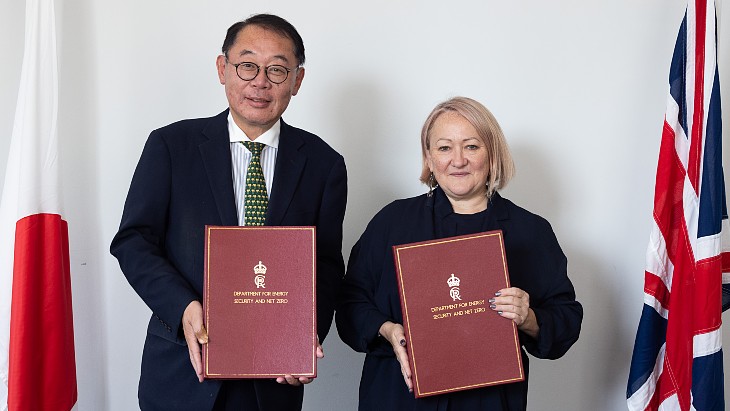
A memorandum of cooperation has been signed between the UK and Japan for partnership on fusion energy - as companies in the two countries announce new collaborations.
(Image: Japan's UK embassy/X)
The memorandum of cooperation was signed by UK Climate Minister Kerry McCarthy and Japan's Education, Culture, Sport, Science and Technology Minister Hiroshi Masuko and aims to "further collaboration in key fusion areas including research and development, regulation and skills and workforce".
McCarthy, said: "The UK is optimally positioned for global fusion investment. Global partnerships such as this one will advance technological developments and help unlock limitless clean fusion power, bringing a fusion energy future closer to a reality."
Separately there has been a memorandum of understanding signed between the UK's Fusion Cluster and the Japan Fusion Energy Council "to foster industrial collaboration, knowledge exchange, and workforce development", and Kyoto Fusioneering has relocated its UK headquarters to UK Atomic Energy Authority's Culham Campus near Oxford.
The collaboration between the Fusion Cluster and the Japan Fusion Energy Council will see them working together to "promote mutual understanding and strategic collaboration in fusion energy development; facilitate cooperation between Japanese and UK industries; and contribute to the development of a global-scale fusion energy ecosystem".
Meanwhile Tokamak Energy, which is based close to Culham, has announced that it has agreed with Japan's Furukawa Electric Group to establish a joint operational base in Japan for manufacturing high temperature superconducting magnet (HTS) technology. This is the method being used to create the strong magnetic fields needed to confine and control hydrogen fuel, which becomes a plasma several times hotter than the Sun, inside a tokamak.
The two companies say they will also explore uses of the technology in a range of other industries, including in medicine and for propulsion under water and in space.
Warrick Matthews, Tokamak Energy CEO, said: "Our magnet technology is an essential part of turning the promise of limitless clean fusion energy into commercial reality. This new venture with Furukawa Electric Group will ramp up our manufacturing capabilities and open a new era of superconducting performance in a range of sectors, from powering data centres to revolutionising electric zero emission motors."
Hideya Moridaira, President, Furukawa Electric Group, said: "We are truly honoured to take this important step forward with Tokamak Energy, deepening our collaboration and initiating efforts toward manufacturing HTS magnet technology for fusion energy in Japan ... by combining our HTS technology with Tokamak Energy’s innovative fusion technology, we are confident we can contribute meaningfully to the next generation of energy solutions.”
Background
Fusion research aims to copy the process which powers the sun - when light atomic nuclei fuse together to form heavier ones, a large amount of energy is released. To do this, fuel is heated to extreme temperatures, at least 10 times hotter than the centre of the sun, forming a plasma in which fusion reactions take place. A commercial power station will use the energy produced by fusion reactions to generate electricity. The fundamental challenge, being addressed in a variety of ways, is to achieve a rate of heat emitted by a fusion plasma that exceeds the rate of energy injected into the plasma.
The promise is that fusion energy will have few carbon emissions and it has abundant and widespread fuel resources.
Vietnam ends death penalty for 8 crimes, may spare real estate tycoon
Business woman Truong My Lan attends a trial in Ho Chi Minh City, Vietnam on April 11, 2024. (Thanh Tung/VnExpress via AP)
HANOI, Vietnam — Vietnam has lifted the death penalty for eight crimes in legal reforms that may spare the life of a real estate tycoon imprisoned in the country’s largest financial fraud case.
The legal reforms in Vietnam ended the death penalty for eight crimes, including trying to overthrow the government, damaging state infrastructure, making and selling fake medicine, starting wars, spying, drug trafficking, embezzlement, and taking bribes.
Vietnamese lawmakers passed the reforms on Wednesday, according to state media.
Truong My Lan, sentenced to death for her involvement in Vietnam’s largest financial fraud case, will be eligible to have her sentence reduced after the reforms, her lawyer said Thursday.
The 67-year-old chair of the real estate company Van Thinh Phat who was facing execution for her involvement in fraud amounting to $12.5 billion — nearly 3% of the country’s 2022 GDP — will now be “eligible for the exemption for the death penalty” according to the new rules, her lawyer Phan Minh Hoang told The Associated Press.
“We are still waiting for the official instructions of implementing the law amendment for next steps in her case,” Hoang said.
The new rules also say that anyone already sentenced to death for these crimes but not yet executed by July 1 will have their sentence changed to life in prison after a final decision by Vietnam’s highest court.
After the legal changes, the maximum punishment for Lan’s crimes will be life imprisonment without parole. Hoang said that they were continuing to work on repaying the damages to get her sentence further reduced.
The law change will likely impact other ongoing trials such as the one that started earlier this week involving the real estate and infrastructure development company Phuc Son Group, whose chairman Nguyen Van Hau is accused of paying over US$5 million in bribes to win contracts for major infrastructure projects across three provinces.
Following the change, Vietnam now has the death penalty for 10 crimes like murder, sexual abuse of children, treason and terrorism.
Hau Dinh, The Associated Press
Russia’s Tinkov and Calvey bet on Mexican fintech as Plata targets $10bn IPO
Two of Russia's best know financiers – Mika Calvey (l) and Oleg TInkov (r) – have teamed up to build a Mexican fintech Plata that aims to IPO with a $10bn valuation. / bne IntelliNews
Two of the most prominent figures in post-Soviet finance – Oleg Tinkov and Michael Calvey – have reunited as investors in Plata, a rapidly growing Mexican fintech aiming to replicate the success of Tinkoff Bank, Russia’s first and leading online-only fintech, in Latin America.
Plata, founded in 2023 by former Tinkoff Bank executives Neri Tollardo, Alexander Bro and Danil Anisimov, is now among the most valuable startups in Latin America. In March, the company was valued at $1.5bn following a $160mn funding round from European and US investors, including New York’s Kora and Moore Strategic Ventures. Tinkov and Calvey’s families were among the original backers, alongside about 20 of Plata’s top executives.
AS the head and founder of Barings Vostok Capital Management, the US-born Calvey is the most famous fund manager in Russia and responsible for bringing billions of dollars of private equity investments into Russia. He has an impeccable track record, having been an early investors into “homerun” projects like Russia’s leading search engine Yandex, which eventually IPO’d with a valuation of $11bn. He was also an early investor into Kazakhstan’s Kaspi.kz, which IPO’d with a valuation of $6.5bn.
However, Calvey made front page news when he was arrested by Russian authorities on St Valentine’s day in 2022 as part of a dispute with his co-investors into a Russian bank. He spent two years in jail and was eventually given a suspended sentence on fraud charges, but he has since left the country and the sentence was erased by the authorities.
Tinkov is a serial entrepreneur, springing to prominence with an eponymous beer, before going on to found Tinkoff Bank. However, he is one of only two prominent business leaders to publicly condemn Russia’s war in Ukraine and was forced to sell his bank to oligarch Vladimir Potanin for “kopeks on the ruble.” He left the country and set up shop in Mexico, where he has been working to repeat the success of Tinkoff Bank in Latin America.
In an interview with journalist Elizaveta Osetinskaya released on her YouTube channel Eto Osetinskaya, Tinkov said Plata’s valuation could double in its next round and reach $10bn within two years, at which point the company aims to launch an IPO, The Bell reports.
“Plata is growing about twice as fast as Tinkoff Bank did at the start,” Tinkov said. “We reached one million cards in a year and a half; Tinkoff needed about three years.”
Plata’s main product is the Plata Card, a cashback credit card delivered by couriers who assist with setup and onboarding. The startup received its banking licence in Mexico in December and now issues roughly one in every ten new credit cards in the country, according to the company.
Tinkov, who renounced his Russian citizenship, sold his stake in Tinkoff Bank in 2022. He has since focused on building fintech ventures abroad. Calvey, who was also an investor in Tinkoff Bank and a personal friend of Tinkov, was one of the earliest Western investors in Russian tech and banking, and now lives in Switzerland, having handed control of Barings Vostok to his Russian partners.
Plata currently employs about 2,000 people, of whom 700 are Russian. Tinkov said 100 staff are based in Mexico, while others work from Cyprus, Serbia and Barcelona. He noted that nearly all employees now hold Mexican citizenship. “Right now, with the exception of a few managers, no one [at Plata] even has Russian passports,” he said.
Calvey added that Mexico has proved itself to be a practical destination for relocation, with visa-free entry for Russians and relatively smooth work permit processes. Plata is now seeking a licence in Colombia, with plans to expand further across the region.
The Yakutia-based InDrive taxi hailing service also targeted Mexico as its first market of operation following its decision to leave Russia in 2022 after the war broke out for similar reasons: a large but underserviced population in a fast growing economy.
“We participate in all key decisions,” Tinkov said of his and Calvey’s involvement. “But we are not involved in the operational day-to-day.”
A look at the major players in the crypto industry and their ties to Trump
Eric Trump, Executive VP of The Trump Organization, from right, speaks as Co-founder of World Liberty Financial Zach Witkoff and Founder of TRON Justin Sun look on during Token 2049, a Crypto event, in Dubai, United Arab Emirates, May 1, 2025.
(AP Photo/Altaf Qadri, File)
WASHINGTON — U.S. President Donald Trump took office in January pledging to “make America the crypto capital of the world.” He has since harnessed wide swaths of the federal government to bolster the industry — all while raking in huge sums of money for his family’s business.
By some estimates, crypto ventures now account for nearly 40 per cent of the Trump Organization’s US$2.9 billion net worth. But the Republican president’s championing of the industry has been just as big a boon for many of the industry’s top names.
Many have seen their profits and political standing soar, while investigations of potential wrongdoing and other legal entanglements led by the administration of Trump’s predecessor, Democratic President Joe Biden, have largely fallen away.
Here’s a look at some of the crypto industry’s top leaders and their ties to Trump:
Justin Sun
A Chinese-born crypto entrepreneur and founder of the cryptocurrency platform Tron, Sun is best known for buying a piece of conceptual art consisting of a banana duct-taped to a wall for US$6.2 million and subsequently eating the banana.
Ties to Trump: Sun was the top investor in Trump’s meme coin, $Trump, and secured the top spot at the president’s recent crypto dinner, which was held at Trump’s golf course just outside Washington. Sun posted a professionally produced video of himself receiving a US$100,000 gold watch that Trump’s meme coin awarded to the top four investors. Sun also recently bragged about his close ties to the White House, posting in Chinese on X “It’s all true” over a series of posts listing his links to the president and his meme coin. Sun was sued by the Securities and Exchange Commission under Biden for working to artificially inflate the price of crypto, an investigation that has been paused since Trump took office. Sun was an early and important investor in World Liberty Financial, a crypto venture Trump and his sons Eric and Donald Jr. launched in September. The president’s most recent financial disclosure report reveals he made more than US$57 million last year from World Liberty Financial, which has launched USD1, a stablecoin pegged at a 1-to-1 ratio to the U.S. dollar.
Michael Saylor
The co-founder and chair of Strategy, formerly known as MicroStrategy, Saylor is one of bitcoin’s most prominent and outspoken evangelists. He owns a yacht once featured on “Entourage,” and his is the most high-profile bitcoin treasury company, which is a type of firm primarily focused on buying and holding bitcoin as its business model. Strategy currently holds more than two per cent of all outstanding bitcoins in circulation and is constantly buying more.
Ties to Trump: Trump Media, the parent company of the president’s social media platform, Truth Social, has announced it will raise US$2.5 billion from institutional investors to buy bitcoin in an attempt to build up a cryptocurrency reserve, similar to what Saylor’s company is best known for. Saylor met in January with Eric Trump at the president’s Mar-a-Lago resort in Palm Beach, Florida, and the president’s son has spoken publicly about how he and Saylor were friends who knew each other in New York two decades ago. Saylor also attended the president’s first crypto summit at the White House in March. “All of us owe him a tremendous debt of gratitude,” Eric Trump said of Saylor, praising him at the recent annual bitcoin conference in Las Vegas as an effective spokesperson for the crypto community.
Changpeng Zhao
Known universally as CZ, Zhao is founder and former CEO of Binance, the world’s largest cryptocurrency exchange. He was sentenced last year to four months in prison for failing to stop criminals from using the platform to move money connected to child sex abuse, drug trafficking and terrorism. Zhao was released in September.Latest updates on investing here
Ties to Trump: World Liberty Financial recently announced that an investment fund in the United Arab Emirates would be using US$2 billion worth of USD1 to purchase a stake in Binance. Zhao also has publicly said that he’s asked Trump for a pardon that could nullify his conviction.
Brian Armstrong
Co-founder and CEO of Coinbase, a major cryptocurrency exchange, Armstrong has been a key figure in the crypto industry’s push into politics.
Ties to Trump: Armstrong and Coinbase were major donors to a political action committee that helped Trump and other pro-crypto candidates. He met with Trump weeks after Election Day and attended the White House crypto summit. Coinbase hired Trump’s former campaign manager, Chris LaCivita, to its Global Advisory Council. Trump also addressed, via prerecorded video message, Coinbase’s State of Crypto Summit this month.
The Winklevoss Twins
Tyler and Cameron Winklevoss founded the Gemini cryptocurrency exchange and are most famous to the general public for suing Mark Zuckerberg over the creation of Facebook, an important plot point in the movie “The Social Network.” In 2023, Biden’s SEC sued Gemini for selling unregistered securities, another case that’s been paused since Trump took office.Latest news & updates on tariffs and the trade war here
Ties to Trump: The twins each pledged US$1 million donations to the Trump campaign, as well as lavish donations to Elon Musk’s political group – though some of the donations to Trump’s campaign were returned because the Winklevoss brothers had violated federal limits. They were invited to Trump’s crypto summit and praised the president’s approach to the sector then. Addressing the crypto conference in Las Vegas, Vice President JD Vance said the brothers “really helped break the dam” and persuade tech sector leaders to support Trump’s campaign. “I think they were some of the first big names in Silicon Valley to take that step, and a whole host of people followed them,” Vance said.
David Bailey
Bailey is the CEO of BTC Inc., an influential holding company with ventures throughout the crypto industry including Bitcoin Magazine. He recently raised US$300 million to launch Nakamoto, a publicly traded bitcoin investment company.
Ties to Trump: Baily served as a crypto adviser to Trump’s campaign. Vance also saluted Bailey at the Las Vegas conference, saying he was “grateful for everything you’ve done for the bitcoin community.”
___
Will Weissert, The Associated Press
Associated Press writer Alan Suderman contributed to this report.
Meta signs deals to source more solar, wind power for data centres
Wind turbines are seen on Tuesday, April 1, 2025, in Boardman, Ore. (AP Photo/Jenny Kane)
Renewable energy developer Invenergy and social media giant Meta Platforms have signed four deals to supply 791 megawatts (MW) more of solar and wind power to operate data centres, the companies said on Thursday.
This is the latest in a string of deals by Meta to meet the surging power demand of its data centres needed for artificial intelligence technologies using clean energy.
Last year, Meta had signed four contracts with the Chicago-based Invenergy for 760 MW of solar electricity. Invenergy said Thursday’s deals bring the companies’ total partnership to 1,800 MW.
Meta has previously announced deals with several large solar projects, a geothermal startup, and is also seeking proposals from nuclear power developers.
The electricity from Invenergy’s solar and wind projects in Ohio, Arkansas and Texas will be delivered to the local grid, while Meta will receive the clean energy credits associated with the new generation capacity coming online, the energy company said.
The companies did not disclose the financial details of the deals.
Reporting by Pooja Menon in Bengaluru; Editing by Tasim Zahid and Sahal Muhammed, Reuters
First Nations say Alberta data centre approach won’t attract big tech players
A sign is displayed on a Google building at their campus in Mountain View, Calif., on Sept. 24, 2019. (AP Photo/Jeff Chiu, File)
The chiefs of four First Nations in Alberta say they’re eager to take part in the province’s nascent data centre industry, but the province is taking the wrong approach to attract large-scale tech players.
The chiefs of the Alexander First Nation, Paul First Nation, Enoch Cree Nation and Alexis Nakota Sioux Nation outlined their concerns in an open letter to Premier Danielle Smith and members of her government.
Data centres are huge facilities housing the computing firepower needed for artificial intelligence and other applications. They take an enormous amount of power to run and cool them.
The Alberta Electric System Operator said earlier this month that it has received requests from 29 proposed data centre projects representing more than 16,000 megawatts — more than 11 times the City of Edmonton’s load.
It said it will allow the connection of up to 1,200 megawatts of large load projects between now and 2028 to ensure the reliability of Alberta’s grid.
The chiefs wrote that companies like Meta or Amazon don’t build small, and the limit sends a signal that Alberta is not ready to meet those companies’ needs or see a flagship project come to fruition.
---
Lauren Krugel, The Canadian Press
This report by The Canadian Press was first published June 27, 2025.
BMO employees to start working four days in office similar to Scotiabank and RBC
People make their way past the Bank of Montreal (BMO) building in the Financial District of Toronto, Monday Aug. 14, 20243. THE CANADIAN PRESS/Spencer Colby
TORONTO — BMO says it is moving towards four days in the office starting in the fall, joining some of its Bay Street peers.
Spokesman John Fenton says that by mid-September, BMO will expect employees in the office four days per week, where existing real estate capacity permits.
He says BMO has over the past decade invested in workplaces designed to maximize team performance by promoting collaboration, problem solving, mentorship, innovation, and career development.
Scotiabank and RBC previously committed to similar moves with both lenders saying the change will start in September, which they believe will improve operations.
Scotiabank says it thinks the move will improve collaboration, engagement and culture, while RBC says it is a relationship-driven bank and in-person work is vital for its long-term success.
National Bank and CIBC have said its number of in-office days depends on each team and the role of employees.
This report by The Canadian Press was first published in 2025.
Trump ending all trade talks with Canada ‘immediately’
U.S. President Donald Trump says his team is ending all trade talks with Canada, “effective immediately.”
He made the announcement in a post Friday on Truth Social, citing Canada’s “Digital Services Tax on our American Technology Companies” as the reason for shutting down negotiations.
Trump’s announcement is a wrench in ongoing trade discussions between the two countries that have been deadlocked in a trade war for months.
Both countries have placed tariffs on each other, though both sides had expressed optimism in recent weeks that a deal was on the way.
“We will let Canada know the Tariff that they will be paying to do business with the United States of America within the next seven day period,” he wrote in his post.
Artistic representation of the magnetic sawtooth structure of atacamite: The magnetic moments (green) of the Cu ions (white and blue) cannot be completely aligned antiparallel to each other due to the triangular arrangement. At low temperatures, this results in the compromise arrangement shown. An external magnetic field destroys it and leads to an unexpectedly strong magnetocaloric effect, which could be used for efficient cooling.
Natural crystals fascinate with their vibrant colors, their nearly flawless appearance and their manifold symmetrical forms. But researchers are interested in them for quite different reasons: among the countless minerals already known, they always discover some materials with unusual magnetic properties. One of these is atacamite, which exhibits magnetocaloric behavior at low temperatures – that is, the material’s temperature changes significantly when it is subjected to a magnetic field. A team headed by TU Braunschweig and the Helmholtz-Zentrum Dresden-Rossendorf (HZDR) has now investigated this rare property (DOI: 10.1103/PhysRevLett.134.216701). In the long term, the results could help to develop new materials for energy-efficient magnetic cooling.
The emerald-green mineral atacamite, named for the place it was first found, the Atacama Desert in Chile, gets its characteristic coloring from the copper ions it contains. These ions also determine the material’s magnetic properties: they each have an unpaired electron whose spin gives the ion a magnetic moment – comparable to a tiny needle on a compass. “The distinct feature of atacamite is the arrangement of the copper ions,” explains Dr. Leonie Heinze of Jülich Centre for Neutron Science (JCNS). “They form long chains of small, linked triangles known as sawtooth chains.” This geometric structure has consequences: although the copper ions’ spins always want to align themselves antiparallel to one another, the triangular arrangement makes this geometrically impossible to achieve completely. “We refer to this as magnetic frustration,” continues Heinze. As result of this frustration, the spins in atacamite only arrange themselves at very low temperatures – under 9 Kelvin (−264°C) – in a static alternating structure.
When the researchers examined atacamite under the extremely high magnetic fields at HZDR’s High Magnetic Field Laboratory (HLD), something surprising emerged: the material exhibited a noticeable cooling in the pulsed magnetic fields – and not just a slight one, but a drop to almost half of the original temperature. This unusually strong cooling effect particularly fascinated the researchers, as the behavior of magnetically frustrated materials in this context has scarcely been studied. However, magnetocaloric materials are considered a promising alternative to conventional cooling technologies, for example for energy-efficient cooling or the liquefaction of gases. This is because, instead of compressing and expanding a coolant – a process that takes place in every refrigerator – they can be used to change the temperature by applying a magnetic field in an environmentally friendly and potentially low-loss approach.
What is the origin of this strong magnetocaloric effect?
Additional studies at various labs of the European Magnetic Field Laboratory (EMFL) provided more in-depth insights. “By using magnetic resonance spectroscopy, we were clearly able to demonstrate that the magnetic order of atacamite is destroyed when a magnetic field is applied,” explains Dr. Tommy Kotte, a scientist at HLD. “This is unusual as the magnetic fields in many magnetically frustrated materials usually counteract the frustration and even encourage ordered magnetic states.”
The team found the explanation for the mineral’s unexpected behavior in complex numerical simulations of its magnetic structure: while the magnetic field aligns the copper ions’ magnetic moments on the tips of the sawtooth chains along the field and thus reduces the frustration as expected, it is precisely these magnetic moments that mediate a weak coupling to neighboring chains. When this is removed, a long-range magnetic order can no longer exist. This also provided the team with an explanation for the particularly strong magnetocaloric effect: it always occurs when a magnetic field influences the disorder – or more precisely, the magnetic entropy – of a system. In order to compensate for this rapid change in entropy, the material has to adjust its temperature accordingly. This is the very mechanism the researchers have now managed to demonstrate in atacamite.
“Of course, we do not expect atacamite to be extensively mined in the future for use in new cooling systems,” says Dr. Tommy Kotte, “but the physical mechanism we have investigated is fundamentally new and the magnetocaloric effect we observed is surprisingly strong.” The team hopes their work will inspire further research, especially a targeted search for innovative magnetocaloric materials within the extensive class of magnetically frustrated systems.
Publication: L. Heinze, T. Kotte, R. Rausch, A. Demuer, S. Luther, R. Feyerherm, E. L. Q. N. Ammerlaan, U. Zeitler, D. I. Gorbunov, M. Uhlarz, K. C. Rule, A. U. B. Wolter, H. Kühne, J. Wosnitza, C. Karrasch, S. Süllow, Atacamite Cu₂Cl(OH)₃ in High Magnetic Fields: Quantum Criticality and Dimensional Reduction of a Sawtooth-Chain Compound, in Physical Review Letters, 2025 (DOI: 10.1103/PhysRevLett.134.216701)
Additional information: Dr. Leonie Heinze Institute of Condensed Matter Physics TU Braunschweig
and Jülich Centre for Neutron Science (JCNS) at the Heinz Maier-Leibnitz Zentrum (MLZ) Forschungszentrum Jülich GmbH Phone: +49 89 158860 811| Email: l.heinze@fz-juelich.de
Prof. Dr. Stefan Süllow Institute of Condensed Matter Physics TU Braunschweig Phone: +49 531 391-5116 | Email: s.suellow@tu-braunschweig.de
Dr. Tommy Kotte High Magnetic Field Laboratory Dresden at HZDR Phone: +49 351 260 2564 | Email: t.kotte@hzdr.de
Medienkontakt: Simon Schmitt | Head Communications and Media Relations at HZDR Phone: +49 351 260 3400 | Mob.: +49 175 874 2865 | Email: s.schmitt@hzdr.de
The Helmholtz-Zentrum Dresden-Rossendorf (HZDR) performs – as an independent German research center – research in the fields of energy, health, and matter. We focus on answering the following questions:
How can energy and resources be utilized in an efficient, safe, and sustainable way?
How can malignant tumors be more precisely visualized, characterized, and more effectively treated?
How do matter and materials behave under the influence of strong fields and in smallest dimensions?
To help answer these research questions, HZDR operates large-scale facilities, which are also used by visiting researchers: the Ion Beam Center, the Dresden High Magnetic Field Laboratory and the ELBE Center for High-Power Radiation Sources. HZDR is a member of the Helmholtz Association and has six sites (Dresden, Freiberg, Görlitz, Grenoble, Leipzig, Schenefeld near Hamburg) with almost 1,500 members of staff, of whom about 680 are scientists, including 200 Ph.D. candidates.