As Nawrocki becomes Polish president, grievances with Ukraine resurface: Why history still divides Warsaw and Kyiv?
This article was produced in the framework of PULSE, a European initiative that supports cross-border collaborative journalism.
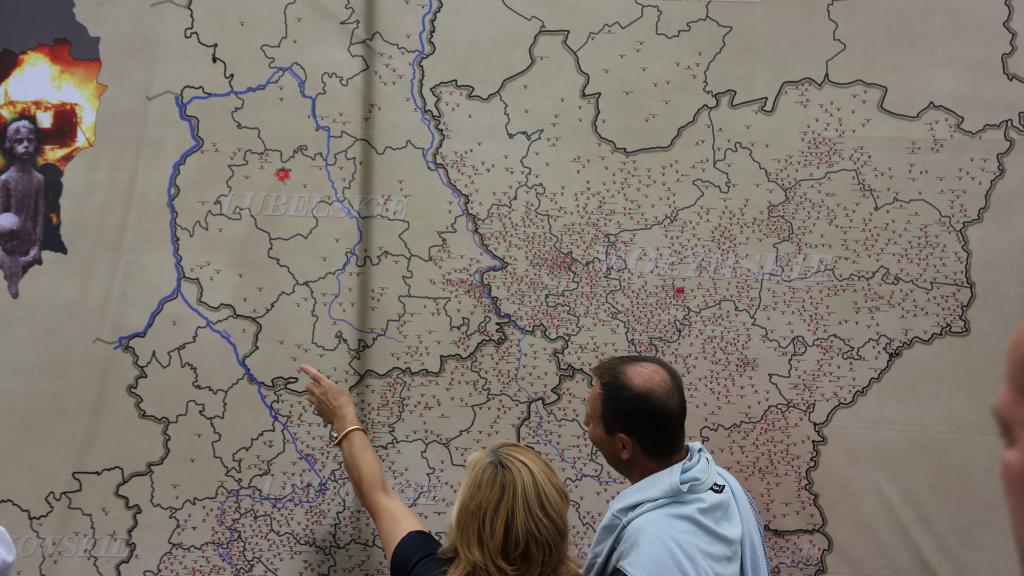
The recent visit of newly elected Polish President Karol Nawrocki to the village of Domostawa, in the Podkarpackie Voivodeship, just hours before the election silence. The Sejm’s decision to establish a new national holiday on July 11 — Remembrance Day for Poles, victims of the genocide committed by the Organisation of Ukrainian Nationalists–Ukrainian Insurgent Army (OUN-UPA) in the Eastern Borderlands of the Second Republic. The controversy surrounding a film falsely attributed by AI to Maria Andruchiw, a Ukrainian activist living in Poland, which denies the 1943 massacres of Poles in Volhynia. All these events share a common thread: the visible resurgence and intensification of debates around the painful legacy of Polish-Ukrainian historical relations.
Poland’s presidential campaign was full of discussions on relations with Ukraine. At least a few candidates — Maciej Maciak, Artur Bartoszewicz and Grzegorz Braun (who won 6.34 per cent of the vote) — openly criticised Ukraine and the Ukrainians for their alleged “parasitism” on the Polish social system, the destruction of Polish agriculture, dragging Poland into armed conflict, and for historic issues, including in particular the Ukrainian massacres of the Polish population in Volhynia and the areas referred to in Polish historiography as Eastern Lesser Poland during the World War II.
Others, such as Sławomir Mentzen, a candidate for the Konfederacja, attempted a more sedate criticism, largely focusing on history. Finally, the main candidate of the right, Karol Nawrocki, spoke more like Mentzen than Kaczyński (the leader of the formation that supported him), not only signing declarations against Ukraine’s accession to the European Union and NATO, but more than once entering into an open polemic with Ukrainian politicians on the subject of Volhynia (it is worth recalling he is president of the Institute of National Remembrance, the main state “seedbed” of nationalism in official state institutions).
What it is at stake
The reemergence of the issue of Volhynian massacres can be understood as a mixture of unresolved historic disputes, legitimate seek of historical justice by communities who were subjected to episodes of violence, and weaponisation of the past by nationalistic forces — all of this “shaken” within the complicated context of Russian’s invasion of Ukraine.
Between 1943–45, Ukrainian nationalist forces, chiefly the UPA, killed tens of thousands of ethnic Poles (around 50–60,000, according to Jared McBride in his 2016 paper Peasants into Perpetrators: The OUN-UPA and the Ethnic Cleansing of Volhynia, 1943–1944), many of them women and children. While Poland defines these events as genocide, Ukraine continues to reject that term — a divergence that continues to complicate diplomatic and symbolic gestures between the two neighbours.
Some Ukrainian historians, for their part, point to the long history of Polish policies of polonisation during the interwar period, which sought to assimilate or marginalise Ruthenians and Ukrainians in the eastern territories of the Second Polish Republic, fueling hatred between the two communities. US historian Timothy Snyder (1999) wrote that “it is indisputable that, in addition to the direct losses from the Holocaust and the Second World War, approximately 50,000 to 100,000 Poles and Ukrainians were murdered, and around 1.5 million were forced to leave their homes between 1943 and 1947.”
Canadian historian John-Paul Himka explains that “the Polish ‘pacification’ of 1930 was a low point, but the Polish government’s attitude toward Ukrainians (and other minorities) hardened even further by the end of the decade, under the rule of the so-called ‘colonels’... Polish repression fueled Ukrainian nationalism, and Ukrainian nationalists began to fantasise about killing large numbers of Poles in ethnically Ukrainian territories, with the idea of assimilating the remaining survivors into Ukrainian identity," he said.
In his opinion, another important factor was “the politics espoused by Poland’s neighbours, Nazi Germany and the Stalinist Soviet Union: both encouraged and made use of violence. Giving this context, the moral universe within Poland shifted dramatically. While the developments of the interwar period didn’t overdetermined the kind of violence that encompassed Volhynia and Galicia, yet they set up some of the parameters.”
Other Ukrainian historians also highlight cases of retaliatory — though smaller-scale — ethnic violence against Ukrainian civilians during the same period, and the aftermath of the war, particularly Operation Vistula (Akcja “Wisła”). Carried out by Polish Communist authorities in 1947, this operation forcibly deported over 140,000 Ukrainians and Lemkos from southeastern Poland to the so-called Ziemie Odzyskane (Recovered Territories) in the west and north of the country. The goal was to eliminate the remaining support base for the UPA and suppress Ukrainian identity, but its legacy is remembered in Ukraine as an act of ethnic repression and trauma. This asymmetrical but reciprocal violence continues to shape the historical narratives on both sides, and underscores why reconciliation remains elusive.
Demands for justice and crash of memories
Nawrocki’s recent election as president brings renewed attention to the memory and legacy of the Volhynia massacres during World War II. A conservative historian and former head of Poland’s Institute of National Remembrance (IPN), Nawrocki made historical “justice” a central theme of his campaign. In his first public statements as president-elect, he welcomed continued partnership with Ukraine, but stressed it must include resolving “overdue historical issues,” a clear reference to the long-standing dispute over the wartime killings of ethnic Poles in Western Ukraine, which the Polish Sejm officially declared as genocide in 2016.
The political context remains fraught. While Poland has stood as one of Ukraine’s most committed allies since the start of Russia’s full-scale invasion in 2022, unresolved historical memory — particularly around Volhynia and the role of the Ukrainian nationalists, Stepan Bandera above all — has repeatedly threatened to undermine that solidarity.
Ukrainian historian Georgiy Kasianov, in his book Memory Crash: Politics of History in and around Ukraine, 1980s–2010s (Central European University Press, 2022), writes: “The story about the past in Ukrainian–Polish relations is very instructive in many respects, especially in regard to the conflict potential of historical politics. Regardless of the political orientation of the individuals and parties at the helm, the ruling elites of both countries consider friendly and cooperative relations with their neighbour to be a top priority. Poland and Ukraine managed to find mutually acceptable solutions in almost every sphere, including economic, political, and cultural relations. There is only one exception, the sphere of historical memory.”
Ukrainian historian Yaroslav Hrytsak agrees that “the Volhynia massacre and the UPA are the only stumbling blocks in Polish-Ukrainian reconciliation. Here we are dealing with national myths that are very asymmetrical. Over the past decade or so, the Volhynia massacre has become a central myth in Polish historical memory — much like the Holocaust in Jewish memory or the Holodomor in Ukraine’s case. In contrast, within Ukrainian historical memory, the Volhynia massacre holds a rather marginal place, and many Ukrainians have only a vague idea of what actually happened there and then,” he explained to us.
“I am confident that until recently, [Ukrainian president Volodymyr] Zelensky had very little, if any, knowledge of the Volhynia massacre. Moreover, Ukrainians do not understand why Polish elites — who are supposed to be allies — keep raising this issue while Ukraine is at war with Russia. They suspect this might be the result of Russian interference aimed at breaking the Polish-Ukrainian alliance.”
Hrytsak recalls that he personally organised or took part in several events aimed at reconciling Poles and Ukrainians. While some of these initiatives ended successfully, those focused specifically on Volhynia were, in his words, “spectacular failures.” His bitter experience leads him to believe that the chances of achieving reconciliation on this issue are very slim, and that it will require significantly more time and effort.
Polish historian Adam Leszczyński, whose own family was directly affected by the events in Volhynia — his grandfather, as a child, had to hide in the forest after his entire family was killed in a village massacre, and was later taken in by Soviet partisans — offers a stark personal perspective on the matter.
“We know the facts, and we can debate the terminology. It was pretty clearly a war crime, very much a case of ethnic cleansing. The discussion now revolves around whether it qualifies as genocide. Does it fit the strict legal definition? Some argue yes, others no... It’s a complex debate, and I don’t think even the Polish state has a clear stance — it often depends on the political context,” he said.
“There’s been huge pressure on Ukraine over the past 10 or 15 years to issue an apology. Zelensky did, perhaps somewhat reluctantly; one of his predecessors also expressed regret. But there are voices on the Polish side who seem to expect Ukrainians to apologise continuously — as if there’s no end to it. And after all, these events happened a very long time ago.”
The new exhumations
Nevertheless, it is legitimate to say that in recent months the issue reached a crossroad. In January, the Ukrainian government lifted a de facto ban on exhumations (in place since 2017) and allowed Polish teams to resume recovery work at mass grave sites. The move, confirmed by Prime Minister Donald Tusk and Culture Minister Hanna Wróblewska, was hailed as a long-awaited breakthrough. In April, the first exhumation began in the former Polish village of Puzhnyky, now in western Ukraine, with the involvement of Polish and Ukrainian experts and relatives of the victims. In recent days, the Ukrainian and Polish governments have agreed to carry out new exhumations in Ukraine’s Lviv oblast and in a village just across the border in Poland.
The process has brought long-overdue recognition to families and placed the memory of Volhynia back in the diplomatic spotlight. “I see exhumations as a positive step”, says Leszczyński. “To me it’s a matter of historical justice towards Polish communities who were subjected to violence and massacres and the Polish state has a duty to accomplish the rescue and the recognition of bodies. It’s a humanitarian obligation, it’s simply a task to do but for many years the Ukrainians for their own reasons were not very willing to cooperate. So, in Poland, one party accused the other party of being not strong enough or not enough diplomatically skilled to get things done. So, we can say there is this ‘ping-pong rhetoric’ inside Polish politics while Ukraine is pretty reluctant to admit that anything bad happened in Volhynia.”
At the same time, there is at least a “third actor” meddling in the Ukraine-Poland bilateral relation, which is Vladimir Putin’s Russia. Needless to say, Russian propaganda often exploits any topic that could deteriorate Ukraine’s relationship with any ally. The subject of the Volhynia massacre has been at the forefront of Russian politics towards Poland in its Ukrainian dimension for years. The tragic events in Volhynia during World War II are perfect fuel for Russia’s anti-Ukrainian propaganda and for portraying “Banderite” Ukraine and Ukrainians as a “nation of criminals” who “first killed in Volhynia and are now doing the same in Donbas.” Moscow is cynically trying to equate these two completely unrelated events, fuelling mutual animosity on both sides of the Bug River.
But then again, as the material exhumations are going on, there is also a sort of symbolic exhumation that involves societies and public opinion in both countries. The subject of crimes committed by Ukrainian nationalists in Volhynia, Podolia, Polesia and the Lviv region from spring 1943 to summer 1944 has always been present in the Polish public sphere, but never with such intensity.
We can identify two turning points in recent years that have enabled nationalist circles, and the Polish right more broadly, to draw greater public attention to this issue. In both cases, however, we are talking about situations in which, apart from historical justice, the broadly understood “Volhynia” has become a safety valve for quite contemporary anti-Ukrainian sentiments.
Historical antagonisms and revanchism emerged in full force when the labour market in Poland was opened to Ukrainians (before the war, about 1.5 million Ukrainian citizens worked in Poland). The situation was also changed by the influx of another huge number of refugees (although immediately after the outbreak of the war, “Volhynia” temporarily disappeared). Issues such as “taking jobs away” from Poles, alleged privileges enjoyed by Ukrainians who fled to Poland, and the “expensive cars” of newcomers from across the eastern border (all local variants of well-known anti-immigrant stereotypes) began to collide with the difficult past of both nations.
We cannot completely ignore the role of the so-called środowiska kresowe (borderland communities), especially the late Armenian Catholic priest Tadeusz Isakowicz-Zaleski. Organisations originating from this movement, although niche, were quite active, going far beyond the traditional, favourable forces of the extreme right, trying to convince, among others, politicians from the Polish People’s Party, and publishing articles in the centre-left magazine Przegląd (it is also worth recalling that Leszek Miller, former prime minister from the Democratic Left Alliance, has taken an openly sceptical stance towards Ukraine, full of historical resentment).
Another factor that fuelled the broadly understood “Volhynian” theme was the shift to the right of a large part of the Polish political mainstream. During the presidency of Bronisław Komorowski of the Civic Platform (2010-2015), not only were Roman Dmowski and the so-called Żołnierze Wyklęci (Cursed Soldiers) idealised, but the then president also quite openly called the Volhynia massacre “an event with the hallmarks of genocide.”
The subject finally appeared in popular culture as well. Wojciech Smarzowski, a director known for his socially critical films (Kler, Drogówka) and his critical take on Polish history (Róża), made a film with the simple and meaningful title Wołyń. Although the author himself rejects any form of revanchism, the harsh and violent image fits well into the highly confrontational revision of Polish memory politics towards Ukraine.
Shifts in public opinion
A CBOS survey conducted in July 2023 (“Polish-Ukrainian relations 80 years after Volhynia”) shows that although the majority, 53% (60% in 2018), acknowledge past events divide Poles and Ukrainians, as many as 31% (compared to 23% five years earlier) expressed the opposite view and believed in the possibility of building a friendly coexistence between the two neighbouring nations, unburdened by history. In turn, a 2024 survey by the Mieroszewski Centre, showed more than 40% of Poles believe that there have been events in the history of Polish-Ukrainian relations for which Ukrainians should feel guilty towards Poles today. Despite the widespread belief that shared history tends to divide Poles and Ukrainians, the vast majority of respondents surveyed by CBOS believe reconciliation between the two nations is possible (78%).
Even in 2023–24, Poles’ declared knowledge of historic events related to Polish-Ukrainian relations was generally quite superficial. Thirty percent of respondents by the Mieroszewski Centre declared that they had reliable knowledge of issues related to the UPA, one third had “heard something about it,” and the same percentage had no knowledge of it. In the case of Akcja “Wisła” and the OUN, the relevant indicators are even lower. Twenty-five per cent of respondents declared detailed knowledge of the post-war deportations of Ukrainians to Poland, while in the case of the OUN, this percentage was 18%. The majority of respondents (51%) also admitted that they had never heard of the OUN.
Only in the case of the Volhynia Massacre did 46% of respondents surveyed by the Mieroszewski Centre claim to have in-depth knowledge of the event, while 41% said they had heard something about it. A CBOS survey conducted a year earlier yielded different results. There, opinions about Volhynia are even more unequivocal: 92% had heard about the Volhynia massacre, compared to only 59% of the population 15 years earlier. The survey also showed an increase in the number of Poles who declared that they knew “a lot” about Volhynia, 64% (in 2018, it was only 37%).
Further opinion polls show that the issue of Volhynia has become a permanent fixture in Polish politics and an important factor that may also shape contemporary relations between the two countries in the future. This is clearly demonstrated by a SW Research poll in September 2024, in which 52.6% of respondents believe that Ukraine’s accession to the EU should be conditional on its agreement to exhume the victims of the Volhynia massacre. Or the poll conducted in December of the same year, in which as many as 67% were sceptical about the sincerity of Ukrainian declarations regarding the exhumation of the victims of the massacres in Volhynia.
While the topic of massacres in Volhynia and other parts of the so-called Kresy Wschodnie (Eastern Borderlands) has become quite prominent in Polish public discourse, the dark chapters of Polish history towards Ukrainians are hardly ever discussed. The widespread practice in Central and Eastern Europe of playing the victim card rather than the perpetrator has not bypassed Poland. In this context, we can recall, for example, the destruction of Orthodox churches in the Chełm region in the interwar period or the aforementioned Akcja "Wisła”, which involved the displacement of a large part of the Ukrainian and Lemko (Rusyn) populations from the present-day provinces of Lublin, Podkarpackie, Podlasie and Małopolska (where they had lived for centuries) to the Recovered Territories, in the western and northern parts of the country, which became part of Poland after World War II.
On March 1, Poland celebrates the so-called “Day of Remembrance of the Cursed Soldiers”, a holiday commemorating the soldiers of the anti-Communist underground after the end of World War II. To this day, it remains controversial in Polish society because it equates the true victims of Stalinism (such as Witold Pilecki) with people who attacked peasants who had received land as part of agricultural reform and ethnic minorities. Among the victims of the “cursed” were Jews, Belarusians, Lithuanians, Slovaks, and very often Ukrainians.
The massacres in Piskorowice, Sufczyn, Wierzchowiny, Sahryń, Miętkie, Szychowice, Turkowice, Pawłokoma, Bachów and Brzuszka, to name but a few, are further pieces of the historical puzzle and mutual reckoning of grievances that could trigger a nationalist backlash and undermine the historical truth about responsibility for crimes among a large part of Polish society, which is susceptible to the myth of being “eternally wronged by foreigners.”
From Poland and Ukraine to Europe
Overall, this process paralleled the political and social developments of Ukraine and Poland after gaining their independence in 1991. As the former dissident activist and Polish Minister of Foreign Affairs and historian Bronisław Geremek put it, “the comeback of freedom brought along the comeback of nationalism.” After the fall of socialism, at different degrees, history was reinterpreted under the national paradigm. By doing so, many issues of the past gradually became relevant in the present.
But in the case of Volhynian massacres it’s not that simple. In fact, there was a sort of road that drove from an initial moment of unity to a separation between the two countries. As the title of a book by Polish and Ukrainian historian Tomasz Stryjek and Joanna Konieczna-Sałamatin summarise, the politics of memory in Poland and in Ukraine underwent a path from re-conciliation to de-conciliation.
Already in the 1950s, a group of intellectuals reunited around Kultura, a Polish-émigré literary-political magazine based in Paris, (among them the Nobel prize Czesław Miłosz), started to advocate for recognising Poland’s postwar eastern borders, namely to drop any territorial dispute with Ukraine, Belarus or Lithuania (at that moment, part of the Soviet Union), as a part of a broader effort and struggle for the independence of all these countries. Indeed, later the movement of Solidarność took up the idea and on this basis in 1989 member of KOR (Workers’ Defence Committee), adviser of Solidarność and Lech Wałęsa, and editor-in-chief of Gazeta Wyborcza Adam Michnik could take part in the founding Congress of Ukrainian Rukh and proclaim that Polish people would have to stand side-by-side with Ukrainians in their struggle to break away from Soviet Union.
Italian historian Guido Crainz (who recently published a book about politics of memory in Europe, Ombre d’Europa) comments: “It is somehow a paradoxical development. Confrontation against Russia created a dialogue between Poland and Ukraine, but at the same time produced national movements which in turn paved the way for a nationalistic interpretation of history. Of course, between the two countries there are no problems insofar that Ukraine commemorates the Holodomor, for example. But tensions arose as Ukraine, by juxtaposition with Russia, started to celebrate national heroes like Stepan Bandera whose army, besides collaborating with Nazis, was involved in the Volhynian massacres.”
These were the premises. But divisions and quarrels arose later in time, especially after the 2000s and 2010s when in Poland and Ukraine political forces started to come to power who explicitly theorised and put into practice the need for having a politics of memory on the state level (PiS in Poland, Viktor Juščenko in Ukraine). This is a common trend in Central and Eastern European states: giving the general social and political turbulences of the ’90s, the fact that many archives and documents begun to open up in that period and the gradual way in which processes of nation-building were set up, it took time for the political and intellectual classes to elaborate a narrative about the past and try to make it official.
Also, after the 2000s, a similar trend was present at the European level. The European Union started to invest in politics of memory and in dialogue between different memories of different nations. Funding for history-related and memory-related activities were established.
Two key events generated this turn: on one hand, the failure of the 2005 French European Constitution Referendum, which prompted the feeling among part of the European elites that mere economic solidarity between member states was not enough to foster a sense of unity and that it was necessary to engage on the cultural and identity level; and, on the other hand, the 2004 European enlargement (the largest in terms of number of states and populations) which, as many former Warsaw-Pact and Soviet nations joined the Union, started to question the “ideological foundation” of European memory based on the Holocaust and defeat of the German Reich by taking into account the need to look and condemn also Communist and Soviet crimes and its occupation of Eastern and Central Europe.
In fact, the issue of Volhynian massacres too is intertwined with European policies and has its European dimension besides the one linked to the bilateral relation between Poland and Ukraine. Nawrocki said he would veto Ukrainian integration in Europe if there was no recognition of the Volhynian tragedy and if exhumations stopped.
But should the European Union take a role in the process? According to Crainz, “some moral persuasion initiatives by European institutions would be useful in order to avoid extreme polarisation or overly controversial decisions (such as happened when Ukraine granted Bandera the title of ‘Hero’ of the country).”
“At the same time, we should not forget that we are talking about a historical quarrel that cannot be solved by decrees or decisions by governments. Political compromise is the opposite of critical engagement with history, and different point of views should dialogue through in-depth study, research and analysis.”
Nevertheless, given the reasons that we mentioned above, the issue is already a European one. Professor Aline Sierp (who has written extensively on topics of history, memory and Europe) explains: “The European Union is constantly involved in similar issues. The way nations consider their past is actually a criteria to evaluate if they are ready to become a full member state. It’s a sort of unwritten rule. It’s not embedded in the European legal system, it’s not in the acquis communitaire, but it’s regularly discussed in offices and institutions in Brussels. We’ve already seen that at the time of 2004 enlargement or during the talks for the access of Turkey.”
‘Without regard for heroes and villains’
Nawrocki’s presidency could mark a turning point. While some hope his background will bring institutional focus and structured dialogue to the issue, others fear it will deepen nationalist framings and hinder reconciliation. Among the critics is Volodymyr Viatrovych, former head of Ukraine’s own Institute of National Memory and often described as the architect of Kyiv’s historical policy after Maidan. Viatrovych accused Nawrocki of having “destroyed the Museum of the Second World War in Gdańsk [where he was director before joining the IPN] and politicised the Polish Institute of National Remembrance.”
Viatrovych has also been accused of shaping Ukrainian national narratives through controversial actions, particularly his whitewashing of the UPA’s role in the war. Kasianov pointed out, “Viatrovych would not have played any role had populists not taken advantage of his activities: from Lyashko and Klitschko to Tymoshenko and Poroshenko, and the remnants of Rukh and its derivatives (like the Ukrainian People’s Party).”
“And of course, Putin helped: because the agenda of the OUN/Svoboda was promoted under the cover of fighting Communism, Soviet legacy, ultimately Russia. In general, it is the right-wing, conservative, and populist forces in both Poland and Ukraine, the real promoters of the conflict, that resemble Siamese twins, as they consistently exploit memory politics whenever it suits them. This is not a conflict between nations or peoples, but between ideologically kindred segments within both societies”.
Within such a heated debate, the task for politicians and public opinions perhaps should be trying to combine the search for historical justice with promoting reconciliation between different communities. Hrytsak and Leszczyński point to Franco-German relations as a potential model for the future. According to the Ukrainian historian, in terms of its significance, this situation can be compared to the reconciliation between France and Germany after World War II. “To the extent that the latter served as a building block for the EU, the Polish-Ukrainian reconciliation created an opportunity to extend the EU further east,” he said.
Leszczyński also said that “the German-French model, or even the Polish-German one, would be appropriate here. We have to acknowledge that both sides were responsible, but first we must establish the facts. The facts are that Polish people were killed. You also have to acknowledge that Ukrainian people were killed on a much smaller scale, and that the Ukrainian movement was persecuted in pre-war Poland. After the war, Ukrainians were second-class citizens in Poland,” he said.
“You have to present the whole story, and then both sides have to admit their faults. Then they can move past the issue and build their friendship on historical truth. The Polish-German and German-French models are good examples of this. They have been able to remove historical disputes from ordinary lives and leave them to the historians.”
Himka points out, “the only way forward is to investigate everything that happened, in its full complexity, without regard for heroes and villains. This is tough academic work, and it will not result in an easily summarised and comforting narrative for any of the national egos involved. Ukraine should take a sober look at the violence OUN-UPA inflicted on national minorities and on its opponents, while Poles have to reckon with the great and painful errors of its interwar republic and the aspirations of its underground in World War II. And it would help if the Russians also came clean about the Stalinist past in reference to Poles and Ukrainians.”
Of course, says Himka, this is a taller order that can be managed at present, in the midst of a war of aggression waged by the Kremlin. Yet, it is the only viable one — otherwise Poland and Ukraine risk being caught in a perpetual cycle of accusations, victimisation and counterproductive uncomprehension. This would not only confuse the past, but also jeopardise the future.
Bloody Amputation: Trump’s “Peace” for Ukraine
Wednesday 20 August 2025, by David Finkel
THE TRAJECTORY WAS always clear to anyone who was paying attention, and knew how to filter out the noise of Donald Trump’s empty threats of “severe sanctions to destroy Russia’s economy,” let alone 500% tariffs on Russia’s oil customers, if there weren’t an “immediate cease-fire” in the Ukraine war.
When Trump met Vladimir Putin at the Munich-in-Anchorage summit, the agenda was the betrayal of Ukraine. This was ordained from the moment of the Trump-Vance ambush of president Zelensky in their infamous February White House encounter, if not even earlier.
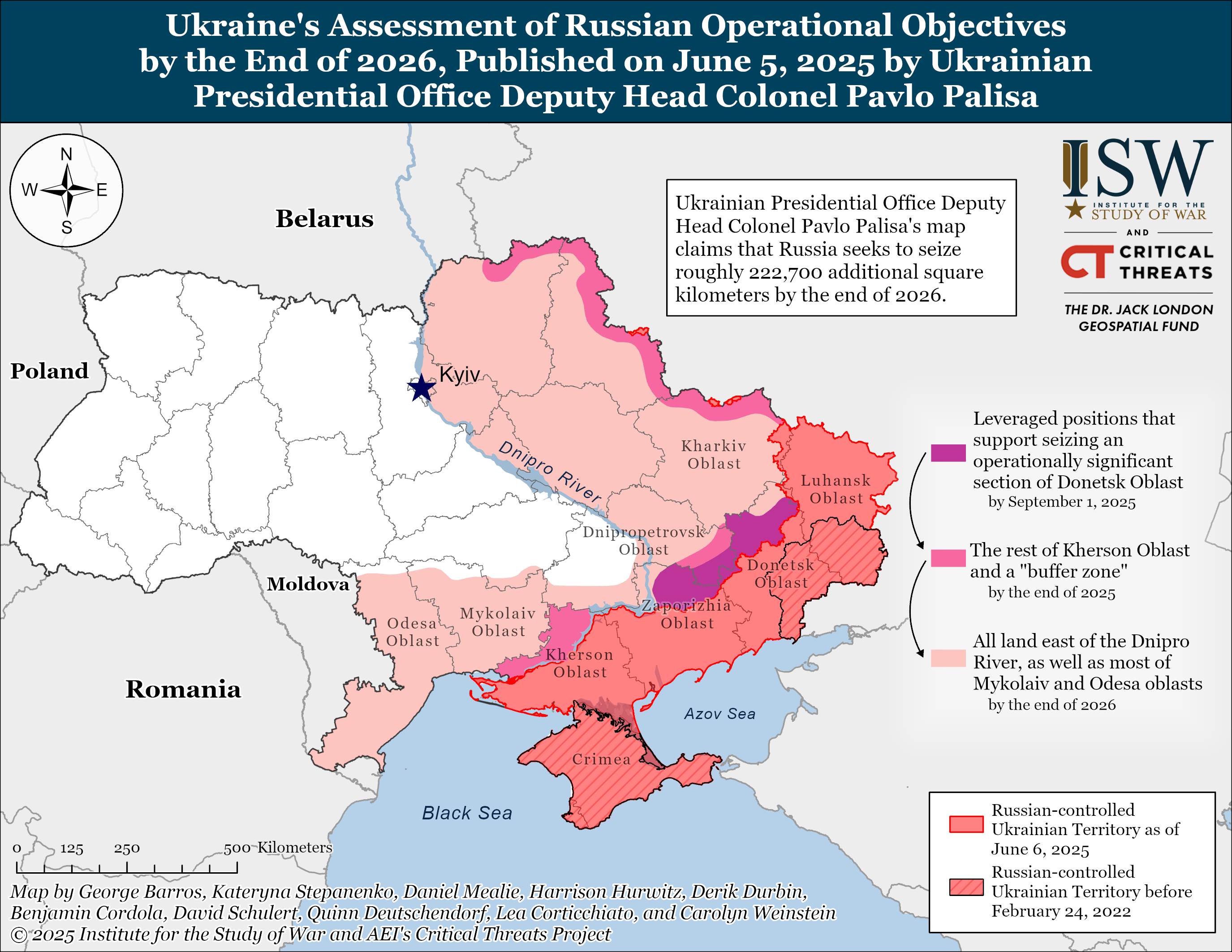
A nation targeted for carveup. (Source: Institute for the Study of War)
It was always Trump’s view, along with the Christian-nationalist far-right sector of the MAGA cult, that the war was Ukraine’s fault from the beginning and that its only option is to surrender on whatever terms Russia’s superior power imposes.
So Trump flew to Alaska blathering cease-fire, while Putin arrived with the proposition for working out a “permanent solution addressing the root causes of the conflict.” That sounds statesmanlike, except for the detail that for Putin’s Russia, the basic “root cause” is Ukraine’s existence as an independent country with the capacity to set its own course and defend itself.
That independent Ukraine is what needs to be eliminated, beginning with the amputation of a fifth of its territory and continuing on to impose a vassal regime. That’s Moscow’s “comprehensive peace” — and Trump of course folded like the cheap empty suit he really is when facing a situation he can’t dominate.
As a bonus, according to Trump, Putin advised him that getting rid of mail-in voting is necessary to guarantee “free elections,” an area in which the Russian president-for-life is a leading expert.
Meanwhile, every day in Gaza dozens of people die of starvation — soon to be hundreds at least — as unrestricted U.S. weapons, not available to Ukraine, flow to Israel’s genocidal slaughter.
European Rescue?
Following the Alaska debacle, European leaders scrambled to Washington to protect the Ukrainian president from a repeat of the February catastrophe. They came deploying the mixture of flattery that Trump requires, with proclamations of solidarity with president Zelensky and phrases of “security guarantees” for Ukraine.
It’s entirely unclear what these hypothetical commitments might mean. Putin immediately responded with 270 drones and missiles hitting Ukrainian civilian and energy infrastructure targets. As The Economist online (August 18) explains:
What Russia cannot get by fighting it is demanding to be given on a plate through the pressure that Donald Trump can put on Ukraine and on America’s European allies. At the top of Vladimir Putin’s shopping-list is the western part of Donetsk province, which is still firmly in Ukrainian hands. But it is not just the symbolism that is important to him. The real prize is to force Ukraine to abandon its strategically critical “fortress belt,” a 30-mile (50km) line that comprises four cities and several towns, which stands in the way not only of Russia’s goal of gaining the whole of Donbas, but also of its ability to threaten other regions.
Not a problem for Trump, evidently. But how then can he get away with perpetrating this treachery?
Truthfully, in the final analysis the fate of Ukraine — like that of Palestine —is not of first-rate importance for the strategic interests of U.S. imperialism. Trump’s buffoonery in the face of a sharp operator like Putin is an American embarrassment, but nothing fatal.
What about the Russian threat? Three years of war have actually demonstrated its relative weakness. If it could not overrun Ukraine, much less could it challenge a middle-rank military state like Poland. What happens to Donetsk, Luhansk and the rest of eastern Ukraine is hugely important for that country and the region, but not for Washington so long as there is no threat of a Europe-wide war.
Since Russia’s all-out invasion in 2022 the United States, first under Biden and now Trump, gave Ukraine’s heroic resistance the weapons and crucial intelligence to prevent Ukraine’s defeat but not to win the war (which would also have been a terminal crisis for the Putin regime).
Today, the greatest dangers for Ukraine and its people appear to be exhaustion and demographic crisis, as the current population of 39 million is sharply down from 52 million at the point of independence in 1991.
For Trump’s family and cronies, Putin’s Russia now appears to present opportunities for business deals and enrichment — on far grander scales than his previous absurdist Mar-a-Gaza resort fantasy.
Meanwhile the genocider Netanyahu has given Trump the gift of a nomination for the Nobel Peace Prize. Little chance of that (unless the peace prize committee can be bought), but perhaps a special “Neville Chamberlain Peace in Our Time” medal could be struck in the president’s honor.
The small consolation in this episode is that Donald Trump, with all his bullying of people without the power to fight back, is exposed as a blustering fool on the world stage when there’s even a second-tier adversary. To some limited extent, U.S. “world leadership” is also weakened. These are good things, but not worth the sacrifice of Ukraine on the altar of cynicism and expediency.
[The Ukraine Solidarity Network (U.S.) is raising funds for urgently needed medical diagnostic equipment needed by front-line nurses.]
19 August 2025
Source Against the Current.
Attached documentsbloody-amputation-trump-s-peace-for-ukraine_a9137.pdf (PDF - 998.3 KiB)
Extraction PDF [->article9137]
United States (USA)
Trump’s Test Case: Deploying the Military to Washington, DC
No Deals with War Criminals on Alaska Soil
The Trump-Era Gender Wars, Brought to You By Neoliberalism
Learning from the DSA convention
DSA’s 2025 National Convention: A New Chapter Opens Up for the Socialist Movement
Russia
“For the Neofascists, the Law of the Jungle is the Only One That Makes Sense”
Let Vlad stay
Support the Russian-Ukrainian resistance against accelerating fascism worldwide
‘No one has strengthened the Ukrainian far-right more than Putin’
“Ukraine’s Fate Raises the Issue of the Rights and Sovereignty of Small States”
Ukraine
Anti‑militarism without pacifism
Kryvyi Rih — Vermont — Paris!
Corruption (Ukraine): a victory
You give us corruption, we give you revolution!
Ukraine’s New Cabinet: Neoliberal Reforms Threaten Wartime Solidarity
David Finkel is an editor of Against the Current, published by the US socialist organization Solidarity (www.solidarity-us.org)
International Viewpoint is published under the responsibility of the Bureau of the Fourth International. Signed articles do not necessarily reflect editorial policy. Articles can be reprinted with acknowledgement, and a live link if possible.