Saturday, August 23, 2025


Semper Fidelis: Always Faithful to Social and Racial Justice


Interview with ex-Marine Don Gomez from California who now runs a small press for the underserved!


My subheading could have been:

Writing for Survival, Sanity and Soldiering On

…Sterncastle Publishing in Lincoln County Brings Voices Who Have Been in the Shadows into the Book World

From California to Iraq and Falluja to Antigua, to local politics and now the wounded warrior runs a small publishing house on the Oregon Coast, highlighting BIPOC, LGBTQA+ and veteran writers, Don Gomez is making small waves in the small “p” publishing world.

My interview with him ran on my KYAQ FM 91.7 FM showFinding Fringe.
Listen here for a compelling story of Don who was a kid in California, had some rough and tumble years being pegged a “spic,” even though that racist term goes only for people of Mexican heritage. His family goes back to the 1850s in Colorado, Spaniards.

He ran for Lincoln County commissioner, but lost:

He runs Sterncastle Publishing here in Newport, Oregon:

Mikey D. | Profile | Fiverr

Addiction ran in his family, and he had his juvenile offending “lifestyle,” but listen to the interview and how he is on a mission, former Marine and all.
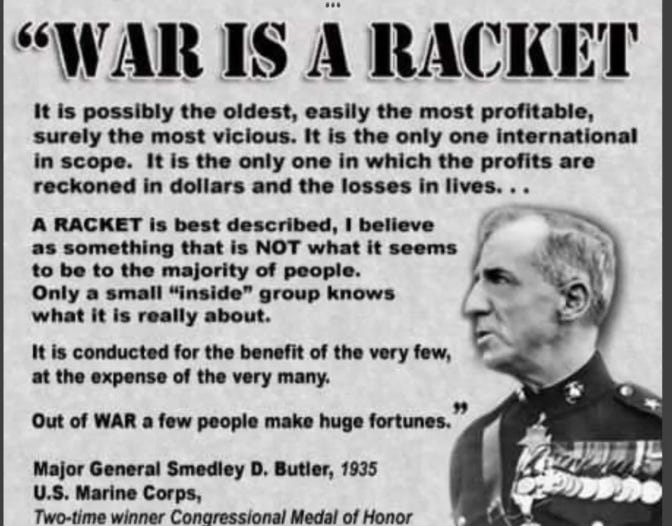
Don talked about veteran writing workshops in San Diego, and he talked about dudes he knew who were not US citizens, but were military vets, rounded up and deported, man.

Even back to the Korean “war,” dudes would write their stories, their remembrances, memoirs, what have you, and it was as if many weights were lifted off their backs and hearts.

“They actually looked different after going through the writing workshop.”

Alienation. Brown in a White Man’s Stolen Land.

I’m writing this because my buddy called right after the interview of Don aired on KYAQ 91.7 FM, kyaq.org.

He said it was my best interview he’s heard so far on my Oregon Coast show, Finding Fringe. Who would have thought?

Kelly called, talked to my wife Monica (alias), we had laughs, and he didn’t realize Monica is Latina, or Hispanic in that weird descriptor.

In fact, here is one of Monica’s worker friends, from Lisa’s old days doing the day and night labor staffing: From a short-lived gig with a Portland paper, called, my column that is, Finding Fringe!

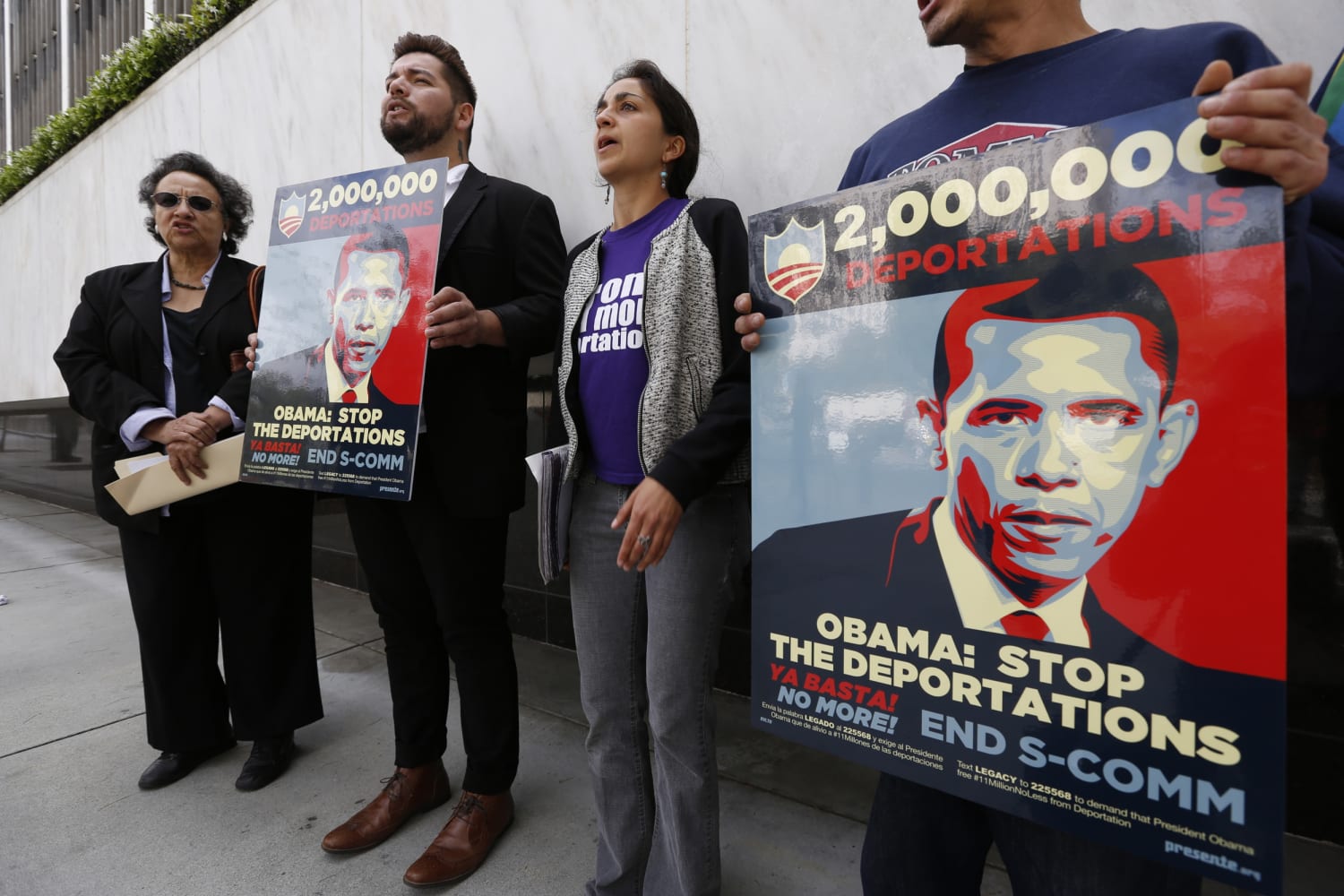
The reality is that Don had people he worked with who were not US Citizens, but who “served” in the US’s various branches of the military and they STILL got deported (by the Obama Regime).

*****

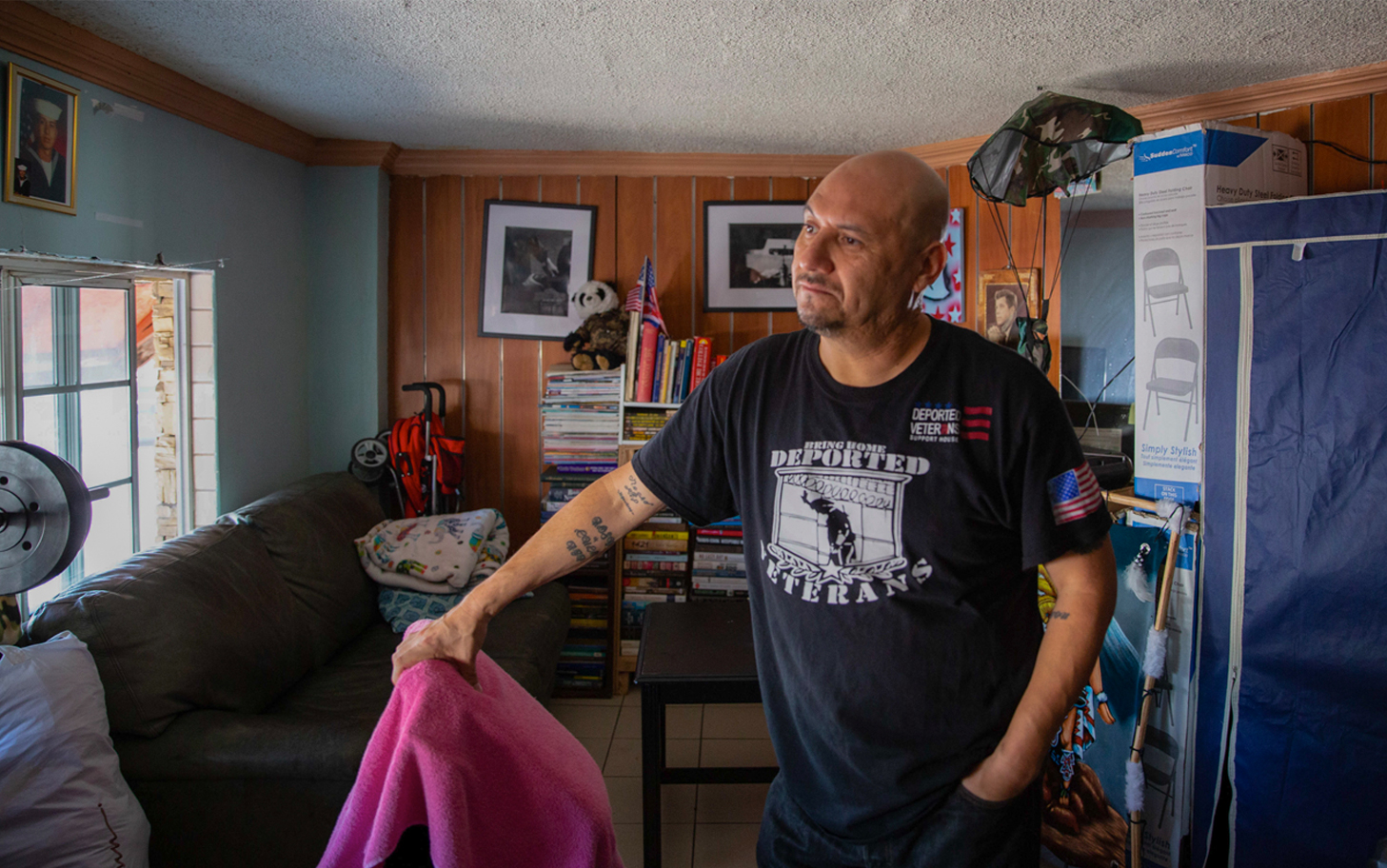
Democratic Rep. Joaquin Castro of Texas recently led a trip to Tijuana, Mexico, to meet with U.S. veterans who have been deported. Six other Democratic lawmakers joined Castro to tour the Deported Veterans Support House, also known as “the bunker.”
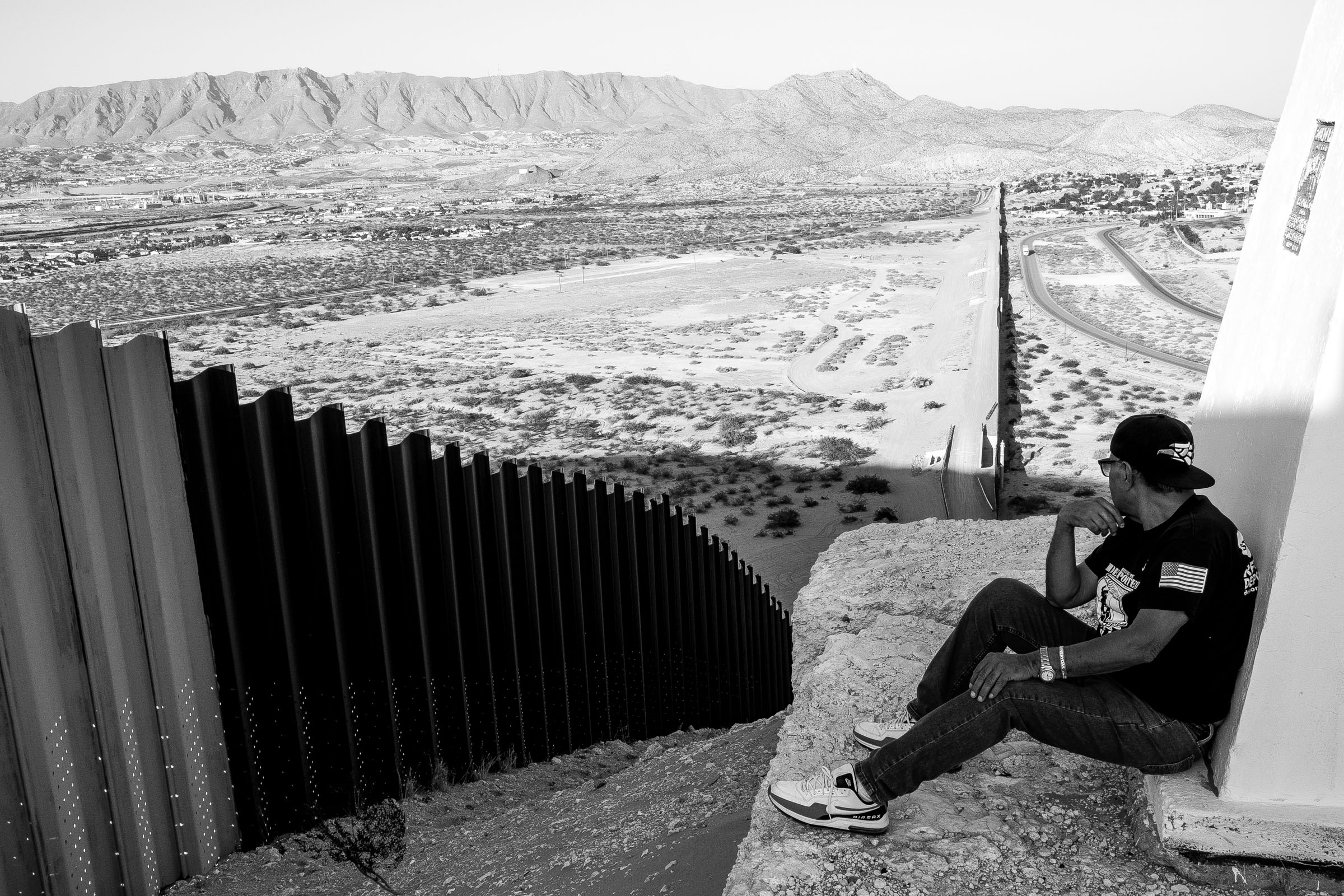
The bunker was founded by Hector Barajas, who served six years in the U.S. Army as a paratrooper. As a veteran, Barajas was deported to Mexico after serving time for a felony of firing a gun into a vehicle. Barajas served two years from 2001 to 2003 and was deported once he was released. “I’ve got to take personal responsibility of what I put myself into, but I already paid my debt to society and I don’t think I should have to pay twice for it,” Barajas said.

Although the deportation of veterans dates to 2013 under President Barack Obama, Democrats now are trying to cash in on Trump’s hard anti-immigration views and policies to make a political statement and present their own legislation to address the issue.

Rep. Michelle Lujan Grisham (D-N.M.) calls the deportation a “life sentence.” As chair of the Congressional Hispanic Caucus, she is familiar with the immigration issue and is working to help these veterans reunite with their families in the U.S.

“They just want to come home and see their children, their spouses and their parents,” Grisham added.

After leaving the military, Hector Barajas-Varela said he struggled with mental health issues and began to spiral into a life of addiction. He served a prison term from 2001 to 2003 and spent another year in immigration detention.

He remembers his first deportation as unceremonious. He wasn’t provided with information, and he doesn’t remember signing any paperwork.

“I don’t even remember like anybody saying, ‘Welcome to Mexico,’” he said. “A gate opened up, and that was it.”

Six months later, he sneaked back into the U.S. and tried to start over. He began a relationship and had a daughter.

“The second time that I was deported was very difficult because I had finally a family and a daughter,” Barajas-Varela said. “Missing my daughter was really difficult.”

Adjusting to life in Mexico was a challenge. Barajas-Varela said he became depressed and again slipped into addiction. He spent six months on the street before he began to pick up the pieces.

In 2013, he converted his home into what would become the Bunker.
Obama Leaves Behind a Mixed Legacy on Immigration

You know, snakes are fast, but alligators are much — we’re going to teach them how to run away from an alligator, OK, if they escape prison. How to run away: Don’t run in a straight line. Run like this. And you know what? Your chances go up about 1%, OK? Not a good thing. …

You have a lot of bodyguards, you have a lot of cops, that are in the form of alligators. You don’t have to pay them so much. But I wouldn’t want to run through the Everglades for long. It will keep people where they’re supposed to be. This is a very important thing. — Trump

Trump says he'd like to see facilities like 'Alligator Alcatraz' in 'many states' - ABC News

*****

Don and his things he carries. Below, Veta and Ms. Yount, who will be on my August 27 show:
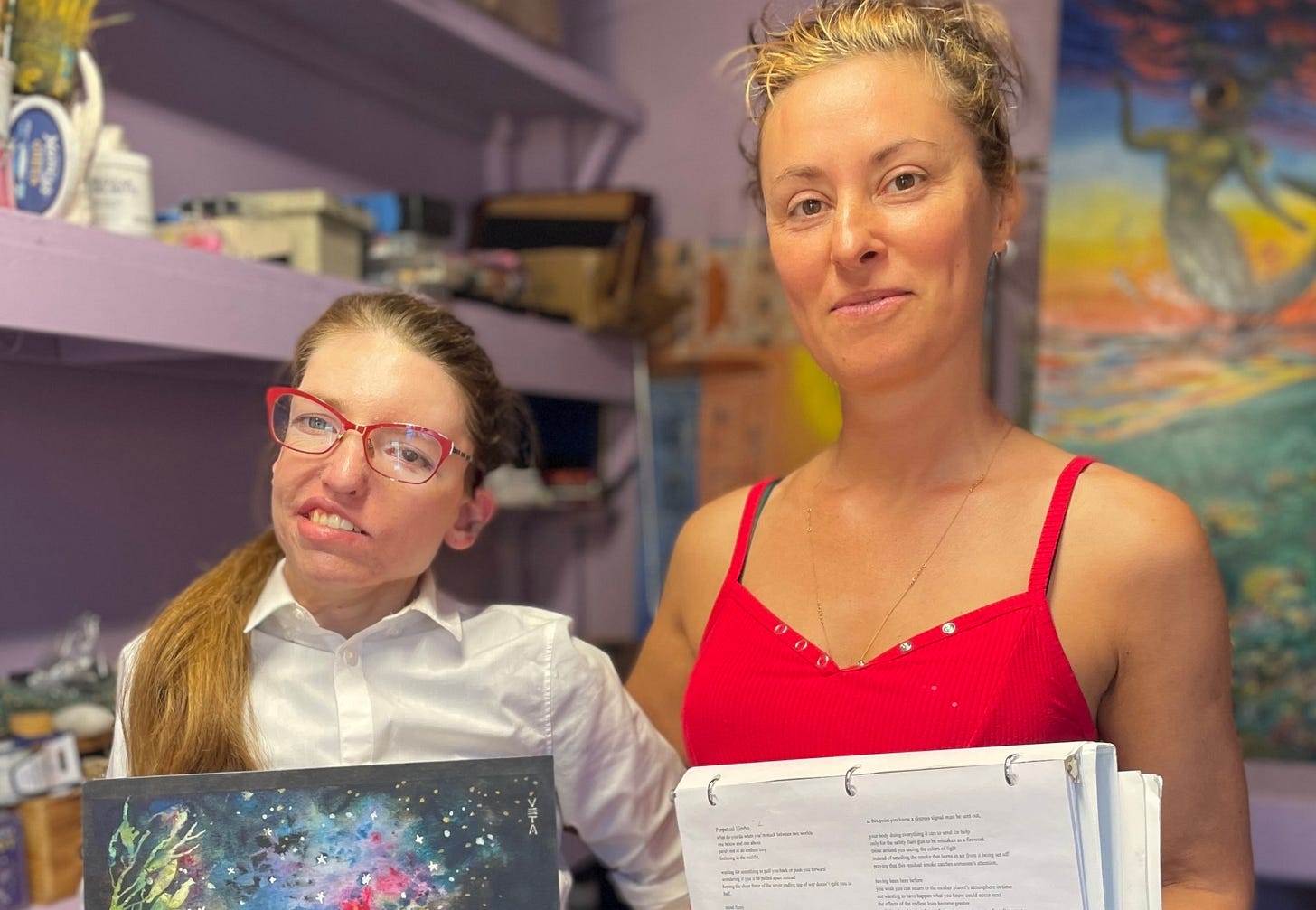
Poet-author, artist and publisher combine to create book to be celebrated Saturday at gallery opening • Lincoln Chronicle

Okay, more on the dirty country of deportati0n:

KFF Survey of Immigrants: Views and Experiences in the Early Days of  President Trump's Second Term | KFF

Atlanta deportations surge in early stages of Trump presidency – the  Southerner Online

Trump's Deportation Flights Increased in May, Data Shows - The New York Times

How Trump's Mass Deportation Plan Would Hurt the United States - The Center  for Migration Studies of New York (CMS)

Article: Immigrant Veterans in the United States | migrationpolicy.org

Haeder’s piece to illustrate some ground-truthing!

Iglesia de Colima in Colima, Mexico. Enrique’s father was a migrant worker, who worked in the United States on farms. He’d return to Colima a few months a year, where his wife, Enrique’s mom, raised 10 kids.

An American story of working undocumented

Finding Fringe | One person’s refugee status is another’s loyalty to employers, state and country  by Paul K. Haeder | 27 Jun 2020

“Give me your tired, your poor, your huddled masses yearning to breathe free, the wretched refuse of your teeming shore. Send these, the homeless, tempest-tossed, to me: I lift my lamp beside the golden door.”

— Emma Lazarus, “The New Colossus”

“Citizenship to me is more than a piece of paper. Citizenship is also about character. I am an American. We’re just waiting for our country to recognize it.”

— Jose Antonio Vargas

Forget the rhetoric from the Obama Camp (“Deporter in Chief”) or the Trump Klan (“All Mexicans are Rapists and Murderers”). Go all the way back through this country’s history — and we find every treaty with Indigenous peoples broken and every piece of ancestral holy land defiled by the nation’s first “illegal aliens.”

Better yet, to counter those misanthropic and racist lines, how about, “We are all illegal aliens.”

It was a bumper sticker created by a group I was working with, Annunciation House, and an offshoot, Solidarity with the Americas.

That was El Paso, 1980, under another racist president, Ronald Reagan, and his team of war mongers — supporting, training and outfitting death squads throughout Central and South America.

There are so many pivotal moments in this country’s racist history, and now amidst lockdown, massive forced unemployment and frayed safety nets, people of color remain the people on the lower rungs of society.

Even so, those from Mexico and Central America are farther down the North American proverbial pecking order. However, without Latinx workers — as well as those from Asian countries and coming from the African continent — the U.S. in many ways would come to a halt.

“We are all illegal aliens!” bumper stickers were an act of collective solidarity against deportations and denied political asylum. As well as recognition of the original peoples of Turtle Island (a name Algonquian- and Iroquoian-speaking peoples use for North America) who never gave anyone papers to come to this continent.

Narrative frames

This is a story about me, which is a story about America, which morphs into a preamble for a universal tale many Oregonians face. It’s also a record of one man’s odyssey — who is under the radar, working in the informal economy, performing under-the-table jobs and yet other times working under legal pretenses, albeit with counterfeit documents.

I’ll call him Enrique because using his real name will get him into trouble. I met him through a very good friend, who once worked at a staffing agency where she hired this fellow and so many other reliable, hard-working men and women who also were undocumented.

She asked to be called Monica. What she’s seen in the staffing arena for 20 years is many variations on a theme with people trying to make ends meet.

“I’ve seen some incredible fake documents. There are a few artists in Portland who can replicate Social Security cards and immigration IDs. In many jobs, I have helped hard workers get jobs without having to be not only humiliated, but denied work and reported to immigration.”

Enrique as a child

[This photo of Enrique was taken when he was a child still living in Colima, Mexico.]

Enrique is a 50-year-old born in the Mexican state of Colima but was raised in nearby Michoacán. He crossed the borderline more than 32 years ago.

In the 1980s, I was a reporter for the El Paso Herald-Post, and part of one six-month period I crisscrossed Mexico, hitting all 32 of Mexico’s official states and the Districto Federal while reporting on tourism, trade, culture and other aspects as a foil against the blanket warnings by then U.S. Ambassador to Mexico, John Gavin, that most of Mexico was a dangerous place.

I love Colima and Michoacán. I have known many “Enrique’s” in my life in Mexico and as a journalist and teacher in El Paso, Texas and Las Cruces, N.M.

After Enrique wound through Mexico and crossed the Rio Grande, he ended up briefly in Seattle, where his uncle, a police officer, wasn’t much help. He soon after set roots in Gresham.

He loves Gresham and considers himself an Oregonian. He’s been a forklift operator for more than 15 years, working for several logistics and warehousing companies in Portland.

In two months as the pandemic took hold, things changed dramatically and dangerously. Especially for our undocumented brothers and sisters.

Desperate times call for desperate measures?

Enrique has been couch-surfing and garage-squatting for five years in friends’ and families’ abodes. He woke up one day a few months ago, ready to take off for an early shift. But, his Mazda B2600 truck had been stolen.

“I put in a new engine in that truck. I have owned it for 28 years. I did all the work on it,” he said, with tears welling up. He is proud of this vehicle.

For Enrique, the Mazda was a lifeline, shuttling him to and from warehouse forklifting jobs. He used it on weekends for landscaping gigs, for fruit picking in Yakima and Hood River and for hauling produce back to Gresham to sell.

He called up my friend Monica, and he was frantic. Nothing like this has ever happened to him. He has auto insurance, but has been driving with an expired license for three years. He told us that every day, every time he parks the truck, he checks tire pressure, all the lights, anything that might give a police officer an excuse to stop him.

Having that truck ripped off meant he had to report the incident to Gresham police.

He ended up getting the truck back. A few things were ripped off, but he got it back in running shape.

Things spiraled down from there, once he got back to the Gresham warehouse where he had worked three years as a forklift driver. The manager told Enrique his job had been eliminated because of COVID-19 work reduction. It turns out, however, the job was actually made available for the manager’s brother-in-law.

A quick note on my omissions: Monica said disclosing her real name, the staffing company’s name and the name of the warehouse where Enrique worked in this article would not be a problem for her. “But,” she said, “I am concerned that if ICE read the story, saw my name, saw the staffing company’s name, saw the name of the warehouse where we had a staffing contract with, then all bets would be off for undocumented workers and their families. I believe ICE would do a forced audit of both the staffing company and the warehouse.”

Enrique’s case is not a rare undocumented story for Oregon.

I talked with Ana Maria Mejia, from Madras, whose husband, Moisés, was deported this January after being in the country since 2005. Ana and Moisés are raising four children. Ana is Mexican-American, U.S. born. She’s got a college class load in early childhood development, and her Head Start gig has moved remotely to her small trailer in Madras.

She chats daily with her husband who is staying with his mother in El Salvador. He is keeping his head down because gangs there are going after everyone, even strait-laced guys like Moisés.
I reached out to Ana to ask about resources I could relay to Enrique — an immigration lawyer, other employment opportunities. Ana knows the routine with ICE. She and Moisés have spent thousands of dollars trying to get legal status for Moisés.

Even though Ana doesn’t know Enrique, she said that in Madras, several farms are hiring and have some accommodations for housing. Cabbage, lettuce and other crops still need tending and harvested.

She said she’d give Enrique names of people to call.

[A man in Cuernavaca carries the insides of dried gourds used as loofah sponges.]

‘We all are illegal aliens!’

Enrique has a Social Security card from an uncle who has since returned to Mexico. Enrique has never spent a day in his life without work. He has gotten jobs with false documents. He’s even had a legal Oregon driver’s license.

That uncle has since passed away in Mexico.

Enrique applied for other jobs. One was as a forklift driver at UPS. He said he was never asked whether he was OK with a pre-employment background check. But the company ran one before ever interviewing him anyway.

What UPS found was the date of birth he gave them did not match the date of birth for the Social Security card he had.

It was an old card for a deceased uncle.

Enrique didn’t know about the background check until he attempted to get another gig through the same staffing company, which had connected him with jobs for 17 years. The agency told him it was shutting him out based on information about his documents UPS had shared with it when it ran an unauthorized background check.

I’ve sought legal opinions on Enrique’s circumstances, and from people I have talked with, it would appear this is both an unethical and illegal decision.

One of those people, lawyer Micah Fargey out of Beaverton, said Enrique had little chance of getting any recourse from this labor issue. He said, “Enrique should just move on.” He said opening an Oregon Bureau of Labor and Industries complaint might be one avenue, but Fargey has worked on clients’ BOLI complaints in the past with no positive result.

Monica told me that if she had still been working at the staffing agency, she would have gone directly to corporate offices and petitioned directly with the human resources department. She told me she had done that many times, putting undocumented people back on the payroll.

Enrique never gave UPS permission to release results of a background check to any person or any company.

Now he needs a labor attorney to get him reinstated into the staffing agency. Maybe it’s a $200 six-line letter from a lawyer explaining the illegality of using another company’s background check as grounds for not hiring.

Enrique has now contacted two attorneys with the help of his former boss, Monica. An attorney with Bailey Immigration law office in Portland indicated Enrique’s is likely a case of both “targeting” a Mexican worker and of an unauthorized background check.

This is an economic thing, stupid!

Let’s look at Enrique’s case through the lens of how much he is being ripped off as a taxpayer:

At $15 an hour, working 40-plus hours a week at this one logistics warehouse, he made more than $90,000 over a three-year period. That was taxed. unemployment insurance was taken out, as well as Social Security taxes.

Enrique never files for refunds because he doesn’t have a Social Security card matching his name. He wants to stay under the radar.

He’s been in this country a long time, so for example, just looking at 15 years working as a forklift driver, we can think about the raw numbers: He’s made upwards of $450,000. No tax refunds from the IRS, no “kicker refunds” from Oregon.

He’s never received food stamps, and he has no children in his household, so no free schooling, no temporary assistance for families in need.

What he did receive from capitalism were 12- and 14-hour days moving boxes, crates and materials for multibillion-dollar companies, at unsustainable wages.

[A woman makes sopes in the town of Cholula.]

A preamble to others

When I worked in El Paso, Texas, and Las Cruses, N.M., with several programs assisting children of migrant agricultural workers, I worked with students in K-12 and those in my community college classes. They, too, have to follow the crops along with their parents and guardians.

Our job was to make sure their coursework articulated from one community college to the next.

That was in the 1980s and 1990s. Many recriminations came crashing in on me as a writer, journalist and teacher: “How can we have all these programs for these illegals?” “How can you justify all this support for these kids whose parents broke the law and crossed in the U.S.?” And, “Why are you helping them and not us?”

I find these questions easy to answer. Just go down the aisles of a grocery store — look at the produce picked and packaged by undocumented immigrants. Know that the meat and poultry these naysayers’ families gobble up, and all those packaged goods, are butchered and packaged in many cases by so-called “illegals.”

In El Paso, I was a journalist, faculty member and activist. By night, I helped several groups with my specially outfitted Datsun pickup bring people from Juarez to El Paso to several way stations, or so-called safe houses.

If my editors had found out about this, or even my so-called liberal English department chairs, the proverbial pink slip would have been dropped onto me instantly.

Enrique’s story is an American story. In these fascist times, in these times of complete government failure, and under the dark cloud of Gestapo-like policing, every single move an undocumented human being makes has to be strategic, stealth and under the radar.

One man’s tribulations are another woman’s PTSD

Monica met Enrique in 2006, when she took over the on-site manager position at a large printing company in Portland. Enrique and 20 others were core employees there who not only were amazing workers, but who helped Monica get the business operations under her belt.

Just a few months before this new gig at the printer, Monica recalls, tears flowing, her first staffing gig at the Fresh Del Monte Produce food processing plant in Portland. It was the day after ICE went in through the ceilings and took away more than 160 workers. They were driven off in blue ICE vans.

Many were from Mexico. “The agents crashed into the offices, and basically it looked like a war zone when I showed up the next day. That was my first day on the job,” she said.

Toil, wet limbs, cold working conditions — that’s our fruit and vegetable cutting trade. Monica said that all the personal protective equipment like aprons, rubberized long sleeves and gloves ended up destroyed or went missing.

“The manager, who drove a Porsche Cayenne to work, basically vanished a few days after the ICE raid. I was left to my own devices. I had to cut out the head and arms of large Glad bags for them. It was humiliating.”

While she attempted to find 80 temporary workers for the three shifts at the Fresh Del Monte plant, every day mothers, children, husbands and wives of the workers who were carted off showed up wanting to know of their loved ones’ whereabouts and well-being.

“Not one of the people that were taken by ICE — and some had papers but not on them at work — came back to work at Del Monte,” she said.

While talking about Enrique, Monica recalls her own Mexican roots, though she jokingly states she’s pale-skinned and speaks no Spanish.

“I feel as if I have a duty to my people. The saddest part of that Del Monte episode was a couple, Paula and Cero; older, but good workers. The trash bag I had to use for protective apron went to Paula’s feet. Both of them just smiled and thanked me.”

[This photo from Paul Haeder’s travels to Mexico shows Adrian Martinez on a cattle ranch near Colima, where Enrique grew up.]

We all are illegal aliens

Accordingly, Monica got her company to end the contract with Del Monte. She recalls how she placed Paula and Cero into another food-production outfit, United Salad Co.

Monica’s eyes tear up again. “Here I thought I put them somewhere safe. Both were doing well. Both were full-time employees. One day we got a call from the HR over there. Something had happened. “

Paula spoke no English, and Cero very little. But they loved working at United Salad, even the demanding, cold food production area.

It turned out that where the time card machine had been placed, there was blind spot, and one day while clocking out, Paula was hit head-on by a forklift. She ended flat on her back, head to concrete. She never spoke after that, and she passed away three months later in a care facility.

She had no broken bones, but the brain injury was enough to end her life. “Cero went to Mexico with Paula to bury her. Cero never came back to the United States.”

Printing companies, restaurants, construction sites, packaging, manufacturing, food handling operations, meat factories and any other places where one might read in the news about large groups of workers not only exposed to coronavirus, but infected with COVID-19, are worksites where guys like Enrique and couples like Cero and Paula make a living.

Enrique is 50, and he is a hard worker. For years he had rented an apartment in his own name. He never had to live in a tent or his truck for long periods of time. For five years he’s been renting rooms from family, and other times he is couch surfing.

He has several brothers and sisters in Washington and Idaho. Many in his family also are undocumented, but most have better forms of ID to make it through the system. Having a spouse and children helps stave off depression and loneliness.
Enrique is depressed about his situation.

He described to us better days: He used to DJ at parties and weddings. He loves landscaping. He learned how to fish in Oregon.

Enrique began working a new job recently, for a parts distribution warehouse. He had to miss a day of his new job in order to testify against the person who stole his truck. He needed that income, plus it’s a new position, and many times these companies frown on taking days off, even for court. Luckily he could appear via webinar, which meant he no longer had to worry about exposing himself to ICE by going to court.

The wall is the closing of the American mind, heart

I used to teach in my writing classes in Texas “Aliens and Citizens: The Case for Open Borders,” a Joseph Carens article utilizing a moral case for open borders.

In any case, the reality is we have Guatemalans in Lincoln County, where I reside, who are so disenfranchised that they need help getting basics like rice, beans and masa. Many speak Indigenous languages, and many are so afraid of any bureaucracy they never seek help. Some have children in the Lincoln County school system.

The reality is Enrique has no rights in the country — in the state — where he has set down roots, has been law-abiding and has contributed to both his community and the companies that have exploited his labor.

If we believe “we all are illegal aliens,” then we might understand how now our government and both major political parties treat us as “less than” human and in fact disenfranchise us no matter our legal status. We are seeing huge bailouts for large corporations. We see huge profits gobbled up by Jeff Bezos and other billionaires.

Yet, the people I work with in the nonprofit program I am running in Lincoln and Jefferson counties are poor, are in a paranoid state, have lost jobs on the coast — many are cooks, in hospitality and work in retail.

Most are American born, but in many ways, they, too, are treated as suspect, just as those who are Mexican and without papers. Many have no ability to get driver’s licenses, and many have no way to get housing because of past evictions. Many have unresolved fines and debts.

“We are all illegal aliens” in the eyes of the rich and the patriarchs.

Paul Haeder's been a teacher, social worker, newspaperman, environmental activist, and marginalized muckraker, union organizer. Paul's book, Reimagining Sanity: Voices Beyond the Echo Chamber (2016), looks at 10 years (now going on 17 years) of his writing at Dissident Voice. Read his musings at LA Progressive. Read (purchase) his short story collection, Wide Open Eyes: Surfacing from Vietnam now out, published by Cirque Journal. Here's his Amazon page with more published work AmazonRead other articles by Paul, or visit Paul's website.


Trump Vulnerable to Progressive Populism


Democrats are politically flummoxed by the flurry of regressive proposals and policies daily manufactured by the Trump administration. Party leadership has been reduced to a reactionary political presence, simply reacting to Trump’s initiatives. Weakened and disoriented, the party seems incapable of effectively challenging Trump’s disingenuous populism. It does not forcefully attack his many vulnerabilities. Democratic party leaders, moreover, refuse to embrace a comprehensive program of fundamental social, economic and environmental projects and guarantees that are both popular and a genuine alternative vision of America.

The beleaguered Social Security Administration offers an enormous opportunity to weaken Trump’s political strength. Ostensibly driven by budget deficits, Trump’s Department of Government Efficiency has eliminated 7000 employees at the SS Administration. That will certainly reduce services since now 1 employee manages 1,480 beneficiaries, which is 3 times the beneficiary load in 1967. Already telephone calls to the agency have gone unanswered. Close to 90 percent of Americans, moreover, wants SS to remain a strict priority of the government, “No matter the state of budget deficits.” Here the Trump administration has left itself wide open to a progressive political challenge that would guarantee funding of SS in the coming decades, definitively reject any privatization plans and highlight how Trump’s cuts threaten the integrity of a service so vital to all Americans.

Trump is also vulnerable in many other of his administration’s initiatives. The elimination of the Agency for International Development, for example, immediately terminated the annual purchase of as much as a million metric tons of U.S. crops, depriving American farmers of a $510 million market. As a direct consequence, farmers are burning crops due to low prices, rising input costs and labor shortages compounded by the government’s immigration policies. Tragically, 1.5 million starving children in Afghanistan and Pakistan depend on AID’s food assistance. By 2030, according to researchers, an estimated 14 million people, including 4.5 million children under age 5, will die without the relief AID’s programs provide.

Exposure of Trump’s cuts and plans for the Federal Emergency Management Agency again opens opportunity to reveal the callousness and shallow, short-term thinking that is typical of the administration. From 2008 to 2024 FEMA provided $170 billion to assist with environmental disasters. FEMA assistance is based on the cost of per capita impact (PCI). Trump has proposed raising the qualifying PCI from $l.89 to $7.56. This policy change is designed to shift the cost of disaster relief onto the states, thereby reducing federal spending and, among other specious cost-reduction efforts, diminish the federal deficit to fund tax cuts that disproportionately benefit wealthy Americans. And contrary to Trump’s assertions, according to the nonpartisan Congressional Budget Office, the tax cuts will spike the deficit by $2.4 trillion programs. over the coming decade.

Trump’s healthcare plan is yet another area of his vulnerability. A national universal health insurance program is long overdue and such a proposal would stand in stark, constructive contrast to the administration’s plan to repeal the Affordable Care Act, which would leave 10.9 million more Americans without healthcare, especially targeting those with low incomes and individuals in poor health. The elimination of the ACA funding mechanism, moreover, will increase the federal deficit by $41 billion. In addition, planned Medicaid cuts threaten rural hospitals that depend on it for a significant percentage of their revenues. And massive cuts to science and medicine in the recently approved ‘Big Beautiful Bill’ will hamper and even end much research into life-saving medicines and reduce the nation’s preparation for future epidemics and pandemics.

The disappearance and detention of thousands of immigrants are a direct attack on the U.S. Constitution. Capturing and transporting law-abiding individuals to distant detention facilities without due process are practices common to police and military states. More than 60,000 immigrants are detained in facilities across the nation. Judges who rule against Trump’s immigration policies and practices are pilloried and threatened by the president himself. Families are broken up and children are arrested. This is yet another example of outrageous and often tragic violations of law and human rights.

Trump’s virtual abandonment of Ukraine and his unwavering support of Israel are also very profound moral issues, positions that must be adamantly opposed. The U.S. and NATO allies must swiftly counter and arrest Putin’s military onslaught. With regard to Israel’s genocidal campaign in Gaza, Trump’s continued support for the Netanhayu government – his approval of $12 billion in military assistance in less than 2 months in office – makes the Trump government an unquestioned accessory to massive crimes against humanity. Trump swiftly by-passed Congress to supply these military weapons to Israel. To date more than 60,000 Palestinians in Gaza have been killed, at least 18,000 of them children.

The list of assailable proposals and program issues is interminable. Flagrant flouting of the law and congressional authority. Threats to and removal of dissenting judges. Weaponizing the Department of Justice. Deploying military troops in streets. The attack on the media to eliminate fact-based critique and dissent. The assault on academic freedom and free speech at universities, blocking the entrance of foreign students and undermining basic scientific research, imperiling U.S. global leadership in science and technology. Elimination of federal support of public education. The pursuit of tariffs that are actually paid by American importers who will raise prices of these goods, inducing inflation. Downgrading the NATO alliance. Violation of the emoluments clause. Usurping congressional authority and eroding separation of powers among the three branches of government. Pardoning insurrections. Appointing unqualified and compromised nominees to sensitive government positions. Undermining the Center for Disease Control and the National Institute of Health. Weakened regulations at the Food and Drug Administration and Environmental Protection Agency. A complete retreat from renewable energy and other green practices and emphatic reliance on fossil fuels. Absolute ignorance of climate change. Aggressive vote suppression and rigging elections. Defunding Corporation for Public Broadcasting. And on and on, ad infinitum….

The Democratic leadership is incapable of moving from soft, centrist politics to a progressive social and environmental agenda. In 2016 Democrats’ electoral scheme of superdelegates undermined the democratic socialist insurgency and its millions of youthful followers. Wedded to identity politics and fixated on quixotic undecided voters and presumably fence-post Republicans, the establishment wing of the Democrats runs away from thoroughgoing reform. Eschewing progressive populism – fearful of being branded leftist, socialist and communist – the party has pursued an electoral platform of abstract ideas such as appeals to saving democracy and nearly politically meaningless allusions to joy and decency. Without a genuine populist agenda the Democratic leadership drifts toward the political center, an increasingly conservative position as the center moves to the political right.

Now is the time for progressive Democrats to break from the party and, allying with politically independent progressives and others on the political left, put forth an agenda that forges an alternative vision of a healthy America, one that supports ordinary families through authentic social welfare and sound environmental policy. To turn back a government takeover by the wealthy corporate class, progressives must seize this political moment. Their voice must be forceful, optimistic and youthful. They must aggressively challenge Trump, preying on his numerous points of vulnerability.

By staging powerful televised weekly press conferences, engineering appearances on televised and digital ‘talk shows,’ generating a compelling social media presence and organizing public rallies and marches, progressives could present timely critiques of Trump’s ongoing misrepresentations and regressive proposals and, even more importantly, put forth a platform of populist programs that will really benefit average Americans. Such a campaign and strategy will energize and focus opponents of Trump, elevating the political discourse and conferring enormous credibility on progressive alternatives. It will give anti-Trump forces a platform of specific programs and goals to confront his dictatorial intentions and methods. If progressives fail to lead at this critical juncture in the nation’s history, they cede the immediate and long-term future to a self-serving dictator supported by a party of sycophants and opposed mainly by weak-kneed, unimaginative politicians.

John Ripton writes political essays and research articles. He holds a Master in International Affairs and PhD in History. His dissertation explores the historical impact of global capitalism on Salvadoran peasants and how it contributed to the revolutionary struggle against authoritarian and dictatorial regimes. John's articles and essays have been published in journals, magazines, newspapers and other publications in North America, Latin America, Europe and Asia. Read other articles by John.

Mainstream Media?


Allen Forrest is writer, painter, graphic artist and activist who produces many cartoons illustrating the regressivism of capitalist societies. One cartoon by Forrest depicted a man and woman swimming in a shark-patrolled sea of MSM (aka mainstream media) lies. But why call it MSM or mainstream media?

Of course, any media would love to be branded as “mainstream media.” After all, “mainstream” is defined as: “considered normal, and having or using ideas, beliefs, etc. that are accepted by most people.” Specifically, what is often called the mainstream media refers to news media: a source for people to find out the how, why, where, and when of events and what these events mean or portend.

This awareness of events, both domestic and international, is important insofar as an enlightened populace is desired by a society. One assumes that most people want to be up-to-date and informed; at the very least people do not want to be kept in the dark on important matters or be deceived by their governments and media.

But the news media of “mainstream” outlets does not appear to have the confidence of the news consuming public. Gallup gauged Americans’ views of of the news media and noted on 27 February 2025: “Americans are now divided into rough thirds, with 31% trusting the media a great deal or a fair amount, 33% saying they do “not [trust it] very much,” and 36%, up from 6% in 1972, saying they have no trust at all in it.” In other words, 31% of Americans trust, to some degree, their so-called mainstream media and the rest don’t have trust in the “mainstream” media.

It should be starkly apparent that 31% constitute a definitive minority of a trusting population. Ergo, it is not “mainstream.” Others will refer to it as monopoly media, as did Ben Bagdikian, in the title of his books on media consolidation that posits media is presenting the views desired by the media consolidators. Another term that came into vogue is legacy media, which refers to the old mass media that predate the internet; for example, newspapers, television, radio, and magazines. Legacy media does proliferate online, as well. Others might simply note that there is state media (media funded by government and hence influenced by views desired by a government) or corporate media (media that seek profits and, therefore, will not want to upset the bottom line by losing potential advertisers).

The poll reveals that 69% of people, far exceeding a 50% cutoff, thus constituting a mainstream, are distrusting of the media.

Many people distrust or have even turned away from legacy media. With the advent of the internet an alternative media has cropped up. To the extent that people have given up on legacy media, then the alternative media may well represent a mainstream media for sourcing news and information. But is this media best depicted as an “alternative”? A more preferable name might be “independent media.” In this case, independent means not dependent on seeking profit beyond breaking even. In fact, many of these independent media editors and writers donate their time and efforts to provide relevant background information and reveal propaganda and disinformation.

Disinformation, being an intentional attempt to deceive, is of particular importance. In the case of the United States-led coalition’s invasion of Iraq, the disinformation campaign helped generate support from many sectors of the public. The legacy media kept repeating the disinformation, and much of the public believed it, being unable to discern the verisimilitude. The legacy media had a hand in the slaughter through its complicity that led to a range of 392,979–942,636 excess mortalities in Iraq. This was based on the fallacious claim that Iraq was in possession of weapons of mass destruction, although United Nations Special Commission (UNSCOM) inspector Scott Ritter had warned against such an attack claiming that Iraq was “fundamentally disarmed.” As such, following four days of detailed information on the method and operation of disinformation, as well as relevant international law and conventions on propaganda, the July 2004 Halifax Symposium on Media and Disinformation held that “disinformation—its creation and propagation—is a crime against humanity and a crime against peace.”

Conclusion

I do not suggest ditching the legacy media; there is value in being aware of the narrative the legacy media is pushing. Approach legacy media the same way one should approach independent media. Use open-minded skepticism. Demand evidence for information presented. Reserve extra skepticism for media sources known to have disinformed in the past.

Consider describing a media accurately by name. Legacy media is not my mainstream news source. Independent media, media dedicated to informing others with factual accuracy, coherent analysis, and a commitment to morality is my mainstream.Facebook

Kim Petersen is an independent writer. He can be emailed at: kimohp at gmail.com. Read other articles by Kim.

From Alternative to Echo Chamber: Why Podcasts Are Starting to Look Like MSM

Like many others, I abandoned mainstream media long ago. The endless spin, shallow reporting, and predictable and propagandist narratives made it unbearable. Podcasts once seemed like the antidote: raw, unfiltered, and intellectually daring. But after countless hours of listening, I’ve begun to notice something unsettling: the global podcast universe is slowly morphing into the very thing it set out to replace.

It doesn’t matter which show you tune into—the same pundits, professors, and activists appear on rotation. The circle is closed. What once felt refreshing now feels predictable and self-referential. And part of the problem is the commercialization and ruthless competition for views and followers. Every podcaster wants traction, and the easiest shortcut is to invite a star guest. We, the audience, fall for it every time—believing that the bigger the name, the more profound the insights. The reality? Most celebrities are exhausted, endlessly repeating the same theses. Consistent, yes. But new? Rarely.

Despite the promise of broader horizons, most discussions follow the daily news cycle or focus on whichever conflict dominates headlines. Everything else disappears. The world is effectively shrinking—reduced to a handful of regions and a narrow set of concerns. Some hosts release multiple episodes in a single day. How deep can those conversations possibly be? Often, what masquerades as productivity is really just mass production. The speed comes at the expense of substance. Meanwhile, Western voices dominate. Women are often absent altogether. So we all end up in the world of westsplaining and mansplaining.

When podcasters endlessly guest on each other’s shows, swapping seats and recycling conversations, the result is not dialogue but repetition. An echo chamber with shinier packaging is still an echo chamber. The real challenge is not in lining up “big names” but in expanding the conversation: making it more polemical, more creative, more imaginative, more globally aware, more diverse.

Perhaps the true problem is our own laziness. We have grown accustomed to outsourcing our judgment, waiting for the “best” or most famous voices to tell us what to think. It is comfortable, quick, and flattering to believe we are following the wisdom of giants. But perhaps it is precisely this habit that leaves us intellectually dependent, recycling dominant (even though alternative, critical) insights instead of creating new ones.

Local and national podcasters are on the rise for quite some time, but their reach remains limited, often hindered by language barriers or uneven production quality. The same pattern repeats everywhere: chasing visibility, recycling familiar perspectives, and favoring recognizable names over truly fresh voices. The result is a public sphere that is narrower, less inventive, and less daring than it could be. But it remains a (relatively) profitable one…

If podcasts are to be more than mainstream media’s digital twin, we need to demand more—not only from hosts but from ourselves as listeners. We must cultivate curiosity beyond celebrity, seek voices we disagree with, challenge accepted wisdom, etc. Otherwise, the danger isn’t just boredom—it’s intellectual stagnation. If we do not break this cycle, we will soon discover that these “alternatives” were never really alternatives at all.

If we don’t insist on new voices (especially from the Global South/majority), bolder ideas, and sharper arguments, the “alternative” will soon be indistinguishable from the mainstream it once sought to escape.

Maybe I am wrong… I am just sharing my observations.
By the way, I still find Substack more inspirative than podcasts. It feels like a space where ideas can breathe, develop, and push us beyond the recycled talking points.

Biljana Vankovska is a professor of political science and international relations at Ss. Cyril and Methodius University in Macedonia, TFF board member, No Cold War collective member, peace activist, leftist, columnist, 2024 presidential candidate. Read other articles by Biljana, or visit Biljana's website.

U.S. Out of Africa: Voices from the Struggle


Is Russia an agent of destabilization in Africa or a lifeline for nations seeking sovereignty? In this second installment of our extended conversation with Dr. Gerald Horne, we challenge Western historical narratives and explore the hard truths behind Africa’s security challenges, the transition from the Wagner Group to the Africa Corps, and the shared grievances that are drawing Moscow and the continent closer.

AFRICOM Watch Bulletin spoke with Professor Gerald Horne for a special two-part exploration of the Russia-Africa relationship. Professor Horne holds the John J. and Rebecca Moores Chair of History and African American Studies at the University of Houston.  He is the author of more than 30 books, including most recently The Capital of Slavery: Washington D.C. from 1800-1865, a regular guest on the Horne Report, which airs on Black Power 96 Radio Sundays at 3:30 PM EST, and host of Freedom Now on KPFK Los Angeles, Saturdays at 11 AM PST.

AFRICOM Watch Bulletin: When people discuss Russia in Africa these days, the primary focus is on security relationships.  From the West (which is to say the US and most of the rest of NATO,) the narrative is that Russia is an agent of destabilization, whereas for many Africans, Russia is a lifeline providing arms and materiel that the NATO camp has either refused to or offered only with onerous conditions attached.  Can you speak to this discrepancy?

Dr.Gerald Horne: Well, it’s obvious that the North Atlantic camp, they do not want the African nations to have allies.  They want to be able to feast on Africa without Africa being able to call on Russia for assistance.  That particularly is the case with regard to the Sahel nations, speaking of Mali, Burkina Faso, and Niger who are trying to move in a progressive direction, witness the recent trips to Moscow of the leaders of both Bamako and Ouagadougou, the latter being Ibrahim Traore, who of course was in Moscow on May 9th, 2025, the holiest day on the Russian calendar, marking the victory over fascism.  This was the 80th anniversary marked in 2025.  And so it reminds me of North Atlantic nations and their relationship to China as well. I mean, [the] United States is in hot to the people’s bank in Beijing, and if you go to Walmart or most major US retail establishments, a good deal of the merchandise is made in China, but at the same time, hypocritically, they turned to African nations and say, don’t deal with China! Well, of course, the African nations might well say, Physician heal thyself! When you break relations with China, we will consider it. But until then, you should shut up, basically, and mind your own business. So we really can’t take seriously these complaints in the North Atlantic camp about Russia’s relations with Africa. African nations are sovereign nations. They’re allowed to make their own decisions. The North Atlantic nations, of course, they don’t necessarily listen to the instructions from Africa, and Africa therefore reciprocates by not listening to the instructions from the North Atlantic nations.

AFRICOM Watch Bulletin: Much of Russian military activity on the continent over the last several decades has occurred through private entities ranging from the Bout network, to PMC Wagner. Especially in light of the documented relationship between Viktor Bout and the late Yevgeny Prigozhin, coupled with the fact that RSF (Rapid Support Forces) in Sudan is reportedly being supported by both Wagner and the UAE where Bout had much of his operation based, (notwithstanding  Russia making overtures to the Sudanese armed forces at the same time,) are private military contractors a fundamentally destabilizing force?  Do victories such as the retaking of Kidal in November of 2023 challenge this thesis?

Dr.Gerald Horne: Well, I would say that it was probably a step forward when Moscow decided in the wake of the death of Mr. Prigozhin, the founder of the Wagner Group, to seek to restrain shall we say euphemistically the Wagner Group and to fold its operations into the government, the Ministry of Defense in Moscow, because I think that these private military groups in some ways are an expression of some of the unfortunate post-Soviet trends.  You might recall that in the wake of the collapse of the Soviet Union, December 25th, 1991, there was a kind of free-for-all in terms of the looting of natural resources creating billionaires for example, some of whom had to be reigned in subsequently by Mr. Putin to the consternation of Washington and London. And the Wagner group in particular, although as you suggested, was able to accomplish certain victories that could very well be deemed to be progressive, this sort of security for minerals proposition which they embodied was not necessarily a step forward, speaking in euphemisms. In fact, you see another expression of security for minerals with regard to these recent deals cut by US imperialism with the Democratic Republic of the Congo.  And of course when you talk about these private military groups, we have to bring up Eric Prince, a comrade of Mr. Trump, who has sent forces most recently into Haiti for example in the wake of the apparent failure by Kenyan police forces to reign in what are called gangs in Haiti. And now Eric Prince and his band of thugs was supposed to accomplish that goal. So I think it would be good for Black Alliance for Peace to look skeptically at these minerals for security/security for minerals deals, to look skeptically at these private military groups. But notice that I said look skeptically.  I think that presumption and opposition to them can be overcome, but there has to be a considerable weight of evidence to overcome that particular presumption.

AFRICOM Watch Bulletin: After the 2023 death of Wagner founder Yevgeny Prigozhin, we are seeing the transition from Wagner to the newly inaugurated Africa Corps which is run by the Russian Ministry of Defense.  Does national attribution bode to increase accountability and how would you compare and contrast Africa Corps with AFRICOM? Is there a reason why African nations could not forgo both for the much vaunted but seemingly ephemeral APSA (African Peace and Security Architecture?)

Dr.Gerald Horne: Well, with regard to the latter, that is something to consider. The problem with the latter is whether or not the Pan-African bodies have the muscle and the resources to combat these malign forces. I mean, for example, to cut to the chase, you mentioned Sudan and you mentioned the United Arab Emirates. My own supposition, and I would like your crack research team to look into this more deeply, is that a number of the Gulf monarchies are interfering grievously in the internal affairs of African states, not only Sudan, but I would argue that the religious zealots who are seeking to destabilize the Sahel nations also have a lifeline that leads back to the Persian Gulf.  That creates contradictions because on the one hand, US imperialism, as referenced by Mr. Trump’s recent trip to that part of the world, he is clearly in bed with the Gulf monarchies, witness the ill-fated, ill-advised Abraham Accords whereby some of these monarchies were warming relations with Israel, and of course that stretches all the way to Morocco. At the same time, these religious zealots, the contradiction is that they can easily destabilize US allies. Speaking of Cote D’Ivoire, for example, speaking of Northern Nigeria for example. But in any case, I think that the Gulf monarchies, they’re trying to satisfy internal domestic issues with regard to religious zealotry in their own homelands by allowing them to run amuck in Africa. They’re sort of exporting the issue to the continent, which they think will allow them to continue in their merry way.  But in any case, my point is, I’m not sure if Pan-African bodies have the resources to confront the complexities of what I’ve just outlined which therefore causes them to call upon external allies such as Moscow to help them to resolve these tensions and contradictions reference my speaking to the trips to Moscow, Traore, Goita, et cetera.

AFRICOM Watch Bulletin: Widening our aperture, how do you assess Russia’s overall relationship with the continent? Considering multilateral entities such as BRICS, or perhaps energy affairs, what are Russia’s interests, what are Africa’s, and do they appear congruent?

Dr.Gerald Horne: I think so.  I think that obviously the African nations have historic and contemporary grievances with regard to the North Atlantic countries. Russia, as I’ve tried to indicate, has historic grievances with regard to the North Atlantic countries. And at this point, let me issue a footnote that is rarely addressed, but I think it’s important, which is that with the breakup of the Soviet Union, and here advert to what I said about how even defeats can lead to contradictions that are difficult to resolve, you saw that Russia or the Soviet Union, it was disrupted.  You created these independent states. Now on the one hand, this allows for the North Atlantic countries, for example, to try to turn Azerbaijan against Russia, to try to turn the Baltic republics against Russia, Estonia, Latvia, and Lithuania. The breakup of the Soviet Union and the socialist camp in Eastern Europe then allows for the attempt to turn or to enhance and exacerbate Polish tensions with Russia. Of course Poland has talked about creating a Fort Trump, for example, which would be useful to that end, even Bulgaria, which traces its sovereignty to 1877/1878 when Russia intervenes to try to rescue it from the clutches of Ottoman Turkey has been moving in that Polish, Baltic, Azerbaijan direction.  So that’s on one side of the ledger. It creates enormous complexities and complications, not only for Russia, but I would say for international peace and security. But at the same time, the breakup of the Soviet Union created new contradictions for the North Atlantic camp. I mean, for example, you have geostrategic analysts going back to the beginning of the 20th century who suggested that the fulcrum of planet Earth rests in Central Asia, in the ‘Stans’ for example, Turkmenistan, Kazakhstan, et cetera, once part of the Soviet Union, now close to Russia and close to China. So if you had honest analysts of US imperialism, they would look into that and draw appropriate conclusions. But of course, you cannot expect honesty from thieves. I should also say that, to put this in language that Wall Street can understand, in many ways Russia was subsidizing many of these other republics. And so when the Soviet Union breaks up, that curtails, if not ceases, the subsidies which helps to explain the economic growth of Russia despite sanctions by the North Atlantic countries, and that’s not even to mention the fact that the Ukraine proxy war has driven Russia and China closer together and geostrategic analysts from the beginning of the 20th century through Henry Kissinger have thought that that would be a nightmare for US imperial interests. But in the footnote, now to return to the question, I would say that the interests of Africa and Russia are parallel insofar as both have a common grievance with regard to the North Atlantic countries. However, given the fact that post 1991 Russia is not the same as the Soviet Union, you have billionaires, you have profit making enterprises, inevitably there are going to be contradictions between certain interests of Russia and certain interests of sovereign and independent Africa. But as the BRICS example tends to illustrate, BRICS includes not only South Africa, but Ethiopia and Egypt, I think that those contradictions can be overcome. It’s not as if they’re the same as the contradictions between say the African nations and the North Atlantic camp.

AFRICOM Watch Bulletin: Finally, if we avoid tired US tropes, do there remain any exploitative conditions deserving of challenge in the name of African sovereignty and self-determination?

Dr.Gerald Horne: It depends on what you mean. I mean, for example, both Africa and Russia, or raw material exporters heavily dependent upon the export of oil;  if you look [at] in the case of Russia, Nigeria, Angola, Gabon, for example, the export of energy, energy including natural gas; Russia, Algeria, for example, the export of precious resources; platinum in the case of South Africa and Russia; diamonds in the case of Namibia and Russia; uranium in the case of Namibia and Niger. And so the OPEC example, the Organization of Petroleum Exporting Countries, which is the exporting countries banding together for mutual benefit, in some ways that sheds light on the parallel interests between Africa and Russia. That is to say, the parallel interests are seeking reasonable prices for their commodities being exported and therefore taking it out of the pockets of the importing countries, speaking of the North Atlantic countries. And therefore you begin to see the contradiction because the North Atlantic countries would like to pay lower prices for the aforementioned commodities. Russia and the African nations would like to see higher prices. The latter then unites Russia and Africa on a common platform. For example, Russia and Africa would like to see the rampant and rampaging interference of North Atlantic countries in the internal affairs of sovereign nations be circumscribed, to put it mildly. And the North Atlantic countries would like to continue that because they think that it’s to their benefit, and certainly US imperialism thinks it’s to their benefit at least up to July, 2025.

The Black Alliance for Peace (BAP) seeks to recapture and redevelop the historic anti-war, anti-imperialist, and pro-peace positions of the radical black movement. Read other articles by Black Alliance for Peace, or visit Black Alliance for Peace's website.

Trump’s Assault Upon the United Nations is at Odds with U.S. Public Opinion


by Lawrence S. Wittner / August 21st, 2025


If one examines Donald Trump’s approach to world affairs since his entry into American politics, it should come as no surprise that he has worked to undermine the United Nations.

The United Nation is based on international cooperation, as well as on what the UN Charter calls “the equal rights … of nations large and small.” It seeks to end “the scourge of war” and to “promote social progress” for the people of the world.

By contrast, Trump has advocated a nationalist path for the United States. Campaigning for the presidency in 2016, he proclaimed that “America First” would “be the major and overriding theme of my administration.” In his 2017 inaugural address, he promised: “From this day forward, it’s going to be only America first.”

Indeed, “America First” became his rallying cry as he championed an unusually aggressive nationalism. “You know what I am?” Trump asked a crowd in Houston. “I’m a nationalist, O.K.? I’m a nationalist. Nationalist!” Sometimes, his displays of superpatriotism―which appealed strongly to right-wing audiences―included hugging and kissing the American flag.

Given this nationalist orientation, Trump turned during his first administration to dismantling key institutions of the United Nations and of the broader system of international law. He withdrew the U.S. government from the Paris Climate Agreement, the World Health Organization, the UN Human Rights Council, and the UN Educational, Scientific, and Cultural Organization (UNESCO). He also had the U.S. government vote against the Global Compact on Refugees, suspend funding for the UN Population Fund and the UN Relief and Works Agency for Palestine Refugees, and impose sanctions on a key international agency, the International Criminal Court, which investigates and prosecutes perpetrators of genocide, war crimes, crimes against humanity, and the crime of aggression.

Nevertheless, many of these Trump measures were reversed under the subsequent presidency of Joseph Biden, which saw the U.S. government rejoin and bolster most of the international organizations attacked by his predecessor.

With Trump’s 2020 election to a second term, however, the U.S. government’s nationalist onslaught resumed. In January 2025, U.S. Representative Elise Stefanik (R-NY), testifying at a Senate Foreign Relations Committee hearing on her nomination to become U.S. ambassador to the United Nations, assailed the world organization, and promised to use her new post to promote Trump’s “America First” agenda. “Our tax dollars,” she argued, “should not be complicit in propping up entities that are counter to American interests.” Joining the attack, Senator Jim Risch (R-Idaho), the committee chair, sharply criticized the United Nations and called for a reevaluation of every UN agency to determine if its actions benefited the United States. If they didn’t, he said, “hold them accountable until the answer is a resounding yes.” He added that “the U.S. should seriously examine if further contributions and, indeed, participation in the UN is even beneficial to the American people.”

Simultaneously, a new Trump administration steamroller began advancing upon UN entities and other international institutions viewed as out of line with his “America First” priorities. At his direction, the U.S. government withdrew from the World Health Organization and the UN Human Rights Council, refused to participate in the UN Relief and Works Agency, announced plans to withdraw from UNESCO, and imposed new sanctions on the International Criminal Court. In the UN Security Council, the U.S. government employed its veto power to block a June 2025 resolution demanding a permanent ceasefire in Gaza and release of all hostages―a measure supported by the 14 other members of that UN entity.

The Trump administration has also worked to cripple the United Nations by reducing its very meager income. In July 2025, rescissions legislation sponsored by the administration and passed by the Republican-controlled Congress pulled back some $1 billion in funding that U.S. legislation had allocated to the world organization in previous budgets. This action will have devastating effects on a broad variety of UN programs, including UNICEF, the UN Development Program, the UN Environment Program, the UN Office for the Coordination of Humanitarian Affairs, and the UN Fund for Victims of Torture.

Moreover, the administration’s fiscal 2026 budget proposes ending UN Peacekeeping payments and pausing most other contributions to the United Nations. Although U.S. funding of the United Nations is actually quite minimal―for example, dues of only $820 million per year for the regular UN budget―the U.S. government has now compiled a debt of $1.5 billion (the highest debt of any nation) to the regular budget and another $1.3 billion to the separate UN Peacekeeping budget.

The Trump administration’s hostility to the United Nations is sharply at odds with the American public’s attitude toward the world organization. For example, a Pew Research Center poll in late March 2025 found that 63 percent of U.S. respondents said that their country benefited from UN membership―up 3 percent from the previous spring. And 57 percent of Americans polled had a favorable view of the United Nations―up 5 percent since 2024.

Furthermore, a University of Maryland public opinion survey in June 2025 found that 84 percent of Americans it polled wanted the U.S. government to work with the United Nations at current levels or more. This included 83 percent supporting UNICEF, 81 percent UN Peacekeeping, 81 percent the UN World Food Program, 79 percent the World Health Organization, and 73 percent the UN Environment Program.

Nor was this strong backing for a global approach to global affairs a fluke. Even when it came to the International Criminal Court, an independent international entity that the U.S. government has never joined and that Trump had roundly denounced and twice ordered sanctioned, 62 percent of Americans surveyed expressed their approval of the organization.

Trump’s “America First” approach can certainly stir up his hardcore followers. But most Americans recognize that life in the modern world requires moving beyond a narrow nationalism.

Lawrence S. Wittner is Professor of History Emeritus at SUNY/Albany and the author of Confronting the Bomb (Stanford University Press). Read other articles by Lawrence, or visit Lawrence's website.