Saturday, August 23, 2025

One of Hurricane Katrina’s Most Important Lessons Isn’t About Storm Preparations – It’s About Injustice

THE CONVERSATION
August 22, 2025

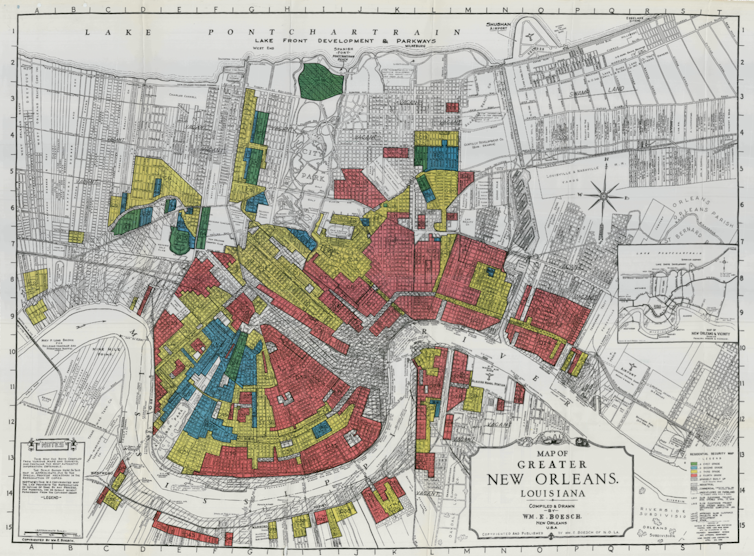
In this 1939 map prepared for the Federal Home Loan Bank Board, redlining separated New Orleans into grades. Green is an A, or first grade; followed by blue, yellow and red, which is last as a D, or fourth grade. The Lower Ninth Ward is the red block farthest to the right.
National Archives via Mapping Inequality/University of Richmond

Twenty years after Hurricane Katrina swept through New Orleans, the images still haunt us: entire neighborhoods underwater, families stranded on rooftops and a city brought to its knees.

We study disaster planning at Texas A&M University and look for ways communities can improve storm safety for everyone, particularly low-income and minority neighborhoods.

Katrina made clear what many disaster researchers have long found: Hazards such as hurricanes may be natural, but the death and destruction is largely human-made.

How New Orleans built inequality into its foundation

New Orleans was born unequal. As the city grew as a trade hub in the 1700s, wealthy residents claimed the best real estate, often on higher ground formed by river sediment. The city had little high ground, so everyone else was left in “back-of-town” areas, closer to swamps where land was cheap and flooding common.

In the early 1900s, new pumping technology enabled development in flood-prone swamplands and housing spread, but the pumping caused land subsidence that made flooding worse in neighborhoods such as Lakeview, Gentilly and Broadmoor.

Then redlining started in the 1930s. To guide federal loan decisions, government agencies began using maps that rated neighborhoods by financial risk. Predominantly Black neighborhoods were typically marked as “high risk,” regardless of the actual housing quality.

This created a vicious cycle: Black and low-income families were already stuck in flood-prone areas because that’s where cheap land was. Redlining kept their property values lower. Black Americans were also denied government-backed mortgages and GI Bill benefits that could have helped them move to safer neighborhoods on higher ground.

Hurricane Katrina showed how those lines translate to vulnerability.

When history came calling

On Aug. 29, 2005, as Hurricane Katrina battered New Orleans, the levees protecting the city broke and water flooded about 80% of the city. The damage followed racial geography − the spatial patterns of where Black and white residents lived due to decades of segregation − like a blueprint.

About three-quarters of Black residents experienced serious flooding, compared with half of white residents.

Between 100,000 and 150,000 people couldn’t evacuate. They were disproportionately people who were elderly, Black, poor and without cars. Among survivors who did not evacuate, 55% did not have a car or another way to get out, and 93% were Black. More than 1,800 people lost their lives.

This lack of transportation — what scholars call “transportation poverty” — left people stranded in the city’s bowl-shaped geography, unable to escape when the levees failed.

Recovery that made things worse

After Hurricane Katrina, the federal government created the Road Home program to help homeowners rebuild. But the program had a devastating design flaw: It calculated aid based on prehurricane home value or repair costs, whichever was less.

That meant low-income homeowners, who already lived in areas with lower property values due to the history of discrimination, received less money. A family whose US$50,000 home needed $80,000 in repairs would receive only $50,000, while a family whose $200,000 home needed the same $80,000 in repairs would receive the full repair amount. The average gap between damage estimates and rebuilding funds was $36,000.

As a result, people in poor and Black neighborhoods had to cover about 30% of rebuilding costs after all aid, while those in wealthy areas faced only about 20%. Families in the poorest areas had to pay thousands of dollars out-of-pocket to complete repairs, even after government help and insurance, and that slowed the recovery process.

This pattern isn’t unique to New Orleans. A study examining data from Hurricane Andrew in Miami (1992) and Hurricane Ike in Galveston (2008) found that housing recovery was consistently slow and unequal in low-income and minority neighborhoods. Lower-income families are less likely to have adequate insurance or savings for quick rebuilding. Low-value homes with extensive damage still had not regained their prestorm value four years later, while higher-value homes sustaining even moderate damage gained value.

Ten years after Katrina, while 70% of white residents felt New Orleans had recovered, only 44% of Black residents could look around their neighborhood and say the same.

Community-led solutions for climate resilience

Katrina’s lessons in the inequality of disasters are important for communities today as climate change brings more extreme weather.

Federal Emergency Management Agency denial rates for disaster aid remain high due to bureaucratic obstacles such as complex application processes that bounce survivors among multiple agencies, often resulting in denials and delays of critical funds. These are the same systemic barriers that added to the reasons Black communities recovered more slowly after Hurricane Katrina. FEMA’s own advisory council reported that institutional assistance policies tend to enrich wealthier, predominantly white areas, while underserving low-income and minority communities throughout all stages of disaster response.

The lessons from New Orleans also point to ways communities can build disaster resilience across the entire population. In particular, as cities plan protective measures — elevating homes, buyout programs and flood-proofing assistance — Hurricane Katrina showed the need to pay attention to social vulnerabilities and focus aid where people need the most assistance.

The choice America faces

In our view, one of Katrina’s most important lessons is about social injustice. The disproportionate suffering in Black communities wasn’t a natural disaster but a predictable result of policies concentrating risk in marginalized neighborhoods.

In many American cities, policies still leave some communities facing a greater risk of disaster damage. To protect residents, cities can start by investing in vulnerable areas, empowering a community-led recovery and ensuring race, income or ZIP code never again determine who receives help with the recovery.

Natural disasters don’t have to become human catastrophes. Confronting the policies and other factors that leave some groups at greater risk can avoid a repeat of the devastation the world saw in Katrina.The Conversation

This article is republished from The Conversation under a Creative Commons license. Read the original article.

Ivis GarcĂ­a, Associate Professor of Landscape Architecture and Urban Planning, Texas A&M UniversityDeidra Davis, Instructional Assistant Professor in Landscape Architecture and Urban Planning, Texas A&M University, and Walter Gillis Peacock, Professor of Urban Planning, Texas A&M University

How to Get the IMF to Think


 August 22, 2025

When will the International Monetary Fund (IMF) learn to think? Over its eighty-one year history, the IMF has published over fifteen thousand reports. Yet, if you download any one of the reports from its website, it is likely that you will know what is being said before you have even read it. The reports are so generic that you do not even need to ask ChatGPT to create a template: each document is a template for the next. They are that regurgitative.

On 8 July 2025, the IMF published a brief blog post called ‘How to Stabilise Africa’s Debt’. The blog is only three pages long (one page shorter than the report upon which it is based). But even in its brevity, it repeats axioms the IMF developed as far back as the founding of its African Department on 10 April 1961. Despite caveats claiming the evaluation in the report is based on ‘new data’, the report is essentially bad old wine in new bottles. Its axioms are as follows:

1. All fifty-four countries on the African continent can stabilise their debt by following the same recipe. There is no need to disaggregate the countries, despite the big data sets, and look at the differences between these countries to get a handle on the various factors that go into their development pathways. One Toyota Land Cruiser fits all African roads.

2. There is no reason for wealthy bondholders and other creditors to accept debt restructuring. ‘Contrary to perception’, they argue, ‘countries in the region have often been able to stabilise or reduce their debt without debt restructuring’. Therefore, there is no reason to make the case for debt forgiveness (jubilee), rescheduling, or conversions (prepayments or buybacks). What is owed must be paid.

3. Budget consolidation, or austerity by the State, is far better for debt reduction or stabilisation than increased economic growth, although having both processes at play is ideal.

4. Debt stabilisation is ‘more likely when an IMF-supported arrangement is present’, in other words, if the IMF imposes the austerity-debt cycle, debt rates can be stabilised.

5. Finally, debt stabilisation is the goal for the African states, and not development. They need to stabilise, not even erase, their debt.

These five axioms are presented as fact when they are fiction. For example, careful scholars of African development, from Samir Aminto Thandika Mkandawire, have cautioned against the type of broad generalisations the IMF is fond of doing. Second, the claim that achieving ‘debt stabilisation’ without restructuring is possible is based on the flawed argument that African countries can grow themselves out of debt – a near-impossibility given the voluminous literature on debt overhang (i.e., the obvious negative effects of debt on growth).

The third axiom, which prioritises austerity over growth, fails in the face of logic and empirical evidence. Growth, by definition, requires the opposite of austerity (i.e., expansionary fiscal policy) with empirical evidence showing that austerity has led to growth tragedies in Africa. This says nothing of the significant human toll that decades of IMF-inspired austerity has inflicted on the people of Africa and the global South more generally.

With regards to the fourth axiom, and as we demonstrate in a recent report from Tricontinental: Institute for Social Research, ‘IMF-supported arrangements’ are the source of Africa’s permanent debt crisis. For instance, a recent study on Zambia shows that IMF conditionality from two decades ago sowed the seeds that led to Zambia’s current debt crisis. In other words, ‘the IMF does not fight financial fires but douses them with gasoline’.

The fifth and final axiom runs counter to decades of development planning in Africa and decades of development scholarship that clearly show the quest for development continues to be a primary preoccupation of African states.

The fact that the IMF blog gets so much wrong is unsurprising given its authors. The blog is written by three IMF staff economists, each of them trained in the West with no substantial experience on the African continent: Athene Laws (from New Zealand, PhD at Cambridge), Thibault Lemaire (from France, PhD at the Sorbonne), and Nikola Spatafora (Italian, PhD from Yale). Both Lemaire and Spatafora work in the IMF’s African Department located in Washington, DC. Avoluminous literature now shows that the lack of rootedness in local contexts explains the dismal nature of Western social science about Africa. Unfortunately, the authors of the IMF blog yet again demonstrate the pitfalls of writing from afar.

+++

The problem is not only the IMF window for short-term credit, which of course comes with conditionalities; it is also with the IMF worldview, which suggests that nothing can be done about the debt except to pursue a futile growth strategy in the context of deep debt. IMF theory is limited to austerity and permanent debt– nothing more. But there is another theory, a few of whose points need to be seriously debated:

1. We need to discuss the importance of debt cancellation, namely the punishing of wealthy bond holders who decide to invest but refuse to bear the outcome of a downside risk.

2. A serious conversation requires discussing sovereignty over raw materials and the proper regulation of multinational corporations.

3. Room must be made to discuss financial integration, the use of regional or local currencies to reconcile trade imbalances, and the need to build regional platforms for both trade and development finance.

4. We need to build sovereign development banks, anchored in the raw material riches of the continent, which are owned by public regional institutions rather than controlled by the US Treasury Department.

5. Building industrial capacity and high-quality infrastructure must be a priority for the African continent.

These are a few rational and tangible points for a new development theory that seeks the genuine advancement of people’s well-being and not merely debt stabilisation. This is something that the IMF theory does not recognise, but it is what a development theory for Africa must put at its centre.

Grieve Chelwa is the Chair of the Department of Social Sciences and Associate Professor of Political Economy at The Africa Institute, Global Studies University. He is a member of the Papal Commission on the Debt and Development Crisis in the Global South, convened by the Pontifical Academy of Social Sciences at the Vatican. He was also recognised by The Africa Report as one of the ‘10 African Scholars to Watch in 2025’. He is a Senior Fellow at Tricontinental: Institute for Social Research.

Vijay Prashad is an Indian historian, editor, and journalist. He is a writing fellow and chief correspondent at Globetrotter. He is an editor of LeftWord Books and the director of Tricontinental: Institute for Social Research. He has written more than 20 books, including The Darker Nations and The Poorer Nations. His latest books are On Cuba: Reflections on 70 Years of Revolution and Struggle (with Noam Chomsky), Struggle Makes Us Human: Learning from Movements for Socialism, and (also with Noam Chomsky) The Withdrawal: Iraq, Libya, Afghanistan, and the Fragility of US Power. Chelwa and Prashad will publish How the International Monetary Fund is Suffocating Africa later this year with Inkani Books.