Monday, December 22, 2025

How Washington’s Syrian Caper Debunks the Case for Empire

by  | Dec 22, 2025 | antiwar.com 

Sometimes a microcosm sheds a powerful light on large-scale macro issues. That was surely the case with respect to last weekend’s news that five US military personnel were involved in an ambush in Syria, which resulted in three deaths and three wounded. The incident apparently was caused by a member of the Syrian security forces, according to the Syrian Interior Ministry, who opened fire on a joint US-Syrian military patrol near the ancient ruins of Palmyra in central Syria (about 134 miles northeast of Damascus).

Needless to say, this news ignited a chorus of WTFs among the non-drinkers of the Deep State Kool Aid who post on X and elsewhere. After all, what other response was there when it became clear that these five servicemen were among more than 2,000 acknowledged US military personnel operating in the no count cipher of Syria; and that there are likely hundreds more covert forces working for the CIA and other US black operations there, as well.

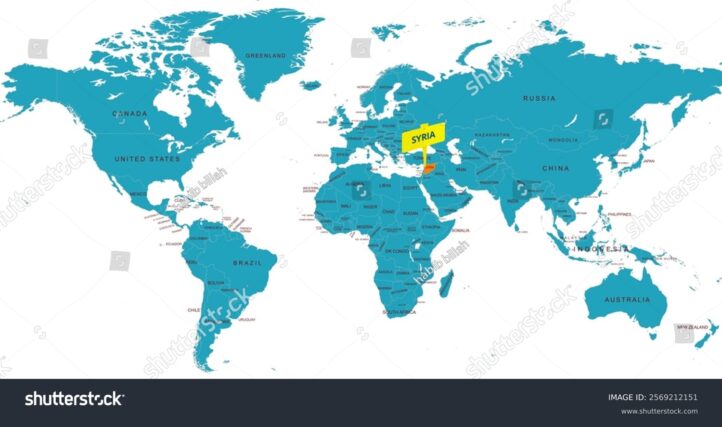
And, yes, we do mean a spec of a country. After all, the tiny orange dot below is the essentially land-locked location of Syria on a representation of the global map. Relatively speaking, it has no economy, no technology, no military, no nukes, no oil, no minerals and, well, no nuthin’ that could possibly bear on the Homeland Security of America, way over here 6,000 miles away on the far side of the Atlantic.

Placement Of The Spec of Syria On A Global Map
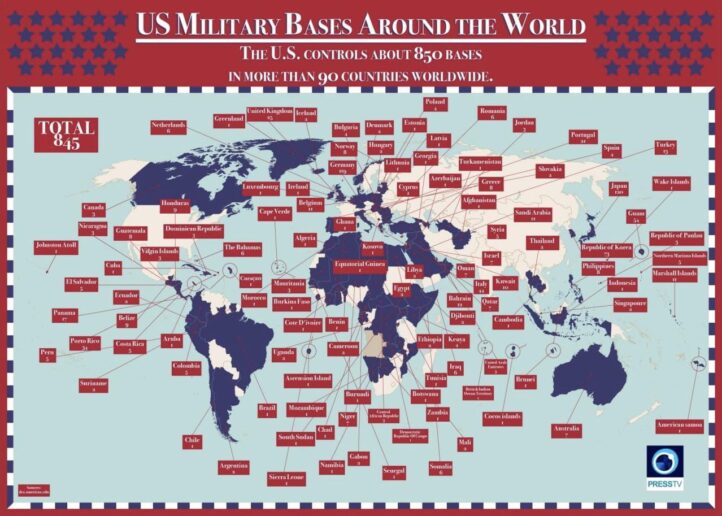
Of course, Syria is just one of the the approximate 90 countries around the world where the US operates upwards of 850 bases and other military installations—-along with America’s massive globe-spanning Navy and Air Force.

Accordingly, last weekend’s incident should provide occasion for taking stock. To wit, what is it that the War Party on the Potomac saw in Syria that has any bearing at all on legitimate national security matters? After all, the unaccountable presence of American troops in Syria begs the larger question about the purpose of Washington’s overall Global Empire, stretching across the entirety of the planet as depicted below.

The fact is, you can find dozens upon dozens of “Syria equivalents” in this map of the Empire’s worldwide footprint. Interested readers, of course, are advised to grab a magnifying glass for further investigation of US military operations in Chad, Niger, Gabon, Namibia, Mali, Botswana, Guam, the Marshall Islands, American Samoa, Belize, Suriname, Aruba, Greenland, Wake Islands and the Republic of Paulau, to name a few.
However, we have asked Grok 4 to provide a summary of the major geo-political and economic characteristics of Syria as a test case as to why any of these non-nuclear statelets with tiny militaries, no long-range missiles or aircraft, no blue water navies and no global-scale economic importance matter to US national security at all.

In this context, we have racked up 17 features of Syria relative to its global counterparts in order to document that it is indeed a tiny spec in the great scheme of global economic, military and national security measures.

For instance, on six big picture variables, Syria amounts to far less than 0.3% of the global total:

  • Population: 24 million vs. 8.16 billion or 0.293%.
  • GDP: $21 billion vs. $117 trillion or 0.018%.
  • Military spending: $1.4 billion vs. $2.718 trillion or 0.052%.
  • Economic wealth (net worth): $51 billion vs. $454 trillion or 0.011%.
  • Fixed domestic investment per year: $0.9 billion vs. $29.3 trillion or 0.003%.
  • Exports: $3 billion vs.$32.2 trillion or 0.009%.

Likewise, Syria doesn’t have any so-called “strategic economic assets” whatsoever. Its puny oil production of 23.7 million barrels annually amounts to merely 65,000 barrels per day in a world economy that produce 83 million barrels per day of crude oil and 30.2 billion barrels per year. That is to say, its oil production and overall energy output amount to a scant 0.078% and 0.0005% of the global total, respectively.

And, no, it doesn’t have any strategic minerals, either. It has zero reserves of traditional core metals including copper, aluminum, iron ore and nickel; and also zero reserves of the new fad in rare earth minerals.

Likewise, what is left of its military after the destruction of the Assad regime amounts to some ragged army units, small naval boats embodying displacement tonnage equal to just 0.025% of the global naval fleets, and several dozen ancient, short-range Soviet era aeroplanes.

And that’s about all here is to be found in the broken state of Syria, domiciled as it is on about 0.126% of the world’s land mass.

17 Key Measures Which Prove That Syria Is A No Count Spec On Planet Earth

Metric
Syria (2024 est.)
World (2024 est.)
Syria %
1) Population (millions)
23.9
8,162.0
0.293%¹
2) GDP (USD billions)
21.0
117,000.0
0.018%²
3) Military spending (USD billions)
1.4
2,718.0
0.052%³
4) Domestic labor force (millions)
6.6
3,696.4
0.179%⁴
5) Annual net fixed investment (USD billions)
0.9
29,250.0
0.003%⁵
6) Oil production (million bbls, annual)
23.7
30,222.0
0.078%⁶
7) Total energy production (BOE millions, annual)
57.0
112,000.0
0.000%⁷
8) Land area (km²)
187,437.0
148,940,000.0
0.126%⁸
9) Food production (million tons, annual)
10.0
9,800.0
0.102%⁹
10) Exports (USD billions)
3.0
32,200.0
0.009%¹⁰
11) Imports (USD billions)
8.0
32,200.0
0.025%¹¹
12) Economic net worth (USD billions)
50.0
454,000.0
0.011%¹²
13) Size of armed forces manpower (thousands)
130.0
27,000.0
0.481%¹³
14) Size of air force (aircraft)
207.0
53,400.0
0.388%¹⁴
15) Size of navy (ships / tonnage)
27.0 / 5,000.0
13,000.0 / 20,000,000.0
0.208% / 0.025%¹⁵
16) Combined copper + aluminum (bauxite ore) + nickel + iron ore reserves (million tons)
0.0
118,110.0
0.000%¹⁶
17) Rare earth elements reserves (million tons REO)
0.0
130.0
0.000%¹⁷

To be sure, this is all very quantitative and mechanical. Yet it actually overstates any plausible rationale for being there!

The truth is, there is one reason alone why 2,000 US forces are still in the Nowhere Land of Syria, and despite the Donald’s order to bring them home in 2018. To wit, they are foolishly stationed in harm’s way because the Washington neocons’ madman ally, Bibi Netanyahu, insisted decades ago that Iran is an enemy of the US and that since Syria had an alliance with Iran, it was an enemy, too. That is to say, Syria became an enemy of America because it was a third cousin consequence of the neocon-officiated nuptials between Washington and Jerusalem.

Of course, there never was any real Iranian threat to America’s homeland because like Syria, Iran doesn’t have any long-range aircraft or missiles or blue water Navy, either.

In any event, the alliance was originally one of shared religious kinship: Bashar Assad (and his father before him) was allied with the Alawite branch of Islam in Syria, which in turn is a first cousin of the Iran-based Shiite confession of the Muslim world. And the latter has been at war with the dominant Sunni branch on and off for, let’s see, 1,350 years!

Consequently, from the moment that the so-called “Arab Spring” took off in Syria in 2011, there has been an internecine war between a wild and shifting mixture of locally and regionally based religious, ethnic and political factions. Yet the outcome has never made a damn bit of difference to the liberty and safety of Americans way over here on the far side of the Atlantic moat.

If there was ever a moment that laid bare the utter stupidity and futility of Washington’s Empire First policy, therefore, it surely emerged last fall in the smoking ruins of Syria. The latter was the desultory culmination of Washington’s 13-years-long effort to destroy the legitimate government of Syria under the cover story that Assad was a brutal tyrant and plunderer of the country’s paltry wealth—even though the real reason is that Netanyahu wanted him gone.

The fact is, Assad probably was both a tyrant and thief. And he might well have been among the worst of the dozens of tyrants who today oppress their citizens in nations large and small around the world.

But so frickin’ what? Again, when was it that God Almighty anointed Washington as some kind of planetary Good Shepard charged with bringing just and kind rule to all the peoples of the planet?

Obviously, America is blessed with many dispensations but for crying out loud: One of them is not a heavenly mandate to bring long pants and peaceable democracy to all the nations. Indeed, maintenance of a sustainable, prosperous, free constitutional Republic requires fidelity to the opposite— a regime of small, solvent government, including on the Pentagon side of the Potomac.

Accordingly, the sole end of foreign policy should be safeguarding the security and liberty of the homeland, not proctoring the governing etiquette of rulers halfway way around the globe that pose no military threat whatsoever to America’s homeland security.

Still, Washington had seen fit during the previous decade to pump-in upwards of $40 billion of overt and covert military aid, economic support and humanitarian assistance to a plethora of opposition Syrian forces for no discernible reason of homeland security.

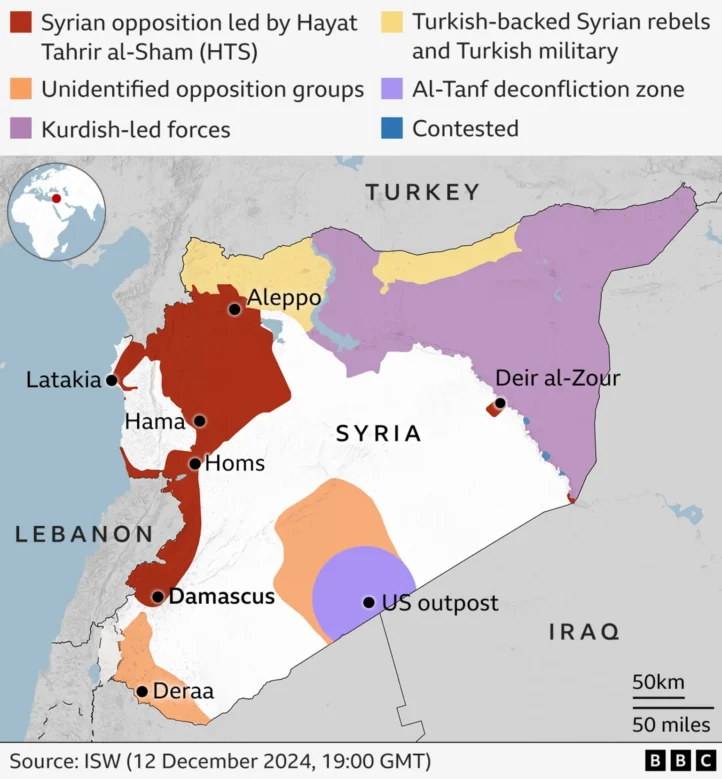
To the contrary, the expenditure of all this treasure and political capital was designed for no purpose other than to effect Regime Change in Damascus. The aim was to eject the Assad government from its control over the remaining white areas of the Syrian map shown below, as its fractured polity existed just a few weeks before the takeover in Damascus by Ahmed al-Sharaa. The latter had previously been known as Abu Mohammad al-Jolani, and had been the head-chopping leader of one of the anti-Alawite factions called Hay’at Tahrir al-Sham (HTS) during the Syrian civil war,

Yet the color-coded regions all around what became the stateless vacuum after Assad’s fall tell you all you need to know about the sheer folly of Washington’s long-running Syria enterprise and why, in truth, Washington has midwived yet another failed state.

And it has done so once again on the pretext of fighting terrorism – this time the residue of the ragged band of ISIS jihadists who briefly planted their black flags and brutal rule in the dusty towns of the Upper Euphrates centered in Raqqah back in 2013-2014, as roughly depicted by the purple area of the map.

The truth, however, is that the white areas of the map, including the Damascus region previously controlled by the Assad government, were the true bulwark against a resurgence of the ISIS head-choppers, who had emerged in 2013-2014 from the ashes of Washington’s failed regime change intervention in Iraq.  So even if the choice was between the lesser of two evils, anyone with his head-screwed on straight could see that bolstering, or at least tacitly tolerating, the secularist, pluralist Alawite regime in Damascus was far preferable to the ISIS Caliphate fanatics.

Alas, not Bibi Netanyahu, who was calling the shots in Washington. He had made himself the career ruler of Israel from the mid-1990s forward by rallying Israel’s numerous right-wing and religious factions in the Knesset against a falsely vilified Iranian regime and the existential threat it allegedly posed to Israel. Accordingly, Bibi’s enemy in Tehran meant that its ally in Damascus perforce became the false enemy of America.
Needless to say, one failed regime change fiasco in Iraq surely warranted second thoughts about the continued pursuit of a second attempt at regime change next door in Syria after 2011. That should have especially been the case because the menace of ISIS, which had afflicted eastern Syria, was the spawn of Washington’s disastrous intervention against Saddam Hussein.

The latter, in turn, had posed no threat to America’s homeland security whatsoever. Yet Saddam Hussein was nevertheless treated to the “shock and awe” of massive military attack in 2003 and eventually the gallows because he was alleged to be a plundering tyrant who wouldn’t play nice with the greedy Emirs who ruled the shared deserts and oilfields next door.

Alas, the Empire First geniuses on the banks of the Potomac learned not one damn thing from the eventual fiasco of Iraq. So their swell plan in 2014 and thereafter amounted to getting rid of both the ISIS jihadists and the Assad regime in Syria at the same time. But in attempting to do so, they ended up creating two new militarized monsters out of the economic dislocations and tribal clashes that resulted from the very civil war they had unleashed.

To that end, the previous ISIS-ruled territory in purple is now controlled by the US-funded Kurdish SDF militias (Syrian Democratic Forces). The latter, of course, are the mortal enemy of Washington’s ostensible NATO ally next door in Turkey, which had been fighting its own Kurdish insurgents for decades.

Indeed, owing to that threat, Turkey has supported and funded the anti-Kurd SNA (Syrian National Army), which occupies the border lands depicted in yellow on the map. A few years ago, however, the SNA was called the FSA (Free Syrian Army), which was a CIA-supported and operated brainchild of the late Senator John McCain, who never met a country in the Middle East that he didn’t wish to invade and occupy.

Meanwhile, with two new US-funded militias competing for military dominance, the third Syrian anti-government force, comprised of the jihadist factions, hadn’t been eliminated, either. That latter illusion, of course, had been triumphantly claimed by Trump when Washington bombed Raqqah and the surrounding areas to smithereens in 2017, and also finished off its terrorist leader, Abu Bakr al-Baghdadi, in 2019.

Like the SNA, however, the jihadist contingent had simply shape-shifted. Twice.

In fact, the new ruling party called Hay’at Tahrir al-Sham (HTS) had originated as the al-Qaeda-affiliated Jabhat al-Nusra (Nusra Front), which al-Sharaa founded in early 2012 specifically to wage jihad against Assad’s regime.

The group focused on targeted attacks against Syrian government forces, while providing social services in rebel-held areas to build local support. Over time, it rebranded: dissolving formal al-Qaeda ties in 2016 to become Jabhat Fataḥ al-Shām, then merging with other Islamist factions in 2017 to form HTS, which became the dominant rebel force in Idlib province by 2019.

HTS played a pivotal role in the 2024 offensive that toppled Assad, capturing key cities like Aleppo and Damascus. HTS’s relationship to ISIS (Islamic State of Iraq and Syria) was one of intense rivalry and direct conflict. Al-Sharaa initially had roots in al-Qaeda in Iraq (AQI), the precursor to ISIS, but rejected ISIS leader Abu Bakr al-Baghdadi’s 2013 attempt to merge Nusra into ISIS, publicly reaffirming loyalty to al-Qaeda’s central leadership instead.

This split turned them into bitter enemies: HTS viewed ISIS’s brutal tactics (e.g., mass civilian attacks) as counterproductive, while ISIS accused HTS of being too moderate and al-Qaeda puppets. From 2014 onward, HTS fought ISIS alongside other rebels to expel it from Syrian territory, particularly around Raqqa, and later cracked down on ISIS cells within its own areas, including handing over prisoners for Western interrogations.

Despite brief tactical overlaps early on (as “frenemies” in 2013), they competed fiercely for recruits, territory, and ideological dominance, with HTS actively targeting ISIS operatives even after rebranding. Post-Assad, the now ruling terrorist faction of HTS had continued suppressing ISIS remnants to prevent resurgence.

For reasons only known to the lunatics on the banks of the Potomac who control America’s foreign policy, therefore, three American servicemen lost their lives last weekend helping one set of head-choppers assault the other such faction.

Nevertheless, since Washington is now sacrificing American lives in the aid of HTS (Hay’at Tahrir al-Sham), which is ostensibly in control of the red-colored corridor in the above map from Aleppo down to Damascus, its history is important. As mentioned above, HTS was previously known as the Nusra Front back in the days when its current leader, the now suit-wearing and Oval Office visiting Abu Mohammad al-Julani, was a strict turban-headed jihadist.

In 2011, he had been sent from Iraq to eastern Syria to foment an uprising by his mentor and terrorist, the aforementioned al-Baghdadi. Both had been graduates of what amounted to the massive prison-based training school for Sunni jihadists at Camp Bucca in Iraq, later dubbed as “America’s Jihadi University”.

The latter 20,000-prisoner monstrosity had been set up by the clueless proconsuls Washington had sent to Iraq after Saddam’s demise, and who soon needed a massive human storage facility for the fruits of their misbegotten de-bathification campaign. So, as we will amplify in Part 2, last weekend’s utterly pointless death of three American servicemen has a linage that goes all the way back to the idiots around the Shock & Awe fool, who landed on the deck of an American aircraft carrier to pronounce, “mission accomplished”.

Actually, the pointless carnage had just begun and lives on to this day 23 years later as a reminder the the death and destruction that the Empire depicted in the map above has spread from one end of the planet to the other.

David Stockman was a two-term Congressman from Michigan. He was also the Director of the Office of Management and Budget under President Ronald Reagan. After leaving the White House, Stockman had a 20-year career on Wall Street. He’s the author of three books, The Triumph of Politics: Why the Reagan Revolution FailedThe Great Deformation: The Corruption of Capitalism in America, TRUMPED! A Nation on the Brink of Ruin… And How to Bring It Back, and the recently released Great Money Bubble: Protect Yourself From The Coming Inflation Storm. He also is founder of David Stockman’s Contra Corner and David Stockman’s Bubble Finance Trader.


The EU blinks: When capital’s inviolability trumps geopolitical necessity

Or: How Belgium’s bankers proved more powerful than European solidarity

DECEMBER 21, 2025

 by Simon Pearson.

The European Union wanted the world to believe it had found an elegant solution to Ukraine’s funding crisis: seize Russia’s frozen assets (€210 billion sitting immobilised across the continent) and use them to back a massive loan to Kyiv. A moment of clarity. A demonstration that when push comes to shove, Western institutions can act decisively against a hostile power waging war on their doorstep.

They bottled it.

Instead, early Friday morning in Brussels, after weeks of theatrical negotiation, EU leaders announced they would fund Ukraine through a conventional loan backed by the EU budget. €90 billion over two years. Substantial, certainly. Necessary, absolutely. But not what they promised. Not what the moment demanded. And not what would have sent the signal that Russian aggression carries material consequences beyond the performative sanctions regime that has defined the West’s response since 2022.

The reason? Belgium (more specifically, the financial institutions holding most of those frozen Russian assets) refused to accept the risk. Legal liability. Potential Russian retaliation. The possibility that Moscow’s courts might rule against European seizure and Belgium would be left holding the bag. The usual concerns of capital when asked to bear even theoretical risk in service of political necessity.

So here we have the EU, that grand project of post-war liberal internationalism, backing down. Again.

The Long 1980s Strikes Again

This is not a story about Belgian intransigence. Belgium is simply where the contradiction became impossible to ignore. This is about the structural incapacity of neoliberal institutions (institutions hollowed out by four decades of prioritising capital mobility over political sovereignty) to act when doing so threatens the inviolability of financial flows.

The Long 1980s, that period of systematic institutional decomposition that began with Thatcher in 1979 and continues today, rests on a fundamental premise: capital must remain mobile, protected, and beyond the reach of democratic politics. National governments surrendered regulatory power. Public institutions were gutted. The welfare state was dismantled. All in service of creating an environment where capital could flow freely, accumulate without constraint, and operate outside political accountability.

The EU is the apotheosis of this project. A supranational body designed not to exercise power but to prevent its exercise. A structure that enshrines capital mobility as constitutional principle whilst treating democratic sovereignty as a threat to be managed. This is why the EU can impose brutal austerity on Greece (political punishment for fiscal deviance) but cannot seize Russian assets to fund Ukraine’s defence. The former reinforces capital’s power. The latter threatens it.

What Belgium Really Means

Belgium’s position is perfectly rational within the logic of financialised capitalism. The frozen Russian assets are not held by Belgium in any meaningful political sense. They are held by Euroclear, a Belgium-based financial institution that operates the international settlement system. Euroclear exists to facilitate capital flows. Its entire business model depends on the perception that assets held within its systems are inviolable: that political considerations will not interfere with the smooth operation of international finance.

If the EU seized Russian assets held by Euroclear to back Ukrainian loans, it would establish a precedent. That European financial institutions can be compelled to subordinate their function to political imperatives. That capital held within European systems is subject to European political authority. That the international financial order is not, in fact, beyond the reach of sovereign power.

This is precisely what cannot be allowed to happen. Not because of Belgian nationalism. Not because of legal technicalities. But because it would undermine the fundamental architecture of neoliberal globalisation: the principle that capital is sovereign and politics subordinate.

Belgium was not alone in its reluctance. Hungary, that Russian cuckoo in the European nest, has spent years obstructing EU action on Ukraine whilst Orbán openly courts Moscow. But here the EU reveals another layer of institutional rot: through enhanced cooperation provisions, Czechia, Hungary, and Slovakia are exempted from any financial obligations under the loan arrangement. Hungary blocks meaningful action, escapes the consequences, and the EU calls this solidarity. Twenty-five member states supposedly support the Ukraine text. Two do not. And the union accommodates the dissenters rather than confronting them.

The difference is instructive: Hungary blocks from ideological alignment with Russian authoritarianism and cynical domestic political calculation. Belgium blocks because seizing Russian assets threatens the fundamental operations of international finance. One is a rogue state within the union. The other is the system protecting itself. And the EU, unable to discipline either, simply carves out exemptions and declares victory.

The Linguistic Gymnastics of Evasion

Read the EU’s own conclusions carefully. They speak of a “reparations loan based on the cash balances linked to Russia’s immobilised assets.” This is what they have been promising for months: a loan mechanism that would use Russian money to fund Ukrainian defence. But in the next breath, they announce the loan will actually be “based on EU borrowing on the capital markets backed by the EU budget headroom.”

These are not the same thing. They are opposites. One uses Russian assets. The other uses European taxpayer commitments. But the EU cannot bring itself to admit the switch openly, so it engages in linguistic contortions that would embarrass a corporate press release. They are still calling it a reparations loan whilst simultaneously explaining it will be funded through conventional EU borrowing mechanisms.

Notice the careful phrasing about repayment: Ukraine will repay the loan “only once Russia compensates Ukraine for the damage caused by its war of aggression.” Which is to say, never. Russia will not pay reparations. Everyone knows this. So what they have created is a grant to Ukraine funded by the EU budget, but they cannot call it that because doing so would require confronting the decision not to seize Russian assets directly. So instead we get this baroque construction where Ukraine owes a debt that will never come due, backed by Russian assets that will never be touched, funded by European money that will eventually mean cuts elsewhere.

The conclusions add that “Russia’s assets will remain immobilised and the EU reserves the right to use them to repay the loan, in accordance with EU and international law.” Reserves the right. Future tense. Conditional. They could not do it now, so they promise they might do it later. This is not policy. This is face-saving.

The Alternative: Austerity by Other Means

So the EU falls back on its budget. €90 billion that will not come from Russian assets but from member state contributions. Money that could fund social housing, public healthcare, education, infrastructure. Money that will instead service a loan to Ukraine whilst Russian assets sit frozen but untouched, generating interest for the financial institutions holding them.

The statement from António Costa, President of the European Council, is instructive: “This will address the urgent financial needs of Ukraine.” Present tense. Urgent needs. Not long-term reconstruction. Not reparations. Not justice. Urgent needs. The language of crisis management, of stopgap measures, of kicking the problem down the road whilst avoiding any action that might threaten the deeper structures of financial capitalism.

Here is where we get to what is not said: that using the EU budget means this cost will eventually fall on European workers and the European working class through reduced social spending, through austerity measures justified by fiscal necessity, through the thousand small cuts that have characterised EU economic policy since 2008. The money will flow to Ukraine (necessary and just) but the cost will be borne by those who can least afford it whilst Russian assets remain pristinely protected.

Hungary, meanwhile, pays nothing. Slovakia pays nothing. Czechia pays nothing. The enhanced cooperation mechanism ensures that opposition to supporting Ukraine carries no financial penalty. You can obstruct EU foreign policy and be rewarded with exemption from its costs.

The Frozen Asset Farce

The EU has supposedly frozen €210 billion in Russian assets. On 12th December, just days before this summit, the Council decided “to prohibit transfer of immobilised Central Bank of Russia assets back to Russia.” Immobilised indefinitely. Permanent freeze. Strong language. Decisive action.

But what does this mean in practice? The assets remain held by European financial institutions. They continue to generate returns. They exist within the international financial system, legally protected and technically operational. They are frozen only in the sense that Russia cannot currently access them, but the institutions holding them can profit from them, and Russia retains legal ownership.

This is not seizure. This is not even sanction. It is the EU performing toughness on Russia whilst ensuring that no actual damage is done to the sanctity of international capital flows. The assets remain frozen indefinitely (a face-saving measure they trumpet as progress) but frozen is not seized. Frozen is reversible. Frozen is safe.

Seizing the assets and using them to fund Ukraine would have been irreversible. It would have been actual punishment. It would have demonstrated that waging aggressive war in Europe carries material consequences beyond frozen bank accounts that might be unfrozen in future negotiations. It would have been an exercise of sovereign power over capital.

Which is precisely why it could not happen.

The Timeline of Paralysis

The European Council met on 23rd October 2025 and agreed to address Ukraine’s “pressing financing needs for the next two years.” Pressing needs. Urgent situation. Immediate action required. That was two months ago.

Since then, nothing. Or rather, weeks of negotiation that produced a half-measure backed by linguistic evasion and structural exemptions for the very states blocking more decisive action. Two months to arrive at a solution that could have been implemented in two days if the political will existed. Two months during which Ukraine continued fighting, continued dying, continued burning through resources whilst European leaders argued over whether Belgian financial institutions might face theoretical legal liability for seizing Russian assets.

The conclusions proudly note that they have “adopted exceptional, temporary and duly justified emergency measures to immobilise Russian assets on a more sustained basis.” This is the language of institutional paralysis disguised as action. Emergency measures to sustain immobilisation. Not to seize. Not to use. To immobilise. To keep things exactly as they are whilst calling it progress.

Meanwhile, they “called on the Council and the Parliament to continue working on the technical and legal aspects of the instrument establishing a reparations loan based on the cash balances linked to Russia’s immobilised assets.” Continue working. Future tense. The thing they just failed to do, they promise to keep trying to do. Perhaps next time. Perhaps when the legal technicalities are resolved. Perhaps when Belgium feels more comfortable. Perhaps never.

Trump, the EU, and Civilisational Erasure

The timing is grimly appropriate. Trump’s national security strategy recently warned that Europe faces “civilisational erasure,” charging that the EU “undermines political liberty” and national sovereignty. For once, Trump’s instinct is accidentally correct, though not for the reasons he imagines.

The EU does undermine national sovereignty, but not through immigration or transnational bodies in the abstract. It undermines sovereignty by subordinating political power to capital mobility. By making democratic decision-making subject to fiscal rules, market confidence, and the interests of international finance. By ensuring that political choices that threaten capital accumulation become structurally impossible.

This is what the frozen assets debacle reveals. The EU cannot act decisively to support Ukraine not because of clunky structures or diverse voices (the usual liberal hand-wringing about democratic complexity) but because doing so would require exercising political power over capital. And that is precisely what the EU’s institutional architecture is designed to prevent.

Trump will use Europe’s weakness to justify American unilateralism. He will paint himself as the decisive actor whilst Europeans dither. And he will not be entirely wrong. But the weakness he identifies is not cultural or civilisational. It is structural. It is the built-in incapacity of neoliberal institutions to subordinate capital to political action.

The Cost of Cowardice

Friedrich Merz, the German Chancellor, offered the standard platitude: “Putin will only make concessions once he realises his war will not pay off.” But Putin has just learned the opposite lesson. He has learned that Europe will not seize his assets. That the sanctity of international finance trumps geopolitical necessity. That he can wage war on Europe’s doorstep and Europe’s institutions will ensure his wealth remains protected within their systems.

He has also learned that Hungary can obstruct European unity with impunity, that a member state can operate as Moscow’s agent within EU structures, and that the union has no mechanism to expel or discipline states that actively undermine its collective security interests. Orbán has turned Hungary into a spoiler, vetoing sanctions, blocking aid, and providing Putin with a European foothold. Which means the EU, constrained by its own requirement for unanimity on foreign policy and its willingness to grant exemptions through enhanced cooperation, can do nothing but watch and accommodate.

The conclusions “strongly condemned Russia’s continued large-scale attacks on civilians and civilian targets in Ukraine, including infrastructure, hospitals, medical facilities and the energy system.” Strong condemnation. Stern language. Moral clarity. And Russian assets remain untouched, generating returns for European financial institutions whilst Ukraine’s energy infrastructure burns.

€90 billion for Ukraine is substantial. It is necessary. It will keep Ukraine funded through 2027. But it is also a missed opportunity: a moment when Europe could have demonstrated that the post-war liberal order still retains the capacity for decisive action when its purported values are threatened. Instead, it demonstrated the opposite.

Belgium did not kill the frozen asset plan. The structural logic of financialised capitalism killed it. Belgium was simply the point where that logic became impossible to ignore. Hungary, meanwhile, continues its work as Moscow’s instrument, a reminder that the EU’s weakness is not just economic but political: a union that cannot discipline its members, cannot override their vetoes when collective survival is at stake, and cannot even require them to share the financial burden of decisions they oppose.

What This Reveals

The EU’s retreat on frozen Russian assets is not a surprise, it can’t be. Neoliberal institutions prioritise capital protection over political action. Always. They treat financial stability as more important than geopolitical necessity. Always. They ensure that even when faced with existential threats (war on the continent, authoritarian aggression, the collapse of the post-war security order) capital remains inviolable. Always.

This is the legacy of the Long 1980s. Not just the destruction of public institutions, not just the gutting of the welfare state, but the systematic subordination of political power to economic imperatives. The creation of institutions that cannot act decisively because doing so would threaten the mobility and security of capital.

Volodymyr Zelensky welcomed the decision as “significant support that truly strengthens our resilience.” He is correct to take what is offered. Ukraine needs the money and cannot afford to refuse it over questions of financing mechanisms. But he, and we, should understand what this moment reveals: that when push comes to shove, when the choice is between supporting Ukraine and protecting Russian assets held within European financial systems, the EU will choose the latter. Not because of Belgian obstinacy. Not because of legal complexity. Not even because of Hungarian sabotage. But because the entire institutional architecture of contemporary European capitalism is built on the principle that capital must remain sovereign.

The €90 billion will flow. Ukraine will be funded through 2027. The EU will trumpet this as solidarity, as commitment, as proof of European unity. And Russian assets will sit frozen but protected, generating returns for European financial institutions, legally intact and politically untouchable. The linguistic gymnastics will continue. The enhanced cooperation exemptions will shield the obstructionists. The promise to maybe use Russian assets someday will remain just that: a promise, deferred, conditional, ultimately hollow.

The war continues. The institutions remain decomposed. And capital, as always, comes first.

Simon Pearson writes at Anti-Capitalist Musings on Substack, where this article first appeared.

Image: https://pix4free.org/photo/37712/sanctions.html Licence: Attribution-ShareAlike 3.0 Unported CC BY-SA 3.0 Deed

For a Peace From Below in Ukraine

The Trump administration now looks closer than ever to stopping the conflict between Russia and Ukraine. Until now, the US president had failed to fulfill his promise, but American diplomacy has gained two new advantages: the Russian army has achieved certain successes, and Ukraine has been engulfed in a political crisis that made President Volodymyr Zelensky more susceptible to outside pressure.

Washington issued an ultimatum to Kyiv, demanding that it accept many of Russia’s conditions, including ones that contradicted Ukraine’s “red lines.” President Zelensky agreed to discuss the plan.

In reality, a ceasefire remains a distant prospect. Ukraine’s diplomatic efforts, its European allies, and many within the United States are trying to amend the draft agreement in Kyiv’s favor. The Wall Street Journal spoke of how at talks in Berlin this week “Zelensky attempt[ed] to rewrite Trump’s peace plan rather than reject it.” It is also unclear whether the final proposal will be acceptable to Moscow. Russian diplomat Yuri Ushakov had already said that “the contribution of both Ukrainians and Europeans to these texts is unlikely to be constructive” and the Kremlin may well reject the edit finalized in the German capital.

To understand the prospects of the current peace initiative, the reasons behind earlier failures, and what awaits Russia, Ukraine, and Europe — whether Donald Trump’s strategy succeeds or collapses — we must decipher the “Trump peace formula” that he is offering the warring sides.

A New Munich?

Critics often compare Trump’s peace plan to the Munich Agreement of 1938, when the leaders of Britain and France forced Czechoslovakia to cede the Sudetenland to Germany. That strategy of “appeasing the aggressor” ended in disaster. In March 1939, Adolf Hitler occupied and subdued the rest of Czechoslovakia.

Just as London and Paris once did, Trump is pressuring an ally to hand over territory to an aggressor and threatening to cut military aid. Upon returning from Munich, British prime minister Neville Chamberlain famously declared: “I believe it is peace for our time.” Trump speaks about peace with no less pathos. There are many parallels between Trump’s diplomacy and the Munich catastrophe but also important differences. After all, why has Vladimir Putin continually rejected Trump’s proposals?

Among the many aspects of the Ukrainian crisis, one makes compromise nearly impossible: one side’s gain means total defeat for the other. At stake is the preservation or destruction of American global hegemony. Russian control over Ukraine would not only be Moscow’s revenge for losing the Cold War; it would radically alter the balance of power in Europe and beyond. Such a Russian triumph would show that borders can be changed without regard for Washington, and that American guarantees are meaningless. When Joe Biden spoke of defending a “rules-based world,” he was referring to US hegemony.A Russian triumph would show that borders can be changed without regard for Washington, and that American guarantees are meaningless.

Certainly, Trump has changed the “rules” of American hegemony. In his version, international law can be violated, and foreign territory seized, if Washington grants political indulgence. He is demonstratively sacrificing the interests and demands of his European allies. Russian Marxist political prisoner Boris Kagarlitsky writes in the terms of Immanuel Wallerstein: “Trump seeks to transform the Western-centric world system into an American world-empire.” But even under such rules, he cannot give Putin all of Ukraine without destroying the entire architecture of US global influence.

Putin, on the other hand, cannot settle for certain regions while leaving the rest of Ukraine under de facto Western protection — in some proposals, even with European troops and military guarantees. Standing in his way are not only imperial ambitions but also pragmatic considerations rooted in history.

In the 1990s, the United States saw Russia as its main partner in the post-Soviet space, and Ukraine as peripheral. But by the end of the decade, ties between Moscow and Washington had weakened. The Kremlin was alarmed by US interventionism (clearly manifested in Yugoslavia, and then in Afghanistan, Iraq, and in a series of “color revolutions” in Europe and the post-Soviet space). Washington feared that deep integration of Russia into Western structures would weaken American influence. Thus, in 2000, Bill Clinton refused Putin’s proposal to join NATO.

To control Moscow’s rapprochement with the European Union, Washington turned to Ukraine. In 2004, the United States supported the first Maidan revolution, which inspired Russia’s liberal opposition. Putin was frightened — not only by the geopolitical implications, but by the threat to his own power. Over time, this fear crystallized into the doctrine that Ukraine had become an American tool for regime change in Moscow — an “Anti-Russia.” In 2007 in Munich, Putin publicly denounced American hegemony for the first time.

After the protests of 2011–2012 in Russia, the second Maidan in 2013–2014 convinced the Kremlin that the struggle was not just over Kyiv but over the survival of the Russian regime itself. The new Ukrainian government dismantled pro-Russian organizations, downgraded the status of the Russian language, and announced that the Black Sea Fleet’s lease in Crimea would not be renewed. The annexation of Crimea and the war in Donbass from 2014 further tied Ukraine to the logic of Russian internal politics. Any defeat would threaten the very existence of Putin’s system.The full-scale invasion bound the fate of Putin’s rule to its success in Ukraine.

The full-scale invasion finally bound the fate of Putin’s rule to its success in Ukraine. The Russian president can feel safe only through triumph in war and Ukraine’s full subordination to Moscow. From the Kremlin’s perspective, the Ukrainian state, at least since the 2014 Maidan, has been institutionally integrated into the system of Western hegemony: aspirations for NATO and EU membership are included in the Constitution; pro-Russian parties, media, and even informal groups of the ruling class oriented toward Moscow are systematically squeezed out of legal politics; linguistic and religious policies are aimed at ousting the Russian language and the Orthodox Church of the Moscow Patriarchate; the nationalist consensus of the post-Maidan elites in the Kremlin is understood as a determination to make the cultural and political rift between the two countries irreversible. In Russian diplomatic language, this is called “the root causes of the conflict, which should be eliminated.” This requires dismantling the Ukrainian state as currently structured.

Any compromise that leaves Ukraine in the Western sphere of influence is dangerous for the Kremlin: massive losses, depleted resources, economic crisis, and hundreds of thousands of traumatized veterans will make political turmoil almost inevitable. Meanwhile, revanchism will become an idée fixe for the Ukrainian elite and much of society, whose military capacity is far greater than in 2022. The Kremlin’s long-standing nightmare has become a self-fulfilling prophecy.

War as the Path of Deception

The diplomatic maneuvers of Trump and Putin perfectly fit the principle of ancient strategist Sun Tzu, who called war “a path of deception.” Moscow and Washington are each trying to sell the other a strategic defeat disguised as compromise. Trump hints he may recognize border changes to persuade Putin to abandon ambitions over the whole of Ukraine. Moscow, in turn, praises Trump’s “peace efforts,” but attempts to add conditions that transform compromise into a Russian victory.

To achieve this, Russian diplomacy advances two sets of demands. First: “demilitarization” of Ukraine — limits on the size of the armed forces, bans on weapon supplies, and prohibition of security guarantees or alliances. This would leave Ukraine defenseless and quickly make it a compliant satellite.

Second: engineering political crisis in Kyiv. Russia demands control over unoccupied territories in Donbass, Zelensky’s resignation, and cultural changes incompatible with Ukraine’s current nationalist narrative (such as restoring official status to the Russian language and legalizing the Moscow-affiliated Orthodox Church). Political chaos is intended to let Russia rebuild the Ukrainian state on its terms.

The “platinum guarantees” for Ukraine promised by Trump after the Berlin talks, if they prove truly serious, could invalidate these Kremlin tactical maneuvers. Then Putin will abandon the ceasefire, and we’ll return to another round of escalation.

The War Party

On both sides of the front, a powerful “war party” persists. In Russia, war has enabled the largest redistribution of property since the 1990s. The officials and oligarchs who have benefited see any compromise as a threat. For many Western politicians, militarization is a last chance to maintain power amid sustained economic crises. The strategy of defeating Russia on the battlefield still enjoys the support of many governments in Europe, as well as parts of both the Republican and Democratic establishments in the United States. However, this strategy seems unlikely to succeed.

First, the United States failed to isolate Russia: China and the Global South resisted Western pressure, and trade with them cushioned Russia from sanctions. Desire to secure Russia’s strategic defeat helped the Kremlin consolidate domestic support.

Moreover, sanctions targeting ordinary Russians, visa bans, canceled flights, and rhetoric about “collective responsibility” have fueled Kremlin propaganda. As Russia Today’s Margarita Simonyan once said: “If we lose, The Hague — literal or symbolic — will come for everyone, even the janitor at the Kremlin wall . . . The scale of catastrophe is unimaginable.” The regime exploits the trauma of the 1990s, remembered as a period of disaster imposed by Western “rules.”Militarization in the West cannot stop Putin’s imperialism — but can grimly turn Western societies into its mirror image.

Still, this rally-’round-the-flag effect is fading. Levada Center polls suggest that Russians’ support for relatives signing army contracts has fallen from 52 percent in 2023 to 30 percent today; 52 percent do not want family members to serve. Twice as many people favor immediate peace talks as continuing the war. A closed VTsIOM poll found 57 percent of Russians saying they are tired of the war. Desertions are growing: 18,500 convictions for unauthorized absence have been issued, and independent reports estimate nearly 50,000 deserters as of late 2024.

Before the war, discontent was most common among the urban middle class. Now it is concentrated among the poor and working class. Wealthy Moscow has become a fortress of loyalty to Putin, while the provinces show the highest levels of dissatisfaction. This is logical: the working class is paying the heaviest price. The profile of political prisoners has changed dramatically (their number has grown eight-to-tenfold, not counting tens of thousands of deserters). As Re:Russia notes, “Resistance to the regime now comes not from urban liberal milieus, but from entirely different social strata.”

These social groups — especially the working class, from which hundreds of thousands of soldiers are recruited — pose the greatest threat to Putin’s rule. But they lack political representation, media, or organizations. Neither Western politicians nor Russian opposition exiles communicate with them, though the basis for dialogue is obvious: peace, which the regime cannot give them.

This latent discontent could turn into action if a force emerges that can offer Russians peace over the heads of a war-entrenched dictatorship. Such a peace must rest on self-determination of peoples—not the sham “referendums” staged under military occupation, but deep democratization across the post-Soviet space. Borders, state structures, and cultural policies should be decided by people themselves, not elites at backstage negotiations.

Militarization in the West cannot stop Putin’s imperialism — but can grimly turn Western societies into its mirror image. A call for immediate peace based on rejecting hegemonic ambitions, military blocs, and spheres of influence would have enormous moral power. It would win support from hundreds of thousands of soldiers and millions in the rear — both in Russia and in Ukraine. If the Kremlin refuses, it will lose both the Global South and its own population.

Peace From Below

It would surely be naive to expect such a radical peace program from current governments in Moscow or the West. For it to come to the fore, we cannot rely on the failing traditional center-left parties that uphold the hegemonic consensus but the rising movements that break with the neoliberal establishment. That also means the kind of forces that powered Zohran Mamdani’s triumph in New York, or La France Insoumise, or the mass solidarity campaigns for Palestine that have become such a tremendous force across Europe.

Left-wing movements across continents share core principles: stopping genocide in Gaza, fighting climate catastrophe, rejecting colonialism and militarism, reducing inequality, and ensuring education and health care as basic rights. But they lack a clear strategy for ending the war in Europe. This was the discussion begun at the recent international antiwar forum in Paris organized by La France Insoumise, its allies, and leaders of Britain’s Your Party including Zarah Sultana.

Hundreds of delegates from global left movements participated, including us, the Russian-Ukrainian coalition “Peace From Below,” which unites left-wing activists from Russia and Ukraine. We are convinced that current governments are incapable of bringing sustainable peace to our peoples, and that the path to achieving it lies through internal change in our countries. We believe this discussion must continue. Victory of progressive forces — nationally or globally — is impossible without a clear strategy to end the war that sustains today’s ruling classes.

Liza Smirnova is a Russian left activist, journalist, and poet. She is a member of Socialists Against War.

Alexey Sakhnin is a Russian activist who was one of the leaders of the anti-Putin protest movement from 2011 to 2013. He is a member of the Progressive International Council and Socialists Against War.Email

Liza Smirnova is a Russian left activist, journalist, and poet. She is a member of Socialists Against War.


Source: Originally published by Z. Feel free to share widely.

US President Donald Trump has made it very clear that he is an enemy of Europe. His administration’s recent National Security Strategy contained deranged and racist raving about Europe facing “civilizational erasure” due to immigration from the Middle East and Africa, while also calling for interference in Europe’s internal affairs by propping up far-right elements in the continent. The policy document was consistent with US Vice President JD Vance’s screeching about European immigration policies at the Munich Security Conference earlier this year and even prompted some mild rebukes from the usually spineless European leaders. Paradoxically, however, Trump’s original 28-point peace plan represents the least bad option for Ukraine to end the almost four-year-old grueling conflict with Russia. It might also have beneficial consequences for Europe as a whole. Trump’s foreign policy agenda is mostly horrendous, and his desire to pursue peace in Ukraine may be solely motivated by a vain ambition to win the Nobel Peace Prize, but that does not mean the merits of the peace plan should be discounted. Trump’s peace plan was greeted with almost universal dismay in Europe, whose political leaders and media commentators argued it was too favorable to Russia while essentially amounting to Ukraine’s capitulation. The unfortunate reality, however, is that there are two realistic alternatives for Ukraine at the present juncture; accepting a peace deal in which Kyiv has to make painful concessions, or the continuation of carnage within Ukraine. Russia is making incremental progress on the battlefield (with an obvious advantage in terms of weaponry and troop numbers), and the sanctions on Russia, while harmful for the country’s economy, are unlikely to exert sufficient pressure on Moscow in the near future. Under such circumstances, it is completely unfeasible that Ukraine could achieve a military victory in the conflict.

Trump’s original peace plan may have been acceptable to Moscow (at least partially), but the revised plan (based on the European counter-proposal and worked out in US Ukrainian negotiations) is unlikely to be accepted by the Kremlin. The European counter proposal was portrayed in Europe as a noble effort to save Ukraine from the Big Bad Wolf in the White House, but what it actually did was to once again undermine the hopes of ending the conflict. It was widely claimed that Trump’s peace plan would have amounted to Ukraine’s capitulation, but under the plan, Ukraine’s sovereignty would have been confirmed, a non-aggression pact would have been signed between Russia and Ukraine, and Ukraine would have been allowed to have a standing army of 600 000 troops (dwarfing the size of the UK, French and German armies). The plan also outlined

a reconstruction package for Ukraine and affirmed its eligibility for membership in the European Union. The plan’s stipulation of Ukraine abandoning its NATO aspirations was considered unacceptable by Kiev’s European allies, but this is something the Ukrainians already agreed to in the ill-fated negotiations in the spring of 2022. It’s also something that common sense dictates; everybody understands that the US government would not tolerate for a second Mexico joining a Moscow-run military alliance. Furthermore, the provocative and needless expansion of NATO in the post-Cold War period is what contributed to the current turmoil in the first place. Continuing to insist on Ukraine’s sacred right to join NATO is sheer madness and a severe obstacle to peace. Indeed, Ukrainian President Volodymyr Zelenskyy recently announced that Kyiv was willing to abandon its NATO ambitions in exchange for Western security guarantees. The issue of territorial concessions is the most painful aspect of the Trump peace plan, but none of its provisions amount to “capitulation”; on the contrary, Ukraine already ensured there would be no capitulation by thwarting Russia’s early attempts to topple Kyiv and install a puppet regime in the country. A peace deal which includes painful concessions but nevertheless maintains Ukraine’s sovereignty is the best realistic option on the table.

If the Ukrainians themselves want to fight to the bitter end before ceding a single square meter of their territory, that is their right. However, there is a curious feature in the contemporary European discourse on the Ukraine-Russia conflict. Those who urge Ukraine to keep fighting an unwinnable and massively destructive war until Kyiv is magically able to secure better terms for itself are considered “pro-Ukraine”. Meanwhile, those advocating for a peace deal in which Ukraine would have to make painful concessions to end the bloodshed are denounced as “Kremlin sympathizers” (or whatever nonsensical derision can be cooked up by the mainstream media with its remarkably limited tolerance for dissenting views on the issue). One could argue that the actual “pro-Ukraine” position is that instead of continued death and destruction, Ukraine should recognize what it has already achieved by preventing a Russian conquest of Kyiv and accept an agonizing peace deal which would nevertheless save the country from further misery. As stated, however, if the Ukrainians wish to keep fighting, that is their business.

Trump’s original peace plan includes provisions that might also be beneficial for Europe as a whole. For example, the plan states that “[a]ll ambiguities of the last 30 years will be considered settled”, Russia and NATO will engage in a dialogue to “resolve all security issues”, and that “[i]t is expected that Russia will not invade neighboring countries and NATO will not expand further”, with Ukraine enshrining neutrality in its constitution. Although many of Trump’s own foreign policies conform to standard US bipartisan foreign policy orthodoxy, he is not wrong when he describes past US foreign policy as disastrous and stupid. One of the most disastrous elements of this pre-Trump foreign policy was the US insistence on the expansion of NATO, an anachronistic monstrosity whose great achievement has been the needless escalation of tensions in Europe in the post-Cold War period. Following the collapse of the Berlin wall in November 1989, alternative visions for Europe’s future were presented. One of these was Soviet leader Mikhail Gorbachev’s “Common European Home”, a pan-European security structure in which both NATO and the Warsaw pact would disappear in favor of West-East co-operation and harmony. Instead, only the Warsaw Pact vanished, while NATO not only remained, but eventually expanded, guaranteeing heightened tensions in Europe for decades to come, eventually culminating in Russia’s illegal invasion of Ukraine. The Trump peace plan might also enhance global security, given that it calls for US-Russian cooperation on nuclear arms control, including an extension to the START I Treaty. No matter how distasteful it may seem to some people, US-Russian cooperation on this issue is a prerequisite for the survival of the world, something that former US President Ronald Reagan understood as well, abandoning his earlier “evil empire” rhetoric about the Soviet Union.

Trump is not the only one who believes that past US foreign policy was foolish. Jack F. Matlock Jr., who served as US Ambassador to the Soviet Union under the Reagan and first Bush administrations, wrote shortly before the invasion was launched that “obviously there would have been no basis for the present crisis if there had been no expansion of the [NATO] alliance following the end of the Cold War, or if the expansion had occurred in harmony with building a security structure in Europe that included Russia”. Citing his own 1997 US Senate Foreign Relations Committee testimony, Matlock added that he believed at the time that the decision to expand NATO might be “the most profound strategic blunder made since the end of the Cold War”. Matlock’s views were echoed in a 1997 New York Times opinion piece by prominent Cold War era US policy architect George Kennan, who warned that the expansion of NATO would be “the most fateful error of American policy in the entire post-cold-war era”. One could, of course, argue that the expansion of NATO was justified because most people in Eastern European countries wanted to join the alliance. It should, however, be permitted to question the prudence of even the will of the majority. On a more personal note, I might add that I very much question the prudence of my native Finland’s decision to join NATO, thereby ostracizing myself from the sphere of social respectability in a country that is gripped by powerful pro-NATO fervor.

The existence of NATO appears to be an immutable fact of life and Gorbachev’s dream of a pan-European security structure with no military alliances died a long time ago. However, there is no need to further escalate tensions by admitting new members into NATO (especially Ukraine or Georgia). Therefore, Trump’s peace plan has the potential to resolve the core issues that have been contributing to tensions in Europe since the end of the Cold War.

Noel Heinonen has a masters degree in social sciences from the University of Helsinki, Finland. He can be reached at jooeljheinonen@gmail.com


A Nestor Makhno in the Culture of Remembrance of Modern Ukraine – AnarchistStudies.Blog