Showing posts sorted by relevance for query INTERNMENT CAMP. Sort by date Show all posts

Tuesday, November 10, 2020

The 'bittersweet' legacy of Canada's wartime Jewish and Italian internment camps

MONTREAL — In 1940, a Jewish student in the United Kingdom named Edgar Lion was sent to Canada against his will on a ship that carried both German and Austrian Jews and Nazi prisoners of war.
    
© Provided by The Canadian Press

And when he first arrived at an internment camp in Trois-Rivieres, Que., the Austrian-born Lion quickly realized the local citizens gathered near the camp entrance didn’t know the difference between the two groups.

“People were cursing us and throwing stones at us. We had to cross a gauntlet of citizens who knew some of us were prisoners of war, but (didn’t know) some of us were just ordinary prisoners," he said in a recent interview.

"We were in the wrong place. We weren’t supposed to be interned.”

Lion, now 100, is one of thousands of Italian, Austrian and German citizens who were rounded up by the British government and sent to Canada to be interned as “enemy aliens” in what remains a relatively unknown chapter in Canada’s Second World War history.

The men, who included Jewish refugees, civilians working in the U.K. and students, were scattered in camps across Ontario, Quebec and New Brunswick, where they were surrounded by armed guards and barbed wire.

Andrea Shaulis, the curator at the Montreal Holocaust Museum, said Canada was unprepared to receive the internees -- Italian, German and Austrian nationals living in Great Britain who were sent overseas because the British government feared could pose a security threat in the event of invasion.

Canadian authorities had thought they would be receiving prisoners categorized as “dangerous enemy aliens,” and had not realized they would be mixed with ordinary citizens or even refugees fleeing Nazi persecution, she said


The facilities where they were sent were primitive at first, including a garage in Sherbrooke, Que., with auto bays filled with water. One camp in Quebec received a load of blankets but no mattresses; another got the opposite.

In some cases Nazi prisoners of war were interned alongside the Jewish refugees at first, causing tension and even fights.

Eventually, however, conditions improved in many of the camps, and the prisoners settled into a routine.

Raffaello Gonnella, the son of an Italian-born man who was interned in a camp on Montreal's Ile Ste-Helene, says his father described life in the camp as boring but safe.

“The war was raging in Europe and Britain, so their families were more in danger than they were,” he said in a phone interview from Glasgow.

Unlike in Great Britain, there was no rationing in Canada, and "being Italian men, they ate rather well,” thanks to the chefs and other restaurant staff among their number who had been working in restaurants prior to being interned, Gonnella recalled.

Lion recalls that in the camps, the internees with university educations created schools and study groups for their younger counterparts.

“We started a camp school for the youngest people who were interned with us, and they didn't have a chance to go to high school, so we made up for it” Lion said.

That effort would later pay off: after their release, many of the internees would go on to study in universities across Canada and Europe, becoming prominent architects, professors, and even Nobel Prize winners.

To this day, the history of Canada’s Italian and German internment camps remains little-known among the general population, with few plaques to mark the sites where they once stood.

The building housing the internment camp on Montreal's Ile Ste-Helene now offers tours to visitors who are often surprised to hear an internment camp existed right next to a major Canadian city.

Paula Draper, a historian who has written books on Canada's Holocaust experience, said this lack of knowledge may be partly because the situation is generally seen as less egregious than the internment of Canadian-born Japanese citizens.

Because conditions were comparatively good, she said many former internees may have hesitated to tell their stories.

“However unpleasant the experience had been to be interned in Canada . . . how do you complain about this when, in fact, the internment saved your life?” she said in a phone interview.

Draper maintains the internment was an “injustice” that should never have happened. On the other hand, it also kept the men safe and, eventually, allowed some to immigrate to North America, where many found great success.

“I always looked at is as a bittersweet kind of Holocaust story,” she said.

Gonnella says the biggest hardship the men experienced in the camp was the uncertainty of not knowing what was happening back home. “They were more worried about their families than themselves,” he said.

But while his father told him stories of pranks and good food, as a young teen Gonnella would learn how deeply the experience had affected his father.

One day, while rooting through his father’s closet for something to wear to school, a young Gonnella came across a denim shirt with a large red, white and blue circle on the back that resembled a target. When he asked if he could wear it, his father “flew into a rage I never saw.”

Unknowingly, Gonnella had taken out his father's camp uniform, emblazoned with a target symbol to make internees visible to the armed guards in the event of an escape attempt.

“I still fill with tears when I think about it,” Gonnella said. “He absolutely went crazy, screaming, shouting, bawling in Italian.”

After spending time in camps in Trois-Rivieres, Que, Fredericton and Sherbrooke, Lion was released in 1941. He moved to Montreal to live with friends of his family and went on to complete his university education, raise a family and build a successful career in the building industry.

Now living in a long-term care home in Montreal, he describes himself as a "survivor" whose life was transformed by his time in the camps.

"It certainly changed my life, because, for one thing, I became a Canadian citizen," he said.

This report by The Canadian Press was first published Nov 9, 2020

Morgan Lowrie, The Canadian Press

Monday, March 15, 2021

WWII-era Japanese internee reburied by family

The family of a Japanese man interned during World War II have buried his remains 75 years after he went missing near a California internment camp. Giichi Matsumura was one of thousands of people of Japanese descent interned during the war. (March 15)

VIDEO WWII-era Japanese internee reburied by family (yahoo.com)

Lost to mountain, Japanese internee's bones return home

photo essay long read


1 / 18

US Japanese Internee Final Burial
Lilah Matsumura, 11, prays for for her great-grandfather, Giichi Matsumura, during a memorial service at Woodlawn Cemetery in Santa Monica, Calif., Monday, Dec. 21, 2020. Giichi Matsumura, who died in the Sierra Nevada on a fishing trip while he was at the Japanese internment camp at Manzanar, was reburied in the same plot with his wife 75 years later after his remains were unearthed from a mountainside grave. (AP Photo/Jae C. Hong)

BRIAN MELLEY
Sun, March 14, 2021, 9:15 AM·15 min read


SANTA MONICA, Calif. (AP) — When Giichi Matsumura arrived at his final resting place in late December, the people who knew him best when he disappeared from a Japanese internment camp in 1945 already were there.

His wife, Ito, who had mourned his passing for 60 years before her death in 2005, was buried in the same plot, as was his daughter, Kazue, who died in 2018. His father, Katsuzo, who died in 1963, was nearby. His brother and two of his three sons were a short walk away, all buried in the shady, grassy haven of Woodlawn Cemetery in Santa Monica.

They last saw Giichi alive in the waning days of World War II at the Manzanar internment camp, one of 10 where the U.S. government held more than 110,000 people of Japanese descent for more than three years, claiming without evidence they might betray America in the war.

In the summer of 1945, Matsumura hiked from camp into the nearby Sierra Nevada, the rugged spine of California, and never returned. His remains were committed to a lonely mountainside grave left to the elements.

His journey home, 75 years in the making, only happened after a hiker bound for the summit of Mount Williamson, a massive peak overshadowing Manzanar, veered off route near a lake and spotted a skull in the rocks. He and his partner uncovered a full a skeleton under granite blocks.

It was 2019, and the duty to bring him back fell to a granddaughter born decades after he died.

Lori Matsumura never expected to play that role. She knew of her grandfather’s unfortunate death, but it wasn’t something she often thought about.

Then an Inyo County sheriff's sergeant phoned and asked for a DNA sample to see if the unearthed bones belonged to her grandfather, the only Manzanar prisoner who died in the mountains.

“It was a complete surprise when I received a call from the sheriff,” Lori said. “There were stories my grandmother told me about her husband passing on the mountain. They were stories to me, and it wasn’t reality. But then when the sheriff called it, you know, brought it into reality.”

That conversation set her on the first step of a mission to reunite her ancestors, a journey that awakened her to a history she had largely seen through a child’s eyes, the edges softened by a generation more inclined to look forward than dwell in the past. Stories that once seemed rosy lost their bloom when faced with the harsh landscape where her relatives spent more than three years in captivity.

___

Until the U.S. entered WWII after the bombing of Pearl Harbor, Giichi Matsumura and his family lived what seemed like a quiet life in the leafy oasis of Santa Monica Canyon, a retreat for artists and stars of old Hollywood.

Born in the Fukui prefecture on the coast of the Sea of Japan, he immigrated to the U.S. in 1916, arriving in San Francisco on a steam ship with a single bag. His father already was there and they worked as gardeners and lived on property owned by the Marquez family, Mexican land grant owners of an area that became parts of Los Angeles and Santa Monica.

Giichi’s wife, Ito, arrived from Kyoto in 1924, according to U.S. Census records. The couple had four children born in the U.S.: sons Masaru, Tsutomo and Uwao, and a daughter, Kazue, the youngest. Kazue, Lori’s aunt, recalled a fun childhood in an interview by Rose Masters, a ranger with the Manzanar National Historic Site, a few months before her death in 2018.

Her mother would pull her in a wagon to play at the beach. She remembers seeing the actor Leo Carrillo, later known as sidekick Pancho to TV’s “The Cisco Kid,” doing lasso tricks.

Giichi Matsumura, who signed up for the World War I draft, registered again on Feb. 14, 1942. Five days later, President Franklin Roosevelt issued an executive order that would force people of Japanese descent on the West Coast into prison camps in waves.

Under an April 20, 1942 order, the Matsumura family had about a week to leave their life in the canyon behind.

Kazue, who wasn’t even aware there was a war, recalled her experience as a 7-year-old.

Her father had to give away his car and they were only allowed to bring a single suitcase to camp.

She had been excited about taking a bus trip, but the novelty after a long ride from LA through the desert along the dramatic eastern flank of the Sierra quickly faded when they arrived at Manzanar.

“I noticed it was all dirt,” she said. “Nothing there. Like a desert.”

Manzanar, which means apple orchard in Spanish, quickly became home to 10,000 people of Japanese descent — two-thirds of whom were U.S. citizens — living in hundreds of cramped, tar-paper covered barracks.

The family would have shared a barrack with four to six other families, each unit separated only by a thin wall that did not extend to the pitched roof. There was little privacy.

The shacks were so poorly built that frequent winds blew sand through the cracks in walls and floors. There was no insulation, making scorching summers intolerable and frigid winters unbearable.

Giichi Matsumura worked as a cook. In his spare time, he painted watercolors, capturing the guard tower, barracks and Mount Williamson, the second-highest peak in California.

His eldest son, Masaru, Lori’s father, had been about to graduate from high school when they were imprisoned. Instead, he had to wait until the next spring when he was in the internment camp’s first graduating class.

Lori remembers her father talking about the camp’s most infamous incident when guards shot into a crowd of people, killing two and injuring nine.

But she doesn’t know much about his time there. He didn’t like to discuss it.

What she knew came mostly from her grandmother and Aunt Kazue, who lived together across the street, stories about squashing scorpions on the way to the bathroom using geta — elevated wooden sandals.

___

Lori Matsumura always meant to visit Manzanar. But she’s not sure she would have made the more than three-hour drive north from Los Angeles.

Now she had to go.

A few weeks after the sheriff’s call, she and her boyfriend, Thomas Storesund, drove to the station in Lone Pine where she gave an oral swab for DNA. They then drove a few miles north where the National Park Service operates the camp as a sort of living museum.

The sentry house still stands at the entrance. A replica of one of the eight guard towers looms overhead and replica barracks, a latrine and a mess hall recreate what the camp looked like, minus hundreds of other structures crammed into a square mile of high desert surrounded by barbed wire.

The buildings display vestiges of life in camp and some of the many indignities experienced, such as the loyalty questionnaire adults had to complete.

“How could something like this happen in America?” Lori thought.

But she wasn’t struck by the gravity of her family’s loss until she visited where they had lived.

Standing near a sign for Block 18, Matsumura looked out at an inhospitable barren patch of scraggly rabbitbrush, fiddleneck weed and a row of barren locust trees. She was filled with sorrow.

“I was blown away by how desolate the place was,” she said. “Seeing it in person made it so sad for me. I don’t think I could have survived that.”

For the first time, Matsumura felt a connection to the place her family lived. She was walking in their footsteps. It was now real.

While the buildings were gone, one reminder stood out: Mount Williamson standing at 14,374 feet (4,381 meters) to the west. It was the site of her grandfather’s first grave.

___

Giichi Matsumura left camp July 29, 1945 heading toward that peak with a group of trout fishermen for a several-day outing. He planned to sketch and paint.

Prisoners had been free to leave camp six months earlier, but about 4,000 internees remained. Many, like the Matsumuras, had nowhere to go or feared racist reprisals in places they once called home.

Ito Matsumura didn’t want her husband to go on the trip. She forbade him from taking his art supplies because she feared he would stop to paint and get lost, Lori’s Aunt Kazue recalled.

It takes at least a full day to ascend about 8,000 feet (2,438 meters) to reach the chain of lakes where they were destined. The trail eventually ends and hikers must navigate a forbidding jumble of granite in the thin air at the high altitude.

On Aug. 2, Matsumura stopped to paint as others fished.

When a storm blew in, the fishermen, who had been there before, knew where to shelter in a cave, said Don Hosokawa, whose father, Frank, was on the trip. The men couldn’t find Giichi after the storm and returned to camp, hoping he headed there.

Exactly what happened to Giichi Matsumura remains unknown. Aunt Kazue said she heard her father slipped on wet rocks and hit his head. Don Hosokawa said the body was later found next to a bloody rock.

His disappearance came four days before the U.S. dropped the atomic bomb on Hiroshima that would hasten the Japanese surrender.

Three search parties looked for him in the following weeks. They found only his sweater.

About a month after he was lost, a hiker from nearby Independence was trying to summit Mount Williamson with her husband and a friend, but rain ruined their plans. They stopped for lunch, and Mary DeDecker, a botanist, noticed a branch in the rocks below, which struck her as unusual because trees don’t grow at that altitude.

A closer look revealed a body.

A small burial party from camp made a last trip into the mountains, carrying a sheet from Ito Matsumura to wrap her husband in. They buried him under granite and affixed a simple piece of paper to a block to mark the grave. In Japanese characters, it gave his name, age and said, “Rest in Peace.”

The group returned with locks of his hair and nail clippings, a Buddhist tradition for a body that couldn’t be returned.

About 150 people attended a funeral ceremony back at the camp. A photo by Toyo Miyatake, famous for documenting Manzanar life, shows mourners in dark suits and dresses behind a wall of crepe paper flowers.

Aunt Kazue lamented that it was difficult never having seen her father's corpse or his gravesite.

“To this day it seems like he’s not passed away,” she said. “It seems like he’s gone some place because I don’t see his body.”

At the Manzanar cemetery, where a tall white obelisk is often decorated with chains of origami cranes left by visitors, a sign says 150 people died at camp. Most were cremated and their ashes buried after their families left camp. One man, Giichi Matsumura, the sign says, died exploring the Sierra and “is buried high in the mountains above you.”

That sign will have to be changed.

___

The gravesite was not widely known so it initially appeared to be a mystery when hikers unearthed it Oct. 7, 2019. Officers from Inyo County Sheriff’s Office flew by helicopter to retrieve the remains.

When word reached rangers and historians at Manzanar, they had a hunch who it was.

“It wasn’t a huge mystery,” Ranger Patricia Biggs told Lori Matsumura in February last year. “We would have been amazed if it wasn’t your grandfather.”

Sgt. Nate Derr had called Matsumura for a DNA sample because she was listed at the historic site as a contact person for her aunt. It took about three months for the Department of Justice to match her DNA with a tooth from the remains to positively identify her grandfather.

Derr notified her in January last year. Then she had to decide what to do with the bones.

Manzanar wouldn’t allow her grandfather to be buried in the small cemetery where only six bodies, interred when the camp was operating, remain. His bones also couldn’t be returned to the mountain.

The thought of scattering his ashes at one of those places held some appeal. Although it’s illegal to scatter ashes on public lands, Lori said she was told by one official that no one would stop her.

But it was unlikely her family would trek up the mountain for a burial service and returning him to a place he’d been captive seemed in poor taste.

After consulting her siblings and cousins, they decided he should be cremated and laid to rest with his wife. His name was already on the grave marker, his toenail clippings and hair buried with her.

Lori had to sign paperwork amending the death certificate from a burial to a cremation. And she wanted to view the remains.

On Presidents Day last year, she and other family members went to the small city of Bishop, about 45 minutes north of Manzanar, to Brune Mortuary, which is also the county coroner’s office.

Coroner Jason Molinar began to lead Lori and her niece, Lilah, from his office to a private viewing room when Lori halted in the doorway to reassure the 11-year-old, who was scared.

“They’re just his bones. That’s all it is,” Lori told the girl.

Laid on a sheet-covered gurney were the remains of the grandfather she’d never met.

The skeleton was roughly arranged in order. The skull was bleached white, most likely from sun exposure. The ribs, spine and joints were stained a shade of brown.

Molinar pointed to a coil of fishing line, the remains of a rusty pocket knife and two buttons found with the bones. A pair of shoes and belt he had worn were next to his lower leg bones.

It was remarkable to find the body 99% intact, Molinar said, a testament to a good burial in a climate where the remains were probably encased in snow and ice much of the year and undisturbed by people or critters.

“The crazy part is the fact that it’s this well-preserved,” he said. “Usually after this many years, you just find fragments.”

Lori made a video call to her sister, Lisa Reilly, who lives in San Francisco and couldn’t make the trip.

“Do you want to see Grandpa’s bones?” she asked.

She then turned the camera to the skeleton and artifacts. She paused at the skull and pointed out the sutures, the fine cracks where the bones of the skull are joined that had begun to separate from exposure. The cracks had led the hikers to speculate on social media about foul play.

Lori and her niece stood with their hands clasped in prayer and heads bowed. They prayed he would rest in peace and be reunited with his family.

After the viewing, they went to Manzanar to donate the shoes, belt, fishing line and knife, to be put on display.

As Biggs looked at the weather-beaten shoes and withered belt, she was almost overcome with emotion.

“I just want to have a moment,” the ranger said. “Out of respect. Wow. It’s amazing to me the things that last forever and the things that don’t.”

In a guest book, Lori’s nephew, Lukas, 9, wrote: “We are bringing you home Great Grampa Giichi Matsumura. We love you.”

Two weeks later, Lori retrieved the ashes.

___

Lost once and found twice, it was now time to properly bury Giichi Matsumura.

On Dec. 21, Lori, her brothers, Wayne and Clyde, along with Clyde’s wife, Narumol, and two children brought his ashes to a burial service at Woodlawn, which is a block from where they grew up.

The Rev. Shumyo Kojima, a Buddhist priest, assembled a small altar with a framed photo of Giichi Matsumura in front of the box containing his remains.

“He moved from the high Sierra to here. All of you are eyewitnesses,” Kojima said. “This is a kind of house-warming party. So, everyone will be here to celebrate his new residence.”

Kojima lit incense and picked up a bell that he rang at different intervals as he chanted ancient sutras, bowing repeatedly.

Each family member stepped forward to sprinkle incense in a burner while Kojima chanted.

Kojima showed a document from the Zenshuji Buddhist Temple that recorded memorial services Ito held for her husband on important milestone anniversaries over the years. It showed how she kept thinking about him, the priest said.

Three cemetery workers then moved the altar to reveal a hole in the ground. One of them placed the box of ashes in the shallow grave.

As the interwoven threads of incense smoke drifted northeast — the direction of Manzanar — the family members each took a turn dropping a shovel full of dirt on the box.

The grave-diggers finished the job and placed a bouquet of white flowers on the grass. Kojima sprinkled water over the grave for purification.

Lori Matsumura wished the hikers hadn’t disturbed the grave. She imagined it was a beautiful setting in mountains her grandfather admired.

Yet she was satisfied he was back with those who loved him.

“His body is laid to rest with everyone, so it’s kind of just closed the chapter on my dad and his siblings and parents,” she said.

She only regretted they weren’t alive to see it.

Tuesday, February 18, 2020

History not forgotten: Colorado students, teacher rebuild WWII prison camp

Sarah Kuta, NBC News•February 16, 2020

Gary Ono has fleeting memories of his time in a Colorado prison camp — seeing snow, jumping into a ditch to avoid a dog, walking across a field with his uncle, watching someone wash photographic prints.

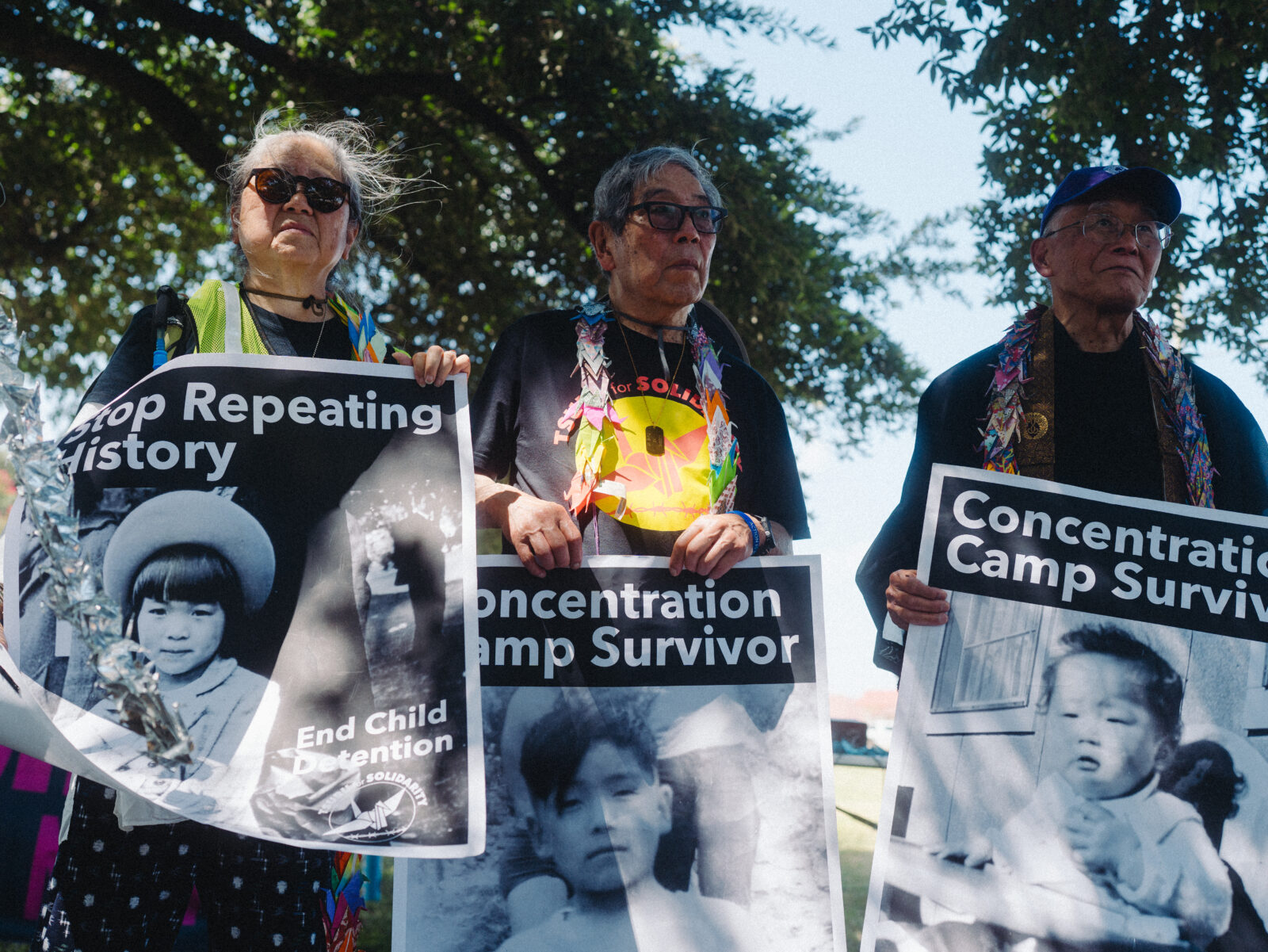
Ono, now 80, was just a toddler when his family was imprisoned at the Granada Relocation Center, one of 10 sites across the country that incarcerated more than 120,000 Japanese Americans during World War II.

As an adult, he's visited what remains of the camp, more commonly known as Amache, many times. During one visit, Ono and a grandson pitched a tent and spent the night at the site of barrack 6, block 10E, the cramped building that housed his and other families.

"If you went out there, like I have several times, it's just empty of everything, except maybe evidence of foundations and things like that," said Ono, who lives in Los Angeles. "You don't get a sense of the conditions people had to live under."

Today, however, structures are again starting to dot the landscape at Amache, which had been reduced to dirt, weeds and crumbling building foundations after the war. Amache is being pieced back together, bit by bit, by a high school teacher and his students who want to make sure this dark period of American history is not forgotten.

Students at Granada High School have spent hours interviewing former internees, gathering and cataloging artifacts, maintaining the grounds, giving presentations and curating a small museum, which this month is moving into a much larger building across the street.

Thanks in large part to their work, Amache is now being considered as a new national park, with federal staffers conducting a special resource study to evaluate the site. Congress will review the findings of that study, which could take up to three years, and make the final decision.

Amache opened in the fall of 1942 a mile outside Granada, Colorado, amid intense racism and anti-Japanese sentiment following the attack on Pearl Harbor.

Tens of thousands of Japanese Americans and people of Japanese ancestry were given just a few weeks — sometimes less — to pack their belongings into two suitcases, leaving behind their homes, pets, cars, businesses and family heirlooms. In addition to Amache, they reported to internment camps in California, Arizona, Idaho, Wyoming, Utah and Arkansas.

At its peak, Amache held more than 7,300 internees, who were confined within a single square mile by barbed wire and armed guards. Despite the abysmal conditions and cruel treatment, more than 950 Japanese Americans held at Amache joined the U.S. military and fought in World War II, including 31 men who died in the war.

At the end of the war, the federal War Assets Administration sold Amache's buildings until all that remained were foundations and a dusty street grid. These structures got a second life on farms and in towns across southeastern Colorado and nearby parts of Kansas and Oklahoma.

Without buildings or signs explaining the history of the site, Amache soon became a distant memory. To this day, many Coloradans have never heard of the internment camp.

"Not only did we wrongfully imprison people who were American citizens, but we also wiped it clean from history," said Tarin Kemp, a recent graduate of Granada High School who helps with Amache preservation efforts. "Even now, very few people learn about it in history classes. Most of the people I've talked to in Colorado don't know there was a Japanese internment camp here. It really was erased from history almost completely."

But high school teacher John Hopper wanted to change all that. Hopper, who grew up in nearby Las Animas, Colorado, came to Granada to teach social studies in 1989. He'd heard about Amache growing up and then again during college at Colorado State University, but did not know much.

After his first day of teaching, Hopper drove around looking for the site of the forced incarceration camp. He found a board nailed to a tree marking the long-forgotten site and drove home.

Several years later, however, the camp was still in the back of his mind. At the time, there were a handful of ambitious students in his U.S. history class and he wanted to give them a meaningful, challenging project to work on. Researching and, later, preserving, Amache seemed like the perfect fit.

"Once it was bulldozed over, it was out of sight, out of mind for a lot of people," Hopper said. "When we started studying it, these students didn't know anything about it and they lived half a mile away."

In the early days, Hopper tasked the students with finding and interviewing former internees to gain first-hand information and stories about Amache, since few records of the camp existed.

The project slowly took on a life of its own, snowballing into an all-out preservation initiative.

More and more people began to take notice of their work, including former internees and their descendants, who shared their memories and donated hundreds of historic artifacts to help create the Amache Museum. Archaeologists at the University of Denver began bringing students to Amache to conduct field research. Several groups and organizations were founded to help keep the memory of Amache alive and bring the camp back to life.

Today, students help with maintaining the site and the small museum, lead site tours and give detailed presentations about Amache all over the world, including in Japan.

But words can only convey so much. Efforts are now underway to reconstruct the original buildings at Amache, which became a National Historic Landmark in 2006, so that visitors can see and feel what life was like for internees.

In 2018, a building that had been a camp recreation center and later served as the Granada city utility building was returned to its original site. A team of historic preservation specialists is currently restoring the building.

Working together, Amache preservation groups also reassembled and returned the camp's water tower, found in pieces on a nearby ranch. Amache is also now home to historic recreations of a guard tower and a barracks.

In an ideal world, Hopper said he wants to someday rebuild an entire block of the camp, complete with a mess hall and latrines.

"It actually lets people step in and experience what it was like for themselves," said Hopper, who now also serves as Granada Public Schools dean of students. "When they step inside the barracks and think about the fact that there was no insulation — it gets up to 114 degrees here in the summer. It might cool down to about 85 at night, but inside those barracks it was still close to 90. Try to sleep in that."

With roughly 500 residents in Granada, the preservation efforts have become deeply ingrained in the town's identity, thanks in large part to Hopper, who has inspired hundreds of students and spent countless hours working to preserve Amache. In 2014, the Consul General of Japan gave him a special commendation for his work.

But to Hopper, it's simply about doing what is right.

"We have to record it so that we don't do it again," Hopper said. "It was wrong. You don't take American citizens' life, liberty and pursuit of happiness away just because they have Japanese ancestry."


Gary Ono during his time at the Granada Relocation Center.
At its peak, Amache held more than 7,300 internees, who were confined within a single square mile by barbed wire and armed guards
Students of Granada High School teacher John Hopper hold pieces of art in the old Amache museum, which is moving into a much larger building across the street.
Historic recreations of a guard tower and barracks at Amache.

Never Forget—The Lasting Shame of World War II Internment
Patrick Murfin, Heretic, Rebel, a Thing to Flout - 3 hours ago
Japanese-American families being hauled to internment camps in a U.S. Army truck.. News last week that the *Trump administration* will dispatch *heavily armed *“*Tactical Units*” a/k/a *paramilitary troops *of the *Immigration and Customs Enforcement* agency (*ICE*) to *Sanctuary Cities *who have proclaimed that they will *not cooperate*with raids on *immigrant communities. *It is a dramatic escalation of Trump’s war on his *domestic enemies*, including *Democratic strongholds* in America’s *major cities *emboldened by his sense of *invulnerability *since his *acquittal* on *impeac...


Wednesday, April 29, 2020

The liberation of Dachau, 75 years ago

When US soldiers reached the gate of the Dachau concentration camp on April 29, 1945, they had no idea what horrors awaited them. War reporter Martha Gellhorn shared what she saw with the world.


WHAT US SOLDIERS FOUND AT DACHAU
The arrival of the US army

On Sunday, April 29, 1945 Colonel Sparks gave the marching orders to the 3rd battalion of his infantry regiment. The US troops came from the West, advancing towards Munich. They didn't know exactly where Dachau, the concentration camp the Nazis set up in 1933, was located. When they discovered it, the troops encountered gruesome sights.

123456789


On the morning of April 29, 1945 the "Rainbow Division" of the Seventh US Army reached the closed gates of the Dachau concentration camp near Munich. The German Wehrmacht had long since withdrawn, and most of the SS guards were on the run.

Without exchanging fire, the US soldiers entered the camp, and were shocked by what they saw: hundreds of corpses in barracks and freight cars, half-starved traumatized prisoners, many with typhoid. Only a few of them could stand on their own.

There was, however, a group of somewhat stronger concentration camp prisoners as well, who, earlier that month, had conspiratorially formed a secret resistance group in the chaos of the overcrowded barracks. They introduced themselves to the American GIs as the International Prisoners' Committee.

Prisoners rejoicing following the liberation of the concentration camp on April 29, 1945

The smell of death wafted through the camp

"Behind the barbed wire and the electric fence, the skeletons sat in the sun and searched themselves for lice. They have no age and faces; they all look alike..." wrote American journalist Martha Gellhorn, who as a war reporter, had been accompanying the advancing US troops through occupied Europe since the previous October.

A few days later, in the early days of May 1945, she entered the liberated concentration camp and described her shock in her writing: "We crossed the wide, dusty compound between the prison barracks and went to the hospital. In the hall sat more of the skeletons and from them came the smell of disease and death. They watched us but did not move: No expression shows on a face that is only yellowish stubbly skin stretched across bones."

Reporting from the gates of hell

Since the beginning of the Spanish Civil War in 1936-38, Martha Gellhorn had been reporting for major American newspapers from wars all over the world. She also happened to be the wife of novelist Ernest Hemingway, whom she married in 1940. As an "embedded journalist" she accompanied the US army on the front lines. On April 26, 1945, she and the GIs reached the Allgäu, and in early May, she was sent to the liberated Dachau concentration camp.

The main gate of the former concentration camp, with the infamous Nazi slogan 'Arbeit macht frei' ('Work sets you free')

"What killed most of them was hunger; starving to death was a routine matter here," the reporter summarized her shocking observations and initial conversations with surviving prisoners, who told her about forced labor and everyday life in the camp. "One worked these long hours on meager rations and lived so overcrowded, cramming bodies into unventilated barracks, waking up weaker and weaker each morning, expecting death."

Living next to the crematorium

Gellhorn gathered from the camp files that well over 200,000 prisoners were interned in Dachau concentration camp since its opening in 1933. "It is not known how many people died in this camp in the 12 years of its existence, but at least 45,000 are known to have died in the last three years," the American journalist wrote in one of her reports.

The facts and figures related to the death toll and human conditions inside Dachau shows that even the experienced war reporter was shaken. Towards the end of her article, she can no longer suppress cynicism.

nhumane medical experiments were performed at the concentration camp; here a subject is immersed in a tank of ice water

"And in front of the crematorium, separated from it by a stretch of garden, stood a long row of well-built, commodious homes," she wrote in May 1945: "The families of the SS officers lived here: their wives and children lived here quite happily while the chimneys of the crematorium spewed out the unending human ashes. ... And last February and March, 2,000 were killed in the gas chamber because, though they were too weak to work, they did not have the grace to die, so it was arranged for them.”

Training camp for the SS

Dachau was the first concentration camp that the Nazis built on German soil. By order of Nazi leader Heinrich Himmler, Chief of Police, an internment camp for 5,000 male prisoners was built at the gates of the small Bavarian town in spring 1933. From its construction to its administrative organization, Dachau became a model for all other concentration camps, including the Auschwitz-Birkenau extermination camp.

Opened March 22, 1933 on the initiative of Heinrich Himmler, Dachau was the first Nazi concentration camp

The first commander was Theodor Eicke, an SS officer who, in accordance with Himmler's orders, made Dachau into what he considered to be a "model camp." The wooden prisoners' barracks were aligned along long streets, with space in between for the SS guards.

The first prisoners in Dachau were political prisoners: opponents of the Nazi regime, trade unionists, social democrats, communists, and in some cases, conservative politicians. They were later followed by criminals, Jehovah's Witnesses, Sinti and Roma, politically committed Christians, and also Jews. With military drills and merciless severity, Eicke trained SS supervisors to get used to torture, brutal violence and being part of the killing machine.

Dachau prisoners were used as forced laborers

30 April: Invasion of Munich

As the prisoners dragged themselves from the barracks to the roll call square in the early morning of April 28, 1945, they were amazed to see that the SS had raised a white flag on one of the watchtowers. Most of the SS men had long since fled.

The remaining guards tried to keep the prisoners in check with machine guns. Rumors ran through the camp like wildfire. The next day, the liberators of the Seventh US Army reached Dachau. It was the second to last of all concentration camps to be liberated by the allied troops.

On April 30, 1945, the Americans marched into Munich, where the Nazis had established the "capital of the movement," as it was called in Nazi jargon, which contained the party headquarters of the Nazi party. On the same day, they learned that Hitler and his partner Eva Braun had committed suicide in their bunker in Berlin.

The last transports of prisoners were liberated by US troops in early May. On May 8, the "unconditional surrender" came into effect, and the war was finally over.


DW RECOMMENDS


Confronting a disturbing truth: 'My father was in the SS'

The Nazi past of relatives could and can be a taboo subject in some German families. But a number of descendants of Nazi criminals want to find out more in a quest to come to terms with themselves. (21.04.2020)


At Auschwitz, Angela Merkel expresses shame over barbaric crimes

After 14 years in office, the chancellor has visited Nazi Germany's most notorious concentration camp. While there, she underscored her country's enduring responsibilities. (06.12.2019)


Pence visits Dachau concentration camp amid fears of rising anti-Semitism in US

The US vice president paid tribute to victims of the Holocaust in a visit to the Dachau memorial site. The trip took on an added dimension after President Trump's exchange with a Jewish reporter about anti-Semitism. (19.02.2017)


Stolen Nazi concentration camp gate found in Norway

The wrought-iron gate was stolen two years ago from the former Nazi concentration camp in Dachau, sparking domestic and international outrage. The gate bears the famous slogan "Arbeit macht frei." (02.12.2016)


Auschwitz commemoration: Holocaust survivors and world leaders gather for 75th anniversary

Hundreds of Holocaust survivors have joined delegates from world governments at the Auschwitz concentration camp on the 75th anniversary of its liberation. Jewish groups urged Germany to do more to combat anti-Semitism. (27.01.2020)


Selfies at Dachau: New film reveals embarrassing reality of remembrance

Is it ok to take a selfie at a concentration camp? The new documentary, "Austerlitz," shows how casually tourists deal with Holocaust memorials. Their actions speak for themselves. (27.01.2017)


Leaders use Dachau liberation anniversary to warn of rising discrimination

Ceremonies have marked 70 years since the Dachau concentration camp was liberated by US forces. Leaders used the occasion to call on people to stand up in the face of hatred, warning of rising discrimination. (03.05.2015)


New figures on extremism in German military 'tip of the iceberg'

Germany's top military intelligence agency has announced a 30% increase in suspected extremists within its ranks. Analysts say the figures indicate a deeper problem. (27.01.2020)


Opinion: The Nazi pogroms: They just looked on

Eighty years after the Kristallnacht pogrom, every German can ask: How did my family react at the time? DW's Felix Steiner takes a personal look at how his family experienced the Night of Broken Glass. (09.11.2018)


What US soldiers found at Dachau

When the soldiers of the US Army reached the Dachau concentration camp gate, they had no idea what was behind it: over 30,000 prisoners, many of whom had died, starved to death. (29.04.2020)


Date 29.04.2020
Author Heike Mund (sh)
Related Subjects Concentration camps, World War II, Nazis, Holocaust
Keywords Holocaust, Heinrich Himmler, concentration camp, Dachau, history, Nazis, liberation, US army
Feedback: Send us your feedback.
Print Print this page
Permalink https://p.dw.com/p/3bW8q

Friday, August 26, 2005

Canada's First Internment Camps

CANADA'S RACIST HISTORY OF EXPLOITATION
OF IMMIGRANT WORKERS

"Ukrainian and other internees at the Castle Mountain Alberta internment camp in 1915"

PM reaches out to Ukrainians
Ottawa to spend $2.5-million to mark internment of citizens in First World War
Thursday, August 25, 2005

There were 24 internment camps across Canada, including ones in Vernon, Banff, Jasper, Brandon and Kapuskasing, Ont. Some camps housed only men, while others, like the large Spirit Lake camp, held women and children, too. The camps provided a cheap way of clearing land, benefiting government and private industry at the expense of second-class immigrants, and reduced unemployment in cities.Workers were meant to be paid 20 to 30 cents a day, but many didn't get their money. "Nine holes of the Banff Springs golf course was hacked out of the bush with this slave labour," Hladyshevsky said.

It's been a long time coming, the UCCLA has been lobbying for two decades to get this wrong addressed. Chretien could have done it back in 1997 or 98, 99, etc etc.

"The Liberal Party understands your concern ... we support your efforts to secure the redress of Ukrainian-Canadians' claims arising from their internment and loss of freedoms during the First World War ... we will continue to monitor the situation closely and seek to ensure that the government honours its promise." Jean Chretien, Leader of the Liberal Opposition, June 8 1993.

Request to the Deputy Prime Minister and Minister
of Canadian Heritage, the Honourable Sheila Copps, MP
by the Ukrainian Canadian Civil Liberties Association
24 January 1997


Before they interned the Japanese, the Canadian Government interned first and second wave Ukrainian immigrant. They did this creating the War Measures Act supposedly because Ukrainian immigrants were from Austro-Hungarian Empire and thus 'enemy aliens'. The real story is that they were interned for being communists, socialists, and labour radicals.

To this date it has not been determined what was the driving force for the Internment. Was it due to wartime xenophobia and war fever, or the Economic benefits of a forced-labour system, or bigoted-driven emotions against Canada's first non-Official language speaking immigrants? The truth is that it was probably due to mixture of these reasons. Unfortunately, the War Measures Act formed the basis for future government incursions on the Civil liberties of Citizens and immigrants to Canada. This act was used as the basis of the internment of the Japanese Canadians in 1941 and the French-Canadians (or Quebecois) in 1970. This act was always implemented via an Order in Council, rather than through approval via the democratically elected parliament. This Act was first implemented during World War I where Ukrainian Canadians were primarly and unjustly made it's first victims.
Internment of Ukrainians in Canada 1914-1920

The internment and arrests coincided with the Canadian Government banning the Industrial Workers of the World, IWW, as an illegal alien organization set to overthrow the government. The War Measures Act was used against the Wobblies and other labour activists. While in the United States, they passed the Criminal Syndicalist Act to ban the IWW, who were in outspoken opposition to Imperialist War.

Anti Immigrant rhetoric was used to cover up the fact that immigrant workers in Western Canada were organizing for their rights, whether those workers were Ukrainian, Italian, German, Slovian, Jews, Icelanders,English, Scots or Irish, etc. Racism against non-English speaking immigrants was virulent, all dark skinned Eastern and Central European workers (being peasants or farmworkers) were called 'niggers', by their English bosses. Ukrainians and other Eastern Europeans were called 'Bohunks'.


In Alberta many of the Ukrainians along with other new immigrants, Italians, Finns, Hungarians, Germans, etc. worked in the the dark primitive coalmines in order to get wages to clear the homesteads they farmed. Homesteads that they had been promised by the CPR and Canadian government in order to open up the West. They had also been promised NO TAXES and NO CONSCRIPTION, both of which were reneged on by the Borden Conservative Government in 1917. This was why Peter Kropotkin advised the Russian Anabaptist Community, the Duhkobours to come to Canada, as pacifists they were being persecuted by the Tsar for refusal to fight in the Cimean War and WWI. The Duhkobours moved to Saskatchewan and B.C.

Between 1906-1919 Alberta along with B.C. was a hotbed of labour organizing in the mining and forestry industries. And it was the 'foriegn workers' who organized usually under the leadership of English trade unionists.

New immigrants helped fuel a growing militancy in the labour movement. These men and women had come to Canada seeking a better life, but many found their success hampered by anti-immigrant sentiment and unscrupulous employers. Under these circumstances, they found it necessary to either organize their own unions or join other groups that promised to promote their interests.

Ukrainian
Jewish

The dissatisfaction with the quality of life in Canada experienced by some Ukrainians forced them to express their frustration in a variety of ways.

"The only salvation from despair was drama and singing groups, and socialist and union organizing."

Excerpt from: No Streets of Gold: A Social History of Ukrainians in Alberta, Helen Potrebenko (Vancouver: New Star Books, 1977).

"Their expectations were low, revolving around work and survival. Indeed, they were preoccupied with survival.... They were willing to work long hours and endure much discomfort if it allowed them security and a viable future for their offspring. They settled for the concept of 'limited good,' but if their modest stipulations were not met, they reacted in a variety of mutinous ways."

Excerpt from: Peasant in the Promised Land: Canada and the Ukrainains 1891-1914, Jaroslav Petryshyn (Toronto: Lorimer, 1985)

Established trade unions under the American Federation of Labour discriminated against them as unskilled immigrants, with the same racist attitudes as the bosses. The Ukrainians and other immigrants found a more sympathetic union in the IWW and later in the One Big Union (OBU)

In addition, many coal miners saw their conditions as the direct result of capitalism and the systemic exploitation of the working classes. This group of militants envisioned “One Big Union” (OBU) to protect their interests. Thus, labour organization would shift from one based on a “craft” or trade to one based on all workers in all industries coming together. At the forefront were the coal miners of District 18 of the UMWA, which comprised western Canada. They wanted to withdraw from the UMWA and set up their own district—District 1, Mining Department, OBU. The UMWA tried to crush this splinter movement and in the period 1919-20 there were a number of strikes and lockouts. It was an idealistic attempt to get workers to see their commonalities rather than differences but was doomed to failure by entrenched craft and trade thinking dating back to the Middle Ages.

In addition, the Winnipeg General Strike, which began in May 1919, set off other strikes in support. Edmonton and Calgary both saw strikes and, in August 1919, violence broke out in Drumheller. Strikebreakers, drawn from returning veterans, attacked the miners and their homes. The miners, largely immigrants, were OBU supporters. When Coal Was King


This was the first interment, after the Winnipeg General Strike of 1919, anti- immigrant anti-bolshevik editorials advised the government of the day to deport the foriegn born Bolsheviks, 'enemy aliens'. Again Ukrainians were deported.

Shortly after the strike began, Winnipeg's most influential manufacturers, bankers and politicians created the Citizens' Committee of 1000 to oppose the action. Winnipeg's leading newspapers published allegations that the strike was initiated by a small group of "alien scum"—European workers and Bolsheviks. Thus, management waged a public relations war by stereotyping the working class as dangerous foreigners—a ploy that proved successful.
The Famous Five.


In the 1920's the Communist Party of Canada was declared illegal, and again Ukrainians, Finns, etc. were deported as foriegn agents of Bolshevism.

The Internment and deportation of Ukrainians was poltical, tinged with the usual anti-immigrant rhetoric. The reality was it was an aspect of the class war in Western Canada that threatened the ruling class and its government in Ottawa.

The practice of Internment was introduced during the Boer War, which Canadian Military Historians see as Canada's first real involvement in a Foriegn War, usually with great fanfare and cheers of our coming of age. The British developed the internment camps for the Boers in South Africa but Canada perfected it.

The Boer War was a first in many ways for Canada. It was the first time we sent troops abroad. It was the first time French and English Canada fought over sending troops overseas, and it was a time when the Canadian military discovered Canadians are not born soldiers, but must be trained like everyone else."For the first time Canadians realized that war is destructive, chaotic and messy. In wars people do get killed," says Granatstein.
Canada's first war a fading memory


Internment was used as an economic measure as much as it was a political one, without the 'slave labour' of the Ukrainian internees there would be NO NATIONAL PARKS IN THE ROCKIES. Banff and Jasper as national tourist resorts were built by the slave labour of the Ukrainian internees.

Life in the internment camps was often harsh, and the lives of the prisoners were often consid­ered expendable to many of their guards. In Canmore and Banff the in­terred prisoners were used to help build roads, create the golf course in Banff , and work the mines in Canmore.
Two camps were set up between 1915 and 1917 in what is now Banff National Park . The Cave and Basin camp area near the Banff townsite was used in the winter, and the other at Cas­tle Mountain , was used during the summer months.
INTERNMENT CAMPS PART OF BANFF HISTORY
BY JACKIE GOLD FOR THE BANFF CRAG & CANYON

A excellent book documenting the Ukrainian internees building of Canada's two most famous national parks is: In the Shadow of the Rockies: Diary of the Castle Mountain Internment Camp, 1915-1917, Edmonton: CIUS Press, 1991

For a great labour/social history of Ukrainians in Alberta see:
Potrebenko, Helen, No Streets of Gold: A Social History of Ukrainians in Alberta (1977) New Star Books. out of print

In the Shadow of the Rockies / As I Walk Through Canada
© Maria Dunn, 2001 SOCAN / Traditional Ukrainian, Public Domain


Growing up in Alberta with the Rockies as a favourite holiday destination, I only learned about the WWI internment of Ukrainian Canadians in the national parks on a trip to Jasper in Spring 2000. There, I came across Bill Waiser's book, Park Prisoners. Shortly afterwards, I read In the Shadow of the Rockies: Diary of the Castle Mountain Internment Camp, 1915-1917 by Bodhan Kordan & Peter Melnycky. When war broke out in 1914, Galicia was part of the Austro-Hungarian Empire, and Ukrainian immigrants (often referred to as "Galicians" in the early 1900s) became "enemy aliens" in Canada, the very place that had actively encouraged their immigration. Ironically, most of them viewed their former Austro-Hungarian rulers not with loyalty, but as occupiers and exploiters of their Ukrainian homeland.

For more information, see the Ukrainian Canadian Civil Liberties Association website: www.uccla.ca

***

Young stranger, as you walk these trails of beauty
And you feel the mountain air caress your face
As you play in the shadow of the rockies
Remember who toiled in this place
Please remember who toiled in this place


They courted our labour and called us to settle
The great Canadian plains
But how fickle the love of a fair young Alberta
For her enemy aliens

Oh pity the young man in 1914
Who hadn't a job or a trade
And doubly so the man from Galicia
For he was soon detained

Our invisible hands worked in nature's cathedral
For the pleasure of tourist and town
Six days a week at slavery's wages
Still we were not wanted around

In a camp that lay beneath Castle Mountain
Rotten food and sodden tents
The most glorious place in the world is ugly
When seen through a barbed wire fence

Our footsteps and voices have long since faded
From these pristine forest paths
Yet many's the mile and the hour we trudged here
To our place of labour and back

If you listen, young stranger, the wind in the pines
Or the water over the stones
You may hear the songs we sang to each other
To remind us of our homes

***

Ethnomusicologist and musician Brian Cherwick chose the traditional Ukrainian tune that follows the CD version of In the Shadow of the Rockies and performs it on tsymbaly. "As I Walk Through Canada" is taken from a field recording made by Robert B. Klymasz of a song sung by Mrs. M. Baraensky, Mrs. G. Kuprowsky and Mrs. S. Stjaharj in Sheho, Saskatchewan, 1964. It was published in Klymasz's An Introduction to the Ukrainian-Canadian Immigrant Folksong Cycle, Folklore Series 8. Ottawa: National Museum of Canada. Brian has provided an English translation of the lyrics here:

As I walk through Canada, I count the miles, (2)
Wherever nightfall finds me, there I bed down.
Hej-ja-hej, there I bed down.

I spent the night in a wood, in a green wood, (2)
Over there my young wife is crying for me.
Hej-ja-hej, my young wife.

My young wife and my young children, (2)
I came to Canada in search of happiness.
Hej-ja-hej, in search of happiness.

On a high hill the grass does sway, (2)
Somewhere my beloved is writing a letter to me.
Hej-ja-hej, is writing a letter.

She writes it in fine, delicate script, (2)
When I read it, I washed myself in tears.
Hej-ja-hej, washed myself in tears.

I waited for a letter for a month and an hour, (2)
I never received the letter from my family.
Hej-ja-hej, from my family.

O Canada, Canada, how deceitful you are, (2)
You have separated many a husband from his wife,
Hej-ja-hej, from his wife.

Photo in CD Liner Notes: Prisoners of war at internment camp, Castle Mountain, Alberta, 1915, Glenbow NA-3959-2

Written as part of an Artist Residency with the Edmonton District Labour Council; funding support from Alberta Foundation for the Arts

Sources used in writing this song:
Kordan, B.S. & Melnycky, P. (1991). In the Shadow of the Rockies: Diary of the Castle Mountain Internment Camp, 1915-1917. Canadian Institute of the Canadian Studies Press: University of Alberta, Edmonton.
Waiser, B. (1995). Park prisoners: The Untold Story of Western Canada's National Parks, 1915-1946. Fifth House: Calgary.
Doskoch, W.H. (2001). Oral history interview by Alberta Labour History Institute. Unpublished.
Doskoch, W.H. (1993). Strait from the Heart: Biography of W (Bill) Doskoch, 1893 - 1941. Self-published.


At the same time as the internment was happening to the Ukrainians the Canadian Government and its mercantilist ruling class which owned the CPR were using Chinese labourers to finish building the railway. They imposed a head tax on Chinese workers, to stop them from immigrating to Canada. They were ok for forced labour at cheap wages, another reason the IWW attempted to organize these workers on the railway, but they were not good enough to become Canadians. And like the Ukrainian Internee campaign, the Chinese Redress campaign has been going on for over two decades.

The Chinese Immigration Act of 1885, 1900, and 1903 were a series of anti-Chinese legislations in Canada that were meant to discourage Chinese from entering Canada after the completion of the Canadian Pacific Railway. These legislations are examples of institutional racism against the Chinese in Canada.The Government of Canada collected well over $23 million from about 82000 head tax payers, some of the money were used to support Canada's war effort in World War I.
Head Tax

Chinese Head Tax & Exclusion Act Redress in Canada
In 1909, Dere's grandfather arrived in Canada only to hand over $500 to the government for simply being Chinese. Now, a special United Nations rapporteur is urging the Canadian government to pay back the money owed to Dere and thousands of other Chinese immigrants and their families who were forced to pay the so-called Chinese head tax.

It was July 15, 1921 when the "Controller of Chinese Immigration" clerk scrawled his signature on the head-tax receipt for Mah Ming Sun, who would take the Canadian name Wally. He and his uncle had just disembarked a steamer from Canton, China. Wally's father had scraped together enough as a labourer building the railroad near Revelstoke, B.C., to pay their passage and the tax. The white children taunted him at school in Kelowna, B.C. "Chink-Chong Chinaman," they would jeer.

The labour movement in Canada never forgot the internment and exploitation of Canada's immigrant working class.

When the depression hit in the 1930's the Government of the day, again the Conservatives this time under Prime Minister R. B. Bennet from Alberta, used internment camps to deal with mass unemployment. They called them 'Relief camps' and rather than providing unemployment benefits all able bodied single men were shipped out of Western Canada's cities, to once again work in forced labour camps under the watchful eye of the Canadian Army and RCMP.

Mass unemployment affected every advanced industrial country in the world, and in response the most radical activists in the labour and farmers movement, usually the communists and anarchists, organized mass Hunger Marches of the unemployed demanding unemployment payments, veterans payments, and farm subsidies.

In Western Canada Hunger Marches were held and were brutally repressed by police assaults ordered by the provincial governments of the day. Including the famous battle of the Evergreens in Edmonton in the winter of 1932. The outrage of the citizens at being attacked by their own government, the United Farmers of Alberta, with the support of the Mayor and city council who were all trade unionists and members of the Edmonton Trades and Labour Council, led to the defeat of the electoral left in Alberta and the rise to power of the Social Credit party.

See:
Labour/Le Travail 16, Fall 1985. Special Issue on Labour in Alberta

Alberta law cases #3-5 - "The Hunger March of 1932"(audio mp3)
In December 1932 unemployed men from all around the prairies congregated in Edmonton. The purpose? - to participate in a ""Hunger March"" to the Alberta Legislature to raise awareness of their desperate situation. A clash between marchers and police resulted in the arrest of 29 participants.

We Were Good People
© Maria Dunn & William Dolinsky, 2003 SOCAN


The Edmonton Hunger March took place on Tuesday, December 20, 1932. Protesters planned to walk in an orderly and peaceful manner from Market Square (currently the Stanley Milner Public Library) to the Legislature to ask for government assistance for farmers and the unemployed in the midst of the Depression. Wielding billy clubs, police on horseback broke up the march. In researching this event, I read an unpublished letter to the Edmonton Journal, written by William Dolinsky in 1999, in which he described the events he had witnessed. He wrote: "I remember well this Bloody Tuesday" and asserted, so eloquently and simply: "We were good people". Of the 10,000 people reportedly in the square that day, I imagined the debacle from the point of view of a mother with two children.

***

I was an ordinary mother in 1932
My husband out of work and more worries here than food
I was weary with asking the man for relief
Feeling like a beggar, being treated like a thief

So when word of a protest started going round
I bundled my boys for the long walk downtown
And bless them, they didn't make a peep about the cold
One was only 5, the other 9 years old

We were good people, gathered in the square
It wasn't ease and comfort had driven us there


Well the air was almost festive with Christmas trees in view
But as we moved to leave the square and march the Avenue
A sound I'd never heard before turned my heart to lead
The sound of a billy club cracking open heads

Well I'd always taught my sons we were safe around police
But when they charged on horses, I dragged us off the street
It made me so angry they'd endanger children too
In silencing the voices of 1932

We were good people, gathered in the square
It wasn't ease and comfort had driven us there
But they treated us like criminals for showing our despair
Oh I remember well this Bloody Tuesday


Where was the government who wouldn't let us starve?
Who wouldn't take the farmer's land, who knew we worked so hard
We, the people, were just scraping by for our daily bread
We had voted for the cowards and away they turned their heads

Now I've read it in the paper, this supposed "Hunger March"
Was the scheme of Reds, they said, our hunger was a farce
Well I don't care what they say, for me it did ring true
An ordinary mother in 1932

Again the leadership in Alberta of the mass movement was Ukrainans in the Worker Farmer Unity League. Several were arrested and tried for inciting a riot and seditious insurrection.

By 1935 a mass movement of labour activism across the west, mobilized the
On to Ottawa trek, it emptied the relief camps of thousands of workers, who then hopped on trains, the CPR again, and were brutally attacked by the CPR police, as well as by the RCMP as they attempted to 'march on Ottawa' to demand an end to internment and demand Unemployment Insurance. They were stopped in Regina where they were met with brutal repression by the RCMP.

The On-to-Ottawa Trek

The On-To-Ottawa-Trek 1935
Courtesy of the Glenbow Collection

Alberta experienced its greatest period of social and economic crisis during the 1930s, better known as the "Dirty Thirties." Trigger by Europe's cut in Canadian food imports the Depression saw wheat prices plunge and that combined with a drought that destroyed many family farms. Railways and mines cut back on their operations and shop laid off employees. Both rural and urban communities were in crisis sending many families to seek relief aid from the government to keep from starving. Many unemployed men began wandering the country, riding the train boxcars, looking for any kind of work. A number of these men ended up working in government relief camps that were no better than hard labour internment camps.

Riding the boxcars to Regina
Courtesy of the Glenbow Collection

The men resented these harsh conditions and organized the Communist-led Relief Camp Workers Union of the Worker’s Unity League organised the On-to-Ottawa-Trek in 1935. Unemployed single men left the relief camps of British Columbia in June on board east-bound trains. The marchers halted at Regina when its leader, Arthur Evans (a former OBU organizer), and others went to Ottawa to express their grievances to Prime Minister R. B. Bennett. Having little sympathy for the protesters, Bennett ordered the Royal Canadian Mounted Police to ambush the protesters and force them to return to the relief camps. Bennett’s order resulted in the Regina Riot of 1 July 1935. Disappointed, 1250 of the protesters volunteered for the Mackenzie-Papineau Battalion to fight for the Spanish Republic during the Spanish Civil War. At least 25 of these men were from Alberta. Many of the Spanish Civil War veterans returned to offer their battle experience to the Canadian Armed Forces and fought as heroes during World War II.


Internment was again used in World War II. It was used as a racist reaction against Japanese Canadian. The first internment had been against Ukrainians because of our language and cultural differences which in itself was racism by the English ruling class. In the case of the Japanese it was because they were a visble minority.


Once the bombing on Pearl Harbour happened racism came to a head. British Columbians started to blame all their troubles and problems on the Japanese. Japanese people were blamed for everything from a bad crop to a flat tire. The scared people of BC cried out, wanting the BC Government to deal with the problem as they saw it-Japanese Canadians. The people of British Columbia wanted to feel safe in their homes again and they wanted Prime Minister Mackenzie King to rid Canada of people of Japanese orign. They were causing a threat to Canada (or so it was believed by the public.) Mackenzie King wanted the votes from B.C. so he was more than happy to do what they asked. Mackenzie's first order of business was to incarcerate all Japanese males between the ages 14 and 45. They were ordered to move more than 160 km inland. This was to "safe guard" the pacific coast from Japanese spies. The Canadian government took away all of the Japanese fishing fleets, in order to protect Canada. The war caused a large labour shortage for farmers, especially sugar beet farmers. The Security Commission Council organized sugar beet projects to combat the labour shortage. This gave the Japanese males a choice. The choice was to work in road camps as slaves or go to the beet camps and be with their families. Working in the beet camps was the choice taken by the majority of Japanese married men.
Japanese Internment Camps

Lethbridge and Southen Alberta boomed with sugar beet production as Japanese families were moved into the province during the war. Once again internment was as much about economics as it was about race and politics. Southern Alberta farmers benefited from the forced labour, and many being former American emigres Mormons in particular, their white racist communities were the perfect location for a visible minority.

Unlike the United States, where families were generally kept together, Canada initially sent its male evacuees to road camps in the B.C. interior, to sugar beet projects on the Prairies, or to internment in a POW camp in Ontario, while women and children were moved to six inland B.C. towns created or revived to house the relocated populace. There the living conditions were so poor that the citizens of wartime Japan even sent supplemental food shipments through the Red Cross. During the period of detention, the Canadian government spent one-third the per capita amount expended by the U.S. on Japanese American evacuees. Not until 1949, four years after Japan had surrendered, were the majority of Nikkei allowed to return to British Columbia. By then most had chosen to begin life anew elsewhere in Canada. Their property had long before been confiscated and sold at a fraction of its worth.
Japanese Canadian Internment
Information at the University of Washington Libraries and Beyond


Today Lethbridge, Warner, Taber, Raymond, Alberta which are the sugar beet centres of Canada, are also home to a large Japanese Canadian community, which grew up there in concentration camps and then made it their home.

Again the use of the 'Concentration Camp', developed by the British but perfected by the Canadian State, was not for keeping prisoners, it was for the extraction of 'Forced Labour', the exploitation of workers. Let us never forget that. And it was used against visible minorities, it was the original source of 'racial profiling'.


Canada's Sad History of Racist Oppression:

Righting wrongs

Ukrainian-Canadians have long sought redress for the internment of 8,579 Eastern Europeans during the First World War, a 'dark chapter' that Prime Minister Paul Martin acknowledged this week. It is one of 13 claims put forward by ethnic and religious groups.

1847 to 1985

In Canada's residential schools, aboriginal children were forced to assimilate and many were abused.

1885 to 1946

Discrimination against immigrants from China, including a $500 head tax.

1891 to 1956

Imprisonment of leprosy patients, mostly Chinese, on two Victoria-area islands.

1900 to 1932

The unjust treatment of black immigrants from the Caribbean.

1914 to 1920

The internment of Ukrainian-Canadians during the First World War.

1938 to 1948

The ban of Jewish immigrants in the mid-20th century, including the time a boat carrying more than 900 German Jews was turned away from a Canadian port in 1939.

1940 to 1943

The internment of Italian-Canadians during the Second World War.

The internment of German-Canadians during the Second World War.

1942 to 1949

The internment and relocation of Japanese-Canadians during and after the Second World War.

Post 1949

The discrimination against aboriginal war veterans, who were offered $20,000 each in compensation in 2002.

OTHER COMMUNITIES

z African-Canadians nationally, including the descendants of black Loyalists, are mobilizing toward a collective claim for reparations.

z In Nova Scotia, the Africville Community is working toward advancing its claims for reparations.

z The Doukhobors, for the forced confinement of children in a sanitorium by the B.C. government.


Today with the so called phoney war on Terrorism, the new security State in Canada is once again threatening the civil liberties of it's citizens and racial profiling those immigrants coming from Muslim countries. Will we see a call for internment of these folks like we have in the past. Not if we are vigilant and learn the lessons of the past. It is up to the labour movement, progressives, Canadians who are concerned about civil liberties and human rights, and most importantly by those communities such as the Ukrainians, Chinese, Japanese, Indigenous peoples, etc. who have been brutalized by the Canadian state to speak out and say loudly and clearly: NEVER AGAIN!

Security certificates
CanWest News Service
OTTAWA - The Supreme Court will decide whether Canada's security certificate policy, which permits non-citizens to be kicked out of the country based on secret evidence that they endanger national security, should be struck down for violating the Charter of Rights and Canada's international commitments.he high court announced yesterday it will hear the appeal of Moroccan-born permanent resident Adil Charkaoui of Montreal, who is accused by immigration authorities of being an al-Qaeda sleeper agent, a charge he denies. Before being granted bail under strict conditions last February, the father of two was detained for 21 months on a security certificate under Canada's immigration laws. Mr. Charkaoui argues the security certificate system is a Kafkaesque violation of his Charter right to a fair hearing and to defend himself because it allows immigration authorities to deport foreign nationals and permanent residents without fully disclosing to them the evidence that allegedly shows that they are a danger to Canadians.

CSIS had concerns over Arar's release
Spy agency felt case was a 'hot potato,' but denies wanting to leave him in Syria
Globe and Mail, Friday, August 26, 2005
Canada's spy agency had concerns about Maher Arar returning to Canada from Syria, but never believed he should remain in a Syrian jail, the second-highest ranking official at CSIS testified yesterday. Jack Hooper, deputy director of the agency, told the Arar inquiry that the Canadian Security Intelligence Service detailed those concerns to the solicitor-general, Foreign Affairs officials and others inside government. Among them: CSIS's ability to deport non-citizens using security certificates could be diminished.


My Grandfather on my mothers side of our family was a miner in Wayne Alberta, and a homesteader. My grandfather on my fathers side was a scholar, the first presbrysterian preacher in the Ukrainian community, a labour activist and helped found the Ukrainian Farmer Labour Temple Association the precursor to the Association of United Ukrainian Canadians.

My partners grandparents and family on her mothers side were Japanese Canadians who were interened during WWII in Warner Alberta. Her grandfather was a Bhuddist priest.

This article is in memory of Comrade George Piche, who passed away July 2005, a tireless fighter for worker and immigrant rights in Canada.

And I would like to thank Maria Dunn for her efforts to document in song the workers history of Alberta.