Wednesday, January 07, 2026

Accused scam boss Chen Zhi arrested in Cambodia, extradited to China: Phnom Penh

Phnom Penh (AFP) – Chinese-born tycoon Chen Zhi, who was indicted by the United States on fraud and money-laundering charges for running a multibillion-dollar cyberscam network from Cambodia, has been arrested there and extradited to China, Phnom Penh said Wednesday.


Issued on: 07/01/2026 - RFI

Chen allegedly directed operations of forced labour compounds across Cambodia, where trafficked workers were held in prison-like facilities surrounded by high walls and barbed wire, according to US prosecutors.

Since the US indictment and sanctions by Washington and London in October, authorities in Europe, the United States and Asia have targeted Chen's firm, Prince Holding Group, with a frenzy of asset confiscations.

Chen founded Prince Group, a multinational conglomerate that authorities say served as a front for "one of Asia's largest transnational criminal organizations," according to the US Justice Department.

Cambodian authorities "have arrested three Chinese nationals namely Chen Zhi, Xu Ji Liang, and Shao Ji Hui and extradited (them) to the People's Republic of China," Cambodia's interior ministry said in a statement on Wednesday.

The operation was carried out on Tuesday "within the scope of cooperation in combating transnational crime" and according to a request from Chinese authorities "following several months of joint investigative cooperation," it said.

Chen's Cambodian nationality was "revoked by a Royal Decree" in December, the interior ministry added.

Chinese authorities did not immediately comment late Wednesday on Chen's arrest and extradition.

US authorities in October unsealed an indictment against Chen, a businessman accused of presiding over compounds in Cambodia where trafficked workers carried out cryptocurrency fraud schemes that have netted billions of dollars.

He faces up to 40 years in prison if convicted in the United States on wire fraud and money laundering conspiracy charges involving approximately 127,271 bitcoin seized by Washington, worth more than $11 billion at current prices.

Prince Group has denied the allegations.

According to the US charges, scam workers were forced -- under threat of violence -- to execute so-called "pig butchering" scams, cryptocurrency investment schemes that build trust with victims over time before stealing their funds.

The schemes target victims worldwide, causing billions in losses.

Scam centers across Cambodia, Myanmar and the region use fake job ads to attract foreign nationals -- many of them Chinese -- to purpose-built compounds, where they are forced to carry out online fraud.

Since around 2015, Prince Group has operated across more than 30 countries under the guise of legitimate real estate, financial services and consumer businesses, US prosecutors said.

Chen and top executives allegedly used political influence and bribed officials in multiple countries to protect their illicit operations.

In Cambodia, Chen has served as an adviser to Prime Minister Hun Manet and his father, former leader Hun Sen.

The Southeast Asian nation hosts dozens of scam centres with tens of thousands of people perpetrating online scams -- some willingly and others trafficked -- in the multibillion-dollar industry, experts say.

© 2026 AFP
Ireland’s China visit underscores EU divisions over how to handle Beijing

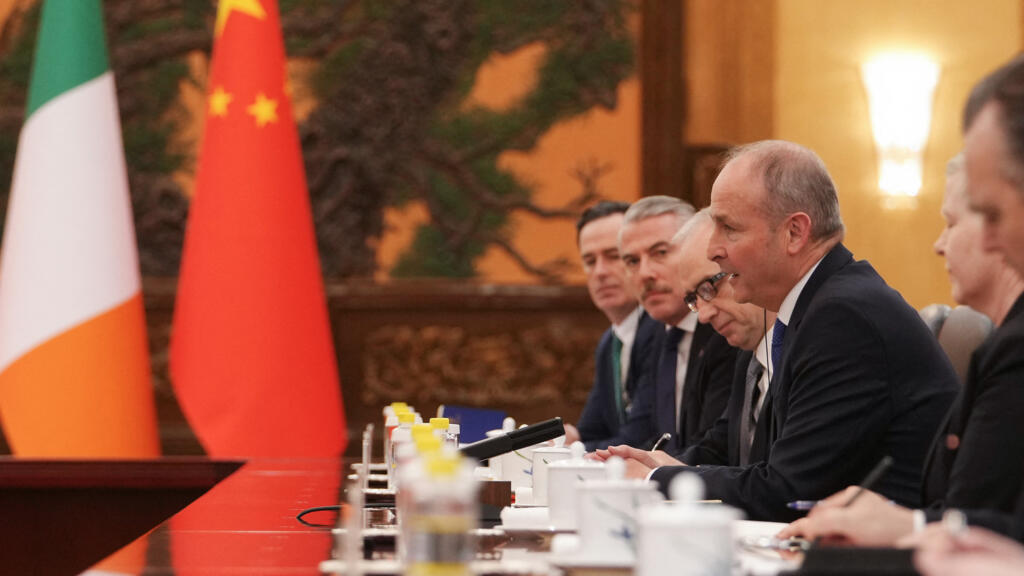
Ireland’s prime minister, Micheál Martin, arrived in Beijing this week for the first visit by an Irish leader to China in more than a decade, placing Ireland at the centre of a rapidly evolving European strategy towards the world’s second-largest economy.


Ireland's Prime Minister Micheal Martin speaks during a bilateral meeting with China's President Xi Jinping at the Great Hall of the People in Beijing on January 5, 2026. AFP - ANDY WONG

By: Jan van der Made with RFI
Issued on: 06/01/2026

The Irish leader’s five-day trip is sandwiched between Emmanuel Macron's December visit and Friedrich Merz's in February, and illustrate the fine line European leaders are taling in their approach to Beijing as transatlantic relations grow increasingly uncertain under Donald Trump's unpredictable policies.

Martin's visit comes as the European Union grapples with an unprecedented €305.8 billion trade deficit with China in 2024 and mounting anxieties about economic dependencies that could prove strategically risky.

But while Brussels talks tough on "de-risking" and "strategic autonomy,” individual member states are pursuing their own pragmatic, bilateral engagement with Beijing - showing deep divisions over how Europe should position itself between an unreliable America and an assertive China.
China - EU Trade 2014 - 2024. © Eurostat


For Macron, December's trip to Chengdu represented a continuation of his distinctive approach to China relations.

The French president, accompanied by nearly 40 chief executives, focused on securing market access for French companies whilst urging Beijing to pressure Moscow over Ukraine.

His delegation signed agreements in nuclear energy cooperation between Électricité de France and China National Nuclear Corporation, but kept on pressing Xi Jinping to address what Macron termed "global imbalances" stemming from Chinese overcapacity and export dependency.

The visit produced little concrete progress on Europe's core concerns about trade asymmetries or China's support for Russia's war machine.

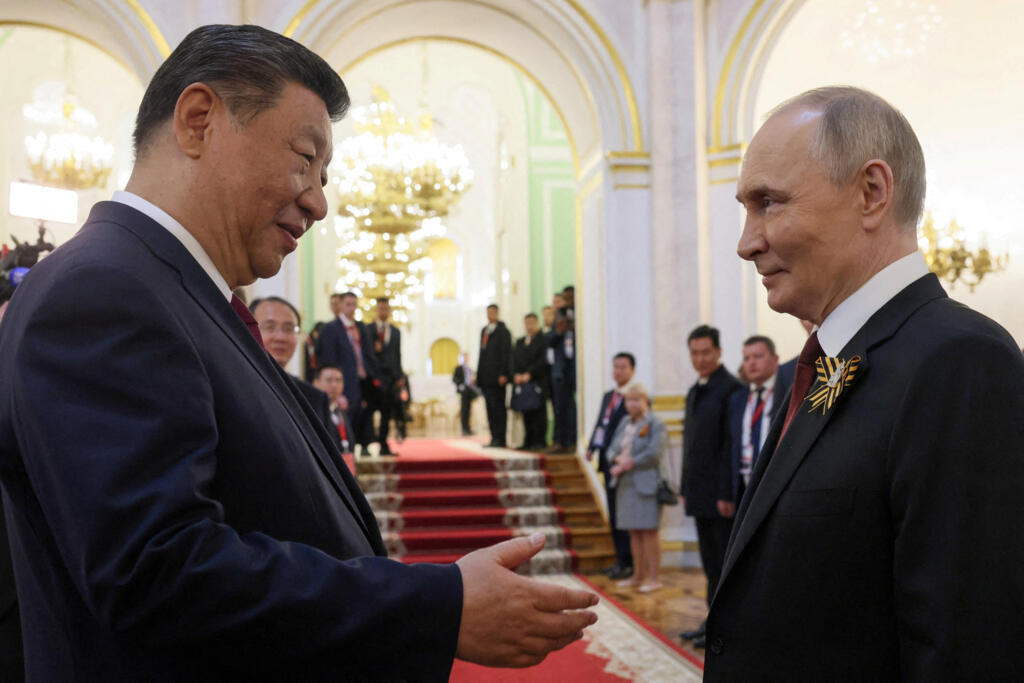
Russian President Vladimir Putin addresses foreign leaders on Victory Day in Moscow, 9 May 2025. via REUTERS - Mikhail Metzel

The trade imbalance remains Europe's most pressing economic challenge with China. EU imports from China reached €519 billion in 2024, whilst exports totalled just €213.3 billion.

Manufactured goods - machinery, vehicles, electronics - account for nearly 97 percent of Chinese imports, flooding European markets with products often subsidised by Beijing's industrial policy.

The automotive sector exemplifies Europe's predicament: despite Brussels imposing tariffs of up to 35.3 percent on Chinese electric vehicles in October 2024, Chinese EV sales in Europe nearly doubled.

Chinese manufacturers have simply pivoted to plugin hybrids, which face no additional tariffs, while simultaneously establishing production facilities inside the EU to circumvent trade barriers altogether.

BYD is building a €4.6 billion factory in Hungary; Chery has established operations in Spain; others are negotiating sites in Italy and Poland.

How the EU’s reliance on China has exposed carmakers to trade shocks

Meanwhile, in semiconductors, China has captured approximately 30 percent of the global market for legacy chips - the mature-node semiconductors essential for automotive, medical, aerospace, and defence applications.

Whilst American export controls have largely succeeded in restricting China's access to cutting-edge chip technology, Beijing has responded by flooding the market with older-generation semiconductors at artificially depressed prices.

European chipmakers, accounting for just 13 percent of global production, find themselves squeezed between subsidised Chinese competitors and American protectionism.

The EU Chips Act aims to double Europe's semiconductor production capacity by 2030, but observers question whether the bloc can move swiftly enough to avoid dangerous dependencies.
Human rights

The human rights dimension of EU-China relations, once a consistent irritant in bilateral ties, has notably receded from prominence. Official statements still routinely express "deep concerns" about Xinjiang, Tibet, and Hong Kong, but these critiques increasingly resemble diplomatic ritual.

Human Rights Watch has criticised what it terms the EU's "failure to meaningfully address Beijing's repression," noting that the annual human rights dialogue has been demoted to a lower-level, private affair.

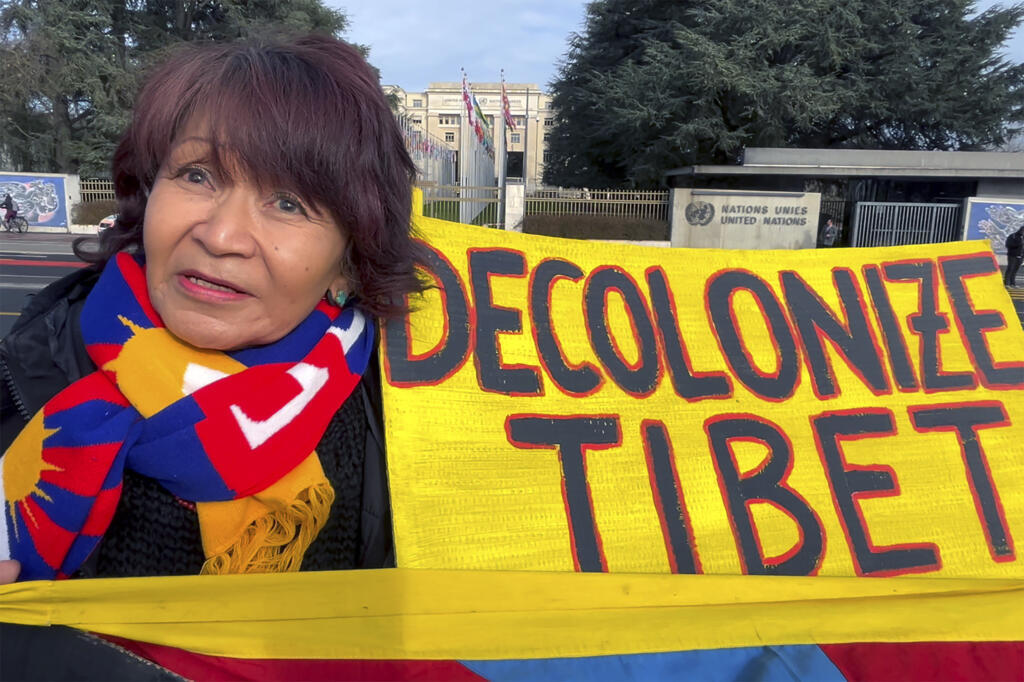
Protester Tseten Zoechbauer holds up a "Decolonize Tibet" banner outside the U.N. office in Geneva, Switzerland, Tuesday, Jan. 23, 2024, at a rally supporting Tibet and the Uyghur minority in China. The demonstration outside the U.N. office in Geneva came as AP - Jamey Keaten

Trade surplus

But even without stressing human rights so as to avoid the ire of Beijing, for Ireland, navigating between Brussels, Washington, and Beijing requires particular dexterity. China is Ireland's largest trading partner in Asia and its fifth-largest globally, with bilateral trade reaching approximately $23.4 billion in 2024.

Crucially, Ireland is one of the few EU countries running a trade surplus with China - a statistical quirk largely attributable to American pharmaceutical and technology companies using Irish subsidiaries to export to Asian markets. This same arrangement makes Ireland extremely vulnerable to American policy shifts.

The Trump administration has threatened to end the tax arrangements that make Ireland attractive to American multinationals.

Commerce Secretary Howard Lutnick singled out companies like Apple, Microsoft, and Pfizer for storing intellectual property in Ireland to reduce their effective corporate tax rates, stating that: “those things got to end."

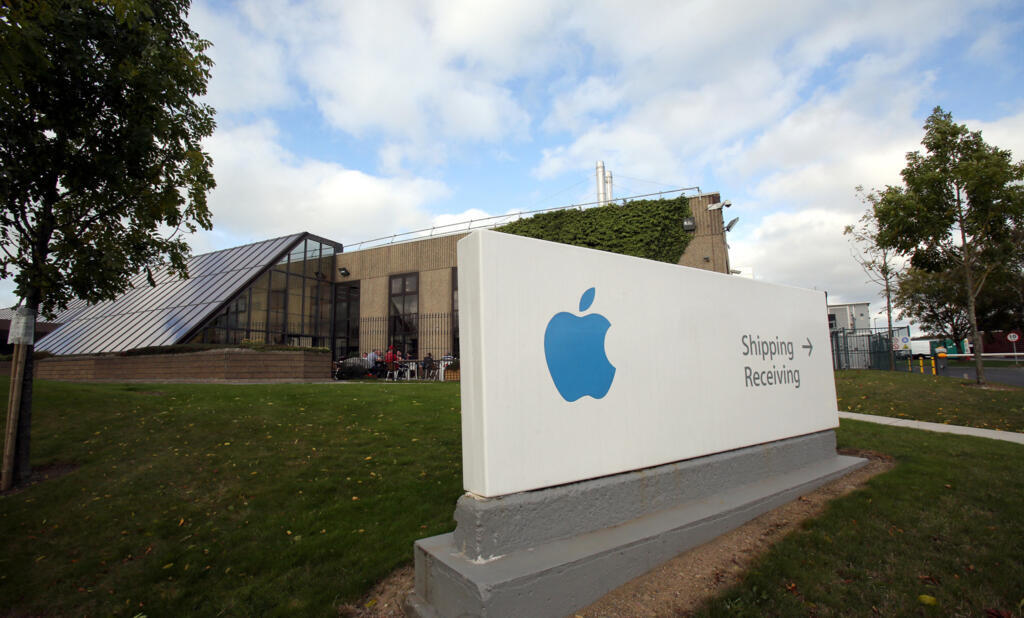
A view of buildings on The Apple campus in Cork, southern Ireland on October 2, 2014. AFP - PAUL FAITH


Over 180,000 Irish workers are employed by American tech companies, and corporate tax receipts - overwhelmingly paid by American multinationals - accounted for over a quarter of all Irish tax revenue in 2024. The windfall from these arrangements has allowed Dublin to avoid difficult decisions about broadening its tax base.

This creates a delicate balancing act. When the European Commission proposed a digital services tax on American tech giants as potential retaliation for Trump's tariffs, Martin quickly declared Ireland would "resist that," arguing it would damage "a significant sector" in Ireland.

Dublin finds itself uncomfortably positioned: economically dependent on American companies that could relocate if pressured either by Washington or Brussels, yet increasingly recognising that diversifying trade relationships—including with China—may be prudent insurance against American unpredictability.

(With newswires)
Tunisia court frees NGO workers accused of helping migrants

A Tunisian court has freed a group of humanitarian workers after handing them suspended sentences for facilitating the "illegal entry and residence" of migrants, a support committee said on Tuesday.

Issued on: 06/01/2026 - RFI

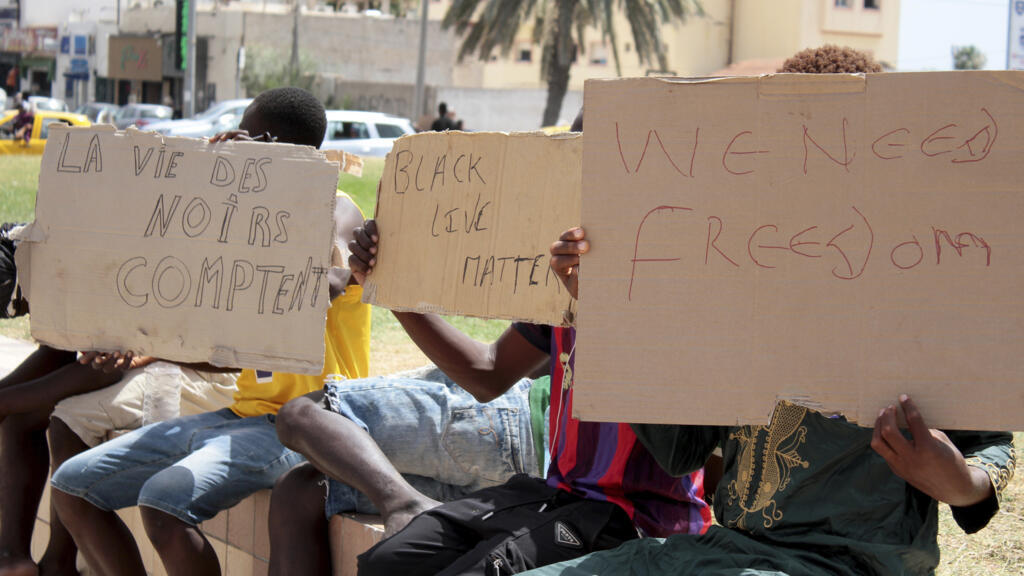
Migrants hold placards reading "Black Lives Matter", left, in French, during a gathering in Sfax, Tunisia's eastern coast, on 7 July, 2023. AP

Sherifa Riahi, the former director of the French NGO Terre d'Asile, and several members of her staff had already spent more than 20 months in jail by the time of their final hearing on Monday.

Hours after the hearing, Riahi's support committee posted a video of her leaving prison overnight, announcing her colleagues had also been freed.

Mahmoud Daoud Yaacoub, a member of Riahi's defence team, told French news agency AFP that the court had handed down a two-year suspended sentence to the defendants who were in pre-trial detention.

"Tomorrow we will learn the rest of the judgment regarding the defendants who are out on bail," he said.

The NGO employees were accused alongside 17 municipal workers from the eastern city of Sousse who were implicated for having lent premises to the organisation.

Driven from camp to camp, Tunisia’s migrants still dream of Europe

The 23 defendants, who were also charged with "conspiracy with the aim of housing or hiding people who entered clandestinely", had faced up to 10 years in prison.

Other charges, including ones alleging financial misdeeds, were previously dropped.

The defendants' lawyers had argued they were simply carrying out humanitarian work under a state-approved programme, in coordination with the government.

On the last day of the trial on Monday, a handful of people gathered outside the courthouse in support of the defendants. The final hearing lasted all day and as night fell, the court retired to consider the verdict.
Sensitive issue

The UN special rapporteur for human rights defenders, Mary Lawlor, had on Sunday urged "the authorities to release her (Riahi) instead of trying her on dubious charges related to her defence of migrant rights".

Migration is a sensitive issue in Tunisia, a key transit point for tens of thousands of people seeking to reach Europe each year.

The defendants were arrested in May 2024 along with about a dozen humanitarian workers, including anti-racism pioneer Saadia Mosbah, whose trial is to start later this month.

Human Rights Watch slams Tunisia’s 'repressive' use of arbitrary detention

In February 2023, President Kais Saied said "hordes of illegal migrants", many from sub-Saharan Africa, posed a demographic threat to the Arab-majority country.

His speech triggered a series of racially motivated attacks as thousands of sub-Saharan African migrants in Tunisia were pushed out of their homes and jobs.

Thousands were repatriated or attempted to cross the Mediterranean, while others were expelled to the desert borders with Algeria and Libya, where at least a hundred died that summer.

This came as the European Union boosted efforts to curb arrivals on its southern shores, including a 255-million-euro ($290 million) deal with Tunis.
Civilians flee Kurdish areas of Aleppo as Syrian army begins shelling

Civilians fled Kurdish-majority neighbourhoods of Aleppo on Wednesday after the Syrian army declared them "closed military zones" and began shelling the area. The fighting marks the deadliest flare-up in violence since an agreement last year to merge the Kurds' semi-autonomous administration and military into Syria's new government.


Issued on: 07/01/2026 - 
By: FRANCE 24
Video by: Rochelle FERGUSON BOUYAHI

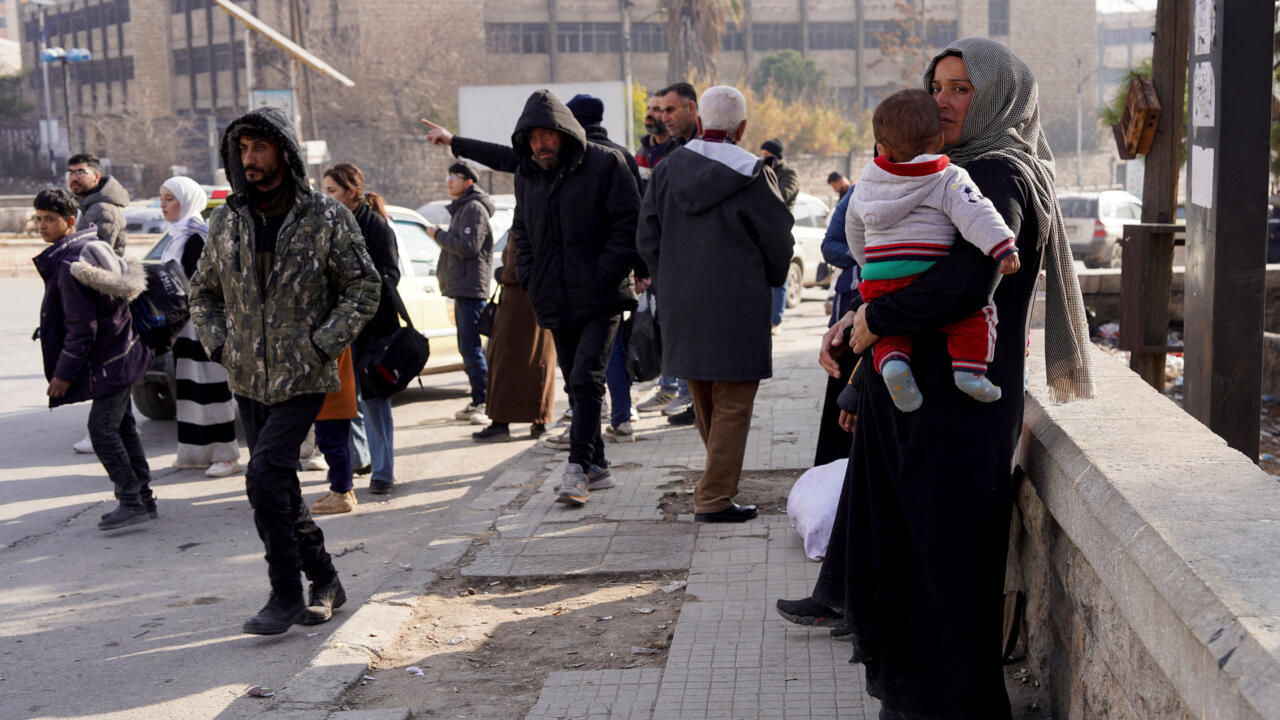
Civilians flee renewed clashes between the Syrian army and the Kurdish-led Syrian Democratic Forces (SDF) in Aleppo on January 7, 2026. © Karam Almasri, Reuters
05:14


Syria's army began shelling Kurdish-majority neighbourhoods in the northern city Aleppo on Wednesday after its deadline for civilians to leave expired, an AFP correspondent said, on the second day of clashes between the two sides.

The Syrian government and Kurdish-led forces traded blame over who started the deadly clashes on Tuesday, with the two sides so far failing to implement a March deal to merge the Kurds' semi-autonomous administration and military into Syria's new Islamist government.

Syria's government demanded that Kurdish fighters leave Aleppo's Kurdish-majority neighbourhoods and that civilians be spared from the conflict.

The Syrian military had declared the city's Sheikh Maqsud and Ashrafiyeh neighbourhoods "closed military zones" from 3.00pm (12:00 GMT), while creating "two safe humanitarian crossings" for civilians


AFP correspondents in Aleppo saw thousands of people leaving the neighbourhoods before the deadline, including large groups of families with children carrying their belongings with them, some in tears.

"We fled the clashes and we don't know where to go ... 14 years of war, I think that's enough," Ahmed, a 38-year-old man who only gave his first name, said while carrying his son on his back.

Ammar Raji, 41, said he and his family were "forced to leave because of the difficult circumstances".

"I have six children, including two young ones ... I am worried we will not return," Raji, who had previously escaped fighting in his northern hometown of Manbij six years ago, added.
'Path of reason'

The Syrian army said that "all Syrian Democratic Forces (SDF) military positions within the Sheikh Maqsud and Ashrafiyeh neighbourhoods of Aleppo are legitimate military targets", referring to the Kurdish-led force.

Senior Kurdish official Ilham Ahmed accused Damascus of launching a "genocidal war" against the Kurds, calling on the Syrian government to "pursue a path of reason to resolve problems through dialogue".

The March agreement on the Kurdish authority's integration into the state was supposed to be implemented by the end of 2025.

The Kurds are pushing for decentralised rule, an idea which Syria's new authorities have rejected.

Sheikh Maqsud and Ashrafiyeh have remained under the control of Kurdish units linked to the SDF, despite Kurdish fighters agreeing to withdraw from the areas in April.

Kurdish security forces said in a statement that they had thwarted "the first incursion attempt ... using tanks" shortly after the deadline set by the army expired.

They accused "Damascus government factions ... of shelling safe residential neighbourhoods with artillery and tanks".

Syrian authorities on their end accused the SDF of bombarding government-controlled areas.

'Nowhere else to go'

Authorities announced the suspension of flights in Aleppo's airport, with schools, universities and government offices in the city shut down.

Joud Serjian, a 53-year-old housewife and resident of the government-controlled Syriac Quarter, said the violence "reminded us of the war".

"We have nowhere else to go, so we'll stay in our home," she added.

The SDF controls swathes of Syria's north and northeast, with the backing of a US-led international coalition, and was key to the territorial defeat of the Islamic State group in Syria in 2019.

Abdul Karim Omar, representative of the Kurds' autonomous administration in Damascus, said that Aleppo's Kurdish-majority neighbourhoods were "completely besieged".

He denied that any shells had been fired from these areas, arguing that they are controlled by the Kurdish security forces, "who only have light weapons".

During the Syrian civil war, Aleppo was the scene of fierce fighting between rebels and forces of ousted president Bashar al Assad before he regained control of the city in 2016.

Assad was ousted in a lightning Islamist-led offensive in 2024.

(FRANCE 24 with AFP)
UN accuses Israel of 'severe segregation and discrimination' in West Bank 'apartheid'

The UN on Wednesday released a report accusing Israel of decades of "severe racial discrimination and segregation" in the West Bank equivalent to "apartheid" as the UN rights office urged Israel to end its "unlawful presence in the occupied Palestinian territory".


Issued on: 07/01/2026 -FRANCE24
By: Joanna YORK

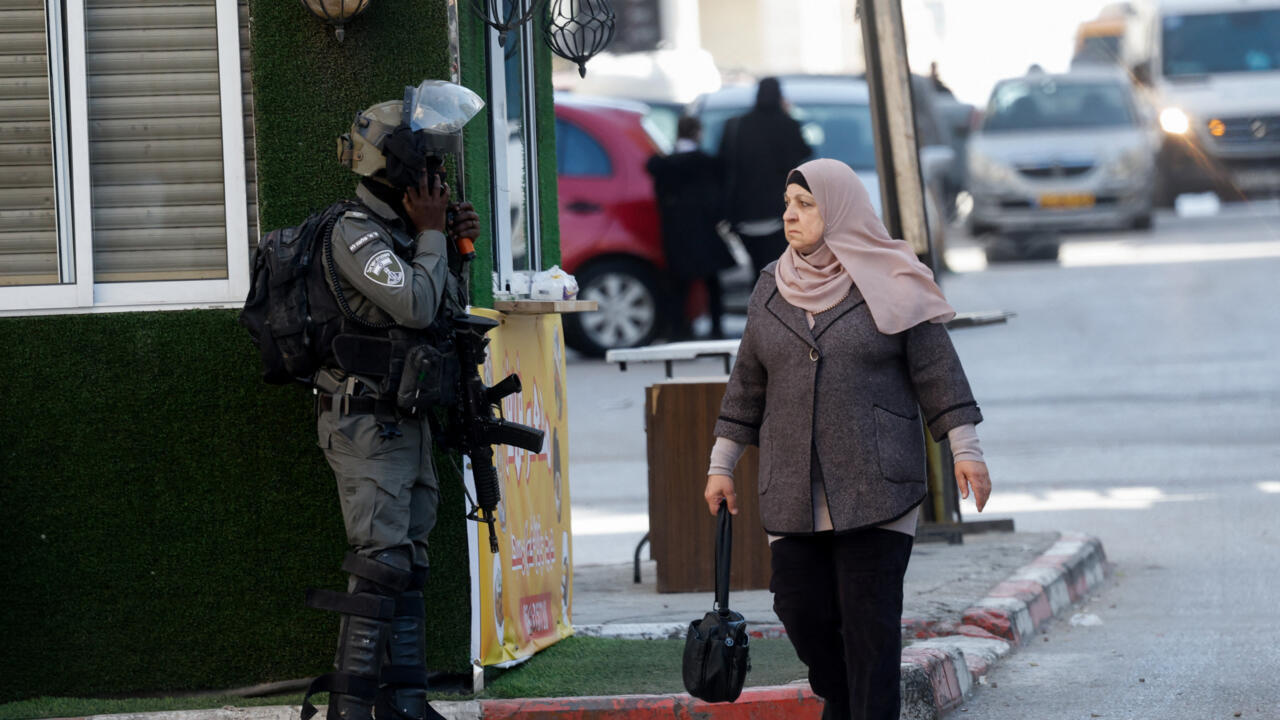
A Palestinian woman walks next to a member of Israeli forces during an Israeli raid in Qalandya, in the Israeli-occupied West Bank on December 23, 2025. © Mohamad Torokman, Reuters

The United Nations on Wednesday said decades-long discrimination and segregation of Palestinians by Israel in the West Bank were intensifying, and called on the country to end its "apartheid system".

In a new report, slammed by Israel, the UN rights office said "systematic discrimination" against Palestinians across the occupied Palestinian territories had "drastically deteriorated" in recent years.

"There is a systematic asphyxiation of the rights of Palestinians in the West Bank," UN rights chief Volker Turk said in a statement.

"Whether accessing water, school, rushing to hospital, visiting family or friends, or harvesting olives – every aspect of life for Palestinians in the West Bank is controlled and curtailed by Israel's discriminatory laws, policies and practices," he added.

"This is a particularly severe form of racial discrimination and segregation, that resembles the kind of apartheid system we have seen before."

A number of independent experts affiliated with the UN have described the situation in the occupied Palestinian territories as "apartheid" but this marks the first time a UN rights chief has applied the term.

Israel's diplomatic mission to the UN in Geneva slammed the report's "absurd and distorted accusations of racial discrimination" against Israel, charging it exemplified the UN rights office's "inherently politically driven fixation ... on vilifying Israel".
Mounting settler violence

The report said the Israeli authorities "treat Israeli settlers and Palestinians residing in the West Bank under two distinct bodies of law and policies, resulting in unequal treatment on a range of critical issues".

"Palestinians continue to be subjected to large-scale confiscation of land and deprivation of access to resources," it added.

This had led to "dispossessing them of their lands and homes, alongside other forms of systemic discrimination, including criminal prosecution in military courts during which their due process and fair trial rights are systematically violated".


Turk demanded Wednesday that Israel "repeal all laws, policies and practices that perpetuate systemic discrimination against Palestinians based on race, religion or ethnic origin".

The discrimination was compounded by continuing and escalating settler violence, in many cases "with the acquiescence, support and participation of Israel's security forces", the rights office said.

More than 500,000 Israelis currently live in settlements in the West Bank, occupied since 1967 and home to around three million Palestinians.

Violence has risen in recent years, surging especially since Hamas's October 7, 2023 attack, which triggered the Gaza war.

Since the start of the war, Israeli troops and settlers have killed more than 1,000 Palestinians in the West Bank, including many militants as well as dozens of civilians, according to an AFP tally based on figures from the Palestinian health ministry.

According to official Israeli figures, at least 44 Israelis, both soldiers and civilians, have been killed in Palestinian attacks or Israeli military operations in the same period.


'Almost complete impunity'

Since the Gaza war began, Israeli authorities had also "further expanded the use of unlawful force, arbitrary detention and torture", the report said.

Increased "repression of civil society and undue restrictions on media freedoms (and) severe movement restrictions" had also characterised "an unprecedented deterioration of the human rights situation" in the West Bank, it said.

There had also been rapid expansions of settlements, considered illegal under international law, even as unlawful killings of Palestinians were taking place "with almost complete impunity", the report warned.

Of the more than 1,500 killings of Palestinians that took place between the start of 2017 and September 30 last year, Israeli authorities had opened just 112 investigations, resulting in only one conviction, it pointed out.

The report said it had found "reasonable grounds to believe that this separation, segregation, and subordination is intended to be permanent ... to maintain oppression and domination of Palestinians".

This, it stressed, amounts to a violation of an international anti-racism convention, "which prohibits racial segregation and apartheid".

The UN rights office on Wednesday urged Israel to end its "unlawful presence in the occupied Palestinian territory, including by dismantling all settlements and evacuating all settlers, and to respect the right of the Palestinian people to self-determination".

(FRANCE 24 with AFP)

France and UK confirm boots on the ground after ceasefire in Ukraine


By Jorge Liboreiro
Published on 

The security guarantees for Ukraine envisioned by the "Coalition of the Willing" and the United States include a high-tech mechanism to monitor a ceasefire, a multinational force led by France and the UK, and a legally binding obligation to assist Kyiv in case of a future Russian attack.

France and the United Kingdom have confirmed their intention to deploy their soldiers on Ukrainian soil after an eventual ceasefire as part of a broader package of security guarantees for Kyiv to avoid a repeat of Russia's full-scale invasion in the future.

The commitment was signed in a formal declaration by French President Emmanuel Macron, British Prime Minister Keir Starmer and Ukrainian President Volodymyr Zelenskyy at the end of a meeting of the "Coalition of the Willing" in Paris on Tuesday.

"I can say that following a ceasefire, the UK and France will establish military hubs across Ukraine and build protected facilities for weapons and military equipment to support Ukraine's defensive needs," Starmer said at the conclusion.

Macron said the multinational force would be deployed "away from the contact line" in the air, sea and land to provide the necessary "reassurance" so that Russia does not attack Ukraine again. Turkey, he said, would join in the operation with maritime support.

"The security guarantees are the key to ensuring that a peace agreement can never mean the surrender of Ukraine or a new threat to Ukraine," Macron said.

The guarantees discussed on Tuesday by allies would also involve a high-tech mechanism to monitor a ceasefire led by the United States and a legally binding obligation to assist Ukraine in the event of a renewed Russian attack.

The obligation, which appears to be modelled after NATO's Article 5 of collective defence, could mean military aid, but also logistical, economic and diplomatic.

Critically, it would require a ratification by national parliaments, a step that could prove difficult to pass in countries where support for Ukraine is fraying. In the case of the United States, it would go through the US Congress for approval.

It remains unclear how much each member of the coalition would contribute, both in the multinational force and the Article 5-like obligation.

After Tuesday's meeting, German Chancellor Friedrich Merz said his country's contribution would require the consent of the Bundestag and limited the deployment of military troops to countries neighbouring Ukraine.

But Merz also said: "We fundamentally don't rule anything out."

Spanish Prime Minister Pedro Sánchez announced he would launch talks with the main parties to discuss Spain's contribution, which, he said, could have a troops component.

"There's an open door for 2026 to become the year when the war ends. This is very good news," Sánchez said. "Europe never wanted this war."

'Huge step forward'

Tuesday's gathering saw leaders from almost 30 Western countries, alongside representatives from Turkey, Australia, Japan and New Zealand, come together.

The US delegation was led by Steve Witkoff and Jared Kushner, the two chief negotiators appointed by President Donald Trump, marking the first time they attended the format in person. Secretary of State Marco Rubio was originally planned to attend, but the recent events in Venezuela prompted a change in his schedule.

"President Trump's mandate is that he wants peace in Ukraine, and we're determined on his behalf to do everything possible," Witkoff said.

Also present in Paris were European Commission President Ursula von der Leyen, European Council António Costa, High Representative Kaja Kallas and NATO Secretary General Mark Rutte. Alexus Grynkewich, the Supreme Allied Commander Europe (SACEUR), who is the highest military authority in NATO, participated in the meeting too.

"We collectively stand by Ukraine, and a safe, secure prosperous future lies ahead," von der Leyen said, calling the meeting a "strong display of unity".

Leaders sought to flesh out and clarify the security guarantees structured along five main pillars: the US-led verification mechanism, military support for the Ukrainian army, the multinational force led by France and the UK, the legally binding obligation to assist in the event of a new attack and long-term defence cooperation with Ukraine.

The obligation to assist Ukraine was first pitched after a meeting in Berlin last month, where it drew comparisons with Article 5 of collective defence, the core foundation of the transatlantic alliance, even if leaders did not use that term publicly.

For Kyiv, a credible deterrent is an indispensable condition to abandon its constitutionally enshrined aspiration to join NATO, which Moscow firmly opposes and Washington does not support under President Donald Trump

Still, the path for an Article 5-like guarantee is riddled with questions.

European governments would have to convince their parliaments, many of which are paralysed by political deadlock, to agree to an exceptionally consequential commitment.

The obligation to assist Ukraine in case of an attack would rely on a mechanism to monitor an eventual cessation of hostilities. This mechanism, envisioned as a system of high-tech sensors across the contact line, would be of critical importance because it would serve to verify potential breaches and allocate responsibility.

If allies were to conclude that Russia is to blame, the Article 5-like assistance would come into play. Triggering the provision would ultimately be a political, not automatic, decision, according to European officials briefed on the discussions.

Zelenskyy hailed Tuesday's meeting as a "huge step forward" but noted the efforts were still not enough. "It will be enough when the war in Ukraine will end," he said.

At this stage, Russia has not given indications that it is willing to compromise on a peace deal and end the war, maintaining the pace of drone and missile strikes against Ukrainian cities, killing scores of civilians and infrastructure.

"We can only get to a peace deal if Putin is ready to make compromises, "Starmer said. "For all Russia’s words, Putin is not showing he's ready for peace."


Ukraine’s Allies Pledge ‘Robust’ Security

Guarantees After Russian War Ends –

Analysis


January 7, 2026 
 RFE RL
By Rikard Jozwiak

Officials from more than 30 Western countries — the so-called Coalition of the Willing — have agreed ensure “politically and legally binding guarantees” for Ukraine once a peace agreement to end the war with Russia is reached.

With Ukrainian President Volodymyr Zelenskyy, along Steve Witkoff and Jared Kushner, US President Donald Trump’s chief negotiators at the table during the January 6 talks in Paris, the coalition agreed that Kyiv’s “ability to defend itself is critically important” to ensure the security of both Ukraine and Europe.

“We confirmed that ensuring the sovereignty and lasting security of Ukraine shall be an integral part of a peace agreement, and that any settlement will have to be backed up by robust security guarantees for Ukraine,” a statement issued after the meeting said.

“Both the Coalition partners and the United States will play a vital and closely coordinated role in the provision of these security guarantees,” it added.

The meeting was called amid an intense flurry of diplomacy to fine tune a peace proposal aimed at ending Europe’s largest and deadliest conflict since World War II.

The statement is the most defined wording the allies have given on military pledges to secure Ukrainians after any peace deal is reached with Moscow.

It says support for Ukraine by the allies would include a US-led cease-fire monitoring and verification mechanism, support for Ukraine’s armed forces, a multinational force for Ukraine, and “binding commitments to support Ukraine in the case of a future armed attack by Russia in order to restore peace.”

“We are talking about strong security guarantees,” French President Emmanuel Macron told reporters after the meeting.

“These security guarantees are a key that a peace agreement cannot mean a Ukrainian surrender.”

European officials have told RFE/RL that there is “a renewed sense of urgency” after a meeting over the weekend of national-security advisers and a gathering of military planners on January 5.

The statement gives no specifics on troops for any multinational force but some officials have said the number that is floating around in various European capitals is that the force will consist of 15,000-20,000 troops, while others hope the level will be closer to 30,000 working under the motto “safe sea, sky and land.”

The bulk of the troops will come from France and the United Kingdom, which would lead the land and air component, while Turkey has indicated it would be in charge of securing transport lanes in the Black Sea.

“Following a ceasefire UK and France will establish military hubs across Ukraine,” British Prime Minister Keir Starmer.

“We can only get to a peace if [Russian President Vladimir] Putin makes compromises and we have to be frank for all Russia’s words Putin has shown he is not ready for peace,” he added without giving further details on the plan.
Unresolved Questions

While the outlines of a Western presence in Ukraine are taking shape, there are still several question marks to sort out, including the rules of engagement and US security guarantees.

“We are largely finished with the security protocol so that the Ukrainian people know that peace comes it will last,” Witkoff said, adding further meetings with the Ukrainian delegation would follow.

“The president [Donald Trump] strongly stands behind security protocols. The president does not back down on commitments. We will be there for the Ukrainians to get there for the final peace.”

Peace talks have intensified since November, when Trump pressed Zelenskyy to accept a 28-point peace proposal that many saw as heavily favoring Russia.

Ukraine and its European allies — led by Britain, France, and Germany — scrambled to develop a counterproposal, eventually putting forward a 20-point plan that took in more of Kyiv’s interests, especially on security guarantees and territorial integrity.
Thorny Issues

Ukraine’s chief negotiator Rustem Umerov recently asserted that “most of the positions — 90 percent of the peace plan — have already been agreed, work continues on the details.”

These details include the thorny issue of territorial concessions with Ukraine pushing the line of contact to be frozen or for the entire Donbas region to become a demilitarized zone.

“We want to be ready so when diplomacy reaches peace we can place the forces of the coalition,” Zelenskyy said.

“We need to work on the question of territory. Ukraine needs missiles because every day notwithstanding the diplomacy the Russian strikes continue.”

Another issue is the ownership of the Zaporizhzhya nuclear power plant with Kyiv dismissing the idea of Ukraine and Russia running it together, preferring that the United States steps in to sell energy from it to Moscow instead.

Few in Brussels, however, are thinking that Russia would agree on any of these issues with the assessment that the Kremlin still feels it is winning on the battlefield.

Russian President Vladimir Putin has said several times in recent weeks that Moscow will achieve the goals of what it calls its “special military operation” either by agreement or force.

With that in mind, the EU is separately preparing a fresh round of sanctions, the 20th since the full-scale invasion nearly four years ago, which is likely to be presented to its member states for approval later in January.Rikard Jozwiak is the Europe editor for RFE/RL in Prague, focusing on coverage of the European Union and NATO. He previously worked as RFE/RL’s Brussels correspondent, covering numerous international summits, European elections, and international court rulings. He has reported from most European capitals, as well as Central Asia.

US backs security guarantees for Ukraine at summit of Kyiv's allies in Paris

The United States has for the first time backed a broad coalition of Ukraine's allies in vowing to provide security guarantees that leaders said would include binding commitments to support the country if it is attacked by Russia again. The agreement followed a "coalition of the willing" summit in Paris in which Ukraine's allies agreed to deploy troops in Ukraine in the event of a ceasefire.

Issued on: 07/01/2026 - RFI

French President Emmanuel Macron and Ukrainian President Volodymyr Zelenskiy at the Coalition of the Willing summit at the Elysee Palace in Paris, 6 January, 2026. via REUTERS - YOAN VALAT

French President Emmanuel Macron, Ukraine's Volodymyr Zelensky and British Prime Minister Keir Starmer signed a declaration of intent on Tuesday in Paris at the "coalition of the willing" summit of mainly European nations.

The declaration foresees Britain, France and other European allies deploying troops on Ukrainian territory after any ceasefire with Russia.

The allies also agreed to participate in a proposed US-led ceasefire monitoring and vertification mechanism.

Macron said that Paris could deploy "several thousand" French troops to Ukraine after the war.

US special envoy Steve Witkoff said that President Donald Trump "strongly stands behind security protocols".

"Those security protocols are meant to ... deter any attacks, any further attacks in Ukraine, and ... if there are any attacks, they're meant to defend, and they will do both. They are as strong as anyone has ever seen."

But a promise that Washington would commit to "support" the European-led multinational force "in case of a new attack" by Russia, which was present in the draft statement, was not in the communique released on Tuesday evening.

US and Ukrainian officials are to continue talks over security guarantees for Kyiv on Wednesday.
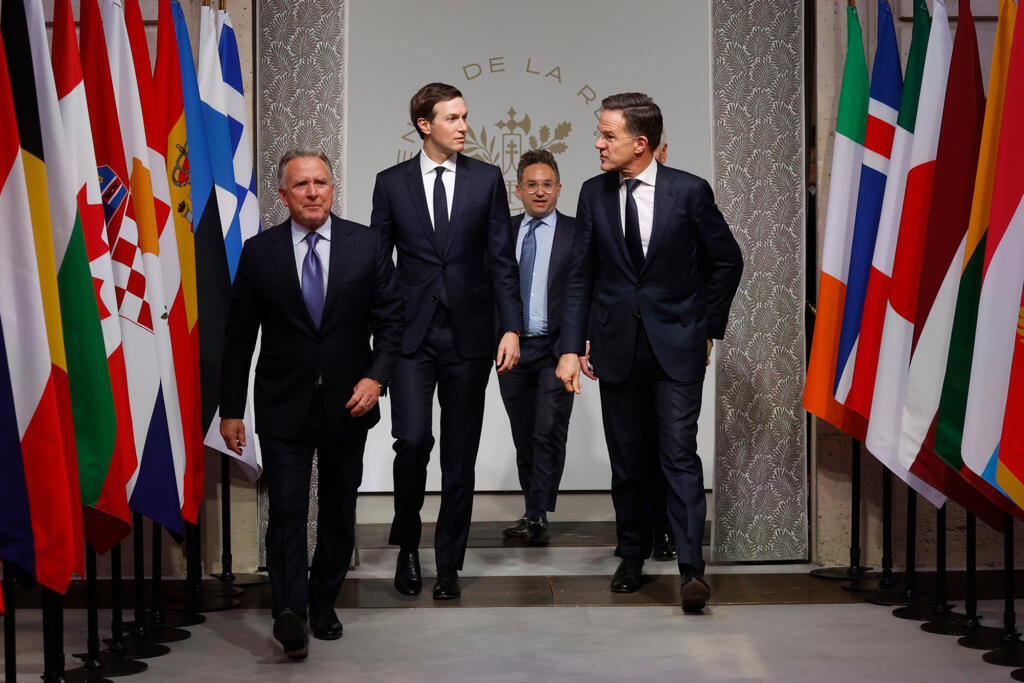
Jared Kushner, second left, US Special Envoy Steve Witkoff, left, and Nato Secretary General Mark Rutte, right, at the Coalition of the Willing meeting. AP - Yoan Valat

Peace with guarantees

Talks to bring the almost four-year conflict to an end have accelerated since November. However, Moscow has yet to signal willingness to make concessions after Kyiv pushed for changes to a US proposal that initially backed Russia's main demands.

Until recently, much of the focus was on pledges of military aid for Ukraine's forces and possible contributions to an international reassurance force.

Attention has now shifted to legally binding guarantees to come to Kyiv's aid in the event of another attack by Moscow. The possibility of a military response is likely to trigger debate in many European countries, diplomats say.

"These commitments may include the use of military capabilities, intelligence and logistical support, diplomatic initiatives, adoption of additional sanctions," the leaders' statement said, adding that they would now "finalise binding commitments".

"We all want ... peace (in Ukraine) to be fair, lasting and clear-eyed… we want this peace to have its guarantees," Macron told a news conference after the summit.


Macron demands 'robust security guarantees' before any Ukraine territorial talks


Renewed unity

European leaders present at the meeting, including Macron, Starmer, Polish Prime Minister Donald Tusk and Italy's Prime Minister Giorgia Meloni stressed that the statement showed renewed unity between Europe and the United States on helping Ukraine.

The leaders' statement also pledged a European-led "Multinational Force for Ukraine ... to support the rebuilding of Ukraine's armed forces and support deterrence" with "the proposed support of the US".

Kyiv has long said it cannot be safe without guarantees that are comparable to the Nato alliance's mutual defence agreement, to deter Russia from attacking again.

Moscow wants any peace deal to bar Ukraine from military alliances.

(with newswires)

Is Havana next? After Maduro's removal, Cuba loses an ally and fears economic disaster

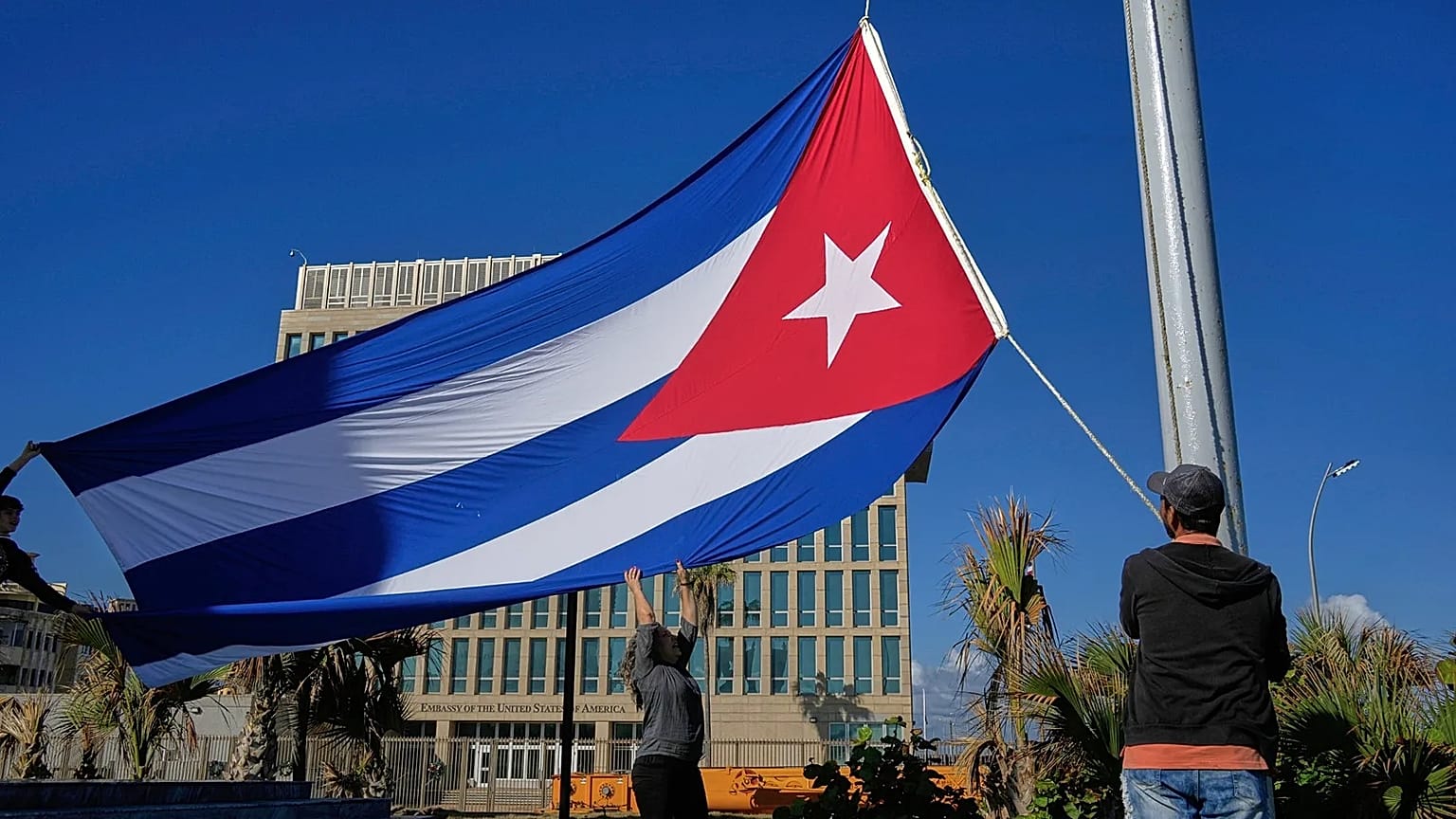
Workers fly the Cuban flag at half-mast in Havana, Cuba, Monday, Jan. 5, 2026, in memory of Cubans who died two days before in Caracas, Venezuela.
Copyright AP Photo
By Sandor Zsiros
Published on 


The Cuban leadership has lost a critical economic ally in Nicolás Maduro, and likely US oil embargo could deepen the island's economic crisis. But according to an expert, it is unlikely to bring people to the streets.

Over the weekend, Cuban authorities announced that 32 Cuban nationals had been killed in the US's raid on the Venezuelan capital, Caracas. They were serving as bodyguards to President Nicolás Maduro in the military compound from which US special forces seized him.

Besides Venezuela itself, Cuba has been hit harder than any other country by Maduro's removal. Havana lost a key political ally and a pillar of its already troubled economy, and statements from the Trump administration in the raid's aftermath made it clear that along with Colombia and Greenland, the US could soon target Cuba as well.

The presence of the Cuban military in Venezuela was just one example of the close cooperation between the two nations.

"Venezuela was Havana’s single most important political ally ever since Hugo Chávez and Fidel Castro struck up their intimate friendship in the early 2000s," Bert Hoffmann, a political scientist at the German Institute of Global and Area Studies, told Euronews.

As a presidential candidate in 1999, Chávez met with the leader of the Cuban Revolution, Fidel Castro, in Havana, and the two governments' alliance has only deepened in the subsequent decades. Maduro was educated in Cuba and has positioned himself as the guardian of Chávez's revolutionary leftist project; he has maintained close ties with Havana ever since coming to power

Cuban officials hold key positions in Venezuela's intelligence apparatus, and Havana has sent Caracas doctors and health care personnel in exchange for political support and cheap oil. Over the last several months, Venezuela shipped around 35,000 barrels daily to Cuba at a heavily subsidised price – and as Hoffmann told Euronews, Venezuelan oil deliveries are still the island’s crucial lifeline.

"Over the last months, Venezuelan oil still made up 70% of Cuba’s total oil imports, with Mexico and Russia sharing the rest," he said. The fear in Havana is that the US could soon try to topple the Cuban regime without direct intervention by cutting it off from Venezuelan oil altogether.

Demise by decoupling

"While Washington will be wary of military action with 'boots on the ground, the navy ships along the Venezuelan coastline can enforce an oil embargo at little cost," Hoffann said. "And whatever the new Caracas leadership’s negotiating power is, continued support for Cuba will hardly be its top priority."

While Cuba could seek alternative supplies from Russia, Iran, or Arab countries, helping out Havana directly would make any new supplier a potential target of US reprisals. And even if Havana is able to find some alternative source of oil, the already precarious living conditions Cubans are experiencing are set to decline further.

Cuba is already experiencing its deepest economic crisis in recent history. The country's economy has shrunk by around 4% in the last years, with a contraction of 1.5% in 2025 alone. With inflation over 20%, food, medicines, and fuel shortages are widespread.

"Economically, Cuba now also pays a heavy price for having concentrated all investment on tourism, an industry for which the dire situation of crisis and political uncertainty is toxic," Hoffmann said.

Meanwhile, removing, undermining or at least isolating Cuba's communist regime one way or another has been an American priority since the Cuban Revolution in 1959, and for the Trump administration, the dire situation and Maduro's forceful departure mean a window of opportunity for regime change.

“Cuba looks like it’s ready to fall. I don’t know if they’re going to hold out,” Trump said on Sunday on board Air Force One.

What next?

Yet according to Hoffmann, despite the events in Venezuela, the leadership in Havana has so far shown no sign of disintegration.

"The fear of what is to come after an eventual regime collapse is a powerful glue for elite cohesion," he said. "They will closely watch how the post-Maduro elite survive the storm, or whether they will be hanged from the streetlamps."

According to US Secretary of State Marco Rubio, who was raised in Miami by Cuban exile parents, the Cuban elite should not be complacent.

“If I lived in Havana and I was in the government, I’d be concerned at least a little bit," he told NBC News over the weekend, though he refused to talk about US plans for Cuba in any detail.

One potential scenario is a complete naval blockade, for which the Cuban army is already prepared – and in Hoffman's view, this would not bring the Cuban people to the streets.

"Even if living conditions become ever more precarious, this does not necessarily translate into rebellion," he said. "Mobilising collective action not only requires shared discontent but also the belief that protest may lead to change."

The military action against Maduro could in fact demobilise everyday Cubans, not motivate them.

"If its message is that it is up to the military to shoot it out and for the governments to negotiate their deals, for ordinary people, this is no time to take to the streets, but to duck and cover."


NVIDIA and Universal Music Group join forces to develop 'responsible AI' for music

NVIDIA and Universal Music Group announced a strategic partnership to develop 'responsible AI' for the music industry.
Copyright Canva

By Anca Ulea
Published on 

Described as an "antidote to AI slop," the strategic partnership will expand NVIDIA's AI music models and develop new AI-powered music creation tools with direct input from artists.

Artificial intelligence (AI) could make it easier to find your next favourite song.

That's the mission of a new partnership announced on Tuesday, between AI company NVIDIA and the world's largest music rights company, Universal Music Group (UMG).

The two industry giants announced they are joining forces to develop "responsible AI for music discovery, creation, and engagement," according to a press release.

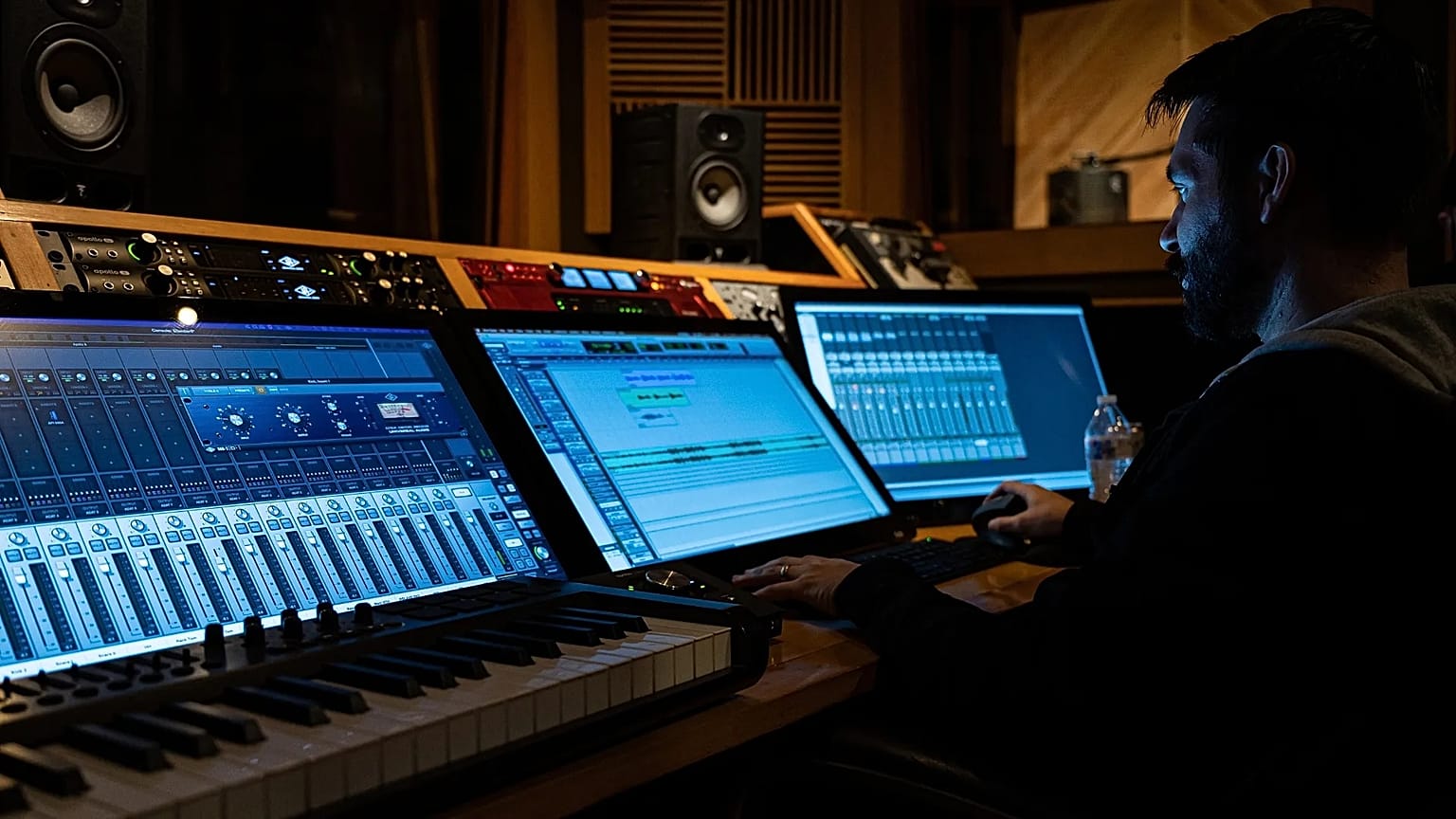
The collaboration will tap into UMG's catalogue of over 3 million recorded songs to expand NVIDIA's AI model Music Flamingo, a large audio–language model that allows the AI system to listen to, interpret and reason about music.

"We're entering an era where a music catalogue can be explored like an intelligent universe – conversational, contextual, and genuinely interactive," Richard Kerris, NVIDIA's vice president of media said in a statement.

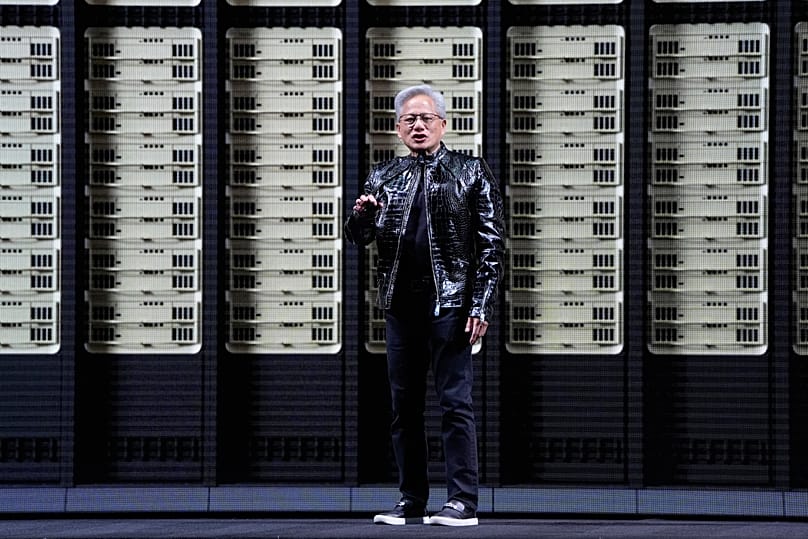
NVIDIA founder and CEO Jensen Huang speaks at a news conference in Las Vegas, 5 January, 2026 AP Photo

NVIDIA's Music Flamingo processes full-length tracks of up to 15 minutes with "unprecedented precision, capturing harmony, structure, timbre, lyrics and cultural context," according to the company.

With more data to train on, Music Flamingo will be able to help fans discover new songs based on "emotional narrative and cultural resonance," going beyond traditional search categories like genre or tempo. The system will also deepen its own knowledge of music, learning to interpret it more like humans do.

According to the company, this will make it easier for emerging artists to find fans who will connect with their sound. Artists will also be able to analyse, describe, and share their music with more depth on Music Flamingo.

"By extending NVIDIA's Music Flamingo with UMG’s unmatched catalog and creative ecosystem, we're going to change how fans discover, understand and engage with music on a global scale," Kerris said. "And we'll do it the right way: responsibly, with safeguards that protect artists’ work, ensure attribution and respect copyright."

The partnership will also develop new AI-driven music creation tools for artists. To guarantee artists are the ones reaping the benefits of these tools, NVIDIA and UMG said they will create a dedicated artist incubator.

The companies said the incubator will invite artists, songwriters, and producers to help design and test the new AI-powered tools, promising to serve as an "antidote to generic, 'AI slop' outputs."

It isn't the first time UMG and NVIDIA have teamed up – UMG's Music & Advanced Machine Learning Lab (MAML) previously trained its models using NVIDIA's AI infrastructure.


Sound the horn! Rare Iron Age battle trumpet found among hoard in Norfolk

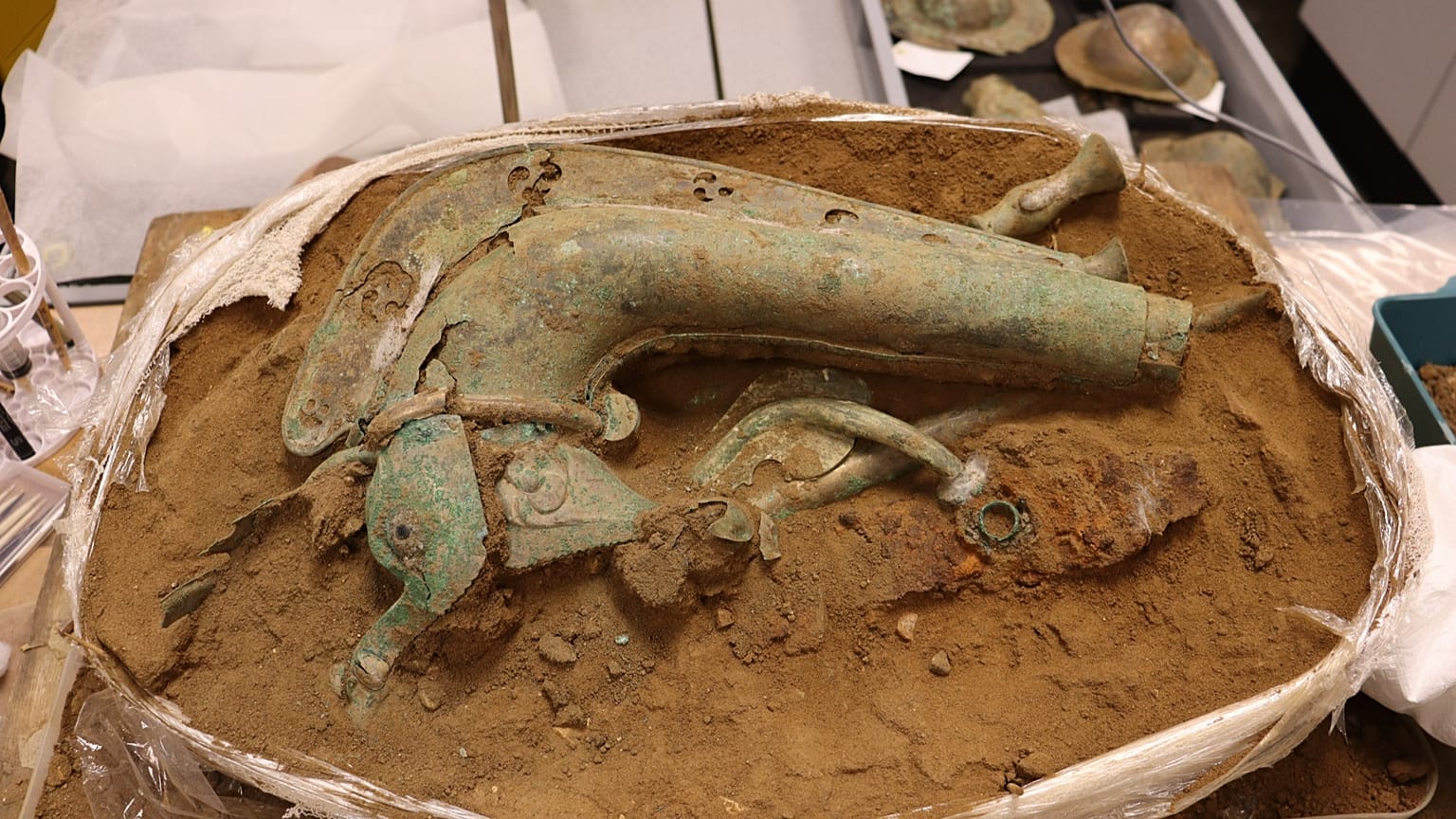
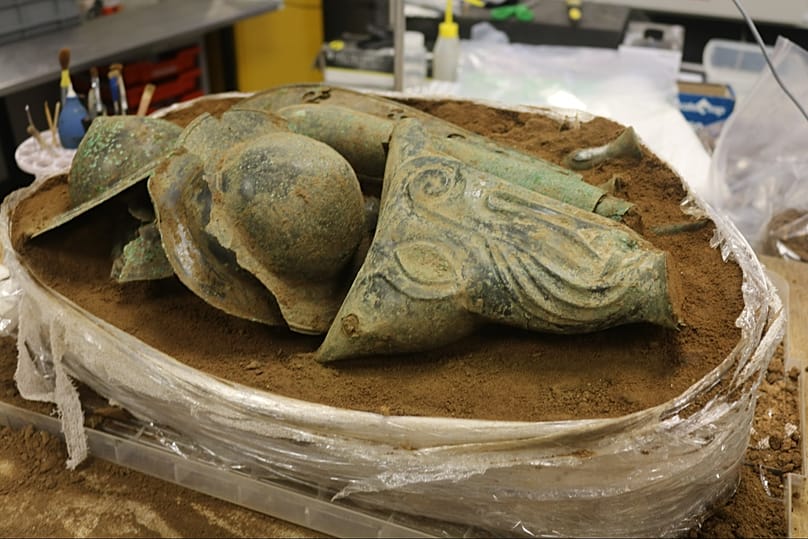
With the shield bosses and boar standard excavated from the block, the carnyx, trumpet, is revealed.
Copyright Credit: Norfolk Museum Service

By Tokunbo Salako
Published on 

An extraordinary collection of Iron Age objects has been unearthed in West Norfolk. The hoard of metal objects was found during a routine archaeological excavation by Pre-Construct Archaeology as part of the standard planning process for residential properties.

A remarkable collection of Iron Age artifacts has been unearthed in West Norfolk, shedding new light on ancient British culture.

The hoard, discovered during a routine archaeological excavation by Pre-Construct Archaeology, includes a near-complete Iron Age battle trumpet, known as a carnyx, and parts of another.

These animal-headed bronze instruments were used by Celtic tribes across Europe to inspire warriors in battle and fascinated the Romans, who frequently depicted them as war trophies. The hoard also includes a sheet-bronze boar's head, originally from a military standard, five shield bosses, and an iron object of unknown origin.

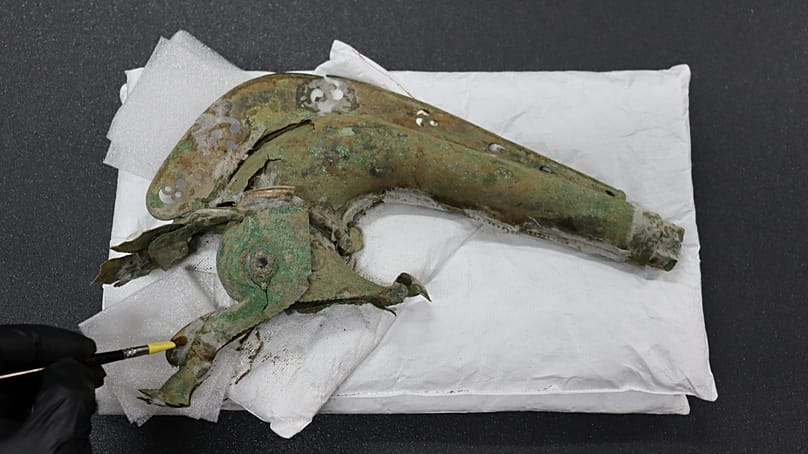
The carnyx is one of only three known examples from Britain and one of the most complete found in Europe. Credit: Norfolk Museum Service

Conservation efforts

According to Dr. Fraser Hunter, Iron Age and Roman curator at National Museums Scotland, this rare find will add enormously to our understanding of the period: "The full research and conservation of these incredibly fragile remains will reshape our view of sound and music in the Iron Age."

"The carnyces and the boar-headed standard are styles well known on the continent and remind us that communities in Britain were well-connected to a wider European world at this time," he added.

The boar standard ready to be lifted from the block Credit: Norfolk Museum Service

Following the discovery, the objects were carefully lifted within a block of soil from the site, and initial scanning took place to reveal their position. Conservation experts at Norfolk Museums Service then removed each object for preliminary examination. The items are in a fragile condition and require extensive stabilization work before detailed research can begin.

"This find is a powerful reminder of Norfolk's Iron Age past, which still retains its capacity to fascinate the British public," said Dr. Tim Pestell, Senior Curator of Archaeology for Norfolk Museums Service. "The Norfolk Carnyx Hoard will provide archaeologists with an unparalleled opportunity to investigate a number of rare objects and ultimately, to tell the story of how these came to be buried in the county two thousand years ago."

As the find consists of two or more base metal prehistoric items from the same find, it has been reported to the coroner as potential treasure under the terms of the Treasure Act 1996. The case currently rests with the coroner, who will determine its legal status in early 2026. This decision will inform the next steps for the hoard’s future.

Historic England is working with Pre-Construct Archaeology, Norfolk Museums Service and the National Museum of Scotland to coordinate research and conservation. Where the objects will be housed long-term is yet to be determined.