Friday, January 09, 2026

Weak US Jobs Report Shows ‘Bleak Economic Reality’ for Workers Under Trump

There has been “almost no hiring since April,” observed one economist.


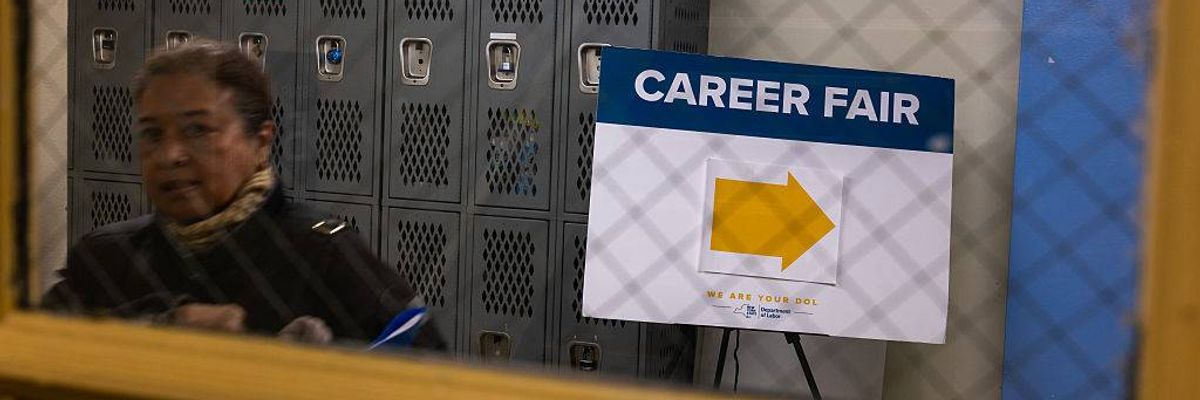
Job seekers attend a career fair in Harlem hosted by Assemblymember Jordan Wright on December 10, 2025, in New York City.
(Photo by Spencer Platt/Getty Images)


Brad Reed
Jan 09, 2026
COMMON DREAMS


The US labor market appears to be running on fumes under President Donald Trump, as the latest jobs report revealed that the American economy added just 50,000 jobs in December, below economists’ consensus estimate of 55,000 jobs.

The report, released on Friday by the Bureau of Labor Statistics (BLS), also found that the US economy as a whole created just 584,000 jobs in 2025, which is less than a third of the 2 million jobs created in 2024 during the last year of former President Joe Biden’s term.

The 2025 figure also marked the lowest number of annual jobs created since 2020, when the economy was shut down due to the Covid-19 pandemic.

Fox Business anchor Cheryl Casone couldn’t put a happy spin on the jobs report after its release, as she noted that the gains of just 37,000 private-sector jobs on the month were “much weaker than expected.”


Digging further into the report, Bloomberg economic analyst Joe Weisenthal observed on X that manufacturing employment has been hit particularly hard in recent months, despite Trump’s vow that his tariffs would lead to a manufacturing revival in the US.

“It’s not just that total manufacturing employment is shrinking,” he explained. “The number of manufacturing sub-sectors that are adding jobs is rapidly shrinking. Of the 72 different types of manufacturing tracked by the BLS, just 38.2% are still adding jobs. A year ago it was 47.2%.”

Heather Cox Richardson, chief economist at Navy Federal Credit Union, noted that the weakness in the labor market extends beyond the manufacturing sector, as there has been “almost no hiring outside of healthcare and hospitality” since the start of Trump’s second term.

Richardson also observed that “there was almost no hiring since April” of last year, when Trump announced his “Liberation Day” tariffs that sent shockwaves through the global economy.

Economist Dean Baker, co-founder of the Center for Economic and Policy Research, zeroed in on downward revisions in prior jobs reports, reinforcing that the current labor market is anemic.

“With the revisions, the average for the last three months was a fall of 22,000 [jobs],” Baker explained. “The healthcare and social assistance sector added an average of 49,000 jobs over this period, which means that outside of healthcare the economy lost an average of 71,000 jobs in the last three months.”

Alex Jacquez, chief economist at Groundwork Collaborative, said the jobs report reflected a “lifeless economy,” and he pinned the blame on Trump and his trade policies as a top reason.

“Working families face sluggish wage growth, fewer job opportunities, and never-ending price hikes on groceries, household essentials, and utilities,” said Jacquez. “Despite the president’s endless attempts to deflect and distract from the bleak economic reality, workers and job seekers know their budgets feel tighter than ever thanks to Trump’s disastrous economic mismanagement.”

Economist Elise Gould of the Economic Policy Institute took a look at the jobs numbers and concluded the US labor market now is far weaker than the one Biden left Trump nearly one year ago.


“The slowdown in job growth this year is stark compared to 2024,” Gould wrote on Bluesky. “The average monthly gain was only 49,000 in 2025 compared to 168,000 in 2024. Over the last three months, average job growth was actually negative, meaning there are fewer jobs now than in September.”
Trump Wants $6 Trillion Tax Hike to Fund $600 Billion in New War Spending

It’s good to see an old man suffering from dementia enjoying himself, but there are much cheaper and less deadly ways to entertain such a person.


Fire at Fuerte Tiuna, Venezuela’s largest military complex, is seen from a distance after a series of explosions in Caracas on January 3, 2026.
(Photo by AFP via Getty Images)


Dean Baker
Jan 09, 2026
Beat the Press

President Donald Trump is now apparently planning to request a $600 billion increase in annual military spending starting in October, financed by another huge jump in import taxes, aka tariffs. I said “apparently” since it’s not clear that he thinks he has to request authority for this spending increase or massive tax hike from Congress.

Under the Constitution there is no ambiguity on these issues. Congress has the power to tax and authorize spending. However, Donald Trump and the Republican Congress have not shown much respect for the Constitution in Trump’s second term and it’s not clear the Supreme Court has any greater level of respect. So, who knows if there actually will be requests for Congress to vote on, or whether he will just do it with no legal authority.


Majority of Democrats Join Senate GOP to Pass Trump’s $900 Billion Pentagon Wish List


Anyhow, apart from the mechanism employed, this would be a massive increase in spending, coming to just under 2% of GDP. It would also amount to a massive tax increase if Trump actually offsets the spending, as he claimed he would, rather than just increasing the deficit.

Taken over a decade, a $600 billion increase in annual taxes would come to $6 trillion, roughly $45,000 per household. It is real money. It would be difficult, but not impossible, to raise this much money through tariffs.

That doesn’t sound like much of an affordability agenda, but Trump was never really into that word anyhow.

Our imports currently come to just to over $3.2 trillion annually. A straight calculation would imply that an across-the-board tariff increase of 19 percentage points could cover the cost of Trump’s military buildup. But the increase in the tariff rate on most items would end up being considerably higher for two reasons.

First imports would fall sharply in response to a tariff of this size. Let’s say they fall by 15%, this would put imports at $2.7 trillion, which would mean a tariff increase of 22 percentage points would be needed to get to Trump’s $600 billion.

The other reason that the tariff on most items would likely be higher is that Trump will presumably exempt some items other for policy reasons or in response to payoffs at Mar-a-Lago. In the first category, much of what we import are intermediate goods used in manufacturing finished products like cars or planes. High tariffs on these inputs will hurt industries that Trump is ostensibly trying to foster.

The other part of the story is that we have seen many executives make the pilgrimage to Mar-a-Lago, most notably Apple CEO Tim Cook, and walk away tariff exemptions on items they import. This trek will be more widely traveled when CEOs are looking at tariffs two or three times their current levels.

That means the import tax on many products will have to increase in the neighborhood of 30 percentage points to hit Trump’s revenue targets. That will be a big hit to many households’ budgets, as we know that the bulk of tariff revenue gets passed on to consumers in the form of higher prices. That doesn’t sound like much of an affordability agenda, but Trump was never really into that word anyhow.

The other side of the story is that this massive increase in military spending will mean a huge diversion of resources from productive uses. Scientists who might have been developing better computers or software for civilian uses will instead be working for military contractors. The same is true for researchers developing new drugs or medical equipment.

This will also be the case with millions of less-highly educated or narrowly trained workers. Instead of working as teachers or in various areas of healthcare, such as physical therapists or home healthcare assistants, they will be employed in the sort of jobs needed by military contractors. That’s a huge drain for the economy and corresponds to the reduction in purchasing power as a result of Trump’s massive tax increase.

If there was some clear argument as to why we needed such a massive increase in taxes and diversion of resources, as when we confronted the Nazis in World War II, perhaps this hit to the economy could be justified. But no one made such claims, not even Trump in his 2024 campaign, until Trump invaded Venezuela and decided it was fun.

It’s good to see an old man suffering from dementia enjoying himself, but it would be much cheaper and less deadly if we just gave him a good video game.


This work is licensed under a Creative Commons Attribution 4.0 International License


Dean Baker
Dean Baker is the co-founder and the senior economist of the Center for Economic and Policy Research (CEPR). He is the author of several books, including "Getting Back to Full Employment: A Better bargain for Working People," "The End of Loser Liberalism: Making Markets Progressive," "The United States Since 1980," "Social Security: The Phony Crisis" (with Mark Weisbrot), and "The Conservative Nanny State: How the Wealthy Use the Government to Stay Rich and Get Richer." He also has a blog, "Beat the Press," where he discusses the media's coverage of economic issues.
Full Bio >

War-Making Belongs to Congress―and the Oil Belongs to the People of Venezuela

The question is not whether a particular president’s motives are sincere, nor whether a foreign government is flawed. The question is whether the United States will remain governed by law―or by precedent accumulated through silence.


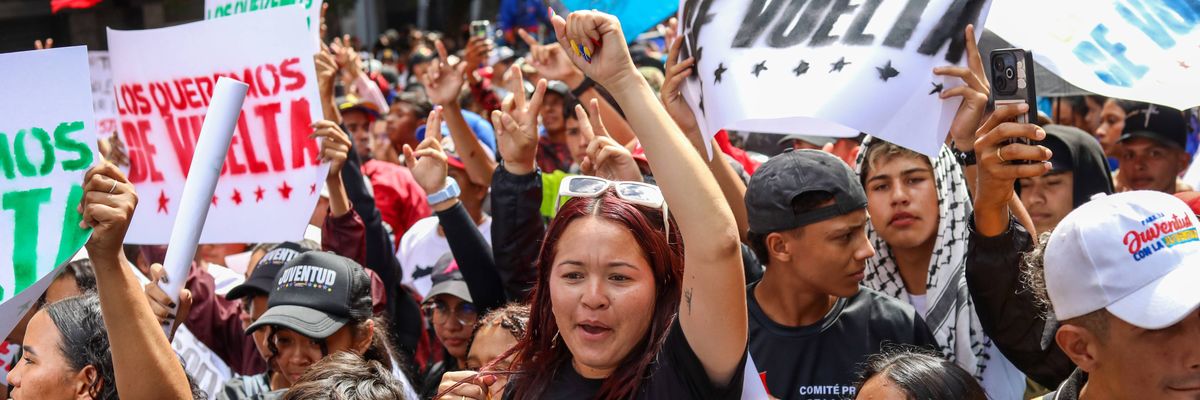
Supporters of Venezuelan President Nicolas Maduro and his wife, Cilia Flores, gather during a demonstration, expressing solidarity with the government, in Caracas, Venezuela, on January 8, 2026.
(Photo by Ivan McGregor/Anadolu via Getty Images)

Angel Gomez
Jan 09, 2026
Common Dreams


The recent Senate debate over U.S. military action in Venezuela exposes a fundamental rupture in American constitutional governance: who has the authority to initiate war. The Constitution answers that question plainly. Yet modern practice―and the arguments advanced in defense of it―have drifted dangerously far from that design. Alongside this constitutional crisis stands a second, inseparable issue: whether the United States may lawfully claim control over the natural resources of another sovereign nation, specifically Venezuela’s oil, under the threat of force.

These questions are not abstract. They determine whether the United States remains governed by law or by precedent accumulated through executive action and congressional silence.


‘This is About Oil and Regime Change’: GOP Lawmaker Speaks Out Against Push for War in Venezuela


‘Get the Oil Flowing’: Trump’s Own Words Make His War Aims in Venezuela Clear

At the center of the debate are two sharply opposed views articulated on the Senate floor. One asserts that the President, as Commander in Chief, may unilaterally use military force whenever he deems it necessary to advance national interests, with Congress relegated to the limited roles of funding restriction or impeachment after the fact. The other insists that the power to initiate war belongs exclusively to Congress, not as a technicality, but as a deliberate constitutional safeguard against impulsive, personalized, or imperial war-making.

Constitutional design and deliberate restraint lie at the heart of the Framers’ intent. Article I of the Constitution vests in Congress―not the President―the power to declare war. Article II assigns the President the authority to command the armed forces once war is authorized and to repel sudden attacks. This division was not accidental. It reflected deep skepticism, shared across the Founding generation, that executives are structurally inclined toward war. James Madison warned that the executive branch is “most prone to it,” driven by secrecy, ambition, and the temptation of unilateral action.

Bombing a foreign capital, removing a sitting head of state, and threatening prolonged military occupation are acts of war by any ordinary, historical, or legal definition. The Constitution does not permit semantic evasions to substitute for authorization.

The Framers, therefore, made war intentionally difficult to launch. They placed the decision in a deliberative body accountable to the people, requiring public debate, recorded votes, and political responsibility. That Congress has too often failed to exercise this duty does not diminish the Constitution’s command. Repeated violations do not convert usurpation into legality. Historical drift explains how power migrated; it does not justify why it should remain there.

Attempts to rebrand large-scale military operations as “law enforcement,” “arrest warrants,” or “limited actions” do not change their substance. Bombing a foreign capital, removing a sitting head of state, and threatening prolonged military occupation are acts of war by any ordinary, historical, or legal definition. The Constitution does not permit semantic evasions to substitute for authorization.

The War Powers Resolution―and the myth of congressional overreach is often invoked as the supposed villain. Critics claim that the 1973 War Powers Resolution is unconstitutional because it allegedly transforms Congress into “535 commanders-in-chief.” This argument inverts constitutional logic. The Resolution does not empower Congress to command troops; it reasserts Congress’s authority to decide whether hostilities initiated by the executive may lawfully continue. It exists precisely because Congress had been sidelined, not because it had seized power.

The statute’s reporting requirements and time limits are accountability mechanisms, not vetoes of military command. Congress’s true failure has not been excessive interference but persistent abdication―avoiding the political responsibility of authorizing war while permitting presidents to act first and justify later. That abdication corrodes checks and balances and transfers the gravest decision a democracy can make into the hands of one person.

Sovereignty, coercion, and Venezuela’s oil bring the constitutional crisis into sharp international focus. The claim that the United States may seize, sell, or administer Venezuelan oil for “mutual benefit” or reconstruction collapses under legal scrutiny. As reaffirmed by the United Nations Secretary-General, Venezuela’s oil belongs to the Venezuelan people. This is not rhetoric; it is a cornerstone principle of international law grounded in state sovereignty and permanent sovereignty over natural resources.

Any alleged “agreement” cited by the Trump administration with a Venezuelan interim authority cannot be credibly described as a genuine agreement at all. Consent extracted under duress is not consent. When a population faces a clear and present threat of escalating military force―further ground operations, hundreds more civilian deaths, and a highly probable invasion―what follows is not agreement but coerced acquiescence. Allowing foreign control of national resources under the shadow of overwhelming military power is not voluntary cooperation; it is survival under threat.

The decision to go to war is not merely strategic. It is moral, constitutional, and irrevocable.

International law does not recognize resource transfers imposed by force or intimidation as legitimate. To do so would resurrect a doctrine of conquest the modern international order was built to reject. If oil may be seized in Venezuela today because military pressure makes resistance impossible, it may be seized anywhere tomorrow by any power willing to invoke its own version of “national interest.”

Such actions erode not only international norms but the United States’ own legal and moral standing. They convert foreign policy from diplomacy into extraction and military power from defense into appropriation.

Democratic accountability and the cost of war demand a return to constitutional first principles. The decision to go to war is not merely strategic. It is moral, constitutional, and irrevocable. It places citizens in harm’s way, reshapes international relations, and unleashes consequences that last generations. That is precisely why the Constitution assigns the initiation of war to Congress.

Congressional authorization does not weaken national security; it strengthens it by conferring legitimacy, public consent, and strategic clarity. History shows that when the United States has truly been attacked, Congress has acted swiftly and decisively. What the Framers sought to prevent was not defense, but adventurism―wars launched without deliberation, accountability, or consent.

Allowing one individual to initiate war, seize foreign leaders, and appropriate another nation’s resources without congressional approval collapses the separation of powers and invites abuse. It replaces law with discretion, deliberation with impulse, and sovereignty with force.

In the end, the question is not whether a particular president’s motives are sincere, nor whether a foreign government is flawed. The question is whether the United States will remain governed by law―or by precedent accumulated through silence. On that question, the Constitution is unambiguous.

War begins with Congress.

And Venezuela’s oil belongs to Venezuelans.


Our work is licensed under Creative Commons (CC BY-NC-ND 3.0). Feel free to republish and share widely.


Angel Gomez
Mr. Angel Gomez is a researcher specializing in the societal impact of government policies. He has a background in psychoanalytical anthropology and general sciences.
Full Bio >

Progressives Say ‘No Taxpayer Subsidies’ as Big Oil Balks at Trump’s Call to Invest in Venezuela

“Trump must not give these companies billions in handouts and stick American taxpayers with the bill,” implored Sen. Elizabeth Warren.


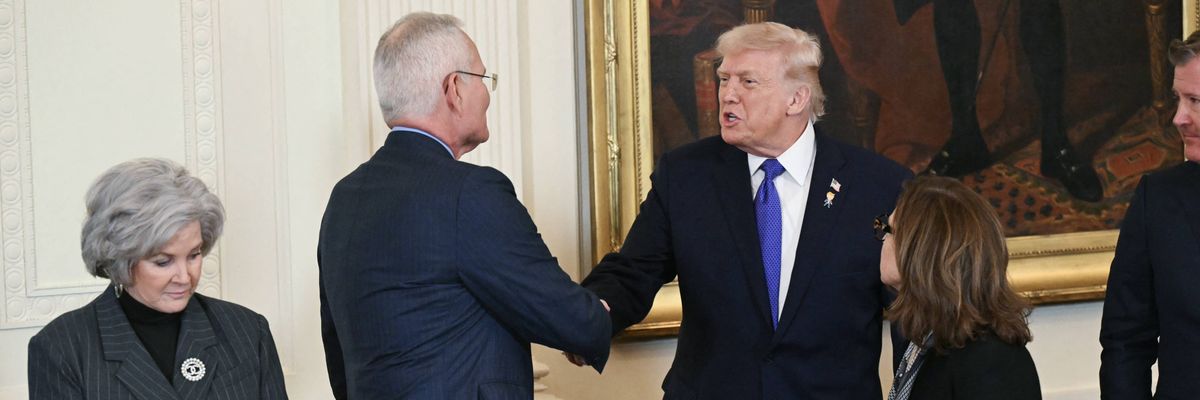
President Donald Trump shakes hands with ExxonMobil CEO Darren Woods during a meeting with US oil companies executives at the White House in Washington, DC on January 9, 2026.
(Photo by Saul Loeb/AFP via Getty Images)


Brett Wilkins
Jan 09, 2026
COMMON DREAMS

ExxonMobil’s CEO told President Donald Trump during a Friday meeting that Venezuela is currently “uninvestible” following the US invasion and kidnapping of President Nicolás Maduro, underscoring fears that American taxpayers will be left footing the bill for the administration’s goal of exploiting the South American nation’s vast petroleum resources.

Trump had hoped to convince executives from around two dozen oil companies to invest in Venezuela after the president claimed US firms pledged to spend at least $100 billion in the country. However, Trump got a reality check during Friday’s White House meeting, as at least one Big Oil CEO balked at committing financial and other resources in an uncertain political, legal, and security environment.
.


Even as Trump Suggests US Taxpayers May Foot the Bill, How Bullish Is Big Oil on Venezuela?


House Dems Unveil Bill to Prohibit Taxpayer Funding for Trump Occupation, Plunder of Venezuela

“If we look at the legal and commercial constructs and frameworks in place today in Venezuela today, it’s uninvestable,” ExxonMobil CEO Darren Woods told Trump during the meeting. “Significant changes have to be made to those commercial frameworks, the legal system. There has to be durable investment protections, and there has to be a change to the hydrocarbon laws in the country.”


There is also skepticism regarding Trump’s promise of “total safety” for investors in Venezuela amid deadly US military aggression and regime change.

However, many of the executives—who stand to make billions of dollars from the invasion—told Trump that they remain eager to eventually reap the rewards of any potential US takeover of Venezuela’s vast oil resources.

The oil executives’ apparent aversion to immediate investment in Venezuela—and Trump’s own admission that the American people might end up reimbursing Big Oil for its efforts—prompted backlash from taxpayer advocates.

“Trump must not give these companies billions in handouts and stick American taxpayers with the bill,” Sen. Elizabeth Warren (D-Mass.) said on social media Friday. “And oil execs should commit now: no taxpayer subsidies, no special favors from the White House.”

Sam Ratner, policy director at the group Win Without War, said Wednesday that “already today, Trump was saying that US taxpayers should front the money to rebuild Venezuelan oil infrastructure, all while oil companies keep the proceeds from the oil.”

“This is not just a war for oil, but a war for oil executives,” Ratner added.

Noting that “Big Oil spent nearly $100 million to get Trump elected in 2024,” former US Labor Secretary Robert Reich—who served during the Clinton administration—described Friday’s meeting as “returning the favor” and “oligarchy in action.”

According to an analysis by the advocacy group Climate Power, fossil fuel industry interests spent nearly $450 million during the 2024 election cycle in support of Trump and other Republican candidates and initiatives.


Reich and others also noted that Trump informed oil executives about the Venezuelan invasion even before he notified members of Congress.

“That tells you everything you need to know: It was never about ‘narcoterrorism’ and always about oil,” Rep. Dan Goldman (D-NY) said on Bluesky.

The legal watchdog Democracy Forward this week filed a Freedom of Information Act request demanding information about any possible Trump administration collusion with Big Oil in the lead-up to the Venezuela invasion.

Other observers shot down assertions by Trump and members of his administration that the attack on Venezuela and Maduro’s ouster are ultimately about restoring democracy.

“Want to know who’s meeting with Trump this morning about Venezuela’s future?” Rep. Adelita Grijalva (D-Ariz.) asked on X.

“Not pro-democracy leaders,” she said. “Oil and gas executives.”

Rodriguez or Trump: Who Is Really Running Venezuela?


Will Delcy Rodriguez govern the country as a compliant and coerced US puppet, or as the leader of an undefeated and independent Venezuela?


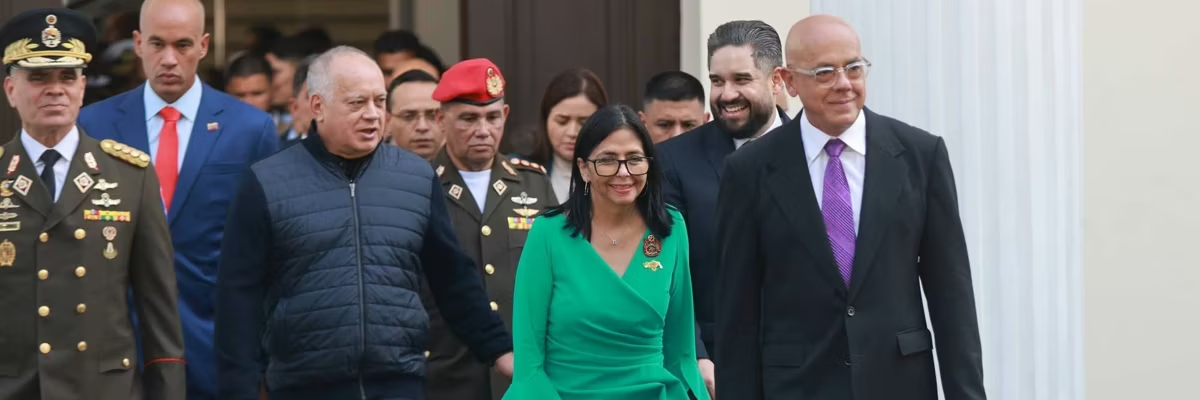
At the opening session of the National Assemblyâs new legislative term, Delcy Rodriguez (2nd R) is sworn in as acting president of Venezuela, pledging loyalty to Maduro and to Chavez in Caracas on January 5, 2026.
(Photo by Venezuelan National Assembly/Anadolu via Getty Images)
Common Dreams

As the Senate voted to advance a War Powers Resolution on Venezuela on January 8th, Republican Senator Susan Collins declared that she did not agree with “a sustained engagement ‘running’ Venezuela.”

The world was mystified when President Donald Trump first said that the United States would “run” Venezuela. He has since made it clear that he wants to control Venezuela by imposing a US monopoly on selling its oil to the rest of the world, to trap the Venezuelan government in a subservient relationship with the United States.

The US Energy Department has published a plan to sell Venezuelan oil already seized by the United States and then to use the same system for all future Venezuelan oil exports. The US would dictate how the revenues are divided between the US and Venezuela, and continue this form of control indefinitely. Trump is planning to meet with US oil company executives on Friday, January 9th, to discuss his plan.

Trump’s plan would cut off Venezuela’s trade with China, Russia, Iran and other countries, and force it to spend its oil revenues on goods and services from the United States. This new form of economic colonialism would also prevent Venezuela from continuing to spend the bulk of its oil revenues on its generous system of social spending, which has lifted millions of Venezuelans out of poverty.

However, on January 7th, the New York Times reported that Venezuela has other plans. “Venezuela’s state-run oil company, Petróleos de Venezuela, confirmed for the first time that it was negotiating the ‘sale’ of crude oil to the United States,” the Times reported. “It said in a statement on social media that it was using ‘frameworks similar to those currently in effect with international companies, such as Chevron, and is based on a strictly commercial transaction.’”

Dealing with Trump is a difficult challenge for Delcy Rodriguez and other Latin American leaders, but they should all understand by now that caving to Trump or letting him pick them off one by one is a path to ruin.

Trump has threatened further military action to remove acting president Delcy Rodriguez from office if she does not comply with US plans for Venezuela. But Trump has already bowed to reality in his decision to cooperate with Rodriguez, recognizing that Maria Corina Machado, the previous US favorite, does not have popular support in Venezuela. The very presence of Delcy Rodriguez as acting president exposes the failure of Trump’s regime change operation and his well-grounded reluctance to unleash yet another unwinnable US war.

After the US invasion and abduction of President Maduro on January 3rd, Delcy Rodriguez was sworn in as Acting President, reaffirming her loyalty to President Maduro and taking charge of running the country in his absence. But who is Delcy Rodriguez, and how is she likely to govern Venezuela? As a compliant and coerced US puppet, or as the leader of an undefeated and independent Venezuela?

Delcy Rodriguez was seven years old in 1976, when her father was tortured and beaten to death as a political prisoner in Venezuela. Jorge Antonio Rodriguez was the 34-year-old co-founder of the Socialist League, a leftist political party, whom the government accused of a leading role in the kidnapping of William Niehous, a suspected CIA officer working under cover as an Owens Corning executive.

Jorge Rodríguez was arrested and died in state custody after interrogation by Venezuelan intelligence agents. While the official cause of death was listed as a heart attack, his autopsy found that he had suffered severe injuries consistent with torture, including seven broken ribs, a collapsed chest, and a detached liver.

Delcy studied law in Caracas and Paris and became a labor lawyer, while her older brother Jorge became a psychiatrist. Delcy and her mother, Delcy Gomez, were in London during the failed US-backed coup in Venezuela in 2003, and they denounced the coup from the Venezuelan embassy in interviews with the BBC and CNN.

Delcy and her older brother Jorge soon joined Hugo Chavez’s Bolivarian government, and rose to a series of senior positions under Chavez and then Maduro: Delcy served as Foreign Minister from 2014 to 2017, and Economy and Finance Minister from 2020 to 2024, as well as Oil Minister and Vice President; Jorge was Vice President for a year under Chavez and then Mayor of Caracas for 8 years.

On January 5th 2026, it fell to Jorge, now the president of the National Assembly, to swear in his sister as acting president, after the illegal US invasion and abduction of President Maduro. Delcy Rodriguez told her people and the world,
“I come as the executive vice president of the constitutional president of the Bolivarian Republic of Venezuela, Nicolas Maduro Moros, to take the oath of office. I come with pain for the suffering that has been caused to the Venezuelan people after an illegitimate military aggression against our homeland. I come with pain for the kidnapping of two heroes who are being held hostage in the United States of America, President Nicolas Maduro and the first combatant, first lady of our country, Cilia Flores. I come with pain, but I must say that I also come with honor to swear in the name of all Venezuelans. I come to swear by our father, liberator Simon Bolivar.”

In other public statements, acting president Rodriguez has struck a fine balance between fierce assertions of Venezuela’s independence and a pragmatic readiness to cooperate peacefully with the United States.

On January 3rd, Delcy Rodriguez declared that Venezuela would “never again be anyone’s colony.” However, after chairing her first cabinet meeting the next day, she said that Venezuela was looking for a “balanced and respectful” relationship with the United States. She went on to say, “We extend an invitation to the government of the US to work jointly on an agenda of cooperation, aimed at shared development, within the framework of international law, and that strengthens lasting peaceful coexistence,”

In a direct message to Trump, Rodriguez wrote, “President Donald Trump: our peoples and our region deserve peace and dialogue, not war. That has always been President Nicolás Maduro’s conviction and it is that of all Venezuela at this moment. This is the Venezuela I believe in and to which I have dedicated my life. My dream is for Venezuela to become a great power where all decent Venezuelans can come together. Venezuela has the right to peace, development, sovereignty and a future.”

Alan McPherson, who chairs the Center for the Study of Force and Diplomacy at Temple University in the US, calls Delcy Rodriguez “a pragmatist who helped stabilize the Venezuelan economy in recent times.” However, speaking to Al Jazeera, he cautioned that any perceived humiliation by the Trump administration or demands seen as excessive could “backfire and end the cooperation,” making the relationship a “difficult balance to achieve.”

After the US invasion on January 3rd, at least a dozen oil tankers set sail from Venezuela with their location transponders turned off, carrying 12 million barrels of oil, mostly to China, effectively breaking the US blockade. But then, on January 7th, US forces boarded and seized two more oil tankers with links to Venezuela, one in the Caribbean and a Russian one in the north Atlantic that they had been tracking for some time, making it clear that Trump is still intent on selectively enforcing the US blockade.

Chevron has recalled American employees to work in Venezuela and resumed normal shipments to US refineries after a four-day pause. But other US oil companies are not eager to charge into Venezuela, where Trump’s actions have so far only increased the political risks for any new US investments, amid a global surplus of oil supplies, low prices, and a world transitioning to cleaner, renewable energy.

Meanwhile, the US Department of Justice is scrambling to make a case against President Maduro, after Trump’s lawless war plan led to Maduro’s illegal arrest as the leader of a non-existent drug cartel in a foreign country where US domestic law does not apply. In his first court appearance in New York, Maduro identified himself as the president of Venezuela and a prisoner of war.

Continuing to seize ships at sea and trying to shake down Venezuela for control of its oil revenues are not the “balanced and respectful” relationship that Delcy Rodriguez and the government of Venezuela are looking for, and the US position is not as strong as Trump and Rubio’s threats suggest. Under the influence of neocons like Marco Rubio and Lindsey Graham, Trump has marched the US to the brink of a war in Latin America that very few Americans support and that most of the world is united against.

Mutual respect and cooperation with Rodriguez and other progressive Latin American leaders, like Lula in Brazil, Gustavo Petro in Colombia, and Mexico’s Claudia Scheinbaum, offer Trump face-saving ways out of the ever-escalating crisis that he and his clueless advisers have blundered into.

Trump has an eminently viable alternative to being manipulated into war by Marco Rubio: what the Chinese like to call “win-win cooperation.” Most Americans would favor that over the zero-sum game of hegemonic imperialism into which Rubio and Trump are draining our hard-earned tax dollars.

The main obstacle to the peaceful cooperation that Trump says he wants is his own blind belief in US militarism and military supremacy. He wants to redirect US imperialism away from Europe, Asia, and Africa toward Latin America, but this is no more winnable or any more legitimate under international law, and it’s just as unpopular with the American people.

If anything, there is greater public opposition to US aggression “in our backyard” than to US wars 10,000 miles away. Cuba, Venezuela, and Colombia are our close neighbors, and the consequences of plunging them into violence and chaos are more obvious to most Americans than the equally appalling human costs of more distant US wars.

Trump understands that endless war is unpopular, but he still seems to believe that he can get away with “one and done” operations like bombing Iran and kidnapping President Maduro and his first lady. These attacks, however, have only solved imaginary problems—Iran’s non-existent nuclear weapons and Maduro’s non-existent drug cartel—while exacerbating long-standing regional crises that US policy is largely responsible for, and which have no military solutions.

Dealing with Trump is a difficult challenge for Delcy Rodriguez and other Latin American leaders, but they should all understand by now that caving to Trump or letting him pick them off one by one is a path to ruin. The world must stand together to deter aggression and defend the basic principles and rules of the UN Charter, under which all countries agree to settle disputes peacefully and not to threaten or use military force against each other. Any chance for a more peaceful world depends on finally starting to take those commitments seriously, as Trump’s predecessors also failed to do.

There is a growing movement organizing nationwide protests to tell Trump that the American people reject his wars and threats of war against our neighbors in Latin America and around the world. This is a critical moment to raise your voice and help to turn the tide against endless war.


Our work is licensed under Creative Commons (CC BY-NC-ND 3.0). Feel free to republish and share widely.


Medea Benjamin
Medea Benjamin is co-founder of Global Exchange and CODEPINK: Women for Peace. She is the co-author, with Nicolas J.S. Davies, of War in Ukraine: Making Sense of a Senseless Conflict, available from OR Books in November 2022. Other books include, "Inside Iran: The Real History and Politics of the Islamic Republic of Iran" (2018); "Kingdom of the Unjust: Behind the U.S.-Saudi Connection" (2016); "Drone Warfare: Killing by Remote Control" (2013); "Don't Be Afraid Gringo: A Honduran Woman Speaks from the Heart" (1989), and (with Jodie Evans) "Stop the Next War Now" (2005).
Full Bio >

Nicolas J.S. Davies
Nicolas J. S. Davies is an independent journalist and a researcher with CODEPINK. He is the co-author, with Medea Benjamin, of War in Ukraine: Making Sense of a Senseless Conflict, available from OR Books in November 2022, and the author of Blood On Our Hands: the American Invasion and Destruction of Iraq.
Full Bio >
Another day, another horror, another grim step in Trump's war on humanity itself

Robert Reich
January 8, 2026
RAW STORY


It seems appropriate right now to try to clarify one of the most basic questions America is (or should be) struggling with: What does it mean to be a human being?

The confusion is mounting.

Three illustrations:


1. Corporations


Corporations are not human beings. That should be self-evident.


But in 2010, the Supreme Court ruled (in its Citizens United case) that corporations are the equivalent of “people” under the First Amendment to the Constitution, with rights to free speech.

This ruling has made it nearly impossible for the government to restrict the flow of money from giant corporations into politics. As a result, the political voices — and First Amendment rights — of most real human beings in America are being effectively drowned out.

But in coming years, states will have an opportunity to circumvent Citizens United by redefining what a “corporation” is in the first place.

Absent state charters that empower them to become “corporations,” business organizations are nothing more than collections of contracts — between investors and managers, managers and employees, and consumers and sellers.

In the 1819 Supreme Court case Trustees of Dartmouth College v. Woodward, Chief Justice John Marshall established that:
“A corporation is an artificial being, invisible, intangible [that] possesses only those properties which the charter of its creation confers upon it …. The objects for which a corporation is created are universally such as the government wishes to promote.”

Montana is now readying a proposition for its 2026 ballot that would empower organizations that sought to be corporations there to do many things — except to fund elections. (I’ve written more on this, here.


2. Artificial Intelligence

AI is not human, although it’s becoming increasingly difficult for many real people to tell the difference between “artificial general intelligence” and a real person.

As a result, some real people have lost touch with reality — becoming emotionally attached to AI chat boxes, or fooled into believing that AI “deepfake” videos are real, or attributing higher credibility to AI than is justified — sometimes with tragic results.

In his typically ass-backward pro-billionaire way, Donald Trump has issued an executive order aimed at stopping states from regulating AI. But some governors — most interestingly, Florida’s Ron DeSantis — have decided to establish guardrails nonetheless.

DeSantis is calling on Florida’s lawmakers to require tech companies to notify consumers when they are interacting with AI, not to use AI for therapy or mental health counseling, and to give parents more controls over how their children use AI. DeSantis also wants to restrict the growth of AI data centers by eliminating state subsidies to tech companies for such centers and preventing such facilities from drying up local water resources.

In a recent speech, DeSantis said:
“We as individual human beings are the ones that were endowed by God with certain inalienable rights. That’s what our country was founded upon — they did not endow machines or these computers for this.”

I never thought I’d be agreeing with Ron DeSantis, but on this one he’s right.

Corporations are legal fictions. Human AI is a technological fiction. Neither has human rights. Both should be regulated for the benefit of human beings.

3. Non-Americans and suspected enemies

The third illustration of our current confusion over what is a human being is endemic in Trump’s policies toward immigrants and many inhabitants of other nations, now especially in and around Venezuela.


On Wednesday, a federal agent shot and killed a 37-year-old woman during an immigration raid in Minneapolis. Despite what Trump and Kristi Noem say, a video at the scene makes clear that the shooting was not in self-defense.

Minnesota Gov. Tim Walz said: “We have been warning for weeks that the Trump administration’s dangerous, sensationalized operations are a threat to our public safety,” adding that it cost a person her life.

ICE agents are arresting and detaining people on mere suspicion that they are not in the United States legally — sometimes deporting them to foreign nations where they’re brutalized — without any independent findings of fact (a minimum of “due process”).

Meanwhile, Trump and Stephen Miller, his assistant for bigotry and nativism, are busy dehumanizing immigrants. For example, Trump describes Somalian-Americans as “garbage.”

Last weekend, the U.S. killed an estimated 75 people in its attack on Venezuela, as it abducted President Nicolás Maduro and his wife. The U.S. has been bombing and killing sailors on small vessels in the Caribbean and off the coast of Venezuela on the suspicion they’re smuggling drugs into the United States — on the vague pretext that they’re “enemy combatants,” although Congress has not declared war.

Trump’s justification for all such killings has shifted from preventing drug smuggling to “regaining control” over oil reserves that Venezuela nationalized 50 years ago.

In all these cases, the Trump regime is violating fundamental universal human rights considered essential to human dignity.

Corporations and AI are not human beings, but people who come to the United States seeking asylum indubitably are human. So too are undocumented people who arrived in the United States when they were small children and have been here ever since. As are our neighbors and friends who, although undocumented, are valued members of our communities.

As are the Venezuelans who have been murdered by the Trump regime.

So, what does it mean to be a human being?

It means the right to be protected from the big-money depredations of giant corporations, and from the emotional lure of AI disguised as a human.

And it means to be treated respectfully — as a member of the human race possessing inherent, inalienable rights.


These are moral imperatives. But America is doing exactly the reverse.


Robert Reich is a emeritus professor of public policy at Berkeley and former secretary of labor. His writings can be found at https://robertreich.substack.com/.

Robert Reich's new memoir, Coming Up Short, can be found wherever you buy books. You can also support local bookstores nationally by ordering the book at bookshop.org
‘To Be Clear,’ Contrary to Vance’s Claims, ICE Agents Do Not Have ‘Absolute Immunity,’ Say Legal Experts

“Just so you all understand what our vice tyrant is saying here this means ICE is allowed to shoot and kill Americans with ZERO consequences,” said one advocate.
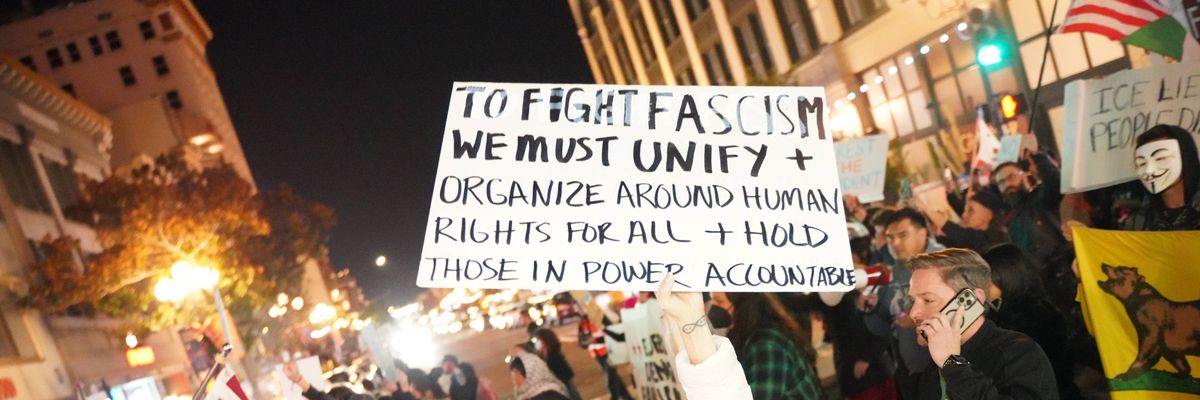


Protesters hold placards during a rally against Immigration and Customs Enforcement in downtown San Diego on January 8, 2026.
(Photo by Michael Ho Wai Lee/Anadolu via Getty Images)

Julia Conley
Jan 09, 2026
COMMON DREAMS

When Vice President JD Vance told reporters at a press briefing Thursday that Jonathan Ross, the federal immigration agent who was filmed fatally shooting Renee Good in Minneapolis, has “absolute immunity,” he was not referring to any recognized statute in United States law, according to legal experts.

Instead, said Human Rights Campaign press secretary Brandon Wolf, “masked federal agents who can gun people down with ‘absolute immunity’ is called fascism.”
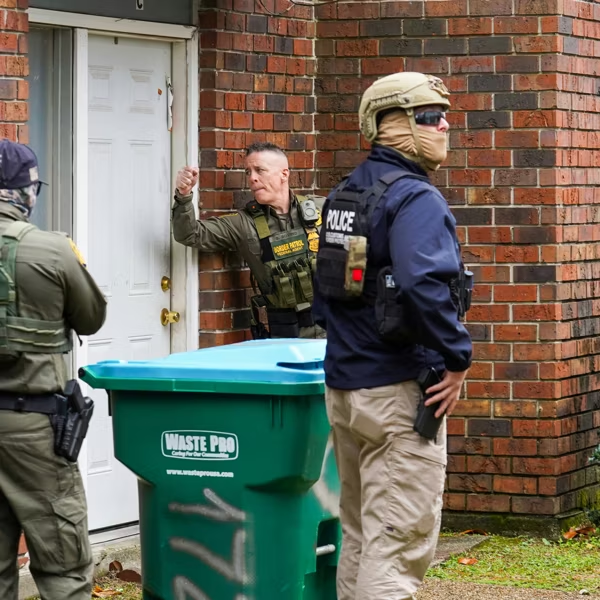


Hours After US Citizen Shot Dead by ICE, JD Vance Says ‘Door-to-Door’ Operations Are Coming
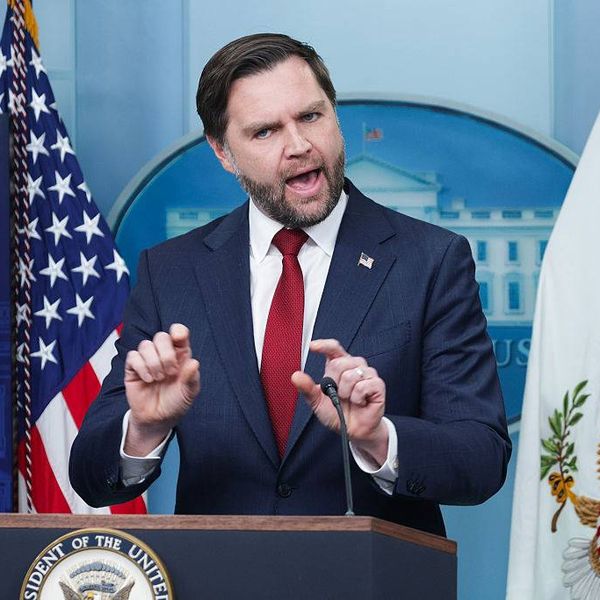


Threatening Prosecutions, JD Vance Blames ‘Left-Wing’ Network—Including Media—for ICE Killing

Vance addressed reporters at the White House the day after Good was fatally shot at close range while serving as a legal observer of US Immigration and Customs Enforcement’s (ICE) surge of federal agents in Minneapolis, where the Trump administration is targeting members of the Somali community in particular.

Widely available footage taken by onlookers shows ICE agents including Ross approaching the car and, according to at least one witness, giving her conflicting instructions, with one ordering her to leave the area and another telling her to get out of the car. The wheel of Good’s car was seen turning as she began to drive away, just before Ross fired his weapon at least three times.

President Donald Trump, Homeland Security Secretary Kristi Noem, and Vance immediately blamed Good for her death, saying she had committed an act of domestic terrorism and had tried to run Ross over with her car.

Vance doubled down on Thursday when a reporter asked him why state officials in Minnesota were being cut off from investigating Good’s death—a fact that has left the Minnesota Bureau of Criminal Apprehension, which had been planning to launch a probe, with few tools to bring a case to prosecutors.

The vice president said Minnesota prosecutors should instead investigate people who “are using their vehicles and other means” to interfere with ICE’s operations before claiming that Ross is protected from being held accountable for his actions.

“That guy’s protected by absolute immunity,” said Vance. “He was doing his job. The idea that [Minnesota Gov.] Tim Walz and a bunch of radicals in Minneapolis are going to go after him and make this guy’s life miserable because he was doing the job that he was asked to do is preposterous.”


Robert Bennett, a veteran lawyer in Minneapolis, told Mother Jones that he has worked on hundreds of cases regarding federal law enforcement misconduct.

“I’ve deposed thousands of police officers,” he said. “ICE agents do not have absolute immunity.”

He continued:
There’s plenty of case law that allows for the prosecution of federal law enforcement agencies, including ICE. And it’s clear under the law that a federal officer who shoots somebody in Minnesota and kills them is subject to a Minnesota investigation and Minnesota law.

Mary Moriarty, the Hennepin County attorney, whose jurisdiction includes Minneapolis, appeared incredulous Friday when asked about Vance’s claim.

“I can’t speak to why the Trump administration is doing what it’s doing or says what it says,” she told a reporter before adding unequivocally, “the ICE officer does not have complete immunity here.”


Constitutional law expert Michael J.Z. Mannheimer of Northern Kentucky University told CNN that more than a century of legal precedent has shown that state prosecutors can file charges against federal officials for actions they take while completing their official duties.

“The idea that a federal agent has absolute immunity for crimes they commit on the job is absolutely ridiculous,” Mannheimer said.

Should the state take up the case, Ross could attempt to raise an immunity argument if he were able to move the case to a federal court, where a judge would then conduct a two-part analysis—determining whether Ross was acting in his official capacity and whether his action was “reasonable” considering all the facts on the ground, gathered from video evidence and eyewitness testimony.

While holding Ross accountable may be an uphill battle, former federal prosecutor Timothy Sini told CNN, “officers are not entitled to absolute immunity as a matter of law,” contrary to Vance’s claim.


Gun control advocate David Hogg called the vice president’s comments “insanely dangerous.”

“Just so you all understand what our vice tyrant is saying here this means ICE is allowed to shoot and kill Americans with ZERO consequences,” said Hogg. “It’s important to note that absolute immunity is something that basically no cop gets. It goes even beyond qualified immunity.”


Police officers are typically shielded from liability for civil damages by qualified immunity, provided they can prove their actions did not violate “clearly established” constitutional rights. “Absolute immunity” is typically applied to judges, prosecutors, and legislators who are acting within their official duties.

On Friday, US Reps. Dan Goldman (D-NY) and Eric Swalwell (D-Calif.) announced they would introduce a bill aimed at stripping ICE officers of qualified immunity.

Goldman noted that under current law, it would be difficult to prosecute an ICE agent because the legal standard “allows for the officer’s own view to carry a lot of weight.”

“So what this bill does is only for civil enforcement officers—not criminal enforcement officers who are dealing with real bad guys, not moms driving cars—it would say that it’s an objective test,” he said on a podcast by the New Republic. “And if you are acting completely outside of your duties and responsibilities, you don’t have immunity from a civil lawsuit, and you don’t have a defense from a criminal charge.”

Goldman added that the bill would make clear that ICE agents’ “only authority is to investigate and civilly arrest immigrants for immigration violations.”

“And so they should have never been in the situation they were in, where they were trying to take a woman out of a car,” he said. “That was not part of what they should be doing. They could ask her to move if they needed to. It doesn’t look like from the video that she was doing anything that was obstructing them.”

Minneapolis Mayor Jacob Frey, who has expressed outrage over Good’s killing and demanded that ICE leave the city immediately, called Vance’s claims about absolute immunity “pretty bizarre” and “extremely concerning” in comments to reporters on Friday, and called on the press to “get to a point where we’re not trusting everything that [administration officials] are saying.”

“That’s not true in any law school in America, whether it’s Yale or Villanova or anywhere else,” said Frey. “That’s not true. If you break the law, if you do things that are outside the outside the area of what your job responsibilities require, and this clearly seems to be at the very least, at the very least, this is gray... This is a problem and it should be investigated.”


Vance’s comments, said political scientist Norman Ornstein, made clear that “we are in a police state.”

“The notion expressed by Trump, Vance and Noem that there is absolute immunity for a cold blooded murder if it’s carried out by one of their agents is the final straw,” he said. “If we do not turn this around, we are done for as a free society and a decent country.”
AMERIKAN GESTAPO

‘Reign of Terror’: ICE Builds Appalling Record of Killings, Beatings, Kidnappings, and More

“We just saw them murder an American citizen in cold blood, in the street,” said US Rep. Alexandria Ocasio-Cortez. “This is an agency that must be reined in.”


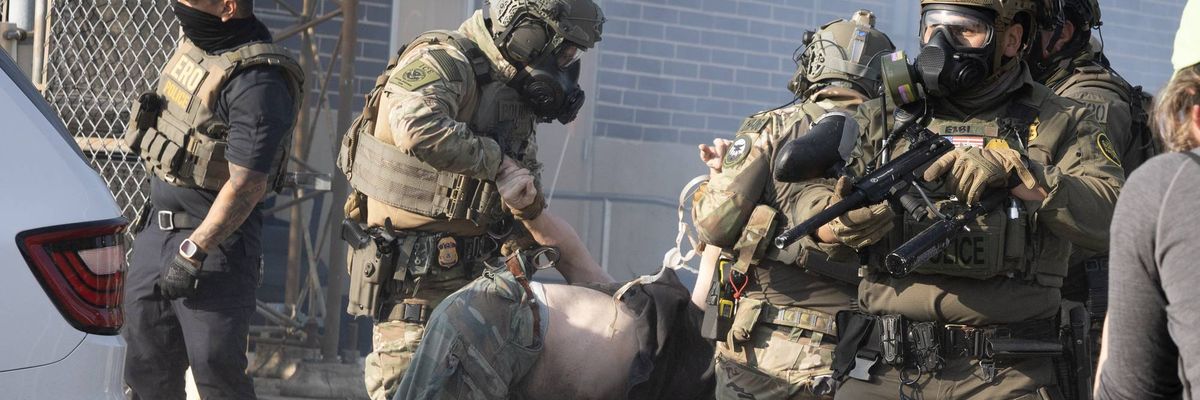
A demonstrator is taken into custody by federal agents aduring a protest on September 19, 2025 in Broadview, Illinois.
(Photo by Scott Olson/Getty Images)

Jake Johnson
Jan 09, 2026
COMMON DREAMS


Federal immigration enforcement agents, unleashed and emboldened by President Donald Trump, have been rampaging through the streets of cities across the United States for months, racking up an appalling record of abuses and alleged crimes, including kidnapping, beatings, and murder.

Such abuses have targeted, but haven’t been limited to, undocumented immigrants. An Immigration and Customs Enforcement (ICE) agent’s killing of Renee Good, a 37-year-old American citizen and mother of three, earlier this week called greater attention to the agency’s lawless behavior, enabled by an administration whose number-two official—Vice President JD Vance—falsely insists that federal immigration officers have “absolute immunity” from prosecution.


“Out of control” were the words lawmakers, advocacy groups, experts, and community members used to describe ICE’s conduct in the wake of Good’s killing.

Just 24 hours later, Border Patrol agents shot and wounded two people in Portland, Oregon, heightening nationwide outrage over the Trump administration’s onslaught against undocumented immigrants, US citizens, and those protesting the presence of ICE agents, who are often masked and dressed in military fatigues.

Seemingly, nowhere is safe; ICE has raided houses of worship, schools, hotels, restaurants, farms, and retail stores.

“Communities across the state have been terrorized by masked, armed agents who are indiscriminately and aggressively harassing and kidnapping individuals at school, at work, on the streets, and in their homes,” the Immigrant Law Center of Minnesota said Thursday.


US Sen. Jeff Merkley (D-Ore.) wrote on social media following the shootings in Portland on Thursday that “ICE has done nothing to keep our communities safer.”

“ICE agents are terrorizing folks in Oregon and across the country,” he added. “I’m demanding full accountability—an investigation that involves Oregon officials—and ICE to immediately end these dangerous operations in Oregon.”

Others have echoed Merkley’s demand that ICE immediately exit cities across the US amid mounting abuses, documented by local and national media outlets, watchdog organizations, and eyewitnesses in the months since Trump launched his mass deportation push.

“Get the fuck out,” was Minneapolis Mayor Jacob Frey’s message to ICE following the killing of Good on Wednesday.

The Marshall Project, a nonprofit news organization, stressed that Good’s killing at the hands of Jonathan Ross—a federal agent with more than a decade of experience at ICE—was not the first time that federal officers have killed civilians since the Trump administration launched its aggressive immigration enforcement campaign.

“Federal officers have fatally shot at least three other people in the last five months,” The Marshall Project noted. “In September, Silverio Villegas González, a father originally from Mexico who worked as a cook, was killed while reportedly trying to flee from officers in a Chicago suburb, WBEZ reported. In December, a border patrol agent killed a 31-year-old Mexican citizen while trying to detain him in Rio Grande City, Texas.”

The organization went on to observe that “federal officers have fired on at least nine people while they were in their vehicles” and repeatedly threatened others with deadly force.

“A pregnant Illinois woman told Newsweek she thought her life was about to end when a federal agent pointed his gun through her car window, after she honked her horn to alert people ICE was nearby,” The Marshall Project reported. “In another incident in Chicago, a combat veteran alleged in a court filing that a federal officer said ‘bang, bang’ and ‘you’re dead, liberal’ while pointing a handgun at him.”

The list of abuses, both alleged and captured in real time, is seemingly endless. As the investigative outlet ProPublica reported late last year:
Americans have been dragged, tackled, beaten, tased, and shot by immigration agents. They’ve had their necks kneeled on. They’ve been held outside in the rain while in their underwear. At least three citizens were pregnant when agents detained them. One of those women had already had the door of her home blown off while Department of Homeland Security Secretary Kristi Noem watched.

Immigrants detained by ICE have accused agents of horrific abuse, including sexual assault. One teenager held at Fort Bliss, the largest immigration detention center in the US, alleged that an officer broke his tooth and “crushed” his testicles while another “forced his fingers deep into my ears,” causing lasting damage.

Those who have turned out in the streets to protest ICE’s activities in their neighborhoods—and those who have tried to stop agent abuses—have also been subject to attacks, including tear gas to the face.


On the same day as Good’s killing, ICE conducted a raid at a nearby Minneapolis high school. One local resident who witnessed the raid said she saw “one teacher get tackled” as educators and other school employees tried to keep the agents away from students.

The Minneapolis Federation of Teachers accused federal agents of using tear gas—which ICE has deployed frequently in recent months.

The Washington Post reported in November that federal immigration officers “have thrown chemical agents out of vehicles on city streets, creating a hazard for motorists.”

“They have thrown tear-gas canisters near stores and schools, exposing children, pregnant women, and older people to the noxious gas,” the newspaper added. “And on numerous occasions federal officers have fired pepper balls directly at protesters—in one case, striking a pastor in the head.”

In response to ICE’s horrific behavior, lawmakers at the federal level have taken steps aimed at constraining an agency whose budget is now larger than that of a dozen nations’ militaries.

US Rep. Robin Kelly (D-Ill.) is introducing articles of impeachment against Noem, accusing her of setting loose ICE’s “reign of terror.”

Axios reported Thursday that US Sen. Chris Murphy (D-Conn.) “will propose sweeping reforms” to the Department of Homeland Security (DHS), “including requiring a warrant for arrests, banning masks during enforcement operations, and requiring Border Patrol to remain at the border.”

Murphy is “also trying to build a coalition of Democrats to insist on some restraints on DHS’ authority as a condition of their support for a spending bill for the department—with funding set to lapse January 30,” the outlet reported.

US Rep. Alexandria Ocasio-Cortez (D-NY), who has previously called for the abolition of ICE, warned that the agency is currently “accountable to no one.”

“It’s a nightmare,” Ocasio-Cortez told reporters on the steps of the US Capitol on Wednesday. “They are operating with impunity. We just saw them murder an American citizen in cold blood, in the street.”

“This is an agency that must be reined in,” she added.