Gangster Capitalism and Corruption in Trump’s America
Photograph by Nathaniel St. Clair
Tradition is not the worship of ashes. It is the preservation of fire.
–Gustav Mahler
Corruption as Authoritarian Spectacle
Corruption has never been far from the center of American politics. Some of the most notorious scandals stretch from the cronyism of Warren G. Harding to the abuses of power exposed during the Watergate scandal under Richard Nixon. Yet many historians argue that what distinguishes What distinguishes Donald Trump from earlier corrupt presidencies is that corruption no longer operates behind closed doors, shielded by the liberal rituals of institutional legitimacy and the euphemisms of political decorum. Under Trump, corruption is performed openly as spectacle, celebrated as a sign of strength, wealth, vengeance, and personal loyalty.
Trump’s ever-expanding regime of corruption is no longer simply hidden financial misconduct but a public display of sociopathic avarice designed to normalize greed, lawlessness, unconstrained power, and the collapse of civic accountability. It reflects a politics of moral nihilism in which fascism no longer appears as a distant threat, but as the future already taking shape.
As a badge of honor, Trump embraces corruption not simply as a mode of governance, but as a spectacle designed to legitimate greed, cruelty, and unchecked power. It functions as what Dominic Wetzel has called the “pornification of the American dream,” a culture in which excess, lawlessness, and predation are celebrated as signs of success and strength. In Trump’s America, corruption metastasizes into a theater of cruelty and violence, saturating political life with the values of fear, spectacle, and disposability. It feeds a broader architecture of domination rooted in toxic hierarchies of race, class, misogyny, and white Christian nationalism, while turning lawlessness and untethered aggression into forms of political entertainment.
Corruption, in this sense, is more than a symptom of institutional decay, moral depravity, or political vulgarity. It becomes one of the central pedagogical and political mechanisms through which fascist politics takes hold, eroding democratic values while legitimating a culture organized around brutality, humiliation, and civic abandonment. In this formulation, corruption functions as a kind of fascist staging ground, creating the conditions that nourish what Jonathan Crary calls in Scorched Earth an “implacable engine of addiction, loneliness, false hopes, cruelty, psychosis, indebtedness, squandered life, the corrosion of memory, and social disintegration.”
The Criminalization of Governance
What defines the Trump regime, then, is not merely corruption in the conventional sense of bribery or financial misconduct. Rather, it is the systemic fusion of authoritarian power, organized greed, spectacle, state-sponsored cruelty, and impunity, a fusion that transforms corruption into a governing principle and a cultural ideal. The display of greed and the ensuing scandals are staggering in scope: the use of Trump hotels and resorts as political cash machines for lobbyists, foreign governments, and Republican operatives seeking influence; the funneling of taxpayer money into Trump-owned properties through Secret Service and government expenditures; the diversion of inauguration funds into private enrichment schemes; the use of cryptocurrency ventures and opaque political action committees as modern slush funds; the acceptance of lavish gifts, luxury travel, and aircraft linked to billionaire benefactors and foreign interests; and the open monetization of political access itself.
Added to this are Jared Kushner’s multibillion-dollar Saudi investment connections following his White House role, Ivanka Trump’s trademark deals and business expansions during the administration, and the nepotistic appointment of family members to positions of immense political influence. What emerges is a scale of self-dealing and lawlessness unprecedented in modern American politics. But these scandals are not isolated abuses of office. They point to a deeper transformation in which corruption becomes institutionalized as a governing logic, a mode of public pedagogy, and a defining feature of authoritarian power.
Trump’s corruption reaches beyond the traditional language of political scandal and increasingly resembles the operational logic of a criminal enterprise. The proposed $1.786 billion slush fund, tied to settlements for insurrectionists, corrupt opportunists, and other Trump allies, signals more than financial gangsterism; it reveals a governing structure in which enormous pools of money function as instruments of loyalty, reward, intimidation, and political protection. Walter Olson quoting Nick Catoggio is right in stating that “It’s simple theft packaged in the argle-bargle of “weaponization” and “compensation.” … The president behaves with impunity because he believes most of his party will unthinkingly defend anything he does, and he’s correct.”
Taken together, these actions reveal a regime that increasingly resembles a criminal enterprise. Such practices build upon Trump’s decision to pardon more than 1,600 individuals convicted in connection with the January 6 attack on the Capitol, including participants involved in violent assaults on police officers defending the democratic process. The pardons transformed political violence into a badge of allegiance, signaling that acts committed in defense of the leader would not only be excused but sanctified as patriotic service.
At the same time, Trump has repeatedly used the pardon power to shield political allies, wealthy donors, and figures associated with spectacular forms of criminality. Among the most notorious was the pardon of Ross Ulbricht, associated with one of the largest online drug trafficking operations in American history. Added to this were pardons and commutations granted to numerous allies and supporters convicted of fraud, corruption, and financial crimes. For example the pardon of Philip Esformes, who was convicted in one of the largest Medicare fraud schemes in U.S. history involving roughly $1.3 billion in fraudulent claims. Esformes became emblematic of a politics in which white-collar criminality is treated not as a threat to the public good but as negotiable currency within a system of transactional loyalty.
As journalist David D. Kirkpatrick reported in The New Yorker the Trump family has pocketed roughly $4 billion through a vast network of business dealings, political branding operations, cryptocurrency ventures, and influence-based transactions linked directly or indirectly to Trump’s political power. What emerges from these revelations is not merely a pattern of isolated ethical violations but the consolidation of a political culture in which corruption becomes normalized as both spectacle and governance. Wealth extraction, patronage, legal immunity, and political violence converge into a single authoritarian machinery fueled by fear, manufactured grievance, and ritualized loyalty to the leader.
Corruption, Fascist Culture, and the Death of Civic Conscience
If one face of fascist politics appears in the transformation of the state into an instrument of domestic terrorism, the other emerges in the fusion of political power and systemic corruption. Here, gangster capitalism reveals itself in its most predatory form as public institutions are hollowed out to enrich ruling elites, reward loyalists, punish dissenters, and normalize lawlessness as a mode of governance. Yet corruption under fascist politics does not operate only through institutions and economic arrangements; it also works through culture, emotion, spectacle, and the shaping of everyday consciousness.
In this sense, corruption cannot be reduced to isolated scandals or individual acts of criminality. It becomes a cultural force and pedagogical weapon that assaults civic consciousness, erodes the social bonds essential to democratic life, and legitimates the mobilizing passions of fascism through spectacles of degradation, disposability, cruelty, and manufactured hatred. It functions as part of a broader neoliberal pedagogy in which civic life is reorganized around the values of self-interest, commodification, hyper-individualism, and ruthless competition. Decades of market-driven propaganda, celebrity culture, anti-intellectualism, and disimagination machines have normalized a moral language in which greed becomes aspiration, cruelty becomes entertainment, and public goods become objects of contempt. Under such conditions, corruption becomes woven into everyday consciousness as common sense rather than recognized as an assault on the ideal and promise of a strong democracy.
Under fascist politics, corruption performs an even deeper and more insidious function. It not only rots institutions but destroys the ethical and civic sensibilities necessary for democratic life itself. By collapsing the distinction between public service and private plunder, between social responsibility and criminality, it deadens conscience, normalizes dishonesty and cruelty, and strips politics of any moral obligation to the common good.
What emerges is a culture in which greed becomes a civic virtue, lawlessness a measure of power, and the suffering of others merely collateral damage in the pursuit of domination. It is precisely this collapse of conscience into moral numbness and thoughtlessness that, as Hannah Arendt argued in Eichmann in Jerusalem and later in Responsibility and Judgment, creates the conditions in which authoritarianism flourishes.
In Trump’s political universe, corruption becomes an authoritarian performance of raw domination, flaunted openly because the point is not to hide criminality but to normalize it. The endless grifts, payoffs, family profiteering, intimidation campaigns, pardons, and transactional loyalties send a clear message to the public: democracy is no longer a shared ethical project but a marketplace of cruelty, patronage, and gangster capitalism.
As historian Ruth Ben-Ghiat has argued, these payoffs and pardons should not be viewed merely as rewards for past loyalty. They function as retainers for future acts of political violence and authoritarian allegiance. Like organized crime syndicates and autocratic regimes across the globe (particularly Hungary before recent Orban’s defeat in recent elections), such systems bind followers to the leader by making their legal troubles disappear while preparing them for future service to the movement. Pardons, financial settlements, political favors, and selective protections become mechanisms for constructing what amounts to a state-funded loyalty network, one designed to secure obedience not through democratic consent but through fear, dependency, corruption, and shared complicity.
Corruption as Public Pedagogy
Under such conditions, corruption takes on a pedagogical force. It teaches that democracy is for sale, that injustice is more important than justice, and that power belongs to those wealthy and ruthless enough to place themselves above accountability. The danger lies not only in the criminal practices involved, but in the broader cultural lessons they impart: that gangsterism can function as statecraft, that loyalty to the leader overrides loyalty to the law, and that democracy can be hollowed out through a fusion of choreographed outrage, corruption, and organized forgetting—fostered by an endless array of disimagination machines. To understand how such corruption secures mass consent, it is necessary to examine the cultural and media apparatuses that circulate its values and transform authoritarianism into a form of everyday pedagogy and language that colonizes consciousness.
Digital Authoritarianism and the Culture of Spectacle
Corruption in the Trump regime does not operate in isolation from culture, media, and everyday life. It is enabled and amplified through a vast network of cultural apparatuses, digital platforms, and billionaire-owned media systems that normalize greed, celebrate ruthless self-interest, and elevate the values of neoliberal capitalism into a governing common sense. The tech oligarchs who dominate social media and digital communications do more than control information; they shape the emotional and pedagogical landscapes through which people learn how to see themselves, others, and the very meaning of politics. In this environment, corruption is no longer viewed primarily as a violation of public trust. In this environment, algorithmic domination and digital feudalism are presented as entrepreneurial cunning, personal branding, and competitive success, and the unapologetic pursuit of power in a winner-take-all culture. In reality, it represents a hyper charged form of instrumentalized evil.
The contemporary pedagogical terrain of gangster capitalism overwhelmingly favors the rich, the reactionary, and the politically powerful. Increasingly, large segments of the public, especially swing voters and younger audiences, no longer receive political information through traditional journalism or democratic public spheres, but through social media platforms, YouTube channels, influencer networks, and podcasts dominated by right-wing personalities such as Tucker Carlson, while algorithm-driven systems controlled by tech oligarchs such as Elon Musk and Mark Zuckerberg amplify outrage, misinformation, and authoritarian resentment. Some of the most listened-to political podcasts are hosted by reactionary figures who traffic in conspiracy theories, manufactured grievance, white nationalism, misogyny, and anti-democratic rhetoric.
At the same time, conservative political forces exercise enormous influence across YouTube, Facebook, TikTok, and X, where outrage, fear, resentment, and spectacle circulate with extraordinary speed and emotional intensity. These platforms reward sensationalism, aggression, and emotional manipulation because outrage generates clicks, attention, and profit. They foster social fragmentation, alienation, atomization and, as Jonathan Crary notes, increasingly represent a “comprehensive global apparatus for the dissolution of society.”
In doing so, they create a cultural and pedagogical environment in which authoritarian values acquire enormous legitimating force while critical thought, historical memory, and civic literacy are increasingly erased, punished, or rendered suspect. At the same time, they reproduce and normalize the poisonous grammar of fascist politics: lawlessness elevated to a governing principle, racial hatred and fantasies of racial cleansing shamelessly defined as matters of security and national purity, critical ideas banned or criminalized, genocidal violence in Gaza rationalized as policy, and the killing of journalists in war zones normalized as collateral damage in an age of organized barbarism. Under these conditions, digital culture no longer merely communicates politics; it becomes one of the primary pedagogical forces through which authoritarian identities, desires, and emotional investments are produced.
MAGA Aesthetics and the Pedagogy of Cruelty
What emerges under Trumpism is not simply a politics of corruption but a broader pedagogical cultural regime of criminality and state terrorism. Unlike older forms of authoritarian propaganda that demanded ideological belief and disciplined obedience, contemporary authoritarian culture demands shallow participation, emotional surrender, anti-intellectual performance, and compulsive circulation through the endless flows of digital media and the dangerous use of AI. Politics is transformed into political theater, meme warfare, and performative outrage. Participation no longer requires informed judgment or critical literacy; it requires emotional investment in spectacles of humiliation, cruelty, resentment, and tribal loyalty. Corruption becomes part of the ritualized displays of domination, flaunted openly as a sign of power, unchecked control, and immunity from accountability.
The endless circulation of memes, AI-generated fantasies, conspiracy theories, staged outrage, and celebrity-driven political performances creates a culture in which authoritarian values are absorbed affectively before they are ever examined critically. In this mediated universe, the language of democracy dissolves into branding exercises and algorithmically engineered emotional reactions. Here Guy Debord’s notion of the spectacle becomes indispensable because politics no longer functions primarily through reasoned argument but through a theater of commodified images, manufactured emotions, and endless distraction. Equally important, Jean Baudrillard’s work helps explain how AI-generated fantasies and hyperreal political imagery circulate not because they are believable in any conventional sense, but because they produce emotional gratification untethered from truth, evidence, or historical memory. At the same time, Neil Postman foresaw a culture in which public life would dissolve into amusement and spectacle, eroding the very capacities necessary for democratic judgment and critical thought.
Increasingly, the corruption of politics is mirrored in the corruption of civic culture, public conscience, and moral judgment. The grotesque AI-generated videos and staged spectacles circulated endlessly by Trump and amplified through right-wing media ecosystems do more than entertain. They function as forms of authoritarian public pedagogy that normalize humiliation, cruelty, racism, hypermasculinity, and civic illiteracy as public virtues. In these digitally manufactured fantasies, Trump appears as a divinely ordained savior embraced by Jesus, critics are reduced to targets of ridicule and fantasies of degradation, and aggression against dissenters is staged as a source of popular amusement and emotional gratification. In one egregious AI-generated racist video, Trump portrays former President Barack Obama and Michelle Obama as apes. Such spectacles matter because they erode the ethical foundations of democratic life, replacing civic responsibility, compassion, historical memory, and critical judgment with a politics of mockery, resentment, manufactured rage, and authoritarian pleasure. Politics no longer appeals to informed consent, ethical responsibility, or reasoned debate. Instead, it trains audiences to take pleasure in humiliation, celebrate unchecked power, and embrace cruelty as entertainment.
Disimagination Machines and Neo-Fascist Culture
Under this pedagogical regime, neoliberal values of toxic competition, unchecked self-interest, disposability, a commodified culture of immediacy, and market-driven survival merge seamlessly with authoritarian politics. Celebrity culture, algorithmic media systems, Christian nationalism, anti-intellectualism, and fascist theatricality fuse into what I have elsewhere called a disimagination machine, a powerful apparatus of public pedagogy that educates people emotionally before it persuades them intellectually. Its deepest power lies not merely in disseminating lies, but in shaping desires, identities, and emotional dispositions that render corruption, cruelty, and gangster capitalism commonplace features of everyday life. Authoritarianism becomes pleasurable, white nationalist movements and cult-like loyalties replace democratic solidarity, and public life is reduced to a brutal game organized around humiliation, extraction, and the thrill of domination.
What emerges from this machinery is a form of neo-fascist politics in which corruption is no longer a deviation from governance but one of its central organizing principles. Yet mainstream media often treats corruption as little more than scandal and spectacle, obscuring its role within a broader politics of disposability, extraction, and authoritarian control. What is at stake is a predatory system that hollows out democratic institutions while concentrating wealth and power in the hands of a financial and political oligarchy bound together by fear, loyalty, and organized greed. But corruption alone is not the deepest threat. The greater danger lies in the cultural and pedagogical conditions that normalize it. In an age dominated by neoliberal disimagination machines, spectacle-driven politics, and manufactured ignorance, gangsterism is recast as strength, cruelty as authenticity, and lawlessness as freedom.
In an age dominated by neoliberal disimagination machines, media-driven politics, and manufactured ignorance, fascist values and passions are no longer hidden; they are marketed, performed, and celebrated. In this scenario, corruption functions as political theater, a site where politics dissolves into the visual grammar of fascism.
Militarism, Hypermasculinity, and White Christian Nationalism
At its extreme, this culture of corruption and authoritarian spectacle converges with a politics that glorifies militarism, violence, and hypermasculine domination. One of the driving forces behind the systemic corruption that defines the Trump regime is the fusion of toxic militarism, white Christian nationalism, and a hypermasculine politics that glorifies violence, domination, and war. This deadly convergence is visible in Trump’s appeals to divine authority, biblical rhetoric, and crusader imagery used to justify military aggression and war-crime-level violence in Iran. It also appears in the militarized language of Pete Hegseth, Trump’s self-styled “Secretary of War,” for whom war becomes a theater of masculine redemption in which cruelty is defined as a badge of strength. Hegseth’s swaggering militarism might appear absurd were it not tied to the power of the state and its capacity to unleash violence at home and abroad. As Jasper Craven observes, his rhetoric is steeped in “Islamophobia, misogyny, and a distinctly toxic version of masculinity,” a poisonous language that turns militarism into a spectacle of aggression while elevating authoritarian brutality into a model of national identity and civic virtue.
Toward a Politics of Resistance and Struggle for Democratic Socialism
It is worth repeating that the crisis we face is not simply one of corruption, but of the accelerating destruction of democracy, as justice, historical memory, civic agency, and public conscience are hollowed out by the forces of predatory neoliberalism and authoritarian rule. Trumpism reveals how gangster capitalism, fused with authoritarian politics, transforms the state into an instrument of domestic terrorism, economic predation, and moral nihilism. It colonizes consciousness, erases historical memory, and rewrites history. Under such conditions, resistance cannot be reduced to legal reforms, ethics commissions, or appeals to civic decorum. History has shown where such forces culminate: in torture chambers, mass incarceration, concentration camps, and the institutionalization of cruelty as a governing principle.
What is needed is a fundamental rupture with a political and economic order that concentrates wealth and power in the hands of financial oligarchs while dismantling public goods, social protections, and democratic institutions in the service of organized greed. This is a struggle that must make education central to politics in order to change public consciousness as part of a wider struggle to dismantle the economic and political institutions of gangster capitalism.
In the end, the corruption at the heart of the Trump regime cannot be separated from the broader authoritarian and neo-fascist culture that both nourishes and legitimates it, a culture in which militarism, apocalyptic nationalism, toxic masculinity, gangster capitalism, and a politics of disposability fuse into a machinery of domination. This is a politics that wages war not only on democratic institutions, critical ideas, and public values, but also on the very conditions that make justice, solidarity, compassion, and collective freedom possible.
The struggle against authoritarian corruption must therefore become part of a broader struggle to reclaim politics as a moral, social, and collective project rooted in historical memory, economic justice, shared responsibility, and the radical promise of democracy life. Yet, this struggle must heed Frederick Douglass’s admonition that “power concedes nothing without a demand.” For Douglass, oppressive power never retreats on its own. It yields only when confronted by a collective force capable of disrupting its authority, exposing its injustices, and making domination increasingly difficult to sustain. In this instance, resistance becomes dangerous to authoritarian power not simply because it opposes domination, but because it embodies a collective moral and political energy capable of unsettling the very foundations upon which that power rests.
What is at stake is not merely the defense of liberal democratic norms, but the creation of a fundamentally different future. The challenges before us are to dismantle gangster capitalism and the fascist politics it breeds. In its place, there is the task of building a democratic socialist vision rooted in human dignity, solidarity, compassion, justice, equality, and the common good. As Douglass famously noted, “if there is no struggle, there is no progress.” This is the power of critical thought, mass resistance, and militant hope.
Trump’s Corruption is Unprecedented
Photograph by Nathaniel St. Clair
Even President Trump’s own Justice Department is having a hard time grappling with Trump’s brazen money grab from the IRS — and, by extension, American taxpayers.
First, Trump attempted to enrich himself and his family by suing the federal government for $10 billion — almost the entire annual budget of the IRS — for releasing Trump’s tax returns.
This is a first on so many levels.
Trump is the first nominated presidential candidate since the 1980s not to release his tax returns. Every other presidential candidate has voluntarily disclosed their tax returns as a gesture of openness.
Trump is the first president in history to sue the federal government for personal damages, and to the whopping tune of $10 billion. But legal experts, including many at the Justice Department, doubted the case would go very far.
U.S. District Judge Kathleen Williams noted that Trump issued an order binding government lawyers to represent his own viewpoint and questioned whether Trump could sue an agency that he controls. Who would defend the government against Trump? The Justice Department never issued any legal statement nor sent lawyers to any of the proceedings.
Second, just as it appeared Judge Williams would dismiss the case, Trump negotiated a settlement with his own Justice Department’s lawyers establishing a $1.776 billion fund to pay off January 6 rioters and others who were prosecuted for their efforts to prevent the transition of power following the 2020 election.
While Trump and the Justice Department lawyers asserted the spending decisions will be made by a five-member commission, the five members are all appointed by the attorney general, four directly and the fifth selected by the attorney general in consultation with congressional leaders.
Since Attorney General Todd Blanche is a Trump loyalist, the commission is not likely to be independent. What is clear is that this is nothing more than a slush fund to reward Trump’s friends and those who stormed the U.S. Capitol on January 6 — yet another self-interested act no president in history has ever done.
Two Jan. 6 police officers who defended the Capitol filed a lawsuit to prevent any payouts from Trump’s slush fund. Filed in U.S. District Court in D.C., Harry Dunn and Daniel Hodges argue that the fund violates the 14th Amendment’s prohibition on using federal money to “pay any debt or obligation incurred in aid of insurrection or rebellion against the United States.” More than 150 officers were injured in the violent attack.
And some members of Congress, both Democrats and Republicans, are pressing congressional action to nullify the fund, asserting that the administration has no authority to establish such a fund without congressional oversight or approval.
If you think Trump’s lawsuit and negotiated settlement are egregious violations of the public trust, Trump took another even more galling and unprecedented action. Attorney General Blanche announced an amendment to the negotiated settlement the very next day that would protect Trump and his family from any lawsuits and investigations by governmental entities, including tax audits.
The one-page amendment reads that the government would be FOREVER BARRED and PRECLUDED (emphasis original) from pursuing current tax claims against Trump and his businesses. This is not only immoral, it’s also likely illegal.
Trump stands to personally gain $100 million or more from such an agreement. Furthermore, 26 U.S.C. 7217 prohibits the president from “directly or indirectly” interfering in tax audits. Though the law does not seem to apply to the attorney general, it could be argued that Blanche is acting at the behest of Trump and thus violating the law.
Trump is now clearly acting purely for his own selfish interest. Voters see it, the courts see it, and even congressional Republicans are beginning to question Trump’s leadership.
As Americans Struggle, Trump’s Wealth Soars
Photograph by Nathaniel St. Clair
President Donald Trump has brazenly engaged in what appears to be insider trading. A bombshell story published in Bloomberg on May 14, 2026, revealed that Trump made thousands of stock trades in the first quarter of this year with companies connected to the government. This isn’t fake news. Bloomberg analyzed publicly available information from the U.S. Office of Government Ethics regarding Trump’s financial disclosures—information that Trump was forced to divulge because of a government regulation called the STOCK Act.
Bloomberg summarized its findings, stating that “President Donald Trump’s latest financial disclosures show that he or his investment advisers made more than 3,700 trades in the first quarter, a flurry totaling tens of millions of dollars and involving major companies that have dealings with his administration.”
Insider trading is blatantly illegal. Among the flood of Trump’s highly questionable, unethical, immoral, and criminal dealings, this one may be the most egregious.
The federal agency, U.S. Securities and Exchange Commission (SEC), definesinsider trading as “buying or selling a security, in breach of a fiduciary duty or other relationship of trust and confidence, on the basis of material, nonpublic information about the security.” Perpetrators usually include corporate executives with inside information that gives them an edge on stock prices, enabling them to buy or sell to their advantage. But the SEC also singles out “Government employees who traded based on confidential information they learned because of their employment with the government.”
So blatant are Trump’s trades that a Bloomberg headline states they even “astonished” Wall Street insiders. But the White House dismissed the idea that Trump engaged in any wrongdoing by simply claiming that he “only acts in the best interests of the American public,” and that “there are no conflicts of interest.”
A USA Today report found that the president’s stock purchases “reflected a broad overlap of companies that Trump has promoted at the White House and on his trip to meet with China’s President Xi Jinping,” including stocks of Apple, Nvidia, and Tesla. Executives of all three companies accompanied the president during his recent visit to China.
Trump is now worth hundreds of millions of dollars more than he was before his second term began, much of it through the buying and selling of cryptocurrency—yet another venture where he used his public office for personal gain. The New York Times explained, “Mr. Trump’s sale of crypto has been by far his biggest moneymaker, according to Reuters. People who hope to influence federal policy, including foreigners, can buy his family’s coins, effectively transferring money to the Trumps, and the deals are often secret. A United Arab Emirates-backed investment firm announced plans last year to deposit $2 billion into a Trump firm—two weeks before the president gave the country access to advanced chips.”
The president of Citizens for Responsibility and Ethics in Washington, Donald Sherman, denounced the deal involving the sale of the chips as a “blatant, disgraceful conflict of interest and a possible violation of the Constitution’s Federal Emoluments Clause.”
Trump has engaged in a dizzying array of insider-trading-type moves that the Brennan Center for Justice called “Epic Corruption in Plain Sight.” These include buying up stocks of Paramount, Netflix, and Warner Brothers at the same time as his administration was overseeing a merger deal involving the three companies, investing in Palantir just before lauding the company in public and approving its contracts with the federal government, and buying stocks of Oracle while approving its deal to buy the social media company TikTok.
That the president is openly cheating is not at all surprising. In an infamous exchange with Democratic presidential nominee Hillary Clinton in 2016, he claimed he was “smart” rather than a cheat for outwitting the IRS.
Such behavior in any other elected official would be cause for a major uproar—investigations, hearings, and possible impeachment. Instead, because Trump has skewed the standards of acceptable behavior to such a great degree, it will likely be met with a collective shrug.
Worse, while Trump is busy cheating his way into extreme wealth, his voters are starving. Literally.
In an NPR interview, Gerald, an ardent fan of the president, who lives in Atlanta, revealed that his precarious financial situation—one that he hoped would improve with Trump in the White House—has only worsened over the past year. Among the reasons for Gerald’s struggles are rising gas prices, which are directly linked to the president’s decision to wage war on Iran. Gerald, who remains “very happy with the president,” was stoic about his situation, saying he skips meals to save money. “[M]e and my wife have been fasting, and there’s a lot of benefits, including one of those benefits is saving money on groceries,” he told NPR.
Anecdotal evidence shows Gerald isn’t the only one suffering. Trump supporters are realizing that their leader has not, in fact, enacted the economic relief he promised. Even a Fox News poll spelled a dire warning, with the headline “As Economic Pain Deepens, Disapproval of Trump Hits New High.”
How concerned is Trump with the public’s suffering? “Not even a little bit,” he said, in response to a journalist’s question before his China trip. “I don’t think about Americans’ financial situation,” he added.
While the Iran war is seen as a source of much economic pain, Trump’s war on immigrants has also hurt U.S. citizens. Conservatives like to claim that immigrants take jobs meant for U.S. citizens and depress wages because they’re willing to work for less. But a new study by the University of Colorado Boulder found that arrests and disappearances by Immigration and Customs Enforcement (ICE) have resulted in a worse economic outlook for all.
Rather than increase wages to attract U.S.-born workers, employers in immigrant-heavy industries, such as agriculture and construction, downsized their businesses when their immigrant workers failed to show up because of deportation or fear of ICE terror. That, in turn, led to job losses among U.S.-born workers. One of the study’s authors noted that “For every six male undocumented workers lost, we found that the labor market also loses one male U.S.-born worker.”
It turns out immigrants work in jobs that complement rather than steal jobs held by citizens, and Trump’s war on immigrants has only caused more economic pain for everyone. Everyone, except for Trump, who received campaign contributions from the private prison industry, which is in the business of imprisoning immigrants.
Trump’s “One Big Beautiful Bill” of 2025 also slashed funding for food stamps and Medicaid, the very government programs that low-income Americans, including his supporters, need in dire times such as these. But this matters little to the president as long as his grand White House ballroom gets built—one that could cost taxpayers $1 billion in security costs.
As Trump’s wealth soars, the economic pain of ordinary Americans is reaching a breaking point—including those of his supporters forking over hundreds of dollars for cheap gold-colored “Trump phones” the president is shilling. The grift is brazen—and apparently made in Taiwan, not the U.S. as promised.
People are hurting, and for now at least, are expressing their rage in opinion polls. In a recent CNN poll, a whopping 76 percent of Americans said the high cost of living was their most important concern. Trump’s Treasury Secretary Scott Bessent’s only explanation for the public’s economic pain is that the respondents seem to be collectively lying: “The consumer, while they may be sounding grim, is actually quite buoyant,” he said. “[I]n their heart of hearts, they feel good. I’m not sure what they’re telling the survey people.”
This article was produced by Economy for All, a project of the Independent Media Institute.
Helping to Make America Great: The TRUMP Store
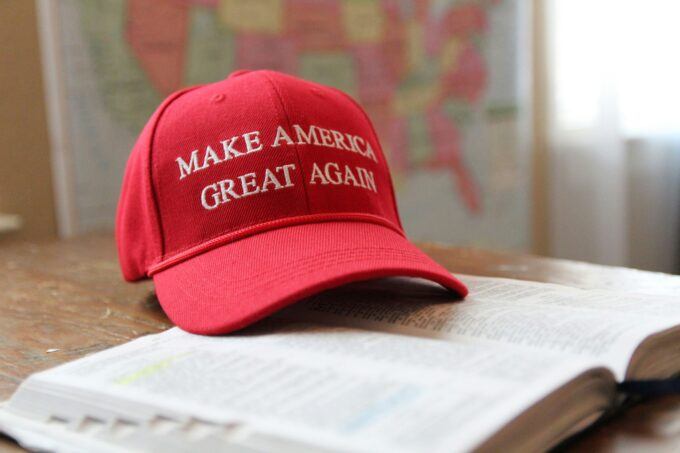
Image by Natilyn Hicks.
Last year, I wrote an article with the title “Our Free Enterprise System Comes Through Again: The Trump Store” about the store and its offerings. I recently developed an urge to revisit the store’s big, beautiful online site.
Much of what is sold by the TRUMP Store is for those with extra money to spend to fulfill their need to engage in excessive consumption while paying a premium price for items, many of which, even those for children and pets, are plastered with Trump’s name.
There is some great news on the inflation front. Many products that were “affordable” a year ago remain just as affordable today. The red baseball cap with the white MAKE AMERICA GREAT AGAIN (MAGA) is still being sold for $55 plus $9.99 shipping. One working at a federal minimum wage job earning $7.25/hour would be able to purchase the hat after putting in the same number of hours (probably around ten after deducting social security and Medicare taxes and possibly paying sales taxes on the purchase) as was required during the previous year. Since last year, if this person is now receiving a deserved pay raise, then fewer hours of work would be required to cover the costs of this hat, representing a fine example of what makes America so great.
A minimum wage worker could afford the hat after working about one hour less by going to Amazon to buy it for $47. Weird that the Trump Store would allow Amazon to sell one of its products for almost 15% less, but great for MAGA consumers who seek to have the honor of helping a person wealthier than Trump become even wealthier. Perhaps the TRUMP Store is willing to make this “sacrifice” given the $40 million Bezos lavished on Melania. Furthermore, the New York Times reports that Bezos has been praising Trump declaring his second presidency is “more mature, more disciplined” and in a CNBC interview, he said “Trump has lots of good ideas, and he’s been right about a lot of things.” What “things” does Bezos think Trump has “been right about,” and, perhaps, more importantly, not right.
More good news from the TRUMP Store: MAGA hats for sale do not exclusively come in red. Among the diverse (as in DEI) offerings in addition to red, are black ones, white ones, and yellow ones, but no brown ones. They also come in unmanly or fairy colors of light pink and light blue with both described as a “still plenty patriotic hat” that is a “limited edition Spring hat [that] makes a great gift for the pastel lover in your life.”
What may provide immense satisfaction to a purchaser of MAGA hats is that one can buy a set of 25 MAGA hats, each a different color combination, normally for $990, but just reduced for a Memorial Day sale to $792, saving one $573 off the price of buying each hat individually. Possessing this set of MAGA hats is described as enabling one to “own them all like a true collector,” to be prepared for “every seasonal twist” and to be “ready to elevate” one’s “look.”
Additionally, the red hat comes with messages other than MAKE AMERICA GREAT AGAIN. For the same $55, one can buy one with the words “FOUR MORE YEARS,” “TRUMP 2028,” or “TRUMP WAS RIGHT ABOUT EVERYTHING.” Does the past tense, “Trump was right,” indicate that he does not continue to be right about everything, or did some antifa subversive terrorist infiltrate the manufacturer of the hats and change an is to a was?
The price of many other items sold by the TRUMP Store remains unchanged from a year ago. The Raised Trump Flag Mesh Back Hat is still selling for $38. The price of the Trump Signature Long Pajama Set remains at $175. The Plush Trump Airplane is still $40. TRUMP 45 Red Sneakers continue to be sold for $225. This shows that at least some commodities in the TRUMP Store have not been “infected” by inflation. Do these unchanging prices demonstrate an important reason why Jerrome Powell, when head of the Federal Reserve Board, was so wrong to have prevented the further lowering of interest rates?
For those into sports, there are numerous items available including a Trump Football for $185 that comes in many color options. There are a variety of pickleball paddles costing $180, many with TRUMP’s name including “the TRUMP exclusive pickle ball paddle.” The Pastel TRUMP paddle comes in pink or blue. Are the colors chosen for these two paddles based on the notion that the blue ones are for men and the pink ones are for those the proprietors of the TRUMP Store view as ladies?
Products to Celebrate the 250TH Birthday of the USA
TRUMP Store merchandise is geared toward special occasions such as Mother’s Day. It now offers commodities celebrating our nation’s 250th birthday. When one clicks Collections on the TRUMP Store home page, click TRUMP 250, and find numerous items for sale with the words TRUMP 250 on them. That prompted me to do a google search to find the meaning of TRUMP 250. At the time I did the search, Google AI provided the following:
“”Trump 250″ generally refers to the Donald J. Trump $250 Bill Act, 2025 proposed legislation by Rep. Joe Wilson to issue a new, legal tender $250 bill featuring Donald Trump’s portrait to mark the U.S. Semiquincentennial (250th anniversary) on July 4, 2026. It is closely tied to the administration’s “Freedom 250” anniversary planning.”
In Rep. Wilson’s February 27, 2025 press release, he is quoted saying “Bidenflation has destroyed the economy forcing American families to carry more cash.” Passage of this legislation [that has not happened] resulting in the printing of $250 bills will, according to the press release, “help families carry less cash.”
Who wants to be weighed down by an excessive amount of $20 or $100 bills? Would the availability of this $250 bill make illegal drug dealers happier because with it, they would be able to reduce the wads of paper money in their pockets?
Among the products in the TRUMP 250 section is a Trump 250 Puzzle selling for $50 that is recommended for ages 9 and up. It is described as a “collectible puzzle [that] offers a fun and patriotic activity for all” and is viewed as “great for…family game nights.” However, it consists of 150 pieces. Was the decision not to make the puzzle with 250 pieces made by some Marxist left-wing thug?
There is good news about some other TRUMP 250 products. They can be viewed as furthering the fight against inflation. TRUMP 250 hats sell for $45-$48, making them as much as $10 cheaper than the MAGA and the TRUMP WAS RIGHT ABOUT EVERYTHING hats.
Is the TRUMP Store Loyal to America?
The TRUMP Store is “the official retail website of The Trump Organization” and is described as a store that enables one to “experience the very best from our [the Trump Organization] retail shops across the globe.”
When learning more about a product being sold, one is sometimes informed, as is the case with the MAGA red hats, that they are made in America. Does no mention of where a TRUMP Store product is produced mean it was not made in America? That is certainly true for two Trump building ornaments as well as the Mar-a-Lago 3D Ornament selling for $95. The description indicates that all three are “hand made in Europe.” Among all our wonderful citizens, is there no one who could have made these ornaments? By selling products that are made abroad, are the owners of the TRUMP Store being disloyal to our country, not putting it and our workers first, and adding to our trade deficit?
From a Google search, an AI Overview that appears to be accurate indicates that the MAGA hats made in America are produced by a workforce that is overwhelmingly Latino who, unsurprisingly, work in a nonunionized “manufacturing facility” for a company named Cali-Fame that is located in in the city of Carson in the unfriendly to Trump blue state of California.
+++
Perhaps, the most sought-after commodity offered by The TRUMP Store for just $125 is an “Age Reversal Kit.” However, read the details about this item. What is being sold are skin care products. Good golly, are consumers being misled by the proprietors of the Trump store?
In this short article, I am unable to comment on all the store’s diverse offerings. Many people spending money buying products from the TRUMP Store will likely find comfort, pleasure and honor knowing that they have enabled the Trump Organization to pocket some of their money.
Warning: If you visit the TRUMP Store, be careful. Having visited the site a few times to write this article, I am now inundated with TRUMP Store ads when I access the Guardian.
Prediction Markets as His Family Profits
“Trump and his family are making tons of money off these new prediction markets—and so of course he is leading the charge against consumer protections,” said one Democratic senator.
The Polymarket online betting app logo is seen displayed on a smartphone screen with an image of President Donald Trump in the background on March 18, 2026.
(Photo by Davide Bonaldo/SOPA Images/LightRocket via Getty Images)
Jake Johnson
May 27, 2026
C0MMON DREAMS
US President Donald Trump on Tuesday used his social media platform to boost prediction markets—a burgeoning industry from which Trump’s family stands to profit—and lashed out at state leaders working to regulate them, singling out officials in Illinois, New York, and elsewhere as “scum.”
Trump, whose administration is considered the most brazenly corrupt in US history, argued that the Commodity Futures Trading Commission (CFTC) must have “exclusive authority” over prediction market regulations, declaring that “it is a major industry, and we must protect it.” The president’s message echoed that of his CFTC chief, Mike Selig, who said earlier this year that the agency would fight any state-level efforts to restrict prediction markets.
Sen. Chris Murphy (D-Conn.), who is co-leading legislation that would ban online prediction markets from allowing bets on government actions, said Trump’s post on Tuesday amounts to “more evidence of how the corruption works.”
“Trump and his family are making tons of money off these new prediction markets—and so of course he is leading the charge against consumer protections and for preferential regulatory treatment of his companies,” said Murphy, alluding to Donald Trump Jr.'s role on the advisory board of Polymarket—the world’s largest prediction market platform.
The New York Times reported last month that Trump’s “publicly traded media company unveiled its own prediction market product last year. And the president’s eldest son, Donald Trump Jr., has ties to two of the industry’s top firms, including Polymarket, the platform that prosecutors say was used by the soldier for well-timed bets.”
“The most corrupt president in our nation’s history wants to make sure states like ours can’t regulate prediction markets so his family and administration can keep profiting.”
The president’s attack on state efforts to regulate prediction markets drew swift pushback from state leaders who have supported cracking down on the platforms, warning they are avenues for insider trading and corruption.
“Illinois took action to prevent and ban insider trading with online prediction markets in our state,” Democratic Gov. JB Pritzker wrote on social media in response to Trump’s post. “The most corrupt president in our nation’s history wants to make sure states like ours can’t regulate prediction markets so his family and administration can keep profiting.”
The Trump administration, which has steamrolled federal regulators who have raised questions about prediction markets, is currently suing Illinois and other states over their efforts to regulate the platforms. Critics argue that prediction markets are illegal sportsbooks masquerading as financial exchanges in an attempt to skirt gambling restrictions.
Dominick Freda, legal director of Better Markets, said Tuesday that “Congress never intended to unleash nationwide gambling and certainly did not envision having the tiny and ill-equipped CFTC adopt the role of nationwide gambling czar.” Better Markets on Tuesday filed an amicus brief in support of Tennessee’s effort to rein in Kalshi and other prediction market platforms.
“The CFTC continues to waste its resources and focus on cheerleading these unpoliced, unregulated casinos when it should focus on its real job: regulating the multi-trillion-dollar commodities and derivatives markets,” said Freda. “It is more important than ever for the CFTC to regulate and police those markets so that Americans can count on stable prices for the many goods they rely on, from gas to groceries. The CFTC should leave gambling regulation to Tennessee and the other states whose laws and regulations have protected the American public for decades, and must be allowed to continue to do so.”
