Showing posts sorted by date for query FARMWORKERS. Sort by relevance Show all posts

Wednesday, November 26, 2025

US farmers, firms flag higher costs even as Trump touts affordability

Washington (AFP) – As biting prices weigh on families heading into the US holiday season, farmers and business owners say President Donald Trump's tariffs have driven up production costs on everything from turkeys to vegetables.


Issued on: 26/11/2025
FRANCE24

First Lady Melania Trump looks on as US President Donald Trump pardons Gobble, one of the National Thanksgiving turkeys, during the White House turkey pardon ceremony in the Rose Garden of the White House in Washington, DC © ANDREW CABALLERO-REYNOLDS / AFP

Grocery prices rose 2.7 percent from a year ago in September, recent government data showed, while a Politico poll found that groceries were the most challenging category for Americans to afford.

But appeals against Trump's tariffs and households' cost-of-living worries contrast against the administration's messaging -- as officials work to convince Americans of the strength of the world's biggest economy.

"While my great work on the Economy has not yet been fully appreciated, it will be! Things are really Rockin'," Trump wrote on his Truth Social platform over the weekend.

He stressed that prices were "coming sharply down."

The White House has pointed to cheaper Thanksgiving meals offered by retailers this year, although some observers caution this could be due to a different mix of products available.

Even as the country has not seen a broad inflation surge from tariffs, economists, policymakers and business owners note that the levies have added to costs.

North Carolina-based farmer Mary Carroll Dodd told reporters this week that "because of increases in our cost, mostly due to tariffs, we've had to raise the price of some of our vegetables" like collards and kale.
'When... crops cost more to grow, the price per pound of turkey goes up,' a farmer says © TIMOTHY A. CLARY / AFP

Even before new tariffs, input costs like fertilizer, seed, chemicals, equipment and fuel were already at all-time highs, added Nick Levendofsky, executive director of the Kansas Farmers Union.

"With tariffs, they are going up even more," he added. "Corn and soybeans make up much of the feed for turkeys and other livestock. When those crops cost more to grow, the price per pound of turkey goes up."

Already, wholesale turkey prices are about 40 percent higher due to supply challenges fueled by avian illnesses, the American Farm Bureau Federation said recently.

This signals that price pressures will likely persist, even if retail prices fell this year as stores featured Thanksgiving deals to draw in consumers.
Business challenges

The Farm Bureau's recent survey noted that prices of fresh vegetables have jumped, with a "continued shortage of farmworkers" and fast-growing wages adding to costs.

"Almost certainly some of that labor shortage is due to the crackdown on both legal and illegal immigration," said Jeremy Horpedahl of the libertarian Cato Institute.

But proponents of Trump's trade strategy argue that tariffs are not a direct driver of price hikes in key sectors like housing, food or health care.

US beef prices for example have been boosted by a drought in recent years and a shrinking cattle herd, said economist Jeff Ferry at the Coalition for a Prosperous America, a group that supports Trump's tariffs.

"The supply chain, including manufacturers and the importers, are absorbing most of the tariff while holding consumer price increases in check," he said.

Proponents of Trump's trade strategy argue that tariffs are not a direct driver of price hikes in key sectors like housing, food or health care © Patrick T. Fallon / AFP


But the picture ahead remains complicated.

In a nod to farmers' challenges, the government is considering aid for the sector hit by low crop prices and a trade row with Beijing this year.

Levendofsky, however, said: "Farmers don't want a bailout. They want trade, not aid."

Some small business owners say they struggle to survive, even as the year-end shopping season approaches.

Jared Hendricks, who owns Village Lighting Co in Utah, told reporters that his company is "approaching a million dollars in tariffs this year" that were not originally in his forecast.

His company specializes in holiday decorations and solutions, placing orders a year in advance with much of the sales tied up in agreements with customers.

"We've sold a lot of that good to them directly at a loss," he said. "At this point, we've kind of transitioned from working for profits to working for tariffs."

"We are just in business to pay off our tariff debt," Hendricks said.

© 2025 AFP


Farmers bemoan crushing Trump tariffs facing higher prices during holiday season
Common Dreams
November 26, 2025 


A farm worker in a field. (Shutterstock)

US farmers warned on Tuesday that they are under increasing strain thanks to President Donald Trump’s tariffs, and they predicted more price increases were coming for American consumers during the holiday season.

As reported by The Packer, representatives from the Kansas Farmers Union, supermarket chain supplier Royal Food, and North Carolina-based Red Scout Farm detailed during a conference call how Trump’s tariffs on nearly all imported goods were raising prices on vegetables, fruits, grains, and meats.

Mary Carol Dodd, owner of Red Scout Farm, said during the call that her farm depends on products imported from other countries, including greenhouse materials, insect netting, and produce bags. With no low-cost domestic substitutes for these products available, said Dodd, she will have no choice but to raise prices.

“When the price of everything it takes to grow vegetables goes up, from soil to tools to fertilizer, packaging, transportation, then the vegetables on the holiday table go up as well,” Dodd explained. “For a small, diversified farm like us, those costs add up quickly. Our profit margins are already very thin, so every increase means tough choices.”

For Dodd, those tough choices have taken the form of a 50% price hike on collard greens and kale, and a 50-cent price increase on mixed-lettuce bags.

Nick Levendofsky, executive director of the Kansas Farmers Union, said during the call that price increases were inevitable given that most farms already operate on razor-thin profit margins.

“Every added cost in the supply chain eventually shows up at the checkout line,” he said. “Tariffs stack up on top of already high input costs, and families end up paying more for the same ingredients they bought last year.”

Colin Tuthill, president of Royal Food, expressed bewilderment that the president would enact policies that raised Americans’ food prices, especially after he won an election last year on the promise to reduce grocery prices starting on his first day in office.

“Placing a tariff or a tax on any kind of food item makes absolutely no sense to me,” he said. “We’re raising the price of food for the most in need.”

The American Federation of Teachers, Century Foundation, and Groundwork Collaborative last week issued a report estimating that Thanksgiving costs for US consumers have gone up by roughly 10% over the last year, with staples such as onions, spiral hams, and cranberry sauce all recording increases of 22% or higher.

The groups also found that Trump’s policies were squarely to blame for the price increases, and not just the tariffs. Specifically, they pointed to chaos at agencies such as the US Department of Agriculture that have weakened efforts to contain bird flu on US farms, which has in turn hurt the supply of poultry heading into the holiday season.

Although Trump has walked back some of his tariffs on staples such as coffee, bananas, and chocolate, the groups noted that this rollback likely came too late to offer relief to US families this year.

“Trump campaigned on bringing down the price of groceries on day one,” they wrote. “Yet in the biggest grocery week of the year, families across the country aren’t seeing any savings. Instead, their budgets are being carved up alongside the Thanksgiving turkey.”

Tariff rollbacks a 'drop in the bucket' compared to yearly family cost: analyst

Adam Lynch
November 26, 2025
COMMON DREAMS


U.S. President Donald Trump gestures during a breakfast with Republican Senators at the White House in Washington, D.C., U.S. November 5, 2025. REUTERS Kevin Lamarque

President Donald Trump recently opted to rollback some tariffs to try to bring down prices on things like coffee, fruit and beef, but CNN analyst Matt Egan says the average U.S. household isn’t even going to notice.

“This would be like if your landlord raised your [monthly] rent by $200 bucks. And then, to make up for it, handed you a gift card for $35,” Egan told CNN anchor John Berman.

The White House claims the tariff rollbacks will address the affordability crisis, and research does show some items may get less expensive. Egan said the cost of bananas could drop by almost 3 percent, and coffee and nuts could get 7 percent cheaper. But Egan said there’s no guarantee stores and markets will pass those savings back to customers because stores “are reluctant to lower prices after raising them.”

But, more importantly, the rollback is not enough to register with straining households.

“But, let's just say [stores] do share the savings with consumers. Peterson Institute research shows that this will lower prices by about $5 billion per year. Now that sounds like a lot — but it's a big country,” Egan said. “When you break this down per household, we're only talking about an annual savings of $35 bucks from these tariff rollbacks. Just $35 bucks. That's against estimates from the budget lab at Yale that the impact of the tariff hikes are costing households $1,700. So, $35 savings $1,700 in cost.”

Enten showed footage of White House Economist Kevin Hassett claiming “prices for goods … weren't necessarily going up just because of tariffs," and that “prices will go down … because the supply of the goods into the U.S. is going to increase” with the rollbacks.

“This is just another example of the disconnect between the rhetoric and the reality on prices," Egan said. “The president says there's no inflation. Clearly there is. He says that grocery prices are down. They're clearly not. And, yeah, rolling back tariffs could help a little bit on the edges. but this is really just a drop in the bucket.”


U.S. late credit card payments 'highest since Great Recession' this holiday: analyst

Adam Lynch
November 26, 2025 
COMMON DREAMS


'Young Corporate Guy Showing His Debit Card' [Shutterstock]

It’s officially shopping season but CNN analyst Harry Enten says high prices are destroying America’s credit cards in the Trump economy.

There are 3 million more shoppers between Black Friday and Cyber Monday, according to analysis, but 90-day credit card delinquencies are exploding.

“I mean, look at this. It's the highest since the Great Recession,” said Enten. “We're talking about 12.4 percent of [credit card] balances are at least 90-plus days late. That is way up from where we were three years ago at this point, when it was 7.6 percent of balances that were 90 plus days late. So, clearly, people are taking on more debt and the debts are climbing higher on their credit cards.”

Enten added that the credit card debt was another aspect of wealthy Americans buying more while the rest of the U.S. tightens their belts.

“You look at those making at least $100,000, the amount of money being spent [by them] up 5 percent. Then you go down the next bracket, at $50,000 to 100,000, it's down 6 percent. And then look at that: Under $50,000 income — way down there, down at 16 percent,” said Enten.


“So that 16 percent drop in the amount of money being spent for household incomes less than $50,000 … compared to up 5 percent [rise] among those making more than $100,000 — I think that is the perfect illustration of this k-shaped economy, whereby folks who are doing pretty gosh darn good are putting out their money, but those who aren't are really going to hold back this year versus last year.”


Monday, October 20, 2025


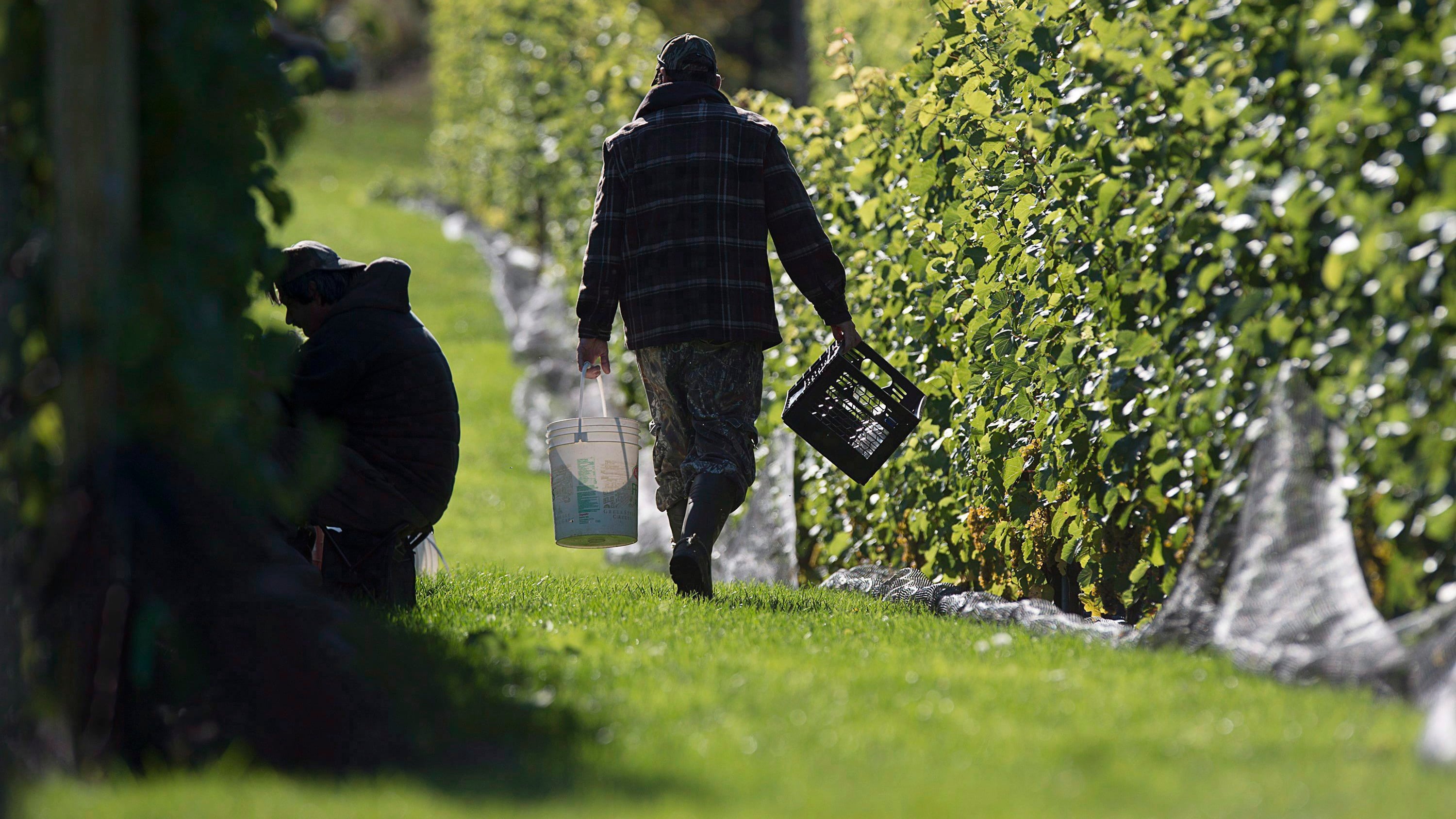
Most of California Wine Country’s agricultural workers have been exposed to wildfires, new survey finds


By partnering with the community, UC Berkeley researchers conducted a sweeping survey of California farmworkers on their experience working during wildfires.


University of California - Berkeley


Sonoma County is known for its rolling fields and famed vineyards, making the region a pillar in California’s wine industry. But a sweeping new survey from UC Berkeley has found that approximately 75% of agricultural workers there have worked during wildfires since 2017, raising questions about worker safety and a program that could further expose workers during wildfire evacuations. 

About half of the 1,000-plus farmworkers who participated in the study reported having ailments like headaches or sore throats after working during a wildfire. Half reported a lack of health insurance, and many worked while feeling ill due to a fear of losing their jobs or not being able to afford basic needs due to lost wages. 

What’s more, a new program meant to ensure that the people who harvest grapes, tend livestock and irrigate fields can continue to work during wildfire evacuations may force workers to choose between their health or paying their bills, according to a policy-focused white paper accompanying the survey findings. 

Led by scholars from the School of Public Health and the Human Rights Center, the research was published today (Oct. 20) in the Journal of Agromedicine. The coinciding white paper calls attention to potential improvements to what’s called the Agricultural Access Verification Card Program — “Ag Pass” for short. 

“The most consistent theme throughout the surveys and interviews was that farmworkers felt it necessary to work in hazardous conditions … to be able to pay for basic needs such as housing and groceries,” the study says. 

The findings for both reports stem from a multiyear community-engaged research project and add critical understandings of the conditions and challenges facing agriculture workers in Wine Country and across California. 

At a time when health care and housing costs are already high, and fires present recurring challenges for communities across the state, the researchers hope the work can inform policy around agricultural workers and improve efforts to keep them safe during disasters. 

“We know farmworkers are going to continue to work in really dangerous conditions,” said Carly Hyland, an assistant professor in the School of Public Health and lead author of the study. “And so I think we’re continuing to strategize about how we can make that as safe as possible for workers.”

Project beginnings

In 2020, approximately one-quarter of wine grapes were believed to have gone unpicked due to lightning-sparked wildfires and effects from the COVID-19 pandemic. It was a major hit to an industry whose future is already uncertain due to changing habits around alcohol consumption, inconsistent weather due to climate change and intermittent wildfires that can bring operations to a standstill. 

The issue hasn’t been limited to vineyards. Elsewhere in California, wildfires have forced evacuations of cattle ranches and other agricultural operations, leaving animals and crops vulnerable and unattended to. Even if it was safe enough for someone to access a livestock operation during a wildfire, the policies surrounding who and how were uneven and unclear.

“Under the evacuation laws at that time, there was no clear way to do that,” said Linda Gordon, a climate researcher at Berkeley’s Human Rights Center and co-author of the new research. “Each county was designing their own programs, if any. There was very little oversight.” 

To clarify things, California lawmakers in 2021 passed legislation authorizing counties to develop a program for approved livestock producers or managers to access properties during disasters. The Sonoma County Board of Supervisors expanded the program to include commercial agricultural operations and all full-time employees, meaning people who tend crops could bypass closures and access vineyards.

While the county’s agricultural office collects basic details about workers and administers the Agricultural Access program, the sheriff’s office distributes passes and decides when and how to activate it. 

Gordon began studying Ag Pass as a law student two years ago. She was concerned it lacked clear input from public health officials and might put those who were expected to work behind evacuation lines at risk. She connected with Hyland, who — with the help of community partners — was already studying the effects of extreme heat, pesticide exposure and wildfire smoke on California farmworkers. 

“This Ag Pass program is really specifically focused on reentering an evacuation zone and does not take into consideration potential health or safety impacts on farmworkers,” Hyland said. “Totally separate from that is, even if an area isn’t evacuated, we know that it can still be really dangerous for farmworkers to be working in.”

‘Like an angel fell from the sky’

Gordon and Hyland knew that if they wanted to accurately document the experiences of agricultural workers, they’d need the help of someone with deep community connections. So they turned to Zeke Guzman.

Guzman is president of the farmworker advocacy group Latinos Unidos del Condado de Sonoma. When he talks about his interest in farmworker safety during fires, he describes his experience during the 2019 Kincaid Fire, when he helped arrange the delivery of more than 600 homemade burritos to a makeshift evacuation site. 

It was the start of his work during wildfires, but it wouldn’t be the end. 

As fires continually flared in subsequent years, Guzman became increasingly concerned about the health effects the smoke was having on those harvesting grapes.

As much as he tried to bring greater attention to the issue, he felt like he was hitting resistance. Then one day in 2022, he received a call from Hyland. 

“It was like an angel fell from the sky,” he said.

Farmworkers can be a hard-to-reach group who may be hesitant to speak with university researchers. After some discussions about the goals of the Berkeley project, Hyland asked if Guzman might be able to help them survey 200 workers. 

He paused. 

“No, probably not,” Guzman said. “But I can get 1,000.”

Community research underway

Guzman and the Berkeley researchers established a six-person community-engagement team from trusted nonprofits and health centers. Together, they developed and refined survey questions and a plan to get it in the hands of as many people as possible — a core tenet of community-engaged research.

Guzman said the process made the community “feel like their voice was important.”

It also led to compelling results. 

With the help of a team of Berkeley undergraduate students and the community partners, the research assistants fanned out in the community, from churches and health clinics to individuals’ homes known to be community hubs. Smaller group settings and recruiting through different messaging apps helped expand the sample size and led to more honest results, the team said.

In spring 2024, they collected 1,011 surveys. It was among the largest recent farmworker surveys in the region — and it surpassed what Hyland and Gordon imagined possible.

“The community engagement team was what made it possible for us to recruit that many participants,” Hyland said. “It again underscores the importance of working with trusted community partners and really listening to them and having them advise us on how to go about doing this work.”

“I really firmly believe not just that it can’t, but that this work shouldn’t be done without local partners,” Hyland added.

The results revealed in new depth the concerns workers had about working in fire zones, the skepticism they held toward the law enforcement agency that administers the program and the barriers to health care tools before they’re exposed to smoke and after they develop symptoms of illness or longer-term disease. 

At the time of the survey, the Ag Pass program had not yet been activated, so the research focused more broadly on previous experiences and sought to understand how the program was understood within the community. 

The vast majority of participants had not even heard of it, and roughly half said information about the program was inaccessible or were hesitant to have their picture taken by the sheriff’s office. They also showed a preference for interacting with community organizations and local health clinics, rather than county government entities.

Pamphlets alone were ineffective. Videos or input from knowledge experts — like in community clinics — would be a more effective way to learn about safety steps during fires, respondents said. 

Ultimately, there’s a bigger economic challenge to overcome, the study found.

“To be honest, it is very hard to stop work, and even if we were in danger because of the wildfires or the smoke or bad quality of air, we still have to work,” one participant said. “We do not have any other form of income.”

Besides pointing to what Hyland said was a “clear tension between health and economic security,” the research team says there are specific steps that can be taken to improve the program. 

At the county level, public health input should become part of the consideration on when to activate it, instead of relying exclusively on the sheriff’s office. The county should also create a data privacy policy that clarifies for the public how personal information collected for the application is stored, shared and protected. Increased outreach in Spanish and Indigenous languages, and collaboration with community groups could help increase trust and engagement with farmworkers, the team said. 

At the state level, the research team said there needs to be an economic safety net for farmworkers who currently cannot pay their bills without working in dangerous conditions. State health agencies should also enforce health and safety laws during wildfires and inside evacuation zones. 

“We can’t design California’s resilient climate policies without thinking about the people who will be most vulnerable and impacted by them when a wildfire hits,” Gordon said.

Thursday, October 16, 2025


Basta! This Land is YOUR Land, Hermanos y Hermanas


The barbarism of the North American conquest was exemplified by scalping and mutilation of Indigenes.


I had Alexis Lisandro Guizar-Diaz, M.S. on my studio recorder today, but it airs Nov. 20 on KYAQ. He’s the Electoral Field Director PCUN.

LISTEN HERE!


April 1985 PCUN is founded as Oregon’s union for farmworkers and treeplanters. WVIP continues its service and immigration work through PCUN’s Service Center for Farmworkers.

1986 The Immigration Reform and Control Act is signed into law, allowing all those who had been living undocumented in the United States since Jan. 1, 1982 or who had worked in agriculture for ninety days between May 1, 1985 and May 1, 1986, to apply for residency.

I met Alexis in Salem at a Chicano-Latinix arts event:

PHOTOS: Urban Art Fest 2025 celebrates culture - Salem Reporter

We talked in a wide-ranging manner about settler colonialism, the attack on immigrants, his own doubts about a PhD program at Portland State University. He’s the son of undocumented immigrants, and his first point of college was around becoming a lawyer, an immigration lawyer, but he’s into ecology of economy and urban planning on a meta level.

While talking with him, I sent him a few pieces of mine:

Love Thy Neighbor — One Woman’s Fight for Her Husband

Love Thy Neighbor

Makwirituni Erakuni – “I’d Like to Introduce You to My family”

erukuni 720

An American story of working undocumented

Enrique as a child

Twenty Years ago, over at Dissident Voice:

This Land is Their Land, and We Are the Illegal Aliens

“We are all illegal aliens.”

It’s a bumper sticker many of us on the frontlines of the fight against the United States’ government’s assault on Central Americans plastered on our car bumpers down El Paso way.

That was in the 1980s.

You know, when Reagan was running amuck ordering his captains Ollie North, McFarland, Casper Weinberger, the whole lot of them, to send bombs, CIA-torture manuals and US agents in order to aid terrorist contras and other despotic sorts in killing hundreds of thousands of innocents in civil wars in Salvador and Guatemala and El Salvador.

We worked with women and children who had witnessed fathers, uncles and husbands eviscerated by US-backed military monsters. Victims of torture, in Texas illegally. You know, what those brave Smith and Wesson-brandishing, chaise lounge Minutemen of today would call aliens.

We worked with people in faith-based communities, mainstream churches, and non-profits throughout El Paso, Juarez and the general area known as La Frontera. Everyone I met working with in this refugee assistance stint had humanitarian blood coursing through their veins. We were proud of our law-breaking work — we gave refuge to terrorized and sometimes half-dead civilians.

We were called lawbreakers by the Reaganites and the Minutemen of that time. Communists. Pinko-fags. Those were the good old days of low-tech surveillance and simple FBI lists.

But what we did was human and humane, in the tradition of that very universal (with roots in Quakerism) belief in bearing witness and acting upon that which has been judged as unjust and inhumane.

Of course, we were up against the laws of this land and coarse politically driven judges who denied victim after victim permanent or temporary status while seeking asylum in the US.

We have so many stories of people sent back who were at best imprisoned, and in the worse cases, mutilated, disappeared, and murdered.

Guatemalan and Salvadorans, that is. Your readers don’t want to hear the narratives and visualize the descriptions of photos of those victims of torture. Ghastly things happened to teachers, nuns, medical workers and farmers, more heinous than what we’ve heard happened in the cells of Abu Ghraib.

We were there to assist, but more importantly to bear witness to our country’s terror campaign. Some of us got so riled up that later in our lives — me included — we hoofed it to Central America. Kicked around. Wrote articles for the few newspapers in this country that even cared about poor, misbegotten, displaced people of Latin America.

But no matter how hard-nosed we became, or how much we could withstand the photographs of women’s sliced backs and beheaded fetuses, we couldn’t shake the images of the children of torture at this two-story refugee house, Annunciation House. It was full of scruffy looking East Coast volunteers who had hooked up with Ruben Garcia, the House’s director, through Catholic services organizations. It was their stint with public service, their spiritual duty calling. Part of their degree plans. But most were converted and slammed hard by the violence their charges had suffered under.

Those PTSD-induced cartoons those children drew sucked the air out of even the hard-ass border patrol guys who used to “dump” the Central Americans at Ruben’s door at all hours of the night. Who can believe it now, that once upon a time official INS and border patrol officers knowingly let their perps go — knew that Ruben and his volunteers could salve emotional and physical wounds of these tortured crossers.

Their chance at freedom. Except for the piss-ant judges. And the memories of pregnant aunties being raped, their fetuses cut out alive, speared, and the laughing Reagan-loved military punks in the highlands and jungle.

Annunciation House was bulging at 100 people — disheveled lives jammed in. Beans always cooking. Songs. Mattresses and piles of donated clothes. Guitars strumming. Gueros, the white ones, and the Chicanos would help with in-takes — asylum transcripts, translation, dotting all the i’s and t’s. Help with getting jobs. Odd jobs in the community. Help with making sure the refugees didn’t get caught again.

But it was always those by-the-letter-of-the-law jurists helping confound the torture. More than 70 percent of our brothers and sisters seeking asylum in the US were denied entry by some fat cat, cocaine-sniffing immigration judge who usually had a friend in the back pocket of some Bush or buddy of Bush somewhere.

Then it was trying to get the denied victims off to Canada without being caught. You remember, the Canada back then which used to open its borders to refugees.

The judges and politicians and Minutemen all professed, “Send them back. Those aliens broke our immigration laws.”

But “we are all illegal aliens” as a rejoinder went much further than USA’s mayhem in Mesoamerica. We worked in solidarity with the housekeepers, bricklayers, agricultural workers and so many other worthy Mexicans who worked their butts off in the US for little pay and much less respect.

These were workers who crossed the Rio Grande to find low-paying jobs with American families and businesses — working for mayors, bigwigs, even on government contracts. In Texas, New Mexico, Arizona, elsewhere. With a wink and a smile by the American exploiters.

Mojado — wetback. Squatter. Beaner. Illegal alien. These were the more tame epithets.

But let’s not kid ourselves about the genesis of this new round of empowered Latinos fighting against racist laws put forward by the dispassionate conservatives running the ship of fools in DC.

This is not a country of legal immigrants. It’s a country based on colonialists, undocumented white people who helped displace native tribes through broken laws and genocide.

It’s a country based on illegal occupation of native lands and on Mexico’s lands, pure and simple. Colonialists protected by Federal laws that deemed free white people as the only ones who had the right to be fully-fledged citizens.

Manifest destiny was a violent racist act to seize lands illegally. Everything this country’s current anti-Mexican and pro-Apartheid border war proponents stand upon — all that doctrine and those so-called laws — is based on illegally seizing lands of Native tribes.

And worse — laws that “removed” natives. Laws that starved natives. Laws that approved of eradicating native families, entire tribes.

The current massive turnout of students and workers alike in this country’s major cities is a testament to these Americans’ backbone to fight this new exclusionary law — HR4377 — a Washington, DC-inspired racist act that has its roots in the Chinese Exclusion Act of 1882.

Many Americans do express a certain humanity and dignity for the people many deem aliens, but it’s not awe-inspiring that some citizens of Denmark or Limerick, Ireland, obey the so-called immigration laws of this country during their initial years as landed immigrants.

Let’s make no bones about the motives of Jim Sensenbrenner, the author of this racist House bill: He sees those brown-skinned south-of-the-border lettuce pickers, linen washers, house framers, and their US-borne children as, what? “Alien gang members terrorizing communities.”

Anyone spouting that we are a nation of immigrants and laws has a disease, what George Orwell called the illness of doublethink.

And until those many white Americans stop spewing that this is their land, a land of their laws, and a land made for Christians, the racist Minutemen will ramp up their gun brandishing on the southern and northern borders. And racist politicians will continue to play on the fears of uniformed constituents and try and pass the 21st Century’s racist exclusionary laws.

I wonder what these modern-day Nazis would say about those children’s cartoons — images of bodies floating in rivers. Blood-soaked church walls. Military men with their M-16s trained on men while others were in their rape hunch. Beautiful jungle birds flying in the sky next to US-paid-for helicopter gunships spraying the corn fields below. Dead mommies cradling dead babies.

Yeah, I’m an illegal alien. We all are illegal aliens, under the laws of these creeps in high office. Humanity and caring and simple benedictions for suffering so much, those are alien traits only held by a minority in this country of exclusion. Yeah, those creeps on hate-radio and in the newspaper columns and on Capitol Hill, sure, they recognize all of us who see the lies and fight the injustice as aliens.

And the children whose post-traumatic cartoons brought tears to men and women who had been in Vietnam. Simple Crayola colorings brought tears to a county sheriff who had survived drug runners shooting up his town and unearthed bodies.

Yeah, we are all illegal aliens. Except them.

Paul Haeder worked in Central America and Mexico writing for newspapers during the 1980s and early 1990s. He’s currently in Spokane, Washington, as an instructor of writing at Spokane Falls Community College and writes sustainability-energy-environmental pieces for the towns weekly, Pacific Northwest Inlander.

*****

Listen to Alexis, man, because he is spot on, one of the good guys who should be in high office changing the smear of the Democrats and Republicans, both parties of KKK and lynching cunts and dirty slavers.

A person holding an object AI-generated content may be incorrect.

Jeremy Kuzmarov has a new piece out — a new book with all the gory facts which will not be taught in K12, or colleges:

In May, President Donald Trump announced that he would not recognize Indigenous People’s Day and would bring Columbus Day “back from the ashes.”

A few months later, War Secretary Pete Hegseth announced that 20 U.S. soldiers who took part in the massacre of hundreds of Lakota Sioux at Wounded Knee in December 1890 will keep the Medals of Honor they were awarded. Hegseth said that the soldiers “deserved those medals.”

Indian killers or Slave killers or BIPOC killers, this is the regime, and every fucking MAGA cunt now needs to be mowed down, really.

Kirk, or Kirker, take your pick: James Kirker, who was a homicidal racist and prolific Indian killer.

A person with his arms crossed AI-generated content may be incorrect.

Along with slavery, the massacre of the Native-American population has by now been well documented. It has been made even more clear in a number of new historical studies that take on a subversive air under the Trump-led order.

One of these studies, by William S. Kiser, Chair of the History Department at Texas A&M-San Antonio, methodically details how white soldiers serving with colonial militias and state police agencies like the Texas Rangers were paid bounties for Native-American scalps and other body parts, which they often took as trophies.

Kiser’s book was published this year in the prestigious Lamar Series in Western History with Yale University Press and is entitled The Business of Killing Indians: Scalp Warfare and the Violent Conquest of North America.

Kiser estimates—conservatively—that between ten and twenty thousand Native Americans were scalped over a 250-year period from the mid-1600s to the late 1800s

A group of men on horses and bodies AI-generated content may be incorrect.

[Texas Rangers with three “bandits” that they killed on the Mexican border.]

WHAT IS PCUN?

Our mission is to empower farmworkers and working Latinx families in Oregon by building community, increasing Latinx representation in elections, and policy advocacy on both the national and state levels.

PCUN values the ability for workers to take action against exploitation and all of its effects, and continues to build an agenda that strengthens workers rights by creating safer workplaces, advocating for fair wages, and pushing for enough economic security to care for our families. We also value dignity, and respect for all workers, and the “Sí se puede ” spirit of Dolores Huerta, and Cesar Chavez. PCUN was founded by farmworkers, and today that legacy continues.

PCUN is focused on building a stronger voice for all Latinx working families in Oregon, from farmworkers to young folks, so that we can collectively improve their well-being and increase prosperity for all.

The growing power of the Latinx workforce, electorate, and population is integral to both our state’s and the nation’s economy and the future of our civic engagement systems, but because of long-standing inequities, Latinx working families are more often marginalized than they are empowered.

If we empower and lift up Latinx working families, they will have a stronger voice in the decisions that affect them, and their well being will increase significantly.

NOW, and . . . LISTEN HERE.

Alexis Guizar-Diaz – TRIO Ronald E. McNair

THEN . . . John Coffee Hays, San Francisco’s first sheriff, had once led deadly Texas Ranger operations against the Comanches and Apaches and campaigns below the Mexican border. In his new job, he organized private volunteers to police California’s frontier that killed yet more Indians.

A person with a beard AI-generated content may be incorrect.

And back to NOW . . .

A group of men in suits AI-generated content may be incorrect.

Comment from a listener/reader: Mike Fish:

Another episode of what some would call anti Angloism, and what is actually known as FACT(S).

How do I, as a so-called white person, with a conscience and a heart, in possession of these FACTS, walk around this defiled land, and not go stark raving mad???

I try to live by the creed, how would I feel if “that” was done to me, mine, and/or my ancestors???

People either don’t know, or don’t wanna know.

Meanwhile, history is being erased and distorted to such a degree, that before long these FACTS will be lost to me, and mine.

2+2=5

Paul Haeder has been a teacher, social worker, newspaperman, environmental activist, and marginalized muckraker, union organizer. Paul's book, Reimagining Sanity: Voices Beyond the Echo Chamber (2016), looks at 10 years (now going on 17 years) of his writing at Dissident Voice. Read his musings at LA Progressive. Read (purchase) his short story collection, Wide Open Eyes: Surfacing from Vietnam now out, published by Cirque Journal. Here's his Amazon page with more published work AmazonRead other articles by Paul, or visit Paul's website.