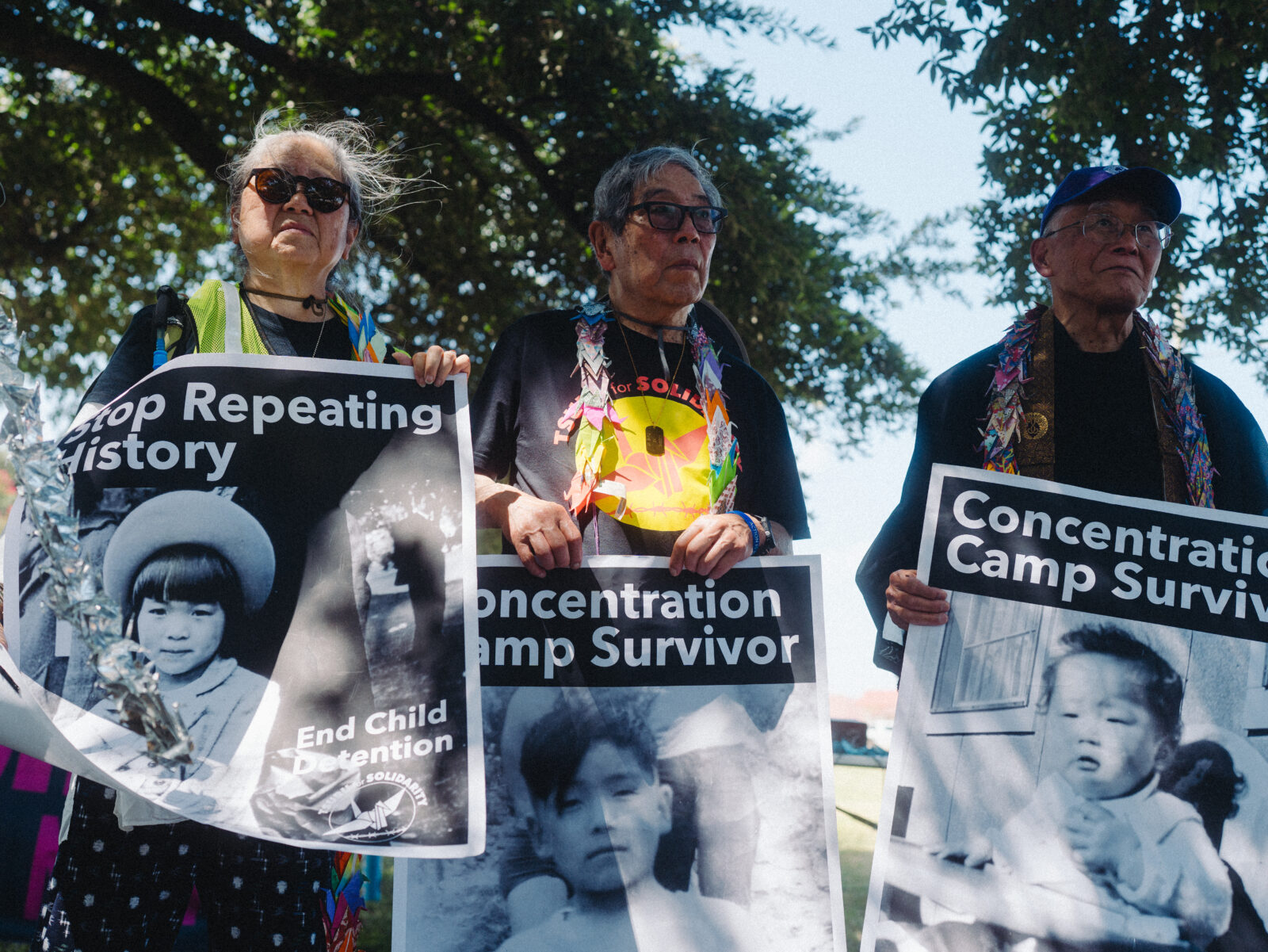
Formerly incarcerated immigrants, solidarity activists, and scholars discuss the underreported resistance in ICE jails.
By Victoria Valenzuela ,
August 7, 2026
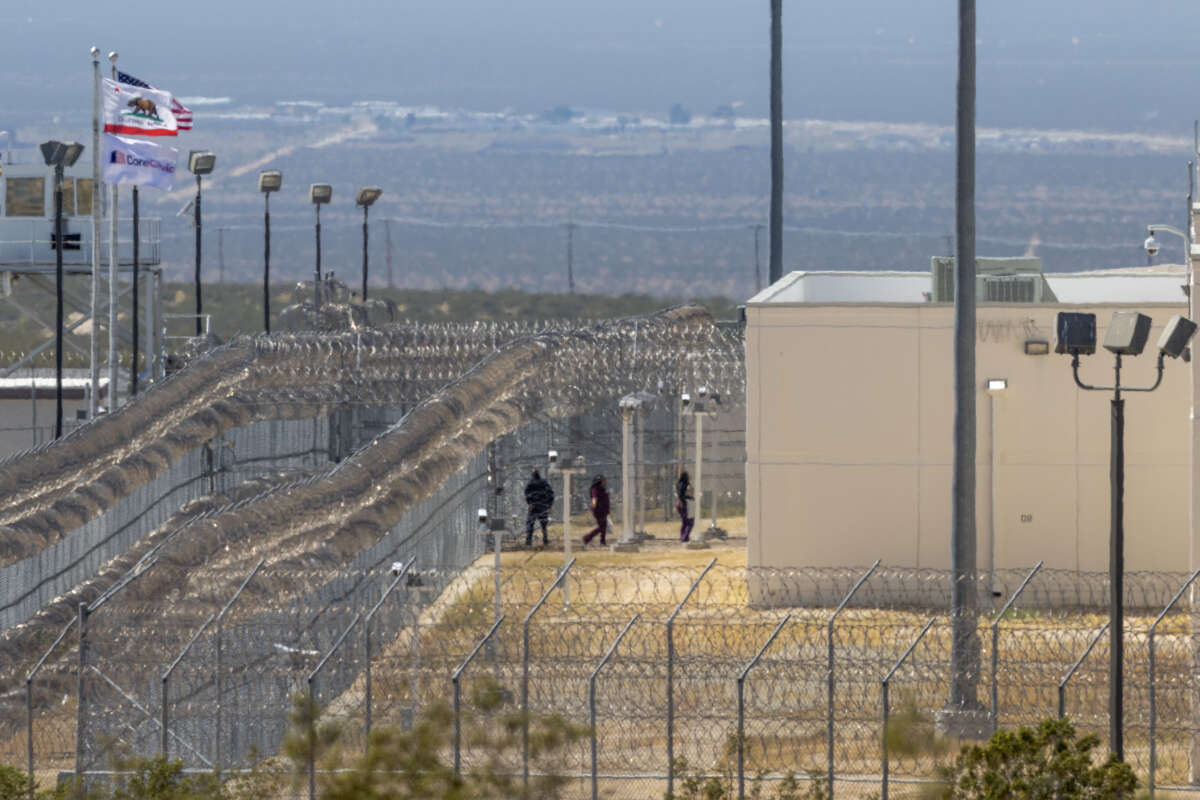
People enter the California City Immigration Processing Center, the state's newest and largest ICE prison, on March 25, 2026 in California City, California.David McNew / Getty Images
When Dilmer “Loba” Lovos Mendez learned about the protests inside the Dilley Detention Center in Texas, they were not surprised. While being held for two years in California immigration jails from 2024 to 2026, Lovos Mendez had seen firsthand how common such organized acts of resistance actually are, and was themself directly involved with three protest actions during that time.
During two hunger strikes, one of which had up to 100 participants, as well as sit-ins that lasted two weeks in September 2025, Lovos Mendez worked with other people inside immigrant jails to protest medical neglect and terrible conditions including rotten food and undrinkable water.
As in the case of Dilley, Lovos Mendez felt it was outrageous that the detainees had to be the ones to expose conditions and make people aware. “It’s the only way that a person inside the detention center can actually have their voices heard,” Lovos Mendez told Truthout.
During the same month as the sit-ins that Lovos Mendez participated in at California City Immigration Processing Center, hunger strikes emerged at Louisiana State Prison (also known as Angola, for the slave plantation it was built over) in “Camp 57,” a solitary confinement unit that was housing immigrants in federal custody. Detainees were given small “childlike” portions of food and weren’t allowed to go to commissary, on top of being housed in tiny cells meant for solitary confinement, according to Chanthila Souvannarath, who helped lead the hunger strike from inside.
How Do We Sustain Momentum for the Anti-ICE Movement Over Time?
Silky Shah, executive director of Detention Watch Network, discusses how the fight against ICE has entered a new phase. By Kelly Hayes , OrganizingMyThoughts July 29, 2026
“We wanted to expose the corruption,” Souvannarath told Truthout. “It’s not a place for detainees. We’re trying to get that place shut down. It’s inhumane.”
These were just two of the many protests emerging in immigration jails across the U.S., only a few of which have come into the national spotlight under the second Trump administration. Even so, Alex Mensing, who works with the California Collaborative for Immigrant Justice, told Truthout that protests happen inside immigration jails all the time, even if it is just one person leading a hunger strike from solitary confinement. These facilities have been sites of resistance since their inception, with one of the first recorded protests occurring in 1985 in El Centro Detention Facility in California.
“There’s a very long lineage and history of incarcerated people resisting as a form of survival, very much as a form of political activism once they’re incarcerated, and sometimes they work with people on the outside in solidarity, but still very much motivated by the people on the inside themselves,” said Jessica Ordaz, a historian and assistant professor of ethnic studies at the University of Colorado Boulder.
Under-Documented Protests
Ordaz told Truthout that when she began researching El Centro Detention Facility, which was built in the 1940s and closed in 2014, she wasn’t trying to look at examples of protests or resistance, but that was the story she found.
She began researching hunger strikes in El Centro that happened in 1985 with about 300 participants. The protest ended after the number of strikers dwindled over several days and guards went in with riot gear, forcibly moved the remaining protestors, and force-fed them. However, when Ordaz interviewed people about that incident, they’d bring up other protests that happened inside the facility.
“They were like, ‘Oh yeah, there was one in ’84 and ’83,’” Ordaz said.
She realized the number of protests occurring was far higher than what had been documented.
“We never hear about everything that happens inside, and there’s a lot of protest that goes on, sometimes even on a daily basis, just for people to get the basics.”
“I don’t know the number, but I will say I generally did see a pattern of them happening very frequently,” Ordaz said. “Unless there’s hundreds and hundreds of incarcerated folks involved, sometimes it’s not picked up [by the media].”
Mensing agreed. As communications director with the California Collaborative for Immigrant Justice, which communicates with immigrants in custody to support their cases and document abuse, he frequently hears about protests happening inside immigration jails in California. Mensing estimated that hundreds of protests have occurred inside since Trump started his second term. He said that most of these protests are sit-ins, shape formations, and hunger strikes — but they only get covered if hundreds of people participate, while smaller ones often fly under the radar.
“We never hear about everything that happens inside, and there’s a lot of protest that goes on, sometimes even on a daily basis, just for people to get the basics,” Mensing said.
The California Collaborative for Immigrant Justice counts a hunger strike even if only one person is involved. If one person does three hunger strikes, then that is already three protests at one detention center in one year. Mensing documented dozens in California detention centers already during the first three months of 2026.
“Multiply that by the number of detention centers, it’s going to be a lot,” Mensing said.
Fighting for Basic Needs
Mensing said that oftentimes incarcerated immigrants use these protests to secure very basic needs like medication, proper food, medical attention, help with their cases, or ways to combat extreme heat. Ordaz has seen the same patterns in her studies of protests in decades past.
“It’s the same story happening decade after decade in terms of the maltreatment and the abuses inside,” Ordaz said.
“They started transferring people, little by little disintegrating the coalition that we had formed in order for us to be able to demand fair treatment.”
For Lovos Mendez, who was deported to El Salvador in March, their advocacy in immigrant detention centers started as soon as they arrived at Golden State Annex in California in 2024. They immediately noticed detainees not being given their medication, being served moldy food, and getting sent to solitary confinement for not following orders, despite language barriers. In February 2024, they began working with others inside to plan a hunger strike that took place in April 2024 and garnered nearly 100 participants. The effort was supported by the California Collaborative for Immigrant Justice.
“We conducted these hunger strikes to stand up for our rights, especially with the food and the medical services,” Lovos Mendez said. “It was a community thing. We all came collectively after seeing so many people suffering from illnesses and health issues that needed medications, and we’re not being given them.”
Another hunger strike took place after that one. Lovos Mendez and many others faced retaliation, including solitary confinement, force feeding, and delayed medications. Lovos Mendez was transferred to the California City Detention Center, a relocation which they saw as a form of retaliation for having demonstrated for human rights. The move positioned them hours away, where it became harder for their mother to visit them.
“The retaliation was to be expected from them, however, we were not prepared for the form of retaliation when they started separating us from our peers, and they started transferring people, little by little disintegrating the coalition that we had formed in order for us to be able to demand fair treatment,” Lovos Mendez said.
Solidarity With Outside Organizers
When Rebecca Asaki, an organizer with Tsuru for Solidarity, a Japanese American organization made up of survivors of U.S. internment camps during World War II and their descendants, heard about the children protesting in the Dilley Detention Center in January, she thought of the 2015 hunger strike led by mothers in Dilley before the facility closed down the first time. The action was coordinated with Tsuru and other organizations as part of a coalition to end family detention, which won an ultimately temporary victory in 2021.
During that time, the coalition also organized other inside and outside actions, including campaigning for the release of Haitian families detained inside the Berks County Residential Center in 2020, before it closed down in 2023.
“We had Haitian drums and Japanese drums, and we were singing,” Asaki said. “The folks who were detained inside also came out cheering us on as we were cheering them on. It was a really incredible moment where we were simultaneously able to have actions.”
Asaki said it is important to have people organizing on the outside to uplift the actions happening inside. She also said that Tsuru’s actions are guided by people who are or were in immigration detention.
Similarly, Josefina Mora Chung has been uplifting protests inside the Tacoma Northwest Detention Center with La Resistencia, which was founded 22 years ago to help people on hunger strikes in immigration jails get their demands out. One thousand two hundred people participated in the 2014 hunger strike at Tacoma Northwest Detention Center, and some of them reached out to the La Resistencia founder to ask for help amplifying their message. That hunger strike lasted for 50 days.
To Mora Chung, the detainees’ outreach demonstrated that there was a large need for outside organizers to step in. “People in detention were asking for a lot more support and in their efforts to pressure for the closure of this particular facility, we began running concurrent campaigns on the outside to create outside pressure, as well as organize with people inside to aim for the eventual closure of this facility,” Mora Chung told Truthout.
Mora Chung said La Resistencia has documented about a dozen hunger strikes in the Tacoma Northwest Detention Center every year of its 12-year existence. Last year, La Resistencia documented 16 hunger strikes. By May of this year the group had already documented 13.
Resistance inside immigration jails is widespread. But robust solidarity efforts on the outside, which organizers like Mora Chung see as essential to the success of inside protests, are significantly rarer.
“People in detention actually see the solidarity that they’re not alone, and that has a really big part to play in empowering them to be able to take actions,” Mora Chung said. “It’s important for them to feel the power of not only the pressure from the outside that they have support, but also that they have the power to really protest against these conditions.”
This article is licensed under Creative Commons (CC BY-NC-ND 4.0), and you are free to share and republish under the terms of the license.
When Dilmer “Loba” Lovos Mendez learned about the protests inside the Dilley Detention Center in Texas, they were not surprised. While being held for two years in California immigration jails from 2024 to 2026, Lovos Mendez had seen firsthand how common such organized acts of resistance actually are, and was themself directly involved with three protest actions during that time.
During two hunger strikes, one of which had up to 100 participants, as well as sit-ins that lasted two weeks in September 2025, Lovos Mendez worked with other people inside immigrant jails to protest medical neglect and terrible conditions including rotten food and undrinkable water.
As in the case of Dilley, Lovos Mendez felt it was outrageous that the detainees had to be the ones to expose conditions and make people aware. “It’s the only way that a person inside the detention center can actually have their voices heard,” Lovos Mendez told Truthout.
During the same month as the sit-ins that Lovos Mendez participated in at California City Immigration Processing Center, hunger strikes emerged at Louisiana State Prison (also known as Angola, for the slave plantation it was built over) in “Camp 57,” a solitary confinement unit that was housing immigrants in federal custody. Detainees were given small “childlike” portions of food and weren’t allowed to go to commissary, on top of being housed in tiny cells meant for solitary confinement, according to Chanthila Souvannarath, who helped lead the hunger strike from inside.
How Do We Sustain Momentum for the Anti-ICE Movement Over Time?
Silky Shah, executive director of Detention Watch Network, discusses how the fight against ICE has entered a new phase. By Kelly Hayes , OrganizingMyThoughts July 29, 2026
“We wanted to expose the corruption,” Souvannarath told Truthout. “It’s not a place for detainees. We’re trying to get that place shut down. It’s inhumane.”
These were just two of the many protests emerging in immigration jails across the U.S., only a few of which have come into the national spotlight under the second Trump administration. Even so, Alex Mensing, who works with the California Collaborative for Immigrant Justice, told Truthout that protests happen inside immigration jails all the time, even if it is just one person leading a hunger strike from solitary confinement. These facilities have been sites of resistance since their inception, with one of the first recorded protests occurring in 1985 in El Centro Detention Facility in California.
“There’s a very long lineage and history of incarcerated people resisting as a form of survival, very much as a form of political activism once they’re incarcerated, and sometimes they work with people on the outside in solidarity, but still very much motivated by the people on the inside themselves,” said Jessica Ordaz, a historian and assistant professor of ethnic studies at the University of Colorado Boulder.
Under-Documented Protests
Ordaz told Truthout that when she began researching El Centro Detention Facility, which was built in the 1940s and closed in 2014, she wasn’t trying to look at examples of protests or resistance, but that was the story she found.
She began researching hunger strikes in El Centro that happened in 1985 with about 300 participants. The protest ended after the number of strikers dwindled over several days and guards went in with riot gear, forcibly moved the remaining protestors, and force-fed them. However, when Ordaz interviewed people about that incident, they’d bring up other protests that happened inside the facility.
“They were like, ‘Oh yeah, there was one in ’84 and ’83,’” Ordaz said.
She realized the number of protests occurring was far higher than what had been documented.
“We never hear about everything that happens inside, and there’s a lot of protest that goes on, sometimes even on a daily basis, just for people to get the basics.”
“I don’t know the number, but I will say I generally did see a pattern of them happening very frequently,” Ordaz said. “Unless there’s hundreds and hundreds of incarcerated folks involved, sometimes it’s not picked up [by the media].”
Mensing agreed. As communications director with the California Collaborative for Immigrant Justice, which communicates with immigrants in custody to support their cases and document abuse, he frequently hears about protests happening inside immigration jails in California. Mensing estimated that hundreds of protests have occurred inside since Trump started his second term. He said that most of these protests are sit-ins, shape formations, and hunger strikes — but they only get covered if hundreds of people participate, while smaller ones often fly under the radar.
“We never hear about everything that happens inside, and there’s a lot of protest that goes on, sometimes even on a daily basis, just for people to get the basics,” Mensing said.
The California Collaborative for Immigrant Justice counts a hunger strike even if only one person is involved. If one person does three hunger strikes, then that is already three protests at one detention center in one year. Mensing documented dozens in California detention centers already during the first three months of 2026.
“Multiply that by the number of detention centers, it’s going to be a lot,” Mensing said.
Fighting for Basic Needs
Mensing said that oftentimes incarcerated immigrants use these protests to secure very basic needs like medication, proper food, medical attention, help with their cases, or ways to combat extreme heat. Ordaz has seen the same patterns in her studies of protests in decades past.
“It’s the same story happening decade after decade in terms of the maltreatment and the abuses inside,” Ordaz said.
“They started transferring people, little by little disintegrating the coalition that we had formed in order for us to be able to demand fair treatment.”
For Lovos Mendez, who was deported to El Salvador in March, their advocacy in immigrant detention centers started as soon as they arrived at Golden State Annex in California in 2024. They immediately noticed detainees not being given their medication, being served moldy food, and getting sent to solitary confinement for not following orders, despite language barriers. In February 2024, they began working with others inside to plan a hunger strike that took place in April 2024 and garnered nearly 100 participants. The effort was supported by the California Collaborative for Immigrant Justice.
“We conducted these hunger strikes to stand up for our rights, especially with the food and the medical services,” Lovos Mendez said. “It was a community thing. We all came collectively after seeing so many people suffering from illnesses and health issues that needed medications, and we’re not being given them.”
Another hunger strike took place after that one. Lovos Mendez and many others faced retaliation, including solitary confinement, force feeding, and delayed medications. Lovos Mendez was transferred to the California City Detention Center, a relocation which they saw as a form of retaliation for having demonstrated for human rights. The move positioned them hours away, where it became harder for their mother to visit them.
“The retaliation was to be expected from them, however, we were not prepared for the form of retaliation when they started separating us from our peers, and they started transferring people, little by little disintegrating the coalition that we had formed in order for us to be able to demand fair treatment,” Lovos Mendez said.
Solidarity With Outside Organizers
When Rebecca Asaki, an organizer with Tsuru for Solidarity, a Japanese American organization made up of survivors of U.S. internment camps during World War II and their descendants, heard about the children protesting in the Dilley Detention Center in January, she thought of the 2015 hunger strike led by mothers in Dilley before the facility closed down the first time. The action was coordinated with Tsuru and other organizations as part of a coalition to end family detention, which won an ultimately temporary victory in 2021.
During that time, the coalition also organized other inside and outside actions, including campaigning for the release of Haitian families detained inside the Berks County Residential Center in 2020, before it closed down in 2023.
“We had Haitian drums and Japanese drums, and we were singing,” Asaki said. “The folks who were detained inside also came out cheering us on as we were cheering them on. It was a really incredible moment where we were simultaneously able to have actions.”
Asaki said it is important to have people organizing on the outside to uplift the actions happening inside. She also said that Tsuru’s actions are guided by people who are or were in immigration detention.
Similarly, Josefina Mora Chung has been uplifting protests inside the Tacoma Northwest Detention Center with La Resistencia, which was founded 22 years ago to help people on hunger strikes in immigration jails get their demands out. One thousand two hundred people participated in the 2014 hunger strike at Tacoma Northwest Detention Center, and some of them reached out to the La Resistencia founder to ask for help amplifying their message. That hunger strike lasted for 50 days.
To Mora Chung, the detainees’ outreach demonstrated that there was a large need for outside organizers to step in. “People in detention were asking for a lot more support and in their efforts to pressure for the closure of this particular facility, we began running concurrent campaigns on the outside to create outside pressure, as well as organize with people inside to aim for the eventual closure of this facility,” Mora Chung told Truthout.
Mora Chung said La Resistencia has documented about a dozen hunger strikes in the Tacoma Northwest Detention Center every year of its 12-year existence. Last year, La Resistencia documented 16 hunger strikes. By May of this year the group had already documented 13.
Resistance inside immigration jails is widespread. But robust solidarity efforts on the outside, which organizers like Mora Chung see as essential to the success of inside protests, are significantly rarer.
“People in detention actually see the solidarity that they’re not alone, and that has a really big part to play in empowering them to be able to take actions,” Mora Chung said. “It’s important for them to feel the power of not only the pressure from the outside that they have support, but also that they have the power to really protest against these conditions.”
This article is licensed under Creative Commons (CC BY-NC-ND 4.0), and you are free to share and republish under the terms of the license.

Victoria Valenzuela
Victoria Valenzuela is an independent journalist in California covering criminal justice, feminism and activism. She recently graduated from the University of Southern California with a master’s degree in specialized journalism with a focus on social justice and investigations. Her work has been published in The Guardian, BuzzFeed News, LAist, Bolts, ScheerPost and more. In the past, she has worked with The Marshall Project and the National Association of Hispanic Journalists. She has also held fellowships with ProPublica, the Law and Justice Journalism Project, and most recently was an Uprising Fellow with Justice Media.