Showing posts sorted by date for query JACKSON BROWNE. Sort by relevance Show all posts

Friday, December 12, 2025

Tired of the same old Christmas songs? 
So were these countercultural carolers

December 09, 2025

With Mariah Carey and Wham! saturating airwaves with their holiday tunes, it’s beginning to sound a lot like Christmas.

But if all you want for Christmas is a reprieve from stereotypical Christmas music, you’re not alone.

Despite the fact that they often rebel against conformity and commercialism, many countercultural musicians have been inspired to produce holiday tracks of their own. Because the symbols of Christmas are so widely recognizable, juxtaposing them with the sounds and values of more niche musical styles can have striking effects.

Here’s how genres like roots reggae, thrash metal and pop punk have added new layers to familiar holiday tropes:

A roots reggae Christmas revival

Certain sounds elicit certain expectations.

If you hear sleigh bells and a children’s choir, lyrics about wintry fun can’t be far. If you hear off-beat reggae guitars and Jamaican accents, you’ll probably picture pot and palm trees, not Christmas.

And yet the roots reggae sound of Jacob Miller’s “We Wish You A Irie Christmas” infuses the classic “We Wish You a Merry Christmas” with Rastafarian liberation theology.

Singers of the classic carol – which some historians trace to 16th-century England – clamor for figgy pudding, a traditional British Christmas dessert. They refuse to leave until they get their sweets: “We won’t go until we get some / So bring it out here!”

By contrast, Miller’s Christmas is “irie,” which, in Jamaican Patois, roughly translates to contentment and inner peace.

In his version, Miller points out that poverty and joy are not mutually exclusive: “We rub it and dub it to the Christmas ‘pon a broke pocket this year.” He also stresses freedom from material desire: “Don’t kill nuf oneself to buy it all.”

After all, the biblical Christmas in Bethlehem had no toys – and no snow either, just like the Caribbean.

For Rastafarians like Miller, the renewal promised by Christmas was deeply personal. In the track, a word that sounds like “Ice-mas” is actually “I’s-mas.” In Rastafarianism, the “I” is the deity contained in each person. Miller’s Christmas revelers dance to their own divinity, anticipating a return to the promised land.

In doing so, Miller turns a simple, well-worn carol into an anthem of self-worth and liberation.

Thrash metal Christmas horror

Other genres can recast an innocent carol’s lyrics into a horror story.

The 19th-century German carol “Kling, Glöckchen, Klingelingeling” was written from the perspective of the “Christkind,” a Christmas gift-bringer in parts of Europe and South America. This “little Jesus” brings gifts in countries where Santa Claus isn’t part of holiday traditions.

Each stanza is framed by a melody and words that evoke the sounds of a ringing bell, which are reflected in the title. In the carol, the Christkind implores children to let it inside so it doesn’t freeze to death. Next, the Christkind promises gifts in return for being let into the living room. Finally, the Christkind asks the children to open their hearts to it.

Who could corrupt this child-friendly pitch for piety?

Enter Thomas “Angelripper” Such, a former coal miner and the front man of the German thrash metal band Sodom.

Where earlier heavy metal could be gloomy and occult, Sodom raised the temperature even more with gory, blasphemous lyrics, buzzsaw guitars and snarled screams. Sodom’s side project, Onkel Tom Angelripper, has recorded metal versions of popular German songs, including “Kling, Glöckchen, Klingelingeling.”

Without changing the lyrics, the thrash metal sound transforms the carol’s wholesomeness into horror. A twee wind arrangement is cut off by heavy, distorted guitars and a growled “Kling.” Metal musicians often use these sounds to evoke feelings of danger.

Angelripper’s caroler sounds more like a large predator who manipulates and bribes his way into a home. In this framing, the final stanza’s line – “open your hearts to me!” – sounds less like a call for communion and more like an ominous threat of mutilation. It’s a home invasion akin to that in the classic Christmas movie “Home Alone,” but it’s all terror, no humor.

This musical corruption of ambiguous lyrics lays bare the fragility of festive innocence.

Christmas grief gets the punk treatment

There’s a whole catalog of melancholic Christmas songs, from Elvis Presley’s “Blue Christmas” to Bing Crosby’s “I’ll Be Home for Christmas.”

But few touch on painful themes of substance abuse, suicide and guilt like the raw-yet-catchy “Christmas Vacation” by pop-punk pioneers the Descendents.

For better or worse, many of the Descendents’ songs are unabashedly immature, petulant and sometimes offensive. Yet their boyish bravado puts moments of vulnerability into relief.

“Christmas Vacation” is no different.

Over jangly guitars and sparse bass, front man Milo Aukerman recalls an alcoholic friend or partner who “took a vacation into oblivion.” And while this turn of events wasn’t a surprise to the narrator, that didn’t change anything: “I knew about your plans / I really did understand / But you didn’t let me know / I wasn’t invited to go.”

The lyrics portray a process of ongoing grief. What makes “Christmas Vacation” poignant is its lyrical vacillation. The narrator wonders: Did she leave forever? Will she be back? Is she to blame? Am I?

The vocal harmony in the chorus – a pop punk staple – mirrors this ambivalence. In the track, the joining of voices starts to sound like a wail. An expected feature of pop punk is transformed into a moving expression of grief and loneliness: a common, less celebrated, holiday experience.

Rather than sneer at or mock Christmas, these three tracks give voice to the complicated emotions that can accompany the holidays. Miller evokes gratitude and hope; Angelripper provokes fear and vulnerability; the Descendents dwell on grief and longing. And all three perspectives end up complementing the focus of mainstream music on food, fancy gifts, snow and family.

Florian Walch, Assistant Professor of Music Theory, West Virginia University

This article is republished from The Conversation under a Creative Commons license. Read the original article.






Saturday, June 08, 2024

Give Turtles a Brake!


 JUNE 7, 2024
Facebook

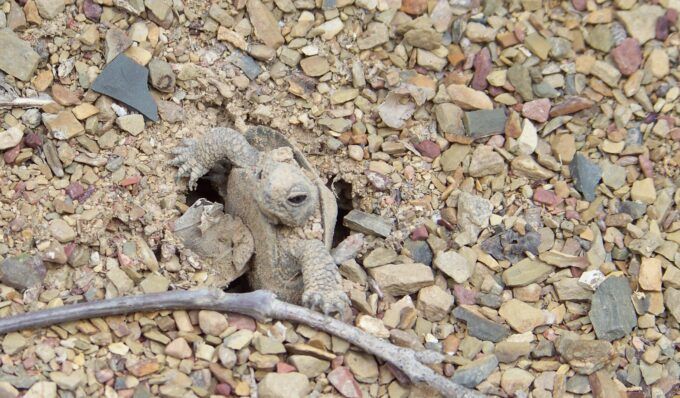
Hatchling Wood Turtle emerging from a roadside nest in Virginia

WE HAVE THE SAME CRITTER CRISIS IN ONTARIO

It’s that time of year, maybe you’ve already noticed. Animals are back and moving about and trying to reproduce. But in this age of hundreds of millions of motor vehicles going everywhere at high speeds, anybody who’s slow is vulnerable. And one of the most vulnerable to death on our highways are turtles. No matter how many times I see them crushed and lifeless on a road, it breaks my heart. It must happen hundreds or thousands of times a day in the USA. 

Nesting Females: Roads, Roadsides, Vehicles, and Predators

What makes it even worse is that a disproportionate amount of the turtles being killed are adult females. They are especially at risk because of the longer distance forays they make searching for nest sites in spring and summer [1]. Some turtles are terrestrial, such as Box Turtles and tortoises, some are amphibious, such as Wood Turtles, but most are aquatic — and they all lay eggs and nest on land. Even aquatic species such as Sliders and Cooters, and Map, Musk, Softshell, and Snapping Turtles may nest 200-550 yards from the water [2,3]. When they leave their wetlands in search of upland nest sites, they usually will have to cross at least one road. 

In addition, roadsides generally fabricate the environmental conditions sought by female turtles for their nests – open canopy, short or sparse ground vegetation, and friable soil [4]. They are attracted to roadsides for foraging and basking also. But though the physical conditions may be favorable, such sites also incur increased mortality. 

Breeding females are the ones most important to sustaining populations and the ones that populations can least afford to lose. Vehicular mortality can cause population declines and roadkill of females during the nesting season can be the most significant threat to population persistence [5,6]. The mortality to the adults can occur from not just vehicles, but also from the predators such as Raccoons who are attracted to roadsides [7]. These predators also dig up the nests and eat the eggs and the hatchlings. At one place, the proportion of turtle nests lost to Raccoon predation ranged from 63% to 100%, and this was in a “protected” area [7]. 

Population Viability

Most turtle species possesses life history traits that make populations especially vulnerable and sensitive to increased human-caused loss and mortality: slow growth, late maturity, long lives, low reproductive potential (small clutches), and high natural mortality of eggs and hatchlings (such as from predators) [8,9]. Some species, such as the northeast’s Wood Turtle, can take 15-20 years to reach maturity. And then, after reaching maturity, turtles must survive and reproduce for decades more just to replace themselves [10,11,12]. 

For turtles there is no apparent “density dependent” response operant [11]; i.e., at low population densities there is no compensatory increase in birth rate or hatchling survival. In fact, just the opposite can reasonably be expected to occur in low populations — decreases in birth rates, due to such factors as difficulty in finding mates [13], resulting in further reductions in population size.

Field studies and statistical analyses clearly show that even modest rates of death or removal (intentional or incidental) of adult or juvenile turtles can lead to strong declines in populations [14]. The loss of a very small number of turtles above natural attrition can be devastating. Turtles may not reproduce enough or survive long enough to make up for the population losses from collection, predation, habitat degradation/destruction, and being killed on roads or by logging or agricultural operations. There are limits to how much cumulative mortality and stress a population absorb and still be healthy and viable for the long term. 

Roads and Roadkill

Each and every day in America there are development and commercial activities on the ground, including more roads being built and more drivers using them. Most areas of the  East, where most turtle species reside, are already within ca. 400 yards of a road [15]. Not surprising, considering that on the landscape currently occupied by the USA, in 400 years we’ve gone from ZERO to ca. 5 MILLION MILES OF ROADS. The ecological effects of roads and/or mechanized use include erosion, air and water pollution, spread of invasive weeds, avoidance of road or machine-affected areas by wildlife, increased access for poachers and common meso-predators (e.g., Raccoons), habitat loss and fragmentation, and massive amounts of roadkill — some estimate 1 MILLION ANIMALS/DAY – and that of course doesn’t include the incomprehensible numbers of invertebrates.

Much of the problem, of course, is not the roads per se, but the vehicles using the roads. Roadkill is exacerbated due to increases in traffic volume. A probability model estimated that the likelihood of a turtle successfully crossing U.S. Highway 27 in Florida decreased from 32% in 1977 to only 2% in 2001 due to a 162% increase in traffic volume [16]. 

Wildlife Friendly Passageways and Fencing

The staggering magnitude of the day-in day-out road kill on America’s highways is a national disgrace and tragedy. Retrofitting the nation’s road system to make it much more “wildlife friendly” needs to be a priority for improving our infrastructure; such as installing fencing and wildlife crossings — overpasses and tunnels. A new Civilian Conservation Corp could put enormous numbers of people to work accomplishing this necessity. 

Making the nation’s road system much more “wildlife friendly”  is also a critical aspect for achieving real habitat connectivity and effective corridors. Hotspots of natural travelways used by fauna, as well as dispersal bottlenecks wrought by human development, have been and can be identified [17, 18]. Improving these sites by putting up fencing and providing underpasses and overpasses for animal movements can bring enormous benefits to both individuals’ survival and population viability. Barrier or drift fences with under-highway culverts to provide passageways and prevent animals’ use of roads during dispersal can dramatically reduce roadkill. Along a 0.7-km section of one north Florida highway near Lake Jackson, turtle mortality before installation of the fence was 11.9 turtles/km/day, while post-fence mortality was 0.09/ km/day, a reduction of more than 99% [16]. 

Doing this systematically and comprehensively across the nation will be one of the most important public works projects in America’s history. The corridor/connectivity issue is finally getting some of the public/political attention and funding it deserves [19]. For instance, in my home state of Virginia, I’m happy to report that the state Senate recently held a hearing on SB 455 which would create the Wildlife Corridor Grant Fund [see 20 for more on connectivity advocacy/issues in VA].

Direct Action

Until we systematically mitigate/ prevent/rectify these systemic sources of population decline, extirpation, and extinction – and even when we do –  direct action and assistance for turtles are essential. Renowned writer Sy Montgomery establishes this beautifully in her latest book, Of Time and Turtles [21]. 

Stopping your vehicle and getting turtles off of roads can make a big difference

(I move snakes off the road as well). You can usually do this without compromising your safety. Be gentle and move the turtle in the same direction it was going, as far off the road as you can place it. It doesn’t take up much of your time. 

And the turtles need all the help they can get. Please help and give them a brake. And encourage your family, friends and neighbors to do likewise. The turtles and I thank you.

Literature citations

1. Steen, D.A., J.P. Gibbs, K.A. Buhlmann, J.L. Carr, B.W. Compton, J.D. Congdon, J.S. Doody, J.C. Godwin, K.L. Holcomb, D.R. Jackson, F.J. Janzen, G. Johnson, M.T. Jones, J.T. Lamer, T.A. Langen, M.V. Plummer, J.W. Rowe, R.A. Saumure, J.K. Tucker, and D.S. Wilson. 2012. Terrestrial habitat requirements of nesting freshwater turtles. Biological Conservation 150: 121-128. 

2. Sterrett, S.C., L.L. Smith, S.W. Golladay, S.H. Schweitzer, and J.C. Maerz. 2011. The conservation implications of riparian land use on river turtles. Animal Conservation 1: 38-46. 

3. Refsnider, J.M. and M.H. Linck. 2012. Habitat use and movement patterns of Blanding’s Turtles (Emydoidea blandingii) in Minnesota, USA: A landscape approach to species conservation. Herpetological Conservation and Biology 7: 185- 195. 

4. Kolbe, J.J., and F.J. Janzen. 2002. Impact of nest-site selection on nest success and nest temperature in natural and disturbed habitats. Ecology 83: 269-281.

5. Crawford, B.A., J.C. Maerz, N.P. Nibbelink, K.A. Buhlmann, and T.M. Norton. 2014. Estimating the consequences of multiple threats and management strategies for semi-aquatic turtles. Journal of Applied Ecology 51: 359–366. 

6. Steen, D.A., M.J. Aresco, S.G. Bielke, B.W. Compton, E.P. Congdon, C.K. Dodd Jr., H. Forrester, J.W. Gibbons, J.L. Greene, G. Johnson, T.A. Langen, M.J. Oldham, D.N. Oxier, R.A. Saumure, F.W. Shueler, J.M. Sleeman, L.L. Smith, J.K. Tucker, and J.P. Gibbs2006. Relative vulnerability of female turtles to road mortality. Animal Conservation 9: 269-273. 

7. Browne, C.L. and S.J. Hecnar. 2007. Species loss and shifting population structure of freshwater turtles despite habitat protection. Biological Conservation 138: 421–429. 

8. Gibbs, J.P. and G.D. Amato. 2000. “Genetics and Demography in Turtle Conservation”, pp. 207-217 in M.W. Klemens (ed.), Turtle Conservation. Smithsonian Institution Press, Washington D.C. 334 pp.

9. Heppell, S.S., H. Caswell, and L.B. Crowder. 2000. Life histories and elasticity patterns: Perturbation analysis for species with minimal demographic data. Ecology 81: 654-665. 

10. See “feasible demography” in Seigel, R.A. 2005. “The importance of population demography in the conservation of Box Turtles: What do we know and what do we need to learn?”, pp. 6-7 in C. Swarth and S. Hagood (eds.), Summary of the Eastern Box Turtle Regional Conservation Workshop. Humane Society of the United States, Washington, D.C.

11. Congdon, J.D., A.E. Dunham, and R.C. van Loben Sels. 1993. Delayed sexual maturity and demographics of Blanding’s Turtles (Emydoidea blandingii): Implications for conservation and management of long-lived organisms. Conservation Biology 7(4): 826-833. 

12. Congdon, J.D., A.E. Dunham, and R.C. van Loben Sels. 1994. Demographics of common Snapping Turtles (Chelydra serpentina): Implications for conservation and management of long-lived organisms. American Zoologist 34: 397-408. 

13. Belzer, W. and S. Seibert. 2009. How do male box turtles find mates? Turtle and Tortoise Newsletter 13: 11–21. 

14. Reed, R.N. and J.W. Gibbons. 2003. Conservation status of live U.S. non-marine turtles in domestic and international trade. Report to US Department of the Interior and US Fish and Wildlife Service. 92 pp. Accessed at www.tiherp.org/docs/Library/Turtle_trade_report.pdf 

15. Riitters, K. and J. Wickham. 2003. How far to the nearest road? Front. Ecol. Environ. 1: 125–129. 

16. Aresco, M.J. 2005. Mitigation measures to reduce highway mortality of turtles and other herpetofauna at a north Florida lake. Journal of Wildlife Management 69: 549–560. 

17. Langen, T.A., K.M. Ogden, and L.L. Schwarting. 2008. Predicting Hot Spots of Herpetofauna Road Mortality Along Highway Networks. Journal of Wildlife Management 73(1): 104-114. 

18. Eberhardt, E., S. Mitchell, and L. Fahrig. 2013. Road Kill Hotspots Do Not Effectively Indicate Mitigation Locations When Past Road Kill Has Depressed Populations. Journal of Wildlife Management 77(7): 1353-1359.

19.  Goldfarb, B. 2023. Crossings: How road ecology is shaping the future of our planet. W.W. Norton Co., New York, NY. 384 pp.

20. Wild Virginia. 2024. “Virginia’s Habitat Connectivity Hub”

Wednesday, February 07, 2024

The Fast Car phenomenon: where has Tracy Chapman been?

Ed Power
Tue, 6 February 2024 

Tracy Chapman and Luke Combs perform onstage during the 66th GRAMMY Awards 
- John Shearer/Getty Images for The Recording Academy

It takes a special star power to eclipse Grammy winners Taylor Swift, Billie Eilish and Miley Cyrus – not to mention a grumpy Jay-Z complaining about the lack of gongs going the way of his wife, the obscure and unheralded singer Beyoncé. But that was what 59-year-old Tracy Chapman achieved when she performed her evergreen dirge Fast Car at Sunday night’s ceremony in a duet with country artist Luke Combs.

Combs’s cover of Fast Car was a huge hit last year. But there was no doubt about who had the upper hand as he and Chapman negotiated the tune on the Grammys’ stage. Gazing at his musical partner with undisguised awe, Combs could have been a stand-in for the millions watching at home, likewise blown away by the ache of Chapman’s voice and by the searing power of lyrics that remain undimmed in their ferocity after 36 years. The impact was immediate – on the back of the Grammys, the track shot to the top of the iTunes charts.

But the biggest surprise wasn’t that Chapman remains a huge talent. It was that she was in front of the cameras in the first place. In the 16 years since her last album, Our Bright Future, she has become one of pop’s great recluses. She hasn’t quite disappeared off the face of creation – three and a half years ago, on the eve of the US Presidential election, she did her bit to topple Donald Trump by performing Talkin’ Bout A Revolution on Seth Meyers’s late-night chat show.

But she has generally maintained a discreet silence and has not toured since visiting Europe in the summer of 2009. Her last UK show, to date, was at the London Roundhouse, where her set included a version of The Cure’s Love Song. And then she was gone – off into the great unknown.

Chapman is no musical eccentric in the tradition of Brian Wilson or Syd Barrett, whose retreats from the spotlight were accompanied by psychological breakdowns of varying severity. As she has grown older, it is more accurate to say that she has come to terms with the fact she is not a crowd pleaser and does not enjoy attention.

Hugely introverted, Chapman has been content to live off the music industry grid – to the point that it is unclear where the Ohio-born artist even calls home nowadays or if she is in a relationship (in the Nineties, she and writer Alice Walker were together for a number of years).


Aside from that Seth Meyers appearance, she had surfaced just once in the run-up to the Grammys – to sue rapper Nicki Minaj for sampling without her permission the track Baby Can I Hold You Now. Chapman is opposed to having her work re-used, and the dispute was settled only when Minaj agreed to $450,000.

Otherwise, she was acoustic pop’s great mystery woman. “I’m a naturally shy person – and it was a bit unusual for me to have a job that involves being in the public,” she told me in 2008, as she was preparing to embark on the first leg of that farewell tour. “I started playing in folk clubs in Cambridge and Boston, usually in front of my friends. That made it much easier. I guess as time passed I grew into it in some ways. I started to understand the business a little better – the nature of celebrity – and tried to figure out a way for it to work.”


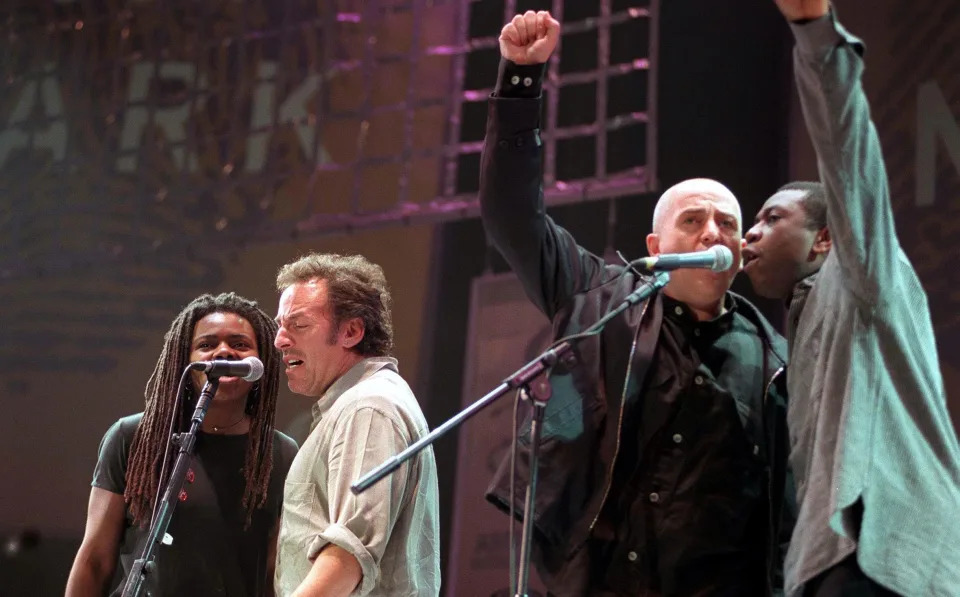
Amnesty International Charity Concert: Tracy Chapman, Bruce Springsteen, Peter Gabriel And Youssou N'Dour - Brian Rasic/Getty Images

“Figuring it out” meant making peace with the fact that, in the US, she was regarded as an anomaly: an African-American woman playing acoustic guitar. If few on this side of the Atlantic batted an eye-lid, it was an immediate talking point in the US.

“I remember people at my record label asking me why I wanted to play acoustic guitar,” she told me. “One person said to me: why aren’t you rapping? All because I was black. I used get it from my own family, too. They were perplexed by my interest in the acoustic guitar. It struck them as odd.”

It wasn’t just her family. After the release of her second album in 1989, Crossroads, Public Enemy’s Chuck D declared, “black people cannot feel Tracy Chapman”. Still, America’s racial schisms notwithstanding, she made a profound impact on the singer-songwriter genre. That is largely – though not entirely – down to the magisterial Fast Car, a downbeat ballad that makes the listener feel seven feet tall.

The tune has its origins in her working-class upbringing in Cleveland. “It very generally represents the world that I saw when I was growing up and Cleveland, Ohio, coming from a working-class background, being raised by a single mom and being in a community of people who were struggling,” she told the BBC. “Everyone was working hard and hoping that things would get better.”


Fast Car is highly symbolic. While the narrator sings about getting out of town in a hot set of wheels, that is just a metaphor for her desire for escape – Chapman isn’t auditioning for a presenter’s gig on Top Gear. “I never had a fast car,” said Chapman. “It’s a story about a couple and how they are trying to make a life together and they face various challenges.”

She wrote it while studying at Tufts University in Boston. One of her fellow students, Brian Koppelman, was the son of music publisher Charles Koppelman (Brian later became a screenwriter – penning Rounders and Ocean’s 13). Passed a tape of Fast Car, Charles was blown away by her talent. He signed her to a management deal – and immediately contacted Elektra Records.

As Chapman would recall, executives were initially nonplussed at the sight of a young black woman with a guitar. Still, they smelled a hit and paired Champan with Joan Baez / Joe Jackson producer David Kershenbaum, who worked with her on the studio version of Fast Car


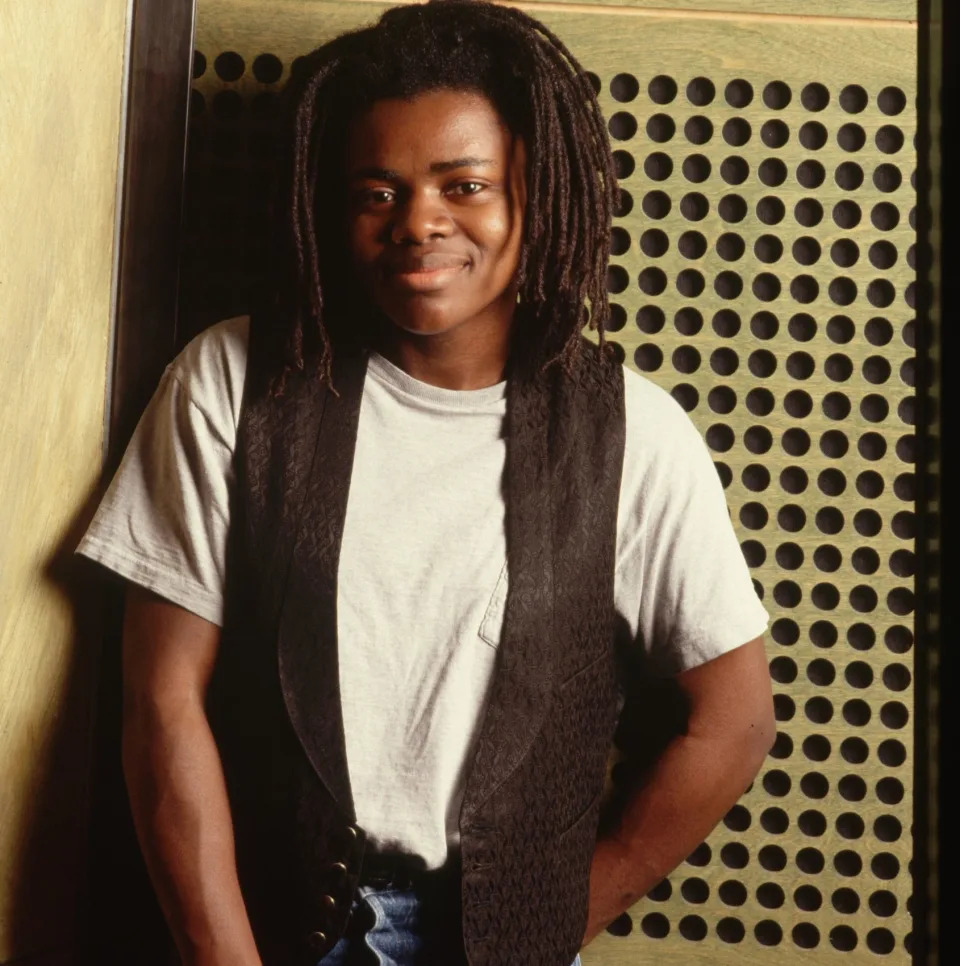
Tracy Chapman in 1992 - Getty

For all its promise, the track failed to cause a stir on its release in April 1988. Everything changed that June when Chapman appeared at Wembley for a birthday concert in honour of Nelson Mandela. As with the Grammys, it was packed with stars: Whitney Houston, Peter Gabriel and Jackson Browne. Nobody expected Chapman to outshine them.

She performed a three-song set – but did not sing Fast Car. She had gone off stage when it was revealed that Stevie Wonder, the next singer up, was delayed. She would have to go back on – and when she did, she blazed through Fast Car. Wembley was speechless. Within a month, Fast Car had blazed up the charts in the UK and the United States. A (reluctant) star was born.

There was a backlash the following year with the arrival of her second LP, Crossroads. The public wanted more Fast Cars. Chapman was not the pandering kind, and the record embraced a variety of styles – there is more piano and a “brighter”, bigger sound.


It duly reached number one in the UK, but reviews were mixed. “As an album, Crossroads is not as focused or consistent as her debut,” said the Boston Globe – which must have hurt as she was still living in nearby Cambridge at that time. There was even a push against her fanbase – “Some critics suggested that her largely white audience embraced her socially conscious message as a way to assuage their middle-class liberal guilt,” said the New York Times in 1996.

Chapman continued to write and record, but it was increasingly clear she did not crave stardom. Her true passion was social justice. She has worked with Amnesty International, produced a video for Cleveland high schools celebrating African American achievement and last April received from South Africa its highest honour, the National Order – “recognising eminent foreign nationals for friendship shown to South Africa”.

Such are the accolades she truly cherishes, it is tempting to conclude. She almost certainly values them more than gold discs or applause. The Grammys have rekindled the world’s love for Tracy Chapman, but anyone expecting her to return the sentiment may be left waiting. All the indications are that, having briefly reminded us she still exists, the Fast Car singer is set to accelerate into the sunset once again.