Showing posts sorted by date for query NFU. Sort by relevance Show all posts

Friday, January 09, 2026

Living In A House Of Dynamite: The Dilemmas Of Nuclear Decision-Making – Analysis


January 8, 2026 
 IPCS
By Dr. Manpreet Sethi

Kathryn Bigelow, an Academy Award-winning filmmaker, describes the contemporary nuclear scenario as ‘a house of dynamite’. The nine nuclear-armed states are inmates in a house (Earth), with each accumulating more dynamite (nuclear warheads) and building capabilities that could blow up the tinderbox. Bigelow’s film, A House of Dynamite, raises several uncomfortable nuclear issues that states face but prefer to push into the background in their search for more or stronger deterrence. It stirred a conversation in the US but didn’t catch much attention in India. Available on Netflix, the film merits a watch for many reasons—with several that are relevant from an Indian perspective.

A House of Dynamite starts with the detection of a missile launch from somewhere in the Pacific. Initially believed to be a test, attitudes change as defence alert levels advance once the missile is ascertained to be heading for Chicago. The confusion, chaos, pressure, and helplessness that follow in the next 18 minutes is captured from three perspectives: the White House Situation Room, US Strategic Command, and the US President. The film wisely stays away from identifying a country as the origin of the missile launch, keeping the focus on nuclear decision-making dilemmas. Given that Washington currently has multiple nuclear-armed security challengers, the fog of information is well brought out. The attacker could be Russia, China, North Korea, or even Pakistan, or a rogue captain on a submarine, or an unintentional/accidental launch. The questions the film seeks to raise aren’t about the attacker but the decisions the US has to make.

One of the major issues that the movie throws up for discussion is the value of ballistic missile defence (BMD). The decision is to shoot the missile down with ground-based interceptors (GBI). Two attempts fail. The first GBI fails to detach and falls back to earth; the second reaches the missile but doesn’t hit the target.

The depiction of BMD failure was quick to elicit a response from the US Department of War, which dismissed it as unrealistic. There is however no denying the fact that ‘hitting a bullet with a bullet’ isn’t an easy proposition, and real-life situations could be quite different from sanitised test scenarios. The US has spent as much as USD 250 billion between 1985-2023 to build systems that protect the mainland and regional allies from missile threats from North Korea and Iran. These systems don’t protect from similar threats from China or Russia who have far more sophisticated missiles.

We shouldn’t assume that the US could have neutralised the missile simply by throwing more interceptors at it. This was the simplest possible scenario, with one solitary incoming missile. In real-life, missiles could be equipped with many countermeasures. Multiple missiles or the use of multiple independently targetable warheads on one missile could cause BMD saturation. Decoys accompanying the warhead or warheads disguised in different configurations of size, reflectivity, and dynamic motion could cause confusion. Radars or sensors could be jammed or attacked, or hypersonic missiles or fractional orbital bombardment system (FOBS) could further degrade it.

BMD therefore can’t automatically help execute a ‘safe’ nuclear war. The ambitious, multi-layered Golden Dome promised by President Trump at an anticipated cost of a trillion plus dollarsenvisions interceptors in space, which would likely exacerbate the arms race with China and Russia. The latter are already taking steps to offset BMD by expanding or diversifying their nuclear arsenals. China is increasing nuclear warheads and delivery platforms and has tested FOBS. Russia is engaged in building what President Putin calls “invincible weapons.” The nuclear-armed, nuclear-powered cruise missile, Burevestnik, and the underwater nuclear drone, Poseidon, were among those tested in 2025.

There is a lesson here for India. After Operation Sindoor, Prime Minister Modi announced the Sudarshan Chakra, a multi-layered defence system that would integrate advanced surveillance, cyber protection, and physical safeguards against enemy strikes. While assurances to protect the public from missiles may seem politically correct, in reality, technologically and materially, it is an extremely demanding effort. India’s missile threat environment is complex. China and Pakistan have robust missile arsenals, having spent the last decade enhancing their missile capabilities in terms of numbers, range, accuracy, reliability, and penetrability. Both have also deployed a growing number of dual-use cruise missiles.

In such a challenging missile threat environment, an Indian BMD will have to be of high sophistication to offer even a modicum of effectiveness. This would require spending liberally on the development of a widespread network of early warning systems, deploying the requisite numbers of interceptors, dedicated cruise missile defences, as well as dogged R&D to move towards boost phase interception given the need to intercept as far away from one’s own territory as possible. Meanwhile, adversaries can be expected to build countermeasures, putting the two sides in an offence-defence spiral.

Even so, no BMD can guarantee 100 per cent success. India can’t afford astrodome protection over its entire landmass. The effort should therefore be to protect the assets most needed for buttressing credible nuclear deterrence. Such a BMD could be for limited, area-specific deployment to provide insurance against pre-meditated, mistaken, or unauthorised launches. Taking a leaf from the film, India must think deeply about its missile defence requirements.

A second issue that the film surfaces are nuclear decision-making dilemmas. As the president is loaded with information—which is nevertheless incomplete despite the US early warning network—he is faced with the critical choice of whether to ‘surrender’ by not responding immediately, or commit ‘suicide’ by approving a retaliation and then bracing for nuclear retaliation. His military commanders recommend a quick, near immediate response. With the US’ launch on warning (LOW) posture, STRATCOM warns that “if we don’t take steps to neutralise our enemies now, we will lose our window to do so. We can strike pre-emptively or risk 100 ICBMs launching our way, at which time this war will have already been lost.” The military advice is to strike at the adversary’s command centres, silos, and bombers while they’re still on the ground, eliminating their ability to take further action.

Despite the military logic, in the absence of any clarity about the attacker and intention, but the certainty of nuclear retaliation that would follow irrespective of whom the US targets, the president’s dilemma is existential. He wonders whether the attack on Chicago could be a one-off—or even an accidental launch—and if his response might lead to the loss of not just one but several American cities. He mulls whether the possibility of a “harsh public backlash” to a non-response “would still not be better than a possible counteract that could put even more US residents at risk.” So, even with a first use nuclear doctrine, the president appears inclined to wait it out—following a de facto no first use (NFU).

India has already eased this burden for the Indian prime minister through its NFU that signals response only after a nuclear attack. For those who view NFU as a passive strategy, it is worth considering whether a country with a declared first use doctrine might also find it prudent to lean towards NFU in case of uncertainty and ambiguity. The strength of the NFU is in the availability of a robust and secure second-strike capability.

Meanwhile, in contrast to LOW, an NFU also reduces the pressure of time on decision-making. In the film, the president feels overwhelmed. Indeed, one is left wondering whether nuclear command and control needs to be structured for speed in decision-making. This question will become even more critical with the integration of AI into military applications. On the one hand, this is being touted as an advantage since speedier assimilation is expected to give decision-makers more time to take a call. On the other, it would increase pressure on decision-making in order to pre-empt the adversary’s move. In having to take as momentous a decision as nuclear use, time can be more debilitating than empowering. Surprise, fear, limited information, and a self-imposed lack of time can cause tremendous strain on leadership.

A third dimension that stands out in the film is the need for channels of communication during crises. In the film, Washington is able to reach out only to Moscow thanks to the hotlines and a nuclear risk reduction centre that followed the Cuban Missile Crisis. In moments of crisis, these mechanisms help dissipate tension. The US has no such channels with China or North Korea, making it difficult to find the right avenue for communication or clarification.

In the India-China and India-Pakistan cases, military hotlines exist. They haven’t however been optimally used in all circumstances. Countries must invest in crisis communication that is technically robust, always available, and politically reliable, given that the missile flight time is far shorter in this regional context and accidents could always happen.

Finally, the film also refers, though tangentially, to the consequences of a nuclear attack. It acknowledges that the missile would result in as many as 10 million casualties in Chicago. One of the officers advises her family to “drive upwind away from any big city.” A nuclear detonation would degrade the internet, power, global financial systems, and transportation. In fact, no disaster planning can hope to cope with the consequences. And, depending on the level of the ensuing nuclear exchange, the long-term environmental, health, and food security impacts would be life-threatening.

While the film ends without showing the detonation and its aftermath, it leaves behind a deep sense of dread about what could have been. It leaves the watcher with questions that continue to preoccupy the mind much after it ends. A House of Dynamite and other films of the kind remind states of the dangers they live with in the presence of nuclear weapons. One person or a handful of people would have only a few minutes to make a decision as momentous as nuclear use. Its consequences, however, will be borne by millions for decades and over generations. To avert such a possibility, uncomfortable questions will have to be posed to and answered by our political leaders and publics. 


 About the author: Dr Manpreet Sethi is Distinguished Fellow with the Centre for Aerospace Power ans Strategic Studies (CAPSS) in New Delhi and Senior Research Advisor with the Asia Pacific Leadership Network (APLN).


Source: This article was published by IPCS
IPCS

IPCS (Institute for Peace and Conflict Studies) conducts independent research on conventional and non-conventional security issues in the region and shares its findings with policy makers and the public. It provides a forum for discussion with the strategic community on strategic issues and strives to explore alternatives. Moreover, it works towards building capacity among young scholars for greater refinement of their analyses of South Asian security.

Friday, December 26, 2025

UK Government waters down inheritance tax changes for farmers


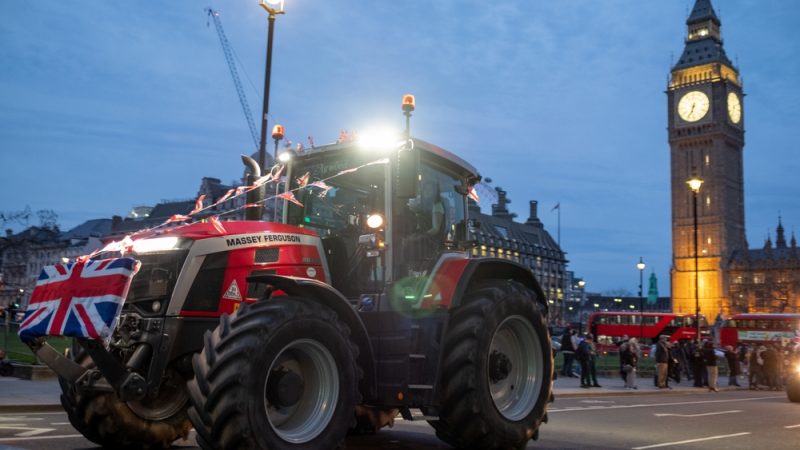
Photo: Lois GoBe/Shutterstock:

Government plans to tax inherited farmland have been watered down following months of protests by farmers and concern from backbenchers.

The individual threshold for a 20% tax on inherited agricultural or business assets will be increased from £1 million to £2.5 million when introduced in April next year.

It comes after more than 20 Labour MPs from mostly rural constituencies abstained on the proposal in Parliament earlier this month, with Penrith and Solway MP Markus Campbell-Savours losing the party whip for voting against.

The increased threshold will halve the number of estates affected by the reform to the Agricultural Property Relief (APR), from 375 to 185.

Environment Secretary Emma Reynolds said: “Farmers are at the heart of our food security and environmental stewardship, and I am determined to work with them to secure a profitable future for British farming.

“We have listened closely to farmers across the country and we are making changes today to protect more ordinary family farms. We are increasing the individual threshold from £1 million to £2.5 million which means couples with estates of up to £5 million will now pay no inheritance tax on their estates.

“It’s only right that larger estates contribute more, while we back the farms and trading businesses that are the backbone of Britain’s rural communities.”

‘Reform will give peace of mind to farming families’

Chair of the Labour Rural Research Group and MP for Suffolk Coastal has welcomed the changes and said they represent a major boost for family farms and rural businesses.

She said: “This is a crucial reform that will give real peace of mind to farming families.

“By increasing the APR threshold to £2.5 million per person, we are recognising the true value of agricultural in rural Britain, and the importance of keeping farms in family ownership.

“For couples, the combined threshold of £5 million will make a transformative difference. It means fewer families facing impossible choices, and greater certainty that farms can continue to operate, invest, and contribute to our rural economy.

“This wouldn’t have been possible if the Government hadn’t listened to rural Labour MP colleagues in the Labour Rural Research Group, to farmers, and to industry. This move shows the government is fully committed to backing working farms and our countryside  – after years of successive failures under the Conservative government that brought farming to its knees.

“This is a big step that will go a huge way to back Britain’s working farms, whilst the government takes forward wider recommendations in Baroness Batters’ Farming Profitability Review.”

NFU President: ‘Common sense has prevailed’

The National Farmers’ Union (NFU), which fought a campaign against the changes to inheritance tax for farmers, said that the increase in thresholds would come as a “huge relief to many”.

NFU President Tom Bradshaw said: “While there is still tax to pay, this will greatly reduce that tax burden for many family farms, those working people of the countryside.

“I am thankful common sense has prevailed and government has listened. I have had two very constructive meetings with Prime Minister Sir Keir Starmer and dozens of conversations with Defra Secretary of State Emma Reynolds. She has played a key role underlining the human impact of this tax. These conversations have led to today’s changes which were so desperately needed. 

“From the start the government said it was trying to protect the family farm and the change announced today brings this much closer to reality for many. I’d like to thank the Prime Minister for recognising the policy needed amending and the Chancellor for bringing in the spousal transfer in the Budget. Combined this is a significant change.

“I would like to thank all those Labour backbench MPs that were contacted by farmers and growers and decided to stand by their constituents as demonstrated by the recent abstentions on the vote on Budget Resolution 50. 

“While small in number, it was a significant and brave move for many. We have spent the past year working with them and there’s no doubt their interventions behind the scenes have also played a huge role in securing today’s news. I would also like to thank all opposition parties for continuously raising the impacts of this proposed policy.”

Macron meets French farmers in bid to defuse anger over trade deal

By AFP
December 23, 2025


French farmers have been fuming over a litany of issues, including a trade deal under negotiation between the European Union and South American bloc Mercosur - Copyright AFP/File kena betancur

French President Emmanuel Macron on Tuesday met with farmers’ unions to discuss a controversial free trade deal and the government’s handling of a cow disease that has led to protests and roadblocks.

It was the first meeting between Macron and union leaders since the start of a protest movement against a mass cull of cows to contain the spread of nodular dermatitis, widely known as lumpy skin disease.

French farmers have been fuming over a litany of issues, including a trade deal under negotiation between the European Union and South American bloc Mercosur, with any further decisions postponed to January.

“The purpose of the meeting was to try to put out the fire that is raging across the countryside,” Stephane Galais of the Confederation Paysanne union told journalists after the meeting, calling for “strong structural measures.”

“We’ve passed the ball to them. It’s in their court,” said Pierrick Horel, head of the Young Farmers union.

“What was important for us was to convey to the head of state the extreme tension that is affecting the agricultural world,” said Arnaud Rousseau, head of the main FNSEA union. “We are opposed to Mercosur.”

The EU-Mercosur pact would create the world’s biggest free-trade area and help EU members export more vehicles, machinery, wines and spirits to Latin America at a time of global trade tensions.

Farmers, particularly in France, worry the Mercosur deal will see them undercut by a flow of cheaper goods from agricultural giant Brazil and its neighbours.

Meanwhile, the culls have divided the unions, with FNSEA supporting the government’s policy under which all animals in affected herds are slaughtered.

On Tuesday, the agriculture ministry confirmed a new case of the disease in southwestern France, bringing the total number of outbreaks recorded in the country since June to 115.

Protesting farmers have for days blocked roads, sprayed manure and dumped garbage in front of government offices to force the authorities to review their policy.

The protests eased ahead of the holiday season but some farmers refused to budge. On Tuesday, motorway blockades remained in place on the A63 south of the city of Bordeaux and on the A64 in the towns of Carbonne and Briscous.

The Petty Bourgeois Farmer


A prevalent phenomenon in the Americas


Anna López and Charles T.
Jul 04, 2024


Image from the Machinefinder Blog

Who is and isn’t the working class? When you get into the nitty gritty, this is a question that confuses many newcomer leftists who may not be well read on a variety of Marxist literature and subsequently do not fully grasp the philosophy. Some people believe that other service workers, like baristas, are not representatives of the working class, yet believe that the average American farmer, rural landholders, are some of the utmost representative of the working class. We’re here to shine a light on the reality, of whose interests aligns with who, and how labor and production is distributed in this regard.
The Historical Development of Land Ownership


In slave societies and especially feudalistic societies, land was characterized by servants and serfs bound to lands who would work to generate enough produce to subside themselves as well as their overlordship or community. This was characterized by urban communities and their leadership who would demand that the peoples working the lands around them would provide food for the community, in exchange for protection and security from other communities, as well as rudimentary public services guaranteeing more free and open trade, stable currency, charity, long-term storage of goods, as well as religious institutions and consistently scheduled holidays, among other things. The political control of these lands, their trade and security, and their division, was expressed through the demarcation of and establishment of lords who obtained their lordship out of being elected leaders of their urban community, through special religious institutions, through appointment by lords of a higher agglomerate of community, or through dynastic descent, in which case they often descended originally from highly respected chiefs and warriors/soldiers who took up leadership to protect the original community and as such divided land amongst themselves, or descend from respected patricians (who were also originally elected leaders of an urban community who often also had warrior origins). This leadership, regardless of their origin, employed many practically independent artisans, merchants, and soldiers, who would help craft tools, buildings, infrastructure, ships, and defend the land and community.

As technology, the means of production developed in quality, so too did the feudal class. Polities organized into larger confederations, a larger but more clear hierarchy, and a developing sense of nationality. Ownership of land became larger and more centralized. More positions of landlordship and community leadership became positions appointed by those higher up the chain of feudal lordship; enfeoffment. This is essentially the origin of “gentrification”, in particular the landed gentry who owned large swaths of lands who had many serfs, servants, farmworkers, or even slaves, work their lands, beginning to not only generate subsistence for their community, but for other communities as well, in essence, they began seeking to generate profit and expand their power and domain. Simultaneously, the urban merchants, tradesmen, artisans, crafters and whatnot, grew in importance, began banding together forming guilds, and employing free laborers to help with their craft. Inevitably some jurisdictions even began allotting land that a free farmer or serf worked on, to said farmer and former serf, letting them privately and freely own the land they work.

With the advent of colonialism, the demarcation of territory in the Americas soon began, and Western European powers began ruling over indigenous feudal polities, conquering indigenous nomadic tribes, assimilating them, such as New Spain, or pushing them away and replacing them entirely such as the coast of South America, North America, and the Caribbean. This prevalent replacement was prolific in these locations due to their ideal locations in growing large numbers of cash crops, that is crop that is highly profitable to the landholders. These areas were characterized by the leaderships of the various European powers allotting settlers large parcels of land, whether they were newcomers seeking economic opportunity, or political and religious exiles, or from merchant families back in Europe, they were allotted these lands as long as they agreed to subdue and/or assimilate the indigenous population, maintain allegiance to the crown, and proliferate their faith and system of governance, being allowed to exist as autonomous colonial communities . This is the beginning of what we shall call a form of para-enfoeffment, in the Americas.

As these colonial communities continued to expand over territory, they began forming a greater sense of autonomy, as well a larger sense of shared identity between each other, and began consciously and purposefully pushing for greater conglomeration and centralization, autonomy, and stronger efforts to subdue indigenous communities. With greater autonomy by the small gentry, gilded merchants and artisans, from the central nobility due to the English civil war, the Spanish war of succession and other similar nearby wars in Europe (especially France, Netherlands, and lower Germany), and with the increasing antagonisms between the crown and the merchants and artisans of the Americas, and between the crown and the increasingly autonomous new landed gentry of the Americas, as a result of the ruling class of the European powers seeking further control over their colonies, in the form of controlling trade through tariffs and taxation among other things, the merchant class (early bourgeoisie) and plantation, estate, and hacienda owners began banding together with a common goal of greater political autonomy from the crown.

Much of the world’s arable land today is split between large swaths of privately owned industrialized farmland, and collectivities of small plots of land for subsistence. The Americas themselves, are characterized by a dichotomy of large swaths of public or communal land, as well as large swaths of industrialized farmland. Much of this industrialized farmland is more contiguously present in temperate regions characterized by a more continental, predictable four seasons, and black, fertile soil, such as Las Pampas region in South America of Argentina, Uruguay, and southern Brazil, as well as North America, most especially the heartland, the Great Lakes, Great Plains, and the Mississippi River Basin of the United States and Canada. These countries also have large swaths of government owned land such as natural parks, as well as military bases, land owned by various governmental and academic institutions, and indigenous community reserve lands.

More countries around Central America, from the northern Andes to Mexico, is characterized by much larger amounts communally farmed common lands. This is characterized by a much higher and more widespread prevalence of tight-nit, more food subsistence based, more traditional, and more indigenous, communities. This is a result of various struggles of land-reform, indigenous rights, and farmworker representation which led to events such as the Mexican Revolution which was a response to excessively liberal reforms. This led to the establishment of the Ejido system (communal-use lands nominally owned by the government) and Comunidads (collectively-owned land by loose indigenous communities), largely preserving the pre-Colombian communal lands common to most of rural Mexico. Of course bourgeois-liberal capitalist forces have made efforts to privatize many lands and have to a degree. Currently however, the way it works is that it is up to the community owners of communal lands to auction off their land. So most land overall remains communal however large proportions of the most fertile lands, such as in Northeastern Mexico and central Jalisco, are private, many a result of recent privitization, and many a result of pre-existing private ownership since even the establishment of the Ejido system itself.

Other countries with a largely Mixed and Indigenous population, such as Guatemala, El Salvador, Ecuador, Peru, Bolivia, among some others, have similar systems in place. There is criticism of these systems from the left and indigenous as well, who argue that these systems do not go far enough in protecting communal lands and indigenous land rights. Of course that makes Bolivia the most ideal in this regard for other states to emulate, as Bolivia is a plurinational semi-socialistic civilization state which guarantees autonomy to all ethnic groups and the land they reside on.

Other countries in the Americas, primarly the U.S., Canada, Brazil, Argentina, Uruguay, and Chile, instead of having a history of liberal assimilation and Mestizaje (encouraged or forced race mixing), and indigenismo, they have a history of displacement, genocide, war campaigns, and mobilizing European immigrants to settle the land, pacify the indigenous, and contribute to the New Economy. This leads to vary organized and large grid-like swaths of land all privately owned by individuals and corporations. Now, every country in the Americas has various different and unique policies regarding indigenous people and the Amerindian race, however the historical generalization between these two paragraphs remains largely correct.


The Petty-Bourgeois Nature of Private Farmers


The first and most essential characteristic of their petty-bourgeois nature is their relations to the means of production. They own their own capital and control their own means of production, regardless of whether they work their land alone with their family, or hire farmworkers. Though, it is worth mentioning that those own large swaths of land and employ many farmworkers (illegal, legal or otherwise), are ostensibly bourgeoisie, likely beyond mere petty-bourgeoisie.

These modern farmers are distinguished from old farmers, or rather peasants by the fact they do not produce for their own means of food subsistence, but rather produce to provide to the market, which in return generates them income, profit, which in essence is their true means of actual subsistence, living off this income and using it to provide for all their own means of actual subsistence, shelter, clothing, ulilities, and a variety of food. Furthermore, they are distinguished by the proletariat by the fact they control their own means of production and make a living, their means of actual subsistence, off of selling their product to the market in general, rather than proletarians, including farmworkers, who make their living, their means of actual subsistence off of selling their labor, recieving an income, a wage from their employer, which they then use to purchase all their necessities to subside themselves; food, shelter, clothing, utilities and whatnot.

Now, some have the erroneous belief that farmers are not petty-bourgeois, but rather an independent, stratified and “free” section of the working-class. The primary reasoning behind this belief is generalized anecdotal thought that because farmers take out loans for their equipment, home, and storage among other things, and that because society is primarily governed by the big bourgeoisie who control industrial capital and finance capital, that the farmers don’t truly own their means of production and therefore are merely a free and independent working-class producing for the general bourgeoisie of society and being alloted a wage by that society in general of which their actual means of subsistence is sourced. Aside from the fact of this notion of the degree of legal and financial ownership by farmers of their means of production is a generalization and anecdotal not based on any particular statistics, it can still be regarded as factually true for many farmers. Regardless, however of the degree of legal and financial ownership of their means of production, it is still their means of production.

We as Marxists must remember we see things through the relations to the means of production, through general political and economic control of society, not merely a piece of legal paper that declares one’s ownership over something. The majority of farmers of America, Canada, Brazil, Argentina, Uruguay, Chile, and to varying degrees in the rest of the Americas and outside of it (especially Europe), who are petty-bourgeois, own, in the sense they control and utilize their own means of production. Ultimately going back to the point that their source of actual subsistence is the product they produce for the market, using their means of production, which includes their machinery and may or may not include farmworkers.

Another characteristic which makes them of a bourgeois nature, and is the source of their independentness (not some kind of independent and “free” working-class, but their nature as independent and petite, bourgeoisie), is their collective unification and shared interest across their industry, its profitability, and their ability to negotiate with big bourgeoisie and society at large guaranteeing being paid fairly for their labor and product. One may rationalize and reduce their negotiating ability as merely a result of the fact they produce food, which is essential to the continued proliferation of society; however this is not dialectical thinking. Ultimately, the petty-bourgeois farmers are a massive subsect of society and the bourgeoisie as a whole, and as such they are alotted by the big-bourgeois apparatus the ability to form networks of farmer cooperatives so that farmers can protect their individual interests and independent nature whilst negotiating and maintaining their rate of profit from society as a whole. On the flip side, this is also the source of their often reactionary nature and political stances, as ultimately they align with the big bourgeoisie to crush farmworker unions, to maintain their rate of profit and the proliferation of their product, as the petty-bourgeois farmer who produces the raw food, and the regular bourgeoisie who cuts it up, mixes it together and packages it (a form of light-industry), are ultimately aligned in holding onto their way of living, pushing their product, exploiting the proletariat, and subsequently maintaining their rates of profit.

These petty-bourgeois farmers are largely descendant of settlers, either literally or figuratively, in the sense that ultimately they are alotted land and independence by the bourgeois state and function as the civilian frontline of the settler-colonial and bourgeois state apparatus and the territorial integrity of such; para-enfeoffment. Subsequently they align with the bourgeois state, to maintain their way of living as strictly as possible, and that is the primary essence of their reactionary politics. The control over their land is largely disimilar from proletarian American homeowners, who continue to be pushed out of the housing market as property is bought up by big landlords and corporations. The petty-bourgeois farmers maintain their farmer cooperatives and ownership over their land, and continue to support reactionary policies to prevent the linear historical progress of capitalism and the centralization of rural production.

At most, private individual landowners, the farmers, due to employing farmworkers, and especially due to increasingly more efficient and automated equipment, buy and hold larger swaths of land. Yet they maintain their control and will continue to support reactionary policies to do so, to prevent the centralization of their rural production, by either corporations, or of course by the proletariat of society as a whole. The latter of which is fundamentally the goal of socialism, where food is not expected to be profitted off of and its price controlled, the proletarian state ultimately controls and owns all land, and remaining farmers become proletarianized, operating the machinery alloted to them by the proletarian state, and working, selling their labor and producing for their actual cooperative and for society as a whole, and not for profit.


Thanks for reading The Pan-American Journal! Subscribe for free to receive new posts and consider a paid-subscritpion to support our work.


Friday, April 18, 2025

Why British Farming needs a YIMBY revolution

15 April, 2025 
Columnists
Left Foot Forward Opinion

Amid economic uncertainty we should be doubling down on domestic production, especially in farming  

.

While Britain finds itself caught in the crosshairs of escalating global trade wars – facing new tariffs from the United States and navigating complex post-Brexit trade dynamics with the European Union, amid grave economic uncertainty, we should be doubling down on domestic production, especially in farming. However, instead of bolstering British agriculture to shield ourselves from volatile global markets, our political class and local councils are doing the exact opposite: strangling investment, blocking innovation and pandering to anti-growth NIMBYs.

Nowhere is this more shameful than in Norfolk, where plans for modern, efficient farms — proposals that would have improved animal welfare, bolstered food security, and lowered food prices — were thrown out by a blinkered council and cheered on by Labour’s own anti-growth MP, Terry Jermy.

Jermy warns that the industrialisation of UK farming would have an adverse impact on the local environment, including on wildlife, as well as causing climate change, water and air pollution.

Let me be blunt: this kind of petty, populist grandstanding is exactly why Britain struggles to feed itself. It’s why we still import nearly half our food. It’s why British farmers are demoralised and disinvested — because instead of being backed, they’re being blocked.

The Facts: UK Self-Sufficiency Is in Freefall

According to the NFU, UK self-sufficiency in food production now languishes at just 62% — a number that continues to drop. In pork, the situation is even worse. DEFRA data shows that UK production to supply ratios of both pork (62%) and poultry (82%) is in decline, meaning we are becoming ever more reliant on imports. Much of it from EU countries with lower animal welfare standards and a higher risk of disease.

In other words: we reject British farms trying to do things right — then turn around and import meat from countries doing it worse.

Rejected Farms, Rejected Common Sense

The Norfolk “megafarm” proposals weren’t crude, cruel factories. These were 21st-century agricultural investments — cleaner, more efficient, and designed to improve animal welfare and reduce environmental impact. They included innovations in manure management, lower transport emissions, better feed systems, and localised supply chains.

Yet despite this, the schemes were smacked down by West Norfolk Council — celebrated by Labour MP Terry Jermy, who has made a career out of posing as a champion of the countryside while doing everything in his power to sabotage rural investment.

His rhetoric about “casting doubt” on Labour’s commitment to farming isn’t just weak — it’s hypocrisy in action. He had a chance to stand with farmers. Instead, he stood with the pitchfork-waving anti-growth mob. Not to mention even having the gall to attack plans for solar farms as a risk to undermining the country’s food security, all the while simultaneously opposing the expansion of a 60 year old farm that would have improved self-sufficiency while increasing higher welfare standards.

It was a decision mired in the old adage of classic NIMBYism. Eco-warrior climate campaigners from Sustain railed against the “extractive system of food production that poses a serious threat to human health”. Jake White from WWF described it as an “unsustainable megaform”, hailing the rejection as a “well-deserved win”. NIMBY MP Jermy – called it a “victory for local people and the environment”. All in all a sad day for growth.

Cranswick’s application was refused because it allegedly failed to demonstrate the development “would not result in significant adverse effects on protected sites”. This all despite it’s main objective being to produce more British food to higher welfare standards through the redevelopment of existing farms.

The scheme had faced 15,000 objections, 90 per cent of which came from outside the local area. Objections came from as far as Rome, Lisbon, Calgary and California. A gold-plated example of the insanity of embedded in the British planning consultation system.

Disease Is a Real Threat — And NIMBYs Are Making It Worse

Across Europe, African Swine Fever (ASF) continues to spread, with outbreaks in Italy, Germany, and Eastern Europe hammering local herds and disrupting trade. Foot-and-mouth disease has seen a resurgence, with parts of Asia and Africa on high alert. An issue made ever more prescient with the UK government recently banning personal meat imports to protect British farmers.

If a major outbreak were to hit the UK again — like in 2001, when 6 million animals were slaughtered and the economy lost £8 billion — the last thing we’d want is an over-reliance on imports. Tourism, rural economies, trade routes — all would suffer. And thanks to short-sighted decisions like Norfolk’s, we’d be more vulnerable than ever.

We need strong domestic herds, raised to high standards, on British soil — not a hollowed-out industry shackled by red tape and NIMBY neuroses.

Let’s Talk Manure — and Why You Should Care

Yes, manure. Because sustainable manure storage is key to improving soil health, reducing runoff, and cutting carbon. But EU data shows that manure storage investments are declining — and the UK’s own Defra survey confirms it: planning issues are one of the main barriers stopping farmers from building adequate slurry stores.

That’s right — the same planners who say “nutrient neutrality” is a priority are also blocking the infrastructure needed to actually manage nutrients. You couldn’t make it up.

Worse still, nutrient neutrality rules — driven by flawed thinking and environmental performatism — are holding up over 160,000 homes in the UK. Farmers have controversially received exemptions from nitrogen vulnerable zones, but the sheer inconsistency in planning policy means farmers can’t invest in the infrastructure that would help solve the very problem these rules pretend to tackle.

The Phosphate Farce: Importing What We Waste

Here’s the kicker: while we import over 170,000 tonnes of phosphorus annually, primarily from countries like Russia, China and Morocco, we simultaneously allow valuable nutrients from animal manure to pollute our rivers due to inadequate storage and management. This is despite 60 per cent of phosphorus being found in poultry diet ingredients, with only 10 per cent digested.

Hence why agricultural runoff, rich in phosphates, is argued to be a major contributor to the degradation of UK rivers, leading to algal blooms and the death of aquatic life.

Instead of investing in infrastructure to recycle this nutrient through anaerobic digestion for biofuel or as fertiliser, planning restrictions and NIMBY objections stifle progress. It’s a ludicrous cycle of importing what we already have and wasting it due to bureaucratic inertia.

The Bottom Line: Planning Is Broken, and Anti-Farmer NIMBYs Are Winning

What we’re seeing is a systematic failure of political and planning leadership. MPs like Terry Jermy talk a big game, but when it comes to standing up for rural jobs and British food, they fold like cheap lawn furniture.

But who pays the price? British consumers, stuck with rising prices and inferior imports. British farmers, denied the tools and permissions to grow and thrive. British rural communities, denied investment, jobs, and economic dynamism.

Back The Farmers Not The Blockers

British farming does not need another timid councillor hiding behind a planning policy – it needs a YIMBY revolution armed with a muck grab and a sense of urgency.

Yes to smart barns and local meat. Yes to modern welfare standards that beat anything we import. Yes to proper slurry storage – not because it is pretty, but because pretending nutrients vanish if you block a shed is peak bureaucratic blob fantasy.

And yes – loudly – to skewering the MPs who would rather chase headlines in the local press over food security. And skewering the councillors who treat the countryside like a museum curated for triple-lock retirees – who have nothing more than strong de-growth opinions that facilitate managed national decline.

This is no longer a mere policy debate. It is a farce. We are importing phosphates we force farmers to dump, banning infrastructure they need, and then wondering why our rivers are full and prices of meat become ever more expensive.

Remember that Anti-Farmer NIMBYs are not guardians of the countryside – they are its undertakers. So yes – it is time to pick a side. Are you with the people growing the food, managing the land, and investing in a secure and sustainable Britain? Or are you still backs-slapping councillors who think a chicken shed is the end of civilisation.

Because if that is your idea of progress – do not be surprised when there is nothing left on the plate but foreign meat, foreign welfare standards, and the bitter taste of a country that forgot how to feed itself.


Chris Worrall is a housing columnist for LFF. He is on the Executive Committee of the Labour Housing Group, Co-Host of the Priced Out Podcast, and Chair of the Local Government and Housing Member Policy Group of the Fabian Society.

Thursday, December 12, 2024

REPEAT AFTER ME; 


Japanese survivor of atomic bomb recalls its horrors in Nobel Peace Prize acceptance speech

A Japanese man who lived through the American atomic bombing of Nagasaki has accepted this year’s Nobel Peace Prize on behalf of an organization of survivors


ByFANNY BRODERSEN Associated Press and VANESSA GERA Associated Press
December 10, 2024


OSLO, Norway -- A 92-year-old Japanese man who lived through the American atomic bombing of Nagasaki described on Tuesday the agony he witnessed in 1945, including the charred corpses of his loved ones and the ruins of his city, as he accepted this year's Nobel Peace Prize on his organization's behalf.

The prize was awarded to Nihon Hidankyo, a grassroots movement of Japanese atomic bombing survivors who have worked for nearly 70 years to maintain a taboo around the use of nuclear weapons. The weapons have grown exponentially in power and number since being used for the first and only time in warfare by the United States on Nagasaki and Hiroshima in 1945.

The bombings pushed Japan to surrender to the Allies. They killed some 210,000 people by the end of 1945, but the full death toll from radiation is certainly higher.

As the survivors reach the twilight of their lives, they are grappling with the fear that the taboo against using the weapons appears to be weakening. It was a concern expressed by the 92-year-old-survivor, Terumi Tanaka, who delivered the acceptance lecture in Oslo's City Hall to an audience that included Norway's royal family.

“The nuclear superpower Russia threatens to use nuclear weapons in its war against Ukraine, and a cabinet member of Israel, in the midst of its unrelenting attacks on Gaza in Palestine, even spoke of the possible use of nuclear arms,” Tanaka said. “I am infinitely saddened and angered that the nuclear taboo threatens to be broken.”

That concern drove the Norwegian Nobel committee to award this year's prize to the Japanese organization, though it had honored other nuclear non-proliferation work in the past.

Jørgen Watne Frydnes, the chair of the committee, said in introducing the laureates that it was important to learn from their testimony as the nuclear dangers grow.

“None of the nine countries that possess nuclear weapons — the United States, Russia, China, France, the United Kingdom, India, Pakistan, Israel and North Korea — appear interested in nuclear disarmament and arms control at present,” he said. “On the contrary, they are modernizing and building up their nuclear arsenals.”

He said the Norwegian Nobel Committee was calling upon the five nuclear weapon states that have signed the Treaty on the Non-Proliferation of Nuclear Weapons — the U.S., Russia, China, France and the U.K. — to take seriously their obligations under the treaty, and said others must ratify it.

“It is naive to believe our civilization can survive a world order in which global security depends on nuclear weapons,” Frydnes said. “The world is not meant to be a prison in which we await collective annihilation.”

In his speech, Tanaka described the attack on Nagasaki on Aug. 9, 1945, three days after the first bomb was dropped on Hiroshima.

He recalled the buzzing sound of a bomber jet followed by a “bright, white light," and then an intense shock wave. Three days later, he and his mother sought out loved ones who lived near the hypocenter.

“Many people who were badly injured or burned, but still alive, were left unattended, with no help whatsoever. I became almost devoid of emotion, somehow closing off my sense of humanity, and simply headed intently for my destination,” he said.

He found the charred body of an aunt, the body of her grandson, his grandfather on the brink of death with severe burns and another aunt who had been severely burned and died just before he arrived. In all, five family members were killed.

He described the efforts of survivors to use their experiences to try to abolish nuclear weapons for the sake of humanity, and to try to receive compensation from the Japanese state, which started the war, for their suffering.

“I hope that the belief that nuclear weapons cannot — and must not — coexist with humanity will take firm hold among citizens of the nuclear weapon states and their allies, and that this will become a force for change in the nuclear policies of their governments,” he said.


Nobel Peace Prize winners urge young people to fight against nuclear weapons

Tue Tuesday 10 December, 2024

Terumi Tanaka, a survivor of the Nagasaki atomic bombing in 1945, accepted the Nobel Peace Prize on behalf of Nihon Hidankyo, an anti-nuclear organisation. 
(AP: Kin Cheung)

In short:

A group of Japanese atomic bombing survivors have been awarded the 2024 Nobel Peace Prize at a ceremony in Oslo.

Terumi Tanaka, the co-chair of the Nobel laureate group Nihon Hidankyo, called for young people to take up their fight against nuclear weapons.

He warned that threats in Ukraine and Gaza to use nuclear weapons were undermining the group's mission of creating a nuclear-free world.


A Japanese atomic bomb survivors' group has urged young people to take up the fight for a nuclear-free world while accepting this year's Nobel Peace Prize.

Nihon Hidankyo, a grassroots movement of survivors of the 1945 nuclear bombings of Japanese cities Hiroshima and Nagasaki, is campaigning for a world free of nuclear weapons using witness testimony.

Nihon Hidankyo's ranks are dwindling with every year. The Japanese government lists around 106,800 survivors of the bombings, also known as "hibakusha", still alive today. Their average age is 85.

"Any one of you could become either a victim or a perpetrator, at any time," Terumi Tanaka, 92, told the audience.

"Ten years from now, there may only be a handful of us able to give testimony as firsthand survivors. From now on, I hope that the next generation will find ways to build on our efforts and develop the movement even further."

Mr Tanaka's group had "undoubtedly" played a major role in creating the worldwide standard that it was unacceptable to use atomic weapons, or 'nuclear taboo', he said. But he warned that standard was being weakened.

"In addition to the civilian casualties, I am infinitely saddened and angered that the 'nuclear taboo' risks being broken," he said.


Terumi Tanaka, Shigemitsu Tanaka, and Toshiyuki Mimaki accepted the Nobel Peace Prize at a ceremony in Oslo. (AP: Kin Cheung)

Nihon Hidankyo was also represented at the ceremony by its two other co-chairs, Shigemitsu Tanaka, 84, and Toshiyuki Mimaki, 82.

An estimated 210,000 people died, either immediately or over time, as a result of the bombs dropped in August 1945 on Hiroshima and Nagasaki. Today's nuclear weapons are far more powerful than those used at that time.

Mr Tanaka was 13 years old at the time of the Nagasaki bombing, and although he survived the explosion almost unharmed at his home some 3km from ground zero, he lost five family members and recalled the harrowing experience.

"The deaths I witnessed at that time could hardly be described as human deaths. There were hundreds of people suffering in agony, unable to receive any kind of medical attention," Mr Tanaka told the audience.


"I strongly felt that even in war, such killing and maiming must never be allowed to happen."
Group warns of nuclear weapon threats

Mr Tanaka expressed concern over threats to use nuclear weapons in the ongoing wars in Ukraine and Gaza.

"There still remain 12,000 nuclear warheads on Earth today, 4,000 of which are operationally deployed, ready for immediate launch," Mr Tanaka said.

In 2017, 122 governments negotiated and adopted the historic UN Treaty on the Prohibition of Nuclear Weapons (TPNW), but the text is considered largely symbolic as no nuclear power has signed it.


THE GANG OF FOUR
Ambassadors from Russia, China, Israel, and Iran were not present at the ceremony.
 (AP: Kin Cheung)

While all ambassadors stationed in Oslo were invited to Tuesday's ceremony, the only nuclear powers in attendance were Britain, France, India, Pakistan and the United States. Russia, China, Israel and Iran were not present, the Nobel Institute said.

Expressing concern about the world entering "a new, more unstable nuclear age", Norwegian Nobel Committee chairman Jørgen Watne Frydnes warned that "a nuclear war could destroy our civilisation".

"Today's nuclear weapons ... have far greater destructive power than the two bombs used against Japan in 1945. They could kill millions of us in an instant, injure even more, and disrupt the climate catastrophically," Mr Frydnes said.

Reuters/AFP


Nuclear War: How Western Media Preps The World – OpEd


By 

Recent modification by the Russian government of its nuclear doctrine has given rise to a wave of news reports and analysis by western media that appears less concerned about the application of the updated doctrine than to tell the world that anything the Russians may want to do in its militarism, the West can do better.


In a 2020 decree, well before its invasion of Ukraine in 2022, Russia had warned that it may use nuclear weapons in case of a nuclear attack by an enemy or conventional attack that threatened the existence of the Russian state. This doctrine – enacted well before the war with Ukraine in 2022 – did not cause concern as it mirrored a similar if unpublicised doctrine of the United States and its western allies.

A later version of this decree proposed in September 2024 for a broadening of the threats under which Russia would consider a nuclear strike. It also included Belarus, an ally, under Russia’s nuclear umbrella and the warning that a rival nuclear power supporting a conventional strike on Russia or its ally would also be considered to be attacking it.

Since then there has been a worsening of the war situation in Ukraine with President Biden’s approval of the use of US long range missiles to strike targets within Russia. This was responded to by President Putin signing into law the earlier proposed September changes. To remind the West of the new red lines, Putin approved the launching of a potentially nuclear warhead carrying missile into Ukraine. Nicknamed ‘Oreshnik’, the hypersonic missile is capable of carrying six nuclear warheads and reaching its targets in Europe in 15-30 minutes.

Western Media Response to Oreshnik

Much of the reaction in western media circles, war analysts and think tanks has been not only to pour cold water on Russia’s capacity to begin a qualitatively new and more destructive phase of military combat. The Ukrainian  newspaper. The Kyiv Independent, argued that Russia is engaged in a psych and propaganda offensive to create a climate of fear and scare Ukrainians and the West into submission (https://kyivindependent.com/oreshnik-strike-propaganda/)

Quoting The Moscow Times, a pro-west  paper, the paper claimed that the propaganda offensive was coordinated between government, military, and intelligence officials, as well as PR experts as a response to the West’s decision to permit Ukraine to strike inside Russia with US and ally ATACM missiles (Army Tactical Missile System).


Although the US has said that it will not change its nuclear posture despite the lowering of the Russian threshold, western media have begun a counter propaganda offensive aimed at heightening condemnation of the Russian measures. At the same time a more intensive propaganda campaign is now ongoing amongst the wolf warrior forces of the west to impress western public on the ability of the US to successfully conduct a nuclear war.

Engaged are also more reputed western media channels intent on increasing their readership by putting up the nuclear war subject in their front page whilst assigning the blame for the start of any nuclear war to the enemies of the West.

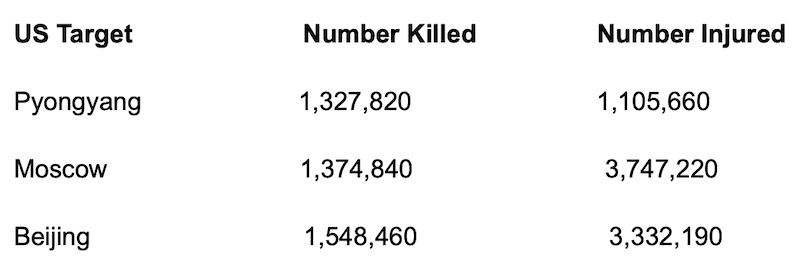
For the ‘benefit’ of its Asian readership, the latest report by American weekly, Newsweek, which claims a large multicultural audience and ‘fair and independent’ journalism, provides detailed maps of the impact of a US initiated nuclear war in Asia. The report starts off with the following lead statement which is intended to absolve the US from responsibility in any of the wars taking place.

“The U.S. is inadvertently involved in multiple conflicts around the world in backing its allies, while also facing tensions with China over several issues including trade.”

According to the report casualties, in an US initiated first nuclear strike, would be of the following magnitude:

What is especially noteworthy in the report is that it is a follow up to initial modelling of the casualties likely from a Russian nuclear strike against the US and NATO capitals. This appears to give the impression that the magazine is fair in its reportage although the emphasis on the American ‘inadvertent involvement’ in multiple conflicts clearly exposes the paper’s real intentions.

The impact of such obviously slanted and clearly mischievous journalism is not only to play up the war fantasies of the forces and lobbies of war in the US and NATO. It is also to desensitize and harden the public into acceptance of the lives to be paid for in any nuclear conflict; and to justify this by assigning blame and responsibility to Russia, China and North Korea.

Policy of NFU on Nuclear Weapons

Most important and crucially missing from the current news reports and analysis on the possibility of a nuclear war taking place is discussion on the policy of first use of nuclear weapons (NFU). For now, China and India are the only two nuclear power countries that have formally committed to a no first use policy. In 1964, following the detonation of its first atomic bomb, China declared that it would never be the first to use nuclear weapons. Today it is the only nuclear-armed nation with an unconditional policy of NFU of nuclear weapons.

In contrast the US and NATO, and its member states of France and the United Kingdom, have repeatedly spurned demands from their public to commit to a NFU policy, thus showing a policy intent not only aimed at deterrence but also to warfighting and first strike.

Media and other stake players committed to preventing a nuclear conflict would do well to highlight the importance of all nations in subscribing to NFU. This would be a more constructive and worthwhile subject for their front pages than what they are now focusing on to prevent a nuclear holocaust.


Lim Teck Ghee

Lim Teck Ghee PhD is a Malaysian economic historian, policy analyst and public intellectual whose career has straddled academia, civil society organisations and international development agencies. He has a regular column, Another Take, in The Sun, a Malaysian daily; and is author of Challenging the Status Quo in Malaysia.