When my book Technofeudalism was published, I had not imagined that it would be embraced by the likes of Steve Bannon but I had fully anticipated a barrage of criticism from Marxist thinkers, especially in response to the book’s provocative subtitle (What Killed Capitalism). Conceived as a Marxist analysis of the present historical moment, but written for a broader audience, a presentation of its thesis tailored for Marxist readers was always on the cards. Now, three years and several critical reviews later, the Marxist case for the technofeudal hypothesis can be outlined.2
The centrality of capital accumulation as the force driving modern societies lies at the heart of Marxist economics. Bypassing moralistic censure or portrayals of capitalism as a system dependent on sleaze, pilfering, injustice and brute force, Marx chose to study capitalism in its purest form. Depicting it as an alien force with its own logic and a supernatural compulsion to reproduce itself through the commodification of everything, he focused on capital, its nature, the process by which it accumulates and, importantly, the extractive powers it bestows upon its owners in the context of a vicious class struggle. Today, any analysis that purports to pursue this task must do likewise.
In this vein, it is incumbent upon Marxists to focus on a brand-new variant of capital whose proliferation weighs heavily on our twin tasks of interpreting and changing the world. I call it cloud capital: networked machines that produce no commodities but generate enormous rent-extractive powers, on behalf of their owners, through interfacing directly with us, outside anything that can be usefully described as a market. Studying this fascinatingly novel form of capital must surely be every Marxist’s burden, regardless of whether one agrees with my hypothesis that cloud capital has transformed capitalism into what I call technofeudalism.
To expedite a fruitful debate, I begin by correcting three misunderstandings regarding cloud capital’s impact and my technofeudal hypothesis. First, I am not arguing that cloud capital’s emergence has returned us to feudalism (Section 1). Second, the proliferation of rents is nothing new to capitalism (Section 2). Third, I also dismiss as an unhelpful form of data fetishism the belief that data is the new ‘land’ from which a new technofeudal class derives its extractive powers (Section 3).
With these three red herrings cast aside, there is a clear path toward a Marxist analysis of cloud capital (Section 4), its withering effect on markets (Section 5), its deployment of influencers and unwaged labour (Section 6), its
It is incumbent upon Marxists to focus on a brand-new variant of capital whose proliferation weighs heavily on our twin tasks of interpreting and changing the world.
impact on business cycles and long term crises (Section 7), the manner in which AI enhances its monetary, geopolitical and ideological footprint (Section 8) and, finally, how it informs revolutionary politics. Only in the conclusion do I return to the question of semantics: Is Marxist theory and politics helped or hindered by referring to the current socioeconomic mode as ‘capitalist’ or ‘technofeudal’?
1. No, we are not returning to feudalism
To dispel a common misconception, the technofeudal hypothesis never implied that history had gone into reverse, heading backwards towards a technologically advanced version of our medieval past whence capitalism emerged. On the contrary, driven by unbridled capital accumulation that begat astonishing machines capable of interfacing directly and dialectically with us, history is hurtling forward towards an entirely new socio-economic mode of production, distribution, exchange and communication, within which capital is more dominant than ever before — a mode I term ‘technofeudalism’.
Nor do I claim that wealth now accumulates chiefly in the form of rents lazily extracted from owning passive assets (land, fossil fuels, intellectual property or, indeed, our stolen data), as was the case under feudalism. No: wealth grows exponentially in the form of returns to gigantic investments in dynamic assets: extraordinary machines that cost Big Tech multi-trillion-dollar investments to develop, manufacture, install and update. In this sense, sprawling conglomerates like Alphabet, Microsoft, Meta, Apple et al are capitalist enterprises driven as ruthlessly as Edison, Westinghouse and Ford once were.
So, why is this not just digital capitalism,3 hypercapitalism, 4 computerised capitalism,5 rentier capitalism,6 platform capitalism,7 or surveillance capitalism?8 Before answering, it is helpful to return to the rich vein of insights on capitalism’s dalliance with economic rent, rent-seeking and other forms of wealth accrual that fall outside pure capitalist market competition.
2. Rents are endemic to capitalism
Capitalism never existed, and could not have done so, in the pure form we encounter in the neoclassical textbooks or in the writings of Adam Smith. Like our bodies, that rely on residual serpent DNA to function, capitalism’s genotype needed remnants of feudalism to replicate. Early on, David Ricardo9 warned that, as markets expand and capital accumulates, ground rent not only survives profit’s triumphant march but, indeed, grows dangerously fast, gobbling up increasing portions of an economy’s surplus. In time, rent not only grew in magnitude but also divided and multiplied, spawning different types – all part and parcel of capitalism’s dynamically expanding domain. In short, from its inception, actually existing capitalism was rentier capitalism.10
When capitalism’s monopoly phase arrived on the coattails of electromagnetism, resulting in the networked conglomerates of the early 20th century, ground rent was overshadowed by what Paul Baran and Paul Sweezy termed monopoly surplus,11 a form of rent accruing to concentrated industrial capital. Instead of a steady collection of rents on static assets (e.g., land or patents), the entire profit-generating process of conglomerates like Ford, General Electric, Boeing and Walmart had augmented surplus value extraction with a vast rent-seeking enterprise founded on three capacities: restricting output; generating new demand via marketing and advertising, the so-called attention economy; and, enlisting an army of bureaucrats, marketeers, scientists and engineers comprising what Galbraith called the Technostructure.12
Bred during the War Economy, and fledged fully during the Bretton Woods era, this broad cross-sector professional class blurred the lines between government and corporate officials. It moved through a ‘revolving door’ to create a symbiotic network that directed state power — through defence contracts, favourable regulations, and intellectual property (IP) law —to protect and subsidise the market dominance of conglomerates. Thus, the accumulation of massive monopoly rents, on top of economic profits, was not merely a market phenomenon; it was the result of a collaborative, planned effort between the corporate branch of the Technostructure and its apparatchiks within the state apparatus.
In Marxist terms, along with the development of the attention economy, the Technostructure empowered big business to obtain substantial surplus value produced by smaller firms elsewhere in the economy. Monopoly power, Marx explains in Capital, Vol. III, creates barriers that restrict the free flow of capital into its sphere. These barriers take very different forms (for instance, patents, intellectual property, network effects, advertising or sheer economies of scale) but their effect is the same: to extract surplus that does not correspond to value created on their premises.
In Marx’s own account, this extra net revenue is a ‘transfer’ or a ‘deduction’ from two sources: first, from the surplus value of other capitalists operating in more competitive sectors (who must, also, pay inflated prices for inputs); and second, from the suppression of workers’ real wages (when the good produced by the monopoly is a consumption necessity). In short, big business uses its market power to prevent the equalisation of the rate of profit across the economy and to accumulate surplus value produced elsewhere at the expense both of other capitalists and the working class.13
Once Bretton Woods was jettisoned, as it had to be after the United States became a deficit economy, financialisation became inevitable and neoliberalism emerged as its ideological cover.14 Thus mountainous financial rents were grafted on to pre-existing forms of rent (ground, IP, monopoly etc.), to the point that it became not just legitimate but urgent to speak of dispossession as almost overwhelming accumulation15 of the overshadowing of productive capital by what Marx defined as fictitious capital,16 of the finance curse;17 of asset-manager autocracy;18 and so on.
But, if rent’s growth and proliferation, along with its profound impact on the nature and character of capitalism, is not reason enough to look beyond capitalism in order to understand the world we live in, then what is? Some suggest that our data has become the new privatised, fenced-off, land out of which a new feudal power has sprung. I am not one of them.
3. Data is not the new land!
The use of insider information and propaganda to enrich oneself at others’ expense is as ancient as Homo Sapiens. But it was under capitalism’s monopoly phase that networked machines weaponised information to secure additional monopoly rents. Free-to-air radio and television were the first to subvert the conventional commodification process: they de-commodified shows (produced at great expense to be given away for free) in order to commodify our attention (secure access to our eyeballs and ears and immediately sell this access to advertisers).
The technofeudal hypothesis never implied that history had gone into reverse, heading backwards towards a technologically advanced version of our medieval past whence capitalism emerged.
The advent of cable television threatened to erode all this by replacing advertising revenues with subscription fees. However, the privatisation of the original internet commons in the mid-1990s disrupted this disruption, giving a momentous boost to the attention market. Tech became Big Tech by moving rapidly on from the commodification of the attention of an amorphous, heterogeneous audience to the commodification of targeted information flows built upon individual data that it harvested directly.
Facebook, Google and so on could now offer advertisers a virtual guarantee that particular sets of eyeballs would be attracted to particular wares. Additionally, they could provide real-time information on what users bought, at what time of the day or night they bought it, etc. Through intense surveillance which allowed them to sell to corporations the power to manufacture tailor-made demand and real-time information flows, Big Tech became the force it is today. In turn, that new power gave conglomerates new scope to pinch more of the surplus value produced in other capitalists’ workplaces.
All that novel power, and the rents it generated, were founded on Big Tech’s capacity to harvest personal data. This intensive surveillance made a mockery of liberal notions of personal autonomy. Understandably, liberal critics19 protested the violation of our customary rights over our data and spoke of surveillance capitalism. Some went further by warning that something like a feudal logic of expropriation was making a comeback.20
However, the incontrovertible fact that personal data is harvested by stealth, making propaganda far more effective in shaping demand and shifting surplus value more violently across different sectors (further preventing the equalisation of profit rates), is not suggestive of new modes of value production ‘but modes (in some cases not particularly new) of participation in the pool of surplus value’.21
Despite startlingly new exploitation-enhancing strategies that digital technologies made possible, Marxists had good cause to reject claims that something fundamental about capitalism had changed just because our data was now stolen systematically by corporations’ intent on extending the reach of their advertisements (Google, Meta etc.) or intermediation (Uber, Airbnb etc.). Evgeny Morozov rightly quips that ‘[i]n pathologising the ongoing extractive side of contemporary digital capitalism’,22 such a critique (e.g. Zuboff ’s Age of Surveillance Capitalism), ‘…completely normalises its non-extractive dimension’.
Put differently, surveillance capitalism would dissolve, if only legislation was passed that granted us full property rights over our data. Any alleged ‘transformation’ of capitalism that evaporates the moment the bourgeois state discovers the courage to enact a Bill of Digital Rights could not have been that transformative!23 Data, to conclude, is not the new land conjuring up feudal-like powers that monopoly capital did not already possess since the early 1900s. Nevertheless, the algorithmic manipulation of pilfered data and information flows does create new powers which neither the notion of surveillance capitalism nor data fetishism (the conviction that data is the new land) help us fully grasp.
Consider traditional advertisers and marketeers who worked as agents of, or service providers to, Coca-Cola, McDonalds and Unilever. Their interests were fully aligned with those of monopoly capital. But that’s not so with Alphabet, Meta, and such like. Big Tech’s interests, unlike those of an advertising firm, are no longer aligned with the interests of traditional capitalists extracting surplus values in the analogue world (even if they, too, use digital tools). Cory Doctorow demonstrates this difference well.24 Once we, the users, have been locked into one of its platforms (such as Facebook, YouTube, and TikTok), and our data is harvested and sold to capitalist vendors, the latter become increasingly dependent on that platform for their revenues. Business users getting as little as 10 percent of their revenue from, say, Google, discover that the costs of switching away from it are unfathomable. Google, immediately, exploits this, pushing them down its search lists and demanding a ransom to bring them up again.
In short, Big Tech is doing more than merely harvesting consumer data in the interests of big business: it uses its power over information flows to create extractive realms from which – for different reasons – both consumers and capitalists find it costly to escape. Thus, unlike advertising companies that were paid by capitalist conglomerates to enhance their monopoly power, Big Tech has found ways to enhance conventional capital’s monopoly power while, at once, creating for itself monopsonistic power over conventional capital.
While this realisation brings us closer to the notion of digital platforms as akin to cloud fiefs,25 Foley is right in saying that, to make sense of Big Tech’s role, we need ‘…a clear understanding of the origin of value in the expenditure of productive labour and of surplus value in the exploitation of productive labour’26 – in short, an advance in Marxist analysis is needed. Morozov is also right to argue that such an advance would need ‘to make sense of the digital economy – of what, exactly, is produced and how’.27
And there’s the rub. In Morozov’s next sentence he states that ‘[i]f one accepts that Google is in the business of producing search-result commodities—a process that does require massive capital investment—there is no great difficulty in treating it as a regular capitalist firm, engaged in normal capitalist production’.
Quite: except that Google’s search results, and most of Big Tech’s significant products, are not commodities.
4. Cloud capital: unproductive but all-powerful
Marx defines commodities as goods or services produced, not to be used or gifted by their producers, but to be exchanged in some market (Capital, Vol. I, Chapter One). Capital goods, in the same vein, are produced means of commodity production (PMCP) and markets are decentralised trading sites,28 or ‘spheres of circulation’, where commodity values turn into money29 and surplus values (once rent and interest are paid) transform into profits. This is the context in which Marxists must ask: What is a Google Search result? What type of capital good is involved in its ‘production’? Is amazon.com a market? Is Uber just an oligopsonistic capitalist intermediary between drivers and passengers?
When Google charges you money for watching a film on YouTube, or Amazon Web Services (AWS) rents you server space, or OpenAI and Netflix sell you subscriptions, they are acting as commodity suppliers utilising sophisticated digital machinery as standard produced means of commodity production (PMCP). But, when the same machinery provides you with, say, a Google search result, or YouTube invites you to upload your video for free, or Amazon’s Alexa helps you choose a book or electric bicycle, Marx is emphatic: however pleased you may be with their service, these are not commodities.30
But if they are not commodities, then what are they? It is easy, but wrong, to surmise that these services are nothing more than the Internet-based equivalent of a free-to-air TV station broadcasting a football match to capture our attention in order to sell us, say, burgers. Indeed, there is a key difference between McDonalds convincing us to buy a burger via a TV ad shown during the Superbowl half-time interval and Google’s Assistant or Amazon’s Alexa convincing us to buy a particular electric bicycle.
When they are not selling us their in-house-produced commodities, Big Tech’s machines do something radically novel: something that free-to-air TV stations could never do in the context of the original attention economy. They engage us in a one-on-one, two-way, real-time dialogue with a view to automating what human propagandists, advertisers and marketeers used to do: influence our desires, modify our behaviour and guide our choices. In that guise, these are dialectical machines producing nothing, except a direct power to modify our behaviour.
These machines surely do harvest information to get a leg up on us; yet, their ambitions go well beyond pilfering our data to target advertisements more effectively, or to charge us different prices depending on our willingness to pay.31 What is this higher aim, for which Big Tech’s machines are optimised? Nothing short of gaining our trust through a never-ending, one-on-one dialogue. For once they succeed in building up, in real time, a dialectical relationship with each one of us separately, complete with the subliminal bonds of trust, they gain unprecedented powers to modify our behaviour. Suddenly, these machines are no long conventional capital goods (PMCP) but have crossed the Rubicon into what I call cloud capital: machines that function as produced means of behavioural modification (PMBM).
To illustrate this, let us examine Amazon’s Alexa, Google’s Assistant, Apple’s Siri etc. While we treat them as servants (‘turn off the lights’, ‘buy me some milk’, ‘suggest a good movie’), these devices (linked to enormous networks of cloud capital) are primed to engage us as follows. First, they train us to train them to know us better, so as to be able to give us helpful advice and thus gain our trust. Once trust has been established, they guide us to particular commodities which they offer to procure with the click of a button. The moment we click it, cloud capital has sold us a commodity (that cloud capital played no role in producing) outside any market, netting its owner (a fellow like Jeff Bezos) up to forty per cent of the price we just paid — a ‘commission’ that is clearly a form of absolute rent, which I call cloud rent.32
Big Tech is doing more than merely harvesting consumer data in the interests of big business: it uses its power over information flows to create extractive realms from which – for different reasons – both consumers and capitalists find it costly to escape.
Conventional capital, Marx taught us, has a dual nature: it is a produced means of commodity production (PMCP), but it is also a social power that its owners exercise over their waged workers to extract surplus value.33 Cloud capital, in contrast, comprises dialectical machines that are, in Marxist terms, unproductive (that is, they produce no commodities). What they do produce, however, is three new types of social power: over consumers (or users), over waged labourers and, lastly, over conventional capitalist producers. Exploiting these powers, cloud capital replaces markets and siphons off as cloud rent large portions of surplus value produced by waged labour operating conventional capital. That’s the key to understanding cloud capital as PMBM.
But I hear you ask: ‘Isn’t amazon.com a market? Isn’t Uber a capitalist intermediary between passengers and owner-drivers? Is Instacart not a hyper-efficient consumer surplus extraction machine — every capitalist’s dream? Are TikTok, Instagram and YouTube creators not entrepreneurs in business for themselves? Are Alibaba and Amazon not capitalist competitors? Are we not free, as opposed to cloud-serfs, when we can freely move to another platform?’ Perhaps, but not if you’re looking at these phenomena through a Marxist prism.
5. Digital markets or cloud fiefs?
Let’s begin with why Amazon.com is not a market. Gosplan, the Soviet State Planning Ministry, was a trading and exchange system matching millions of buyers and sellers at prices that were centrally directed. But a market it was not — in fact, it was its opposite: a top-down, algorithmic planning scheme by which to replace the market mechanism. Amazon.com is not a market for the same reason.
Markets are, by definition, fairly decentralised systems, with buyers and sellers able to interact directly. For Marx, these anarchic, unplanned interactions were essential to the process by which commodities circulate so that values created in the sphere of production are realised as prices and surplus values as rents, interest and profits. Even in a fully monopolised market, buyers can still interact with one another. In contrast, under both Gosplan and amazon.com no one can interact with anyone unless expressly matched by the prevailing, top-down, all-seeing all-controlling algorithm. In this light, amazon.com is a more efficient, digitised version of Gosplan, with one fundamental difference: it does not even pretend to be pursuing some common good, owned as it is by one man, Jeff Bezos. That’s the first sign of technofeudalism, the system cloud capital has begotten, which has replaced markets with something quite different: digital platforms which, I argue, can be usefully labelled cloud fiefs.
Critics of my technofeudal hypothesis, even when they acknowledge the power of cloud capital, assume that its effects are marginal; that most economic activity still unfolds under traditional capitalist, ultra-competitive markets; that cloud rents are mere bubbles on a steady stream of capitalist profits. However, on closer inspection, a different picture emerges: capitalist profit is fast becoming the bubble on a whirlpool of cloud rents accruing not only within cloud fiefs such as amazon.com but also across countless small, bricks-and-mortar retailers.34
A good case in point is Instacart, a corporation that spreads its cloud capital across thousands of retailers, of all sizes and localities, to practise a form of price discrimination so extreme that it annuls the most basic features of a capitalist market.35 By implementing ‘perfect price optimisation’, a practice now emulated by every major retailer in the United States and beyond, Instacart not only extracts what economists call ‘consumer surplus’36 but, far more importantly, it renders price competition next to impossible. With perfect recall of every consumer’s behavioural pattern, its algorithm follows a pricing pattern that prevents anyone from comparing prices across persons or timeframes within, but also across, shops and platforms. Additionally, Instacart enables physical retailers and digital platforms alike to collude – sometimes unbeknownst even to their managers – in ways that the naked eye can never discern. The system is designed to be unseen, indiscernible; an irresistible solvent of anything that can be described as a market mechanism.37
Turning to Uber, yes, it looks very much like a monopoly reseller of monopsonised owner-drivers’ labour (and capital stock) to paying commuters.38 In addition to Instacart-like surge and customer-specific pricing, Uber practices real time wage discrimination. Drivers reluctant to accept Uber’s fares are offered higher rates until they start accepting them. Soon they begin to rely on the combination of higher per mile pay and the high ratings (or stars) they amass from appreciative customers. At that point, once tethered to the Uber app, their pay rates enter a downward spiral. They can, of course, quit the app but doing so is the corporate equivalent of quitting before your share options have matured.
So far, so hyper-capitalist. But that’s not the whole story. Before their pay rate falls, promises of higher per mile rates and better customer ratings en- courage Uber drivers to borrow — often from Uber affiliated financiers — to upgrade their cars. That’s when Uber’s algorithm drops the offered pay rates precipitously, discouraging risk-averse, indebted drivers from experimenting with some other platform, opting instead for longer working days — only to find that, on days before their monthly debt repayments are due, their pay rates fall further. This tactic is now typical of many other work-finding applications whose reach spreads like wildfire.
The ShiftKey and ShiftMed applications, which Cory Doctorow has described as ‘Uber for Nurses’, track nurses’ financial obligations in order to offer them lower hourly rates a few days before their rent or their monthly credit card payments fall due. Similarly with Amazon’s own Mechanical Turk work hellscape, where millions work for piece rates.39 In short, cloud capital and debt finance have now merged to create a newfangled hold over cloud-proles; that is, proletarians forced to yield ever greater surplus value by the same algorithms that modify consumers’ behaviour.
To see how Uber-like applications propel the social relations of production and exchange beyond the thin red line into technofeudalism, consider another hidden dimension of the business practices its cloud capital has made possible – a feature it shares with Tesla and others. When you drive a cloud-connected Tesla, or are driven in an Uber, their algorithms record where you travel, what music you listen to while travelling, what purchases you make on amazon.com or Instacart soon after you arrive, whom you visit, when your next credit card or rental payment is due etc. Cloudalist corporations then use this data to enable their ‘assistants’ (Alexa, Google’s Assistant, Instacart’s Cart Assistant etc.) to win you over more efficiently with ‘better’ advice and tips. Thus, their cloud capital stock (their PMBM) accumulates as a result of the waged labour of cloudproles (e.g., Uber drivers or Mechanical Turk and ShiftMed workers) but also the unpaid labour of all of us – the cloud-serfs.
Snow objects, contending that ‘consumer-users are not serfs’ since ‘they really can leave platforms, and do so all the time’. Sure enough, we can, if we so choose, delete any and all apps (Uber, x.com, amazon.com, ShiftMed, YouTube etc.). We can join other platforms or even opt for flip phones, petrol cars, physical cash. This is a legitimate liberal point: we have the formal freedom to say ‘no’ to cloud capital. But since when are Marxists impressed by formal freedom? If, as Marx taught us, capitalism’s formal freedom masks a deeper real unfreedom, which becomes more pervasive the more voluntary it appears, then surely our abstract liberty to quit cloud capital’s interfaces is no evidence that we are not cloud-serfs.40
This is unprecedented. We work and interface with unproductive machines that incite us to labour effectively – and unwittingly – to build ever higher fences around us, that raise our costs of exiting their cloud-based realm. With every video we post or commodity we buy, every rating that we earn, and every mile we drive, we help the walls around us get taller, we enable cloud capital to accumulate, we help turn the digital platform into a cloud-fief that, yes, we can quit but at a cost that we ourselves increase with every click, every like, every drive, every review, every purchase.41
Perused from a broader political economy perspective, cloud capital ensures that we labour (voluntarily, of course) to build up its capital stock and amplify its power to extract larger cloud rents from the pool of surplus value at the expense of capitalist profit. Ergo, our (mostly unpaid) work is now doing something that never obtained under capitalism: by fuelling the accumulation of unproductive cloud capital, it deepens and hastens the falling rate of profit and, consequently, the next crisis.
6. Competition or rivalry? Empowered influencers or cloud serfs?
A related objection to my technofeudal hypothesis is that Big Tech’s digital platforms, unlike the original fiefdoms, are engaged in cutthroat competition (e.g. TikTok vs Instagram, Uber vs Lyft). While there is, undoubtedly, an intense rivalry between them, is it equivalent to competing in a market context as, for example, Ford and Volkswagen or Eli Lilly and Novo Nordisk do? The question is important because the difference between market competition and economic rivalry is both easy to miss and crucial.
Fierce economic rivalry predates capitalism by centuries. Benedictine monasteries forged alliances to wage economic war against secular lords.42 Lords poached peasants from rival fiefs by offering better economic terms.43 The Hanseatic League fought for control of lucrative trade routes against feudal Danish kings and Slavic princes. Pre-capitalist economic rivalries were ferocious, brutal zero-sum games for control of the factors of production and the means of distribution in land-based economies. Conflict over land, labour, trade routes, and legal privileges was prevalent. But market competition it was not.
Market competition, at least from a Marxist perspective, is specific to capitalism and hinges on fluctuating prices, qualities and, in the case of labour markets, terms and conditions. But the clash of Big Tech corporations utilising cloud capital to extract cloud rents is nothing like that. TikTok’s success against Instagram, for example, bears no resemblance to Toyota’s defeat of General Motors, which boiled down to lower prices and higher quality. The argument that platforms compete as if in some marketplace, I shall argue below, collapses upon close inspection.
Though we have not gone back to feudalism (Section 1), the clash between cloudalist corporations is closer to pre-capitalist economic rivalries than to market competition. Whether in the social media space (TikTok vs Instagram vs YouTube) or in the contest for controlling physical commodities (Instacart vs amazon.com vs walmart.com), cloudalist firms are in a race to recruit users, customers, workers and capitalist firms. Rather than attracting us through lower prices (which we can hardly compare across platforms), they lock us in with highly efficient cloud capital that can directly modify our behaviour. Once there, the same cloud capital that lured us into its platform surreptitiously puts us to work to reproduce it through our unpaid labour so that it can increase its hold on us.
What of the influencers whom Big Tech rewards handsomely? Does the fact that so many of them make so much money contradict their portrayal as cloud-serfs? Are they not entrepreneurs whom Big Tech empowers freely to create content using its cloud capital? What do I say to a YouTube creator who celebrates that she is ‘…not beholden to any network’; who proudly and happily says: ‘I am the CEO, and I am the showrunner, and I am the host, I am the talent. Like, I’m all of it’? At a personal level, I congratulate her for doing something she likes and making money out of it. But, from the vantage point of Marxist analysis, it is a different story.
Influencers work hard. To gather a loyal audience and keep them coming back for more takes real, often backbreaking work, plus talent, skills etc. However, from a Marxist political economy perspective, it is unproductive work – which is not the same as pointless work. To see the difference between unproductive and pointless work, consider a simple, rather primitive, two-sector economy featuring capitalists and proletarians, where one sector produces corn (using proletarian farm labour) while the second produces gold (using proletarian mining labour). Of these two commodities, corn is both a consumption good (sustaining proletarians and capitalists) but also (in seed form) the only capital good (PMCP). Gold, in contrast, is only a consumer good (as it is not used to produce either gold or corn).
While gold is produced by proletarian miners who do the gruelling, dangerous work of digging it out of the ground, and people covet and admire gold so much that they are prepared to pay through the nose for it, nonetheless Marx considers the miners’ labour unproductive. This is not a moral or normative but an economic argument. Having refined Adam Smith’s definition of unproductive labour as work expended in a sector whose product is not an input into the production of any commodity, in his Theories of Surplus Value Marx says it clearly: ‘Only that wage-labour is productive which produces capital’.44
Returning to influencers, their labour generates use-value, or utility. But it produces no new (exchange) value and does nothing to spearhead the production of more capital. But do influencers not produce, reproduce and augment cloud capital, unlike the gold miners above whose work produces no capital goods? They sure do. Alas, cloud capital is itself not productive (Section 4)! Thus, the influencers’ labour is unproductive, however lucrative it may be for influencers and for Big Tech’s shareholders.
In summary, the accumulation of cloud capital spawns brutal rivalries between the platforms it powers up. Each platform, or cloud fief, is in the business of recruiting unpaid cloud-serfs, and locking them in. To help them win this recruitment game, Big Tech companies remunerate a small percentage of users – the influencers – whose work helps lure more unpaid users.45 Once locked in, users’ unpaid work helps augment the cloud fief ’s cloud capital that strengthens the walls around the cloud fief ’s perimeter. Consequently, its owners extract snowballing cloud rents – burgeoning portions of the surplus value produced in other sectors employing productive labour and productive capital.
7. Volatility and crises in the Technofeudal Age
But what is the macroeconomic impact of this? In Marx’s political economy, it is the accumulation of capital that drives business cycles, periodic recessions and capitalism’s slide into a long-term profitability slump. Prior to the emergence of cloud capital, there were two drivers of capital and labour flows between the sectors producing consumption and machine (or capital) goods. First, the tendency of capital to shift to the sector with the highest profit rate and, secondly, the tendency of labour to shift to the sector in which the exploitation of workers is relatively less intense.
Assuming that the production of machines is more mechanised (i.e., capital intensive) than the production of consumption goods, the profit rate will be higher in the latter thus causing a flight of capital from the machine goods to the consumption goods sector. As capital flows to the sector with the higher profit rate, profit rates tend to equilibrate. However, proletarians working in the consumption goods sector find that they are exploited more intensely (relative to those working in the machine goods sector). So, labour will tend to migrate from the consumption goods to the machine goods sector and so the profit rates will diverge again, causing a further migration of capital from the machine goods to the consumption goods sector. Thus, there is a permanent flux of capital and labour shift between the two main productive sectors (see Appendix).
At the macroeconomic level, as production becomes increasingly mechanised across the board, the economy’s average profit rate declines. Less efficient firms go bankrupt, rising unemployment pushes down aggregate demand, profit rates decrease further and a recessionary negative feedback mechanism kicks in. Once input prices and wages fall below their value level, and bankruptcies eradicate many of their competitors, surviving capitalists see their profit rates rise sharply. To shore up their newfound market power, they begin to invest and so a self-propelling recovery begins. But that spurt of growth is, again, pregnant with the next recession. Moreover, with every recession that is overcome, as capital utilisation rises across the economy, profitability follows a downward trend and thus the capitalist system sinks deeper into its permanent crisis.46
Let us now bring in cloud capital. The machines on which it runs are dual-use, capable of functioning (with minor modifications) both as traditional capital goods deployed productively (PMCP) and as unproductive cloud capital goods (PMBM).47 The economy is thus divided in two departments: The productive department in which all value is created, comprising the consumption goods and the machine goods sectors. And the technofeudal department in which no new (exchange) value is created, but where cloud capital empowers its owners to amass cloud rent. It is now fairly easy to demonstrate the effect of this technofeudal department both on business cycles and on the economy’s secular tendency toward increasingly violent crises.
Modelling the prey-predator dynamic between productive and cloud capital, the first result is that, as cloud rents are extracted from the consumption goods sector, the profit rate in the latter trails the rate of return in the rest of the economy. Consequently, two migration processes emerge. The first is the standard migration of capital and labour backwards and forwards between the two productive sectors which now also depends on the size of the cloud rents extracted by the economy’s technofeudal department. However, it is the second process that goes to the heart of the technofeudal hypothesis: the migration of capital from the productive to the technofeudal department (see Appendix).
A simple extension of Marx’s two-sector model sheds light on this. The assumption that adheres to Marx’s original work is that the technofeudal department will grow relative to the productive department when the returns to cloud capital (cloud rents) exceed the returns to productive capital (profits). And vice versa. Furthermore, to be consistent with Marx’s original analysis, two dynamic links between the rate of profit and the rate of cloud rent extraction are posited (see Appendix):
- The technofeudal dynamic: When profitability rises above some threshold (π*), cloud capital over-accumulates and the rate of cloud rent extraction falls.
- — The productive dynamic: When the rate of cloud rent extraction falls below some threshold (ρ*), productive capital accumulates in the productive department thus pushing down the rate of profit.
Analysing the dynamic interplay that results from the above, we find that the economy goes through four phases:
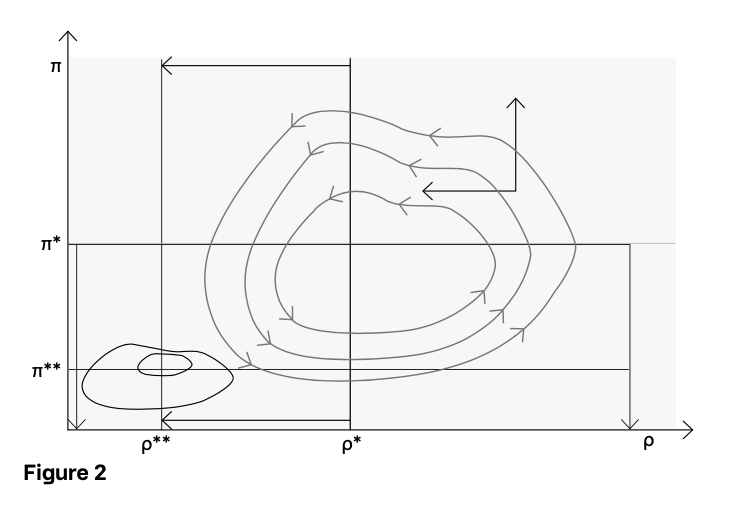
In Phase 1 the technofeudal department grows at the expense of the productive department as the rate of cloud rent extraction rises and cloud capital accumulates while profit rates fall across the productive department. However, when the rate of cloud rent extraction (ρ) exceeds some threshold ρ*, the system moves into Phase 2 in which productive capital is converted to cloud capital, resulting to an increase in the rate of profit in the productive department.
Phase 2, in short, is a period when both the technofeudal and the productive departments grow. But then, once the profit rate exceeds its threshold (π*), we are in Phase 3.
In Phase 3, because cloud capital has over-accumulated, it pushes the rate of cloud rent extraction (ρ) downward. Phase 3 is, therefore, a period during which the cloud rent leakages have grown so much that aggregate demand falls and the technofeudal sector suffers the fate of a parasite that sucked too much energy and nourishment from its host. Thus, Phase 3 is a period during which the technofeudal expansion is checked and the productive department reclaims part of its lost ground, untilthe rate of cloud rent extraction (for the first time since Phase 1) dips below its threshold (ρ*), at which point the system enters Phase 4.
In Phase 4, both the productive and the technofeudal departments are in recession, as profit rates and cloud rent extraction rates are in decline. However, the moment profitability drops below threshold (π*), cloud capital starts accumulating again and the rate of cloud rent extraction begins to rise. As it does, and once it exceeds its threshold (ρ*), the system returns to Phase 1 — the phase during which the technofeudal department grows at the expense of the productive department. And so on.
This analysis of the dynamic clash between the technofeudal and the productive departments (resembling the clash between a predator and its prey) is consistent with the intuition that the growth of the technofeudal part of the economy is bounded by the capacity of the economy’s productive labour to generate the values that cloud capital plunders. But what happens in the long run? Is this cycle, from Phase 1 to Phase 4 and then back to Phase 1 and so on, stable? Can the productive department escape the clutches of its technofeudal counterpart? Is there an end-state to this bifurcated economy?
While the analysis cannot predict the timing of these cycles or how long it will take for the system to approach its end-state, it does point to the system’s unique end-state: a collapse of both the profit rate and the cloud rent extraction rate. The analysis thus generalises Marx’s original falling rate of profit hypothesis for a world in which capital is bifurcated between productive and cloud capital.
The intuition behind the analysis is clear. In Marx’s original analysis, capital accumulation is in the driving seat, pushing the capitalists’ profit rate down-wards as it amplifies the economy’s organic composition of capital. The rise of cloud capital adds a second driver: the rising organic composition of cloud capital. As the ratio of cloud rents to Big Tech’s wage bill increases, courtesy of cloud capital’s capacity to accumulate by recruiting massive unpaid labour (outside of any labour or commodity market),48 the trajectories of the profit rate (π) and of the rate of cloud rent extraction (ρ) tend toward zero.
In conclusion, the accumulation of cloud capital not only amplifies the volatility and secular degeneracy that Marx showed to be inherent to capitalism, but it also produces a doom loop of collapsing cloud rents and profits. In this context, technofeudalism is a process that exacerbates the dilemma expounded by Rosa Luxemburg from her prison cell: socialism or barbarism.
8. AI, the dialectics of cloud capital, money, class struggle, ideology, geopolitics and war
Cloud capital did not need AI to materialise. Big Tech’s cloud fiefs were erected on reinforcement learning algorithms well before AI burst upon the scene with OpenAI’s ChatGPT. Even before large language models could emulate human-like interaction between people and machines, cloud capital interfaces (Amazon’s web-based algorithm, Alexa, Google’s Assistant etc.) had already empowered Big Tech to extract macroeconomically significant cloud rents. What AI brings is a massive escalation in cloud capital’s extractive powers and the final demise of any pretence that cloud fiefs compete in anything resembling a marketplace.
AI is also a dual use technology. Much like Amazon’s machines, which bring in profit when selling data storage space, and cloud rent when they sell someone else’s cereal,49 AI is deployed to do two things: First, allow companies like OpenAI, Anthropic etc. to supply a standard commodity to paying customers (i.e., subscription services that help us write reports, code, poems etc.). Secondly, empower Big Tech’s existing cloud capital to modify our behaviour far more efficiently. It is this second use of AI that will have the greatest impact.
When Chinese start-up DeepSeek disrupted the AI-commodity market with a free service that was far less costly to produce and not worse than ChatGPT, Big Tech realised that their prospects as profitable AI-based commodity (or subscription service) suppliers were coming to an end. The race was on to shift AI-powered cloud capital from the economy’s productive to its technofeudal department. It could not be otherwise. Given a choice between (a) precarious profits that any start-up, like DeepSeek, can dissolve overnight and (b) cloud rents that AI-enabled machines can lock in for the long run, Big Tech is opting for the latter. Any company that, today, continues to try to profit by supplying AI-based commodities will either have to switch to extracting cloud rents in the technofeudal department or perish.50 The reason is obvious to anyone who has spent a moment or two with one of the latest AI-powered bots.
An AI-powered version of Alexa, or a similar bot, will very soon not only know you perfectly but will be able to speak to you in a manner that is indistinguishable from that of a human.51 Meanwhile, underneath its human-like bonhomie, it will gradually cultivate in you a dependence that makes it indispensable to your psyche. Going back years, it will remember every detail of anything you said or did or wished for. It will develop a capacity to take you to the brink of your tolerance (so as to extract maximum rents from you, and the vendors selling to you) without crossing your red lines. It will have perfect recall of your whims, musical sensibilities, shopping habits, disappointments. It will keep you company in moments good and bad. It will be able to predict when one of its recommendations will jar with you. And once you have struck such a relationship with your AI bot, switching to a competitor’s alternative bot will be almost unthinkable – closer to a heart-wrenching divorce than to finding another e-shop to buy stuff from.52
Karl Marx and Friedrich Engels depicted history as the outcome of a constant, dialectical clash between (backward) social relations of production and (advancing) produced means of production (PMCP). Cloud capital adds to this another dialectical contradiction, which gathers pace and potency as a result of AI, On the one hand there are artificial social relations of consumption (ASRC) between humans and AI-powered cloud capital (the produced means of behavioural modification, PMBM). On the other hand, there are the AI-powered produced means of behavioural modification (PMBM) themselves. As the latter (PMBM) evolve faster than the former (ASRC), our common domain is strained like it never had before and ruptures become more frequent and deeper.
While human labour remains the only value-producing force, the social relations of both production — and, now, consumption — are increasingly dominated by unproductive machines (i.e., AI-powered cloud capital) whose evolution causes both profits and cloud rents to shrink in the long term.53 The question then becomes: How does capital react to these intensifying realisation crises?
Shortly after Marx completed his analysis of why the most ethereal, purest, form of capitalism is ridden with contradictions and prone to crises, his successors considered what that meant in practice. How did capitalism respond to its own inherent contradictions? The answer they gave was threefold: through the rise of finance capital and the financialisation of society;54 through imperialism;55 and through suitable ideologies such as neoliberalism, which act as legitimisers of the ruling class’s brutal moves to reclaim lost ground.56
Cloud capital’s rise, and the intensification of the contradictions it occasioned, has already had a profound impact on finance, geopolitics, war, and ideology. As cloud capital merged with traditional finance into what I call cloud finance, it ignited the New Cold War between the United States and China giving imperialism a new twist.57 More recently, propelled by Donald Trump’s ‘Genius Act’, cloud finance has become pivotal in the gradual privatisation of the dollar by means of stablecoins that bequeath Big Tech with powers once reserved for central banks.58
Meanwhile, cloud capital accumulates new powers in the battlefields, where its algorithms’ capacity to understand and to manipulate humans is improving at breakneck speed.59 In addition to refining Amazon’s, Google’s and Meta’s ability to make us buy things, to poison our conversations on x.com, and to drive increasingly dispossessed proletarians, nurses, drivers and warehouse workers, AI-targeting devices that maximised death and destruction in Gaza also enhance the cloud capital that Palantir and Oracle sells to Britain’s National Health Service.
On the ideological front, just as financialisation begat neoliberalism, cloud capital is giving rise to a new creed: techlordism. A mutation of transhumanism, techlordism replaces Homo Economicus at the heart of neoliberalism with a human-AI continuum (which I have referred to as HumAIn).60 The result is an ideological cloak that shrouds cloud capital’s expanding domain in three ways. First, techlordism justifies the wholesale replacement of human value-creating labour with cloud-rent-extracting machines. Second, it paves the ground for the complete integration of Big Tech into state institutions (from the Pentagon to the last federal or state agency).61 Third, it offers cloud finance a supporting narrative to its project of taking over central banks.
While it is clear that, in the same way that imperialism, wars, financialisation and neoliberalism ameliorated capitalism’s internal contradictions, and bought it a century of dominance in spite of severe crises that Marx had astutely anticipated, the developments described above will, no doubt, buy time for the new technofeudal order. But, exactly as the financialisation of the 1980s and 1990s bought capitalism a few decades of fast growth at the cost of the 2008 earthquake, cloud finance, the New Cold War, techlordism etc. are now buying time for this new system at the cost of future crises whose magnitude grows exponentially with every expansion of cloud capital’s domain.
While waiting to see how these forces play out, it is not too soon to discern a phenomenon of great significance to those of us who make sense of the world through the prism of historical materialism. Marxist analysis places great emphasis on how capital accumulation within the bourgeois mode of production separated political from economic power (Wood, 1999, 2003).62 Following the financialisation drive that the Nixon Shock delivered in the early 1970s,63 the sphere of economic power was itself subdivided into two separate spheres: industrial and financial. And now?
Intriguingly, cloud capital is now re-integrating all three spheres, along with that of state power. What Galbraith64 had described as the Technostructure (a unitary professional class running, simultaneously, the state, Wall Street and monopoly capital) has been overshadowed by the increasingly dominant cloudalist or technofeudal ruling class which is concentrating all powers in its owners’ hands (financial, industrial, political, cultural and state power). However, and this is its central dialectical contradiction, the more it succeeds in concentrating every power that matters in its hands, the more our new ruling class is undermining itself in the long run, unleashing as it does a dynamic heralding systemic collapse.
9. Beyond theory: How do we change the world?
Critics of my technofeudal hypothesis argue that Marx would take one look at Big Tech and immediately recognise them as capitalist firms. Of course he would, as we all do! But, he would also discern a crucial peculiarity of Big Tech: a new power stemming from a mutation of capital into cloud capital, that renders it unproductive (in Marx’s analytical terms), yet so incredibly potent that it bestows upon its owners an unprecedented power to fulfil every capitalist’s ultimate fantasy: to replace markets with wholly owned fiefs, encase other capitalists and consumers in it, and charge them all cloud rents.65
This is the dialectical materialist contradiction at the heart of the technofeudal hypothesis: by enabling a tiny band of capitalists to replace markets (with market-like cloud fiefs) and siphon off profits (as cloud rents), a mutation of capital is demolishing capitalism’s twin pillars- markets and profits. In addition to dominating the social relations of production, capital now also dominates the social relations of leisure and consumption in ways that undermine what we assumed capitalism to be:66 a mode of production where profits are the main driver of wealth accumulation and all economic activity is channelled through markets. The result is not a regression to the socioeconomic mode from which capitalism emerged (feudalism) but, rather, a hi-tech world in which capital ditches markets and sheds profits to achieve a despotic power reigned in only by its dampening effect on surplus value generation.
Some critics have objected that, in claiming that something even worse than capitalism is upon us, I am absolving capitalism and serving the agenda of bourgeois propagandists in the business of canvassing a return to some fictitious pure capitalism.67 This is an understandable but misplaced fear. As the preceding pages show, the technofeudal hypothesis is grounded firmly in the Marxist tradition which depicts capitalism as monstrously irrational (and for this reason unjust) even in its purest form. Moreover, cloud capital is shown to be a mutation whose reasons and logic are internal to capitalism, not a deviation from pure capitalism that could have been somehow avoided, or which can be dis-invented or reversed.
Like unemployment, recessions and devastating crises are not bugs but designer features of capitalism, the emergence of the technofeudal department (Sections 4-7 above) was functional to capitalism and could only have been prevented by the socialist transformation of society that capitalist forces employed such brutality to avert.68 In this light, rather than being strategically disorienting for the Marxist left, the technofeudal hypothesis offers us new, powerful arguments for the socialist transformation – the only alternative to societal and environmental collapse.
One such argument is that private capital is now inconsistent with private ownership, except that of a tiny band of techlords. After two centuries of fear- mongering that socialism is out to collectivise the middle class’s dwindling belongings, AI-enabled cloud capital is collectivising each and every product of our intellect, even our audio-visual identities. With mounting evidence that the bourgeois state is incapable of effectively regulating Big Tech, it is easier than ever for Marxists to make our long-standing case that realigning our technological capacities with our species’ interest requires the socialisation of the means of production, distribution, exchange and communication – i.e., society’s capital stock, both conventional and cloudalist.
Even so, I appreciate how the technofeudal hypothesis jars with many Marxists’ mindset. The most touching objection I encountered was by a Marxist economist who, in private, said he refused to let go of the thought that people like us came to this world to overthrow capitalism. ‘If capital did that without us, what’s our purpose in life?’, he asked with a bitter smile. I sympathised. For I too grew up in hope that we, the left, would have the honour of felling capitalism; that the next socioeconomic mode would be a socialist one that we construct, not a technofeudal one that Big Tech imposed. But then I remembered Rosa Luxemburg’s decisive formulation: ‘socialism or barbarism’.69 By posing this alternative, she was warning us that socialism was not inevitable and that barbarism was another, very real, possibility. In her days, barbarism prevailed in the form of fascism. Today’s fascism is riding on the coattails of technofeudalism and Big Tech’s techlordist ideology.
Moving beyond ‘interpreting the world’ to what needs to be done to change it,70 another criticism focuses on my claim that, in the technofeudal age, it is not enough to organise auto-workers, nurses, teachers and miners; that it is crucial to forge a united front of traditional proletarians, cloud proles, cloud serfs and even some vassal, small-scale capitalists facing ruin in the shadow of cloud capital.71 This is, of course, a contentious suggestion that must be scrutinised by Marxists. Nonetheless, it is certainly not a novel question. Since Marx’s time, revolutionaries have debated vociferously the optimal potential alliance of waged labourers, peasants and the petty bourgeoisie.72
Like those older debates on what alliances best served the cause of overthrowing the tyranny of capital were taking place within the Marxist framework, today our debate on whether cloud serfs can, or should, be organised – or, indeed, if vassal capitalists must also be courted – is a debate we must also have within the Marxist frame. In short, turning a blind eye to the technofeudal turn of capital accumulation and political power undermines, rather than upholds, the Marxist tradition.73
10. Conclusion: What’s in a word?
Underpaid work generating surplus value in the workplace has been capitalism’s lynchpin from its inception. Unpaid domestic labour has also been crucial to indirectly aiding capital accumulation.74 By highlighting a new role for unpaid work beyond traditional workplaces, the technofeudal hypothesis marks a fundamental transformation in the social relations of both production and consumption: unpaid work is now directly reproducing a form of capital — cloud capital — that generates not profits but the power to extract rents from surplus value.
Cloud capital enlists the masses, from all classes, to labour ‘voluntarily’ to build up its power to extract burgeoning cloud rents at the expense of capitalist profits and workers’ wages. Our unpaid work within Big Tech’s cloud-fiefs boosts our economic and, increasingly, emotional costs of switching to other platforms, thus erecting ever taller walls around us. As this newfangled unproductive cloud capital accumulates, our unpaid labour accelerates the fall of the profit rate and, in the process, deepens the system’s crisis.
Whether one considers this a radical break from capitalism or an extension of its domain is a matter of judgement, not calculation. What is beyond dispute is that Marxist analysis is duty-bound to take this radical development seriously. Which brings me to the ultimate question: What’s in a word? Should we still call this capitalism or should Marxists call it something different, such as cloudalism or technofeudalism? Does it matter what we call it?
Marxists must surely agree that we are witnessing a new and dangerous transformation. Whether this a transformation within capitalism, as my critics argue75 or beyond capitalism, as I claim, is another issue. Before deciding, or even agreeing to disagree, it is helpful to remind ourselves that capitalism always featured a non-capitalist, rent-extracting department (Section 2).
So, the question becomes: Is the realm of cloud capital (the technofeudal department in Section 7) just an annex to capitalism’s pre-existing feudal component, or has it subjugated the economy’s capitalist department to such an extent as to warrant the claim that the parasite has taken over the host?76 Has a new ruling class (the cloudalists or techlords) emerged as dominant on the coattails of cloud capital? Are their cloud rents macroeconomically inconsequential bubbles on a torrent of capitalist profits, or are capitalist profits increasingly turning into frothy bubbles on a vortex of cloud rents?
These questions have an empirical and an analytic dimension. The empirical question is difficult to answer definitively because, since capitalism’s early days, it has been hard empirically to separate profits from rents. Today, this separation is even harder to make, given the dual nature of the digital technologies involved.77 However, the empirical dimension may not be the deciding factor.
In the 1770s, Adam Smith was celebrating the birth of ‘commercial society’ as a ‘system of natural liberty’ — his terms for capitalism. Back then, British society’s feudal sector overshadowed its relatively small capitalist sector. But that was no reason for Smith to hold back his proclamation of a great transformation. Even in the 1840s and 1850s, when Marx and Engels were writing, a case could be made that the capitalist sector was smaller than the feudal one, especially if one took in the entire European continent, where capitalism had not taken root properly yet. In this sense, Smith, Ricardo, Marx and Engels could have credibly called the new era industrial or market feudalism. Yet calling it capitalist helped their peers appreciate the extent of the transformation underway.78
So, words matter. The safe option today is to continue to assume that the cloudalist transformation is internal to capitalism. The controversial choice, in contrast, is to jolt our collective imagination by adopting a different term (e.g., cloudalism, technofeudalism) by which to emphasise the radical nature of the ongoing transformation.79 Both options are defensible within the Marxist tradition and neither choice is a good reason for unnecessary nastiness.80 Indeed, the two outlooks are fertile ground for a dialectical synthesis that constitutes an advance for Marxist analysis and practice.81
Dialectics begins with the recognition that reality is neither harmonious nor homogenous, but is instead built on contradiction. As Bertolt Brecht taught us,82 the soul of real drama is not conflict between people who disagree about this and that but, rather, the co-existence of two things that shouldn’t be able to exist at the same time. Similarly with our current bourgeois mode of production: it is both capitalist and technofeudal, in the same way that at the time of original Great Transformation, it was both feudal and capitalist.83
The whole point of Marxist dialectics is to see this puzzling, unfathomable co-existence and recognise in it the possibility of radically overcoming the contradiction through socialist transformation. But first, we need to recognise the contradiction. Once we have recognised it, the emancipatory, revolutionary potential of resolving it knows no bounds.
Appendix
The intertwined dynamics of capital and cloud capital accumulation. Marx’s falling rate of profit hypothesis, now augmented with a falling rate of cloud rent extraction hypothesis
In each sector i, the profit rate is defined as πi = Πi/(Ci+Vi) and the exploitation (of labour) rate as εi= Si/(Ci+Vi)
where
— Πi are the total profits in sector i,
— Ci is the expenditure on capital goods in sector i (i.e., investment in productive machines),
— Vi is its expenditure on labour (i.e., the wage bill), and
— Si is the surplus value (net of rent and interest payments) extracted from labour in sector i (as a result of paying workers for the value of their time and skills but not for the value that they actually input – through their labour – into the final commodity).
It is now simple to show that:
πi = εiμi = εi(1-ki) … (1)
where
— μi is the ratio of expenditure on wages over total expenditure on machines and labour [μi = Vi/(Ci+Vi)], and
— ki is Marx’s definition of the sector’s organic composition of capital, a metric of capital intensity calculated as the ratio of expenditure on productive machines (i.e., capital goods) over total expenditure on machines and labour [ki = Ci/(Ci+Vi)].
Proof of Equation (1): Assuming, as Marx does, that competition restricts total profits (Πi) to the total surplus value left over for the capitalists (after repaying rent and interest), equation (1) obtains as follows:
πi = Πi/(Ci+Vi) = Si/(Ci+Vi) = (Si/ Vi ) X (Vi /(Ci+Vi)) = (Si/ Vi ) X [1-(Ci /(Ci+Vi))]
The Transformation Problem (Resolved)
Marx initially assumed (Capital, Vol. I) that profit rates and labour exploitation rates must be (both) equalised across all sectors of a capitalist economy (i.e., πi = πj and εi = εj). However, when the organic composition of capital ki (i.e., capital intensity) differs across sectors, either profit rates (πi) will be equalised or exploitation rates (εi) will be equalised – but not both. This observation gave rise to the notorious ‘transformation problem’.
However, it is not a problem (see Capital Vol. III) if one accepts either that surplus value generated in one sector is appropriated by another (e.g., through monopoly power or, as in my analysis, cloud rents extracted by cloud capital) or that the two equalisation processes work in tandem, with the system permanently in flux – see below. [For more on the ‘transformation problem’, see Chapter 5 in our Modern Political Economics.]84
Proof that labour and capital will migrate constantly
If the machine goods sector is more capital intensive than the consumption good sector (i.e., kM > kC), and if the rate of exploitation is the same in the two sectors (i.e., εM = εC), profits will be lower in the machine goods sector and capital will, therefore, flow from the capital good to the consumption good sector. But, as this capital migration tends to equalise the profit rates, the exploitation rates will diverge; with labour exploitation increasing in the machine good sector.
As a result, labour will now migrate to the consumption good sector. But, as it does, the exploitation rate there will fall and so will [see equation (1)] the profit rate in the consumption good sector, causing a capital flight back to the machine good sector. And so on.
The analysis here begins with the original Marxist model outlined above before introducing the technofeudal hypothesis that cloud capital enables its owners to extract cloud rents R from the surplus value in the consumption good sector. So, equation (1) now becomes
πC= (εC – r)(1-kC) … (2)
where r=R/Vc is the ratio of cloud rents to total wages of workers in the consumption good sector.
Meanwhile the machine good sector’s profit rate remains the same as
πM= εM(1-kM) … (3)
Assuming (once more) that the machine sector is more capital intensive than the consumption good sector (i.e., kM>kC), capital will migrate from the consumption to the machine good sector pushing πM and πC closer together. Equalising (2) and (3), and solving for r we find the level of r (say r*) the profit rates will be equalised within the productive department:
r’ = [εC(1-kC) – εM(1-kM)]/ (1-kC) …. (4)
However, as r rises approaching that level (r’), the rate of exploitation within the consumption good sector will exceed that in the machine good sector and, therefore, labour will tend to leave the latter for the former.
This labour migration disequilibrates the profit rates, pushing profitability in the consumption good sector below that of the machine good sector and, once again, causing capital to flow to the machine good sector. And so on.
Dynamic Analysis
The analysis below borrows from Goodwin85 the idea of using a system of two differential equations in order to capture Marx’s dynamic analysis.
Let the cloud rent extraction rate ρ be defined as the ratio of total cloud rents over total expenditure in the technofeudal department [i.e., ρ = R/( CT+VT), where CT and VT are, respectively, the expenditure on cloud capital (CT) and waged labour (VT) in the technofeudal department]. Now, suppose ρ* is the threshold of ρ such that, if exceeded, profitability (π) in the productive department falls. Then, the technofeudal dynamic is captured as follows:
— If ρ > ρ*, then π rises – and vice versa.
This dynamic can be expressed most simply by the following linear differential equation:
— dπ/dt = α(ρ – ρ*) … (5)
where α is some positive constant capturing the speed at which profitability in the productive department responds to changes in the technofeudal department’s cloud rent extraction rate.
Now, let us assume that when profitability π exceeds a certain threshold (π*), then the cloud rent extraction rate ρ (the ratio of total cloud rents over total expenditure in the technofeudal department) falls. In short,
— If π> π*, then ρ falls – and vice versa.
This second dynamic is captured by the linear differential equation in (6) below.
— dρ/dt = β(π*-π) … (6)
where β is some positive constant capturing the speed at which the cloud rent extraction rate in the technofeudal department responds to changes in the profitability of the productive department.
To see how this system yields the four phases that are described in the text, plot equations (5) and (6) on the (ρ,π) plane and note that at profit rates above π* the rate of cloud rent extraction ρ declines (and falls when π< π*) while the profit rate π falls when ρ lies below threshold ρ*. These two tendencies (the Techno-feudal Dynamic and Productive Dynamic) produce the phase diagram in Figure 1.
An important caveat applies, here: Whereas capital can flow relatively unimpededly between different sectors of the economy’s productive department, the same is not necessarily true between the productive and the technofeudal departments. Due to network effects, and the need to recruit millions of users as cloud serfs, the fixed costs of building up cloud fiefs are enormously larger than constructing even an electricity grid used to be. In other words, second and third movers may find that they need to invest sums multiple times those of first movers before they can collect significant cloud rents. This is why Elon Musk was keen to buy Twitter, rather than try to build a cloud fief from scratch: see Chapter 5 of my Technofeudalism.
As cloud capital accumulates and expenditure on waged labour in the technofeudal department falls concurrently (courtesy of the increasing preponderance of unpaid labour that cloud capital recruits), the two thresholds ρ* and π* in equations (5) and (6) decline. As ρ* and π* decline, the system’s cycles shift downwards, tending toward the origin in Figure 2. Ergo, not only is this analysis consistent with Marx’s original hypothesis that the rate of profit has a tendency to fall but points to a secular decline in the cloud rent extraction rate as well.
Hypothesis 1: As cloud capital accumulates, the profit rate threshold (π*), beyond which the rent extraction rate (ρ) declines, also declines
The cloud rent extraction rate ρ is an increasing function of the cloud capital stock in the technofeudal department (CT) if and only if the organic composition of cloud capital (γ) is less than the responsiveness of aggregate cloud rents to changes in the stock of cloud capital (η). As cloud capital accumulates (i.e., CT rises), the threshold ρ* declines.
PROOF: The cloud rent extraction rate is defined ρ=R/CT+VT). The rate of change in this rate is thus defined by equation (7)
∂ρ/CT=((CT+VT ) ∂R⁄/CT -R)⁄(CT+VT)2 … (7)
It is now simple to show that the condition for ∂ρ/(/CT )>0 is that γ<η where
— γ=(CT/(CT+CT )) is the organic composition of cloud capital (i.e., the ratio of expenditure on cloud capital over total expenditure in the technofeudal department), and
— η=(∂R×CT/(∂CT×R)) is the ratio of the proportional rate of change in aggregate cloud rents over the proportional rate of change in the stock of cloud capital.
In other words, the condition for the rate of cloud rent extraction to stabilise (π=π*) requires that γ=η. However, it is in the nature of cloud capital that, as its stock grows (i.e., CT rises), its owners’ expenditure on waged labour (i.e., VT) declines for any given level of cloud rents (R). This means that both γ and η will be rising in the longer-run in response to the secular decline of VT. Consequently, the profitability level at which ρ stalls (i.e. π*) must decline. QED.
INTUITION: As cloud capital (CT) accumulates, the organic composition of cloud capital (γ) rises. At low profit rates (π<π*), γ>η and, thus, ρ rises as cloud capital accumulates. But, above a certain level of profitability in the economy’s productive department, η (the responsiveness of aggregate cloud rents to the
increases in the stock of cloud capital) exceeds the organic composition of cloud capital (γ) [i.e., η>γ]. At that point, the accumulation of cloud capital leads to a fall in ρ, the rate of cloud rent extraction. That point, however, is where profitability in the productive department equals threshold π*. But, as cloud capital accumulates, and both γ and η grow, the profitability threshold π* at which the rate of cloud rent extraction stalls (dρ/dt=0) must decline.
Hypothesis 2: The rent extraction rate (ρ*), beyond which the profit rate rises, also declines as cloud capital accumulates
As the organic composition of productive capital (kC and kM) rises in the longer run for every level of expenditure on cloud capital (CT), the cloud rent extraction rate (ρ) at which profitability picks up (i.e. ρ*) must fall. In other words, the threshold of the cloud rent extraction rate, ρ*, below which profitability in the productive sector rises, and thus productive capital accumulation, falls is a decreasing function of cloud capital accumulation. QED.
Notes
1 Thanks are due to Julian Assange, Tony Aspromourgos and Cory Doctorow for helpful comments. All errors are, of course, mine.
2 See, for example, Henry Snow, ‘We’re Still Living Under Capitalism, Not “Techno-Feudalism”’, Jacobin, 2023, available at: https://jacobin. com/2023/10/cloud-capitalism-technofeudalism-serfs-cloud-big-data-yanis-varoufakis; David Addison and Merle Eisenberg, ‘Capitalism Is Changing, but Not Into “Neofeudalism”’, Jacobin, 2025, available at https:// jacobin.com/2025/05/capitalism-neofeudalism-tech-medieval-history; Evgeny Morozov, ‘Le numérique nous ramène-t-il au Moyen Âge?’, Le Monde Diplomatique, August 2025, pp. 1, 8–9.
3 Daniel Schiller, Digital Capitalism, Cambridge, MA: MIT: 1999.
4 Philip Graham, ‘Hypercapitalism: A Political Economy of Informational Idealism’, New Media and Society, Vol.2, Issue 2, 2000, available at: https://journals.sagepub.com/doi/10.1177/14614440022225742
5 Nicholas Gane, ‘Computerized Capitalism: The Media Theory of Jean-François Lyotard’, Information, Communication and Society, 6, 3, 2003, pp. 430–50.
6 Guy Standing The Corruption of Capitalism: Why Rentiers Thrive and Work Does Not Pay, Hull: Biteback Publishing, 2016.
7 Nick Srnicek, Platform Capitalism, Oxford: Blackwell, 2016.
8 Shoshana Zuboff, The Age of Surveillance Capitalism, New York: Profile Books, 2024.
9 David Ricardo, On the Principles of Political Economy and Taxation, edited by Piero Sraffa, Cambridge: Cambridge University Press, 1951 [1817].
10 Mainstream (or neoclassical) economics defines economic rent as any payment for a commodity over and above the opportunity cost of supplying it. However, in David Ricardo and Karl Marx, absolute rent (as opposed to differential rent) is understood as the payment to landowners for the mere permission to use land, arising from their exclusive property rights over the land. Marx, in particular, argued that absolute ground rent stems from the fact that agriculture has a lower organic composition of capital (see Appendix) than industry, allowing agricultural products to sell above their price of production but at their value. The difference between value and price of production is pocketed by the landowner as rent. The concept of cloud rent that is introduced below stems from this notion of absolute ground rent, adapted to a world in which absolute cloud rents (as opposed to ground rents) are charged to anyone wishing access to digital, or cloud, fiefdoms – e.g., amazon.com.
11 Paul Baran and Paul Sweezy, Monopoly Capital: An Essay on the American Economic and Social Order, New York: Modern Reader, 2016.
12 John K. Galbraith, The New Industrial State, Boston: Houghton Mifflin, 1967.
13 The monopoly price of certain commodities would merely transfer a portion of the profit of the other commodity-producers to the commodities having the monopoly price… In this case the monopoly price would be paid by a deduction from real wages (i.e.. the quantity of use-values received by the labourer for the same quantity of labour) and from the profit of the other capitalists’: Marx, Capital, Vol. 3, Chapter 50.
14 Yanis Varoufakis, The Global Minotaur: America, Europe and the Future of the World Economy, London: Zed Books, 2011.
15 David Harvey, The New Imperialism, Oxford, Oxford University Press, 2003.
16 Robert Brenner, The Economics of Global Turbulence, London: Verso, 2006; Cédric Durand, Fictitious Capital: How Finance Is Appropriating Our Future. London: Verso, 2017.
17 Nicholas Shaxson, The Finance Curse: How Global Finance Is Making Us All Poorer, London: Bodley Head, 2018.
18 Brett Christophers, Our Lives in Their Portfolios: Why Asset Managers Own the World, London: Verso, 2023.
19 Zuboff, The Age of Surveillance Capitalism, op. cit.
20 Cédric Durand, How Silicon Valley Unleashed Techno-feudalism: The Making of the Digital Economy, London: Verso, 2024 (original French version in 2020); Joel Kotkin, The Coming of Neo Feudalism: A Warning to the Global Middle Class, New York: Encounter Books, 2020.
21 Duncan Foley, ‘Rethinking Financial Capitalism and the “Information” Economy’, Review of Radical Political Economics, 45: 257, 2013, available at https://journals.sagepub.com/doi/10.1177/0486613413487154.
22 Evgeny Morozov, ‘Critique of Techno-Feudal Reason’, New Left Review, 133/134, 2022.
23 Cory Doctorow, in our private communication, offers a devastating challenge to the bourgeois idea of individual property rights over private data: ‘I think this is a really bad frame. Data is valuable but it is not property (people are valuable but we’re not property, either). Who owns the fact that your father is your father? You? Him? Me. If your father was abusive and wanted to stop you from publishing the fact that he was your father, would he have a property right to decide whether that fact could be disclosed? Do your kids have the right to give half of your DNA to 23andme? “Property” is a really bad framework for regulating data — far better to put data rights into frames like labour, privacy, etc.’
24 Cory Doctorow, Enshittification: Why Everything Suddenly Got Worse and What To Do About It, London: Verso, 2025.
25 Yanis Varoufakis, Technofeudalism: What Killed Capitalism?, London: Bodley Head, 2023.
26 Foley, ‘Rethinking Financial Capitalism and the “Information” Economy’, art. cit.
27 Morozov, ‘Critique of Techno-Feudal Reason’, art. cit.
28 Markets can be less or more competitive, oligopolistic (few sellers, many buyers) or oligopsonistic (many sellers, few buyers); tending in the limit to monopoly (a single seller and many buyers) or monopsony (a single buyer, many sellers). However, markets wither when the number of buyers and the number of sellers both shrink, tending to one on each side (in which case we have a case of one-on-one bargaining, or bilateral monopoly-monopsony).
29 Markets are integral to capitalist reproduction, essential links in the circuit of capital where money M buys commodities C (i.e., labour power and capital goods) to power up the production of more commodities C’ whose sale results in more money M’ etc. (M→C…P…C’→M’).
30 ‘In order to produce [commodities], he must not only produce use-values, but use-values for others… (And not merely for others. The medieval peasant produced a corn-rent for the feudal lord and a corn-tithe for the priest; but neither the corn-rent nor the corn-tithe became commodities simply by being produced for others. In order to become a commodity, the product must be transferred to the other person…through the medium of exchange.)’ Karl Marx, Capital, Vol. I, Chapter 1.
31 Price discrimination is as old as any market: the seller’s attempt to extract the so-called consumer surplus (the difference between the maximum price they would be prepared to pay for an item and the actual price). To this end, sellers attempt to separate customers from one another so as to charge each one of them the maximum price that they would pay (a task that necessitates making it impossible for buyers to re-sell to one another). Naturally, algorithmic machines do this better than any previous analogue device or method ever could.
32 Critics of the technofeudal hypothesis contest the economic significance of Alexa or even WhatsApp on the basis that they have not been monetised successfully. Snow (‘We’re Still Living Under Capitalism’, art. cit), for instance, writes that ‘[f]ar from being an asset, Alexa has been a multibillion-dollar write-off’. But this is an accounting mirage. Amazon subsidises the Alexa devices massively, choosing to sell them below their manufacturing cost. Apple provides Siri for free. Instacart does the same with its assistant. Nonetheless, these assitants are excellent investments. Alexa allows Amazon to extract cloud rents that its accountants do not, and cannot, ascribe to Alexa. This raises the intriguing empirical question of how cloud rents can be measured and distinguished from profits. This problem is not new, of course. When Ricardo (On the Principles of Political Economy and Taxation, op. cit.) introduced the distinction between profits and rents, and Baran and Sweezy (Monopoly Capital, op. cit.) the distinction between monopoly profits and monopoly surplus, the accounting profession proved neither interested nor capable of accounting for these separately. To this day, rents and profits are lumped together under the same column. Marxists, however, have no excuse to fail to draw this distinction and thus to fall into the trap of concluding that Alexa and WhatsApp are lossmaking only because accountants have neither an interest nor the ability to count the rents they procure on behalf of the likes of Jeff Bezos and Marc Zuckerberg.
33 ‘The means of production and subsistence, while they remain the property of the immediate producer, are not capital. They become capital only under circumstances in which they serve at the same time as means of exploitation of, and domination over, the worker’ (emphasis added): Karl Marx, Capital, Vol. I, Chapter 33.
34 A report from the Centre for Research on Multinational Corporations (SOMO) describes the Big Tech model as a ‘self-reinforcing machine for rent extraction’.
35 See the documentary on Instacart by ‘A More Perfect Union’, available at https://www.youtube.com/watch?v=osxr7xSxsGo
36 Consumer surplus is the sum of the differences between the price that any unit of any commodity sells for, and the maximum that some consumer would be prepared to pay for it (if they had to do so).
37 The COVID-19 pandemic played a role, too. Once supply-chains collapsed and prices took off, the pre-existing collusive price equilibrium was shattered. The resulting price inflation added noise and behind that noise algorithmic pricing took off to annul price competition.
38 A firm is monopsonistic if it is the only one that buys a certain commodity. If a company, like Uber, is the sole buyers of a pool of drivers’ labour power, it is a labour monopsonist.
39 Marx analyses piece-rates in Chapter Twenty-One of Capital, Vol. I. The important difference with Amazon’s implementation of piece rate labour remuneration is that its cloud capital is programmed to modify the readiness of workers to accept lower piece rates depending on their private circumstances, in real time.
40 In the Grundrisse, Marx (see Notebook VI, December 1857 – January 1858, section ‘Bastiat and Carey’) criticises liberal economists Bastiat and Carey for their ahistorical, harmonious view of capitalism, juxtaposing earlier forms of exploitation (corvée, slavery), that were transparent, against capitalist exploitation which is concealed by the wage contract. This concealment is a source of ideological power for the capitalist system, as it creates the appearance of a ‘free and fair’ exchange. By the same token, it is illegitimate to claim that one can’t possibly be an Uber or Amazon cloud serf because one can always quit.
41 Something similar applies to start-ups. In his infamous ‘Competition is for losers’ speech, Peter Thiel preached the importance of capturing and locking in users in digital ‘enclosures’ (or cloud fiefs, as I call them). Failure to do so means bankruptcy, he argued, offering the bursting of the dot.com bubble as an example of what happens when Big Tech fails to lock users in cloud fiefs. Without this ‘confinement’, he continues, tech conglomerates can expect no super profits and, as a result, no venture capital (VC) infusions. Without VC infusions, he went on to say, no start-up can grow fast enough to compete against startups with VC infusions.
Thiel’s argument is a vindication for the technofeudal hypothesis: Finding ways of confining users in digital enclosures created by Big Tech’s cloud capital is their ticket to immense extractive power. Moreover, no start-up that wants to succeed can escape this ‘duty’ to confine users into cloud-fiefs from which they have the formal freedom to escape, but only at a prohibitive cost. See Peter Thiel, ‘Competition Is For Losers’, Wall Street Journal, 12 September 2014, available at: https://www.csun.edu/~vcact-00f/497CapStone/Peter%20Thiel_%20Competition%20Is%20for%20Los-ers%20-%20WSJ.pdf.
42 Constance Hoffman Bernan, The Cistercian Evolution: The Invention of a Religious Order in Twelfth-Century Europe, Philadelphia: University of Pennsylvania Press, 2000.
43 M.M. Postan, The Medieval Economy and Society, London: Penguin Books, 1975, offered evidence that Black Death created labour shortages leading to competitive bidding for workers, undermining legislation that tethered them to the land.
44 ‘Productive labour, in its meaning for capitalist production, is wage-labour which, exchanged against the variable part of capital (the part of the capital that is spent on wages), reproduces not only this part of the capital (or the value of its own labour-power), but in addition produces surplus-value for the capitalist. It is only thereby that commodity or money is transformed into capital, is produced as capital. Only that wage-labour is productive which produces capital’ (emphasis added): Karl Mardx, Theories of Surplus Value, Part 1, Chapter IV, London: Lawrence and Wishart, 1987.
45 After all, sheriffs, vicars and court jesters were also rewarded, and often lived exceedingly well, under feudalism. Under technofeudalism, these rewards are decided and divvied up automatically by the same cloud capital which recruits the rest of us to the cloud-fiefs.
46 Marx’s hypothesis known as the Falling Rate of Profit is reflected in equation (1) – Appendix. As the organic composition of capital (k) rises, the profit rate declines. If this is replicated across the economy, and systematically, the more capital accumulates the deeper capitalism sinks into a secular profitability crisis.
47 For example, Amazon’s servers accommodate (a) traditional capital (e.g., running the software of industrial robots manufacturing electronics, cars etc.), (b) pure cloud capital (e.g., Amazon’s own Alexa, amazon.com’s interface) and (c) others’ cloud capital (e.g., Uber). Additionally, they cater for military software applications (e.g., Palantir).
48 Tractors, electricity generators and industrial robots can only be manufactured by employing proletarian labour. In contrast, cloud capital accumulates with every post, video, comment or like we upload — for no pay — on, say, Instagram. With every one of our posts our costs of switching away from Instagram increase. Thus, without doing anything, Meta sees its cloud capital (its power to keep us engaged so that it can modify our behaviour) accumulate in direct proportion to the unwaged labour of its users which, inadvertently, increases their switching costs and, therefore, the hold the platform has over them. This is why Big Tech’s wage bill, as a proportion of their revenues and capitalisation, are so small, compared to conglomerates employing productive capital: its users reproduce much of their cloud capital with their free labour.
49 Digital machines are productive when used to produce commodities but not so when configured as cloud capital. To reject the technofeudal hypothesis because these networked machines, like the servers of AWS, are also used in the context of standard commodity production (as was always the case with machines under capitalism) is a little like saying that capitalism was not qualitatively different to feudalism because capital goods were also used in feudal fiefs. The AWS outage of 2025 adds to this point: Platforms including Signal, Snapchat, Roblox, Duolingo, as well as services such as banking sites and the Ring doorbell company were some of the 2,000 companies affected by the outage, according to Downdetector — a site that monitors internet outages — with more than 8.1m reports of cloud capital failures from users across the world. There is now clear evidence of excessive valuations of companies that, like OpenAI, are in the business of selling AI subscriptions. As Elder (2025) shows, the costs of large language models increase exponentially when the expected subscription revenues increase more or less linearly. In contrast, when AI is incorporated into Amazon’s Alexa or Google’s Assistant or Gemini, its capacity to net cloud rents on its owners’ behalf by modifying our behaviour (both as consumers and as producers) knows no bounds.
50 There is now clear evidence of excessive valuations of companies that, like OpenAI, are in the business of selling AI subscriptions. As Elder (2025) shows, the costs of large language models increase exponentially when the expected subscription revenues increase more or less linearly. In contrast, when AI is incorporated into Amazon’s Alexa or Google’s Assistant or Gemini, its capacity to net cloud rents on its owners’ behalf by modifying our behaviour (both as consumers and as producers) knows no bounds.
51 In private communication, Julian Assange commented on this point as follows: ‘We are well beyond surveillance capitalism with spying and behavioural surplus as a base. Sensor input, from satellites, radio, radar, weather stations, vehicles, drones, robots, phones, seismic, as well as financial data, will continue to be important, but what people are posting on Facebook or searching for is low volume and noisy, and interrogative learning, which is superior, is also coming down the pipe. This mirrors the development of chess, where for 40 years computer chess was trained on human chess games, but about eight years ago AlphaChess started with a blank slate and played itself, rediscovering, then shifting beyond, all three thousand years of human chess within 24 hours. Of course chess is a discrete toy world with full information, but modern robotics training is using training in physics simulations (very fast) then retraining in the real world (slow)’.
52 Generative AI businesses differ from past success stories in the Big Tech tradition because they are far more capital-intensive. Behemoths like Google, Microsoft and Meta earn a great deal from their legacy cloud rent extraction business model (and can, thus, afford to outspend conventional capitalist enterprises on AI). In contrast, developers such as OpenAI that try to profit through selling AI-created commodities will run out of money unless they switch from commodity production to the technofeudal mode (i.e., the behavioural modification business).
53 Lest there be any doubt that cloud capital is even more concentrated than conventional capital has ever been, consider this: According to the research group Synergy, AWS, Microsoft’s Azure and Google Cloud between them control nearly two-thirds of global capacity in cloud services. China has responded with accumulating its own cloud capital. Europe, in contrast, owns almost no cloud capital. AWS dominates Europe with what it calls the ‘European sovereign cloud’, run by units incorporated in Europe and a management team comprising EU citizens living in the EU. Yet the US Cloud Act, which gives the US government broad powers over data providers, still extends into EU jurisdictions.
54 Rudolf Hilferding, Finance Capital: A Study of the Latest Phase of Capitalist Development, London: Routledge & Kegan Paul, 1981 [1910].
55 Rosa Luxemburg, The Accumulation of Capital, London, Routledge and Kegan Paul, 1951 [1913]; Vladimir Ilyich Lenin, Imperialism, the Highest Stage of Capitalism [1917], in Selected Works, Vol. 1, Moscow: Progress Publishers, 1963.
56 Philip Mirowski, Never Let a Serious Crisis Go to Waste: How Neoliberalism Survived the Financial Meltdown, London: Verso, 2013.
57 See, in Chapter Six of Varoufakis, Technofeudalism: What Killed Capitalism?, op. cit., the section entitled ‘Technofeudalism’s global impact: the New Cold War’.
58 Yanis Varoufakis, ‘Defusing the Stablecoin Time Bomb’, Project Syndicate, 2 July 2025, available at https://www.project-syndicate.org/commentary/ private-stablecoins-are-a-formula-for-financial-crisis-by-yanis-varoufakis-2025-07.
59 Yanis Varoufakis, ‘Technofeudalism Is War’s Handmaiden’, Project Syndicate, 6 February 2025, available at https://www.project-syndicate.org/ commentary/rise-of-cloud-capital-makes-war-more-likely-by-yanis-varoufakis-2025-02.
60 Yanis Varoufakis ‘Trump and the Triumph of the Technolords’, Project Syndicate, 30 April 2025, available at https://www.project-syndicate.org/ commentary/technofeudalist-ideology-emerging-from-neoliberal-rubble-by-yanis-varoufakis-2025-04.
61 The rise of cloud capital upends the entrepreneurial state. Gone are the days when new technologies were invented in government laboratories or in universities; innovations that were then developed and monetised by the private capital. Today, top-end innovations are taking place within Big Tech.
62 Ellen Meiksins Wood, The Origin of Capitalism, London: Verso, 1999; Empire of Capital, London: Verso, 2003.
63 Yanis Varoufakis, Joseph Halevi, and Nicholas Theocarakis, Modern Political Economics, London and New York: Routledge, 2011.
64 Galbraith, The New Industrial State, op. cit.
65 This is where I part ways with Mackenzie Wark (Capital Is Dead: Is this something worse?, London: Verso, 2019), who argues that ‘capital is dead’, killed by a new vector of information flows. Where we do agree is in that we are facing a new mode of production, one not ruled over by owners of produced means of production (traditional capital goods). But, whereas Wark argues that the new ruling class comprises those who own and control ‘information vectors’, my hypothesis is that the control of information is only a small part of the story of power in contemporary society. Capital is alive and kicking and has morphed into a new form — cloud capital — whose accumulation ushered in a new mode of production ruled over by a new ruling class comprising the owners of this new form of unproductive capital (the cloudalists for short).
66 In contrast to those focusing on surveillance and data extraction, my technofeudal hypothesis sees Alexa, Google Assistant and the rest of Big Tech’s interfaces as desire implanters and market bypassers, not mere data harvesters.
67 Portrayed as a ‘eulogy for capitalism’, the technofeudal hypothesis is dismissed as strategically disorienting and politically convenient for those who would rather debate data harvesting than the source of capitalist power, thus serving a form of nostalgic-liberal rather than a revolutionary politics. Geoff Mann, for example, wrote that my technofeudal hypothesis: ‘… is exculpatory. If capitalism is already dead, we cannot hold it responsible for the misery it continues to produce… This is a gift to the capitalist, who can now say, ‘Don’t look at me, I’m as much a victim as you are’. A Marxist critic added on a social media post: ‘Varoufakis provides a palatable, “radical” analysis for the professional-managerial class that feels uneasy about Bezos but is deeply invested in the 401(k) system. It’s critique as safety valve’.
68 A good example is the manner in which cybernetics (which is what AI used to be known as, before it was taken over by Big Tech) was fruitfully deployed by the Allende government in Chile, before the CIA coup of 11 September 1973. See Eden Medina, Cybernetic Revolutionaries: Technology and Politics in Allende’s Chile, Cambridge, MA: MIT Press, 2014.
69 Rosa Luxemburg, The Junius Pamphlet: The Crisis in Germa Social Democracy, 1915 translated by Dave Hollis, available at https://www.marx-ists.org/archive/luxemburg/1915/junius/index.htm.
70 ‘Philosophers have hitherto only interpreted the world in various ways; the point is to change it’ is Karl Marx’s eleventh Thesis on Feuerbach (1845), published in English in 1938 in The German Ideology.
71 Varoufakis, Technofeudalism: What Killed Capitalism?, op. cit., Chapter Seven.
72 For instance, whereas Georgi Plekhanov and Rosa Luxemburg argued that the revolution should be led strictly by the proletariat, Lenin proposed a worker-peasant alliance (Smychka). Leon Trotsky thought that the proletariat should lead but not before winning the support of the peasantry. In contrast, Mao Zedong gave a different answer to the ‘Agrarian Question’: in colonial contexts, the peasantry had to become the revolution’s main force, leading an alliance that included even the ‘national bourgeoisie’ against imperialism. Meanwhile, Georgi Dimitrov, the General Secretary of the Communist International (Comintern), proposed to its Seventh World Congress (1935) a popular front of proletarians, peasants and the petty bourgeoisie (i.e., capitalists who were also being ruined by large monopoly capital, like the vassal capitalists in Technofeudalism) to combat the immediate threat of fascism—which he described as the ‘open terrorist dictatorship of the most reactionary… elements of finance capital’.
73 For a detailed account on what alliances I believe can prove truly revolutionary, as well as what the socialisation of capital, cloud capital, land and finance should look like, see my Another Now, London: The Bodley Head, 2020 — a sci-fi novel.
74 In Capital Vol. I, Marx explains how surplus value extracted in workplaces is indirectly analogous to unpaid labour of women in the home – which contributes directly to the reproduction of labour power (the commodity traded in labour markets). By producing use-values (meals, clean clothes, cared-for children) that would otherwise have to be bought from wages, unpaid domestic labour lowers the cost of reproducing the working class. See also Friedrich Engels, The Origin of the Family, Private Property and the State, Moscow: Progress Publishers, 1972 [1884], and Margaret Benston, The Political Economy of Women’s Liberation, Monthly Review, 21, no. 4, 1969, pp. 13–27.
75 See Snow, ‘We’re Still Living Under Capitalism’, art. cit.; Addison and Eisenberg, ‘Capitalism Is Changing, but Not Into “Neofeudalism”’, art.cit.),
76 In Technofeudalism, I argue that a new ruling class, possessing no productive capital, lives like a burgeoning parasite at the expense of the capitalist department. Therefore, the capitalist department has become for the cloud capital owners what humans are to the machines in the movie The Matrix: essential but utterly subservient.
77 Morozov (‘Le numérique nous ramène-t-il au Moyen Âge?’, art. cit.) claims that AWS makes most of Bezos’ money by providing capitalist services to other conglomerates. This is so. But what are these conglomerates using their access to these dual-purpose machines for (recall Section 4)? Uber, Airbnb, Meta and Palantir rent AWS servers not to offer capitalist commodities but to run their own cloud capital. Essentially, this is a joint cloud capital venture between AWS and other cloudalist firms, not a capitalist B2B service market.
78 Marx hardly ever used the word capitalism, or kapitalismus. His preferred term was the ‘bourgeois mode of production’ or the ‘system of capital’. In the Theories of Surplus Value (1861-63), he does refer to ‘the capitalist mode of production, or capitalism’ (‘die kapitalistische Produktionsweise, oder das Kapitalismus’). However, judging by his prose, Marx resembled a political scientist who studies bourgeois systems of democratic governance but who only speaks of democracy reluctantly.
79 The counter-argument here is that, unlike capitalism that marked a drastic break from land-based feudalism, technofeudalism still relies on capital, albeit cloud capital. On the other hand, however, cloud capital constitutes a rupture from capitalism’s essence: a system driving the commodification of everything via markets. Cloud capital accumulation, in contrast, spawns a power exercised outside markets (Section 5).
80 Morozov (‘Le numérique nous ramène-t-il au Moyen Âge?’, art. cit.) levels the accusation that in my ‘eagerness to imitate Karl Marx’, I ‘ended up copying Charles Dickens, a Victorian melodrama disguised as social theory’. Such accusations are unhelpful and a reminder of attitudes that divide the Marxist left unnecessarily.
81 Whether or not one adopts the technofeudal hypothesis, it is helpful to remember that Marxist economics without dialectics reduces to a stale form of Ricardianism.
82 Bertolt Brecht, A Short Organum for the Theatre: The Development of the Aesthetic, New York: Hill & Wang, 1949.
83 The dialectical method completes the circle by returning to the point in Section 1 that the technofeudal hypothesis does not hypothesise a return to feudalism. Rather, the argument is that capital’s stupendous evolution has brought back (not feudalism but) aspects of feudalism – in the same way that the US Constitution is nothing like ancient Athenian democracy but an oligarchic device alluding to it.
84 Varoufakis, Halevi, and Theocarakis, Modern Political Economics, op. cit.
85 R.M. Goodwin, ‘A Growth Cycle’, in C.H. Feinstein (ed), Socialism, Capitalism and Economic Growth, Cambridge: Cambridge University Press, 1967.