Showing posts sorted by date for query lese-majeste. Sort by relevance Show all posts

Saturday, July 19, 2025


OUTLAW LESE MAJESTE

Thai activist lawyer Anon Nampa faces over 29 years in prison over ‘Royal Insult’

Anon Nampa

A protester (center) standing in front of the Criminal Court on July 8, 2025, holding a picture of Anon Nampa (Photo by Ginger Cat). Source: Prachatai, content partner of Global Voices

This article was published by Prachatai, an independent news site in Thailand. An edited version has been republished by Global Voices under a content-sharing agreement.

Human rights lawyer and activist Anon Nampa has been sentenced to 2 years and 4 months in prison on charges of royal defamation and sedition, bringing his total prison sentence to 29 years and 1 month.

He was charged with royal defamation, sedition, participating in a gathering of more than 10 persons, and causing a breach of peace, as well as violations of the Emergency Decree, the Communicable Diseases Act, and the Public Assembly Act for participating in the November 17, 2020, protest in front of parliament to demand constitutional amendments.

Thai Lawyers for Human Rights (TLHR) reported that the court found Anon guilty of royal defamation because it believed that, when he mentioned selfies and putting on an act in his speech, he was referring to King Vajiralongkorn’s visit to Udon Thani, in which he greeted supporters, and Princess Sirivannavari’s selfies with members of the public. Although Anon did not mention the King and the Princess by name, the Court said the speech was defamatory because it believed he was calling them fake. It is illegal in Thailand to “defame, insult, or threaten” the Thai royal family based on the controversial Lèse-majesté law.

The court noted that Anon often expressed his disagreement with the monarchy. Although he said he did not want to overthrow the monarchy by criticizing it, but wants it to co-exist with democracy and dignity, the court said that he should have found other, more appropriate ways of doing so.

Activist Parit Chiwarak also faced the same charges. However, he was found not guilty of royal defamation because his speech criticized the parliament building and its design, although he used it as a metaphor about the structure of society and the monarchy.

The court found Anon and Parit not guilty of participating in a gathering and causing a breach of peace and violations of the Emergency Decree, the Communicable Diseases Act, and the Public Assembly Act because the protest was held in an open space at a time when disease control measures declared during the COVID-19 pandemic were already being relaxed. The prosecution could not prove that they organized the protest, and so he was not responsible for notifying the authorities of the protest or keeping it peaceful. Sharing the Facebook post announcing the protest does not mean that they organized it.

The court ruled that the protest was peaceful, and that the right to protest is enshrined in the Constitution and international laws, and so could not be limited by the police. Anon and Parit also told the protesters to stay peaceful and not try to incite unrest. The court also noted that most of those injured by tear gas and water cannons were pro-democracy protesters, and so they were not the cause of the violence. Anon and Parit also did not threaten Parliament into passing constitutional amendment bills in their speeches.

Nevertheless, the court found Anon and Parit guilty of sedition because they announced the end of the protest and called for another protest the next day at the police headquarters.

Anon was sentenced to three years in prison for royal defamation, reduced to 2 years because the witness examination provided useful information. He was sentenced to 6 months for sedition, reduced to four months for the same reason, bringing his total prison sentence in this case to two years and four months.

Anon has so far been found guilty of 10 counts of royal defamation, one count of sedition, one count of violating the Emergency Decree, and one count of contempt of court. The latest verdict brought the total prison sentence he is facing for his activism to 26 years, 37 months, and 20 days, or around 29 years and 1 month. He has been detained pending appeal at the Bangkok Remand Prison since 26 September 2023.

Parit, meanwhile, was sentenced to six months in prison for sedition, later reduced to four months.

The November 17 protest took place at the same time as a special parliamentary session, during which senators and MPs discussed seven proposals for constitutional amendments, including the so-called “people’s draft,” proposed by iLaw, a legal watchdog NGO, and endorsed by 98,041 voters. None of the drafts were passed.

The protest was met with blockades and riot police. Tear gas and water mixed with chemical irritants from water cannons were fired at protesters occupying Samsen Road and Kiak Kai intersection. There were reports of more than 10 waves of tear gas being used on protesters, both in canister form and from the water cannon, as well as some clashes between pro-monarchy protesters and pro-democracy protest guards.


Saturday, July 12, 2025

LESE MAJESTE

Trump threatens to revoke Rosie O'Donnell's US citizenship


Presenter Rosie O'Donnell speaks on stage about Madonna during the 30th annual GLAAD awards ceremony in New York City, New York, US, on May 4, 2019.
PHOTO: Reuters file

PUBLISHED ON   July 12, 2025 

WASHINGTON - US President Donald Trump on Saturday (July 12) said he might revoke talk show host Rosie O'Donnell's US citizenship after she criticised his administration's handling of weather forecasting agencies in the wake of the deadly Texas floods, the latest salvo in a years-long feud the two have waged over social media.

"Because of the fact that Rosie O'Donnell is not in the best interests of our Great Country, I am giving serious consideration to taking away her Citizenship," Trump wrote on his Truth Social platform, invoking a deportation rationale the administration has used in attempts to remove foreign-born protesters from the country.

"She is a Threat to Humanity, and should remain in the wonderful Country of Ireland, if they want her. GOD BLESS AMERICA!" he added.

Under US law, a president cannot revoke the citizenship of an American born in the United States. O'Donnell was born in New York state.

O'Donnell, a longtime target of Trump's insults and jabs, moved to Ireland earlier this year with her 12-year-old son after the start of the president's second term. She said in a March TikTok video that she would return to the US "when it is safe for all citizens to have equal rights there in America."

O'Donnell responded to Trump's threat in two posts on her Instagram account, saying that the US president opposes her because she "stands in direct opposition with all he represents."

Trump's disdain for O'Donnell dates back to 2006 when O'Donnell, a comedian and host on The View at the time, mocked Trump over his handling of a controversy concerning a winner of the Miss USA pageant, which Trump had owned.

Trump's latest jab at O'Donnell seemed to be in response to a TikTok video she posted this month mourning the 119 deaths in the July 4 floods in Texas and blaming Trump's widespread cuts to environmental and science agencies involved in forecasting major natural disasters.

"What a horror story in Texas," O'Donnell said in the video. "And you know, when the president guts all the early warning systems and the weathering forecast abilities of the government, these are the results that we're gonna start to see on a daily basis."

The Trump administration, as well as local and state officials, have faced mounting questions over whether more could have been done to protect and warn residents ahead of the Texas flooding, which struck with astonishing speed in the pre-dawn hours of the US Independence Day holiday on July 4 and killed at least 120, including dozens of children.

Trump on Friday visited Texas and defended the government's response to the disaster, saying his agencies "did an incredible job under the circumstances."


Lèse-majesté is a crime according to Section 112 of the Thai Criminal Code, which makes it illegal to defame, insult, or threaten the king of Thailand.


LA REVUE GAUCHE - Left Comment: Search results for LESE MAJESTE

Sunday, June 29, 2025

Thousands of protesters demand Thai PM's resignation

Montira RUNGJIRAJITTRANON
Sat, June 28, 2025
AFP


Protesters rallied in Bangkok demanding Prime Minister Paetongtarn Shinawatra resign after a leaked diplomatic phone call stirred public anger over her leadership
MANAN VATSYAYANA/AFP

Thousands of anti-government protesters rallied in the Thai capital Bangkok on Saturday, demanding Prime Minister Paetongtarn Shinawatra resign after a leaked diplomatic phone call stirred public anger.

A Cambodian elder statesman leaked a call meant to soothe a border spat between the two nations in which Paetongtarn called him "uncle" and referred to a Thai military commander as her "opponent".

A key party abandoned Paetongtarn's coalition, accusing the 38-year-old dynastic premier of kowtowing to Cambodia and undermining Thailand's military, leaving her teetering with a slim parliamentary majority.

About 10,000 demonstrators jammed roads ringing the capital's Victory Monument, waving Thai flags and placards reading "Evil PM, get out".

One speaker took to the stage and shouted: "PM, you committed treason!"

The crowd was mostly senior-aged and led by veteran activists of the "Yellow Shirt" movement, which helped oust Paetongtarn's father Thaksin in the 2000s.

One of Thaksin's former allies, now among his harshest critics, was also a key organiser.

"I'm here to protect Thailand's sovereignty and to say the PM is unfit," said 70-year-old protester Seri Sawangmue, who travelled overnight by bus from the country's north to attend.

"After I heard the leaked call I knew I couldn't trust her," he told AFP. "I've lived through many political crises and I know where this is going. She's willing to give up our sovereignty."

Thailand has seen decades of clashes between the bitterly opposed "Yellow Shirts" who defend the monarchy and military, and the Thaksin-backing "Red Shirts", considered by their opponents a threat to the traditional social order.

Jamnong Kalana, 64, said she was once a "Red Shirt" but had changed her colours and was demanding the resignation of Paetongtarn, leader of the Pheu Thai party.

"I feel full of pain when I see a fellow Thai who doesn't love the country like I do," she said.

- Make-or-break court cases -


Mass protests have been uncommon in Thailand since 2021, when youth-driven demonstrations calling for monarchy reform ended with many leaders convicted under the country's strict lese-majeste laws.

Authorities said more than 1,000 police and 100 city officials had been deployed to the protest, which remained peaceful on Saturday afternoon.

The 62-year-old protester Santhiphum Iamjit was overcome with emotion.

"Our ancestors shed blood, sweat and tears for this land, but now politicians are ready to give it away for personal gain," the former bureaucrat tearfully told AFP.


Paetongtarn was visiting Thailand's flood-hit north but before departing Bangkok she told reporters: "It's their right to protest, as long as it's peaceful."

The prime minister has been battered by controversy and abandoned by her largest backer, the Bhumjaithai Party, after her phone call with Cambodia's ex-leader Hun Sen was leaked earlier this month.

Tensions between the countries have soared after a border dispute boiled over into violence last month which killed one Cambodia soldier.

Thailand's military has staged a dozen coups since the end of absolute monarchy in 1932 and politicians are usually careful not to antagonise the generals.

After calling a border region military commander her "opponent", Paetongtarn gave a contrite press conference where she issued a public apology flanked by military officials in a show of unity.

Her remaining coalition partners have not yet backed out of their pact.

But next week both Paetongtarn and her father face legal battles that could reshape Thailand's political landscape.

On Tuesday the Constitutional Court will decide whether to take up a petition by senators seeking her removal over alleged unprofessionalism.

That same day her father is set to stand trial on royal defamation charges linked to decade-old remarks to South Korean media.

Paetongtarn took office less than a year ago after her predecessor was disqualified by a court order and her father returned from exile after 15 years.

She is the fourth Shinawatra-linked figure to become prime minister following her father, aunt and uncle-in-law.

Thousands call for Thai PM's removal during Bangkok protests

Simon Corlett
Sat, June 28, 2025 
UPI


Protestors took to the streets of Bangkok Saturday, calling for the removal of Thailand’s prime minister Paetongtarn Shinawatra, less than a year after she was sworn into office. File Photo by Rungroj Yongrit/EPA-EFE

June 28 (UPI) -- Protestors took to the streets of Bangkok Saturday, calling for the removal of Thailand's prime minister, less than a year after she was sworn into office.

Demonstrators blocked streets in the country's capital city, taking issue with Prime Minister Paetongtarn Shinawatra's phone call with Cambodian leader Hun Sen.

The call was recorded and made public this week. In it, Shinawatra appears to be close with Hun, the former prime minister and ex-military officer who is the current head of the Cambodian Senate and the country's de facto leader.

Shinawatra has since apologized for the phone call, which took place because of a border dispute between the two countries.

Following the phone call, Thai officials sent a letter of protest to the Cambodian government.

Earlier this week, authorities closed Thailand's border to travelers looking to cross into Cambodia, following a dispute over scams. One Cambodian soldier has been killed in the rising tensions between the neighboring countries.

More than 6,000 people converged for the protests in heavy rain Saturday, Thai police reported.

Local media reported Saturday that Shinawatra reaffirmed the public's right to peacefully protest, in a country where previous rulers have been overthrown in military coups, including two of the prime minister's relatives.

Shinawatra became Thailand's youngest-ever elected leader when she was sworn into office last August at the age of 37.

The leader of the country's ruling Pheu Thai Party is the third member of her family to hold the title of Thai Prime Minister.

Her billionaire father Thaksin and aunt Yingluck both led the country during separate periods. The family made its money in the telecom industry.

Thaksin served as Thailand's prime minister from 2001 until 2006 when he was deposed by the military. He has had previous close ties with Hun and is set to face trial in the coming weeks over charges he insulted the Thai military.

Yingluck Shinawatra served as prime minister between 2011 and 2014 and was removed by a constitutional court.

Thousands demand Thai prime minister quit over border dispute

Panu Wongcha-um and Devjyot Ghoshal
Fri, June 27, 2025 
REUTERS 


Anti-government protest against Thailand's PM Shinawatra in Bangkok

Anti-government protest against Thailand's PM Shinawatra in Bangkok

Anti-government protest against Thailand's PM Shinawatra in Bangkok

Thailand's Prime Minister Paetongtarn Shinawatra looks during a press conference, in Bangkok

BANGKOK (Reuters) -Thousands of protesters rallied in the Thai capital Bangkok on Saturday to demand the resignation of Prime Minister Paetongtarn Shinawatra, piling pressure on a government at risk of collapse over a border dispute with neighbouring Cambodia.

In the largest such rally since the ruling Pheu Thai party came to power in 2023, crowds braved heavy monsoon rain to demonstrate against Paetongtarn, 38, who is also battling to revive a faltering economy and keep a fragile coalition together ahead of a potential no confidence vote next month.

"She should step aside because she is the problem," Parnthep Pourpongpan, a protest leader, said.

The latest dispute started with a skirmish between Thailand and Cambodia over a disputed patch of border territory in May. Thai nationalist groups called for Paetongtarn to go after she appeared to criticize a Thai army commander and kowtow to Cambodia's former leader, Hun Sen, in a leaked phone call with him.

Public criticism of the army is a red line in a country where the military has significant clout. Paetongtarn apologised for her comments after the call.

Parnthep, the protest leader, said many Thai people felt the prime minister and her influential father, Thaksin Shinawatra, were being manipulated by Hun Sen, a former ally of the family who has turned against them

'UNG ING, GET OUT'


Blocking the busy intersection at Victory Monument, a war memorial, crowds including many elderly people waved flags bearing Thailand's national tricolor.

“Ung Ing, get out,” the crowd occasionally chanted in unison, calling the premier by a nickname.

Thapanawat Aramroong, 73, said Paetongtarn’s comments about the army commander and seeming eagerness to please Hun Sen were unacceptable.

The demonstration was organised by the United Force of the Land, a coalition of largely nationalist activists who have rallied against other Shinawatra-backed governments over the last two decades.

In a statement read aloud before the crowds, the group said "the executive branch" and parliament were not working "in the interest of democracy and constitutional monarchy".

Remaining coalition partners should quit immediately, they said.

While past protests against the Shinawatras did not directly cause the downfall of those governments, they built up pressure that led to judicial interventions and military coups in 2006 and 2014.

Protester Somkhuan Yimyai, 68, said he did not want the military to end up staging a coup and that previous military takeovers had not "provided solutions for the nation in terms of solving corruption or the government's administration of the country."

ECONOMIC TURMOIL


The political turmoil in Thailand threatens to further damage the country's struggling economic recovery.

The prime minister now controls a slim majority coalition following the exit of former partner Bhumjaithai Party last week. Protesters on Saturday called for other coalition partners to quit.

Paetongtarn also faces judicial scrutiny after a group of senators petitioned the Constitutional Court and a national anti-graft body with a wide remit to investigate her conduct over the leaked phone call.

Decisions from either bodies could lead to her removal.

Hun Sen also launched an unprecedented public attack on Paetongtarn and her family, calling for a change of government, in an hours-long televised speech on Friday, which the Thai foreign ministry described as "extraordinary" while insisting that Thailand prefers to use diplomacy.


Wednesday, June 25, 2025

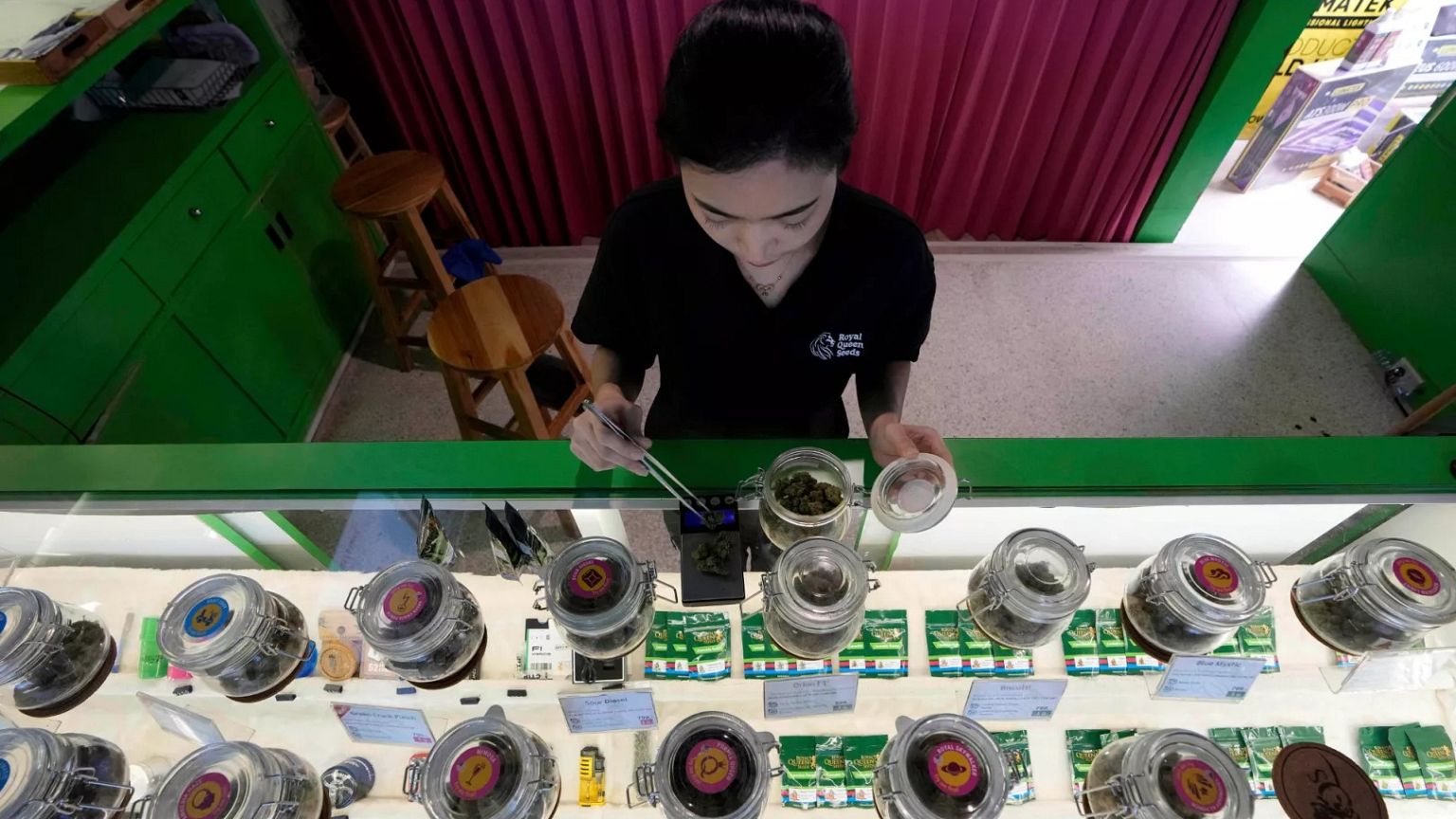
Thai cannabis stores fret as government moves to tighten rules on sales

Bangkok (AFP) – Thai cannabis store owners and activists on Thursday hit out at new government plans to tighten the rules on selling the drug by requiring a doctor's approval, three years after it was decriminalised.


Issued on: 26/06/2025 -


Thailand's government has announced a plan to tighten rules on selling cannabis, the kingdom's latest attempt to restrict the drug, three years after it was decriminalised © Chanakarn Laosarakham / AFP/File


The kingdom was the first country in Southeast Asia to decriminalise the drug when it removed cannabis from the list of banned narcotics in June 2022.

The intention was to allow sales for medical rather than recreational use, but the move led to hundreds of cannabis "dispensaries" springing up around the country, particularly in Bangkok.

While the relaxation has proved popular with some tourists, there are concerns that the trade is under-regulated.

Health Minister Somsak Thepsuthin signed an order late on Tuesday requiring an on-site doctor to approve sales for medical reasons.

The rule would only come into force once it is published in the official Royal Gazette. It is not clear when this would happen.

Thanatat Chotiwong, a long-time cannabis activist and store owner, said it was "not fair" to suddenly change the rules on a sector that was now well established.

"This is a fully-fledged industry -- not just growers selling flowers. There are lighting suppliers, construction crews, farmers, soil and fertiliser developers, and serious R&D," he told AFP.

"Some of us have invested tens of millions of baht in greenhouses and infrastructure. Then suddenly, the government steps in to shut it all down."

Thanatat urged the government instead to "implement proper taxation and regulation -- so this revenue can be returned to society in a meaningful way."

- 'Too few doctors' -

The government has made several previous announcements of plans to restrict cannabis, including legislation moved in February last year, but none has come to fruition.

The new rules would mean cannabis could only be sold to customers for medical reasons, under the supervision of licensed professionals such as medical doctors, traditional Thai medicine doctors, folk healers or dentists.

"It's going to work like this: customers come in, say what symptoms they have, and the doctor decides how many grams of cannabis is appropriate and which strain to prescribe," Kajkanit Sakdisubha, owner of The Dispensary cannabis shop in Bangkok, told AFP.

"The choice is no longer up to the customer -- it's not like going to a restaurant and pick your favorite dish from a menu anymore."

And he warned that many of the shops that had sprouted since decriminalisation would not be able to adapt to the changes.

"The reality is there are too few doctors available. I believe that many entrepreneurs knew regulations were coming, but no one knew when," he said.

While waiting for the rules to come into force, The Dispensary is halting cannabis sales as a precaution, store manager Bukoree Make said.

"Customers themselves are unsure whether what they're doing is legal. I've been receiving a lot of calls," Poramat Jaikla, the lead seller or "budtender", told AFP.

The cannabis move comes as the government led by Prime Minister Paetongtarn Shinawatra's Pheu Thai party is hanging by a thread after losing its main coalition partner, Bhumjaithai.

Though conservative, the Bhumjaithai party has long supported more liberal laws on cannabis.

The party quit the coalition this month in a row over a leaked phone call between Paetongtarn and former Cambodian leader Hun Sen.

© 2025 AFP


Thailand decriminalised cannabis 3 years ago. Now it’s banning sales without a prescription

A staff prepares flower bud of cannabis for a customer at cannabis shop in Bangkok, Thailand, July 18, 2024.
Copyright Sakchai Lalit/AP Photo

By Euronews with AP
Published on 

The shift comes amid a rift between former coalition partners in the Thai government.

Thailand is further tightening control of cannabis by banning sales of the plant to those without prescriptions.

Thailand became the first country in Asia to decriminalise cannabis in 2022, in a move that boosted Thailand’s tourism and farming, and spawned thousands of shops.

But the country has faced public backlash over allegations that under-regulation has made the drug available to children and caused addiction.

Health Minister Somsak Thepsutin signed an order this week that bans shops from selling cannabis to customers without a prescription. It also seeks to reclassify cannabis buds as a controlled herb.

Phanurat Lukboon, secretary-general of the Office of the Narcotics Control Board, said Wednesday that his agency is ready to study and implement the change in regulations.

The order did not detail any punishment for the violation. It will take effect when it is published in the Royal Gazette, although it was unclear when that would happen.

The ruling Pheu Thai Party previously promised to criminalise the drug again, but faced strong resistance from its former partner in the coalition government, the Bhumjaithai Party, which supported decriminalisation.

Somsak told reporters that he would like to relist cannabis as a narcotic in the future. The move came after officials last month revealed that cannabis smuggling cases involving tourists had soared in recent months.

Phanurat said that a study done by his agency last year found the number of people addicted to cannabis had spiked significantly after it was decriminalised.

A group of cannabis advocates said Wednesday that the change in regulations was politically motivated. The group said they will rally at the Health Ministry next month to oppose the change and the attempt to make it a criminal offence again to consume or sell cannabis.


Embattled Thai PM reshuffles cabinet as crisis rages

Bangkok (AFP) – Thai Prime Minister Paetongtarn Shinawatra began a cabinet reshuffle on Monday as a political and judicial crisis sparked by a leaked phone call threatens to sink her government.


Issued on: 23/06/2025 - RFI

Paetongtarn Shinawatra is battling a political crisis © Handout / ROYAL THAI GOVERNMENT/AFP

The 38-year-old daughter of controversial former premier Thaksin Shinawatra began handing out ministerial posts vacated when her main coalition partner quit last week -- a move that nearly took her government down.

Paetongtarn, in office for less than a year, is hanging on by a thread, and on top of the party horse-trading she now faces a Constitutional Court case that could see her barred from office.

She faced calls to quit or call an election last week as critics accused her of undermining the country and insulting the army during the leaked call with former Cambodian leader Hun Sen, which focused on a festering border dispute.

The conservative Bhumjaithai party quit the governing coalition led by Paetongtarn's Pheu Thai party over the call, leaving it with a wafer-thin majority.

But the crisis stabilised as other coalition partners said they would stay, and Pheu Thai secretary general Sorawong Thienthong told AFP on Monday that all 10 remaining parties were sticking with the government.

"None of the other parties are pulling out -- the remaining parties are staying united with the government," Sorawong said.

"The prime minister has discussed the reshuffle with other political leaders."

The new cabinet line-up will be finalised by Friday but sources said changes are expected in key positions including the defence ministry as the border row with Cambodia rumbles on.

The long-running dispute over several small stretches of the frontier in northeast Thailand flared into military clashes last month that left one Cambodian soldier dead.

The standoff has shown little sign of going away and on Monday the Thai army closed border crossings in six provinces to all vehicles and foot passengers except students and people seeking medical treatment.

The latest border restrictions apply to foreigners as well as Thais, and mean that tourists cannot enter Cambodia via the popular Aranyaprathet-Poipet crossing point.

The move came a day after Cambodian Prime Minister Hun Manet ordered a halt to fuel and gas imports from Thailand.

He visited troops on the border on Monday and an evacuation centre housing some 3,850 people moved from their homes near the border as a precaution.

Hun Manet said Monday that the "key" to normalising relations again lay with Thailand, blaming "Thai nationalism and internal politics" for the dispute.
Court case looms

With the loss of Bhumjaithai, the government can command only a handful more than the 248 votes needed for a majority in parliament, making it deeply vulnerable.

A group of political activists involved in huge demonstrations that helped sink previous leaders linked to the Shinawatras has pledged to hold a major rally on Saturday calling for Paetongtarn to quit.

Even if Paetongtarn rides out the parliamentary crisis, a potentially bigger threat is looming in the Constitutional Court.

A group of conservative senators has submitted a petition asking the court to throw Paetongtarn out of office over her conduct in the call with Hun Sen.

The same court sacked Paetongtarn's predecessor, Srettha Thavisin, in an ethics case in August last year.

Srettha was the latest in a long line of Thai prime ministers from parties linked to Thaksin to be kicked out of office by court orders or military coups -- including Thaksin himself and his sister Yingluck Shinawatra.

Thai politics has endured two decades of chronic instability fuelled by a long-running battle between the military, pro-royalist establishment and parties linked to Thaksin.

While Thaksin, 75, remains popular with his rural base, he is deeply disliked and distrusted by Thailand's powerful elite.

In another headache for the Shinawatras, Thaksin faces a criminal trial next week for insulting the monarchy in an interview with South Korean media a decade ago.

Under Thailand's strict lese-majeste laws, insulting King Maha Vajiralongkorn or his close family is punishable by up to 15 years in jail for each offence.


burs-pdw/dhw

© 2025 AFP


Thursday, April 10, 2025

Thailand revokes visa of US academic charged with royal insult


By AFP
April 9, 2025


A sign is displayed outside the Criminal Court during a protest against article 112, Thailand's lese majeste royal defamation law
 - Copyright AFP Pedro UGARTE

Thailand’s immigration authorities revoked the visa Wednesday of a prominent American scholar detained a day earlier on royal defamation charges, his lawyer said.

Paul Chambers, who has spent over a decade teaching Southeast Asia politics at a Thai university, had his bail request rejected Tuesday by a court in Phitsanulok province after reporting to police to answer a charge of lese-majeste.

His case is a rare instance of a foreigner falling foul of strict laws which shield King Maha Vajiralongkorn and his close family from any criticism and can lead to decades-long prison sentences.

“The immigration police just came into the detention centre earlier this afternoon,” said Wannaphat Jenroumjit, who is with the Thai Lawyers for Human Rights (TLHR) and representing Chambers.

The Thai military filed a complaint against Chambers earlier this year over an article linked to a think-tank website which focuses on Southeast Asia politics.

“Urgent! Lawyers have been informed that immigration police have revoked the visa of Paul Chambers,” TLHR posted on X.

The organisation said it will appeal the visa revocation decision within 48 hours and continue efforts to secure Chambers’ release.

Wannaphat told AFP she had submitted a second bail request on Tuesday and was awaiting the court’s decision.

She said Chambers was “not confident but remains hopeful” in the Thai justice system.

Chambers told AFP last week he felt “intimidated” by the situation, but was being supported by the US embassy and colleagues at his university.

The US State Department said Tuesday it was “alarmed” by the arrest.

Chanatip Tatiyakaroonwong, a researcher at Amnesty International who campaigns for the release of political prisoners, said the visa revocation was meant to “intimidate” Chambers.

“They found his work threatening, so revoking his visa means he can no longer remain in Thailand and continue his work,” he told AFP.

“The visa revocation is meant to send a message to foreign journalists and academics working in Thailand, that speaking about the monarchy could lead to consequences.”

He added that the chances of Chambers being granted bail looked grim, given a “pattern” in which people charged under lese-majeste laws are rarely granted bail.

International watchdogs have expressed concern over the use of the laws — known as Article 112 — against academics, activists and even students.

One man in northern Thailand was jailed for at least 50 years for lese-majeste last year, while a woman got 43 years in 2021.

In 2023, a man was jailed for two years for selling satirical calendars featuring rubber ducks that a court said defamed the king.

Saturday, April 05, 2025

Prominent US academic facing royal insult charge in Thailand

ABOLISH LESE-MAJESTE LAW
ABOLISH MONARCHY


By AFP
April 4, 2025


Thailand's King Maha Vajiralongkorn is protected from criticism by tough lese-majeste laws - Copyright AFP/File Manan VATSYAYANA

Thai police summoned a prominent American academic on Friday to face charges of insulting the monarchy, a rare case of a foreign national being charged under the kingdom’s strict lese-majeste law.

The army filed a complaint against Paul Chambers, a lecturer at Naresuan University in northern Thailand and respected authority on the kingdom’s politics, over comments he made in an online discussion.

Thai King Maha Vajiralongkorn and his close family are protected from criticism by the lese-majeste law, with each offence punishable by up to 15 years in jail.

Charges under the law have increased dramatically in recent years and critics say it is misused to stifle legitimate debate.

According to a police summons dated Friday and seen by AFP, Chambers is accused of “insulting or showing malice towards the king, queen, heir to the throne, or regent”, as well as “introducing counterfeit computer data that could threaten national security”.

Chambers told AFP the charge stems from remarks he made during a webinar held last year in which he discussed the relationship between the Thai military and the monarchy during a question-and-answer session.

“I believe I’m the first non-Thai in years to face this charge,” he said by phone.

He said that while he felt “intimidated” by the situation, he was being supported by the US embassy and colleagues at the university.

Sunai Phasuk of Human Rights Watch confirmed to AFP that police in Phitsanulok province agreed not to detain Chambers immediately.

Instead, he has been summoned to formally acknowledge the charge at a police station on Tuesday.

Phitsanulok Police did not comment about the case when contacted by AFP.

The royal defamation law, known as 112 from the relevant article of Thailand’s criminal code, has been widely criticised by human rights groups for its broad interpretation and harsh penalties.

International watchdogs have expressed concern over its increasing use against academics, activists, and even students.

Charges under 112 grew sharply in the wake of youth-led protests in 2020 that called for reforms to the monarchy’s role in public life.

One man in northern Thailand was jailed for at least 50 years for lese-majeste last year, while another woman got 43 years in 2021.

And in 2023 a man was jailed for two years for selling satirical calendars featuring rubber ducks that a court said defamed the king.


Wednesday, January 15, 2025

Thai man serving record royal insult sentence faces new charges


By AFP
January 14, 2025


Mongkol Thirakot was sentenced last year to at least 50 years in prison on royal defamation charges for posts made on his personal Facebook account several years ago - Copyright AFP Kirill KUDRYAVTSEV

A Thai man serving a record sentence for insulting the monarchy has been hit with three more charges, a rights group told AFP on Tuesday.

Mongkol Thirakot, 31, was sentenced last year to at least 50 years in prison on royal defamation charges for posts made on his personal Facebook account several years ago.

The record-breaking sentence came after several years in which Thailand ramped up use of the controversial legislation against pro-democracy protesters in what critics say is a tactic to silence dissent.

“Police have charged him with three more counts of royal defamation over three Facebook posts from 2022,” said Noppol Achamas from Thai Lawyers for Human Rights (TLHR).

He told AFP that Mongkol faces at least nine more years in prison.

The lese-majeste law, which shields King Maha Vajiralongkorn and his close family from criticism, is often referred to as 112 in Thailand after the relevant section of the criminal code.

When Mongkol was sentenced in January last year, TLHR said it was the longest jail term handed down for royal defamation, beating the previous record of 43 years imposed on a woman in 2021.

Mongkol, who owns an online clothing store in Thailand’s north, is currently being held in Chiang Rai Central Prison.

He has filed an appeal to the Supreme Court on his earlier sentence, according to TLHR.

More than 250 activists have been charged under lese-majeste laws since the 2020 protest movement began, according to the rights group.

Wednesday, December 04, 2024

LESE MAJESTE

Thai dissident jailed for two more years over royal defamation


By AFP
December 3, 2024

Arnon Nampa, a 40-year-old human rights lawyer and activist, is already serving time in prison - Copyright AFP Lillian SUWANRUMPHA

One of Thailand’s most prominent human rights activists was sentenced to two years in prison Tuesday under the kingdom’s royal defamation law, his fifth conviction on the controversial charges, a legal rights group said.

Thailand has some of the world’s strictest royal defamation laws, which shield King Maha Vajiralongkorn and his close family from criticism and which opponents say have been weaponised to silence dissent.

Arnon Nampa, a 40-year-old human rights lawyer and activist already serving time in prison, was convicted on Tuesday at Bangkok Criminal Court over a 2020 social media post in which he allegedly criticised the king’s authority, according to Thai Lawyers for Human Rights (TLHR).

The latest conviction, his fifth, means he will serve in total more than 16 years in prison, according to TLHR.

Arnon was first jailed for four years in September last year, over a speech he made in 2020 as a leading figure in the kingdom’s youth-led pro-democracy protest movement which called for changes to the lese-majeste law.

On Tuesday, the court found that Arnon’s online remarks had influenced others and said it was “necessary for the state to punish” him, TLHR said on X.

The court said Arnon’s post was “insulting” to the monarch, TLHR added.

Youth-led demonstrations in 2020 and 2021 saw tens of thousands take to the streets, with many demanding changes to the strict lese-majeste laws.

Arnon is among more than 150 activists who have been charged in recent years under those laws, often referred to as “112” after the relevant section of the criminal code.

Sunday, September 15, 2024

Exiled, jailed or silenced: Thailand’s youth protest leaders languish under prosecution blitz

(Clockwise from top left) Benjamaporn Nivas, Panusaya Sithijirawattanakul, Bunkueanun Paothong and Patsaravalee Tanakitvibulpon. 
PHOTOS: COURTESY OF BENJAMAPORN NIVAS, TAN HUI YEE

Tan Hui Yee
Indochina Bureau Chief
Sep 15, 2024, 05:00 AM


BANGKOK - Benjamaporn Nivas, 19, sells bubble tea in Vancouver while taking adult education classes to make up for her interrupted schooling.

It has been two years since she has seen her friends and family in Thailand, and four years since she co-founded a student group to reform Thai education.

The mass protests she helped to lead eventually challenged the status quo and demanded reform of Thailand’s powerful monarchy.


But she paid the price for her activism.

“I never imagined I would end up so far away,” she told The Straits Times in a video call from Canada, where she received asylum after fleeing a possible lese majeste conviction in 2022.

“Sometimes I feel sad and miss home. But I am safe. There are things which I had to give up in exchange for that, and it was painful. But I have to keep going.”

Four years after student protests first broke out across South-east Asia’s second largest economy – challenging the then military-linked government and eminence of King Maha Vajiralongkorn – the young people who drew thousands of protesters onto the streets are grappling with prosecutions that have driven some into exile, others to incarceration and many more to silence.

Benjamaporn Nivas shows artwork she created in Canada about the Thai political situation
PHOTO: COURTESY OF BENJAMAPORN NIVAS

According to advocacy group Thai Lawyers for Human Rights, more than 1,900 people have been charged – for taking part in public assemblies or expressing their political opinion – since youth protests first broke out in July 2020.

Among them were 272 people charged with lese majeste – an offence that carries a jail term of up to 15 years.

At least 126 of the 155 lese majeste cases known to be concluded so far have resulted in jail sentences. Prominent protest leader and activist lawyer Arnon Nampa, 40, is serving 14 years in prison for the royal insult cases against him concluded so far.

Arnon was the first activist at the protests to call for discussion about the King, who controls his own military units as well as billions of dollars of assets he took over from the Crown Property Bureau, an agency which managed assets on behalf of the palace.

For lese majeste defendants yet to be convicted, pre-trial detention in prison is common. Democracy activist Netiporn Sanesangkhom, who was facing lese majeste and other charges, died in detention in May at the age of 28, after a months-long hunger strike to protest against the justice system.

Some youth leaders have decided to skip town. Fugitive activist Panupong Jadnok, 27, reportedly arrived in New Zealand in August after missing a lese majeste-related court date months earlier. Parit Chiwarak, a 26-year-old student leader who goes by the nickname of Penguin, was saddled with 25 royal defamation cases when he skipped a court hearing in June. He is presumed to have fled Thailand.

Youth protest leaders who remain in Thailand say they are forced to structure their lives around a revolving door of court appointments and make peace with the ever-present possibility of losing their freedom.

Panusaya Sithijirawattanakul, 25, is trying to cram studies for a master’s degree in human rights with attending court hearings for the 31 cases filed against her. Nine of them involve alleged lese majeste.

Panusaya Sithijirawattanakul has 31 cases filed against her. 
ST PHOTO: TAN HUI YEE


Rung, as she is known among friends, stunned the Thai public in August 2020 when she read out a list of 10 demands for monarchy reform before thousands of protesters just outside Bangkok. Among other things, it called for the monarch to be stripped of legal immunity and the royal budget to be reduced in line with economic conditions. It also demanded that the lese majeste law be abolished.

Then a sociology and anthropology undergraduate at Thammasat University in Pathum Thani province, Rung went on stage to speak at many other protests as part of a group called the United Front of Thammasat and Demonstration.

But the resulting state surveillance, prosecution and body-shaming online attacks by conservatives left her “stressed and anxious”, she told ST.

“I am still an activist and human rights defender,” she said in an interview near her home in Nonthaburi province. “With the time that I have left, I will use it to study human rights and democratisation. If I am sent to jail, I would have some knowledge or skills that can protect other inmates in prison.”

Other youth leaders – spooked by state pressure on them and their relatives – have sworn off demonstrations.

Bunkueanun Paothong, a 25-year-old international relations undergraduate at Mahidol University, told ST: “A lot of protest leaders paid a price. I am no different. Even though I hate to admit it as much, I believe that now it’s not a price I can pay any more.”

He is instead focusing on his work in the Mahidol University student council, of which he is a member.

Bunkueanun Paothong is focusing on his work in the Mahidol University student council. ST PHOTO: TAN HUI YEE


He recalled “almost” losing his sanity after being constantly tailed by people he identified as police officers.

“I lost the ability to confidently walk and do things without being surveilled all the time,” he said.

New political developments have drawn public attention away from these youth leaders.

The street protests eased as Thailand emerged from the Covid-19 pandemic and held a general election in May 2023.

Coup leader and then prime minister Prayut Chan-o-cha – a major source of public ire – was relegated to political obscurity after a disastrous showing by his political party in the 2023 general election. He is now a privy councillor.

Many people who took to the streets in 2020 to call for reforms later pinned their hopes on the progressive Move Forward Party, which won the 2023 election but was blocked by royalist factions in Parliament from forming a government.

The Constitutional Court deemed that Move Forward’s campaign to amend the lese majeste law was illegal – and dissolved the party on those grounds. This pushed the possibility of amending the draconian law even further back.

Meanwhile, election runner-up Pheu Thai Party has joined hands with parties across the political spectrum to form two coalition governments so far.

While the current government is helmed by 38-year-old Prime Minister Paetongtarn Shinawatra, it is thought to be controlled by her father Thaksin Shinawatra.

Mr Thaksin, himself a former prime minister, spent 15 years in self-exile to evade graft-related charges but returned to Thailand in 2023 through what was seen as a political deal for lenient treatment. Tellingly, he prostrated himself before a picture of the King and Queen as soon as he returned.

Still, while fading from public consciousness, the youth protesters have left an indelible mark on Thai politics.

“The main legacy of the youth movement is their contribution to the ideological shift in Thailand,” said Dr Janjira Sombatpoonsiri, a Bangkok-based research fellow at the German Institute for Global and Area Studies. “The popular mood back then – right in the middle of the pandemic – was a questioning of the status quo. There was real resentment against injustice and elite privileges.

“The movement voiced this in public, and it started the conversation about key institutions that undergird the status quo.”

She added: “Now that cannot be undone, regardless of the repression of the movement and the fact that there is currently no mass mobilisation against the elite.”

Some youth leaders say they can afford to wait.

Patsaravalee Tanakitvibulpon, 29, is fighting 15 protest-related charges – including three involving lese majeste. She has focused on campaigning work related to resources like land and water, which she feels are closely tied to Thailand’s power structure.

“I am still fighting, but the method that I have chosen is appropriate for the current circumstances,” she told ST. “Discussions about the monarchy are still taking place online even though there is no protest.”

Patsaravalee Tanakitvibulpon is fighting 15 protest-related charges – including three involving lese majeste. 
 ST PHOTO: TAN HUI YEE

While there have been efforts to introduce an amnesty Bill for victims of political prosecution, individuals accused of lese majeste are unlikely to get a reprieve under this move, said Dr Janjira, who is a member of a parliamentary committee looking into this.

This is because there is not enough support among legislators or even the public for amnesty on this controversial issue.

Despite the threat of jail, Rung is optimistic about political change in Thailand, simply because the biggest defenders of the status quo belong to the older generation.

“They are older than us. They will die before us,” she said matter-of-factly. “If we can maintain the idea of change, the idea of democracy, the idea of equality within our generation and the generation after us, maybe one day Thailand will become more diverse and more equitable.”

Benjamaporn, meanwhile, has no regrets despite being driven into exile.

“The Thai education system has gradually changed and students have become braver and more aware of their rights,” she said. “I am proud of what I had done. Even if I could turn back the clock, I still would have done what I did.”

More On This Topic