Honda is set to build an electric vehicle battery plant next to its Alliston, Ont., assembly plant, which it is retooling to produce fully electric vehicles as part of a $15-billion project to create a supply chain in the province for the Japanese automaker.
The plan – which includes up to $5 billion in public funds – is expected to see the two main plants create 1,000 jobs on top of retaining the existing 4,200 jobs at the assembly plant. That plant is set to produce up to 240,000 vehicles per year when fully operational in 2028.
Prime Minister Justin Trudeau said the jobs involved are at the heart of the deal.
"It's about, yes, creating green products that Canadians can rely on into the future, but it's primarily about investing in the workers and the communities that they are part of as these plants get built and as they work for generations to come," he said Thursday at a news conference detailing the project.
The deal does not involve production subsidies, which were used to woo two other automakers to build battery plants in Ontario instead of the United States with its incentives under the Inflation Reduction Act.
But the federal government is set to give the Japanese automaker around $2.5 billion through tax credits.
Federal Finance Minister Chrystia Freeland's recent budget announced a 10 per cent Electric Vehicle Supply Chain investment tax credit on the cost of buildings related to EV production as long as the business invests in assembly, battery production and cathode active material production in Canada.
That's on top of an existing 30 per cent Clean Technology Manufacturing investment tax credit on the cost of investments in new machinery and equipment.
Ontario has committed to providing up to $2.5 billion directly – such as for capital costs – and indirectly, such as covering site servicing costs.
Trudeau defended the public money that is being put toward the project, saying countries around the world are competing for investments in greener manufacturing and Honda's project will benefit Canada's economy and communities.
"That's not just creating jobs, great jobs for 1,000 new people around here, that's contributing to an ecosystem that will involve parts suppliers, it'll involve communities with vibrant art scenes and strong main streets, it'll involve future generations of Canada building the kinds of solutions the world needs," he said.
"Yes, there are politicians who sit back and say, 'No, no, no, no, no. We've got to balance the budget at all costs, even if it means not investing in Canadian workers and investing in the future.' Well, I think they're wrong."
Ontario Premier Doug Ford said Honda's investment is a generational commitment.
"This is decades and decades down the road," he said.
"What price do you put on that? There is no price you can put on that because we're investing into the people. The money is staying here in Ontario. It's not going overseas, it's not going down to the U.S., it's staying right here in Ontario for decades and generations to come."
The federal Opposition Conservatives suggested that other foreign companies that have received Canadian government subsidies have not filled their jobs with Canadian workers. Concerns have been raised about international workers being used to help build another EV battery plant in Windsor, Ont.
"We can't trust that his latest announcement of $5 billion in Canadian taxpayer money to another large multinational corporation will be any different," two critics wrote in a joint statement.
"Conservatives will not let Justin Trudeau sell out Canadian union workers and taxpayers yet again."
The $15-billion Honda project includes the retooled plant, an electric vehicle battery plant nearby, as well as two key battery parts facilities located elsewhere in Ontario. Honda and POSCO Future M Co., Ltd. will build a cathode active material and precursor processing plant, and the automaker will also build a separator plant through a joint venture with Asahi Kasei Corporation.
Honda's global CEO, Toshihiro Mibe, suggested the company is not stopping there.
"In the future, Honda will consider building a comprehensive battery chain beyond the four areas of EVs, EV batteries, cathode material and separators," he said, noting that battery recycling is key as well.
"Honda will realize low carbon value creation throughout the battery life cycle. In this way, Honda will establish a highly profitable business foundation and contribute to realizing a carbon neutral society."
The Honda facility will be the third electric vehicle battery plant in Ontario, following in the footsteps of Volkswagen in St. Thomas, Ont., and a Stellantis LG plant in Windsor.
The deal comes after years of meetings and discussions between Honda executives and the Ontario government, which began after the last big government announcement at Honda's Alliston facility.
Trudeau, Ford and Honda executives were on hand in March 2022 when the Japanese automaker announced hybrid production at the plant, with $131.6 million in assistance from each of the two levels of government.
That kickstarted conversations about a larger potential investment into electric vehicles, and negotiations began that summer.
In the midst of those negotiations, in May of 2023, Stellantis and LG stopped construction on their $5-billion electric vehicle battery facility, as they pressed the federal government to match what the United States would offer under its then-new Inflation Reduction Act.
They ultimately reached a deal with Canada and Ontario that will see the companies receive performance incentives of up to $15 billion over about 10 years.
The offer was also extended to Volkswagen for its electric vehicle battery facility and that deal could see up to $13 billion in incentives.
Freeland has said large production incentives were necessary for both Volkswagen and Stellantis to help establish Canada’s green economy and ensure the companies were not lured away to the United States by the benefits under the IRA.
The federal government later indicated that tap was turned off, and Ontario Economic Development Minister Vic Fedeli said in an interview that it didn't derail the negotiations with Honda.
"Production incentives were meant to match the American production incentives, but it's just far too much to continue with on an ongoing basis," he said.
"I think they were good to get started, but the rest of the industry now is starting to realize, right across North America, that you need to be where you really should be for the talent, clean energy and critical minerals."
The other two battery plants in the works have also started to draw other parts of the supply chain, Fedeli said, which became another part of the pitch for Honda – and perhaps others.
"We wanted EV manufacturers, we wanted a couple of battery manufacturers, and now we're filling in the major supply chain: cathode, anode, separator, electrolyte, copper foil, lithium hydroxide, those six major components," he said.
"We still have some room in our incentive packages for that line of six. After that, the incentive is: we brought you a customer. We brought you a battery maker ... you have to go and do your deal with them. You have enough incentive to come here."
This report by The Canadian Press was first published April 25, 2024.
Ottawa, Quebec commit $100M for semiconductor capacity in Bromont, Que., 280 jobs
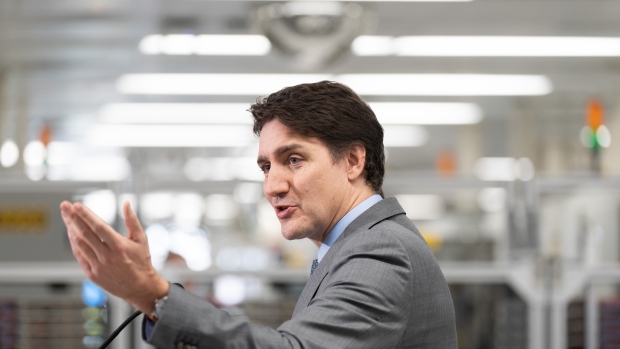
Prime Minister Justin Trudeau speaks to the media following a tour at IBM in Bromont, Que.,
Friday, April 26, 2024. The federal government is announcing an investment of nearly $60 million
in semiconductors, a technology omnipresent in electronic devices, also used to develop
artificial intelligence. , THE CANADIAN PRESS/Christinne Muschi
The federal and Quebec governments are spending close to $100 million to boost the country's manufacturing capacity for semiconductors, which are vital in technologies ranging from artificial intelligence to quantum computing.
At a news conference Friday in Bromont, Que., Prime Minister Justin Trudeau announced that Ottawa will invest $59.9 million to help fund IBM Canada’s semiconductor packaging facility in the town about 70 kilometres southeast of Montreal. The investment will also go toward the Bromont-based MiQro Innovation Collaborative Centre, a research group that tries to speed up the commercialization of components in digital technologies.
The world, Trudeau said, is looking for dependable sources of products that spur economic growth, and he said semiconductors are one of the many products Canada can be trusted to deliver.
"As we are in terms of energy, quantum computing, robotics … these are things that the world is increasingly looking for," he said, "reliable, strong responsible partners like Canada to be at the heart of it."
Quebec, for its part, is offering IBM Canada $38.9 million in loans to help the company buy equipment, increase capacity at its Bromont plant, and create a new generation of switches.
Provincial Economy Minister Pierre Fitzgibbon told the news conference that within the funding envelope is a $32-million "forgivable" loan for new equipment to package semiconductor circuitry, but he didn't give details about the loan conditions. Another $7-million loan, he said, will help automate a packaging assembly line for switches destined "for the entire telecommunications industry."
A news release from the federal government says the funding from both levels of government will help create 280 jobs in the region.
IBM Canada says its plant in Bromont is one of the continent's largest chip assembly and testing facilities and that the money will solidify Canada's place in the supply chain for advanced packaging of semiconductors.
The Bromont plant, IBM says, "transforms advanced semiconductor components into state-of-the-art microelectronic solutions," and works closely with the company's complex in Albany, N.Y.
The agreements announced on Friday "will help to further establish a corridor of semiconductor innovation from New York to Bromont," IBM said.
This report by The Canadian Press was first published April 26, 2024.
IBM offices in Foster City, California. Photographer: David Paul Morris/Bloomberg , Bloomberg
(Bloomberg) -- International Business Machines Corp. will expand its Canadian semiconductor packaging and testing plant with more than C$1 billion ($730 million) in investments over the next five years.
Focused on advanced semiconductor components, IBM’s 800-acre site in Bromont, Quebec, about 50 miles east of Montreal, is the largest of its kind in North America, and home to Canada’s first universal quantum computer.
Packaging, a technical process in which chips are transformed into microelectronic components, is an essential part of the supply chain and requires a skilled workforce. There’s very little semiconductor packaging capacity on the continent, and most of it is at the 1,000-employee Bromont facility.
“Even if we produce the processors at factories in the US or Canada, we would then have to send them back to Taiwan for packaging,” Jamie Thomas, general manager of technology lifecycle services at IBM, said in an interview. “What you really need is a full supply chain onshore.”
IBM’s C$1 billion Bromont growth plan will unfold between now and 2029, she confirmed. After months of talks with government, IBM announced an initial phase on Friday that will create 280 skilled jobs.
The first stage is an investment worth C$227 million — including an IBM partner, the MiQro Innovation Collaborative Centre — that will expand the existing Quebec plant and build a research and development lab.
The announcement is “a critical piece to support our growth at this site,” said Thomas. The Canadian and Quebec governments will provide in total about C$100 million for this first phase, according to statements.
“It’s important that Canadians be at the center of developing these technologies — but it’s important for the world, particularly for our allies,” Prime Minister Justin Trudeau said at a news conference.
Supply disruptions during the pandemic have shown the great dependence of the US on East Asia, which accounts for 75% of the global semiconductor production.
Last year, when US President Joe Biden visited Trudeau in Ottawa, IBM and the Canadian government signed a high-level agreement on semiconductor cooperation.
No Big Subsidies
Canada is a so-called “fabless” G7 nation — it has skills, but no large-scale chip factory. Those in the chip manufacturing industry are eager to see a broad strategy from the government backed by substantial support, akin to the billions of dollars in commitments given to the electric-vehicle battery industry for plant construction and operating subsidies.
Government incentives for the chip industry will be focused, Industry Minister Francois-Philippe Champagne said Friday in an interview. “It’s probably not for us to replicate what already exists in the US, but to be complementary and to look at what are the strategic places where we can play a role.”
The US, through the 2022 Chips Act, has set aside $39 billion in direct grants, plus loans and loan guarantees worth $75 billion to incentivize domestic semiconductor production.
Canada positioning is focused more on improving North America’s supply-chain resiliency with advanced capabilities for chips dedicated to highly specialized sectors such as aerospace and health care, rather than supporting large-scale factories.
The lack of major government investments isn’t too much of a concern for Benjamin Bergen, who’s president of the Canadian Council of Innovators. Committing hundreds of millions of dollars to a single foreign-based multinational would only mean “the government hasn’t thought more strategically about what type of semiconductor strategy it wants to have,” he said.
--With assistance from Brian Platt.
(Adds comments from industry minister and industry group from 12th paragraph.)
©2024 Bloomberg L.P.