Saturday, April 27, 2024

Animal Rights groups are urging tourists not to visit Wyoming after a man hit a wolf then took it to a bar

The Canadian Press
Fri, April 26, 2024


CHEYENNE, Wyo. (AP) — As Yellowstone National Park in Wyoming opens for the busy summer season, wildlife advocates are leading a call for a boycott of the conservative ranching state over laws that give people wide leeway to kill gray wolves with little oversight.

The social media accounts of Wyoming's tourism agency are being flooded with comments urging people to steer clear of the Cowboy State amid accusations that a man struck a wolf with a snowmobile, taped its mouth shut and showed off the injured animal at a Sublette County bar before killing it.

While critics contend that Wyoming has enabled such animal cruelty, a leader of the state’s stock growers association said it's an isolated incident and unrelated to the state's wolf management laws. The laws that have been in place for more than a decade are designed to prevent the predators from proliferating out of the mountainous Yellowstone region and into other areas where ranchers run cattle and sheep.

"This was an abusive action. None of us condone it. It never should never have been done,” said Jim Magagna, executive vice president of the Wyoming Stock Growers Association and a Sublette County rancher who has lost sheep to wolves. “It’s gotten a lot of media attention but it’s not exemplary of how we manage wolves to deal with livestock issues or anything.”

Wolves are federally protected as an endangered or threatened species in most of the U.S. but not the Northern Rockies. Wyoming, Idaho and Montana allow wolves to be hunted and trapped, after their numbers rebounded following their reintroduction to Yellowstone and central Idaho almost 30 years ago. Before their reintroduction, wolves had been annihilated in the lower 48 states through government-sponsored poisoning, trapping and bounty hunting into the mid-1900s.

Today, Wyoming has the least restrictive policies for killing wolves. There are limits on hunting and trapping in the northwestern corner of the state and killing them is prohibited in Yellowstone and neighboring Grand Teton National Park, where they are a major attraction for millions of tourists. But outside the Yellowstone region, in the 85% of the state known as the “predator zone,” they can be freely killed.

The wolf allegedly was run down, shown off and killed within the predator zone.

Wolves roam hundreds of miles and often kill cattle and sheep. Gray wolves attacked livestock hundreds of times in 2022 across 10 states including Wyoming, according to an Associated Press review of depredation data from state and federal agencies, the most recent data available. Other times livestock succumb to other predators, disease or exposure or simply go missing.

Losses to wolves can be devastating to individual ranchers, yet wolves' industry-wide impact is negligible: The number of cattle killed or injured in documented cases equals 0.002% of herds in the affected states, according to a comparison of depredation data with state livestock inventories.

The predator zone resulted from negotiations between U.S. and Wyoming officials who traded away federal compensation for livestock killed by wolves in exchange for allowing free killing of wolves in that area.

Saharai Salazar is among out-of-staters changing their travel plans based on what allegedly happened Feb. 29 near Daniel, a western Wyoming town of about 150 people.

The Santa Rosa, California, dog trainer posted on the state’s tourism Instagram account that she would not get married in Wyoming next year as planned. The post was among hundreds of similar comments, many with a #boycottwyoming hashtag on social media in recent weeks.

“We have to change the legislation, rewrite the laws so we can offer more protection, so they can’t be interpreted in ways that will allow for such atrocities,” Salazar said in an interview.

Wyoming’s rules have long invited controversy but are unlikely to harm the overall population because most of the animals in the state live in the Yellowstone region, said wolf expert and former U.S. Fish and Wildlife Service wolf biologist Ed Bangs.

Bangs said the incident of the wolf brought into the bar was a “sideshow” to the species' successful recovery. The predator zone is made up largely of open landscapes that generally don't support wolves, he said.

Wyoming’s rules, including the predator zone, have withstood multiple court challenges that have put wolves on and off the endangered species list since they were first delisted in 2008. Wolves haven't been on the list in the region since a 2017 court order and their current Wyoming population of more than 300 is similar to their number in 2010.

Though state law doesn’t specify how wolves in the predator zone can be killed and doesn’t specifically prohibit running them over, the Humane Society and others argue the state’s animal cruelty law applies in this case.

Widely circulating photos show the man posing with the wolf with its mouth bound. Video clips show the same animal lying on a floor, alive but barely moving.

The Sublette County Sheriff’s Office said it has been investigating the anonymous reports of the man’s actions but has struggled to get witnesses to come forward.

“We’ve had the tip line open for two weeks hoping for witnesses or something helpful,” sheriff’s spokesperson Sgt. Travis Bingham said. “I know there’s some hesitation for people to come forward.”

The only punishment for the man so far is having to pay a $250 ticket for illegal possession of wildlife.

The suspect has not commented publicly and did not answer calls to his business. Calls to the bar went unanswered.

___

Matthew Brown in Billings, Montana, contributed to this report.

Mead Gruver, The Associated Press

UK

Former Conservative Health Minister Defects to Labour: Observer

(Bloomberg) -- Conservative Member of Parliament Dan Poulter is defecting to Labour, the Observer reported, citing an interview with the former health minister.

Poulter, the MP for Central Suffolk and North Ipswich who also works part-time as a mental health doctor in an NHS hospital, said he won’t seek re-election and would be taking the Labour whip until the next election. 

“The Conservative government has been failing on the thing I care about most, which is the NHS and its patients,” he told the Sunday newspaper.

More than 60 Tory MPs have said that they won’t run again at a general election that has to take place within the next 10 months. 

SIR KEIR'S LABOUR ARE RED TORIES


Feds need 'nuanced' approach to ensure public sector doesn't lose tech talent: Anand

Treasury Board President Anita Anand says Canada has to take a "nuanced" approach to shrinking its public service in order to protect some of its tech worker ranks.

Anand says she does not want to see the number of cyber or procurement experts decrease in an era when their skills are crucial.

The remarks come roughly a week after the federal government's budget revealed natural rates of attrition will see the public service's size decline by 5,000 full-time roles over the next four years.

The public service sat at about 368,000 members at the end of March, but Anand said last week that no government ministry and agency would be left out of the process of cutting.

Anand appeared virtually at a Microsoft event in Toronto, where she discussed the $2.4 billion in AI investments in the government's budget.

Anand also used her appearance at the event to tease a summit in Ottawa next month with think tanks and other stakeholders to help the government develop an AI strategy for the federal public sector.

This report by The Canadian Press was first published April 24, 2024.

Canada's retail sales flatlined in the first quarter of 2024


CONSUMERS ARE WORKERS SPENDING THEIR WAGES

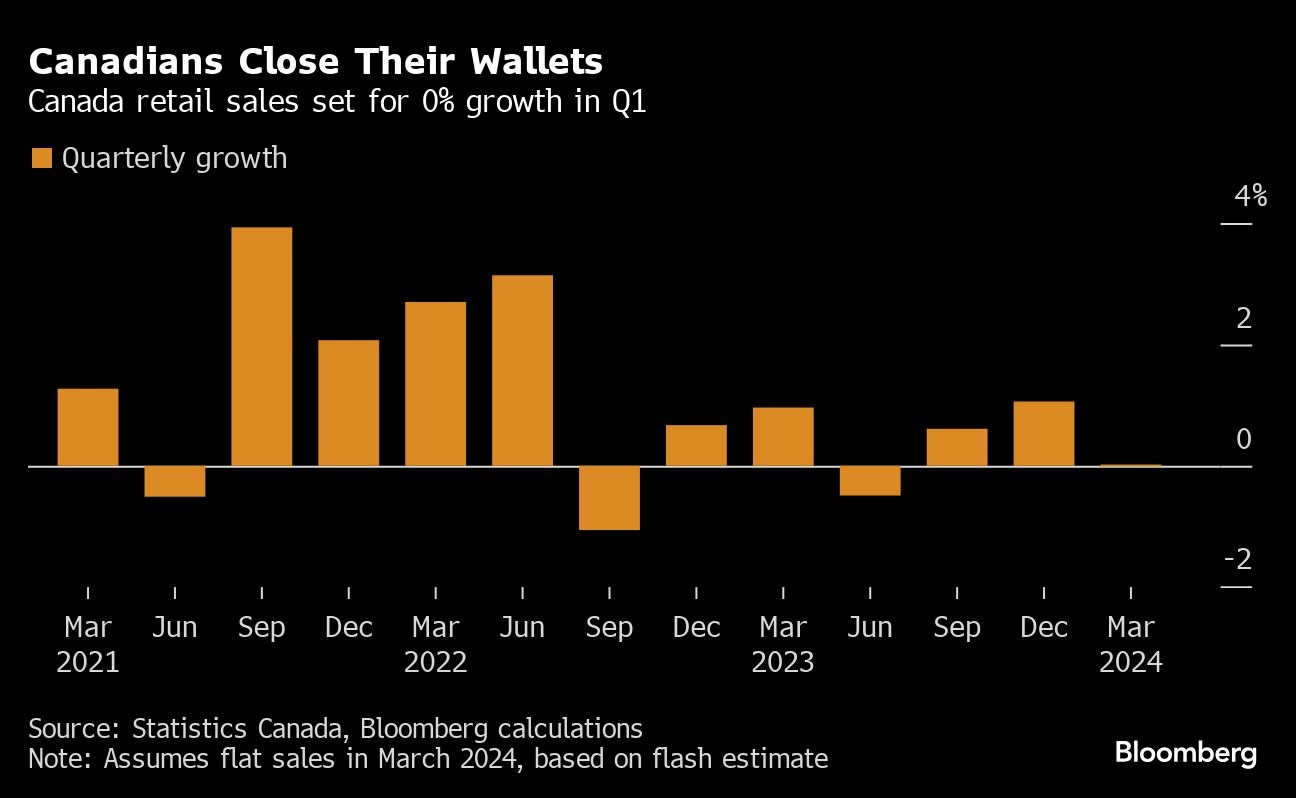
Canadian consumers haven’t tightened their belts this much in nearly a year, and there are no signs of spending growth since the start of 2024.

Receipts for retailers were unchanged in March, according to an advance estimate from Statistics Canada released Wednesday. That followed a 0.1 per cent drop in February, missing expectations for a 0.1 per cent gain in a Bloomberg survey.

Taken together with the 0.3 per cent plunge in January sales, the figures point to a flat reading in the first three months of the year, the weakest pace since the second quarter of 2023.

After the release, yields on two-year Canadian government bonds fell about three basis points to 4.25 per cent, while the loonie weakened about 0.3 per cent to $1.372 per U.S. dollar as of 9:08 a.m. Ottawa time.

February’s decline was led by lower sales at gas stations, while car sales rose. Excluding these two subsectors, core retail sales were unchanged. All in, the report shows consumers cutting back on discretionary products including clothing and accessories as well as sporting goods.

In volume terms, retail sales decreased 0.3 per cent in February. Excluding autos, retail sales fell 0.3 per cent, lower than expectations for a 0.1 per cent increase, while the previous month’s growth was revised down to 0.4 per cent.

February’s decline was more widespread than weakness seen in January, underscoring the challenges facing consumers amid rising costs of living and financing, Maria Solovieva, economist at Toronto Dominion Bank, said in an email.

“Despite the overall softness, auto sales emerged as a bright spot, demonstrating their usual roly-poly resilience by bouncing from previous declines,” she said, adding that the bank’s internal data points to solid spending in March.

Tiago Figueiredo, macro strategist at Desjardins Financial Group, said he expects retail sales to struggle given the mortgage renewal cycle, slowing population growth and rising business insolvencies, which are pushing the unemployment rate higher.

The data reinforces that a Bank of Canada interest-rate cut is likely at the next meeting in June, Olivia Cross of Capital Economics said in a report to investors.

Regionally, sales were down in seven provinces in February, with the largest declines in Alberta, led by lower car sales. Canada’s two most populous provinces — Ontario and Quebec — as well as its three biggest cities — Toronto, Montreal and Vancouver — all saw receipts for retailers decrease.

The statistics agency didn’t provide details on the March estimate, which was based on responses from 61.9 per cent of companies surveyed. The average final response rate to the survey over the previous 12 months was 90.7 per cent.

February’s retail sales growth fell below the range of estimates in the Bloomberg survey, which spanned 0.0 per cent to 0.8 per cent.

CRIMINAL CAPITALI$M

Former SNC-Lavalin executive sentenced to prison term in bridge bribery case

A former SNC-Lavalin executive has been sentenced to three and a half years in prison in connection with a bribery scheme for a bridge repair contract in Montreal, the RCMP say.

Normand Morin, once a high-ranking vice-president at the engineering firm, received the sentence Tuesday after his conviction for corruption and fraud last month.

A police investigation revealed that SNC-Lavalin executives paid bribes of roughly $2.3 million in order to secure a $128-million contract to repair the Jacques Cartier Bridge deck in the early 2000s.mer CEO of the Federal Bridge Corp., admitted to receiving the bribes through Swiss bank accounts between 1997 and 2004.

Fournier, who served as chief of staff to Jean Chrétien when he was Opposition leader in the early 1990s, was sentenced to five and a half years in prison and has since received full parole.

Ex-SNC vice-president Kamal Francis was also hit with forgery and fraud charges in 2021. Court proceedings are ongoing, the RCMP said.  

SNC-Lavalin — now known as AtkinsRéalis — agreed in 2022 to pay Quebec nearly $30 million over three years to settle criminal bribery charges stemming from work on the bridge that spans the St. Lawrence River between Montreal and Longueuil, Que.

The deal, a so-called deferred prosecution agreement, allowed the company to continue doing business with the governments of Quebec and Canada as well as abroad.

The RCMP said the charges resulted from a complex investigation dubbed Project Agrafe (“Staple”) that started in 2013. It was carried out by the Sensitive and International Investigations division of the force, mandated to investigate criminal activity that poses a threat to Canada’s government institutions, public officials or the integrity of the Crown.

SNC-Lavalin was previously charged with bribery and fraud in relation to its past work in Libya, which became the focal point of the high-profile 2019 battle between Prime Minister Justin Trudeau and then-attorney general Jody Wilson-Raybould.

In December 2019, the company reached an agreement that saw its construction division plead guilty to a single count of fraud, accompanied by a $280-million fine, while other charges related to acts committed in Libya between 2001 and 2011 were set aside. The company retained the right to bid on federal government contracts.

The same month, former SNC-Lavalin vice-president Sami Babawi was found guilty of bribing foreign officials and pocketing millions of dollars. He was sentenced to eight and a half years in prison in January 2020 after a jury found him guilty of five fraud and corruption charges.

He has until early 2025 to pay back $24.69 million that he earned from his crimes.


Capital gains tax changes will impact financial corporations the most: economists

Economists say the impact of Ottawa’s move to raise the inclusion rate on capital gains taxes will impact financial corporations most of all. 

Florence Jean-Jacobs, a principal economist at Desjardins, and Randall Bartlett, a senior director of Canadian economics at Desjardins, said in a report Thursday that the impact of the new measures will be felt differently across industries. Last week Canada’s federal government tabled its 2024 budget, which included intentions to raise the inclusion rate on capital gains taxes from one-half to two-thirds for all gains realized by corporations and trusts. The new rate would only impact individuals with gains above $250,000. 

“In the absence of public data on capital gains by sector, the greater the assets (especially financial assets), the greater the risk that some of these industries could be affected by the changed inclusion rate for capital gains,” the report said. 

“This is especially the case for financial corporations, which derive a not insignificant share of their profit from capital gains.” 

The economists highlighted that generally, non-financial private corporations have a “fairly diverse asset base” with around 55 per cent coming from financial assets, while financial corporation assets are 99 per cent liquid. 


“We can therefore assume that the financial sector is likely to be the most impacted by the new measure. This would include the major asset holders in that industry: banks and quasi-banks (37 per cent of assets), mutual funds (16 per cent), and captive financial institutions and money lenders (15 per cent),” the report said. 

The report said around 300,000 corporations in Canada declare capital gains, or around 12.6 per cent of businesses. Additionally, the tax changes are believed to generate around $19.4 billion in revenue over the next five years. 

According to the economists, the impact across individual financial corporations will depend on the type of assets held and specific exemptions in certain sectors. 

“Assets whose capital value can fluctuate, thus potentially yielding capital gains, are more likely to be impacted (debt securities, equity and investment fund shares, for instance),” the report said. 

“This contrasts with loans, whose capital value is fixed. Furthermore, pension plans and insurance companies may be subject to certain exceptions, given the nature of the tax treatment of investment income as laid out in the Income Tax Act.” 

The economists also questioned the timing of the tax changes, saying it is “hardly the time” to bring in new measures that will hinder business investment in the country. While revenues are likely to increase due to the new tax measures, the report highlighted that it could “come at an economic cost.” 

“Canada has a productivity problem, and it’s unclear how reducing Canada’s relative tax advantage will reverse this slide, as investment in innovation is urgently needed,” the economists said.


Will the capital gains tax changes really jeopardize doctors' retirement?

The Canadian Medical Association asserts the Liberals' proposed changes to capital gains taxation will put doctors' retirement savings in jeopardy, but some financial experts insist incorporated professionals are not as doomed as they say they are. 

Prime Minister Justin Trudeau's government presented a federal budget last week that proposes making two-thirds rather than one-half of capital gains — or profit made on the sale of assets — taxable.

The increase in the so-called inclusion rate would apply to capital gains above $250,000 for individuals, and all capital gains realized by corporations.

Since doctors typically incorporate their medical practices and invest for retirement inside their corporations, the association points out its members will now face a higher inclusion rate on all capital gains they earn, including on retirement investments. 

It remains unclear, however, just how much of an impact Canadian physicians are facing.

Jean-Pierre Laporte, CEO of Integris Pension Management Corp., argues physicians can fully shield their retirement savings from capital gains taxation.

Laporte says incorporated professionals like doctors can sell off investments and open a registered pension plan. Contributions to the plan would be tax deductible, which means the individual would not pay any tax on the capital gains they earn.

"If a medical professional corporation is concerned about increasing corporate taxes because of this change to the budget, a solution that's been around for years ... is to have the corporation set up a registered pension plan," Laporte said.

Physicians would still have to pay income taxes on the money they receive in the form of a pension, as is the case with other Canadians who have a pension. 

There are also limits on how much someone can contribute to a pension plan, which means physicians will still end up paying more taxes on personal investments. 

"Eventually, they will be impacted by these measures. But nowhere near to the extent that is made out in the news," Laporte said.

Nicole Ewing, director of tax and estate planning at TD Wealth, says whether opening a pension plan makes sense depends on an individual's circumstances.

"It's not a one-time decision. There are ongoing compliance and administrative requirements. And there are restrictions on how you can get out of that in the future. So, making sure that you go into something like that with eyes wide open is really important to understand," Ewing said. 

As to how much the new capital gains tax rules will affect doctors, Ewing said it's too soon to tell. 

"I think that it's premature at this stage to make any conclusions about what the impact would be," Ewing said. 

In a statement, the Canadian Medical Association echoed Ewing's comments, noting that opening a pension plan may make sense for some people.

"While certain individuals may benefit from an (individual pension plan), there are numerous variables to consider," the CMA said, noting there are limitations to contributions that can be made. 

The Liberal government has argued that the proposed changes to capital gains taxation are about fairness and levelling the playing field between those who earn their income via capital gains versus other sources, such as employment. 

Physicians who incorporate their practices have historically benefited from lower tax rates that made it easier to save money in the first place. 

Experts who help manage their financial affairs say many doctors take full advantage of registered retirement savings plans and tax-free savings accounts, which are not affected by capital gains taxation.

They also note that by incorporating their practices, they benefit from a lower tax rate — in Ontario, that's just 12 per cent on the first $500,000 of taxable income.

Trudeau and Finance Minister Chrystia Freeland have dismissed the doctors' plea to reconsider the capital gains tax changes, arguing the revenue the tax change generates is needed to fund things like housing and health care for all.

"I think Canada's health-care professionals recognize, maybe more than anyone else, how important these investments are," Freeland said Tuesday.

"They are massive and I think it's entirely appropriate, it's really fair to ask those who are doing the best in our society to pay a little bit more to fund them."

The government estimates only 0.13 per cent of Canadians in any given year will have to pay more in capital gains taxes as a result of the changes. 

The federal government expects the increase to the inclusion rate to generate $19.4 billion in revenue over five years. 

This report by The Canadian Press was first published April 25, 2024. 

The Canadian Medical Association funds a fellowship that supports journalism positions at The Canadian Press. CP is wholly responsible for the editorial content created under the initiative.


Tim Hortons to stage theatrical production


DANCING COFFEE CUPS AND DONUTS (WITH SPRIKLES)

In the last year, Tim Hortons has treated cottaging Canadians to a boat drivethru, revived its beloved Dutchie doughnut and launched flatbread pizzas.

But perhaps its biggest surprise will come this summer, on the heels of its 60th anniversary on May 17, when it enters a realm so unexpected for a fast-food giant that even its executives expect some people’s first reactions to be, “What?!”

The head-scratcher will come in the form of "The Last Timbit," a musical for which Tim Hortons has assembled a who’s who of Canadian artists to stage at the Elgin Theatre in Toronto this June.

The production is loosely based on a 2010 snowstorm that was so bad, drivers on a highway east of Sarnia, Ont., were forced to hunker down in cars and others had to wait out the inclement weather at a local Tim Hortons.

Turning the story into a theatrical production was the brainchild of Gut, a marketing firm Tims hired to help it conjure up a way to celebrate its milestone year.

Tims was determined to give Gut as much room to be creative as possible, so it didn't even specify the firm had to come up with an event. All the chain said was to find "something with heart" and that would reflect the relationship the fast-food eatery has with its customers, recalled the chain's chief marketing officer Hope Bagozzi.

When she was pitched on a play, even she was surprised.

“What on earth would we know about pulling something like this together ... in a really highly professional way,” she said was her reaction.

“Our agency, that’s not their specialty. It’s certainly not ours.”

Despite it being new territory and Tims having to wrangle talent well outside its comfort zone, she felt “cautiously optimistic” about the idea.

“It’s a little wacky but certainty it felt grand (and) of the kind of ambition we had," she said.

So Bagozzi and her staff set about making it happen.

Among their first calls was Michael Rubinoff, a Toronto lawyer and theatre producer who turned the story of passengers on planes diverted to Gander, Nfld. after the 9/11 attacks in New York into hit musical "Come From Away."

“We didn’t imagine that he would actually come on board. We just thought we would try to pick his brain on, 'Are we crazy? Should we do this? How would we go about it?'” Bagozzi recalled.

Rubinoff wasn’t fazed by the unlikely caller. Though many would assume he was shocked to hear a fast-food brand wanted to jump into theatre, he didn’t find it unusual because “Tims has been part of Broadway for many years.”

“The Tims logo is on one of the backdrops in 'The Book of Mormon' that people don’t realize and of course, in the musical I’m involved in, 'Come From Away,' Tims plays a really important part,” Rubinoff said.

“After the opening number, the first line is ‘I start my day at Tim Hortons’ and we have a scene in the Tim Hortons and we come back to it, so Tim Hortons in musical theatre didn’t seem as outlandish to me as it might have to other people.”

Alongside Rubinoff, other talent started flowing in.

Nick Green, the playwright behind "Casey and Diana," wrote the script and Anika and Britta Johnson of "Life After" created the music and lyrics, which include a song called "What would you do for a Timbit?"

The cast features Stratford and Shaw festival regulars Andrew Broderick and DeAnn deGruijter, as well as Broadway stars Kimberly-Ann Truong, Jake Epstein and Chilina Kennedy.

Most were surprised Tims, which is spending the year focused on expanding its afternoon and evening sales, was behind the play. Once they saw the calibre of theatrical talent on board, they realized "this is going to be something that they're excited to attach themselves to," Rubinoff said.

The production comes as arts organizations have struggled to retain corporate funding. Last summer, Bell stopped funding the Toronto International Film Festival after 28 years of sponsorship. In March, the Bank of Nova Scotia ditched its title sponsorship of the Contact Photography Festival in Toronto.

Hot Docs, Canada's largest documentary film festival, has also warned its future is in jeopardy.

Such struggles have not been lost on Rubinoff, who called "The Last Timbit" a "major investment."

"We only get better and we only strengthen those skills when we have the opportunities to actually do the thing, and this is the opportunity to do the thing," he said.

He's approaching the project with the same seriousness as he does any other theatrical production. There's been months of perfecting the script and table reads and soon, rehearsals will begin.

The music has already become an earworm.

"These songs have been on loop. I am telling you I can't sleep without hearing the songs," he said. "I wake up hearing the song, so I know that it's a great sign."

While he doesn't want to give away too many hints about the tunes or the play's plot, he said at the core of the storyline is a mother and daughter impacted by the storm. (The last Timbit they will vie for is a birthday one.)

And though the play is meant to mix humour and heart, he said, "nobody will dress up and dance like a Timbit, but I don't want to say no to anything."

That includes touring with the production, which will premiere in front of Tims franchisees visiting Toronto and then continue with five shows for the public. Tickets go on sale Friday.

Those who snag seats will be able to buy Tims-centric merchandise from Roots Corp., which doubles as the play's wardrobe partner, and will likely find a concession stand of Tims favourites, including Timbits, Bagozzi said.

"Those won't dance away," Rubinoff chimed in. "You can enjoy them."

This report by The Canadian Press was first published April 25, 2024.


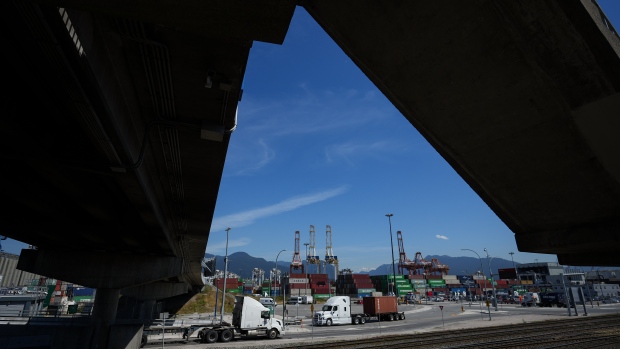
U.S. election uncertainty making 'very difficult' freight market worse, TFI CEO says

The head of Canada's biggest trucking firm says the upcoming U.S. election is straining an already weak market for freight.

Uncertainty over the outcome of the political contest this fall means some customers are holding off on shipments until the result becomes clear, Alain Bédard, chairman and CEO of TFI International Inc., said Friday.

On a conference call with analysts, Bédard gave the example of a green energy company spun off from General Electric, claiming GE Vernova's wind turbine business could suffer depending on who wins after ballots are cast on Nov. 5.

"If it's candidate one, he's against windmills, so that business is going to fall. If you take the No. 2 guy, well he likes windmills, he's more green. So that's why we have these kinds of customers just sitting on the fence not knowing where the ball is going to drop — left or right,” Bédard said.

“We still anticipate this freight recession will not change probably before ’25. We have an election year in the U.S. A lot of our customers are just waiting to see what's going to happen.”

GE Vernova did not respond to a request for comment.

A tough trucking environment in general has also hurt transport companies, the chief executive said, resulting in a seven per cent year-over-year drop in adjusted earnings per share in TFI's first quarter, below analysts' expectations.

"Why is that? Because the truckload in Q1 was just a disaster," he said. “It's a very, very difficult market right now.”

Bédard was referring to the "truckload" segment of the business that carries full loads to a client, as opposed to "less-than-truckload" deliveries that make multiple drops of cargo for different clients on a single run.

Employment in trucking and logistics fell by about 38,000 jobs between 2021 and the end of last year, according to industry non-profit Trucking HR Canada.

The Conference Board of Canada has said household debt will hamper consumer spending this year, as Canadians' penchant for online purchases continues to taper off from pandemic highs, leaving shippers in the lurch.

Bédard said rampant undercutting of labour laws by some trucking outfits has harmed TFI to the point where he is mulling a sale of one of its components.

Asked by an analyst whether he would dispose of its ailing Canadian truckload division, Bédard replied: "We're asking ourselves that question."

Bédard called the phenomenon known as Driver Inc. a “cancer” for legitimate trucking companies as rule-breaking rivals gain a competitive advantage.

Driver Inc. refers to the misclassification of workers as self-employed, which means the company does not provide benefits or basic labour protections.

“Our Canadian business will shrink, absolutely, because of Driver Inc.," he said. "People will lose jobs — good-paying jobs — at TFI because of that Driver Inc. unfair competition."

The mislabelling of contractors who drive for only one company and do not own their trucks or control their own schedules is illegal — and risky, since workers do not receive basic entitlements such as workers' compensation, paid sick leave, overtime or severance.

"They don't pay any benefits to their drivers. That is really killing us," Bédard said.

He added that he believes provincial and federal leaders will crack down on scofflaws, but noted the problem has persisted despite years of warning calls from the industry.

In the federal budget this month, the government reiterated its pledge from a year earlier to amend the Canada Labour Code to bolster job protections for federally regulated gig workers. The effort would strengthen bans on employee misclassification, according to the Canada Revenue Agency.

Other challenges lie ahead for TFI, including the integration of Daseke Inc. 

TFI closed its purchase of the Texas-based flatbed trucking company for about $1.1 billion earlier this month in a move that bolsters its fleet of 11,000-plus trucks by more than 40 per cent.

“It’s not a disaster. It’s not UPS Freight, where these guys were losing money," Bédard said of an acquisition from 2021. But he criticized Daseke's former head office: "Those guys were costing a fortune and the results were not there."

Last year, TFI snapped up JHT Holdings in August. The addition drove up revenue in TFI's logistics segment by 24 per cent year-over-year — the only one to see an increase last quarter.

Despite its acquisitions — six in the past 12 months — net income fell 17 per cent year-over-year to $92.8 million in the quarter ended March 31. Revenue nudged up one per cent to $1.87 billion.

This report by The Canadian Press was first published April 26, 2024.

Documents reveal Ottawa's efforts to get Loblaw, Walmart on board with grocery code


It was evident to the federal government as early as last fall that Loblaw and Walmart might be holdouts to the grocery code of conduct, jeopardizing the project's success. 

Documents obtained through access to information legislation shed new light on the federal government’s efforts to convince the two retailers to sign the grocery code of conduct, with cracks appearing in the months leading up to a House of Commons meeting where the grocers said they couldn't sign the near-complete code.

“There are ongoing federal efforts to seek commitment from key players, including large retailers like Walmart and Loblaws, to participate in the code,” read a briefing note prepared on Sept. 22 for a meeting between federal agriculture and agri-food minister Lawrence MacAulay and Quebec agriculture and food minister André Lamontagne. 

The document, obtained through the Access to Information Act, says participation by some of the largest retailers — namely Loblaw and Walmart — is “still to be determined.”

The code of conduct is intended to set out agreed-upon rules for negotiations between industry players, including retailers and suppliers. It would also include a dispute resolution process. 

It was meant to be voluntary, but it's always been acknowledged that it needs all the major players on board to work, said Francis Chechile, a spokesman for MacAulay, in a statement. 

Until last fall, the code appeared to be progressing well, said Chechile, noting that federal, provincial and territorial governments had been closely monitoring progress and engaging with stakeholders including Loblaw and Walmart. 

“By late October, it had become evident that the hesitation from Loblaw and Walmart was such that it posed a risk to the successful implementation of a code with full industry participation," said Chechile. 

On Dec. 7, leaders from Loblaw and Walmart told the House of Commons committee studying food prices that they couldn’t commit to signing the code in its current form, citing concerns it would raise prices. 

At the meeting, Loblaw chairman Galen Weston said he stood by a letter the company had sent a month earlier to the committee developing the code. The letter said that Loblaw was worried the code could “raise food prices for Canadians by more than $1 billion." 

The Dec. 7 committee meeting served as public confirmation of the two grocers' unwillingness to sign on to the code as drafted, said Michael Graydon, CEO of the Food, Health and Consumer Products of Canada association and leader of the group that's been developing the code. However, he also said there were indications for him around October that this might happen. 

As the code neared completion, plans were underway to launch a grocery code adjudicator office.

But after the Dec. 7 comments by Loblaw and Walmart, progress on the office stalled. Work to hire an adjudicator is on hold, and a funding request for the office is in limbo, said Graydon. 

However, even before indications of the two grocers' reticence became apparent to Graydon and the federal government in October, officials were working to get the retailers on board, the documents show.

Deputy minister of agriculture Stefanie Beck, two representatives from Loblaw and three other government officials met on Sept. 22 to discuss several issues, primarily sustainable agriculture, according to a briefing note. 

But they also planned to talk about the code. The briefing note said government officials should “underscore the federal desire that all large retailers commit to the grocery code of conduct.” 

“Loblaws has not taken an active role in the industry-led process to develop a grocery code of conduct and they have been reluctant to publicly confirm support for the code until the industry proposal is finalized,” the note reads. 

The federal, provincial and territorial ministers had a call on Nov. 27 to discuss the code and the possibility that the two major retailers might not adopt it, according to a briefing note.

Though the code is meant to be voluntary, recently there have been talks of making it law instead to force everyone to participate. 

MacAulay has said that the government is “actively examining all federal options,” including legislation. 

And in a letter mid-February, the House of Commons committee urged Loblaw and Walmart to sign on, saying if they didn’t, it would “not hesitate to recommend that the federal and provincial governments adopt legislation to make it mandatory.” 

Graydon is still hopeful. 

“I don't think it's dead in the water; I think there is some really strong desire to try to find a solution,” he said. 

The group is looking at whether some of the language of the code could be changed to bring more clarity, or more prescriptiveness, said Graydon — “and there seems to be openness, at least from one of the retailers, to have those conversations.” 

Conversations with Loblaw have given the committee a chance to explain aspects of the code and see whether a solution can be reached, he said. 

“My sense is they're legitimate in their approach to try to find a solution.”

Loblaw spokeswoman Catherine Thomas said in an email the company is an “active participant in the ongoing industry process” and is optimistic a code can be finalized that everyone can support. 

Walmart Canada spokeswoman Sarah Kennedy directed The Canadian Press to previous public statements about the code by the retailer, including one from October in which the company said it’s “conscious of adding unnecessary burdens that could increase the cost of food for Canadians.”

A more recent statement from mid-February states that Walmart supports initiatives promoting fairness and reciprocity, and benefiting consumers. 

“While we have significant concerns about the code in its current form, we will continue to work constructively with the industry on this topic.”

Proponents of the code have pushed back on claims that it could lead to higher retail prices. 

The documents also show that the industry steering committee requested around $1.8 million in government funding to support the implementation of the not-for-profit grocery code adjudicator office.

A memo to the deputy agriculture minister digitally signed on June 6, 2023 describes the request for a non-repayable contribution from federal, territorial and provincial governments to support the office for its first two years, “until its revenue model is implemented and becomes self-sufficient.” 

“The majority of funding is going to come from large retailers and large manufacturers,” said Graydon, though the group has planned for scenarios in which not all major players sign on right away. 

“Hopefully, it's the opposite, everybody's in, everybody's early, we get the funding that we require, and we can reduce the requirements in regards to any sort of contribution from government,” he said.

Chechile confirmed that “officials are awaiting the outcome of industry discussions before taking further steps” related to the funding request. 

With files from researcher Ken Rubin in Ottawa

This report by The Canadian Press was first published April 26, 2024.