Wednesday, May 07, 2025


Eating avocados during pregnancy associated with lower food allergy risk in baby


First-of-its-kind research links a specific food in maternal diet to lower odds of food allergies in child’s first year of life


Hass Avocado Board

Colorful Banana, Strawberry, and Avocado Smoothie Bowl 

image: 

New research supports eating avocados during pregnancy may lower food allergy risk in baby.

view more 

Credit: Image courtesy of Avocados - Love One Today.


MISSION VIEJO, Calif. (May 7, 2025)  -- An observational study among 2,272 mother-child pairs in Finland found that infants had 44% lower odds of developing food allergies at 12 months if their mother consumed fresh avocado during pregnancy, after adjusting for other lifestyle, delivery, and maternal health factors.

Decades of research have explored the relationship between maternal diet and allergic outcomes in infants, but this is the first published study to link avocados in the maternal diet to a lower risk of infant food allergies—a growing public health concern that affects nearly one in 13 children, or roughly two in every classroom, according to Food Allergy Research and Education (FARE).  

Given food allergy has reached epidemic levels, the Avocado Nutrition Center supported this research to grow the world’s understanding of how avocado, a food with nutrients that support fetal and infant development, may further benefit children.

“As a caregiver, the growing prevalence of food allergy feels very scary and out of my control,” says Sari Hantunen, study author and Senior University Lecturer at the University of Eastern Finland. “There is no cure for food allergy, but promising prevention and therapeutic strategies are in development as well as emerging research such as this. Based on these findings, it’s encouraging to know that eating avocados may provide even more value to maternal and children’s health, beyond the benefits that have already been established through scientific research.”

Researchers analyzed data collected from 2013 to 2022 as part of the Kuopio Birth Cohort (KuBiCo). Avocado intake was assessed using an online food frequency questionnaire during the first and third trimesters. Participants who reported eating any avocado (>0 grams) in either trimester were defined as avocado consumers, and non-consumers were those who did not report consuming any avocado in either trimester.

Infant allergic outcomes, including rhinitis, paroxysmal wheezing, eczema, and food allergy, were evaluated at 12-months of age. After adjusting for factors such as maternal and gestational age at delivery, education, diet quality, smoking, alcohol consumption, BMI in the first trimester, and breastfeeding, food allergy was found to be significantly higher in infants of non-avocado consumers (4.2%) versus avocado consumers (2.4%). No associations were found for other allergic conditions when all other factors were considered.

Mothers who consumed avocado during pregnancy tended to be older at delivery, be less likely to undergo a caesarean delivery, be a non-smoker, breastfeed for a longer duration, have higher diet quality scores, and have lower BMI levels in the first trimester.  

Findings from this study cannot establish causation or be applied to all audiences, and while more research is needed to understand the exact mechanism, they underscore the value of avocados which provide the following nutrients per serving (1/3 medium avocado):

  • A good source of fiber, a nutrient most Americans under-consume
  • A good source of folate, essential for fetal neural and heart development
  • Lutein (136 mcg), critical for proper eye development in utero
  • Naturally good fats (mono- and polyunsaturated fats), vital for early structural and functional brain development

The Dietary Guidelines for Americans recommends pregnant women eat 2 ½ to 3 ½ cups of vegetables a day and toddlers aged 12-23 months eat 2/3 - 1 cup per day. One avocado counts as a cup. 

To help healthcare providers encourage healthy dietary habits from the start and further the food is medicine movement, a free resource, Healthy Beginnings: A Health Professional’s Roadmap to Cultivating Healthy Habits in Moms, Babies, Children and Adolescents is available here.

About Avocados – Love One Today®

Avocados – Love One Today® is a leading source of the healthiest reasons and tastiest ways to enjoy fresh avocados. A science-based resource, it provides facts about fresh avocados in relevant and credible ways to help make it easy for health professionals and consumers to learn more about the nutritional benefits of fresh avocados and ways to include them in everyday menus. Visit www.LoveOneToday.com for avocado nutrition, recipes, and tips.

# # #

Donald Trump plans to transport illegal immigrants to Libya

LIBYA IS IN THE MIDST OF A CIVIL WAR


Donald Trump© Getty Images, 2025 Getty Images

Donald Trump's administration plans to transport illegal immigrants to Libya using an American military plane. This decision raises numerous controversies and concerns regarding safety.

Key information

Trump's administration plans to deport immigrants to Libya.

The operation could begin as early as Wednesday, Eastern Time.

Human rights organizations warn about dangers in Libya.


Donald Trump's administration intends to transport illegal immigrants to Libya using an American military plane. This information was reported by "The New York Times," noting that the operation could begin as early as Wednesday. This decision is seen as an escalation of Trump's administration's deportation policy.

Read also:

The choice of Libya as a deportation destination raises particular concerns. The country is mired in conflict, and the social situation is unstable. Human rights organizations are warning that detention centres for migrants in Libya are "horrific" and "deplorable". The U.S. Department of State advises against travelling to Libya due to numerous threats.

The United States has formal relations only with the Tripoli government. But Mr. Haftar’s son, Saddam, was in Washington last week, and met with several Trump administration officials. Mr. Trump had friendly dealings in his first term with Mr. Haftar, who controls most of Libya’s lucrative oil fields, notes "The New York Times."
Controversies surrounding deportation policy

The plans to deport to Libya are another controversial move by Trump's administration. Previously, Venezuelans were deported to El Salvador, and hundreds of migrants were sent to Panama and Costa Rica. Secretary of State Marco Rubio announced that more countries willing to receive and imprison deportees will be identified.

Read also:

Trump's administration's actions are seen as a signal intended to discourage potential illegal immigrants. The prospect of harsh conditions after deportation is meant to deter attempts at illegally crossing U.S. borders.
Trump renames Persian Gulf amid rising Middle East tensions

Story by Kamila Gurgul


Trump wants to do it again. There will be another geographical name change.© Google Maps, PAP

President Donald Trump intends to announce this coming week that the United States will use the name Arab Gulf instead of the Persian Gulf. This information was reported by the Associated Press, indicating that this decision coincides with a planned visit by American representatives to the region and the growing tensions in relations with Iran.

What do you need to know?

Donald Trump plans to change the name of the Persian Gulf to the Arab Gulf.

The Associated Press notes that the decision coincides with Trump's planned visit to Saudi Arabia.
Trump has already changed geographical names. In January, he ordered the Gulf of Mexico to be renamed the American Gulf.


Two officials from the American administration, who wished to remain anonymous, told AP that soon the name Arab Gulf is expected to become commonly used instead of the Persian Gulf. Media outlets emphasize that this move is in response to the calls of the Arab countries surrounding this body of water. Tehran, however, does not change its stance and still maintains historical ties with the gulf, including its name.

Experts highlight that the US administration aims to strengthen relations with the countries of the Persian Gulf. Washington seeks to attract investments to the United States and gain support in regional conflicts, such as the Israel-Hamas war or limiting Iran's nuclear potential.

The AP agency reminds us that the name Persian Gulf has been used since the 16th century, although in many Middle Eastern countries, the version with "Arab" is preferred. In 2012, the Iranian government, formerly known as Persia, threatened a lawsuit against Google for not labelling this body of water on maps.

For many years, the American military has used the term Arab Gulf instead of Persian Gulf in its statements and recordings.

Donald Trump to visit the capital of Saudi Arabia

AP notes that this decision coincides with Donald Trump's visit to the Middle East. U.S. President Donald Trump plans to visit Riyadh, where he will meet with the leaders of the six Gulf Cooperation Council (GCC) countries. The visit will take place in mid-May, and its purpose is to strengthen economic and investment cooperation with the Gulf countries.

On the morning of May 14, the Gulf Cooperation Council summit will be opened. In the afternoon of the same day, Trump will travel to Doha to meet with the Emir of Qatar, Sheikh Tamim bin Hamad Al Thani. Then, on May 15, he will visit Abu Dhabi, where he will talk with UAE President Mohammed bin Zayed Al Nahyan. The White House announced that the details of the trip will soon be officially released.

This will be Donald Trump's first foreign visit in this term (besides the visit to the Vatican for the unexpected funeral of Pope Francis).

Trump previously changed the name of a gulf

In January, Donald Trump ordered the Gulf of Mexico to be renamed the American Gulf. "As directed by the President, the Gulf of Mexico will now officially be known as the Gulf of America and North America’s highest peak will once again bear the name Mount McKinley," announced the Department of the Interior.

Previously, Mexican President Claudia Sheinbaum jokingly suggested renaming a part of North America, based on how it looked on maps from 1607 - Mexican America, that sounds nice - said Sheinbaum.

Trump Education Secretary mocked after critics spot (SP), grammatical errors in Harvard letter


Story by Katelyn Caralle, Senior U.S. Political Reporter In Washington, D.C.
• DAILY MAIL , MAY 6. 2025

 
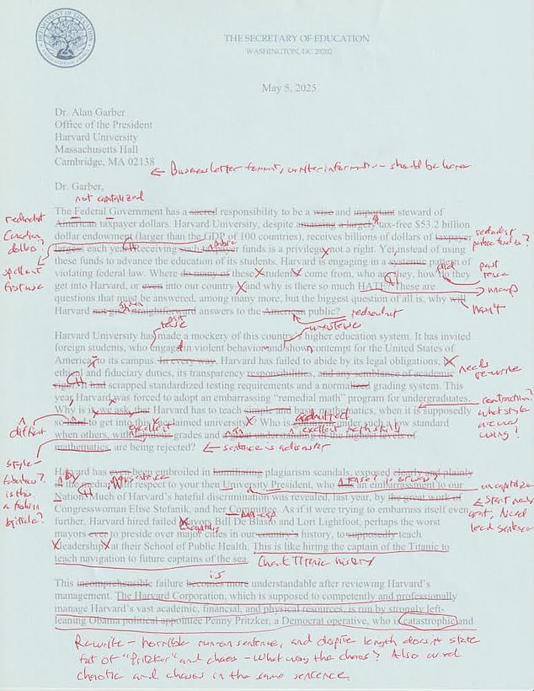
Social media users were quick to hop on editing a letter sent by President Donald Trump's Education Secretary to Harvard informing the Ivy League it would no longer receive federal grants.

Education Secretary Linda McMahon ramped up the administrations' war with the college on Monday by sending a letter informing Harvard's President Dr. Alan Garber his institution will not be eligible to receive money from the federal government until they fall in line with what Trump wants to see from colleges.

But the letter was swiftly lambasted by social media critics who noticed a slew of mistakes made by the woman in charge of helping dismantle the Education Department.

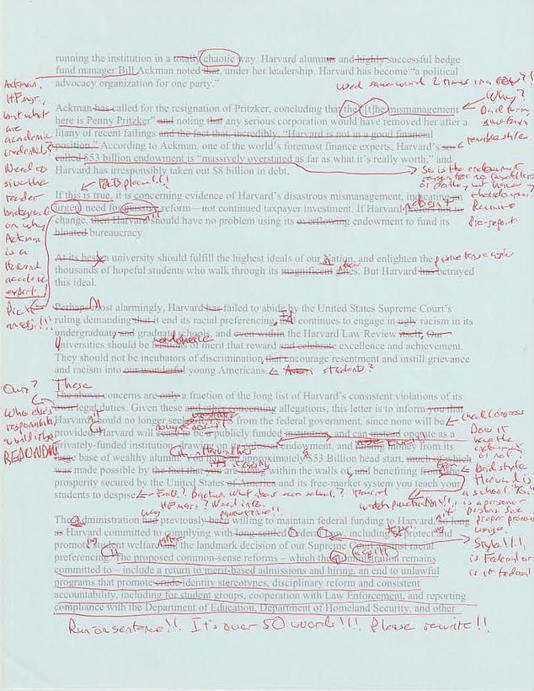
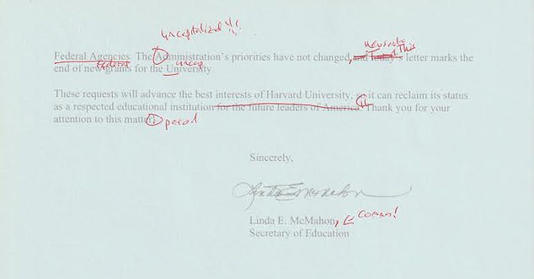
Harvard even edited the letter professor-style and sent it back to McMahon with the errors noted in red pen, according to a few posts made to X with a picture of the marked-up three pages.

'Harvard is engaging in a systemic (sic) pattern of violating federal law,' McMahon wrote in her letter, which both the university and others who edited the letter noted was likely meant to say 'systematic.'

'Where do many of these 'students' come from, who are they, how do they get into Harvard, or even into our country—and why is there so much HATE?' Secretary McMahon continued in the opening paragraph.


Education Secretary Linda McMahon was excoriated on social media when critics marked-up and red-lined her mistake-ridden letter to Harvard


A few different versions began circulating social media with professor-style red pen editing of McMahon's letter to Harvard threatening to pull federal grants


The notes call out randomly capitalized letters, run-on and incomplete sentences and even improper use of words and punctuation


Trump Education Secretary mocked after critics spot grammatical errors in Harvard letter

The letter goes on to mock Harvard's educational standards, despite McMahon's own mistakes. She goes after the Ivy League for the teaching of 'remedial math' and calls attention to plagiarism scandals at the school.

White House correspondent Andrew Feinberg with the Independent wrote on X of the letter: 'Whoever wrote this is barely literate.'

Another reporter questioned if it was written by Artificial Intelligence (AI).

An official previewed the action on a Monday night call before McMahon posted the letter on social media.

'For Harvard to become eligible for those competitions again, it would have to enter into a negotiation with the government to satisfy what the government says is in compliance with all federal laws,' the official said.

Research grants would be impacted by this action - but not federal student aid, which funnels through universities before going to students and providing them with financial relief.

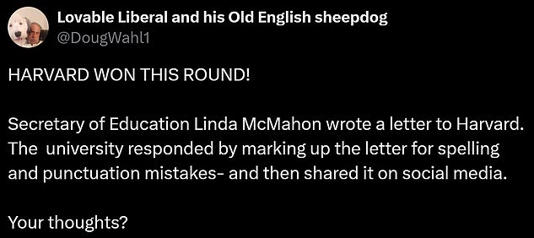
Social media users said that Harvard 'won' this round of the war with the administration because of the numerous mistakes in the letter.

Right off the bat, McMahon wrote 'Federal Government,' which critics said was improper because she capitalized the letters 'F' and 'G' when it is not a proper noun.


Trump Education Secretary mocked after critics spot grammatical errors in Harvard letter


One version, social media users claim, was marked-up and sent back to McMahon by Harvard – leading them to dub the Ivy League the winner of this round of the war with the Trump administration

The other mark-ups include noting run-on and incomplete sentences, inconsistent tensing and randomly capitalized words.

Trump has voiced displeasure with universities allowing pro-Palestinian demonstrations to run amok on campuses.

Officials within the president's team have also taken issue with what they consider to be lack of diversity in higher education - with too few conservatives on staff.

'They have become monolithically leftist and that DEI ideology connects to the anti-Semitism problem because they're teaching young people to make snap judgments about each other based on identity and skin color,' the senior official said.

The latest move represents a major escalation in a months-long war against the prominent institution.

Trump previously froze $2.2 billion in federal grants to Harvard and said he's looking into stripping the Ivy of its tax-exempt status.

A Department of Education official said in Monday's call that Harvard's endowment is 'virtually untaxed' and 'massive.'

'It's larger than the GDP of many countries and it was only possible for them to amass that thanks to the blessings of this country that they do business in,' the official said.

Garber has previously said he won't bend to the government.

The university sued last month to overturn the funding freeze, pushing back against the government's 'sweeping and intrusive demands.'

In the letter, released on White House officials' social media accounts, McMahon said that receiving taxpayer funds was a 'privilege, not a right' and claimed that Harvard was breaking federal law.

The letter started out by focusing on the immigration status of students - likely those involved in the pro-Palestinian demonstrations - with McMahon saying they were engaged in 'violent behavior.'  
IRONIC CONSIDERING SHE IS HALF OWNER OF THE WWE 
ALONG WITH HUBBY VINCE.
Danielle Smith dismisses Doug Ford's warning against separatist threats from Alberta

JUST AS THE PQ AND BQ HAVE DONE IN THE PAST OVER QUEBEC SEPERATION


Story by Lisa Johnson
CANADIAN PRESS
MAY 6.2025


Alberta Premier Danielle Smith announces proposed changes to several pieces of democratic process legislation, in Edmonton on Tuesday, April 29, 2025. THE CANADIAN PRESS/Jason Franson© The Canadian Press

EDMONTON — Alberta Premier Danielle Smith is urging her Ontario counterpart Doug Ford to mind his own business when it comes to talk of separating from Canada.

Smith announced this week that she doesn’t want Alberta to leave Canada but, if enough residents sign a petition asking for a referendum on it, she’ll make sure it’s put to a vote in 2026.

Ford, without mentioning Smith by name, said Tuesday that Canadian unity is critical as the country engages in a tariff fight with the United States.

"This is a time to unite the country, not people saying, 'Oh, I'm leaving the country,'" Ford said.

Asked about his remarks, Smith said she has a great friendship with Ford but that they have different jurisdictions to govern.

"I don't tell him how he should run his province, and I would hope that he doesn't tell me how I should run mine," she said.

She made the comments at a news conference Tuesday, answering a wide range of questions about everything from the potential economic impact of separatism threats to the continued concern of Indigenous leaders.

Last week, Smith’s United Conservative government introduced legislation that, if passed, would sharply reduce the bar petitioners need to meet to trigger a provincial referendum.

Related video: Alberta premier defends speech outlining grievances with Ottawa (Global News)  On a day when all eyes were on Washington


Chiefs from more than a dozen First Nations across Alberta held what they called an emergency meeting in Edmonton on Tuesday and, at a news conference, condemned any talk of Alberta separation.

Many have warned that their treaties with the Crown predate the province and that Alberta doesn't have the authority to challenge those agreements.

Piikani Nation Chief Troy Knowlton said he voted for Smith's United Conservative Party but didn't vote for policies like the legislation tabled last week.

"The rhetoric and insanity of separation here in Alberta has united First Nations on this land, all across Canada from coast to coast to coast," he said.

"We're not going anywhere, and if you feel that you have problems with First Nations, you could leave."

Athabasca Chipewyan First Nation Chief Allan Adam, whose community is located downstream of the Alberta oilsands, said he's calling for all development and exploration on traditional territories to stop immediately.

as First Nations people are saying that if Alberta wants to separate and doesn't want to be part of Canada, then you're not allowed on our traditional territories anymore for exploration because we don't know who you're exploring for," he said.

Cold Lake First Nations Chief Kelsey Jacko also said the Confederacy of Treaty Six First Nations cancelled a planned meeting with Smith.

"The meeting has been cancelled until she changes her tone," Jacko said.

Smith has said she is committed to protecting and upholding treaties, but hasn't offered details about how she would do so.


On Tuesday, she said treaty rights can't be voted away and she would expect those rights to be honoured by any referendum question.

“Any discussion that we're having, including Alberta expressing its own constitutional sovereignty, is about Alberta's relationship with Ottawa," she said.

When asked if she had a mandate from voters to open the door to secession, Smith pointed out that her party doesn’t officially support separation.

“I don’t have a mandate,” she said, reiterating that the question will need to be put on the table by citizens.

“All I've said is I will honour the process, and the public very clearly knows that we are a party of direct democracy,” she said.

Smith repeatedly said that it would be pre-emptive to imagine what impact a ballot question might have because none have been put forward or worded yet. But, she confirmed that she would respect the wishes of Albertans should a majority vote in favour.

Her appearance came as Prime Minister Mark Carney met with U.S. President Donald Trump in Washington, D.C.

When asked about Smith’s potential referendum, Carney told reporters there that Canada is always stronger when Canadians work together.

"As an Albertan I firmly believe you can always ask a question, but I know what I would respond, clearly."

In Quebec, Paul St-Pierre Plamondon, the leader of the sovereigntist Parti Québécois, said Smith is simply standing up for her province's autonomy.

St-Pierre Plamondon said Tuesday that Smith has used the possibility of a referendum to give her province leverage as she makes demands of the federal government.

Alberta has long fought with Liberals in Ottawa and Smith has said their policies have amounted to an attack on Alberta and its ability to develop its oil and gas industry.

Smith’s approach includes chairing town halls from May to October to hear grievances from Albertans, while sending a negotiating team to Ottawa to demand concessions to boost Alberta’s economy.

--With files from Jack Farrell in Edmonton and Allison Jones in Toronto

This report by The Canadian Press was first published May 6, 2025.

Lisa Johnson, The Canadian Press


Media Organisations Demand End to Israel’s Genocide


Peoples Dispatch 

On World Press Freedom Day, media organizations from across the globe released a joint statement demanding an end to Israel’s genocide in Gaza.


Over 50 media organizations from countries across the world released a statement on World Press Freedom Day, honoring the Palestinian journalists who have been killed and those that continue to risk their lives exposing Israel’s genocidal assault on the Gaza Strip. The organizations demand press freedom, which cannot exist while genocide continues and journalists are targeted.

The full statement reads:

May 3 marks World Press Freedom Day, which will be commemorated this year amid Israel’s ongoing genocidal aggression against the Gaza Strip and countries of the region.

Since this genocide began, tens of thousands of innocent people, most of them children, women, and elderly have been murdered and tens of thousands of others have been injured. The aggression has included a total systematic destruction of the Gaza Strip and its infrastructure, in addition to forced displacement, blockade, and the starvation of the people in Gaza.

Amid this barbarity, the people of the world have stood firmly with the Palestinian people in demanding an end to the genocide in Gaza, an end to Israel’s colonial occupation of Palestine, and an end to its aggression against Lebanon, Yemen, and Syria. The unprecedented outpouring of international solidarity and support has been in great part due to the work of Palestinian journalists who have sacrificed their lives to document this genocide and tell the stories happening on the ground, forever shifting public opinion against the Israeli state and its primary backer, the United States.

Their immeasurable sacrifice has had a toll, Palestinian journalists have been singled out by Israeli forces, who have bombed media offices, journalists’ accommodations, and press vans in Palestine and Lebanon.

Israel’s war on the people of the region has been the most deadly in recent history for journalists, with over 200 killed, and the number continuing to rise.

All of this has happened while the regimes that boast human rights, freedom of expression, freedom of speech, international law, and international conventions are drowning in the darkness of silence.

Further undermining of press freedom has taken place on digital platforms where texts mentioning “zionist” “genocide” and “Palestine” are censored, shadow-banned, and deleted.

On this World Press Freedom Day, we declare that there can be no press freedom as long as genocide is taking place and as long as our colleagues in Palestine and Lebanon are targeted in a futile attempt to extinguish the voices that clamor against Israel’s genocide and occupation.

We call on people of conscience, journalists, and media outlets to join us in upholding and defending true press freedom and to continue reporting on Israel’s crimes against the Palestinian people and the peoples of the region.

We extend our greetings to the journalists of conscience all over the globe

Glory and eternity to journalist martyrs

May 3, 2025

Signatories:

  1. Taqadoom, Kuwait
  2. Peoples Dispatch, International
  3. African Stream, Kenya
  4. Al Akhbar English, Lebanon
  5. Al Hadaf Magazine, Palestine
  6. Al Maydan, Sudan
  7. Al Nahj, Morocco
  8. Al Nida, Lebanon
  9. Al Nour Newspaper, Syria
  10. Altaqadomi, Bahrain
  11. ANRED, Argentina
  12. ARG Medios, Argentina
  13. Barricada TV, Argentina
  14. Brasil de Fato, Brazil
  15. BreakThrough News, US
  16. Capire, International
  17. Colombia Informa, Colombia
  18. Coloquio Internacional Patria, Cuba
  19. Comuna Audiovisual, Argentina
  20. Comunicambio, Peru
  21. ComunicaSul, Brazil
  22. CovertAction Magazine, US
  23. Dialogos do Sul Global, Brazil
  24. Dominio Cuba, Cuba
  25. El Grito del Sur, Argentina
  26. Europe for Palestine, Europe
  27. Fight Racism! Fight Imperialism, UK
  28. Globetrotter, International
  29. Insurrecta, Ecuador
  30. International Magazine, India
  31. La Komuna Noticias, Peru
  32. Laborans, Turkey
  33. Liberation News, US
  34. Madar, International
  35. Mint Press News, US
  36. Nawafth, Egypt
  37. Nida al Wattan, Jordan
  38. Opera Mundi, Brazil
  39. Pagine Esteri, Italy
  40. Palestine Chronicle, Palestine
  41. Pan African TV, Ghana
  42. Periferia UY, Uruguay
  43. Prensa Rural, Colombia
  44. Radio Gráfica, Argentina
  45. Red Alterna, Colombia
  46. Republic Palestine, Palestine
  47. Resumen Latinoamericano, Argentina
  48. Revista Crisis, Argentina
  49. Revista Crisis, Ecuador
  50. Sout Alshaab FM, Lebanon
  51. Sout Alshaab, Tunisia
  52. Tareeq Alshaap, Iraq
  53. Telesur English, Latin America and the Caribbean
  54. Telesur, Latin America and the Caribbean
  55. Thaqafa Jadeda Magazine, Iraq
  56. The Insight Newspaper, Ghana
  57. The Katie Halper Show, US
  58. Venezuela Analysis, Venezuela


Courtesy: Peoples Dispatch


Why Tariff Parleys With US Will Hurt Indian Farmers

Prabhat Patnaik 

The net outcome will be a cut in Indian tariff rates vis-à-vis US goods, which will mean lowering of MSP for foodgrains and the entry of heavily subsidised American grains into India.

Elementary textbooks in economics invariably begin with a completely mythical concept: the concept of “perfect competition”, which is different from the concept of “free competition” that the classical economists and Marx had used.

“Free competition” was characterised by the equality of wages (for equal skills) and of profit-rates across sectors; all it required for its realisation was free mobility of labour and of capital across sectors, which was by no means a far-fetched assumption in the pre-monopoly era.

“Perfect competition” by contrast is characterised additionally by zero profits. This can happen only in one situation: whenever any positive profits are being earned in any sector, so many capitalists flood into that sector that the positive profits disappear. This requires not only free mobility across sectors but free mobility into the ranks of capitalists, that is, workers can become capitalists whenever there are positive profits.

“Perfect competition”, therefore, assumes perfect social mobility, namely, a classless society, which is an absurd assumption to make for a capitalist society and hence a completely mythical state of affairs in the present context.

The prices prevailing in equilibrium under this “perfect competition”, however, have some properties of optimality, because of which, if they prevailed, then any deviations from them would be inadvisable.

Yet, in designing the new international trade rules, the World Trade Organisation (WTO) made the totally illicit assumption that this mythical state of “perfect competition” is what actually prevailed in the world, so that any deviations of prices from what actually prevailed was to be avoided. Accordingly, it stipulated that any subsidies given through price support to producers in any sector were to be avoided as being “trade-distorting”, while subsidies given in the form of income transfers to the same producers were perfectly permissible.

The utter absurdity of this stipulation becomes obvious from the fact that any effort in the real world of today to curb monopolists’ profits by having controls over their profit-margins, would be prohibited as being price-distorting and trade distorting, hence nonoptimal.

Read Also: Two Alternative Growth Models & Foodgrain Output

Indeed, it is amazing that such an absurd stipulation, that any interference with prices as they actually exist in today’s world should be avoided as these prices are optimal in a certain sense, a stipulation based on the pretence that the real world is characterised by “perfect competition”, could be rammed down the throats of so many countries of the Global South in reaching the WTO agreement. These countries should have known better; but they were browbeaten, and one obvious result of this was an assault on peasant agriculture.

It is well-known that advanced capitalist countries give enormous subsidies to their agriculturists, but these subsidies are in the form of direct income transfers rather than through the prices of the goods they sell. In the US and in the European Union such subsidies amount to almost half of the total value of the produce; in Japan, these almost equal the total value of the produce.

Despite their enormity, however, the WTO does not frown upon such subsidies because it considers them “non-price-distorting”, which is supposed to be a virtue because the world is supposed to be characterised by perfect competition. (Even this, however, is theoretically erroneous since in an economy marked by “perfect competition”, direct income transfers are supposed to distort the relative price between work and leisure, and hence are not strictly “non-price-distorting” but let us ignore it here).

But, in a country like India, where the government provides price-support to farmers, i.e., subsidises farmers by interfering with prices (like providing a minimum support price (MSP) or a procurement price), such support is objected to by the advanced capitalist countries and by the WTO, that approves of their subsidies as being “price-distorting”, hence “trade-distorting”, and wrong.

This insistence on “non-price-distorting” subsidies is not only theoretically unfounded, for the world does not conform to a “perfectly competitive economy”, but is impractical as well. Income support can be provided by the government to farmers in the US because there are only a few thousand farmers. But, in an economy like India, which has over a hundred million farmer households, the provision of individual income support to each household is simply not a practical proposition.

The only way that support can be given to so many farmers is through the price mechanism, through the blanket provision of a suitably remunerative price. To insist that support be provided solely through incomes rather than prices, therefore, amounts to demanding de facto an abolition of all support to farmers in a country like India.

Read Also: Trump Tariffs: India Should Shun ‘Business as Usual’ Response

This is, in fact, what has happened vis-a-vis cash crop growers in India: they no longer enjoy the kind of price support that they had earlier. Before the neoliberal regime was instituted, in years of world price crashes, the various government agencies, such as the tea board, coffee board, coir board etc., had stepped in to support domestic prices by purchasing crops at those prices, and the tariff rates had been suitably adjusted to make this possible. But this does not happen any longer.

This withdrawal of price support to cash crops in accordance with the WTO’s stipulations is what has contributed significantly to the large number of farmer suicides in the country over the past several decades, something that had never happened in post-Independence India in the pre- “liberalisation” years.

The government wanted to withdraw price-support from foodgrains as well, which it had not dared to do earlier, through the three infamous farm laws; but the year-long farmer agitation forced it to retract temporarily, though it has not abandoned its project of withdrawing price-support.

US President Donald Trump’s tariff policy has now brought this issue back on the immediate agenda. If India had just imposed retaliatory tariffs against Trump’s tariff-hike, and left the matter there, then there would have been no threats to the farmers.

But since India has agreed to negotiate with the Trump administration, which basically means that it has agreed to lower its tariffs vis-a-vis American goods in return for the US not raising tariffs against India, clearly the amount of price protection that the foodgrain producers had got until now will no longer be available to them.

The net outcome of these negotiations will be a reduction in Indian tariff rates vis-à-vis American goods which will necessarily mean a lowering of the MSP for foodgrains (if at all they continue to exist), and the entry of heavily subsidised American grains (through income transfers) into the Indian market. The long-cherished dream of the US to export its grains to India, unfulfilled since the Green Revolution, will finally get realised.

This would be a disaster from India’s point of view. Not only will it entail much greater distress for farmers, and hence an increase in the incidence of farmer suicides (which had been less severe till now in the case of grain farmers), but a loss of food security for the country.

The country will not only become dependent on food imports from the US which will give the Americans great leverage over Indian policy-making, but the incidence of famines will also increase.

As farmers shift away from producing foodgrains toward other crops that may be remunerative at that moment, when the prices of such crops crash, as they inevitably do on the world market, the country would be short of foreign exchange to purchase foodgrains internationally.

What is more, even if this does not happen, or “food aid” is forthcoming from the US (for which, of course, it will extract a price in some form), the farmers will lack the purchasing power to buy such imported foodgrains. Either way, the country will be pushed into a famine.

This is precisely what has happened in Africa. Several African countries were induced to give up foodgrain production and become importers instead, in the name of exploiting their “comparative advantage”; but they have been racked by famines whenever the prices of the crops they export have crashed.

Economist Amiya Bagchi calls these famines “globalisation famines”, that is, famines that occur because of the abandonment of foodgrain self-sufficiency that is induced by globalisation. Until now, Africa had been the victim of “globalisation famines”; now India will also be a victim, ironically as a fall-out of Trump’s threat to move away from globalisation.

The government, no doubt, will claim that farmers’ interests will not be sacrificed in the trade negotiations with the US; but any reduction in tariffs vis-à-vis American goods will hurt farmers’ interest. The very fact of India’s entering into trade negotiations with the US, therefore, is inimical to farmers’ interest.

Trump’s not raising tariffs vis-à-vis India as a quid pro quo for India’s lowering of tariffs vis-à-vis the US will bring no benefit to our foodgrain growing farmers, since they are not significant exporters of foodgrains to the US. It may bring some benefit to the Indian monopoly capitalists engaged in manufacturing; but that will not make an iota of difference to the grim fate of Indian farmers.

The writer is Professor Emeritus, Centre for Economic Studies and Planning, Jawaharlal Nehru University, New Delhi. The views are personal.


High-Stakes, Global Battle Over Trump’s Tariffs


John Ross 


Through his “tariff war”, Trump seeks to subvert multilateral institutions and renegotiate trade agreements to (even further) benefit the US.

Trump’s “tariff war” is not an issue solely or even primarily about the US economy. It is an attempt to bring the entire world trading system under unilateral US control, removing any minimal element of multilateral negotiation from it.

In essence, the United States, despite accounting for only 11% of world trade and 4% of the global population, is demanding the right to unilaterally dictate the rules of global trade to the rest of the world.

If Trump succeeds in this effort, the consequences would be sweeping and deeply negative. Trade now constitutes 58% of global GDP, meaning that the livelihoods of more than 8 billion people would be directly affected by the outcome of this confrontation.

However, the numbers also show the objective weakness of Trump’s global position: 89% of global trade is not with the US. If other governments resist this pressure, Trump cannot succeed. He is, therefore, depending on the willingness of some governments to surrender their people’s and their national interests and capitulate to Washington’s demands. Unfortunately, based on past events, there is a danger that some governments may do exactly that. This makes it essential for people around the world, and for progressive and democratic forces, to understand what is at stake and to oppose this project.

The WTO system

It must be clearly emphasized: the current world trade system, embodied in the World Trade Organization (WTO), is itself fundamentally flawed and unjust. While the WTO formally operates on the principle of “one country, one vote”, in practice, trade deals are shaped by the major capitalist powers behind closed doors. Rich countries continue to shield their own industries with high tariffs in sectors where developing countries are competitive. They impose technical barriers, such as anti-dumping duties, to block exports from the Global South.

Multinational corporations – overwhelmingly headquartered in the Global North – have privileged influence within the WTO system. Progressive social and developmental policies are excluded from WTO decision-making. The TRIPS Agreement (Trade-Related Aspects of Intellectual Property Rights) prioritizes corporate profits over access to medicine and technology. The Agreement on Agriculture (AoA) allows chronic dumping of subsidized food exports from the Global North while failing to protect small farmers in the Global South, resulting in devastating crises such as farmer suicides in countries like India.

Despite these flaws, socialists and democrats have long understood that the choice is rarely between a good and bad system, but between a flawed system and something worse. Failing to recognize this can lead to grave mistakes.

In the meantime…

A classic example is the position toward capitalist democracy. While it is true that liberal democracy ultimately operates within the framework of capitalist domination – where private capital controls the economy, where media and elections are heavily dominated by wealth, and where military coups are used to overturn democratic systems if the rule of capital is challenged – progressive forces still recognize the need to defend parliamentary democracy against fascist or authoritarian threats. Lenin and Gramsci made this point clear during the earliest fights against fascism in Italy in the 1920s, confronting those on the left who failed to grasp this distinction.

Sometimes, alliances must even be made with imperialist powers. For instance, President Franklin D. Roosevelt was the leader of US imperialism, aiming to establish US global dominance, while UK Prime Minister Churchill was a racist and an antisemite, responsible for atrocities such as the 1943 Bengal famine. Yet the Soviet Union rightly allied with both the US and Britain to fight against the still greater threat posed by Nazi Germany and Japanese militarism. Progressive forces also supported such an alliance, and failing to make it would have been a catastrophic error.

Trump’s goal is not to reform or improve the current global trade system, fundamentally flawed though it is. He opposes it precisely because even its minimal multilateral rules constrain US dominance. His aim is to replace multilateralism with a system based solely on bilateral agreements in which the US can use its weight to dominate smaller partners individually.

Such a system would be a major regression even compared to the WTO. It would remove even the modest protections offered by multilateralism and replace them with arbitrary, US-dictated terms, vulnerable to sudden changes depending on Washington’s interests.

Mexico

A vivid example is Mexico. In 1992, Mexico entered a trilateral deal with the US and Canada – NAFTA. During his first term, Trump discarded NAFTA in favor of the USMCA, a deal more favorable to US interests. That agreement still allowed about half of Mexican exports to enter tariff-free, and many others faced only a 2.5% tariff. But in his second term, Trump declared this was still not favorable enough and imposed a 25% tariff on most Mexican goods not covered under USMCA. Canada faced similar treatment.

Trump’s model is clear: he wants a global trade regime where the US can change the rules at will, penalizing any country it deems too successful or politically inconvenient.

Given how clearly this undermines the interests of nearly every other country, one might assume all governments would resist such a system. And it is true that the US cannot impose this model unilaterally, given it accounts for just 11% of global trade. But experience shows that some governments do bow to US pressure, even at great cost to their own nations.

Europe is the largest and clearest case. Western European governments backed disastrous US policies such as NATO expansion, which led to the war in Ukraine. That war not only caused massive human suffering but also severed Europe’s energy ties with Russia, driving energy prices in Europe far higher and deeply damaging European economies and living standards. These decisions ran counter to Europe’s own economic, social, and geopolitical interests.

Mexico and Canada have announced that they will retaliate against US tariffs. China, the world’s largest trading nation, has declared that it will counter-sanction any country that, under US pressure, takes hostile trade measures against Chinese exports. President Claudia Sheinbaum of Mexico has publicly opposed US pressure and defended Mexico’s sovereignty. The results of the Canadian election also show strong opposition to subordination to US demands.

The understanding and resistance of the peoples of countries, demanding that their governments oppose these US actions, is crucial. The fight is not just about tariffs. It is about whether the future of world trade will be determined by a fundamentally flawed trade system, which requires drastic improvement, but which contains at least some minimal elements of multilateral negotiation and compromise, or one determined purely by unilateral US power. As so often in the past, but without any evasion, socialists must defend a fundamentally flawed system against one which is still worse.

John Ross is a senior fellow at Chongyang Institute for Financial Studies, Renmin University of China. He is also a member of the international No Cold War campaign organizing committee. His writing on the Chinese and US economies and geopolitics has been published widely online and he is the author of two books published in China, Don’t Misunderstand China’s Economy and The Great Chess Game. His most recent book is China’s Great Road: Lessons for Marxist Theory and Socialist Practices. He was previously director of economic policy for the mayor of London.

This article was produced by Globetrotter and No Cold War.

Courtesy: Peoples Dispatch