Wednesday, May 07, 2025


18 States File Suit to Challenge Trump’s Order Pausing Wind Energy Licenses
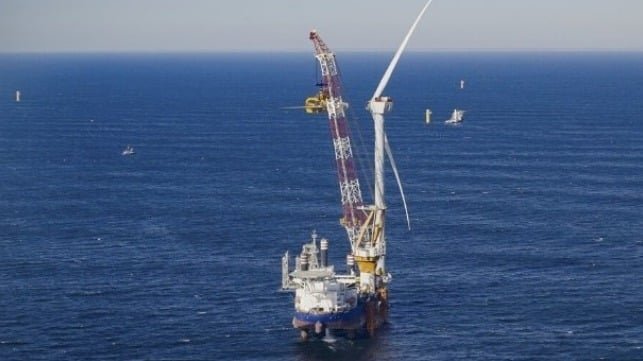
offshore wind energy installation
States are challenging Trump's efforts to stop wind energy development (Orsted)

Published May 5, 2025 3:20 PM by The Maritime Executive


A wide-reaching coalition of states involved in offshore as well as onshore wind energy filed suit in federal district court on May 5 seeking to stop the implementation of the presidential executive order to suspend and review leasing for wind energy projects. They are calling the “blockade” on wind energy projects “unlawful,” and asked the District Court in Massachusetts to issue a preliminary injunction to immediately stop the administration from enforcing the freeze while the litigation proceeds.

“This administration is devastating one of our nation’s fastest-growing sources of clean, reliable, and affordable energy,” said New York State Attorney General Letitia James. “This arbitrary and unnecessary directive threatens the loss of thousands of good-paying jobs and billions in investments, and it is delaying our transition away from the fossil fuels that harm our health and our planet.”

According to New York State, “The administration’s indefinite blockade could leave billions of dollars in states’ clean energy investments stranded or underutilized and significantly harm their economic development.”

Associated Press got a comment from the White House calling the lawsuit “lawfare” from Democratic attorneys general and linked wind energy to the “Democrats’ radical climate agenda.” A spokesperson said it was an effort to stop a popular agenda energy and to stop unleashing American energy and lower prices.

Donald Trump signed an Executive Order on January 20 suspending all federal approvals for wind energy projects and ordering his departments to begin a review of the industry and the licensing process. Since then, the Department of the Interior ordered New York’s Empire Wind project being developed by Equinor to stop construction even though the project was fully licensed in 2024. The EPA has also revoked an air permit related to the construction of a planned offshore wind farm in New Jersey while the Bureau of Ocean Energy Management stopped reviews, and grants to a research project in Maine for floating wind turbines were suspended.

“The President’s attempts to stop homegrown wind energy development directly contradict his claims that there is a growing need for reliable domestic energy,” said Massachusetts Attorney General Andrea Joy Campbell. “My colleagues and I will continue to challenge this administration’s unlawful actions to chill investment and growth of this critical industry.” 

The 101-page filing cites the hypocrisy of the president’s approach to energy pointing out that Donald Trump also signed an Executive Order declaring a “National Energy Emergency, purportedly brought on by the country’s alleged ‘insufficient energy production’.”  The Executive Order called for steps to “shore up the inadequate energy supply.”

The filing says while energy, and specifically domestic energy, is a high priority the administration is threatening to undermine a critical source of clean energy and job growth. They note the years of bipartisan support for offshore and onshore wind energy projects and the efforts in Trump’s first term. They state that states have a responsibility to meet increased energy demand.

The suit contends that the president is acting outside his legal authority and has no statutory right to shut down the permitting process. They are calling the order “arbitrary and capricious” saying it is in violation of the Administrative Procedure Act.

They are asking the court to intervene and rule the approval blockade unlawful. They want the court to prevent the departments from enforcing the order and wind energy permitting process.

The coalition filing the suite includes states involved in offshore wind energy (Massachusetts, New York, California, Connecticut, Delaware, Maine, Maryland, New Jersey, Oregon, Rhode Island, and Washington) as well as other states (Arizona, Colorado, Illinois, Michigan, Minnesota, New Mexico, and the District of Columbia). 

It comes as developer Equinor has also threatened to challenge in court the federal order to stop its project off New York. Others in the industry however have already pulled back on their U.S. investment plans moving their emphasis to Europe and other parts of the world which continue to adopt offshore wind energy development.


Ørsted Discontinues Planned UK Wind Farm Citing Costs and Interest Rates
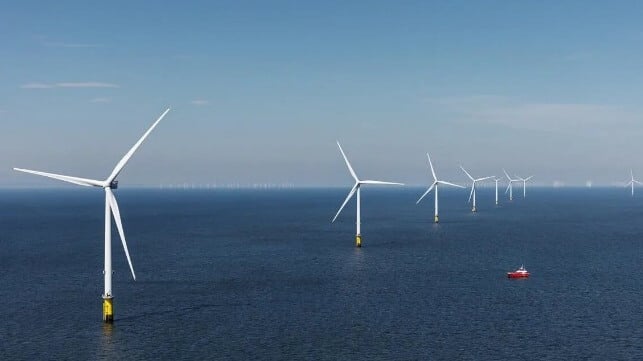
offshore wind farm
Orsted is stopping work on Honsea 4 due to costs and interest rates (Orsted)

Published May 7, 2025 3:46 PM by The Maritime Executive


Danish renewable energy giant Ørsted has decided to discontinue efforts on the fourth phase of a major UK offshore wind energy project, which comes as a major blow to the UK’s renewable energy ambitions. The company is citing increased costs and risks despite the UK’s decision in 2024 to increase its support for the projects and the new government’s strong commitment to wind energy.

Ørsted has decided to discontinue the UK’s Hornsea 4 project in its current form, attributing the move to a combination of increased supply chain costs, higher interest rates, and increased execution risk. These factors, the company determined, have deteriorated the expected value creation from the project. It asserts that it, however, remains fully committed to the UK market.

Located approximately 40 miles off the UK coast and with a capacity to generate 2.4 GW, Hornsea 4 was the company’s fourth gigawatt-scale project in the Hornsea zone. Both Hornsea 1 and Hornsea 2, with a combined capacity of 2.5 GW, are operational, while Hornsea 3, with a 2.9 GW capacity, is currently under construction.

Ørsted was awarded the Contract for Difference (CfD) for Hornsea 4 in September last year and had planned to reach a final investment decision later this year for the wind farm that would have powered 2.6 million UK households. The CfD was at a strike price of £58.87 ($77.40) per megawatt hour (MWh), a fixed price at which the company would sell the electricity generated for the first 15 years.

However, changing dynamics in the offshore industry, the company said, forced it to abandon the project. Ørsted highlights that the new developments have increased the execution risk and deteriorated the value creation of the project, meaning it was not viable to continue with its implementation in the current form.

Taking the decision to stop further spending on Hornsea 4 and terminating the project’s supply chain contracts is resulting in material negative impacts on the company’s books. The company will incur costs of $533.4 million to $685.7 million in 2025 to shelve the project. The EBITDA impact is expected to be $475 million to $533.4 million, which includes a write-down of the offshore transmission assets and a provision for contract cancellation fees. The impacts on its books also include a write-down of between $76 million and $152.3 million in capitalized construction costs.

“Our capital allocation is based on a strict and value-focused approach, and after careful consideration, we’ve decided to discontinue the development of the Hornsea 4 project in its current form,” said Rasmus Errboe, Ørsted Group President and CEO.

Errboe, who only took over the leadership of the company in January following the ouster of Mads Nipper, added that adverse macroeconomic developments, continued supply chain challenges, and increased execution, market, and operational risks have eroded value creation from the project.

Despite putting the brakes on Hornsea 4, Ørsted says that if industry fundamentals change in the future, it might reconsider the development. While discontinuing the project is a big blow for Ørsted, the company is still reporting a solid operational performance and reaching more than 10 GW of offshore capacity during the first quarter of this year. Ørsted saw its operating profit (EBITDA) increase by 18 percent to $1.3 billion compared to $1.1 billion in the same period last year.

Despite the challenges engulfing the offshore industry, the company maintained its full-year guidance of between $3.8 billion and $4.2 billion, excluding earnings from new partnership agreements and impacts from cancellation fees. This year, the firm is also committing between $7.6 billion and $8.2 billion in capex.


Google Signs Power Agreement with Shell Extending Life of Dutch Wind Farm
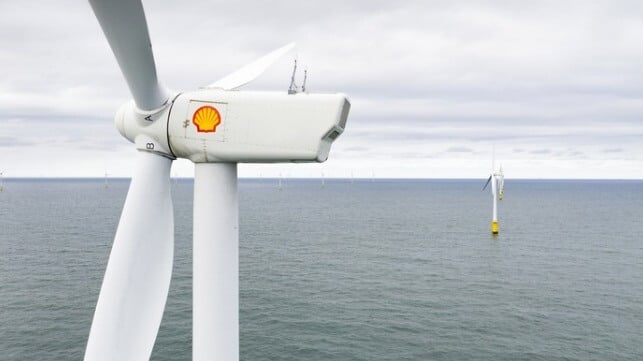
Shell offshore wind farm
The corporate PPA will permit Shell to invest in a life extension for the Dutch wind farm (Shell)

Published May 6, 2025 3:58 PM by The Maritime Executive


Google, which is expanding its use of renewable power for its operations, is reporting that its latest power agreement will be the first time a corporate power purchase agreement has extended the lifespan of an offshore wind farm. Google has entered into a power purchase agreement with Shell for the nearly 20-year-old Egmond aan Zee offshore wind farm taking up 100 percent of the site’s 108 MW capacity.

Egmond aan Zee was built as part of the NoordzeeWind joint venture with Vattenfall with Shell controlling a 50 percent share. The wind farm located approximately six miles from the coast began production in 2007 becoming the first large-scale commercial offshore wind farm to be built in the Dutch North Sea. Shell acquired full ownership of the wind farm in 2021.

Google’s newest power purchase agreement for the site will permit Shell to extend the lifespan of the offshore wind farm by at least four years beyond its original decommissioning date. According to Google, it permit enabled Shell to pursue permit extensions and invest in crucial upgrades.

Shell NoordzeeWind will be the first offshore wind farm to undergo a life extension in the Netherlands. Google says that it believes it is also the first that faced decommissioning and permit expirations, but will be extended through the corporate PPA.

To date, Google reports it has supported over 1 gigawatt of clean energy generation capacity in the Netherlands through PPAs. This investment in offshore wind reflects Google’s broader commitment to employ renewable energy. It hopes this effort will inspire similar partnerships giving new life to clean energy assets facing retirement.

At the beginning of 2024, Goggle reported adding over 700 MW of renewable energy agreements in Europe, including in Belgium, the Netherlands, Italy, and Poland.  This included agreements with Shell and with Eneco, owners of the Crosswind & Ecowende joint ventures. Google said it would support 478 megawatts of carbon-free energy capacity with two new-to-the-grid offshore wind farms: HKN V and HKW VI.

Google last month also signed its first power purchase agreement for offshore wind energy in Taiwan and the Asia Pacific region. Google has committed to purchase renewable energy from the Fengmiao I offshore wind project being developed by Copenhagen Infrastructure Partners and due to begin generation in 2027. 


North Star Delivery of 1st CSOV, the Grampian Kestrel, with Naming Ceremony
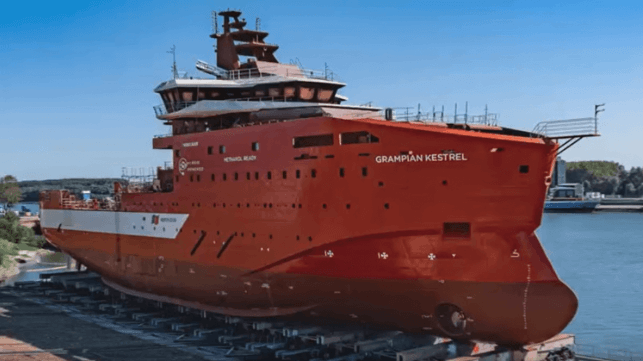
North Star

Published May 6, 2025 3:30 PM by The Maritime Executive


[By: North Star]

North Star has officially named its first commissioning service operation vessel (CSOV), the Grampian Kestrel. The vessel was named at a ceremony at VARD’s shipyard in Tomrefjord, Norway, Vard Langsten on Tuesday 6 May.

This milestone event reflects the organisation’s ongoing commitment to the delivery of high-quality offshore support vessels for the renewables sector. The Grampian Kestrel is the first of two CSOVs to be delivered this year, as part of the firm’s drive to support its growing portfolio of offshore wind clients with cutting-edge tonnage and exceptional service.

The new vessel, of VARD 4 22 design, will go on service with EnBW and precede the decade-long minimum charter contract the firm signed in 2024 to provide a SOV (of VARD 407 design) for the German energy utility firm’s He Dreiht wind farm in the North Sea.

A high specification vessel, the Grampian Kestrel has the ability to support all aspects of the wind farm’s life cycle, offering essential accommodation and logistics to support construction and commissioning works. Following this, it will lead EnBW’s operations and maintenance activities until the newbuild SOV is delivered in Q3 2026. 

The VARD 4 22 design, has been developed in close collaboration with Vard Design in Ålesund, Norway, with new methanol ready hybrid-propulsion solutions and an increased number of single cabins, providing hotel quality accommodation for the technicians working in field. It also includes a high-performance daughter craft with space for a second to suit the clients’ operational needs.

“The Grampian Kestrel marks yet another milestone in our strategy towards making North Star a leading SOV provider in Europe,” said Gitte Gard Talmo, CEO at North Star.

“The vessel is built to service all aspects of an offshore windfarms’ lifecycle and has a competent North Star crew to ensure we deliver our services to the highest standard. 

"We are proud to christen this future-ready vessel, which sets a new industry benchmark by becoming the world’s first to achieve Lloyd’s Register’s Cyber Resilience classification. This certification underscores our commitment to being a safe and reliable partner - for our employees, our clients, and the broader offshore wind industry.”

James Bradford, chief technology officer at North Star explained: “As part of its digital capabilities, North Star has made a substantial investment in the advanced automation and innovative solutions utilised across its renewables fleet, essential for monitoring performance and ensuring safe vessel operations.

“This included technologies such as digital twins, dynamic positioning software and the complex control systems connected to the Voith Schneider propulsion units, all designed to support operational safety and enhance crew wellbeing.”

Ms Gard Talmo added “This vessel and her world first accreditation were achieved in cooperation with VARD ship design. At North Star we know that industry collaboration is the key to success, and we truly look forward to delivering our services to our client, EnBW.”

Over the past three years, North Star has invested £270m in its commitment to build 40 offshore wind vessels by 2040. North Star’s offshore wind fleet now comprises eight vessels, including both delivered and in-build assets. The shipping firm has also placed 160 experienced seafarers to support its SOV fleet and will recruit a further 160 seafarers in the next three years to meet current contract charter commitments.  

The Grampian Kestrel’s naming ceremony was attended by representatives from North Star, VARD, EnBW and other key stakeholders and was a celebration of the successful partnership between all parties involved and a recognition of the hard work that went into bringing the asset to life.

During the event, the godmother for the vessel was announced as Indu Vaidya, a board member at North Star and a Member of Management at Partners Group, one of the largest firms in the global private markets industry, acting on behalf of its clients. Investment from Partners Group has played a key role in North Star’s growth, with the firm implementing a transformational value creation plan to expand North Star's platform in Europe, grow its offshore wind fleet, and broaden its offering in renewables. Indu played a key role in the naming ceremony which also featured a local blessing.

VARD CEO, Cathrine K. Marti, added: “On behalf of everyone at VARD, I would like to congratulate North Star on their new cutting-edge vessel. Grampian Kestrel is a purpose-built CSOV, designed by North Star to meet North Star’s specific strategy and the demands of the offshore wind market.

“She is built for efficiency, comfort, and flexibility — and she is future-ready from day one. 

“With key contributions from Vard Electro and Vard Interiors, this vessel reflects the strength of our integrated approach and our long-standing partnership with North Star. Congratulations once again. We wish Grampian Kestrel and her crew fair winds and following seas.”

The products and services herein described in this press release are not endorsed by The Maritime Executive.


DEME Completes Acquisition of Havfram to Expand Position for Offshore Wind
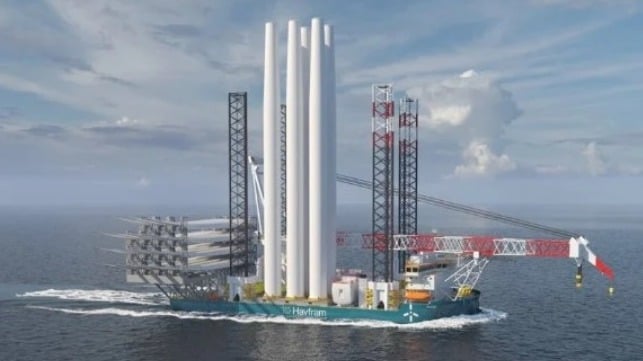
offshore wind installation vessel
Havfram is building two hybrid, state-of-the-art, large installation vessels which will be integrated into DEME's fleet (Havfram)

Published May 2, 2025 8:23 PM by The Maritime Executive


Belgium’s DEME Group which is an established leader for installations of offshore wind energy reported that it has completed the acquisition of Norway-based Havfram. The agreement to acquire the company was announced in April with DEME highlighting that it would expand its footprint in the offshore wind energy market and enhance its positioning in turbine and foundation installations.

Offshore wind energy is a fast-growing portion of DEME’s business with the company highlighting to investors in the first quarter that offshore wind and offshore energy accounted for approximately €2 billion of its revenues in 2024 or nearly half the group’s total revenues of €4.1 billion. It started in offshore wind in 2000 and says it has completed over 350 projects including for foundations, cables, turbine installation, and rock placement. It reported 37 percent growth in revenues from wind energy projects, having more than doubled in two years and a backlog of approximately €4.3 billion at the end of 2024. It however is one part of a group that has more than 100 vessels and is also active in environmental remediation, dredging, and marine infrastructure.

DEME called the acquisition of Havfram strategic citing 90 percent utilization of its assets for offshore wind energy in 2024. It is contracted to support some of the highest-profile projects both in Europe and North America, including Dominion Energy’s Coastal Virginia Wind Farm.

“DEME’s investment in Havfram underscores our unwavering belief in the immense potential of offshore wind infrastructure as a key element in the global energy transition,” said Luc Vandenbulcke, CEO of DEME on April 9 announcing the agreement. “This acquisition complements our fleet and will bolster our competitive edge in both turbine and foundation installations, enhancing our operational flexibility and interchangeability, and strengthening DEME's leadership position in the industry.”

The acquisition represented an aggregated transaction value of approximately €900 million, including the share purchase and the remaining capital expenditures needed to complete the construction of two installation vessels Havfram has on order in China. The shares were acquired from Sandbrook Capital, a private investment firm focused on climate infrastructure, and the Public Sector Pension Investment Board (PSP Investments), one of Canada’s largest pension investors.

Havfram announced in 2021 an agreement with J.P. Morgan to fund its expansion and the order of installation vessels.  Two vessels were ordered from China’s CIMC Raffles using the GustoMSC NG20000X Jack-Up vessel design. The ships are reported to incorporate the latest battery hybrid drive train technology. Detailing the designs, Havfram had said the vessels would have the capability of installing offshore wind turbines with a rotor diameter of more than 300 meters, as well as XXL monopiles weighing up to 3,000 tons at water depths of up to 70 meters. Capacities were optimized for high variable deck load and the extreme lift heights expected over the next decade. The crane would have a lifting capacity of 3,250 tons.

DEME said that Havfram's state-of-the-art vessels would be seamlessly integrated with DEME's existing fleet. They are due for delivery in the fourth quarter of this year and early in 2026 with Havfram reporting it had already booked approximately €600 million in assignments between 2026 and 2030. Havfram in 2023 said it had options for two additional vessels. It had also expored building a vessel for the U.S. offshore market.

Havfram will be integrated into DEME’s Offshore Energy segment under the DEME brand. It plans to continue operations from Havfram’s current offices in Oslo, Norway. It said there would be no disruption to project planning for the Havfram’s assignments.

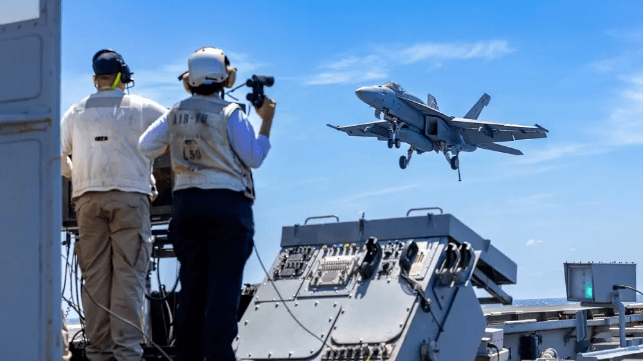
 

Carrier USS Truman Loses Another F/A-18 Fighter in Red Sea

A fighter comes in for a landing aboard USS Harry S. Truman, 2024 (USN file image)

Published May 7, 2025 3:02 PM by The Maritime Executive


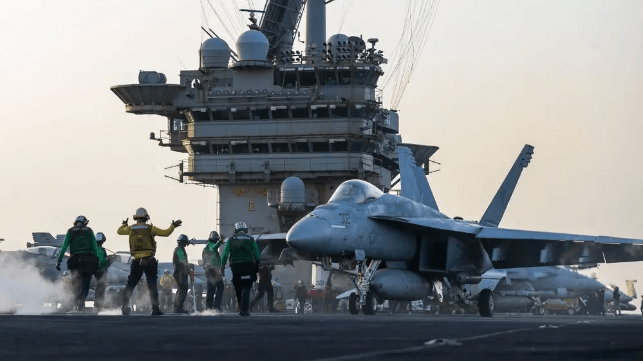
On Tuesday, the same day that the White House announced a truce with Yemen's Houthi rebels, another F/A-18 fighter went over the side of the carrier USS Harry S. Truman in the Red Sea. It is the second lost overboard and the third lost overall since the supercarrier deployed to waters off Yemen. 

The fighter came in for a landing and touched down, but the arresting cable system failed and the aircraft went over the side, an unnamed official told CNN and AP. Two pilots ejected successfully, and they were rescued by one of the carrier's helicopters. They sustained minor injuries but survived. No injuries were reported aboard the carrier. The Navy has not officially confirmed the accident, and it was not immediately clear whether it occurred before or after President Donald Trump's announcement of a ceasefire in the Red Sea on Tuesday. 

Last month, an F/A-18 fighter rolled over the side from Truman's hangar deck elevator while it was being moved, along with the tractor that was towing it. Truman was turning hard to avoid an incoming Houthi threat, and the sudden maneuver was enough to send the unsecured aircraft overboard. One crewmember sustained slight injuries but none were killed or pulled over the side in the incident. 

In December, one of Truman's escorts - the cruiser USS Gettysburg - accidentally shot down one of the carrier's F/A-18 fighters with an anti-aircraft missile. The friendly fire mishap occurred after an engagement with inbound Houthi drones and missiles, and Gettysburg appears to have mistaken the airborne fighter for a threat. 

Truman and USS Carl Vinson were engaged in "round-the-clock" operations against Houthi targets from March 15 through May 6, when the campaign ended with a ceasefire that the White House described as a "capitulation." Truman has had her deployment extended twice, and was scheduled to head home at last sometime next week. 

The Navy often acts to recover the wreckage of intact fighter aircraft from the bottom after a mishap in order to prevent foreign intelligence-gathering efforts. Wreck recovery efforts in the contested waterway have not yet been announced; if the ceasefire holds, the unarmed subsea construction vessels that are often used for these deepwater salvage projects could access the area without risk of Houthi attack. 

Houthis' Fight With Israel Could Mean Continued Risks for Shipping

Houthi attack drone over the Red Sea (Marine Nationale file image)

Published May 7, 2025 8:50 PM by The Maritime Executive

 
Yemen's Houthi rebels have begun to clarify their version of the Red Sea truce agreement announced by the White House, and it appears that international shipping may still face risks on the waterway. 

On Tuesday, President Donald Trump announced that the Houthis had "capitulated" after an extended U.S.-Israeli bombing campaign. The group agreed to stop attacking U.S. shipping, Trump said, and U.S. forces would immediately stop bombing sites in Yemen. 

After Trump's statement, official Houthi media channels announced that the group would continue to attack Israel in retaliation for the ongoing military operations in Gaza. On Wednesday, Houthi spokesman Mohammed Abdulsalam emphasized that the new agreement with the White House did not affect the group's hostilities with Israel in "any way, shape or form." 

If the Houthis' plans to attack Israel also extend to Israeli shipping, the new ceasefire may not reduce risk for foreign-flag commercial traffic. The Houthis have previously attacked vessels with documented links to Israel, but they have used the same justification to attack vessels with no clear Israeli ties - and even vessels that have clear ties to Houthi allies. If this targeting pattern continues, neutral vessels could be targeted as "Israeli ships," whether by accident or by intent. 

Given the uncertainty, leading ocean carriers have suggested that they will wait some months after hostilities end before returning their ships to the Red Sea at scale, in part because of the cost and disruption of adjusting global networks to a different route. It would be expensive to change from the Cape of Good Hope route to Suez, then change back to the Cape route again if the Houthis began targeting foreign-flag merchant ships once more. 

Analysts agree that when container shipping does return to the shorter Red Sea route, the global ocean freight market will return to a familiar pattern - overcapacity and thin margins. 

"The one element of the container shipping market that affects freight rates the most . . . may be nearing an end. But, let's see if this is really happening," said Xeneta lead analyst Peter Sand in a social media post. "If transiting the Red Sea to its full extent is once again safe . . . the balance of the market will once again shift. From its current tightness to one where overcapacity will depress freight rates."

U.S. Suspends Bombing After New "Ceasefire" With Houthis

Flight crew on the deck of USS Harry S. Truman in the Red Sea, 2025 (USN)

Published May 6, 2025 5:21 PM by The Maritime Executive


The Trump administration has decided to implement a mutual ceasefire with Yemen's Houthi rebels, President Donald Trump announced in a press conference Tuesday. He said that U.S. bombing runs over Yemen would cease "effective immediately," and that he would take the Houthis "at their word" that they would cease attacking American shipping. 

According to the Sultanate of Oman, which brokered the reported agreement, "neither side will target the other, including American vessels, in the Red Sea and Bab al-Mandab Strait, ensuring freedom of navigation and the smooth flow of international commercial shipping." 

This appears to return relations between the Houthis and the U.S. to the state that existed in January, when a U.S.-brokered ceasefire in Gaza prompted the Houthi leadership to halt attacks on most shipping.

The Israeli government was not informed of the U.S.-Houthi detente ahead of Trump's announcement, according to The Jerusalem Post's Amichai Stein.

After Trump's statement, official Houthi outlets pledged to continue missile attacks on Israeli territory. 

It remains unclear whether the new ceasefire also ensures the safety of non-American shipping in the Red Sea, including Israeli-linked shipping. A State Department spokesperson declined to clarify, and referred reporters back to the president's remarks.

Mohammed Ali al Houthi, one member of the Houthi leadership council, has cast doubt on whether the arrangement is final. In a statement on X, he said that the group would evaluate an American proposal "on the ground" before making any formal agreements. Trump described the arrangement not as a deal, but a "capitulation" - a Houthi proposal to give up attacks on shipping in exchange for an end to U.S. bombing. 

The effects of combined U.S. and Israeli airstrikes would have given the Houthi leadership a powerful incentive to reach a compromise agreement. American forces have hit Houthi command posts and weapons sites "around the clock" since March 15, and two carriers have been deployed in the Red Sea to ensure a high tempo of bombing runs. Since last weekend, Israeli forces have launched mass attacks on dual-use targets in Houthi areas, destroying the airport in the group's capital of Sana'a, the seaport at Hodeidah and several cement factories. The ceasefire announcement followed just hours after the latest Israeli raid. 

Possible guidance improvements in the Houthis' Iranian-supplied missile inventory may also have made the group more dangerous to U.S. military assets in recent weeks. Satellite imagery suggests that at least one U.S. Navy carrier off Yemen was forced to make unusual high-speed evasive maneuvers in late April, and the Navy has confirmed the loss of an F/A-18 strike fighter over the side of USS Harry S. Truman during a hard turn; the crew got out of the way before it went over, but one crewmember was injured. 

After the ceasefire announcement, analysts' attention has quickly turned to the Houthis' Iranian sponsors - and the question of whether the truce would be durable. 

"If this sticks, the Houthis and Iran will use the quiet to rebuild Houthi capabilities in Yemen and try to create the illusion that Tehran is de-escalating amid U.S.-Iran talks when it's a tactical pause to survive," said United Against a Nuclear Iran's Jason Brodsky. "Recall after Israel struck Iranian soil last year, the regime pushed Hezbollah into a ceasefire to not only buy quiet to rearm, but to avoid further damage to Iranian interests."


Upgraded Houthi Missiles Pose a Problem for Shipping

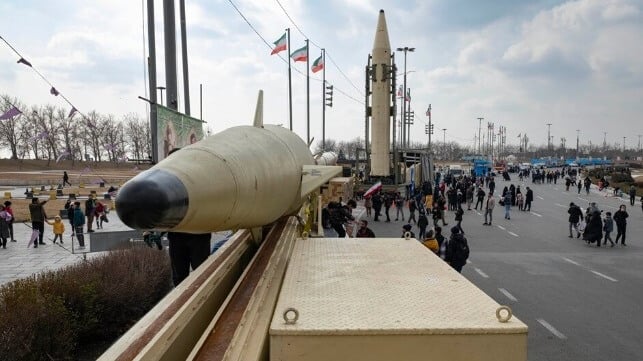
Iranian ballistic missiles on display, Tehran, February 2025 (Photo by Morteza Nikoubazl / NurPhoto via AP)

Published May 6, 2025 2:48 PM by The Maritime Executive


The successful penetration of Israeli air defenses, as occurred when a Houthi missile hit an empty space within the grounds of Tel Aviv airport, would not normally merit a mention in the annals of the Maritime Executive. In this instance, however, it is emerging from the May 4 attack that the Houthis have a capability which could threaten both ports and ships at sea.

This may explain why the carrier USS Harry S. Truman (CVN-75) has been seen performing vigorous evasive maneuvers in the Red Sea, one of which is likely on April 28 to have caused the loss overboard of an F/A-18 being deck-handled.

What the Houthis described as a Palestine-2 missile impacted on waste ground within Ben Gurion International Airport, landing within 500 yards of the Terminal 3 building and injuring a number of people in the adjacent car park. Attempts to shoot down the incoming missile using both US THAAD batteries and Israel’s Arrow-2/3 systems both failed, although Israel claimed the missile type was not new, had been shot down before, and that technical faults had affected both interceptor systems.

In reality, the likelihood of simultaneous faults occurring on two separate interceptor systems is low. This apparent heightened threat, plus the proximity of the impact point to a busy airport terminal building, provoked an unusually angry Israeli government response.

On the evening of May 5, after a pause of many months, Israel launched the first wave of an attack using 20 aircraft, firing 50 missiles at military and infrastructure targets in Yemen, including what was left of the port at Hodeida and Yemen’s largest cement factory at Bajil.

On May 6, attacks at the same scale continued, with Sana’a International Airport comprehensively targeted. Israel’s Arabic language spokesman tweeted out a warning to civilians to clear the airport area an hour before impact. Several power stations in Sana’a were also struck, as was a second cement factory in Amran.

The apparently improved performance of the Houthi missile may potentially be connected to the unveiling by Iranian Defense Minister Brigadier General Aziz Nasirzadeh of an improved warhead to their Haj Qasem medium-range solid fuel missile. The separating warhead appears to be independently maneuverable, and its rounded nose, apparent in imagery of a test flight, supports claims by the Brigadier that it has a non-emitting homing system immune to jamming, probably using an electro-optical sensor to compare the image gathered passively with pre-loaded satellite imagery of the target.

The Iranians are claiming to be back-fitting this new warhead to their existing silo-based Haj Qasem fleet, calling the upgraded missile the Qasem Basir. But the warhead is small enough to have been shipped into Yemen as an assembly, for the Houthis to integrate onto their own versions of the Haji Qasem.

In recent days, US Defense Secretary Pete Hegseth has said that Iran has indeed been spotted shipping weaponry to the Houthis. The Houthis could do so for example by using Iranian cargo ships equipped with deck davit cranes to offload cargoes at remote ports on the Hodeida coastline; such a ship, the MV Elyana (IMO: 9165827), made a northerly passage up the Red Sea at the end of April, and is currently en route to Benghazi.

The electro-optic target acquisition system in the Iranian missile warhead is best suited to static targets with distinctive layouts such as airports. Hence the Houthi threats in the wake of the Ben Gurion attack to target airports in the future as part of an ‘air blockade’ of Israel, and also Iranian threats to hit airfields in GCC states which support American operations.

Ports also make distinctive targets for this relatively unsophisticated homing system. A harder task for such an acquisition system would be to target an aircraft carrier - but the Houthis appear in recent days to have been attempting to use their new capability for just this very purpose.

If precedent is followed, the Houthis will attempt another missile attack shortly, to demonstrate that they retain offensive intent, despite the Israeli air attacks. Senior Houthi figures continued to issue threats after the second wave of airstrikes.


Port Sudan Hit by Wave of Attacks in Three-Year-Old Civil War

Port Sudan
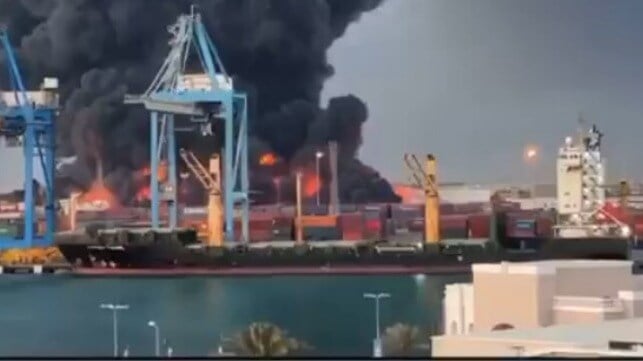
Fires burning after the early morning drone attack on Port Sudan

Published May 6, 2025 12:07 PM by The Maritime Executive


Sudan’s primary port and the de facto capital of the country came under attack for the first time in the three-year-old civil war. Sudan’s paramilitary Rapid Support Forces (RSF) have launched a new wave of attacks which expanded today to target and damage key parts of the port.

Media reports cited a loud explosion early Tuesday morning coming for the port area in Port Sudan followed by pictures of large plumes of smoke. The attacks were reportedly launched by drones and marked the first time Port Sudan has been directly targeted in the new wave of violence.

The fuel storage area in the port was reported to be burning. Pictures released by the Sudan News also showed areas of the container port on fire. Several ships appeared to be docked in the port.


The news reports said it was part of a larger wave of attacks with the city’s commercial airport also hit. An army base was also reportedly targeted.

Civilian teams were working to control the fires, but it is unclear if there have been causalities or deaths from today’s attack. The Sunday News reported marine activities resumed in the port later in the day.


Port Sudan is a critical point for the country and its population which is reported to be facing starvation. Most of the humanitarian aid entered the country passes through Port Sudan. It is the main cargo handling facility both for dry bulk and nearly one million containers annually. The government supported by the army also fled into Port Sudan after losing the country’s capital Khartoum and much of the east of the country to the RSF forces.

The latest wave of attacks started on Sunday when the RSF forces launched a drone attack on a military base outside the city limits. On Monday they also launched attacks on the country’s main fuel storage depot south of the city.

UN officials on Monday called the latest escalation a “worrying development,” saying it would threaten humanitarian efforts. The UN has estimated that nearly nine million people are displaced in the country with many having fled to the relative calm around Port Sudan. 


Well Intervention Contractor Brings Louisiana Spill Under Control

Contractors prepare to cut off the leaking wellhead at the flange (USCG)

Published May 4, 2025 8:07 PM by The Maritime Executive


A spewing wellhead at an abandoned oilfield in the Mississippi Delta has been successfully sealed after a week of effort, according to the U.S. Coast Guard.  

On Sunday, a well intervention team working for Couvillion Group - on contract for the Coast Guard - cut the flange on the discharging wellhead, then installed a flowback assembly to gain control of the source and shut off the leak. The abandoned well had been spraying a mist of oil and gas into the air in a marsh near Pass a Loutre since April 26, releasing an unknown quantity of petroleum into the environment. 

Oil spills are common in Louisiana, but this was on the larger side. So far, the response team has recovered 70,000 gallons of oily water mixture from the site. To keep the pollution from spreading, more than 20,000 feet of standard containment boom has been rolled out to encircle the wellhead and the work site. Cleanup and damage assessment efforts continue, according to the Coast Guard. 

“Gaining control of the discharge is a vital milestone, but it marks only the beginning of our work. The Unified Command is fully committed to an exhaustive cleanup effort and will remain on site for as long as necessary to ensure the removal of oil and the safety of both the community and the ecosystem,” said Capt. Greg Callaghan, Federal on Scene Coordinator.

The well was operated by Spectrum OpCo, which is a unit of Houston-based Spectrum Energy, according to NPR. Spectrum OpCo was the responsible party; on Thursday, the Coast Guard decided to federalize the response and tap the Oil Spill Liability Trust Fund to ensure "continuity of operations."

Well 59 was a disused wellhead that had been decommissioned 10 years ago. According to NPR station WWNO, the well dates back to the Second World War and is now 83 years old; the unknown condition of the well below the surface complicated the response effort, WWNO reported. 


Three Dead, Seven Missing in Capsizing off San Diego

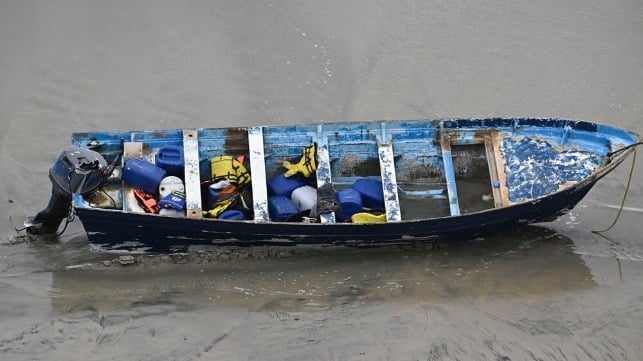
A boat that capsized sits on the beach Monday, May 5, 2025, in at Torrey Pines State beach in San Diego, Calif. (AP Photo/Denis Poroy)
A boat that capsized sits on the beach Monday, May 5, 2025, at Torrey Pines State beach in San Diego, Calif. (AP Photo/Denis Poroy)

Published May 6, 2025 7:47 PM by The Maritime Executive


Three people are dead and seven are missing after a rustic vessel capsized off Del Mar Beach in San Diego, sending the passengers into the water. 

At about 0630 hours on Monday morning, Coast Guard Sector San Diego received an alert from local first responders that a panga-style vessel had overturned off Del Mar Beach. Pangas are small, rustic wooden vessels used for fishing in Mexico, and are often encountered in drug-smuggling and human trafficking cases. 

At least 16 people had been aboard the boat. Three individuals were found dead at the scene, and four more were injured. Good Samaritans walking on the beach were first to the scene and administered CPR, according to the local fire department. 

From the accounts of the survivors, the first responders determined that about seven more people were missing and possibly lost at sea. Initially the number was believed to be as high as nine people, but two individuals were found on land and detained, leaving seven missing. 

Sector San Diego launched a Jayhawk helicopter, a response boat and a C-27 Spartan aircraft to conduct a search. The combined assets covered more than 500 square nautical miles over the span of 28 hours. 

On Monday night, the Coast Guard suspended its search operation pending further developments. 

The occupants of the boat were likely to be migrants, Coast Guard Petty Officer Chris Sappey told media, though stressing that their status was not confirmed. "They were not tourists," he told AP. 


Indonesian Ferry Sinking Claims Lives of Two Crewmembers

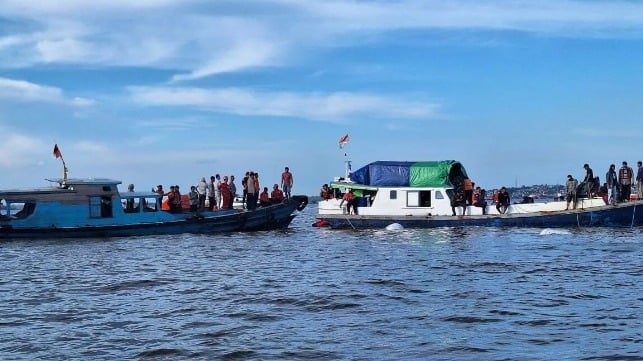
Good Samaritans and first responders at the site of the sinking, May 5 (Indonesian National Police)

Published May 6, 2025 9:55 PM by The Maritime Executive


On Monday, an Indonesian car ferry sank off East Kalimantan, claiming the lives of two crewmembers.

At about 1500 hours, the ferry Muchlisa was under way on a short voyage from Balikpapan to Penajam and approaching its destination when the port engine failed. The crew discovered that the vessel's propeller shaft had broken, resulting in hull damage, and it was taking on water. Attempts at an emergency patch repair were not successful.

Muchlisa contacted another nearby ferry and requested help in intentionally grounding the vessel to prevent it from fully sinking. The Muchlisa successfully stranded on a sandbar, but later drifted free and sank about 600 feet offshore, according to local media. Passengers were evacuated, with assistance from first responders. The ferry eventually listed to starboard, capsized and sank.

Police have questioned the crew, including the captain and the helmsman, and an investigation is underway. As is common in Southeast Asian ferry casualties, the precise number of passengers and crewmembers on board was not immediately known, and the official count grew as the response operation went on.

Initially, local authorities believed that there were no casualties, according to Visi News. After assembling a list of 23 passengers and 21 crewmembers who were aboard on the casualty voyage, rescue agency Basarnas identified two missing crewmembers - named as Ilham and Khayu - who may have been trapped in the wreckage. 

Surface search efforts continued Tuesday, and a Basarnas dive team has deployed to the site for a search and recovery mission within the vessel's interior. Both missing individuals were recovered deceased, and the search has been suspended, according to local outlet Beritakaltim. 


62 People Were Injured in Failed Gaza Floating Pier Mission Last Year

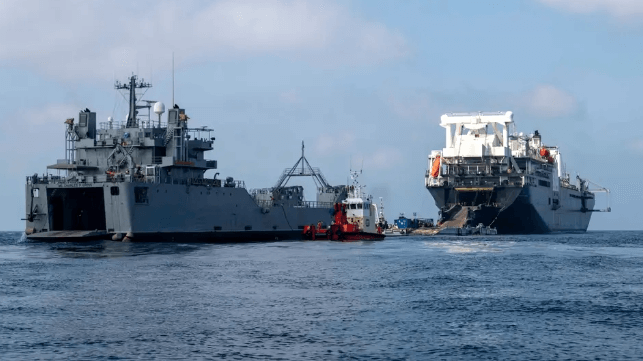
A deep-draft Military Sealift Command ro/ro transloads rolling cargo onto an Army landing craft at a moored transfer platform off Gaza, 2024 (USN)
A deep-draft Military Sealift Command ro/ro transloads rolling cargo onto an Army landing craft at a moored transfer platform off Gaza, 2024 (Department of Defense)

Published May 7, 2025 5:06 PM by The Maritime Executive


Last year's Gaza floating-pier mission was even more fraught than previously reported, according to a new investigation by the Pentagon's independent inspector general's office. In addition to the servicemember who was killed in an accident during cargo operations, 62 people were injured in unspecified incidents, the IG found.

Most of the problems were built into the operation before it got under way. The IG found that the Army and Navy had systematically downsized their joint logistics over the shore (JLOTS) capabilities since 2018, leaving remaining units undermanned and underequipped for the mission. The Army had cut its watercraft division's inventory from 134 vessels down to 64, and the Navy had eliminated one of its two JLOTS units. The surviving units had a low (but undisclosed) mission readiness rate, and had a hard time meeting manning requirements for watercraft. Officials involved in the deployment told the IG after the fact that "the DoD's current JLOTS capabilities were not sufficient to meet projected needs."

In addition, the Army and Navy pontoon systems were different and resulted in damage when used together; they were designed with different amounts of freeboard, and Army boats would ram into and puncture the sides of taller Navy pontoons. After challenges experienced in a previous exercise, the services had concluded that these systems could not be used together - but they were still deployed and combined for the operation off Gaza. 

In the run-up to the deployment, planners also failed to take beach conditions and sea states at the site under consideration - a profound and inexplicable error for this particular system. Certain elements of the JLOTS pier and pontoon system are rated for surface conditions of Sea State 3 or less, equivalent to a gentle breeze and waves of less than four feet. These conditions could be expected in a sheltered bay or harbor, but the operating site was on an exposed beachhead facing the sea. One bout of rough weather tore the pier structure apart and scattered pontoon sections along the beachfront, and after this experience, the operating units were forced to remove and withdraw the structure to the shelter of a nearby port whenever the forecast called for higher waves.

Taken together, these challenges severely limited the mission's ability to deliver food; ultimately, the JLOTS system was in working service for just 23 days, and it shipped just 8,100 tonnes of food and other aid to shore - a small fraction of what one merchant ship could have delivered to the Israeli port of Ashdod, just 25 miles northeast.

The IG called for the Navy and the Army to go over their respective JLOTS units and determine how to bring them up to mission-capable levels. 

The mission's failure did not go unnoticed. In designing its own over-the-shore logistics system, the Chinese People's Liberation Army learned from the limitations of floating piers, and it jumped straight to a jack-up system instead. Its newly built landing barges are equipped with tall jack-up legs to get out of the wave action, and they are fitted with extra-long bridging ramps to land troops and vehicles far up the beach. They can be connected end-to-end to form a "causeway" out to deeper water, giving Chinese military logistics vessels a comparatively secure, less weather-dependent landing platform to offload.